Welcome to FMEP’s Weekly Settlement Report, covering everything you need to know about Israeli settlement activity this week.
To subscribe to this report, please click here.
September 9, 2022
- Israel Advances Givat HaShaked Settlement Plan in East Jerusalem
- Israel Delays (for now) Consideration of E-1 Settlement
- Israel Planning to “Legalize” 30+ Shepherding Outposts in Massive Land Grab
- Israel to Request Another Delay in Demolition of Khan al-Ahmar
- IDF Issues Orders to Keep Settlers Out of Ramat Migron Outpost Area
- IDF Removes Amichai Settlement Tower
- Yesha Council Elects New Leader
- Settlement Schools are Flourishing
- Bonus Reads
Israel Advances Givat HaShaked Settlement Plan in East Jerusalem
On September 5th, the Jerusalem District Planning Committee advanced plans to build a new settlement in East Jerusalem, to be called “Givat HaShaked.” The plan provides for 700 housing units (in 4 highrise towers and several six-story buildings), a school, and commercial buildings –all to be built on a highly sensitive and geopolitically critical sliver of land located within the Palestinian neighborhood of Beit Safafa. The plan was approved for public deposit, an advanced stage in the Israeli planning process. The plan for Givat HaShaked is unprecedented, according to the Israeli NGO Terrestrial Jerusalem, in that it is the first settlement of this size that that Israeli government will establish within a Palestinian neighborhood. Beit Safafa is already in the process of being completely surrounded by Israeli development (for Jewish Israelis) — most notably with final approval of the Givat Hamatos settlement plan, for which tenders were issued in January 2021.

The Israeli NGO Ir Amim also points out that, while the government goes to great lengths to find a way to squeeze in several high rise towers to house Israelis in East Jerusalem, there is no parallel effort to address the decades-long lack of planning and approvals for Palestinian communities. Ir Amim writes:
“Givat HaShaked is also a flagrant example of the breadth and depth of housing and planning discrimination in the city. While Givat HaShaked is intended for land located along the built-up area of Sharafat, it is not designated for the community’s development needs, but rather a new housing project for Israelis over the Green Line in Jerusalem. Construction of this new settlement will likewise stand in stark contrast to the existing Palestinian neighborhood, dwarfing and engulfing Sharafat with high-rise apartment buildings – the likes of which Israeli authorities refuse to promote or approve for Palestinian areas. In a similar fashion, the remaining land reserves on the eastern side of Beit Safafa, which could have been used to address the neighborhood’s housing needs, were depleted to advance construction of the Israeli settlement of Givat Hamatos.”
Interior Minister Ayelet Shaked celebrated the advancement, telling Arutz Sheva:
“As I promised, despite all the pressures from at home and abroad, the Givat Hashaked plan was approved today by the district committee. This plan is located in the heart of Jerusalem and is unthinkable to prevent development and construction in this area as well as all over the city. This is an important plan that will lead to an increase in the supply of housing units, employment areas and public buildings for the well-being of the residents.”
As a reminder, the Israeli government has been sitting on plans for Givat HaShaked for decades, but has refrained from implementing them because doing so would require the government to seize a sizeable amount of land in East Jerusalem, some of which is privately owned by Palestinian residents of Sharafat (a section of the Palestinian neighborhood of Beit Safafa). Other parts of the land proposed to be used for the Givat HaShaked settlement plan are managed by the Israeli General Custodian (but neither owned or claimed by the government of Israel) – a fact Ir Amim calls “highly unusual and seemingly marks a new phenomenon.” The Israeli General Custodian is empowered by the State to act as a caretaker of land that has unknown ownership until the heirs are located. In an attempt to explain why the General Custodian has the authority to approve a plan for construction on land that the State does not own, the Israeli Justice Ministry told Haaretz that the plan for Givat HaShaked increased the value of the land and that “by law, the administrator general is obligated to care for the assets under his management in a way that will benefit their private owners.” This answer implies, bizarrely, that if and when Palestinian heirs are located, they will be somehow better off with their land having been used to build a settlement.
Another important facet of how Givat HaShaked is being advanced now is the decision by the Israeli government in late 2020 to initiate a (typically secret) registration process for land in East Jerusalem, including in the Sharafat area. At this time, it is unknown whether the land managed by the General Custodian in Sharafat (and designated for the new settlement) has been – or is in the process of being – registered. On that uncertainty, Ir Amim writes:
“…in the event that it is the same location [where formal land registration has taken place], this move would constitute yet another brazen example of how the settlement of title procedures are repeatedly being used to aid state authorities and settler groups in taking over more land in East Jerusalem…Although portrayed as a measure to ostensibly benefit Palestinian residents, there has been grave alarm that these [land registration and settlement of title] procedures would in fact be exploited to confiscate Palestinian land for political purposes, leading to the expansion of Jewish settlement and widespread Palestinian dispossession in the city.”
For a deep dive into land registration in East Jerusalem, please listen to a new FMEP podcast featuring Kristin McCarthy (FMEP) in conversation with Amy Cohen (Ir Amim).
Israel Delays (for now) Consideration of E-1 Settlement
The Israeli Higher Planning Committee of the Civil Administration has again delayed its consideration of the E-1 settlement plan, which was scheduled to be taken up at the Committee’s September 12th meeting. The E-1 settlement is considered a “doomsday” settlement for much of the international community that still hopes to negotiate a two state solution. This same committee was previously scheduled to take up the E-1 plan on July 18th – days after U.S. President Joe Biden’s visit to Jerusalem. The Israeli government intervened to postpone the meeting, rescheduling it for September 12th – the hearing that has now also been delayed.
Peace Now said in response:
“This is welcome news, but we wish to see E1 taken off the table completely. E1 is lethal to the two-state solution, highly detrimental to Palestinian freedom of movement and to connection between different parts of the future Palestinian state. The Israeli government, and in particular Minister of Defense Benny Gantz (in whose jurisdiction these decisions lie), must take the plan off the table completely.”
This repeatedly delayed meeting promises to be a decisive one for the long-pending E-1 plan, and could result in the Committee granting final approval to the highly contentious plan. Barring intensive outside pressure, additional postponement of the hearing seems highly improbable, given the Israeli domestic politics and the upcoming national election.
As a reminder: in its current form, the E-1 plan provides for the construction of 3,412 new settlement units on a site located northeast of Jerusalem. The site is home to several Palestinian bedouin communities, including Khan al-Ahmar, which Israel has already undertaken to forcibly displace (many attempts). Long called a “doomsday” settlement by supporters of a two-state solution, construction of the E-1 settlement would sever East Jerusalem from its West Bank hinterland, preventing East Jerusalem from ever functioning as a viable Palestinian capital. It would also cut the West Bank effectively in half, isolating the northern West Bank from the southern West Bank and foreclosing the possibility of the establishment of a Palestinian state with territorial contiguity.
Israel’s “answer” to the latter criticism has long been to argue that Palestinians don’t need territorial contiguity, and that new roads can instead provide “transportational continuity.” To this end, Israel has already built the so-called “Sovereignty Road” – a sealed road that enables Palestinians to pass through, but not to enter, the E-1 area. That road is wholly under Israel’s control (meaning Israel can cut off Palestinian passage through it at any time). In January 2021, then-Prime Minister Netanyahu promised to increase funding for the “Sovereignty Road” as part of the drive to get E-1 built.
And another reminder: there have been attempts to promote the E-1 plan since the early 1990s, but due to wall-to-wall international opposition, the plan was not advanced until 2012, when Netaynuahu ordered it to be approved for deposit for public review (a key step in the approval process), ostensibly as payback for the Palestinians seeking recognition at the United Nations. Following an outcry from the international community, the plan again went into a sort of dormancy, only to be put back on the agenda by Netanyahu in February 2020, when he was facing his third round of elections in the two years. Also, as a reminder: under the Trump Plan (which the Biden Administration has yet to comment on), the area where E-1 is located is slated to become part of Israel.
Israel Planning to “Legalize” 30+ Shepherding Outposts in Massive Land Grab
Haaretz reports that the Israeli Civil Administration is in the midst of a years-long process of drafting new protocols that will allow the State to “legalize” settlers’ claims to huge areas of the West Bank (mainly in Area C) that settlers have de facto seized through illegal shepherding activities (grazing settler-owned flocks of sheep, etc on the land). The Civil Administration is working to “legalize” this land theft in areas where the land in question is categorized by Israel as “State land.”
The phenomenon of “shepherding outposts” has been extensively documented by the Israeli NGO Kerem Navot, which has identified it as currently the “most significant mechanism for dispossessing Palestinian communities” in the West Bank. According to Kerem Navot’s May 2022 report, entitled “Wild Wild West,” settlers have taken control of nearly 7% of Area C of the West Bank (around 60,000 acres) via 77 of these grazing outposts.
The Haaretz Editorial Board – in a piece entitled “Settler Crime Always Pays” – writes:
“Once again, the settlers have proved that Jewish crime in the territories always pays. The Civil Administration began formulating the draft regulation about two years ago, against the background of the increase in the number of these outposts. The proper response to the growing number of farms established illegally would have been to see to their removal and to step up enforcement. Instead, the agency bowed down to the settler masters and seeks to cut the law to fit their vices…It must be hoped that he [Gantz] recognizes that it is a looting mechanism designed to take control of more and more of Area C, to prevent Palestinians from working their land and to reduce their living space.”
As a reminder: Israel has a legal responsibility under international law regarding stewardship of “state land” held under its occupation. As the Association for Civil Rights in Israel explains:
“Israel holds state land in an occupied territory as a trustee, and must do everything possible to preserve and develop it for the benefit of the local Palestinian population. The very use of state land for the purpose of building settlements and/or developing infrastructure and industrial zones not in favor of the Palestinian population constitutes a violation of international law.”
Israel to Request Another Delay in Demolition of Khan al-Ahmar
Facing a September 11th deadline to complete the forcible relocation of the Khan al-Ahmar community from their longtime lands just east of Jerusalem (an act that would constitute a war crime), Israeli Prime Minister Yair Lapid has become just the most recent Israeli premier to ask the Court for an extension. As a reminder, the High Court has ordered the demolition of Khan al-Ahmar, which it declared to be illegally built (i.e., lacking Israeli building permits that are virtually impossible for Palestinians to obtain).
The Israeli High Court imposed a deadline on the State to demolish Khan al Ahmar in response to a petition filed by the right-wing pro-settler group Regavim, which sued the government for failing to carry out the demolition of the community in the wake of the Court’s ruling that the community was built illegally. That demolition order has been pending since 2018. The Court granted several delays to the Netanyahu government, and one to the Bennett government. When granting the government another delay in September 2020, the Court said that it would not be granting any more delays. It then granted several more delays, most recently in July 2021, ostensibly due to Russia’s invasion of Ukraine.
Prior to becoming Prime Minister, Lapid opposed the State’s plan to forcibly relocate Khan al-Ahmar. Reports suggested that the government has been preparing a plan that would entail the demolition of the Khan Al-Ahmar, followed by (bizarrely) the rebuilding of the community some 300 meters from where it currently stands.
IDF Issues Orders to Keep Settlers Out of Ramat Migron Outpost Area
After three weeks of repeatedly demolishing the “Ramat Migron” outpost, only to have settlers rebuild it, the IDF has issued a new order declaring the area a “closed military zone” — apparently in hopes of barring settlers from entering the area. The order is effective for only one month. As a reminder: The IDF already viewed it as illegal for settlers to enter the area (which is why the IDF arrested settlers in the area last week), so it is not clear (at least as of this writing) what is different about this new order.
The IDF informed the settlers of the new order as they were in the process of constructing buildings at the Ramat Migron site. Settlers have already vowed to continue fighting to establish a settlement on the hilltop.
IDF Removes Amichai Settlement Tower
On September 8th, Israeli authorities demolished a tower built by settlers on land that has been allotted to the Amihai settlement, located in the Shiloh Valley in the northern West Bank. Settlers built the tower apparently in order to surveil a nearby Palestinian village where new homes are being built. Settlers have already vowed to rebuild the tower.
The Amichai settlement was approved for construction in 2017, making it at that time the first new settlement formally approved by the Isareli government in 25 years. Aerial imagery from 2021 show the massive growth Amichai has enjoyed in the years that followed its establishment, a previously empty hilltop with cultivated fields nearby have been transformed into a sizable suburban neighborhood. In addition to new construction, Amichai was also massively expanded, subsequent to its initial construction, when the Israeli Civil Administration announced that its plan to retroactively legalize the Adei Ad outpost by significantly expanding the borders of the Amichai settlement to turn Adei Ad into a (non-contiguous) neighborhood. In effect, this was a slight-of-hand by Israel to turn the Adei Ad outpost into an entirely new official, legal settlement.
Yesha Council Elects New Leader
The Yesha Council – an association of heads of settlements and regional council leaders that acts as the settler lobby to the government – has elected a new chair, Shlomo Ne’eman. Ne’eman is set to take over the post from David Elhayani.
Ne’eman has earned his stripes as the chairman of the Gush Etzion Regional Council. Upon his election (he was unopposed), Ne’eman said:
“The first task before us is to strengthen the sovereignty and the Jewish presence in the region. This is the time to unite against those who seek our harm, the Palestinian Authority and other terrorist organizations that fight us with guns and knives, as well as with plows and concrete pumps, and to continue working to develop and strengthen Israeli settlement in Judea, Samaria and the Jordan Valley.”
Settlement Schools are Flourishing
According to a newsletter issued by the Friends of Beit El Settlement (an organization that former Ambassador David Friedman used to chair), as the new school year starts there are 86,000 children living in settlements and enrolled in 270 elementary schools across the West Bank. In addition, the newsletter reports that 35,000 settler students attend ~200 post-elementary schools. Gloating, the newsletter boasts:
“Beautiful numbers like these don’t just happen on their own. We can barely imagine the amount of idealism and effort and self-sacrifice over the course of decades, under severely difficult economic and security conditions, that has gone into the Yesha enterprise.”
Bonus Reads
- “Settlement Org Eyes a New Target, and Israeli Authorities Go Out of Their Way to Help” (Haaretz)
- “IDF preparing to use armed drones in West Bank operations” (The Times of Israel)
- “U.S. Examining Allegations Against Israel’s Orthodox West Bank Battalion” (Haaretz)
Welcome to FMEP’s Weekly Settlement Report, covering everything you need to know about Israeli settlement activity this week.
To subscribe to this report, please click here.
August 25 2022
- Ir Amim Gets Set to Sue Settlers & State Over Plan for Settler-Run Cultural Center in Silwan
- This Week in Area C: Evangelical Group Launches Land-Grab as Demolition Rates for Palestinian Construction Spike
- IDF Prepares to Fortify Settlers’ Access to Joseph’s Tomb in Nablus
- Bonus Reads
Ir Amim Gets Set to Sue Settlers & State Over Plan for Settler-Run Cultural Center in Silwan
Ir Amim announced that, after exhausting every avenue for administrative remedy, it will likely proceed with a civil lawsuit in light of the State’s move last month to proceed with the construction of a “Yemenite Jewish Culture Center” in the Batan al-Hawa section of Silwan, despite two pending legal petitions against the project.
 Last month (July 2022), the Israeli government announced that the Jerusalem District Court had accepted a plan that would allow the project to move forward. That plan would see the building at the center of the dispute to be leased to a new company, which would establish and manage the cultural center. Hatched in secret by senior government officials and a body known as the Benvenisti Trust (which is at the center of the two pending legal petitions), the plan creates the appearance that the Benvenisti Trust is no longer directly involved in the project — but Ir Amim reports that there is reason to believe that this new company is an affiliate or subsidiary of Ateret Cohanim, the settler body that controls the Benvenisti Trust.
As a reminder, the two legal petitions filed by Ir Amim and residents of Batan al-Hawa against the project are:
- A June 2020 petition directly challenging the legitimacy of Ateret Cohanim’s (a settler group) resuscitation and takeover of the Benvenisti Trust – the Jewish endowment fund which allegedly held title to land in Batan al-Hawa in the late 19th century.
- A December 2020 petition challenging the issuance of a tender for the new culture center, pending the resolution of the first petition regarding the relationship between the Benvenisti Trust and Ateret Cohanim.
Ir Amim explains that, in response to the State’s new plan, it has requested an update on its petitions. Describing a letter it recently sent to the the Ministry of Justice (which was supposed to have launched an investigation into the allegations) Ir Amim provided the following update:
“Ir Amim called again for suspension of the project, stating numerous arguments, including the fact that announcement of such an initiative by Ministers Elkin and Sa’ar (the new State Camp Party) during a transitional government constitutes “campaign advertising” and therefore violates election campaign regulations. Moreover, the letter emphasized that leasing the property to “some other organization” for the establishment of a tourist site still violates the trust’s charter and designated purpose of the property, which is for residential use only. In light of the conduct of the trustees’ (i.e. Ateret Cohanim) and state authorities’ to date, there is reason to believe that this purported organization is a subsidiary or affiliate of Ateret Cohanim.
As the letter states, “if this is indeed the case, this is yet further decisive proof that the Benvenisti Trust is clearly being harnessed for the purposes of Ateret Cohanim and its affiliated bodies. This is another layer of a serious conflict of interest in the trustees’ activity to the point of attempting to alter its official goals, which the Registrar of Trusts considered not in accordance with the law and the opinion of the original grantor. It likewise evades the obligation to comply with the grantor’s instructions concerning the trust’s assets through creating a measure to try and underhandedly circumvent these barriers.” As such, Ir Amim demands the complete suspension of the project and an immediate freeze on the state’s allocation of public funds.”
This Week in Area C: Evangelical Group Launches Land-Grab as Demolition Rates for Palestinian Construction Spike
In its monthly report, OCHA reports that the month of June saw a 48% spike in the number of Palestinian-owned structures demolished or seized by Israel. Recall that this spike comes against the backdrop of settlers’ ongoing campaign to push the Israeli government to more expansively and expeditiously destroy Palestinian buildings in Area C. Four of the structures demolished by Israel in June were demolished within 96 hours of their discovery, under an expedited process Israel formulated and implemented, by fiat, via a military order (Military Order 1797).
Meanwhile, Haaretz reports that an American Evangelical Christian group calling itself “Hayovel” has undertaken a tree-planting campaign on privately-owned Palestinian land in Area C. The group, a U.S. 501(c)(3) nonprofit organization whose mission is to support “Israel’s right to exist in their biblical heart”, is charging donors $25 per tree, and has begun planting trees near the Har Bracha settlement in the central West Bank, south of Nablus. According to Dror Etkes – founder of the settlement watchdog group Kerem Navot – over 90% of the land in the area where the trees are being planted is owned by Palestinians from the nearby town of Burin. The land was once richly cultivated by its Palestinian owners, but has been left fallow for years because the Israeli military and settlers have prevented Palestinians from accessing the area. The American group’s stated objective is to plant 3,000 new trees in the West Bank by the end of 2022, and then 20,000 trees every year following.
When asked about the land on which the trees are planted, Hayovel asserted that it was given permission by several Israeli authorities, telling Haaretz:
“We do not own any of the land where we plant trees. We work closely with individual farmers, local Jewish communities, and local municipality governments. Most of the Greening Israel Project forestry sites are located on land owned and controlled by the State of Israel.”
IDF Prepares to Fortify Settlers’ Access to Joseph’s Tomb in Nablus
Arutz Sheva reports that the IDF is preparing to increase its protection for settlers who regularly visit Joseph’s Tomb, located inside the Palestinian city of Nablus, near the Balata refugee camp. Settlers regularly visit the religious site, escorted by the IDF, which regularly results in clashes with Palestinians.
As a reminder, Nablus is located in Area A of the West Bank, where the Oslo Accords afford Israel no jurisdiction. However, the Oslo Accords designated Joseph’s Tomb as one of two holy sites in Area A over which Israel retained control.
A former IDF Major General (Res.) Gadi Shamni, stressed the absurdity of the situation, telling a radio station:
“The entire story of Joseph’s Tomb is one big mistake. This is a huge operation of bringing people, transportation and other events around the prayers…There are parties who earn a lot of money there and there are many political interests. We have to stop endangering soldiers. Every entry into the site causes friction and it’s only a matter of time until a disaster happens there.”
Bonus Reads
- “Jewish extremists accused of slashing tires, graffitiing in Palestinian town” (The Times of Israel)
- [Video] “Palestinians in Masafer Yatta fear displacement” (Middle East Eye)
- “Demolishing our community center won’t destroy our resistance” (+972 Magazine)
- “Editorial | Denying the Green Line” (Haaretz)
Welcome to FMEP’s Weekly Settlement Report, covering everything you need to know about Israeli settlement activity this week.
To subscribe to this report, please click here.
August 11, 2022
- Israel Completes Secret Registration of New Land in East Jerusalem
- Israel Asks Court to Stay Out of Homesh Outpost Case on Promise to Evacuate Settlers (Eventually)
- IDF Removes Settlers from Ramat Migron Outpost
- This Week in Area C: Continued Annexation & Harassment
- Not Just Area C: Settlers Eye Archaeological Site in Area B
- Update: Israeli University Defends Excavation Near Nabi Saleh
- New Analysis of “Silicon Wadi” Project
- Bonus Reads
Israel Completes Secret Registration of New Land in East Jerusalem
Israel Hayom reports that Israel has succeeded in secretly registering State ownership of 16 dunams (four acres) of land in East Jerusalem, opening the possibility for constructing a new settlement enclave there.
The Israeli Justice Ministry secretly completed the acquisition of the land after the Israeli Custodian General hired researchers tasked with finding evidence that the land was purchased by Jews in the 1920s as part of a larger land purchase, though this part of the land was not registered. A court recently accepted new evidence found by the researchers, resulting in the land being placed under the control of the Israeli Custodian of Absentee Property on a temporary basis, while the State searches for the Jewish owners (or their heirs).
The newly-registered land is surrounded by Palestinian neighborhoods, close to the West Bank barrier (which in this location is an actual wall) to the East – with Abu Dis on the far side – and the Palestinian neighborhood of Jabal al-Mukhaber to the west. According to Haaretz, the location is considered one of the most sensitive in East Jerusalem, due to its proximity to the building designated as the future home of the Palestinian parliament and its distance from other Jewish neighborhoods.
This land is south of the area where that has been planned for the settlement called Kidmat Tzion, though this plan has been frozen. In 2017 (during the Trump-Netanyahu era), Ir Amim reported that Kidmat Zion was one of nine Jerusalem area settlements that Israel planned to move forward.
Israel Asks Court to Stay Out of Homesh Outpost Case on Promise to Evacuate Settlers (Eventually)
On August 10th, lawyers representing the Israeli government told the High Court of Justice that it plans to remove settlers from the illegal Homesh outpost site as soon as the Defense Minister sets a date for the evacuation, asking the Court to allow it to delay the evacuation until it finds “the right time from a security standpoint.” This is the second time the State has assured the Court that it will dismantle the outpost without committing to a deadline to enforce Israeli law against the settlers illegally living and studying there.
The Israeli NGO Yesh Din said in response:
“The state continues its foot-dragging and refuses to carry out its legal and moral obligation, which is to evacuate the outpost built illegally on private land belonging to the village of Burqa. The expulsion of Palestinians and the stealing of their land must end. Every day that passes increases the injustice and rewards lawbreakers. The defense minister and the prime minister, like their predecessors, prove that the rule of law will always take second place in the face of political interests and appeasing the settlers. The Supreme Court must bring them back into line by a clear judicial ruling that expresses its displeasure at this conduct, which is a complete infraction of the law and infringement of Palestinian rights.”
The State has, for over a year, delayed its response to a 2019 petition filed by Yesh Din seeking the removal of settlers and settler structures from the site of the former Homesh settlement, located in the northern West Bank, and a guarantee of the site’s return to Palestinian landowners. The Homesh settlement was dismantled by the Israeli government as part of the 2005 Disengagement Plan (along with two other small settlements in the area). Despite Homesh being dismantled, Israel never permitted Palestinians to regain access to or control of the land, declaring it a closed military zone. That status has prevented Palestinians from entering the area, while allowing settlers to routinely enter and (illegally, under Israeli law) inhabit the land, even (illegally) establishing a yeshiva there. That yeshiva, according to the Israeli NGO Kerem Navot, has become one of the West Bank’s “hardcore centers of settler terror”. Settlers have also wreaked terror on nearby Palestinian villages, most notably Burqa and Sebastia. One Israeli politician even went so far as to say that settlers are “carrying out a pogrom” in Burqa.
Settlers and and their powerful allies in the government ramped up their lobbying campaign pressing the Israeli government to officially reestablish the Homesh settlement in the wake of the death of settler Yehuda Dimentan in December 2021. Dimentan studied at the illegal yeshiva at the Homesh site. In January 2022, settlers staged a massive march to Homesh as part of its pressure campaign to legalize the yeshiva in his memory.
IDF Removes Settlers from Ramat Migron Outpost
In the early morning hours of August 11th, Israeli forces cleared the illegal outpost dubbed by settlers “Ramat Migron”, removing three mobile homes and razing a structure used by settlers as a synagogue. The Times of Israel reports that three families and several young settlers were living in the outpost, which is located north of Ramallah on a hilltop where the illegal outpost of Migron, evacuated by the government of Israel a decade ago, formerly stood. Settlers remain defiant, saying:
“We have something to tell you, ministers of the government: we do not intend even for a moment to give up, and we intend to continue to hold on to the hill until it becomes an established and flourishing permanent settlement.”
As a reminder, the illegal outpost known as Migron was dismantled by the Israeli government in 2012 when the Israeli High Court ruled the land is privately owned by Palestinians. Since then settlers have continually sought to reestablish a settlement there. Israeli forces have razed outposts at the site at least 10 times in the past 10 years — all the while denying Palestinians the ability to reclaim control over land that an Israeli court affirmed they own.
As a reminder: In addition to the IDF retaining control over the Migron outpost site, Israel rewarded the settlers it forcibly removed from the outpost by promising to establish two new official settlements: “New Migron” as well as 184 housing units to be built east of the settlement of Adam (aka, Geva Binyamin). Construction of the “New Migron” settlement was completed in July 2020. All said, the two new settlements and temporary housing for the evicted settlers cost Israeli taxpayers millions of dollars – sending a clear message that settler law-breaking pays off.
This Week in Area C: Continued Annexation & Harassment
The Israeli state and its settlers have not taken a summer break from the ongoing campaign to effect the de facto and de jure annexation of Area C.
- On a tour of the northern West Bank, Justice Minister Gideon Sa’ar called for a new National Plan to “protect” Area C.
- Also in the northern West Bank, work began this week on a large, new Torah center in the Immanuel settlement – a settlement currently enjoying a construction boom as reported by Arutz Sheva.
- And finally, settlers continue to closely monitor and report on Palestinian construction in Area C – this time on a new water park that opened this summer and a few new Though settlers allege the water park was built illegally, the Israeli Civil Administration assured Israel Hayom that illegal construction has already been dismantled.
Not Just Area C: Settlers Eye Archaeological Site in Area B
As FMEP has chronicled, settlers and the Israeli state have undertaken an organized campaign that weaponizes archaeology to serve their own political agenda. Just last week, FMEP covered how the Sambuski cemetery in East Jerusalem is a part of the effort.
An August 3rd report by Israel Hayom details Palestinian plans to develop a national park at a historical site that settlers refer to as “Tel Orma,” which is the site of an ancient fort and reportedly rich with remnants of Jewish heritage in the area. The report suggests that the Palestinian Authority has damaged the site and is also determined to destroy evidence of Jewish civilization and antiquities that are potentially located there. This site is in Area B of the West Bank, where Israel does not exercise civil control of matters like culture and archaeology, but that has not stopped settlers from flying a drone over the site to see what the Palsetinians have been developing there, or from visiting the site to see the work in person.
Head of the Samaria Regional Council Yossi Dagan – whose ambitions to take over more land for the settlements are not confined to Area A – told Israel Hayom:
“We call on the Israeli government, the defense minister, and the public security minister to take action right away and protect these important places. Just like no other country in the world would allow its people’s history to be attacked, we must not allow rioters from the Palestinian Authority to harm our history. Tel Orma is [part of] the Jewish people’s legacy and an important part of Jewish history, and we cannot stand by as the place is systematically destroyed.”
Update: Israeli University Defends Excavation Near Nabi Saleh
Following media attention to an excavation being conducted by Bar Illan University in the West Bank, the university has now publicly defended the dig, saying that it is located on “State land.” The Israeli Civil Administration also stated that the dig is being conducted legally and that a permit had been issued in accordance with Israeli military law which governs the occupied territories.
The area is located between the Palestinian villages of Nabi Saleh and Deir Nidham, just north of Ramallah. Palestinians claim that the land is privately owned.
New Analysis of “Silicon Wadi” Project
This week Ir Amim issued a new report on the “Silicon Wadi” project being implemented by the Jerusalem Municipality, which calls for the establishment of a major high-tech hub along the western side of East Jerusalem’s Wadi Joz neighborhood, requiring the eviction of many Palestinian businesses located there. The report is a useful summary of where the project stands, what its implications are, and how the “Silicon Wadi” initiative connects to larger plans by the State and settlers to increase Israeli hegemony over Jerusalem.
Most importantly and urgently, Ir Amim stresses regarding the Silicon Wadi project:
- Palestinian businesses are in a “tenuous position” because most are able to operate based on “special use” permits allowing them to conduct business on land that is not zoned/designated for such use. Theoretically, Israel can revoke those permits if it chooses.
- The land in question has not been registered, and Israel has been re-initiating the land registration in other parts of Jerusalem. If the process were to be restarted for this land, the land could be placed under the control of the Israeli Custodian General. Ir Amim also reports that the attorney hired by Israel to conduct an unofficial mapping of the area is known to have ties to settler groups.
- The project fails to address the primary need of East Jerusalem: housing. The ongoing housing crisis in East Jerusalem is at an all-time high.
- And finally, Ir Amim writes: “The land slated for the Wadi Joz Business Park is located between the Kerem al-Jaouni section of Sheikh Jarrah, where settler groups have been working to evict approximately 30 Palestinian families, 5 and the northeastern part of the Old City. …there is speculation that the plan aims to extend the ring of settlements within Palestinian neighborhoods around the Old City and establish an Israeli stronghold on the northeastern side under the guise of economic development.”
Bonus Reads
- “More U.S. Jews Moved to West Bank Settlements in 2021 Than Any Other Year in Past Decade” (Haaretz)
- “Israel expands West Bank security fence as violence escalates in Jenin” (Al-Monitor)
- “Israel Demolished a Palestinian’s Home in Violation of Court Orders. He Now Lives in a Tent With His Children” (Haaretz)
- “Top British Funder of Israel Trips to Probe Surprise Overnight Stays in Settlement” (Haaretz)
- “Jewish groups fume at construction of illegal Palestinian water park“ (Israel Hayom)
- “Opinion Shame on me for believing courts could stop the Israeli settlement machine” (Gershom Gorenberg / Washington Post)
- “Basketball Team From West Bank Settlement Should Be Kicked Out of Israel League, Says Ex-pro Player” (Haaretz)
Welcome to FMEP’s Weekly Settlement Report, covering everything you need to know about Israeli settlement activity this week.
To subscribe to this report, please click here.
August 4, 2022
- Encircling Jerusalem: Israel Advances Settlement Plans Across the City, While Settler Projects Tighten the Noose
- Dumping Any Pretense of Respect for Rule of Law, Israeli High Court Reverses Course, Allows Mitzpe Kramim Outpost to be “Legalized”
- Settlers Acquire Another Home in Downtown Hebron
- Elad Closes Palestinian Access Road Near Sambuski Cemetary in Silwan
- This Week in Area C, Part 1: JNF Approves Purchase of Palestinian Land In Jordan Valley While High Court Weighs Petition
- This Week in Area C, Part 2: Regavim Files Petition Pushing for Immediate Demolition of Palestinian Construction in Area C
- This Week in Area C, Part 3: Settlers Continue to Occupy Six Sites After Recent Attempt to Establish New Outposts En Masse
- Groups Petition to Cancel New Israeli-Led Archeological Dig in the West Bank Citing Legal Questions
- Bonus Reads
Encircling Jerusalem: Israel Advances Settlement Plans Across the City, While Settler Projects Tighten the Noose
It must be stressed that events over the past several months (while the Settlement Report has taken an abbreviated form) have rapidly accelerated the encirclement of Jerusalem by settlements and settler-backed projects — developments which come at the direct expense of Palestinians — their presence in Jerusalem, their rights as land owners, and their quality of life. This encirclement continues to progress, unabated and almost entirely unchallenged, each day. 
Last week, on July 25th, the Jerusalem District Planning Committee advanced plans for two brand new settlements in East Jerusalem – “Givat HaShaked” and the “Lower Aqueduct” plan. These two settlements that would nearly complete the encirclement of Jerusalem to the south. Details of those plans are:
- The Lower Aqueduct plan (1,465 new units) was approved for deposit for public comment. This plan would see a new settlement – called the Lower Aqueduct Plan – built on a small sliver of land between the controversial settlements of Givat Hamatos and Har Homa – and is intended to connect them. In so doing, it will establish an uninterrupted continuum of Israeli settlements on the southern rim of Jerusalem, and destroy the contiguity of Palestinian land in the West Bank and East Jerusalem.
- The Givat HaShaked settlement was also discussed, and the Committee opted to increase the total number of units that the plan outlines for construction, from ~400 to 700 housing units, plus schools and synagogues. Ir Amim and Terrestrial Jerusalem both report that, after a few technical requirements are met, the plan to build Givat HaShaked is expected to receive final approval when the Committee reconvenes in the coming weeks. The plan for Givat HaShaked is unprecedented, according to Terrestrial Jerusalem, in that it is the first settlement of this size that that Israeli government will establish inside of a Palestinian neighborhood – Beit Safafa, which will be completely encircled by Israeli construction if Givat HaShaked is built.
For more background on the Lower Aqueduct plan, see resources by: Terrestrial Jerusalem and Ir Amim.
These plans are significant developments in the effort to establish settler hegemony over East Jerusalem, but are only part of the story of how the encirclement of East Jerusalem has rapidly advanced over the past months. In addition to the construction of new settlements and growth of existing ones, settlers are succeeding in advancing new projects under the guise of tourism (like: the Cable Car, a new visitors center in Batan Al Hawa, and more) and the State is undertaking systematic efforts to take over more and more land. Those methods include the revival of a politicized land registration process in East Jerusalem and the expansion of “national park” lands onto the Mount of Olives. Palestinians in Sheikh Jarrah and Silwan also continue to face the looming threat of dispossession through Court proceedings. In a rare piece of good news — on July 21st the Israeli Supreme Court partially accepted a petition filed by the Duweik family, which has led to the (temporary) freezing of their eviction.
Another facet is the looming threat is the seemingly growing inevitability of the construction of the E-1 settlement to Jerusalem’s east. Prior to the arrival of U.S. President Joe Biden in Jerusalem on July 13th, the Israeli government intervened to postpone a critical hearing on the E-1 settlement, rescheduling it for September 12th. The rescheduled hearing, if it is not postponed yet again, could result in granting final approval to the highly contentious plan (and barring intensive outside pressure such additional postponement seems highly improbable, given the Israeli domestic politics and the upcoming national election). See Terrestrial Jerusalem for a recap of President Biden’s visit.
Dumping Any Pretense of Respect for Rule of Law, Israeli High Court Reverses Course, Allows Mitzpe Kramim Outpost to be “Legalized”
Nearly two years after ruling there is no possible legal basis by which the Mitzpe Kramim outpost can be retroactively “legalized” under Israeli law, the Israeli Supreme Court has now reversed course and will allow the State to formally legalize the settlement using the so-called Market Regulation principle.
In its original ruling, issued in September 2020, the High Court held that construction of the Mitzpe Kramim outpost was not undertaken in “good faith” because there were “multiple warning signs” that the land was privately owned by Palestinians. The outpost was ordered to be dismantled at that time. Now, with apparently no new evidence, the Court decided to accept the settlers’ claim of “good faith.”
The “good faith” condition for retroactive legalization of illegal settler construction on privately-owned Palestinian land is a central element of the “market regulation” legal principle which was devised by former Attorney General Avichai Mandelblit in December 2018 as an alternative to the (now overturned) Settlement Regulation Law. The principle offers a path to grant retroactive legalization to the settlers for what this principle treats as “unintentional” land theft – throwing the principles of both rule of law and private property rights out the window. Peace Now has a comprehensive breakdown of the legal opinion, including the specific criteria outlining which outposts can qualify under the new scheme. It is estimated that 2,000 illegal settlement structures qualify for retroactive legalization using this principle.
Yesh Din writes on the significance of this ruling:
“This ruling overtly indicates Israel’s intentions to continue to pursue retroactive legalization of illegal Israeli construction in blatant disregard of the rights of the local Palestinian population of the West Bank. The State of Israel continues to ignore the duties bestowed upon it by IHL, as the occupying power, to protect the occupied population. Additionally, as the occupying power, Israel is prohibited from transferring the occupier’s population into occupied territory. The interpretation of the Supreme Court’s majority opinion will, in practice, undoubtedly serve to fulfill the intentions of the repealed Regularization Bill from 2017. It will enable settlers, backed by the Civil Administration and other State authorities, to take over thousands of dunams of Palestinian land, leading to human rights violations on a massive scale all over the West Bank and serving as the basis for future negligent and illegal policies, which are now more likely to be given the go-ahead by the Supreme Court. This ruling symbolizes a turning point of Israel’s Supreme Court, which, for the first time, has endorsed the forced confiscation of privately owned land, which is not required for military needs, for the sole purpose of use by Israeli civilians for the establishment of a new settlement.”
In +972 Magazine, Orly Noy writes:
“The court’s ruling could potentially pave the way for the retroactive legalization of thousands more homes in outposts built on privately-owned Palestinian land…The legalization of Mitzpe Kramim is only a footnote in Israel’s policies of dispossession and land theft on both sides of the Green Line, carried out through what the Israeli regime deems completely “legal” expropriations…And one more word regarding the concept of “good faith,” which was sufficient reasoning for the High Court to retroactively legalize the theft of private Palestinian land. This same line of argumentation did not protect the residents of Umm al-Hiran, a Bedouin village in the Negev/Naqab, from being threatened with destruction and expulsion, even though they were physically placed where the village exists today in the 1950s by the military government after it expelled them from their original land, on which Kibbutz Shoval now sits. Although the state itself was the one to move them to their new location, the residents of Umm al-Hiran have lived for decades without basic infrastructure such as water and electricity — that is, until the state decided to destroy the village in order to build Hiran, a town for Jews alone, on its ruins. Unlike the settlers of Mitzpe Kramim, the residents of Umm al-Hiran did not take over land that did not belong to them, nor did they settle on private land that belonged to others. And yet, the state did not hesitate to brutally deport them — even killing a local resident, Yacoub Abu al-Qi’an, in the process. The same court that will allow the residents of Mitzpe Kramim to remain on land it itself admits does not belong to them did not hesitate to legalize the cleansing of Umm al-Hiran. Because, after all, in the apartheid regime, even the concept of “good faith” applies solely to Jewish citizens.”
Settlers Acquire Another Home in Downtown Hebron
On July 28th, a settler group called Harchvi announced it has purchased a three-story house in central Hebron, very close to the Tomb of the Patriarchs/Al-Ibrahimi Mosque and on the Palestinian side of a key IDF checkpoint (the “Pharmacy” checkpoint), which Israeli Jews are supposed to be prohibited from crossing. The group was granted a purchase agreement by the Israeli Defense Ministry this week, which seemingly legitimizes the settlers claim to have purchased the property – but it is not a final determination of the legality of the transaction. This is the second such house in Hebron that settlers have claimed to have purchased from Palestinians owners this year.
Providing more detail on the status of the house, Peace Now writes:
“Peace Now has no information regarding the alleged deal in this case. We know from many other cases in Hebron and in the West Bank that these are dubious purchases, which are sometimes based on forgery or the purchase of only small parts of the property. It almost always turns out that the settlers may have managed to acquire the rights from one person, but the rest of the rights holders did not agree and the issue gets to courts for lengthy hearings. When settlers entered the Za’atari house in March 2018, the case got to the courts and the legal argument is still pending, but the settlers are still in the house. Every purchase of land in the territories requires the approval of the Minister of Defense – according to the law in the Occupied Territories, in order to make a transaction and register it in the land registry, a transaction permit from the Civil Administration is required. Any such transaction-permit requires the prior approval of the Minister of Defense. In this case, it is hard to believe that the settlers have a transaction permit from the Minister of Defense. In all previous cases the settlers hurry to establish a fact on the ground, enter the house and only then submit applications for registration of purchase, and only then does it come to the Defense Minister’s approval. The defense minister can refuse and prevent the execution of the deal.”
In addition to the settlement activity in Hebron that the state of Israel has formally (and publicly) sanctioned, +972 Magazine reports this week that over the past month settlers have been bulldozing Palestinian stores that have been inaccessible to their owners for more than 20 years under Israel closure orders. Though the Israeli Civil Administration has denied authorizing the settlers’ destruction of the stores over the past month, one of the Palestinian shop owners, Tareq Al-Kiyal, raises the point that “Nothing moves in the Old City — and certainly no bulldozers come in and destroy buildings — without a green light from the army.” Palestinians have filed a police report regarding the damage to the stores, which they believe were demolished by settlers in order to expand the nearby settlement enclave, Avraham Avinu.
The shops are in an area referred to as the Kiyal Market, which was “temporarily” shuttered by the Israeli army in 2001 during the Second Intifada. Since then, Palestinians have been forbidden from reopening the shops and cannot even enter their shops to remove valuable equipment. Meanwhile, Israeli settlers have systematically looted the stores, and have been using the buildings for warehouses, recreational spaces, and even as housing.
Elad Closes Palestinian Access Road Near Sambuski Cemetary in Silwan
Emek Shaveh reports that the Elad settler group has blocked an access road near the Sambuski cemetery in the Silwan neighborhood of East Jerusalem, a move which blocks car traffic to the Wadi Rababa area of Silwan where some 150 Palestinian families live. Palestinian residents, in partnership with Emek Shaveh, have appealed to several Israeli authoritative bodies (including the Israeli Nature and Parks Authority, the Jerusalem Municipality, and the Israeli police) to remove the boulders blocking the road, but Elad has failed to cooperate with efforts to negotiate a solution and has instead continued their work at the site. Emek Shaveh reports that the ongoing blockage of the road has led to daily friction between Palestinians and Elad employees.
The Sambuski cemetery is deeply integrated into Elad’s overarching, comprehensive plan to control the Silwan neighborhood. However, the cemetery was a relatively unknown, neglected site until recent years. In 2020, the Trump “Peace to Prosperity” plan identified the Sambuski cemetery as a place of prime historical and religious importance to Israel, elevating the status of the cemetery. The Israeli NGO Emek Shaveh – which has a special expertise on archaeology and the way archeology has been weaponized to serve the political agenda of the settlers and the state – wrote a report on exactly how the Trump “Vision” supports settler efforts to use Jerusalem’s history and antiquities to promote Israeli-Jewish hegemony and control over the city.
Emek Shaveh explains how the cemetery is connected to other settler endeavors in Silwan:
“For the Elad Foundation the cemetery is a strategic site as it links together two important focal points of its enterprise – the neighborhood of Silwan, home to the City of David archaeological park and specifically to the Pool of Siloam at the southern tip of the site, and the Hinnom Valley an area which Elad has been developing for the past two years (more below).”
This Week in Area C, Part 1: JNF Approves Purchase of Palestinian Land In Jordan Valley While High Court Weighs Petition
At the urging of the Israeli government, the Board of the Jewish National Fund (JNF) approved the allocation of $18 million for the purchase of 250 acres (1,000 dunams) of Palestinian-owned land in the Jordan Valley, land that is the subject of a petition with the High Court of Justice.
Israel has controlled the land in question since issuing a military closure order in 1969. In the 1980s, the World Zionist Organization then allocated the land (which is privately owned by Palestinians) to settlers without any documentation of either having received control of the land from the government, or documentation allocating the land to the settlers. Since then, settlers have developed the land into profitable date farms. In 2018, several Palestinian landowners have filed a petition with the High Court of Justice to have the settlers removed from the area and the land returned to their control. In a contentious court hearing in June 2022, in which the State conceded that it does not know how or why the settlers were allocated the land in the first place, High Court Justice Esther Hayut told the State lawyer: “Given that you cannot explain how the land was given to those to whom it was given, does that give them the right to remain there forever?”
The JNF – via its subsidiary group Himnuta, which handles West Bank transactions – allegedly secured a deal with a Palestinian landowner to purchase the land in phases, starting with a smaller plot in 2018. Further phases of the the transaction were canceled due to criticism of the JNF’s involvement in land purchases in the occupied West Bank at the time. The deal is now back in process at the request of the Isareli Defense Ministry in order to finalize the transaction before the High Court.
This Week in Area C, Part 2: Regavim Files Petition Pushing for Immediate Demolition of Palestinian Construction in Area C
The settler group Regavim filed a petition with the Israeli High Court of Justice seeking to change operational procedures within the Civil Administration so that Palestinian construction in Area C can be immediately demolished – eliminating any chance for Palestinian landowners to challenge the demolition of their property – if it is believed to be illegal. Regavim calls it “absurd” that the Civil Administration would allow Palestinians a chance to assert their legal rights to build on land in Area C before demolition is carried out.
While settlers push for faster demolition of illegal (under Israeli law) Palestinian construction in Area C, a new piece by +972 Magazine reveals that an Israeli official who is in charge of handing out demolition orders against Palestinian buildings in the Massaffer Yatta region, himself lives in an illegally built home in an illegally built outpost. This only furthers the clear message that settler groups are not interested in ensuring the faithful enforcement of Israeli law, but are rather interested in wielding Israeli law as a weapon to displace and replace Palestinians.
This Week in Area C, Part 3: Settlers Continue to Occupy Six Sites After Recent Attempt to Establish New Outposts En Masse
According to an op-ed by Arlene Kushner, settlers continue to ”maintain a presence” at six sites located in Area C where they are planning to establish new outposts. These are the same sites that were part of a large-scale effort two weeks ago, led by the Nahala settler movement, to establish six new outposts all at once. That effort was thwarted by Defense Minister Benny Gantz, who ordered Israeli security forces to prevent and remove settlers from the sites.
The determination of settlers to violate the law is unsurprising, in the ensuing hours after the failed operation a leader of the Nahala Movement, Daniela Weiss, told Haaretz:
“We’ll be back, of course. We’ll try to come back in a day or two. If it’s this Shabbat, I can’t say. We’re taking it one step at a time.”
Groups Petition to Cancel New Israeli-Led Archeological Dig in the West Bank Citing Legal Questions
The Israeli NGOs Haqel and Emek Shaveh report that on July 25th, an Israeli archaeologist launched a new excavation of the “Tel Tibnah” site in the Ramallah district, with sponsorship from the Israeli Bar-Ilan University. The NGOs jointly raised concerns about the political motivation behind the excavation, given “several fundamental legal and ethical issues” with the dig. The groups have called for the immediate cancellation of the excavation.
Haqel and Emek Shaveh further explain:
To the best of our knowledge, the site is situated on private and public lands of three Palestinian villages: Deir-Nisham, Beit Rima and Nebi Salah, and lies in proximity to the village of Abud. These lands are used by the local Palestinian population for agriculture and herding. In addition, within the site there is a spring that serves for drinking and irrigation. Initiating archaeological projects on privately owned land, even if these are declared as archaeological sites, demands that notification be given to the owners of these lands and their approval is required in advance. Entering private property without the permission of the owner is defined as a criminal act of incursion, even more so when conducting actions that might damage property and prevent access to the property, as is a frequent occurrence throughout the West Bank. The local residents unambiguously submitted their objection to the proposed excavations which will have a dramatic effect on their lives, impact their freedom of movement and violate their property rights. So far, this objection has not been taken into consideration.
The main question at stake is the State of Israel’s range of legitimate courses of action and that of Israeli academia. Initiation of an academic archaeological excavation serves, by nature, a scientific-academic motivation. This project does not serve an immediate necessity or mitigate against a pending danger, and does not meet the criteria as a “salvage excavation”, nor does it serve the local population living around the site. Any attempt to “govern” archaeological sites that are not within the sovereign borders of Israel is a political act and not a scientific one.
In addition, the claims of “antiquity robbery” should not justify state actions, and the political act should not be concealed as an archaeological one. The erosion of the distinction between heritage protection on the one hand and settlement and annexation on the other, threatens the future of archaeology.”
As FMEP has chronicled, settlers and their allies are intent on taking control of archaeological sites in the West Bank, and and seizing artifacts that are currently under Palestinian control. Settlers claim the sites are neglected and/or damaged. To that end, the settler groups known as “the Shilo Forum” and the “Shomrim al HaNetzach” (“Preservers of the Eternal”) — see background on these groups here — issued a report surveying 365 sites in the West Bank and arguing that the Palestinian Authority is moving to “erase all traces of Israel’s ancient Jewish heritage.” The accusations were in addition to allegations of neglect, mismanagement, and intentional damage. The report is part of the organizations’ campaign to push the Israeli government to assert control over these sites.
Bonus Reads
- “Saving Masafer Yatta: The Fight Against Expulsion” (Mondoweiss)
- “Military Rule: Testimonies of soldiers from the Civil Administration, Gaza DCL and COGAT (2011-2021)” (Breaking the Silence)
- “Palestinian family encircled by Israeli settlement” (Al-Monitor)
Welcome to FMEP’s Weekly Settlement Report, covering everything you need to know about Israeli settlement activity this week.
To subscribe to this report, please click here.
February 18, 2022
- Israeli Court Agrees to Hear Case on Settlements & Discriminatory Land Allocation
- Government Data Shows: Over Past 5 years, in Area C Israel Granted 33 Building Permits for Palestinians, compared to more than 16,500 for settlers
- A Perfect Storm – For a Major Crisis – Gathers Over Sheikh Jarrah
- Maaleh Ahuvia Outpost Demolished, Immediately Rebuilt
- Settlers are Running a Government-Backed Program for Israeli Kids on Palestinian Land in East Jerusalem
- Lapid: Israel Will Refrain from the Most Problematic Settlement Expansion
- Further Reading
Israeli Court Agrees to Hear Case on Settlements & Discriminatory Land Allocation
The Israeli High Court has moved forward with a case challenging Israel’s discriminatory allocation of “state land” in the West Bank, 99.8% of which Israeli authorities have summarily handed over for the benefit of settlements. On February 10th, the Court gave the Israeli government a May 1st deadline to submit an explanation for why — in the context of this specific case — it refuses to consider allocating to Palestinians any of the “state land” previously allocated for the expansion of the Efrat settlement (to build the new “Givat Eitam/E2” settlement on a hilltop known to Palestinians as a-Nahle ).
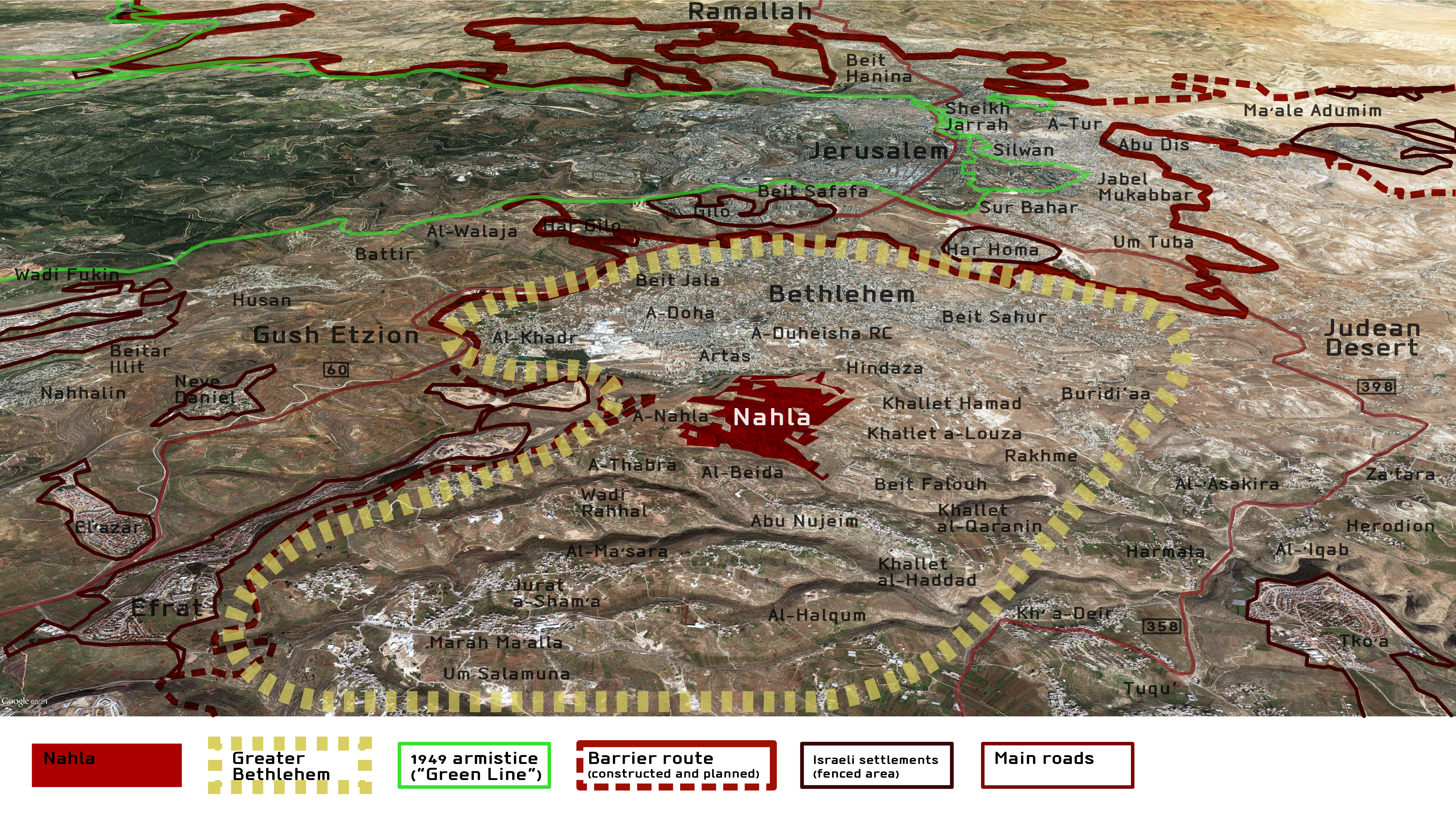 This is the first time the High Court has elected to take up the matter of discriminatory land allocation. The decision to do so was prompted by a petition filed by over a dozen Palestinian landowners in May 2020, with the assistance of Peace Now. This petition was filed after previous legal efforts failed to overturn Israel’s declaration of their land, part of the Palestinian village of a-Nahle, as “state land”. Past attempts to use litigation in Israeli courts to challenge Israel’s use of “state land” declarations in order to expand settlements have typically not continued past this point. This is in part because in order to challenge how “state land” is allocated, the Palestinian petitioner must, in effect, concede that the land in question (which Israel has seized from them) is legitimately “state land” in the first place — something Palestinian landowners are understandably loathe to do. Thus, this petition represents a novel challenge for the Court.
While the Court’s decision to allow the case to go forward is significant, it is important to note, too, that the wording of the Court’s order to the government indicates that the Court is only considering a limited part of the petition. That is: rather than examining the underlying principle of discriminatory land allocation practices, it is pursuing a limited consideration of why the State chose not to allocated parts of the land to these specific petitioners, in this specific case.
Peace Now said in a statement:
“For more than 50 years, Israel has allocated the precious resource of land in the West Bank to Israelis only. This policy confirms the claims of those who accuse Israel of applying an Apartheid regime in the Occupied Territories. The allocation of the land in E2 for a settlement is immoral, illegal and disproportionate in a way that cries to heaven. Although the order given by the court does not cover the entire area of the petition, the court signals that this discrimination must not continue.”
As a reminder, the settlement at the heart of the case is called Givat Eitam by settlers, but it is called “E-2” by anti-settlement watchdogs, in light of its dire geopolitical implications for any future Palestinian state (similar to those of the E-1 settlement on Jerusalem’s eastern flank). The construction of Givat Eitam/E-2 would significantly expand the Efrat settlement in the direction of Bethlehem, effectively cutting Bethlehem off from the southern West Bank and completing the city’s encirclement by Israeli settlements.
Government Data Shows: Over Past 5 years, in Area C Israel Granted 33 Building Permits for Palestinians, compared to more than 16,500 for settlers
Directly relevant to the court case regarding the allocation of state land to the Efrat settlement for the construction of a new settlement (see above), new data released by the Israeli government has revealed that over the past five years, Israel has issued only 33 building permits to Palestinians living in Area C while over the same period and for the same area, it issued over 16,500 building permits to settlers.
As a reminder, Area C is the 60% of the West Bank where Israel enjoys total authority and in which Israel has systematically denied Palestinian building rights, while promoting the expansion of settlements and unauthorized outposts, and in parallel systematically demolishing Palestinian un-permitted construction. This trend pre-dates the 5-year period covered in the new government data — for example, from 2016-2018, Israel issued only 21 building permits to Palestinians, while during that same period issuing 2,147 demolition orders against Palestinian construction.
These trends are part of the continuing efforts of Israeli settlers and the Israeli government to entrench and expand Israel’s control over (and de facto annexation of) the entirety of Area C. Notably, in September 2020 the Israeli government allocated 20 million NIS ($6 million USD) for the newly created Settlement Affairs Ministry to survey and map unauthorized (by Israel) Palestinian construction in Area C — construction which Israel has been aggressively demolishing. In addition to funding the expansion of policies that systematically discriminate against and dispossesses Palestinians in Area C, this funding further empowers a domestic Israeli body to exert extraterritorial sovereignty over Area C – in effect, treating the area as land already annexed by Israel.
The Knesset has also to a great extent adopted the narrative of settlers and pro-settler organizations — a narrative predicated on the idea that Area C belongs to Israel and must be defended against Palestinian efforts to steal it (framing that in effect dismisses the legitimacy of any Palestinian landownership in Area C). The Knesset has repeatedly hosted forums to discuss the alleged (by settlers and their allies/advocates) “Palestinian takeover of Area C.” Consistent with this framing and pushed by outside groups, many members of the Knesset have criticized the Israeli government’s alleged failure to robustly “defend” Israel’s rights/ interests in Area C — demanding that the government do more to prevent and demolish “illegal” Palestinian construction (even as it refuses to issue permits for Palestinians to build “legally), that it must prevent foreign projects that support Palestinians’ presence in the area, that it must clear Palestinians out of areas targeted by settlers, and that it must do more to expand settlements and consolidate state-built settlement infrastructure.
A Perfect Storm – For a Major Crisis – Gathers Over Sheikh Jarrah
Israeli settlers and police have provoked significant violence and rising tensions in Sheikh Jarrah ahead of Israel’s imminent forced displacement of the Salem family from their home of 60+ years in favor of settlers. That eviction is slated to be carried out by Israel sometime between March 1 and April 1. The latest violence has centered on the area around the Salem family home, where on February 13th, Kahanist Knesset Member Itamar Ben-Gvir erected a makeshift outpost — which he calls a “parliamentary office”– directly outside of the home.
Ben-Gvir’s action — which he clearly intends as a provocation — sparked a series of events that continue to result in violence, injury, and an increasing Israeli police presence in the neighborhood.
The escalation of conflict in Sheikh Jarrah has caused many – including in the Israeli government and the Biden Administration – to worry about a repeat of the events of May 2021, when a crisis centered on Sheikh Jarrah and the Temple Mt/Haram al Sharif ultimately sparked direct conflict between Hamas in Gaza, and the Israeli military, with devastating results for Gaza. The looming eviction of the Salem family mirrors the events which sparked those events last summer, with the added context of the convergence of three important religious holidays: Passover, Ramadan, and Easter. A U.S. official called this a “recipe for disaster in Jerusalem.”
Mohammed El-Kurd (whose family is also facing eviction in Sheikh Jarrah) writes about events transpiring around the Salem family home this week:
“While the Israeli regime has long managed to conceal its practices of ethnic cleansing, apartheid, and colonial expansion behind a mix of complex legislation, Hasbara, and the rhetoric of “war and peace,” politicians like Ben-Gvir increasingly do not bother to play that game. And they are not so fringe. Palestinians know that Ben-Gvir’s eliminationist rhetoric is cemented, albeit in more polished form, in Israeli policies of mass transfer. His office stunt is merely a more explicit version of the Zionism that Israeli leaders have governed with for the past seven decades—one predicated on replacing Palestinians with settlers. As I write this, colonial violence continues in my neighborhood and across colonized Palestine. Israeli forces have shot and killed Nihad Barghouti, a Palestinian teenager who was protesting in occupied Nabi Saleh, Ramallah; attacked protesting students with tear gas canisters at Abu Dis University; assaulted a disabled activist in Sheikh Jarrah while providing protection for Ben-Gvir’s entourage; and demolished a Palestinian’s home in the South Hebron Hills, shortly before brutally detaining him. As the injuries and arrests mount, it’s hard not to see the parallels between today’s events and the events that sparked last year’s Unity Uprising and the devastating assault on the besieged Gaza Strip. Many hold their breath, anticipating the repression that accompanies resistance, the steep price of revolt.”
For further background on the Salem family’s case (including on the Israeli laws that were expressly designed to enable the eviction of Palestinians in favor of settlers), see reporting by Ir Amim and Peace Now.
Ma’aleh Ahuvia Outpost Demolished, Immediately Rebuilt
On February 8th, the IDF dismantled the illegal outpost of “Ma’aleh Ahuvia.” Hours later, the IDF failed to prevent settlers from promptly (and illegally) rebuilding and improving the outpost – demonstrating the lack of either willpower or lack of efficacy of Israeli officials in the West Bank to constrain settler activity. That evening, settlers from the outpost carried out a so-called “price tag attack” on the nearby Palestinian village of Deir Jarrar, damaging cars and inflicting terror.
Prominent Israeli solidarity activist, Rabbi Arik Ascherman, documented settlers rebuilding the site, and wrote:
“Army vehicles pass by every day on the way to a base the message to Palestinian victims of violence, of ravaged vineyards, orchards and fields, and of theft Palestinians even susect that the water container and other items in the outpost were stolen from them.) will continue with no relief from Israel. The message to settlers is they have nothing to fear. They continue to wreak terror.”
As a reminder, this outpost is a named for Ahuvia Sandak, a settler “hilltop youth” who died when the car he was traveling crashed as it was fleeing Israeli police with a group of settler youth who allegedly has been stoning Palestinian cars. Settlers and their supporters have painted Israeli police as perpetrators of a crime of negligence (or worse) against the settler youth; the Knesset has taken up the issue; and Sandak has been memorialized as a hero and a martyr to the cause of Greater Israel.
Settlers Are Running Government-Backed Program for Israeli Kids on Palestinian Land in East Jerusalem
Haaretz reports that the radical settler group Elad is running a program that enables Israeli students to earn school credit for doing work on land in the Ben Hinnom Valley. The land in question is privately owned by Palestinians (and recognized as such by Israel). However, the government of Israel has issued “landscaping orders” (also called “gardening orders”), and order which allows Israel to “temporarily” (at least in theory) take over privately owned land for what are ostensibly public purpose.
Elad’s student program on the private Palestinian land has been operating under the auspices of the Jerusalem Municipality in partnership with the Israel Nature & Parks Authority, once again demonstrating how settlers and the Israeli state work hand-in-hand to assert Israeli control over Palestinian land.
Fearing that the setters’ control over the land will become permanent, the Palestinian owners of the land in question have filed an appeal against the landscaping orders. The Jerusalem District Court recently heard arguments on the appeal, where a lawyer representing the Palestinian landowners argued that there is no precedent for using “landscaping orders” to take over so much land. The judge hearing the appeal did not issue a decision, instead postponing judgment.
As a reminder: In June 2019, the Jerusalem Municipality used the issuance of “landscaping orders” to take control of 12 plots of privately owned Palestinian land near an area where the Elad settlement group has been active – again, based in part on the argument that the owners were not presently using the land. However, the land in question is located in an area that Israel has declared to be a national park. With that “national park” declaration, Israel legally barred the private landowners from using their own land. With its subsequent “landscaping orders,” Israel has in effect asserted that since the owners weren’t using the land (that they were legally barred, by Israel, from using), that land can now, in effect, be seized by Israel for its own purposes (the landscaping orders last for a period of 5 years, with the likelihood of extensions after that — tantamount to expropriation).
Emek Shaveh’s Executive Director Alon Arad told Haaretz:
“People who love Jerusalem and care about its heritage don’t harm its landscapes or push out its people. The Israel Nature and Parks Authority, through Elad, is promoting development that essentially changes the landscapes, damaging the historical heritage of the valley and reshaping it to fit political interests. It is shameful that this work is being done by a political organization that drafts teens and children for its own needs under the framework of fulfilling their educational obligations.”
Lapid: Israel Will Refrain from the Most Problematic Settlement Expansion
Standing alongside the German Foreign Minister at a press conference, Israel Foreign Minister (and alternate Prime Minister) Yair Lapid stated that Israel will not build settlements that prevent a two-state solution (a statement that reflects an Israeli mindset according to which there can be “peace” based on Israel dictating to Palestinians what areas of the West Bank will become part of Israel). Lapid insisted that Israel will only approve plans that accommodate the “natural growth” of settlements (of course, there is nothing “natural” about growth of settlements, given that such growth is possible only due to Israeli government policies that support and enable the establishment and expansion of settlements, and policies that actively incentivize and support Israel citizens moving to and living in the West Bank).
A quick survey of recent settlement plans and projects, as summarized weekly by this report (archived here), highlights the dishonesty in even this weak commitment by Lapid to keeping the two-state solution alive. These include the State’s efforts to retroactively legalize the Evyatar outpost, to reestablish the Homesh settlement, and to advance plans for six new settlements in East Jerusalem; in addition to the myriad of unofficial mechanisms by which the State grants increasing control over land in the West Bank to the settlers.
Bonus Reads
- “One Year Report on Demolitions and Seizures in the west Bank, Including East Jerusalem (Reporting Period: 1 January 2021 – 31 December 2021)” (European Union)
- “Opinion: Palestinians have denounced Israeli apartheid for decades. As the world catches up, how will it react?” (Mariam Barghouti in the Washington Post)
- “Violent Israeli Settlers Are Starting to Resemble the KKK” (Michael Sfard in Haaretz)
- “Terrorizing a Nation: Israeli Settler Violence Against the People of Palestine – A Yer in Review (2021)” (PLO-NAD)
- “A broken ankle, a demolished home, and a crushed water cistern” (Ali Awad in +972 Magazine)
- “The “Father of the Settlements”” (Arutz Sheva)
Welcome to FMEP’s Weekly Settlement Report, covering everything you need to know about Israeli settlement activity this week.
To subscribe to this report, please click here.
November 12, 2021
- Settlers Secure Deal for Eventual Eviction of Another Sheikh Jarrah Family
- Increasing Pressure on the Government, Settlers to Operationalize Plan to Increase Control Over Area C
- JNF Stops Funding 18-Year Legal Battle Over Beit Bakri in Hebron
- Demolitions in East Jerusalem Continue, Including in Al-Walaja
- Settler Violence & Expansionism Continue to Escalate in the South Hebron Hills
- Bennett Pledges Evyatar Outpost will be Legalized, Sparking Palestinian Ire & More Coalition Threats
- Government Punts on Outpost Legalization Bill, Knesset Might Move Forward Anyway
- Bonus Reads
Settlers Secure Deal for Eventual Eviction of Another Sheikh Jarrah Family
Israel Hayom reports that a Palestinian family in the Sheikh Jarrah neighborhood has reached a Court-approved “deal” with settlers to recognize settler ownership of their home (where they have lived since 1956), in exchange for being allowed to stay as paying tenants for a period of at least ten years. The “deal” follows the broad outline of a Court-authored compromise that was rejected last week by four other Palestinian families (the cases are separate, but not unrelated).
Israel Hayom additionally speculates:
“The compromise, which was given the force of a legal ruling in the Jerusalem Magistrates Court a few days ago, could serve as a precedent for other local Arab families and is seen as a blow to the Palestinian Authority and Hamas, which are both pressuring Arab residents of Sheikh Jarrah-Shimon HaTzadik to refuse any proposed deals to vacate the properties.”
Increasing Pressure on the Government, Settlers to Operationalize Plan to Increase Control Over Area C
In a closed meeting on November 10th, the heads of settler regional councils met to discuss their ongoing effort to get the Israeli government to annex Area C of the West Bank. According to Arutz Sheva (the settler media outlet), the meeting resulted in significant decisions that create a more unified settler operation on the matter, including the formation of a “joint command center” through which all of the councils will act together, and a commitment by all the regional leaders to form a unified front to pressure the government.
Following the meeting, the participants released a statement saying:
“This struggle is over whether we continue to exist or to fold. This is an existential battle involving the entire Nation of Israel. We are all committed towards working together in order to stop the hostile takeover of our lands and in order to preserve the future of Jewish life in Judea and Samaria.”
An op-ed published in Israel Hayom on November 11th – entitled “In Area C, the time has come to get off the fence” – seemingly making the case for such an effort, the settlement activist Sara Haetzni-Cohen writes:
“Efrat’s dedicated residents have established their own war room. They track every brick and every bit of cement that is spilled and report it to the authorities. They know every demolition order that is issued but not enforced, and they do not give up. But the state quite simply does not exist. The Civil Administration is failing at its task and by choice…We’ve reached a stage where there is no state on which to rely on major issues. Real leadership from leaders who will get off the fence is needed. Local leadership in Judea and Samaria, whether elected or civilian organizations, must get off the fence and protect state lands, settlement lands, our homeland. It should be done intelligently, responsibly, and in a law-abiding manner. We should not resort to violence or vandalism against the Arab population, but rather go about this in a positive way, by planting trees and working the land, by showing our presence on the ground. If we will not be for ourselves, who will be for us? There simply isn’t any choice. We must get off the psychological and physical fence and defend our land.”
As a reminder, under the Oslo Accords, the West Bank was divided into 3 “areas” – Area A, B, and C – pending a permanent status Israeli-Palestinian agreement that would determine final control over all the land (an agreement that was supposed to have been reached by by May 1999). The Oslo Accords gave Israel complete control over Area C, which accounts for around 60% of the West Bank. Throughout the 28 years since the Oslo Accords were signed (and with no peace agreement achieved or in sight), Israel has systematically denied Palestinians in Area C permits that would enable them to build “legally” (under Israeli law) on their own land. As a result, Palestinians have been forced to build without Israeli permits (i.e., “illegally” in the eyes of Israeli authorities), and Israel has responded by issuing wide-scale demolition orders and carrying out frequent demolitions. In recent years, Israel has increasingly treated Area C as indistinguishable from sovereign Israeli territory, effectively extending its laws and regulations to the area and its Israeli settler inhabitants. In parallel, settler groups – most notably the notorious “Regavim” – have lobbied Israeli authorities to crack down on “illegal” Palestinian construction, claiming that Palestinians are trying to “take over Israeli land”.
As part of these ongoing efforts — by settlers and the Israeli government — to entrench and expand Israel’s control over/de facto annexation of the entirety of Area C, in September 2020 the Israeli government allocated 20 million NIS ($6 million USD) for the newly created Settlement Affairs Ministry. That ministry was given the mission of surveying and mapping “unauthorized” (by Israel) Palestinian construction in Area C (the same construction which Israel has been aggressively demolishing). This funding further empowers a domestic Israeli body to exert extraterritorial sovereignty over Area C – in effect, treating the area as land already annexed by Israel.
The Knesset has also repeatedly hosted forums to discuss the alleged (by settlers and their allies/advocates) “Palestinian takeover of Area C” — framing predicated on the assertion that Area C belongs to Israel (an assertion that is not supported by the Oslo Accords) and must be defended against Palestinian efforts to “steal” it. Consistent with this framing, and under pressure from various outside groups, many members of the Knesset have criticized the Israeli government’s alleged failure to robustly “defend” Israel’s rights/ interests in Area C (e.g., failure to prevent/destroy “illegal” Palestinian construction, failure to block foreign government-funded humanitarian projects that support Palestinians’ presence in the area; failure to clear out Palestinians from the area, expand settlements, and consolidate state-built settlement infrastructure; etc.).
JNF Stops Funding 18-Year Legal Battle Over Beit Bakri in Hebron
The Jerusalem Post reports that the Board of the Jewish National Fund in Israel has decided to stop funding the legal costs of a group of settlers battling to win control over a contested home in Tel Rumeida, in the heart of downtown Hebron (and to that end, forging documents). Israeli Courts have ruled against the settlers’ claim to the home twice, most recently in December 2019, in a ruling which affirmed that the Palestinian Bakri family is the rightful owner (the house is known as “Beit Bakri”).
At the request of the settlers, the JNF has agreed to pay installments on a legal guarantee to Israeli courts in order to allow the settlers to avoid eviction while pursuing an appeal against the December 2019 ruling against them. Since 2019, the JNF has paid some $35,000 (110,000 NIS) towards the case.
The Palestinian homeowners – the Bakri family – temporarily fled their home under constant settler harassment during the Second Intifada, a time when Tel Rumeida could have been accurately described as an “urban battlefield.” While the family was gone, settlers broke into the house, damaged it, destroyed the Bakri’s property, and ultimately took up residence there.
The Bakri family has spent the past 18 years petitioning Israeli police and the courts to remove the settlers — cases the Bakri family repeatedly won. The settlers have managed to repeatedly delay their eviction by essentially exploiting every possible legal defense, no matter how absurd or contradictory. For example: At different points over the past 18 years, settlers argued in court that they had a rental agreement; that they purchased the home; that the plot of land was owned by a Jewish trust prior to 1948 and they are “reclaiming” the property; and that because they had invested so much money in improving the land since taking it over, under Ottoman Law it now legally belongs to them, regardless of the means by which they acquired it. When at one point some years ago the courts ruled that the settlers had to evacuate, the settler occupants of the Bakri home did, indeed, leave, only to be immediately replaced by other settlers — at which point the Israeli Attorney General told the Bakri family that they had to start eviction proceedings anew. For a detailed timeline of the Bakri family’s saga, see this report from Peace Now.
Throughout the course of this saga, the settlers’ effort to hold on to the Bakri home was aided by the State’s unwillingness to implement court orders against the settlers. Peace Now said in a statement:
“This is not only a matter of cruelty, deceit and theft of settlers who are not loathe to take control of assets that are not theirs, but also a matter of the lack of government accountability. For 18 years the government did not enforce the law against the invading settlers, and even assisted them and allowed them to continue to steal the house and terrorize their Palestinian neighbors in Tel Rumeida. Furthermore, it should be remembered that Hebron is under Israeli occupation and the Palestinian residents cannot remove the settlers from their homes by appealing to the Palestinian Authority. The power lies in the hands of the Israeli government, which does nothing to fulfill its responsibilities to protect abandoned Palestinian property.”
Demolitions in East Jerusalem Continue, Including in Al-Walaja
Over the past week the Israeli government has moved forward with demolitions in Palestinian neighborhoods across East Jerusalem, including:
- The demolition of three Palestinian homes in the village of Al-Walajah on November 9th. For more on Israel’s systematic campaign to demolish homes in Al-Walajah – including its refusal to approve building plans initiated by Palestinians – see FMEP’s September 9, 2021 settlement report;
- Israeli authorities delivered demolition notices to 10 Palestinian families (70 individuals) living in an apartment building in the al-Tur neighborhood. The notice ordered the families to self-demolish the four-story building within one week, or have Israeli forces demolish the building, with the cost of the demolition billed to the residents. The families reportedly began removing their belongings from the building on November 5th in anticipation of demolition;
- Under coercive Israeli policies, a Palestinian family opted to self-demolish an apartment building in the Beit Hanina neighborhood;
- Under coercive Israeli policies, a Palestinian family opted to self-demolish its house in the Jabel al-Mukaber neighborhood.
As is always the Israeli position, the State asserts that the homes being demolished and under threat of demolition have been built by Palestinians without the required Israeli permits (often on land that even Israel recognizes they privately own). Such permits are generally all but impossible for Palestinians to obtain; in the case of al-Walajah, they are literally impossible to obtain, since the area lacks the required Israeli-approved “outline plan,” without which permits are an impossibility. Facing the reality of having Israel demolish their homes and being required to pay excessive costs and fees associated with such demolitions, Palestinians sometimes choose to self-demolish their homes.
Settler Violence & Expansionism Continues to Escalate in the South Hebron Hills
On Wednesday, November 10th a group of settlers attempting to install a campsite and graze their flocks on land near the Palestinian village of Khilet al-Daba clashed with local Palestinians, who worried that the settlers were making an attempt to take over the land – an understandable concern giving the growing phenomenal of farming outposts as a means for settlement expansion. The clashes – which took place at night after a full day of building tensions – took a violent turn when settlers set a Palestinian agricultural structure on fire. The evening ended with two Palestinians being shot by settlers with live rounds, three Palestinians wounded by settlers throwing rocks, and damage to several cars owned by Palestinians.
The land on which the settlers were grazing their flocks and attempting to install a campsite was declared to be a firing zone by the Israeli government, making it illegal for Palestinians to build there or even enter. According to Haaretz, the Israeli state has plans to evict Palestinians who live in this area (who have ostensibly lived in the area prior to it being declared by Israel to be a firing zone).
The IDF, which had been at the scene intermittently during the day, eventually sought to separate the groups by declaring the area a closed military zone. South Hebron Hills activist Basil Al-Adraa explained how this practice works to allow settlers to accomplish their goals, saying:
“The army arrived, declared it a closed military zone and kicked us out. But they didn’t kick out the settlers or take down the tent they put up today.”
The South Hebron Hills is a hotbed for settler violence, and was the scene of a settler attack – a Jewish pogrom – in September. Earlier this week, settlers from a nearby outpost – aided by the IDF – temporarily blocked Palestinian access to a playground in the village of Susiya. In addition to settler violence, the Israeli government is also acting to significantly expand settlements and retroactively legalize outposts in the South Hebron Hills.
Notably, two U.S members of Congress – Mark Pocan (D, WI-2) and Jamaal Bowman (D, NY-16) – visited the village of Susiya in the South Hebron Hills on November 10th (prior to the outbreak of violence that night). They pair met with local Paelstinian activist where they were told of the violence settlers inflict on the local population.
In an interview with Jewish Currents in October 2021, Basil Al-Adraa explained how violence and land takeovers are two sides of the same coin in the South Hebron Hills,
“Settlers have long been attacking the communities here. The [Israeli] Civil Administration gives them land stolen from the Palestinians: They declared it state land so they can take it by force, for settlers to build settlements and outposts and farms. This year, the settlers have started these new sheep farms around the West Bank, where they bring volunteers to work on these farms. But the settlers aren’t content with the tens of thousands of dunams [one dunam equals 1,000 square meters] they’ve been granted: They bring their animals to our private fields, which the state can’t take from us. They bring them to our orange trees, to drink from our water systems—like the well where we collect rainwater—and to graze on our grass. And what’s been happening recently, especially since May, is they’ve been organizing big attacks on Shabbat and holidays because settlers don’t have much work to do on those days. Dozens of settlers will come masked, with hammers, machine guns, sticks, and stones. The army escorts them two or three kilometers from their settlements to our villages. They burn houses, cut down olive trees. If the army sees some Palestinian trying to defend themselves, then they will shoot at [that Palestinian] with live stun grenades, or tear gas, or rubber bullets. They use all the force. We are under army law as Palestinians in Area C, but the settlers are under civilian law, so the soldiers in the area can’t deal with the settlers, who are under the jurisdiction of the police. But the police take three or four hours to come, only after the attacks have finished. In my community, al-Tuwani, there have been at least seven organized attacks. A lot of people look at these as [isolated] incidents, and this time, there was more media attention to the issue because there was a three-year-old child who was wounded. But it’s part of a policy, in which settlers and the Israeli army don’t want us to feel safe where we live. Like the home demolitions, the blocking of roads, the cutting water and electricity networks, it’s all leading to one goal: They want to kick us out of this land, out of Area C toward Area A [areas under Palestinian administrative and police control, like Ramallah]. But our land is here, our life is here.”
Bennett Pledges Evyatar Outpost will be Legalized, Sparking Palestinian Ire & More Coalition Threats
In a press conference on November 7th, Prime Minister Bennet affirmed his commitment to granting retroactive legalization to the unauthorized outpost of Evyatar – which was built on a strategic hilltop named Mount Sabih, located just south of Nablus on land historically belonging to nearby Palestinian villages Beita, Yatma, and Qablan. Even before Bennett’s most recent statement, several members of his fragile coalition have spoken out to insist that the reestablishment of Evyatar is a redline that, if crossed, could bring down the coalition (FMEP covered a few such statements two weeks ago). In the wake of Bennett’s press conference, more continued to do so, which only adds to the growing public fracture in the coalition over outposts and settlement building more broadly.
Public Security Minister Bar Lev (Labor) pledged to block the legalization of Evyatar, said this week:
“There are enough ways to dissolve this agreement. The Evyatar community [outpost] was illegal and illegal communities should be evacuated.”
The Mayor of Beita predicts that Bennett’s pledge to legalize the outpost (coupled with the end of the olive harvest season, which consumed protestors’ time elsewhere) will spark renewed energy in Palestinian-led protests in the town of Beita. Since settlers struck a deal with the government to temporarily vacate the outpost back in July 2021, Palestinians have staged regular protests against Evyatar outpost, and against the continue denial of access to the land on which the outposts continues to exist (the area is a closed military zone, where Palestinians are denied the ability to access). The protests over the summer were particularly violent, resulting in the killing of at least five Palestinian protestors by Israeli soldiers.
An organizer of the protests, Amal Bani Shamseh, told The New Arab:
“the people in Beita can not stand the idea of a single settler moving back to Mount Sabih and are willing to intensify protests, and women are the first to affirm it.”
As a reminder, the fate of the Evyatar outpost was the first controversy that threatened to divide the fragile Bennett-led government when it was sworn in. Bennet’s partners were bitterly divided on whether to evacuate the outpost or let it be, while the government sought to grant it retroactive legalization. In the end, the government reached a “deal” which saw the settlers (temporarily) vacate the outpost on Friday, July 2nd. In return, the government left the settlers’ illegal construction at the site in place (i.e., did not demolish it) — including buildings and roads — while it “examines” the status of the land to see if it can be declared “state land” and therefore “legally” turned into a settlement (opening the door for the settlers to return). Under the agreement, the outpost is being used as a military base in the interim.
The fact that the “compromise” left in place the settlers’ structures and allowed Israel to maintain complete control over the site during the “survey” process signalled from the start that the government is not concerned with enforcing Israeli law, but rather is focused on finding a political solution that works for the settlers. It was further clear from the terms of the “compromise” that the Bennet government believed it will be succeed in finding a pretext to assert that the land on which the outpost stands is “state land” which can be used by the state as it sees fit (i.e., give it to the settlers). If the state decides, pursuant to the investigation, that it has a basis on which to declare the site to be “state land,” the settlers will be allowed to return and resume the establishment of what would from that point no longer be an illegal outpost, but a new “legal” settlement.
Government Punts on Outpost Legalization Bill, Knesset Might Move Forward Anyway
The Jerusalem Post reports that the Ministerial Committee on Legislation has decided to delay by four months its decision on whether to grant government backing to a bill that would grant retroactive authorization (i.e., legalize) nearly 70 West Bank settlement outposts that Israel has failed to find any other way to legalize (because they are built on land even Israel recognizes is privately owned by Palestinians). As a reminder, the Ministerial Committee on Legislation is composed of government Ministers, and decides whether or not the governing coalition will throw its support behind a bill in the Knesset – ensuring either its passage or defeat.
In response to this news, MK Orit Struck (Religious Zionist Party) — who is also a longtime Hebron settlement leader — said that she intends to bring the bill to the Knesset for an initial reading despite lacking government-backing. Struck believes a strong majority of Knesset Members, regardless of the government’s position, will support the bill. Members of the Knesset attempted to fast-track the passage of this same bill in May 2021, while Bennett and Lapid were in negotiations to form the current governing coalition.
The bill introduced in May 2021 included an explanatory text claiming that the proposed law is in line with a decision the Security Cabinet took in 2017, when it tasked a new committee – headed by notorious settler leader Pinchas Wallerstein – to prepare individualized plans for each outpost to gain retroactive legalization based on the passage of the Regulation Law and the recommendations in the Zandberg Report. Bills similar to this have been filed several times in the past, and the Israeli government has debated granting retroactive authorization to the outposts via a government decision – and came close to doing so in the waning days of the Trump Administration.
Bonus Reads
- “Israeli Settlers Escalate Violence in West Bank” (Foreign Policy)
- “Nearly 20 years on, Israeli barrier shapes Palestinian lives” (AP)
- “Far-right protestors clash with cops in Jerusalem over settler teen’s death” (The Times of Israel)
- “They should have been lawyers. Instead they’re at Israeli construction sites” (Basil al-Adraa in +972 Magazine)
- “How the Occupation Harms Not Only the Palestinians, but the Planet Too” (Haaretz)
- “Palestinians say no to work in settlements” (Al-Monitor)
Welcome to FMEP’s Weekly Settlement Report, covering everything you need to know about Israeli settlement activity this week.
To subscribe to this report, please click here.
August 13, 2021
- The First Bennett/Biden Settlement Wave, Part 1: Israel Set to Advance 2,259 Settlement Units
- The First Bennett/Biden Settlement Wave, Part 2: Israel Announces Intention to Issue 863 Building Permits for Palestinians in Area C
- The First Bennett/Biden Settlement Wave, Part 3: Observations on Settlement Policy Coordination Between Governments
- Jerusalem District Court Orders 16 Homes to Be Demolished While Delaying – for 6 months – Demolition of Others in Silwan
- Israel Begins Work on Settler-Back Project at the Ibrahimi Mosque/Tomb of the Patriarchs
- Atarot Settlement Plan to Be Discussed on December 6th
- Bonus Reads
Questions/comments? Email kmccarthy@fmep.org
The First Bennett/Biden Settlement Wave, Part 1: Israel Set to Advance 2,259 Settlement Units
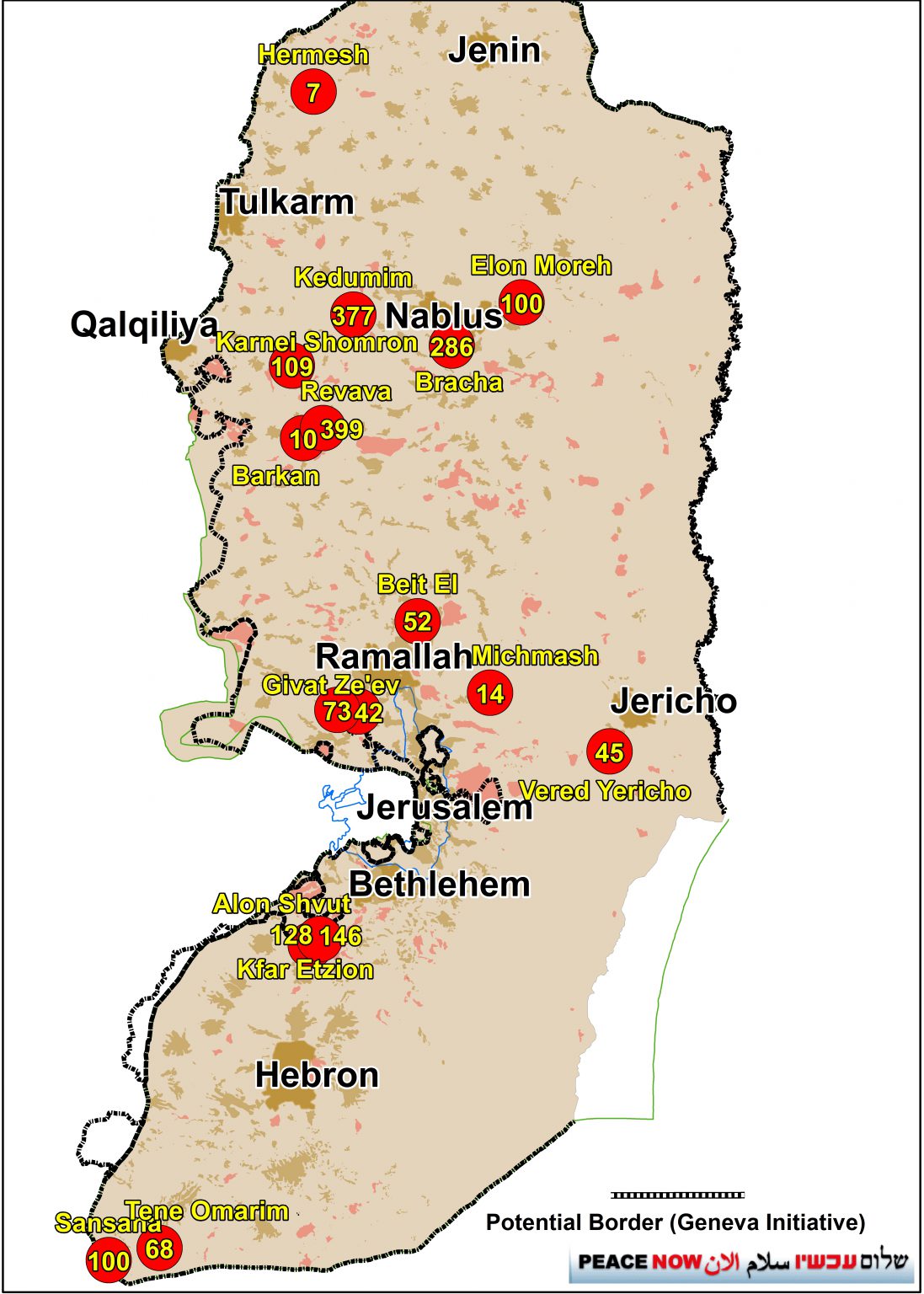 On August 12th, Israeli Defense Minister Benny Gantz announced that the High Planning Council will convene on August 18th to advance 2,259 new settlement units, as part of projects across the West Bank. Of these, 908 units are slated to receive final approval, including many units in areas beyond Israel’s security barrier. This will be the first time that the High Planning Council (HPC) has convened in 10 months, and it will be the first time a large number of settlement units has been advanced since Biden entered the White House. As a reminder, the HPC is a body within the Israeli Civil Administration (which is a part of the Israeli Ministry of Defense) that has authority over construction planning and approvals for both settlers and Palestinians in the West Bank (the HPC does not have authority with respect to settlement construction in East Jerusalem; since Israel annexed the area in 1967, Israeli domestic Israeli planning authorities are in charge there).
The plans expected to receive final approval include:
- 286 units in the Har Bracha settlement, located south of Nablus. If implemented, these new units will double the size of Har Bracha;
- 146 units in the Kfar Etzion settlement, located between Bethlehem and Hebron and on the Israeli side of the planned route of the barrier (which is not yet built in this area);
- 110 units in the Alon Shvut settlement, located just north of the Kfar Etzion settlement and between Bethlehem and Hebron;
- 82 units in the Karnei Shomron settlement, located in the northern West Bank, east of the Palestinian village of Qalqilya. Israel has openly declared its intention to continue expanding settlements in this area with the stated goal of bringing 1 million settlers to live in the area.;
- 52 units in the Beit El settlement, located in the heart of the northern West Bank [as a reminder, former US Ambassador to Israel David Friedman has deep ties to the Beit El settlement]; Construction on 350 new units in Beit El began earlier this year;
- 42 units in the Givat Zeev settlement, located south of Ramallah in an area that. is on the Israeli side of the barrier;
- 14 units in the Ma’aleh Mikhmash settlement, located east of Ramallah;
- 10 units in the Barkan settlement, located about half way between the Ariel settlement and the cluster of settlements slated to be united into a “super settlement” area (Oranit, Elkana, Shiva Tikva, and others).;
Peace Now said:
“The approval of thousands of housing units in the settlements harms the Israeli interest and the chances of reaching peace. It seems that the approval of a handful of plans for the Palestinians is only intended to try to reduce criticism of the government and to please the US administration ahead of Prime Minister Bennett’s expected visit to Washington in the coming weeks. For years, Israel has pursued a policy of blatant discrimination that does not allow almost any construction for Palestinians in Area C, while in the settlements it encourages and promotes the construction of thousands of housing units each year for Israelis. The approval of a few hundred housing units for Palestinians can not cover up discrimination and does not change the fact that Israel maintains an illegal regime of occupation and discrimination in the territories.”
The First Bennett/Biden Settlement Wave, Part 2: Israel Announces Intention to Issue 863 Building Permits for Palestinians in Area C
In announcing plans to advance over 2,000 new settlement units, Defense Minister Gantz also announced his intention to issue permits for 863 houses – some of which will be issued for existing structures – for Palestinians living in Area C. Haaretz reports that the permits are being advanced in order to buy the consent of the few members of the Israeli governing coalition that oppose settlement construction, and as “calculated risk” with respect to the Biden administration.
As a reminder, Area C is the 60% of the West Bank where Israel enjoys absolute authority and has systematically denied Palestinian building rights, while promoting the expansion of settlements and unauthorized outposts. If issued, these permits for Palestinians will be the first issued by Israel in years, and the first of any significant size. Only 21 building permits were issued to Palestinians between 2016 to 2018, while 2,147 demolition orders were issued in the same period.
Commenting on the announcement of the planned permits (which, given past experience, there is no reason to assume will ever be issued) Peace Now said:
“It is a very small expansion of the Palestinian villages and a drop in the ocean in terms of real Palestinian development needs.”
Peace Now reports that these permits, if they are ever issued, might be for:
- 270 houses in the Bir al-Bash village, located south of Jenin in the northern West Bank;
- 233 houses in the the Almasqufa village, located near Tulkarem in the norhtern West Bank;
- 160 houses in the Abba a-Sharqiya village, also located south of Jenin in the northern West Bank;
- 150 houses in the Al-Ma’asara village, located south of Bethlehem; and,
- 50 houses in the Khirbet Zakariya, also located south of Bethlehem.
The First Bennett/Biden Settlement Wave, Part 3: Observations on Settlement Policy Coordination Between Governments
In reporting over the past week, Axios journalist Barak Ravid has documented the efforts by the Israeli and U.S. governments to square conflicting positions with regards to settlement growth.
On the U.S. side, the Biden Administration has appeared to take pains to make room in its official discourse to begrudgingly tolerate settlement construction. While the U.S. has criticized the new batch of settlement advancements, until this week the U.S. had reportedly identified three actions it has asked Israel to refrain from, notably not including settlement expansion. Those three actions are: the demolition of Palestinian homes, the eviction of Palestinians from their homes, and the establishment of new outposts in the West Bank. The U.S. is also reportedly asking Israel to take positive steps to stabilize the Palestinian Authority, which is suffering from economic shortfalls and crashing levels of popular support.
For it’s part, Israeli press suggests that the Bennett government reduced the number of upcoming settlement advancements in order to appease the Biden Administration. The Israelis wanted to advance 3,623 plans, but announced a total of 2,259 (a 39% cut according to Jerusalem Post). Axios also reports that the Israeli government is assertively framing its settlement policy as one of restraint, prioritizing settlement projects that address the supposed “natural growth” needs of existing settlements.
“Natural growth” has been used many times in the past by the Israeli government as an argument for why settlements must be allowed to expand. FMEP’s Lara Friedman has debunked this argument many times in the past, explaining:
“While ‘natural growth’ has no formal definition, it has generally been used in the settler context to mean population growth due to births, as contrasted to growth due to immigration from Israel or other places. But in numerical terms (according to Israeli official statistics), taking into account deaths and people migrating out of settlements, births inside the settlements account for approximately 60% of the annual population growth in settlements, while around 40% is immigration from inside Israel or abroad. So clearly population growth in settlements is not simply a matter of births. Perhaps this is why some excuse-makers have expanded ‘natural growth’ to include other ways that families can grow, from non-settler spouses to aged non-settler relatives moving in.
“Regardless of what definition people want to use, the fact is that ‘natural growth’ is not a legitimate argument against a complete freeze in settlement construction. Yes, settlers, like people everywhere, indeed have the right to have babies, and yes, their children indeed have the right to grow up and have families and homes of their own. But nowhere in the world – not in New York, or Paris, or Tel Aviv – do people have an inalienable right to live exactly where they want – in the size home they want, in the neighborhood they want – irrespective of real estate market factors, or any political, economic, zoning, or other considerations that may come into play (including in this case, considerations about actual land ownership). Inside Israel, just like in other countries, people regularly face difficult decisions about where to live, given that major cities like Tel Aviv and Jerusalem are crowded and little affordable housing is available.
“Settlers have the right to have babies and to take in their parents or grandparents. When settler children grow up they have the right to start families and have homes of their own. But the settlers must do what people everywhere must do: reconcile their needs as best as possible to the housing market, which is affected not only by demand but by a myriad of other variables – including, in this case, the fact that settlers have knowingly and voluntarily chosen to make their lives on land that is the subject of a political dispute of global proportions.”
Axios quotes an Israeli government official saying:
“The Biden administration knows we are going to build. We know they don’t like it, and both sides don’t want to reach a confrontation around this issue.”
An Israeli government source summarized the dance going on between the respective governments by saying:
“[The U.S.] will express opposition to this move, but everyone wants this impossible coalition in Israel to hold out… It was clear for Bennett he would not have been able to advance this move after his meeting with [U.S. President Joe] Biden at the end of the month, so as not to damage their relations, and that’s why he had to announce it as early as he did.
Jerusalem District Court Orders 16 Homes to Be Demolished While Delaying – for 6 months – Demolition of Others in Silwan
On August 12th, a Jerusalem Court granted a six-month freeze on demolition orders affecting dozens of Palestinian homes in the al-Bustan section in the Silwan neighborhood of East Jerusalem. At the same time, the Court cleared the way for the immediate demolition of 16 Palestinian homes in the same area.
A lawyer representing the Palestinians involved in these demolition cases said his clients intend to file for permits for the structures, which were built on land that Palestinians assert they own. Israel argues that the land is public land.
Israel Begins Work on Settler-Back Project at the Ibrahimi Mosque/Tomb of the Patriarchs
This week, an Israeli crew began construction on a new elevator leading to the Ibrahimi Mosque/Tomb of the Patriarchs in Hebron, arguably one of the most sensitive religious sites outside of Jerusalem. The project to install accessible infrastructure at the site has been backed and pushed by settlers for over two decades and provides a means by which the State of Israel has increased its control over the site. The project is roundly opposed by Palestinians along with archaeologists and other experts. The Israeli archeology group Emek Shaveh explains its opposition:
“We claim that while the plan is couched in terms of concern for the disabled and elderly worshippers, in actual fact it is unilaterally advancing changes to a site mired in deep political controversy…The size and characteristics of the structure demonstrate that at issue is not simply a lift for persons with disabilities, but a significant change to the compound. The lift will constitute a change in the status quo and a strengthening of the settlers’ control of the holy site. Ignoring the fact that the site falls under the auspices of the Hebron Municipality is evidence that Israel is further reneging on its commitments to agreements signed in the past with Palestinians.”
Atarot Settlement Plan to Be Discussed on December 6th
As expected, the Jerusalem District Planning and Building Committee has set a date – December 6th – for the advancement of the Atarot settlement plan. This plan would allow for the construction of 9,000 settlement units, to be built on the site of the former Qalandiya airport (located at the northern tip of East Jerusalem).
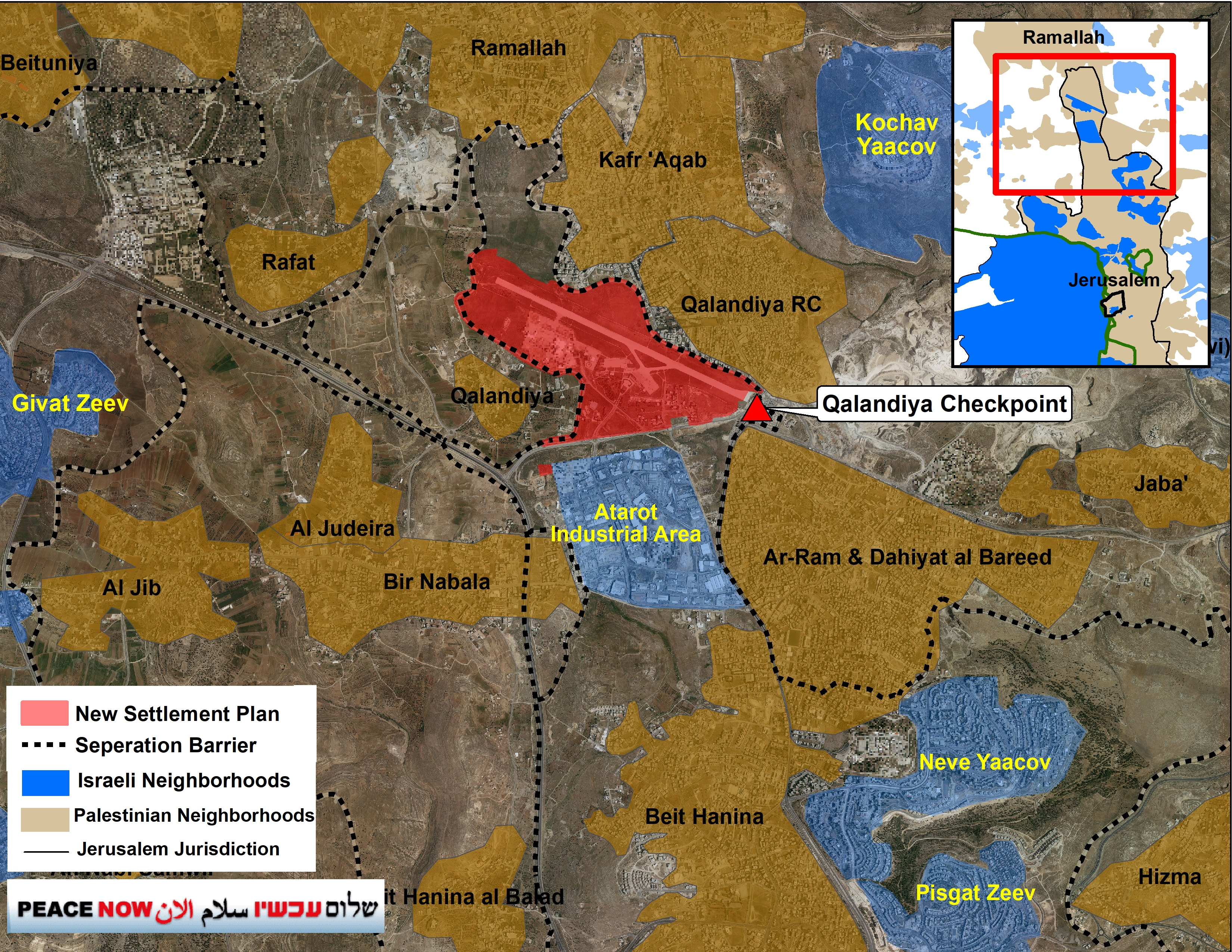 The Atarot settlement plan dates back to 2007. It was pursued by the Israeli government in 2012 but shelved under pressure from the Obama administration. The plan came back into consideration in April 2017 (a few months following the inauguration of President Trump) when it was rumored to be included on Netanyahu’s master blueprint of settlements for which he was seeking U.S. approval. In February 2020, following the publication of the Trump Plan – which designated the area that would be used for the settlement as a “special tourist zone” for Palestinians – the Atarot settlement plan was formally introduced. In January 2021 then-Prime Minister Netanyahu dangled the advancement of the plan as an incentive for parties to join his flagging coalition in order to remain in power.
In its current form, the plan provides for up to 9,000 residential units for ultra-Orthodox Jews (assuming, conservatively, an average family size of 6, this means housing for 54,000 people), as well as synagogues, ritual baths (mikvehs), commercial properties, offices and work spaces, a hotel, and a water reservoir. If built, the Atarot settlement will effectively be a small Israeli city surrounded by Palestinian East Jerusalem neighborhoods on three sides and Ramallah to its north.
There are currently 15 Palestinian families living in buildings on the land slated for the settlement, part of which is privately owned by Palestinians. Other land in the area has been declared “state land” by Israel or belongs to the Jewish National Fund. To solve the problem of Palestinian land owners, the Israeli government will need to evict the Palestinians living there and demolish their homes — a step that will be facilitated by the fact that all of the homes lack Israeli-issued building permits (which are essentially impossible for Palestinians to receive). The private Palestinian landowners will then be subjected to a non-consensual process of “reparcelization,” in which Israel will unilaterally reparcel and then redistribute the land amongst its owners on the basis of the value of the land (as determined by Israel) and the percentage of their ownership claim.
The Atarot airport site is an important commodity and, during past negotiations, it was promised to the Palestinians for their state’s future international gateway. Israeli development of the site as a settlement would — by design — not only deprive a future Palestinian state of the only airport in a Palestinian area, but also dismember Palestinian neighborhoods in the northern part of the Jerusalem, and sever East Jerusalem from a Palestinian state on this northern flank of the city (acting like E-1 on Jerusalem’s northeast flank, and like Givat Hamatos on Jerusalem’s southern flank).
Bonus Reads
- “Case Study: How a Settler Law-Breaker Became the #2 Official in Israel’s Ministry of the Interior” (FMEP // Lara Friedman w/ Dror Etkes)
- “Senior Israeli Official’s Appointment Approved Despite Demolition Order for His Settlement Home” (Haaretz)
- “In Sheikh Jarrah, anonymous actors and an absent state have created a powder keg” (The Times of Israel)
- “The Fight for Palestine’s Sheikh Jarrah Isn’t Over” (Jacobin)
- “ICC Mulls Probing Israel Over Razing Palestinian Homes in Jordan Valley” (Haaretz)
- “81 Palestinian homes demolished by Israel in East Jerusalem in 2021” (Middle East Monitor)
- “Jewish claim of land ownership in occupied East Jerusalem neighborhood displaces five Palestinian families” (WAFA)
Welcome to FMEP’s Weekly Settlement & Annexation Report. To subscribe to this report, please click here.
June 25, 2021
- Defense Ministry Approves 31 New Projects in Settlements
- Settlers Pressure Bennet Over Fate of (Illegal, even under Israeli law) Evyatar Outpost, Plan to Appeal to the High Court for Protection
- Demolish “Oz Zion” Outpost
- Gantz Orders Construction of Settler-Backed “Accessibility” Project at Tomb of the Patriarchs/al-Ibrahimi Mosque in Hebron
- Settlers Raid Homes of Prominent Activists in Sheikh Jarrah
- Bonus Reads
Comments or questions? Email Kristin McCarthy – kmccarthy@fmep.org.
Defense Ministry Approves 31 New Projects in Settlements
On Wednesday, June 24th – just two weeks after Naftali Bennett became Prime Minister – the Israeli Defense Ministry advanced the construction of 31 settlement zoning plans (with 18 receiving final approval), in settlements across the West Bank. This is the first time this particular subcommittee inside the Defense Ministry – which handles smaller settlement plans, while the Defense Ministry’s High Planning Council considers larger plans – has met since January 2021.
The plans which were advanced provide for the construction of public buildings, including a special needs school in the Elkana settlement, a new shopping mall in the Mishor Adumim settlement, and the Kfar Adumim and Karnei Shomron settlements both received approval for new synagogues and seminaries. As of the time of publication, final details of each plan are not publicly available.
The settler Yesha Council, led by David Elhayani (who had been publicly hopeful about the Bennett-led government), released a statement deriding the government for its failure to advance not just public buildings but also settlement housing units. The statement demands that Bennet convene the High Planning Council in order to issue more approvals.
The Joint List’s Ayman Odeh denounced the new government, including its left-wing members, over the settlement advancements:
“The government has existed for less than two weeks, and already, 31 construction plans have been approved in the settlements…the left is surrendering to the right and setting the diplomatic issue aside, but the right continues to sabotage the chances of peace and to deepen the occupation, repression, and dispossession of millions of Palestinians. Only the end of the occupation and a just peace will bring equality, democracy, and social justice to both peoples.”
Settlers Pressure Bennet Over Fate of (Illegal, even under Israeli law) Evyatar Outpost, Plan to Appeal to the High Court for Protection
New Israeli Foreign Minister (and Prime Minister in waiting) Yair Lapid has told press that the unauthorized outpost of Evyatar, located Palestinian land south of Nablus, will be razed as ordered by the Civil Administration. Yet, the dozens of settler families who are illegally squatting in approximately 50 buildings at the site are hoping to avoid that fate, and have until Monday June 28th to file an appeal with the Israeli Supreme Court or else face removal from the outpost barring political interference from PM Bennett (who is facing pressure from within his own party to save the outpost). The outpost continues to be a central flashpoint of violence in the West Bank over the past month, so far five Palestinians have been killed by IDF fire while protesting the land takeover.
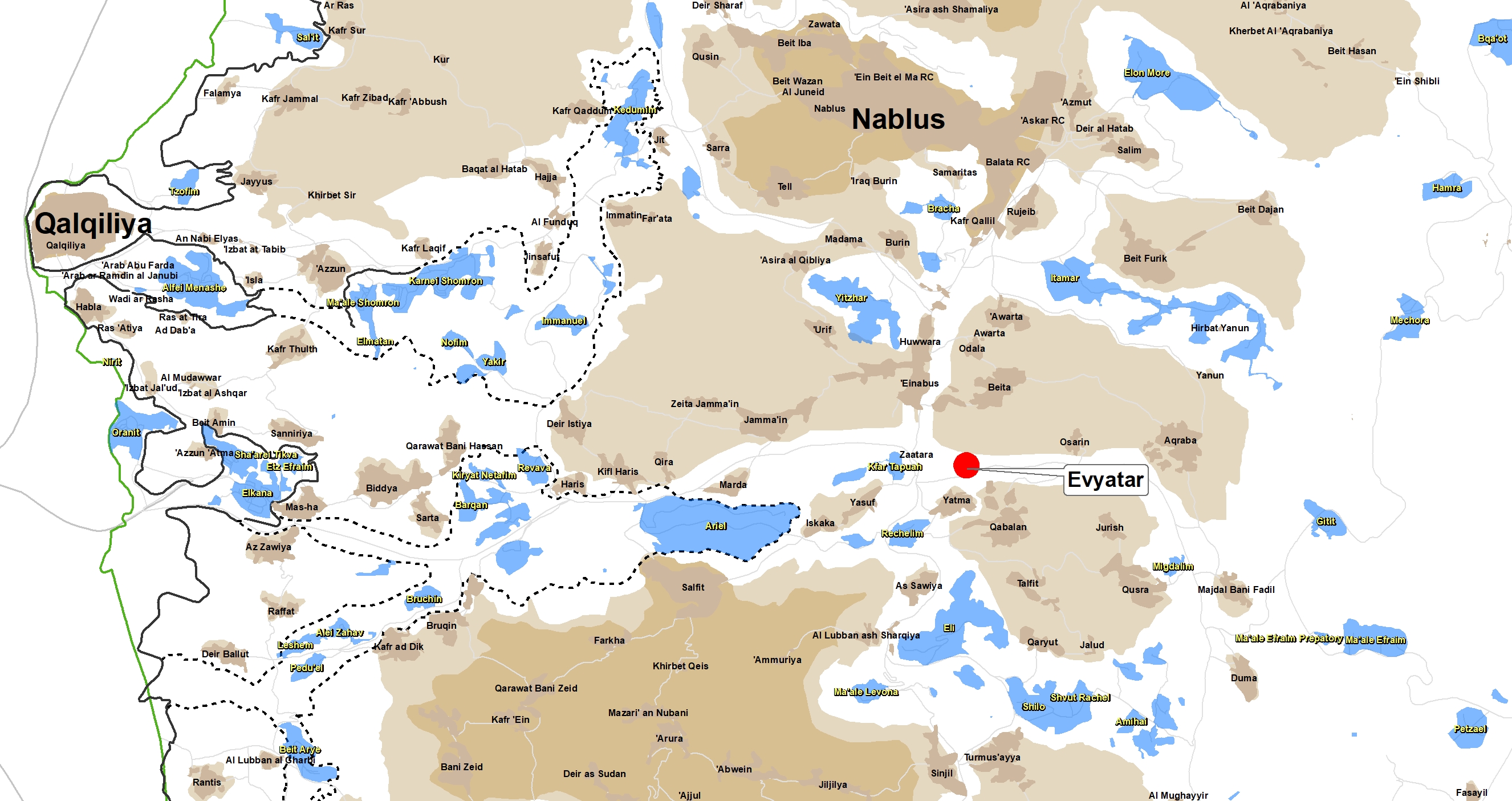
Map by Peace Now
Late last week, the settlers submitted plans – which outlined 100 housing units in addition to land for parks, a synagogue, a daycare center, and a school – to the IDF’s Civil Administration, in hopes of gaining retroactive legalization for the structures they already illegally built on the land. The plan framed the outpost as an extension of the nearby (but not contiguous) Kfar Tapuah settlement. This tactic – issuing retroactive approval to outposts under the premise that they are new neighborhoods of existing settlements – has in the past proven effective, and is a tactic promulgated by the Israeli government. For a few examples, see the following cases: the Adei Ad outpost, the Har Homa E settlement, Shvut Rachel East, and New Migron.
Speaking about the settlers’ hopes of gaining retroactive legalization of Evyatar, prominent settler leader and head of the Samaria settler municipal council, Yossi Dagan, said:
“The Council only submitted a request to authorize construction for the town of Evyatar after establishing beyond doubt that it is not situated on privately held land. Rather, it is situated on state-held land, and only the lack of a clear decision on the part of politicians is preventing its authorization. After going through such a difficult period, the State of Israel should be mobilizing all its forces to take this step, which would be both moral and ethical – it should be strengthening the 50 families who live here and giving Evyatar equal legal status to any other town in the country.”
Nonetheless, the Civil Administration (the arm of the Israeli Defense Ministry responsible for running the West Bank) rejected the settlers’ plans, based on the fact that the outpost was built illegally in blatant violation of Israeli planning laws. The military has also said the outpost undermines “security [and] stability” in the area. Further, the authorities said that the plan was not “properly developed” and that settlers do not have rights to the land. Following the Civil Administration’s rejection of their plans, Evyatar settlers plan to appeal to the Israeli High Court of Justice to stop the demolition, which is set for June 27th.
Notably, the Civil Administration’s rejection of the settlers’ plans for Evyatar does not mean that the IDF recognizes Palestinian ownership of the land, even though aerial photos obtained by the NGO Kerem Navot show that Palestinians cultivated the land at least until 1980. Rather, the IDF is now investigating the status of the land, leaving open the possibility that the land may be declared “state land” – at which point (based on past practice) it is a near certainty it would be allocated for Israeli settlement.
Peace Now also provides a key insight on the settler group which is behind the creation of this new outpost, and why it matters, writing:
“The body behind the establishment of the outpost is the settler organization of Nahala, with the close assistance of the Shomron municipality and its mayor, Yossi Dagan (a central member of the Likud party). The Nahala organization and the main activists of the new outposts are not the mainstream old-guard settlers (like the Amanah organization who is behind many other settlements and outposts and gets much more support from the authorities), however they are not a small fringe. This outpost is an example of a rift that is being created within the Israeli right wing. The more extreme right, which is willing to challenge the system more strongly, and the old-guard settlers who continue the mentality of working ‘with’ the government as much as possible. On the partisan level we see this rift in the creation of two different parties: Yamina, headed by Naftali Bennet, and the Jewish Zionism, headed by Betzalel Smotrich and Itamar Ben Gvir. The challenge of the new outpost puts the new shaky government, which is a coalition of parties which don’t agree about many things, to face its first big political test. The extreme right is signaling that it is planning to continue to challenge the new government, like it had done in the flags march in East Jerusalem, and in yesterday’s settlers’ marches throughout the West Bank.”
Peace Now called for the outpost to be expeditiously demolished, saying:
“A small group of people is creating facts on the ground that effect dramatically Israel’s security and its foreign policy without any authority. The new government must not accept that. This outpost must be evicted not only because it is deepening the occupation of the Palestinians in the West Bank but because it is bad for the security of Israel and bad for the possibility of future peace for Israel”.
IDF Demolish “Oz Zion” Outpost
On June 23rd, the Israel IDF dismantled an illegal outpost – called “Oz Zion” by the settlers – located between Ramallah and Jerusalem. The Times of Israel reports that the IDF removed more than 20 settlers and demolished several structures. Seven settlers were arrested for throwing objects at Israeli soldiers. This particular outpost has been built by settlers, and then demolished by the IDF, several times previously.
Opposition MK Bezalel Smotrich railed against the new government for its demolition of the outpost, saying:
“As we feared, within days of the formation of the government the destruction of communities has begun… Arab construction is out of control in the Negev, Galilee and Judea and Samaria and Bennett and [Justice Minister Ayelet] Shaked are choosing to demolish for Jews.”
As a reminder, Naftali Bennet once served as the head of the settler Yesha Council – which is effectively the main body lobbying the Israeli government on behalf of the settlement movement. That fact does not sit well with Kahanist MK Itamar Ben-Gvir, who said in a statement:
“The person who was once the director of the Yesha Council is now leading the demolition and destruction of the settlements. It is amazing that without blinking, Bennett approved the demolition of a settlement, at a time when he and his friends are making sure that there won’t be demolitions in the Bedouin sector. There is one law for the Bedouin, and a different law for the Jews. What an embarrassment.”
Gantz Orders Construction of Settler-Backed “Accessibility” Project at Tomb of the Patriarchs/al-Ibrahimi Mosque in Hebron
On June 10th, Israeli Defense Minister Benny Gantz gave instructions to COGAT – the body within the Defense Ministry which coordinates civilian affairs in the occupied territories – to issue a building permit and sign a contract for the construction of accessible infrastructure, including an elevator and wheel chair ramp, at the Tomb of the Patriarchs/al-Ibrahimi Mosque in Hebron. The project, which required Israel to seize land that is owned by the Islamic Waqf, strengthens Israeli control over the site and its immediate surrounding area.
The orders from Gantz follow a decision by the Israeli High Court of Justice to dismiss a petition against the plan filed by the Palestinian-run Hebron Municipality. The petition argued that the plan violates agreements, including the Hebron Protocols, signed by Israel specifying that the Palestinian-led municipality has planning authority over the site.
Emek Shaveh – an Israeli NGO with expertise in archaeology and settlement planning – also filed a petition against the plan, describing the plan as “unprofessional” and “a farce.” Emek Shaveh said previously:
“One need not be an archaeologist or architect to review the council’s plan and understand that it is destructive in a manner which is unprecedented. We are convinced that the plan, as approved, would never have been promoted had it not been driven by political motives.”
Emek Shaveh has previously provided critical context as to why this plan is not really, or not fully, being advanced out of humanitarian concerns, explaining:
“Israel’s decision to seize responsibility for the site from the Hebron municipality and the Palestinians sends a clear political message that Israel is reneging on agreements that were signed with the Palestinians in Hebron. Beyond the precedent that will enable the settlers in the future to demand additional changes at the Tomb of the Patriarchs/Ibrahimi Mosque, this is also a precedent that could play out at other sites under the responsibility of the Islamic Waqf. Experience has shown us that what begins in Hebron percolates into other places including Jerusalem. It begins with a seemingly rational demand to benefit the disabled or the general public and evolves into a new status quo. The expected change in Hebron has not escaped the attention of members of the Temple movement and they will know how to present their demands to the government. If Israel can repudiate agreements with the Palestinians in Hebron and expropriate land from the Waqf, it would seem that accepting what appears to be the far more modest demands by the Temple movement to pray or to walk about the Temple Mount complex freely is not so far-fetched. In the reality of Hebron and East Jerusalem, a change involving only several meters at a historic or holy place is not free of political considerations and often it is part of long-term strategy. While it is necessary to tend to the needs and interests of persons with disabilities, the extremists who presume to speak on their behalf must be prevented from forging Israeli policy, even if it is only a matter of a lift and an access path.”
Read Emek Shaveh’s full analysis here: “Humanitarianism Hebron Style.”
Settlers Ramp Up Battle for Area C with Provocative West Bank Marches
In recent years, Israel has increasingly treated Area C as indistinguishable from sovereign Israeli territory. In parallel, settler groups – most notably Regavim – have lobbied Israeli authorities to crack down on “illegal” Palestinian construction, claiming that Palestinians are trying to use “illegal” construction to “take over” Israeli land.
In line with this effort, on June 21st, hundreds of settlers participated in marches throughout friction zones in the West Bank, in an effort to push the newly sworn-in Israeli government to increase their persecution of Palestinian construction in Area C of the West Bank. In advance of the march, settler leaders (excluding Yesha Council head David Elhayani) released a joint statement saying:
“It is our duty to do everything legally passive to stop the savage Arab invasion of Area C to stifle Jewish settlement and establish facts on the ground. Together we will head out to explore the area, to occupy the space with our feet and demand that the authorities enforce the law in the area out of a deep belief that this land is ours.”
Making clear that the settlers have no sense of irony, one of the settler marches was held near the unauthorized Evyatar outpost – which the settlers built illegally and over which they are now engaged in a struggle with the government to prevent Israeli law from being applied to their (Jewish Israeli) illegal construction.
As a reminder, Area C accounts for around 60% of the West Bank. The Oslo Accords gave Israel complete control over Area C, and Israel for years has systematically denied Palestinians in Area C permits that would enable them to “legally” build on their own land. As a result, members of these communities have been forced to build without Israeli permits, and then face Israeli demolition orders, and demolitions, for having done so.
Settlers Raid Homes of Prominent Activists in Sheikh Jarrah
On Tuesday, June 22nd, a group of settlers attempted to force their way into three homes belonging to the El Kurd, Diab, and Qasem families – all of which are living under imminent threat of forced displacement – in the Sheikh Jarrah neighborhood of East Jerusalem. The families were able to prevent their entry.
Israeli MK Bezalel Smotrich and the head of Nahalat Shimon (the settler organization behind the campaign to displace Palestinians from their homes in Shiekh Jarrah) were among the group of settlers who tried illegally invade the homes and threatened the Palestinian occupants. Eventually, Israeli police calmly escorted the settlers away from the homes.
These home invasions followed one of the most violent days Sheikh Jarrah has seen in recent months. During protests against settler takeovers in the neighborhood on June 21st, 21 Palestinians were wounded including three who were hit with live bullets fired by the IDF and three Palestinians who were beaten. As a reminder – a recent investigative report revealed that a New York-based lawyer, Seymour Braun, is financially connected to settler efforts to displace Palestinians in Sheikh Jarrah.
Bonus Reads
- “’Silent intifada’: West Bank is at boiling point” (Ynet)
- “Israeli forces launch violent crackdown on protesters in Beita” (Middle East Eye)
- “Reality of a West Bank Outpost: Four Dead Palestinians and a Drone Spraying Tear Gas” (Haaretz)
- “Ariel University opens medical school in honor of Sheldon Adelson” (Arutz Sheva)
- “ Israel Stops Its Nighttime ‘Mapping’ Raids, but Constant Surveillance of Palestinians Continues” (Haaretz)
- “Amazon’s Investments in Israel Reveal Complicity in Settlements and Military Operations” (The Nation)
- “The Photos Exposing What Israel Is Trying to Hide” (Haaretz)
- “Israel’s Demographic Warfare Rages on Both Sides of Green Line. With One Difference” (Haaretz)
- “The Trilemma of Power, Aid, and Peacebuilding in the Israeli-Palestinian Context” (Middle East Institute/Dr. Carol Kasbari)
Welcome to FMEP’s Weekly Settlement & Annexation Report. To subscribe to this report, please click here.
March 11, 2021
- Al-Walajah is One Month Away From Potential Mass Displacement
- Regavim Moves to Cut Off Palestinians in Area C from Israel’s Power Grid
- New Report: “This Is Ours – And This, Too : Israel’s Settlement Policy in the West Bank”
- Bonus Reads
Comments/Questions? Contact Kristin McCarthy (kmccarthy@fmep.org)
Al-Walajah is One Month Away From Potential Mass Displacement
Ir Amim and Bimkom report that on March 8th the Jerusalem District Planning Committee rejected the most recent proposal for an outline plan for the Palestinian village of Al-Walajah – leaving 38 houses at risk of demolition next month (April 2021).

click to enlarge
The homes facing demolition are in the northern section of the village, where they were built by Palestinians (on their own private land) without the necessary permits from the Israeli government. Setting aside the fact that Israel rarely issues permits for Palestinians to build, these villagers have zero hope of obtaining the necessary permits given the fact that the Israeli government has refused to approve an official outline plan for the area – and without an outline plan, permits cannot be issued.
In an effort to overcome this obstacle, Palestinians, with the help of planning experts, initiated their own outline plan for this section of Al-Walajah in the hopes of getting it approved by Israeli authorities — to no avail. Israeli authorities have repeatedly refused to approve the resident-backed plan, and have also refrained from initiating their own planning process. The result: Al-Walajah’s residents were left in limbo – that is, until the Jerusalem District Committee, as part of a January 25, 2021 ruling against an outline plan proposed by residents, deemed the area in question — where Palestinians have lived for decades — an “agricultural area” where no building would ever be permitted.
Explaining why that ruling is significant, Ir Amim and Bimkom writes:
“The designation of areas as national parks, nature reserves, and/or green spaces is a common practice of Israeli authorities in East Jerusalem to suppress Palestinian planning and residential development while allowing for the seizure of their lands to serve Israeli interests. Although the planning committee dismissed the village’s outline plan for the purpose of ostensibly promoting nature conservation, plans for Israeli settlement construction in the same area on lands confiscated from al-Walajeh have all been advanced. This includes expansion of the Gilo neighborhood/settlement (to the east of the village), the al-Walajeh Bypass Road and the new settlement of Har Gilo West (see more below). Not only does this reveal the baseless nature of the committee’s claims concerning environmental considerations, but also underscores the rampant planning and housing discrimination leveled against Palestinians in Jerusalem. Likewise, the committee’s citation that the area’s traditional and historical agricultural assets must be preserved explicitly overlooks the village’s essential role in this centuries-old preservation. Continued cultivation of the land and conservation of the surrounding landscape is inextricably tied to the existence of the village and the close proximity of their homes to their agricultural lands.”
It’s also worth re-reading the brief synopsis of the saga provided in the report to understand the story of the 38 homes under present threat of demolition in the context of Israel’s decades-long campaign to make life in Al-Walajah untenable:
“After being uprooted from its lands on the Israeli side of the Green Line in 1948, al-Walajeh was rebuilt on village lands which remained on the West Bank side of the Green Line. In 1967, the northern section of the village was annexed to Israel and absorbed into Jerusalem. Today, this part of the village is a small community of roughly 150 homes, which were mostly built after 1967 and considered illegal by the Israeli authorities due to the impossibility of procuring building permits. Over the years, dozens of homes have been razed in the annexed part of the village. Since 2016, there has been a significant rise in the number of home demolitions in this area of al-Walajeh as a result of increased enforcement and penalization of building offenses in Palestinian residential areas in Jerusalem. More than 20 houses have been demolished in the past five years. While 38 homes currently face pending demolition orders, many others are at risk of receiving them, subjecting nearly the entire community to the threat of widespread demolition and displacement.“
Regavim Moves to Cut Off Palestinians in Area C from Israel’s Power Grid
On March 8th, the settler group Regavim filed a petition with the Jerusalem District Court seeking data that could shed light on the number of Palestinian homes in Area C of the West Bank that are connected to an Israeli power company (the East Jerusalem Electric Company). The Civil Administration has already rebuffed Regavim’s freedom of information request for the data, so Regavim has turned to the Court to force the issue.
Regavim reportedly wants to know how the East Jerusalem Electric Company received permission to connect to several Palestinian homes near the Efrat settlement, and whether there is an approved electricity plan that includes the Palestinian homes (which Regavim asserts were built illegally – i.e., without the almost impossible-to-obtain Israeli building permissions). A senior Regavim staffer made clear to Jewish Press that this initiative is about promoting total Israeli control over Area C.
This latest legal initiative from Regavim should be understood as part of the ongoing campaign — by settlers and the Israeli government — to entrench and expand Israel’s control over (and de facto annexation of) the entirety of Area C, which represents around 60% of the West Bank. Notably, in September 2020 the Israeli government allocated 20 million NIS ($6 million USD) for the newly created Settlement Affairs Ministry to survey and map unauthorized (by Israel) Palestinian construction in Area C (which Israel has been aggressively demolishing). This funding further empowers a domestic Israeli body to exert extraterritorial sovereignty over Area C – in effect, treating the area as land already annexed by Israel.
The Knesset has also repeatedly hosted forums to discuss the alleged (by settlers and their allies/advocates) “Palestinian takeover of Area C.” Consistent with this framing (which is predicated on the idea that Area C belongs to Israel and must be defended against Palestinian efforts to steal it), and pushed by outside groups, many members of the Knesset have criticized the Israeli government’s alleged failure to robustly “defend” Israel’s rights/ interests in Area C (e.g., preventing “illegal” Palestinian construction, preventing foreign projects that support Palestinians’ presence in the area, clearing out Palestinians, expanding settlements, consolidating state-built settlement infrastructure).
New Report: “This Is Ours – And This, Too : Israel’s Settlement Policy in the West Bank”
Two venerable Israeli NGOs – B’Tselem and Kerem Navot – released a new report entitled “This Is Ours – And This, Too : Israel’s Settlement Policy in the West Bank.” The report covers two main areas of interest:
- The ways by which the Israeli government has encouraged Jews to move to settlements, most importantly the financial incentives and benefits extended to individuals (like housing subsidies), as well as the settlements/industrial zones/outposts and business operating in the settlements (like tax benefits, grants, subsidies, land, etc).
- The spatial impact of two blocks of Israeli settlement: the first is the settlements encircling Bethlehem in the southern West Bank; the second is in the central West Bank including Ariel, Rehelim, Eli, Ma’ale Levona, and Shilo.
The report, which readers are encouraged to read in the context of B’Tselem’s recent position paper on Apartheid – concludes:
“While de-jure annexation of the West Bank may have been shelved, this is immaterial in practice – as the report demonstrates yet again. Construction and infrastructure work has recently been carried out in the West Bank on a scale not seen in decades. This large-scale development is designed to facilitate another significant spike in the number of settlers living in the West Bank, which settlement leaders predict will reach one million in the near future. This massive investment further entrenches Israel’s hold on the West Bank, clearly demonstrating the regime’s long-term plans. These include cementing the position of millions of Palestinians as subjects denied rights and protection, who are deprived of any ability to influence their own future and forced to live in disconnected, dwindling, economically suppressed enclaves. They are forced to look on as they are dispossessed of more and more land, while communities and infrastructure are built for Jewish citizens. Two decades into the 21st century, Israel appears more determined than ever to continue upholding and perpetuating an apartheid regime throughout the area under its control, well into the coming decades.”
Bonus Reads
- “THREAD “Israeli Army officers arresting children at the request of settlers. This is what occupation and apartheid look like.” (Twitter / Sarit Michaeli)
- “Palestinians appeal to Jordan, PA to prevent Israel from evicting them” (MEMO)
- “There’s no reason for Israel not to apply sovereignty over Judea and Samaria” (Israel Hayom)
- “Michaeli: No one thinks half a million settlers will be evacuated” (Jerusalem Post)
Welcome to FMEP’s Weekly Settlement & Annexation Report. To subscribe to this report, please click here.
February 5, 2021
- Pending Eviction of Palestinian Family in Silwan Delayed (at least briefly) by Israeli Court
- E-1 Settlement Remains on the Agenda
- The Numbers Prove It: Israel Systematically Denies Palestinians the Right to Build (on their own private land) in Area C
- Israel Hopes to Continue Procedure for Settlement Advancements Established Under Trump
- Bonus Material
Comments, questions? Email kmccarthy@fmep.org
Pending Eviction of Palestinian Family in Silwan Delayed (at least briefly) by Israeli Court
On January 31st, the Israeli Supreme Court issued an injunction delaying the eviction of the Palestinian Shweiki family from their longtime home in the Batan al-Hawa section of the Silwan neighborhood of East Jerusalem. The injunction is set to expire on February 8th, the day after the deadline set by the Court for the Shweiki family to respond to the latest filing by Ateret Cohanim, the settler organization that is seeking the family’s eviction. Ateret Cohanim is also seeking the eviction of some 84 additional Palestinian families (a total of 700 people) in Batan al-Hawa.
Israeli courts have repeatedly upheld Ateret Cohanim’s claim to own a large swath of land in the tiny Batan al-Hawa neighborhood – which now being litigated on a house-by-house manner with Palestinians attempting to remain in their homes. The most recent court ruling in favor of Ateret Cohanim was in November 2020. The group’s claim is based on having gained control of the historic Benvenisti Trust, which oversaw the assets of Yemenite Jews who lived in Silwan in the 19th century. In 2001 the Israeli Charitable Trust Registrar granted Ateret Cohanim permission to revive the trust and become its trustees, (following 63 years of dormancy). In 2002, the Israeli Custodian General transferred ownership of the land in Batan al-Hawa to the Trust (i.e., to Ateret Cohanim). Since then, Ateret Cohanim has accelerated its multifaceted campaign to remove Palestinians from their homes, claiming that the Palestinians are illegally squatting on land owned by the trust.
Palestinians have challenged the legitimacy of the Benvenisti Trust’s claims to the currently existing buildings, saying that the trust only covered the old buildings (none of which remain standing) and not the land, but the courts have so far rejected their argument.
Peace Now, the settlement watchdog group, said in a statement this week:
“We will not remain silent as the government helps settler groups, under the auspices of a discriminatory law, wage a racist struggle to evict Palestinian families from their homes, with the aim of “Judaizing” East Jerusalem. This will be a protest for justice, equality and morality. A direct line connects the corruption threatening Silwan and the corruption in Balfour. When our neighbors are in danger of displacement, it is our duty to stand up and prevent it.”
E-1 Settlement Remains on the Agenda
The Local Planning Committee of the Maaleh Adumim settlement has scheduled a meeting to discuss the E-1 settlement plan on February 14th, and has summoned the anti-settlement watchdog Peace Now to attend that meeting. Peace Now, along with Ir Amim and the Association of Environmental Justice in Israel submitted a formal objection with the Civil Administration against the E-1 plan in August 2020. While the Maale Adumim Local Committee does not have authority to approve the E-1 plan, the February 14th meeting is yet another step towards approval, which must be granted by the Israeli Civil Administration. The Civil Administration has yet to schedule its own discussion of the E-1 plan, but may do so at anytime.
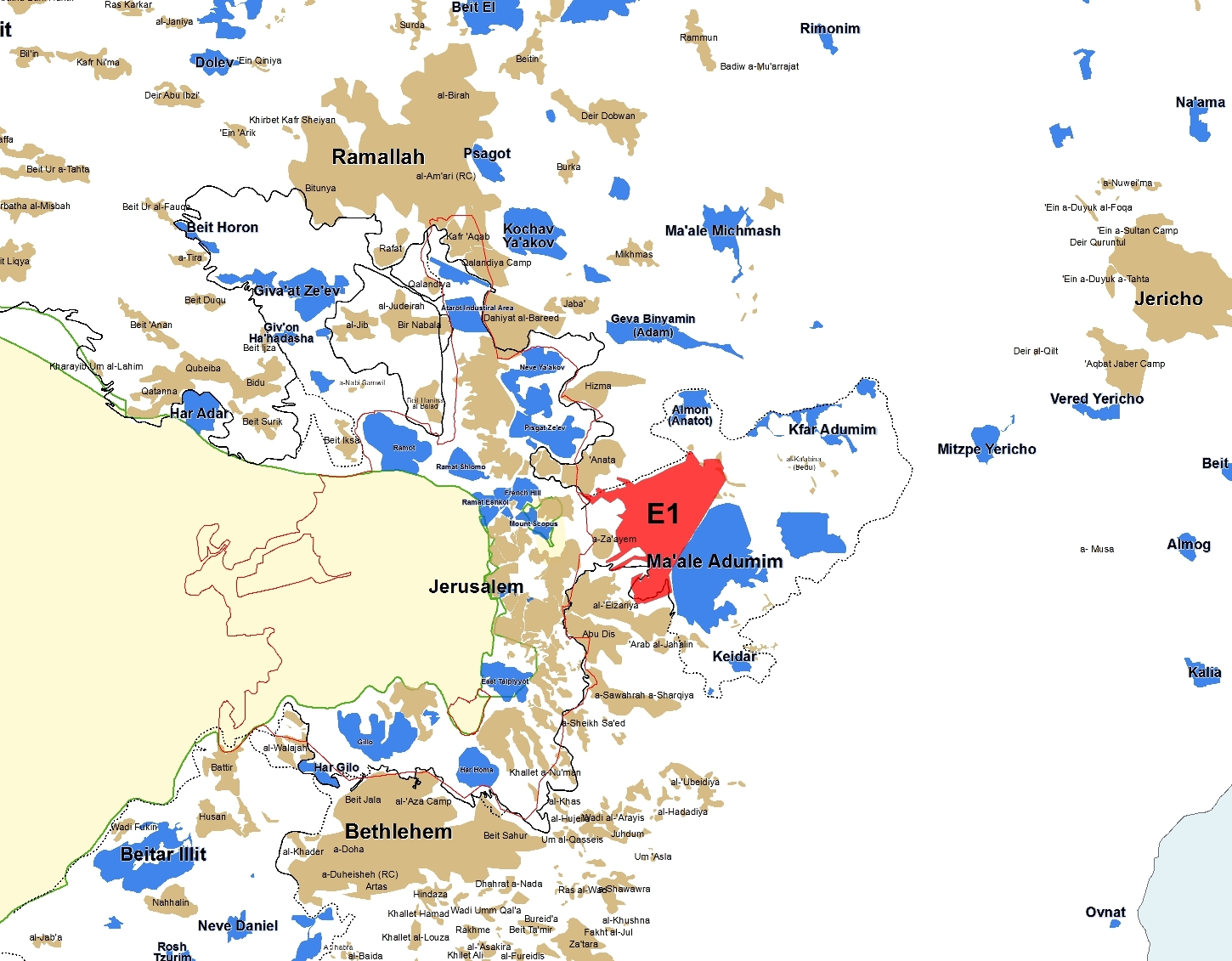 Long called a “doomsday” settlement by supporters of a two-state solution, construction of the E-1 settlement would sever the West Bank effectively in half, foreclosing the possibility of drawing a border between Israel and Palestine in a manner which preserves territorial contiguity between the northern and southern parts of the West Bank. The “Sovereignty Road” has long been Israel’s answer to that criticism, with Israel arguing that it will replace territorial contiguity with limited “transportational continuity” – via a sealed road that is under Israel’s total control (meaning they can cut off passage through it at any time). Just last month (January 2021), Netanyahu promised to increase funding for the Sovereignty Road as part of the drive to get E-1 constructed.
Ir Amim writes:
“Construction in E1 not only deals a death blow to the prospects of a sustainable Palestinian state with a capital in East Jerusalem, but will likewise lead to the displacement and dispossession of some 3,000 Palestinians living in Bedouin communities in the area, including Khan al-Ahmar.”
Regarding the petition, Peace Now said:
“Construction in E1 is considered essentially fatal to the prospect of a two-state solution because it divides the West Bank into two – a northern and a southern region – and prevents the development of the central Ramallah-East Jerusalem-Bethlehem metropolis in the West Bank. Even from an Israeli development and planning perspective, a settlement in E1 will do more harm than good and it may lead to the weakening of Jerusalem economically and socially.”
The Numbers Prove It: Israel Systematically Denies Palestinians the Right to Build (on their own private land) in Area C
In a new report based on data provided by the Israeli government, Peace Now documents how from 2019-2020, the Israeli Civil Administration approved plans for 16,098 new units for Israeli settlers in Area C, in addition to issuing construction permits for at least an additional 2,233 settler units. During this same period, Israel approved plans for only 265 units for Palestinian communities in Area C. The disparity in planning approvals and permits is not new, tracking with trends over the past decade. Peace Now data shows that from 2009-2018 just 98 construction permits for Palestinians were issued.
Israel’s refusal to allow for Palestinian construction in Area C is accompanied by Israel’s concerted effort to police and demolish “illegal” Palestinian construction there (reminder: when Israel refuses to issue construction permits, Palestinians are put in the position of having to build illegally to meet the population’s basic need for shelter). Peace Now data shows that from 2019-2020 Palestinians filed 313 petitions to stop demolition of structures in Area C. Israel only accepted ONE of those petitions.
These shocking (but not surprising) figures must be understood as part of the ongoing campaign — by settlers and the Israeli government — to entrench and expand Israel’s control over (and de facto annexation of) the entirety of Area C – some 60% of the West Bank. To that end, in September 2020 the Israeli government allocated 20 million NIS ($6 million USD) for the newly created Settlement Affairs Ministry to survey and map unauthorized (by Israel) Palestinian construction in Area C (which, as just noted, Israel has been aggressively demolishing). This funding further empowers a domestic Israeli body to exert extraterritorial sovereignty over Area C – in effect, treating the area as land already annexed by Israel.
The Knesset has also repeatedly hosted forums to discuss the alleged (by Greater Israel advocates) “Palestinian takeover of Area C.” Consistent with this framing (which is predicated on the idea that Area C belongs to Israel and must be defended against Palestinian efforts to steal it), and pushed by outside groups, many members of the Knesset have criticized the Israeli government’s alleged failure to robustly “defend” Israel’s rights/ interests in Area C (e.g., preventing “illegal” Palestinian construction, preventing foreign projects that support Palestinians’ presence in the area, clearing out Palestinians, expanding settlements, consolidating state-built settlement infrastructure).
Israel Hopes to Continue Procedure for Settlement Advancements Established Under Trump
As the Biden Administration continues to take shape, Israel Hayom reports that Israeli officials intend to propose maintaining the arrangement it had in place with the Trump Administration with regards to settlement planning and construction. Under that arrangement, Israel agreed to condense its settlement announcements into four tranches each year, and allowed the Trump Administration to review the plans Israel would be advancing ahead of time, with the understanding that the U.S. would tolerate some settlement activity. Although press reports regarding the Trump arrangement suggest that the U.S. also limited Israel’s ability to build freely in the West Bank by requiring new settlement construction to be adjacent to existing settlement construction (i.e. Israel cannot build anywhere), it in fact did no such thing.
As things stand today, it is not clear where the Biden Administration will end up on the issue of settlements. A report issued last week by the Washington Institute for Near East Affairs’ David Makovsky made the case for the Biden Administration to adopt a policy closely resembling the one Israel Hayom says Israel officials are asking for. Another report, issued a few weeks ago by the Center for New American Security (CNAS) articulates a similar policy as an “option” that the Biden Administration might consider.
FMEP’s Lara Friedman analyzed these recommendations and what they would mean, if adopted by the Biden Administration, in a detailed Twitter thread (part 1 here, Part 2 here), closing with the observation:
“…What’s being recommended is US shift from principled opposition to settlements (consistent with intl law, intl consensus, the principles on which the entire peace process is based, etc) to …[the] US giving a green light for unlimited settlement of parts of the West Bank, alongside continued *impotent* opposition to settlements everywhere else. History has demonstrated where such a policy leads, & it’s not to increased viability/credibility of the two-state solution. Or peace.”
Bonus Material
- “Webinar: Shrinking Space in Area C” (ELSC)
- “How Do You Say Ku Klux Klan in Hebrew?” (Haaretz // Michael Sfard)
- “The State Fills Israel’s High Court With Lies About Palestinians in the West Bank” (Haaretz // Amira Hass)