Welcome to FMEP’s Weekly Settlement & Annexation Report. To subscribe to this report, please click here.
January 22, 2021
- Cashing In Before Trump Cashes Out, PART 1: Israel Awards Tender for the Construction of Givat Hamatos
- Cashing In Before Trump Cashes Out, PART 2: Israel Issues Tenders for 2,572 Settlement Units
- Cashing In Before Trump Cashes Out, PART 3: In Final Hours of Trump Era, Israel Advances Plans for 780 Settlement Units Across the West Bank
- Netanyahu’s Bid for Mass Legalization of Outposts Fails (For Now)
- Bonus Material
Comments/Questions – email Kristin McCarthy (kmccarthy@fmep.org)
Cashing In Before Trump Cashes Out, PART 1: Israel Awards Tender for the Construction of Givat Hamatos
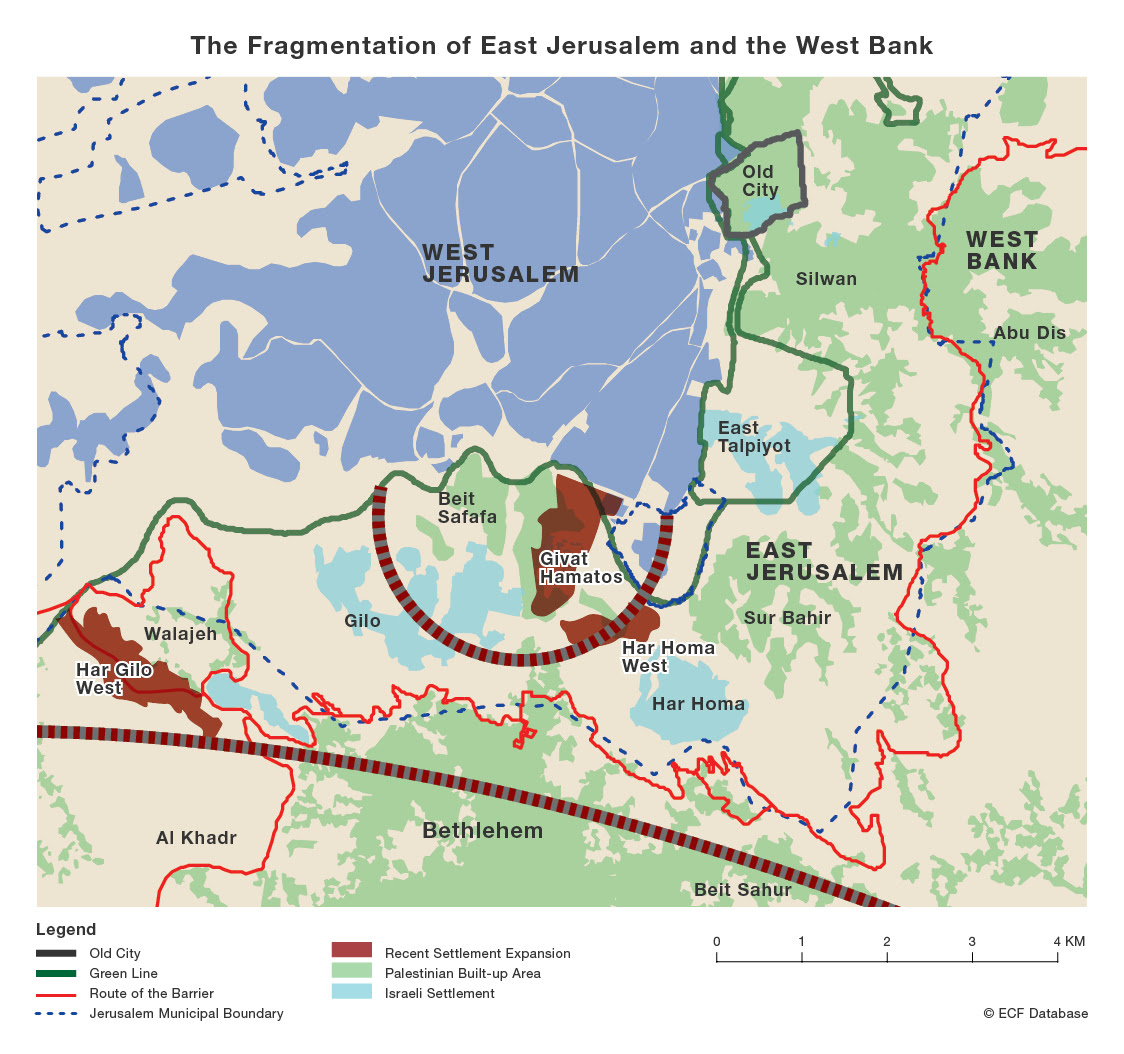
Map by Terrestrial Jerusalem
On January 19th, the Israel Land Authority issued the tender for the construction of the Givat Hamatos settlement in East Jerusalem (the tender is for a total of 1,257 settlement units). The issuance of the tender came a mere 6 hours before Joe Biden was sworn in as the President of the United States.
Prior to the issuance of the tender, the Jerusalem District Court rescinded its injunction against the tender, which the Court had issued last week in response to a petition filed by Palestinian residents of East Jerusalem and the Israeli NGO Ir Amim. That petition – which alleges that the planned construction of government-subsidized housing has discriminatory eligibility guidelines – is still pending, and the Court scheduled a discussion of the petition for May 27th.
According to Jerusalem expert Daniel Seidemann (of the Israeli NGO Terrestrial Jerusalem), now that the tender has been issued and awarded, construction of Givat Hamatos is now “virtually inevitable.” Givat Hamatos has long been regarded as a doomsday settlement by parties interested in preserving the possibility of a two-state solution, in that it will prevent the division of Jerusalem into an Israeli capitol and a Palestinian capitol (if the Givat Hamatos settlement is built, the Palestinian neighborhood of Beit Safafa in East Jerusalem will be completely surrounded by Israeli construction, severing its connection to the West Bank). Regardless of the implications of Givat Hamatos on a two state solution, the impact of the new settlement on the Beit Safafa neighborhood are nonetheless significant.
Explaining how Netanyahu bears direct responsibility for the highly consequential decision to move ahead with Givat Hamatos, Terrestrial Jerusalem writes:
“Netanyahu could have made this ‘go way’ at ZERO political cost to himself. He could have said truthfully: I tried, but the Court didn’t let me. Instead, he pulled out all plugs and instructed the State Attorney to aggressively pursue the rescission of the injunction. He went out of his way to make this happen. The tender process may now be completed, after which construction is virtually inevitable.This is happening because Netanyahu wants it to happen. This is happening now, because Netanyahu wants it to happen now.”
Ir Amim punctuates its analysis of the move by writing:
“The fact that the ILA hastened to announce the winners of the tender only 6 hours before Joe Biden’s inauguration serves to underline how determined the Israeli government is to create as many facts on the ground as possible before Biden takes office.”
Regarding the prospects of its petition against the Givat Hamatos tender, Ir Amim writes:
“The petition targets the conditions of eligibility for subsidized housing within the tender which discriminate against Palestinians. The petition does not call for cancellation of the tender but it remains to be seen how the petition will be viewed by the court and whether or not this will affect more than the specific discrimination present. One possible result of the petition – although we do not think its likelihood is high – can be that subsidized housing be completely removed from the tender in which case it is very possible that the tender will have to be reissued.”
Cashing In Before Trump Cashes Out, PART 2: Israel Issues Tenders for 2,572 Settlement Units
On January 20, 2021 – inauguration day in the U.S., the Israeli government issued tenders for the construction of 2,572 units (total) in settlements across the West Bank, as well in East Jerusalem. Now that the tenders are issued, construction companies are invited to bid to win the contract. Peace Now estimates that building is likely to happen within two years from now.
The issuance of these tenders comes in addition to the Givat Hamatos tender (see section above) and the advancement of plans for 780 more settlement units (see section below).
Commenting on the tenders, Peace Now said in a statement:
“Our out-of-touch government leadership continues to press on with its mad scramble to promote as much settlement activity as possible until the last minutes before the change of the administration in Washington. By doing so, Netanyahu is signaling to the incoming President that he has no intention of giving the new chapter in US-Israel relations even one day of grace, nor serious thought to how to plausibly resolve our conflict with the Palestinians.”
The 2,572 tenders issued on January 20 provide for:
- 941 units in the Emanuel settlement, located in the northern West Bank east of the Palestinian village of Qalqilya. Israel has openly declared its intention to continue expanding settlements in this area – which includes the settlements of Karnei Shomron and Alfei Menashe – with the stated goal of bringing 1 million settlers to live in the area.
- 460 units in the Pisgat Zeev settlement, the largest settlement in East Jerusalem. This involves the issuance of two tenders, one for 210 units and a second for 250 units.
- 377 units in the Adam (aka Geva Binyamin) settlement, through the issuance of three tenders, one for 94 units, a second for 263 units, and a third for 20 units. The Adam settlement is located northeast of Jerusalem, just beyond the separation barrier. Israel has for some years been steadily building the Adam settlement in a manner meant to connect the settlement seamlessly with East Jerusalem settlements and infrastructure, erasing the Green Line.
- 359 units in the Beit Aryeh settlement, located northwest of Ramallah, through the issuance of two tenders, one for 159 units and a second for 200 units.
- 220 units in the Maaleh Efraim settlement, located in the northern West Bank in the area between the central ridge and the Jordan Valley, through the issuance of three tenders, one for 24 units, a second for 178 units, and a third for 18.
- 150 units in the Alfei Menashe settlement, located in the northern West Bank east of the Palestinian village of Qalqilya. Israel is planning to continue expanding this area – which includes Karnei Shomron and Emmanuel – with the stated goal of bringing 1 million settlers to live in the area.
- 49 units in the Karnei Shomron settlement, through the issuance of two tenders, one for 48 units and a second for 1 unit). Israel also advanced plans for construction of 24 more units in the Karnei Shomron settlement through an earlier stage of the planning process (see the section below). Karnei Shomron is located in the northern West Bank east of the Palestinian village of Qalqilya. Israel is planning to continue expanding Karnei Shomron with the stated goal of bringing 1 million settlers to live in the area.
- 16 units in the Beitar Illit settlement. through the issuance of two tenders, one for 14 units and a second for 2 units). Beitar Illit is located west of Bethlehem, near the Green Line.

Cashing In Before Trump Cashes Out, PART 3: In Final Hours of Trump Era, Israel Advances Plans for 780 Settlement Units Across the West Bank
At its final meeting of the Trump era — which took place the day before Joe Biden’s inauguration — Israel’s High Planning Council advanced plans for 780 new settlement units. This includes final approval for plans for a total of 365 units plus the expansion of an industrial zone and approval for deposit for public review (one of last steps before final approval) for a total of 415 units, including retroactive legalization to two illegal outposts.
Commenting on the Council’s actions, Peace Now said in a statement:
“By promoting hundreds of settlement units, Prime Minister Netanyahu is once again putting his personal political interests over those of the country. Not only will this settlement activity erode the possibility for a conflict-ending resolution with the Palestinians in the long-term, but in the short-term it needlessly sets Israel on a collision course with the incoming Biden administration.”
Specifically, plans granted final approval by the Council include:
- 152 new units in the Shavei Shomron settlement, located in the northern West Bank, northwest of Nablus.
- 123 new units in the Itamar settlement, located southeast of Nablus in a cluster of notoriously violent settlements and outposts.
- 66 new units in the Oranit settlement, located in the northern West Bank, in the “seam zone” between the 1967 Green Line and the Israel separation barrier (a barrier constructed along a route designed to keep as many settlements and as much adjacent land as possible on the Israeli side of the wall/fence).
- 24 new units in the Karnei Shomron settlement, located in the northern West Bank east of the Palestinian village of Qalqilya. Israel is planning to continue expanding Karnei Shomron with the stated goal of bringing 1 million settlers to live in the area.
- Expansion of the Barkan Settlement Industrial Zone, located in the northern West Bank and a part of a strand of settlements connecting Israel proper and the Ariel settlement. Ariel is located in the very heart of the northern West Bank, reaching literally to the midpoint between the Green Line and the Jordan border. The future of Ariel and the settlements between Ariel and Israel proper have long been one of the greatest challenges to any possible peace agreement, since any plan to connect Ariel to Israel will cut the northern West Bank into pieces. For background on this industrial zone and others, see here.
Plans the Council approved for deposit for public review include:
- The retroactive legalization of 118 existing units in the Nofei Nehemia outpost. If implemented, this plan would have the effect of retroactively legalizing the outpost as a “neighborhood” of the Rehelim settlement, notwithstanding the fact that the Nofei Nehemia outpost is a fair distance from the Rehelim settlement and is not contiguous with the built-up area of Rehelim. In reality, Nofei Nehemia – if authorized – should be understood as a brand new settlement in its own right, rather than an expansion of an existing one (as the Israeli government wants the world to believe). The Nofei Nehemia outpost is located east of the Ariel settlement in the very heart of the northern West Bank. The Nofei Nehemia outpost made news this week with launch of a public bus route through the outpost – an overt act of entrenching and normalizing its presence by Israeli authorities.
- 107 new units in the Tal Menashe settlement, located on the tip of the northern West Bank, inside the “seam zone” between the 1967 Green Line and the Israel separation barrier, which was constructed along a route designed to keep as many settlements and as much adjacent land as possible on the Israeli side of the wall/fence. Tal Menashe is technically a neighborhood of the Hinanit settlement, though the built-up areas do not connect. The plans for 107 units would, if implemented, “dramatically increase” the size of the Tal Menashe settlement, which is the settlement where Esther Horgan – who was murdered by a Palestinian in late December 2020 – lived. Israeli government officials have made it a clear policy to advance settlement construction in response to deadly attacks on settlers by Palestinians, an approach publicly endorsed by U.S. Ambassador to Israel David Friedman.
- The retroactive legalization of 96 units in the Havot Yair outpost, with the intention of granting retroactive legalization (under Israeli law) to the entire outpost. The Havat Yair outpost is located near the Karnei Shomron settlement in the northern West Bank, east of the Palestinian village of Qalqilya. Israel is planning to continue expanding Karnei Shomron area with the stated goal of bringing 1 million settlers to live in the area.
Netanyahu’s Bid for Mass Legalization of Outposts Fails (For Now)
Despite an intensive last ditch effort, Netanyahu did not succeed in pushing through a government decision to grant retroactive legalization to dozens of outposts in the waning hours of the Trump era.
According to reports, Netanyahu made a last minute effort to gain Gantz’s support for a more narrow authorization – for 6 outposts instead of the 43 outposts as included in an earlier draft government decision. Gantz reportedly blocked Netanyahu’s proposal from coming up for a vote at the Israeli government cabinet meeting on January 19th, saying that “no diplomatically irresponsible proposal will be raised at such a sensitive time.” Other reports suggest European leaders intervened to make their objections to outpost authorization clear.
According to Haaretz, Netanyahu made several attempts to get the decision passed, including convening a call with Israel’s Attorney General to make progress. During that call Netanyahu complained that “jurists” were getting in his way. Netanyahu then surprised Gantz by adding the outpost issue to the Cabinet’s meeting planned for January 19th (a meeting devoted solely to the COVID-19 crisis).
The 6 outposts Netanyahu’s proposal reportedly listed for legalization are: Tel Zion, Ovnat, Metzoke Deragot, Kedem Arava, Avigail, and Asa’el. For more information on those outposts, see Peace Now’s reporting. Of those outposts, three would have been legalized as neighborhoods of existing settlements (Tel Zion, Ovnat, Metzoke Deragot), and three would have been authorized as full-fledged independent settlements (Kedem Arava, Avigail, Asa’el). Netanuyahu’s new proposal also called for the government to allocate over $6.2 million (NIS 20 million) to hire 13 new staff members at the Civil Administration tasked with continuing outpost legalization legal efforts.
FMEP has traced this saga for weeks – from the time when Likud and Blue & White officials were collaborating to draft such a decision, to last week’s news that Gantz decided to continue blocking the move despite a private meeting with settlers asking him to give his OK. It’s worth reiterating that Gantz has made clear he is not opposed to granting retroactive legalization to outposts, but is opposed to this manner of doing so. Gantz prefers for each outpost to be considered on an individual basis.
Bonus Material
- “A regime of Jewish supremacy from the Jordan River to the Mediterranean Sea: This is apartheid” (B’Tselem)
- “Al-Haq Welcomes B’Tselem’s Recognition of Israeli Apartheid” (Al-Haq)
- [VIDEO] “Calling the Thing by its Proper Name: “Apartheid” Between the Jordan River & the Mediterranean Sea” (FMEP)
- “Palestinian factory workers strike in West Bank industrial zone” (Al-Monitor)
- “West Bank demolitions and displacement | December 2020” (OCHA)
Welcome to FMEP’s Weekly Settlement & Annexation Report. To subscribe to this report, please click here.
January 15, 2021
- Tender for Givat Hamatos Settlement Construction Delayed
- Israel Expected to Advance Plans for (At Least) 684 Settlement Units, Grant Retroactive Approval to Outposts
- Netanyahu Promises to Boost Funds for “Sovereignty Road”
- Settlers Escalate Campaign for Outposts Legalization
- Israel Sets Up New Hotline to Assist Settler Surveillance of Palestinian Construction in Area C
- Key Quotes from U.S. Amb. Friedman on His Way Out the Door
- Bonus Reads
by Kristin McCarthy (kmccarthy@fmep.org)
Tender for Givat Hamatos Settlement Construction Delayed
On January 15th, the Jerusalem District Court issued a temporary injunction against the issuance of the tender for construction of 1,257 units in the Givat Hamatos settlement, slated to be built in East Jerusalem. Givat Hamatos has long been regarded as a doomsday settlement by parties interested in preserving the possibility of a two-state solution, assuming that Jerusalem will need to be divided and shared. If the Givat Hamatos settlement is built, the Palestinian neighborhood of Beit Safafa in East Jerusalem will be completely surrounded by Israeli construction, severing its connection to the West Bank.
Map by Terrestrial Jerusalem
The injunction comes in response to an emergency petition submitted on January 14th by 25 Palestinian residents of East Jerusalem with the assistance of the Israeli NGO Ir Amim. The petition argues that the conditions of the tender represent “severe housing discrimination” in that non-Isareli citizens are ineligible for the government subsidized housing planned for Givat Hamatos. Rather than seeking to stop the construction of Givat Hamatos, the petition asks the government to correct these discriminatory conditions so that Palestinian residents are also welcome to purchase homes in Givat Hamatos.
The tender was scheduled to be published on January 18th (2 days before the inauguration of Joe Biden as the new U.S. president). The injunction delays that publication and orders the government to respond to Ir Amim’s petition by January 21st.
Ir Amim explains the petition’s claims in detail:
“40% of the homes [planned for Givat Hamatos] will be allocated to individuals who are eligible for a government subsidized housing scheme. To qualify, individuals must be a non- homeowner and an Israeli citizen, which entirely precludes EJ Palestinians, as the vast majority do not hold citizenship but rather permanent residency. Not only are they excluded from an affordable subsidized housing option, but only 60% of the apartment supply offered to an Israeli citizen is available to a Palestinian resident, which discriminates on two planes. The petition therefore calls for the following remedies:
1 – to grant Palestinian residents eligibility to qualify for the subsidized apartments on Givat Hamatos,
2 – Instruct the state to consider equitably allocating a significant number of affordable apartments to Palestinian residents of Jerusalem,
3 – Postpone the apartment marketing process for a period of no less than six months to allow for interested Palestinian Jerusalem residents to apply for eligibility for the subsidized housing scheme, or
4 – To cancel the subsidized housing scheme and rather sell all apartments on the free market, making them accessible to all…
East Jerusalem Palestinians already suffer from acute housing shortages and suppression of residential development stemming from long-standing discriminatory planning and building policies. Since East Jerusalem’s annexation in 1967, not one neighborhood has been built for Palestinians, while only 8.5 % of Jerusalem is zoned for their residential use despite them constituting nearly 40% of the city’s population. 1/3 of the land in East Jerusalem was confiscated to build Israeli neighborhoods/settlements. If and when residential outline plans are approved for existing Palestinian neighborhoods, they only allow for a few hundred housing units versus thousands of housing units in Israeli neighborhoods across the city.”
Terrestrial Jerusalem’s Daniel Seidemann comments:
“This is far from over, and one can never estimate the life expectancy of an injunction like this, but this is very good news. As matters stand the tender process regarding Givart Hamatos will NOT end on January 18, and the bids will not open.”
Israel Expected to Advance Plans for (At Least) 684 Settlement Units, Grant Retroactive Approval to Outposts
The Israeli Defense Ministry’s Higher Planning Council (which oversees all construction in the occupied West Bank) is expected to meet on January 17th to advance plans for at least 684 – but potentially 850 or more – settlement units across the West Bank, while also advancing the retroactive legalization of two outposts. These approvals will come only days before the inauguration of Joe Biden as the new President of the United States, a changing of the guards expected to temper U.S. support and approval for settlement construction.
An additional report by Middle East Eye reports that on January 13th the Israeli planning authorities in Jerusalem advanced plans for 400 units in the Gilo settlement and 130 units in the Ramat Shlomo settlement, both located in East Jerusalem. FMEP will provide more details when those reports are confirmed.
FMEP will confirm the details of the Civil Administration’s High Planning Council meeting in next week’s Settlement Report. Based on what is known today, the settlement units expected to receive final approval include:
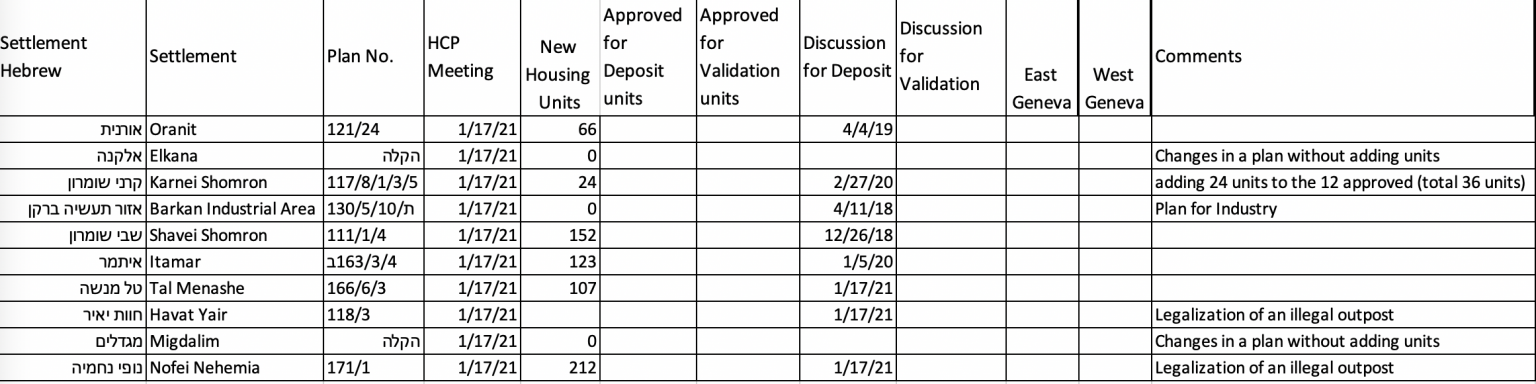
- 152 new units in the Shavei Shomron settlement, located in the northern West Bank – northwest of Nablus;
- 123 new units in the Itamar settlement, located southeast of Nablus in a cluster of notoriously violent settlements and outposts;
- 66 new settlements units in the Oranit settlement, located in the northern West Bank, in the “seam zone” between the 1967 Green Line and the Israel separation barrier (constructed along a route designed to keep as many settlements as possible on the Israeli side of the wall/fence);
- 24 new units in the Karnei Shomron settlement, located in the northern West Bank east of the Palestinian village of Qalqilya. Israel is planning to continue expanding Karnei Shomron with the stated goal of bringing 1 million settlers to live in the area surrounding the settlement;
- Expansion of the Barkan Settlement Industrial Zone, located in the northern West Bank and a part of a strand of settlements leading from Israel proper all the way to the Ariel settlement in the very heart of the northern West Bank, reaching literally to the midpoint between the Green Line and the Jordan border. The future of Ariel and the settlements between Ariel and Israel proper have long been one of the greatest challenges to any possible peace agreement, since any plan to connect Ariel to Israel will cut the northern West Bank into pieces. For background on this industrial zone and others, see here.
The settlement units slated to be advanced to the planning stage of depositing for public review include:
- The retroactive legalization of 212 existing units in the Nofei Nehemia outpost, which if implemented would have the effect of retroactively legalizing the outpost as a neighborhood of the Rehelim settlement. The Nofei Nehemia outpost is a fair distance from the Rehelim settlement and is not contiguous with the built up area of Rehelim, making Nofei Nehemia – if authorized – more properly understood as a brand new settlement rather than an expansion of an existing settlement (as the Israeli government would want one to believe). The Nofei Nehemia outpost is located east of the Ariel settlement in the very heart of the northern West Bank.
- 107 new units in the Tal Menashe settlement, located on the tip of the northern West Bank. Tal Menashe is technically a neighborhood of the Hinanit settlement, though the built up areas do not connect. Notably, the plans for 107 units would, if implemented, “dramatically increase” the size of the Tal Menashe settlement, which is the settlement where Esther Horgan – who was murdered by a Palestinian in late December 2020 – lived. Israeli government officials have made it a clear policy to advance settlement construction in response to deadly attacks on settlers by Palestinians, an approach publicly endorsed by current U.S. Ambassador David Friedmam. Tal Menashe is situated in the “seam zone” between the 1967 Green Line and the Israel separation barrier, which was constructed along a route designed to keep as many settlements as possible on the Israeli side of the wall/fence.
- An unknown number of units in the Havot Yair outpost with the intention of granting retroactive legalization (under Israeli law) to the entire outpost. The Havat Yair outpost is located near the Karnei Shomron settlement in the northern West Bank, east of the Palestinian village of Qalqilya.
Wasel Abu Youssef, a member of the Executive Committee of the Palestine Liberation Organization told Reuters:
“[Israel’s advancement of settlement construction] is an attempt to race against time and benefit from the last days of the current U.S. administration.”
Peace Now said in a statement:
“By promoting hundreds of settlement units, Prime Minister Netanyahu is once again putting his personal political interests over those of the country. Not only will this settlement activity erode the possibility for a conflict-ending resolution with the Palestinians in the long-term, but in the short-term it needlessly sets Israel on a collision course with the incoming Biden administration. For eight years as vice president, Biden and the rest of the Obama administration gradually became more irritated and willing to spar with Israel over settlements, and for the past four years Biden has watched Netanyahu stroke Trump’s ego to promote policies meant to undermine the very foundations for a two-state solution. Although supporting more settlement activity may be a shrewd way to attract votes over the increasing number of rivals to his right, Netanyahu is gambling with Israel’s all-important relationship with its US ally.”
It’s worth noting that current Israeli Defense Minister (and increasingly disgraced Blue & White party leader) Benny Gantz, following the publication of the High Planning Council’ agenda for settlement construction, announced that his office had taken “preliminary steps” towards the approval of Palestinian construction plans in communities located in Area C of the West Bank (some 60% of the West Bank which Israel exercises unilateral civil and security control over, and which is the focus of the most intense settler campaigns for de jure annexation). The Times of Israel reports that those plans include: the expansion of the Palestinian village of Al-Walaja (located south of Jerusalem and surrounded on three sides by the Israeli separation barrier), the expansion of Hizma (located on the northern border of the Jerusalem municipal boundary), approval of a new hotel in the Bethlehem area (note: Bethlehem itself is not in Area C), a hearing on plans for a hotel in Beit Jala (located on the eastern border of Bethlehem, 75% of land belonging to Beit Jala was designated as Area C under the Oslo Accords), and a hearing on the retroactive legalization of farming buildings in al-Fara (located in the northern West Bank). Commenting on Gantz’s announcement of these Palestinian plans, Bimkom researcher Alon Cohen-Lifshitz told told The Times of Israel:
“This is like mocking the poor. Most of the plans are from 2012. They’re all very small in terms of their land use and do not allow for [further] development.”
Predictably, settlers responded with vitriol to the rumor of plans to regulate (i.e., post-facto legalize) Palestinian construction in Area C. A spokesman for the Young Settlements Forum (“young settlements” is a new euphemism for illegal outposts that has been catching on in Israeli politics) said:
“There is no limit to this cynicism. The defense minister and the prime minister want to legitimize the illegal Palestinian takeover of Area C in violation of political agreements, and remove from the agenda the regulation of Israeli settlements that have been built on state land.”
Netanyahu Promises to Boost Funds for “Sovereignty Road”
According to the Jerusalem Post, Prime Minister Netanyahu has promised to allocate an additional $4 million USD (NIS 14 million) or more to the construction of the so-called “Sovereignty Road.” The road is a key element in Israel’s plan to build the E-1 settlement east of Jerusalem and its larger ambition to annex (de facto or de jure) a huge area of West Bank territory located between Jerusalem and Jericho.
According to the Jerusalem Post, Netanyahu met with Benny Kashriel, mayor of the Ma’ale Adumim settlement (located adjacent to the E-1 site), along with Transportation Minister Miri Regev and Finance Minister Israel Katz to discuss the matter this week. During the meeting, Bibi made the verbal commitment to allocating additional funds to see that the road is built.
Peace Now responded to the news:
“Netanyahu’s election campaign is costing Israel a very heavy price. Once again, he is using the election period to try to impress key Likud supporters by promoting a plan that could eliminate the possibility of a two-state solution. The planned road will allow Israel to cut the West Bank in two, build E1 and the separation barrier, and close the door on the possibility of developing a sustainable Palestinian state.”
For decades, construction of the E-1 settlement – which is now actively advancing through the planning process – has been adamantly opposed by the international community. A key criticism of the plan is that it would effectively cut the West Bank in half — thereby preventing any two-state solution. The “Sovereignty Road” has long been Israel’s answer to that criticism, with Israel arguing that it will replace territorial contiguity with limited “transportational continuity” – via a sealed road that is under Israel’s total control (meaning they can cut off passage through it at any time).
If built, a section of the Palestinian-only road is projected to run under the separation barrier (which is not currently built in this area). The rest of the road will run relatively adjacent to the route of the planned separation barrier, in order – in the words of former Defense Minister Bennet – to prevent Palestinian traffic from coming “near Jewish communities.” This new section of road connects to the infamous “apartheid road” (aka, the Eastern Ring Road) which has a high wall down the middle dividing Israeli and Palestinian traffic, and which was opened for Palestinian traffic in January 2019.
In March 2020, then Defense Minister Naftali Bennet gave final approval for the “Sovereignty Road” plan, at the time giving lip service to the idea that the plan will benefit Palestinians (even as it further cuts them off from Jerusalem, takes more land, and cuts the West Bank in half). At the same time, he made clear his real objective. stating:
“[the road] will improve the quality of life for residents in the area, avoid unnecessary friction [for Israelis] with the Palestinian population and most importantly — allow for continued [settlement] construction. We’re applying sovereignty [to the West Bank] in deeds, not in words.”
Peace Now has previously explained the issue with Israel’s design:
“The new road is intended to allow Palestinians to pass under the route of the separation barrier, and to travel ‘inside’ the Adumim Bloc along a wall without entering the ‘Israeli’ side, as in a kind of tunnel. Once the road is paved, Israel can then claim that construction in E1, and the construction of the barrier around the Adumim bloc does not sever the West Bank because the Palestinians have an alternative transport route. This argument is preposterous. A thin line of road connecting separate territorial sections–transportational contiguity–does not meet the needs for territorial viability for the development and livelihoods of Palestinians in the critical Ramallah-Jerusalem-Bethlehem metropolitan area. Without actual territorial contiguity, an independent Palestinian state cannot be established and prosper, and therefore a two-state solution cannot be reached.”
Settlers Escalate Campaign for Outposts Legalization
Kan radio reported that Defense Minister Benny Gantz told settlers that he remains opposed to issuing retroactive authorization to dozens of outposts in one fell swoop, but will instead prefers that each outpost go through a legal process individually in order to gain legalization.
Settlers have been encamped in front of the Prime Minister’s office for nearly two weeks demanding for the passage of a government decision for large scale retroactive legalization of as many as 70 outposts. That decision has been drafted but has been held up by Defense Minister Gantz; In December 2020, Knesset introduced a bill to circumvent Gantz’s opposition and grant authorization to 65 outposts.
Some of the protesting settlers began a hunger strike in hopes of escalating their demands for outpost authorization. Numerous politicians and officials have visited the encamped settlers to show solidarity, including aspiring Prime Minister Naftali Bennett visited the encamped hunger strikers, saying:
“Netanyahu, authorize the young settlements [outposts] now in these coming 10 days. If you don’t do it, when I am the prime minister, I will do it.”
Israel Sets Up New Hotline to Assist Settler Surveillance of Palestinian Construction in Area C
Haaretz reports that in November 2020 the Israeli Civil Administration (the body within the Israeli Defense Ministry tasked with coordinating all civilian affairs in the occupied West Bank) created a new hotline for settlers wishing to report their suspicions of “illegal” Palestinian construction in the West Bank (on the Kochav Ya’akov settlement website, the new phone service is called a “snitch line”).
Amira Hass reports in Haaretz that the Civil Administration’s announcement of the “snitch line” said:
“Have you seen Palestinian construction work that looks to you to be suspicious and unauthorized? Have you encountered a sanitation hazard created by Palestinians who disdain the law? From now on you have a ‘snitch-line’ of your own. Call at any hour of the day and submit a complaint about it. Every day there will be a summary of the complaints and a display of what was examined and what was confiscated in the event that there was improper conduct. Good luck.”
Testing whether the new hotline was exclusively for Israeli settlers reporting on Palestinians, the Palestinian-led NGO Haqel tried reporting illegal construction by the settlers. In response, the Civil Administration said that the “coordination office representatives sent someone to check what’s going on.”
The new hotline is yet another victory in the campaign by settlers to stop Palestinian construction in Area C, and push Palestinians out altogether. In November 2020, in addition to razing an entire Palestinian community, Khirbet Humsa, and tightening the noose on Khan Al-Ahmar – the Israeli government advanced plans to begin a land registration process in Area C as a means by which the state can declare more West Bank land to be “state land,” a way to retroactively legalize unauthorized settlement construction there (as well as put more land off limits to Palestinain construction and even render some existing Palestinian construction illegal).
Additionally, on September 10th the Israeli government allocated $6 million USD (20 million NIS) for the newly created Settlement Affairs Ministry to survey and map unauthorized (by Israel) Palestinian construction in Area C of the West Bank, which Israel – egged on by settlers – has been aggressively demolishing in an effort to rid the area of Palestinians. Haaretz reports that this is the first time that the state budget has included funds specifically for a land survey in the West Bank. The state also allocated an additional $2.8 million (9.5 million NIS) to an existing grant program specifically for settlement municipalities to cash in on. As a reminder, virtually all Palestinian construction in Area C of the West Bank is “unauthorized,” because Israel almost universally refuses to give Palestinians permission to build in Area C even on land that Israel recognizes as owned by Palestinians.
The Settlement Affairs Ministry is a new creation of the current coalition government, and is headed by Tzachi Hanegbi (Likud). The funding for the Settlement Affairs Ministry to conduct a survey of unauthorized Palestinian construction in Area C further empowers a domestic Israeli body to exert extraterritorial sovereignty over Area C – in effect, treating the area as land already de facto annexed by Israel. While technically the occupied territories are administered by the Israeli Civil Administration (a body within the Defense Ministry), Israel has spent decades bringing the administration of the territories (specifically the settlements and Area C) ever more directly under direct Israeli law (de facto annexation).
The Knesset has also repeatedly hosted forums to discuss “the Palestinian takeover of Area C.” Consistent with this framing (which is predicated on the idea that Area C belongs to Israel), and pushed by outside groups, many members of the Knesset have criticized the Israeli government’s allegedly lackadaisical approach to defending Israel’s rights/ interests in Area C (i.e., preventing “illegal” Palestinian construction, preventing foreign projects that support Palestinians’ presence in the area, clearing out Palestinians, expanding settlements, consolidating state infrastructure). Reportedly, Foreign Affairs Minister Gabi Ashkenazi (Blue & White) sent a letter to the committee in October 2020 specifically addressing the Knesset’s outrage over European humanitarian assistance projects for Palestinians in Area C. In the letter, Ashkenazi not only celebrated the reduction of European projects over the past year, but validated settlers’ insinuations regarding the nefarious nature of European assistance for Palestinians, saying that any European activity in the West Bank lacking Israeli permission is “an attempt to define a border.”
At one Knesset hearing, MK Bezalel Smotrich (Yamina) suggested that a solution could be to empower the settlements with the ability to demolish Palestinian construction they believe to be unauthorized. Smotrich’s partymate Ayelet Shaked (former Justice Minister) suggested that the government should appoint a project manager tasked with preventing a “Palestinian takeover” of Area C.
As noted above, Israel has long denied Palestinians the ability to build in Area C, resulting in many Palestinian structures (including homes, schools, farms, etc) being built without the required Israeli-issued permits. To fully understand what is happening, see B’Tselem’s excellent explainer.
Key Quotes from U.S. Amb. Friedman on His Way Out the Door
Please read the New York Times feature on David Friedman in its entirety, and the two separate threads (one and two) journalist David Halbfinger tweeted with supplemental material from the interview. A few key quotes regarding U.S. settlement and annexation policy over the past four years are copied below.
On internal Israeli annexation negotiations between Netanyahu and his government coalition partners:
“I was invited.”
On the future of Israel’s de jure annexation of West Bank land:
“They [Israel] can act unilaterally. It’s suboptimal, but at some point, it’s just sort of necessary just to move on.”
On how the U.S. settlement policy over the past four years:
“he agreed with the Israelis that they should build ‘from the inside out’ — to expand settlements ‘with the least amount of damage to the overall footprint. And that’s how they’ve been operating over the last four years’.”
On the opposition to settlement construction by previous U.S. administrations:
“just to kind of virtue-signal that we think the Palestinians should have something more, made no sense to me…[What Israel does inside or outside the settlements is] an internal decision.” And also on the idea of asking for a settlement freeze: “for them [Israel], I think a freeze of construction is the acknowledgment that the land doesn’t belong to them.”
On criticisms of the Trump Plan map:
“We spent months working on ways to achieve contiguity. You can drive from Hebron to Nablus and never see an Israeli. “I used to take the Midtown Tunnel to work every day. If you tell me that there’s a river, that I go under a river, I don’t know that. I never saw the river once. I drove under that thing for 30 years, never saw a river. So I take it on faith that there’s an East River. I’m just saying that we created enough contiguity so that Palestinians could go throughout the West Bank without ever coming face-to-face with the Israelis.”
On the role Israelis played in creating the Trump Plan and map:
“The editorial control was always ours. This was entirely authored by us and almost entirely conceptualized by us.”
On how to get Israelis to buy into future peace talks:
“Peace talks would only gain traction with the Israeli right, he ‘without the accusation that somehow it’s a thief and being asked to return things that it stole. Israel will not and should not come to the table on the basis of being an illegal occupier of stolen land’”
On the current status quo (in which Israel occupies the West Bank and blocakes the Gaza Strip):
“the status quo is not unsustainable, but I think the status quo is suboptimal and should be.”
On the dangers posed to Israeli democracy by permanent occupation:
“I don’t think it has anything to do with Israel’s democracy because Israel’s democracy is the function of the citizens, and these are not citizens of Israel.”
Friedman confirmed that the Trump Plan and normalization deals between Israel and the UAE and Bahrain held out the “aspiration” of a massive change to the status quo on the Temple Mount in which non-Muslim prayer would be allowed at all areas except Al Aqsa Mosque.
Dismissing any remaining doubt that normalization deals between Israel and Arab countries were contingent on Israel’s permanent suspension of annexation:
“I don’t think it would’ve been appropriate for Israel to, especially without the consensus of the Israeli population, to just give up territory permanently for any agreement with another country,”
He blamed the Israeli left for a tense moment in 2010 between then Vice President Biden and the Israeli government, when Biden arrived in Israel on the same day Isreal announced settlement construction plans:
“The reality here is whenever under the last administration somebody of significance came to visit, the Israeli left would immediately publicize whatever they could find in terms of settlement expansion, to create that friction,”
On his future plans:
“I’m going to stay American-only for at least four years. I want to give myself every opportunity to return to government.” And later, “Finally, there’s talk of his forming an Israel-based pro-settlement group. He hinted: ‘I will stay in the space somehow, but I just don’t know how,’ he said. ‘I’ll try to maintain a voice. I mean, it’s a huge drop-off when you no longer have access to the president’.”
Bonus Reads
- “[Webinar] ‘Raided and Razed’: West Bank Education under Attack” (FMEP & NRC)
- “‘Does someone have to die for West Bank outposts to be legalized?’” (Jerusalem Post)
- “Land of wine and honey? Israeli settlers export to UAE, to Palestinian chagrin” (Reuters)
Welcome to FMEP’s Weekly Settlement Report, covering everything you need to know about Israeli settlement activity this week.
To subscribe to this report, please click here.
July 3, 2020
- The [Purported] Israeli Counter-Proposal to the Trump Annexation Map
- De Jure Annexation Remains Imminent: Reports Say Trump to Make Final Decision Next Week
- U.S. Said to Ask for Israeli “Gesture” to Palestinians in Order to Approve Annexation Plan
- Settlers Continue Opposition to Trump Plan, While Pushing Bibi to Stop Delaying
- Settler Group Announces New Outpost Near Hebron
- Israeli Court Issues Ruling to Throw Sumreen Family Out of Their House
- Settlers Claim to Have Purchased an Illegally Built Palestinian Home in Wadi Hilweh, Silwan
- Israel Orders Demolition of Illegal Settler Structures Following Reversal of Regulation Law
- State Admits to High Court that Jerusalem Cable Car Project Will Require Confiscating Private Palestinian Land
- New Ir Amim Paper Looks at Jerusalem to Underscore the “Truth About Annexation”
- Bonus Reads
Comments/questions? Contact Kristin McCarthy (kmccarthy@fmep.org)
The [Purported] Israeli Counter-Proposal to the Trump Annexation Map
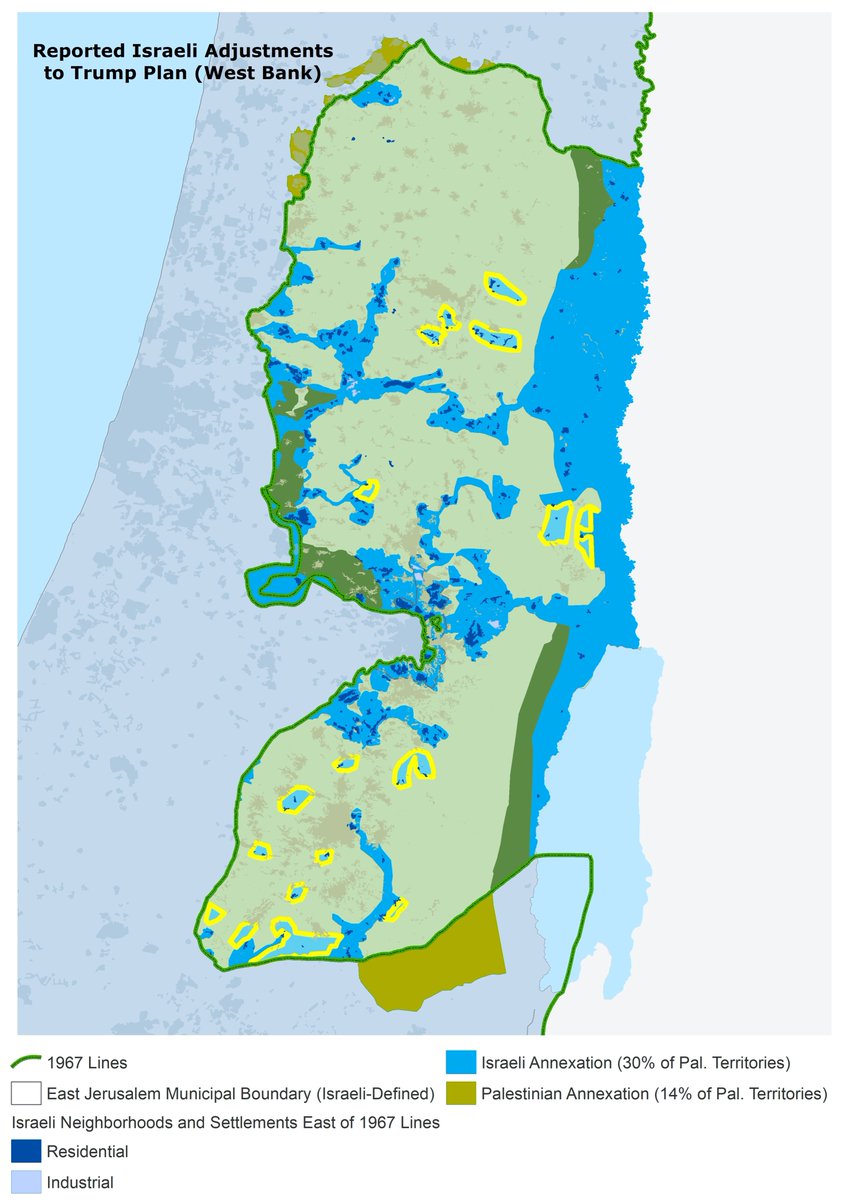 Israel’s Kan News published what it claims to be the Israeli government’s counter-proposal to the Trump annexation map. The reported counter-proposal adds a significant amount of West Bank land to the area Israel will annex, rendering even more severe the fragmentation of any future Palestinian state the plan is supposedly interested in seeing established. Specifically, the counter-proposal (which is exceptionally well explained by Israeli analyst and mapping expert Dan Rothem) achieves four main goals:
- It expands the channels of land which connect 15 far-flung outposts and settlements to what is today sovereign Israel. The Trump map connects these “enclaves” via narrow land corridors and roads (referred to by settlers as “balloons on a string”). The alleged counter-proposal annexes 2.7% more of the West Bank to enlarge those corridors.
- It provides for Israel’s annexation of about 20 additional settlements/outposts left out of the (initial) annexation provided for under the Trump Plan. These include the radical and violent settlement of Yitzhar and its outposts) located near Nablus, as well as the (relatively) nearby settlements Elon Moreh (and its outposts), Har Bracha (and its outposts), and Itamar (and its outposts). All of these settlements/outposts are, notably, located deep in the West Bank heartland.
- It proposes “compensating” Palestinians by designating an additional 4.6% of the West Bank — areas designated under the Trump Plan for Israeli annexation, comprised of West Bank territory where there are no settlers and some empty areas in the Jordan Valley/Judean desert — to (possibly) be under some degree of Palestinian control (without providing details on what would be the status of the land). (Reminder: Netanyahu said he will not annex a single Palestinian).
- The map also appears to propose population transfer, putting parts of the so-called Triangle Area — an area of densely populated towns located within Israel’s sovereign borders, inhabited by Palestinian citizens of Israel — into the area that could theoretically become a Palestinian state (assuming the Palestinians accepted the Trump Plan and satisfied a laundry list of conditions that no Palestinian leadership would ever accept — all to end up with an archipelago of territory that they might be allowed to call a “state” but that would have few if any actual attributes of sovereignty). Reminder: Forcible population transfer is a flagrant violation of international law (as is annexation of any scope); a government re-drawing its borders to deprive its own citizens of their rights, based on their ethnicity, is antithetical to democracy.
Additionally, while Israeli officials originally indicated that annexation would begin with the Jordan Valley, rampant reports indicate that the focus has now shifted to annexing elsewhere (settlement blocs) as the first stage of annexation. Perhaps responding to criticism over delaying the annexation of the Jordan Valley, Israeli Regional Cooperation Minister Ofir Akunis (Likud) told The Jerusalem Post that “of course” the Jordan Valley is included in Israel’s annexation plans [which should surprise nobody, given that politicians across most of the political spectrum in Israel came out in support of annexation of the Jordan Valley (including Benny Gantz), even before the Trump Plan].
So what is Netanyahu really thinking? According to Haaretz, he has not held discussions with his own Security Cabinet on the annexation plan, and the key Israeli bodies which will be involved in implementing annexation – the Justice Ministry, the Attorney General (whom Bibi is in open war with), the IDF chiefs, and Foreign Ministry – have not begun preparing for implementation.
De Jure Annexation Remains Imminent: Reports Say Trump to Make Final Decision Next Week
July 1st – the first day Netanyahu was permitted to bring annexation up for a vote in the Cabinet or in the Knesset, but by no means a deadline for such an action – came and went without an announcement. Reports almost immediately suggested that the annexation decision – reportedly delayed by U.S. demands and Israeli disunity.
After a week of meetings with Israeli leaders, National Security Council advisor Scott Leith and Middle East envoy Avi Berkowitz (who in the meetings were of course joined by US ambassador to Israel David Friedman) headed back to Washington. On Thursday, Berkowitz met with Jared Kushner in preparation for presenting their plan to the President. Despite the palace intrigue surrounding Kushner this week, Kushner plays a critical role in leading Trump a final decision on annexation, expected to come next week..
Though Trump has not been involved in any details of the annexation deliberations, Israeli Regional Cooperation Minister Ofer Akunis asserted that Israel will not act without a statement from Trump himself, telling the Jerusalem Post:
“[annexation] will only happen after a declaration by Trump.”
Following the departure of Leith and Berkowitz (Friedman remained in Israel), an anonymous U.S. official told the Jerusalem Post that the fact that July 1st came and went without an announcement does not mean that annexation is any less likely to happen. That official said:
“The administration is appreciative of the ongoing conversations and serious considerations that have gone into our recent discussions with the Israeli government.July 1 is not and has never been a US deadline, nor do we believe it is an Israeli deadline. We look forward to continuing the dialogue with our Israeli partners and working productively and in earnest towards implementing the president’s Vision for Peace in the Middle East.”
U.S. Said to Ask for Israeli “Gesture” to Palestinians in Order to Approve Annexation Plan
U.S. Amb. David Friedman, National Security Council advisor Scott Leith, and Middle East envoy Avi Berkowitz spent the past week in Israel, negotiating with Israeli Prime Minister Netanyahu and Alternate Prime Minister Gantz over the extent and timing of Israeli annexation of West Bank territory. Israeli press – particularly right-wing outlets – asserted that the Americans were pushing Israel to make a more significant “gesture” to the Palestinians in order to win American support (reminder: the Palestinian leadership has not been involved in negotiations at all).
Reportedly, the US suggested that such a gesture could consist of granting the Palestinian Authority greater control over the remnants of Area C left to the Palestinians after Israeli annexation — with Israel retaining the ability to “secure” those areas as-needed (essentially transforming a small part of Area C land into Area B).
The Jerusalem Post goes so far as to suggest that “many” of the conversations this past week focused on what the Palestinians will be given/offered/forced to accept, rather than the details of what/how/when Israel will annex. More than anything else, this suggests that the U.S. is not imposing limits on what Israel can annex.
Settlers Continue Opposition to Trump Plan, While Pushing Bibi to Stop Delaying
Worried both about the details of the Trump Plan and that Bibi will not pull the trigger on annexation at all, settler leaders and their allies continue their criticism of Netanyahu for every move (and non-move) he makes.
Two prominent settler leaders who oppose the Trump Plan – Yesha Council chairman David Elhayani and Samaria Regional Council chairman Yossi Dagan – continued lashing out at Netanyahu for his posture on issues of key concern to settlers (the creation of settlement enclaves, a settlement construction freeze, and the possibility of future Palestinian statehood) and for failing to act on July 1st. Dagan called the July 1st date “one big farce.”
Elhayani – who estimated that there is an 80% chance that there will be no annexation – told Walla News:
“Tying the lack of sovereignty [announcement] to Benny Gantz is a pathetic excuse..In reality, it is in the hands of the prime minister, who must accept responsibility for the decision, demonstrate leadership and say: ‘I have made this commitment to the electorate in two election campaigns, and I will stand by it’.”
Another group of settlers who are adamantly against the Trump Plan launched a new campaign targeting Netanyahu. The campaign, which was covered in the front page of the Israel Hayom paper, features photos of PA President Mahmoud Abbas, Joint List Parliamentary head MK Ahmed Tibi, and Netanyahu, and alongside the photos uses the slogan:
“They [Abbas and Tibi] will not decide. You’ve [Netanayhu] decided – Keep your promise.”
Another settler group – the Sovereignty Movement – put up billboards all over the country calling on Netanyahu to annex and to say “no” to a Palestinian state.
Former Defense Minister Avigdor Liberman (Yisrael Beytenu) put on a public display of his pointed displeasure with Netanyahu’s failure to advance annexation on July 1st. Visiting a vista overlooking the Palestinian Bedouin village of Khan al-Ahmar in the West Bank – which Netanyahu has long promised to demolish – Lieberman told the press:
“We’re meeting here at Khan al-Akhmar because this is part of the same pattern of behavior. For fourteen months, Netanyahu has been yelling about ‘sovereignty’, and the whole time he’s cheated his voters…Netanyahu has tricked everyone. He has no intention of applying sovereignty: not over Maale Adumim and not even in the Jordan Valley. He always manages to trick everyone, but it was clear to me that he is lying, just as he lied about Khan al-Akhmar.”
Former Justice Minister and Yamina party leader MK Ayelet Shaked told the Jerusalem Post that she believes Bibi has “given up on the Jordan Valley.”
Haaretz reports that settlers – both those who support the Trump Plan and those who want more than what the plan is offering – have been successfully working with U.S. evangelicals to pressure Trump to OK annexation. Netanyahu himself spoke at a high profile online event for Christians United for Israel, and Yossi Dagan was interviewed by the Christian Broadcasting Network. Efrat settlement Mayor Oded Revivi has been in private conversation with U.S. evangelical leaders.
A recent poll by the radical settler group Regavim found that only 30% of settlers supported the Trump Plan after they were told that it will require Israel to agree to the establishment of a Palestinian state. Additionally, 53% of settlers said they believe that Netanyahu will give in to pressure from Trump rather than stand his ground on issues under negotiation.
Settler Group Announces New Outpost Near Hebron
On July 1st, a group of about 500 settlers held a protest against the Trump Plan and announced their plans to establish a new outpost. The protest was held on a hilltop belonging to the Palestinian village of Halhul, near Hebron in the southern West Bank. One of the protests leaders, veteran settler activist Daniella Weiss, told Ynet:
“The Trump plan needs to be thrown in the trash. We came here to establish a settlement. Today everyone understands that the purpose of the plan is to establish a Palestinian state in the heart of Israel.”
Israeli Court Issues Ruling to Throw Sumreen Family Out of Their House
On June 30th, the Jerusalem District Court rejected an appeal by the Palestinian Sumreen family to stop the Jewish National Fund (JNF) from evicting them from the home of 60 years in the Silwan neighborhood of East Jerusalem. The Court gave the 18-member family until August 16th to vacate the property and ordered them to pay 20,000 shekels (about $5,800) to the JNF for legal costs. The Sumreen family is considering taking their case to the Israeli Supreme Court.
The Coalition for the Sumarin Family said in a statement:
“In the ruling, the court did not address the most important, fundamental point, which is that the house was taken in plunder. The JNF’s legal woes did not change the fundamental fact that the use of the Absentees’ Property Law to take over the house was done without good faith, as two government legal advisers and a government inquiry commission, determined”.
The Sumreen family home is located in the middle of what today has been designed by Israel “the City of David National Park.” The area is managed by the radical Elad settler organization, which for years has also been pursuing the eviction of Palestinians from the homes in Silwan. For nearly three decades, the Sumreen family has been forced to battle for legal ownership of their home, after the state of Israel, prompted repeatedly by the JNF, declared the Sumreen’s home to be “absentee” property. After that designation – which was not communicated to the Sumreen family – Israeli law permitted the state to take over the rights to the building. The state then sold the rights to the home to the JNF in 1991. The JNF has pursued the eviction of the Sumreen family ever since. Israeli courts ruled in favor of the Sumreen family’s ownership claims to the home for years, until a September 2019 ruling by the Jerusalem Magistrate’s Court granted ownership of the family’s home to the JNF, a decision the family immediately appealed to the Jerusalem District Court.
A full history of the saga involving the Sumreen family – which is similar to dozens of other Palestinian homes in Silwan that were declared Absentee Property in the 1990s – can be found on the Peace Now website here.
In a recent letter organized by Israeli academics, thirty-four Israel Prize laureates pleaded to the head of the JNF to stop eviction proceedings against the Sumreen family. The letter reads:
“The expulsion of the family, as part of a campaign to Judaize Silwan which has been going on for many years, will stain the reputation of the KKL … we beg of you to desist from taking actions that would be clearly immoral.”
This week, +972 Magazine published an illuminating article by a former staff member of the JNF, looking at the role the organization has played in advancing annexation policies on the ground for decades with evictions like the Sumreen case. IMEU also just published an excellent fact sheet about the Jewish National Fund.
Settlers Claim to Have Purchased an Illegally Built Palestinian Home in Wadi Hilweh, Silwan
On June 30th, a group of settlers invaded a vacant building in the Wadi Hilweh section of the Silwan neighborhood in East Jerusalem, saying that they had purchased the house from its Palestinian owners. Peace Now reports that the home was built by Palestinians years ago without an Israeli-issued permit (Palestinians in East Jerusalem are systematically denied permits to build on their own land). The family that had been living in the house left about four months ago after a demolition order was issued by the Jerusalem Municipality. 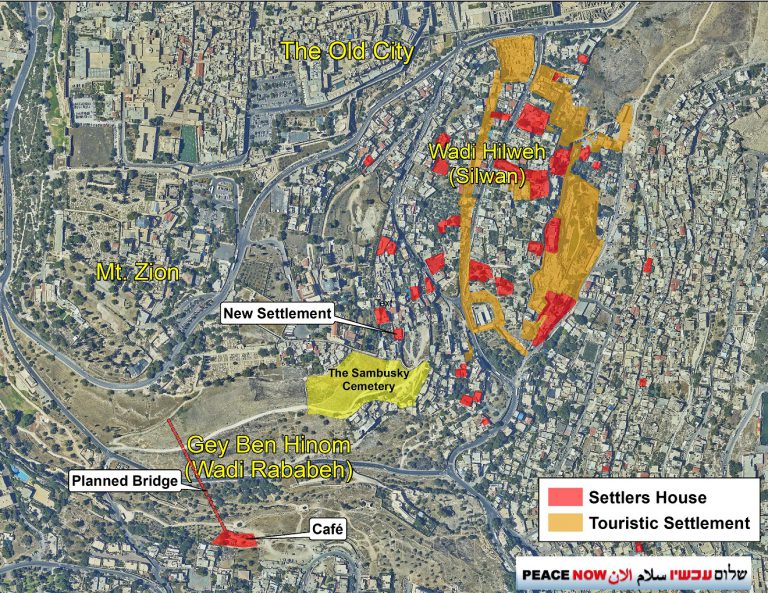
The house is located in the Ben Himmon Valley and very close to a Jewish cemetery that is currently being rehabilitated by the radical Elad settler organization. Elad has been involved in the systematic displacement of Palestinians from the Silwan neighborhood and has been weaponizing tourism and archaeology as a means by which to do so.
Peace Now explains:
“In recent years, the Elad Association, together with the Jerusalem Development Authority and the Nature and Parks Authority, has been intensively developing the Ben Hinnom Valley area leading to the Sambusky Cemetery in an attempt to produce Israeli territorial contiguity from the Sultan’s Pool area and Ben Hinnom Valley area through the cemetery toward Wadi Hilweh and the ‘City of David’ visitors’ center…The takeover of this house extends the settlers’ control in the southwest corner of Wadi Hilweh: In September 2014, the settlers entered a nearby house, and in January 2016 another house adjacent to it…All of these projects, along with the settlers entering the house yesterday, are intended to strengthen Israeli presence in this contested and occupied area, and thus make it more difficult for the territorial compromise in Jerusalem needed for a Palestinian capital in East Jerusalem and therefore the two-state solution itself. Tourism development projects in Jerusalem are one of the most significant ways of settlement, leading to both a change on the ground and in the public domain, as well as a change in Israeli attitudes by hardening them to the idea of this necessary territorial compromise.”
Israel Orders Demolition of Illegal Settler Structures Following Reversal of Regulation Law
In response to a petition filed by Yesh Din and Emek Shaveh, Israel has said it will demolish illegally built settlement structures on privately owned Palestinian land belonging to the villages of Dir Amar and Ras Karakar. Years ago settlers illegally installed tourist accommodations – benches, terraces, paths, picnic benches and a pergola – at the site of an ancient spring in this area, in an attempt to take control of the site known as Nabi Aner. Nabi Aner is part of an historic Muslim pilgrimage route between Hebron and Bethlehem. The entire area is located in Area C of the West Bank.
Israel’s announcement that it will demolish the structures (and, ostensibly, agree to return the site to Palestinian control), comes two weeks after the Israeli High Court of Justice overturned the Regulation Law, which sought to provide a basis for legalizing settlement structures built on land that even Israeli acknowledges is owned by Palestinians (as is the case with the site in question). The petition to demolish the settlers’ construction was filed in 2017, but was not considered by the Court until now, based on the argument that the Regulation Law – if it withstood Court scrutiny — might have provided the State a basis for retroactively legalizing the structures.
Emek Shaveh said in a statement:
“Over the years, the authorities in the area have refrained from enforcing the law with respect to illegal construction that was carried out on private land and around the archaeological site. In recent years, the State used the pretext of the Regularization Law as an excuse for continuing the policy of non-enforcement. This is an example of the importance of the nullification of the Regularization Law, which enabled settlers to take over private lands. But regardless of the Regularization Law and its nullification, we find it regrettable that we were forced to petition the court to instruct the State’s enforcement authorities to simply carry out their duties and prevent the settlers from illegally building on private Palestinian land. We regret that the State does not of its own accord enforce the law and stop the damage to archaeological sites and the process of severing Palestinians from access to their cultural and religious roots.”
State Admits to High Court that Jerusalem Cable Car Project Will Require Confiscating Private Palestinian Land
On June 29th, the Israeli High Court of Justice heard arguments concerning the Jerusalem cable car project, an initiative backed by the Elad settler group and advanced by the Israeli Tourism Ministry. During the hearing, the State admitted the implementation of the cable car project will require the confiscation of privately owned Palestinian land in the Silwan neighborhood of East Jerusalem. The cable car line is slated to terminate at the settler-run Kedem Center compound (Elad’s large tourism center currently under construction at the entrance of the Silwan neighborhood, in the shadows of the Old City’s walls and Al-Aqsa Mosque).
The cable car plan, touted by Elad and other supporters as a vital transportation project, is in reality intended to further entrench settler control in Silwan, via archeology and tourism sites, while simultaneously delegitimizing, dispossessing, and erasing the Palestinian presence there. Emek Shaveh and other non-governmental organizations, including Who Profits and Terrestrial Jerusalem, have repeatedly challenged (and provided evidence to discredit) the government’s contention that the cable car will serve a legitimate transportation need in Jerusalem, and have clearly enumerated the obvious political drivers behind the plan, the archeological heresies it validates, and the severe negative impacts the cable car project will have on Palestinian residents of Silwan.
New Ir Amim Paper Looks at Jerusalem to Underscore the “Truth About Annexation”
In a new policy paper, Ir Amim looks at how Israel’s annexation of East Jerusalem has played out since 1967. Ir Amim’s main points – and warnings regarding Israel’s imminent annexation of more West Bank land – are:
- Israel annexing Palestinian land, but not Palestinian people, who since 1967 have been classified as “permanent residents,” rather than being made citizens, like the Palestinians who remained inside the Green Line after 1948.;
- Since the moment of annexation of East Jerusalem, Israel has pursued policies meant limit the number of Palestinains in the area, including by driving Palestinians from East Jerusalem;
- Since the moment of annexation, Israel has attempted to take control of more and more land in East Jerusalem;
- The Absentees’ Property Law (1950) and The Law and Administration Ordinance (1970) have been Israel’s tools of choice to evict Palestinians from their homes and take their property in East Jerusalem, under the guise of legality;
- Israel has repeatedly attempted to expand the borders of the area it annexed to include nearby settlements.
Ir Amim writes:
“In order to understand the consequences of annexation it is pertinent to learn from the case of East Jerusalem which Israel unilaterally – and in contravention of international law – annexed. Since 1967 East Jerusalem has been subject to the Jerusalem municipality and to Israeli law. In the decades since 1967, Israeli policy in the city has been driven by massive settlement construction and consistent steps to reduce the city’s Palestinian population. The combination of these two methods is considered by Israel the key to solidifying its control over the annexed territory and to asserting its sovereignty. Examining Israeli policies in East Jerusalem can therefore teach us the dangers of what can take place if the current annexation plan of the Israeli government actually takes place.”
Bonus Reads
- “Annexation is Already Here” (Jessica Montell // The Times of Israel)
- “Fight Annexation on Moral Grounds” (Yehuda Shaul // Haaretz)
- “Quick Facts: Israel’s West Bank Settlement Enterprise” (IMEU)
- “Despite Talk of Annexation, Fewer Immigrants to Israel Moving to West Bank Settlements” (Haaretz)
- “Quick Facts: What is the Jewish National Fund” (IMEU)
Welcome to FMEP’s Weekly Settlement Report, covering everything you need to know about Israeli settlement activity this week.
To subscribe to this report, please click here.
December 14, 2018
- Israel Seizes on Palestinian Attacks as Pretense to Advance Settlement on Multiple Fronts
- The WZO Used Non-Existent Land Plots as “Collateral” for Loans to Build Illegal Outposts
- Israeli AG Freezes New Grants Program for Illegal Outposts
- At the Opening of New West Bank Highway Interchange for Settlers, Netanyahu Celebrates Erasing the Green Line
- Hanukkah Event Draws Political Support for Settlers’ Bid to Take Over Site in the Old City’s Muslim Quarter
- Huge Holes Open on Streets of Silwan…Above Settler Excavations
- Israel’s Top Court Slams State Rail Company for Moving Debris to Private Palestinian Land as Part of Plan to Build a Settlement Park
- Bonus Reads
Questions/comments? Email kmccarthy@fmep.org
Israel Seizes on Palestinian Attacks as Pretense to Advance Settlement on Multiple Fronts
Seizing on a series of deadly Palestinian attacks this week as his pretext, Prime Minister Netanyahu announced he will:
- retroactively legalize thousands of settlement structures and outposts;
- initiate a plan to build 82 new units in the Ofra settlement;
- build two new settlement industrial zones (one near the Avnei Hefetz settlement and one near the Beitar Illit settlement); and,
- implement a range of policies that collectively punish Palestinians in the West Bank.
In addition, the Israeli Ministerial Committee on Legislation (a committee within the Israeli cabinet that decides whether to give government-backing to Knesset legislative proposals) will consider supporting a bill written by MK Bezalel Smotrich (Habayit Hayehudi) which would allow the government to provide municipal services, like water and electricity, to some illegal outposts. The bill assumes the series of outposts will be retroactively legalized, an assumption based on the work to achieve that end spearheaded by settler leader Pinchas Wallerstein (who has his own history of ignoring the law).
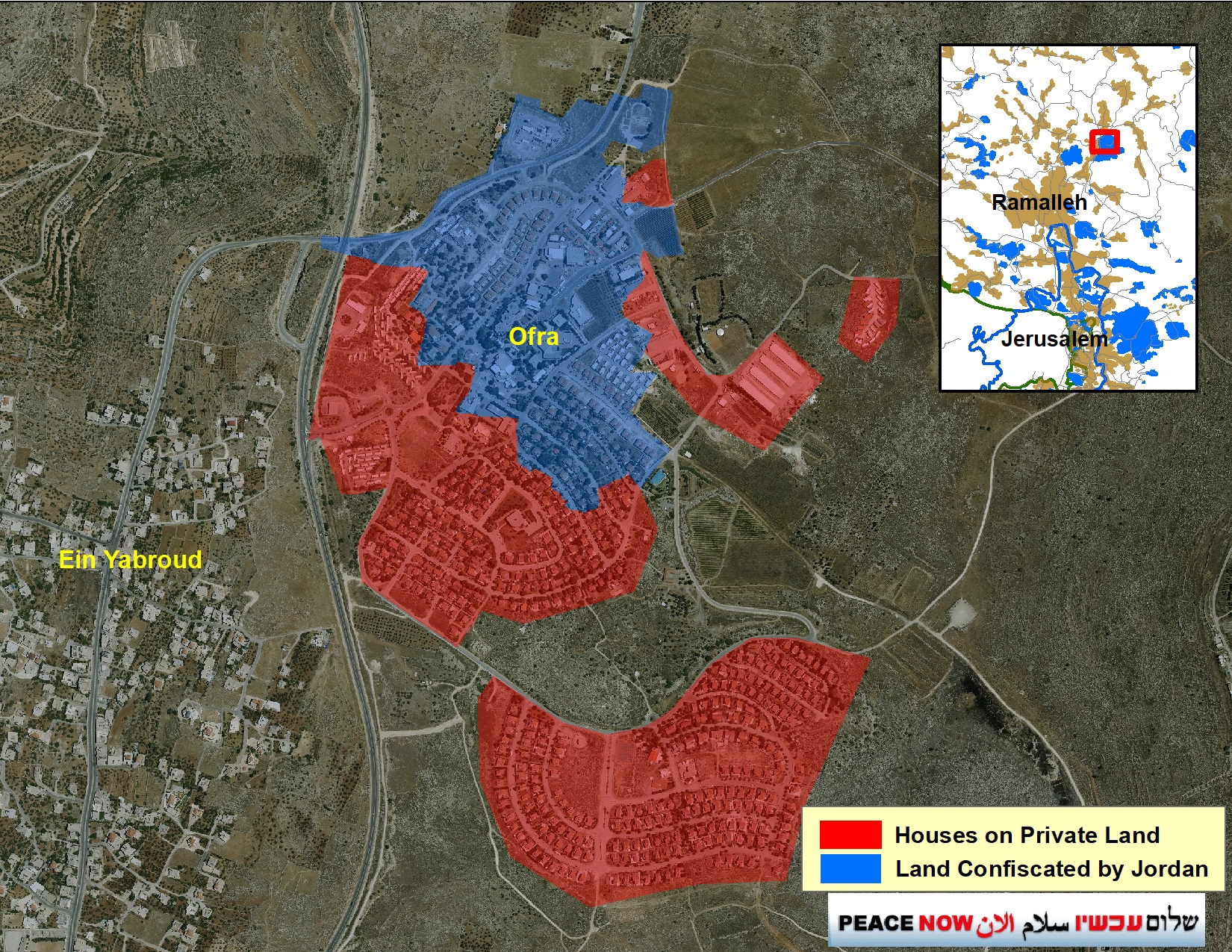 Many other senior Israeli officials joined Netanyahu in advocating for the immediate legalization of every unauthorized (i.e., illegal under Israeli law) structure in the Ofra settlement. The Ofra settlement – located northeast of Ramallah – was first established by settlers on land that had been expropriated in 1966 by the Jordanian government in order to build a military base (which was never built, as Israel took control of the West Bank in 1967). The Israeli government used this pretext to expropriate the land in 1977 in order to recognize the Ofra settlement, which had been established in the area illegally (i.e., without government approval, but with its tacit cooperation) two years prior. However, the majority of the Ofra settlement was not built on the land expropriated by the Israel in 1977, but instead on land that is registered to Palestinian owners from the nearby village of Ein Yabroud. In light of the legal status of the land, no Israeli government has yet been able to find a way to fix the legal status of these homes (not for lack of trying) – meaning that the majority of the structures in Ofra were built without permits, making them illegal under Israeli law.
Peace Now elaborates:
“Most of the houses built in Ofra (approximately 413 out of 625) were built on an area of 550 dunams of privately owned Palestinian land. In addition, hundreds of dunams of Palestinian private land were seized for roads in Ofra, as well as infrastructure and agricultural lands for the settlers. The only way to regulate the theft of these lands would be to expropriate them from the Palestinian landowners for the benefit of the settlers, in complete contradiction to the positions of previous Israeli governments and legal advisors, and contrary to binding rulings of the High Court. Although the current legal advisor (Avichai Mandelblit) allowed land expropriation in some places for settlement purposes (for example, in Haresha), in the regulation of massive land theft such as in Ofra the Israeli government would be crossing a new red line.”
Justice Minister Ayelet Shaked said that she already has a draft resolution and a legal opinion supporting retroactive legalization of Ofra. Shaked further threatened:
“Facing the price tag of Abu Mazen [Palestinian President Mahmoud Abbas], we pose our own price tag. Every terror attack will strengthen the settlement establishment instead of weakening it, and every potential attacker will know in advance that he will be considered responsible for strengthening settlements.”
Speaker of the Knesset Yuli-Yoel Edelstein vowed to push a plan through the Knesset to regulate Ofra, saying:
“The immediate answer to such an incident is to finally regulate Ofra, one of the oldest and most beloved communities. The 20th Knesset has been good and the Government has been positive towards the settlement enterprise. There have been important achievements and laws, but it’s not enough… I pledge to support the plan that will be formulated and advance it myself in the Knesset. This is our duty towards millions of citizens. The fate of Ofra must be the same as the fate of Petah Tikva.”
Yisrael Gantz, the new chairman of the Binyamin Regional Council, called for the:
“immediate approval of thousands of housing units… in order to deepen our roots here.”
The WZO Used Non-Existent Land Plots as “Collateral” for Loans to Build Illegal Outposts
The Israeli NGO Kerem Navot discovered more proof that the World Zionist Organization’s Settlement Division is directly financing the construction of illegal outposts with public funds — by providing loans to settlers based on non-existent assets, including fictitious plots of land in the West Bank. This reporting builds on previous revelations about the WZO’s complicity in illegal settlement construction on privately owned Palestinian land in the West Bank, including in the cases of the Mitzpe Kramim outpost and the Ma’aleh Rahavam outpost. Nonetheless, the Israeli government is rapidly advancing plans to hand over even more West Bank land to the WZO for settlement expansion.
On its latest findings, Kerem Navot founder Dror Etkes told Haaretz:
“This story exposes again the Settlement Division’s swindling ways and dirty dealings. [Like in the case of MK Bezelal Smotrich] who received a mortgage in the Kedumim settlement for a plot that doesn’t exist. It’s obvious from that and from the other cases that this is only the tip of the iceberg of a much broader practice.”
As a reminder, the WZO’s Settlement Division was created by the Israeli government in 1968 and is funded entirely by Israeli taxpayers. Its mandate is to manage West Bank land expropriated by Israel, in order to facilitate the settlement of Israeli Jews in the occupied territories. To make this possible, the Israeli government has allocated approximately 60% of all “state land” in the West Bank to the WZO’s Settlement Division [over the past 50 years Israel has declared huge areas of the West Bank to be “state land,” including more than 40% of Area C, where most of the settlements are located]. In addition, settlement and human rights watchdogs have repeatedly documented how the WZO’s Settlement Division has worked to take over additional land, including privately owned Palestinian land, in order to build more settlements.
Israeli AG Freezes New Grants Program for Illegal Outposts
Israeli Attorney General Avichai Mandelblit has reportedly frozen the implementation of a resolution, passed by the Israeli cabinet last week, designating three outposts as “national priority areas” for development. The resolution would direct enormous amounts of state resources to the outposts for construction.
Mandelblit wrote a letter slamming Housing Minister Yoav Gallant for bypassing the Attorney General in approving the resolution. According to Haaretz, Mandelblit had previously told the Housing Minister that the inclusion of settlements in the list of national priority areas needs to be thoroughly reviewed before the resolution was passed. Ignoring Mandelblit, Gallant advanced the resolution without a thorough review and without the permission of the government’s top legal official.
At the Opening of New West Bank Highway Interchange for Settlers, Netanyahu Celebrates Erasing the Green Line
Map by OCHA
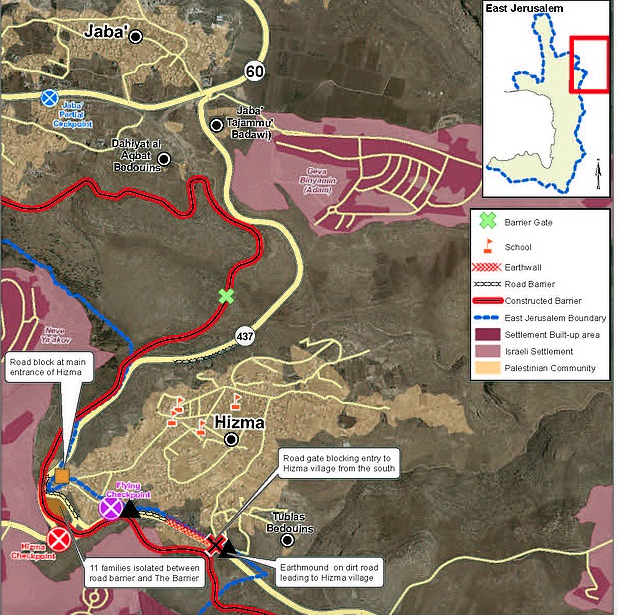
Israeli Prime Minister Benjamin Netanyahu attended a ceremony marking the opening of a newly renovated traffic interchange on Highway 60 (the main north-south highway in the West Bank). Located near the Adam/Geva Benyamin settlement and the Palestinian village of Hizma, the new interchange is meant to ease traffic congestion for settlers travelling to Jerusalem from the northern West Bank. More importantly, it advances the seamless integration of infrastructure serving Israeli settlements and sovereign Israeli territory – a key effort by settlers and their government allies to effectively erase the Green Line.
At the event, Netanyahu said:
“We are not stopping here. We will yet complete the paving of bypass roads, the widening of lanes and the improvement of infrastructures. There is a combined transportation-security aspect here. We are making yet another great link. While we are joining the country geographically, we are also joining the present to the future. Today and in this place we are doing something else, we are also joining the present to the past. Our ancestors walked here and took in this view of these valleys and these hills. The greatest dramas in the history of our people and of humanity took place here in this place; therefore, we are also joining our past to our future and this is a very great privilege.”
Minister Katz, who was also in attendance, said:
“We’re promoting a strategic plan on a very wide range with light rail routes at high-risk areas and traffic lights to make Judea and Samaria part of the Israeli norm of a developed and connected country…After we completed these two projects (Adam Interchange and Givat Assaf Traffic Light) we’ll work to enable this connection with a road with better conditions. This is part of the large and complementary projects to allow traffic to flow here.”
In September 2018, the United Nations Office for the Coordination of Humanitarian Affairs (OCHAS) released a report looking at the impact of Israeli roads on the the village of Hizma, as a case study of the effects road closures have on Palestinian rights. OCHA wrote:
“Hizma is a Palestinian village of over 7,000 residents in Jerusalem governorate. The bulk of its built-up area is in Area B but small parts of the village lie in Area C or within the municipal boundaries of Jerusalem, although it is separated from the rest of the city by the Barrier. Between 28 January and the end of March 2018, the three access roads into the village were either totally or partially closed to Palestinian traffic. The Israeli army hung posters on village shops stating that the army ‘will continue its work so long as you [residents] continue to be disruptive’. Other posters showed broken windshields. Following communications with the Israeli military, the head of the village council reported that the posters justified the closures as a response to stone throwing by Palestinian youths at vehicles with Israeli number plates. In 2017 and the first two months of 2018, OCHA recorded 11 incidents of Palestinians throwing stones at Israeli vehicles near Hizma that resulted in Israeli injuries or damage to vehicles.
The closures disrupted access by Hizma’s residents to services and livelihoods. Traffic between the north and south of the West Bank that passed through the village was diverted, undermining the commercial life of the village. Service providers, including a third of the teachers in village schools who commute on a daily basis, faced delays reaching the village. Over 50 shops/businesses that are the main source of income for 150 households were affected by the diversion of Palestinian traffic away from the village. Family life was also affected by the unpredictable nature of the closures.”
Hanukkah Event Draws Political Support for Settlers’ Bid to Take Over Site in the Old City’s Muslim Quarter
The Israeli archeological group Emek Shaveh reports that the Ateret Cohanim settler organization hosted a Hanukkah celebration – drawing the participation of the incoming Mayor of Jerusalem Moshe Lion, Minister of Jerusalem Affairs Ze’ev Elk, and the son of the Israeli Prime Minister, Yair Netanyahu – at the “Little Western Wall.” The site (which Israelis call the “Kotel Ha’Katan”) is a section of the retaining wall of the Temple Mount/Haram al-Sharif located within the Old City’s Muslim Quarter. It is viewed by some religious Jews as the closest point to the Holy of Holies at which Jews are permitted to pray. For historical background on the site and Ateret Cohanim’s role and goals related to it, see this 2016 report by Haaretz’s Nir Hasson.

Emek Shaveh writes:
“The recent Hanukkah ceremonies demonstrate an increase in political support for Ateret Cohanim and, no less important, the growing importance of the Little Western Wall, a politically and religiously charged place, attesting to a growing consensus among the Israeli Right regarding strengthening Jewish presence in areas immediately adjacent to the Temple Mount/Haram al-Sharif.”
Ateret Cohanim is a radical settler organization working to increase the presence of Israeli Jews living inside Palestinian neighborhoods of Jerusalem – including in the Old City, where the group recently succeeded in purchasing a Palestinian house in the Muslim Quarter (a property sale that continues to stoke controversy within the Palestinian community). Ateret Cohanim, along with their compatriots in the Elad settler group, also leads efforts to take over land and evict Palestinians from their homes in the Silwan neighborhood. Ateret Cohanim’s recent efforts in Silwan include using the guise of a Yemenite cultural center to build a new settlement in Silwan with government financing, and winning a High Court ruling that permits them to continue their campaign to evict 700 Palestinians from their homes.
Huge Holes Open on Streets of Silwan…Above Settler Excavations
 The Israeli archeological group Emek Shaveh reports that holes have begun appearing in the ground of Silwan, along the route of an underground excavation run by the Israeli Antiquities Authorities and funded by the Elad settler group. Elad has invested heavily in archeological excavations in Silwan in a campaign to co-opt the ancient history of Jerusalem to strengthen the Jewish hold on and presence in Palestinian neighborhoods in East Jerusalem. Emek Shaveh writes:
“There’s rarely a dull moment in Silwan. Last weekend, after the rain came, large holes opened up in the ground. This is not normal. And no amount of cement poured into the holes will make it so. Perhaps the reason for this odd occurrence can be found in the fact that Israel Antiquities Authority is excavating a tunnel along an ancient Roman road which runs right underneath the places where the holes opened up. There are 15 houses along the route of the tunnel. In some of them cracks have shown up. Others have shown signs of sinking into the ground. A few months ago we asked the Antiquities Authority to examine the homes and were assured the engineer would look into it. We’re still waiting for answers.”
The new holes are just the latest in a long series of above-ground damage related to excavations which the Israel Antiquities Authority (IAA) started in 2013. The IAA began the excavations without notifying Palestinian residents of the project. Palestinians began complaining about the work when cracks began appearing in their homes, threatening their structural integrity, and forcing many to leave their homes.
Emek Shaveh has repeatedly asked the IAA to investigate the issues caused by the excavations, but has not received an answer to date. Emek Shaveh also shared footage of Israelis haphazardly attempting to fill in the new holes with concrete.
Israel’s Top Court Slams State Rail Company for Moving Debris to Private Palestinian Land as Part of Plan to Build a Settlement Park
The Israeli High Court of Justice sharply criticized Israel Railways, the state rail company, for moving debris on to privately owned Palestinian land in the West Bank, as part of a plan to use the debris to develop a new park in the nearby Nili settlement. The debris comes from tunnelling a path for the Tel Aviv to Jerusalem rail line, meaning the debris was transported from sovereign Israeli territory into the West Bank, where it was deposited on Palestinian land.
Back in 2011, the Court chastised Israel Railways for its actions and ordered the debris to be removed. Seven years later, the Palestinian land is still a dumpsite while the Israeli government and Israeli Railways bicker over who is responsible for clearing the refuse. This week the Court rebuked the company and hinted that it would soon issue a ruling against it.
Bonus Reads
- “Q&A with Naftali Bennett” (The Forward)
- “A Plan for Perpetual Conflict” (Carnegie Endowment)
- “The New Capital of Israel” (Haaretz)
- “Annexation Legislation is Imminent, and Dangerous” (Commanders for Israeli Security)
- “Forged Jerusalem Home Sale Gets Jordan’s Attention” (Al-Monitor)
Welcome to FMEP’s Weekly Settlement Report, covering everything you need to know about Israeli settlement activity this week.
To receive this report via email, please click here.
April 20, 2018
- Israeli Police Assist Settlers in Taking Over Three Palestinian Apartments in East Jerusalem
- Palestinians Petition Civil Administration to Evacuate Squatting Settlers from Hebron Compound
- Bibi Govt Proceeds with Effort to Strip High Court of its Powers
- IDF Aids Settlers in Closing Off Key Road to Palestinians
- $120 Million Investment into Jordan Valley Communities, Including Settlements
- Settlers Assault IDF & Terrorize Palestinians in Nablus Area
- Americans for Peace Now: “From Creeping to Leaping: Annexation in the Trump-Netanyahu Era”
- Bonus Reads
Comments, questions, or suggestions? Email Kristin McCarthy at kmccarthy@fmep.org
Israeli Police Assist Settlers in Taking Over Three Palestinian Apartments in East Jerusalem
On April 9, 2018, Israeli police officers assisted settlers in evicting three Palestinian families from apartments in the Silwan neighborhood of East Jerusalem, making way for the settlers to move in. The take-over seemed to have happened prematurely, since the family that owns the apartment units – the Ruweidi family – filed an appeal with the Court that had not yet been heard. The High Court ordered a temporary delay on the eviction order, but the delay was issued too late and the settlers had already emptied out the apartments. According to Haaretz, the apartments will remain empty until further notice from the Court.
In February 2018, the Jerusalem District Court ruled that the property rightfully belongs to the radical settler group Elad, which claims to have bought it from one member of the Ruweidi family, Raziq Ruweidi. The Ruweidi family disputes the court’s decision, saying that the properties were jointly owned by six other family members and therefore could not have been lawfully sold. The matter wound up in court after Raziq Ruweidi was murdered three years ago, leaving debts that the Israeli courts had to settle.
As documented in previous editions of the FMEP settlement report – here, here, here, and here – the Elad settler group frequently works with the Israeli government and the courts to accomplish its goal of erasing the Palestinian presence in East Jerusalem in favor of Israeli Jews, including cooperation on major projects like the touristic Kedem Center in Silwan and the cable car line that will service it.
Palestinians Petition Civil Administration to Evacuate Squatting Settlers from Hebron Compound
Three weeks after settlers broke into and took up residence in the “Zaatari Compound” in Hebron, the Palestinian al-Zaatari family filed an appeal this week with the Israeli Civil Administration to have the law-breaking squatters evacuated. The settlers – who were reportedly given permission to enter the property by the IDF and Defense Minister Lieberman – claim to have legally purchased the properties. A lawyer representing the al-Zaatari family wrote in the petition that claim “has no basis in reality, since my clients and/or their representatives never sold their ownership rights in their homes.” The court has
Like hundreds of Hebronites, the al-Zaatari family was forced to leave the home during the Second Intifada due to the IDF’s suffocating restrictions on the freedom of movement of Palestinians in and around the Old City of Hebron, conditions which persist today.
Peace Now released a statement saying:
“The ink has not yet dried in the High Court of Justice’s decision to evacuate the Abu Rajab House, where settlers also broke into and squatted, yet the settlers dare to break into another house without the same approval they lacked in that case. The government must evict the trespassers immediately; the settlers have not proven any ownership. The behavior of the government and recent statements by the defense minister raise the suspicion that this home invasion was carried out in coordination with the defense ministry, and that the government lent a hand to breaking the law and stealing. Instead of protecting the landowner’s rights, the government is helping robbers seeking to take possession of the property without allowing the current owners their rightful legal avenue to prove ownership. The establishment of a new settlement house in the heart of Hebron is a severe blow to the fragile situation in Hebron and is liable to cause new restrictions on the movement of Palestinians.”
Bibi Govt Proceeds with Effort to Strip High Court of its Powers
It was decided by the the Israeli government’s ruling coalition this week that the next Knesset – which opens on April 29 – will vote on legislation aimed at stripping the High Court of its power to strike down laws passed by the Knesset. At the weekly cabinet meeting, Prime Minister Netanyahu and Finance Minister Moshe Kahlon agreed to form a “small ministerial committee” to try to bridge various proposals to restrict the High Court’s power to overturn laws – a move that could impact the fate of (among other things) the Regulation Law.
Notably, Attorney General Avichai Mandelblit was permitted to attend the cabinet meeting to present his opposition to most serious of the proposed versions — the Netanyahu-backed model, according to which laws could be overturned only by a unanimous vote in the High Court; Kahlon’s issue-specific formulation, seeking to allow the Knesset to overturn the High Court decision vis-a-vus a single piece of legislation, related to African asylum seekers; and a version, backed by Justice Minister Ayelet Shaked and Education Minister Naftali Bennet, allowing the High Court to be overruled by a simple majority vote in the Knesset. Mandelblit recommended his own version — one that would require a super-majority vote by the High Court (7 of 9) to strike down a law, and would allow the Knesset to overturn such a decision by the High Court by a super-majority of 70 votes.
Netanyahu and Transportation Minister Levin (Likud) rejected Mandelblit’s proposal, and said that the High Court should only be able to strike down laws by a unanimous vote (meaning that it would be highly unlikely that the Court would ever succeed in striking down any law). Following the cabinet meeting, Levin also specifically took issue with Khalon’s version of the bill (which seeks to create a unique exception for the Knesset to overturn the High Court’s ruling against a law related to the detention and deportation of African asylum seekers). Making clear his real objectives and concerns (and making explicit the connection to settlements), Levin told reporters that this version is:
“significantly erroneous and will lead to striking down laws, including the Regulation Law (legalizing Israeli outposts in the West Bank).”
You can follow the key events regarding the progression of this legislation via FMEP’s recently published resource, “Israel’s Creeping Annexation Policies.”
See this Haaretz overview for more even more detail.
IDF Aids Settlers in Closing Off Key Road to Palestinians
Haaretz reports that the IDF is contributing to the efforts of settlers from Halamish, a settlement located north of Ramallah, to restrict Palestinian access to a critical highway along which the settlers recently established a new unauthorized outpost.

Map by Kerem Navot
According to testimonies collected by Haaretz, IDF soldiers at two military roadblocks near the settlement and the new outpost have been conducting prolonged searches of Palestinian vehicles and buses headed for Ramallah via road 450. The vehicles and their passengers are regularly delayed and harrassed. One Palestinian recounts a soldier reportedly admitting that the actions are meant to incentivize Palestinians to take a detour around the area of the settlement and outpost (which is a longer route). In addition, settlers have repeatedly posted – and the IDF has repeatedly removed – a sign on the road that reads:
“The area where you are now is under the control of the Jews. Entry by Arabs to this area is completely prohibited, danger of death!”
Months ago, Halamish settlers started a Saturday morning prayer event in the middle of the road (between the settlement and the outpost on the other side). In cooperation with the settlers, IDF soldiers have been shutting down all Palestinian traffic and guarding the settlers during the prayer event.
The settlers intent has long been clear. By sealing off Palestinian access to the road, it will become an interior road between the settlement and the new outpost, effectively expanding the boundaries of Halamish at the cost of Palestinians.
The Halamish settlers established the outpost – which they call “Yad Ahi” or “My Brother’s Hand” – in July 2017, following the brutal murder of four of the settlement’s residents by a Palestinian attacker. Since then, the settlers have worked determinedly to fortify and expand the settlement to include the outpost and more, as extensively documented by the Israeli NGO Kerem Navot.
$120 Million Investment into Jordan Valley Communities, Including Settlements
The office of the Prime Minister announced a $120 million grant program for infrastructure projects in Israeli communities in the Jordan Valley. According to The Times of Israel, the budget earmarks $7 million to “help local farmers acquire more agricultural land and locate additional water sources and to build affordable homes for first-time buyers through the Housing Ministry Program.” One Israeli business news outlet reports that this is an “aid program for settlements in the Dead Sea area coping with the problem of sinkholes.”
Some 11,000 settlers and 65,000 Palestinians live in the Jordan Valley – the latter facing severe restrictions on land use and freedom of movement, and lack of access to municipal services like water and electricity.The current Israeli government has publicly and repeatedly demanded complete Israeli sovereignty over the Jordan Valley in the context of any peace agreement (meaning that any future Palestinian state would be entirely encircled by Israel, having no international border with any other nation). One Likud MK, Sharren Haskel, recently unveiled a bill to annex the Jordan Valley. Haskel is seeking government backing for the bill before formally introducing it in the Knesset.
A recent report by B’Tselem documents how Israeli settlers were allowed to establish two new outposts in the Jordan Valley last year. In recent months, Israel has delivered eviction notices to entire Palestinian communities near Israeli settlements in the Jordan Valley. Simultaneously, settlers have been allowed to continue construction on a tourist project – a car race track built in a closed military zone (land expropriated from Palestinians ostensibly for security purposes), despite a court ordered stop-work order.
Settlers Assault IDF & Terrorize Palestinians in Nablus Area
Three settlers were arrested for throwing stones at IDF soldiers engaged in the evacuation of an unauthorized outpost near the Itamar settlement, south of Nablus. The outpost – called “Rosh Yosef” by the settlers – has been evacuated several times before, but settlers have repeatedly re-occupied the hilltop site. The settlers, one of whom is a minor, were released a day later and put under house arrest.
The evacuation comes against the backdrop of frequent attacks perpetrated by Israeli settlers in the Nablus area recently. Last week, settlers allegedly set the entrance to a mosque on fire and spray painted the building with anti-Arab, anti-Muslim threats. On April 18th, settlers destroyed at least two dozen olive trees and spray painted hateful words on houses in the village of Urif. The Ynet news outlet reports that the radical and violent “Hilltop Youth” settler group is responsible for most of these crimes, noting that its members are increasingly outraged by outpost demolitions, fixated on calls for “revenge” against Palestinians following terrorist attacks, and resentful of recent criminal punishments levied against their members as a result of the Shin Bet’s crackdown on the group’s criminal activities.
Americans for Peace Now: “From Creeping to Leaping: Annexation in the Trump-Netanyahu Era”
Americans for Peace Now published a new policy paper analyzing how “the Israeli right has launched an unprecedented drive to annex the West Bank, piecemeal or in its entirety” since the inauguration of President Donald Trump. The paper “lays out the recent developments that present a quantum leap in Israeli annexation efforts, analyzes these moves against the historical backdrop of Israel’s 50-year occupation of the West Bank, examines the ramifications of the transition from ‘creeping’ to ‘leaping’ annexation, and considers why this transformation is happening now.”
FMEP’s recently published resource, “Israel’s Creeping Annexation Policies” is being updated to include several items from APN’s excellent work.
Bonus Reads
- “Israel and Annexation by Lawfare” (Michael Sfard, The New York Review of Books)
- “How Israel’s Government is Aiming to Outweigh the Supreme Court” (Haaretz)
- “Attempts to ‘bypass’ Israel’s High Court will create a ‘tyranny of the majority’ ” (+972 Mag)
- “As Israeli pushes for West Bank railway, Palestinians brace for more land grabs” (Middle East Eye)