Welcome to FMEP’s Weekly Settlement Report, covering everything you need to know about Israeli settlement activity this week.
To subscribe to this report, please click here.
August 11, 2022
- Israel Completes Secret Registration of New Land in East Jerusalem
- Israel Asks Court to Stay Out of Homesh Outpost Case on Promise to Evacuate Settlers (Eventually)
- IDF Removes Settlers from Ramat Migron Outpost
- This Week in Area C: Continued Annexation & Harassment
- Not Just Area C: Settlers Eye Archaeological Site in Area B
- Update: Israeli University Defends Excavation Near Nabi Saleh
- New Analysis of “Silicon Wadi” Project
- Bonus Reads
Israel Completes Secret Registration of New Land in East Jerusalem
Israel Hayom reports that Israel has succeeded in secretly registering State ownership of 16 dunams (four acres) of land in East Jerusalem, opening the possibility for constructing a new settlement enclave there.
The Israeli Justice Ministry secretly completed the acquisition of the land after the Israeli Custodian General hired researchers tasked with finding evidence that the land was purchased by Jews in the 1920s as part of a larger land purchase, though this part of the land was not registered. A court recently accepted new evidence found by the researchers, resulting in the land being placed under the control of the Israeli Custodian of Absentee Property on a temporary basis, while the State searches for the Jewish owners (or their heirs).
The newly-registered land is surrounded by Palestinian neighborhoods, close to the West Bank barrier (which in this location is an actual wall) to the East – with Abu Dis on the far side – and the Palestinian neighborhood of Jabal al-Mukhaber to the west. According to Haaretz, the location is considered one of the most sensitive in East Jerusalem, due to its proximity to the building designated as the future home of the Palestinian parliament and its distance from other Jewish neighborhoods.
This land is south of the area where that has been planned for the settlement called Kidmat Tzion, though this plan has been frozen. In 2017 (during the Trump-Netanyahu era), Ir Amim reported that Kidmat Zion was one of nine Jerusalem area settlements that Israel planned to move forward.
Israel Asks Court to Stay Out of Homesh Outpost Case on Promise to Evacuate Settlers (Eventually)
On August 10th, lawyers representing the Israeli government told the High Court of Justice that it plans to remove settlers from the illegal Homesh outpost site as soon as the Defense Minister sets a date for the evacuation, asking the Court to allow it to delay the evacuation until it finds “the right time from a security standpoint.” This is the second time the State has assured the Court that it will dismantle the outpost without committing to a deadline to enforce Israeli law against the settlers illegally living and studying there.
The Israeli NGO Yesh Din said in response:
“The state continues its foot-dragging and refuses to carry out its legal and moral obligation, which is to evacuate the outpost built illegally on private land belonging to the village of Burqa. The expulsion of Palestinians and the stealing of their land must end. Every day that passes increases the injustice and rewards lawbreakers. The defense minister and the prime minister, like their predecessors, prove that the rule of law will always take second place in the face of political interests and appeasing the settlers. The Supreme Court must bring them back into line by a clear judicial ruling that expresses its displeasure at this conduct, which is a complete infraction of the law and infringement of Palestinian rights.”
The State has, for over a year, delayed its response to a 2019 petition filed by Yesh Din seeking the removal of settlers and settler structures from the site of the former Homesh settlement, located in the northern West Bank, and a guarantee of the site’s return to Palestinian landowners. The Homesh settlement was dismantled by the Israeli government as part of the 2005 Disengagement Plan (along with two other small settlements in the area). Despite Homesh being dismantled, Israel never permitted Palestinians to regain access to or control of the land, declaring it a closed military zone. That status has prevented Palestinians from entering the area, while allowing settlers to routinely enter and (illegally, under Israeli law) inhabit the land, even (illegally) establishing a yeshiva there. That yeshiva, according to the Israeli NGO Kerem Navot, has become one of the West Bank’s “hardcore centers of settler terror”. Settlers have also wreaked terror on nearby Palestinian villages, most notably Burqa and Sebastia. One Israeli politician even went so far as to say that settlers are “carrying out a pogrom” in Burqa.
Settlers and and their powerful allies in the government ramped up their lobbying campaign pressing the Israeli government to officially reestablish the Homesh settlement in the wake of the death of settler Yehuda Dimentan in December 2021. Dimentan studied at the illegal yeshiva at the Homesh site. In January 2022, settlers staged a massive march to Homesh as part of its pressure campaign to legalize the yeshiva in his memory.
IDF Removes Settlers from Ramat Migron Outpost
In the early morning hours of August 11th, Israeli forces cleared the illegal outpost dubbed by settlers “Ramat Migron”, removing three mobile homes and razing a structure used by settlers as a synagogue. The Times of Israel reports that three families and several young settlers were living in the outpost, which is located north of Ramallah on a hilltop where the illegal outpost of Migron, evacuated by the government of Israel a decade ago, formerly stood. Settlers remain defiant, saying:
“We have something to tell you, ministers of the government: we do not intend even for a moment to give up, and we intend to continue to hold on to the hill until it becomes an established and flourishing permanent settlement.”
As a reminder, the illegal outpost known as Migron was dismantled by the Israeli government in 2012 when the Israeli High Court ruled the land is privately owned by Palestinians. Since then settlers have continually sought to reestablish a settlement there. Israeli forces have razed outposts at the site at least 10 times in the past 10 years — all the while denying Palestinians the ability to reclaim control over land that an Israeli court affirmed they own.
As a reminder: In addition to the IDF retaining control over the Migron outpost site, Israel rewarded the settlers it forcibly removed from the outpost by promising to establish two new official settlements: “New Migron” as well as 184 housing units to be built east of the settlement of Adam (aka, Geva Binyamin). Construction of the “New Migron” settlement was completed in July 2020. All said, the two new settlements and temporary housing for the evicted settlers cost Israeli taxpayers millions of dollars – sending a clear message that settler law-breaking pays off.
This Week in Area C: Continued Annexation & Harassment
The Israeli state and its settlers have not taken a summer break from the ongoing campaign to effect the de facto and de jure annexation of Area C.
- On a tour of the northern West Bank, Justice Minister Gideon Sa’ar called for a new National Plan to “protect” Area C.
- Also in the northern West Bank, work began this week on a large, new Torah center in the Immanuel settlement – a settlement currently enjoying a construction boom as reported by Arutz Sheva.
- And finally, settlers continue to closely monitor and report on Palestinian construction in Area C – this time on a new water park that opened this summer and a few new Though settlers allege the water park was built illegally, the Israeli Civil Administration assured Israel Hayom that illegal construction has already been dismantled.
Not Just Area C: Settlers Eye Archaeological Site in Area B
As FMEP has chronicled, settlers and the Israeli state have undertaken an organized campaign that weaponizes archaeology to serve their own political agenda. Just last week, FMEP covered how the Sambuski cemetery in East Jerusalem is a part of the effort.
An August 3rd report by Israel Hayom details Palestinian plans to develop a national park at a historical site that settlers refer to as “Tel Orma,” which is the site of an ancient fort and reportedly rich with remnants of Jewish heritage in the area. The report suggests that the Palestinian Authority has damaged the site and is also determined to destroy evidence of Jewish civilization and antiquities that are potentially located there. This site is in Area B of the West Bank, where Israel does not exercise civil control of matters like culture and archaeology, but that has not stopped settlers from flying a drone over the site to see what the Palsetinians have been developing there, or from visiting the site to see the work in person.
Head of the Samaria Regional Council Yossi Dagan – whose ambitions to take over more land for the settlements are not confined to Area A – told Israel Hayom:
“We call on the Israeli government, the defense minister, and the public security minister to take action right away and protect these important places. Just like no other country in the world would allow its people’s history to be attacked, we must not allow rioters from the Palestinian Authority to harm our history. Tel Orma is [part of] the Jewish people’s legacy and an important part of Jewish history, and we cannot stand by as the place is systematically destroyed.”
Update: Israeli University Defends Excavation Near Nabi Saleh
Following media attention to an excavation being conducted by Bar Illan University in the West Bank, the university has now publicly defended the dig, saying that it is located on “State land.” The Israeli Civil Administration also stated that the dig is being conducted legally and that a permit had been issued in accordance with Israeli military law which governs the occupied territories.
The area is located between the Palestinian villages of Nabi Saleh and Deir Nidham, just north of Ramallah. Palestinians claim that the land is privately owned.
New Analysis of “Silicon Wadi” Project
This week Ir Amim issued a new report on the “Silicon Wadi” project being implemented by the Jerusalem Municipality, which calls for the establishment of a major high-tech hub along the western side of East Jerusalem’s Wadi Joz neighborhood, requiring the eviction of many Palestinian businesses located there. The report is a useful summary of where the project stands, what its implications are, and how the “Silicon Wadi” initiative connects to larger plans by the State and settlers to increase Israeli hegemony over Jerusalem.
Most importantly and urgently, Ir Amim stresses regarding the Silicon Wadi project:
- Palestinian businesses are in a “tenuous position” because most are able to operate based on “special use” permits allowing them to conduct business on land that is not zoned/designated for such use. Theoretically, Israel can revoke those permits if it chooses.
- The land in question has not been registered, and Israel has been re-initiating the land registration in other parts of Jerusalem. If the process were to be restarted for this land, the land could be placed under the control of the Israeli Custodian General. Ir Amim also reports that the attorney hired by Israel to conduct an unofficial mapping of the area is known to have ties to settler groups.
- The project fails to address the primary need of East Jerusalem: housing. The ongoing housing crisis in East Jerusalem is at an all-time high.
- And finally, Ir Amim writes: “The land slated for the Wadi Joz Business Park is located between the Kerem al-Jaouni section of Sheikh Jarrah, where settler groups have been working to evict approximately 30 Palestinian families, 5 and the northeastern part of the Old City. …there is speculation that the plan aims to extend the ring of settlements within Palestinian neighborhoods around the Old City and establish an Israeli stronghold on the northeastern side under the guise of economic development.”
Bonus Reads
- “More U.S. Jews Moved to West Bank Settlements in 2021 Than Any Other Year in Past Decade” (Haaretz)
- “Israel expands West Bank security fence as violence escalates in Jenin” (Al-Monitor)
- “Israel Demolished a Palestinian’s Home in Violation of Court Orders. He Now Lives in a Tent With His Children” (Haaretz)
- “Top British Funder of Israel Trips to Probe Surprise Overnight Stays in Settlement” (Haaretz)
- “Jewish groups fume at construction of illegal Palestinian water park“ (Israel Hayom)
- “Opinion Shame on me for believing courts could stop the Israeli settlement machine” (Gershom Gorenberg / Washington Post)
- “Basketball Team From West Bank Settlement Should Be Kicked Out of Israel League, Says Ex-pro Player” (Haaretz)
Welcome to FMEP’s Weekly Settlement & Annexation Report. To subscribe to this report, please click here.
August 7, 2020
- U.S. “Source”: Annexation is Still on the Table
- Givat Hamatos Settlement Tender Delayed (Again)
- Emek Shaveh: Civil Administration Hearing on Hebron Settlement Project is a “Farce”
- Minister Presides Over Celebration of Completion of New Migron settlement
- On 15-Year Anniversary of Disengagement, Israeli MKs Vow No More Settlement Evacuations
- Settlers Say Israel’s Mismanagement of West Bank Land Registry Has Enabled Palestinian Theft of Land in Area C
- State Comptroller Report Re-Centers Long Standing Settler Safety Complaints As Grounds for More De Facto Annexation
- Near Nablus, Palestinians Take on IDF & Settlers to Stop Land Theft
- Israel’s Short-Lived Settlement Affairs Ministry Shipped to London
- West Bank Realities No Longer Hidden by U.S. Satellite Imagery Prohibition
- Bonus Reads
Comments/questions? Contact Kristin McCarthy (kmccarthy@fmep.org)
U.S. “Source”: Annexation is Still on the Table
Annexation rumors were kept alive this week with an August 3rd report that a “well placed source” told The Times of Israel that Avi Berkowitz (an assistant to President Trump and Special Representative for International Negotiations) continues his work to get Trump’s sign-off on Israel’s plan to annex of a massive portion of the West Bank. The source said that more negotiations between the U.S. and Israel are needed, and that the U.S. is demanding that Israel make some kind of gesture to the Palestinians. In weeks past, it has been suggested that this “gesture” could be Israel giving Palestinians some degree of control over a small part of Area C.
Also on August 3rd, Prime Minister Netanyahu commented to his fellow Likud Party members that the Trump Plan was not off the table, but that the decision and movement around the plan was in the U.S. arena.
Speaking on August 5th, Foreign Minister Gabi Ashkenazi (a key leader of the Blue & White Party) appeared to contradict Netanyahu, saying:
“Right now [annexation is] not on the agenda, because everyone is busy” [but also making clear his support for the Trump Plan and annexation, noting “as we stated, it’s a framework to solve the conflict. We prefer to do to in dialogue with our neighbors, we prefer to do to it without interfering with the existing past peace agreements [with Egypt and Jordan], and future ones. We are fully aware of the consequences of this vision and we would like to do it in a responsible way.”
Givat Hamatos Settlement Tender Delayed (Again)
Scheduled to be open for bidding on August 2nd, Ir Amim reported on August 3rd that (as of that date) the tender for the construction of the Givat HaMatos settlement in East Jerusalem (1,077 units) had not yet been opened online. The Israeli government has not offered an explanation for the delay (the second delay in this opening for bids) or timetable for when the bidding will be opened.
Though the plan for Givat Hamatos has been fully approved, construction of the settlement has yet to start. Givat Hamatos has long been regarded as a doomsday settlement by parties interested in preserving the possibility of a two-state solution. If the Givat Hamatos settlement is built, the Palestinian neighborhood of Beit Safafa in East Jerusalem will be completely surrounded by Israeli construction, severing its connection to the West Bank.
In anticipation of the bidding window opening, 15 European Union members issued a rebuke of the plan during a video conference, with the French Embassy in Israel later tweeting its disapproval of Israel’s advancement of both the E1 and Givat Hamatos settlements. Peace Now also delivered a letter to Benny Gantz and Gabi Ashkenazi beseeching them to stop those two settlement plans from moving forward.
Hanan Ashraw sharply responded to the outcry against E-1 and Givat Hamatos from the EU countries, saying:
“Rhetorical opposition has not deterred Israel. In fact, Israel is emboldened to escalate its criminal actions precisely because it is confident that opposition will not move from the verbal to the practical. If implemented, these Israeli plans would completely sever occupied Jerusalem from its natural Palestinian surrounding and cut the occupied West Bank in half. While the international community is concerned with the “possibility” of annexation, Israel is implementing its annexation scheme on the ground without any deterrence.”
Emek Shaveh: Civil Administration Hearing on Hebron Settlement Project is a “Farce”
On August 4th, the Israeli Civil Administration’s High Planning Committee held a public hearing to discuss objections submitted against its plan to build accessible infrastructure, including an elevator, at the al-Ibrahimi Mosque/Tomb of the Patriarch in Hebron — a plan which requires Israel to seize from the Islamic Waqf.
Described as “unprofessional” and “a farce” by Emek Shaveh (an Israeli NGO with deep expertise in archaeology and the preservation of historic sites), the hearing began with the Council chairman stating that the government had already determined that it will build the elevator regardless of any objections to the plan. The Chairperson said:
′′We [the members of the planning committee] all decided, it is an important program that must be promoted…What is this attitude, you came to resist. Why resist?””
Emek Shaveh raised several objections to the plan’s archeological and planning deficits, and the Palestinian Municipality of Hebron submitted objections to Israel’s violation of agreements, signed by Israel, relating to governance and planning in Hebron.
Emek Shaveh said in its statement:
“The most important historical, archaeological and holy site in the West Bank has been subject to reckless and amatuer planning and is the victim of politically motivated, unprofessional decision making.”
Minister Presides Over Celebration of Completion of New Migron settlement
On July 27th, Health Minister Yuli Edelstein spoke at an event to celebrate the end of construction on the new Migron settlement, which will house 50 settler families.
The new Migron site is located a little over one mile away from the original site of the outpost bearing the same name – which settlers were forced by Israel to evacuate. The new site is on a hilltop that is technically within the jurisdiction of the Kochav Ya’acov settlement, but is not contiguous with its built up area. As such, it is properly understood as a new settlement. The fact that the site is within the territory allocated to Kochav Ya’acov allowed Israel to approval of New Migron as if it were merely a neighborhood of an existing settlement rather than a new settlement.
In 2011, the Israeli High Court ruled that (old) Migron – an illegal outpost – must be evacuated because it was built on privately owned Palestinian land. Most of the illegal outpost’s residents were evacuated and most of the outpost’s buildings were demolished in 2012. Determined to demonstrate its support for settlers in the face of this court-compelled evacuation, the government promised to establish two new settlements: “New Migron” (the settlement officially inaugurated this week), as well as 184 housing units to be built east of the settlement of Adam (aka, Geva Binyamin). All said, the two new settlements and temporary housing for the evicted settlers cost Israeli taxpayers millions of dollars – sending a clear message that settler law-breaking pays off.
At last week’s ceremony, which was also attended by Ronen Peretz, a senior aid to Netanyahu, Minister Edelstein said:
“This is an important national moment…this is the response [to Disengagement]. This is what provides hope…With God’s help, the application of sovereignty over Judea and Samaria will give an even more determinative response.”
Edelstein’s reference to the “Disengagement” refers to Israel’s unilateral move in 2005 to evacuate its settlements in the Gaza strip and a small number of settlements in the northern West Bank (which took place almost 15 years ago to the date the celebration of New Migron).
On 15-Year Anniversary of Disengagement, Israeli MKs Vow No More Settlement Evacuations
On August 4th, a coalition of Knesset Members led by Bezalel Smotrich (Yamina) and Miki Zohar (Likud) introduced a bill meant to prevent the government from evacuating settlements under any circumstances. The bill was introduced on the anniversary of Israel’s 2005 unilateral move to evacuate 21 settlements in the Gaza Strip and four settlements in the northern West Bank.
Minister of Diaspora Affairs Omer Yankelevich (Blue & White) also took the opportunity to state her opposition to settlement evacuation, making the following remark during a tour of settlements in the northern West Bank:
“Settlement evacuation brings terror, not peace…Judea and Samaria are an inheritance from our forefathers. There are those who speak of these areas in terms of cost versus benefit but we need to remind them that we are talking about our land and not to be ashamed of this fact. Extension of sovereignty over these areas is our desire at the end of the day, under the right conditions,”
In addition, Gilad Sharon (son of former Prime Minister Ariel Sharon who devised and implemented the 2005 disengagement) added his voice to the anti-evacuation chorus. While defending his father’s actions and bashing the Palestinians, Sharon said:
“What we could afford in the Gaza Strip, in an isolated area squeezed between the desert and the sea, we cannot do in Judea and Samaria. This is the heart of the land, Judea and Samaria. When the world sees what happened in Gaza, because they got billions of dollars. What did they do with the money? [Did they build] any housing, factories, something? Only rockets and terror tunnels. That’s what they did, so everyone understands that that’s how they behave when they are left alone. What you can afford for yourself in an isolated corner, you cannot do in the heart of Tel Aviv, in the suburbs of Tel Aviv, in the heart of the country. I don’t think we should evacuate anything. Gaza was a very unique case, nothing to do with Judea and Samaria, which we have to hold forever.”
Settlers Say Israel’s Mismanagement of West Bank Land Registry Has Enabled Palestinian Theft of Land in Area C
A new report published by the Israeli State Comptroller chided the Israeli Defense Ministry for its incomplete land registry documenting land ownership (Palestinian and Israeli) in Area C of the West Bank. The radical settler group Regavim used the report as yet another opportunity to perpetuate the myth that the Palestinian Authority is orchestrating a campaign to steal Area C land from Israel. As a reminder, Area C land is not Israeli land; it is land occupied by Israel that, under the Oslo Accords, came under temporary Israel civilian and security control under arrangements that were supposed to last only a short period of time before a permanent status agreement was reached between the parties – an agreement that was supposed to be reached within 5 years.
Regavim Director-General Meir Deutsch said:
“The painstaking, glacial pace of handwritten record keeping is fertile ground for forgery, and leads to further violation of property rights, making it nearly impossible to conduct property transactions in a normal fashion. The failure to carry out the necessary registration and regulation of land in these areas has enabled the Palestinian Authority to carry out a well-planned, carefully-timed and well-funded land-seizure program.”
State Comptroller Report Re-Centers Long Standing Settler Safety Complaints As Grounds for More De Facto Annexation
A new report published by the Israeli State Comptroller blamed the Israeli Defense Forces for putting settlers in danger by failing to secure roads in Area C for the settlers. The report explained that part of the IDF’s failure was due to bad communication and conflict over which Israeli ministry – Defense or Transportation – was actually in charge. This framing is significant given that the Israeli Civil Administration – the body which effectively is the occupying government of the West Bank – is part of the Defense Ministry, while the Transportation Ministry does not have legal planning authority in the West Bank (it is a part of Israel’s own government, meaning that giving it authority in the West Bank amounts to de facto annexation). The report also called out the Defense Ministry for the poor quality and incompleteness of the West Bank land registry (as discussed above).
Efrat Council Chairman Oded Revivi said that the report demonstrates why Israel needs to annex the settlements.
As a reminder: settlers are Israeli civilians who have chosen, for a variety of reasons, to live in an area under military occupation where their “safety” must be actively attended to by the Israeli army. The issue of security for settlers and settlement infrastructure has in the past translated to massive investments of government resources into projects that entrench and expand Israel’s de facto annexation of the West Bank. For example, following months of intense pressure from settlers, in October 2017, then-Defense Minister Avigdor Liberman promised to allocate $939 million for projects for settlers and settlements across the West Bank. According to the Times of Israel, the $939 million package was dedicated to funding:
“the installation of security cameras along roads throughout the West Bank; the installation of cell phone towers to improve reception for settlers who may need to call for help; the paving of bypass roads around Palestinian towns and settlements to allow the populations to avoid each other; the bolstering of armored buses that travel through the West Bank; and broad security improvements for each settlement that will include security cameras, “smart fences” and sensors to warn of attempts to sneak into settlements.”
The following year (2018), Israel inaugurated several new bypass roads In partial fulfillment of the 2017 funding commitment to a settler security package. In 2019, Israel issued permits for the construction of an additional two bypass roads.
Near Nablus, Palestinians Take on IDF & Settlers to Stop Land Theft
On August 6th, Wafa reports that Palestinians clashed with IDF just west of Nablus, at the site of a new outpost that settlers were attempting to establish near a well on privately-owned Palestinian land. The report says Palestinians were attacked by the IDF when they attempted to reach the area where settlers had set up a tent and a caravan.
Palestinians reportedly planned to continue their struggle to challenge the settlers’ effort to take over the site by staging Friday prayers there.
Israel’s Short-Lived Settlement Affairs Ministry Shipped to London
After serving for around four months as Israel’s first Settlement Affairs Minister, Tzipi Hotovely (Likud) has now moved on to be Israel’s Ambassador to the United Kingdom. There is no word on her replacement.
Hotovely is regarded as a rising star in the Likud Party (which some suggest is why she is being sent abroad, noting that Netayahu has a pattern of using ambassadorship to put some distance between himself and those he sees as posing the greatest challenge to him politically). Hotovely is well known for her radical views — racist, homophobic, and pro-annexation — as well as her denial of the existence of the Palestinian people.
West Bank Realities No Longer Hidden by U.S. Satellite Imagery Prohibition
Al-Shabaka policy fellow Zena Agha writes in Foreign Policy about the repercussions and importance of a recent change in U.S. policy regarding satellite imagery. This change eliminates the longstanding prohibition on American satellite imagery companies producing high-resolution photos of the West Bank. Agha writes:
“Significantly, the reversal empowers humanitarian groups working to hold Israel accountable for its violations of international law, including unlawful killings and settlement construction (which, under the fourth Geneva Convention, constitutes a war crime). It is perhaps for this reason that the KBA’s reversal has already caused some disquiet in Israeli military quarters. The reversal also has geopolitical implications. Satellite images of the border areas of Jordan, Syria, Lebanon, and Egypt have thus far been both downsampled and poorly covered (with many operators wary of capturing any Israeli territory). The change in legislation will provide uncensored images of these areas and allow for their monitoring and investigation, particularly around environmental issues such as water extraction. Finally, from the perspective of historical justice and accountability, uncensored, high-resolution images enable Palestinians to accurately catalog the remnants of villages and towns destroyed during the events of 1948 and beyond. The democratizing power of the reform will allow Palestinians to use technology to rediscover an erased past and to imagine an alternative future.”
Bonus Reads
- “Court override bill dead in the water as Haredim, Liberman rule out support
- “ (The Times of Israel)
- “Peace Now asks Gantz, Ashkenazi to halt east Jerusalem Givat Hamatos homes” (Jerusalem Post)
- “What Comes First, an Israeli Army Firing Zone or Palestinian Villages?” (Haaretz)
- “Netanyahu’s decline benefits pro-settler Bennett” (Al-Monitor)
- “Israel Offers Money to Palestinian family for Killing by Settler” (Ynet)
Welcome to FMEP’s Weekly Settlement Report, covering everything you need to know about Israeli settlement activity this week.
To subscribe to this report, please click here.
December 7, 2018
- Looming Mass Eviction in Silwan, Part 1: High Court Rules that Settler Organization Can Pursue Eviction of 700 Palestinians in Batan Al-Hawa Section of Silwan
- Looming Mass Eviction in Silwan, Part 2: Elad Settler Org Wins Eviction Case Against Palestinians in Wadi Hilweh Section of Silwan
- Israel to Fast-Track Two Settlement Plans in Sheikh Jarrah
- Justice Ministry Finalizes Legal Opinion to Retroactively Legalize the Haresha Outpost
- Three Illegal Outposts (& Ariel) Are Now “National Priority Areas” Eligible for Government Subsidies
- High Court Rules the Jewish National Fund is the Legal Owner of Land South of Bethlehem
- Israel Seizes Jordan Valley Land Owned by the Catholic Church
- Israeli Civil Administration Report Criticizing Yitzhar Settler Violence Leads to Renewed Calls to Annex the West Bank
- After IDF Killed Two Palestinians, Civil Administration Grants Settlers Victory in Struggle Over Hilltop
- The New Mayor of Jerusalem, Moshe Lion, On Settlements
- Al-Shabaka Policy Paper: “The EU & Jerusalem”
- Breaking the Silence Report – “Occupying Hebron: 2011-2017”
- U.S. Chatter on Economic Coexistence Initiatives (Which Normalize Settlements/Occupation) Provokes Strong Palestinian Response
- Bonus Reads
Questions/comments? Email kmccarthy@fmep.org
Looming Mass Eviction in Silwan, Part 1: High Court Rules that Settler Organization Can Pursue Eviction of 700 Palestinians in Batan Al-Hawa Section of Silwan
On November 22nd, the Israeli High Court of Justice ruled that the settler organization Ateret Cohanim can continue to pursue the eviction of 700 Palestinians from their homes in the Batan al-Hawa section of the Silwan neighborhood in East Jerusalem. This would be the largest displacement of Palestinians from East Jerusalem since 1967.
The High Court’s ruling did not decide the central issues in the case, which call into question Ateret Cohanim’s ownership of the land through its control of an historic Yemenite land trust (the Benvenisti Trust). The High Court reserved those issues for the Jerusalem Magistrate’s Court to decide as part of its consideration of individual eviction cases.
In its ruling, the High Court criticized of the government’s involvement in the case, specifically calling out the role the government played in transferring ownership of the land to Ateret Cohanim without properly informing the Palestinian residents. The High Court ruling said:
“We can’t continue without expressing surprise at the state’s assumption that a decision so significant to the lives of hundreds of people – ‘liberating’ the property on which they have lived for many years [and transferring it] to other hands – isn’t the kind of thing that ought to be publicized through reasonable means. Even the precise identity of the property’s residents wasn’t known, and that’s the interpretation kindest to the state…Evicting people who have lived on this land for decades – some of them without even knowing that the land belongs to others – creates a human problem. Especially when it’s done without compensation or any other solution. It seems the state would do better to consider providing a solution, in appropriate cases, for those evicted from their homes. Property rights are important, but it’s also important to defend people’s homes.”
B’Tselem commented:
“The judgment proves, yet again, that the Israeli High Court gives its seal of approval to almost any infringement of Palestinians’ rights by the Israeli authorities.”
Ateret Cohanim has waged a years-long eviction campaign against Palestinians living in Silwan, on property the settler NGO claims to own, based on its control of the historic Benvenisti Trust, which oversaw the assets of Yemenite Jews who lived in the neighborhood in the 19th century. Palestinians have challenged the legitimacy of the Benvinisti Trust’s claims to the currently existing buildings, saying that the trust only covered the old buildings (none of which remain standing) and not the land. Despite ongoing legal challenges, in October 2018 the Jerusalem Magistrate’s Court ruled in Ateret Cohanim’s favor in one of the cases connected to the Benvenisti Trust’s claim to the buildings there – resulting in the eviction of the last remaining Palestinian tenants (the Abu Sneina family) from a building in area of Silwan known as Batan al-Hawa.
The ruling this week does not give a final decision to the underlying questions of ownership, but it allows Ateret Cohanim to proceed – from a strengthened position – in its legal efforts to evict Palestinians from their homes.
Looming Mass Eviction in Silwan, Part 2: Elad Settler Org Wins Eviction Case Against Palestinians in Wadi Hilweh Section of Silwan
 On December 5, 2018 the Jerusalem Magistrate’s Court upheld the eviction of a Palestinian family – the Siyams – family their home in the Wadi Hilweh section of Silwan, in East Jerusalem, just 820 feet from the southern wall of Al-Aqsa Mosque. Like Ateret Cohanim (see above), the Elad settler organization has been waging a years-long legal battle to take control homes in Silwan, including a 20-year battle to take control of the Siyam family home, which Elad insists legally purchased it.
The Court ruling this week was the first ruling in the settlers’ favor. The Siyam family announced plans to petition the ruling to the Jerusalem District Court.
In response to the ruling, Peace Now said:
“This case is an example of how the settlers manage to take control of Palestinian property in East Jerusalem by combining manipulations, money, forgery and significant aid from the Israeli authorities. It is not a regular case between equal sides, but a story of David and Goliath, and the settlers are the Goliath. There is a settlers organization with almost unlimited financial resources and enormous political power against an ordinary Palestinian family that has been forced into court for more than 20 years, to invest tremendous resources in legal defense and to deal with various and varied purchase claims. This way the settlers are causing great damage to Israel when they harm the delicate fabric of life in Jerusalem and the possibility of compromise in Jerusalem and a two-state solution.”
Israel to Fast-Track Two Settlement Plans in Sheikh Jarrah
Ir Amim reports that the Jerusalem District Planning and Building Committee will meet on December 23rd to fast-track the approval of two plans for a total of 13 new settlement units in the Sheikh Jarrah neighborhood of East Jerusalem. The plans put approximately 5 Palestinian families at imminent risk of eviction.
On December 23, the Committee will discuss public objections to plans for the two settler building (one for 10 units and one for 3 units), which if approved, will result in the eviction of 5 Palestinian families.
Ir Amim further explains:
“The two plans in Sheikh Jarrah are being pushed by city councilperson and settler leader Arieh King, a close ally of Jerusalem’s just inaugurated mayor, Moshe Leon. King has recently joined the new mayor at several public events and is said to be eyeing a deputy mayor position in the new administration.”
+972 Magazine has an excellent piece on the resumption of evictions and settlement takeovers in Sheikh Jarrah, which have been stalled since 2009, in part due to international pressure. A prominent figure in the Sheikh Jarrah resistance movement, Saleh Diab, said:
“Ever since Trump said last year that Jerusalem belongs to the Jews, we have been feeling the change. The settlers are working quickly to evict us before the American administration changes…How will we go back to the days of protests? The police today are like the police in [apartheid] South Africa. Israelis who stood alongside us were fired from their jobs because of their views…Like in Khan al-Ahmar, they are trying to expel an entire community and turn us into refugees for a second time.”
PLO Spokeswoman Hanan Ashrawi released a statement saying:
“Since the beginning of the year, Israel has accelerated and intensified its efforts to entrench its colonial military occupation, especially in and around occupied Jerusalem…Israel’s extremist, racist government coalition headed by Prime Minister Benjamin Netanyahu is deliberately and systematically working to complete the total annexation and isolation of Jerusalem from its Palestinian environs and surrounding areas, as well as the distortion of the occupied city’s demographic, historical and cultural character…These measures pose a strategic threat to Palestinian human and national rights, especially through the imposition of new and ‘permanent’ realities on the ground that deliberately undermine the achievement of Palestinian statehood…At a time when the rights-based international system is under threat, the reality and future of Jerusalem is a litmus test for the world and the integrity of its legal and political system. It is our hope that the global community and people of conscience will rise to the challenge and defend the universality and indivisibility of human rights. The world must not fail Jerusalem.”
Justice Ministry Finalizes Legal Opinion to Retroactively Legalize the Haresha Outpost
On December 6, 2018, Israel Justice Minister Ayelet Shaked announced a new legal opinion that permits the Israeli government to proceed with its plan to retroactively legalize the Haresha outpost by building an access road through privately owned Palestinian land. According to the new opinion, the Israeli government is permitted to “temporarily seize” the privately owned land to build a tunnel underneath it leading to the outpost, though it leaves open the possibility for the government to permanently expropriate the land in the future. The lack of an access road has until now prevented the Israeli government from retroactively legalizing the entire Haresha outpost; once the access road is deemed legal, the government is expected to act quickly to legalize it and pursue plans to build more settlement units there. 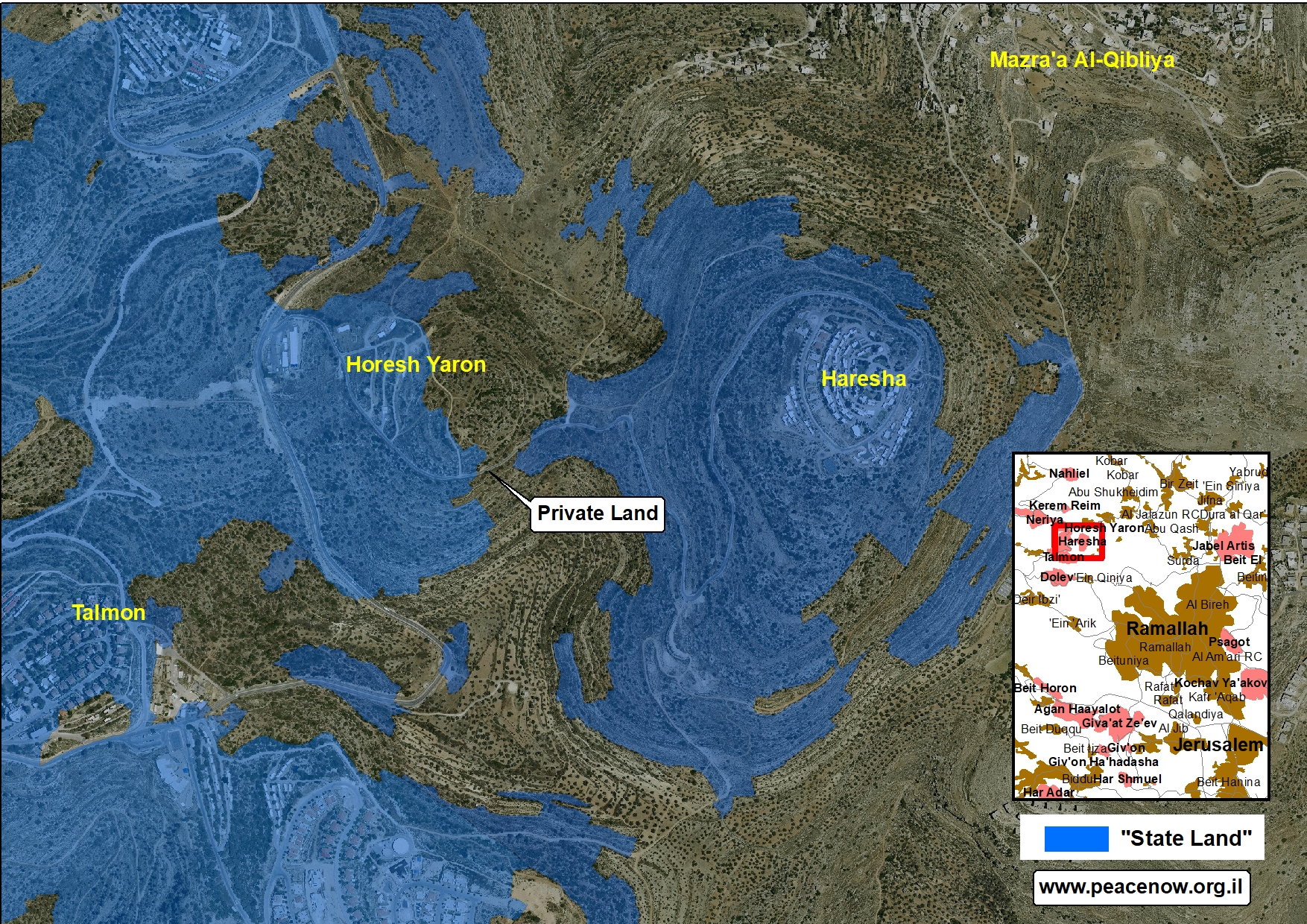
Israeli Attorney General Avichai Mandelblit – who signed off on the new Justice Ministry opinion – in November 2017 released a different legal argument in favor of permanently expropriating the land to legalize the access road, arguing that settlers are part of the “local population” of the West Bank and are therefore eligible to be the sole beneficiaries of land seized for “public use” (the access road is not open to Palestinian traffic). The opinion released this week, which cites Mandelblit’s previous opinion, finds yet another way to accomplish the same goal, by temporarily seizing the land to build a permanent tunnel for the settlers underneath it.
Justice Minister Ayelet Shaked said:
“From the beginning of my current term I have set a goal of normalizing the lives of the residents of Judea and Samaria and normalizing as many communities as possible. We have gone from a discourse of eviction to a discourse of normalization. These actions are in addition to the strengthening of the communities by other means, such as the transfer of authority in matters of Judea and Samaria from the Supreme Court to the Administrative Affairs Court in Jerusalem, as well as the equalization of legislation for Judea and Samaria…I will continue to work for the normalization of additional communities in Judea and Samaria. I thank Attorney General Avichai Mandelblit, Deputy Attorney General (Erez) Kaminitz and the Legal Advisor for the Judea and Samaria Area for their important activity on the issue.”
Peace Now told the Times of Israel:
“This move is a mockery of justice. Since the Regulation Law is tied up in court, the Ministry of Justice is yet again using every crooked justification it can concoct to expropriate private Palestinian land in order to dissect the West Bank with settlements until they have achieved their one-state apartheid agenda.”
Dror Etkes, founder of the anti-settlement watchdog group Kerem Navot, wrote:
“the outpost of Haresha, comprised of about 100 illegal structures, is of course not the story here. The story that the settlers are striving to resolve, with Mandelblit’s help, involves hundreds (yes hundreds!) of roads that have been illegally paved for decades around settlements and outposts, on land that even Israel recognizes as privately-owned. Now, with a little creativity and a lot of nerve, a legal mechanism has been invented to enable settlers to retroactively authorize the road system, without which the national land grab enterprise championed by Israel in the West Bank, can’t function.”
Three Illegal Outposts (& Ariel) Are Now “National Priority Areas” Eligible for Government Subsidies
On November 26th, Israeli Housing Minister Yoav Gallant announced that three illegal outposts – Kerem Reim, new Migron, and Shvut Rachel – will be considered “national priority” areas for development, marking the first time that illegal outposts are eligible for significant government subsidies to encourage growth.
In order to include the outposts, the Israeli Housing Ministry wrote and adopted a new criteria to make “neighborhoods located far from a ‘parent town’ that do not rely on the infrastructure of said town” eligible for priority status. For the purposes of the government subsidies plan, Kerem Reim is considered a “neighborhood” of the Talmon settlement, New Migron is considered a “neighborhood” of the Kochav Yochav settlement, and Shvut Rachel is considered a “neighborhood” of the Shilo settlement.
Though the Israeli government has rewritten its laws to consider these “children” outposts as “neighborhoods” of existing, government-approved settlements, they are, in fact, independent settlements. This fact is underscored by the Housing Ministry’s new criteria which admits that the outposts do not share the same infrastructure systems as the settlements of which they are considered a part (and, indeed, rewards that fact).
The Ariel settlement was also re-designated as a national priority area (having been previously selected and then later removed from the list), among a total of 583 communities from both sides of the Green Line. The selected communities, settlements, and outposts will benefit from massive government subsidies, including at least 50% of infrastructure costs for the construction of new housing. Israelis seeking to purchase a home in the selected communities will receive government loans and forms of assistance.
Haaretz reports Housing Minister Yoav Gallant remarked:
“it is a social and national duty to prevent negative migration from distant towns and to enable them to thrive and prosper.”
The Jerusalem Post quotes Gallant as saying that the decision to include the outposts:
“is a clear statement by the government that it will continue to develop and strengthen the settlements.”
High Court Rules the Jewish National Fund is the Legal Owner of Land South of Bethlehem
On November 28, 2018 the Israeli High Court of Justice ruled that the Jewish National Fund is the legal owner of 130 acres of land south of Bethlehem, ending a 22-year legal battle over ownership claims. Palestinians from a nearby village challenged the validity of the sale of the land to the Jewish National Fund when the organization moved to register its ownership of the land with the Israeli Civil Administration in 1996.
This week, the Court held that the Jewish National Fund (via its subsidiary company, Himnuta) had legally purchased the land in 1944 from its original Palestinian owners. The ruling will allow the settlers to move forward with plans for building more settlement units on the land, which is already home to one settlement, Rosh Tzurim, and to the headquarters of the Gush Etzion Regional Council.
The head of the Gush Etzion Regional Council, Shlomo Ne’eman, celebrated the ruling, saying:
“the task of expanding the lands of Gush Etzion is a national mission. The Supreme Court’s ruling gives us optimism that the court’s position will benefit the Jews and Jewish land in Judea and Samaria and will not automatically rule in favor of the thieving claims of the Arab intruders.”
Israel Seizes Jordan Valley Land Owned by the Catholic Church
On November 27, 2018, the Israeli Civil Administration announced that it is seizing 66 acres of land in the northern Jordan Valley that is owned by the Catholic Church. The Civil Administration said the land was needed for “military purposes.”
The Latin Patriarchate of Jerusalem responded to the seizure in a statement, saying:
“The Patriarchate is looking into the aspects of this decision in order to address it in the appropriate manner, have it contested and to stop further damage.”
Israeli Civil Administration Report Criticizing Yitzhar Settler Violence Leads to Renewed Calls to Annex the West Bank
An Israeli news outlet, Kan 11 news, revealed the existence of a new Civil Administration report that criticizes the Yitzhar settlement. According to Kan 11, the report states that Yitzhar is a source of violence that “undermines governance and the rule of law.”
In addition to documenting the violence perpetrated by Yitzhar residents against Palestinians living nearby, the report also documents incidents of Yitzhar settlers attacking Israeli forces. The report calls on the IDF Commander Maj. Nadav Padan to punish the Yitzhars settlers by scuttling plans to build a new kindergarten and by ceasing to guard dangerous roads around the settlement and its many outposts.
In response, Yossi Dagan (head of the Samaria Regional Council, a settlement municipal body) called for the author of the report to be fired, saying:
“Officials in the Civil Administration are torpedoing the approval of security elements which could have prevented terrorist attacks in threatened settlements such as Itamar, and in the Barkan industrial zone before the attack, as well as narratives of the Palestinian Authority and radical left-wing organizations.This is an example of the evil in the civil administration. I call on the head of the Civil Administration to remove the clerk … who acts like a politician and not as is required. This report is malicious and false. The Yitzhar leadership is leading the community in a good and positive direction, and this report has nothing but lies. This is the total loss of control of the Civil Administration. While murderers with the blood of Israelis on their hands, the Civil Administration refrains from punishing the sources of terror out of statements that this is collective punishment, and now they want to create collective punishment for the Jews. The head of the Civil Administration and the deputy defense minister should call this clerk for a hearing before his dismissal.”
In response to the report’s recommendations, MK Bezalel Smotrich (HaBayit HaYehudi) called for the entire Civil Administration to be disbanded. Smotrich announced that he will seek government backing for a bill to achieve that end during the next meeting of the Israeli Cabinet, scheduled for December 9th. Under the bill, Israeli settlers in the West Bank will come under the full sovereignty of domestic Israeli institutions, while Palestinians will be ruled by “Regional Liaison administrations.” The bill would effectively annex the entire West Bank to Israel.
Smotrich said:
“The Civil Administration must be shut down now. This document reflects a political agenda that is hostile to the settlement enterprise and to the local residents, [an agenda] which unfortunately is expanding in this unnecessary body…This is the same Civil Administration that for years has pushed for a policy of separation between Arabs involved in terrorism and the rest of the Arab population. Now it suddenly remembers to use collective punishment against Jewish residents…for years now, the residents of Judea and Samaria, who are equal citizens who serve in the army and in the reserve and who pay taxes, are not entitled to equal rights and receive inferior service from the Civil Administration instead of receiving optimal service from government ministries like all citizens of Israel. The time has come to fix that.”
After IDF Killed Two Palestinians, Civil Administration Grants Settlers Victory in Struggle Over Hilltop
On November 29th, Haaretz reported the tragic story of two Palestinians who were shot and killed by Israeli forces while protesting attempts by Israeli settlers to take over a hilltop belonging to the Palestinian village al-Mazra’ah al-Qibliyah, just north of Ramallah. Following a clash on October 26th, in which the IDF opened fire on Palestinian protesters – killing the two men – the IDF issued a military order closing the hilltop – known as Khirbet Na’alan – to Palestinians on Fridays. As Haaretz notes, the military order was a victory for the settlers, who have been aggressively trying to take over the hilltop since July 2018.
The residents of al-Mazra’ah al-Qibliyah have fought against the increasing encroachment of the Talmon settlement and its seven illegal satellite outposts, which collectively surround the village. Having seen several outposts take over their land illegally and under the protection of the IDF, Palestinians began actively trying to prevent the takeover of the Khirbet Na’alan hilltop. The settlers waged their own campaign to harass and intimidate the village, often entering the village at night to paint hateful messages and damage Palestinian property. Each Friday, the settlers would go pray at the site.
In response to petitions filed by Palestinians, the Israeli Civil Administration issued an order barring the settlers from accessing the hilltop. On the same day the villagers found out about the order, they watched 10 settlers from the Kerem Reim outpost (which was recently selected as a “national priority area” to encourage growth, see above) approach the hilltop with heavy IDF protection. It was on this day that the IDF opened fire on a group of Palestinians protesting the incursion, killing two and wounding many others.
Video of the bloody incidents shows the IDF opening fire at an incredibly close distance, and at least 10 Palestinians falling down amidst gunfire.
The New Mayor of Jerusalem, Moshe Lion, On Settlements
In a thorough analysis of the recent Jerusalem Municipal elections, Terrestrial Jerusalem’s Danny Seidemann shared key insights into what may be in store for settlement activity under Jerusalem’s new mayor, Moshe Lion. Seidemann writes:
“Lion emerged from the ranks of the less ideological elements in the Likud. However, support for East Jerusalem settlements and settlers is so deeply ingrained even in this segment of the party as to be second nature. Lion never mentioned the Palestinians of East Jerusalem in his campaign, and actively cooperated with Aryeh King, who represents the right-wing fringe of the East Jerusalem settlers. Consequently, it is highly likely that Lion will continue to do the bidding of the settlers in East Jerusalem, and to neglect the Palestinian sector. Nothing in his world view or the way he understands his political interests suggests otherwise.”
Al-Shabaka Policy Paper: “The EU & Jerusalem”
Al-Shabaka analyst Yara Hawari published a new paper exploring options for European Union member states to push back on U.S. policy and Israel’s annexation of Palestinian land. Hawari writes:
“The US embassy move has accelerated and legitimized a process of de-Palestinianization of Jerusalem that began over seven decades ago. In the absence of concrete pressure, Israel will continue to violate the fundamental rights of the Palestinian people in Jerusalem and the rest of historic Palestine, with the full support and encouragement of the Donald Trump administration as well as its far-right allies within Europe and in Latin America. Despite the inaction described above and the global political shift to the right, there remains potential for the EU to pressure Israel and pursue Palestinian human rights. This is due to strong European popular support for Palestinian rights and sovereignty that has allowed grassroots solidarity networks to grow, as well as the fact that the EU is premised on international law and human rights…”
Breaking the Silence Report – “Occupying Hebron: 2011-2017”
Breaking the Silence released a new compilation of testimonies from Israeli soldiers who served in the Hebron area. Breaking the Silence writes:
“The Israeli settlement in the heart of the city of Hebron marked its 50th anniversary this year. Its story is a microcosm of the occupation: contempt and disregard for the rule of law, daily violence, deprivation of Palestinian residents’ basic rights, and a military system that preserves all of the above. This booklet of testimonies intends to offer the public a glimpse of the reality in Hebron from our perspective as soldiers deployed there. These testimonies were given by soldiers who served in the city from 2011-2017. They reveal the violence and discrimination that have become an inextricable part of life in Hebron, and their impact on the lives of Palestinian residents.”
The online portal for the report also has an interactive map, where users can see where each incident took place against the backdrop of Hebron’s closed streets, religious sites, and settlement enclaves.
U.S. Chatter on Economic Coexistence Initiatives (Which Normalize Settlements/Occupation) Provokes Strong Palestinian Response
Top U.S. negotiators have continued hinting about a major economic element to the yet-to-be-unveiled “deal of the century.” As FMEP has documented to this point, Ambassador David Friedman has met with Israeli and Palestinian businessmen in a bid to promote joint projects in the Occupied Territories in a way that normalizes Israeli settlements and annexation bids.
On November 28th, Ambassador Friedman was interviewed by the Christian Broadcast Network. Part of the transcript of the interview reads:
Question: “One of the aspects of the peace plan seems to be a relationship between Palestinian businessmen and Israeli businessmen. Some would say you crossed a red line when you crossed the green line into Ariel officially. What was the importance of that meeting?”
Friedman: “On a practical level, I met with, I don’t know, maybe 8 or 10 Palestinian business leaders and, to a person, they all said to me, ‘let’s do business, let’s get going. We want to work with Jews; we want to work with Israelis.’… I try to look at everything from a lens of what is best for the United States. That’s my job. I represent the United States. But look, we are a nation under God; we’re built on Judeo-Christian values. Much as I try I cannot help but see the majesty of God’s work and all the miracles that happen in this incredible country.”
U.S. Special Representative for International Negotiations, Jason Greenblatt, wrote an op-ed also emphasizing, among of myriad of accusations against the Palestinian Authority, that the U.S. is hoping to jump-start economic development, separate from its “plan” to resolve core issues. The article reads:
“While waiting for a possible political solution, it is high time to build the Palestinian economy and provide Palestinians with the opportunities they deserve…We know that the Palestinians are not interested in mere economic peace. The Trump Administration continues to strive for a peace agreement, but the Palestinians need economic help now – with or without a peace agreement. The technology sector in the West Bank and Gaza has great potential and can be developed without treading into the politically contentious core issues of the conflict…I continue to meet with ordinary Palestinians and what is striking is that, although they complain about the Trump Administration’s policies, they remain focused on their economy…Palestinians are a proud people and want to create and earn on their own. They believe, as I do, that Palestinians should be allowed to improve their economy without worrying about whether they will give up on their national cause…Let’s be real – 136,000 Palestinians commute to work with Israelis every day because the opportunity is there. Anti-normalisation is a failed policy that only hurts the Palestinians. Let’s allow Palestinians to thrive in the way they are educated, capable of and deserve. We won’t tire of trying to resolve the political conflict (and certainly Palestinians won’t either), but we must focus on helping the Palestinian economy where we can, before it is too late.”
Palestinians reacted strongly to Greenblatt’s screed. Saeb Erekat, chief Palestinian negotiator, wrote in response:
“…economic desperation is seen by the Trump administration as an opportunity to force Palestinians to normalise Israel’s occupation, to legitimise its settlements and its whole system of oppression. The administration has been trying to divide Palestinians by claiming that the Palestinian leadership is preventing economic growth. However, there is a consensus among our people that the primary responsibility for our grave financial situation is the Israeli occupation.”
Hani Masri, a Palestinian political analyst, said:
“Trump thinks that what the Palestinian leadership has rejected can be passed through the people, but the majority of Palestinians will not positively absorb or accept what Greenblatt is promoting. There are economic interests between the Palestinians and Israelis, however the political issue is a different subject and can’t come at the expense of the legitimate rights of the Palestinians.”
Elsewhere, at an event hosted by the Brookings Institute, former peace negotiator Dennis Ross promoted draft legislation in the U.S. Congress that would invest heavily in joint economic projects in the West Bank which normalize the settlements. The Jewish Insider summarizes:
“[Dennis] Ross praised current draft legislation in Congress that would give upwards of $150 million to joint Israeli and Palestinian projects: [Ross:] ‘Cutting $10 million for projects that are joint projects between Israelis and Palestinians, the rationale for that is hard to grasp. If there is one thing that we should be doing [it is] demonstrating that when Israelis and Palestinians cooperate there’s a payoff for it. And that ought to be elementary. That ought to be just a given. Anything you’re doing should be to designed to elevate the payoffs of practical tangible cooperation.’”
Finally, the Friends of Beit El organization (previously headed by now-Ambassador David Friedman) hosted a star-studded fundraiser in New York to raise funds for and awareness of the Beit El settlement. It was attended by two Members of Congress and the speaker of the Israeli Knesset Yuli Edelstein, who told the crowd:
“Independence, sovereignty, will eventually come to Judea and Samaria and many more houses with be built in order to reach the number we all dream — a million Jews in Judea and Samaria.”
Notably, the mention of Rep. Nancy Pelosi, the newly elected Speaker of the House, elicited boos from the crowd.
Bonus Reads
- “Annexation – at what cost?” (Times of Israel)
- “Leftists on tour in Hebron confirmed in view that settlers ‘have already won’” (Times of Israel)
- “Shaked touts ‘confederation’ of Jordan WEst Bank, and Gaza” (Times of Israel)
- “Inside the Evangelical Money Flowing Into the West Bank” (Haaretz)
Welcome to FMEP’s Weekly Settlement Report, covering everything you need to know about Israeli settlement activity this week.
To subscribe to this report, please click here.
November 8, 2018
- Jerusalem Municipality Gives Final Approval to Two East Jerusalem Settlement Schemes Pushing Towards Beit Hanina
- Claiming Ignorance, State Tells the Court it Will Demolish New Jordan Valley Outpost
- Government Officials Lay Cornerstone of “New Migron” Settlement
- Israel Seizes Palestinian Land to Build New Road to Settlement
- Bennett Violated Govt Rules to Get a Legal Opinion Supporting the De Facto Annexation of Ariel University
- In Reversal, Israeli Ministers Embrace Bill to Allow Knesset to Overrule High Court on Any Issue (Not Just on Deporting Asylum Seekers)
- Settlers Group Alleges Palestinians are Undertaking a European-Backed Scheme to “Take Over” Area C of West Bank
- UN Report Details Israel’s De Facto Annexation of West Bank Land
- Four Alleged Security Incidents Near Settlements
- Bonus Reads
Comments, questions, or suggestions? Email Kristin McCarthy at kmccarthy@fmep.org.
Jerusalem Municipality Gives Final Approval to Two East Jerusalem Settlement Schemes Pushing Towards Beit Hanina
 On November 6th, Jerusalem planning authorities granted approval to two settlement projects totalling 652 units in strategic areas that will increase the encroachment of settlements on the Palestinian East Jerusalem neighborhood of Beit Hanina – where the Israeli government is also advancing the first-ever government-backed settlement enclave inside of the neighborhood. This week the Committee approved:
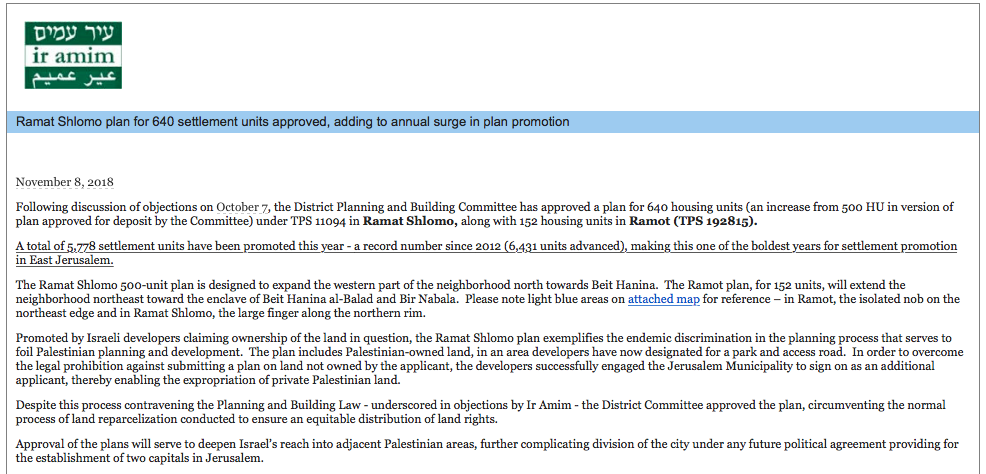
- A plan for 152 new units in the Ramot settlement in northern Jerusalem, extending the settlement’s footprint towards the Palestinian neighborhood of Beit Hanina.
- A plan for 640-units in the Ramat Shlomo settlement, to be built partially on Palestinian land, also extending the settlement north towards an existing settlement enclave inside of the Palestinian Beit Hanina neighborhood.
In granting final approval for the Ramat Shlomo plan, the Jerusalem District Planning and Building Committee decided to increase the number of approved units, from the proposed 500 to 640. And significantly, the Committee rejected serious complaints about expropriating privately owned Palestinian land for settlement purposes.
The Israel anti-settlement watchdog NGO Ir Amim filed one such complaint against the plan, explaining:
“Promoted by Israeli developers claiming ownership of the land in question, the Ramat Shlomo plan exemplifies the endemic discrimination in the planning process that serves to foil Palestinian planning and development. The plan includes Palestinian-owned land, in an area developers have now designated for a park and access road. In order to overcome the legal prohibition against submitting a plan on land not owned by the applicant, the developers successfully engaged the Jerusalem Municipality to sign on as an additional applicant, thereby enabling the expropriation of private Palestinian land.”
Ir Amim researcher Aviv Tartarsky told Haaretz this week:
“It’s very disappointing that the district committee relied on formalistic reasons to approve a step that violates the property rights of Palestinian landowners through and through. These aren’t extremist settlers in outposts somewhere out on hilltops in Samaria [the northern West Bank] but state institutions that are working in Israel’s capital city. This decision is additional proof that Israeli control in East Jerusalem means a regime based on serious discrimination.”
The new approvals add to an ever-growing tidal wave of settlement activity in East Jerusalem affecting the viability of the two-state solution, while tightening the screws on the local Palestinian population.
Claiming Ignorance, State Tells the Court it Will Demolish New Jordan Valley Outpost
Israeli government lawyers told the High Court of Justice that the State of Israel does not know who built an illegal outpost on a disused military base in the Jordan Valley, which settlers have named “Camp Gadi”, and announced that the Civil Administration will demolish it. If the Civil Administration moves to demolishes the outpost, it will require evicting several settler families who are squatting there, and shutting down a pre-military school that the families have been promoting.
The head of the Jordan Valley Regional Council, David Lahiani, seemed to contradict the government’s claim to innocence when he said that he has been in touch with the Civil Administration about legalizing the outpost. If Lahiani has been in touch with the Civil Administration, then questions arise about at what point the Israeli government learned about the outpost and who is behind it. Lahiani’s statement also contradicts (or at least raises questions about) a prior statement from the Jordan Valley Regional Council which denied involvement in establishing the outpost. Further calling into question the role of the Jordan Valley Regional Council, Lahiani was in a picture taken at the outpost which was uploaded to Facebook on October 24th.
Government Officials Lay Cornerstone of “New Migron” Settlement
A cornerstone laying ceremony marked the start of construction on the “New Migron” settlement, to be for the settlers who were removed from the illegal Migron outpost. Several government officials were on hand to lay the cornerstone of the new settlement, plans for which were approved in 2017, near the Kochav Yaakov settlement north of Jerusalem.
In 2011, the Israeli High Court ruled that the Migron outpost must be evacuated because it was built on privately owned Palestinian land. Most of the illegal outpost’s residents were evacuated and most buildings were demolished in Migron in 2012. Determined to demonstrate its support for settlers in the face of this court-compelled evacuation, the government promised to establish two new settlements: “New Migron” (located close to Kochav Yaakov settlement) as well as the approval of a plan for 184 housing units east of the Adam settlement (aka Geva Binyamin). All said, the two new settlements and temporary housing for the evicted settlers cost Israeli taxpayers millions of dollars – sending settlers a clear message that for them, law-breaking pays off.
At the ceremony this week, Jerusalem Affairs Minister Ze’ev Elkin said:
“During such events, it is customary to rejoice, but as someone who accompanied Migron from the moment of the evacuation to the present day, this is not a happy event. We would be happy if we had another legal system that made a logical decision, and I long for the days when the justice system will do justice. The settlement will grow and expand this way from time immemorial. The evacuation attempts will only lead to the strengthening and expansion of settlement.”
Housing Minister Yoav Galant, also at the ceremony, said:
“laying the cornerstone means that the territories of Yehudah and Shomron are not negotiable. It is not a subject for sale. We are laying a cornerstone for Migron and we will build it. I will see to it that the Israeli government does so by the end of the year.”
Knesset Speaker Yuli Edelstein, also in attendance, said:
“I did not come here to convince anyone about our rights in the land of Israel, I came here with mixed feelings of happiness from laying the cornerstone, alongside the great sadness of the difficult evacuation five years ago. We are here, first and foremost, thanks to the families of Migron that did not give up.”
Israel Seizes Palestinian Land to Build New Road to Settlement
According to Maan News, Israeli forces seized 38 acres (155 dunams) of Palestinian land in order to pave a road to the Beit Aryeh settlement, located northwest of Ramallah. Members of the al-Lubban al-Gharbi village council claim that the land is privately owned by Palestinians from the village and called on village residents to find documents proving land ownership in anticipation of an appeal against the construction.
So far this year, the Beit Aryeh settlement has been the beneficiary of two significant settlement advancements totalling 563 new units:
- On August 23, 2018 the Israeli Housing Ministry published a tender for 52 new settlement units in Beit Aryeh.
- On August 11, 2018 the government published a tender for 511 new settlement units in Beit Aryeh.
Bennett Violated Govt Rules to Get a Legal Opinion Supporting the De Facto Annexation of Ariel University
According to a new Haaretz report, Education Minister Naftali Bennett violated Israeli guidelines by using a private law firm to support his Knesset bill bringing settlement colleges and universities under the authority of the Israeli Higher Education Council. Prior to the Knesset’s passage of Bennet’s bill in February 2018, the Higher Education Council only included schools located inside of sovereign Israeli territory. The new law is tantamount to de facto annexation of settlement schools, and members of the Israeli Higher Education Council remain vocally opposed to the move.
The use of a private law firm is seen as an attempt to bypass the Education Ministry’s own apolitical (for now) legal advisors, and is a breach of the guidelines set years ago for every ministry by the Israeli Attorney General. The guidelines stipulate that in cases where private opinions are sought, the legal advisors for the ministry must supervise the process.
Bennet reportedly used an opinion paper issued by the Herzog Fox & Neeman firm stating the inclusion of Ariel University in the domestic Higher Education Council would not violate existing grant terms between universities in sovereign Israel and the European Union (which does not do business in the occupied territories). The opinion was then presented to members of the Higher Education Council to assuage fears that implementing the new law would result in losing international funding. The opinion said that the potential for funding cuts is “nearly non-existent.”
An anonymous senior official with the Higher Education Council told Haaretz:
“You cannot base official policy on an opinion paid for by an interested party. That’s not serious.”
Ariel University has not yet been admitted to the Council, despite the passage of the law in February 2018 and despite Minister Bennett’s repeated threats to end state relations with the Council if it did not immediately grant membership to the school. Israeli President Reuven Rivlin issued a rebuke to Bennett’s threats, saying:
“It’s possible to love Ariel without mocking academia.”
In Reversal, Israeli Ministers Embrace Bill to Allow Knesset to Overrule High Court on Any Issue (Not Just on Deporting Asylum Seekers)
At a meeting on November 4th, ministers in the governing Israeli coalition reportedly decided to abandon a bill that would empower the Knesset to reinstate its plan to deport African asylum seekers after it was struck down by the High Court, in favor of a much more far-reaching bill granting the Knesset the ability to reinstate any law the High Court strikes down. The passage of that bill would likely impact the fate of not only African asylum seekers but settlement-related legislation that has already been passed – most notably,the settlement Regulation Law – and other undemocratic measures that might follow. This news follows an exact opposite announcement two weeks ago, when Justice Minister Ayelet Shaked embraced the single-issue version of the bill, while promising to make the unlimited version a sticking point in any future coalition agreement.
Notably, the leaders of the current governing coalition decided to make this move at a meeting that was not attended by Kulanu Party leader Moshe Kahlon, who has until now blocked the coalition from advancing the unlimited version bill.
Israeli Attorney General Mandelblit vehemently opposes the bill. Mandelblit said:
“One must vigorously oppose this bill, which harms the constitutional regime of the State of Israel as a Jewish and democratic state. Removing all restrictions on undermining the human rights of a specific group, as is proposed now, has far-reaching implications for constitutional law and the democratic regime in Israel, and I strongly oppose it.”
Settlers Group Alleges Palestinians are Undertaking a European-Backed Scheme to “Take Over” Area C of West Bank
The radical settler organization Regavim – which devotes its efforts to systematically mapping out and expelling Palestinians from strategic areas in Jerusalem, the West Bank, and the Negev – presented a new report to the Knesset this week claiming that the Palestinian Authority (PA) is using European funding to take over land in Area C of the West Bank. The report alleges that the PA uses European money to pave roads, build on strategic military and diplomatic locations, and “steal” water resources, at the expense of Israel.
Regavim warns:
“If the government does not come to its senses and does something now, the Palestinian plan will create irrevocable changes and facts on the ground.”
Adding irony to Regavim’s current efforts to stop “illegal” Palestinian activity in the West Bank, in August 2018 the Israeli daily newspaper Yedioth Ahronoth published a comprehensive investigation into Regavim’s leaders. The group’s stated mission is “to ensure responsible, legal, accountable & environmentally friendly use of Israel’s national lands and the return of the rule of law to all areas and aspects of the land and its preservation.” The investigation revealed, however, that the organization’s efforts to identify and stop illegal construction are merely a tool to dispossess Palestinians of their land.
The Investigation found, in fact, that Regavim and its leaders have a demonstrable disregard for the Israeli planning and building laws that they purport to be dedicated to enforcing, evidenced most plainly by the fact that 15 Regavim officers are living in structures built on privately owned Palestinian land, some with demolition orders issued against them. These include the building where Yehuda Eliyahu, the current executive director of Regavim, lives.
UN Report Details Israel’s De Facto Annexation of West Bank Land
The United Nations Special Rapporteur on Situation of Human Rights in Palestinian Territories, Michael Lynk, issued a new report to the UN General Assembly – half of which is devoted to documenting the Israeli government’s annexation of Palestinian land in East Jerusalem and de facto annexation of land in the occupied West Bank.
The report concludes in part:
“These statements of political intent, together with Israel’s colonizing acts on the ground, its legislative activity, and its refusal to adhere to its solemn obligations under international law or to follow the direction of the international community with respect to its 51-year-old occupation, have established the probative evidence that Israel has effectively annexed a significant part of the West Bank and is treating this territory as its own. While Israel has not yet declared formal sovereignty over any parts of the West Bank, the Special Rapporteur submits that the strict prohibition against annexation in international law applies not only to a formal declaration, but also to those acts of territorial appropriation by Israel that have been a cumulative part of its efforts to stake a future claim of formal sovereignty over the occupied Palestinian territory.”
Four Alleged Security incidents Near Settlements
In the past three days, Israeli authorities have reported four security incidents near settlements:
On November 7th, the IDF reported that unknown assailants shot at a bus and lightly injured two Israelis near the settlement of Beit El, located deep inside the West Bank near Ramallah.
On November 6th, three Palestinian men were arrested near the Mevo Dotan settlement, south of Jenin, one of whom was allegedly carrying a gun.
Earlier on November 6th, a Palestinian woman was shot and arrested near the Kfar Adumim settlement, between Jerusalem and Jericho,after allegedly attacking Israeli border policemen with a pair of scissors.
On November 5th, a Palestinian man was shot and arrested after allegedly attempting to stab Israeli settlers and an Israeli IDF officer near the Kiryat Arba settlement, in Hebron.
Bonus Reads
- Khan al-Ahmar and Israel’s Creeping Annexation of the West Bank” (Newsweek)
- “Everyone Knows Settlers Cut Down Palestinian Olive Trees. But Israel Doesn’t Care” (Haaretz)
- “Settler leaders warned Rabin not to ‘cross redlines’ before assassination” (Times of Israel)
- “Hard Questions, Tough Answers: Why the Israeli mainstream turned right” (Americans for Peace Now)
- “An Interview with MK Sharen Haskel” (Fathom Journal)
- “Israeli justice minister opposes letting government jurists act as ‘gatekeepers’” (Haaretz)