Welcome to FMEP’s Weekly Settlement Report, covering everything you need to know about Israeli settlement activity this week.
To subscribe to this report, please click here.
August 4, 2022
- Encircling Jerusalem: Israel Advances Settlement Plans Across the City, While Settler Projects Tighten the Noose
- Dumping Any Pretense of Respect for Rule of Law, Israeli High Court Reverses Course, Allows Mitzpe Kramim Outpost to be “Legalized”
- Settlers Acquire Another Home in Downtown Hebron
- Elad Closes Palestinian Access Road Near Sambuski Cemetary in Silwan
- This Week in Area C, Part 1: JNF Approves Purchase of Palestinian Land In Jordan Valley While High Court Weighs Petition
- This Week in Area C, Part 2: Regavim Files Petition Pushing for Immediate Demolition of Palestinian Construction in Area C
- This Week in Area C, Part 3: Settlers Continue to Occupy Six Sites After Recent Attempt to Establish New Outposts En Masse
- Groups Petition to Cancel New Israeli-Led Archeological Dig in the West Bank Citing Legal Questions
- Bonus Reads
Encircling Jerusalem: Israel Advances Settlement Plans Across the City, While Settler Projects Tighten the Noose
It must be stressed that events over the past several months (while the Settlement Report has taken an abbreviated form) have rapidly accelerated the encirclement of Jerusalem by settlements and settler-backed projects — developments which come at the direct expense of Palestinians — their presence in Jerusalem, their rights as land owners, and their quality of life. This encirclement continues to progress, unabated and almost entirely unchallenged, each day. 
Last week, on July 25th, the Jerusalem District Planning Committee advanced plans for two brand new settlements in East Jerusalem – “Givat HaShaked” and the “Lower Aqueduct” plan. These two settlements that would nearly complete the encirclement of Jerusalem to the south. Details of those plans are:
- The Lower Aqueduct plan (1,465 new units) was approved for deposit for public comment. This plan would see a new settlement – called the Lower Aqueduct Plan – built on a small sliver of land between the controversial settlements of Givat Hamatos and Har Homa – and is intended to connect them. In so doing, it will establish an uninterrupted continuum of Israeli settlements on the southern rim of Jerusalem, and destroy the contiguity of Palestinian land in the West Bank and East Jerusalem.
- The Givat HaShaked settlement was also discussed, and the Committee opted to increase the total number of units that the plan outlines for construction, from ~400 to 700 housing units, plus schools and synagogues. Ir Amim and Terrestrial Jerusalem both report that, after a few technical requirements are met, the plan to build Givat HaShaked is expected to receive final approval when the Committee reconvenes in the coming weeks. The plan for Givat HaShaked is unprecedented, according to Terrestrial Jerusalem, in that it is the first settlement of this size that that Israeli government will establish inside of a Palestinian neighborhood – Beit Safafa, which will be completely encircled by Israeli construction if Givat HaShaked is built.
For more background on the Lower Aqueduct plan, see resources by: Terrestrial Jerusalem and Ir Amim.
These plans are significant developments in the effort to establish settler hegemony over East Jerusalem, but are only part of the story of how the encirclement of East Jerusalem has rapidly advanced over the past months. In addition to the construction of new settlements and growth of existing ones, settlers are succeeding in advancing new projects under the guise of tourism (like: the Cable Car, a new visitors center in Batan Al Hawa, and more) and the State is undertaking systematic efforts to take over more and more land. Those methods include the revival of a politicized land registration process in East Jerusalem and the expansion of “national park” lands onto the Mount of Olives. Palestinians in Sheikh Jarrah and Silwan also continue to face the looming threat of dispossession through Court proceedings. In a rare piece of good news — on July 21st the Israeli Supreme Court partially accepted a petition filed by the Duweik family, which has led to the (temporary) freezing of their eviction.
Another facet is the looming threat is the seemingly growing inevitability of the construction of the E-1 settlement to Jerusalem’s east. Prior to the arrival of U.S. President Joe Biden in Jerusalem on July 13th, the Israeli government intervened to postpone a critical hearing on the E-1 settlement, rescheduling it for September 12th. The rescheduled hearing, if it is not postponed yet again, could result in granting final approval to the highly contentious plan (and barring intensive outside pressure such additional postponement seems highly improbable, given the Israeli domestic politics and the upcoming national election). See Terrestrial Jerusalem for a recap of President Biden’s visit.
Dumping Any Pretense of Respect for Rule of Law, Israeli High Court Reverses Course, Allows Mitzpe Kramim Outpost to be “Legalized”
Nearly two years after ruling there is no possible legal basis by which the Mitzpe Kramim outpost can be retroactively “legalized” under Israeli law, the Israeli Supreme Court has now reversed course and will allow the State to formally legalize the settlement using the so-called Market Regulation principle.
In its original ruling, issued in September 2020, the High Court held that construction of the Mitzpe Kramim outpost was not undertaken in “good faith” because there were “multiple warning signs” that the land was privately owned by Palestinians. The outpost was ordered to be dismantled at that time. Now, with apparently no new evidence, the Court decided to accept the settlers’ claim of “good faith.”
The “good faith” condition for retroactive legalization of illegal settler construction on privately-owned Palestinian land is a central element of the “market regulation” legal principle which was devised by former Attorney General Avichai Mandelblit in December 2018 as an alternative to the (now overturned) Settlement Regulation Law. The principle offers a path to grant retroactive legalization to the settlers for what this principle treats as “unintentional” land theft – throwing the principles of both rule of law and private property rights out the window. Peace Now has a comprehensive breakdown of the legal opinion, including the specific criteria outlining which outposts can qualify under the new scheme. It is estimated that 2,000 illegal settlement structures qualify for retroactive legalization using this principle.
Yesh Din writes on the significance of this ruling:
“This ruling overtly indicates Israel’s intentions to continue to pursue retroactive legalization of illegal Israeli construction in blatant disregard of the rights of the local Palestinian population of the West Bank. The State of Israel continues to ignore the duties bestowed upon it by IHL, as the occupying power, to protect the occupied population. Additionally, as the occupying power, Israel is prohibited from transferring the occupier’s population into occupied territory. The interpretation of the Supreme Court’s majority opinion will, in practice, undoubtedly serve to fulfill the intentions of the repealed Regularization Bill from 2017. It will enable settlers, backed by the Civil Administration and other State authorities, to take over thousands of dunams of Palestinian land, leading to human rights violations on a massive scale all over the West Bank and serving as the basis for future negligent and illegal policies, which are now more likely to be given the go-ahead by the Supreme Court. This ruling symbolizes a turning point of Israel’s Supreme Court, which, for the first time, has endorsed the forced confiscation of privately owned land, which is not required for military needs, for the sole purpose of use by Israeli civilians for the establishment of a new settlement.”
In +972 Magazine, Orly Noy writes:
“The court’s ruling could potentially pave the way for the retroactive legalization of thousands more homes in outposts built on privately-owned Palestinian land…The legalization of Mitzpe Kramim is only a footnote in Israel’s policies of dispossession and land theft on both sides of the Green Line, carried out through what the Israeli regime deems completely “legal” expropriations…And one more word regarding the concept of “good faith,” which was sufficient reasoning for the High Court to retroactively legalize the theft of private Palestinian land. This same line of argumentation did not protect the residents of Umm al-Hiran, a Bedouin village in the Negev/Naqab, from being threatened with destruction and expulsion, even though they were physically placed where the village exists today in the 1950s by the military government after it expelled them from their original land, on which Kibbutz Shoval now sits. Although the state itself was the one to move them to their new location, the residents of Umm al-Hiran have lived for decades without basic infrastructure such as water and electricity — that is, until the state decided to destroy the village in order to build Hiran, a town for Jews alone, on its ruins. Unlike the settlers of Mitzpe Kramim, the residents of Umm al-Hiran did not take over land that did not belong to them, nor did they settle on private land that belonged to others. And yet, the state did not hesitate to brutally deport them — even killing a local resident, Yacoub Abu al-Qi’an, in the process. The same court that will allow the residents of Mitzpe Kramim to remain on land it itself admits does not belong to them did not hesitate to legalize the cleansing of Umm al-Hiran. Because, after all, in the apartheid regime, even the concept of “good faith” applies solely to Jewish citizens.”
Settlers Acquire Another Home in Downtown Hebron
On July 28th, a settler group called Harchvi announced it has purchased a three-story house in central Hebron, very close to the Tomb of the Patriarchs/Al-Ibrahimi Mosque and on the Palestinian side of a key IDF checkpoint (the “Pharmacy” checkpoint), which Israeli Jews are supposed to be prohibited from crossing. The group was granted a purchase agreement by the Israeli Defense Ministry this week, which seemingly legitimizes the settlers claim to have purchased the property – but it is not a final determination of the legality of the transaction. This is the second such house in Hebron that settlers have claimed to have purchased from Palestinians owners this year.
Providing more detail on the status of the house, Peace Now writes:
“Peace Now has no information regarding the alleged deal in this case. We know from many other cases in Hebron and in the West Bank that these are dubious purchases, which are sometimes based on forgery or the purchase of only small parts of the property. It almost always turns out that the settlers may have managed to acquire the rights from one person, but the rest of the rights holders did not agree and the issue gets to courts for lengthy hearings. When settlers entered the Za’atari house in March 2018, the case got to the courts and the legal argument is still pending, but the settlers are still in the house. Every purchase of land in the territories requires the approval of the Minister of Defense – according to the law in the Occupied Territories, in order to make a transaction and register it in the land registry, a transaction permit from the Civil Administration is required. Any such transaction-permit requires the prior approval of the Minister of Defense. In this case, it is hard to believe that the settlers have a transaction permit from the Minister of Defense. In all previous cases the settlers hurry to establish a fact on the ground, enter the house and only then submit applications for registration of purchase, and only then does it come to the Defense Minister’s approval. The defense minister can refuse and prevent the execution of the deal.”
In addition to the settlement activity in Hebron that the state of Israel has formally (and publicly) sanctioned, +972 Magazine reports this week that over the past month settlers have been bulldozing Palestinian stores that have been inaccessible to their owners for more than 20 years under Israel closure orders. Though the Israeli Civil Administration has denied authorizing the settlers’ destruction of the stores over the past month, one of the Palestinian shop owners, Tareq Al-Kiyal, raises the point that “Nothing moves in the Old City — and certainly no bulldozers come in and destroy buildings — without a green light from the army.” Palestinians have filed a police report regarding the damage to the stores, which they believe were demolished by settlers in order to expand the nearby settlement enclave, Avraham Avinu.
The shops are in an area referred to as the Kiyal Market, which was “temporarily” shuttered by the Israeli army in 2001 during the Second Intifada. Since then, Palestinians have been forbidden from reopening the shops and cannot even enter their shops to remove valuable equipment. Meanwhile, Israeli settlers have systematically looted the stores, and have been using the buildings for warehouses, recreational spaces, and even as housing.
Elad Closes Palestinian Access Road Near Sambuski Cemetary in Silwan
Emek Shaveh reports that the Elad settler group has blocked an access road near the Sambuski cemetery in the Silwan neighborhood of East Jerusalem, a move which blocks car traffic to the Wadi Rababa area of Silwan where some 150 Palestinian families live. Palestinian residents, in partnership with Emek Shaveh, have appealed to several Israeli authoritative bodies (including the Israeli Nature and Parks Authority, the Jerusalem Municipality, and the Israeli police) to remove the boulders blocking the road, but Elad has failed to cooperate with efforts to negotiate a solution and has instead continued their work at the site. Emek Shaveh reports that the ongoing blockage of the road has led to daily friction between Palestinians and Elad employees.
The Sambuski cemetery is deeply integrated into Elad’s overarching, comprehensive plan to control the Silwan neighborhood. However, the cemetery was a relatively unknown, neglected site until recent years. In 2020, the Trump “Peace to Prosperity” plan identified the Sambuski cemetery as a place of prime historical and religious importance to Israel, elevating the status of the cemetery. The Israeli NGO Emek Shaveh – which has a special expertise on archaeology and the way archeology has been weaponized to serve the political agenda of the settlers and the state – wrote a report on exactly how the Trump “Vision” supports settler efforts to use Jerusalem’s history and antiquities to promote Israeli-Jewish hegemony and control over the city.
Emek Shaveh explains how the cemetery is connected to other settler endeavors in Silwan:
“For the Elad Foundation the cemetery is a strategic site as it links together two important focal points of its enterprise – the neighborhood of Silwan, home to the City of David archaeological park and specifically to the Pool of Siloam at the southern tip of the site, and the Hinnom Valley an area which Elad has been developing for the past two years (more below).”
This Week in Area C, Part 1: JNF Approves Purchase of Palestinian Land In Jordan Valley While High Court Weighs Petition
At the urging of the Israeli government, the Board of the Jewish National Fund (JNF) approved the allocation of $18 million for the purchase of 250 acres (1,000 dunams) of Palestinian-owned land in the Jordan Valley, land that is the subject of a petition with the High Court of Justice.
Israel has controlled the land in question since issuing a military closure order in 1969. In the 1980s, the World Zionist Organization then allocated the land (which is privately owned by Palestinians) to settlers without any documentation of either having received control of the land from the government, or documentation allocating the land to the settlers. Since then, settlers have developed the land into profitable date farms. In 2018, several Palestinian landowners have filed a petition with the High Court of Justice to have the settlers removed from the area and the land returned to their control. In a contentious court hearing in June 2022, in which the State conceded that it does not know how or why the settlers were allocated the land in the first place, High Court Justice Esther Hayut told the State lawyer: “Given that you cannot explain how the land was given to those to whom it was given, does that give them the right to remain there forever?”
The JNF – via its subsidiary group Himnuta, which handles West Bank transactions – allegedly secured a deal with a Palestinian landowner to purchase the land in phases, starting with a smaller plot in 2018. Further phases of the the transaction were canceled due to criticism of the JNF’s involvement in land purchases in the occupied West Bank at the time. The deal is now back in process at the request of the Isareli Defense Ministry in order to finalize the transaction before the High Court.
This Week in Area C, Part 2: Regavim Files Petition Pushing for Immediate Demolition of Palestinian Construction in Area C
The settler group Regavim filed a petition with the Israeli High Court of Justice seeking to change operational procedures within the Civil Administration so that Palestinian construction in Area C can be immediately demolished – eliminating any chance for Palestinian landowners to challenge the demolition of their property – if it is believed to be illegal. Regavim calls it “absurd” that the Civil Administration would allow Palestinians a chance to assert their legal rights to build on land in Area C before demolition is carried out.
While settlers push for faster demolition of illegal (under Israeli law) Palestinian construction in Area C, a new piece by +972 Magazine reveals that an Israeli official who is in charge of handing out demolition orders against Palestinian buildings in the Massaffer Yatta region, himself lives in an illegally built home in an illegally built outpost. This only furthers the clear message that settler groups are not interested in ensuring the faithful enforcement of Israeli law, but are rather interested in wielding Israeli law as a weapon to displace and replace Palestinians.
This Week in Area C, Part 3: Settlers Continue to Occupy Six Sites After Recent Attempt to Establish New Outposts En Masse
According to an op-ed by Arlene Kushner, settlers continue to ”maintain a presence” at six sites located in Area C where they are planning to establish new outposts. These are the same sites that were part of a large-scale effort two weeks ago, led by the Nahala settler movement, to establish six new outposts all at once. That effort was thwarted by Defense Minister Benny Gantz, who ordered Israeli security forces to prevent and remove settlers from the sites.
The determination of settlers to violate the law is unsurprising, in the ensuing hours after the failed operation a leader of the Nahala Movement, Daniela Weiss, told Haaretz:
“We’ll be back, of course. We’ll try to come back in a day or two. If it’s this Shabbat, I can’t say. We’re taking it one step at a time.”
Groups Petition to Cancel New Israeli-Led Archeological Dig in the West Bank Citing Legal Questions
The Israeli NGOs Haqel and Emek Shaveh report that on July 25th, an Israeli archaeologist launched a new excavation of the “Tel Tibnah” site in the Ramallah district, with sponsorship from the Israeli Bar-Ilan University. The NGOs jointly raised concerns about the political motivation behind the excavation, given “several fundamental legal and ethical issues” with the dig. The groups have called for the immediate cancellation of the excavation.
Haqel and Emek Shaveh further explain:
To the best of our knowledge, the site is situated on private and public lands of three Palestinian villages: Deir-Nisham, Beit Rima and Nebi Salah, and lies in proximity to the village of Abud. These lands are used by the local Palestinian population for agriculture and herding. In addition, within the site there is a spring that serves for drinking and irrigation. Initiating archaeological projects on privately owned land, even if these are declared as archaeological sites, demands that notification be given to the owners of these lands and their approval is required in advance. Entering private property without the permission of the owner is defined as a criminal act of incursion, even more so when conducting actions that might damage property and prevent access to the property, as is a frequent occurrence throughout the West Bank. The local residents unambiguously submitted their objection to the proposed excavations which will have a dramatic effect on their lives, impact their freedom of movement and violate their property rights. So far, this objection has not been taken into consideration.
The main question at stake is the State of Israel’s range of legitimate courses of action and that of Israeli academia. Initiation of an academic archaeological excavation serves, by nature, a scientific-academic motivation. This project does not serve an immediate necessity or mitigate against a pending danger, and does not meet the criteria as a “salvage excavation”, nor does it serve the local population living around the site. Any attempt to “govern” archaeological sites that are not within the sovereign borders of Israel is a political act and not a scientific one.
In addition, the claims of “antiquity robbery” should not justify state actions, and the political act should not be concealed as an archaeological one. The erosion of the distinction between heritage protection on the one hand and settlement and annexation on the other, threatens the future of archaeology.”
As FMEP has chronicled, settlers and their allies are intent on taking control of archaeological sites in the West Bank, and and seizing artifacts that are currently under Palestinian control. Settlers claim the sites are neglected and/or damaged. To that end, the settler groups known as “the Shilo Forum” and the “Shomrim al HaNetzach” (“Preservers of the Eternal”) — see background on these groups here — issued a report surveying 365 sites in the West Bank and arguing that the Palestinian Authority is moving to “erase all traces of Israel’s ancient Jewish heritage.” The accusations were in addition to allegations of neglect, mismanagement, and intentional damage. The report is part of the organizations’ campaign to push the Israeli government to assert control over these sites.
Bonus Reads
- “Saving Masafer Yatta: The Fight Against Expulsion” (Mondoweiss)
- “Military Rule: Testimonies of soldiers from the Civil Administration, Gaza DCL and COGAT (2011-2021)” (Breaking the Silence)
- “Palestinian family encircled by Israeli settlement” (Al-Monitor)
Welcome to FMEP’s Weekly Settlement & Annexation Report. To subscribe to this report, please click here.
September 11, 2020
- Gantz Pushes for Quick Approval of 5,000 New Settlement Units
- Givat Hamatos Tender Postponed (Again), But Government Says Construction is Imminent
- One More Step Towards Mass Eviction, Jerusalem Court Orders Eviction of Additional Four Families in Silwan in Favor of Radical Settler Group
- Jerusalem Committee Delays Decision on the Cable Car Project, & Defers Decision on Silwan Land Expropriation to the High Court
- Handing Another Victory to New Settler Strategy, Civil Admin Issues Expropriation Orders for West Bank Antiquities Sites
- State Attempting to Circumvent High Court Order Against Mitzpe Kramim Outpost
- Israeli Using Normalization as a “Cover” to Change Status Quo on Temple Mount
- BonusReads
Comments/questions? Contact Kristin McCarthy (kmccarthy@fmep.org)
Gantz Pushes for Quick Approval of 5,000 New Settlement Units
On September 7th, Israel’s Channel 12 reported that Defense Minister Benny Gantz is seeking approval from Prime Minister Netanyahu to advance 5,000 new settlement units, to be located in settlements across the West Bank. Gantz is said to have sent a letter to Netanyahu calling on him to end what Gantz called a “de facto freeze” on settlement construction by granting permission to immediately convene the High Planning Council in order to grant approval for the settlement plans. The High Planning Council – the body within the Israeli Civil Administration (which itself is a body within the Defense Ministry) responsible for regulating all planning and construction in the West Bank – has advanced plans for a total of 4,385 settler units so far this year in two meetings, but has not been convened since late February 2020.
Channel 12 and the Jerusalem Post report that of the 5,000 units under discussion, 2,000 are ready for final approval and 3,000 are ready to be deposited for public review (a late stage in the planning process). The units are slated to be built in settlements including Beit El, Shiloh, Nokdim, Har Bracha and even some far flung settlements located in the south Hebron hills.
Gantz’s maneuver has served to intensify the discontent and impatience with Netanyahu amongst the settler leadership, which has criticized Netanyahu both for suspending annexation plans and for freezing settlement construction projects.
A Knesset grouping called the “Israel Land Caucus” — which reportedly intends to file a bill in the Knesset mandating a regular schedule of High Planning Council meetings — convened an emergency meeting following the reports of Gantz’s letter. At the meeting, the co-chair of the caucus, Bezalel Smotrich, said:
“I congratulate the Alternate Prime Minister and Defense Minister for approving all the plans and calling on the Prime Minister to convene the planning council. Hopefully the Prime Minister will not leave Gantz to the Right of him”
Smotrich’s co-chair, Likud MK Haim Katz, attempted to defend Netanyahu but also urged immediate action, saying:
“I believe the Prime Minister wants the development of settlement and therefore the Supreme Planning Council must be convened. It’s inconceivable that they don’t convene the planning council. We issued a letter to the Prime Minister, we must try and influence through convening the Lobby. I strongly believe the Prime Minister wants development of settlement and through the Lobby the tools need to be examined to prove to Netanyahu that the Council must convene. Localities are growing and there are basic needs that must be promoted.”
The head of the settler Yesha Council, David Elhayani, was less generous in his assessment of Netanyahu’s motivations, saying:
“I’m unwilling to accept an equation where we’re going to be held hostage by this or that situation. We didn’t come as thieves in the night. The Israeli governments sent us to settle the area. I can’t see how a Rightist prime minister can’t justify why the committee doesn’t convene. It’s not just residential construction, it’s also freezing a day center for people with special needs. The freeze today is not like the freeze in the days of Obama. No matter what the political reasons – the Prime Minister must be real and determined. There’s no reason for us to become 7th-class citizens. There is no difference between a resident of Karnei Shomron, Har Bracha, Eli, or Beit She’an, Beit Shemesh or somewhere else. I expect the Prime Minister to conduct himself in Hebrew and not in English.”
Givat Hamatos Tender Postponed (Again), But Government Says Construction is Imminent
Ir Amim reports that the publication of the tender for construction of the Givat Hamatos settlement in East Jerusalem – which has been fully approved since 2014 – has been delayed once again, marking the third time the government has delayed the opening of the tender. According to an announcement by the Israel Lands Authority, the tender is now scheduled to be opened for bidding on November 2nd.
Following the announcement of delay, Israel’s Housing Ministry issued a statement defending Prime Minister Netanyahu from accusations by settlers and their allies that he has bowed to international pressure to abandon the Givat Hamatos settlement plan. The Ministry released a statement saying that the delays are due to technical issues, not political ones, and that the Ministry is currently discussing routine budgetary and development considerations with the Jerusalem Municipality in preparation for the eventual construction of the settlement.
Ir Amim notes:
“Such recurring postponement of a tender is unprecedented. On the one hand, the delays are a sign that Israel is under strong pressure not to open the tender – which is seen as a red line by the international community; it may be that negotiations currently underway with Arab states under the auspices of the Trump administration are also a cause for the delay. On the other hand, the fact that Israel refuses to withdraw the tender and has repeatedly set new dates for its opening shows how determined the government is to begin construction in Givat Hamatos and therefore it is leaving the door open so that it can seize an opportunity once it feels able to do so.”
Givat Hamatos has long been regarded as a doomsday settlement by parties interested in preserving the possibility of a two-state solution. If the Givat Hamatos settlement is built, the Palestinian neighborhood of Beit Safafa in East Jerusalem will be completely surrounded by Israeli construction, severing its connection to the West Bank.
One More Step Towards Mass Eviction, Jerusalem Court Orders Eviction of Additional Four Families in Silwan in Favor of Radical Settler Group
Peace Now reports that in the case of a longstanding property dispute in Silwan, the Jerusalem Magistrates Court ruled in favor of the radical settler group Ateret Cohanim, ordering the eviction of the Rajabi family, consisting of 26 individuals, from their longtime homes in Silwan. The court ordered the family to vacate the three properties by April 2021.
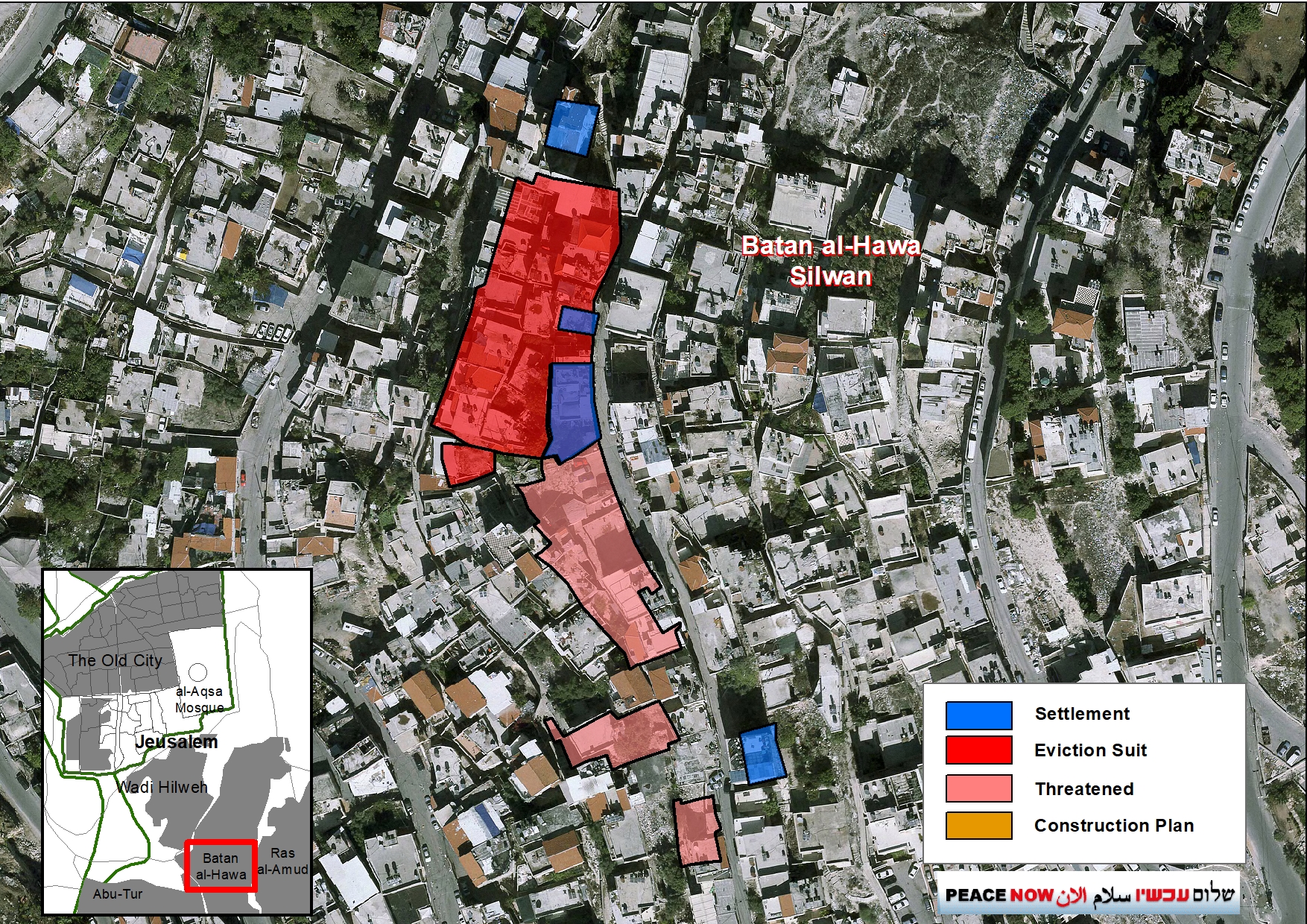
Map by Peace Now
This case is one of nearly a dozen lawsuits brought by Ateret Cohanim seeking the eviction of approximately 700 Palestinians from the Batan al-Hawa section of Silwan. Ateret Cohanim has maneuvered to have the Court order these evictions by gaining control of an pre-1948 land trust – called the Benvenisti Trust – and then asserting their ownership of land in Silwan where Palestinians have lived for generations. This is now the fourth instance in which the Court has ruled in Ateret Cohanim’s favor, strongly suggesting that the dozens of pending cases will also be decided in the settlers favor.
Peace Now said in a statement:
“This is an attempt to displace a Palestinian community and to replace it with an Israeli one, in the heart of a Palestinian neighborhood in East Jerusalem. The settlers could not have succeeded without the Israeli authorities’ close support and assistance. In addition to the hard blow to the prospects for a two-state solution by preventing a Palestinian capital in East Jerusalem, this is an injustice and an act of cruelty to throw out families who have lived lawfully in their homes for decades. For every dunam in East Jerusalem that was owned by Jews and had been lost in the 1948 war, there are tens of thousands of dunams in Israel that were owned by Palestinians who lost them in the 1948 war. The settlers’ demand to disposes the Palestinians based on pre-1948 ownership is a strategic threat on the moral justification of hundreds of thousands of Israelis living on lands that were owned by Palestinians.”
As FMEP has detailed, Ateret Cohanim is a settler organization which works to establish Jewish enclaves inside densely populated Palestinian neighborhoods of East Jerusalem, for the explicit purpose of “reclaiming” Palestinian parts of Jerusalem for Jews. In Silwan, its tactics depend largely on identifying land that belonged to Jews before 1948 and, with the support of Israeli laws and courts, acting to “reclaim” it. Notably, under Israeli law, Palestinians enjoy no similar right to reclaim land that belonged to them before 1948 (to the contrary – Israeli law is engineered to erase Palestinian properties rights based, largely based on the absentee property law). The current and pending evictions are based on the fact that in 2001, Ateret Cohanim gained control of the Benvenisti Trust, which owned land in Silwan in the 19th century. In 2002, the Israeli Custodian General agreed to transfer land in Batan al-Hawa to the Trust/Ateret Cohanim. Since then, Ateret Cohanim has accelerated its multifaceted campaign to remove Palestinians from their homes, claiming that the Palestinians are illegally squatting on sacred land owned by the Trust.
Haaretz columnist Nir Hasson tells the story:
“The neighborhood of Batan al-Hawa is an extreme example stressing the difference between how Arab property was dealt with as opposed to Jewish property. A Jewish neighborhood that had been built for immigrants from Yemen with funds raised by the philanthropic organization Ezrat Nidahim lay in the Batan al-Hawa area until 1938. The homes in the neighborhood were owned by an Ottoman-era land trust that was registered in the name of Rabbi Moshe Benvenisti. In 2001, more than a century after the land trust had been established, the Jerusalem District Court approved the request by three members of Ateret Cohanim to become trustees of the land. With this brief decision that takes up half a page, and a subsequent decision by the Custodian General, the state placed 700 Palestinians, along with their property, under the control of Ateret Cohanim, which seeks to increase Jewish presence in Jerusalem’s Old City.”
Jerusalem Committee Delays Decision on the Cable Car Project, & Defers Decision on Silwan Land Expropriation to the High Court
At a meeting on September 9th, the Jerusalem Municipality’s Planning & Building Committee decided to delay its final approval of plans to build a cable car line in East Jerusalem until the High Court of Justice issues a ruling on whether or not the state is permitted to expropriate the privately owned Palestinian land that is needed to carry out its construction. The High Court is actively considering the cable car case, recently ordering the state to offer a factual explanation for how the cable car line will boost tourism in the city – an explanation that the state has struggled to articulate convincingly. The state was ordered to submit that explanation on September 7th, but requested and received an extension of that deadline to October 1st.
Despite the ongoing court case, the Times of Israel reports that the Jerusalem Development Authority is actively planning for implementation of the project, even issuing public notices in newspapers over the past few weeks in preparation for accepting bids for the construction of the project. The notices announced two conferences slated to be held in October for interested bidders to learn more about the plans.
Some of the land slated for expropriation in connection with the cable car plan is located in Silwan, a densely populated Palestinian neighborhood in East Jerusalem that is the focus of intense settler activity. Ir Amim reports on the details of the expropriation the plan requires:
“The expropriation is intended for the construction of infrastructure poles and stations for the cable car. Some of the expropriation is permanent and some is for an eight-year period. The land targeted for expropriation lies on both sides of the Green Line. On the East of the Green Line, eight parcels of land in Silwan with a total area of 1,357 square meters are targeted for expropriation. The significance of the expropriation is much more than its size may suggest. The lands marked for expropriation are located in the densely built up area of Wadi Hilwe, Silwan. At worst they can lead to the demolition of nearby homes if they were built without a permit. Even if homes are not demolished, the construction of the cable car infrastructure and the subsequent operation of the cable car above their rooftops will greatly harm the community of Wadi Hilwe.
Most significant is the purpose and the impact that the operation of the Cable Car will have on Wadi Hilwe and the whole of Silwan. This huge transportation project is funded by the Israeli Ministry of Tourism at a budget of hundreds of millions of shekels. It will connect between West Jerusalem (“The First Station” complex) and the Kedem Compound in Wadi Hilwe, Silwan. The Kedem Compound is a planned visitor center that the settler organization ELAD is planning to construct on the main road of Silwan across from the City of David National Park which it operates. Although the Cable Car is presented as a means of public transportation for those wishing to visit the Old City, its station is planned to be constructed on the roof of the ELAD controlled Kedem Compound whereby it will lead all those who use it to ELAD’s Activity Center.”
In response to the Committee’s decision this week to delay approval of the plan, Emek Shaveh said:
“We are pleased that the municipality and members of the committee have shown responsibility and stopped the deplorable attempt by the promoters of the cable car to advance the expropriation of private property before the High Court even rules on the matter. We thank the promoters for disclosing how the cable car will look and who will pay the price for its construction: the cable car pillars will be constructed inside the yards of the residents of Silwan and the cars will sail directly over their heads.”
Handing Another Victory to New Settler Strategy, Civil Admin Issues Expropriation Orders for West Bank Antiquities Sites
On August 31st, the Israeli Civil Administration issued expropriation orders for two archaeological sites in the West Bank located on privately owned Palestinian property northwest of Ramallah. The expropriations – the first of their kind in 35 years – come amidst a new campaign by settlers lobbying the government to take control of such sites, based on the settlers’ claims that antiquities are being stolen and the sites are being mis-managed by Palestinians. The settlers’ pressure is also credited as the impetus behind the government’s clandestine raid of a Palestinian village in July 2020 to seize an ancient font.
The two antiquity sites expropriated on August 21st are both located next to settlements. The site of Deir Sam’an is owned by Palestinians from the village of a-Dik, which is adjacent to the settlement of Leshem. The Deir Kala’ archeological site is owned by residents of Deir Balut, and is adjacent to the Peduel settlement. For a background on both of these antiquity sites – see Emek Shaveh’s analysis.
Emek Shaveh said in a statement:
“In the past two years we have witnessed increasing pressure by settler organizations on the Civil Administration and the Staff Officer for Archaeology to increase the use of archaeological sites to remove Palestinians from Area C. While in Susya, the pretext for the expropriation was the existence of an ancient synagogue and therefore logical from the point of view of the authorities, the decision to expropriate two Byzantine era sites is unusual and attests to the growing trend of using archaeological sites as a pretext for barring Palestinians from sites in Area C.”
FMEP has covered the recent surge of settler pressure on the government to take control of archeological sites which are owned and/or controlled by Palestinians. A new settler group calling itself “Shomrim Al Hanetzach” (“Guardians of Eternity”) recently began surveying areas in the West Bank that Israel has designated as archeaological sites in order to call in Israeli authorities to demolish Palestinian construction in these areas. The group communicates its findings to the Archaeology Unit in the Israeli Civil Administration (reminder: the Civil Administration is the arm of the Israeli Defense Ministry which since 1967 has functioned as the de facto sovereign over the West Bank). The Archaeology Unit, playing its part, then delivers eviction and demolition orders against Palestinians, claiming that the structures damage antiquities in the area. As a reminder, in 2017, Israel declared 1,000 new archaeological sites in Area C of the West Bank. The new group is, not coincidentally, an offshoot of the radical Regavim organization, which among other things works to push Israeli authorities to demolish Palestinian construction that lacks Israeli permits (permits that Israel virtually never grants).
The new group has also raised public alarm about the Trump Plan, alleging that hundreds of biblical sites in the West Bank are slated to become Palestinian territory. The group’s leaders accuse the Palestinian Authority of mismanaging the sites and they accuse Palestinians of looting them. The group is demanding that Israel annex all the sites.
State Attempting to Circumvent High Court Order Against Mitzpe Kramim Outpost
The Israeli government is reportedly working to find a way to circumvent the recent High Court order requiring the evacuation of 12 structures built on privately owned Palestinian land in the Mitzpe Kramim outpost from evacuation. Of the 16 structures in the Mitzpe Kramim outpost, 12 were built on land that Israel has (very reluctantly) acknowledged to be owned by Palestinians. Settlers say that evacuation of the 12 homes will spell the end for the entire outpost community.
Israel’s Reshet Bet radio reported that Israeli Settlement Affairs Minister Tzachi Hanegbi, Binyamin Regional Council mayor Yisrael Gantz, and senior Netanyahu aid Ronen Peretz are working together on a plan to get around the Court ruling. There is reportedly a sense of optimism that the team will succeed because the Israeli Attorney General supports the settlers’ claim to stay in their homes, and because Israeli Justice Minister Avi Nissenkorn criticized the ruling, which was issued on August 27th.
In its ruling, the High Court held that construction of the Mitzpe Kramim outpost was not undertaken in “good faith” because there were “multiple warning signs” that the land was privately owned.
The “good faith” condition for retroactive legalization of illegal settler construction on privately-owned Palestinian land is a central element of the “market regulation” legal principle which was issued by Attorney General Avichai Mandelblit in December 2018 as an alternative to the (now overturned) Settlement Regulation Law. The principle offers a path to grant retroactive legalization to the settlers for what this principle treats as “unintentional” land theft – throwing the principles of both rule of law and the private property rights out the window. Peace Now has a comprehensive breakdown of the legal opinion, including the specific criteria outlining which outposts can qualify under the new scheme. Attorney General Mandelblit estimated that 2,000 illegal settlement structures qualify for retroactive legalization using this principle.
Israeli Using Normalization as a “Cover” to Change Status Quo on Temple Mount
In a special report, Terrestrial Jerusalem, the Israeli NGO led by Jerusalem expert Danny Seidemann, warns that the new UAE-Israel normalization deal echoes a controversial provision in the Trump Plan which significantly erodes the status quo on the Haram al-Sharif/Temple Mount.
Under the current understanding – most recently agreed to by Prime Minister Netanyahu and Jordan’s King Abdullah in 2015 – members of all religions are allowed to visit the Haram al-Sharif/Temple Mount, but only Muslims are allowed to pray there. This policy is consistent with the status quo that has reigned on the Temple Mount/Haram al-Sharif dating back to before 1967, and that has been upheld by every Israeli government since it took control of the area in the 1967 War.
In a little-noted but highly consequential shift in approach, the Trump Plan specifically called for people of all faiths to be allowed to pray at the Temple Mount/Haram al-Sharif. The inclusion of this language in the Trump Plan suggested that the current U.S. administration has embraced and is now formally promoting the agenda of Israel’s “Temple Mount-ers” – hardline religious nationalists who seek to expand Israeli/Jewish control of the site and open it to Jewish prayer.
Subsequently, this shift to embracing a change in the Haram al Sharif/Temple Mount status quo showed up again in the Joint Statement released by Israel, the UAE, and the United States, albeit in language that is somewhere more artful. The statement specifies that only Muslims may pray at the al-Aqsa Mosque, while all faiths are allowed to pray at “other holy sites” in Jerusalem. This formula – which is brand new – clearly suggests that Jewish prayer is to be allowed on the Temple Mount/Haram al Sharif, just not in the Aqsa Mosque (meaning, for example, that if Jews want to enter the Dome of the Rock and pray there, they would be permitted to do so).
Terrestrial Jerusalem writes:
“The cumulative message of the new policies and recent events is clear: if, in the past, the Temple Mount/Haram al Sharif was a Muslim place of worship open to the visits of non-Muslim guests, it is rapidly becoming a shared Muslim-Jewish site, like the Ibrahamiya Mosque/Tomb of the Patriarchs in Hebron. This is the declared goal of the Temple Mount Movement and the deepest fears of the Muslim worshipers. And it’s already happening. For centuries, a spark on the Mount has been the likeliest cause of an eruption of violence in the Holy Land, and the current trends on the Mount are making just such an event more likely. Events at Al Aqsa invariably send shock waves throughout the region. Should an incendiary incident on Haram al Sharif/the Temple Mount indeed take place and intersect with the sense that Palestinian/Arab/Muslim interests and equities on the Mount are being bartered away, the results might be dire indeed. And now, what is happening on the ground has been enshrined in the founding statement upon which Israel-Emirati agreement is based.”
The report ends with a warning:
“Jerusalem is a very wise and kind city to those treating her complexities with the reverence they deserve. It is a cruel and vindictive town to those who treat those complexities cavalierly, or ignore them. Jerusalem’s millennia old history is littered with the bodies, literal and figurative, of conquerors, prophets and emperors who acting as though Jerusalem a is a private or collective asset to be exploited at whim, or a commodity which can be bartered. One tinkers with Jerusalem at grave peril to all involved, and the provisions of the Joint Statement recklessly tinker with the status quo. As currently crafted, normalization is being used as a cover to allow one of its stakeholders to remold the most sensitive place in Jerusalem in its own ideological image. One need only recall the aftermath of the opening of the Western Wall Tunnel in 1996 (by the very same Netanyahu) and the Sharon visit to Haram al Sharif/the Temple Mount in 2000 in order to realize just how irresponsible and dangerous this can be.”
Bonus Reads
- “Stop or suspend West Bank annexation? Devil in the detail for Israel-UAE Deal” (Reuters)
- “Israel’s Message to Troops Placing Explosives at Village: Don’t Worry, It’s Combat” (Haaretz)
- “Tourist Attractions in ‘Yesha-stan’: A Display of Israel’s Apartheid Mindset” (Haaretz)
- “Despite COVID-19 Travel Ban, Israel Lets in 70 Evangelicals to Volunteer in Settlements” (Haaretz)
- “Palestinian leaders: Disabled access to Tomb of Patriarchs is ‘war crime’” (Jerusalem Post)
- “Researchers: Israel is going ahead with annexation” (MEMO)
Welcome to FMEP’s Weekly Settlement Report, covering everything you need to know about Israeli settlement activity this week.
To subscribe to this report, please click here.
May 31, 2019
- Israel Publishes Tenders for 805 Settlement Units in East Jerusalem; More May Be Coming
- The World Zionist Organization Continues to Finance Illegal Settlement Construction
- Yitzhar Settlers Attack Israeli Police Officers, Again
- Israel Cut-Off & Trapped a Palestinian Family on the Israeli Side of the Wall, Then Banned Them from Entering Israel
- Palestinians React to Latest Annexation Rumors Amidst Israeli Government Chaos
- Florida Governor Leads Headline-Grabbing Trade Delegation to West Bank Settlements
- Scheindlin: Israel’s Democratic Decay is Happening for the Sake of Annexation
- Bonus Reads
For questions and/or comments contact Kristin McCarthy – kmccarthy@fmep.org.
Israel Publishes Tenders for 805 Settlement Units in East Jerusalem; More May Be Coming
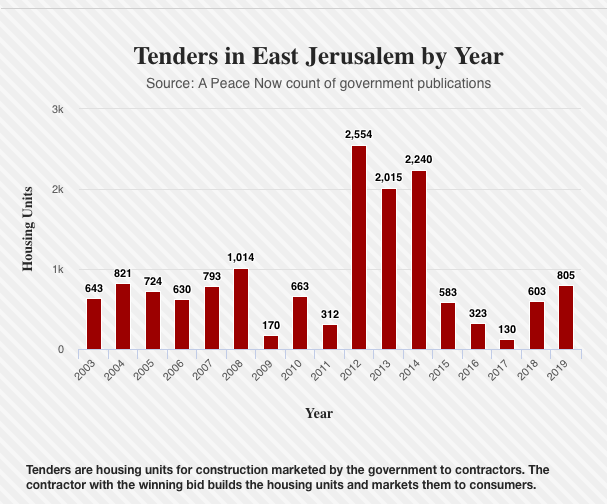 On May 30th, the Israel Land Authority published tenders for a total of 805 new settlement units in East Jerusalem, a decisive step towards the start of construction. The 805 tenders were issued for 345 units in the Ramot settlement and 460 new units in the Pisgat Ze’ev settlement. These are the first tenders published for East Jerusalem settlement construction since April 2018, and collectively are the most tenders published in a single year (let alone simultaneously) since 2014. Moreover, as Jerusalem expert Daniel Seidemann explains, this batch of tenders allows for more construction in East Jerusalem settlements than the government has approved for East Jerusalem Palestinian neighborhoods since Israel gained control of East Jerusalem in 1967.
Furthermore, the Jerusalem settlement watchdog group Ir Amim warns that this batch of tenders may only be the first of an oncoming wave:
“For several years after the collapse of the Kerry initiative in April 2014, there was a significant decrease in the approval of master plans in East Jerusalem and as a result, few tenders were announced. This dramatically changed in 2017 and 2018 with the advancement of master plans reaching near record levels. Today’s tenders are primarily a result of plan approvals from last year, potentially signaling impending large-scale announcements of tenders based on additional plans which have been approved over the last year.”
Peace Now, the veteran settlement monitoring organization, said in a statement:
“Continued construction in East Jerusalem does not contribute to Jerusalem and does not contribute to Israel. As long as we have not reached a permanent agreement with the Palestinians on Israel’s borders, building beyond the Green Line is illegitimate and only harms the prospects for peace and trust between the sides.”
The World Zionist Organization Continues to Finance Illegal Settlement Construction
According to documents acquired by Israel’s Movement for Freedom of Information, over the past two years the Settlement Division of the World Zionist Organization continued to finance illegal settlement construction while simultaneously trying to hide this information from the public.
As a reminder, the Settlement Division is technically part of the World Zionist Organization, but in practice the unit was created by the Israeli government in 1968 and is funded entirely by the Israeli government (and Israeli taxpayers). Its mandate is to manage West Bank land expropriated by Israel, in order to facilitate the settlement of Israeli Jews in the occupied territories. To make this possible, the Israeli government has allocated approximately 60% of all “state land” in the West Bank to the WZO’s Settlement Division [over the past 50 years Israel has declared huge areas of the West Bank to be “state land,” including more than 40% of Area C, where most of the settlements are located]. Together, the WZO and the Israeli government work in coordination to develop West Bank settlements and encourage Jews to move into them, working together so closely that the Settlement Division even splits its real estate profits with the Israeli Housing and Construction Ministry.
According to the WZO’s financial documents for 2017-2018, the WZO subsided settlement projects that are illegal under Israeli law — to the tune of $734,577 USD (NIS 2,668,427).
In addition, the WZO failed to specify how it spent an additional USD $16 million (NIS 58 million) in support of new construction projects, leaving the exact location and legal status of the construction unknown. This represents 43% of the WZO’s overall budget for subsidizing projects.
The settlement projects known to have been subsidized by the WZO in 2017-2018 include:
-
- $640,000 USD (NIS 2,330,973) for the establishment of a community center in the Eli settlement. Though the Eli settlement previously received Israeli government approval, a “Master Plan” – which officially zones land for distinct purposes (residential, commercial, public) – has never been issued for Eli, meaning all construction there is illegal under Israeli law.
- $85,816 USD (NIS 311,736) on projects in the unauthorized Brosh outpost (the Israeli government is advancing a plan that would legalize Brosh retroactively, but until it does, all projects in it are illegal).
- $42,000 USD (NIS 153,127) for infrastructure development in the unauthorized Givat Eitam/E-2 outpost, which according to Peace Now appears had not been transferred as of the end of 2018. FMEP has covered the settlers efforts to establish the Givat Eitam/E-2 outpost and the government’s plan to retroactively authorize it as an official settlement in detail. It is worth recalling that the location of the Givat Eitam/E-2 has dire geopolitical consequences for the fate of the two state solution as well as the development of Palestinian communities just south of Bethlehem.
- $6,000 USD (NIS 22,445) for projects in the unauthorized Mitzpe Kramim outpost. Funding for Mitzpe Kramim over the past two years is particularly galling, given ongoing litigation that has included evidence that the Settlement Division knowingly gave land privately owned by Palestinians to settlers in order to build the outpost.
- $900 USD (NIS 3,273) for renovation of illegal structures in the unauthorized outpost of Haresha. The Israeli government has successfully used the Haresha outpost as a test case for new legal tools the government of Israel developed in order to justify the expropriation of privately owned Palestinian land in order to retroactively legalize outposts. Using these tools, the government has found a way to “legally” build an access road to the settlement through privately owned Palestinian land; once the road is built, there is nothing preventing the government from retroactively legalizing Haresha.
Peace Now said in a statement:
“The Settlement Division is a body that was born in sin immediately after 1967 in order to carry out the dubious works of building settlements for the government. It turns out that even today, after regulating the activities of the Settlement Division, it still operates without transparency and continues to finance illegal activity. The time has come to dismantle the Settlement Division and to restore to the government the governmental activities it has privatized.”
Despite the WZO’s ongoing defiance of Israeli planning and building laws — or perhaps in light of its direct and very effective role in entrenching and expanding the settlements — the Israeli government is actively seeking to transfer more West Bank land to the WZO for management. In the last Knesset session, a government-backed bill to expedite the transfer of more land to the WZO was stalled by the Israeli Attorney General only because the bill, in the view of the Attorney General, was duplicative of his own efforts to enrich the Settlement Division at the administrative level.
Yitzhar Settlers Attack Israeli Police Officers, Again
On May 26th, dozens of masked Israeli settlers violently attacked Israeli police officers who approached an illegal outpost near the settlement of Yitzhar, forcing the Israeli army to intervene in order to get the police officers to safety.
Not a single settler was arrested for the attack.
The event started when Israeli police arrived at the Kippah Sruga outpost in response to calls saying that clashes had broken out between Palestinians and Israelis in the area. According to Israeli police, when they arrived masked settlers began launching stones at them and slashed their car tires with a knife.
Haaretz reporting on this incident reminds readers:
“Over the past several weeks, settlers from Yizhar and surrounding settlements have been involved in several altercations, yet police have not arrested a single suspect. Last week, Israelis and Palestinians reported a field set ablaze and clashes in the Palestinian towns of Burin, Urief and Asira al-Qibliya. In a video disseminated by Asira al-Qibliya’s council, settlers are seen throwing stones at Palestinians, while soldiers nearby do nothing to arrest them. In response to the video, the IDF spokesman said that ‘Palestinians started a fire near Asira al-Qibliya. The IDF, the Border Police and civilian volunteers worked to extinguish the fire, which was spreading towards a military position and the edge of Yitzhar.’ After a B’Tselem video surfaced, showing settlers setting fire to fields, the army revised its response and confirmed that Jewish settlers also took part in setting fires.”
Israel Cut-Off & Trapped a Palestinian Family on the Israeli Side of the Wall, Then Banned Them from Entering Israel
On May 27th, Haaretz published a gut wrenching profile of the Hajajla family who lives on the Israeli side of the separation wall that cut them off from their hometown of al-Walajah, a Palestinian village just south of Jerusalem. Two days after publication of the profile – which FMEP shares in brief below – Israel issued an order banning the patriarch of the family, Omar Hajajala, from entering Israel, though he lives on the Israeli side of the wall in a spot where the route of the wall juts into the West Bank.
Before jumping into the full story, here is a reminder about the situation facing all of the residents of al-Walajah, in the words of Danny Seidemann:
“Walajeh is a village on Jerusalem’s southern flank that is entirely surrounded by the separation barrier. Since 1967, Walajeh’s inhabitants have lived in a Kafka-esque situation, with their village technically located inside Israel’s expanded borders, but with villagers never given Israeli residency (they are considered West Bankers and thus are not permitted inside Jerusalem). As a result, the villagers’ presence in their own village is, under Israeli law, illegal, and their homes there are, by definition, illegal.”
The Hajajla family was the only home in al-Walajah disconnected from the village when the separation barrier was built, leaving the family home on the Israeli side of the wall since 2014. The family refused to abandon their home despite the coercive and legal efforts by Israel to force them to do so. In 2014, after a petition before the High Court of Justice, the Defense Ministry opted to build the family a special passage underneath the barrier so it could reach the village, at a cost $1.1 million USD (NIS 4 million).
After the tunnel was constructed, the Israeli government began to impose new, burdensome, and compounding restrictions on the family regarding its use of the passageway. In 2017, the government decided to install a locked gate at one end of the passageway to control who enters and exits, which could be opened only by a single remote control given to the family. That single remote meant that whenever one member of the family left the home (impossible without taking the remote control with them), the rest of the family was left trapped, literally, until the remote-holder returned.
To make the situation more workable, Omar Hajajla, the family’s patriarch rigged an electric bell near the gate so that the single remote control can stay at the house while family members leave and return (the bell enables someone in the home to know that someone is at the gate needing to be let in). The bell has been in place for over a year, but only recently the Israeli Border police opted to make it an issue. This month, the police took Omar in for questioning and changed the lock so that the family could not open the gate at all. Omar Hajajla was ultimately fined and released, but the lock on the gate remained — until Haaretz filed an inquiry on May 26, 2019.
Omar Hajajla speculates that a recent court ruling in his family’s favor prompted the Israeli Border police to escalate their harassment of the family and make an issue of the bell. About a month ago, the Jerusalem Magistrate’s Court rejected the state’s assertion that the family’s home is illegal – allowing the Hajajla family to stay put.(Note: The state of Israel has initiated demolition proceedings against dozens of homes in al-Walajah claiming that they were built without Israeli building permits – which are next to impossible for Palestinians to obtain, let alone Palestinians on coveted land like al-Walajah) –
In response to the May 27th Haaretz profile, Israeli police stated:
“At issue is a security passage that provides a short passage for the family from their home in Israeli territory to the Palestinian Authority areas. As you can see from the attached video and photos, the gate was shut last Monday to repair security cameras that were broken, to repair damage to the gate and to remove an electric bell that the father of the family had installed against the law, by attaching an unapproved electric wire from his home, a distance of dozens of meters from the passage. After the repair the passage was opened on Wednesday but when the father was seen exploiting it to illegally allow Palestinians to enter it was shut again and the suspect was taken for questioning. The passage was opened again yesterday, but because of a technical problem that was discovered it was shut again and we are working to fix it quickly. The Israel Police will not allow any damage to the security passages it is responsible for and will bring to justice anyone who vandalizes them and tries to harm the State of Israel’s security.”
The treatment of the Hajajla family should be seen in context of Israeli efforts to seal off al-Walajah from Jerusalem. As FMEP has previously reported, residents of al-Walajah have long been struggling against the growing encroachment the nearby Etzion settlement bloc and the Israeli government’s attempt to de facto annex the bloc as part of “Greater Jerusalem.” Ir Amim explains several prongs of this effort, including a particularly problematic section of the separation barrier around al-Walajah that has been planned in order to (a) almost completely encircle the village, (b) turn its valuable agricultural land into an urban park for Jerusalem, and (c) enable construction of a highway that will connect the Etzion settlement bloc to Jerusalem with Israeli-only bypass roads.
Palestinians React to Latest Annexation Rumors Amidst Israeli Government Chaos
Al-Monitor reports reactions from Palestinian leaders who are increasingly fearful that rumors about Israeli annexation of the settlements will be acted upon. Those rumors – as FMEP wrote last week – suggest that Israel will strip the Israel Civil Administration of its authority over the settlements and bring all settlements under Israeli domestic law, making settlement affairs the responsibility of the various Israeli ministries.
Wasel Abu Youssef, member of the PLO Executive Committee in the West Bank, told Al-Monitor:
“Expanding the powers of the Israeli ministries at the expense of the civil administration is an attempt to impose occupation and establish it in the West Bank, to end the [idea of a] two-state solution and prevent the establishment of a Palestinian state, which falls within the framework of denying the Palestinian people their rights to freedom and independence. These efforts mean practically annexing parts of the West Bank to Israel. Unfortunately, this comes with the blessing of the administration of US President Donald Trump, who doesn’t recognize the option of a two-state solution and gives Israel the green light to do whatever it wants in the West Bank.”
Walid Assaf, head of the Colonization and Wall Resistance Commission, told Al-Monitor:
“The efforts to transfer the powers of the civil administration to the Israeli ministries directly mean the annexation of the West Bank settlements to Israel. This will lead to annexing Area C — which amounts to over 60% of the entire area of the West Bank — to Israeli sovereignty…Annexing West Bank settlements to Israel would pave the way for Israel to perpetuate a policy of ethnic cleansing against the Palestinians, and this will push the Palestinians in Area C to migrate to PA-controlled Areas A and B.”
Hanna Issa, an international law professor at Al-Quds University in Abu Dis, told Al-Monitor:
“The Israeli occupation has always been there. It is essential that the Palestinian territories [including the Israeli settlements] remain administered through the civil administration of the Israeli army [in cooperation with the Palestinians] until this occupation ends…“Limiting the powers of this administration and giving its responsibilities to the Israeli ministries is a dangerous step aimed at annexing occupied areas under international law.”
Scheindlin: Israel’s Democratic Decay is Happening for the Sake of Annexation
In a new paper for The Century Foundation, Israeli pollster and political analyst Dahlia Scheindlin writes an important analysis regarding Israel’s path to annexation:
“This report argues that Israel’s slide into illiberal democracy can only be understood as part of an attempt to go beyond military or physical control and establish a political and legal foundation for permanent annexation of both land and people. The assault on Israel’s democratic norms over the past decade initially appeared only indirectly related to a future of permanent annexation, as they suppressed the mechanisms of dissent and undermined the basis for minority rights. Then, in the recent elections, Prime Minister Benjamin Netanyahu made explicit his goal to annex occupied territory in the West Bank, which represented the culmination (to date) of increasingly open policies and legislative initiatives from the previous term that explicitly advance annexation.”
The entire paper is worth reading, and is available online here.
Florida Governor Leads Headline-Grabbing Trade Delegation to West Bank Settlements
From May 25-31, Florida Governor Ron DeSantis led a trade mission – purposefully and prominently also visiting settlements in the West Bank. While on the ground, DeSantis made headlines by blasting BDS, endorsing Israeli settlements, and gloating about Florida’s role in AirBnB’s reversal of its decision to remove rental listing located in Israeli settlements.
DeSantis signed several formal partnerships between Florida universities and Israeli schools, most notably including an agreement between Florida Atlantic University and Ariel University – the first such deal between a U.S. school and an Israeli school located in a settlement. In recognition of the historic deal, Ariel University presented DeSantis with an Honorary Fellowship Award at an event in the settlement, attended by U.S. casino magnates and settlement financiers Sheldon Adelson and Dr. Miriam Adelson. In his acceptance speech, the Governor invoked the Bible to lend his support for Israel’s permanent control of the West Bank, saying:
“We are now in the heart of the Holy Land of Israel. When you think about Israel’s history and the tradition that connects Israel and the U.S., it’s inspiring. On my last visit to Israel in 2014, the U.S. embassy was in Tel Aviv and we were on the verge of signing a destructive agreement with Iran, and I am happy that today we have achieved real progress. We have an American embassy in Jerusalem with an American acceptance of the sovereignty of the State of Israel on the Golan Heights and the agreement with Iran has been removed from the stage of history. I, personally, have fought Airbnb’s discriminatory policy against Jewish-owned properties in Judea and Samaria, and only recently have they changed their discriminatory policy. I say here: BDS has no place in Florida. The memorandum of understanding signed today between the University of Ariel and Florida State University is a blessed agreement that will bring these two institutions forward. I am happy to say that Florida is a very diverse state, but not when it comes to its unequivocal support for the State of Israel.”
U.S. Ambassador to Israel David Friedman also hosted DeSantis for a reception and Israel’s Minister of Public Security Gilad Erdan joined DeSantis on a visit to additional West Bank settlements, this time in Gush Etzion, for a briefing about the fight against BDS. Friedman said:
“Israel has no greater friend in all the 50 governor mansions than Ron DeSantis. I welcome you and the Cabinet members and your delegation to this small but incredibly important country.”
As mentioned by Ambassador Friedman, DeSantis was joined by members of the Florida Cabinet on the trade mission, including Florida Attorney General Ashley Moody and Florida Agricultural Commissioner Nikki Fried. In a controversial move, DeSantis convened a Florida cabinet meeting on May 29th at the Embassy in Jerusalem, despite a lawsuit filed in Florida seeking to stop him from doing so. The lawsuit was filed by a government watchdog group and several news outlets, arguing that convening the Cabinet in Israel violated a state law that requires government meetings to be accessible to the public. The lawsuit was dismissed because the court could not serve paperwork to DeSantis and the other named defendants – who were, obviously, in Israel.
At the Cabinet meeting on may 29th, DeSantis signed a bill to prohibit anti-Semitism in Florida’s public schools and universities. The new law wrongly conflates anti-Semitism with criticism of Israel by including in the definition of anti-Semitism, “drawing comparisons of contemporary Israeli policy to that of the Nazis,” ″blaming Israel for all interreligious or political tensions,” and/or “requiring behavior of Israel that is not expected or demanded of any other democratic nation.”
The next day, DeSantis met with Prime Minister Netanyahu while the larger delegation visited the City of David national park, which is run by the radical Elad settler group.
Bonus Reads
- “Israel’s High Court Seeks Order, Not Justice” (Haaretz)
- “Another Company Withdraws from Israeli Light Rail Project” (IMEMC)
Welcome to FMEP’s Weekly Settlement Report, covering everything you need to know about Israeli settlement activity this week.
To subscribe to this report, please click here.
March 15, 2019
- State Submits Defense of Mitzpe Kramim Outpost Legalization to High Court, Peace Now Petitions to Join the Case
- Civil Administration Employees Go on Strike, Delaying Approval of 4,500 New Settlement Units
- 47% of Palestinian Land Expropriated by Israel for “Security Needs” Has Been Given to the Settlements
- Transportation Ministry Denies Involvement in Jerusalem Cable Car Project, Calls it a “Tourist Cable Car”
- State Department Formalizes Occupation Denial as Official U.S. Policy; Israeli Politicians Immediately Plan for Annexation
- For the First Time, AIPAC National Policy Conference to Host Settler Leader
- Wind Power & Israel’s Occupation of the Golan Heights
- Bonus Reads
Questions/comments? Email kmccarthy@fmep.org
State Submits Defense of Mitzpe Kramim Outpost Legalization to High Court, Peace Now Petitions to Join the Case
On March 10th, the state of Israel submitted a written argument to the High Court of Justice in defense of its plan to expropriate land that it acknowledges is privately owned by Palestinians in order to retroactively legalize the Mitzpe Kramim outpost.
The state’s argument was previously accepted by the Jerusalem District Court in an August 2018 ruling, which paved the way for the High Court to resume its consideration of a petition against the Mitzpe Kramim outpost, submitted by the registered Palestinian landowners in 2011.
In both cases the state’s argument relies on the “market regulation” principle, which the Israeli Attorney General invented as a legal basis for retroactively legalizing settlements and outposts built on land that even Israel recognizes as undeniably owned by Palestinians.
According to the “market regulation” principle, in cases where all relevant parties – in this case, the government, the World Zionist Organization, and the settlers – acted “in good faith” in the course of events that lead to the establishment of the unauthorized outpost on privately owned Palestinian land, the ownership of that land can legally be given over to the settlers. It is notable that the Palestinians are not considered relevant parties in this analysis (even when they and human rights groups alerted Israeli authorities in real time of the illegal building taking place – challenging the very idea of “good faith” mistakes).
The state’s March 10th argument also attempts to explain why the landmark 1979 Elon Moreh ruling, which explicitly prohibits Israel from building settlements on land expropriated for military purposes, should not apply to the Mitzpe Kramim case, given that the outpost was allegedly built in “good faith” based on the settlers’ belief that the land in question was part of a military seizure order from the 1970s (this belief was incorrect – the land was/is recorded in the Israeli Land Registry as privately owned by Palestinians from the village of Deir Jarir).
Also on March 10th, Peace Now filed an application to join the Mitzpe Kramim High Court case as a “friend of the court,” citing the organization’s professional expertise on the subject matter. In the application, Peace Now explained the potential devastating ramifications of the “market regulation” principle, and challenged the notion that “good faith” can be attributed to the Israeli parties involved in illegally building the Mitzpe Kramim outpost. Peace Now’s main points on the case are:
- The broad implications of the ruling – Peace Now has submitted to the court a list of 132 settlements and outposts where nearly 7,000 housing units have been built on private Palestinian land, stretching over 10,000 dunams. This is in addition to thousands of dunams or even tens of thousands of dunams taken from their owners by settlements for infrastructure, agriculture, and so on. The ruling is likely to serve as a precedent for the massive land grabs that the state has carried out over the years in the settlements.
- Land Management by the Custodian of Government and Abandoned Property in Judea and Samaria – A description of a series of failures in the General Director’s actions led to the many “errors” in the allocation of land that is not owned by the state. Some of the failures were presented in official government reports and by the state comptroller, which attest to historic failures and oversights that have not been corrected to this day.
- Land management by the Settlement Division, not done in “good faith” – Extensive information on the activities of the Settlement Division on land allocated to it (and land not allocated to it) and in many cases of allocations granted without authorization.
- The nature of the “market” for which the “market regulation” is applied – In fact, there is no “market” or “normal trading life” in transactions of the kind that the state manages in the territories. There is no ongoing trade, certainly not in “state lands” allocated by the state to settlers and transactions between the state and the World Zionist Organization (the umbrella organization that includes the Settlement Division). Moreover, there is no possibility – even theoretically – of the opposite situation: seizing privately owned land for Jews and transferring it “by mistake” to Palestinians. Nor is there a governmental body in the area that expropriates private land from Jews. Only one side is consistently discriminated against, as evidenced in the data according to which 99.76% of the allocated state land in the West Bank was given to the Israeli population, and while less than a quarter of a percent was allocated to Palestinians since 1967.
FMEP’s Annexation Policy Tables track the ongoing legislative, political, and legal transformations happening in the Israeli government to justify the expropriation of Palestinian land for settlements. As a reminder, the “market regulation” principle was promoted by Israeli Attorney General Avichai Mandelblit, who offered it as an alternative to the legal basis provided in the “Regulation Law” to legalize unauthorized outposts and settlement construction.
Civil Administration Employees Go on Strike, Delaying Approval of 4,500 New Settlement Units
The Times of Israel’s settlement correspondent Jacob Magid reports that employees of the Israeli Civil Administration – the Israeli legal body that runs the West Bank, operating under the Ministry of Defense – will resume a strike for improved compensation and working conditions. Employees of the Civil Administration went on strike in July 2018 over the same set of issues.
The strike, if it happens, may delay the next meeting of the Civil Administration’s High Planning Committee (the body which regulates all planning and building in the West Bank), scheduled for next week. The committee is expected to advance 4,500 new settlement units.
47% of Palestinian Land Expropriated by Israel for “Security Needs” Has Been Given to the Settlements

Graph by Kerem Navot
A new report by Kerem Navot has revealed the extent to which military seizure orders have been used to expropriate privately owned Palestinian land in the West Bank not for military or security purposes, but to advance the settlements.
The report – entitled, “Seize the Moral Low Ground: Land Seizures for ‘Security Needs’ in the West Bank” – provides detailed data on how land taken by Israel via military seizure orders is currently being used. Important and illustrative data points include:
- Under international law Israel, as the occupying power, may seize private Palestinian land for military purposes, but such seizures must be temporary in nature (the land must be returned to its owners when it is no longer being used for the purposes for which it was seized) and the owners must be compensated for the period of the seizure.
- From 1967-2014 Israel issued 1,150 military seizure orders, taking nearly 25,000 acres (just over 100,000 dunams).
- 67% of land seized by military order is privately owned by Palestinians.
- 47% of the total land seized by Israel by military orders is currently used to serve the needs of the settler population.
The new report also provides a fascinating explanation of how Israeli courts have at times held that the establishment of a civilian settlement on land seized for security needs is a valid use of that land, holding that settlements promote Israeli security. This was the case in a 1980 ruling on the Beit El settlement, which held that the civilian settlement of Beit El, constructed on land seized for military purposes, should be viewed as a security asset. Regarding this concept, the judge wrote:
“Israel, a small country within the long narrow confines of the Green Line, is surrounded, very regretfully, by countries that do not hide their hostility toward it. It is doubtful whether this situation, into which I will not go into detail, has any parallel in the history of humankind. … It is therefore reasonable to assume that in this unique situation, which requires supreme alertness to precede any possible calamity if, where, and when it may flare up, it is necessary to make use of exceptional solutions as well. … One of these solutions — and the topic of the discussion before us — is the creation of a Jewish civilian presence at particularly sensitive points. … I am aware of the fact that we are referring to a civilian population. … Against this backdrop, I accept Major General Orly’s claim that a civilian presence at these sensitive points is the necessary solution.”
This legal argument appears to directly contradict the landmark Elon Moreh settlement ruling in 1979, in which the courts barred the state from using privately owned Palestinian land that had been seized for security needs in order to build civilian settlements.
The report is available online here.
Transportation Ministry Denies Involvement in Jerusalem Cable Car Project, Calls it a “Tourist Cable Car”
The Israeli Transportation Ministry has publicly confirmed that it is not involved in the development of the Jerusalem cable car project, contradicting the Israeli Tourism Ministry, which has pitched the project as a transportation solution for traffic congestion around the Old City.

Map by Terrestrial Jerusalem
In response to an inquiry from the Israeli NGO Emek Shaveh – a prominent critic of the cable car’s settler-linked agenda and damaging impact on Jerusalem’s archeological integrity – an official at the Transportation Ministry said, “We have no information on the cable car project. This is a tourist project not a transport one.” That fact was confirmed by The Times of Israel, which received the following response to their own inquiry: “This is a tourist cable car, and therefore the Ministry of Transportation is not involved in the project.”
The non-involvement of the Transportation Ministry only compounds the secrecy and unusual circumstances surrounding Tourism Minister Yair Levin’s promotion of the cable car project. In addition to circumventing the normal planning process for such large-scale, landscape-altering construction projects in and around the Old City, the Jerusalem Development Authority (JDA) – the quasi-governmental body that is leading efforts to implement the plan – continues to refuse requests to release the “economic feasibility report” outlining critical details about the cable car plan. The JDA said that the publication of the report would “disrupt the project’s progress” and “harm” the tender process.
Emek Shaveh filed a petition with the Jerusalem District Court to compel the release of the economic feasibility report, only to be told by the court that the respondents to the petition (the JDA and the Tourism Ministry) do not have to respond to the petition until the Fall, well after the April 2nd date for public comment.
In a statement issued in March 2019, Emek Shaveh wrote:
“The fact that the developers of the cable car project are concealing such important information from the planning committees casts a dark shadow over the project. It is no secret that the project was presented in the National Infrastructure Committee, because it obviously would not have passed in the planning committees. Even in a governmental committee that is their own playing field, the project’s developers have to scheme in order to get it approved. The cable car initiative is a destructive plan that clashes with the unique character of Jerusalem as an historic and holy city for three religions. Spurred by the political interest of strengthening the settler organization “Elad,” the Israeli government is willing to compromise the Old City walls, the skyline of the Historic Basin and its antiquities – and dares to call it tourism. We, at Emek Shaveh, together with a coalition of organizations and people, will do everything we can to object to and stop this plan, which will harm World Heritage assets that were entrusted to the State of Israel.”
Emek Shaveh attorney Eitay Mack said:
“The public has access neither to a transport plan nor to an economic plan. This is a populist project, which hasn’t been thought through and risks becoming a white elephant.”
As FMEP has previously covered, the Jerusalem cable car project is an initiative of the Elad settler organization (which is building a massive tourism center – the Kedem Center, which will be a stop along the cable car’s route – in the Silwan neighborhood). The cable car project is intended to further entrench settler activities and tourism sites inside Silwan, while simultaneously delegitimizing, dispossessing, and erasing the Palestinian presence there.
State Department Formalizes Occupation Denial as Official U.S. Policy; Israeli Politicians Immediately Plan for Annexation
Under the close guidance of U.S. Ambassador David Friedman, the U.S. Department of State’s annual report on human rights covering events in 2018 does not recognize the West Bank and Gaza as occupied territory. The 2018 report also marks U.S. recognition of the Golan Heights as “Israeli-controlled” rather than “Israeli-occupied,” as previous administrations had addressed the Syrian territory.
Following the report’s release, and widespread press coverage of the language change, Education Minister Naftali Bennett and Justice Minister Ayelet Shaked (who are campaigning for the next Knesset as the co-leaders of The New Right party) announced that they will be introducing a bill to annex Area C of the West Bank. Making the connection to the U.S. policy shift clear, Bennett said:
“Now that the United States no longer sees Judea and Samaria as an occupied territory, there is no reason to wait [on annexing Area C] any longer. Half a million Israelis have to stop being second-class citizens. In Ariel, Ma’aleh Adumim and Ofra Jewish citizens discriminated against because they chose to settle the land. I would like to thank President Trump for the tremendous change in the administration’s position, it is a correct step in the right direction.”
Shaked added:
“It is time to apply sovereignty in Area C. The declaration of the United States obliges the State of Israel to make bold and courageous decisions that will help Israel’s security and full equality of rights for all its citizens.”
Ambassador Friedman has spent his two-year tenure pushing for and implementing pro-settlement policy changes, which is in line with his belief that Israeli settlements in the West Bank are not illegal and that occupation is a matter of allegations and opinions. Reflecting Ambassador Friedman’s talking points, a State Department official told Haaretz:
“We retitled the human rights report to refer to the commonly used geographic names of the area the report covers.”
The 2017 State Department report laid the groundwork for the wholesale elimination of occupation from the State Department lexicon this year. It was the 2017 report – issued in 2018 by Acting Secretary of State John Sullivan – that altered the titles of the two sections covering Israel and the Palestinians, from “Israel” and “The Occupied Territories” to “Israel and the Golan Heights” and “West Bank and Gaza.” The 2017 report did acknowledge Israel’s occupation of the West Bank and East Jerusalem in 1967, though reference to and criticism of the occupation was severely neutered compared to previous reports (including the 2016 report issued by the newly inaugurated Trump Administration under Secretary of State Rex Tillerson).
Hanan Ashrawi, member of the Executive Committee of the Palestine Liberation Organization (PLO), said in a statement:
“After the release of the so-called Human Rights Report by the US State Department, it is now abundantly clear that the Trump administration is gearing all branches of the government to whitewash the Israeli occupation and its pervasive violations of human rights. The ‘report’ also decontextualizes the reality by omitting the inescapable fact of Israeli occupation of Palestine, reflecting this administration’s infatuation with an alternative yet fallacious version of reality and legality…The intention of this publication is clear. It is to exonerate Israel from its indisputable human rights violations, while deliberately attempting to depict the racist policies and attitudes of the Israeli government as benign despite the fact that they deny the Palestinian people’s humanity, nationality, and narrative. In its zealous pursuit to justify and mainstream the right-wing agenda in Israel, the Trump administration has made a mockery of the Human Rights ‘Report’ and reaffirmed its complicity in the promotion and support of human rights violations against the Palestinian people.”
Debra Shushan, Director of Policy & Government Relations at American for Peace Now, told FMEP in reaction:
“Denying occupation doesn’t change the reality of occupation. As for the Golan Heights, US acceptance of Israeli annexation there is a gateway drug to recognizing annexation of West Bank. If the administration, with support from some Congressional Republicans, is willing to recognize the violation of international law with regard to Syrian territory annexed by Israel, why not recognize annexation of other territories Israel occupied in 1967? Naftali Bennett and Ayelet Shaked are taking the State Department report as a US decision that ‘US no longer sees Judea and Samaria as occupied territory’ and pledge to introduce legislation to annex Area C in first week of next Knesset session. If Netanyahu retains the prime ministership he’s likely to agree to anything to get a right-wing coalition to support immunity for him so he can stay out of jail. This report, and the broader Trump/Friedman policy of which it is part, could have huge consequences.”
Also commenting from the U.S., Eugene Kontorovich – head of the international law department at the Kohelet Policy Forum, a right-wing pro-settlement organization, who has long argued that Israel is not occupying Palestinian territory – said:
“This year’s report for the first time does not use the inaccurate legal description ‘occupation’ to refer to Israel’s presence in the West Bank or Golan…This is a massive change in how America relates to the conflict. It is coming to understand that while Israel and the Palestinians have a dispute, international law does not provide the answers to that dispute. The report also for the first time expresses skepticism at the claims and submissions of anti-Israel groups, whose poorly documented allegations had previously been accepted as gospel.”
As a reminder, Kontorovich self-identifies as a key figure in the drafting of “anti-BDS” (but actually, anti-free speech/pro-settlement) laws in the United States. Kontorovich has also testified multiple times to U.S. Congress, including in support of moving the U.S. Embassy to Jerusalem; in support of Congress legislating U.S. foreign policy, including with regard to Jerusalem; on the impact of the BDS movement, and in support of U.S. recognition of Israel’s sovereignty over the Golan Heights, a push which gained even more momentum in Congress this week when Senator Lindsey Graham visited the Golan Heights alongside Netanyahu and Amb. Friedman.
Senator Ted Cruz (R-TX) also commented on the significance of the Human Rights Report’s language. A spokesman for the Senator told Jewish Insider:
“Sen. Cruz believes that it is in the United States’ national security interests to recognize Israel’s sovereignty over the Golan Heights. Anything that moves in that direction is a welcome step, but we must do more. He will continue advancing his legislation, introduced with Sen. Cotton and Rep. Gallagher in the House, to establish that it is the policy of the United States to recognize Israel’s sovereignty. Any policy short of full recognition is a policy that falls short of securing American national security interests.”
For the First Time, AIPAC National Policy Conference to Host Settler Leader
The American-Israel Public Affairs Committee (AIPAC) will host settler leader Oded Revivi at the upcoming AIPAC national policy conference in Washington, D.C. Revivi will speak on a panel entitled, “The Future of Judea and Samaria.” Revivi is the former head of the Yesha Council, an umbrella group that represents all settlements in the West Bank; he currently serves as Mayor of the Efrat settlement and the foreign envoy of the Yesha Council. In September 2018, Revivi proudly boasted about his role in illegally establishing a new outpost on privately owned Palestinian land.
With respect to his invitation, Revivi told the Jerusalem Post:
“AIPAC has finally realized that they cannot ignore half-a-million people living in Judea and Samaria, who are becoming more and more attractive to the audience of AIPAC.”
AIPAC denies that Revivi’s official role in the conference marks a change in policy; AIPAC publicly supports the two state solution – a position which produced an awkward public fight between settlers leaders – who do not support a two state solution – and AIPAC last year. An AIPAC spokesman said:
“At every policy conference, we have scores of speakers from across the political spectrum — including those with diverse views on settlements — and this year is no different..we do not take a position on settlements.”
At the 2018 AIPAC policy conference, several prominent Israeli politicians held pro-settlement, pro-annexationist discussions on the margins of the AIPAC conference – but were not part of the official program. Mondoweiss notes that there are growing ties between AIPAC and the Yesha Council, and that AIPAC delegations (including Congressional delegations) regularly meet with Revivi while in Israel and the West Bank.
Wind Power & Israel’s Occupation of the Golan Heights
The Israeli NGO Who Profits has released a new report entitled, “Greenwashing the Golan: The Israeli Wind Energy Industry in the Occupied Syrian Golan.” The report details Israeli commercial wind farms currently under development in the Golan and their role in exploiting Syrian land, strengthening illegal settlements and normalizing the Israeli occupation. The report also exposes the involvement of private international and Israeli corporations, including the involvement of the U.S.-based multinational General Electric and the Israeli publicly traded companies Enlight Renewable Energy, Minrav Group and Energix Renewable Energies.
Bonus Reads
- “BBC Global Questions – Trump’s ‘Deal of the Century’” (YouTube/BBC)
- “VIDEO: Sabbagh Family Faces Imminent Eviction in Sheikh Jarrah” (YouTube/Ir Amim)
- “70% of Israeli Jews Find Israeli Control Over the Palestinians as Immoral” (Jerusalem Post)
Welcome to FMEP’s Weekly Settlement Report, covering everything you need to know about Israeli settlement activity this week.
To subscribe to this report, please click here.
December 21, 2018
- Israel Nears Final Move to Carry Out Massive Land Theft to “Regulate” Illegal Outposts
- Ministers Back a Bill to Legalize 66 Outposts
- In New Legal Opinion, Israeli AG Outlines Strategy for Legalizing Outposts
- New Outpost #1 : Settlers & Government Officials Illegally Re-Build Amona Outpost
- New Outpost #2: Settlers Build Outpost Overlooking Hebron
- More Details on the Plan to Dig a Tunnel Road to the Haresha Outpost
- High Court Criticizes State Over Illegal Road on Palestinian Land
- New Report Documents Israel’s “Severe and Regular” Violation of International Law in Hebron
- High-Rise Settlement Housing Promoted As a Means to Achieve 2020 Settler Vision & As a Solution to Israel’s Affordable Housing Shortage
- Fourth Quarter Decline in 2018 Settlement Construction Starts Doesn’t Tell the Whole Story
- Bonus Reads
Questions/comments? Email kmccarthy@fmep.org
Israel Nears Final Move to Carry Out Massive Land Theft to “Regulate” Illegal Outposts
As has become routine, Israeli settlers and their allies in government are exploiting the recent deaths of three Israelis (two soldiers and a baby) at the hands of Palestinian attackers as an opportunity to accelerate settlement-related activities. This includes advancing new legislation and accelerating/expanding the application of new legal tools designed to entrench and expand the permanence of some of the most radical Israeli settlers living in isolated outposts across the West Bank.
If implemented, the plans and legislation detailed below (and in last week’s settlement report) will expropriate huge amounts of land that even Israel recognizes as privately owned by Palestinians, in order to retroactively legalize Israeli outposts scattered across the West Bank. Such a move will complete what has been a gradual but steady formal suspension of even the pretense of maintaining the rule of law with regard to Israeli settlers’ or the Israeli government’s’ actions in the West Bank (which comes on top of Israel’s official and open contempt for international law). As Haaretz columnist Zvi Bar’el writes:
“The legal criminality that the government invented in honor of the settlers… is an unbridled attack on the rule of law, the undermining of Palestinian landowners’ right to appeal at the High Court, and the destruction of the planning and building system. And mainly, it turns terror into a real estate perk for lawbreaking extortionists.”
Americans for Peace Now said:
“In reaction to murderous terrorist attacks targeting West Bank Jewish settlers and Israeli soldiers, the government of Israel has come under pressure from the settlers to exact retribution against Palestinians. Two of the measures adopted are bound to open the floodgates for the legalization of existing settlement-outposts and the establishment of new ones.”
Ministers Back a Bill to Legalize 66 Outposts
On December 16th, the Israeli Cabinet voted unanimously to give government backing to a bill (called “Regulation Law 2” or the “Young Settlement Bill”) that directs the government to treat 66 illegal outposts built on privately owned Palestinian land as legal settlements, while giving the government 2 years to find a way to retroactively legalize those outposts.
The bill, proposed by MK Bezalel Smotrich (Habayit Hayehudi) and MK Yoav Kisch (Likud), also freezes any/all legal proceedings against the outposts and requires the government to connect the outposts to state infrastructure including water, electricity, provide garbage removal, and also approve budgets for them. The law also allows the finance minister to guarantee mortgages for settlers seeking to buy units in these outposts, even before the legal status of the land is resolved (a remarkable state-directed violation of normal practices in the mortgage industry). With government backing, the bill will now be introduced in the Knesset, where it must pass three readings before becoming law.
Though this bill has been ready for months, the Cabinet decided to advance the bill now in response to recent Palestinian terror attacks. MK Smotrich said: “This is the definitive answer to the murderous terrorism of the Arabs.” This sentiment was echoed widely across the settler movement.
The Cabinet voted to support the bill despite strong opposition from the Israeli Attorney General’s office. Deputy AG Ran Nizri told the Cabinet ahead of the vote that the bill has “significant legal problems,” represents a sweeping violation of the property rights of Palestinians in the West Bank, and will likely face a drawn out Court battle that might result in the High Court of Justice overturning the law. Notwithstanding these seemingly principled arguments opposing this tactic for legalizing outposts, it should be recalled that the Attorney General’s office has proposed what it believes is a more defensible means means to accomplish the same ends – called the Market Regulation principle (discussed below).
The Jerusalem Post speculates that passage of the “Regulation Law 2” in the Knesset may not be automatic, in light of past instances where international condemnation of such moves to legalize outposts led to hold-ups. The Times of Israel points out that the Trump Administration has failed to express any criticism about the new bill, which is unsurprising given Trump Administration officials’ statements and actions embracing and normalizing the settlements.
Israeli Justice Minister Shaked praised the bill, saying:
“[the bill is a] clear statement that will legalize young settlements [outposts] in Judea and Samaria. In the last three years, we changed the conversation from one of evacuation to one of legalization. There is no reason for the residents of Judea and Samaria to always have to live under the sword of evacuation.”
Peace Now said:
“Another populist and unconstitutional initiative is approved by the settler government, and only in such a state can an ‘illegal settlement’ be classified as a ‘young settlement.’ The settlers’ violence against Palestinian passerby that we witnessed during the weekend is a direct result of the government’s policy and of such bills that actually telling the settlers that they are above the law and whatever violation of the law the make, the government will legalize it.”
The bill is a follow-up to the first Regulation Law, which was passed by the Knesset in February 2017 but has since then been frozen by the High Court of Justice while it considers the law’s constitutionality. One month after passage of the Regulation Law, the Israeli Cabinet passed a resolution to enact the law expeditiously, at which point the cabinet created a committee – now headed by settler leader Pinchas Wallerstein – to build a list of outposts which the government can retroactively legalize and to complete the bureaucratic work required to do so. Wallerstein – who has a long history of ignoring Israeli law but is now responsible for massaging it to suit his needs – has been vocal about what the government can do immediately, telling the Knesset in October 2018 that there are at least 20 outposts which can be “easily” legalized as neighborhoods of existing settlements, and 50 more outposts that can be legalized but require more complex solutions.
The outposts slated to be legalized are scattered across the West Bank, many of which FMEP has reported on regularly, including: Haresha (the center of recent legal maneuvers aimed at legalizing an access road built on privately owned Palestinian land); Givat Assaf (where two Israeli soldiers were killed on December 13th); Havat Gilad (another outpost which gained political support following a Palestinian terror attack); Yitzhar South, Yitzhar East (satellites of the radical and violent Yitzhar settlement near Nablus; Ma’ale Rehavam (which was built on privately owned Palestinian land that the WZO illegally allotted to the settlers); Mitzpe Kramim (where once again the WZO gave settlers land owned by Palestinians. A court recently ruled the WZO acted in “good faith” in the transaction despite evidence to the contrary); Netiv Ha’avot (FMEP extensively covered the saga of Netiv Ha’avot); and, Adei Ad (a violent outpost that has been approved to be added to the jurisdiction of the new Amichai settlement in the Shilo Valley).
FMEP tracks all developments related to Israeli legislative, cabinet, and judicial action that promotes the retroactive legalization of outposts built on privately owned Palestinian land as part of its documentation of creeping annexation – available here.
In New Legal Opinion, Israeli AG Outlines Strategy for Legalizing Outposts
On December 13th, Israeli Attorney General Avichai Mandleblit issued a new legal opinion outlining how the government can implement the “market regulation” principle (which he invented) as a new legal basis for retroactively legalizing outposts and settlement structures built on privately owned Palestinian land. According to this principle – which contradicts any notion of rule of law or the sanctity of private property rights – settlement structures and outposts built illegally on private Palestinian land, can be legalized, if the settlers acted “in good faith” when they took over and built on the land. His opinion and subsequent arguments to the Israeli High Court of Justice (below) confirm that in the view of the Israel’s top law official, Israel has the right to expropriate privately owned Palestinian land in the occupied West Bank and give it to Israeli settlers; the only disagreement he has with the Knesset is over the method of doing so.
Peace Now has a comprehensive breakdown of the new legal opinion, including the specific criteria outlining which outposts can qualify under the new scheme. AG Mandelblit estimates that 2,000 illegal settlement structures qualify for retroactive legalization using this principle,
The Israeli government has already used the “market regulation principle” in court twice, both in defending against lawsuits filed by Palestinians (first in response to petitions by Palestinian landowners against structures on their land near the Ofra settlement, second in response to petitions filed by Palestinian landowners against the Mitzpe Kramim outpost). This week’s move by the Attorney General allows the government to proactively initiate proceedings to retroactively legalize unauthorized outposts and settlement structures.
Reportedly, the Attorney General prepared this legal opinion a while back, but was stopped from publishing it by Prime Minister Netanyahu, who was concerned about the international and diplomatic repercussions. It seems likely that the recent string of Palestinian terror attacks prompted Netanyahu to give the AG the green light to go ahead, along with advancing a number of other punitive settlement plans.
Shortly after approving the implementation of the “market regulation principle,” Mandleblit called on the High Court of Justice to overturn the Regulation Law, which the Court has been considering for more than a year. In a letter to the High Court Justices, Mandleblit argued that implementing the “market regulation principle” is “a more proportionate and balanced measure than the arrangement prescribed in the Regulation Law,” providing a more narrow legal basis by which Israel can strip Palestinian landowners of their rights (estimating that 2,000 structures can be legalized under the “market regulation principle,” compared to an estimated 4,000 under the Regulation Law). Of course, this argument overlooks the severe violation of Palestinian rights, the rule of law, and international law inherent in Israel’s decision to in effect erase Palestinian private property rights in the occupied territory to benefit the settlers.
Peace Now said:
“The attorney general is crossing yet another red line by laying the foundations for an institutionalized theft mechanism that will expropriate land from Palestinians and allocate it to settlers who stole it.This is part of a larger move led by AG Mandelblit to reduce the rights of Palestinians in the occupied territories and to expand the privileges of the settlers, thereby bringing us closer to an apartheid reality.”
FMEP tracks all developments related to Israeli legislative, cabinet, and judicial action that promotes the retroactive legalization of outposts built on privately owned Palestinian land as part of its documentation of creeping annexation – available here.
New Outpost #1 : Settlers & Government Officials Illegally Re-Build Amona Outpost
In recent days, dozens of Israeli settlers moved two mobile homes placed on the hilltop where the illegal Amona outpost once stood, claiming to have purchased the land from its Palestinian owners. Prominent settler leaders and MK Bezalel Smotrich (Habayit Hayehudi) visited the site to celebrate the resurrection of the infamous outpost, an endeavor which was directly supported and facilitated by the Binyamin Regional Council (a settlement regional authority which draws its budget from Israeli taxpayer funds).
Settlers have reportedly submitted documents to the Israeli Civil Administration which they claim prove the land has been legally purchased (a claim which, even if true, does not justify the settlers’ illegal invasion of and construction in an area designated by Israel as a closed military zone). The Civil Administration – which is the sovereign power over the West Bank and responsible for enforcing the law there – has confirmed that it is aware of the new outpost and has received documents from the settlers, but has not yet reviewed the documents.
Yesh Din, an Israeli NGO representing the Palestinian landowners, immediately filed a petition to have the illegal structures removed. Yesh Din also filed a criminal complaint against the Israeli government officials who were involved with invading the hilltop. As of this writing they have not received a response on either front. Peace Now has also stated it will pursue legal action against the settlers.
Yesh Din explains key context in the Amona outpost saga:
“After the evacuation [of the Amona outpost] in 2017, the Israeli army declared the area a closed military zone, prohibiting entry of Israelis and Palestinians to the area where the outpost had been located. The closure, however, was not enforced for Israelis, who freely entered, while Palestinians – including the legal landowners – were forbidden to enter and cultivate the very land for which they had struggled for years. In addition to the audacity of blatantly defying the High Court of Justice ruling and trampling on the rights of the landowners, the placing of the new structures this weekend violates the closure order and constitutes a further infringement of the law as the establishment of a new settlement in Amona was never authorized – certainly no permits or outline plans exist. But in the ‘land of the settlers,’ the concept of rule of law has long since lost any meaning. Any Israeli can decide to build a settlement on a hill, merely because they feel like it. The buildings then remain regardless of their illegality, Israeli authorities not daring to challenge their imposing presence.”
Benyamin Regional Council Chairman Yisrael Gantz said in a statement:
“After two years of this place being uninhabited, we are fortunate to resume Israeli life here. The plots upon which we erected the structures were legally purchased. Yesterday, I promised to establish a new settlement in Binyamin in response to the deadly attacks and today we are carrying it out.”
Yossi Dagan, head of the Samaria Regional Council said at the event:
“In these dark days, when terrorist attacks are so numerous and the honor of the people of Israel is harmed, we must get fired up and today’s ascent to Amona is an appropriate Zionist response.”
Peace Now said in a statement:
“There is no limit to the cynicism of the hilltop criminals who exploit the events of recent days to trample the law and ignite disturbances, all with public funds. These pyromaniacs are backed by Knesset members and local politicians… It is difficult to understand how an order has not yet been issued to evacuate them, and we ask whether the IDF and the police would have allowed this if they were Palestinians. This disgrace should be addressed today.”
Re-establishing the Amona outpost would hand a complete and total victory to the settlers who were forcibly evacuated from the site in 2017 – proving that not only does settler law-breaking go unpunished, but it is handsomely rewarded by the Israeli government, and that establishing illegal outposts is an effective route to establishing new settlements. Since being evacuated, the Amona outpost settlers have (so far) been “compensated” by the government with financial compensation and two new settlements:
- The first new government-backed settlement in 25 years, Amichai. The Israeli Civil Administration High Planning Council subsequently approved a plan to triple the size of the Amichai settlement to include the Adei Ad outpost and the lands between the two; and,
- The Shvut Rachel East settlement. This is an outpost that was granted authorization as a “neighborhood” of the Shilo settlement, but is properly understood as a new settlement unto itself. Teh Amona outpost settlers were first offered the Shvut Rachel East hilltop as a relocation site, but rejected it in favor of the nearby Amichai hilltop. Despite rejection, Shvut Rachel East received authorization anyways.
New Outpost #2: Settlers Build Outpost Overlooking Hebron
In recent days, a group of settlers have moved back into the site of an evacuated outpost near the city of Hebron, just north of the Kiryat Arba settlement, which settlers are calling Givat Mevaser. At a celebration of the decision by settlers to reestablish the outpost, the chairman of the Kiryat Arba settlement local council, Eliyahu Libman, said:
“We made a decision in light of the harsh news endured by the people of Israel last week to permanently move families into Givat Mevaser.”
The IDF was present at the celebratory event to protect the settlers, but an official at the Defense Ministry admitted that the settlers did not coordinate their actions with authorities. The site was previously approved to be developed into a settlement industrial zone, and according to a spokesperson for the new outpost, settlers are in the process of changing the building plan in order to get authorization for residential housing. Nonetheless, the settlers are at present violating Israeli law by taking up residence at the site.
More Details on the Plan to Dig a Tunnel Road to the Haresha Outpost
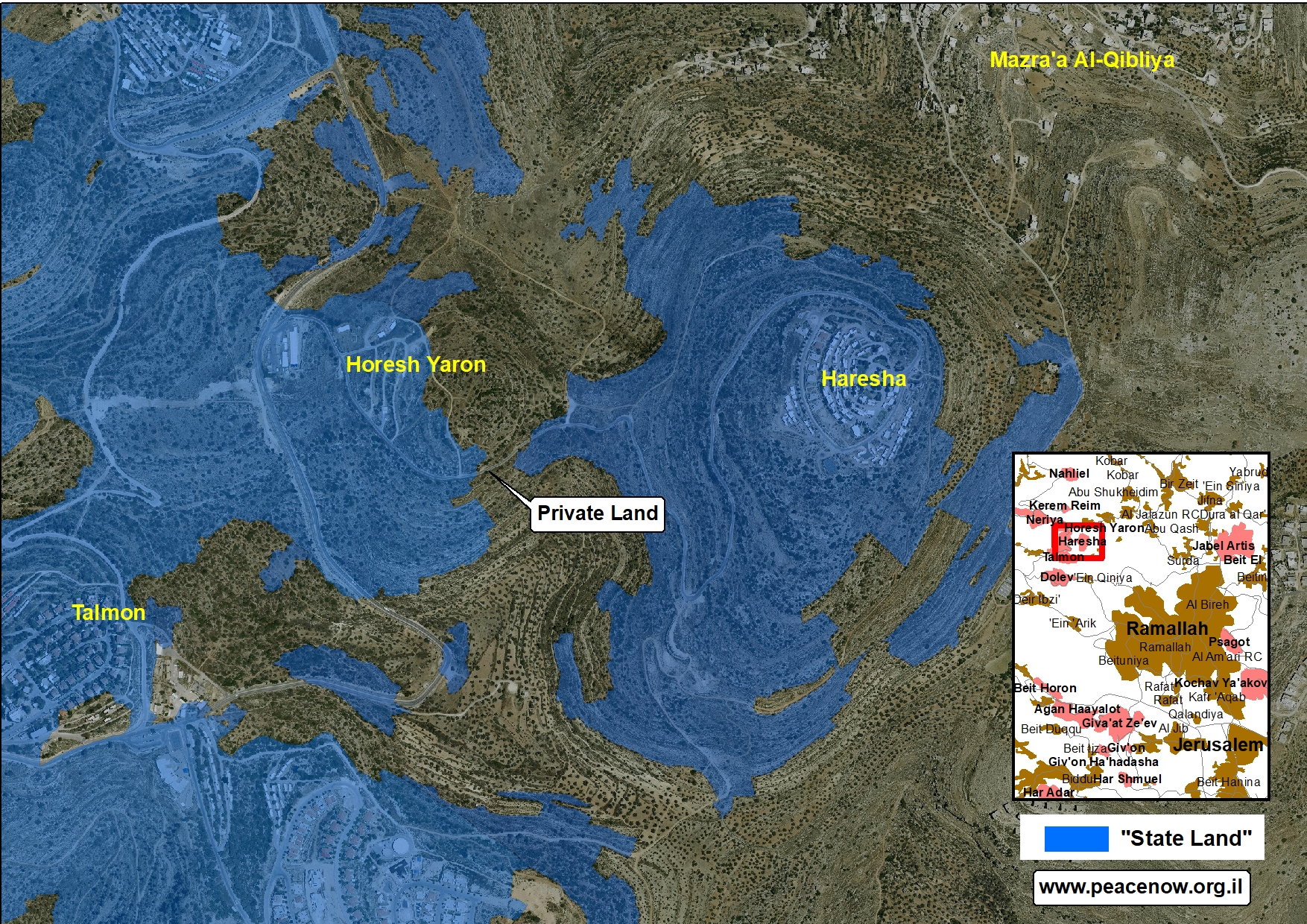 Kerem Navot has published a Justice Ministry opinion that provides further details on the government’s plan – approved on December 6th – to retroactively legalize the Haresha outpost by building a tunnel road underneath privately owned Palestinian land (an olive grove). The Justice Ministry document explains that while the Israeli government in principle has the right to permanently expropriate the land from its Palestinian owners, such an action would likely be challenged in the High Court of Justice, where it might be overturned. The Justice Ministry suggests instead that the government should “temporarily” expropriate the land while a tunnel is dug and road paved beneath the olive grove – with the plan being, ostensibly, to return the land to its Palestinian owners after construction is complete.
Kerem Navot comments:
“now, in order to legalize the outpost, shady legal advisers (of the type to whom Justice Minister Ayelet Shaked is drawn) write documents in which they lay down their doubts on whether to expropriate the grove ‘permanently,’ which will be cheaper and faster (but it is likely to be rejected by the High Court of Justice), or to ‘temporarily’ expropriate it solely for the construction of a tunnel through the ‘excavation and cover-up’ method.”
As a reminder, in November 2017 the Attorney General gave the Israeli government a green light to permanently expropriate the privately owned land based on a legal argument that holds Israeli settlers to be part of the “local population” of the West Bank, and therefore eligible to be the sole beneficiaries of state land expropriated for “public use.”
High Court Criticizes State Over Illegal Road on Palestinian Land
At a December 18th hearing, the High Court of Justice gave the government of Israel 60 days to explain why it should not be required to demolish a road and several buildings that were built on land that the state has admitted it believes is privately owned by Palestinians. The case is before the court on a petition by Palestinians who claim that a 200-meter (650-foot) stretch of the road is built on their land.
The Court also slammed the State for allowing the construction of the road and buildings to be completed after a stop-work order was issued against the construction, a stop-work order the State assured the Court would be implemented. At the December 18th hearing, an attorney from the State Prosecutor’s Office told the Court that the road in question was a dirt road, and argued that the state had not sanctioned or had a hand in its construction.
New Report Documents Israel’s “Severe and Regular” Violation of International Law in Hebron
Haaretz shares details from a leaked report written by the Temporary International Presence in Hebron (TIPH), which documents the totality of Israel’s policies in Hebron, serve to aid and protect settler and which collectively impose severe human rights violations and restrictions on Palestinians.
The report accuses Israel of being in “severe and regular breach” of international law, highlighting the many ways in which the human rights of Palestinians are systematically trampled on – specifically as it relates to radical settlers, their increasing activities in Hebron’s Old City, and the role of nearby settlements.
The Temporary International Presence in Hebron (TIPH) was first established in 1997 as part of the Oslo Accords’ Hebron Protocol, which allowed the partial redeployment of Israeli military forces to the part of the city that remained under its control. Israel must renew the TIPH’s mandate every six months; some fear that the next renewal has been jeopardized by the leaked report’s publication.
High-Rise Settlement Housing Promoted As a Means to Achieve 2020 Settler Vision & As a Solution to Israel’s Affordable Housing Shortage
Haaretz reports that the Yesha Council – the umbrella group representing all settlements in the West Bank – has adopted a strategic goal to advance “high quality, high density” settlement schemes in order to reach their goal of having 1 million settlers living in the West Bank by 2020. The basic idea is to build high-rise apartment complexes in settlements close to major highways in the West Bank and aggressively market them to Israelis who are seeking cheap rent and a fast commute, two key complaints of Israelis living and working in sovereign Israeli territory.
The strategy marks a shift in how settlements have typically been marketed to the Israeli public; once sold as an answer for young Israeli families looking for a single family unit with land, housing in settlements is now being marketed as the answer for young professionals looking for affordability, convenience and accessibility. The Yesha Council has coupled the new strategy with pressure on the government (and a promise to potential purchasers) to expedite West Bank infrastructure projects that will ease traffic, including bypass roads and detours around Palestinian towns.
In a February 2018 article, the Chairman of the Yesha Council wrote:
“Looking ahead, the patterns of thinking and action in the settlement movement need to be changed in two main areas: high-rise construction and doing away with admission committees. The available land for building is not plentiful. Until now, we’ve been used to rural communities with a one-family home on a half-dunam plot, but the goal from now on should be to build as many housing units as possible on that same land. High-density construction — building up or in a terraced fashion, depending on topography — will change the balance in the area and also require a new approach to infrastructure development to suit the number of residents in the future.” [Note: the Haaretz article explains that “admission committees” are a function of settlements which have standards for who is permitted to live there, mostly in ultra-orthodox and ideological settlements]
Fourth Quarter Decline in 2018 Settlement Construction Starts Doesn’t Tell the Whole Story
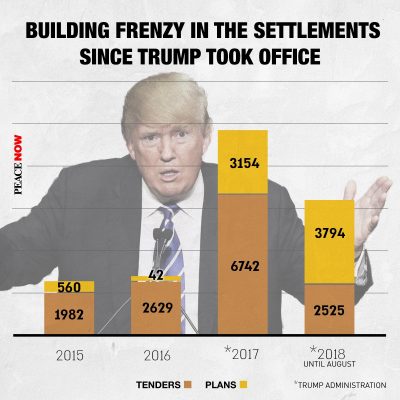
by Peace Now
The Israeli Central Bureau of Statistics (CBS) released new data showing a 52% decrease in the number of settlement construction starts in the third quarter of 2018 compared to the second quarter of 2018. News about a “decline,” relative to the last quarter, obscures the clear and alarming settlement surge currently taking place. As Peace Now has reported, by August 2018 the total number of settlement tenders and plans that have been advanced (6,319) is more than double the total amount in 2016 (3,189).
In addition, it is important to bear in mind that the number of construction starts do not begin to depict or reveal the level of settlement activity happening in the West Bank. Israel’s settlement enterprise is not solely a matter of residential housing plans, but also the unceasing expansion of infrastructure and security measures that exclusively benefit Israeli settlers, the normalization and development of settlement industrial zones, and illegal settlement activity (outposts, which are now regularly legalized ex post facto) that does not register in numbers tracking the settlement planning process.
Bonus Reads
- “Israel Has Weaponized the Settlements” (Haaretz Editorial)
- December 2018 public opinion poll – Palestinian Center for Policy and Survey Research
Welcome to FMEP’s Weekly Settlement Report, covering everything you need to know about Israeli settlement activity this week.
To subscribe to this report, please click here.
September 28, 2018
- Following Murder of Ari Fuld, Settlers Start Building “Givat Eitam/E-2” Settlement
- Undermining Any Claim of “Good Faith,” Reports Shows Israel & WZO Knew Land Was Stolen Before Giving to Settlers
- Palestinians Demand $360 Million in Back Taxes on Businesses Operating in Israeli Settlements
- UNSC & UNGA Round-Up: Notable Activities & Statements Related to Settlements
Comments, questions, or suggestions? Email Kristin McCarthy at kmccarthy@fmep.org.
Following Murder of Ari Fuld, Settlers Start Building “Givat Eitam/E-2” Settlement
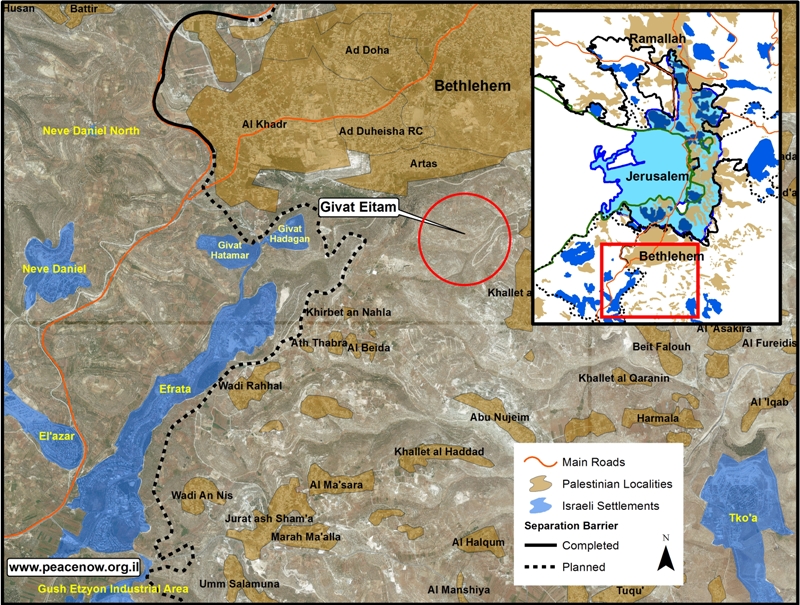 In response to the terrorist attack that resulted in the death of Israeli-American settler Ari Fuld, the local council of the Efrat settlement (where Fuld resided) has directed the start of (unauthorized) construction at the highly consequential “Givat Eitam” settlement site (nicknamed by settlement watchers “E-2” for its resemblance, in terms of dire geopolitical implications, to the infamous E-1 settlement plan). Located east of the separation barrier on a strategic hilltop overlooking the Palestinian city of Bethlehem to its north, Givat Eitam/E-2 is located within the municipal borders of the Efrat settlement but is not contiguous with its built-up area, making Givat Eitam/E-2 effectively a new settlement that, according to Peace Now, will:
“block Bethlehem from the south, and prevent any development in the only direction that has not yet been blocked by settlements (the city is already blocked from the North by the East Jerusalem settlements of Gilo and Har Homa, and from the West by the Gush Etzion Settlements) or bypass roads (that were paved principally for Israeli settlers). The planned building in area E2 would likely finalize the cutting off of Bethlehem city from the southern West Bank, delivering a crushing blow to the Two States solution.”
A small group of settlers are currently living in makeshift shelters at the site, under the protection of the Israeli army. The Israeli Civil Administration – which is responsible for enforcing planning and building laws in the occupied territory – has acknowledged the unauthorized construction at the Givat Eitam/E-2 site but has not announced any intention to remove the settlers or their illegal structures.
The head of the Efrat Local Council, Oded Revivi, took credit for the establishment of the outpost and acknowledging a long effort to build at the site, saying:
“Less than 24 hours after the murder of our friend Ari Fuld, the Efrat local council is offering a suitable Zionist response and building a new point of settlement in the Land of Israel – Givat Eitam – a strategic hill that connects the center of Gush Etzion to the eastern part. After many attempts and a lot of work, and a great deal of pressure from all sides, we’re on our way there. The residents of Efrat are with us, behind us, in cars, accompanying us. We will arrive in just a few moments and will be able to recite the blessing: “Blessed be He who establishes the border of the widow.”
Settlers have tried to build, legally and illegally, on the hilltop for over a decade. In 2004, Israel declared the area as “state land” and put it under the municipal jurisdiction of the Efrat settlement. Palestinians challenged the declaration, providing deeds to the land, but the High Court of Justice rejected the majority of the petitioner’s arguments and sent the case back to the appeals court to reconsider its previous ruling against the Palestinians. Since then, Israel and the settlers have acted unilaterally on the assumption that the area is theirs to build on. Settlers built an illegal outpost on the exact hilltop in 2011 and again in 2013; both times the Civil Administration removed the outposts after some time. In 2014, the settlers were allowed to build an access road to the Givat Eitam/E-2 site. In 2015, the Civil Administration – apparently accepting the settlers’ argument that the land belongs to Israel – destroyed Palestinian wheat crops that were planted there.
The new outpost of Efrat serves to magnify the territorial issues presented by the Efrat settlement, which is located inside a settlement enclave that cuts deep into the West Bank. Efrat’s location and the route of the barrier wall around it, have literally severed the route of Highway 60 south of Bethlehem, cutting off Bethlehem and Jerusalem from the southern West Bank. The economic, political, and social impacts of the closure of Highway 60 at the Efrat settlement (there is literally a wall built across the highway) have been severe for the Palestinian population. The concentrated settlement growth in Efrat (Efrat saw more construction starts in 2016 than any other settlement and has financed illegal construction projects to expand its borders) exacerbates all of these problems and further entrenches what settlement expert Lara Friedman calls “the trend of ‘canonization’ of the West Bank.”
Undermining Any Claim of “Good Faith,” Reports Shows Israel & WZO Knew Land Was Stolen Before Giving to Settlers
A new Haaretz report challenges the legal basis for the recent and monumental Jerusalem District Court ruling which held that the Mitzpe Kramim outpost can be retroactively legalized because the State, the World Zionist Organization, and the settlers all acted “in good faith” in the course of events that lead to the establishment of the unauthorized outpost on privately owned Palestinian land. Legal and bank documents seen by Haaretz show that the World Zionist Organization (WZO) transferred ownership rights to settlers two months after the State was informed that the land belongs to Palestinians. The sequence of events fundamentally calls into question the Jerusalem District Court’s holding that the State and WZO acted “in good faith.”
In early 2011, Palestinians filed petitions with the High Court of Justice asserting ownership of the land in question. The State responded to the Court regarding the petition, claiming that it mistakenly thought the land was under State control when it was granted to the WZO (an admission that the land should not be under WZO control). On February 6, 2011 the High Court of Justice ordered a temporary injunction against construction on the land until the ownership issues were resolved. Despite the legal proceedings and the State’s acknowledgement that the land should not be in the hands of the WZO, newly revealed documents show that the WZO transferred land rights to Israeli settlers in a series of transactions in the months after the Court order (from March to July 2011). In bank documents submitted in August 2011 (six months after the Court ruling) the WZO attested to to the settlers’ ownership of the land, paving the way for the bank to issue mortgages to the settlers, despite the unresolved ownership issues about which the WZO was aware.
Dror Etkes, the founder of the NGO Kerem Navot, who discovered the bank documents, said:
“So this is what ‘good faith’ looks like in Mitzpeh Kramim: the Settlement Division, the settlers, Amana, and the banks, worked together in a cold and calculated manner during the first few months after the petition was submitted – when there couldn’t have been the slightest doubt that construction was being illegally conducted on privately owned land – to present decisive facts before the High Court of Justice and prevent their eviction.”
The case regarding Mitzpe Kramim is now before the High Court of Justice, which will issue a final ruling about the future of the outpost, and potentially render a final verdict regarding the “good faith” of the State and WZO, and the rights of the Palestinian landowners.
Palestinians Demand $360 Million in Back Taxes on Businesses Operating in Israeli Settlements
First reported by i24 News, in a new report the Palestinian Authority documents what it estimates to be $360 million in “fiscal leakages” – monies have been denied to the PA by Israeli control over Area C, and which the PA is seeking to recoup. The PA reportedly planned to present the findings to international donors at a meeting on the sidelines of this week’s UN General Assembly meeting in New York.
The PA report asserts that since 2000 (at which time Israel ceased informing the PA about commercial activity in Area C), Israel has collected an estimated $1.7 million each month from about 2,000 businesses operating in settlements in the occupied territories. The PA argues that according to the 1994 Paris Protocol (which the report extensively cites), all these funds should be transferred to the PA by Israel, and that going forward Israel should transfer the monthly sum to the PA.
UNSC & UNGA Round-Up: Notable Activities & Statements Related to Settlements
On September 27, 2018 Palestinian Authority President Mahmoud Abbas addressed the United Nations General Assembly. Abbas twice stated that the Trump administration’s policy vis a vis settlement construction is a verdict on the final status issue of land, Abbas said:
“I renew my call to President Trump to rescind his decisions and decrees regarding Jerusalem, refugees and settlements, which contravene international law and UN resolutions, as well as the understandings among us, in order to salvage the prospects for peace and to achieve stability and security for the future generations in our region….We awaited his peace initiative with utmost patience, but were shocked by decisions and actions he undertook that completely contradict the role and commitment of the United States towards the peace process. In November 2017, his administration issued a decision to close the PLO office in Washington, DC. He then announced his recognition of Jerusalem as the capital of Israel and transferred his country’s embassy from Tel Aviv to Jerusalem, and boasts that he has removed the issues of Jerusalem, refugees, settlements and security off the negotiation table. All such decisions threaten the Palestinian national cause and constitute an assault on international law and relevant United Nations resolutions. The US administration went even further in its assault by cutting assistance to the Palestinian National Authority, UNRWA and Palestinian hospitals in occupied East Jerusalem.”
On September 27th, 2018 Israeli Prime Minister Benjamin Netanyahu also addressed the United Nations General Assembly. Netanyahu’s speech did not address settlements.
On September 27th, U.S. Special Representative for International Negotiations Jason Greenblatt, gave a speech defending U.S. funding cuts to Palestinians and humanitarian projects. As part of that speech Greenblatt noted that the U.S. decision was motivated in part by the Palestinian Authority’s refusal to cooperate with Israeli businesses, which might be pointing towards industrial zone projects inside Israeli settlements – an “economic peace” scheme the U.S. administration recently promised to support. Greenblatt said in his speech that PA leaders:
“refuse opportunities to build the economy due to an anti-normalization prejudice towards doing business with Israelis. (…) The United States will not use the hard-earned tax dollars of its citizens to subsidize anti-normalization”.
At a September 26th press conference during UNGA that the U.S. preferences a two-state solution, President Trump articulated support for a two-state solution. Commenting on Trump’s statement, Husam Zomlot – until recently the PLO Ambassador to the U.S. – said:
“[Trump’s] statements contradict his actions. His policy is destroying any chance for peace.”
J Street has the following reaction:
“If President Trump truly supports a two-state solution, then he should reverse the many actions by his administration that have made it much harder to achieve. He should stop claiming that he has taken the issue of Jerusalem “off the table,” and stop the cruel and destructive cuts in humanitarian aid and assistance to the Palestinian people. He should instruct the US ambassador to Israel to stop condoning Israeli settlement expansion in the West Bank. President Trump and his administration should be judged by actions, not words, and their actions have made clear: they have no interest in promoting genuine peace between Israelis and Palestinians. Until those destructive actions change, the idea that they are formulating a credible ‘peace plan’ is absurd.”
Also on September 26th, President of the Palestinian Authority, Mahmoud Abbas, held a meeting to gather support for an alternative model for negotiations – a model that replaces U.S. leadership in the process with a multilateral approach. The meeting was attended by foreign ministers of Turkey, Ireland, and Japan, UK Minister for the Middle East Alistair Burt, and diplomats from Germany, Norway, Spain, Morocco, Egypt, Ethiopia, and Indonesia, among others. UN Special Coordinator for the Middle East Peace Process Nickolay Mladenov and Under-Secretary-General for Political Affairs Rosemary DiCarlo also attended the event.
On September 20, 2018, the UN Special Coordinator for Middle East Peace Nickolay Mladenov provided an update on the implementation of UN Res 2334 to the United Nations Security Council (UNSC), chaired by U.S. Ambassador to the UN Nikki Haley. Mladenov began his update saying:
“No steps have been taken during the reporting period to ‘cease all settlement activity in the occupied Palestinian territory, including East Jerusalem’, as required by the resolution.”
Mladenov’s report goes on to document the number of settlement units approved for construction. He concludes with broad observations about the context and consequences of Israeli settlement activity, starting with:
“The expansion of Israeli settlements is illegal under international law and continues to erode the viability of a two-state solution. Particularly alarming are legal and administrative steps which could consolidate and expand settlement activity deep in the West Bank, further undermining the contiguity of a future Palestinian state.”
Welcome to FMEP’s Weekly Settlement Report, covering everything you need to know about Israeli settlement activity this week.
To subscribe to this report, please click here.
August 31, 2018
- Setting a New Legal Precedent, Court Accepts “Market Regulation” Principle As Basis for Legalizing Outpost
- Shaked & Regavim Take Credit for Precedent-Setting Outpost Legalization Victory
- Another New Outpost – Continuing the Trend of Unannounced, Unopposed, & Highly Consequential Settlement Expansion
- Special U.S. Regulations Protect Israel’s Settlement Enterprise from Quality Aerial Documentation
- Bonus Reads
Comments, questions, or suggestions? Email Kristin McCarthy at kmccarthy@fmep.org. To subscribe to this report, please click here.
Setting a New Legal Precedent, Court Accepts “Market Regulation” Principle As Basis for Legalizing Outpost
Jerusalem District Court Ruling
On August 18th, Jerusalem District Court Judge Arnon Darel ruled in favor of retroactively legalizing the Mitzpe Kramim outpost, holding that privately owned Palestinian land can (and should) be expropriated for the settlements in instances where Israeli settlers built “in good faith” and with government support – a rationale called the “market regulation” principle. According to the ruling, the Court held that the parties responsible for the outpost – the Israeli government, the World Zionist Organization, and the settlers – all acted in “good faith.” Specifically, the Court held that the State acted in “good faith” even though it was negligent in its responsibility to protect the rights of Palestinians and correctly record/manage the status of land in the West Bank; and, that the settlers acted in “good faith,” even though they built the outpost without government authorization, without building permits, and without a master plan.
This is the first time an Israeli court has accepted the “market regulation” principle as a valid basis for legalizing outposts, setting a monumental new precedent according to which outposts that the government had previously been unable to legalize (because they were built on land recognized by Israel as privately owned by Palestinians) to petition for authorization. With this judgment, the public got a first glimpse of the incredibly broad interpretation of “good faith” that the Jerusalem District Court (now the court of first jurisdiction for land disputes in the West Bank) is inclined to apply on behalf of law-breaking settlers.
Peace Now released a statement saying:
“The court today chose to ‘align’ with the project of annexation and dispossession of the Israeli government led by the Netanyahu and the Jewish Home. It is absurd to attribute ‘good faith’ to the settlers of an illegal outpost whose homes were built illegally and without permits on private Palestinians land, because of a ‘mistake’ made by the authorities in allocating the land. The Israeli Authorities should protect the properties of the people under their control, and failing to do so cannot be used as an excuse to take the land from the Palestinian owners. Let us hope that the Supreme Court will erase this shame.”
Background on the Mitzpe Kramim Case
 The outpost at the center of the case – Mitzpe Kramim – was built in 1999 without government authorization on land near the Kochav Hashachar settlement, located deep inside the West Bank, closer to the Jordan River than sovereign Israeli territory. In the 1970s, land in the area was taken by the State of Israel by military order; subsequently, the land on which the outpost was built was allocated to the World Zionist Organization (WZO), apparently based on the (mistaken) assumption that the land in question was part of that military seizure. The WZO then gave the land to settlers, even issuing a certificate of ownership in their names. However, the land in question was not included in the military seizure of the 1970s, but was/is In fact recorded in the Land Registry as privately owned by Palestinians from the village of Deir Jarir. This fact should, under Israeli law, invalidate the government’s allocation of the land to the WZO, and the WZO’s grant of the land to the settlers.
In 2011, the registered Palestinian landowners filed a petition with the High Court of Justice to have the Mitzpe Kramim outpost removed from their land, only to see the settlers file their own petition in 2013 with the Jerusalem District Court (which froze the High Court’s consideration of the Palestinians’ petition), seeking to be registered as the rightful landowners. In their petition, the settlers – who are represented by Harel Arnon, the same lawyer hired to represent the Israeli government in its defense of the “Regulation Law” – argued that they are innocent victims of a mistake by the government, and as such should not be forced to bear the consequences of having built their homes on someone else’s land. Originally the Israeli government, admitting that the Civil Administration had made a mistake in mapping the area, argued that the settlers should be removed. In July 2018, the State completely reversed its stance, submitting a new argument to the Court citing the “market regulation” principle in defense of expropriating the land for the settlers.
In its ruling this week, the Jerusalem District Court gave legal validity to the newly invented “market regulation” basis for taking Palestinian land that had previously been impossible for the State to legally expropriate.
What’s Next?
Now that the Jerusalem District Court has ruled in favor of the settlers’ claim, the High Court of Justice is set to take up the original petition filed by the Palestinian landowners to have the outpost removed. Part of the High Court’s deliberations will now have to grapple with the new jurisprudence established by the Jerusalem District Court on the “market regulation” principle.
Regardless of whether or not the High Court allows the Jerusalem District Court’s ruling to stand, that ruling has already energized pro-settlement, pro-annexation Israeli policymakers and influencers, who (unsurprisingly) have lauded the ruling and urged more outpost legalization cases forward. The ruling also legitimizes the longstanding arrangement between Israel and the settlers: the government turns a blind eye to illegal settlement activity (including rebuffing efforts by settlement watchdogs to force it to take action, and when forced by the courts to take action, drags its feet to allow illegal activities to become more deeply entrenched), only to go to any lengths to authorize the illegal actions post-facto. This modus operandi allows Israel to circumvent the limitations of Israeli law, bureaucracy and international criticism, all of which would otherwise restrain (to some extent) unfettered settlement construction and land theft in the West Bank.
FMEP tracks the ongoing legislative, political, and legal transformations happening in the Israeli government to justify the expropriation of Palestinian land for the settlements in its Annexation Policy Tables. As a reminder, the “market regulation” principle was promoted by Israeli Attorney General Avichai Mandelblit, who offered it as an alternative to the legal basis provided in the “Regulation Law” to legalize unauthorized outposts and settlement construction.
Shaked & Regavim Take Credit for Precedent-Setting Outpost Legalization Victory
Celebrating the Jerusalem District Court’s ruling on the Mitzpe Kramim outpost case (covered above), Justice Minister Ayelet Shaked (Likud) said:
“The District Court today clearly stated that whoever settled [the land] with the state’s approval and in good faith, would not be evacuated. The injustice done in the evacuations of the Amona and Netiv Ha’avot [outposts] should not be repeated. The court should not be a party to the political debate between the Right and Left. That should be left to the ballot box. Through joint and intensive work, we have brought about a policy change in the state’s responses to the High Court of Justice. Now we are seeing a change in the district court.” [emphasis added]
Indeed, Justice Minister Shaked has led a years-long effort to re-make the judicial branch, injecting pro-settlement policies and figures into key positions within the Court system, with the explicit goal of protecting all Israeli settlements and outposts from any legal accountability for illegal actions. Part of that effort was her decision in 2015 to hire a private lawyer, Amir Fisher (who also represents the settler group Regavim), to essentially write the State’s responses to petitions before the High Court that deal with settlements.
As noted in the section above, the state of Israel reversed its own position vis a vis the future of Mitzpe Kramim in its 2018 submission to the Court, a reversal that happened after Fisher and Shaked were firmly in control of the State’s handling of outpost legalization cases. What’s more, Shaked installed a pro-settlement judge on the Jerusalem District Court (which issued the precedent-setting ruling this week), and then promoted legislation that strips the High Court of Justice of its primary jurisdiction over certain West Bank legal petitions (including Palestinian petitions relating to land disputes, travel permits, and building permits) and gave that jurisdiction to the Jerusalem District Court. Shaked is currently promoting another bill which would allowed the Knesset to reinstate any law struck down by the High Court of Justice. The Ministerial Committee on Legislation, of which Shaked and Education Minister Naftali Bennett are members, voted to give government backing to the bill in May 2018. The totality of Shaked’s efforts are documented, on an ongoing basis, in FMEP’s Annexation Policy Tables.
Shaked’s fellow travelers at Regavim released a statement following the Jerusalem District court ruling, emphasizing the far-reaching implications:
“This is a product of a long legal battle, run by the settlements and settling bodies. They asked to legalize outposts that were established by the State of Israel. This blessed decision is a historic one. We call upon the attorney general to apply the principles of this decision to all other outposts in Judea and Samaria that need regularization.”
The fruits of Shaked and Regavim’s work was applauded by many others in the government, including Education Minister Naftali Bennett (Jewish Home), who said the ruling was a:
“victory for decency and common sense, another step toward legalizing the settlements in Judea and Samaria and turning them into an integral part of the State of Israel.”
Culture Minister Miri Regev (Likud) said she was:
“happy that common sense and justice prevailed over cold formalism..[the ruling sends] a clear-cut message to the Palestinians and their collaborators from far-left organizations, that you don’t destroy and evacuate communities in the Land of Israel.”
Agriculture Minister Uri Ariel (Jewish Home) said:
“This is a blessed month of settlement, and after the decision of the Housing Cabinet to establish three new towns [in the Negev], comes the court’s decision regarding Mitzpeh Kramim. Such significant decisions strengthen and expand the settlement of the Land of Israel.”
Knesset speaker Yuli Edenstein (Likud) said:
“The determination and strong spirit of the people of Mitzpeh Kramim proved themselves. I welcome this just, requisite ruling from the District Court in Jerusalem. We will continue to strengthen settlement in Israel!”
Another New Outpost – Continuing the Trend of Unannounced, Unopposed, & Highly Consequential Settlement Expansion
Haaretz reports that settlers have built a strategic new outpost deep inside the West Bank near the settlement of Eli, in a bid to eventually annex privately owned Palestinian land that falls between Eli and pockets of “state land” in the area. The new outpost was built without Israeli permits on the outer edge of newly declared “state land,” some of which had been used as farmland by Palestinians. Haaretz notes a trend:
“Around the West Bank, settlers have been setting up farms near the outer edge of state-owned land, as in the case near Eli, in an effort to expand existing settlements. Even though they have been established without permission, no legal action has been taken against them.”
The Israeli Civil Administration – responsible for enforcing building laws in the occupied territory – told Haaretz that it is unaware of the new outpost. The Head of the Binyamin Regional Council (an Israeli municipal body responsible for settlements in the northern West Bank – recently proven to be bankrolling new outposts), Avi Roeh, denied that the Council was involved with the new outpost.
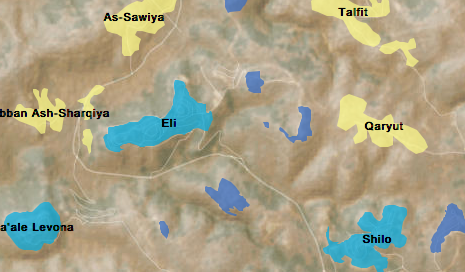
Map by WINEP
The new outpost is the fifth illegal satellite of the Eli settlement, stretching the band of Israeli settlements further and further east towards the Jordan Valley. Eli is located between the Ariel and Shilo settlements (both of which have seen tremendous growth and government support over the past two years – Ariel with its new medical school and Shilo with the promotion of the new Amichai settlement to its immediate east), in an area where settlers are working to connect settlements and outposts into a contiguous band of settlement stretching from sovereign Israeli territory all the way to the Jordan Valley.
As evidenced this week in the Israeli court system, the government – which consistently turns a blind eye to illegal outpost construction – is willing to go to great lengths to retroactively legalize outposts, even when the cost to Israeli taxpayers is enormous and even when doing so contradicts any notion of justice under the law.
Special U.S. Regulations Protect Israel’s Settlement Enterprise from Quality Aerial Documentation
Al-Shabaka published a new report this week detailing a little-known U.S. law that restricts companies from producing high quality satellite imagery of the West Bank. Al-Shabaka explains the significance of that limitation on U.S. companies like Google:
“Although the legislation was implemented under the pretense of protecting Israel’s national security, it is better characterized as an act of censorship. By deliberately blurring aerial images of Palestine-Israel, the [The Kyl-Bingaman Amendment (KBA) to the US National Defense Authorization Act] hinders the work of archaeologists, environmentalists, geographers, and humanitarians. It poses serious obstacles, not only for the preservation of cultural heritage, but also for holding Israel to account for land grabs, home demolitions, and settlement activity….While the legislation only applies to US companies, their hegemony in the commercial market for satellite imagery has elevated the legislation to de facto institutionalization on a global scale, affecting the access of researchers worldwide.”
The report can be accessed here.
Bonus Reads
- “The West Bank Model is a Failure” (The New York Times)
- “Israeli Taxpayers Bear Financial Burden of Evicting Illegal West Bank Outposts, And Sometimes, Making them Legal” (Haaretz)
Welcome to FMEP’s Weekly Settlement Report, covering everything you need to know about Israeli settlement activity this week.
To receive this report via email, please click here.
July 12, 2018
- Continuing New Legal Strategy, Israel Argues “Market Regulation” Principle In Bid to Legalize Outpost
- Cabinet to Consider New Bill to Legalize 70 Outposts
- Cabinet to Consider Three Bills that Advance Annexation of Area C Settlements
- New Proof that the Israeli Government is Driving Unauthorized Settlement Activity
- High Court Freezes Plan for Settlement Committee in Hebron; IDF Seizes Private Land Near Kiryat Arba
- High Court Allows the Israel Land Authority to Remain Under the Influence of the Jewish National Fund
- New Bill Would Allow Settlers to Build on National Park Grounds in East Jerusalem
- Civil Administration Strike Will Delay Settlement Construction
- Amichai Settlement’s Makeshift Sewage Pit is Contaminating Nearby Palestinian Fields
- Israeli President Cautions Against Shaked’s Bill to Politicize Key Legal Appointments
- United Nations Envoy: Israel is Moving Towards Formal Annexation
- Bonus Reads
Comments, questions, or suggestions? Email Kristin McCarthy at kmccarthy@fmep.org.
Continuing New Legal Strategy, Israel Argues “Market Regulation” Principle In Bid to Legalize Outpost
On July 3rd the Israeli State Prosecutor’s Office told the Jerusalem District Court that it has the right to retroactively legalize the Mitzpe Kramim outpost based on the “market regulation” principle. This is the recently-invented legal principle according to which the government can seize privately owned Palestinian land to give to settlers if settlers can demonstrate (to the satisfaction of an Israeli government that is doing everything possible to help them) that they built on the land “in good faith,” based on government assurances, and if the rightful landowners are offered compensation. This is just the second time the government has used the “market regulation” principle to defend the seizure of privately owned Palestinian land in court, the first being in November 2017 when the State informed the High Court of Justice that it intended to expropriate private land near the Ofra settlement. Neither court ruled on either case.

Map by Haaretz
The government’s deployment of the “market regulation” principle in the Mitzpe Kramim case completely reverses the position the government has taken for the last 7 years on this specific outpost case. Since 2011, the Israeli government admitted that the land was privately owned, that it had been mistakenly given to the World Zionist Organization in the 1980s (the Mitzpe Kramim outpost was built without Israeli authorization in 1999), and that the situation should be corrected. In its argument on July 3, 2018, the government is expressing its newfound power to seize the land, asserting that the settlers built there “in good faith” and should not be punished for the government’s mistake, under the powers of the “market regulation.”
Peace Now said:
“The state’s announcement to the District Court is a new low in the moral and political deterioration led by the Netanyahu government. As the body that has assumed responsibility for the Occupied Territories for the last 51 years, the state should have protected the property rights of Palestinians, who have no civil rights nor the ability to defend their own land. The fact that the state failed to protect their land cannot be an excuse to steal the land and grant it to the settlers.”
As Peace Now also notes, in order to satisfy the 1967 Government Property Order (which is the law underlying the “market regulation” principle) all of the land owners must be invited to participate in the court case. However, the settlers who filed the petition regarding Mitzpe Kramim failed to include all of the registered land owners, meaning there is a long course of legal action ahead before the case. Should the Court decide the case in the settlers’ favor, it would set a potentially far-reaching precedent for implementing and upholding the “market regulation” principle.
Israeli Attorney General Avichai Mandelblit originally argued for the “market regulation” principle in late 2016 as an alternative legal basis to the Regulation Law, which he believes to be “a sweeping and injurious arrangement that does not meet the test of proportionality.” That law, passed by the Knesset in February 2017, is now in serious legal jeopardy. While the Israeli government continues to staunchly defend the broader legal basis for expropriating privately owned Palestinian land established under the “Regulation law,” its increased use of the “market regulation” principle makes clear that come what may, the Israeli government has the intention to do whatever it takes to “legally” seize Palestinian private land in order to legalize outposts (offering a stark illustration of the difference between “rule of law” and “rule by law.”)
For extensive reporting on and analysis of the “market regulation” principle and the “Regulation Law,” see FMEP’s tables documenting Israeli annexation policies.
Cabinet to Consider New Bill to Legalize 70 Outposts
MKs Bezalel Smotrich (Habayit Hayehudi) and Yoav Kisch (Likud) have submitted a bill for consideration by the Israeli Cabinet that seeks to retroactively legalize 70 unauthorized outposts across the West Bank. The Ministerial Committee for Legislation (a group of Cabinet members that decides whether or not to lend government backing to Knesset legislation before it is introduced) could vote on the July 15th, during its last weekly meeting before the Knesset recesses for its summer break. According to a Defense Ministry spokesperson, 50 of the 70 outposts can become part of existing official settlements — meaning that if passed into law, the bill would (a) significantly expand the borders/footprint of some 50 existing settlements (to include the outposts and land separately the outposts from the new parent settlement), and (b) create as many as 20 new settlements.
In addition, the bill would direct the government to treat the 70 unauthorized outposts as if they were legal settlements, which would include providing municipal services like water and electricity infrastructure at the expense of the relevant regional council (funded by Israeli tax-payers). The bill would also stop the potential of enforcement of the government’s own laws against the specified 70 outposts (reminder: the Israeli government rarely enforces building laws against Israeli settlers, actively funds outposts despite their illegality, and continues to invent new ways to legalize them). According to the bill, enforcement of building laws against the unauthorized outposts could only happen at the direction of the Defense Minister or the Prime Minister, with the backing of the Cabinet.
FMEP has repeatedly covered news regarding the government’s efforts to legalize outposts built on privately owned Palestinian land. The passage of the settlement “Regulation Law” gave the government new, sweeping authority to legalize outposts which it had been unable to address under existing Israeli law (because of the fact that they were built on privately owned Palestinian land, in effect turning these into cases of incontestable theft of private property. The 2005 Sasson Report admitted that there was no possible way to legalize outposts built on privately owned Palestinian land, and concluded that all such outposts should be evacuated). With the new law in place permitting Israel to launder this land theft, the Cabinet created a Defense Ministry task force – and appointed veteran settler leader Pinchas Wallerstein as its head – empowered to examine the individual legal situation of each outpost and devise plans to retroactively legalize as many outposts as possible. In January 2018, a leaked recording revealed that the task force had been working for six months to prescribe courses of action for the outposts. Despite this, settlers and Knesset members have complained that the task force has done nothing and has not been funded, using these as talking points in their push for the new Smotrich bill.
Developments related to these efforts are tracked in FMEP’s annexation policy tables.
Cabinet to Consider Three Bills that Advance Annexation of Area C Settlements
In addition to the outpost legalization bill (covered above), the Israeli Ministerial Committee on Legislation is slated at its next weekly meeting on July 15th to discuss three bills that seek to advance Israeli de facto annexation of Area C, after refraining from discussing them last week. Those bills are:
- A bill to recognize settlements in the South Hebron Hills as well as the Kiryat Arba settlement (which is, in effect, part of Hebron) as part of the Negev regional economy. Economically, the change would enable these settlements to benefit from government grants and programs for the Negev; politically, and far more importantly, the change would erase the Green Line, legally treating these settlements as part of sovereign Israeli territory (the Negev is an area located inside sovereign Israel).
- A bill to change a 1953 Jordanian law in order to allow Israelis to directly purchase property in the West Bank. Under the current law, private, non-Arab individuals cannot purchase land in the West Bank. In 1971, the law was amended to add a loophole allowing companies registered to operate in the West Bank (like the World Zionist Organization and the Jewish National Fund) to purchase property, and often do so only to give it to Israeli settlers. This additional change would open the door for private purchases across the West Bank by settlers and their backers, including in the heart of Palestinian cities. Notably, Israeli security officials have in the past objected to changing this law, based on their recognition of the fact that settlers implanting themselves wherever they want in the West Bank – including in acts intended to be deliberately provocative – will be a security nightmare for the IDF and will enable settlers and their financial patrons to further hijack the national security agenda of the state of Israel.
- A bill to rescind the 2005 Disengagement Law in order to allow four settlements in the northern West Bank to be rebuilt. The settlements – Sa-Nur, Homesh, Kadim and Ganim – were evacuated following the passage of the Disengagement Law. Notably, the head of the Samaria Regional Council, Yossi Dagan, is one of the settlers that was evacuated from Sa-Nur in 2005 and has championed the bill, which was submitted for Cabinet consideration by Bezalel Smotrich (Habayit Hayehudi).
New Proof that the Israeli Government is Driving Unauthorized Settlement Activity
The Israeli State Comptroller published a report that exposes how Israel government bodies have colluded with the Binyamin Regional Council (one of the main governing bodies over West Bank settlements) to bankroll the construction and ongoing support of unauthorized outposts, even as the Israeli Civil Administration acts to try to stop the illegal construction the government is funding.
The report reads:
“The [Binyamin Regional] council has been the driving force in the construction of unauthorized communities [outposts] and has financed them…In so doing, the council has dictated a negative standard of behavior, that has allowed for illegal construction in the Judea and Samaria and has even advanced such activity…Government offices were involved in financing the planning and construction of the unauthorized outposts.”
In one of several examples of how the collusion has worked, the Comptroller explained that the Esh Kodesh outpost – which is actually located outside of the Binyamin Regional Council’s jurisdiction – was built in 2000 without government permission. In 2014, the Interior Ministry financed the renovation of roads in the outpost. Meanwhile, the Civil Administration issued demolition orders against structures in the outpost in 2003, 2012, and 2013.
Sensing opportunity to promote their new bill to retroactively authorize outposts (see above), MKs Yoav Kisch (Likud) and MK Bezalel Smotrich (Bayit Yehudi) argued that the Comptroller’s report, by proving the the state has participated in building outposts, underlines the necessity of authorizing those outposts for the sake of the settlers who moved to the outposts at the encouragement of the state.
Adding to the Comptroller’s report (and echoing several of its key points), a freedom of information act filed by Peace Now revealed that the Binyamin Regional Council has been concealing massive and illegal annual contributions to the Amana organization, which leads wide scale illegal settlement construction. Amana received NIS 37 million over three years from the Council, which is 57% of the funds doled out to non-governmental groups over that period. The Comptroller’s report criticized the Council’s support for private organizations, which violates Israeli law restricting regional councils to supporting apolitical, public groups. The report said “the council serves as a conduit for transferring funds from the state to a private association.”
Peace Now writes:
“this data now reveals the depth of this robbing of public funds to finance political campaigns and illegal activity. It is time for the Interior Ministry to put an end to this abuse of Israelis’ taxpayer money and to demand that the authorities in the West Bank cease this illegal funding and give the money back.”
High Court Freezes Plan for Settlement Committee in Hebron; IDF Seizes Private Land Near Kiryat Arba
The Israel High Court has ordered a temporary freeze on a military order creating a new, autonomous settler committee to represent and service a cluster of Israeli settlement enclaves in Hebron’s city center, a plan announced by Defense Minister Avigdor Liberman in August 2017. The military order, if allowed to be implemented, would transfer responsibility for the settlers’ municipal services (roads, sewage, electricity, etc.) from the Hebron Municipality to the new settler committee, a plan which contradicts the 1997 Hebron Protocol.
The High Court gave the Israeli government 120 days to explain the legality of the plan, which was challenged on multiple fronts by the Hebron Municipality. The petition argued that the military order was intentionally vague in defining the legal and geographical jurisdiction of the proposed settler body, and pointed out that the new committee would be able to override decisions by the Hebron Municipality thereby stripping Palestinians of autonomy and representation in matters that directly affect them.
While the Court considers the matter, events on the ground continue to underscore the volatility of the situation in Hebron. Elor Azaria, the Israeli soldier who was caught on camera executing an incapacitated Palestinian on the streets of Hebron, victoriously returned to the city on July 3rd after serving only 9 months in jail. The festivities welcoming Azaria were planned by a group that included the extremist settler and politician, Baruch Marzel. Only two days after the Azaria lovefest, Marzel pitched a two-person tent on the sidewalk next to a Palestinian home in the Tel Rumeida neighborhood in the Old City of Hebron. According to the Palestinian news outlet Ma’an, Marzel was involved in attacks on Palestinians in Tel Rumeida the same day, in an incident that resulted in the arrest of one Palestinian. Israeli police removed Marzel’s encampment from the street.
Also in Hebron, Palestinian media reports that Israeli forces have confiscated a plot of privately owned Palestinian land near the Kiryat Arba settlement and the Ibrahimi Mosque/Cave of the Patriarchs. A Hebron activist reports that the Israeli Army set up a new camp across the street from the seized land about one month ago, and is now moving the camp to the new site with the intention of declaring it a “closed military zone” to prevent Palestinians from entering the area.
High Court Allows the Israel Land Authority to Remain Under the Influence of the Jewish National Fund
The High Court of Justice dismissed a petition filed by Adalah which alleged that the Jewish National Fund’s representation on the Israel Land Authority council infringes on the rights of Palestinian to equality and dignity. Under Israeli law, 6 of the 14 members on the Land Authority council are to be appointed by the Jewish National Fund, an organization the petitioners say (with good cause) “openly discriminates against non-Jews and sees itself as an entity that serves only one population.” The Israel Land Authority is responsible for deciding how (and to whom) to allocate or sell land in Israel, including the land owned by the Jewish National Fund (13% of all land in Israel).
Following the High Court’s dismissal of the petition, the Haaretz Editorial Board wrote:
“In a properly run country, people who declare that they’re committed to acting in a discriminatory way are immediately disqualified from a public role. One can only imagine what Israelis’ response would be if in a country where Jews were a minority, half of a group’s members stated their intention to discriminate against Jews.”
New Bill Would Allow Settlers to Build on National Park Grounds in East Jerusalem
The radical settler group Elad is lobbying for a bill that will allow the group to build settlement units on the grounds of one specific national park located in the East Jerusalem neighborhood of Silwan, where Elad is engaged in a variety of activities to displace Palestinians and replace them with Israeli settlers (as FMEP has reported on extensively). On July 10th, the bill was approved by the Knesset’s Interior and Environment Committee, despite objections submitted to the committee by the Justice Ministry and the Attorney General. The bill was sent to the Knesset plenum for its first of three votes.
The bill will allow Elad to build more homes for Israeli settlers on the grounds of the City of David national park, which is located immediately south of the Temple Mount, adjacent to the southern wall of the Old City of Jerusalem. Since 2001, Elad has managed the park grounds on behalf of the Israel Nature and Parks Authority, a scheme which gives the settler group authority over (but no legal responsibility towards) thousands of Palestinian homes and hundreds of settler homes – a demographic balance Elad is working hard to flip.
Ir Amim’s researcher Aviv Tatarsky told Haaretz:
“This isn’t the first time a monkey is being made of the law and common sense to advance the agenda of the Elad settlers. But even this law can’t change the fact that Silwan, like East Jerusalem, is entirely a Palestinian city. Israeli attempts to deny that simple truth impair the basic rights of 350,000 people in East Jerusalem. The residents of the Israeli city also pay a price for it.”
For more information on the role on national parks around Jerusalem in advancing the Israeli settlement agenda in Palestinian neighborhoods, see Ir Amim’s reporting here, and a key survey and analysis of national parks in Jerusalem/East Jerusalem by Bimkom here.
Civil Administration Strike Will Delay Settlement Construction
A recently released list of Civil Administration functions that will be brought to a halt during the impending union strike includes the High Planning Council’s work to advance settlement construction plans, though a Civil Administration spokesperson said that construction can be expected to climb next quarter.
Hananel Dorani, Chairman of the Yesha Council, the umbrella group representing settlements,wrote a letter to Prime Minister Netanyahu, Defense Minister Lieberman, and Finance Minister Kahlon. Dorani, highlighting the green light from the political echelon to promote settlements, criticized the Civil Administration while pushing for a resolution:
“Especially now, at a time when political approval was given to promote construction, it’s not only commonplace that the Civil Administration doesn’t meet the task properly, but the workers’ strike will exacerbate the situation and create a bottleneck that’ll be difficult to free from for years. Civil Administration employees’ demand to add additional positions and their requests to improve salary conditions so they can fill existing positions hasn’t been answered for a long time, leading to renewed sanctions. As is well known, this is not the first time Civil Administration employees have initiated sanctions, but this hasn’t yet been dealt with…this organization is routinely substandard, and for a long time important headquarters work wasn’t promoted, plans approved by the political echelon are halted and piled up on the table in the Civil Administration, budgets earmarked for infrastructure projects (transportation, cellular, etc.) aren’t realized, no work permits are issued, and more…We ask that you get involved with all relevant parties and act immediately and personally to restore the Civil Administration to full functioning.”
Samaria Regional Council chairman Yossi Dagan complained:
“As if it is not enough that every house in Judea and Samaria (West Bank) needs four different permits from the political echelon, now the residents have also become hostages in a conflict between Civil Administration employees and the Finance Ministry.”
The Civil Administration will also suspend the following operations: the flow of commercial goods between the West Bank (both settlements and Palestinian areas) and sovereign Israel; changes to the land and population registries, issuance of import licenses and business permits; and, significantly, all actions – including demolitions – against illegal construction, which might delay the demolition of the Khan al-Ahmar bedouin community.
Amichai Settlement’s Makeshift Sewage Pit is Contaminating Nearby Palestinian Fields
Raw sewage from the Amichai settlement (the first new government-backed settlement in 20 years, established in the Shiloh Valley as pay-off to the evacuees of the illegal Amona outpost) has been flowing into the agricultural lands of the nearby Palestinian village Turmus Ayya.
The settlers dug a temporary sewage site (a pit in the ground that is now overflowing) only a few meters from Palestinian farm lands. Settlers have been living in mobile homes on the site of the settlement (which has not been built yet) for less than four months, and Palestinians say the the sewage began overflowing two months ago. A permanent sewage site for the settlement has not yet been built, in part because the settlement plans were approved at a “dizzying speed,” as Haaretz explains it.
Israeli President Cautions Against Shaked’s Bill to Politicize Key Legal Appointments
At a swearing in ceremony for new judges, Israeli President Reuven Rivlin took the opportunity to pointedly criticize a bill promoted by Justice Minister Ayelet Shaked which would, by design, politicize the appointment of ministerial legal advisors (a bill FMEP reported on here).
Rivlin said:
“we need independent legal advisors whose commitment to the law and being gatekeepers flows in their veins and constitutes the essence of their professional ethic. I understand elected officials. I too served in one or two roles before I reached this house, and I didn’t always agree with the legal advisor’s position. However, I believe we must be careful not to weaken one of the important pillars of the executive branch in Israeli democracy. We all want a legal advisor who’ll serve all elected officials from anywhere in the political spectrum in exactly the same way. Faithfully, devotedly, professionally, committed to government policy and primarily responsibility to uphold the law.”
United Nations Envoy: Israel is Moving Towards Formal Annexation
Ahead of the United Nations Human Rights Council’s meeting on the Israeli-Palestinian conflict, legal expert Michael Lynk told press that:
“After years of creeping Israeli de facto annexation of the large swathes of the West Bank through settlement expansion, the creation of closed military zones and other measures, Israel appears to be getting closer to enacting legislation that will formally annex parts of the West Bank. This would amount to a profound violation of international law, and the impact of ongoing settlement expansion on human rights must not be ignored.”
The statement was later posted on the Human Rights Council’s website.
Bonus Reads
- “US administration silent on Israel’s occupation policy” (Al Monitor)
- “A Tango of Violence: Building Outposts on Palestinian Land” (Haaretz)
- “The Maps of Israeli Settlements that Shocked Barack Obama” (The New Yorker)
- “Israel slams ‘immoral’ Irish bill banning trade with settlements” (Times of Israel)
- “The demolition of Khan al-Ahmar is more than just a war crime” (+972 Mag)