Welcome to FMEP’s Weekly Settlement Report, covering everything you need to know about Israeli settlement activity this week.
To receive this report via email, please click here.
February 22, 2018
- Caravans Move Into New Shiloh Valley Settlement
- State Requests Delay of Demolitions in Netiv Ha’avot Outpost
- Process Begins for Major Expansion of Gilo Settlement in East Jerusalem
- Construction of New Checkpoint Near al-Walajah Proceeds, Despite Lacking Permit
- High Court Issues Injunction Against Construction & Sale of Homes in Shvut Rachel “Neighborhood”
- Israel Evacuates Outpost, Again
- Jordan Valley Annexation?
- U.S. Ambassador: “Settlers are Here to Stay”; Settler Leader Credits Trump for Settlement Growth
- Bonus Must-Reads
Comments, questions, or suggestions? Email Kristin McCarthy at kmccarthy@fmep.org.
Caravans Move Into New Shiloh Valley Settlement
This week, the delayed construction of the Amichai settlement in the Shiloh Valley got a temporary fix: the Israeli Civil Administration (a branch of the Israeli Defense Ministry that is the sovereign power ruling over the West Bank) began installing 36 trailers for settlers to move into while the permanent settlement is being built. The construction of Amichau has hit many snags since the government green-lighted the project. Budgetary fights led to repeated delays, and several NGOs have filed legal petitions on behalf of nearby villages whose land the settlement will steal.
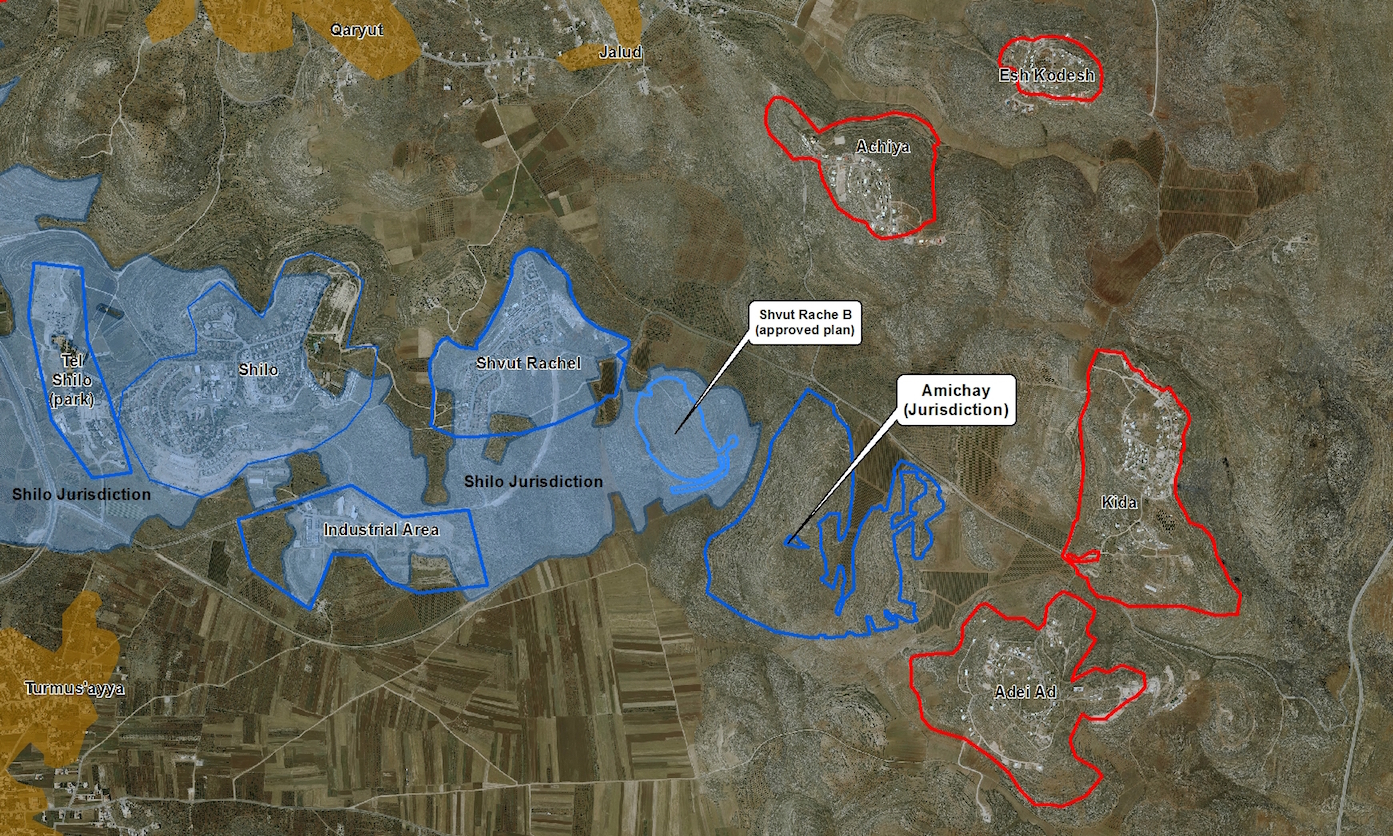
Map by Peace Now
As we have written about many times in the past, Amichai is the first of two new settlements approved by the Israeli government in early 2017 as pay-off to settlers forced to evacuate the Amona outpost by the High Court of Justice. That Amona outpost was established without authorization from the Israeli government and on private Palestinian land; the government of Israel fought for years to legalize it post-facto, but eventually was forced by the High Court to evacuate its residents (evacuation that some residents resisted violently). The establishment of Amichai clearly demonstrates that settler law-breaking not only goes unpunished, but is handsomely rewarded by the Israeli government, and that establishing illegal outposts is an effective route to establishing new settlements.
The Amona settlers have been some of the most vocal and demanding advocates for ever more concessions from the Israeli government, including the installation of these temporary mobile homes on their preferred site. With the approval of that demand, a spokesman for the Amona evacuees said triumphantly:
“Beyond the Regulation Law, the legalizing of thousands of homes in Judea and Samaria (West Bank), the establishment of a new settlement after decades of drought, the great thing that the people of Amona have achieved in their uncompromising struggle is a change in discourse and consciousness.”
Peace Now – which has filed one of the petitions against the construction of Amichai – said:
“42 families, which the court ruled had stolen private land, are extorting the government…”
State Requests Delay of Demolitions in Netiv Ha’avot Outpost
Two weeks ahead of the slated demolition of 15 structures in the Netiv Ha’avot outpost – structures built on privately owned Palestinian land – the state of Israel is urging the High Court of Justice to delay the demolition for three additional months. The reason? To allow more time for another outpost to be constructed for the settlers to move in to (plans for which were approved last week).
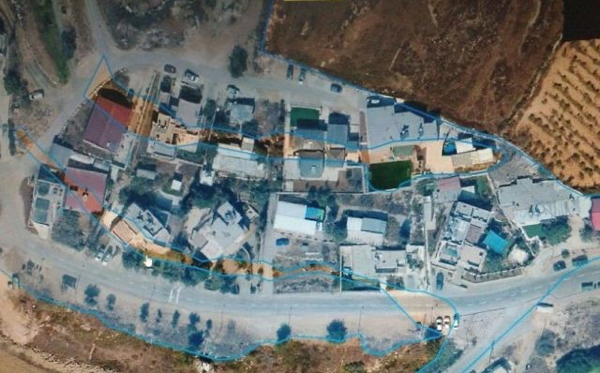
Map by Times of Israel
The delay will also allow more time for settlers to advance plans to save seven of the 15 structures ordered to be demolished; settlers have proposed saving the seven buildings by demolitioning only the parts of the buildings that sit on Palestinian land, leaving the rest intact.
While the Netiv Ha’avot settlers are trying to stay put, Israeli press reports this week suggest that Netanyahu has asked his Cabinet to approve a payout of millions of shekels to the settlers, in advance of their evacuation, ostensibly to to facilitate a public-relations friendly demolition of the targeted 15 structures. Cabinet ministers are now seeking funds from their ministry budgets to help fund Netanyahu’s Netiv Ha’avot bribe. The bribe money will come in addition to the estimated $14 million to $17 million it will cost Israeli taxpayers to dismantle the 15 structures slated to be demolished in Netiv Ha’avot.
Once again, the establishment of a new outpost for setters who built illegally on land recognized by Israel as privately owned by Palestinians, plus a huge financial pay-off to them, demonstrates clearly that settler law-breaking not only goes unpunished but is actively rewarded and incentivized by the Israeli government.
Process Begins for Major Expansion of Gilo Settlement in East Jerusalem
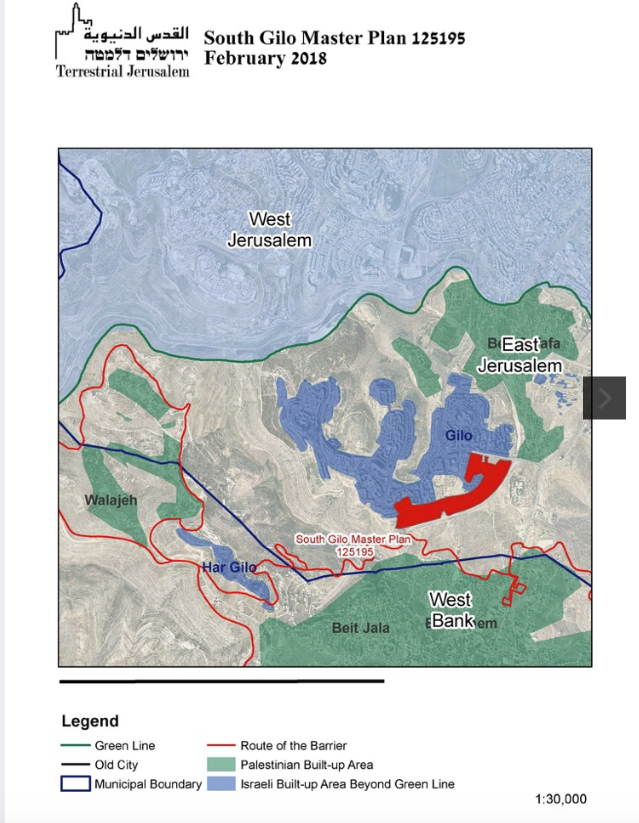 Jerusalem expert Daniel Seidemann’s NGO, Terrestrial Jerusalem, reports that the Jerusalem planning authorities met on February 21st to initiate the planning process for a new neighborhood of the Gilo settlement in East Jerusalem. The plan seeks to significantly expand the footprint of Gilo in the direction of Bethlehem (the Gilo settlement literally looms over Bethlehem; the new plan will develop the southern slope leading down into the Palestinian city). The plan calls for building 2,992 new units.
Terrestrial Jerusalem writes:
“In 1995, Israel made a commitment to the U.S. government that no additional land in East Jerusalem would be expropriated for the purposes of building or expanding settlement neighborhoods. That commitment has guided the boundaries of Israeli settlement expansion in East Jerusalem in the ensuing years. While the scope of the expropriations under this scheme will be limited, this significantly contravenes the spirit of that undertaking, significantly expanding the built-up footprint of the Gilo settlement.”
Ir Amim writes:
“The Gilo Southeast plan is yet one more link in a chain of developments designed to seal off the southern perimeter of East Jerusalem from the West Bank, nullifying prospects for a two state solution. Advancing a new plan for 3,000 units on land near Givat Hamatos indicates that the Israeli government will continue to do everything just short of taking action on Givat Hamatos to fill in any remaining gaps along the southern flank of the city.”
Construction of New Checkpoint Near al-Walajah Proceeds, Despite Lacking Permit
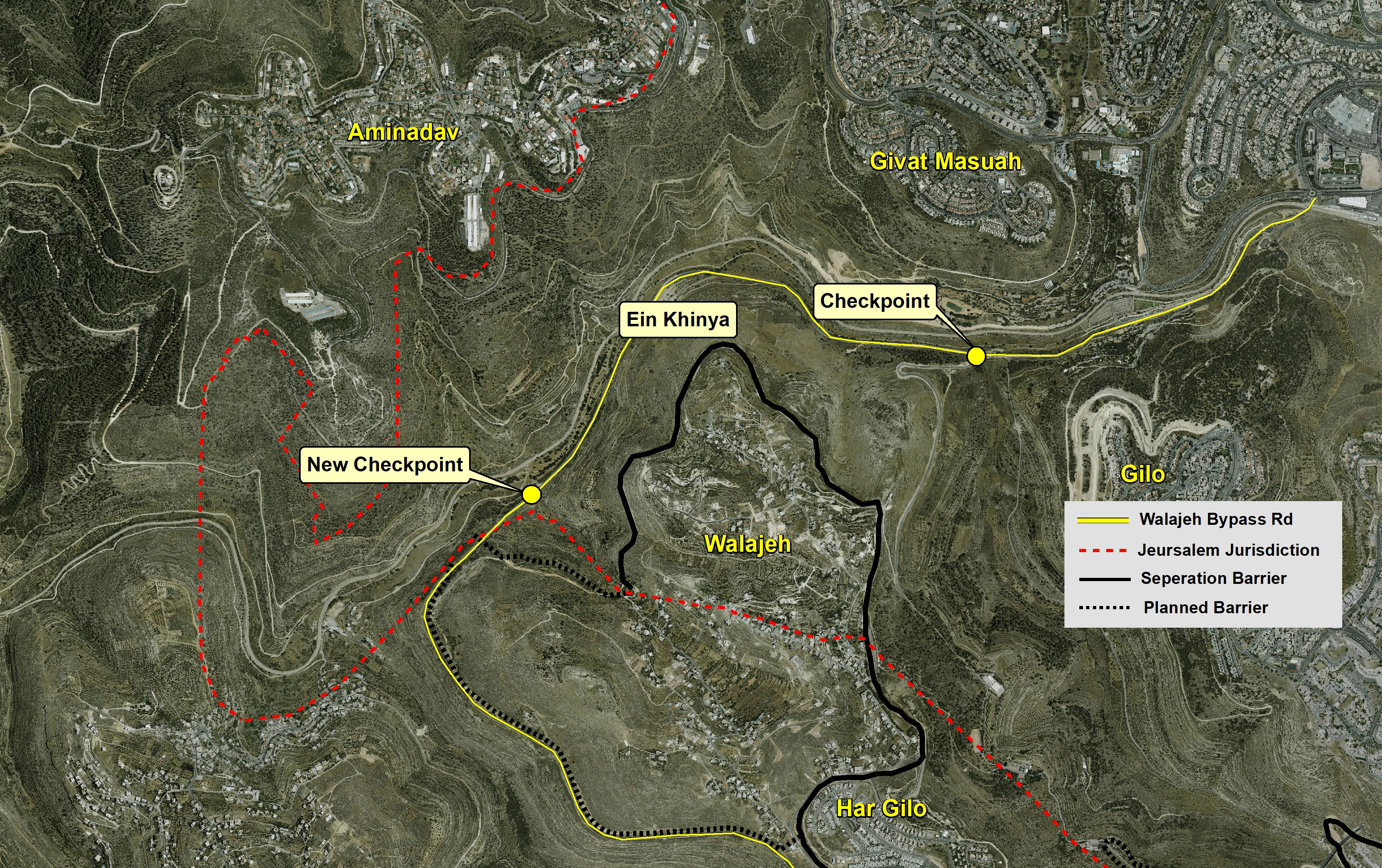
Map by Peace Now
The Jerusalem Municipality recently began (and has nearly completed) the construction of a new checkpoint that will further isolate and imprison the Palestinian city of al-Walajah, which is surrounded on three sides by the Israeli separation barrier. The construction of the checkpoint is going ahead despite the fact that it lacks the legally required permit and in contravention of an Israeli court order.
The new checkpoint is meant to replace the current one, located further down the road. The current arrangement allows al-Walajah residents to access an important and historic natural spring without passing through a military checkpoint. The new checkpoint will block the village’s access to the spring and it will advance the consolidation of Israeli control of the village’s only remaining access point to Jerusalem.
Terrestrial Jerusalem provides background on the spring, which is now inside of an area Israel has declared an Israeli national park, and Israeli actions to consolidate control over it:
“The move comes as part of the Municipality’s decision, supported by the government, to designate the area as an Israeli national park. The decision to move the Ein Yael checkpoint is designed, deliberately, to prevent el-Walajeh’s resident from accessing the park (for further background on the national park project, see our previous report here). Following the inauguration of the area as a national park by Jerusalem Mayor Nir Barkat and Tourism Minister Ze’ev Elkin (Likud), construction works for the relocation of the checkpoint started on February 12, 2018, without a permit being issued and in contravention of a court order requiring the Municipality to suspend all work in order to enable el-Walajeh’s residents to appeal the Municipality’s decision.”
Ir Amim further explains the drama that ensued when the Jerusalem Municipality began the construction illegally, against the orders of the court:
“On February 12, the District Committee approved a permit for construction, rejecting separate objections from residents of Al-Walaja and the Har Gilo settlement. Despite the committee granting a week for the attorney for the residents of Al-Walaja to submit an appeal, the Municipality – which initiated and is funding the multi-million shekel project – launched construction two days later. The director general of the Municipality, Amnon Merhav, personally supervised the illegal construction, refusing to halt the equipment when confronted by the residents’ attorney and Ir Amim field researcher, Aviv Tatarsky. Tatarsky was arrested and jailed on his way to work the following morning for disrupting the peace.”
Peace Now adds even more color to the late-night legal proceedings and wacky defenses that the Jerusalem Municipality deployed in order to continue the construction. In the end, the presiding judge decided to nullify the 1-week injunction to allow the construction to proceed, a ruling that accepted the Municipality’s argument that stopping the construction would endanger motorists. The judge will hear complaints filed by al-Walajah residents on March 6th.
High Court Issues Injunction Against Construction & Sale of Homes in Shvut Rachel “Neighborhood”
On February 18th, the High Court of Justice issued an injunction freezing the construction and sale of new homes in the Shvut Rachel “neighborhood” of the Shiloh settlement. Importantly, Shvut Rachel is not actually a neighborhood of Shiloh: it is located outside of Shiloh’s boundaries and is correctly termed an illegal outpost. The injunction follows a petition launched by Peace Now against the illegal construction, filed at the end of January 2018. This is not the first time Peace Now has challenged illegal/unauthorized construction in this area. The first such petition was filed in 2010, but the illegal construction was nonetheless allowed to advance in fits and starts, with the government of Israel fully aware of the crime. Now, the project is nearly complete and ready for sale. And once again, the actions of the Israeli government in allowing the illegal construction to reach this point demonstrate that settler law-breaking not only goes unpunished but pays off.
Israel Evacuates Outpost, Again
The Israeli army removed settlers from an encampment set up near the Tapuah settlement in the northern West Bank, just south of Nablus, as they have done several times over the past 5 years. Settlers reacted violently – throwing stones, burning tires, and pouring oil on roads – in order to deter the Israeli army’s dismantlement of the mobile home camp. Two Israeli youths were arrested in the incident.
After the army left, the settlers marched towards the nearby Tapuah settlement, encountering and attacking two Palestinian vehicles and a Rabbi for Human Rights activist along the way.
Jordan Valley Annexation?
The settler-aligned Arutz Sheva media outlet is reporting that the Ministerial Committee for Legislation (a committee of Cabinet members who decide if the government will support legislative proposals) will consider endorsing a bill to annex the Jordan Valley at its weekly meeting.
The bill was introduced by Likud MK Sharren Haskel, who recently said:
“The support we are receiving in the international arena from our friend the United States proves that there has not been and will not be a better time…With the support of the Likud members who demand the necessary change, with the support of the government where we have the majority needed to pass the bill, together with my friends Motti Yogev and Miki Zohar, I am proud to lead the bill to apply Israeli law in the Jordan Valley”
The Arutz Sheva report suggests the Netanyahu might block the bill from coming up for a vote (a suggestion that is likely part of the effort to pressure Netanyahu not to block it). The same report notes that the Likud-inspired annexation bill will be postponed for cabinet consideration for another week.
U.S. Ambassador: “Settlers Are Here to Stay”; Settler leader: “thank God” for Trump
Veteran Haaretz columnist Barak Ravid reported remarks made by U.S. Ambassador David Friedman during a meeting with the Conference of Presidents of Major Jewish American Organizations earlier this week. Friedman reportedly said that Israeli settlements will not need to evacuated under a U.S. peace plan, noting specifically, “the settlers aren’t going anywhere.” Given the public record of Friedman’s policy positions, this is not a surprising statement or U.S. policy manifestation.
Notably, the Trump Administration (White House and State Department) offered no substantive correction.
At the same time, the Associated Press ran a story this week (which got picked up by several major outlets including the Washington Post, TIME, ABC News, and Voice of America) quoting the braggadocious remarks of settler leader, Yaakov Katz. Katz has ties to a prominent settler organization, “Bet El Institutions,” which, as noted by Haaretz, has ties to U.S. negotiators (as in, David Friedman was the longtime leader of the U.S. fundraising arm of Bet El, and both he and the Kushner family have donated to Bet El). Hailing the “success” of the settlement enterprise in 2017, Katz quipped:
“This is the first time, after years, that we are surrounded by people who really like us, love us, and they are not trying to be objective…We have to thank God he sent Trump to be president of the United States.”
Katz also said (among other things):
“We are changing the map. The idea of the two-state solution is over. It is irreversible.”
Katz’s excitement is a marked contrast from the January reaction of the Yesha Council (the umbrella organization of municipal councils of Jewish settlements) to 2017 population growth data. The Yesha Council lamented declining growth in settlements and blamed it on what a purported “quiet freeze” on settlement construction in 2017, despite the fact that Peace Now chronicled an alarming acceleration of settlement activity in 2017.
As FMEP explained in January, 2017 Israeli government data (covering 150 West Bank settlements and outposts, but not East Jerusalem) shows that the settler growth rate has decreased for the sixth consecutive year, from 3.9% in 2016 to 3.4% in 2017 (the growth rate hit a high in 2008, at 5.8%). Even with this decline, the 3.4% settler population growth rate still outpaces Israel’s national average, which comes in at 2%. Moreover, the data show that settler population is far younger than the population inside the Green Line, with 47% of settlers being below the age of 18, compared to 27% of Israelis inside the Green Line.
Bonus Must-Reads
- “Israel’s Latest Attempts to Alter Geopolitical Realities in Jerusalem” (Al-Shabaka) *This is a short policy memo drawing from a brief which will be published in March 2018.
- “The End of Israel’s ‘Enlightened Occupation’ “ (+972 Mag)
- “Netanyahu’s Real Crime: Plundering Land from Palestinians” (Al-Monitor)
- “Netanyahu’s West Bank Annexation Talk Was No Gaffe” (American Conservative)
FMEP has long been a trusted resource on settlement-related issues, reflecting both the excellent work of our grantees on the ground and our own in-house expertise. FMEP’s focus on settlements derives from our commitment to achieving lasting Israeli-Palestinian peace, and our recognition of the fact that Israeli settlements – established for the explicit purpose of dispossessing Palestinians in the West Bank and East Jerusalem of land and resources, and depriving them of the very possibility of self-determination in their own state with borders based on the 1967 lines – are antithetical to that goal.
Welcome to FMEP’s Weekly Settlement Report, covering everything you need to know about Israeli settlement activity this week.
To receive this report via email, please click here.
October 20, 2017
- Israel Advances 2,646 Settlement Units
- Construction of the Givat Hamatos Settlement in East Jerusalem is Underway
- Israel to Invest in $939 Million “Settler Security Package” for Settlements Across the West Bank
- Court Orders Evacuation of Settlers from “Machpelah House” in Hebron
- As Olive Harvest Begins, Settlers Steal and Destroy the Palestinian Crop
- Labor Chairman Shocks Israeli Left with Defense of Settlements
- Bonus Reads
Comments, questions, or suggestions? Email Kristin McCarthy at kmccarthy@fmep.org.
Israel Advances 2,646 Settlement Units
This week the Netanyahu government advanced plans for a total of 2,646 settlements units across the West Bank. According to Israel’s veteran settlement watch organization, Peace Now, the Israeli government has advanced plans for 6,742 new settlement units so far in 2017, a steep escalation from previous years.
As we reported last week, these advancements include several provocative plans that will “compensate” settlers who had built illegally in the West Bank (296 units in Beit El, 102 units in the brand-new settlement of Amichai, and 86 units in Kochav Yaakov), move towards retroactively legalizing an illegal outpost (the Netiv Ha’avot plan, which the High Planning Council called “improper” but approved anyway), enlarge settlement enclaves in Palestinian neighborhoods (31 units on Shuhada Street in Hebron – the first new settlement construction approved inside Hebron in more than a decade. Btselem’s short video documentary on Shuhada Street is here).
The anti-settlement watchdog group Peace Now said:
The Israeli government has lost all its inhibitions, while promoting settlement expansion in a record pace for recent years and distancing us daily from the possibility of a two state solution. The government is sending a clear message to settlers – build illegally and anywhere and we will find a solution for you. It is clear that Netanyahu is prioritizing his settler constituency over the rule of law and the possibility for peace.
The Palestinian Authority reacted with anger, calling on the international community and the Trump administration to intervene, saying “This settlement assault comes at a time when the administration of US President Donald Trump is exerting effort and creating the conditions that will pave the way for making a real peace.” The EU and key European nations strongly condemned the settlement approvals. Germany noted, “…each new housing unit cements a one-state reality…”
The White House issued the same talking points on settlement announcements it has since President Trump took office, expressing concern that unrestrained settlement activities does not advance the prospects for peace but saying past demands for a settlement freeze have not been helpful to negotiations.
Construction of the Givat Hamatos Settlement in East Jerusalem is Underway
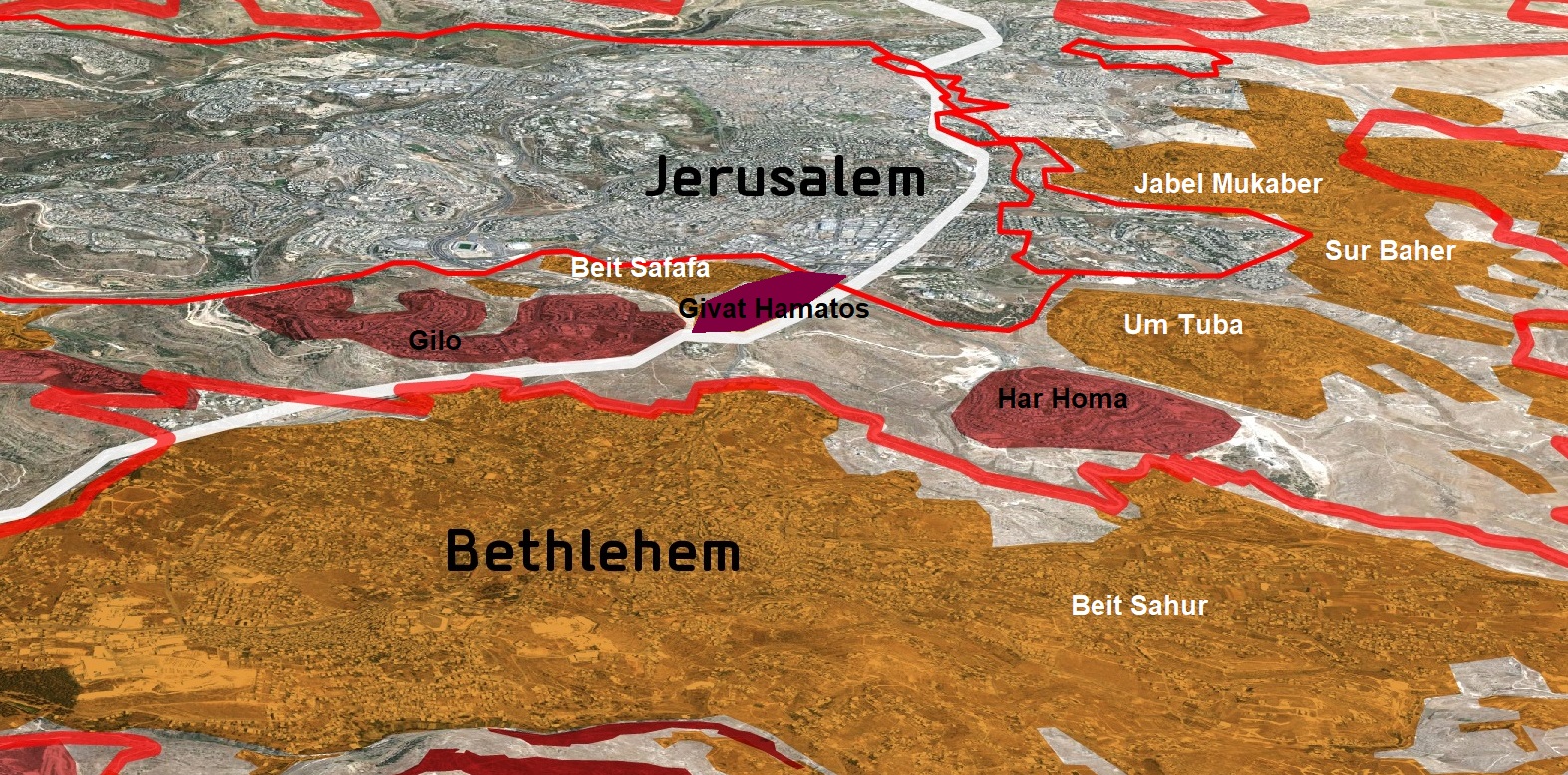
Map by Peace Now
In addition to the massive wave of settlement advancements this week, infrastructure work has started at the site of the long awaited (and much feared) Givat Hamatos settlement in East Jerusalem. Construction workers and machinery were spotted clearing the ground as the Israeli government prepares to issue the first tender for the settlement, which will green-light the construction of some 1,600 units. [image]
The construction of Givat Hamatos will be especially devastating to the two-state solution. It will complete a barrier of Israeli settlements between Jerusalem and Bethlehem; it will complete the encirclement and isolation of the Palestinian neighborhood of Beit Safafa; and, it will be the first new Israeli settlement in East Jerusalem in 20 years.
Ir Amim writes,
Construction of Givat Hamatos – prospectively, the first new [government-backed] settlement in East Jerusalem in two decades – would cap off a wave of simultaneous developments along the southern flank of East Jerusalem to complete consolidation of Israeli control of the southern perimeter and render the two state solution nonviable.
Peace Now writes:
The preparation for a tender in Givat Hamatos, together with Netanyahu’s statements last week regarding the construction of thousands of housing units in Ma’ale Adumim with heavy hints towards E1, are all a part of the government’s effort to create a de-facto annexation and prevent the possibility for two states on the ground. Netanyahu is taking far-reaching steps, which he has thus far avoided, and by doing so he risks the two state solution and the future of Israel.
The Givat Hamatos plan received final approval two years ago, but construction was delayed in light of international pressure including interventions by the Obama administration. As FMEP reported earlier this year, at the onset of the Trump administration, reports suggested a huge slate of Jerusalem area projects would now move forward – those rumored plans included Givat Hamatos, Atarot, Ramat Shlomo, and more (including E-1). Though an official announcement of advancement of those plans has not yet been made, the movement on Givat Hamatos piques concerns of additional major new settlement developments in the Jerusalem area.
Israel to Invest in $939 Million “Settler Security Package” for Settlements Across the West Bank
The Times of Israel reports that Defense Minister Avigdor Lieberman is planning to allocate $939 million for projects for settlers and settlements across the West Bank. Liberman’s plan addresses the complaints of settlers who staged a protest in front of Prime Minister Netanyahu’s private residence earlier this week demanding enhanced security measures. Settlers complained that Netanyahu had promised the infrastructure but had not yet allocated funds to effectuate the projects. According to the Times of Israel, the $939 million package will fund:
the installation of security cameras along roads throughout the West Bank; the installation of cell phone towers to improve reception for settlers who may need to call for help; the paving of bypass roads around Palestinian towns and settlements to allow the populations to avoid each other; the bolstering of armored buses that travel through the West Bank; and broad security improvements for each settlement that will include security cameras, “smart fences” and sensors to warn of attempts to sneak into settlements.
Court Orders Evacuation of Settlers from “Machpelah House” in Hebron
The Israeli High Court has ordered the evacuation of settlers from a disputed home in Hebron. Settlers broke into the “Machpelah House” nearly 3 months ago, despite an ongoing legal battle to determine ownership of the home. The evacuation of the squatters had been repeatedly delayed by the political echelons and by attempts by the settlers to delay their evacuation until the Court makes a final ruling on ownership of the Machpela House, as we have previously reported. It remains to be seen if this court order will be carried out or if further delaying tactics will be brought into play.
As the Olive Harvest Begins, Settlers Steal and Destroy the Palestinian Crop
Yesh Din has documented 10 cases of settlers destroying or stealing olives from Palestinian groves across the West Bank this week, in what has become a common occurrence this time each year. Rabbis for Human Rights has documented an additional four cases this week, calling it a “severe wave of olive theft.”
Israeli police routinely arrest, release, and forget the settlers who commit harvest-time crimes, as documented thoroughly by Yesh Din. In one incident this week, settlers were filmed stealing olives, arrested by the Israeli police, and released on the same day. Yesh Din writes:
Since 2005, we have documented around 280 investigation files dealing with damage to olive trees. Only in 6 cases were indictments served (2.2% of cases for which an investigation has been concluded). More than 93% of these cases were closed due to police failure to locate the perpetrators or to gather enough evidence to prosecute suspects.
Rabbis for Human Rights says:
These are ideologically driven hate crimes. Due to the fact that most of the thefts took place on Palestinian lands which the farmers are restricted by the Israeli army from entering, the army has an increased responsibility to protect these groves.
Labor Chairman Shocks Israeli Left with Defense of Settlements
Avi Gabbay, the relatively unknown political outsider who was elected to be Chairman of the Israeli Labor Party earlier this year, has set off a debate within the center-left party following a series of shocking comments on settlements this week. Most pertinently, Gabbay stated that he does not believe Israel should have to evacuate settlements as part of a peace agreement – a position that is at odds with members of his own party and of the position of the Zionist Union, of which the Labor Party is a major part. He later praised Israeli settlers, saying “The settlement [project] was and remains the beautiful and devoted face of Zionism….[the settlers are] the pioneers of our generations, people who act in the face of adversity, who cause the wilderness to bloom, who realize the impossible.”
Any initial hesitancy of MKs to disagree with the party leader eventually gave way to an onslaught of Labor officials publicly discrediting the chairman’s position on the evacuation of settlements. Tzipi Livni, a member of the Hatnua party and leader of the Zionist Union that unites Labor with other left and center-left political parties, took a simple and strong line saying, “The opposition to evacuating settlements is not the position of the Zionist Union.”
Gabbay’s hardline comments on settlements were not the only remarks that landed him in hot water over the last week. He also stated that he would not agree to form a (hypothetical) government with the Arab-Israeli Joint List because, as he said, “I do not see anything that connects us to them or allows us to be in the same government with them,” and, “I don’t deal with rights of Palestinians.”
The Times of Israel recounts the contextual history of the Labor Party on the issue of settlements and the Party’s important role in previous peace negotiations:
The center-left Labor party has long been the Israeli political standard bearer for reaching a peace agreement with the Palestinians — involving the relinquishing of most of the West Bank and many of the settlements — with former Labor prime ministers Yitzhak Rabin, Shimon Peres and Ehud Barak all investing considerable efforts to negotiate an accord.
Bonus Reads
- “In Jerusalem, Municipal Issues Have Political Overtones” (NPR)
- “In unprecedented move, eight European countries to demand compensation from Israel for West Bank demolitions” (Haaretz)
FMEP has long been a trusted resource on settlement-related issues, reflecting both the excellent work of our grantees on the ground and our own in-house expertise. FMEP’s focus on settlements derives from our commitment to achieving lasting Israeli-Palestinian peace, and our recognition of the fact that Israeli settlements – established for the explicit purpose of dispossessing Palestinians in the West Bank and East Jerusalem of land and resources, and depriving them of the very possibility of self-determination in their own state with borders based on the 1967 lines – are antithetical to that goal.
Welcome to FMEP’s Weekly Settlement Report, covering everything you need to know about Israeli settlement activity this week.
To receive this report via email, please click here.
October 12, 2017
- Bibi Approves Major Expansion of Settlements
- DETAILS: Thousands of Settlement Units to Advance Next Week with Netanyahu’s Permission
- U.S.: No Comment, No Change in Talking Points
- Bonus Reads
Comments, questions, or suggestions? Email Kristin McCarthy at kmccarthy@fmep.org.
Bibi Approves Major Expansion of Settlements
This week, the Israeli Prime Minister Netanyahu announced imminent approval of major new settlement construction across the West Bank, including in some especially sensitive/controversial areas.
How major? There has been debate and disagreement in the Israeli press about the number and what they exactly mean. Haaretz reports that, while Netanyahu listed plans totalling 3,736 settlement units, only 600 of those units will actually be approved for immediate construction (the rest are part of plans that are in earlier stages of the approval process). However, the Times of Israel counts 1,941 units being advanced, of which 1,197 units will receive final approval. The Peace Now Settlement Watch Project counts 3,400 units up for advancement, and tenders (the final step before construction) expected for 296 units.
This debate over the numbers should not obfuscate the fact that Netanyahu is orchestrating an acceleration of settlement growth, the totality of which we will have definitive knowledge of only after the High Planning Council meets next week.
Please note, there is no benign stage in the settlement planning process. No matter the stages of the planning process involved, Netanyahu’s announcement this week represents a huge wave of forthcoming settlement construction.
As Terrestrial Jerusalem’s founder Daniel Seidemann wrote in 2015,
There is no such thing as a “window of opportunity” in stopping settlement planning/approvals. When the world objects to settlement approvals, the answer from Israeli officials, invariably, is either, “It’s too early, it’s just a plan – what are you objecting to?” or “It’s too late, this was approved long ago – why are you bothering us now?” In truth, settlement plans can be stopped at almost any point on the road to implementation, and the earlier a plan is stopped, the lower the political costs.
With that in mind, we cover the plans expected to be advanced in detail below.
DETAILS: Thousands of Settlement Units to Advance Next Week with Netanyahu’s Permission
Prime Minister Netanyahu has publicly announced his permission for the High Planning Council to advance 3,736 of settlement units during the Council’s meeting next week (Oct. 17-18). If all of the reported plans are approved, the total number of settlement units promoted so far in 2017 will reach 6,500 by the end of the month, a significant increase compared to 2,629 for all of 2016, and 1,982 for all of 2015, according to Peace Now data. One Israeli official has promised the settlement numbers will reach 12,000 by the year’s end, bragging that the amount is four times the total promoted in 2016.

Graphic by Haaretz
Of the thousands of units slated for advancement, several plans are at the final stage of planning and will likely receive the green light to start construction. These plans fulfill specific promises to settlers Netanyahu has made over the years (and address some of his most acute domestic political pressure points). The following plans – all of which are in settlements located deep inside the West Bank and beyond the separation barrier – are expected to receive building permits, as reported by Haaretz:
- 31 units for the settlement enclave on Shuhada Street, in the heart of downtown Hebron. This is the first plan for new settlement units in downtown Hebron in the last 12 years; the Hebron Municipality is expected to mount a legal challenge against the plan’s implementation. Peace Now explains, “alongside additional developments in Hebron, including the creation of an independent administration and the entry to the Abu Rajab House, this can be seen as another effort by the government to strengthen the radical settlement in the heart of Hebron.”
- 296 units in the Beit El settlement, which are part of Netanyahu’s promise to compensate for the settlers evacuated from the Ulpana outpost in 2012.
- 86 units in the Kochav Yaakov settlement which are part of Netanyahu’s promise to compensate for the settlers evacuated from the Migron outpost also in 2012. The evacuation of the Migron outpost has lead to the construction of not one but two new settlements as compensation.
- 146 units in the Nokdim settlement, where Israeli Defense Minister Avigdor Liberman lives.
- 9 units in the Psagot settlement.
The Times of Israel reports additional units expected receive final approval:
- 459 units in Ma’ale Adumim.
- 102 units in the new settlement of Amichai, which was approved earlier this year as payoff for settlers evacuated from the unauthorized outpost of Amona. Haaretz suggests that construction of these units will remain stalled as the State responds to a petition filed against the Amichai settlement by the Israeli NGO Yesh Din, arguing that the settlement’s borders annex land that is privately owned by Palestinians. As reported in detail in past editions of the FMEP Settlement Report, Amichai is the first new settlement to receive government authorization in the past 25 years. It is to be located deep inside the Shilo Valley in an area that cannot, under any conceivable two state arrangement, be included inside the borders of an Israeli state in a way that preserves the territorial contiguity of a Palestinian state.
The High Planning Council will also consider depositing for public review (a last step before final approval) plans for 30 units in the Elon Shvut settlement that will expand the settlement borders to build the homes in order to compensate residents in the unauthorized outpost of Netiv Ha’avot, an outpost where the government is appealing to the High Court to save settlement homes that were partially constructed on land that is proven to be privately owned by Palestinians. The Court has ordered that the outpost be razed by March 2018.
To see all of the plans expected to be addressed next week, see Peace Now’s data table (link near the middle of this page). Peace Now issued an accompanying statement saying,
The government has gone wild with settlement plans deep in the West Bank for thousands of new settlers, whom Israel will have to evacuate in a two state solution agreement. Faced with the growing pressures and investigations, Netanyahu goes out of his way to prove how radical he is, without considering the consequences of massive settlement expansion on the future of the two state solution. The plans for Hebron and Nativ Ha’avot are particularly enraging, as they indicate to settlers that the rule of law does not apply to them and illustrate the government’s deteriorating legal standards when it comes to settlement expansion.
U.S.: No Comment, No Change in Talking Points
The Trump Administration has issued no statement regarding Netanyahu’s brazen settlement advancements. Instead, unnamed White House officials repeated the same talking points that have defined the Trump Administration’s settlement stance, saying,
President Trump has publicly and privately expressed his concerns regarding settlements, and the administration has made clear that unrestrained settlement activity does not advance the prospect for peace. At the same time, the administration recognizes that past demands for a settlement freeze have not helped advance peace talks.
Hagit Ofran, Director of Peace Now’s Settlement Watch Program, told the Washington Post, “This year is looking to maybe even be a record year… It’s without a doubt due to the fact that there have been changes in the White House.”
Bonus Reads
- “By Backing ‘Greater Jerusalem’ Bill, is PM leaning towards annexing settlements?” (Times of Israel)
- “The Transformation of Jerusalem” (Arab American Institute)
- “The Bedouin village where compassion ends” (+972 Magazine)
FMEP has long been a trusted resource on settlement-related issues, reflecting both the excellent work of our grantees on the ground and our own in-house expertise. FMEP’s focus on settlements derives from our commitment to achieving lasting Israeli-Palestinian peace, and our recognition of the fact that Israeli settlements – established for the explicit purpose of dispossessing Palestinians in the West Bank and East Jerusalem of land and resources, and depriving them of the very possibility of self-determination in their own state with borders based on the 1967 lines – are antithetical to that goal.
Welcome to FMEP’s Weekly Settlement Report, covering everything you need to know about Israeli settlement activity this week.
To receive this report via email, please click here.
October 4, 2017
- Bibi Backs Bill to Annex Settlements into Jerusalem’s Municipality (and Cut Out Palestinians)
- Tenders for Givat Hamatos to be Issued in Coming Months
- Eastern Ring Road Construction Has Started, Enabling Future E-1 Construction
- Ambassador Friedman Says Settlements Are Part of Israel, Gives Settlement Growth a Green Light
- Putting It All Together: Israeli Actions and U.S. Statements
- Update: Amichai Construction Stalled (Again)
- Bonus Reads
Comments, questions, or suggestions? Email Kristin McCarthy at kmccarthy@fmep.org.
Bibi Backs Bill to Annex Settlements into Jerusalem’s Municipality (and Cut Out Palestinians)
On October 2nd while speaking in the Ma’ale Adumim settlement east of Jerusalem, Netanyahu announced his support for the “Greater Jerusalem” bill, a piece of legislation that proposes annexing 19 settlements into Israel’s Jerusalem municipality while simultaneously creating new municipalities for Palestinian neighborhoods in East Jerusalem that fall on the West Bank side of the separation wall. FMEP covered similar legislation in our July 28th Settlement Report. At the event, Netanyahu also promised thousands of new units for the settlement and vowed that it will be a part of Israel forever.
The legislation’s author, Yisrael Katz (Likud) who serves as both the Minister of Transportation and the Minister of Intelligence, explained the bill’s purpose is to “strengthen Jerusalem by adding thousands of Jewish residents to the city, while simultaneously weakening the Arab hold on the capital.” Netanyahu has members of his governing coalition to formally introduce the “Greater Jerusalem” bill by the end of the year.
Jerusalem expert Daniel Seidemann reported previously on the bill in detail here. Writing about this latest development, he observed: “Such a move has correctly been viewed in the past as tantamount to de facto annexation and the erasure of the Green Line…a new and deeply disturbing geopolitical reality is taking shape before our very eyes.”
Tenders for Givat Hamatos to be Issued in Coming Months
Terrestrial Jerusalem reports that Israeli Prime Minister Benjamin Netanyahu has decided to allow tenders to be issued for the establishment of the two-state ending Givat Hamatos settlement, in the southern part of Jerusalem. Rumors of these tenders first emerged in August of this year.

Map by Peace Now
If constructed, Givat Hamatos will be the first new government-backed Israeli settlement in East Jerusalem since the establishment of Har Homa in 1997. The settlement will complete the barrier of settlements that sever Palestinian East Jerusalem from Bethlehem to its south, and inside Jerusalem will complete the isolation of the Palestinian neighborhood of Beit Safafa from any possible connection to the West Bank. Givat Hamatos will thus prevent a border from being drawn in Jerusalem along the lines of the Clinton Parameters (i.e., according to which Palestinian neighborhoods are part of Palestine and Israeli neighborhoods are part of Israel), and in a manner that permits the emergence of a Palestinian state with a viable capital in Jerusalem.
Eastern Ring Road Construction Has Started, Enabling Future E-1 Construction
Peace Now reports that Israel has started construction on a controversial and highly consequential portion of the “Eastern Ring Road” in the E-1 area. If this section of the road is completed and opened, it will redirect Palestinian traffic around the E-1 settlement area, ostensibly paving the way for construction of the two-state ending settlement. In June 2017, Ir Amim reported that Israel had approved a budget for the construction of this segment of the road.

Map by Peace Now
The “Eastern Ring Road” is often called the “Apartheid Road” because the separation wall runs down the middle of the road, separating Palestinian and Israeli settler traffic. Israel designed the Eastern Ring Road, which is still incomplete after years of stalled construction, to solve several problems it faces in connecting Israeli settlements to Jerusalem.
Peace Now explains:
This road is part of a future road, which, if completed, will allow Israel to build in E-1 and divide the West Bank in two on the pretext that the road provides a solution to the Palestinian need to connect north to south. However, the Palestinian need is not only a question of transportation, but also a question of territory and the possibility to develop the areas at the heart of the West Bank, without which a viable Palestinian state cannot be established.
This start of this new construction comes in the context of other developments that seem to signal a serious intent to move forward with E-1. Specifically, the ongoing Israeli government plans to expel Bedouin living in the area (discussed in detail in last week’s Settlement Report) and Netanyahu’s now open embrace of legislation to effectively annex the area to Jerusalem (discussed above).
Ambassador Friedman Says Settlements Are Part of Israel, Gives Settlement Growth a Green Light
In his first on-camera interview since taking office, U.S. Ambassador David Friedman told an Israeli news outlet that Israel’s settlements are a part of Israel, breaking with 50 years of bipartisan U.S. policy that distinguishes between sovereign Israel and its settlements.
Ambassador Friedman, who personally raised money for the Beit El settlement before taking office, said:
I think the settlements are part of Israel… There was always supposed to be some notion of expansion into the West Bank, but not necessarily expansion into the entire West Bank. And I think that’s exactly what, you know, Israel has done. I mean, they’re only occupying 2% of the West Bank. There is important nationalistic, historical, religious significance to those settlements, and I think the settlers view themselves as Israelis and Israel views the settlers as Israelis.
The U.S. Department of State has not clarified Ambassador Friedman’s remarks, but has said that his comments do not represent a shift in U.S. policy. This is the second time this month that the Administration has had to publicly distance itself from controversial pro-settlement remarks by the Ambassador. However, State Department Spokeswoman Heather Nauert created more consternation when she was unable to clarify on record how much of the West Bank the U.S. believes to be occupied(though she was asked twice over the past week).
Additionally, days before the interview, Ambassador Friedman and U.S. Special Envoy Jason Greenblatt reportedly told Netanyahu that the U.S. accepts a distinction between what Israel calls its “settlement blocs” and far-flung, isolated settlements. Netanyahu relayed news of the (alleged) major U.S. policy shift during a private meeting with settler leaders. According to meeting participants, Netanyahu also claimed the U.S. Ambassador gave him permission to continue expanding Israeli settlements, but had warned Israel not to go overboard.
As we noted last week, actors in Israel and in the U.S. have been pushing for the U.S. to adopt such a distinction, which would allow Israel to annex the “settlement blocs” outside of the framework of a peace deal. The campaign is further evidenced by a new article written by Eli Lake, quoting Elliot Abrams extensively, defending Ambassador Friedman’s remarks about settlements being a part of Israel and arguing for Israel’s unilateral annexation of the blocs.
As we also noted last week, FMEP President Lara Friedman has written extensively against the normalization and annexation on the so-called settlement blocs. Dating back to 2013 she wrote that this approach:
“…is a recipe not for strengthening the two-state solution, but for imposing a unilateral Israeli vision of a Greater Israel extending beyond the Green Line, adjacent to a balkanized Palestinian entity. Such an outcome may be appealing to Benjamin Netanyahu and his U.S. apologists. It will never be acceptable to the Palestinians and the international community, and it certainly shouldn’t be mistaken for a “solution” to the Israeli-Palestinian conflict.”
Americans for Peace Now (APN) is calling on President Trump to fire Friedman. Debra DeLee, APN’s President & CEO, said that Ambassador Friedman’s comments are “outrageous, unacceptable, and flat-out wrong” and that “Americans should be appalled to hear our ambassador parrot this disingenuous argument, in effect revealing himself as a spokesman for the extremist ideological settler population, rather than a faithful representative of the US government.”
J Street also released a statement lambasting the Ambassador’s remarks, saying
Eradicating that distinction and normalizing settlements as “part of Israel” would severely damage the prospects for a two-state solution and undermine the United States’ capacity to act as helpful facilitator in reaching a deal to end the conflict. Such a change in policy would strengthen the position of Israel’s settlement movement and rejectionist right….While the State Department’s clarification is important, it remains unacceptable that the chief American diplomatic representative in Israel continues to misrepresent and undermine long-standing US policy. His statements are a stark reminder of why Friedman’s nomination to be ambassador to Israel faced an unprecedented level of congressional opposition, with a record 46 senators voting against. It is now clear that concerns about Friedman as an official representative of the United States because of his long history of close ideological and financial ties to the settlement movement were well-founded.
Putting It All Together: Israeli Actions and U.S. Statements
A few of the major Jerusalem-area developments over the past couple months include:
- The advancement of the “Greater Jerusalem” bill that will annex Israeli settlements to the Jerusalem municipality and cut out Palestinian neighborhoods of East Jerusalem. [reported above]
- The advancement of settlement plans in Palestinian areas of East Jerusalem and surrounding settlements including Ramat Shlomo/Neve Ya’akov. [Terrestrial Jerusalem]
- An uptick in evictions and demolitions in Palestinian neighborhoods of East Jerusalem (Silwan, Sheikh Jarrah, and Issawiya to name a few) and al-Walajah (part of al-Walajah is inside of the Jerusalem municipality, this is the area where the threat of evictions and is most acute).
- Israel’s stated plan to forcibly relocate the Khan al-Ahmar community from the area near the E-1 and Ma’ale Adumim settlements. [B’Tselem]
- News of imminent tenders for the Givat Hamatos settlement and for the expansion of the Nof Zion settlement enclave inside of a Palestinian East Jerusalem neighborhood. [Terrestrial Jerusalem & Peace Now]
- The resumption of construction of the “Eastern Ring Road” which paves the way for Israel to build in E-1. [Peace Now]
Over the same period, the key statements from Trump Administration officials have been:
- Amb. Friedman and Jason Greenblatt reportedly told Israel not to “go overboard” on settlement growth, but gave a clear green light for settlement growth.
- In an on-camera interview with Walla Israel, Amb. Friedman said that settlements are a part of Israel and that Israel is only occupying 2% of the West Bank.
- Amb. Friedman referred to the “alleged occupation” in an interview with the Jerusalem Post,
- The State Department has been unable to explain or clarify Ambassador Friedman’s remarks regarding the amount of the West Bank that Israel is occupying, or the status of Israeli settlements.
- The Trump administration continues its refusal to directly comment on any specific settlement announcement, and has yet to do so with this week’s news regarding the “Greater Jerusalem” bill.
The United State’s diplomatic pressure has played an historically important role in dissuading Israel from pursuing two-state ending settlement activity in the Jerusalem area. That diplomatic pressure, it seems, is no longer a factor.
Update: Amichai Construction Stalled (Again)
The construction of the new settlement of “Amichai” has once again stalled. This week the government reportedly declined to expedite the transfer of funds to the contractor building Amichai, instead requiring the contractor to go through the planning process to acquire and additional tender. Until the tender is officially approved by the government, the contractor is unable to continue the construction due to lack of funds.
The new settlement of Amichai was approved earlier this year as a pay-off for the families who illegally established the Amona outpost and were forcibly evacuated earlier this year. Amichai is the first new West Bank settlement to be approved by the Israeli government in the past 25 years.
Bonus Reads
- “How Settlers Turn Archeological Sites Into Political Tools” (Al Monitor)
- “UN Special Envoy Says Israel Ignoring Demand to Halt Settlements” (Times of Israel)
- “Apartheid in Hebron” (Arab American Institute)
- “Goods from Israel Settlements Granted Preferential EU Trade Deals” (Middle East Monitor)
- “Despite Police Restrictions, MKs Tour East Jerusalem” (Jerusalem Post)
FMEP has long been a trusted resource on settlement-related issues, reflecting both the excellent work of our grantees on the ground and our own in-house expertise. FMEP’s focus on settlements derives from our commitment to achieving lasting Israeli-Palestinian peace, and our recognition of the fact that Israeli settlements – established for the explicit purpose of dispossessing Palestinians in the West Bank and East Jerusalem of land and resources, and depriving them of the very possibility of self-determination in their own state with borders based on the 1967 lines – are antithetical to that goal.
Welcome to FMEP’s Weekly Settlement Report, covering everything you need to know about Israeli settlement activity this week.
To receive this report via email, please click here.
September 7, 2017
- In Sheikh Jarrah, Palestinians Evicted, Settlers Move In
- Major Expansion in Settlement Enclave – Approval of Permits Imminent
- High Court Lets Settlers Stay in Hebron House [That They Took Over Illegally]
- Amichai Update: Work on New Settlement to Resume with Infusion of Government Funds
- U.S. Ambassador Questions if the Occupation Exists, Minimizes Impact of Settlement Enterprise
- Bonus Reads
Comments, questions, or suggestions? Email Kristin McCarthy at kmccarthy@fmep.org.
In Sheikh Jarrah, Palestinians Evicted, Settlers Move In
On September 5th, the Israeli army evicted members of the Shamasneh family from their home in Sheikh Jarrah, a Palestinian neighborhood in East Jerusalem; they had lived in that home since 1964. Within hours of the eviction, extremist Israeli settlers moved into the home. This is the first eviction to be carried out in Sheikh Jarrah since 2009, when evictions there inspired a sustained domestic and international protest.
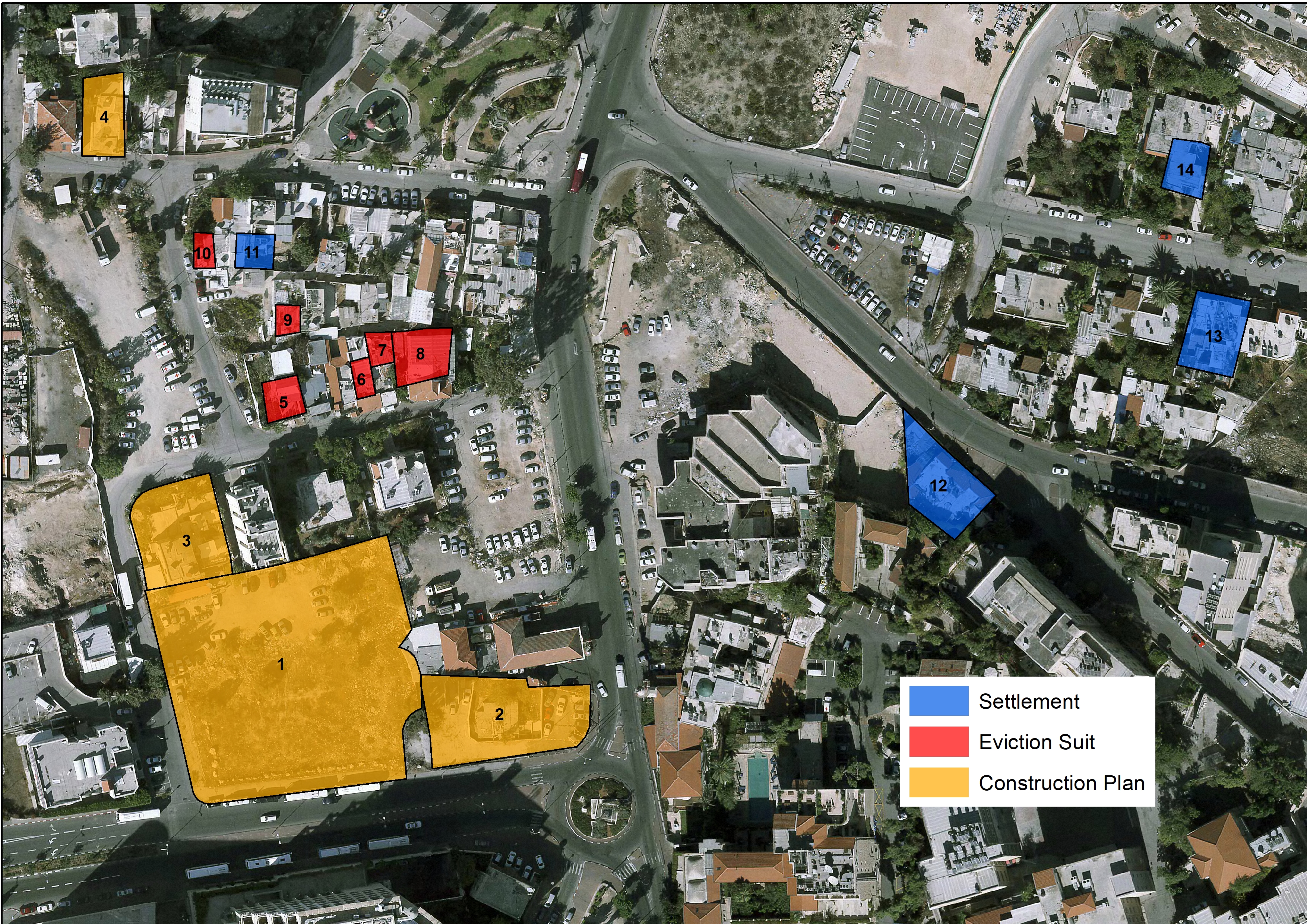
Map by Peace Now
The Shamasneh family was sent an eviction notice back in 2013, after a court ruled in favor of Israelis who sought to “redeem” the home. Their case was based on an Israeli law that allows Jews to reclaim property and land they were forced to abandon in 1948, when Jordan captured East Jerusalem (a right Palestinians are not afforded with respect to properties they were forced to abandon in what became Israel in 1948). The eviction of the Shamasneh family was repeatedly delayed out of “humanitarian concerns” over the health of the elderly Shamasneh patriarch. Earlier this year, it became clear the eviction was going to be carried out when a wave of provocative East Jerusalem settlement plans were advanced, including multiple plans to build more settlement units in the Sheikh Jarrah neighborhood.
Regarding the Shamasneh’s case, Ir Amim wrote:
Today’s eviction of the Shamasneh family symbolizes the boldness with which these settlement activities in the most sensitive part of East Jerusalem are now being executed – with the full backing of the state – and the pressing need to halt this escalation of events in order to preserve the waning viability of the two state solution.
Regarding that same eviction, East Jerusalem settler impresario (and city councilman) Aryeh King exulted:
I expect more evictions this year of residents who refuse to recognize the Jewish owners of the properties where they are living. With the opening of the new National Insurance Institute nearby, the Nahalat Shimon [Shimon Hatzaddik] neighborhood is going to see a significant expansion of Jewish settlement, which residents of Jerusalem have waited for years to see.
On the evening prior to the eviction, Israeli forces raided several Palestinian homes in Sheikh Jarrah and issued six additional eviction notices.
Major Expansion in Settlement Enclave – Approval of Permits Imminent
The Jerusalem municipality is set to grant building permits for 176 new housing units in the Nof Zion settlement, an Israeli enclave located inside the Palestinian neighborhood of Jabel Mukaber in East Jerusalem. If approved, construction of the units will make Nof Zion the largest Israeli settlement enclave in East Jerusalem.
Peace Now, which was first to report the story, wrote:
It appears that the [Israeli] government has opened all the floodgates when it comes to settlement developments within Palestinian neighborhoods. Building a large settlement in the heart of a Palestinian neighborhood would constitute a severe blow to Jerusalem and to the chance to arrive at a two state solution. This is not a matter of real estate but a matter of politics and sovereignty, as the Israelis moving to homes inside Palestinian neighborhoods are motivated solely by ideology, and are trying to prevent a future compromise in Jerusalem.
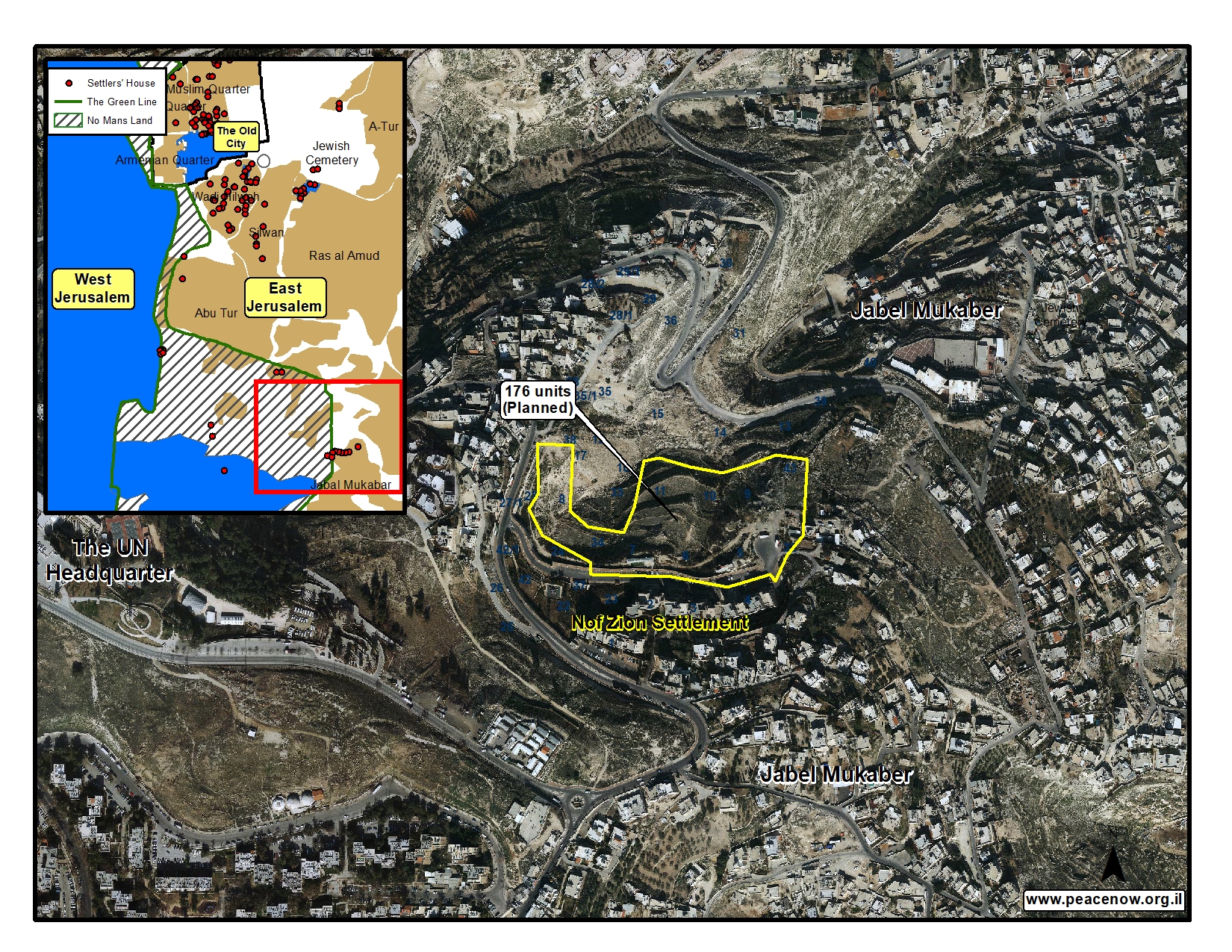
Map by Peace Now
Plans for 395 new units for the Nof Zion enclave were originally approved in 1994, but the first phase of construction bankrupted the developer. A drama ensued over the fate of the project, after a Palestinian-American made a bid to buy the development rights. His winning bid was ultimately blocked by right-wing Israelis [with a key role played by Jerusalem settler impresario Aryeh King] who objected to the sale of the property – in an Palestinian neighborhood – to an Arab.
As it stands, only the Prime Minister’s personal intervention might stop the construction, which does not seem likely given Netanyahu’s repeated declaration that his is the most settlement-friendly government in the country’s history.
The units are not the only construction happening in Nof Zion. Earlier this year, the government approved a plan to build a new synagogue and mikveh on private Palestinian land that was expropriated from the Jabel Mukaber neighborhood in 2016.
Ir Amim writes:
The primary objective of the settlers’ infiltration into the Palestinian neighborhoods in and around the Old City is to undermine the possibility of dividing Jerusalem, thereby foiling the possibility of a political resolution on the city and an end to the Israeli-Palestinian conflict. The building permits will issue a clear statement that the Israeli government sanctions and supports the establishment of new facts on the ground designed for this purpose.
High Court Lets Settlers Stay in Hebron House [That They Took Over Illegally]
On September 3rd, the Israeli High Court of Justice issued an injunction allowing for a one-week delay of the evacuation of 100 Israeli settlers from the “Machpela House” in Hebron. The settlers have been illegally inhabiting the house, under the protection of the Israeli army, since they broke into the property on July 25th.
The delay is the result of a last minute petition filed by the squatters claiming rightful ownership of the house; the petition gives Palestinian claimants and the state of Israel one week to respond, during which time the settlers are allowed to remain in the house. The injunction reverses an order by the Israeli Attorney General last week to evacuate the settlers by September 3rd.
Peace Now said in a statement about the settlers’ latest petition:
The settlers’ petition is absolutely outrageous and its baseless arguments have been rejected again and again in previous legal proceedings. After having been granted an independent administration a few days ago, it is no wonder the Hebron settlers feel empowered to do as they wish, while ignoring the law and on the expense of Palestinians. [Editor’s note: the reference to an “independent administration” relates to a decision last week, explained in the same Peace Now explainer linked above, to promote the status of an administrative body that can represent Hebron’s settlers to the Israeli government].
Amichai Update: Work on New Settlement to Resume with Infusion of Government Funds
On September 3rd, the Israeli Cabinet approved the allocation of 55 million shekels ($15.3 USD) to the Interior Ministry for the construction of the Amichai settlement in the Shilo Valley, the first official new Israeli settlement to be built in 25 years. The construction of Amichai, which was approved as a pay-off for families evicted from the illegally built the Amona outpost, has been stalled for nearly two months for lack of funds.
The Cabinet’s resolution notes that any additional government contribution to the project “depends among other things on court verdicts,” because “legal proceedings are now before the court against the construction of the new settlement, including the infrastructure work.” Last week we reported on a petition to the High Court filed by Bimkom on behalf of Palestinian landowners in the vicinity of Amichai.
The government’s funding will go towards providing public infrastructure to the new settlement: paving access roads, building sewage systems, and connecting it to the Israeli power grid. The 55 million shekels allocated this week fall within the original 60 million shekel budget approved by the Cabinet last year.
U.S. Ambassador Questions if the Occupation Exists, Minimizes Impact of the Settlement Enterprise
In an interview in the Jerusalem Post, U.S. Ambassador to Israel David Friedman articulated major points of the Trump Administration’s approach to Israel, the Palestinians, and peace negotiations.
Alarmingly, the Ambassador called into question whether or not Israel is, in fact, occupying the West Bank. Amb. Friedman – who before he was nominated to be Ambassador had a long history of criticizing the American Jewish Left, including calling its members “kapos” – reportedly told the Post, “The [American Jewish] Left…is portrayed as believing that only if the ‘alleged occupation’ ended would Israel become a better society.” Following the publication of Ambassador Friedman’s interview, a senior White House official told the Guardian that his comments do not represent a shift in U.S. policy.
Israel’s occupation of the West Bank, East Jerusalem, and the Gaza Strip is an objective fact, acknowledged by the entire international community including, until now, the United States. As noted by Americans for Peace Now:
The West Bank and Gaza are viewed by virtually all international legal experts as “occupied territory.” Since 1967, legal experts, including in Israel, have been virtually unanimous in recognizing this…Even the Israeli Supreme Court has repeatedly used the term “belligerent occupation” to describe Israel’s rule over the West Bank and Gaza… Even Ariel Sharon, one of the principal architects of Israel’s policy of building settlements in the West Bank and Gaza, recognized this reality. On May 26, 2003, when he was Prime Minister of Israel, he bluntly told fellow Likud members, “You may not like the word, but what’s happening is occupation [using the Hebrew word “kibush,” which is only used to mean “occupation”]. Holding 3.5 million Palestinians under occupation is a bad thing for Israel, for the Palestinians and for the Israeli economy.”
Also of concern with respect to settlements, Ambassador Friedman said,
If you listened to the Obama administration, you would think that the [Israeli] settlements had overtaken the West Bank. It’s still under 2% of the territory. I am personally convinced that there’s nothing in the current status quo with regards to settlements that precludes the resolution of the Palestinian [issue].
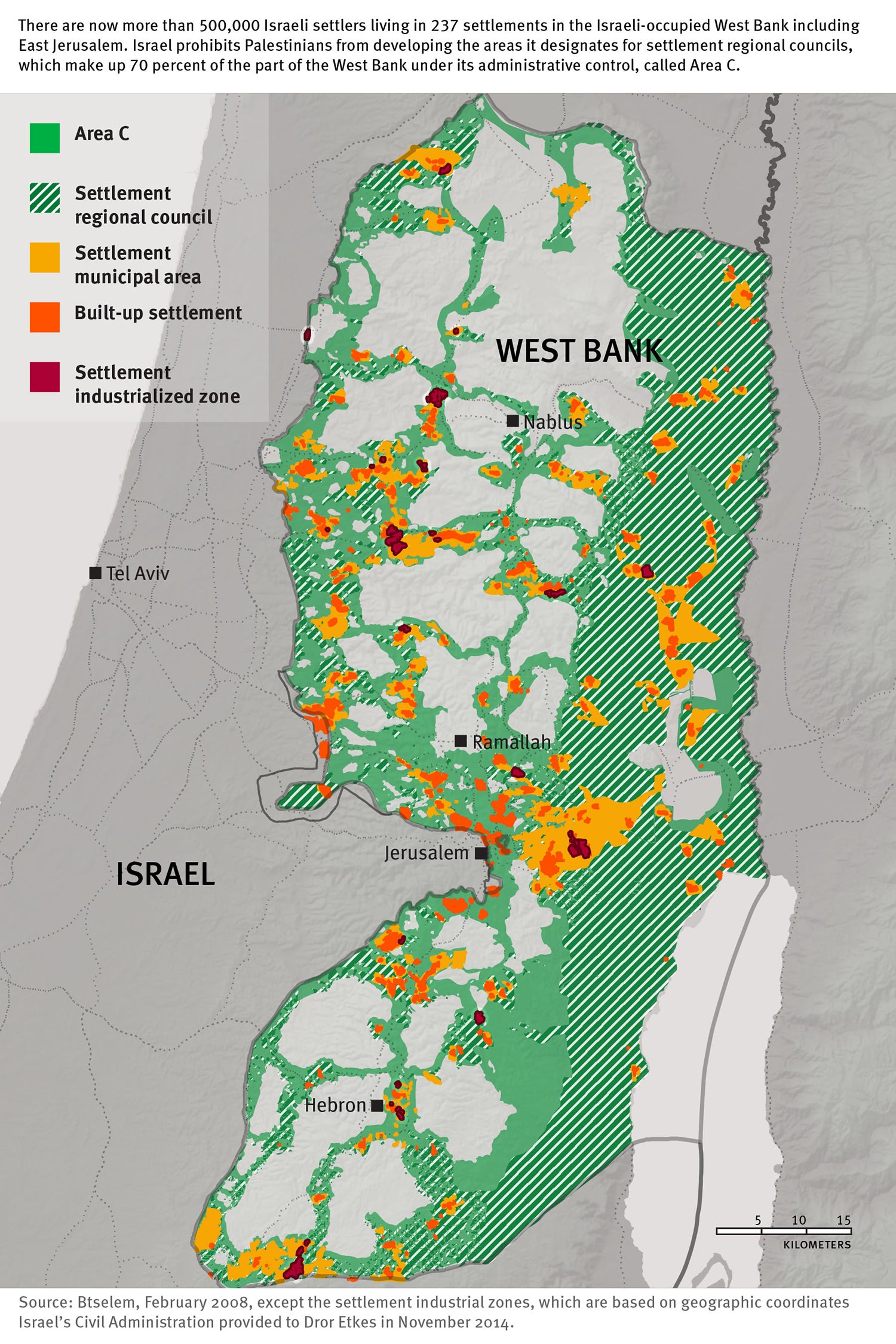
Map by Human Rights Watch
Ambassador Friedman’s 2% figure is misleading. It refers restrictively to the amount of land settlers have actually built on [2% of the West Bank], but does not count the many ways settlements have created a massive, paralytic footprint in the West Bank. This argument was comprehensively dismantled last November by FMEP’s Lara Friedman, in her testimony before the UN Security Council.
In a report last year, Yesh Din explained further:
The jurisdiction areas of many settlements are much larger than the area they actually use. In 2013, the total area under the jurisdiction of settlements, including regional councils, stood at 1.2 million dunams (roughly 120,000 hectares), or 63% of Area C. In practice, the area covered by the settlement enterprise is larger, as it also includes the unauthorized outposts, many of which are outside local council jurisdiction areas, as well as their farmland. Palestinians are barred from entering all of these areas, by virtue of a “closed military zone” order which prohibits entry without a permit.
The settlements command an area that is larger than their residential, built-up portion. Each community has a system of access roads, and each is assigned vast areas intended to ensure the residents’ safety. Many settlements include farmland, industry and commerce zones, green areas and parks, and in many of them the distance between the houses is so large, that the space they take up has no direct correlation to the number of people living in them.
Yesh Din’s full report, “Land Takeover Practices Employed by Israel in the West Bank” is available online here.
Bonus Reads
- “Illegal outpost residents ask court to save parts of homes set to be razed” (Times of Israel)
- “Bedouin Shepherds Between a Rock, a Hard Army, and West Bank Settlers” (Haartez)
FMEP has long been a trusted resource on settlement-related issues, reflecting both the excellent work of our grantees on the ground and our own in-house expertise. FMEP’s focus on settlements derives from our commitment to achieving lasting Israeli-Palestinian peace, and our recognition of the fact that Israeli settlements – established for the explicit purpose of dispossessing Palestinians in the West Bank and East Jerusalem of land and resources, and depriving them of the very possibility of self-determination in their own state with borders based on the 1967 lines – are antithetical to that goal.
Welcome to FMEP’s Weekly Settlement Report, covering everything you need to know about Israeli settlement activity this week.
To receive this report via email, please click here.
August 31, 2017
- Netanyahu: Israel Will Not Withdraw from Settlements, Ever
- U.S. Refuses to State a Clear Position on Settlements
- Netanyahu Delays Settlement Advancements Until After September UNGA Session
- Palestinians & NGOs Launch Legal Challenge to New Settlement
- Settlers Ordered to Leave the Illegally-Occupied Building in Hebron, or be Evacuated
- Liberman Approves New Israeli Municipality for Settlers in Hebron
- Liberman Comes Out Against Regulation Law…Because It Could Undermine Settlements
- Beit El Settlement Will Get a Wall & New Homes This Year
- Bonus Reads
Comments, questions, or suggestions? Email Kristin McCarthy at kmccarthy@fmep.org.
Netanyahu: Israel Will Not Withdraw from Settlements, Ever
Israeli Prime Minister Benjamin Netanyahu continues to make the case that no Israeli government has been better for settlements than his own. This time around, he did so at an event held in a settlement, celebrating 50 years since took control of the West Bank (or, occupied and began illegally settling civilians in it).
At the event, Netanyahu pledged,
Map by Peace Now
We are here to stay, forever. There will be no more uprooting of settlements in the land of Israel. It has been proven that it does not help peace. We’ve uprooted settlements. What did we get? We received missiles. It will not happen anymore…So we will not fold. We are guarding Samaria against those who want to uproot us. We will deepen our roots, build, strengthen and settle.
At the same event, Minister of Education Naftali Bennett said, “We [Israelis] shouldn’t need permits, building in Judea and Samaria should be unrestricted. The freedom to build in our country.” Bennett is a leading figure in a powerful far-right faction of the Israeli government which is pushing Netanyahu to take radical, anti-democratic positions to advance settlements and sabotage the possibility of any future peace deal with Palestinians.
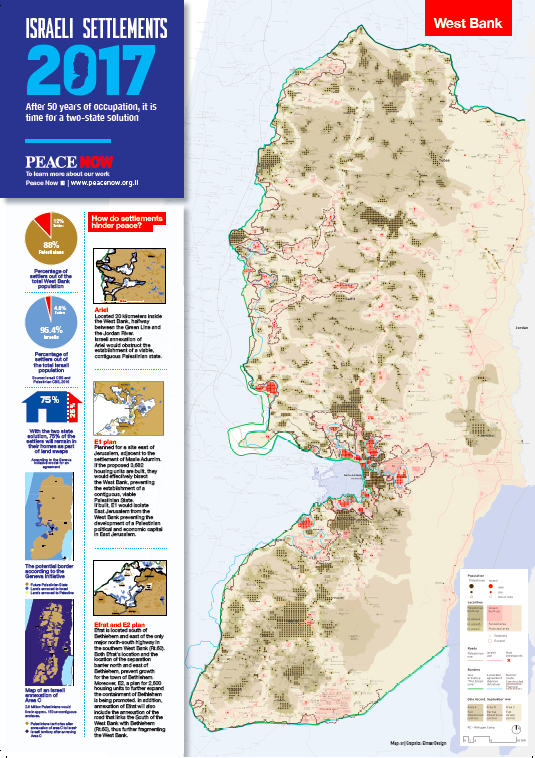
As a reminder, the Israeli settlement watchdog organization Peace Now documents 131 Israeli settlements and 97 outposts in the occupied West Bank, totaling 385,900 settlers. There are an additional 208,410 Israelis living in Palestinian East Jerusalem. There cannot be a viable, contiguous, independent Palestinian state if all of these settlements remains in place.
U.S. Refuses to State a Clear Position on Settlements
Despite a Palestinian pressure campaign last week to get the Trump Administration to publicly commit to a two-state solution and a settlement freeze while in the region, the U.S. delegation came and went without articulating support for either of those baselines for negotiations.
Immediately after the negotiation team departed, Palestinian news reported that Jared Kushner – who led the delegation – told President Abbas that the U.S. cannot call for a settlement freeze because the it would lead to the collapse of Prime Minister Netanyahu’s government. A senior White House official quickly, and vehemently, denied the report as “nonsense.”
These are just the latest reports adding to the confusion and concern about the Trump Administration’s changing position on settlements. To date, the U.S. has only (and repeatedly) stated that unrestrained settlement growth is not “helpful” to the peace process. President Trump and his spokespeople have refused to comment directly on any of the major settlement announcements Israel has made since Trump took office, including the approval of the first new official settlement in 25 years (Amichai, located far beyond the separation barrier and approved as a pay-off to settlers who defied Israeli law in building elsewhere) and alarming developments in East Jerusalem.
At first the White House even declined to comment on Netanyahu’s promise to never uproot another Israeli settlement (reported above); 24-hours later, an anonymous White House official commented to the Times of Israel that, “It is no secret what each side’s position is on this issue [settlements]. Our focus is on continuing our conversations with both parties and regional leaders to work towards facilitating a deal that factors in all substantive issues.”
Several FMEP grantees and U.S. civil society organizations have put out statements on the Administration’s position:
-
- J Street President Jeremy Ben-Ami writes, “It is no accident that the prime minister’s open rejection of the two-state solution has grown bolder since President Trump took office. By refusing to support two states or to seriously oppose settlement expansion, the Trump administration has given the Israeli government the green light to entrench the occupation and avoid meaningful negotiations. It is empowering the most extreme voices and positions on both sides.”
- Americans for Peace Now released a statement saying in part, “By refusing to publicly endorse a two-state solution to the Israeli-Palestinian conflict and suggesting that doing so would “bias one side over the other” regarding possible outcomes, the Trump Administration yesterday dropped a dangerous and unacceptable bombshell. The Administration turned its back on a core bipartisan foreign policy principle, thumbed its nose at an international consensus regarding the way to resolve the conflict, and handed a gift to extremists on both sides of the Israeli-Palestinian divide.”
Netanyahu Delays Settlement Advancements Until After September UNGA Session
The Times of Israel is reporting that the Civil Administration’s High Planning Committee has delayed a meeting scheduled for this week until the conclusion of the United Nations General Assembly (UNGA) session (taking place September 12-25 at UN headquarters in New York). The committee’s meeting was set to advance 3,000 settlement units first reported to be moving in June of this year. The units are expected to be advanced by the end of September, despite the short delay.
In addition, the Times of Israel report suggests Netanyahu’s government is moving to significantly shorten the settlement approval process by eliminating the number of authorizations each plan needs to obtain before being implemented.
Palestinians & NGOs Launch Legal Challenge to New Settlement
This week, a group of Palestinians and Israeli NGOs filed a legal challenge against the first settlement to be built in the West Bank in 25 years, Amichai. The petition claims that the settlement’s location will deny Palestinians access to their own private land – land on which they depend for farming and grazing. A construction plan for Amichai was approved earlier this year as payoff to families which the government was forced to evacuate from the illegal Amona outpost.
Map by Peace Now
The location of the new settlement, north of Ramallah and deep in the Shilo Valley, is a brazen challenge to Israeli planning laws. Bimkom, an Israeli NGO leading the new petition against Amichai, explains that the IDF has repeatedly demolished an illegal outpost on the very same hilltop on which Amichai is being built. Alon Cohen-Lifschitz of Bimkom says, “We [Bimkom] didn’t even file petitions against the outpost. The Defense Ministry simply understood that it was illegal and acted. But now they want to establish a settlement in that same problematic area…“there was no legitimacy to establish the settlement. They [the Israeli government] rushed through the entire process without gaining the necessary permits.”
The petition might delay the construction of the new settlement for several months while the court considers and demands a State response to the petitions’ claims. Such a delay would be i addition to the problems already facing the new settlement: after getting off to a fast start, construction on Amichai stopped at the end of July due to budget shortfalls, and so far has not resumed despite reports that Netanyahu’s government is seeking to triple the government’s contribution to the project.
Settlers Ordered to Leave the Illegally-Occupied Building in Hebron, or be Evacuated
On August 27th, Israeli Attorney General Avichai Mandleblit ordered Israeli settlers to voluntarily leave the building in Hebron they have dubbed the “Machpelah House” within the week, or face a forcible evacuation. Approximately 100 Israeli settlers broke into the property and took up residence on July 25th, over five weeks ago. The Attorney General’s order has put an end date on attempts by the Defense Ministry to negotiate a peaceful evacuation.
The Attorney General’s order came as the result of a petition filed by Palestinians who say they own the home. Legal ownership of the home is a complicated, fiercely disputed matter; what is neither complicated nor in disputed is the fact that the settlers broke Israeli law when the took over the site.
Hagit Ofran, the head of Peace Now’s Settlement Watch Project, said, “It’s truly a shame that the state needs a High Court petition in order to uphold the law.”
Liberman Approves New Israeli Municipality for Settlers in Hebron
On August 29th, Israeli Defense Minister Avigdor Liberman announced that the government had approved granting the status of an independent municipality to the loose cluster of settlements, home to around 1,000 Israeli settlers, located in Hebron’s city center. Until now, these settlements and their residents have technically fallen under the municipal jurisdiction of the Palestinian Authority while for all practical purposes operating as an enclave under full Israeli control and authority. That changed officially on Thursday, when the Israeli army signed an order to create a new municipal services administration for Jewish settlers.

Map by Mike King for the New York Review of Books
The creation of a municipal body is a major boon to the settlers, who will now enjoy far greater freedom and authority to administer their own affairs and promote their own agenda – which includes attempting to rewrite the city’s history and cultural identity to effectively erase the Palestinians – without having to deal with the Palestinian Authority.
Liberman’s decision, and the actions of the settlers, violate the 1997 Hebron Protocol signed by Arafat and Netanyahu, which divided Hebron into two security areas, H-1 controlled by Palestinians (80% of Hebron) and H-2 controlled by the Israeli army. That agreement stipulated that the Palestinian Authority would provide municipal services to all parts of the city, gave the PA control over all infrastructure, and specifically protected the Palestinian cultural identity of Hebron.
Commenting on this new development, Peace Now says:
By granting an official status to the Hebron settlers, the Israeli government is formalizing the apartheid system in the city. This step, which happened immediately following the announcement on the evacuation of the settlers who took over a house in Hebron [discussed above], is another illustration of the policy of compensating the most extreme settlers for their illegal actions.
Liberman Comes Out Against Regulation Law…Because It Could Undermine Settlements
To the surprise of many, this week Israeli Defense Minister Avigdor Liberman – himself a settler – railed against the Regulation Law, which was passed by the Knesset in order to retroactively legalize Israeli outposts in the West Bank.
Why would an ardent supporter of settlements do so? Liberman’s logic is clear: he is concerned that the law will provide the basis for legalizing not only illegal construction by settlers but that it could also lead to the legalization of “illegal” Palestinian construction. Unpacking the false symmetry built into this logic, Liberman fears that this law – designed to legalize the approximately 2,000 units settlers built on private Palestinian land, making them illegal even under Israeli law, will compel Israel to also legalize the approximately 10,000 units build by Palestinians on their own private land, but without Israeli permits (it is virtually impossible for Palestinians to obtain such permits in the more than 60% of the West Bank known as Area C, that under the Oslo Accords is under full Israeli control).
Liberman also criticized unauthorized construction in settlements, which his ministry was recently tasked with cracking down on – because, he argued, the lawlessness often brings land cases before the High Court and draws more legal scrutiny to the settlements. In addition, he called the violent Hilltop Youth movement “disturbed idiots,” leading the movement’s supporters to file a criminal complaint against the Defense Minister in order to “send a message that this is not how an elected official is supposed to behave.”
Beit El Settlement Will Get a Wall & New Homes This Year
This week the Israeli Defense Ministry confirmed that it is planning to build a wall around part of the Beit El settlement, located northeast of Ramallah. According to a Defense Ministry spokesman, the wall will be built along a portion of the settlement’s western side, separating it from the Palestinian Al-Jalazoun refugee camp, “based on security needs and circumstances.” The construction does not yet have the necessary permissions, but the spokesman said he expects building to begin in the coming weeks.

Map by Haaretz
Prime Minister Netanyahu has personally promised to approve 300 new housing units for Beit El by the end of September. There was significant outrage in pro-settlement quarters earlier this year, when new homes in the Beit El settlement were not included in the wave of settlement approvals that came out in July. That outrage was rewarded with the Prime Minister’s assurances that the units would, indeed, be built.
Beit El is the settlement with which current U.S. Ambassador to Israel David Friedman is most closely associated, having donated to and fundraised for prior to his appointment (in his capacity as the President of the American Friends of Beit El, reportedly from 2011 until he became ambassador). As of March 2017, Amb. Friedman’s son-in-law was still reportedly involved in fundraising for the settlement.
Bonus Reads
- “Jerusalem Stakeout Reveals ‘New Generation’ of Radical Jewish Settlers” (Haaretz+)
- “The Writing on the Wall: Signs of Occupation in Hebron” (The Forward)
- “Hobby Lobby Funds Israeli Settlement Archeology” (Al Jazeera)
- “How Palestinian students prepare for settler attacks” (Al Jazeera)
FMEP has long been a trusted resource on settlement-related issues, reflecting both the excellent work of our grantees on the ground and our own in-house expertise. FMEP’s focus on settlements derives from our commitment to achieving lasting Israeli-Palestinian peace, and our recognition of the fact that Israeli settlements – established for the explicit purpose of dispossessing Palestinians in the West Bank and East Jerusalem of land and resources, and depriving them of the very possibility of self-determination in their own state with borders based on the 1967 lines – are antithetical to that goal.
Welcome to FMEP’s Weekly Settlement Report, covering everything you need to know about Israeli settlement activity this week.
To receive this report via email, please click here.
August 24, 2017
- Israel Mounts Legal Defense After High Court Puts 2-Month Hold on Regulation Law
- Government Data Shows Regulation Law Could Legalize 3,455 Settlement Structures
- Israeli AG Demands Better Enforcement of Settlement Construction Laws
- Yitzhar Settlers Attack IDF During Outpost Demolition
- Settler-Led Petition Seeks to “Test”High Court’s Consistency on Palestinian Land Ownership Rights
- Updates: Amichai Funds, Sheikh Jarrah Eviction, Jordan Valley Race Track, E-1 Demolitions
- Bonus Reads
For comments and questions, please email Kristin McCarthy (kmccarthy@fmep.org).
Israel Mounts Legal Defense After High Court Puts 2-Month Hold on Regulation Law
On August 17th, the Israeli High Court of Justice ordered a two month hold on the use of the controversial Regulation Law, which was set to take effect this week. The Regulation Law (also called the “Expropriation Law,” the “Regularization Law,” the “Legalization Law,” or the “Settlements Law”) was passed earlier this year by the Israeli Knesset to pave the way for the government to retroactively legalize outposts and other construction of Israeli settler homes on privately owned Palestinian land, among other things. The High Court ordered the two-month freeze following a direct request from Israeli Attorney General Avichai Mandleblit, who has called the law unconstitutional.
The court is currently weighing two petitions challenging the legality of the law filed this past March; one petition by the Israeli civil society organizations Yesh Din, Peace Now, and the Association for Civil Rights in Israel (ACRI); the second petition was filed by Palestinian civil society groups Adalah, Al-Mezan, and the Jerusalem Legal Aid Center.

Map by Peace Now
In response to the petitions, the Israeli government’s private attorney Harel Arnon provided the court with a 156-page defense arguing that, “the Regulation Law balances the obligation of the government towards thousands of citizens who have relied in good faith on government action and a minor infringement of property rights, with increased compensation to the [Palestinian] landowners.” Prominent Israeli lawyer Michael Sfard explained why this is “legal fantasy.” Israel was forced to hire a private lawyer to represent them before the High Court after Attorney General Avichai Mandleblit announced his refusal to defend the measure as soon as it was passed into law.
The trio of Israeli petitioners released a blistering statement following the government’s response. Peace Now, Yesh Din, and ACRI wrote,
“The State of Israel, in its response today, is trying to present the land expropriation law as addressing a national problem, when in practice it involves continued government support for a criminal enterprise that has continued for decades. The government is minimizing the continuing harm to the rights of the Palestinian landowners, and at the same time is trying to present the Israeli citizens who are taking part in the looting of West Bank Palestinians as people who have been harmed and who require ‘compensation’ for their part in the looting,” they added. “We hope the court rejects the state’s arguments out of hand, strikes down this unconstitutional and immoral law, and sends a loud and clear message: No more.”
Peace Now goes further to say, “In its response the government attempts to present Israeli citizens, who are directly involved in land theft of Palestinians, as deserving a reward for their participation in the thievery.”
Adalah also issued a sharp response, saying “The state’s position amounts to a de facto annexation of the West Bank.”
Haaretz put out a searing editorial demolishing the government’s claim that settlers are owed a solution to the “distress” they live in as a result of their land theft. Haaretz editors wrote in “The ‘distress” of the Israeli settlers,”
The government broke a record for cynicism when it made its arguments against the petitions. In a perfect reversal of occupier and occupied, it explained that the expropriation law constitutes “a humane, proportionate and reasonable response to the real distress” of all those “Israeli residents” who live under “a cloud of uncertainty” that is “disrupting their lives.” It’s hard to believe, but this is not a description of the situation of millions of Palestinians living under occupation whose lands are being seized, but of the distress of the settlers, who chose to live outside the state’s official borders and whose very presence there is illegitimate.
The High Court of Justice is months away from issuing its ruling on the Regulation Law’s constitutionality. The Knesset’s legal experts are expected to present their case in support of the law in September, and Attorney General Mandleblit is expected to argue against his own government’s law in October.
Government Data Shows Regulation Law Could Legalize 3,455 Settlement Structures
According to the Israeli government’s own data, there are 3,455 illegally built Israeli structures in the West Bank that can be legalized if the Regulation Law (see above) goes into effect. Haaretz has an explanation of the three categories of land where these structures were illegally built and how the Regulation Law seeks to absolve the government and its settlers of their illegality.
The Haaretz reporting confirms and compounds documentation published by Peace Now earlier this year which estimated that the Regulation Law could legalize 3,850 structures and 53 outposts, adding up to a total land grab of 8,000 dunams of privately owned Palestinian land (1 sq. km = 1,000 dunams | 1 acre = 4 dunams).
Israeli AG Demands Better Enforcement of Settlement Construction Laws
Israeli Attorney General Avichai Mandleblit held a series of meetings over the past month in an attempt to force the government to rein in illegal construction happening inside of settlements. Haaretz reports that Mandleblit met with Prime Minister Benjamin Netanyahu, Defense Minister Avigdor Liberman, and Finance Minister Moshe Kahlon several times to demand the creation of a special unit in the Defense Ministry tasked with policing planning and construction laws inside of settlements.
Haaretz relays from sources in the meetings, “He [Mandleblit] said, in the presence of officials in the Prime Minister’s Office, the treasury and the Defense Ministry, that the present situation, in which there is no group enforcing the planning laws in the settlements except for the committees acting on behalf the settlements’ regional councils themselves, is ‘clearly illogical,’ and creates a situation in which there are illegal structures over which nobody has authority.”
The recent discussions followed Mandleblit’s request last month for the High Court to issue an order demanding the Defense Ministry to create the unit. The Defense Ministry has refused to establish the unit, citing a lack of funding. Mandleblit’s request to the High Court was meant to force Defense Minister Liberman to create the unit by making it mandatory.
Yitzhar Settlers Attack IDF During Outpost Demolition
For the second time this year, the Israeli army clashed with radical Yitzhar settlers as the army executed orders against homes the settlers built without the proper permissions. This time, in contrast to the incident in June where houses were razed inside the settlement, the IDF removed six caravans that were set up outside of the settlement’s municipal border in an outpost known as Kumi Ori.
Settler-Led Petition Seeks to “Test” High Court’s Consistency on Palestinian Land Ownership
Ynet News reports that the right-wing settler organization Regavim has launched a petition against the construction of a road in the West Bank, which they claim – with undisguised irony – is being built on privately owned Palestinian land. The road is an access road to the new Palestinian city of Rawabi, a $1.4 billion dollar investment project to provide a state-of-the-art planned city for Palestinians in the West Bank (and the first new Palestinian city Israel has permitted since 1967).
For Ragavim, the case is a win-win. If the court rules in Regavim’s favor, it will be a blow to efforts to develop Rawabi. If the court rules against Regavim (i.e., in favor of the construction and against the rights of Palestinian landowners), it will set a legal precedent that Regavim and others can exploit for the benefit of settlers. Regavim is clearly hoping for the latter result: Regavim’s lawyer said, “In the last few years, the High Court of Justice has taken a very strict line and ordered the demolition of buildings and roads built by Jews on private Palestinian land. That is why in this case, it is unacceptable that the High Court of Justice is nonchalant about the rights of private landowners.”
Updates: Amichai Funds, Sheikh Jarrah Eviction, E-1 Demolitions, Jordan Valley Race Track
- Haaretz has spoken to four government officials who report that the office of the Prime Minister has requested to nearly triple the amount of government funds allocated towards the construction of the first new settlement in 25 years, Amichai. The Prime Minister’s office denied the Haaretz report.
- In Sheikh Jarrah, a Jerusalem court rejected a petition to delay (again) the eviction of the Shamasneh family from their longtime home in the East Jerusalem neighborhood. Eviction is rumored to proceed on September 9th.
- In E-1, the Israeli Army’s Civil Administration has threatened to move forward with demolitions against Bedouin structures they say were illegally built in the area of E-1 despite an order from the High Court of Justice delaying the demolitions. Back in February, the High Court ruled that the structures should not be demolished and that the Bedouin and Civil Administration must work together to see if the structures can be legalized.
- In the Jordan Valley, Israeli settlers are continuing to build a recreational race track despite a stop-work order issued against the project in February 2017. The large race track complex is partially on land that the Israeli army has declared a closed firing zone, a designation which resulted in the forcible displacement of Palestinians who lived there
- For background on all of these stories, see past editions [link] of FMEP’s Settlement Report.
Bonus Reads
- “U.S. Trying to Prevent UN ‘Blacklist’ of Companies Working in Israeli Settlements” (Washington Post)
- “Netanyahu to attend West Bank event celebrating 50 years of settlements” (August 21, 2017, Jerusalem Post)
- “In Walajeh, Palestinians residents mobilize against Israeli demolitions” (August 21, 2017, +972 Mag/Active Stills)
- “From jail cells, settler youth call for defiance of administrative orders” (August 23, 2017, Times of Israel)
Welcome to FMEP’s Weekly Settlement Report, covering everything you need to know about Israeli settlement activity this week.
To receive this report via email, please click here.
August 16, 2017
- Israel Demolishes Buildings in Key East Jerusalem Areas
- Bedouin are Powerless in E-1 Area as Settlement Plans Loom
- Jewish National Fund Resumes Targeting Land in the Occupied West Bank
- Settlers in Israeli Government Turn Blind Eye to Settlers Breaking Israeli Law
- Former Israeli AG Says Sheikh Jarrah Property Should be Given to Palestinians
- Three New Outposts Near Nablus
- Updates: Al-Walajah, Sheikh Jarrah, Amichai Settlement
- Bonus Reads
Comments, questions, or suggestions? Email Kristin McCarthy at kmccarthy@fmep.org.
Israel Demolishes Buildings in Key East Jerusalem Areas
The Israeli government demolished eight Palestinian structures in the East Jerusalem neighborhoods of Silwan, Beit Hanina, Jabal Mukaber, and Isawiyyah. According to Ir Amim, the two apartments demolished in the al-Bustan area of Silwan are the first demolitions to be carried out there since 2008. Looking at East Jerusalem as a whole, Ir Amim writes, “[these] demolitions bring the 2017 total to 128, including 84 residential units and 44 non-residential units. These numbers are on well on target to meet or surpass the total number of 203 demolitions executed in East Jerusalem last year.”
Bedouin are Powerless in E-1 Area as Settlement Plans Loom
According to B’Tselem, last week Israeli officials confiscated solar panels that were providing electricity to a Bedouin community’s school in the controversial area adjacent to Jerusalem known as “E-1.” The confiscation happened despite a temporary court-ordered injunction against it. The Israeli government has long refused to connect the Bedouin to a power grid; the solar panels confiscated this week were donated only a month ago by a humanitarian organization.

Map by the Economist
The E-1 area has long been slated for Israeli settlement construction, but plans have been continuously delayed by the Israeli political echelon – due in large part to pressure from U.S. administrations and others in the international community. If E-1 is developed it will seal Palestinian East Jerusalem off from the West Bank to its east, and create a land bridge from Jerusalem to the Maale Adumim settlement. The settlement will render the two-state solution impossible because it would preclude the ability to draw contiguous borders for a future Palestinian state with a capital in East Jerusalem.
East Jerusalem expert Danny Seidemann has issued several warnings this year that E-1 – a “doomsday settlement” – might be slated for advancement under the current settlement policy of the Netanyahu government and with no discernable counter-pressure from the Trump Administration. Seidemann warned in January, “The main obstacle preventing a green light for E-1 has, until now, been wall-to-wall opposition from the international community, led by the United States (dating back to the era of President Clinton).”
The Bedouin community living in the E-1 area has long been threatened with forcible relocation (which would amount to population transfer). The 18 Bedouin tribes that live in the vicinity of Maale Adumim and E-1, totaling approximately 3,000 people, have already endured numerous emolitions this year alone.
Jewish National Fund Resumes Targeting Land in the Occupied West Bank
According to Peace Now, the Jewish National Fund (JNF) is set to resume its practice of purchasing land in the West Bank for use by Israeli settlers, after abandoning the effort many years ago. In the past, many of the JNF’s land purchases reportedly involved fraud, extortion, and/or forgery on the part of middlemen.
Peace Now writes, “Through purchasing lands in the occupied territories, JNF serves the settlers, hurts the possibility to arrive at a two state solution, and jeopardizes the future of Israel as a Jewish and democratic state.”
The JNF – which collects donations internationally, including in the United States – currently owns land (through its Israeli subsidiary) in numerous settlements, including Itamar, Alfei Menashe, Enav, Kedumim, Givat Ze’ev, Metzadot Yehuda, and Otniel.
Settlers in Israeli Government Turn Blind Eye to Settlers Breaking Israeli Law
There have been several recent reports about structures inside of settlements that were built (or are being built) without the legally-necessary permissions, as Israeli officials turn a blind eye.

Map of the Hayovel outpost by Times of Israel Red encircles site construction, arrow points to the house of Liberman’s settlement affairs advisor.
Notably, one report identifies dozens of unauthorized homes being built in the outpost of Hayovel (which is effectively an extension of the settlement of Eli), despite a stop-work order issued by Civil Administration (the arm of the Ministry of Defense that is sovereign in the West Bank). The construction is taking place virtually across the street from the home of Israeli Defense Minister Avigdor Liberman’s own adviser on settlement affairs, who is himself a resident of the illegal outpost (Liberman is also a settler, residing in the settlement of Nokdim). The illegal construction will double the size of the outpost.
Another report reveals that Shlomo Ne’eman, the head of the Gush Etzion Regional Council – which promotes the expansion of settlements in the Etzion bloc – lives in an illegal outpost. The Regional Council insists that the outpost is a “neighborhood” of the Karmei Tzur settlement, but aerial images show it is outside of the settlement’s municipal border. The Israeli Civil Administration has ordered the structures there to be demolished but has not carried out those orders. Settlement watchdog Kerem Naboth says, “Ne’eman has joined the list of elected officials and politicos among the settlers who are not only assisting others in stealing land, but are also doing it themselves.”
Haaretz notes that these two are part of a longer list of elected officials and senior civil servants living in illegal outposts, Also on that list far right-wing Knesset Member Bezalel Smotrich (Habayit Hayehudi), who lives in an illegally-built home in Kedumim (not coincidentally, Smotrich was one of the key backers of a law passed earlier this year to “legalize” such settlement illegalities). Likewise, a January report revealed that the head of the Finance Ministry’s department of building regulations enforcement, Avi Cohen, lives in an illegal outpost of the Eli settlement. At the time of the report in January, Rabbis for Human Rights said, “A situation in which the system responsible for enforcing building laws is headed by someone living in an outpost demonstrates contempt for the system and Israel’s values.”

Image by Kerem Naboth
Another report documents how in the Efrat settlement (in the Etzion settlement bloc) a school was recently expanded, illegally, on private Palestinian land located land outside of the settlement’s border. Funding for the project was raised by an organization, called the Ohr Torah Stone, which operates a branch in the United States and is eligible to receive tax-deductible donations from U.S. donors. According to settlement watchdog Kerem Naboth, the Efrat settlement itself was built on land that the Palestinian village of al-Khadr had long cultivated. Kerem Naboth reports, “aerial photographs from the 1980s indicate that in the past there was a vineyard on site.”
Former Israeli AG Says Sheikh Jarrah Property Should be Given to Palestinians
Speaking in Sheikh Jarrah, former Israeli Attorney General Michael Ben-Yair called on the Israeli government to intervene to stop the eviction of the Shamasneh family from their longtime family home. Ben- Yair served as the AG from 1993-1997, under prime ministers Rabin and Netanyahu.
Ben-Yair, whose family lived in Sheikh Jarrah until 1948, suggested he would be ready to reclaim his family’s property and then transfer it to the Palestinians currently living there – and called on the government to adopt a policy to do exactly that, across the board. He said, ”If the Israeli government would have acted decently toward all its residents, including you [the Arab residents], it would have appropriated the properties in the neighborhood [from their Jewish owners who lived there before the War of Independence] and given these properties to the Palestinians who live there today.”
The former AG also noted that Jews who lost property in the 1948 war were already compensated – at the expense of Palestinians. Ben-Yair said, “My family and the family of my cousin who were forced to leave the neighborhood in January 1948 got properties of Palestinians refugees on Jaffa Road and in the Katamon neighborhood in west Jerusalem. They were worth much more than the properties that we left in Sheikh Jarrah.
Since we covered the Shamasneh family’s story last week, a temporary injunction against the eviction expired on Sunday, August 13th. The family’s lawyer requested a second injunction, but the petition is still pending. As of this writing the family is still living in the home.
Three New Outposts Near Nablus
The Palestinian Authority is reporting that settlers from the radical Yitzhar settlement, south of Nablus, have moved 11 mobile homes to an area outside of the settlement, a move which would expand the settlement’s footprint. In addition, nine mobile homes were reportedly placed near the Palestinian village of Qusin, which is a few miles east of Nablus, and another nine were placed near the border of the Einav settlement, a few miles east of Qusin.
Updates: Al-Walajah, Sheikh Jarrah, Amichai Settlement
Updates from last week’s Settlement Report:
- Residents of the village of Al-Walajah were able to stop the demolition of one home last week by forming a human barrier around it, blocking a bulldozer from tearing it down. Approximately one third of the village is inside of Jerusalem’s municipal boundary. In this area specifically, Ir Amim estimates that 50% of the homes are under threat of demolition. Al-Walajah residents say the Israeli government has recently increased the rate of home demolitions significantly and has also resumed construction of the separation barrier around the village.
- UNRWA has weighed in on the pending eviction of the Shamasneh family from their home in Sheikh Jarrah. UNRWA spokesman Christopher Gunness states, “The members of the Shamasneh family are long-standing Palestine refugee residents in East Jerusalem, which is occupied territory and affected by continued settlement expansion contrary to international law. It is a matter of deep concern that Palestine refugees who have already endured multiple displacements should be subject to the humiliation of the kind inflicted by forced evictions.” The statement calls on the Israeli government to reconsider the eviction ruling.
- Construction on the first new settlement in 25 years, Amichai, remains stalled due to lack of government funding. After nearly three weeks of inactivity on the construction site, the families who the settlement is being built for are preparing to move to the area with semi-permanent structures and take up residence. On plans to move to the site while construction is stalled, one settler told Ynet News, “It is clear that when we do go there [to the site of Amichai], thousands of youths will join us. When we do, it will be to stay for good.”
Bonus Reads
- “Adalah opposes mandate of Israeli Interior Ministry borders cmte. weighing annexation of West Bank land to settlements” (August 13, 2017)
FMEP has long been a trusted resource on settlement-related issues, reflecting both the excellent work of our grantees on the ground and our own in-house expertise. FMEP’s focus on settlements derives from our commitment to achieving lasting Israeli-Palestinian peace, and our recognition of the fact that Israeli settlements – established for the explicit purpose of dispossessing Palestinians in the West Bank and East Jerusalem of land and resources, and depriving them of the very possibility of self-determination in their own state with borders based on the 1967 lines – are antithetical to that goal.
Welcome to FMEP’s Weekly Settlement Report, covering everything you need to know about Israeli settlement activity this week.
To receive this report via email, please click here.
August 9, 2017
- Israel Moves Forward with Inflammatory Evictions & Home Demolitions in Jerusalem
- Netanyahu Celebrates Expansion of Beitar Illit Settlement
- Attorney General Requests Temporary Injunction Against “Regulation Law”
- Palestinian Leaders Criticize U.S. Peace Efforts & Point to Silence on Settlements
- New Poll Reveals Settlers Prefer the Status Quo to Annexation or Peace
- Updates: Machpelah House; New “Amichai” Settlement; Netiv Ha’avot Outpost
- Bonus Reads
Comments, questions, or suggestions? Email Kristin McCarthy at kmccarthy@fmep.org.
Israel Moves Forward with Evictions & Home Demolitions in Jerusalem
Last week we covered three devastating bills moving in the Knesset that seeking to remove Palestinians and include far flung settlements in the borders of Jerusalem. Now, several seemingly small but incredibly significant developments in Jerusalem show how Palestinians are already being forced out of the city:
-
Map by Peace Now
In Sheikh Jarrah, a Palestinian family is fighting against imminent eviction from their family home of 50 years, an eviction ordered by the Israeli Supreme Court. This is the first eviction in the Sheikh Jarrah neighborhood of Jerusalem since 2009 and comes on the heels of several inflammatory settlement announcements which will bring more Israeli settlers into the neighborhood that sits just north of Jerusalem’s Old City. The Court’s decision to evict the Shamasneh family relies on an Israeli law which allows Jews to regain East Jerusalem property owned before Jordan’s 1948 capture of that part of the city. Daily solidarity protests are reportedly being staged in an effort to prevent the family’s eviction.
-

Map by Emek Shaveh
In Silwan, the settler group Elad is bidding to become the majority-owner of an apartment building that Palestinians are in a bidding war to keep. The Siyam family originally owned the entire building but over time lost control of one-half of it to the settlers another one-fourth of it to Israel’s Custodian of Absentee Property. The owners of the remaining one-fourth – Silwan non-violent opposition leader Jawad Siyam and his sister – currently reside. Now the Custodian is auctioning off its one-fourth share and if the settlers have the winning bid, it is a near certainty that Jawad and his sister will be evicted from the house by Israeli courts. This ownership battle could have a decisive impact on the character of this critically-located East Jerusalem neighborhood, which sits in the shadow of the Temple Mount/Haram al-Sharif. Elad has long been active in Silwan, taking over properties and, working hand-in-hand with the Israeli government and Jerusalem Municipality, gaining control over the public domain via tourism and park projects at the expense of the Palestinian residents. Elad recently won the rights to build a state of the art visitor center that will also be a stop on the new cable car line running to the Mount of Olives. Elad’s efforts to take over Palestinian property in East Jerusalem rely in large part on Israel’s “Absentee Property Law” (1950), according to which Palestinians who were not present at their property immediately following the 1967 war are considered “absentee,” and consequently forfeit ownership rights to the Israeli government. The government can then dispose of the property as it sees fit. In Jerusalem, Elad’s multi-million dollar annual budget puts Palestinians at a potentially insurmountable disadvantage. When Israel used the “Absentee Property Law” in 2004 to seize Palestinian property in East Jerusalem, then-President George W. Bush called on Israel to reconsider the decision.
- In al-Walajah, a wave of home demolitions combined with the nearly completed construction of the separation barrier threatens to completely sever and displace al-Walajah’s residents from the West Bank (who hold West Bank IDs, rather than Jerusalem residency, despite the fact that in 1967 most of the village’s land was made part of Jerusalem). Just this week the Israeli government issued demolition orders against 14 Palestinian homes built without the proper permits (these permits are nearly impossible for obtain).
Map by Ir Amim
The 14 homes are in addition to 28 other homes already slated for demolition in the village. On the same day, the Israeli Supreme Court decided to temporarily delay the implementation of 7 of those previous orders in light of a petition brought to the court by the Norwegian Refugee Council. Residents of al-Walajah have fought the growing encroachment the nearby Etzion settlement bloc and the Israeli government’s attempt to de facto annex the bloc as part of “Greater Jerusalem.” Ir Amim explains several prongs of this effort, including a particularly unbelievably section of the separation barrier planned to almost completely encircle the village, to turn its valuable agricultural land into an urban park for Jerusalem, and construction of a highway that will connect the Etzion settlement bloc to Jerusalem with Israeli-only bypass roads.
- In Jabal al-Mukaber, a neighborhood south of the Old City in East Jerusalem, Israel demolished four Palestinian homes without prior notice to the residents. Ma’an News reports, “Israeli authorities have stepped up issuing demolition warrants for Palestinians in East Jerusalem in recent months, particularly after Jerusalem Mayor Nir Barakat threatened that the demolition of the illegal Israeli outpost of Amona in the occupied West Bank would be met with the mass demolition of Palestinian homes lacking the nearly impossible to obtain Israeli-issued building permits.”

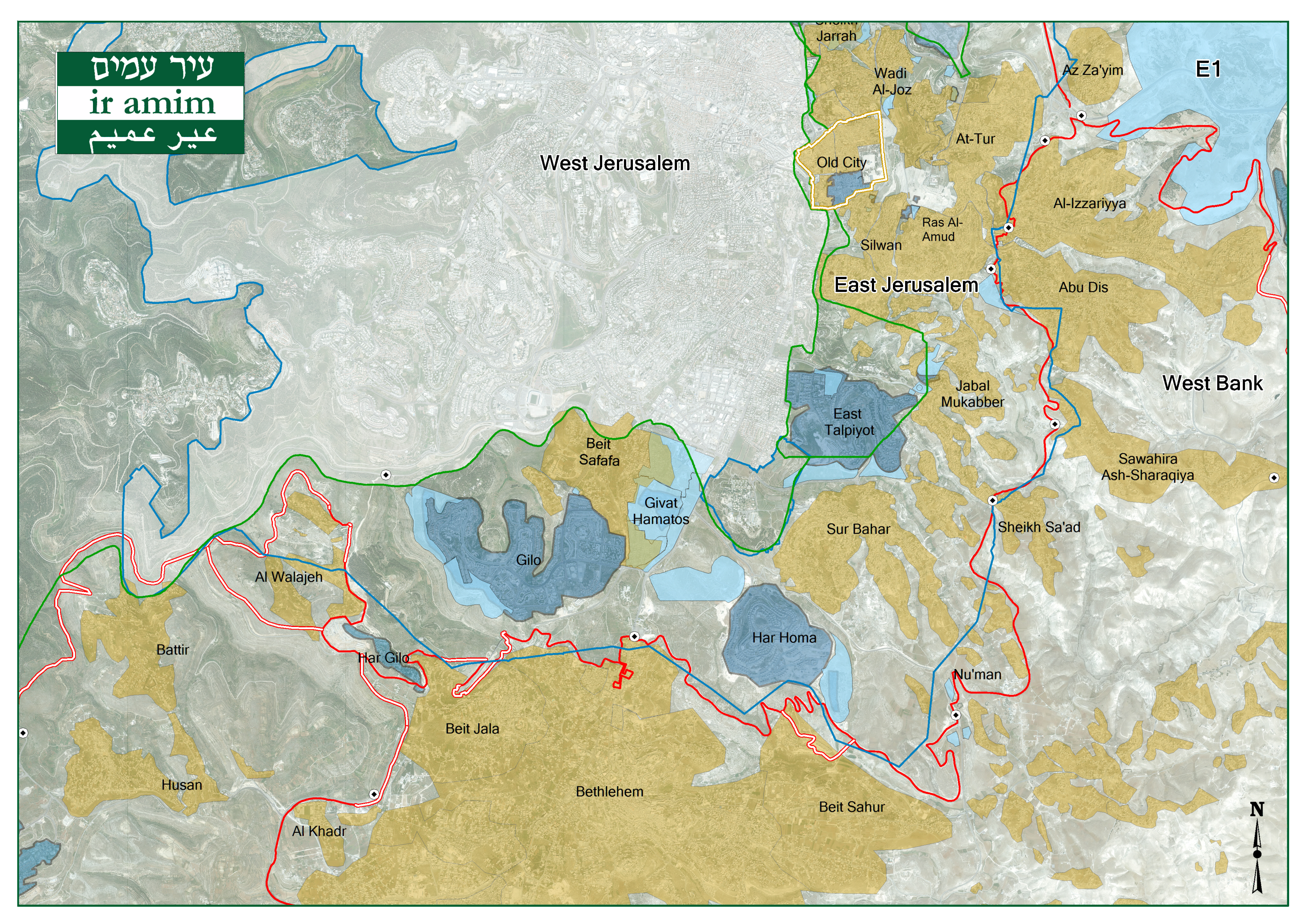
Netanyahu Celebrates Expansion of Beitar Illit Settlement
Prime Minister Netanyahu attended a cornerstone-laying ceremony for hundreds of new homes set to be built in the Beitar Illit settlement, a massive, fast-growing, ultra-Orthodox settlement in the Etzion bloc. At the ceremony, Netanyahu proudly repeated his assertion that, “There is no government that does more for the settlement [movement] in Israel than the one under my leadership.” The project will annex a third strategic hilltop to the Beitar Illit, which like much of the Etzion bloc is located on the Israeli side of the separation barrier.
The same day Netanyahu visited Beitar Illit, several right-wing Knesset members traveled to the northern part of the West Bank to call on the Prime Minister to re-establish four Israeli settlements located near the West Bank city of Jenin, that were dismantled in 2005 of part of Ariel Sharon’s disengagement from Gaza. A bill has been introduced in the Knesset that would rescind the 2005 disengagement memo which led to the evacuation of the four settlements.
Attorney General Requests Temporary Injunction Against “Regulation Law”
On August 7th, Israeli Attorney General Avichai Mandelblit weighed in on a petition filed with the Israeli Supreme Court challenging the legality of the “Regulation Law,” which was passed this year and provides a legal basis for retroactive legalization of outposts and other settlement activity in the West Bank on land owned by Palestinians. Mandelblit – who argued against passage of the Regulation Law late last year and after the law’s passage and said he would not defend it in court – asked the High Court to put a temporary injunction against the law until the Court issues its ruling. The injunction would prevent the Civil Administration (the arm of the IDF that rules over the West Bank) from using the law, and possibly from even taking the preliminary steps towards using the law, in order to retroactively legalize outposts and unauthorized settlement activity.
The petition against the Regulation Law (also called the “Expropriation Law,” the “Regularization Law,” the “Legalization Law,” or the “Settlements Law”) was filed in March by three leading Israeli settlement watchdogs: Yesh Din, Peace Now, and ACRI.
Palestinian Leaders Criticize U.S. Peace Efforts & Point to Silence on Settlements
The Palestinian outlook on President Trump’s negotiation efforts has grown outright grim this week. Any initial optimism has been replaced with a sense of abandonment on the part of Mahmoud Abbas’s Palestinian Authority and the topic of unfettered settlement growth has been a recurring talking point. On August 7th in Ramallah, Jordan’s King Abdullah and the Palestinian Authority jointly called for the U.S. to unequivocally state its support for a two-state solution and reiterated that a complete settlement freeze remains a precondition for the resumption of negotiations, including in East Jerusalem. That statement should dispel any lingering questions regarding reports in June that the PA was willing to drop a settlement freeze as a precondition to peace talks.
The new statement comes after a week of terse, unscripted criticism by the Palestinians aimed at President Trump. A top Abbas advisor, Dr. Nabil Sha’ath, told Haaretz that that Palestinians no longer look to the U.S. to be helpful on the issue. Sha’ath said, “Palestinian efforts in the near term will be focused on the international arena in an effort to prevent accelerated settlement construction or the passing of laws that have direct consequences for the peace process.”
In an interview with Jewish Insider last week, top Palestinian negotiator Saeb Erekat did not mince words about his disappointment with the Trump administration’s earlier attempts to get the ball moving on Israeli-Palestinian negotiations. Of note, Erekat laments, “Israel announces thousands of new settlement units that make it almost impossible to achieve the two-state solution, and it’s merely met with silence from U.S. officials.” Erekat is not entirely correct about the U.S.’s silence. The U.S. Department of State has repeatedly issued the same ambiguous statement regarding Israeli settlement policy, that “unrestrained settlement activity is not helpful to the peace process.” The statement echoes President Trump’s remarks in February calling for Israel to “hold back a little” on settlements.
In a third report, an anonymous Palestinian official took aim at Jared Kushner and Jason Greenblatt, Trump’s senior-most envoys dealing with Israel and the Palestinians. The source said, “It’s not a nice thing to say, but they are both ardent supporters of the settlements.They are completely unfamiliar with the other side, they don’t understand the region and they don’t understand the material. You can’t learn about what is happening here in a seminar lasting just a few weeks.” The remarks came one day before the release of a recording of Jared Kushner revealed his thinking on the topic of Israeli-Palestinian issues during which he expressed a lack of interest in history lessons on the topic.
New Poll Reveals Settler Prefer the Status Quo to Annexation or Peace
A new poll reveals remarkable differences between Israeli Jews living within the borders of sovereign Israel and those living in settlements. It sheds light on who in Israel is benefitting from the current “status quo” (which was undefined in the poll’s questions to respondents):
Of Israeli settlers:
- 35% called for the continuation of the status quo
- 24% want Israel to annex the West Bank
- 15% want to see a peace agreement
- 10% back a decisive war against the Palestinians
Of Israeli Jews living in Israel:
- 18% called for the continuation of the status quo
- 9% want Israel to annex the West Bank
- 45% support a peace agreement
- 12% back a decisive war against the Palestinians
The poll also examined the views of Palestinian citizens of Israel and Palestinians in the West Bank and East Jerusalem.
Updates: Machpelah House; New “Amichai” Settlement; Netiv Ha’avot Outpost
Several important updates to last week’s settlement report:
- In Hebron, settlers continue to illegally occupy the Machpelah House under the protection of the Israeli army, despite a new petition seeking their evacuation filed this week by Palestinians who claim to own the house. Last week, the head of the “Samaria Regional Council” Yossi Dagan, moved into the house along with his wife and three children. Approximately 120 Israeli settlers were already living there, having illegally broken into into the house last week in a bid to circumvent legal proceedings regarding rightful ownership. The IDF quickly declared the house a closed military zone, but the order has not been enforced, which is the only reason why Dagan and his family were able to enter the building. Yossi Dagan was elected head of the Samaria Regional Council in 2015. He opened a campaign office for Donald Trump during the 2016 U.S. Presidential election and published an open letter to Steve Bannon expressing his admiration and support for the newly elected U.S. administration.
- Netanyahu’s cabinet gave a major boost to the stalled construction of a new settlement called Amichai by reportedly doubling the size of the government’s financial contribution to the project. Last week, after it was reported that construction has been halted due to lack of funds, Netanyahu quickly issued assurances that the problem will be fixed. The new Amichai settlement – the first to be approved by the government since 1991 – is being built in the Shilo Valley, deep inside of the West Bank, as the payoff for families who built the illegal Amona outpost and were evacuated earlier this year. Immediately next to the Amichai construction site, at the site of the future Shvut Rachel East settlement (which was the original plan to pay-off the Amona evacuees but was rejected because it wasn’t the preferred hilltop — but was nonetheless approved for construction by the Israeli government as a neighborhood of the Shilo settlement) several caravans have been moved onto the recently leveled land in preparation for further construction.
- In two separate meetings last week, settler leaders met with PM Netanyahu and his chief of staff in their bid to cajole the Prime Minister into intervening against a demolition order threatening 15 homes in the Netiv Ha’avot outpost near Bethlehem. Commenting on the issue while at a ceremony in the Beitar Illit settlement, Netanyahu committed to helping the affected families “within the framework of the law that would minimize the damage.” It’s not clear if the Prime Minister was referring to the past damage caused to the Palestinians who own the land upon which settlers built illegally, or the future damage it will cause to relocate the families who live in illegally built homes.
Bonus Reads
- Who Profits Flash Report: “Tracking Annexation: The Jerusalem Light Rail and the Israeli Occupation” (July 2017)
- “The Young Palestinian Men of East Jerusalem Have Nothing to Lose” (August 3, 2017 | Haaretz+)
- Human Rights Watch: “Jerusalem Palestinians Stripped of Status” (August 8, 2017)
- “Demographic hysteria leaves Jerusalemites by the wayside” (August 7, 2017 | +972 Mag)
FMEP has long been a trusted resource on settlement-related issues, reflecting both the excellent work of our grantees on the ground and our own in-house expertise. FMEP’s focus on settlements derives from our commitment to achieving lasting Israeli-Palestinian peace, and our recognition of the fact that Israeli settlements – established for the explicit purpose of dispossessing Palestinians in the West Bank and East Jerusalem of land and resources, and depriving them of the very possibility of self-determination in their own state with borders based on the 1967 lines – are antithetical to that goal.
Welcome to FMEP’s Weekly Settlement Report, covering everything you need to know about Israeli settlement activity this week.
To receive this report via email, please click here.
July 28, 2017
- Bibi Embraces “Population Transfer” – Asks for US OK
- The Knesset & Bibi Move to Gerrymander Jerusalem
- Settlers Set Up Outpost, Seek to Expand Settlement as “Response” to Murders
- Settlers Seize Contested Building in Hebron
- Construction on New Settlement in Shilo Valley Stalled (Due to Lack of Funds)
- High-Ranking Government Officials Defend Outpost from Demolition
- Bonus Reads
Comments, questions, or suggestions? Email Kristin McCarthy at kmccarthy@fmep.org
Bibi Embraces “Population Transfer” – Asks for US OK
According to a report from Israel’s Channel 2 News, Prime Minister Netanyahu recently asked U.S. Ambassador David Friedman and Special Envoy Jason Greenblatt to support a populated land-swap as part of a future peace deal.
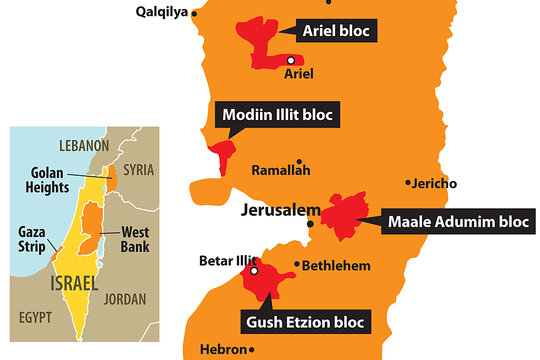
Map in CSMonitor
The swap in question would transfer 300,000 Palestinian citizens of Israel (living in the Wadi Ara region, an area known as “the triangle,” near Haifa) to the Palestinians, in exchange for Israel’s annexation of settlements in the Etzion bloc. The plan – which was previously championed by Defense Minister Avigdor Liberman, who even proposed it at the United Nations – is in effect a population transfer that would allow Israel to get rid of a large cluster of Palestinian cities, including the city where the two terrorists who attacked guards at the Haram al-Sharif/Temple Mount last week grew up.
An unnamed White House official made a statement in response to the report saying, “This may have been one of many ideas discussed several weeks ago in the context of a peace agreement and not in the context of a separate annexation.”
FMEP President Lara Friedman commented on what message Bibi’s endorsement of this idea sends: for the current Israeli government, “citizenship of Jews is inalienable right; citizenship of Arabs is revocable privilege.”
Arab Israeli MK Aida Touma-Suliman responded to the report saying, “The cat is out of the bag and Netanyahu has shown his true colors regarding the Arab population…the [Wadi] Ara residents are not only Israeli citizens, they’re also indigenous people who dwell on their land, and are not to be compared with settlers dwelling on another nation’s land. We the Arab citizens aren’t part of any such equation and aren’t willing to pay the price again for Israel’s policy of occupation and settlements.”
When Avigdor Liberman promoted the idea back in 2014, then-President Shimon Peres said, “Israel cannot take away its citizens’ citizenship simply because they’re Arab.” Then-Interior Minister Gideon Sa’ar said, “An Israeli citizen is not an object and not transferable as part of a framework political agreement.” Netanyahu has never expressed support for the plan prior to this news report, but the plan has allegedly come up in negotiations before.
The area of settlements known as the “Etzion Bloc” is home to over 22 settlements and 75,000 Israeli settlers. The loose cluster of settlements is located south of Jerusalem, extending from the 1967 Green Line deep into the West Bank; most of the settlements are on the Israeli side of the separation barrier. The major traffic junction in the area has recently seen numerous car-ramming and stabbing attacks by Palestinians targeting Israeli settlers and soldiers in the area, including an attack today that resulted in the death of the attacker and no other reported injuries.
The Knesset & Bibi Move to Gerrymander Jerusalem
In tandem with the Temple Mount/Haram al-Sharif crisis is, three important bills regarding Jerusalem’s future have advanced in the Knesset:
-

Map by Haaretz
Prime Minister Netanyahu announced his support for a bill in the Knesset that would allow 130,000 Israeli settlers living four West Bank settlements to vote in Jerusalem’s municipal elections while effectively excluding around 100,000 Palestinians from the Jerusalem municipality (most obviously the Shuafat refugee camp and Kafr Aqab, which are located outside the separation barrier). The four settlements are Maale Adumim, Givat Ze’ev, Beitar Illit, and Efrat, the last of which is six miles from Jerusalem. All are illegal under international law. Netanyahu’s support for this bill means that it is set to move forward when the Knesset’s reconvenes from its 3-month summer recess in November.
- Another bill (introduced a few days before the one described above) would allow the Israeli government to transfer Palestinian neighborhoods of Jerusalem outside the barrier to a separate, new municipality, created especially for this purpose. This bill and the one above aim to remove from the municipal area of Israel’s eternal, united capital those areas that threaten the Jewish demographic majority in Jerusalem, relegating them to a separate authority.
- These bills are complementary to a bill voted on last week that seeks to prevent the Israeli government from transferring parts of Jerusalem to a foreign power (i.e. the Palestinian government) in a future peace deal.
Settlers Set Up Outpost, Seek to Expand Settlement as “Response” to Murders
Following the horrific murder of three Israelis living in the Halamish settlement, the settlement’s leaders are seeking to consolidate and expand their illegal presence in the West Bank.
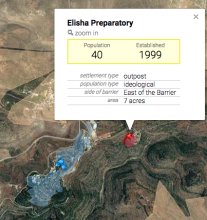
Map by Peace Now Israel
Within hours of the murder, hundreds of Halamish residents set up a campsite and a blockade of the eastern road leading to the settlement. The campsite is being called “Yad Ahi,” or “My Brother’s Hand” in memory of the three family members who were slain by a Palestinian youth last Friday. Settlers are rotating shifts inhabiting the campsite, aiming to make it an official outpost of the settlement and permanently close the road to Palestinians.
Halamish leaders are also demanding the government allow the expansion the settlement’s borders. A spokesman of the Binyamin Regional Council (which represents and provides municipal services to settlements in the Halamish region) called on the government to approve construction plans connecting the Halamish settlement to a nearby outpost called Tzofit, in order to “create a bigger security area and allow building neighborhoods that have already received zoning approvals.” Tzofit (also known as “Zufit” and/or “Elisha Preparatory”) is an illegal outpost that was established in 2007.
U.S. Ambassador David Friedman and Special Envoy Jason Greenblatt went to the illegal Halamish settlement this week to offer their condolences to the victims of the murder.
Halamish is located northwest of Ramallah, deep inside the West Bank. When the settlement was founded in the 1970s, Palestinian residents from the nearby towns of Deir Nidham and Nabi Saleh sued to stop the settlement’s construction, claiming it was being built on their villages’ land. The Israeli Supreme Court ruled in favor of the settlers, declaring the area to be state land. The Halamish settlement and its ever-growing encroachment on surrounding Palestinian villages has inspired weekly protests in Deir Nidham and Nabi Saleh, which has become infamous for weekly demonstrations – often involving clashes with the IDF – in recent years, often with international participation.
Settlers Seize Contested Building in Hebron
On the evening of July 25th — while events in Jerusalem were dominating the attention of the region and the world — 120 settlers broke into and illegally occupied a contested building near the Tomb of the Patriarchs/Ibrahimi Mosque in Hebron. The Israeli army immediately surrounded the building and on the morning of July 26th the area was declared a “closed military zone.” Prime Minister Netanyahu ordered the Defense Ministry to allow the settlers to stay as negotiations on their fate and ownership of the building continue.
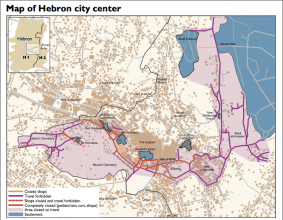
Map by B’Tselem
The Times of Israel reports that, “sources close to the prime minister said that Netanyahu was looking to avoid having to evacuate the families.” On the other hand, Yesh Atid chairman Yair Lapid called for their immediate evacuation. As of this writing, the settlers are still being allowed to illegally squat in the property.
Peace Now warned that the settler’s action can “ignite the region” and called on the government to, “follow the law and the Israeli interest and evacuate the trespassers without delay.”
J Street issued a statement calling on the U.S. government and international actors to pressure Israel to remove the settlers, saying “the Hebron settlers and their allies clearly believe that they can take advantage of the present crisis and push their long-term expansionist agenda by creating new ‘facts on the ground.’ It is vital that the prime minister and defense minister act in the best interests of Israeli security and uphold the rule of law by swiftly removing these families from the property.”
Hebron’s settlers have for some time been waging in a legal struggle to prove they legally purchased the building, known as the Machpela House. Palestinians contend they did not purchase it from the legal owners. While proceedings are ongoing, the settlers have once before broken into and occupied the building; when they did so in 2012, they were allowed to stay in the house for a week before being evacuated at the urging of the then-Attorney General of Israel who argued that it was necessary to preserve the rule of law.
Construction on New Settlement in Shilo Valley Stalled (Due to Lack of Funds)
A month after construction began on the first new settlement authorized by Israel in 25 years, the project has come to a halt – no over politics but due to insufficient government funds. The government had promised to bankroll the settlement’s construction but has not contributed to costs yet, according to the Binyamin Regional Council, which is currently footing the bill. The spokesman for the Binyamin Regional Council speculated on July 25th that the issue will be resolved quickly and expressed confidence in the government’s commitment to the project. Prime Minister Netanyahu reportedly gave orders to ensure construction is resumed quickly. As of this writing, there is no reporting to suggest construction has resumed.
High-Ranking Israeli Officials Defend Outpost from Demolition
Last week we reported on an impending demolition order against the Netiv Ha’avot outpost (near Bethlehem), along with the public relations efforts settlers were leading to elicit government intervention in their favor. The settlers got a helping hand this week when Israeli Education Minister Naftali Bennett and Yair Lapid (who heads the Yesh Atid political party) attended an event at the outpost. The Haaretz report suggests Bennett engaged in a conversation with the outpost’s leaders on how to “deal with” the demolition order and impending deadline.
Bonus Reads
- “This Synagogue Furniture Factory Is Actually a Sweatshop That Tramples Palestinians’ Rights” (July 26, 2017, Haaretz+)
- “The Settler Leader Who’s Even Charming Liberals as Israel’s Top Man in New York” (July 27, 2017, Haaretz+)
- “A Rare Glimpse: Shabak Agent Recruiting Hilltop Youth” (July 3, 2017, Jewish Press)