
A candle light vigil honors Iranians killed in election protests, and marks the 10th anniversary of the Tehran student uprising known as 18 Tir on July 9, 2009.
The debate in Washington over the Iranian nuclear deal was among the toughest fights of Obama’s second term. The failure of anti-deal hardliners to muster enough congressional support for a disapproval resolution helped advance a broader progressive policy of improving our security through diplomacy, rather than war. It also sent an important signal to the world, and particularly Iran, that the United States can be counted on to follow through on its commitments.
In Tehran, too, the deal was controversial. While Iran’s supreme leader Ayatollah Ali Khamenei supported the negotiations (they wouldn’t have happened otherwise), he issued regular warnings to Iranian negotiators signaling continued hostility to the United States. The deal was approved in mid-October after an extremely heated debate in the Iranian Parliament in which Iranian opponents argued the deal served American interests at Iran’s expense; one member even reportedly threatened the life of the head of Iran’s Atomic Energy Agency.
As polls consistently showed, the Iranian people overwhelmingly supported the nuclear deal, since it offered relief from the sanctions strangling Iran’s economy and dangled the prospect of greater openness to the world.
Iran’s human rights–activist community was quite vocal during this process, and was particularly helpful in building support for the deal in Washington. In return, it’s hugely important that those of us who have backed the negotiations not forget them, and maintain a strong focus on their plight.
Read the rest of the article at The Nation.
The tragic upsurge in violence in Israel and Palestine over the past two months, which began with the August murder of a Palestinian family by Jewish settlers, followed by clashes on the Temple Mount and Noble Sanctuary, and over the past several days by a spate of horrific attacks by Palestinians against Israeli civilians, has been accompanied by the usual accusations and counter-accusations from politicians and pundits. It’s worth examining these claims for a moment to see what they tell us about the current moment, and why it’s likely to recur as long as the occupation continues.
In a speech in the Israeli Knesset, Prime Minister Benjamin Netanyahu accused Palestinian President Mahmoud Abbas of lying about Israeli plans on the Temple Mount. “If the situation deteriorates as a result of this incitement,” he said, “you will bear responsibility.”
According to an assessment last week by the Israel Defense Forces intelligence directorate, however, Abbas has been taking responsibility—and fighting terror. The IDF also reported that, despite Abbas’ speech at the United Nations late last month threatening to withdraw from agreements with Israel, the close security cooperation between Palestinian and Israeli security forces in the West Bank has continued.
In the days leading up to his speech Wednesday to the United Nations General Assembly, Palestinian President Mahmoud Abbas had promised something big—a “bombshell,” he told reporters. He did not exactly disappoint: Abbas used the speech to announce that the Palestinians would no longer be bound by the Oslo Accords, the historic 1993 agreement between Israel and the Palestinian Liberation Organization that created the Palestinian Authority. The agreement contained a set of interim arrangements, giving the Palestinians a small measure of autonomy in the occupied West Bank and Gaza, and was supposed to last five years, at which point a final peace treaty would be signed between Israel and Palestine. 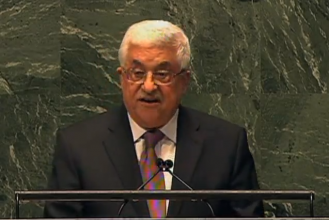
Twenty-two years after Oslo was signed in Washington, and PLO Chairman Yasir Arafat and Israeli Prime Minister Yitzhak Rabin famously shook hands on the White House lawn in front of a beaming President Bill Clinton, the Palestinians haven’t moved appreciably closer to their goal of national self-determination. The Middle East is undergoing a period of intense crisis unmatched in modern history, presenting a considerable challenge to the Palestinians to even keep their liberation struggle on the international agenda. (President Barack Obama didn’t even mention the Israeli–Palestinian conflict in his speech to the U.N.earlier this week.) But Abbas’ headline-grabbing gambit today gets his people nowhere.
The Israeli occupation is as deeply entrenched as ever. The number of Israelis living in settlements across the West Bank has tripled since 1993, with members of the settlement movement now occupying key positions of government power. Terrorist attacks by Palestinian militant groups during the Second Intifada dramatically weakened the Israeli peace camp. And the Palestinians remain politically and geographically divided between Hamas-controlled Gaza and Fatah in the West Bank. A recent poll by the Palestinian Center for Policy and Survey Research showed that, for the first time in many years, a majority of Palestinians no longer support a two-state solution, and nearly two-thirds of Palestinians want Abbas to resign.
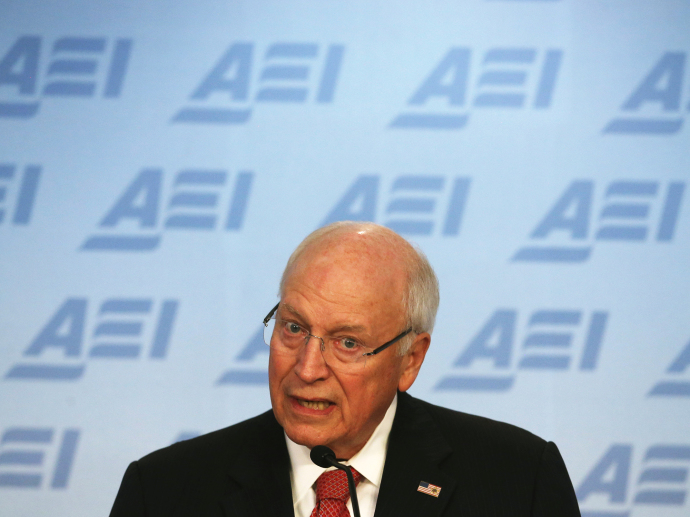
There is a lot that was strange about former Vice President Dick Cheney’s anti–Iran deal speech at the American Enterprise Institute on Tuesday morning. First, the deal is essentially done in Congress. Last week, President Obama secured the final Senate vote needed to sustain his veto of congressional disapproval when Maryland Sen. Barbara Mikulski announced her support for the agreement.
flickr/nordique
Second, if the goal were actually to pick off anyone undecided about the Iran deal, the optics of a Dick Cheney speech at AEI on weapons of mass destruction in the Middle East are just comically bad. Cheney, who made numerous false claims about the threat posed by Iraq’s non-existent weapons of mass destruction, appearing at the Washington think tank that did more than any other to bring about the Iraq debacle is a bit like an unrepentant crook returning to the scene of the crime.
Cheney previewed the speech with a typically mendacious appearance on Fox News Sunday, in which interviewer Chris Wallace had to correct Cheney’s claim that Iran’s nuke program went from zero to 5,000 centrifuges under Obama. Wallace noted that, in fact, this happened on Bush and Cheney’s watch. In typical fashion, Cheney shrugged it off and moved on to the next claim.
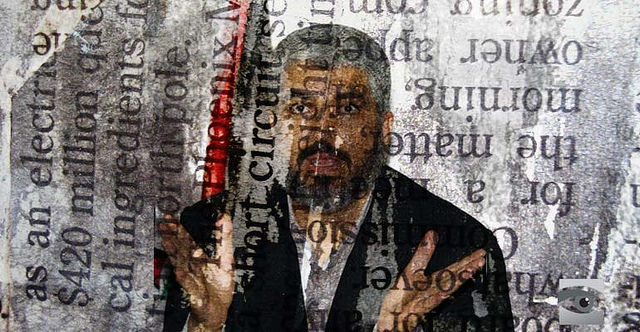
The Israeli government has consistently denied that any such negotiations were taking place. Hamas leaders have given contradictory statements; Hamas political chief Khaled Meshaal saidlast week that the negotiations looked “positive,” whereas Hamas co-founder Mahmoud Zahar has denied the negotiations existed at all.
It’s important to understand these statements in light of Meshaal and Zahar’s positions within the broader Hamas movement.
Read more at Talking Points Memo.
Photo credit: Flickr user HonestReporting.
Does the boycott, divestment and sanctions campaign unfairly single out Israel?
“The occupation has gone on far too long, I think Israel does need to start facing some costs and consequences for an occupation…. the BDS movement has helped to elevate a debate that was long overdue, and that’s a success in itself – my own concerns about BDS goals aside. As to the actual economic impact – I see very little evidence of any real impact,” FMEP’s Matt Duss tells Al Jazeera.
Watch the full segment here.
It’s tempting to treat last week’s tragic murder of 18-month-old Ali Dawabsheh, burned alive in his bed as the result of a firebomb thrown by suspected Jewish settlers, as somehow separate from the occupation through which Israel has ruled the West Bank, East Jerusalem, and Gaza since 1967. Israeli officials have certainly been at pains to make that case, condemning the murder and promising swift action. But we should note that Ali was the fourth Palestinian killed over the previous week and a half. The reality is that Ali’s murder is only a particularly shocking expression of the violence that Israel’s occupation exacts upon Palestinian civilians every day. And any genuine effort to put a stop to extremist violence in the West Bank, by Israelis or Palestinians, requires a fuller awareness of how that extremism is driven by the occupation, and of the role that the U.S. has played in sustaining it.
Don’t expect acknowledgement of the deeper problems here from the current Israeli government—it’s all in behind the occupation and settlements. While there’s no reason to doubt the government’s regret over the death of a child, it’s reasonable to ask how much that regret is actually worth while it remains committed to the policies that led to that death. Israeli Defense Minister Moshe Yaalon announced, “We intend to fight Jewish terror with our full might, without any leniency.” But of course he has no plans to end the system of radical institutionalized inequality that affirms and empowers Jewish extremists while containing Palestinians within a series of disconnected, impoverished cantons.
Statement by Matthew Duss
President, Foundation for Middle East Peace, Washington, D.C.
Presented to Subcommittee on National Security, Committee on Oversight and Government Reform
“Impact of the Boycott, Divestment, and Sanctions Movement”
Mr. Chairman, Members of the Oversight Committee, thank you for inviting me to testify today on this important and timely issue.
In the ten years since it commenced, the global Boycott, Divestment and Sanctions movement, or BDS as it is called, has slowly but steadily risen in visibility. I’d like to focus today on the role that the BDS movement has been playing recently in the U.S, particularly with regard to recent Congressional action.
In order to do that, I first want to take a moment to identify just what we’re talking about when we refer to BDS. The movement began in July 2005 with a joint call from a number of Palestinian civil society organizations, with three main demands: An end to the occupation that began in 1967; equal rights for Palestinians citizens within Israel; and protecting and promoting the rights of Palestinian refugees to return to their homes in what is today Israel. The term “BDS” is widely understood to refer to the network of grassroots activists who are part of a global movement to encourage boycotts, divestment from, and ultimately international sanctions against Israel to achieve these goals.
This movement – its goals and its activism – is distinct from the many peace activists in Israel, Palestine, the United States and elsewhere, who, in their effort to preserve the possibility of a two-state solution to the Israeli-Palestinian conflict, call for boycotts of settlement products and divestment from businesses profiting from the 48-year old occupation of the West Bank, Gaza and East Jerusalem.
Crucially, this movement is also distinct from actions and policies of the European Union and the governments of some member states that distinguish between Israel within the pre-1967 lines – known as the Green Line – and the occupied territories. A recent report by the European Council on Foreign Relations emphasizes that these actions and policies do not represent a policy shift by the European Union, but simply more faithful adherence to the EU’s existing laws.
The report states, in part, “The EU has never recognized the legality of Israeli settlements in the occupied territories (including those in East Jerusalem and the Syrian Golan Heights that have been formally annexed by Israel) and consequently does not consider agreements signed with Israel to also apply to Israeli settlement-based entities.” The report also cites a February 2010 ruling from the European Court of Justice (ECJ) stating that agreements reached with Israel must be interpreted in light of the EU’s agreements with the Palestinians, which stipulate that only Palestinian authorities can issue origin certificates for goods from the West Bank, including from Israeli settlements. As a result, the report states, “The European Commission and the EEAS have gradually been compelled to take greater care in ensuring the EU’s correct adherence to European law in its bilateral relations with Israel.”
The key distinction here is between Israel within the Green Line, and the occupied territories. Israel is understandably concerned about the potential consequences of Europe, its largest trading partner, more energetically enforcing these laws. The EU has, for years, looked the other way on these regulations in the hope that the occupation would soon end and that the differentiation between Israel and the settlements would become moot. As the ECFR report states, “[D]ue to the fact that as cooperation with Israel expanded in the 1990s, the EU treated Israel’s occupation as temporary in the belief that the imminent success of the Oslo peace process would make added clarifications a moot point. The EU therefore avoided implementing a legal regime of differentiation (between Israel and the occupied territories) during this period.”
But in recent years, as the peace process has stalled, most recently with the collapse of Secretary of State Kerry’s effort in April of last year, the EU has renewed an effort to begin more aggressively enforcing their existing laws. It is important here to point out that these laws are fully consistent with long-standing American policy that similarly does not recognize the legitimacy of Israeli settlements, unless and until their status is redefined in negotiations.
This is where we come to the recent action by Congress and the response from the State Department. With the stated intention of protecting Israel from BDS, a provision was recently added to the Trade Promotion Authority bill– a provision that implied a significant shift in the policy of the United States since 1967. The provision requires the U.S. Trade Representative to discourage European Union countries from boycotting “Israel or persons doing business in Israel or Israeli-controlled territories” (emphasis added) as part of free-trade negotiations between the U.S. and the EU. In doing so, the amendment conflates Israel and the occupied territories. By blurring this important distinction, a dangerous precedent could be set for treating Israeli settlements beyond the 1967 lines no differently from the internationally recognized State of Israel. At the very least, it would create confusion amongst our allies with regard to U.S. policy regarding the occupied territories and their ultimate disposition.
In addition, conflating Israel and the settlements for the purposes of U.S. trade negotiations represents a clear threat to the two-state solution itself, undermining the our country’s ability to effectively broker a peace agreement between the Palestinians and Israelis.
This is why it was important and appropriate for the State Department to offer a clarification as it did upon passage of the trade bill. State Department spokesman John Kirby noted that, “The United States government has … strongly opposed boycotts, divestment campaigns, and sanctions targeting the State of Israel, and will continue to do so. However, by conflating Israel and ‘Israeli-controlled territories,’ (this) provision of the Trade Promotion Authority legislation runs counter to longstanding U.S. policy towards the occupied territories, including with regard to settlement activity.” Mr. Kirby went on to state that, “The U.S. government has never defended or supported Israeli settlements and activity associated with them and, by extension, does not pursue policies or activities that would legitimize them.”
It is important to recall that U.S. law already protects Israel against boycotts initiated by foreign governments. The Export Administration Act of 1979 and the Ribicoff Amendment to the Tax Reform Act of 1976 were enacted to protect Israel from the Arab League’s boycott against the State of Israel. The amendment to the fast-track bill adds nothing in this regard. Rather, it serves only one purpose: protecting settlements from pressure.
Ironically, this very conflation is precisely what the most radical elements in the BDS movement strive to achieve. Those who believe that the only solution to the conflict is the end of Israel as a Jewish state and the creation of a single state in its place reject any distinction between, for example, the settlement of Ariel in the occupied territories and the city of Tel Aviv. Similarly, those who support a messianic vision of “Greater Israel,” which requires permanent Israeli control of the occupied territories, reject any distinction between Haifa and the settlements inside Hebron. For those who support a two-state solution that includes a secure, democratic and Jewish state of Israel living side by side with a secure and independent Palestinian state, this conflation is extremely problematic.
There is another conflation here that is also of concern. When questions arise about the possible impact of BDS, there is often no distinction made between the effects of the BDS movement and the actions taken by European or other trading partners of Israel. This ends up overstating the impact of the BDS movement, both for its supporters and detractors.
There is no evidence that the European Union’s policies and actions with regard to settlements are based on the actions of the BDS movement. On the contrary, it is the collapse of the peace process, the deepening of Israel’s occupation and the possible foreclosure of the two-state solution that have motivated these European moves. In a letter to European Union Foreign Minister Federica Mogherini in April, sixteen European Foreign Ministers urged the labelling of products originating in the settlements, writing that: “European consumers must indeed have confidence in knowing the origin of goods they are purchasing. Green Line Israel and Palestinian producers will benefit from this.” Far from being motivated by the BDS movement, the ministers made it clear that it was the stalled peace process that provided the impetus for their recommendation. The goal was, in their words, “the preservation of the two-state solution.”
Likewise in the United States, the most prominent examples of concrete boycott- and divestment-related activism in the Israeli-Palestinian arena have fact been focused unambiguously not on Israel but on the settlements and the occupation. These developments are the product of frustration with the failure of diplomacy to bring an end to the occupation, and a desire to preserve the possibility of a two-state solution. As in Europe, the actions involved are distinct from the efforts and goals of the BDS movement. For example, the Presbyterian Church (USA) heard a great deal from the BDS movement over the years in which it debated the decision it eventually adopted in 2014 to divest from companies it believed were profiting from Israel’s occupation. Yet the Church made it clear in its decision that it was not acting in concert with the BDS movement, but from its own principles – and it focused its activism not on Israel, but explicitly on the occupied territories.
In a statement made after the vote to divest, PC (USA) issued a statement saying, “[O]ur action to selectively divest was not in support of the global BDS movement. Instead it is one of many examples of our commitment to ethical investing. We are pressed and challenged to follow our faith values and commitments in all times and in all areas of our lives. The occupation must end. All peoples in Israel and Palestine should live in security, freedom, and peace. This action is but one aspect of our commitment to work to this end.”
PC (USA) went on to explicitly reiterate its support for the existence of the State of Israel and for the two-state solution, clarifying that, “This action on divestment is not to be construed or represented by any organization of the PC (USA) as divestment from the State of Israel, or an alignment with or endorsement of the global BDS (Boycott, Divest and Sanctions) movement.”
As of today, the BDS movement, in and of itself, is not a threat to Israel, either economically or in terms of security. The main impact of the BDS movement has been in generating an oftendivisive debate, on American campuses, among academics faced with campaigns for academic boycotts and in getting a handful of musicians to cancel or publicly declare their intent not to perform in Israel.
To the extent that one sees BDS actions as part of an effort to “de-legitimize” Israel, they should certainly be addressed, but not through legislation. Israel has the protection it needs and deserves under existing U.S. law. The arguments raised by the BDS movement in academic and other civil society institutions should be addressed, in the American tradition, with thoughtful, considered and ethical counter-arguments.
I would also suggest that it is a mistake to focus on the BDS movement while ignoring the main reason for its continued growth, which is the failure to end the occupation that began in 1967 and achieve Palestinian national liberation and sovereignty. If one is genuinely concerned about the impact of the BDS movement, the surest way to take the wind out of its sails would be to work diligently to achieve those goals, and act against efforts which prevent them.
Moreover, it would be hugely counterproductive to give BDS an unearned win by cooperating in any way with the conflation of Israel and the occupied Palestinian territories. We must recognize legitimate actions, whether we agree with them or not, by European governments as well as civil society actors that draw a distinction between the settlements and the State of Israel. We can and must support Israel in defending herself against actions that genuinely threaten its security and legitimacy. This has been a consistent American position since Israel’s birth.
Another position in which America has been consistent has been in opposing the creation of Israeli settlements beyond the Green Line, which have been deemed illegitimate and an obstacle to peace by every U.S. president since 1967. Efforts to blur that distinction are just as dangerous to Israel’s existence as a Jewish and democratic state as attacks on Israel’s legitimacy itself. It is entirely consistent with longstanding U.S. policy, and indeed necessary to preserve the ultimate goal of a two-state solution, to continue to preserve that distinction in U.S. policy and law.
I thank you, Committee members, for your time and attention.
“I don’t want to just end the war, but I want to end the mindset that got us into war in the first place.” That was Senator Barack Obama, speaking about Iraq in a 2008 primary debate. For a candidate who had seen his own campaign surge on the strength of his opposition to the Iraq war, it was a near-perfect distillation of the change he hoped to bring to America’s foreign policy discussion, long dominated by hawkish views that were shattering against the bloody reality of Iraq’s civil war.
During the 2008 campaign, Obama started—and won—a hugely significant debate about the proper uses of U.S. power. His declaration that he would not be afraid to talk to America’s enemies brought accusations of naiveté from both his Republican adversary John McCain and Democratic primary opponent Hillary Clinton, who would go on to begin implementing that same policy toward Iran as Obama’s first Secretary of State.
Ending that mindset has proven a difficult task. The idea that military force is decisive in a way that diplomacy is not remains a very attractive one, especially for politicians looking for cheap ways to appear tough. And to be fair, Obama has moved slowly on this, often frustratingly so. There are policy areas, particularly the use of drone warfare, where he has continued the commitment to the use of force. But Obama’s Iran policy is one in which the president has followed through on that central promise of his candidacy, and with great results. In short, Obama’s Iran policy is the anti–Iraq war.
Read the rest at The New Republic.
Former Israeli Ambassador Michael Oren has said that he asked for the publication of his book to be moved up specifically so it would intervene in the debate over the Obama Administration’s proposed Iran deal. Part of his effort has involved an effort to reopen a discussion about the nature of the Iranian regime. In one of his op-eds,published in the Los Angeles Times, Oren took aim at a statement President Barack Obama made in a May interview with journalist Jeffrey Goldberg, regarding the anti-Semitism expressed by some Iranian leaders. Asked by Goldberg whether a regime that espouses such views can be counted on to be entirely rational, the president responded: “Well, the fact that you are anti-Semitic, or racist, doesn’t preclude you from being interested in survival. It doesn’t preclude you from being rational about the need to keep your economy afloat; it doesn’t preclude you from making strategic decisions about how you stay in power; and so the fact that the supreme leader is anti-Semitic doesn’t mean that this overrides all of his other considerations.”
A number of writers quickly pounced on these remarks, arguing that they revealed a flaw in the president’s policy. “Obama believes that the Iranian government’s anti-Semitism is subject to the same rational cost-benefit calculus as any other aspects of a nation’s behavior, even if anti-Semitism is itself irrational,” wrote Armin Rosen inBusiness Insider, suggesting that this represented “a tension in Obama’s thinking that could prove fatal to his top foreign policy priority.” Tony Badran of the Foundation for Defense of Democracies even wrote that the interview shows that, “Obama will even defend anti-Semitism to spin his Iran deal.”
Read the rest at Tablet Magazine.