Two weeks ago saw the latest blow to the on-again-but-mostly-off-again reconciliation between the two leading Palestinian political factions, Hamas and Fatah. A Fatah delegation from the West Bank entered Gaza for what was planned as a weeklong visit to address the sticky issue of payment to some 40,000 Hamas government employees, which was one of the main drivers of Hamas’ decision to accept a reconciliation agreement in April 2014, largely on Fatah’s terms. Instead, the Fatah delegation stayed only one day, departing after claiming that Hamas had prohibited it from traveling from their beachfront hotel to their offices. Hamas, for its part, responded that the makeup of the delegation had not been appropriately cleared in advance.
A few days later, as Israelis celebrated their Independence Day, the first rocket was fired into Israel from the Gaza Strip in four months. An Israeli tank barrage into Gaza followed shortly after. Read more at Tablet Magazine.
The Israeli-Palestinian peace process — the one that is supposed to end with a two-state solution — is on life support. Both sides in the conflict have made their share of missteps, but Benjamin Netanyahu, Israel’s prime minister, all but pulled the plug earlier this month by pledging during his reelection campaign that Palestine would never become a state on his watch. He reaffirmed the sentiment even as he dialed back the rhetoric after the vote. This position runs directly counter to U.S. national security goals.
A two-state soluti on has been an American goal for nearly two decades. Ina 2002 speech, George W. Bush became the first president to explicitly call for the creation of an economically sustainable, demilitarized Palestinian state. “The establishment of the state of Palestine is long overdue,” he saidin 2008. “The Palestinian people deserve it. And it will enhance the stability of the region, and it will contribute to the security of the people of Israel.” Today, virtually all American politicians, on both sides of the aisle, publicly support this outcome. But with Netanyahu standing in its way, how can the United States advance this goal?
By recognizing the state of Palestine.
>>Read the full article in the Washington Post>>
In the wake of Israeli Prime Minister Benjamin Netanyahu’s declaration that a Palestinian state would not be created on his watch, the Obama administration has signaled that it is considering a “reassessment” of its options with regard to the two-state solution.
“We cannot simply pretend that those comments were never made, or that they don’t raise questions about the prime minister’s commitment to achieving peace through direct negotiations,” said Denis McDonough, the president’s chief of staff, in remarks at a conference held Monday by the pro-Israel, pro-peace lobby J Street.
In a Sunday interview with Israeli radio, U.S. Ambassador to Israel Dan Shapiro confirmed that a shift is under way. While Shapiro was careful to make clear that no decision had been reached regarding future U.S. action, he did point out that Washington’s defense of Israel at the United Nations was predicated on Jerusalem’s commitment to the two-state solution.
For years, Netanyahu has strung the United States and the international community along with a kind of “Two-State Hamlet” act, providing just enough reasons, little hints here, a trail of breadcrumbs there, to sustain the hope that yes, under the correct circumstances, and offered the appropriate truckload of carrots, he could be the Man to Make a Deal. But, as Netanyahu himself once said, “The question is not of hope, the question is of actual results.” And the results are now in on Netanyahu.
Rancor over a possible Iran nuclear deal reached a new level this week with a letter from Senate Republicans, initiated by freshman Arkansas Senator Tom Cotton, telling Iran that a future U.S. government would not necessarily abide by such a deal. While it’s good that many Republicans have now recognized that the letter was a pretty dumb stunt, it’s worth taking a step back and considering the issue that has everyone so worked up.
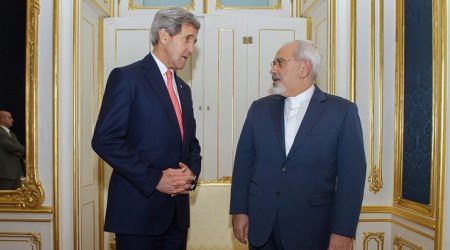
Let’s take a breath on Iran, everybody.
Here’s where we are: The U.S. and its partners in the P5+1 (the five permanent members of the UN Security Council plus Germany) have been negotiating a deal with Iran that would limit Iran’s nuclear program and place it under intrusive inspections for at least a decade. Critics of the deal insist that this is insufficient, and that any deal that leaves open the possibility of Iran someday obtaining a nuclear weapon is too dangerous. Republican Speaker of the House John Boehner invited Israeli Prime Minister Benjamin Netanyahu to address Congress last week to make the latter case.
In a recent piece on the controversy over Netanyahu’s speech to Congress, and the policy differences at its core, I suggested the comparison of Democrats inviting French President Jacques Chirac to deliver a speech in 2003 against the impending Iraq invasion. I think it’s pretty obvious that supporters of the Bush administration would have flipped out over it. The same people who praised the Netanyahu speech, and who are now praising the Cotton letter, would have been screaming “TREASON!” from Washington’s rooftops.
Clearly, such a speech would have been a violation of political norms, just as were the Netanyahu speech and the Cotton letter. But, as Brian Beutler asks in a smart piece on the Cotton contretemps, wouldn’t such a violation have been worth it for the chance of the US avoiding such a huge mistake in Iraq?
To be sure, there’s a bit of the comical in the plaintive cries from Senate hawks that they just want to “have a role” in Iran policy. The reality is that the Obama administration has actually spent a considerable amount of time engaging with Congress on the issue of Iran. And no one can seriously deny that opposition to a deal with Iran is at least partly rooted in opposition to, and hatred of, Obama himself. Conservatives have said since the first days of his administration that their overriding concern was to make sure his presidency was a failed one.
Furthermore, many Congressional critics of the deal have been quite clear that they are opposed to diplomacy with Iran, period. Sen. Cotton has made no secret of his view that the goal of new sanctions is not to get a better deal, as so many sanctions supporters have insisted, but to scuttle the deal entirely.
So Obama has some valid reasons for wanting to minimize Congress’s role in the negotiations.
Still, the legislative branch does have an important role to play in interrogating the executive’s foreign policy initiatives, especially one as potentially far-reaching as an Iranian nuclear deal. If they’re interested in playing that role in a serious and responsible way, and not simply using it as opportunity for grandstanding, they should be able to play it. And, given how lax Congress’s oversight of foreign policy in general has been in recent years, Americans should welcome it. And so should President Obama.
In many ways, Obama’s Iran policy is the mirror image of Bush’s Iraq policy, offering a very different vision of the use of American power, one that advances American security through diplomacy and the cultivation of international consensus rather than invasion and occupation. Rather than spin intelligence, cobble together a “coalition of the willing” and then go in guns blazing (literally), as Bush did in Iraq, with Iran Obama has carefully articulated and executed a two-track policy of economic sanctions pressure and negotiations. It was only when the former began to bite that the latter came into seriously play. But it’s also true that the offer of the latter acted as an important force multiplier for the former. While the president and his team have explained this approach many, many times over the past years, including in front of various Congressional committees, I think our country would benefit from hearing from them more.
Barack Obama was correct in opposing the Iraq war. He was correct in conceiving an Iran policy that is, in many ways, its opposite. But part of that has to be a willingness to engage in the open and rigorous debate that we never got on Iraq. If an Iran deal is the anti-Iraq war, let’s have it be that in every way, including the time we spend discussing it. Given the significant impact that an Iran nuclear deal could have on U.S. security and that of our partners, I think President Obama owes the American people that discussion, just as his Congressional critics owe the American people more than attention-getting stunts.
Israeli Prime Minister Benjamin Netanyahu did President Obama an enormous favor Tuesday. Given the opportunity, on perhaps the world’s biggest political stage, to articulate the best possible case against the nuclear deal currently being negotiated with Iran, Netanyahu came up empty. He whiffed. His shot sailed so wide of the rim that it went up into the bleachers and struck a small child in the face.
Given how much buildup the speech received—and how much of America’s time has been wasted with the controversy surrounding it—it’s simply amazing that Netanyahu didn’t use the chance to offer any new or interesting ideas, any viable path to achieving the prevention of an Iranian nuclear weapon—which he insists is a shared goal with the United States—other than the one we are on now. Read more at Slate.com
As the conflict over Israeli Prime Minister Benjamin Netanyahu’s March 3 speech to Congress has grown, one of the arguments being offered in its favor is that Congress “needs” to hear Netanyahu’s views about the nuclear deal shaping up between Iran and the P5+1. This is an odd claim for a few reasons. First, it’s not as if members of Congress don’t hear views very similar to Netanyahu’s all the time from various lobby groups and think tanks. But more to the point, as the head of a modern, technologically advanced state, Netanyahu has multiple ways of making his views heard. He can appear on U.S. television news shows, as he has done many times before, which members of Congress can watch. He can make a speech in Israel, which members of Congress can also watch. He can even just make remarks in one of his regular cabinet meetings, which will then be reported and can be read by members of Congress on the internet via the computers in their offices, or on their smart phones.
All that aside, if it really is that important for Congress to hear from Netanyahu in person, I propose this conflict-ending solution: Invite Netanyahu to testify. I recognize that having foreign heads of state testify before Congress is not something that’s usually done, but having foreign heads of state attack the President of the United States’ foreign policy agenda before Congress isn’t something that’s usually done, either. Not only would this arrangement address concerns that Netanyahu might use his speech to Congress for his own domestic political advantage, it would also give members of Congress the opportunity to ask questions and probe his views more deeply.
Let’s remember that Prime Minister Netanyahu has some experience with this, having testified before Congress in 2002 in support of the invasion of Iraq, where he told the House Government and Reform Oversight Committee, “There is no question whatsoever that Saddam is seeking and is working and is advancing towards the development of nuclear weapons — no question whatsoever,” and assured them, “If you take out Saddam, Saddam’s regime, I guarantee you that it will have enormous positive reverberations on the region.”
Matt Duss is the President of the Foundation for Middle East Peace
To hear the condemnations from members of Congress, you’d think the Palestinian Liberation Organization had returned to armed struggle. But no, it’s Palestinian nonviolence — specifically, the decision by the State of Palestine to join the International Criminal Court — that’s being called “deplorable, counterproductive.”
Senator Rand Paul (R-Ky.) went the furthest, introducing a bill last Wednesday that would cut off U.S. aid to the Palestinian Authority if it did not cease action at the ICC. “Certainly, groups that threaten Israel cannot be allies of the U.S.,” Paul said. “I will continue to do everything in my power to make sure this president and this Congress stop treating Israel’s enemies as American allies.”
This is a ridiculous overreaction. The Palestinians’ move to join the ICC, which would give them the ability to try Israeli officials for alleged war crimes, must be understood as an expression of profound frustration over the stalled peace process.
Read more at The Week.
In early August, as the latest Gaza war raged, two pro-Israel consultants, Meagan Buren and Jennifer Laszlo Mizrahi, circulated a memo addressed to “Top leaders who care about Israel and protecting Jews.” The memo discussed “significant, problematic issues in public opinion about Israel among key American demographics including liberals, minorities and young people.” Citing a recent focus group of “Capitol Hill senior staff from both parties,” the pair warned that the views and opinions they had encountered stood in “stark contrast to the public statements and votes that indicate support for our issues,” such as a recently passed (and typically one-sided) congressional resolution supporting Israel’s military operation.
“Congress is supposed to be our fortress,” the consultants wrote. “While Israel faces Hamas tunnels, it appears that the negativity and lack of support among young people is tunneling its way into congressional offices, even while the Congressmen and Senators remain steadfast on the surface.”
Read more on Democracy Journal.
For decades, Israel has deepened its occupation of Palestinian land and expanded its settlements in East Jerusalem and the West Bank with virtually zero consequences. As a result, successive Israeli governments have had no reason to cease these policies and Israeli voters have had no reason to be concerned with voting for governments who carry them out. But with new Israeli elections scheduled for March 17 and signs of increasing pressure from Israel’s allies in the West, this could finally be about to change.
Last month, the Israeli newspaper Haaretz reported on an internal European Union document detailing a menu of possible new measures toward Israel in response to “acts by the Israeli government that are liable to make the two-state solution an impossibility,” such as settlement construction in specific areas in and around Jerusalem. Measures under discussion included limiting economic cooperation with Israel, compulsory labeling of products made in West Bank settlements, and ceasing projects with companies that operate in the occupied territories. On the more extreme end, the document also proposed a “no contact policy with settler organizations/Refus[ing] to engage with settlers, including public figures and those publicly rejecting the two-state solution” — similar to the current ban on officials meeting with Hamas.
Read more at Foreign Policy.
President Obama might take his time deciding who his adversaries are, but eventually he gets there. This was the case with Republicans in Congress. It was the case with Iran and Russia. And it appears, finally, to be the case with Israeli Prime Minister Benjamin Netanyahu.
In a recent piece by The Atlantic‘s Jeffrey Goldberg, anonymous administration staffers leveled a series of insults at the Israeli prime minister, with “chickenshit” being the most talked about.
Such remarks are inappropriate, not because they are undeserved, but because they belittle the U.S. (Are anonymous petty insults really how a great power should respond to uncooperative client states?) More importantly, they also distract from the very real and legitimate issues the U.S. has had with Netanyahu’s behavior over the past five years.
Read more at The Week.