Last month, President Donald Trump granted a cherished wish of American and Israeli hardliners, taking Jerusalem—an issue that the Oslo Agreement stipulated would be resolved only in permanent status negotiations—“off the table.” Now, only weeks later, American and Israeli hardliners are again trembling with anticipation at the possibility that Trump will fulfill another long-held desire: destroying or crippling the United Nations Relief and Works Agency (UNRWA), the UN agency that supports Palestine refugees across the Middle East.
Many are now arguing, correctly, that undermining UNRWA will threaten an already fragile status quo in the West Bank and Gaza (not to mention Jordan and Lebanon), and thus would be bad for Israel and would have serious humanitarian implications for Palestinians. For these and other reasons, some suggest that the attack on Palestinian aid is a tactical “misstep” by the Trump Administration. These arguments miss the point: with this new approach to UNRWA, undermining the status quo is a feature, not a bug.
The Trump Administration has tied its attack on UNRWA to UN and Palestinian reactions to Trump’s Jerusalem policy shift. Taking to Twitter this week, Trump railed about Palestinian ingratitude for U.S. funding (which is a tiny fraction of what the U.S. provides Israel). U.S. Ambassador to the UN Nikki Haley said that funding would be suspended until the Palestinians “return to the negotiating table” – suggesting a new peace framework predicated on blackmailing the Palestinians into accepting Israeli and American diktats.
In reality, the threat to de-fund UNRWA has nothing to do with any of those things, except in an opportunistic sense. What it is really about is further shattering the terms of reference established by the Oslo Agreement and removing from the negotiating agenda another sensitive and explosive permanent status issue. In short, this attack is about taking Palestinian refugees, like Jerusalem, “off the table” – consistent with the view articulated by U.S. Ambassador to Israel David Friedman, writing in October 2016, when he referred to Palestinian “so-called ‘refugees.’”
The effort to erase Palestinian refugees by gutting UNRWA is nothing new. Dating to the late 1990s, reactionary voices in Israel and the United States (for examples, see the Gatestone Institute and Middle East Forum)—often joined by fellow travelers in Congress—have been making the case that the “solution” to the Palestinian refugee issue should be found not through negotiations between Israel and the Palestinians, but through unilateral action by the United States to re-define Palestinian refugees out of existence.
As I observed previously, this approach won’t work. Palestinians’ self-identification as refugees is grounded in their own experiences, history, and narrative, not permission from UNRWA or anyone else. Dissolving UNRWA or compelling the UN to re-define millions of Palestinians to no longer technically qualify as refugees won’t change that self-definition an iota. Moreover, like Trump’s Jerusalem move, doing so not only won’t make reaching a peace agreement easier in the future, it will make it harder, dictating new terms of reference that are wholly disconnected from the actual issues at the heart of the conflict and that actively obstruct any chance for a resolution.
What of the argument, made sincerely by some and patently insincerely by others, that for the sake of both Palestinian refugees and peace, it would be better to dissolve UNRWA and treat Palestinian refugees like refugees from any other conflict, under the authority of the United Nations High Commissioner on Refugees (UNHCR)?
Answering this question is a matter of reviewing the options available to UNHCR to resolve the plight of refugees, as helpfully laid out in detail by former UNRWA spokesman Chris Gunness in a 2011 interview. Briefly, UNHCR’s preferred option is returning refugees to their home countries. This option is, of course, wholly off the table for Palestinians, because Israel won’t permit it. UNHCR’s second option is settling refugees where they are currently located. This option, too, is off the table for Palestinians, as key host countries like Jordan and Lebanon have political and demographic considerations of their own which powerfully mitigate against formally or permanently absorbing Palestinian refugees. It’s also worth remembering that the West Bank and Gaza, where many Palestinian refugees are located, have been under Israeli occupation for 50 years, and absent a two-state agreement there is no avenue for turning these refugees, or any residents of the West Bank and Gaza, into citizens. UNHCR’s third option is voluntary resettlement of refugees in third countries. This option, too, is not a solution, as Palestinian refugees cannot be forced to re-settle.
What about the argument that UNRWA perpetuates the Palestinian refugee problem by conferring refugee status on descendants of those who lost homes in 1948 and 1967? The resounding answer can be found in today’s news, which reports that 50,000 Rohingya babies are expected to be born in refugee camps this year. All of these babies will have refugee status under UNHCR.
One final note: the political agenda inherent in the efforts to undermine UNRWA is highlighted by the case of another set of self-identified Middle East refugees: Jews who fled or were kicked out of Arab countries during the 20th century, mainly in connection with the birth of the state of Israel. Many of these individuals and their descendants—despite being citizens of Israel (which is, in the words of Israeli Prime Minister Benjamin Netanyahu, “the nation-state of one people, the Jewish people, and no other”), the U.S. or various other countries—today still identify as refugees. Like Palestinians who lost homes in what is today Israel, these Jews don’t rely on the UN to give them permission to do so, or to authorize their claims of dispossession (which, like Palestinian claims, are well-documented) or to approve their right to demand recognition and compensation.
While anti-peace hardliners in the U.S and Israel have constantly attacked Palestinian refugees—as is happening again today—many, including in Congress, have embraced the cause of Jews from Arab lands. Ironically, this embrace has for the most part had nothing to do with bringing justice to Jews from Arab lands; rather, like the attacks on UNRWA, it has been about exploiting them as a tool to—you guessed it—take Palestinian refugees off the table.
_________
This post was originally published January 5, 2018, on the Huffington Post.
Last week, on December 21st, the United States took off the gloves at the United Nations. With the General Assembly poised to vote on a resolution rejecting President Donald Trump’s policy shift regarding the status of Jerusalem, Nikki Haley, the United States’ Ambassador to the United Nations, warned:
“the president will be watching this vote carefully and has requested I report back on those countries who voted against us. We will take note of each and every vote on this issue.”
Since then, innumerable pundits and politicians have weighed in about the outcome of that vote and what it says about the international community’s views on Jerusalem and Trump’s Middle East policy. A close look at the data, however, reveals that much of the conventional wisdom is contradicted by the facts.
Most people are by now familiar with the most basic fact: just 7 nations joined the United States and Israel in voting “no” on the Jerusalem resolution – the Marshall Islands, Micronesia, Nauru, and Palau (representing a combined total of just over 200,000 people), along with Togo, Honduras and Guatemala (whose president has since announced that its embassy would be moved to Jerusalem).
That list should surprise nobody: it comprises the core group of tiny island nations that reliably opposes such resolutions, plus-or-minus a short and ever-changing list of other nations. Looking at votes since 1999 on routine Israel-Palestine resolutions – that is, resolutions brought periodically before the General Assembly – the number of “no” votes is strikingly consistent both in composition and in numbers, ranging from a low of 1 (Israel alone) to at most (and rarely as high as) 10.
What about non-routine resolutions against which Israel and the United States lobby intensely, like the December 21 Jerusalem resolution? The last such vote was in 2012, when the topic was the status of Palestine at the United Nations. In that case, too, only seven nations stood with the United States and Israel in voting “no”: the same four island nations, plus Canada, the Czech Republic, and Panama.
Some pundits suggest that the important number to focus on from last week’s vote is not the “no” votes, but the fact that 35 nations elected to abstain. That number, however, is only meaningful if compared to other UNGA votes on Israel-Palestine. A review of such votes just over the past year reveals that this number is indeed significant, not because it is large but because it is small. By way of comparison: on three routine (and routinely contentious) General Assembly resolutions this year dealing with the Palestinians, the number of abstentions was much higher: 77, 57, and 59. Back in 2012, on the vote determining the status of Palestine at the UN, 41 nations abstained.
Drilling down deeper, was there anything significant about how specific nations voted last week? Absolutely. Take, for example, Canada, which over the past year voted “no” on 13 out of 14 General Assembly resolutions related to Israel-Palestine, and which was one of just seven nations that voted “no” on the 2012 resolution. Yet, despite this track record, and despite the very real possibility of negative repercussions for ongoing negotiations around the North America Free Trade Agreement, Canada elected to abstain on the Jerusalem resolution.
Also notable: China and India, two heavy-hitter countries in which Israel has invested huge diplomatic and economic efforts, voted in favor. Russia, despite strong ties to the Trump Administration and warm relations with the Netanyahu government, did so as well. The same goes for Greece, a country with which Israel has been strengthening relations for years. And despite intense courting of Sunni states by the Israeli government and Trump Administration, and notwithstanding analyses suggesting a readiness on the part of many these states to give up supporting the Palestinians in order to build a coalition against Iran, neither Saudi Arabia nor Bahrain – nor, indeed, any Sunni-majority nation — abstained.
Then there is Europe. Some have suggested that with last week’s vote, Israel and President Trump succeeded in breaking European Union unity on Israel-Palestine. The facts suggest the opposite is true. In last week’s vote, just 6 out of 27 EU member states abstained (Croatia, the Czech Republic, Hungary, Latvia, Poland, and Romania), with all others voting “yes.” Compare this to 2012, when 11 abstained (Bulgaria, Estonia, Germany, Hungary, Latvia, Lithuania, the Netherlands, Poland, Romania, Slovakia, and Slovenia) and a twelfth, the Czech Republic, voted “no” (Croatia, not yet a member of the EU, also abstained). Clearly, EU voting on important Israel-Palestine resolutions in the General Assembly was already dis-unified before last week’s vote; Trump policies on Israel-Palestine appear to have made it less so.
Looking at the votes of official U.S. allies suggests, similarly, a consensus rejection Trump’s Israel-Palestine policy and a declining readiness to line up behind the United States and Israel in the General Assembly. In the 2012 vote on the Palestine resolution, 14 out of 29 NATO member states abstained and 2 voted “no”; last week, only 6 NATO nations abstained and not a single one voted “no.” Similarly, out of the 16 nations designated by the United States as major non-NATO allies, none (other than Israel) voted “no” on this latest resolution, and only 3 abstained.
Does the data show a shift in votes that would suggest, in any category, an increased alignment with Israel and Trump? Possibly, but any such shift is (so far) incremental, likely utilitarian (grounded in political and economic quid-pro-quos), not necessarily durable, and wholly limited to African and Latin American countries. Specifically, on the Palestine resolution of 2012, not a single African nation voted “no,” 5 abstained, and 3 didn’t vote on the Palestine resolution. Last week, one voted “no” (Togo), 8 abstained, and 7 didn’t vote. Likewise, not one Latin American country voted “no” on the 2012 resolution and only 4 abstained; this time around, 2 voted “no,” 7 abstained, and one didn’t vote.
Finally, did Ambassador Haley’s threat change the votes of recipients of American financial assistance? The votes suggest it did not: Eight out of ten of the top recipients of United States aid– Afghanistan, Egypt, Iraq, Jordan, Pakistan, Nigeria, Tanzania, and Ethiopia – all voted “yes.” Only one – Israel – voted “no,” and only one, Kenya, elected not to vote.
In short, last week’s vote on Jerusalem in the UN’s General Assembly was a repudiation of the view, increasingly voiced by Israeli and American officials, that the world no longer cares about Israel-Palestine. It likewise revealed increasing, not decreasing, unity among key nations and groupings of nations in opposing Israeli and American policies in this arena. Perhaps most clearly, it was a powerful defeat both for Trump’s new Israel-Palestine policy and his leadership in the international arena — a defeat all the more resounding given the heavy-handed tactics employed by the Trump Administration to try to avert precisely such an outcome.
_______________________
Originally published December 27, 2017 at the Huffington Post.
Since well before Election Day, Donald Trump and his key advisors made clear that a Trump administration would blow-up longstanding U.S. policy on Israel-Palestine. Whether talking about moving the U.S. embassy, renouncing any commitment to the two-state solution, or adopting a policy of at best agnosticism, at worst outright support for settlements, this administration deserves credit for maintaining consistent positions from the 2016 campaign through its first 11 months in office.
On the 50th anniversary of the 1967 Six Day War the Anti-Defamation League (ADL) BICOM and Fathom Journal compiled a compendium of contributions from prominent thinkers, activists, security professionals, politicians, and artists to discuss and debate the implications of the 50th anniversary of the War, it’s legacy for Israel and Zionism and prospects for peace in the region.
FMEP President Lara Friedman was 1 of the 50 voices who participated in the conversation. You can read Lara’s piece below, the 49 other contributions are available online: https://www.50voices50years.com/50-voices
by Lara Friedman
In 1968, Israeli philosopher Yeshayahu Leibowitz warned what the legacy of the 1967 War would be for Israel, if it held on to the newly-occupied territories:
“A state ruling over a hostile population of 1.5 to 2 million foreigners would necessarily become a secret-police state, with all that this implies for education, free speech and democratic institutions. The corruption characteristic of every colonial regime would also prevail in the State of Israel…the Israel Defense Forces, which has been until now a people’s army, would, as a result of being transformed into an army of occupation, degenerate, and its commanders, who will have become military governors, resemble their colleagues in other nations.”
Fifty years later, this legacy is on stark display. The post-1967 fantasy that Israel can simultaneously exist as a liberal democracy and as a state ruling over millions of disenfranchised Palestinians is collapsing under the weight of its own contradictions.
The collapse of this fantasy is evident in “united” Jerusalem, which is more divided and undemocratic than at any time since 1967. It is on view in policies in the West Bank that Israel no longer bothers to pretend are temporary, like the two legal regimes it has for 50 years maintained in this single territory: one for Israelis, one for Palestinians, separate and unequal. Earlier this year, Israeli legislation removed even the veneer of respect for this occupation-version of rule of law, in order to launder settler law-breaking.
Within Israel’s recognized borders, an illiberal wave threatens Israeli society and the foundations of Israeli democracy. The most right-wing government and Knesset in history today govern Israel, and have declared war on Israeli civil society. Working hand-in-hand with reactionaries, they are using legislation and intimidation to try to silence those who challenge the pro-occupation, pro-settlements agenda. Peace and human rights activists live under threat; the courts and even military leaders are assailed for any perceived failure to defend the pro-occupation line. Free speech – on campuses, in the media, the arts, and the public square – is under assault.
Internationally, the Israeli government is demanding that the world cease talking about “occupation” and accept a new definition of “Israel,” updated to mean, “Israel-plus-settlements.” Carrying this logic to its most cynical conclusion, it brands opposition to occupation and settlements as “anti-Israel” or even anti-Semitic, and works to enlist other countries in its effort to quash free speech and activism critical of its policies. In doing so, Israel is on a collision course not only with the governing body of world soccer, but with its closest allies, like Germany; Israel’s leaders are also risking relations with Jews in the Diaspora, and especially the United States, as, for the sake of settlements, they align themselves with illiberal forces in other countries.
Israel has realized many achievements in the past fifty years, but all of them are overshadowed by five decades of policies that have allowed those who prioritize keeping the land occupied in 1967 over all else – including over peace, security, democracy – to determine Israel’s future. This is the disastrous legacy of the 1967 War.
Speaking at a national security conference in Tel Aviv last month, Israeli opposition leader Isaac Herzog announced a new plan to “separate” from the Palestinians. Declaring a two-state solution unachievable in the foreseeable future, Herzog said that Israel should take a set of unilateral steps in the occupied West Bank and Jerusalem while still keeping the two-state option open for the future. Those steps include limiting settlement growth to the so-called “blocs,” expanding areas of Palestinian Authority political and economic control (while still retaining full Israeli security control), completing the security fence, and separating some Palestinian neighborhoods from Jerusalem.
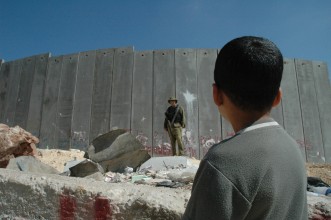
In an analysis (which I encourage you to read) of Herzog’s plan as outlined in the speech, my colleague Mitchell Plitnick observed that it “seems more tailored for domestic political gains than for actually resolving the vexing problems Israel faces.” Mitchell concluded that while Herzog’s plan “has some points that might be worked with, it is not, on balance, sound policy. It has little chance of achieving the quiet Herzog envisions; on the contrary, it is likely to further enflame the conflict.”
Herzog’s announcement caught a lot of people by surprise, including members of his own party. Hilik Bar, the Labor Party’s secretary general and head of the Knesset’s Two-State Caucus, was overheard slamming Herzog’s shift as a lame political maneuver. “If he [Herzog] is going to be a pathetic copy of [Prime Minister Benjamin] Netanyahu, the people will run from him,” Bar said.
Nevertheless, days later Herzog successfully managed to get Labor to endorse the plan, including Bar, who assented out of a stated interest in party unity. Shelly Yachimovich, Herzog’s predecessor and main rival for Labor leadership, pointedly refused to speak at the Labor gathering, and has stated her opposition to the plan. Yariv Oppenheimer, the head of Peace Now, also criticized the plan. “If we want mandates, we need to differentiate ourselves from the Likud,” he said. “Whoever copies Netanyahu will be irrelevant.”
My friend Michael Koplow, policy director of Israel Policy Forum, wrote of the plan that, while it has flaws, it’s better than nothing. “One can take the Netanyahu approach, which is to sit on one’s hands and do nothing, or one can try to advance an alternative that is highly suboptimal but that beats the status quo,” Koplow wrote. “I would rather see the latter option be tried rather than continuing to sacrifice the good on the altar of the perfect.”
I’m a big admirer of Michael’s work, but I think there are some problems with this. It’s really not the case that Netanyahu is “sitting on his hands and doing nothing.” As multiple U.S. administration officials have warned over the past few months, Netanyahu’s government has been doing a lot of things to shape the environment in the West Bank – none of them good. The occupation’s system of radical inequality has become even more entrenched, settlements continue to grow at a rapid clip, Palestinian lands continue to be expropriated and homes demolished, and the Palestinian Authority continues to be politically undermined and weakened to a point just short of collapse. This isn’t the absence of a plan from Netanyahu. This is the plan.
Koplow wrote that “Herzog’s measure can theoretically be a good initial step if it is done right,” and identifies a set of questions need to be answered: How are the settlement blocs defined? What steps will be taken to facilitate Palestinian economic growth? What exactly will this separation of Palestinian neighborhoods from Jerusalem look like? These are, of course, hugely important questions. Each of them is potentially politically explosive, for both Israelis and Palestinians. The fact that Herzog does not even address them affirms Plitnick’s (and Bar’s) argument that this is simply a political maneuver and not a serious policy alternative.
The problem is that even political maneuvers have consequences. The effect here is to remove any political pressure on Netanyahu by essentially affirming his diagnosis of the situation (and unfortunately adopting his racist language, which is particularly disappointing from a self-identified progressive like Herzog), and to reward the settlement movement for decades of law breaking, and incentivize even more, by legitimizing the blocs. Meanwhile, the plan offers nothing to arrest the decline of the Palestinian Authority and enable the Palestinian economic growth that is absolutely necessary for the security of both sides.
A number of left-leaning Israeli analysts have strongly criticized the plan. “Even politically, its unilateralism makes no sense,” wrote journalist Noam Sheizaf in +972 Magazine. ”All the difficult steps Israel refuses to take in negotiations — in order to build trust or as a temporary solution (such as a settlement construction freeze) — it is now supposed to implement without receiving anything in exchange, without anyone taking responsibility on the other side. In short: it’s unclear what Labor’s plan is supposed to achieve, since it is neither meant to be a permanent solution nor a temporary one. So why bother?”
“It is impossible to separate from the Palestinians without a Palestinian state. There cannot be a vacuum,” wrote Mikhael Manekin, executive director of the Israeli think tank Molad. “Either we (Israel) are the sovereign or the Palestinians are. If there is no Palestinian state, we will be forced to continue to dominate the territory (the airspace, imports, exports, currency, and other matters). In other words, we separate from the Palestinians, but we still keep our military reservists in the Territories.”
“The most problematic point in Herzog’s document,” Manekin concluded, “is that his worldview is identical to Netanyahu’s — ‘We will forever live by the sword.’ All we can do is buy time between one boxing round and another. It will never be possible to live a normal life in Israel. And the best we can aspire to is a better fence.”
Herzog’s plan is an alternative to Netanyahu’s only in the sense that smoking one pack of cigarettes a day is an alternative to smoking two. Sure, one is better than two, but you probably shouldn’t expect your doctor to congratulate you. Herzog’s plan, at least as currently outlined, leads us to the same place that Netanyahu’s does: Palestinians confined to what are essentially Bantustans, with nothing on the horizon to address the hopelessness that many, including Israeli security chiefs, have identified as a key driver of violence. It’s hard to imagine that this is a recipe for more security and stability rather than less.
Matthew Duss is the president of the Foundation for Middle East Peace. Previously, he was a policy analyst at the Center for American Progress, where his work focused on the Middle East and U.S. national security, and director of the Center’s Middle East Progress program.
Gershon Baskin is the founder of IPCRI – Israel/Palestine Center for Research and Information, and served as its co-director until January 2012. He is a long-time veteran of both Israeli peace NGOs and second track diplomacy between Israel and the Palestinians, and has many key contacts on both sides. This gives him a particularly well-informed grasp of current events.
In July 2006, after Gilad Schalit’s abduction in Gaza he began unofficially, without governmental authorization or support, to open a back channel with Hamas. Baskin was involved in the ultimately successful efforts leading up to Shalit’s release for more than five years
Baskin is a member of the steering committee of the Israeli Palestinian Peace NGO Forum, a member of the Board of Directors of ALLMEP – the Alliance for Middle East Peace, a member of the Israeli Board of One Voice Movement, and a member of the editorial committee of the Palestine Israel Journal.
Baskin holds a Ph.D. in International relations from the University of Greenwich.
All of this makes his insight into how to resolve issues particularly valuable. As this week of escalated violence in Israel and the West Bank came to a close, Baskin posted some of his thoughts to his Facebook page. We reprint them here with his permission.

From my talking and listening to many Palestinians over the past days I can conclude that no matter what we say about Israel not having plans to take over Al Aqsa, facts have nothing to do with perception and what people believe. Palestinians honestly believe that Israel has grand designs for changing the status quo on the Temple Mount/Al Aqsa. People told me quite clearly that the problem is not solely a religious one – perhaps not even mainly a religious problem – it is political, and it has to do with the continuation and the entrenchment of the occupation. The symbol of that entrenchment is Israeli control and domination over the Tempe Mount/Al Aqsa.
Here is what I think has to be done:
- Netanyahu should notify President Abbas that he is welcome to invite the leaders of the Arab world to come and pray in al Aqsa (at his invitation – not Israel’s). The list of invitees hopefully would include King Abdallah of Jordan, King Mohammed of Morocco, King Salman of Saudi Arabia, and President Sisi of Egypt.
- Israel should be holding regular, ongoing and quiet talks with the Jordanian and Palestinian Waqfs which are in control of what goes on all over the Mount. I assume that these talks are taking place but the return to status quo means that the Israeli police will refrain from entering the Mount on the condition that the officials from the Waqfs guarantee that stones, bottles and other explosive devices will not be brought into the mosques or any area on top that will be used for throwing at Jews praying at the Western Wall.
- Israel should agree that PA security personnel be allowed back onto the Mount and in the Old City and in Palestinian neighborhoods, as they used to be during the first years of the Oslo peace process. They were then in civilian dress, some of them had weapons -agreed to by Israel- others did not. They had the ability to bring suspects to Ramallah for questioning and arrest if necessary. Israel does not patrol the Palestinian neighborhoods in East Jerusalem on a regular basis – there are places that they don’t even enter. It is important to provide these people with a sense of security and for them to know that eventually understandings will be reached between Israel and Palestine on the future of Jerusalem.
In recent weeks, an upsurge in violence in Jerusalem has brought the embattled city back into the headlines. According to Danny Seidemann, founder of Terrestrial Jerusalem and one of the leading experts on the city, this violence, boiling at a level unseen in Jerusalem since 1967, actually began over a year ago, and it is not just another spoke in the “cycle of violence.”
“Usually there’s a tendency to overstate the instability of Jerusalem,” Seidemann said at a meeting of journalists and analysts in Washington this week. “But Jerusalem is normally a far more stable city than its reputation. What we are seeing now are significant developments that go well beyond tomorrow’s headlines.”
Seidemann described a dangerous confluence of factors, with the political stalemate creating an atmosphere of despair in which the conflict, which has always been political, will finally become the religious conflict that many have believed, until now incorrectly, that it is. The current conflict centered on the Temple Mount is only the tip of the iceberg. According to Seidemann, “The entire fabric of this conflict has changed.”
“The fighting over the Temple Mount indicates the establishment of a biblical narrative which is already fanning the flames of a religious conflict,” Seidemann said. “It is planting the seeds of the transformation of a political conflict, which can be solved, into a religious conflict which cannot be solved. We are seeing the ascendancy of those faith communities that weaponize faith. We are seeing the marginalization of traditional religious bodies who understand that Jerusalem is best served by the faiths working together.
“Nothing guarantees the outbreak of violence as much as the real or perceived threat to sacred spaces,” Seidemann continued. “But the Temple Mount is the detonator, not the explosive device. Violence is sustained by the perceived loss of the two-state solution.”
As Seidemann pointed out, the two-state solution has lost a great deal of its credibility. This is true for both sides, but it is especially impactful for the Palestinians. While observers, politicians, academics and activists debate whether or not the two-state solution is still feasible, that loss of hope for ending the occupation is the key factor in creating despair among the Palestinians. Recent statements by Israeli leaders, indicating that they have no intention of ever leaving the West Bank, and by Palestinian President Mahmoud Abbas that the Palestinians no longer consider themselves bound by previous agreements may have brought doubts about the two-state solution into sharper relief, but it is the reality on the ground that convinces Palestinians of the solution’s failure.
The result is despair, and that is not at all confined to Jerusalem. Israel might have escalated the tensions in September by granting access to the Temple Mount to hundreds of the most extremist Jewish radicals, but all that did was raise the temperature on an already burning flame.
That flame, however, could burn high for some time. The increasing influence of religious forces among Palestinians has been well-documented in the Western media. Less obvious, but just as important, has been the dramatic increase in the influence radical religious forces have in Israel. Formerly, the Israeli government sought to contain such forces, and particularly to keep messianic radicals away from the Temple Mount. As Netanyahu demonstrated last month, this has changed.
The reporting in the United States has largely focused on incidents of assault or murder of Israeli civilians. In covering the leaderships of the two sides, much of the debate has been over whether or not Abbas has been “inciting” the violence, as Netanyahu accuses him of (and which the IDF refuted today). The theoretical discussion has been about whether this is the beginning of a “Third Intifada.”
All of these are missing the mark. While many, in and out of Israel, may have relegated last summer’s devastation of Gaza to historical memory, in the West Bank, Palestinians saw it as yet another confirmation of the low value the world, not only Israel, places on their lives. That despair, the despair of occupation, rather than any of Abbas’ words, is what incites violence. This is the atmosphere that leads to more protests and more violence, as Palestinians are forced to confront a reality where they have nothing to lose. It is not an “Intifada,” and it is not any sort of organized uprising. It is simply the inevitable result of an occupation that seems to have no end.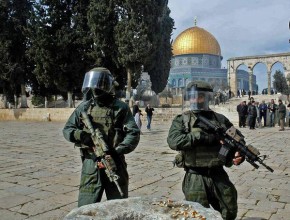
While Abbas’ faltering position as the head of the Palestinian Authority and the aggressive attitude of the Netanyahu government are major factors in creating this hopeless atmosphere, Seidemann pointed out that the problem is not limited to those bodies.
Referring to the announcement the same day of Israel having demolished homes of two terrorists who carried out deadly attacks last year, Seidemann said, “Demolishing of these houses make Palestinians wonder when the Abu Khdeir terrorists and Duma terrorists will be dealt with.”
This refers to two cases of Jewish terrorism that sparked global outrage. But the way Israel has dealt with them demonstrates why Palestinians feel so devalued. Muhammed Abu Khdeir was murdered in July of 2014. The culprits have been arrested and are still on trial at this time in Israel’s criminal court system. In contrast, Palestinians accused of terrorism are tried by Israeli military courts. And where the families of Palestinians convicted in those courts see their homes demolished in a type of collective punishment, it is the Abu Khdeir family, not those of the confessed murderers, that have been spat upon outside the court. Even the US State Department has accused the Israeli government of harassing the Abu Khdeir family.
The Duma murderers are even more immediate and galling to Palestinians. The arson in the Palestinian village of Duma in the West Bank killed an 18-month old baby and both his parents. Yet, despite the fact that Defense Minister Moshe Ya’alon has publicly stated that Israel knows who the murderers are, they have not been arrested. “This creates a feeling that Palestinian lives don’t matter, and that is not only directed at Israel, but also to the Palestinian Authority and much of Arab world,” Seidemann said.
Seidemann is one of the growing body of serious analysts who contend that the model of bilateral talks brokered by the United States that grew out of the Oslo Accords can never produce an end to Israel’s occupation. His message was that outside intervention was going to be necessary, even as he understood how difficult it would be to make that happen.
“There has been no action on Israel since collapse of Kerry initiative (in 2014),” Seidemann said. “Many in the Obama administration are making compelling arguments for simply walking away. Taking any action on this issue would require expending political capital and still may not be successful. These are strong arguments.
“But the implications of walking away are startling. It is very likely that the two-state solution, if it is not lost already, will be clearly lost before January 2017. If that happens, it will have died under this president.”
Seidemann pointed out that, in some ways, the two state solution is being lived now in Jerusalem, with Israeli Jews rarely entering Palestinian areas and Palestinians avoiding the Jewish parts unless they have work or other business there. Settlers in East Jerusalem, however, are living a one state reality, with soldiers accompanying convoys in and out of their enclaves, constant tension and very different standards of living between the two isolated communities. Seidemann described it as “Belfast at its worst.”
Seidemann said that the level of cooperation between Israel and the Palestinian Authority on security remains good. But that won’t last in the current climate. Regardless of Abbas’ commitment to non-violence, Netanyahu continues to accuse him of incitement – “Netanyahu plays on Israeli fears and anxieties like a virtuoso plays on a Stradivarius,” said Seidemann — and the security cooperation is becoming more and more of a political liability for Abbas. Eventually, those things will combine to break that cooperation. This was one of the implications of Abbas’ speech at the United Nations last week. In any case, Seidemann said, that cooperation is insufficient to deal with destabilizing forces at play.
The Israeli-Palestinian peace process — the one that is supposed to end with a two-state solution — is on life support. Both sides in the conflict have made their share of missteps, but Benjamin Netanyahu, Israel’s prime minister, all but pulled the plug earlier this month by pledging during his reelection campaign that Palestine would never become a state on his watch. He reaffirmed the sentiment even as he dialed back the rhetoric after the vote. This position runs directly counter to U.S. national security goals.
A two-state soluti on has been an American goal for nearly two decades. Ina 2002 speech, George W. Bush became the first president to explicitly call for the creation of an economically sustainable, demilitarized Palestinian state. “The establishment of the state of Palestine is long overdue,” he saidin 2008. “The Palestinian people deserve it. And it will enhance the stability of the region, and it will contribute to the security of the people of Israel.” Today, virtually all American politicians, on both sides of the aisle, publicly support this outcome. But with Netanyahu standing in its way, how can the United States advance this goal?
By recognizing the state of Palestine.
>>Read the full article in the Washington Post>>
As a Jew, I would be absolutely appalled to read these sentences: “The Huckabeeans also heard from Muhammed Tamimi, national president of the Arab Organization of America, who explained to the group, according to
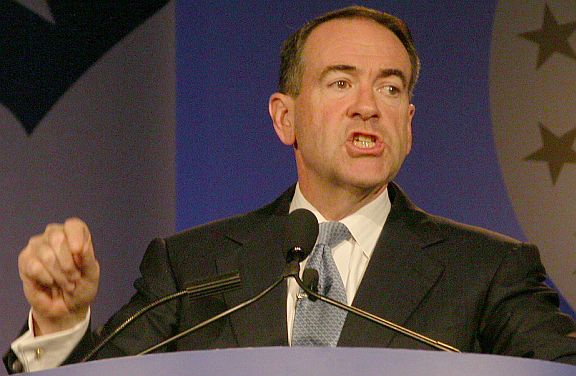
Huckabee, that there’s really no such thing as the ‘Jewish People.’ ‘The idea that they have a long history here, dating back hundreds or thousands of years, is not true,’ Huckabee said.”
In fact, what appeared in the front-page article of today’s Washington Post read, “The Huckabeeans also heard from Morton Klein, national president of the Zionist Organization of America, who explained to the group, according to Huckabee, that there’s really no such thing as the ‘Palestinians.’ ‘The idea that they have a long history, dating back hundreds or thousands of years, is not true,’ Huckabee said.”
Aside from mentioning that prospective GOP presidential candidate Mike Huckabee and his group would not be visiting Ramallah or meeting with any Palestinians, there was no mention of the Palestinians in this piece at all. Can any of us imagine an article in one of America’s most prominent newspapers where such a claim was made about Jews or Israelis without a single quote from a Jewish source in response, or at the very least a challenge to that claim by the author?
Perhaps the author of the article, William Booth, thought the assertion so absurd it needed no rebuttal. But in fact, Huckabee and Klein espoused a view of the Palestinians that a great many Americans hold, and one that even more Americans do not have the knowledge of Palestinian history to judge, and might just accept on faith.
Indeed, such statements are the very definition of “de-legitimization,” a charge Israel and her supporters throw around constantly. It is an offense to Jews when they are told they have no connection to the Land of Israel. It should be no less so for Palestinians to be told they do not exist. Yet somehow, in American discourse, the former is, rightly, treated with disdain while the latter is perfectly acceptable.
Let’s try on another picture. A Muslim cleric, a formerly powerful politician with ambitions of returning to even higher office, leads a tour of his devout followers and fellow travelers to Palestine. He takes them on a tour of the Dome of the Rock, the al-Aqsa Mosque, the Hebron Mosque, and the tombs of a list prophets revered in Islam. They meet no Israeli Jews though they do view the settlement of Har Homa from nearby Bethlehem.
Let’s say this cleric not only denied any Jewish connection to the land, but had another Muslim cleric tell a reporter that “… if you are a friend of Palestine, you are okay. If you’re an enemy, you’re in real trouble. God doesn’t change his mind about this stuff. The Qu’ran is an eternal book.” Would this not send chills down most American and Israeli spines? And wouldn’t this be called incitement to violence?
Well, substitute “Israel” for “Palestine” and the Bible for “the Qu’ran” and those were the words of Rev. Steve Sturgeon, a retired military chaplain and a pastor who was part of Huckabee’s entourage. And let’s not kid ourselves: his words reflect the views of a significant number of Americans. This is not just about Mike Huckabee, a man who is very unlikely to win the race for the White House next year. In part, though, it is about the very significant and influential segment of American society he represents.
Huckabee’s promotion for the Holy Land Tour on his website boasts that pilgrims will get to tour many biblical and historical sites, hear from Huckabee and other famous people about their views and experiences of the Holy Land and Israel’s value to the United States, and will meet with top Israeli officials. Interestingly, and unsurprisingly, there is not a mention anywhere of the Christian Palestinians who actually live in the Holy Land.
It is disturbing enough that these views have influence in the discourse around American policy toward Israel. But perhaps even more disturbing is the Washington Post allowing itself to be turned into a platform for this kind of radicalism.
The byline of the article locates the piece in “Masada, Israel.” The idealized story of Masada permeates the article, and clearly left Huckabee and his crew awestruck. Booth uncritically quotes Huckabee and zealously fills in more details himself about the Sicarii “rebels’” heroic stand at Masada, ending with a Roman siege and the decision by the Sicarii to die rather than live as Roman slaves.
These are the “Jews” these Christians admire, and about whom they beseech God in their prayers to “give us some of their backbone.” In fact, the Sicarii were a band of assassins, named after their long and curved daggers who committed atrocities, often against other Judeans. These included the massacre of 700 women and children in a raid on a Judean village, and, perhaps most tellingly, destroying the food supply in Jerusalem in order to force the people to war rather than the peace they were trying to negotiate with the Romans.
That would seem to describe al-Qaeda a lot more closely than the Huckabeean view of Israelis. But those suicidal assassins who attacked civilians are the “Jews” Huckabee and his crew admire, and why shouldn’t they? The view that was reinforced for them on this trip is one that rejects peace in favor of Israeli domination of another people and offers no sympathy for civilians harmed on a daily basis by the ongoing conflict and occupation.
But the more important question is why the Washington Post delivers their readers the Huckabeean view of Israel, and its concomitant blindness to Palestinians, with no critique and no counter-balance. Supporters of Israel would never tolerate the reverse, and rightly so. For all the activism aimed at protecting Israel’s image in the media, pro-Israel forces never have to contend with something like this on the front page of one of America’s leading dailies. And that tells us a great deal about why Americans have the one-sided view of the conflict that we do.
The idea that the two-state solution to the Israeli-Palestinian conflict is dead has been repeated so many times in the
 past several years that it has taken on the droning sound of a mantra. Yet at the same time, we continue to hear pleas like the one that Palestinian Ambassador to the United Nations, Riyad Mansour made as the Security Council was about to reject the Palestinian resolution calling for an end to Israel’s occupation: “Those eager to save the two-state solution must act and cannot continue to make excuses for Israel and to permit, and thus be complicit in, its immoral and illegal behavior.”
So which is it? Must we abandon the two-state solution and think of other formulations or do we desperately need to revitalize and resuscitate the process we’ve been working on since 1993? Perhaps there is a better answer: a completely different approach to the two-state solution. (more…)