Welcome to FMEP’s Weekly Settlement & Annexation Report. To subscribe to this report, please click here.
June 5, 2026
- WEST BANK: E-1 Update; High Council Advances Plans for 2,162 New Units; Archaeology Annexation Bill is Stopped for Now; Tax Break for Settlers; WZO Eases Land Purchase Rules
- Further Reading
WEST BANK
E-1 Update
As previously reported, tenders for the construction of the E-1 settlement were scheduled to be published/opened on June 1st – – but as of reporting the tenders have not been published. Terrestrial Jerusalem founder and Jerusalem expert Danny Seidemann cautions that delays are normal and alarm should remain high:
“In the past, this [delay] would be very much in line with Netanyahu’s modus operandi: bluster, but at the last moment make E-1 go away without leaving fingerprints. However, with Smotrich breathing down his neck and elections approaching, Netanyahu will be called out if he silently freezes E-1. He is not likely to do that.”
On June 3rd, 85 members of the U.S. Congress penned a letter to Secretary of State Rubio urging action to stop the construction of E-1. On the same day, a group of EU representatives visited Khan al-Ahmar, the bedouin community that stands to be forcibly transferred from their land by Israel in order to enable the construction of the E-1 settlement. At the United Nations, the Arab Group (an official regional and political coalition composed of 22 member states representing the Arab nations), issued a statement touching on many Israeli annexationist moves including E-1, urging strong opposition and increased pressure on the Israeli government to back off.
2,162 New Settlement Units Advanced
On June 3rd, the Israeli High Planning Council advanced the construction of 2,162 new settlement units, including plans for two new settlements. The plans advanced this week were:
- Hamivesher (a new settlement): The Council approved for deposit a plan for the construction of 234 new settlement units in the outpost of Hamivesher, which would authorize its as a legal (under Israeli law only) settlement. Until now, the Hamivesher outpost has been laundered through the planning process as a “neighborhood” of the Kiryat Arba settlement but is more properly understood as its own settlement. The Hamivesher settlement is detached from Kiryat Arba, located some ~800 meters north.
- Gvaot: The Council gave final approval for the construction of 1,006 new units in the Gvaot settlement, located west of Bethlehem. There are only a few dozen families currently living in the Gvaot settlement, so this plan represents a massive expansion and its transformation into a more established and urban settlement. Gvaot was built illegally by settlers and initially laundered as a “neighborhood” of the Alon Shvut settlement despite being detached from it. The government authorized Gvaot as an independent settlement in March 2025.
- Har Bracha: The Council approved a plan for 922 new units in the Har Bracha settlement, located south of Nablus. If given final approval, this plan will triple the size of Har Bracha, which is known to be particularly violent towards surrounding Palestinian communities.
Celebrating the approvals, Bezalel Smotrich said:
“This is not just a planning step, but a national development that solidifies our hold on the territory, strengthens Israel’s security, and establishes clear facts that prevent the establishment of an Arab terrorist state in the heart of the country.”
Bibi Stops (for now) Annexation-Via-Archaeology Bill
It’s widely reported that Prime Minister Netanyahu has intervened to stop the advancement of a bill that would annex heritage and archaeological sites across the West Bank and Gaza. Emek Shaveh warns the bill is not dead yet:
“it is important to emphasize that the bill has yet to be withdrawn (a procedure that we will demand). And as long as it remains within the legislative process, it can be revived relatively quickly. Since it has already passed its first reading, a future government or coalition could apply legislative continuity and resume the process from the point at which it was halted. In practical terms, the bill remains very close to being ready for second and third readings.”
Israel Seizes Herodium Archaeological Site & Surrounding Land
The Israeli Civil Administration issued an expropriation order for the Herodium archaeological site – which Israel had already seized and declared an Israeli national park – and surrounding areas, totalling 320 dunams (80 acres). The Herodium site is located on a hilltop south east of Bethlehem, in Area C, surrounded by settlements. This is at least the third archaeological annexation of the year, following the expropriation at the Nabi Samwil site last week and at the Sebastia site in February 2026.
Peace Now said in a statement:
”The government is trying to exploit every moment before the elections to create additional facts on the ground that will advance the full annexation of the West Bank. Tourist and archaeological sites constitute another form of settlement. Their purpose is not only to seize extensive areas of land but also to shape public consciousness, marginalize the Palestinian connection to the land, and transform this country into a land exclusively for Jews, both physically and in terms of heritage. This policy condemns us to many more years of a painful and bloody conflict that can only be resolved through a compromise over this land, which is precious to both Israelis and Palestinians.”
Tax Break for Settlers aka Looting Public Funds for Settlers
This week by a vote of 32-23 the Knesset passed a bill that grants a 7% tax break (capped at NIS 10,000 per year) to residents of 58 specified settlements – most of which are settlements which support, based on voting data, Bezalel Smotrich’s political party (an earlier version of the bill sought to benefit all settlements, but was shrunk to 58 settlements when the cost was estimated at 450million NIS annually). Ostensibly, the 58 settlements were selected based on distance from Israel’s Separation Barrier and the use for armored school buses for children.
Peace Now – which said the move is “a brazen move of looting public funds” – said in a statement:
“The proposal to grant tax benefits to settlements is brazen greed on the part of settlement leaders. No sector in the country receives more benefits and public investment than the settlers, and there is no justification whatsoever for adding tax breaks that would simply plunder the public treasury for the benefit of a small minority within the government’s political base.”
WZO Eases Rules on Land Purchases
The World Zionist Organization recently announced that it will begin allowing settlers to buy a second residential plot of land. Until now, the WZO closely controlled land management and most settlers do not own the land on which their houses are situated, instead they have long term leases on the land via the WZO.
Bonus Reads
- “Israeli Settlers Wound Three Palestinians in Attack Near West Bank’s Hebron, Medics Say” (Haaretz, 6/5/26)
- “Seven Palestinians Wounded in West Bank Settler Raid, Some by IDF Fire” (Haaretz, 5/30/26)
- “Digitally annexing the West Bank: Israel moves its theft of Palestinian land online” (Mondoweiss, 6/3/26)
- “Who Will Stop Smotrich, if Not The Hague?” (Haaretz, 6/3/26)
West Bank
Israel Expropriates Nabi Samwil Antiquity Site Currently Managed by the Muslim Waqf
The Israeli Civil Administration issued an expropriation order to seize the Nabi Samwil antiquity site, located just north of Jerusalem’s municipal boundary in the Palestinian village of Nabi Samwil. The seizure order affects a mosque that is currently managed by the Palestinian Authority’s Muslim Waqf, marking the first time Israel has unilaterally taken control of a holy site owned by the Waqf. In addition to the mosque, Israel has expropriated the archaeological site around the mosque, a spring, agricultural lands, and access roads leading to the area – a total of 109.79 dunams (27 acres).
The Civil Administration explained it was seizing the site “for the public benefit, for the purposes of undertaking a development project to preserve the archaeological site of the Prophet Samuel’s tomb,” claiming that there are safety issues in the compound. Israel is advancing development plans for several other significant antiquity sites that have been under Palestinian control across the West Bank, most notably Sebastia.
Peace Now said in a statement:
“Once again, we find ourselves confronting decisions by the Civil Administration, operating under Minister Smotrich, that are intended to expand and deepen annexation. From plans to expand settlements and unprecedented declarations of ‘state land,’ the Civil Administration has moved on to taking control of heritage sites and is now appropriating religious sites, creating tension in some of the most peaceful and sensitive places in the West Bank. The messianic agenda of the Israeli government should have been stopped long ago. Instead, each passing day appears to further endanger us and create the conditions for transforming a political conflict into a religious war.”
The Palestinian village of Nabi Samwil is located on a strategic and highly prized hilltop (inside of an area Israel post-facto declared a national park) just outside of the municipal borders of Jerusalem but on the Israeli side of the separation barrier — placing residents (who have West Bank ID cards) in a Kafka-esque situation wherein they are cut off from both Jerusalem and the West Bank (legally they are forbidden from taking the one road out of the village into Jerusalem, since they are West Bankers, and the West Bank is accessible only via a circuitous route that passes through an Israeli checkpoint – for background see: The Palestinian village where Israel forbids everything). The suffocation of Nabi Samwil is in line with Israel’s long-time ambitions to completely de-populate the village and take control of the land.
Israel Takes Another Step Towards Forcible Transfer of Khan Al-Ahmar
Ir Amim reports the Civil Administration issued a seizure order for a strip of land running through the Khan al-Ahmar bedouin community’s land to enable the construction of a new water line between two nearby settlements, Mishor Adumim and Kfar Adumim. The seizure order was issued the same day, May 19th, that Finance Minister Bezalel Smotrich vowed to move forward with the long-stalled forcible transfer of Khan al-Ahmar.
Ir Amim further details:
“Moreover, the water line is clearly not intended to serve Khan al-Ahmar or other Palestinian communities in the area. It is rather designed to upgrade infrastructure for the settler population in the E1/Maaleh Adumim area. Since Kfar Adumim is already connected to water infrastructure, the new line likely indicates preparations for the expansion of Kfar Adumim and/or other nearby settlements.”
Bibi Requests Review of Annexation via Antiquities Bill
The Times of Israel reports that Prime Minister Netanyahu has directed his Cabinet Secretary to prepare a comprehensive review of a bill to annex antiquity sites in the West Bank and Gaza. Bibi’s request might be intended to delay or scuttle the bill, which has faced heavy international criticism in addition to opposition by Israeli legal advisors and defense experts. Just this week the Knesset Education, Culture and Sports Committee Legal Adviser Tami Sela wrote a position paper criticizing the bill saying that it “contradicts” international law, specifically with regard to the bill’s application to Areas A & B in the West Bank and to Gaza. The Israeli army has also expressed opposition.
In addition to fast-tracking a bill to create an Israeli civilian authority to control antiquity sites in all areas of the West Bank and Gaza, the Israeli government is simultaneously proceeding with the appointment of a new head of the Israel Antiquities Authority that is both unqualified and clearly political. A group of 60 archaeologists petitioned the Knesset this week to block the appointment.
Israel Launches Online West Bank Land Registration System
On May 27th the Israeli government launched an electronic registration system for the “Land Registry and Settlement of Rights” for Area C of the West Bank. The online system is an instrument for the implementation of a February 2026 decision by the Israeli Security Cabinet to publish the West Bank land registry and to revive a “State Land Acquisition Committee.” These moves are best understood as a way to annex the West Bank, to help facilitate settler claims over disputed and/or unregistered land, and to spur the proactive government purchases of West Bank land for the purpose of settlement expansion.
The Palestinian Authority urged Palestinians to withhold information from Israeli entities working on the registration system, which Birzeit University’s Institute of Law argues consolidates Israeli dominance, marginalizes the Palestinian Authority, legitimizes settlement expansion, and creates irreversible facts on the ground.
Following the Security Cabinet’s February 2026 decisions, the full Israeli Cabinet quickly approved the decisions and allocated a four-year, $78 million (NIS 244.1 million) budget to establish a mechanism (with up to 35 employees) for updating the records in Area C of the West Bank. The Israeli Justice Ministry is tasked with carrying out the land registration process, effectively transferring sovereignty over Area C from the Israeli military to Israeli civilian governance, clear annexation. According to Peace Now, the process of land registration in Area C carried out will lead to the wide scale dispossession of Palestinians from the area. The Cabinet set a target goal of completing the land registration process for 15% of Area C within the next five years.
Yara Asi explains for the Arab Center DC:
“Israel’s February 2026 decisions mark a turning point in the governance of the West Bank. While presented as administrative measures, they collectively restructure land, authority, and law in ways that extend beyond the logic of temporary occupation. Through land registration, control is converted into ownership; through governance reforms, Israeli authority is extended across territorial lines; and through judicial changes, the limited constraints on these processes are further weakened. Together, these developments reflect a shift from managing occupied territory to integrating it into Israel.
This transformation carries significant legal and political implications. By embedding control within legal and institutional frameworks, these measures reduce the prospect of reversal and reshape the conditions for any future political settlement. In this sense, they illustrate a broader strategy of annexation through law—one that proceeds without formal declaration yet produces many of its defining effects.”
Itay Epshtain posted on X:
“The system, codenamed “Grenade”, was launched this morning and openly endorsed by Ministers Smotrich and Strook as “a central pillar in applying sovereignty in the territory and strengthening our hold and roots in Judea and Samaria.”
The candor is striking. What was once advanced incrementally, is now pursued through digitized cadastral engineering. A land registry presented as bureaucratic modernization is, in substance, an instrument for the consolidation of unlawful territorial acquisition.
International law is neither ambiguous nor silent. An occupying Power is prohibited from annexing occupied territory, permanently appropriating public or private property outside the strict limits of military necessity, or altering the legal status of the territory under occupation. Yet this is precisely what is now occurring, in broad daylight, through administrative and technological means designed to render unlawful presence increasingly irreversible.”
As a reminder, only one-third of West Bank land was registered and titled (under the British Mandatory government and then continued by Jordan) when Israel seized control of the West Bank and froze land registration proceedings. The publication of the West Bank land registry is something the settlement movement has pushed for in order to be able to identify landowners in all areas of the West Bank and approach them for purchase, which – with the repeal of the ban on the sale of land to non-Arabs – settlers can now do outright. Opening the land registry will help facilitate settler claims over disputed and/or unregistered lands, making Palestinians vulnerable to further settler harassment regarding the sale of land.
As reported by Israel Hayom in 2020, the Israeli land registration process would first require a survey of the land, after which time anyone claiming ownership could present documents to the Israeli government seeking to prove their ownership. In the case of land where Israel recognizes no valid ownership claims – including cases where Palestinians do not have documentation that Israel will accept – Haaretz has previously reported that the process gives heavy weight to whomever currently controls the land (e.g., if a settler has built illegally on Palestinian land and lived there, under the protection of the IDF, the process will give weight to their claim absent overwhelming documentation, accepted by Israel, from the Palestinian owner). The registration decisions can be appealed, but once the claims are resolved by an Israeli official appointed to oversee the process, no further appeal is possible. Moreover, all “unclaimed” land – that is, land over which Israel does not recognize any legal ownership, will automatically become “state land.
Shlomo Zacharia, a land lawyer working with Yesh Din, further explained how the process of Israeli-controlled land registration will dispossess Palestinians, saying:
“If a village has 30 plots, with [specific, documented] ownership claims on only 20 of those, the other ten automatically transfer to the state. If you haven’t filed a claim of ownership, it goes to the state. Period. The arrangement will primarily benefit the Civil Administration and the settlers, since most of the land allocated by the state goes to settlers, and because the arrangement process (in Israel and the West Bank) favors the person holding the land in practice.”
Israel Seizes Area A Land Inside Jenin for Army Base
972 Magazine reports the Israeli army seized land inside of the Palestinian village of Jenin, on a hilltop overlooking the Jenin refugee camp, in order to establish an army base. Dror Etkes (Kerem Navot) reports the seizure order coupled with newly paved military roads nearby suggest Israel has plans to establish a large military base there, marking the first time since the signing of the Olso Accords that Israeli seized land in Area A for a military base. Etkes ties the move to the broader Israeli government move to expand settlements around the Jenin area. Etkes says:
“There are more than 100 new settlements [including outposts] in the West Bank, and 15 in the Jenin area alone,” he said. “This is not just going back to the four settlements dismantled in 2005. It is something much larger. This is [Israel] reestablishing a military presence in the Jenin area, The only reasonable interpretation is that it is directly related to the biggest settlement boom in the West Bank…The aim is to strengthen the settlements that already exist along these routes, effectively surrounding Jenin and disconnecting it from its immediate rural surroundings. These are methods that we recognize from settlement expansion patterns elsewhere.”
Bonus Reads
- “Humanitarian Situation Report | 25 May 2026” (OCHA)
- “Pastoral Settlement: Dispossession, Forced Displacement and the Erosion of Livestock-Based Livelihoods in the Context of Eid al-Adha” (Balasan Initiative, 5/26/26)
- “The Four Steps Israel Is Taking to Clear Palestinians From West Bank’s E1 Area” (Haaretz, 5/27/26)
- “’They stole our sheep, killed my son’: Israeli settlers, soldiers attack and loot West Bank villages” (Middle East Eye, 5/27/26)
- “In West Bank, Latest Victim of Israeli Settler Violence Shocks in a New Way” (New York Times, 5/22/26)
- “Likud minister says resettlement of Gaza should be on party’s official election platform” (The Times of Israel, 5/26/26)
- “Smotrich’s Bid for Political Survival Relies on Bribing Israeli Settlers” (Haaretz, 5/28/26)
- “Israel Has Physically Divided Gaza With Over 25 Kilometers of Earthen Barriers” (Drop Site, 5/25/26)
Welcome to FMEP’s Weekly Settlement & Annexation Report. To subscribe to this report, please click here.
May 22, 2026
- WEST BANK: Smotrich Orders Khan Al-Ahmar Demolition; Knesset Fast-Tracks Annexation-via-Archaeology; Smotrich Leads Settlers to Joseph’s Tomb
- EAST JERUSALEM: Flag March and Related Government Action
- STATE-BACKED SETTLER TERRORISM: EU Sanctions
- BONUS READS
WEST BANK
Smotrich Orders Khan al-Ahmar Cleared, as E-1 Plan Advances
On May 19th, Israeli Finance Minister Bezalel Smotrich announced that he had ordered preparations for the forcible displacement and demolition of the Khan al-Ahmar, the bedouin village located just east of Jerusalem in an area that needs to be cleared in order for the construction of the E-1 settlement. The destruction of the community is expected to move forward in the coming days, as the publication of tenders for the construction of the E-1 settlements is scheduled for June 1st and bids will close on June 6th.
Amnesty International says that, if implemented, the forcible transfer of Khan al-Ahmar is a war crime. Smotrich said he issued the order after the International Criminal Court notified him that it was prepared to issue an arrest warrant against him, along with National Security Minister Ben Gvir, Settlement Minister Orit Strock, and two IDF officials.
The E-1 settlement will see the construction of 3,401 new settlement units on a site located northeast of Jerusalem that is home to several Palestinian bedouin communities, comprising 3,000 people, including about 300 residents of Khan al-Ahmar. The residents of Khan al-Ahmar have lived and worked on this land since the 1950s – when the community was forced to leave their land in the Negev during the 1948 war. There has been a decades long drama over the Israeli government’s plans to construct the E-1 settlement, which has long been held as a red-line for Israel that the international community had been willing to step up to maintain.
Terrestrial Jerusalem’s Danny Seidemann explains:
“Why Khan al-Ahmar? Israel has delineated the area under its exclusive control in the occupied West Bank between Jerusalem and the Jordan River Valley. It has consolidated its hold by large and medium-sized settlements, and “illegal” outposts. It has neutralized the Palestinian presence, and has seamlessly integrated the area into pre-1967. Multi-lane highways, tunnels, and bridges have erased the Green Line.
There is little doubt that this reality is tantamount to de facto annexation.If that be so, why is Israel so obsessed with the displacement of the few hundred
Bedouin of Khan al-Ahmar that it is willing to bear universal opprobrium in order to evacuate the hamlet?
The answer is simple: because Khan al-Ahmar and similar Bedouin encampments are the final obstacle standing in the way of de jure annexation.
In 1967, Israel annexed East Jerusalem. It did so without extending Israeli citizenship to the Palestinians residing in the annexed areas. The Palestinians of East Jerusalem enjoy certain personal entitlements, but no political rights.”
Balasan Initiative explains:
“The evacuation of Khan Al-Ahmar violates the International Criminal Law (ICL) and International Humanitarian Law (IHL), which prohibit the forcible transfer of protected persons from territory under occupation…particularly in light of the retaliatory intentions of Smotrich following the ICC arrest warrant proceedings, the planned evacuation of Khan Al-Ahmar remains unlawful, unjustified, and incompatible with international humanitarian law.
Hence, alongside the humanitarian consequences that would result from the demolition of the village and the forcible displacement of its residents, the destruction of Khan Al-Ahmar must also be understood within the broader framework of territorial fragmentation and settlement expansion in the occupied Palestinian territory. The village’s strategic location within the E-1 corridor renders its removal politically and geographically significant, as it would facilitate the territorial linkage between Ma’ale Adumim and Jerusalem while further isolating East Jerusalem from the remainder of the West Bank. Such measures undermine the contiguity and viability of a future Palestinian state and reinforce irreversible demographic and geographic changes on the ground.”
Peace Now said in a statement:
“Minister Smotrich seeks to take revenge on The Hague and the international community at the expense of one of the most vulnerable communities, which for years has struggled simply for the right to live on the small piece of land in its possession. The expulsion of Khan al-Ahmar is part of a broader government plan to take control of the entire central West Bank area, build in E1, and remove all Palestinian communities from the region. This is a cynical and destructive plan that could devastate the prospects for future peace and a resolution of the conflict, as part of Smotrich and his allies’ annexation agenda.”
Knesset Fast-Tracks Annexation-via-Archaeology
On May 20th, the Israeli Knesset passed a bill allocating $86 million (NIS 250 million) for developing archaeological and heritage sites across the West Bank. In addition to this huge budget investment, on May 11th the Knesset began fast-tracking a separate bill that would outright annex heritage, antiquities, and archaeological sites to Israel by bringing them under direct Israeli civilian control. That bill is being finalized by the relevant Knesset Committee and expected to be ready for its second and third readings and vote on Sunday, May 24th. For further information on the bill, see this detailed paper opposing the bill by Emek Shaveh.
If approved, the annexation bill will create a new Israeli civilian authority under the Heritage Ministry given exclusive authority to develop and manage West Bank heritage sites, taking those authorities away from the Israeli Defense Ministry. The new body in the Heritage Ministry would have the power to acquire or expropriate land for the purpose of protecting, conserving, researching, and developing heritage sites. In an added absurdity, Heritage Minister Amihai Eliyahu recently announced he has selected Esther Schreiber as the next head of the Israel Antiquities Authority (IAA), that is in despite of the fact Schreiber has no background in archaeology and lacks experience in managing large public institutions.
Emek Shaveh said:
“The political appointment at the Israel Antiquities Authority and the proposed Heritage Authority Law for the West Bank are two sides of the same coin: transforming archaeology from a tool of research into an instrument of propaganda in the service of annexation, dispossession, and a messianic ideology.”
The Haaretz Editorial Board writes:
“The proposed new agency will be another tool by which the government will be able to abuse its Palestinian subjects in the West Bank (it will have the authority to expropriate land) and to harness archaeology to the needs of the settlers. The bill also amounts to annexation, in violation of international law. The bill, like Schreiber’s appointment, was advanced despite overwhelming opposition from Israel’s archaeological community, which already faces boycotts abroad that hinder its operation. It can only be hoped that the government is replaced before Eliyahu & Co. also manage to destroy Israeli archaeology.”
Smotrich Leads Settler Raid on Joseph’s Tomb
On May 14th Finance Minister Smotrich led a group of over 100 settlers on a trip to Joseph’s Tomb for morning prayers, the heritage site in Nablus as Israel expands the scope and scale of Israeli presence there. Smotrich promised to control the site and said during his visit:
“Our presence here at Joseph’s Tomb, in broad daylight, is a clear statement: the people of Israel are returning home to all parts of their land…Joseph’s Tomb is living testimony to the inseparable connection between the people of Israel and their land.”
As a reminder, Joseph’s Tomb is a holy site for Jews and cultural site for Palestinians, located in the heart of Nablus. The tomb is located within Area A of the West Bank (where Israel does not, under the Oslo Accords, have direct control). However, Joseph’s Tomb is one of two sites in Area A which the Oslo Accords stipulate are under the control of the Israeli military. As such, it has been a perennial flashpoint, largely due to deliberately provocative actions by settlers.
In January 2026, Israeli Defense Minister Katz agreed to allow settlers to perform morning prayers at Joseph’s Tomb in Nablus for the first time in 25 years, and on January 29th, Israeli ministers and settler leaders led a group of 1,500 people under a heavy security escort to Joseph’s Tomb. In 2000 during the Second Intifada, Israeli officials restricted Israeli access to the site to nighttime hours in hopes of minimizing conflict.
EAST JERUSALEM
Israel to Expropriate Land/Homes/Business on Chain Gate Road
Ir Amim reports that on May 17th – Jerusalem Day – the Israeli government approved the establishment of an inter-ministerial committee tasked with advancing land expropriation of dozens of properties along the Chain Gate road in the Old City. The move would displace generations-old Palestinian family homes and businesses in the Muslim Quarter. Ir Amim explains:
“The decision refers to a 1968 land expropriation order for an area within Jerusalem’s Old City, which served as the basis for the expropriation of properties in the Jewish Quarter and the displacement of its Palestinian residents at the time. According to the new government decision, the expropriation order issued 58 years ago was never fully implemented. This specifically concerns properties along the southern side of Chain Gate Street (Bab al-Silsila Street), a strategic and central corridor along the seamline between the Muslim and Jewish Quarters that connects Jaffa Gate directly to Al-Aqsa/Temple Mount. See exaction location on map below.
The government now appears poised to advance the expropriation of these properties under a decades-old order, with the new committee tasked with devising the mechanism for its implementation. The committee has been instructed to complete an action plan within 12 months.”
The Flag March
As in years past, thousands of radical Israeli settlers staged a violent rampage – the “Flag March” – through the Old City on Jerusalem Day, bringing destruction and chaos with them as they attempted to show dominance and control over the city. As usual, the crowds shouted “Death to Arabs” and “May your village burn,” and gangs of young settlers were filmed attacking shopkeepers and one Israeli journalist.
Israel Ministers Smotrich and Ben Gvir joined the parade this year, with Ben Gvir leading a large group into the Al-Aqsa Mosque Compound – waiving the Israeli flag in front of the Dome of the Rock. Ir Amim explained the significance of this event:
“The erosion of the status quo at Al-Aqsa cannot be separated from the Flag March itself. In the lead-up to the march, we warned about the growing influence of Temple movements and the support they receive from organizers and participants alike. Throughout the march, countless shirts and flags called for the construction of a Third Temple — in even greater numbers than in previous years — alongside signs reading: “This is not Al Aqsa, this is the Temple Mount!” and “You wanted a massacre? You’ll get a Nakba!” Meanwhile, in the markets of the Old City, Palestinian shop owners were forced by police to close their businesses to clear the area for marchers. Year after year, the daily lives and livelihoods of Palestinian residents are disrupted and undermined to facilitate the march’s passage through the Damascus Gate plaza and Muslim Quarter.
Throughout the march, racist and violent chants filled the streets, including: “May your village burn,” “May your name be erased,” and “Slaughter Nablus.” Palestinian residents and solidarity activists were assaulted, while shops and property were vandalized — all under heavy police presence and with little meaningful intervention. Many Palestinian residents were forced to remain inside their homes or leave the Old City altogether out of fear of violence from the crowds.
Contrary to the way these events are often portrayed in mainstream coverage, such displays of racism and hatred are not isolated incidents on the margins of the march — they are central to it. They unfold within a crowd that includes not only youth, but also educators and adults, many of whom respond with indifference or outright encouragement. The march is officially recognized by Israel’s Ministry of Education and supported by the Jerusalem Municipality. The deeper issue is not merely the racist slogans or acts of violence, but the march itself: a public display of domination in the heart of the Muslim Quarter, built on the takeover and paralysis of Palestinian public space and reflective of a much broader political reality.”
Bonus Reads on East Jerusalem
- “Palestinians forced to demolish own homes to make way for Israeli theme park” (The Guardian, 5/22/26)
- “Only 7% Approved: Palestinian Building Permits in East Jerusalem Plunge, Freezing Construction” (Haaretz, 5/17/26)
- “Israel to Build Defense Compound on Site of Demolished UNRWA Headquarters in East Jerusalem” (Haaretz, 5/17/26)
- LISTEN: “And I too, Love Jerusalem “: Voices from Al Nakba” (This is Palestine podcast, 5/14/2026)
- “Israel’s trying to expel a whole Palestinian district in East Jerusalem, activists say” (NPR, 5/19/26)
STATE BACKED SETTLER TERRORISM
EU Sanctions Violent Settler Entities & Individuals
On May 11th the European Union announced that it plans to place sanctions on several Israeli settlement organizations, including Amana, Nachala and its leader Daniella Weiss, Hashomer Yosh and its former CEO Avichai Suissa, and Regavim and its Director Meir Deutsch. For background on these organizations, see Peace Now’s reporting.
An EU MP told The Guardian that the decision to sanction these entities and individuals is only a “baby step” after years of deadlock on the action. Ireland, a member of the EU, is going even further and is expected to introduce a bill seeking to limit the trade of goods with Israeli settlements.
In response, Israeli Minister Smotrich called for Israel to annex parts of the West Bank. Ben Gvir called the sanctions antisemitic.
Peace Now said in a statement:
“This is a grave warning sign presented to us by the European Union. The rampant violence of settlers in the West Bank, encouraged and supported by the government, is leading Israel into a moral abyss and casting an indelible stain on the State of Israel. The European Union’s decision is also a call to the Israeli public to open its eyes and see the reality we have created through decades of control and settlement in the occupied territories. It is time to stop the deterioration and begin the long journey toward a political agreement and peace. The first step is stop settlement activity.”
Bonus Reads on Settler Terrorism
- “The State Is Supplanting Settlers as the Driving Force of West Bank Takeover” (Haaretz, 5/18/26)
- “’He Attacked a Tied-up Dog’: Israeli Settler Filmed Abusing Palestinian-owned Dog in West Bank” (Haaretz, 5/16/26)
- “Israeli settlers force Palestinian family to exhume and rebury their father” (Al Jazeera, 5/9/26) and,
- “In the Palestinian Village Where a Man Was Buried Twice in a Day, Residents Are Still Stunned” (Haaertz, 5/16/26)
- “Timeline: How One Palestinian West Bank Community Was Erased” (Haaretz, 5/13/26)
- “They Fled to Safety in Palestinian Territory, Then Settlers Attacked Again” (New York Times, 5/16/26)
BONUS READS
- “Israel’s Gradual Annexation of Southern Syria under the Pretext of Mine Removal” (Syrian Network for Human Rights, 5/17/26)
- “Israeli Right’s Praise of Free Market Capitalism Stops at West Bank Settlements” (Haaretz, 5/18/2026)
- ”Israel’s Real Police Commander Lives in the West Bank Settlement of Kiryat Arba” (Haaretz, 5/12/26)
- “Strangle, Expel, Collapse: The Smotrich Doctrine for Bringing Down the Palestinian Authority” (Haaretz, 5/18/26)
- “The Numbers Behind the ‘Sacred Work’ of Cleansing West Bank Palestinians for Future Jewish Villas” (Haaretz, 5/20/26)
- “Erased: Israeli Settlers’ Brutal War on Palestinian Communities in the West Bank” (Haaretz)
Welcome to FMEP’s Weekly Settlement & Annexation Report. To subscribe to this report, please click here.
February 13, 2026
- ANNEXATION: Cabinet Approves Annexation, Gov’t OKs “West Bank Heritage Authority”
- EAST JERUSALEM: Demolitions in al-Bustan
- WEST BANK SETTLEMENTS & OUTPOSTS: Settlers Bulldoze Houses, Land Seizure Near Qalqilya for New Settlement
- SETTLER & STATE TERRORISM: 54 Injured in Wave of Attacks
- BONUS READS
ANNEXATION
Cabinet Announces Sweeping Annexation Moves
On February 8th, the Israeli Security Cabinet approved seven new measures that result in the annexation of the entire West Bank, stripping powers from the Palestinian Authority and paving the way for massive settlement expansion and the continued ethnic cleansing of Palestinians from all areas of the West Bank. With the Security Cabinet decisions made and support from the Attorney General, the Israeli military is expected to quickly issue military orders duplicating the decisions in order for them to be a matter of law in the West Bank. In announcing the decisions, Israeli Ministers Katz and Smotrich issued a joint statement saying the moves are intended:
“to remove decades-old barriers, repeal discriminatory Jordanian legislation, and enable accelerated development of settlement on the ground,” the two ministers said in a joint statement.”
The seven significant acts of annexation are:
- LEGALIZING SETTLER LAND PURCHASES – The Cabinet decided to repeal a Jordanian-era law that restricted the sale of land in the West Bank to the local Palestinian population (individuals and companies), effectively legalizing the sale of West Bank land to Israelis. Now, settlers will be able to purchase land anywhere in the West Bank including in major Palestinian cities – possibly creating new enclaves that bring Israeli security installments with it, a reality that has transformed Hebron into an apartheid dystopia.
- REMOVING KEY OVERSIGHT OF LAND PURCHASES – The Security Cabinet repealed a law that requires individuals to obtain a special land purchase “transaction permit” from the Israeli Civil Administration, a law that was aimed at establishing oversight on to stem fraudulent claims of land purchases, which offered Palestinians some level of protection.
- PUBLISHING THE LAND REGISTRY – The Cabinet approved the publication of the West Bank land registry, something the settlement movement has pushed for in order to be able to identify landowners in all areas of the West Bank and approach them for purchase, which – with the repeal of the ban on the sale of land to non-Arabs – settlers can now do outright. Opening the land registry will help facilitate settler claims over disputed and/or unregistered lands, making Palestinians vulnerable to further settler harassment regarding the sale of land.
- REVIVING A “STATE LAND ACQUISITION COMMITTEE” – The Cabinet revived a “state land” acquisition committee to expand settlements. The revival of the committee is meant to facilitate the proactive government purchases of West Bank land for the purpose of settlement expansion and “to secure land reserves for settlement for generations to come.”
- EXTENDING ISRAELI CONTROL TO AREAS A & B – The Cabinet extended Israeli oversight and enforcement in Areas A & B with regard to water issues, archaeological sites, and environmental concerns. This means that the Israeli military will be able to demolish Palestinian homes and property if it determines the Palestinian presence interferes with the concerns under their purview – water, archaeology, and environment. Now, Areas A & B will be subject to the same weaponization of the planning code that is currently being used by the Civil Administration to clear Palestinians
- SEIZING HERITAGE SITE IN BETHLEHEM – The Cabinet voted to create a new municipal body to take control over the Rachel’s Tomb religious site, located within the municipal boundaries of Bethlehem. Seizing control over the site will allow the Israeli government to allocate state funds to renovating the site as well as a Jewish yeshiva next to it. Rachel’s Tomb is located just close to the heart of the city of Bethlehem, and with Israeli settlers in control over the space Mondoweiss reports that area is likely to be developed into a new settler enclave.
- SEIZING PLANNING POWERS IN HEBRON – The Security Cabinet stripped planning and building authorities from the Palestinian Municipal Authority in Hebron and transferred it to the Israeli Civil Administration. Now, the Israeli military will exercise full control over settlement construction and planning for the Cave of the Patriarchs/Il-Ibrahimi Mosque.
Finance Minister Smotrich celebrated, saying:
“We are deepening our roots in all parts of the Land of Israel and burying the idea of a Palestinian state.”
The settlement Yesha Council, which oversees all settler municipalities, said in a statement:
“The government of Israel announced today, in practice, that the Land of Israel belongs to the Nation of Israel,” the council said, adding that the decisions “rectified an injustice of many years and are entrenching Israeli sovereignty on the ground, de facto.”
Peace Now said in a statement:
“Netanyahu promised to topple Hamas in Gaza, but in practice he chose to topple the Palestinian Authority, cancel agreements that Israel signed, and impose de facto annexation on us—completely against the will of the public, Israel’s interests, and the clear position of President Trump. The cabinet’s decision shows that this is not about deepening annexation in Area C, but about dangerous and irresponsible sovereignty measures also in Areas A and B, and about breaking every possible barrier on the path to massive land theft in the West Bank. This is an extreme and irresponsible government dragging us toward disaster. All democratic forces in Israel must act now, in every possible way, to stop this!””
Palestinian analyst Nour Odeh warns:
“These Israeli decisions are not administrative or bureaucratic. They’re transformative. The only logical next steps would be dismantling Palestinian political representation & mass ethnic cleansing. The only remaining obstacle to greater Israel are the remaining Palestinians.”
Government Endorses Bill to Establish West Bank Heritage Authority
On February 8th, in addition to the seven decisions to annex the West Bank as described above the Ministerial Committee on Legislation decided to throw the governing coalition’s support behind a bill in the Knesset that create a statutory body within the Israeli government that would exercise broad authority over heritage sites in “the area” of the West Bank — an act of de facto annexation.
Emek Shaveh, Peace Now, and the Geneva Initiative highlight that, if passed, this would be the first instance of Israel applying domestic Israeli law to territory (land) rather than persons (settlers) in the West Bank. The coalition further warns that the bill does not currently provide a definition of what area the new body would have jurisdiction over, as Emek Shaveh details in its latest update:
“Previous iterations of the bill explicitly stated the intention to bring antiquities sites in Areas A, B and C under the Authority’s jurisdiction, and even included an express reference to extending its jurisdiction to Gaza. In the current version of the bill, however, following a closed-door committee session, all references to Areas A, B, C and Gaza were removed, and the question of defining the territorial scope of “the Area” was deferred to a committee discussion after the bill’s first reading in the plenum. Nevertheless, yesterday’s cabinet decision may render any future discussion concerning the definition of “the Area” in the bill redundant, as the legislation provides for the transfer of all powers and responsibilities currently vested in the Staff Officer for Archaeology within the Civil Administration (ICA) to the new statutory authority (see section 2 in annex 1 below).
Taken together, these developments constitute a fundamental turning point. Empowering an Israeli civilian authority to carry out enforcement measures, expropriations, and excavations deep inside Palestinian Authority Areas B and A effectively dismantles the framework established under the Oslo II Accords. Under that framework, responsibility for antiquities and archaeological sites in Areas A and B rests with the Palestinian Authority’s Ministry of Tourism and Antiquities, which operates pursuant to the Palestinian Authority’s Antiquities Law of 2018.”
EAST JERUSALEM
Large Scale Demolitions in al-Bustan, Silwan
Peace Now reports the Israeli government carried out extensive demolitions in the al-Bustan area of Silwan. The municipality destroyed walls between houses, a construction supply business site, and a parking structure. The demolition notices were delivered just minutes before the bulldozers arrived, depriving Palestinians of the chance to challenge the actions and/or remedy the issues cited on the notices. Residents filed an emergency injunction, and the Jerusalem District Court issued an injunction stopping the demolitions after three hours. While no homes were demolished in this instance, Israel recently issued demolition notices to 15 Palestinian homes in al-Bustan.
Peace Now explains how these demolitions are a part of a much larger scheme to replace Palestinians with Israeli settlers and tourist attractions which erase Palestinian heritage:
“Since the demolition of the Mughrabi Quarter in 1967 to make way for the Western Wall Plaza, Israel has not carried out the expulsion of an entire neighborhood. Now, the municipality, backed by the government and the police, is advancing the displacement of a whole neighborhood in order to establish a tourist-settlement park. This policy, which on the one hand virtually prevents Palestinians in Jerusalem from building homes and on the other hand demolishes their houses, is a cruel, settlement-driven policy with no limits. For years Israel has claimed that Jerusalem is a ‘united’ city, but its policy toward the Palestinian population shows that this is not ‘unity,’ but occupation.”
WEST BANK SETTLEMENTS & OUTPOSTS
Settlers Bulldoze 15 Palestinian Homes Near Jericho
Haaretz reports a group of about 30 settlers accompanied by IDF protection arrived in the village of Ein a-Duyuk a-Tahta, located near the Hasmonean Palaces antiquity site near Jericho, and proceeded to attack Palestinian residents and bulldoze 20 structures, including 15 homes. The IDF told Haaretz that the demolitions were not carried out by Israeli authorities (though eye witnesses said IDF troops were on site the whole time providing security), and said that the IDF is opening an investigation into the incident.
Israeli Heritage Minister Amichay Eliyahu said during a live video posted on X:
“We will destroy any [home] built on Jewish people’s heritage. We will return here, pave roads and make the place flourish. “We do not apologize for holding onto our land. Through hard work and the investment of millions, we are reclaiming our heritage sites and deepening our historical hold on the land of our forefathers for the sake of our children’s future…Here at the Hasmonean Palaces in Jericho, the gateway to the Land of Israel, we are raising the flag of our sovereignty.”
Israel Seizes Land Near Qalqilya
Peace Now reported that in early January 2026 the Civil Administration declared 694 dunams adjacent to the Wadi Qana nature reserve (east of Qalqilya in the central West Bank) as “state land.” The seizure, along with the purchase of land near the area by an Israeli developer, appears to indicate a new settlement, called “Dorot”, is being planned for the area.
Peace Now explains:
“In 2020, an outpost known as Nahal Qana Farm (sometimes referred to as “Dorot Farm”) was established in the area and began exerting pressure on nearby Palestinian residents and farmers. Those operating the farm grazed cattle inside Palestinian orchards and cultivated fields and forcibly prevented Palestinians from accessing hundreds of dunams in the vicinity of the outpost.
In recent years, private developers have begun marketing building plots to the public for a future city called “Dorot Illit,” intended for the ultra-Orthodox community, despite the absence of a government decision to establish a settlement in the area or an approved construction plan. As part of the land marketing, the development company presents a rendering of the planned settlement that includes all nearby Israeli settlements, while the surrounding Palestinian villages are effectively erased and are absent from the promotional materials.
It has now emerged that the government is joining the settlement planning effort: the Civil Administration has labeled the land declaration adjacent to the developers’ holdings as “Dorot.” This is not the first settlement to be established at the initiative of private developers claiming to have purchased land from Palestinians. In February 2023, the government formally approved the establishment of the settlement of Mishmar Yehuda, where state land was likewise designated adjacent to plots acquired by developers. Other settlements established in a similar manner in the past include Modi’in Illit, Revava, Avnei Hefetz and others.”
STATE-BACKED SETTLER TERRORISM
Mass Attack Leaves 54 Wounded
On Friday February 13th settlers and Israeli troops carried out a wave of attacks on Palestinians concentrated in the area south of Nablus but extending across the West Bank, leaving at least 54 wounded.
Al Jazeera reports the following attacks:
- Settlers fired live ammunition and tear gas at Palestinians near Talfit and Qusra, south of Nablus, shooting at least one man.
- Settlers stormed the Khillet as-Sadrah gathering near the town of Mikhmas, northeast of occupied Jerusalem.
- Near Ramallah in Turmus Aya, settlers cut down roughly 300 olive trees and bulldozed agricultural land, while military forces raided homes in the village and arrested multiple people.
- In the same area, the military stormed Deir Ghassaneh and Beit Rima, while forces also descended upon several towns near Jenin, including Jaba, Siris and Meithalun.
- In the Jordan Valley, settlers set fire to a building
In West Bank, Israel’s Goal is Expulsion
Israeli government policy facilitates and augments the continued settler terrorism that is resulting in the mass expulsion of Palestinians from the West Bank – a reality that is now regularly in the headlines. Now, the Israeli Shin Bet is criticizing the Israeli Police’s refusal to allocate needed police force to confront the rampant settler terrorism that is only escalating as settlers face zero consequences to their violent criminality.
Haaretz columnist Amira Hass writes in the West Bank:
“Israel has only one goal: not maintaining quiet but fomenting military and socioeconomic explosions that will encourage emigration or allow a forcible population transfer. The line separating expulsions from mass slaughter is thin to the point of invisibility, as the army has taught us in Gaza. This isn’t a prophecy but another desperate cry for the world to wake up.”
BONUS READS
- “2 settler activists cross into Lebanon to plant trees, are returned to Israel by IDF” (The Times of Israel, 2/12/2026)
- “PODCAST: Documenting the settler takeover of the West Bank” (+972 Magazine, 2/13/2026)
- “PODCAST: Entire Communities Fled: ‘The West Bank’s Area C Is Almost Completely Ethnically Cleansed‘” (Haaretz, 2/11/2026)
- “Bezalel Smotrich’s long struggle to annex the West Bank for Israel” (Al Jazeera, 2/12/2026)
- “Israel Escalates its Settlement Expansion in the Heart of a UNESCO World Heritage Site in Bethlehem: Battir” (Balasan Initiative, 2/5/2026)
- “Settlers Violence Doesn’t End With Palestinians in the West Bank” (Haaretz, 2/13/2026)
Welcome to FMEP’s Weekly Settlement & Annexation Report. To subscribe to this report, please click here.
November 7, 2025
- Tenders Issued for New Neighborhood in Geva Benaymin Settlement
- Israel Advances Plans for 1,985 New Settlement Units
- Israel Delivers Demolition Notices to Entire Village of Umm Al Kheir in South Hebron Hills
- Israel Allocates $12 Million to Deepen Control Over West Bank Archaeology Sites
- Settler Violence & The Olive Harvest
- Bonus Reads
Tenders Issued for New Neighborhood in Geva Benaymin Settlement
 Peace Now reports that on November 4th the Israeli Housing Ministry published tenders for the construction of 342 new settlement units – establishing a new neighborhood in the Geva Benyamin (aka Adam) settlement. The new construction will expand the settlement northward towards the Jaba’ bedouin community, and connect the settlement to an outpost established by settlers in February 2025. Since the outpost was established, settlers have routinely and violently attacked the Jaba’ community.
Peace Now warned:
“Since the beginning of 2025, tenders have been published for a total of 5,667 housing units in settlements – an all-time record and about 50% more than the previous peak year, 2018, when tenders were published for 3,808 units. If the tenders published this year are built, these homes would add roughly 25,000 settlers to the West Bank.”
Israel Advances Plans for 1,985 New Settlement Units
Peace Now reports that on November 5th, the High Planning Council advanced plans for the construction of 1,985 new settlement units across the West Bank.
Since the beginning of 2025, including the plans slated for approval this week, Israel has advanced a total of 28,195 settlement units — setting a record for annual numbers. See Peace Now’s records here.
The plans that received final approval this week include:
- 133 new units in the Kfar Tapuach settlement, located south of Nablus.
- 80 units in the Etz Efraim settlement, located south of Qalqilya and on the Israel-annexed side of the Separation Barrier.
- 178 units in the Ganei Modi’in settlement, located on the Israel-annexed side of the Separation Barrier in the northern West Bank.
The plans which were deposited for public review this week include:
- 720 units in the Avnei Hefetz settlement, located just east of Tulkarem;
- 568 units in the Einav settlement, located east of Tulkarem and east of the Avnei Hefetz settlement.
- 48 units in the Etz Efraim settlement (in addition to the plans which received final approval).
- 258 units in the Rosh Tzurim settlement, located south of Bethlehem in the Etzion settlement bloc.
Israel Delivers Demolition Notices to Entire Village of Umm Al Kheir in South Hebron Hills
On October 28th, the Israeli Civil Administration delivered demolition notices to 13 structures (including 11 homes) in the village of Umm al-Khair in the South Hebron Hills – a village that is almost entirely surrounded by Israeli settlements and violent outposts. The residents were given four days to appeal the demolition notices, which were issued due to lack of Israeli-issued building permits (the buildings are over a decade old).
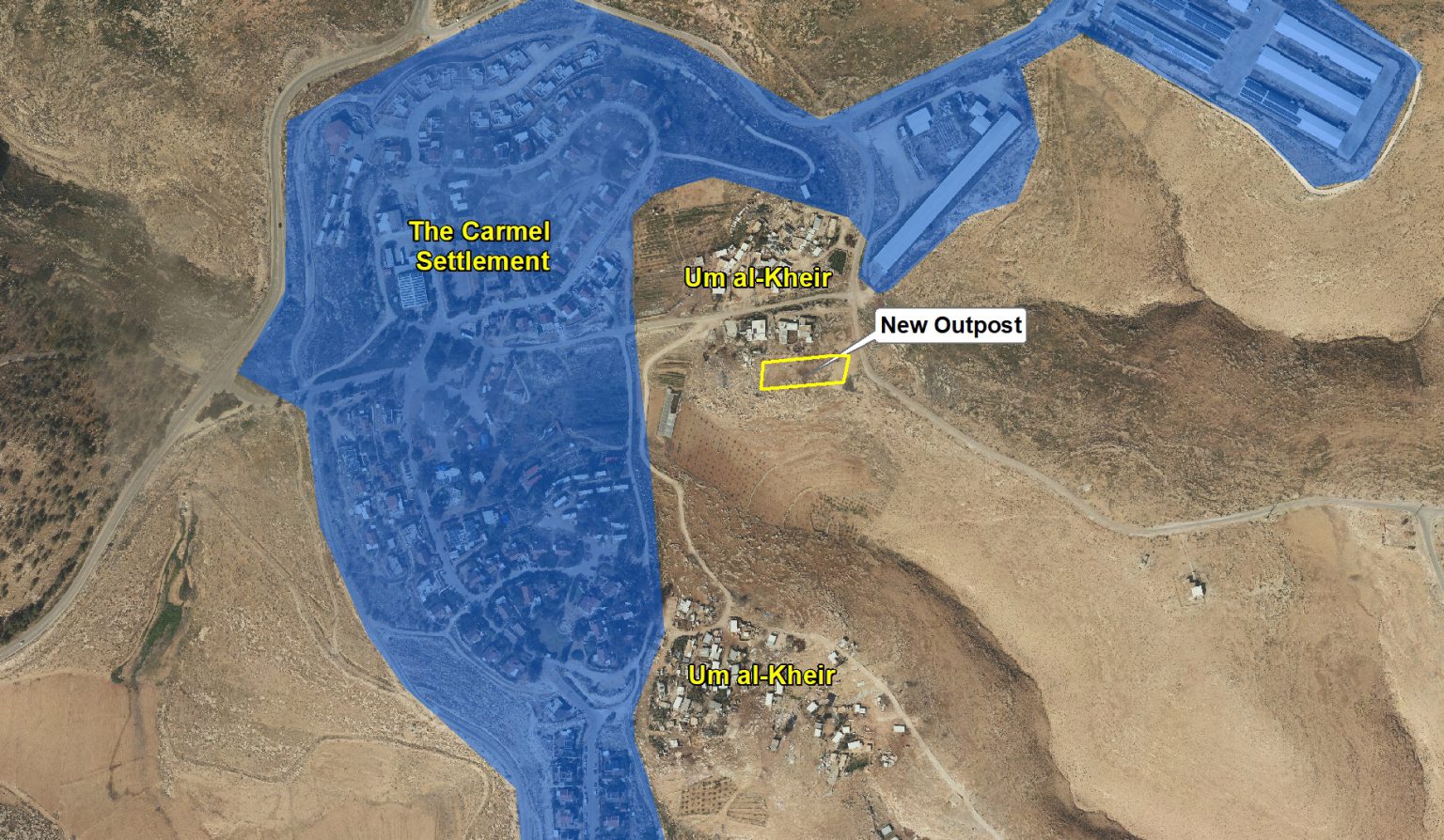 These notices come only a few weeks after the Jerusalem District Court attempted to temporarily stop settlers from establishing another new outpost literally next to homes in the Umm Al-Khair.
For an in-depth background of Umm al-Khair is its struggle to stay on its land despite settler and state violence, see Peace Now’s reporting and 972 Magazine’s repository of stories on the village – including several written by Awdah Hathaleen, a native of Umm Al-Khair who was murdered by an internationally sanctioned settler earlier this year (a settler who is facing no legal repercussions for the murder).
Israel Allocates $12 Million to Deepen Control Over West Bank Archaeology Sites
Emek Shaveh reports that on October 26th the Israeli government allocated an additional $12million (NIS 33.6 million)to renovate and strengthen Israeli control over archaeological sites in the West Bank. The government had previously allocated $33 million (NIS 120 million) in 2023 to the same project as well as a special budget of NIS 32 million for the Sebastia site alone.
Israeli Heritage Minister Amichai Eliyahu said: ““will not wait for the formal imposition of sovereignty over the West Bank.” As a reminder, in July 2024 the Israeli government gave the Civil Administrative sweeping powers over archaeological sites in Area B of the West Bank.
Emek Shaveh said in a statement:
“The government decision to redirect funds from other offices to sites in the West Bank reflects the ministers’ true priorities. At a time when health, welfare, and education systems have been severely impacted by two years of war and soaring defence spending, the government is diverting critical resources to advance the settlers’ long-standing agenda: expanding control over territory through archaeology.
By declaring more areas as archaeological sites “off limits” to Palestinians and developing them as tourist attractions to draw mainstream Israeli visitors into the settlements, the government is instrumentalising antiquities both as a bureaucratic tool for displacement and annexation, and as a means of shaping a biblical-nationalist narrative that excludes other histories and denies Palestinian connection to the land.”
Settler Violence & The Olive Harvest
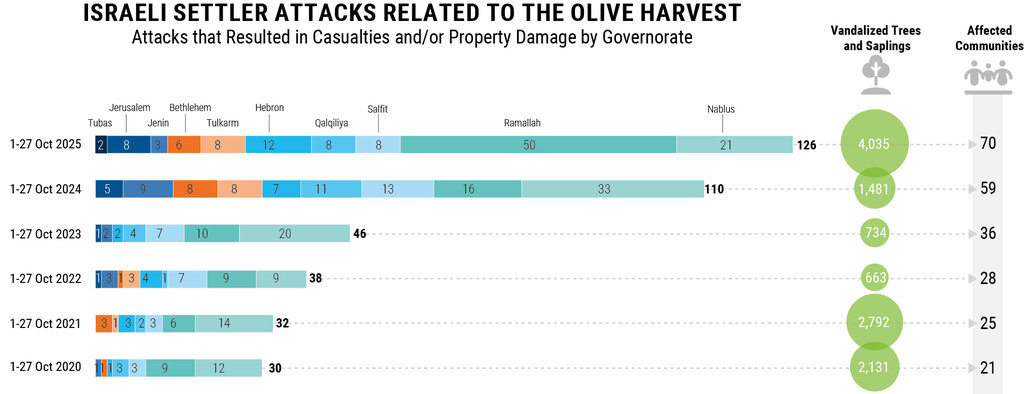 Settlers have continued to terrorize Palestinians harvesting olives during the 2025 harvest season, with virtually no recourse or accountability. Over the course of October, OCHA recorded the highest monthly number of Israeli settler attacks since OCHA began documenting such incidents in 2006, documented 260 attacks – an average of 8 per day. In addition Palestinians continue to suffer from increasingly restrictive Israeli policies that limit access to agricultural land located near settlements and/or the Separation Barrier. Adding to the heightened settler violence, the Israeli government has undertaken a deportation campaign against international solidarity activists who, for years, have accompanied Palestinians during harvest season as a protective presence.
Since October 21st, there have been at least 104 attacks, 20 of which were directly related to the olive harvest, including the following incidents of note over the past two weeks:
- Mikhmas: On October 20th, settlers from a newly established outpost attacked a group of Palestinians and solidarity activists in the bedouin villages of Mikhmas and al-Ara’ara, located north of Jerusalem. The settlers threw stones at the Palestinians and set a house and olive trees on fire. Then, on October 23rd settlers cut the water pipelines which serviced Mikhmas. On October 25th, settlers violently attacked Mikhmas, burning six structures and injuring Palestinians and solidarity activists. Many residents of Mikhmas have left the village under the coercive displacement policies of the state and the escalating violence of the settlers – which goes unpunished. OCHA has documented
- Al-Mughayyir: On October 24th dozens attacked al-Mughayyir during the night, setting cars on fire. This is the 43rd time this year that settlers have attacked Al-Mughayyir, a town that is surrounded by seven outposts.
- Samu, South Hebron Hills: Settlers were filmed ransacking a farm and torturing livestock – including baby lamb – in a small village in the South Hebron. Six lambs were killed and four were severely injured.
- Beit Ummar: Wafa News reports that on October 29th settlers cut down approximately 50 olive trees and stole construction equipment. Israeli settlers and soldiers have carried out more than 250 attacks on Palestinian olive farmers since the harvest began earlier this month, according to the Ramallah-based Colonization and Wall Resistance Commission
- Qarawat Bani Hassan: On November 4th, settlers attacked Palestinians harvesting olives alongside a large group of volunteers (including American volunteers). As filmed by the harvesters, settlers flew a drone directly into the crowd of activists injuring one, and then proceeded to shoot live ammunition into the air, threatening to shoot the volunteers while they attempted to retrieve the drone. Haaretz reports the settlers were part of the security unit of the nearby Revava settlement.
The continued violence prompted the following statement by Tom Fletcher, Under-Secretary-General for Humanitarian Affairs and Emergency Relief Coordinator:
“Reports of attacks by Israeli settlers on Palestinians and their property across the West Bank continue. Many are related to Palestinians’ attempts to harvest their olive crops. Palestinians have been killed and injured. Their homes and property damaged. Their livestock attacked. More trees have been damaged and more communities affected this year than in the previous six years. The failure to prevent or punish such attacks is inconsistent with international law. Palestinians must be protected. Impunity cannot prevail. Perpetrators must be held accountable.”
Bonus Reads
- “The Business of Apartheid: What Companies and Investors Should Know” (AFSC, 10/30/25)
- “How one road and an Israeli settlement could end dreams for this Palestinian city” (Los Angeles Times, 10/24/25)
- “Israel’s Education Commissar Wants to Force Settler Indoctrination in Schools” (Haaretz, 10/29/25)
- “Smotrich proposes weekly protest in ‘Sovereignty Square’ to push for Judea and Samaria annexation” (World Israel News, 10/26/25)
Welcome to FMEP’s Weekly Settlement Report, covering everything you need to know about Israeli settlement activity this week.
To subscribe to this report, please click here.
December 5, 2024
-
- End of Year Rush: High Planning Council Set to Meet Twice to Advance Settlement Plans
- Settlers Violently Storm Palestinian Towns After Outpost Evacuation
- Israel Gives Settler Power Over Palestinian Property in East Jerusalem
- Settlement Construction Group is Working in North Gaza, As Israeli Govt Officials Meet with Gaza Settlement Activists
- Emek Shaveh Challenges Military Construction at Sebastia Site
- Recapping Knesset Debate on Annexation via Archaeology
- Settlers Set Operational Plan for Trump Administration
- Don’t Miss: New Reports from B’Tselem & Yesh Din
End of Year Rush: High Planning Council Set to Meet Twice to Advance Settlement Plans
Peace Now reports that the Civil Administration’s High Planning Council met on Nov. 4th and is scheduled to meet again on Nov. 11th to consider advancing plans for a total of 501 new settlement units. In total, Peace Now reports that Israel has advanced plans for a total of 8,720 new settlement units in the West Bank in 2024.
The following plans for a total of 274 units were listed on the agenda for November 4th, with all slated to be deposited for public review (a latter stage of the planning process):
- 83 new units in Elon Moreh settlement, located east of Nablus (for background on the significance of the Elon Moreh settlement, please see here);
- 79 new units in the Mitzpe Yishai settlement; and,
- 112 new units in the Ma’ale Amos settlement, located between Bethlehem and Hebron.
The Committee is set to meet again on November 11th with the following plans for a total of 227 new settlement units on the agenda:
- 196 units in the Telem settlement – ready for final approval. The Telem settlement is located north of Hebron;
- 21 units in the Eli settlement – ready for deposit. The Eli settlement is located southeast of the Ariel settlement in the central West Bank. Though the Eli settlement previously received Israeli government approval, a “Master Plan” – which officially zones land for distinct purposes (residential, commercial, public) – has never been issued for Eli, meaning all construction there is illegal under Israeli law; and,
- 10 units in the Givat Ze’ev settlement – ready for final approval. Givat Zeev is located south of Ramallah in an area that is on the Israeli side of the barrier.
Peace Now said in a statement:
“The Israeli government is expanding settlements in the occupied West Bank as part of its broader plan to entrench Israeli control over the territories, thereby harming any chances for a political solution. After more than a year of war, Israelis and Palestinians do not need more settlement expansion but rather hope for peace and a future free from the horrors of war and occupation.”
Settlers Violently Storm Palestinian Towns After Outpost Evacuation
In the early morning hours of December 4th, dozens of settlers marauded two Palestinian cities near Nablus, and were stopped by the IDF from raiding a third. While storming through Huawara and Beit Furik, settlers threw Molotov cocktails setting at least one home and two cars on fire, and violently attacking at least one person with stones and sticks, fracturing his skull. Israeli police said that eight people have been arrested.
The attackers reportedly came from the Yitzhar settlement, and was launched as a response to the IDF’s removal of settlers from a nearby outpost called Hill 617.
In an Editorial entitled, “Israel’s Government Instigates Settler Pogroms Against Palestinians,” the Haaretz Editorial Board writes:
“When Defense Minister Israel Katz announced when he took office that would stop the use of administrative detention orders against settlers, the lawbreakers in the occupied territories immediately understood they had been given a green light to run amok. The spirit of the new commander is that there is no commander, that the extremist settlers are above the law, that the military, the Shin Bet security service and the police must obey them, that the blood of the Palestinians can be shed and that their land and assets are there for the taking. Aware of Katz’s new policy, on Wednesday, dozens of settlers threw Molotov cocktails and set fire to homes and vehicles in the towns of Beit Furik and Hawara, near Nablus.”
Beit Furik has been a repeated target of settler attacks, including a major incursion last month.
Israel Gives Settler Power Over Palestinian Property in East Jerusalem
The Israeli government has appointed Hananel Gurfinkel as the head of a newly established position of Adminstrator General of the Custodian of Absentee Property Division in the Finance Ministry. This role holds the important and powerful task for managing absentee property owned by Palestinians in East Jerusalem.
Gurfinkel lives in the Nof Zion settlement enclave in East Jerusalem, and is the founder of an organization (Boneh Yerushalayim) dedicated to building settlements in East Jerusalem.
For the past ten years, Gurfinkel has worked in the Justice Ministry’s Custodian General’s office, where he managed Jewish-owned absentee property. In that role, Haaretz reports Gurfinkel:
“used his position to aid settler organizations seeking to control Palestinian-owned properties and promote new settlement projects in the city. He facilitated the sale of land in the Silwan area to the pro-settler group Ateret Cohanim, and hired attorneys affiliated with the group and other right-wing organizations to represent the state in eviction cases targeting Palestinian families. Gurfinkel also actively supported right-wing efforts to expand Jewish settlement and reshape the demographic landscape of East Jerusalem.
Before Gurfinkel took his post, the Custodian General’s Office rarely initiated construction plans for properties under its authority. His tenure, however, marked a significant shift, culminating in a collaboration between the Justice Ministry, Ateret Cohanim and a right-wing-managed real estate company, to advance plans for three new Jewish settlements near Palestinian neighborhoods in East Jerusalem.
Hundreds of homes for Jews are set to be built in each of these new neighborhoods, adjacent to or even inside Palestinian communities.
The construction plans include the neighborhoods of Givat Shaked near the Palestinian Arab neighborhood of Sharafat, Kdmat Zion near Ras al-Amud and another neighborhood between the Palestinian villages of Umm Lison and Jabal Mukkaber…
According to Palestinian residents of Sheikh Jarrah, Gurfinkel has been enthusiastic about evicting them.”
Settlement Construction Group is Working in North Gaza, As Israeli Govt Officials Meet with Gaza Settlement Activists
Drop Site news reports that Israel has contracted with private companies specializing in settlement construction to work in northern Gaza. It is reported to be the first confirmation that Israel has hired private contractors to conduct demolitions and construction work in northern Gaza (previously documented in Rafah) – an arrangement which brings Israeli civilians to an area outside of Israel’s internationally recognized borders.
One of the confirmed private construction companies working in northern Gaza, Libi Constriction and Infrastructure Ltd., is owned by settlers and participates widely in settlement construction, including reportedly the Adei Ad outpost, the Itamar settlement, the Revava outpost. The company’s founder (Harel Libi) has a documented criminal history of illegal construction in the West Bank and has been subjected to a removal order in 2012 after participating in violent attacks on Palestinians in the West Bank.For more details on Harel Libi and his construction company, read Drop Site’s reporting.
As Israel’s actions in Gaza continue to come under increased scrutiny (with Amnesty International recognizing it as genocide this week), Israeli government officials and actions on the ground point to a long term Israeli presence. The New York Times documents how the Israeli military has entrenched its presence in Netzarim Corridor – which has been cleared of any signs of life prior to the military’s arrival. Satellite images show at least 19 large IDF bases, 12 of which have been built or expanded since September. There are also dozens of small bases in the area. Israel’s Minister of for Food Security Avi Dichter – who also services on the Isreali Security Cabinet – said at a press conference this week:
“I think most people understand that [Israel] will be [for] years in some kind of West Bank situation where you go in and out and maybe you remain along Netzarim [corridor].”
Israeli Finance Minister Bezalel Smotrich recently advocated for the Palestinian population in Gaza to be “thinned” by half within two years.
Meanwhile, Israeli Housing Minister Yitzhak Goldknopf was photographed on the Gaza border meeting with prominent settlement activists Daniella Weiss, who was seen showing Goldknopf a map of Gaza showing where she plans to establish Israeli settlements.
Goldknopf stated;
“Jewish settlement here is the answer to the terrible massacre and the answer to the international court in The Hague which, instead of caring about the 101 hostages, chose to issue warrants against the Prime Minister and (former) Defense Minister.”
Appearing on Israeli TV last week, Weiss said:
“The moment that entry is possible, we enter,” she said. “We don’t wait for water supply infrastructure, generators or any other preparations. If 300 people enter at once, evacuating them would require 1,000 soldiers.”
Emek Shaveh Challenges Development of Sebastia
In November 2024, Emek Shaveh joined Palestinian landowners and the Sebastia municipality to file a petition against the construction of a military facility g at the summit of the Sebastia archaeological site. The petition complains that the plans violate private property rights and that the Isareli Staff Officer for Archaeology in the Civil Administration did not submit an opinion regarding the potential impact of a military facility on the ancient site.
The plans for construction were disclosed only months after the Israeli army issued a military order seizing the plot of land, and a year after the Israeli government passed a $9 million (NIS 32 million) plan designed to impose Israeli control over the site both logistically and in the narrative about the site’s history. E
Settlers have been openly agitating for Israel to assert control over the archaeological site in Sebastia for years, and the settler Samaria Regional Council organizes regular tours to the site. To secure the settlers’ visits, the IDF shuts down the town of Sebastia, closing Palestinian streets and businesses.
As in other cases across the West Bank, settlers allege that Palestinians are damaging the Sebastia site and that the Israeli government needs to intervene. In 2021 amidst intensifying settler efforts related to the site, the Palestinian Foreign Ministry called on UNESCO to “protect all Palestinian archaeological and religious sites from Israeli violations, attacks and falsifications.” The archaeological site of Sebastia is on the tentative list of World Heritage sites in Palestine.
Recapping Knesset Debate on Annexation via Archaeology
On November 27th, the Knesset’s Education, Culture, and Sports Committee discussed a proposed bill to expand the Israel Antiquities Authority’s jurisdiction into the West Bank, effectively annexing West Bank antiquity sites to Israeli control. This bill is being prepared for a first reading soon.
The discussion, as summarized by Emek Shaveh, included the strong objections to the bill from the Israeli archaeological community, which stressed the move would be tantamount to annexation and have repercussions for Israel. The Committee’s own legal advisor said that the bill is “incompatible with the region’s laws.”
Emek Shaven Director Alon Arad said:
“Advancing this legislative proposal amounts to the annexation of parts of the West Bank and is contrary to international law and agreements to which the State of Israel is a signatory. This is a bad and dangerous legislative proposal that reflects an extreme and messianic Jewish supremacist ideology. It is being promoted against the opinions of professionals and will inevitably harm the State of Israel, its foreign relations, its political horizon, and put its academic community at risk while hollowing out the field [of archaeology] and turning it into nothing more than a political tool.”
Settlers Set Operational Plan for Trump Administration
At the end of November, the settler Yesha Council convened a high-level meeting in Jerusalem to develop a “operational strategy” to implement the expansion of settlements and annexation of the West Bank during the Trump Administration.
The meeting reportedly proposed a plan that would establish 3-4 new settlements and expand the jurisdiction of regional councils over all of the West Bank land, including Palestinian areas (current jurisdictions only include settler populations). In tandem, the group proposes removing he Palestinian Authority from a position of any control and hinting at dismantling it altogether. Israel Hayom reports that MK Boaron explains:
“Instead [of the PA], the Arab population in the West Bank would be under self-governing municipal authorities. These would receive and pay for services from Israel, with residents holding status similar to Jerusalem’s Arab residents. Their national orientation would mirror the pre-1967 arrangement under Jordanian administration.””
MK Boaron also called for transforming the Jordan Valley into a “power generation huib” by building many power stations there. Plans for the two new power stations were recently announced by Israeli Energy Minister Eli Cohen.
Likud MK Avihai Boaron, who attended the meeting, said:
“We are at a critical juncture – a window of opportunity that we can utilize either wisely or squander. Taking the foolish path would merely result in 700,000 residents and additional housing units four years from now. The wise approach would establish conditions to make Judea, Samaria, and the Jordan Valley inseparable from Israel – not just by creating demographic facts on the ground, but by fundamentally transforming the region’s administrative framework.”
Don’t Miss: New Reports from B’Tselem & Yesh Din
On December 3rd, B’Tselem released a new report on the escalation of brutal policing of Palestinians in Hebron, including patterns of arbitrary arrests, severe beatings and zero accountability. The report presents over 20 testimonies collected between May and August 2024. Victims describe being randomly seized by soldiers, mostly as they were walking down the streets of the city, going about their daily affairs. They were beaten and subjected to severe abuse by soldiers, sometimes in the street, and at other times inside military outposts where they were taken.
In November, Yesh Din released a report documenting at the Abu Awwad family’s case and the severe (and insane) movement restrictions facing the family in the village of Turmusaya in the central West Bank. The family’s sole access to their residential compound, located on the outskirts of the town, was blocked by an earth mound of dirt and stones placed by soldiers and settlers in October 2023. This was only the start of a year of increasing imposition of restrictions imposed on the family by Israeli soldiers. Yesh Din has accompanied the family in filing a petition with the Israeli High Court of Justice to have the earth mound removed.
Welcome to FMEP’s Weekly Settlement Report, covering everything you need to know about Israeli settlement activity this week.
To subscribe to this report, please click here.
July 12, 2024
- A Stunning, Expansive Time for Israel’s West Bank Annexation
- Civil Admin Seizes Patchwork of Plots as “State Land” in Order to Legalize the Evyatar Outpost
- Government Establishes Jurisdiction for New Settlement on World Heritage Site Near Bethlehem
- Settlers Takeover New Building in Hebron
- Historic Year for Land Grabs: Israel Seizes Over 3,000 Acres in the Jordan Valley as “State Land”
- Civil Admin Advances Plans to Legalize Three Outposts & Build 5k New Units Across West Bank
- Israeli Cabinet Gives Civil Admin Authority Over Antiquity Sites in Area B
- Israeli Cabinet Supports Knesset Considers Bill to Transfer West Bank Antiquities Control from Civil Admin to Domestic Body
- U.S. Issues New Round of Sanctions Against Settlers & Settler Organizations
- Israeli Court Orders 11 Families Out of Homes in Batan al-Hawa, Silwan
- Israeli Court Rules to Demolish Wadi Hilweh Info Center in Silwan
- Israeli Court Tells Settlers To Leave Khalidi Library in Old City of Jerusalem
- Israel to Advance 6,000+ Settlement Units in East Jerusalem in Coming Weeks
- Amidst Wave of Violence, Settlers Lead Progrom On Massafer Yatta Region
- Ariel Settlers Close Access Road to Palestinians
- IDF Demolishes Outposts, Clashes With Settlers
- Bonus Reads
A Stunning, Expansive Time for Israel’s West Bank Annexation
Over the past two weeks, Israel has unleashed a flurry of settlement activity that makes its annexation of the West Bank complete. Even a small sampling of those acts, detailed below along with other news, are stunning when taken together. Indeed, Israeli National Missions Minister Orti Strock called this “a miraculous time,” referring to the control her and her allies have over key government bodies and how easy it is for them to fund settlement construction. Strock is a member of the Religious Zionism party, along with Bezalel Smotrich.
Renowned Israeli human rights lawyer Michael Sfard encapsulates this time powerfully in an article entitled, “Smotrich Has Completed Israel’s Annexation of the West Bank”:
“The only thing the annexationist criminals must be saying to themselves now is: why did we wait for 57 years? It’s so easy.”
Civil Admin Seizes Patchwork of Plots as “State Land” in Order to Legalize the Evyatar Outpost
On July 8th, the Israeli government declared 16 acres (66 dunams) of land south of Nablus as Israeli “state land” in order to pave the way for the legalization of the Evyatar outpost. Palestinians who have private ownership claims to the land have 45 days in which to submit an appeal. The declaration is the result of three years of “work” by Smotrich’s Settlements Administration to examine the status of the land in order to find a way for the state to take control of the land in order to legalize the outpost. The declaration comes one week after the Israeli Security of Cabinet decided in favor of legalizing the Evyatar outpost along with four other outposts.
The Evyatar outpost was illegally built by settlers on a strategic hilltop named Mount Sabih, located just south of Nablus on land historically belonging to nearby Palestinian villages Beita, Yatma, and Qablan. It was evacuated by the Israeli government in 2021 in the context of an agreement with settlers that left all construction at the site in place, maintained an IDF presence at the site, and made clear the government’s intent to legalize settlement at the site in the future – a goal which was made more than official when it was agreed to in writing as part of the coalition agreements that formed the current Israeli government.
 To underscore the absurdity which has characterized the State’s blatant intent to legalize Evyatar even though Israeli law makes that an impossibility because parts of the land are recognized by the State as privately owned by Palestinians (which is the only reason Evyatar has yet to be legalized), the State’s new declaration of “state land” is a complete patchwork. The order does not include the land on which the central square of the outpost is built, nor does it include 11 buildings, or, very importantly, the access road leading from the main road to the outpost. The implications of this patchwork is that even though the privately owned land was not seized, Palestinians will remain unable to access the land and will, in practice, lose that land as well as land abutting the settlement as it grows, expands, and establishes control over the area with the assistance of the IDF.
Peace Now reports that this is the fifth “state land” declaration so far in 2024 bringing the total land in the West Bank taken into Israeli control this year to 5,879 acres (23,572 dunams), breaking all previous annual records combined. Israel invented the concept of “state land” in order to find means by which to confiscate land in the occupied West Bank, and to do so Israel cites Ottoman law which provided that land which has not been cultivated in consecutives years becomes the property of the sovereign. Peace Now explains:
“The declaration process is essentially a legal maneuver developed by Israel to circumvent the prohibition in international law against expropriating private property of the occupied population for the benefit of the occupying power. To “convert” private land into public land (termed “state land”) without expropriating it, Israel claims that it is not changing the land’s status but merely “declaring” it officially.
According to Israel’s interpretation of Ottoman land law, which underpins the land laws in the occupied territories, if a landowner does not cultivate their land for several years, the land is no longer theirs and becomes public property. To this end, the mapping personnel of the Civil Administration, now operating under the Settlements Administration with legal counsel under Minister Smotrich, examine aerial photographs to identify uncultivated lands and mark them as “state land.”
The declaration map for the Evyatar outpost shows that there were indeed several cultivated lands, even by Israel’s stringent interpretation. For example, the declaration creates an enclave of about 3.5 dunams in the middle of the area designated for the settlement, considered private land. In principle, Israel would argue that it is not expropriating this area and that the Palestinian landowners are still recognized as the owners. However, as in hundreds of similar cases, it is clear that they will not have access to their land and no possibility of using it when it is located in the middle of an Israeli settlement.
To enable an access road connecting the outpost to the main road without crossing private land, the map’s designers managed to “find” an 11-meter-long and 1.5-meter-wide corridor of land that they claim was uncultivated and thus considered state land. This interpretation of Ottoman law brings it to absurdity.
According to this, if a person has a plot and cultivates it intensively, but there is a small uncultivated strip on the edges, say a rock that cannot be plowed, that small part of the plot is not owned by the landowner. This interpretation is far removed from the purpose of the Ottoman law, which was to encourage the empire’s subjects to cultivate the lands to increase its tax revenues.
Regarding the access road – in any case, for modern vehicles, a road 1.5 meters wide is insufficient, and it is clear that to allow access to the settlement, the state will encroach on private Palestinian lands (requiring another legal maneuver). Thus, it can be said that this entire declaration of state land is essentially an unlawful expropriation under international law.”
Government Establishes Jurisdiction for New Settlement on World Heritage Site Near Bethlehem
On July 9th, the IDF Commander signed an order establishing the jurisdiction for a new settlement on the lands just west of Bethlehem, lands that are recognized as a World Heritage Site by UNESCO. Notably, the jurisdiction for the new settlement, called “Nahal Heletz”, does not include the land on which two illegal outposts already exist on Battir’s land. The new settlement is being planned for land that is between Bethlehem and several villages to its west (Walaja, Battir, and Husan) – meaning that construction on this land will sever the territorial continuity of Palestinian land in the Bethlehem region, and, in the words of Peace Now: “turn them [the villages] into an enclave within Israeli territory.”
There are several extraordinary facts about this land and Israel’s legal acrobatics to establish a new settlement at this location:
-
- The status of the land within the new jurisdiction is unclear, and quite possibly includes privately owned Palestinian land. The Israeli Blue Line Team (a government effort to precisely map the boundaries of state land in the West Bank) has prepared updated maps to show the boundaries of state land in the area, but has yet to release it – meaning that the status of the land is unclear. The jurisdiction appears to stretch beyond the previously understood boundaries of land that Israel seized as “state land” in the 1980s, onto land that is privately owned by Palestinians. The updated boundaries might change that fact in the eyes of the Israeli government. But,once the new Blue Line in the area is made public, Palestinians will/should be able to contest it.
- There is no access road to the area, and it is surrounded by privately owned Palestinian land. Israel will have to unilaterally expropriate privately owned Palestinian land in order to pave a road to the new settlement – – an extraordinary act which Israel has done in the past (having invented a legal basis on which to do it, a concept which considers Israeli settlers as part of the “local population” of the West Bank).
- The jurisdictional area established by this new order is too small for real development – just under 30 acres (120 dunams). Peace Now explains that “small settlements severely impact open spaces, require substantial resources for infrastructure and transportation, and contradict fundamental planning principles. The sole reason for establishing such a settlement is political: the desire to prevent a Palestinian territorial continuity in the Bethlehem area and the possibility of a viable Palestinian state.”
- The jurisdiction is a stones throw away from Palestinian houses and Area B.
Settlers Takeover New Building in Hebron
Peace Now reports that in early June 2024 settlers have taken over a building (“Beit HaTkuma”) in Hebron and established a new settlement enclave there. The house, which settlers illegally entered once before but were removed under the Bennet-Lapid government, on the main road leading from the Kiryat Arba settlement to the Tomb of the Patriarchs/Al-Ibrahimi Mosque.
Settlers claim to have purchased the house, which is a three-story building, from its Palestinians owners, and report that the Civil Administration has recently issued them a permit to begin the registration process. The timing of this permit coincides with the first days of Hillel Roth’s assumption of his role in the Defense Ministry as the civilian in charge of all land matters in the West Bank. Upon receiving the permit (allegedly), the settlers decided to enter and occupy the building although the permit does not provide for that. [map]

Historic Year for Land Grabs: Israel Seizes Over 3,000 Acres in the Jordan Valley as “State Land”
 On June 25th, the head of the IDF signed an order declaring 3,138 acres (12,700 dunams) of land in the Jordan Valley as “state land” – the largest state land seizure since the Oslo Accords were signed in 1993. This is the first declaration enacted under the authority of Hillel Roth, the new civilian deputy in the Civil Administration responsible for land policy in Area C of the West Bank. Peace Now reports that the legal opinion supporting this massive declaration of state land was crafted by lawyers in the Department of Defense and not legal advisors with the IDF.
Peace Now further reports:
“A significant part of the area that was declared as state land was previously defined as a nature reserve, and also as a “fire area”, for military use, for decades. Today’s announcement completes the Israeli takeover of this area that has been done so far through the declaration of the area as a military area and as a nature reserve – something that imposed many restrictions on the Palestinians’ ability to use their lands. The declaration creates a territorial continuity between the settlements in the Jordan Valley (Yifit and Masu’a) and the settlements at the eastern end of the mountainside (Gitit and Ma’ale Efraim).”
So far in 2024, Israel has declared 5,852 acres as “state land” a figure eclipsing any other year since the Oslo Accords were signed in 1993. The highest previous total was in 2014, and it was for 1,181 acres.
Civil Admin Advances Plans to Legalize Three Outposts & Build 5k New Units Across West Bank
On July 4th, the Israeli Civil Administration approved the advancement of plans for 5,295 settlement units, including plans which would in effect legalize three outposts under the guise of being “neighborhoods” of existing settlements. This is the first time the Civil Administration’s High Planning Council has met since it came under the authority of a civilian official, Hillel Roth, who was appointed by Bezalel Smotrich. The HPC last met in March 2024. The Associated Press has called Israel’s advancement of plans a “turbo charged settlement drive [that] threatens to further stoke tensions on the West Bank.”
The three outposts that are now on their way to legalization, once given final approval, are:
- Mahane Gadi – to be legalized as a neighborhood of the Masu’a settlement in the northern Jordan Valley. This outpost was built in 2018 on an abandoned Isareli military camp. The outpost currently functions as an educational campus and pre-military academy. Plans advanced this week are for the construction of 260 settlement units. Masu’a settlement, and its outpost satellites, were recently benefitted by the Israeli government’s massive declaration of state land that borders Masu’a.
- Givat Hanan (Susya East) – to be legalized as a neighborhood of the Susya settlement located in the South Hebron Hills.
- Kedem Arava – it appears that the Kedem Arava outpost was legalized along with Beit Hogla in February 2023 (previously unclear), located south east of Jericho. Plans advanced this week are for 316 settlement units in the Kedem Arava outpost area, but filed as if they are plans for the Beit Hogla settlement.
The settlement plans that were approved for validation (a near final step in the West Bank planning process) are:
- Beitar Illit – 298 settlement units. An additional 453 units were approved for deposit (751 settlement units total).
- Givat Zeev – 452 settlement units
- Mitzpe Yericho – 365 settlement units
- Nokdim – 290 settlement units
- Immanuel – 266 settlement units
- Elon Moreh – 186 settlement units
- Kiryat Arba – 165 settlement units
- Negohot – 158 settlement units
- Tzofim – 74 settlement units
- Ganei Modiin – 46 settlement units
- Etz Efraim – 12 settlement units. An additional 24 units were approved for deposit (36 units total)
- Eli – 24 settlement units
- Mitzad (Asfar) – 6 settlement units
The settlement plans that were approved for deposit (an earlier step in the West Bank planning process) are:
- Neria – 436 settlement units
- Modin Illit – 300 settlement units
- Gva’ot – 250 settlement units. There were over 1,000 plans for the Gva’ot settlement on the High Planning Council’s agenda, but only one plan was advanced, the rest continue to be worked on.
- Yakir – 168 settlement units. Haaretz reports that these units are slated to be built on land that is discontiguous from the built up area of the Yakir settlement, on the far side of the settlement’s access road, effectively building a new settlement. The construction of these units requires the evacuation of a military base.
- Kiryat Netafim – 136 settlement units
- Hagai – 135 settlement units
- Maale Shomron (Elamatan) – 120 settlement units
- Almon (Anatot) – 91 settlement units
- Shilo – 90 settlement units
- Pduel – 37 settlement units
- Revava – 16 settlement units
- Elkana – 8 settlement units
- Shaarei Tikva – 6 settlement units
Peace Now said in a statement:
“Netanyahu and Smotrich’s agenda became evident through the decisions of the Planning Council: approval for thousands of housing units, the establishment of three new settlements, and strategic appointments of Smotrich’s allies in key roles instead of military personnel underscore the annexation occurring in the West Bank. Our government continues to change the rules of the game in the occupied West Bank, leading to irreversible harm. While the north is neglected and citizens across the country are abandoned, with 120 hostages still in Gaza, the process of annexation and land theft continues to expand, contrary to Israeli interests. This annexationist government severely undermines the security and future of both Israelis and Palestinians, and the cost of this recklessness will be paid for generations to come. We must bring down the government before it’s too late.”
Israeli Cabinet Gives Civil Admin Authority Over Antiquity Sites in Area B
In late June, the Israeli Cabinet approved several punitive measures against the Palestinian Authority, measures which included usurping the Palestinian Authority’s singular responsibility for antiquity sites in Area B. Under the decision passed last week, the Civil Administration was granted enforcement powers over antiquity sites in Area B that are alleged to be damaged.
Emek Shaveh explains why this is incredibly significant:
“Approximately 6,000 archaeological sites have been identified in the West Bank. Almost every village or settlement contains archaeological and historical remains that require archaeological supervision to prevent damage to sites, structures, or findings. Thousands of sites are located in Areas A and B…expanding the powers of the [Civil Administration] into these areas represents another Israeli departure from the Oslo Accords. The implications of the decision for Palestinian residents are far reaching. The Staff Officer for Archaeology [in the Civil Administration], which derives its authority from the antiquities law effective in the West Bank (the Jordanian Antiquities Law of 1966), will now be empowered to perform various enforcement actions in Area B including:
- Declaration of archaeological sites, determining their boundaries.
- Issuing work stoppage orders for any development within the boundaries of a declared site or a site suspected of containing archaeological remains.
- Imposing fines for damage to an antiquity site, whether the site is declared or not.
- Demolishing structures located within a declared archaeological site or one that will be declared in the future.
- Collecting information, investigating, and requesting the arrest of suspects in antiquities theft or illegal antiquities trade.
This decision taken together with other decisions for Area B aimed at promoting annexation will dramatically reduce Palestinian space. It should be noted that the SOA consistently avoids enforcing the law when it comes to heritage site destruction by settlers (this is true in Hebron, Battir, and in other places)….
The expansion of archaeological activity into the oPt, especially as reflected in this cabinet decision, indicates the government’s intention to promote annexation by any means. It also fundamentally challenges the possibility of conducting impartial archaeological-scientific activity as long as it operates as part of an oppressive mechanism under military auspices. Israeli archaeological activity in the West Bank necessarily becomes an act of land appropriation and a deepening of Israel’s hold on the West Bank. This action violates international law and ethics, disregards the existence of the Palestinian community, and serves as a weapon for oppression.
The destruction of sites cannot and should not serve as a pretext for political action, and political action should not be disguised as archaeological activity. Blurring the distinction between heritage preservation and settlement and annexation activities turns the practice of archaeology into a weapon of oppression while undermining its professional legitimacy.”
Notably, Israel Hayom credits this Cabinet action to a settler group called “Keepers of the Eternal,” (or, “Guardians of Eternity” – an offshoot of Regavim) the leader of which called the new powers granted to the Civil Administration “dramatic.” FMEP has reported on this group repeatedly as it has increased its pressure on and work with the government to take control of West Bank antiquity sites. Dating back to June 2020, the “Guardians of Eternity” began surveying areas in the West Bank that Israel has designated as archaeological sites, looking for Palestinian construction (barred by Israel in such areas) that they could then use as a pretext to demand that Israeli authorities demolish it. The group systematically began communicating its findings to the Archaeology Unit of the Israeli Civil Administration.
Then in January 2021, the Israeli government committed funding to a settler initiative to surveil archeological sites under Palestinian control. While the objective of protecting antiquities might appear uncontroversial and apolitical, the true (and transparently self-evident) objectives behind this effort are: to support yet another pretext to surveil and police Palestinians; to establish and exploit yet another means to dispossess Palestinians of their properties; to expand/deepen Israeli control across the West Bank; and to further entrench Israeli technical, bureaucratic and legal paradigms that treat the West Bank as sovereign Israeli territory. It is the result of a campaign that has taken place over the past year in which settlers have escalated their calls for the Israeli government to seize antiquities and “heritage sites” located in Palestinian communities across the West Bank, especially in Area C, which Israel today treats as functionally (and legally) indistinguishable from sovereign Israeli territory.
Israeli Cabinet Supports Knesset Considers Bill to Transfer West Bank Antiquities Control from Civil Admin to Domestic Body
Emek Shaveh reports that the Israeli cabinet gave its support to a bill in the Knesset that would transfer authority over West Bank antiquity sites from the Defense Ministry’s Civil Administration to the domestic Israeli Antiquities Authority, bringing the cultural, heritage, and archaeological sites in the West Bank under the direct control of the Israeli government in which West Bank Palestinians have no rights.
The bill, as proposed by Likud’s Amit Halevi, explains that the move is justifiable because the West Bank antiquity sites (unbelievably) “have no historical or other connection to the Palestinian Authority.” The bill passed a preliminary vote in the Knesset on July 10th.
U.S. Issues New Round of Sanctions Against Settlers & Settler Organizations
On July 11th, the United States announced another round of sanctions targeting Israeli settlers and settler organizations it asserts are perpetrating violent crimes against Palestinians and Israeli solidarity activists in the West Bank. These sanctions expand the web or already sanctioned individuals and entities.
The individuals and entities sanctioned by the U.S. this week are:
- 1 settler organization:
- Lehava – a settler group led by Benzi Gopstein, who is already under U.S. sanctions.
- 3 individuals:
- Issachar Manne – who established the Manne’s Farm outpost.
- Reut Ben Haim – the co-head of the Tzav 9 settler group, which is already under U.S. sanctions;
- Shlomo Sari – the co-head of the Tzav 9 settler group, which is already under U.S. sanctions;
- Four illegal outposts:
- Meitarim Farm (established by Yinon Levi, who is already under U.S. sanctions);
- HaMahoch Farm (established by Neria Ben Pazi, who is already under U.S. sanctions);
- Neria’s Farm (established by Neria Ben Pazi, who is already under U.S. sanctions); and,
- Manne’s Farm, established by Issachar Manne, who came under sanctions this week, and located in the South Herbon Hills.
Notably, The Times of Israel has previously reported that in 2021 a corporation owned by the Har Hebron Regional Council signed a legally binding contract with Yinon Levi (a previously sanctioned individual) to establish Meitarim Farm. This legal connection exposes the settlement municipality to US sanctions as well.
Aaron David Miler, a former state department Middle East negotiator now a senior fellow at the Carnegie Endowment for International Peace, tells The Guardian that the expanding targets of U.S. sanctions are creeping closer towards the Israeli government, saying:
“It appears that [the U.S. State Department] not just targeted extremist settlers but … introduced a linkage to territoriality by citing illegal outposts…It doesn’t take much imagination to conclude that the next target would be [Israeli] government financing for illegal outposts. And that would be a new departure to be sure.”
Sara Yager, Washington director of Human Rights Watch, said:
“In this case we’re pleased that the Biden administration is going farther than before with the alert…Now it’s time for sanctions against the Israeli authorities that are approving and inciting. We want to see the US, UK, Canada and others focus on power behind all this in the West Bank.”
Israeli Court Orders 11 Families Out of Homes in Batan al-Hawa, Silwan
This week the Jerusalem District Court ruled on two significant cases affecting 11 Palestinian families in Silwan facing forcible eviction from their homes at the hands of the Ateret Cohanim settler organization. Both cases were found in favor of the settlers, leaving 11 families at risk of imminent mass displacement from East Jerusalem. The Palestinians plan to appeal the ruling to the Israeli Supreme Court – though it was only a month ago that the Supreme Court rejected an appeal by the Shehadeh family whose case is similar to those decided this week.
On July 9th, the Israeli court rejected the final appeal of the Gheith and Abu Nab families (4 family units totalling 22 individuals) and ordered their immediate eviction. The families were also ordered to pay the legal fees incurred by Ateret Cohanim.
On July 10th, the Israeli court rejected the final appeal of the Rajabi family (7 family units, 65 individuals), ruling that the 66-member family must vacate their longtime home by January 2025.
In both cases, Ateret Cohanim claims ownership of the buildings becuase it gained control of the historic Benvenisti Trust, which oversaw the assets of Yemenite Jews who lived in Silwan in the 19th century. In 2001 the Israeli Charitable Trust Registrar granted Ateret Cohanim permission to revive the trust and become its trustees following 63 years of dormancy. In 2002, the Israeli Custodian General transferred ownership of the land in Batan al-Hawa to the Trust (i.e., to Ateret Cohanim). Since then, Ateret Cohanim has accelerated its multi-pronged campaign to remove Palestinians from their homes, claiming that the Palestinians are illegal squatters. Silwan is just one site of Ateret Cohanim’s work to establish Jewish enclaves inside densely populated Palestinian neighborhoods of East Jerusalem, for the explicit purpose of “reclaiming” Palestinian parts of Jerusalem for Jews.
Ir Amim explains:
“These families are among some 85 Palestinian families, consisting of over 700 individuals, who face largescale displacement and settler takeovers of their homes in Batan al-Hawa. This is a result of eviction claims filed by a Jewish trust established in the 19th century, which is now controlled by the Ateret Cohanim settler group who is exploiting it to take over Palestinian homes.
While carried out under a veneer of legitimacy, the proceedings are underpinned by discriminatory laws, political motivations, and a system that is rigged against Palestinians from the outset which deprives them of equal access to justice. Moreover, theses measures are a violation of international law and could amount to a form of forcible transfer.
Rather than adjudicating these cases from a broader perspective, which includes moral, geopolitical, and humanitarian considerations, as well as international law, the Israeli judiciary is instead complicit with these moves.
These cases are part and parcel of a coordinated and systematic political campaign aimed at uprooting Palestinians and expanding Jewish settlement in the heart of Palestinian neighborhoods. While the eviction claims themselves are initiated by settlers, they are aided and abetted on all levels of the state, which carry far-reaching implications on the future of Jerusalem and the conflict as a whole.”
Israeli Court Rules to Demolish Wadi Hilweh Info Center in Silwan
On July 3rd, the Jerusalem Court of Local Affairs ruled that the Wadi Hilweh Information Center will be demolished within a year, and fined the Center over $5,000 (NIS 20,000). The Wadi Hilweh Information Center is run by prominent activist Jawad Siyam, who along with the center is a fixture in Silwan and an important interlocutor with diplomats and alternative tourism who are seeking to learn about Palestinian history in the area and current struggles to remain there while enduring state + settler harassment and displacement.
The Center was opened in 2009, at which time the Jerusalem Municipality issued a warning notice demanding the demolition of part of the building that was recently “renovated” (the roof was repaired) because the Center did not obtain an Israeli-issued building permit to do the work. The Center says that the building itself predates Israel’s control of the area in 1967. It currently stands in the shadow of the massive “City of David Visitors Center” complex that the Elad settler organization has built over the years.
Peace Now said in a statement:
“Instead of taking care of all the residents of Jerusalem, Jews and Arabs, the Jerusalem Municipality works to harm the Palestinian residents and make their lives difficult. The tourist settlement in the Palestinian neighborhoods around the Old City, which is massively supported by the government, is aiming at erasing the Palestinian presence from the public space in East Jerusalem. The pressures exerted by the municipality against the Wadi Hilweh Information Center in Silwan and the intention to demolish it, are for the political purpose of not allowing the residents to organize and make their voices heard in the public domain.”
Israeli Court Tells Settlers To Leave Khalidi Library in Old City of Jerusalem
On June 30th, the Jerusalem District Court made a group of settlers vacate ta building in the Khalidi Library complex located in the Old City of Jerusalem after they broke into the building and occupied it three days prior. The library is within eyesight of the Western/Wailing Wall plaza (Kotel Plaza), on Chain Gate Road, which leads to the Haram al-Sharif. There is an IDF checkpoint right outside of the door, reflecting what an intensely sensitive area it is in.
The settlers had forged documents claiming to have purchased the building, but upon review of the Khalidi families’ own documents which show the family has owned the building for at least 160 years, the Court ordered the settlers to leave. There is another hearing set in the coming weeks which will allow the settlers, if they choose, to make their case.
Listen to Rashid Khalidi explain the history of the Khalidi Library, the current situation and its importance, and the ongoing fears of settler takeover in a conversation with FMEP Fellow Peter Beinart on a recent episode of FMEP’s “Occupied Thoughts” podcast.
In a statement, the Khalidi family said:
“Despite this temporary success, there is an ongoing fear of settler violence and the chilling effect of the occupation. Two of the settlers involved have been identified as Eli Attal ad Erez Zaka, the former linked to previous takeovers of Palestinian properties in the old city. After today’s ruling, scores of settlers remain lingering outside the house and on the rooftops filming and occasionally bagining on the doors and windows, posing a threat of breaking and entry and further illegal actions.”
Israel to Advance 6,000+ Settlement Units in East Jerusalem in Coming Weeks
Ir Amim reports that within the next two weeks Israel is planning to advance plans for 6,700 new settlement units in East Jerusalem. Plans to be advanced include:
-
- Givat Hamatos – plans for 3,500 new units, 1,300 new hotel rooms, five synagogues, and two mikvahs (ritual baths). This plan wouldl double the number of units in the settlement and expand its size by nearly 40%;
- Gilo – two plans for a total of 1,288 new settlement units, expanding hte settlement to the south east, further choking the Palestinian neighborhood of Beit Safafa and severing neighborhoods in southern Jerusalem from the Bethlehem area;
- Ramot – plans for 800 new settlement units.
Details of the plans slated for advancement are reported here by Ir Amim, and will be reported by FMEP in more detail when they are advanced.
Amidst Wave of Violence, Settlers Lead Progrom On Massafer Yatta Region
Palestinian residents in Masafer Yatta, an area of small villages in the South Hebron Hills, have been live streaming the frequent and intensifying terror that Israeli settlers have been inflicting on them for years. The terror peaked to unimaginable levels over the last weeks when, on multiple occasions, armed settlers descended on villages in the area inflicting terror, violence, and intimidation.
Eid Suleman, a prominent activist in Umm al-Khair, told the Associated Press:
“We know what this is. They’re trying to expel us out of here. The military did the dirty job last week and now the settlers are following up.”
Some of the events that have transpired include:
On June 26th, the IDF arrived in Umm al-Khair early in the morning and proceeded to demolish a third of Umm al-Khair’s structures (11 homes), leaving 38 people (30 children) homeless).
On July 1st, armed settlers descended on Umm al-Khair, some dressed as IDF officers, and fired live ammunition toward Palestinians, deployed tear gas, and attacked people with wooden sticks. Israel soldiers and police were nearby but did not intervene.
On July 2nd, settlers were accompanied by Isreali soldiers as the entered the village of Umm al-Khair and built a tent in the center square, where 40 settlers gathered in a sort of celebration. When they eventually left, the settlers cut the water pipes supplying the village and warned of their plans to return the next day.
On July 3rd, settlers descended on the nearby village of Khalled al-Daba’a and set agricultural crops and trees on fire. The settlers then proceeded to march on the homes in the village carrying cans of gasoline and guns.
On July 4th, Palestinian residents reported that 100 settlers attacked the village of Khaled al-Daba, setting fire to fruit trees and shooting live ammunition directly towards Palestinians. Settlers proceeded to beat villages with sticks. Israeli forces arrested one Palestinian.
Settlers then moved to Mufagarah, a nearby village, where they destroyed vehicles and prevented emergency medical workers from reaching Palestinians and internationals in need. Palestinians report several Palestinians and two internationals were injured by the settlers.
On July 7th, the IDF arrested members of the Hureini family – who are all prominent activists in the area – who had called the police to report that settlers had shepherded flocks of sheep onto the Hureini’s land.
The Center for Jewish Nonviolence (which maintains a protective presence in Masafer Yatta and closely allied with the local population there) reports that “the attacks on Umm al-Khair after the demolition on Wednesday are being led by a settler named Shimon Atiya (or Atia), a leader of the nearby illegal outpost, Havat Shorashim (or “Roots Farm” in English). For months, he has been one of countless settlers acting with impunity while wreaking havoc on Palestinian communities across Area C.”
The events in Massafer Yatta bring into stark relief the intensity and persistence of settler terrorism in the West Bank, especially since October 7, 2023. AIDA (Association of International Development Agencies) has recorded 1,000 incidents of settler violence since October 7th.
The outgoing head of the Israeli Army’s Central Command, Yehuda Fuchs, used his farewell speech to criticize Israel policy makers for their failure to deter settler terrorism in the West Bank.
Ariel Settlers Close Access Road to Palestinians
The Mayor of the Ariel settlement has blockaded on the main access road leading to the nearby Palestinian village ofSalfit, boasting about his actions in an Instagram post. In addition to building a blockade of boulders and a welded gate, workers also destroyed parts of the road. The Civil Administration has attempted to remove the blockades and restore use of the road, but each time the settlers have re-constructed the blockade.
The Ariel settlement Mayor, Yair Chetboun, said in the video:
“Security is foremost upon us, upon the city. We trust the IDF, love the IDF, but if the senior levels don’t understand the importance of blockading this route – which led to attacks and enables car theft. We won’t permit such a reality. We are also operating on the political front but also on the ground.”
IDF Demolishes Outposts, Clashes With Settlers
On July 3rd, settlers clashed with Israeli authorities as they attempted to demolish the illegal outpost “Oz Zion B.” Haaretz reports that five settlers were arrested for violence against Israeli Border Police, and four were quickly released without questioning or restrictions. One settler who pepper sprayed an officer was brought to court for a hearing but later released and forbidden from going near the outpost.
The demolition of the outpost was reportedly ok’d by Prime Minister Netanyahu – going over the head of Bezalel Smotrich and the Settlement Administration, which has seized control of building enforcement in the West Bank. The outpost, according to the Shin Bet, was the source of violent terror.
Bonus Reads
- “Road to Redemption: How Israel’s War Against Hamas Turned Into a Springboard for Jewish Settlement in Gaza” (Haaretz)
- “A look at how settlements have grown in the West Bank over the years” (AP)
- “West Bank Annexation and Destabilization in the Shadow of the Israel-Hamas War” (J Street)
- “The Status of De Jure West Bank Annexation” (Israel Policy Forum)
- “Mounting International Sanctions Against Powerful Israeli Settler Group Could Be Earth-shattering” (Haaretz)
- “A warm relationship is being built between Judea, Samaria and America” (JNS)
- “Why there is no uprising in the West Bank – yet” (Mondoweiss)
- “In His Retirement Speech, Israel’s Top Officer in the West Bank Revealed the Hidden Truth” (Haaretz)
- “The Companies Making it Easy to Buy in the West Bank” (The Intercept)
Welcome to FMEP’s Weekly Settlement Report, covering everything you need to know about Israeli settlement activity this week.
To subscribe to this report, please click here.
January 12, 2024
Peace Now Petitions Israeli High Court Over Illegal Outpost
Peace Now reports that the Israeli Supreme Court will convene on January 29th to hear a petition concerning an illegal outpost that settler built initially on July 23, 2023 on land belonging to the Beit ‘Awwa municipality, west of Hebron. The petition was filed by the municipality, Peace Now, and a group of Palestinian residents who have been severely affected by the outpost and accompanying construction.
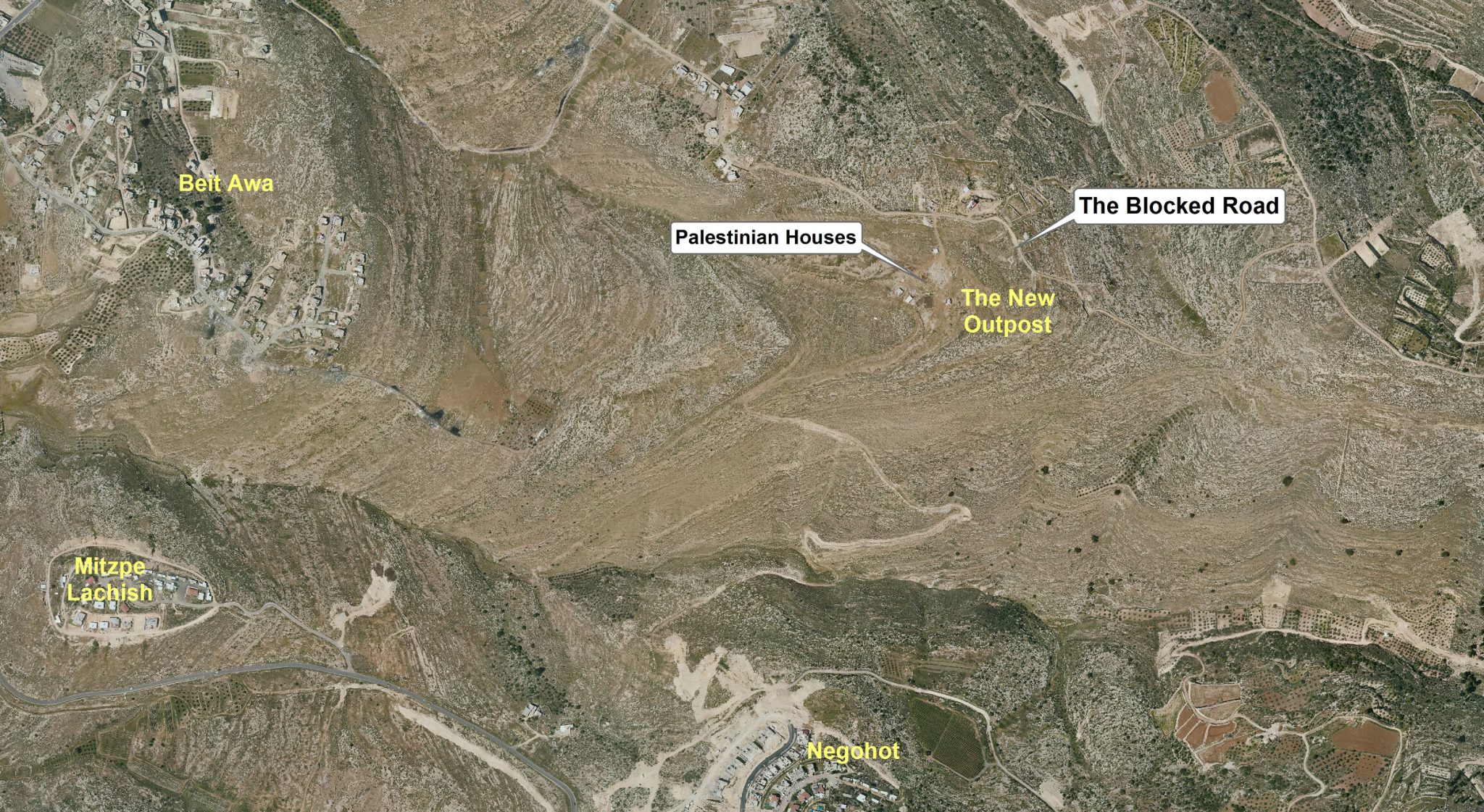 The petition seeks the re-opening of a road that leads to six homes and agricultural land, a road that has been blocked by the UDF since August 2023. Since then, Palestinians who live in those six homes have been forced to walk several hundred meters uphill with their water, supplies, and food (amongst other challenges posed by the inability to access one’s home and agricultural land by vehicle). Meanwhile, since October 7, 2023 settlers have illegally paved at least two new roads between the outpost and the Negohot settlement.
Peace Now said in a statement:
“The establishment of the new outpost has had severe consequences on the lives of Palestinians in the area. The military’s involvement with the settlers, through securing illegal activities and blocking Palestinian roads, is unbearable. Instead of halting the settlers and preventing the establishment of illegal outposts and roads in an area that affects the future of the State of Israel and regional security stability, the IDF is assisting lawbreakers. It is time to put an end to lawlessness in the territories and dismantle the illegal outposts.”
The outpost was established in July 2023 by setters from the nearby Negohot outpost. Settlers initially took over dozens of dunams of land, bulldozing and clearing th area with heavy machinery and assistance from the IDF. Since then, the outpost has evolved and grown to have many structures and a permanent settler presence. These settlers have engaged on violent intimidation and harassment of Palestinians who live and work near the outpost.
With Eyes on Gaza, Four Major Developments Regarding West Bank Antiquity Sites Targeted for Annexation by Israel
Emek Shaveh has raised concerns over recent developments at four different antiquity sites in the West Bank, explaining that these events taken together show how “processes tantamount to the weaponization of heritage in the service of settlement expansion in the Occupied Territories continue unhindered.” Details of the developments are below.
New Outpost in Battir
As FMEP has previously reported, on December 24, 2023 settlers established an illegal outpost on land near the Palestinian village of Battir (a UNESCO World Heritage Site). Emek Shaveh adds, “The new outpost established […] is situated half a kilometer from the village Battir in the core zone of the World Heritage Site. The announcement of plans to expand the Har Gilo settlement in 2022 also remains a threat to the integrity of the World Heritage site.”
Allocation of Funds for Secret “Khirbet Eqed” Site
Emek Shaveh reports that on December 31, 2023 the Knesset’s Finance Committee approved a $3.25 million (NIS 12.25 million) budget for the preservation and development of a site called “Khirbet Eqed,” located in a JNF-established Park (the Ayalon-Canada Park) in the “seam zone” area between the Israeli separation barrier and the 1967 Green Line.
Emek Shaveh explains:
“Khirbet Eqed and its environs has been excavated multiple times by Israeli archaeologists since 1976, mainly by the Civil Administration’s Staff Office for Archaeology (SOA) and Tel Aviv University. Since the construction of the separation wall east of Mavo Horon in the early 2000s, this area had been de-facto annexed both physically and, with the help of the park, also conceptually…The Ayalon-Canada Park and the investment in Khirbet Eqed is an example of a site where the process of annexation has been completed. What began with the expulsion of Palestinian communities in 1967 and was followed by the establishment of a settlement segued into the creation of a park which has been cut off from the West Bank. The latest plan takes this process to its logical conclusion with the development of the archaeological site and tourist attractions, all in service of erasing the greenline. Investment in Khirbet Eqed has the same purpose of entrenching Israeli control and normalizing tourism on Palestinian land like at multiple other sites throughout the West Bank.”
Military Activity in Bani Naim
Over the past week, Emek Shaveh has fielded many reports about increased military activity in the village of Bani Naim, where there are three antiquity sites. Bani Naim is located in Area A of the West Bank as defined by the Oslo Accords, where the IDF does not have authority to operate. Settlers have targeted at least two of these sites, located a bit south of the village, in their lobbying efforts to push the Israeli government to unilaterally seize and “safeguard.”
Government Budget Allocation Funds Settlers’ Antiquity Agenda
Emek Shaveh reports key details on the government’s December 2023 approval and allocation of $19 million (NIS 72 million) for a “Jerusalem and Heritage” program.
The approved budget and later additions include:
- $4.25millino (NIS 16 million) to promote tourism to antiquity sites in the West Bank.
- $8.8million (NIS 33 million) for a project entitled “Strengthening and Branding of Jerusalem’s Historical Basin”.
- $4.25 million (NIS 16 million) for the Shalem Plan C which is focused on the excavation, preservation and development of archaeology in the Historic Basin mainly in the archaeological park of the City of David, located in the Silwan neighborhood of East Jerusalem.
- $670,000 (2.5 million NIS) for the Sebastia plan () aimed at turning the site into a tourist stronghold with a total budget of 32 million NIS.
Knesset Caucus, Settler Leader Promises Gaza Resettlement
In early January 2024, the Knesset “Caucus to Strengthen the Awareness of Israeli Victory” held a meeting to encourage the re-establishment of settlements in Gaza. Led by MK Tzvi Succot, the caucus discussed what “victory” in the context of the current war on Gaza could look like, with applause for nearly every time a speaker mentioned resettlement.
MK Zuccot led the charge, encouraging that:
“At least in the northern Gaza Strip we first have to conquer, annex, destroy all the houses, build neighborhoods – large and expansive neighborhoods, large settlements in that place that will be named after our heroes, after the nation’s heroes who fought there. We will distribute free plots there to the soldiers who fought, to the wounded who fought. This image, and this is the most important thing, of the destroyed Gaza, of Palestine Square that will become Israeli Heroism Square, this image will echo in every home around the world so that everyone will see what happens to those who mess with the people of Israel.”
One of the figures leading the calls for the resettlement of Gaza, is settler leader Daniella Weiss who attended the caucus meeting. Weiss later claimed on X that she is planning a convoy to the northern areas of Gaza on January 11th. Weiss has said that over 1,000 Israelis are ready to move to Gaza, and called for the Israeli government to clear all Palestinians out of Gaza so that the settlers can see the sea. It is unclear at the time of publication if the convoy proceeded.
Bonus Reads
- “Editorial | Arming and Mobilizing Settlers Must Stop to End Violence Against West Bank Palestinians” (Haaretz)
- “Settlers killed a Palestinian teen. Israeli forces didn’t stop it.” (Washington Post)
Welcome to FMEP’s Weekly Settlement Report, covering everything you need to know about Israeli settlement activity this week.
To subscribe to this report, please click here.
October 6, 2023
- Smotrich Sidelines Military Legal Advisor In Order to Pursue Agenda
- Smotrich & Settlers Demand Bypass Road Near Huwara Following Latest Violence
- Israel Tightens Grip on Sebastia Site
- Settlers, Knesset Continue Push for IDF to Seize “Archaeological Site” at Mt. Ebal/El-Burnat
- The Acceleration of “Herding Outposts”, And Their Impact
- OCHA Reports on Ongoing Ethnic Cleansing of Masafer Yatta
- The JNF Is Funding Hilltop Youth
- Bonus Reads
Smotrich Sidelines Military Legal Advisor In Order to Pursue Agenda
Haaretz reports that Bezalel Smotrich has taken further steps to consolidate his governance over settlements and outposts in the West Bank by sidelining the Defense Ministry’s top military legal advisor in favor of his own hand-picked deputy legal advisor, Moshe Frucht. Prior to joining Smotrich, Frucht was a researcher at the far-right Kohelet Policy Forum, an organization that is widely understood to be the architect behind the anti-democratic judicial revolution and author of many legal opinions arguing for the legality of Israeli settlements under international law.
In recent meetings on the topic of settlements, Smotrich has gone from overruling the objections of the military advisor to excluding them from meetings altogether. One Israeli MK, Gilad Kariv (Labor), also accuses Smotrich of hiding the army’s official legal position from the Knesset in committee hearings and when discussing government decisions.
As a reminder, in February 2023 Smotrich was effectively made the ruling sovereign of Area C of the West Bank via his role as a minister in the Defense Ministry and as the head of the newly created Settlements Administration, which was given power over civilian affairs in Area C.
Smotrich & Settlers Demand Bypass Road Near Huwara Following Latest Violence
The Palestinian village of Huwara has been a focal point of violence over the past few days after a Palestinian gunman opened fire on a settler vehicle on October 5th, following repeated incidents of rock-throwing at Israeli vehicles near Huwara this week. Over the night of October 5th, hundreds of settlers – including MK Zvi Sukkot – descended upon Huwara in what they claim was an attempt to set up a Sukkah in celebration of the Sukkot holiday and in response to the attack. Settlers attacked Palestinian homes and businesses resulting in clashes with Palestinians. A 19-year old Palestinian boy, Labeeb Mohammed Dmaidi, was shot and killed while standing on the roof of his family home and allegedly throwing rocks towards the settlers and IDF soldiers. Palestinians believe a settler was the shooter.
The violence has resulted in the settlers demanding that the government complete the Huwara Bypass road, which has dragged on since construction began in 2021. Bezalel Smotrich publicly stated his support for the demand while in Huwara the day after the attacks, where he further called on Netanyahu to force Palestinian shops on Huwara’s main road to remain closed until the road is complete. Smotrich later criticized Netanyahu and Defense Minister Gallant for closing down Route 60 during the funeral procession for Dmaidi. Recall that earlier this year Smotrich said that Israel should “wipe out” Huwara.
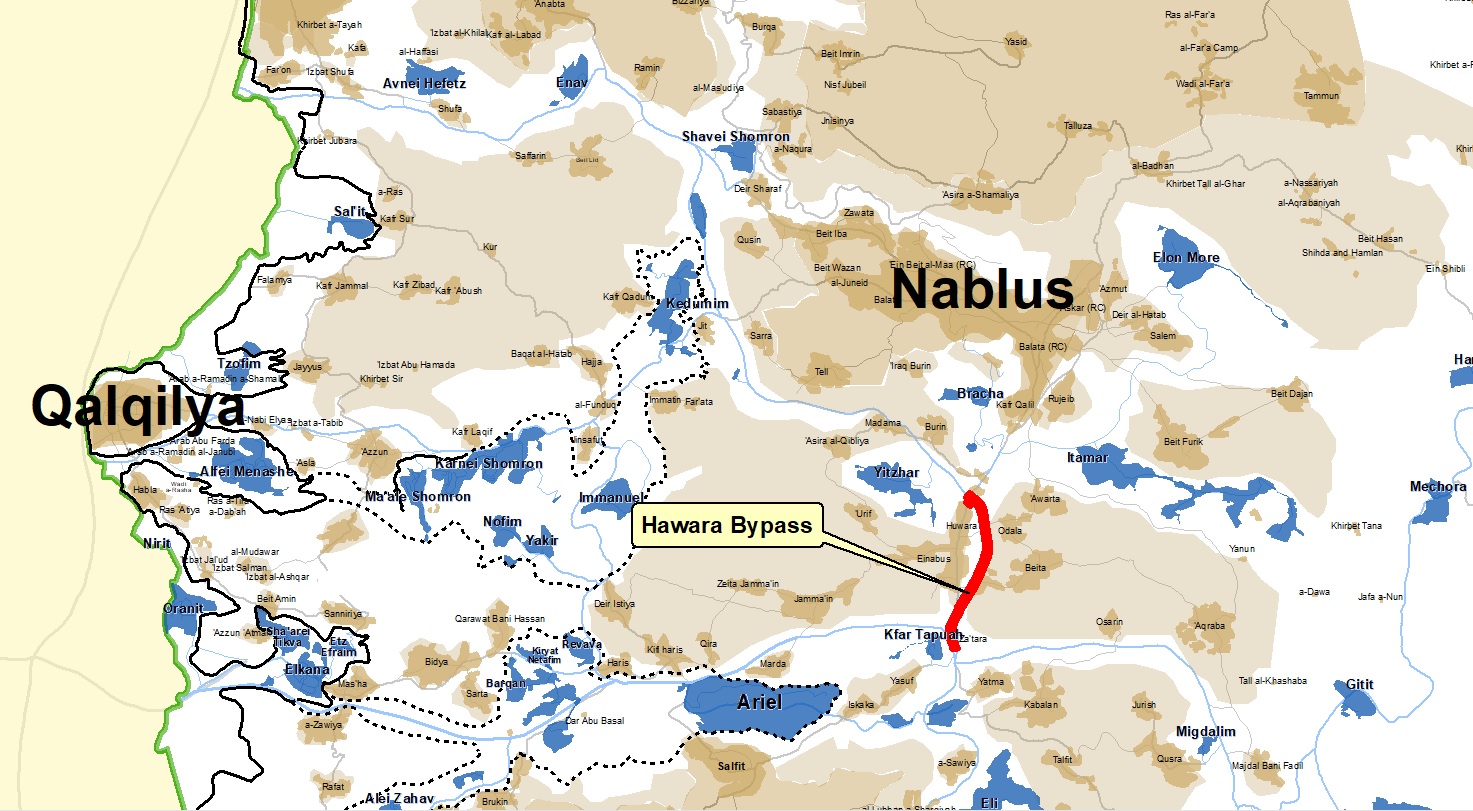 The initial shooting attack occurred on Route 60, which is used by both settlers and Palestinians as the main thoroughfare connecting central and northern West Bank. Route 60 passes through Huwwara. The bypass road is designed so that residents of Nablus-area settlements can more easily/directly access Jerusalem without driving through Huwara. Israel unilaterally expropriated private Palestinian land along the route of the road in preparation for construction.
Beyond the new demand and the possible implications it will have on the freedom of movement for Palestinians to and from Huwara, National Security Minister Ben Gvir posted on X during the settlers October 5th attack on Huwara that “”Our [Jewish Israeli] lives take priority to the Palestinians’ freedom of movement (and commerce). We’ll continue to say this truth and actively work to implement [this truth].” This is the second time that Ben Gvir has said that the rights and freedoms of Jews are more important than Palestinians.
Israel Tightens Grip on Sebastia Site
Emek Shaveh reports that on October 1st Israeli Minister for Environmental Protection, Idit Sliman, toured the archaeological site of Sebastia alongside settler leader Yossi Dagan, declaring that the land belongs to Israel. The Sebastia site is located near the Palestinian village of Sebastia, north of Nablus in the heart of the West Bank, and straddles the line designating Areas B and C, with most of the site is in Area C. The Palestinian village of Sebastia – which settlers travel through to reach the site – is in Area B entirely. During Sliman’s tour of the site the IDF sealed off all entry points to the village.
On May 7, 2023, the Israeli government approved nearly $9 million (NIS 32 million) for a project to develop and “renovate” the archaeological site of Sebastia. The project includes plans to pave a new access road for Israelis to reach the site, which they currently have to access by traveling through the Palestinian village of Sebastia.
Settlers have been openly agitating for Israel to assert control over the archaeological site in Sebastia for years, and the settler Samaria Regional Council organizes regular tours to the site. To secure the settlers’ visits, the IDF shuts down the town of Sebastia, closing Palestinian streets and businesses. As in other cases across the West Bank, settlers allege that Palestinians are damaging the Sebastia site and that the Israeli government needs to intervene. In 2021 amidst intensifying settler efforts related to the site, the Palestinian Foreign Ministry called on UNESCO to “protect all Palestinian archaeological and religious sites from Israeli violations, attacks and falsifications.” The archaeological site of Sebastia is on the tentative list of World Heritage sites in Palestine.
Emek Shaveh further explains the history and politicization of this archaeological site
“The battle over Sebastia is also played out in the narratives each side presents to the public. The informational material distributed by the PA does not include an explicit reference to the Kingdom of Israel or to the Hasmonean connection. On the other hand, in recent years the settlers have been rehabilitating the figure of Omri, a King of the Kingdom of Israel, in an effort to imbue Sebastia with greater nationalist significance. Sebastia also holds a special place in recent history for the settlers because it is the place where the leaders of Gush Emunim, the group that first fought for the establishment of settlements in the West Bank in the 1970s, celebrated the government’s agreement to establish the first settlement in the area in 1975.
In tandem with the growing campaign of recent years to apply full Israeli control over Sebastia, larger numbers of Israelis visit the site every week in buses organized by the Samaria Regional Council and accompanied by soldiers.
Sebastia, is a declared national park. National parks and nature reserves in Area C of the West Bank are managed by the Civil Administration and are referred to as “parks”. Their total area spans approximately 500,000 dunams and constitutes roughly 14.5% of Area C. Palestinians’ rights are violated in these territories through various means. In the Ein Prat Nature Reserve, for example, landowners cannot cultivate their land as their access is restricted. In Herodion National Park and Nabi Samuel, residents can neither construct nor renovate their homes.”
Settlers, Knesset Continue Push for IDF to Seize “Archaeological Site” at Mt. Ebal/El-Burnat
This week settlers have carried out daily trips to the archaeological site at Mt. Ebal, known as el-Burnat to Palestinians, located in Area B of the West Bank. On Monday, the Israeli army coordinated a trip for hundreds of Israelis to the site, but has not coordinated with settlers on their trip to the site in the subsequent days. Over the past two years, settlers have been clamoring for the army to take unilateral control over the site after the Palestinian Authority began to develop land nearby.
On October 6th, MK Son-Harmelech participated in a trip to the site and subsequently called on the government of Israel to establish a new settlement at the site (which, again, is located in Area B).
In a further show of the settlers influence and the government’s intentions with the site, Emek Shaveh reports that on September 25th a subcommittee of the Knesset’s Foreign Affairs and Defense met to discuss accusations (which have proven to be false yet are weaponized by settlers) that the Palestinian Authority has recklessly damaged and is attempting to destroy the site. Emek Shaveh explains: “The reports and the special subcommittee session are part of an orchestrated attempt by the settlers and their representatives in the Israeli parliament to use antiquity sites as a ruse for advancing annexation.”
At the hearing, the Civil Administration’s Head of Infrastructure, Lieutenant Colonel Adam Avidan, acknowledged that the site is in Area B where the IDF has limited authority. He also said the IDF constructed an observation tower to monitor Palestinian activity at the site. Avidan also explained that the IDF had summoned the Palestinian village leader to warn him not to conduct any construction work at the site, showing a map that marked the borders (reminder that the IDF does not have any authority over antiquity sites in Areas A or B).
Mt.Ebal/el-Burnat is purported to be an antiquity site where the biblical prophet Joshua built an altar, originally identified as such in the 1980s by an Israeli archaeologist though the majority of professional archaeologists do not support that conclusion. Emek Shaveh, an Israeli NGO with expertise in archaeology, called the settler campaign to seize Mt. Ebal as a “watershed in Israeli archaeology.” In July 2023, Emek Shaveh reported that a triad composed of settlers, an American Christian evangelical organization, and the Israeli army collaborated on a recent unlicensed excavation on Mount Ebal, which Emek Shaveh called antiquity theft. Further, the groups transferred some 80 cubic meters of soil from Mount Ebal to the Shavei Shomron settlement, where settlers then promoted an opportunity for members of the public to join the archaeologists in sifting through the materials (thereby promoting tourism to the settlements). Haaretz called the excavation “is mainly used as a tourist attraction to the West Bank and is of little scientific significance.”
Emek Shaveh’s explained the significance of what is happening on Mount Ebal:
“The archaeological site at Mount Ebal is becoming a watershed in Israeli archaeology. The activity on the site has turned from a pirate operation led by a group of Messianic Jews and Christians into a state sponsored operation under the auspices of the Civil Administration led by Minister Bezalel Smotrich.This is yet another violation of the Oslo Accords and suspected violation of domestic and international law that is whitewashed by Israeli authorities and intended to serve as a method for advancing the annexation of the West Bank to Israel.In addition to the alleged violation of the law, the excavation constitutes an ethical failure by the entire archaeological community in Israel whose silence continues to grant legitimacy to such projects. A comprehensive and immediate investigation is required by all the relevant parties as well as independently by the Israeli Archaeological Association.”
The Acceleration of “Herding Outposts”, And Their Impact
On October 3rd The New York Times published an article describing the impact of so-called herding outposts on the battle for control over land in the West Bank, highlighting reporting from Kerem Navot that shows how settlers have been establishing herding and farming outposts as a way to coerce the displacement of Palestinians and assert control a maximal amount of land with a minimal number of Israeli settlers.
That 20 new herding outposts have been established so far this year, showing how this tactic has accelerated since 2018 when settlers began to strategically focus on herding outposts as an effective mechanism. Three Palestinian herding communities have been displaced from their lands this year, largely in fear of nearby settlers.
The Times reports:
“The Israeli settlers’ stated intention is to chip away at wide expanses of land that the Palestinian leadership, at the advent of the Oslo peace process 30 years ago, hoped would form the territorial spine of a future Palestinian state. ‘It’s not the nicest thing to evacuate a population,’ said Ariel Danino, 26, an Israeli settler who lives on an outpost and helps lead efforts to build new ones. ‘But we’re talking about a war over the land, and this is what is done during times of war’.”
In a 2022 report on this herding phenomenon, Kerem Navot explains:
“…the development of Israeli sheep and cattle grazing in the West Bank, […] has gradually become Israel’s most significant mechanism for dispossessing Palestinian communities. At issue are tens of thousands of acres of open areas expropriated by the Israeli authorities and settlers through dozens of shepherd outposts and farms, the great majority of which have been established over the past decade. The use of grazing to seize land began in the early 1970s and continued intermittently in the 1980s and 90s. In recent years, however, the phenomenon mushroomed in terms of area size, investments, and the destructive repercussions for Palestinian communities.
The declared objective of the farm outposts is to “protect state lands”. In practice, however, they are designed to uproot Palestinian grazing and farming communities from public or private lands, and turn them into lands that only settlers can use. To promote this objective, one instrument must be used above all others: violence. Indeed, the farm outposts have recently seen some of the most violent incidents in the West Bank. It is no wonder that the uprooting of people from their lands, often also their ancestral lands, requires severe and ongoing violence. Accordingly, countless incidents involving threats, harassments, and assaults on Palestinian farmers and shepherds have occurred around these outposts in recent years, often in the presence and full support of military or police forces.
These outposts are the spearhead of a violent land-grabbing system, well planned and generously funded by various state and quasi-state bodies. These include the military, the Israeli Civil Administration (of the West Bank), regional and local councils, the World Zionist Organization’s Settlement Division, the Ministries of Agriculture and Education, and the new Ministries of Settlement and Intelligence. All are preoccupied with what has recently been referred to as the “Battle for Area C”, meaning the coercive transfer of Palestinians from the area, which represents 61% of the total area of the West Bank, and their enclosure in isolated enclaves.”
OCHA Reports on Ongoing Ethnic Cleansing of Masafer Yatta
 In a new report, OCHA OpT reports that over the past three months, 13 Palestinian families (84 individuals, 44 of which are children) have been forcibly displaced from the homes and grazing lands in the Masafer Yatta region in the South Hebron Hills.
OCHA reports:
“Over the years, and increasingly since May 2022, the Israeli authorities have imposed movement restrictions, confiscated property, demolished homes, and carried out military trainings in Masafer Yatta. Jointly, these practices have contributed to a coercive environment that has pressured residents to move out. In the past three months, movement restrictions have further intensified. Operating from a newly established military base, Israeli forces now patrol the area more frequently, further restricting people’s movement and access to markets and basic services, as well as the shipment of fodder and other inputs for livestock, on which most families rely. They have additionally confiscated vehicles used by residents. Two schools in the area report that 24 students have dropped out this year, including pupils whose families have left amid this coercive environment, and others who fear the unsafe journey to school. In one incident, in September, Israeli forces stopped teachers who were travelling to work and threatened to seize their vehicle if they used it again.”
The JNF Is Funding Hilltop Youth
Haaretz reports that the Jewish National Fund has givn $1million over the past two years to organizations which are involved in the construction of illegal outposts, specifically to support a project aimed at the “Hilltop Youth.” The funding is meant to offer professional training for young high school drop outs living in illegal WEst Bank outposts.
In response the this revelation, the Haaretz Editorial Board writes:
“The Jewish National Fund is continuing to bolster its role as a key player in the settlement enterprise and its accompanying looting and dispossession of the Palestinians in the West Bank, in preparation for a future annexation. Like all other settlement players, JNF too seems to view all means as kosher. And if they aren’t kosher, then they’ll be koshered retroactively in the future, after the settlers finish their takeover of Israel. Over the last two years, the Jewish National Fund has invested 4 million shekels in a project to rehabilitate teen dropouts living on farms and herding outposts in the West Bank. The money, which was meant to fund professional training for teens, is passed on to organizations that encourage the establishment of illegal settlement outposts….. the occupied territories aren’t the periphery, and “agricultural farms” in the West Bank lie outside Israel’s borders. And judging by its response, JNF is indifferent to their illegality. “The JNF is active in educational programs and does not deal with the legal status of these farms,” it said. In practice, it is directing at-risk youth to join the settlers’ extremist “hilltop youth.” Like all of Israel’s other national institutions, JNF completed its national mission once the state was established and should have been closed at that time. This is doubly true now that it has become the Settlement and Annexation National Fund.”
Bonus Reads
- “How to establish a new settlement without the world noticing” (+972 Magazine)
- “Settler violence is fueling the effects of climate breakdown on Palestinians” (+972 Magazine)
- “West Bank Dispatch: Settlers escalate harassment campaign, while army targets more resistance groups” (Mondoweiss)
- “Biden and Europe Beware: Your Silence on Israel’s Annexation Strengthens Putin” (Haaretz)
- “PA police extract 5 tourists mobbed after illegally entering Joseph’s Tomb in Nablus” (The Times of Israel)
- “How Israel uses settler violence to displace Palestinians” (The New Arab)
- “Why I spent Yom Kippur protecting Palestinian villagers from settler violence” (JTA News)
- ”Analysis | Israeli Far Right’s Ambitious West Bank Plan Could Be Saudi Deal’s Achilles’ Heel” (Amos Harel in Haaretz)
Welcome to FMEP’s Weekly Settlement Report, covering everything you need to know about Israeli settlement activity this week.
To subscribe to this report, please click here.
September 8, 2023
- Israel Establishes Official Borders for Three Outposts
- IDF Demolishes Illegal Settler Structures Near Yitzhar
- Settler Leader Pushes Campaign to Seize Mt. Ebal, Located in Area B
- New Civil Admin Head Nominated, Without Input or Approval of Smotrich
- Real Estate Developer Files Suit Against Settlers, IDF
- Blistering New UN Report Calls Israeli Occupation Illegal & Calls for Reparations
- Settler Terrorism as a Means of State-Sanctioned Ethnic Cleansing
- Bonus Reads
Israel Establishes Official Borders for Three Outposts
On September 6th, the head of the IDF signed a military order establishing municipal borders for three outposts – Avigail, Asa’el, and Beit Hogla – a significant step towards the retroactive legalization of the outposts, which was directed by the Israeli government in February 2023 (along with five others). The Avigail and Asael outposts are located in the South Hebron Hills; the Beit Hogla outpost is south east of Jericho.
The next step in the legalization of the outposts is creating a masterplan to designate the area for residential construction, so that the existing buildings can be granted retroactive legalization and future building can commence planning.
Bezalel Smotrich (who is effectively governor of the West Bank in his capacity as a minister within the Defense Ministry) celebrated this step towards legalization of the outposts, saying:
“Great things are happening in the settlements, and the nationalist government is advancing right-wing, Zionist and nationalist policies that see the development of the settlements in Judea and Samaria as an asset to the State of Israel,”
Peace Now said in a statement:
“The annexation has for a long time stopped creeping. The Israeli government led by Netanyahu and Smotrich has officially decided to promote with all its vigor the annexation of the West Bank. The decision of the commander of the IDF Central Command regarding the municipal boundaries is yet another step in this process. Not only is the State of Israel promoting more settlements, which do great damage to Israelis and Palestinians, it is also giving each settlement a huge and disproportionate area for its boundary jurisdiction…The main goal of the regime and the messianic [judicial] coup is to enable such processes, and to import the reality of apartheid in the [West Bank] territories into the territory of the State of Israel,” it added. “Anyone who opposes the regime coup must oppose this process that will lead us to the end of the State of Israel as a democratic and Jewish state.”
Reported last week, the Israeli non-profit Kerem Navot says that the proposed new boundary of the Asa’el settlement is eighteen times larger than the outpost, which currently has 71 (illegal, even under Israeli law) buildings. The boundary of the Avigail settlement is nearly three times the size of the outpost.
The Avigail outpost, currently composed of 48 buildings, is located in Firing Zone 918 in the South Hebron Hills. This is the same firing zone that is home to the Palestinian communities of Masafer Yatta — whose existence pre-dates Israel’s declaration of the area as a firing zone. Those communities are today in the process of being ethnically cleansed by Israel. Both Avigail and Asael have, illegally, built access roads on privately owned Palestinian land. Legalization of the Avigail outposts will undoubtedly also include the theft of the Palestinian-owned land these roads were illegally built on.
The Beit Hogla outpost is located in the Jordan Valley near the Dead Sea, and has 22 buildings currently.
IDF Demolishes Illegal Settler Structures Near Yitzhar
On September 4th, an estimated 150 Israeli soldiers and police arrived on land near the radical Yitzhar settlement to forcibly remove settlers and demolish three illegal structures. One of the structures, described as a lookout point, was located in Area B, while two others were built on land that the Oslo Accords designated as Area C. The Times of Israel reports this is only the third time the current government has carried out a demolition order against illegal settler construction.
Settlers expressed fury following the demolition of the structures, which settlers say were constructed in the memory of Rina Schnerb – an Israeli settler who was killed by a bomb placed by a Palestinian at a West Bank spring. The fury, almost entirely, was directed at Bezalel Smotrich who is single handedly responsible for overseeing demolition actions in Area C of the West Bank.
Settler Leader Pushes Campaign to Seize Mt. Ebal, Located in Area B
Yossi Dagan, head of the Samaria settlement council and a prominent leader, went on Israeli TV to push the government to unilaterally annex the area of Mt. Ebal in the northern west bank, known as el-Burnat by Palestinians. Mt. Ebal/el-Burnat is located in Area B of the West Bank, some 22% of the West Bank that the Oslo Accords does not afford Israel control over civilian matters like archaeology. Dagan alleges that the Palestinian Authority is “systematically trying to destroy the heritage sites of the Jewish people.” As FMEP has chronicled, settlers and their allies are intent upon using claims of Palestinian damage/neglect as a pretext for Israel taking control of archaeological sites and artifacts across the West Bank.
Dagan pushed for action, saying:
“I am very upset because we will not be able to chase the mosquitoes. We need to dry up the swamp. The Israeli government must regain full control over Joshua’s Altar on Mount Ebal. It must fence it and place a guard there. Netanyahu said two years ago that we would place a guard there and I expect that the promise will be kept and a guard will be posted. No nation would accept a situation where its most important heritage sites are abandoned to systematic destruction and looting.”
Mt.Ebal/el-Burnat is purported to be an antiquity site where the biblical prophet Joshua built an altar, originally identified as such in the 1980s by an Israeli archaeologist though the majority of professional archaeologists do not support that conclusion. Emek Shaveh, an Israeli NGO with expertise in archaeology, called the settler campaign to seize Mt. Ebal as a “watershed in Israeli archaeology.” In July 2023, Emek Shaveh reported that a triad composed of settlers, an American Christian evangelical organization, and the Israeli army collaborated on a recent unlicensed excavation on Mount Ebal, which Emek Shaveh called antiquity theft. Further, the groups transferred some 80 cubic meters of soil from Mount Ebal to the Shavei Shomron settlement, where settlers then promoted an opportunity for members of the public to join the archaeologists in sifting through the materials (thereby promoting tourism to the settlements). Haaretz called the excavation “is mainly used as a tourist attraction to the West Bank and is of little scientific significance.”
Emek Shaveh’s explained the significance of what is happening on Mount Ebal:
“The archaeological site at Mount Ebal is becoming a watershed in Israeli archaeology. The activity on the site has turned from a pirate operation led by a group of Messianic Jews and Christians into a state sponsored operation under the auspices of the Civil Administration led by Minister Bezalel Smotrich.This is yet another violation of the Oslo Accords and suspected violation of domestic and international law that is whitewashed by Israeli authorities and intended to serve as a method for advancing the annexation of the West Bank to Israel.In addition to the alleged violation of the law, the excavation constitutes an ethical failure by the entire archaeological community in Israel whose silence continues to grant legitimacy to such projects. A comprehensive and immediate investigation is required by all the relevant parties as well as independently by the Israeli Archaeological Association.”
As a reminder, on July 17th the Israeli government approved a three-year $33 million (NIS 120 million) plan to take control over archaeological sites throughout the West Bank, including plans to establish 4-7 new settlement tourist sites. The $33million budget came in addition to $9 million dollars in funding that the government approved in May 2023 to develop and “renovate” the archaeological site of Sebastia, located near the Palestinian village of Sebastia, north of Nablus in the heart of the West Bank. The project includes plans to pave a new access road for Israelis to reach the site, which they currently have to access by traveling through the Palestinian village of Sebastia, which will increase and entrench Israeli control not only over the site itself but the surrounding area – effectively weaponizing archaeology as a tool for dispossession.
In January 2021, the Israeli government committed funding to a new settler initiative to surveil archeological sites under Palestinian control. While the objective of protecting antiquities might appear uncontroversial and apolitical, the true (and transparently self-evident) objectives behind this effort are: to support yet another pretext to surveil and police Palestinians; to establish and exploit yet another means to dispossess Palestinians of their properties; to expand/deepen Israeli control across the West Bank; and to further entrench Israeli technical, bureaucratic and legal paradigms that treat the West Bank as sovereign Israeli territory. It is the result of a campaign that has taken place over the past year in which settlers have escalated their calls for the Israeli government to seize antiquities and “heritage sites” located in Palestinian communities across the West Bank, especially in Area C, which Israel today treats as functionally (and legally) indistinguishable from sovereign Israeli territory. Funding committed by Israel for West Bank “heritage sites” should be understood in this context
Previous victories for the settlers in this same arena include the Israeli Civil Administration’s issuance in 2020 of expropriation orders – the first of their kind in 35 years – for two archaeological sites located on privately owned Palestinian property northwest of Ramallah. The settlers’ pressure is also credited as the impetus behind the government’s clandestine raid of a Palestinian village in July 2020 to seize an ancient font.
In June 2020, the “Guardians of Eternity” group began surveying areas in the West Bank that Israel has designated as archaeological sites, looking for Palestinian construction (barred by Israel in such areas) that they could then use as a pretext to demand that Israeli authorities demolish it. The group communicates its findings to the Archaeology Unit of the Israeli Civil Administration (reminder: the Civil Administration is the arm of the Israeli Defense Ministry which since 1967 has functioned as the de facto sovereign over the West Bank). The Archaeology Unit, playing its part, then delivers eviction and demolition orders against Palestinians, claiming that the structures damage antiquities in the area.
And one more reminder: in 2017, Israel designated 1,000 new archaeological sites in Area C of the West Bank. The “Guardians of Eternity” group, not coincidentally, is an offshoot of the radical Regavim organization, which among other things works to push Israeli authorities to demolish Palestinian construction (on Palestinians’ own land) that lacks Israeli permits (permits that Israel virtually never grants).
New Civil Admin Head Nominated, Without Input or Approval of Smotrich
On September 3rd,, the IDF Chief of Staff appointed Brig. Gen. Hisham Ibrahim as head of the Civil Administration, the body within the Israeli Defense Ministry which acts as administrator of the occupation. The appointment was made without the approval of Bezalel Smotrich, who wields virtually unchecked power over civilian matters in Area C of the West Bank as a minister within the Defense Ministry and head of the “Settlements Administration” and as entitled to appoint the Deputy Chief of the Civil Administration.
Israel Hayom further reports that Smotrich recommended his own candidate for the post, but was rebuffed by Defense Minister Gallant and the head of the IDF.
Real Estate Developer Files Suit Against Settlers, IDF
Haaretz reports that the Union Construction and Investment company has filed a $5.2million lawsuit with the Tel Aviv District Court against six settlers, the IDF, and Israeli police – a lawsuit which documents 74 raids by Israeli settlers into the land and construction site the company is developing in the Palestinian village of Turmus Ayya in the northern West Bank. The company is owned by Palestinian-Canadian Khaled Al-Sabawi, who purchased land in Turmus Ayya in 2019, planning to build a housing project on the land.
The lawsuit alleges that settlers damaged the construction site in 26 separate incidents, which include damaging construction equipment and physical attacks on the company’s employees and clients. The settlers also have been repeatedly video-taped intimidating Palestinian workers and clients who go to the site, telling them “This isn’t your land,” “You can’t be here,” “If you love your children, don’t bring them here.” The Israeli police and IDF are accused in the lawsuit of failing to stop the settlers’ violence.
One of the six defendants is Elisha Yered, a well-known, radical, and violent settler who has been repeatedly in the news cycle, most recently for his involvement in the murder of Qosai Jammal Mi’tan in Burqa. Yered lives in the outpost of Ramat Migron in the northern West Bank, and is under ongoing investigation following his arrest in August 2022 for “racist conspiracy” — amongst other charges for crimes against Palestinians. Yered also serves as the spokesman for Otzma Yehudit lawmaker Limor Son Har-Melech.
Al-Sabawi – represented by prominent human rights lawyer Michael Sfard and Hussein Abu Hussein – told Haaretz that he is suing for $5.2 million in damages the company incurred due to the settlers attacks, saying that because of the settlers he cannot sell the properties and some of his clients have even asked for refunds.
The six settlers listed in the lawsuit have filed a response, claiming that their actions are legal forms of protest, that the statute of limitations has expired, and that the development is located in Area B where the Israeli court does not have jurisdiction.
Blistering New UN Report Calls Israeli Occupation Illegal & Calls for Reparations
On August 30th, the United Nations Committee on the Exercise of the Inalienable Rights of the Palestinian People (CEIRPP) released an exhaustive 106-page report on the conduct of Israel in the occupied Palestinian territories, concluding that the occupation is illegal and that “reparations should be accorded to… Palestinian individuals, corporations & entities, for the generational harm caused by Israel’s land & property appropriations, house demolitions, pillage… denial of return & other war crimes & crimes against humanity.” The report calls for the immediate, unconditional and total withdrawal of Israel’s military forces; the withdrawal of colonial settlers; and the dismantling of the military administrative regime” and more.
Former UN Special Rapporteur on PalestineMichael Lynk called the report:
“the most comprehensive, the most detailed, the most thorough documentation addressing the questions that the UN General Assembly has put before the International Court of Justice regarding its advisory opinion on the legality of Israel’s now over 56-year occupation of Palestine.”
Settler Terrorism as a Means of State-Sanctioned Ethnic Cleansing
There have been several must-read articles detailing how settler violence towards Palestinian herding communities amounts to ethnic cleansing. FMEP recommends reading:
- “The End of Widady” (Jewish Currents)
- “Settlers Have a Very Effective System for Forcing Palestinians Out of Their Homes” (Avishay Mohar for Haaretz)
- “Israeli Settlers Target the Weakest Link as Ethnic Cleansing Becomes Policy” (Gideon Levy for Haaretz)
Bonus Reads
- “Important Update on the 6 Homes at Risk of Imminent Demolition in Al-Walaja (East Jerusalem)” (Ir Amim)
- “’There Is an Apartheid State Here’: Ex-Mossad Chief on Israel’s West Bank Occupation” (Haaretz)
- “Far-right activists in Ma’ale Adumim try to curb Palestinian presence in settlement” (The Times of Israel)
- “The Druze ‘Hilltop Youth’: Young men building illegal outposts on Mount Carmel” (Arutz Sheva)