Welcome to FMEP’s Weekly Settlement & Annexation Report. To subscribe to this report, please click here.
April 17, 2026
- WEST BANK: 34 New Settlements
- EAST JERUSALEM: Demolitions and Evictions in Silwan, Eviction in Old City, First Jerusalem Outpost
- STATE-BACKED SETTLER TERRORISM
- BONUS READS
WEST BANK
Unprecedented: Israel Approves 34 New Settlements

This is the largest number of settlements ever approved at one time. Since Netanyahu came back to power in 2022, his government has approved the establishment of 103 settlements. Before 2022, there were 127 official settlements, meaning that over the past 4 years the Netanyahu government has increased the number of settlements by 80%.
According to media reports (the Cabinet has not published official information), the new settlements are located across the entire West Bank. Notably:
- Six new settlements will be established in isolated areas of the northern West Bank encircling the Palestinian city of Jenin. There is not currently any Israeli presence in at least five of these areas, meaning these settlements will bring with them significant new infrastructure and military presence to serve and protect the settlements. When the Israeli Cabinet met to consider and approve the 34 new settlements, its reported that IDF Chief of Staff Lt. Gen. Eyal Zamir warned the lawmakers that the IDF does not have enough manpower to meet the needs posed by 34 new settlements, and that the IDF could potentially collapse.
- Seven new settlements are slated for the Jordan Valley
- Six new settlements in the South Hebron Hills area, 3 of which are slated for firing zones.
- 8 of the new settlements will be built on land that Israel recognizes as privately owned by Palestinians.
- Only 15 of the settlements are slated to be built on land that Israel has declared “state land,” meaning that eleven settlements will be built on land without clear legal status.
- All of the new settlements are located in Area C.
Peace Now said in a statement:
“The government has gone into a frenzy ahead of the elections, seeking to create as many facts on the ground as possible and leave Israel with scorched earth. Today it is already clear to everyone—and the IDF emphasizes this again and again—that the establishment of settlements harms security, places an abnormal burden on the IDF, and undermines the possibility of resolving the conflict and achieving any future security and peace.”
Israeli settlement expert Shaul Arieli posted on X:
“…32 of the 34 settlements are planned outside the route of the existing security barrier. This exposes the gap between the security rationale long presented to the public and the reality on the ground. If the barrier was built to ensure security, why insist on expanding settlement activity beyond it? The answer is clear: ideology, not security, lies at the heart of this policy. It should also be emphasized that these locations remain approximate, as no official map has been published and no final coordinates have been determined. This ambiguity is hardly incidental; it enables the advancement of far-reaching policies away from public scrutiny, avoiding real-time criticism.”
EAST JERUSALEM
Ethnic Cleansing of Silwan Continues with Demolitions and Evictions
On March 30th, Israel demolished four Palestinian buildings in the Al-Bustan section of Silwan – displacing 16 people and damaging other houses in the area. During the demolitions, Israeli inspectors said 10 more demolitions will happen in the coming weeks, and another 30 demolitions are planned for later this year. That would conclude the demolition of the entire neighborhood; Israel plans to build a settler-run archaeological park called “King’s Garden” on the ruins of Palestinian homes.
Ir Amim writes:
“These expulsions are part of an unprecedented escalation in forced displacement from Silwan that is tantamount to forcible transfer and involves multiple state institutions and entities working in collusion with settler groups and reinforced by a complicit judiciary. The amount of resources being allocated and deployed to carry out these measures during an ongoing war underscores the Israeli government’s resolve to exploit the circumstances to accelerate forcible transfer and solidify an irreversible apartheid reality. As detailed in a forthcoming Ir Amim report, a web of state and local authorities, statutory bodies, and laws converge into a single coordinated, multi-layered system of state-orchestrated dispossession and displacement of Palestinians in East Jerusalem, in flagrant violation of international law.”
In a report on Silwan, B’Tselem writes:
“Silwan lies within what is also known as the Holy Basin, which includes the Muslim and Christian quarters of the Old City, Sheikh Jarrah, aTur (Mount of Olives), Wadi alJoz, Ras al‘Amud and Jabal alMukabber. Due to its geographic location, Silwan is rich in archaeological and historical sites, which Israel uses to justify planning and zoning policies that restrict Palestinian development and promote Israeli control in the area. Declaring land as a national park, archaeological site or nature reserve serves, in practice, as a tool for dispossessing Palestinian residents of their land. Moreover, the development of these areas as heritage sites is carried out in close cooperation with far-right civil society organizations, particularly Ateret Cohanim and Elad. This joint effort serves a clear political objective: creating a Jewish strip of territory that severs the contiguity of Palestinian neighborhoods in East Jerusalem and cuts them off from the rest of the West Bank.”
First Jerusalem-Area Outpost
Settlers have erected the first ever outpost within Israel’s expanded municipal borders of Jerusalem, on lands between the bedouin village of Nu’uman and Umm Tuba.
Haaretz reports the settlers behind the new outpost are a group of teenagers, and while the outpost is currently one large tent the settlers have begun clearing roads. These settlers have already established a pattern of violence, and have launched at least one attac on nearby Palestinian villages – after which the IDF arrested four Palestinians and zero settlers. The settlers also attack Palestinians who have approached their outpost hilltop. Their violent presence has already limited the ability of Palestinians to graze their livestock in the area.
Eviction of Elderly Family in the Old City
The Jerusalem Magistrate Court has ruled that 12 elderly members of the Palestinian Basha family must vacate their home in the Old City, where their family has lived since the 1930s, by April 26th. The State of Israel initiated the eviction case in 2018, arguing that the property belongs to a Jewish religious endowment. The state filed the lawsuit in cooperation with the Ateret Cohanim settler organization.
Mufid Basha told Haaretz: “We have nowhere to go. This is where I was born, and so were all my siblings.”
Peace Now said in a statement:
“This is an injustice that cries out to heaven. While hundreds of thousands of Israelis live securely in properties that belonged to Palestinians before 1948, the law in East Jerusalem allows Palestinians to be dispossessed of homes that belonged to Jews before 1948. The government has established a mechanism for the dispossession and expulsion of Palestinians in East Jerusalem, and the General Custodian, a governmental body, has become a central executive arm of this policy. In addition to dozens of eviction lawsuits filed in recent years against Palestinians, the Custodian has also initiated and advanced plans for new settlements within Palestinian neighborhoods in Jerusalem.”
STATE-BACKED SETTLER TERRORISM
State-backed settler terrorism has continued at an alarming rate of 10 incidents per day since the start of the Israeli-U.S. war on Iran. Key incidents over the past three weeks include:
- Tayasir: On April 9th settlers attacked the Palestinian village of Tayasir,resulting in the murder of one Palestinian, Alaa Khaled Sbaih. This deadly attack is the latest in a string of settler attacks on Tayasir, with settlers injuring Palestinians and setting homes, vehicles, and buildings on fire. Settlers attacked a CNN crew who was documenting their attacks on Tayasir. On April 1st, before the murder of Sbaih, eight families from Tayasir decided to leave their homes and village under the coercive threat of settler violence.
- Deir Jarir: Settles attacked the Palestinian village of Deir Jarir on April 11th, opening fire on Palestinians who attempted to deter them. One Palestinian, Ali Majed Hamadneh (23), was killed by settler fire as he ran away from the settlers.
Further reading on settler terrorism:
- “Israeli Settler Violence: A Strategy to Displace Palestinians from their Land” (Arab Center DC, 4/10/2026)
- “After uprooting Palestinian hamlets, extremist settlers set sights on purge of entire West Bank” (The Times of Israel, 3/31/2026)
- “A strategy ‘to make life intolerable’: Israeli settlers are driving Christians out of West Bank” (The Guardian, 4/5/2026)
- “Political Pressure on IDF High Command Hampers Enforcement Against Settler Violence, Source Says” (Haaretz, 3/31/2026)
- “It’s Time for Trump to Understand: Israel’s Government Won’t Stop Jewish Terror in the West Bank” (Haaretz Editorial, 3/29/2026)
- “Amir Survived a Settler’s Bullet Once. This Time, They Shot Him Through the Heart – in Front of His Father” (Haaretz, 3/27/2026)
- “Israeli Settler Violence Is So Out of Control Even Western Activists Can’t Stop Them” (Jerusalem Post, 4/16/2026)
BONUS READS
- “After Expelling 120 Families, Israeli Settlers Turn Stream Into Holiday Attraction” (Haaretz, 4/12/2026)
- “On the Brink: The Forced Displacement Crisis Facing Bedouin Communities in the Naqab” (Adalah, March 2026)
- “Israeli policies pose an existential threat to Palestinians in the West Bank. Why isn’t there more resistance?” (Mondoweiss, 3/31/2026)
- “US Sanctions: Criminalizing Palestinian and Global Justice Work” (Al-Shabaka, 3/31/2026)
- “‘It’s Treason’: He’s a Founder of Israel’s Settlements. He’s Horrified by the Rise of Jewish Terror” (Haaretz, 4/9/2026)
- “No permit, no work, no future: inside the lives of West Bank workers crushed by Israel’s labor ban” (Mondoweiss, 4/16/2026)
Welcome to FMEP’s Weekly Settlement & Annexation Report. To subscribe to this report, please click here.
March 27, 2026
- WEST BANK: Five New Outposts, Cabinet Approves Legalization of 30 Outposts, 972 Investigations Shows Area B Strategy Unfolding, 19 Billion for Settlements Since 2023, Weaponization Continues
- EAST JERUSALEM: 15 Families Dispossessed in Silwan
- STATE-BACKED SETTLER TERRORISM: Settlers Organze Multi-Day Terror Campaigns
- BONUS READS
WEST BANK
Overnight, Settlers Establish Five New Outposts, Killing One Palestinian Who Tried to Stop Them
Haaretz reports that on the night of March 26 settlers established five new outposts, four of which are located in Area A (some ~18% of the West Bank). Later reports suggest the IDF has already demolished all five outposts.
When approximately 40 settlers invaded land in the Palestinian village of Tayasir, settlers fired at Palestinians who came out to stop them from establishing an outpost, killing Mohammad Faraj Al-Malhi, a 27-year-old resident of East Jerusalem. Clashes at the sites of the other outposts resulted in the injury of 14 additional Palestinians. Settlers had attacked Tayasir just one day prior, firing at Palestinians
Kerem Navot founder Dror Etkes told Haaretz:
“Establishing four outposts in Area A is unprecedented by any measure, and shows the extent to which the State of Israel has lost control not only over settlers in the West Bank, but also over the army, the police and other authorities meant to enforce the law. The establishment of four outposts in a single night is an extreme event with very few precedents in the history of settlements.”
Cabinet Approves “Legalization” of 30 Outposts
The Israeli Security Cabinet reportedly approved the retroactive legalization of 30 outposts across the West Bank. The approval came during the same meeting when IDF Chief of Staff Zamir informed the Cabinet of growing settler violence. There no details on which 30 outposts were affected.
972 Investigation: Settlers Systematically Expanding Control Into Areas A & B
In an investigation with The Nation, 972 Magazine chronicles how settlers, having effectuated the de facto annexation of Area C of the West Bank, are now in the process of “methodically breach[ing] the borders of Area B…[where] settler outposts are being strategically used to seize land and drive Palestinian communities out — with the backing of the Israeli army and police. Palestinian communities on the outskirts and margins of Area B towns are being pushed inward, to the centers of these localities. Land on these margins is incrementally taken over through the construction of outposts, the carving of roads, and the declaration of military zones. The effect is a fragmented landscape in which communities are cut off from one another and from agricultural land essential to their livelihoods.”
The investigation, which focuses on the experiences of 12 Palestinians communities, reports the results of settlers’ shifting focus:
“Since October 7, settlers have worked in tandem with the Israeli army to expel at least 76 entire Palestinian communities, while settlers have simultaneously established 152 new outposts. Among these outposts, at least 22 have been established in Area B, including 12 in the “Agreed-Upon Reserve” (a plot of 167,000 dunams in the southern West Bank that is designated as Area B). One outpost has also appeared inside Area A.
According to mapping by +972 Magazine, Local Call, and The Nation, based on data collected by the Israeli organizations Kerem Navot and Peace Now, the settlers living in these outposts have taken control of around 98,000 dunams (almost 25,000 acres) in Area B and Area A. In total, settlers living in outposts now wield effective control over roughly 1 million dunams (250,000 acres) across the West Bank.”
Netanyahu Government Has Allocated 19 Million for Settlements
Peace Now reports that since returning to power in late 2022, the Netanyahu government has allocated NIS 19 Billion to the settlement enterprise. Peace Now details the expenditures in depth in their report, which you can read/download here.
Continued Escalation of Archaeology as Means of Dispossession
State and settler focus and seizure of archaeological sites continues to expand in scope and intensity. As settlers and the state now routinely make incursions into and exercise authority over Area B of the West Bank, Palestinian communities living near/amongst ancient sites are coming under increasing pressure.
Emek Shaveh documents the following incidents since Israel and the U.S. launched a war on Iran:
- Tel Aroma/Jabel Urma: Located south of Nablus and adjacent to the Palestinian town of Beita (Area B), this antiquity site has become the focus of nearby settlers who have tried to establish an outpost at the site though it was dismantled. Settlers nonetheless continue to raid the site and harass Palestinians.
- Marajam: The IDF carried out a demolition of a house in Marajam, located southwest of Duma in the central West Bank (Area C). The house was located on the periphery of an antiquity site but did not pose any threat to the site – as determined by archaeological experts.
- al-Fasayil: The IDF demolished the village of al-Fasayil on March 17th, a bedouin community in the Jordan Valley. Israel had denied building permits for their homes of 20+ years because they were built within an archaeological site. Most residents of al-Fasayil had already fled their homes and lands under the constant, violent harassment of settlers. The Israeli state has previously conducted excavations at the site.
Israeli archaeologist and Board member of Emek Shaveh writes:
“In a recent Facebook post, Israel’s Heritage Minister, Amichai Eliyahu, uploaded a reel of his visit to the Herodium palace in Jericho, putting up an Israeli flag and declaring: “This is our land. Any place built on the heritage of the Jewish people – we will destroy it.”
By defining all “Judea and Samaria” antiquities as “ours” and extracting and appropriating cultural wealth from the ground, Israel impoverishes the Occupied Palestinian Territories. It reduces the Palestinians themselves to the status of strangers in their own land.
In recent years, this has served as a preface to ethnic cleansing. Less than a week after Eliyahu made his statement about “destroying” anything built on our heritage, Israeli settlers from the illegal Palace Farm outpost demolished 13 Palestinian houses in a nearby suburb of Jericho, claiming that they endangered antiquities.
Archaeological excavations across the West Bank, in places such as Susiya, Otniel, Auja al-Foka, and Fasa’il (to name but a few), have foreshadowed the destruction of dozens of Bedouin hamlets and the expulsion of their inhabitants from the southern Hebron Hills and the Jordan Valley. An archaeological park in Jerusalem threatens 100 homes in Silwan….
Archaeology is also wielded as an administrative weapon in the West Bank and east Jerusalem. With as many as 6,000 archaeological sites in the database, legal restrictions on construction and development – as well as claims of damage and looting – are used to demolish Palestinian homes and constrain economic growth (in Israel, sites are routinely examined and, if necessary, removed to allow development)
A common Israeli claim is that Palestinians have “no interest” in antiquities. Beyond perpetuating a racist trope that justified centuries of looting by imperial powers (there are, in fact, hundreds of Palestinian archaeologists), this sentiment fails to recognize that it is Israel’s weaponization of archaeology that has become a threat to Palestinian land and identity. The more we [Israelis] insist that antiquities are ours and only ours, the more we endanger the very sites and artifacts we want to protect.
Only by realizing that the heritage of Israel and Palestine belongs to all who live between the river and the sea will we create the basic conditions for its preservation.”
EAST JERUSALEM
Ethnic Cleansing in Action: 15 Families Dispossessed in Silwan in Favor of Settlers
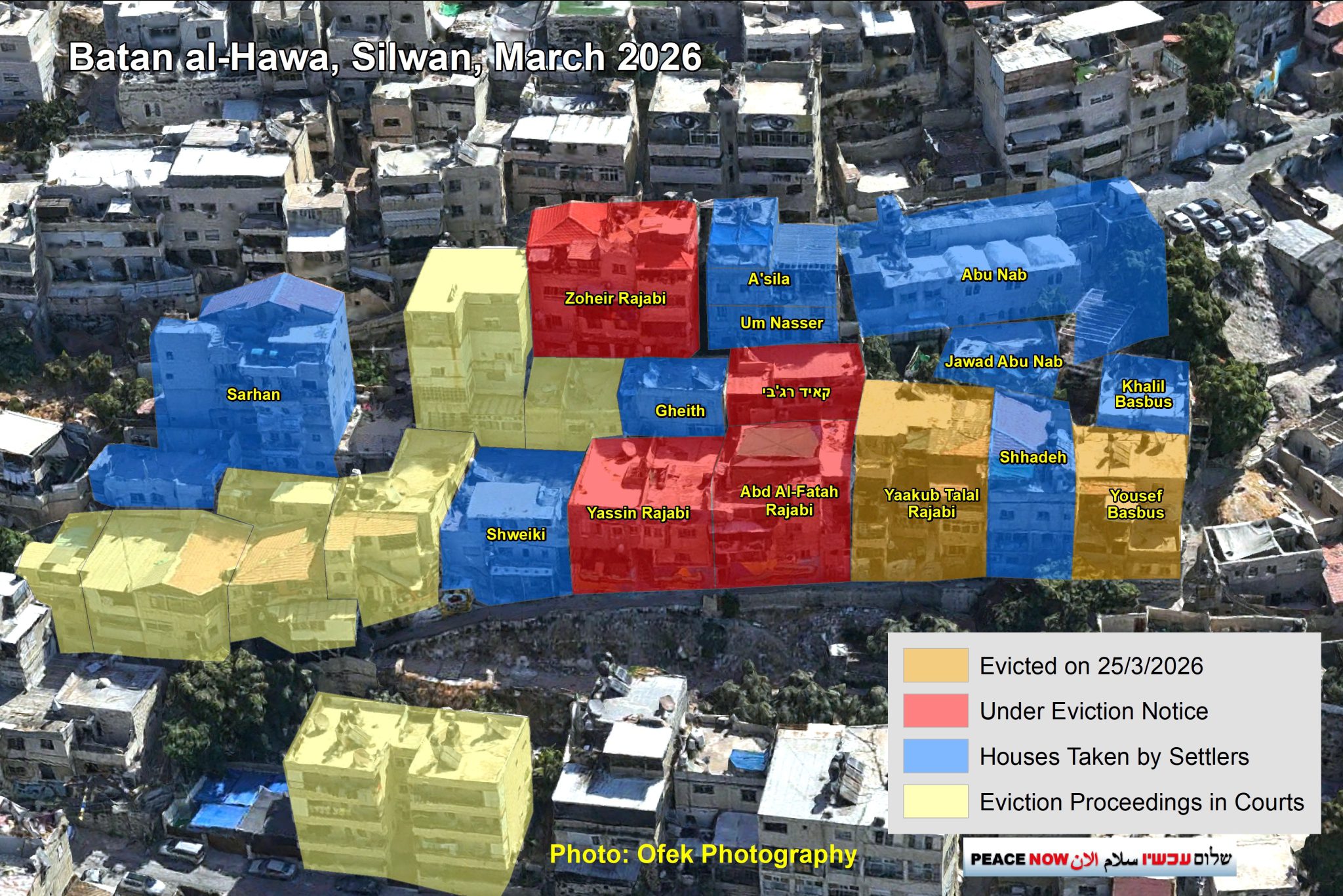 Over the past week, Israeli forces and settlers forcibly removed 15 Palestinian families from their homes in the Batan al-Hawa section of Silwan, clearing them and their belongings out so that the Ateret Cohanim settler organization can take possession of the buildings and Israeli settlers can move in. There are an additional 15 families under imminent threat of eviction on the basis of the same court decision.
Yosef Basbous, whose family was expelled this week said:
“Our family was expelled in 1948 and dispersed in refugee camps in the West Bank. I arrived in Silwan with my parents more than 60 years ago. I built this house stone by stone, brick by brick, nail by nail. Today they come to us and expel us again. They claim that the land belonged to a Yemeni waqf and that the custodian sold the land to settlers. The police say they are implementing the court’s decisions, according to the law. But what kind of law is this that can expel me, who has been here for more than 60 years.”
Another expelled resident, Jacob Rajabi told Haaretz:
“They came at 9 A.M., entered the house, took the children and women, and put us out on the street. This is the home where I was born, where I got married, raised children – my whole life is there.”
Peace Now said:
“Unfortunately, there is no other word to describe this than ethnic cleansing. Settlers, with the help of the government and a discriminatory legal system, are expelling an entire Palestinian community and replacing it with settlers. This is happening in the Jerusalem of 2026 and it is a stain that will not be erased from Israel.”
Ir Amim explains:
“These expulsions are part of an unprecedented escalation in forced displacement from Silwan that is tantamount to forcible transfer and involves multiple state institutions and entities working in collusion with settler groups and reinforced by a complicit judiciary. The amount of resources being allocated and deployed to carry out these measures during an ongoing war underscores the Israeli government’s resolve to exploit the circumstances to accelerate forcible transfer and solidify an irreversible apartheid reality. As detailed in a forthcoming Ir Amim report, a web of state and local authorities, statutory bodies, and laws converge into a single coordinated, multi-layered system of state-orchestrated dispossession and displacement of Palestinians in East Jerusalem, in flagrant violation of international law.”
B’Tselem details the history and context of Silwan, and explains:
“In Silwan, as in other Palestinian neighborhoods of Jerusalem and Palestinian villages across the West Bank, the Israeli regime uses every tool at its disposal to dispossess Palestinians of their land. The goal of removing Palestinians from their homes is pursued out in the open, the core features of Israel’s apartheid regime, via the court system, and in cooperation with settler organizations, with matching efforts to make Palestinians’ lives unbearable through systematic neglect and violence perpetrated by both official and unofficial actors. This is the reality of systematic, institutionalized violence in which Palestinian residents of Jerusalem live daily under Israel’s apartheid regime, stripped of their most basic rights. Confronting this reality requires urgent and immediate intervention by members of the international community.”
STATE-BACKED SETTLER TERRORISM
The pace of settler attacks is nearly impossible to keep track of. On March 21st (Eid weekend) settlers organized mass riots and attacks on Palestinian communities overnight, resulting in 17 pogroms across the West Bank completely undeterred by the IDF. The attacks were organized in reaction to the death of an 18-year old settler in a car accident, which settlers insisted was a terror attack despite unclear and at times contradictory facts. At the funeral for the settler, Finance Minister Bezalel Smotrich called for settlers to respond with settlement expansion, saying “We will erase the lines, the definitions, and the letters, and we will settle our land in all its expanses.” The father of the settler called him a “sacrifice“ for the settlements.
Settlers organized a second wave of terror campaigns on March 23rd, injuring at least 10. Five were reportedly arrested.
BONUS READS
- “How Israel’s strangulation of the West Bank is collapsing the Palestinian educational system” (Mondoweiss, 3/24/2026)
- “Israel’s Top Court Orders Compensation for Palestinian Family Whose Cattle Were Stolen by IDF Troops” (Haaretz, 3/25/2026)
- “32 Outposts, 10 Miles of Ground Barrier: IDF Builds New Border Line Inside Gaza. Here’s How It Looks” (Haaretz, 3/26/2025)
- “Netanyahu Coalition Pushes to Fast-track New Jewish Towns in Arab, Bedouin Areas” (Haaretz, 3/25/2026)
- “Vance’s office denies report VP raised anti-Palestinian riots with Netanyahu” (Cleveland News Journal)
- “The Iran War Is About Palestine” (Jewish Currents, 3/24/2026)
- “Israeli settlers are growing more violent in the West Bank” (The Economist, 3/26/2026)
- “Settlement of Land Title in the oPt: An International Law-Based Appraisal” (International Humanitarian Law Centre, 3/27/2026)
Welcome to FMEP’s Weekly Settlement & Annexation Report. To subscribe to this report, please click here.
March 6, 2026
- WEST BANK: 2.2% Settler Growth Rate in 2024; IDF Taking Over Palestinian Homes
- EAST JERUSALEM: E-1 Delay?, Report on EJ Settlement Surge Since Oct 2023
- SETTLER & STATE TERRORISM: Severity
- U.S. NEWS
WEST BANK
Settler Population Grew by 2.2% in 2025
According to data from West Bank Jewish Population Stats (a setter-run enterprise), the settlement population in the West Bank (excluding East Jerusalem) grew by 2.2% in 2025. The rate is twice as high as the rate of Israel’s overall population growth rate, which is likely reflective of an on-average large family size of settler families. Settlers in the West Bank constitute 5.32% of the Jewish Israeli population.
The fastest growing settlements in 2025 are worth noting, all of which were established as illegal outposts and legalized by the Israeli government in February 2023. All are located in high friction areas:
- The Avigail and Asael settlements in the South Hebron Hills. Avigail grew by 720% while Asael grew by 644.8%.
- Shaharit settlement grew by 600%.
- Givat HaRoeh settlement grew by 169.4%.
- Beit Hogla settlement in the Jordan Valley grew by 111.6%.
The settler growth rate continues to see small declines year on year: the 2024 growth rate which was 2.4%; the 2023 growth rate was 2.9%.
IDF Takeover of Palestinian Homes
There are increasing reports of the IDF entering PAelstinian private residences, evicting families with moments notice, and claiming the home as a new military base. Recent reports document this in Ni’lin, Al-Bireh, and Haris. Two months ago, another instance in Yabad was spotlighted by Amira Hass in Haaretz. Documenting the recent case in Ni’lin, Breaking the Silence writes:
“As one of our testifiers shared, homes are typically vandalised during these takeovers: “You do a Straw Widow, and then you need to do a spray paint of north-south-east-west […] And then someone takes [the spray paint] and writes: ‘Without settlement, there is no victory.’””
Further Readings
- “Statement by the Humanitarian Country Team of the Occupied Palestinian Territory*” (OCHA, 2/28/2026)
- “Smuggling of Hazardous Israeli Waste into Occupied Palestine: A Deliberate Environmental Crime” (PLO-NAD, 3/1/2026)
- “Update from Issa Amro – March 2026” (Friends of Hebron, 3/5/2026)
- “Israel launches Bible study program targeting US evangelicals” (Responsible Statecraft, 2/28/2026)
- “New academic initiative puts Judea and Samaria at center of global debate” (Ynet,
- “In the West Bank, Israel is brazenly defying Trump” (Lior Amihai and Hadar Susskind in The Hill, 3/5/2026)
EAST JERUSALEM
E-1 Settlement Bidding May Be Delayed
Terrestrial Jerusalem reports that, due to the Israeli and U.S. war on Iran, it is likely that the bidding window for construction of the E-1 settlement might be delayed – opening a small opportunity for international engagement particularly by Arab states.
Peace Now Report Shows Totality of Post-October 2023 Settlement Surge in East Jerusalem
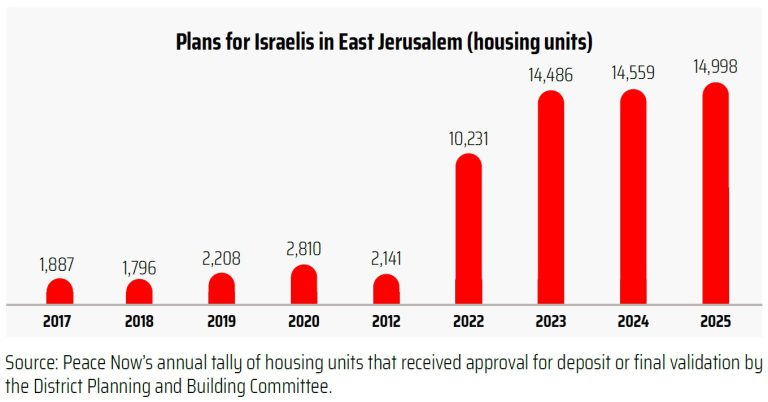 In a new report (PDF) on settlement activity in East Jerusalem from 2023-2025, Peace Now documents the rapid surge in state-backed settlement expansion and expulsion of Palestinian communities since 2023. The full report includes numerous maps and graphics that capture the detail and the totality of the new East Jerusalem.
The reports key findings are:
- Advancement of plans for 33,519 new settlement units in East Jerusalem
- Approval of the E1 plan and publication of tenders for its construction, alongside steps to seal off the entire Ma’ale Adumim area (the heart of the West Bank) from Palestinians, including through the construction of a new roads.
- Planning of four new settlements located within or on the edges of Palestinian neighborhoods: Givat HaShaked, Kidmat Zion, the Lower Aqueduct, and Kiryat Menachem Begin in Sheikh Jarrah. (Two additional settlements—Atarot and “Nahlat Shimon”—were advanced in January 2026.)
- Promotion of four new settlements in the outer ring surrounding East Jerusalem: Nahal Heletz, Shdema, Mishmar Yehuda, and Adam West.
- Development of road infrastructure around East Jerusalem at a cost of billions of shekels for the service of the settlements.
- Eviction of 11 families (64 individuals) from six homes in the Batan al-Hawa area of Silwan, followed by the entry of settlers into those properties. Dozens of additional families face imminent eviction.
- Demolition of 37 homes in the al-Bustan neighborhood of Silwan, as part of a process that threatens the destruction of the neighborhood in its entirety, leaving hundreds of residents displaced.
- Advancement of tourism-oriented settlement projects in Jerusalem’s Historic Basin, including land expropriations for the cable car project to the Old City/Silwan; the opening of a new visitors’ center on the outskirts of Jabal Mukaber and the “Omega” project; and the opening of a tunnel connecting Silwan to the Western Wall excavations, running beneath homes in Silwan and under the Old City walls.
- Approximately 100 million shekels annually allocated to security for settlers within Palestinian neighborhoods in Jerusalem.
STATE-BACKED SETTLER TERRORISM
It’s been another horrific week of state-back settler terrorism in the West Bank. Yesh Din has documented 50 settler attacks since Israel and the U.S. began their war on Iran. In addition, since the war started Israel imposed severe movement restrictions on Palestinians in the West Bank. B’Tselem reports the entry and exit from most villages and cities in the West Bank has been fully or partially blocked, and passage between the various areas of the West Bank has also been blocked – – leaving Palestinians locked in and isolated, and easy pray for settler attacks.
Several very serious events include:
- In Qaryut, settlers – likely IDF reservists – shot and killed two Palestinians and injured many more. Videos captured the armed settlers firing towards Palestinians homes and its aftermath. Residents of Qusra report that settlers arrived with bulldozers to destroy the village’s olive groves and orchards, and then the settlers raided the village firing live ammunition. IDF, arriving on scene, arrested 20 Palestinians who emerged to defend the village from the settlers.
- A bedouin village near Duma made the painful decision to leave their land under escalating settler terrorism and state-facilitation. Recently, the Israeli military issued orders banning activists from entering the bedouin village – where many Israelis had spent months offering protective presence to the village that was under constant attack from nearby settlers. Without activists present in the village, settlers seized the opportunity to expel the village, leading residents to abandon all of their belongings and land in fear for their lives. Once the village was empty – settlers trashed everything there.
- In Qusra, settlers were filmed attacking Palestinians and Israeli human rights activists in the West Bank on Friday. Two Palestinians were hospitalized and two Israeli activists were severely injured and evacuated by Israeli helicopter. Israel has reportedly opened a military police investigation.
Yesh Din, an Israeli organization which closely documents settler violence, writes:
“We remind you that since the attack on Iran began, extreme restrictions have been imposed on Palestinians’ freedom of movement in the occupied territories. It now appears they are expected to wait in their homes until settlers come and attack. Neither missiles from Iran nor from Lebanon will prevent the ethnic cleansing taking place under the auspices of the State of Israel and the IDF. Don’t look away, we must stop this.”
B’Tselem reports:
“Under the cover of war, Israeli militias, with army backing, continue to harass and attack Palestinian communities across the West Bank in an attempt to expel them from their places of residence. The attacks include: raids on pastoral communities and villages, house searches, theft of sheep and vandalism, as well as assaults with clubs and stones on residents trying to protect their homes or herds, leading to severe injuries and bruises.”
Israeli journalist Roy Sharon captured the state of terror:
“The creeping transfer carried out by Jewish rioters in recent months against Palestinians echoes in right-wing pamphlets and Telegram groups. The method has become very simple: setting fire to buildings in small villages while unleashing physical violence against anyone who tries to resist or document it. Eventually, the residents will realize that no one will protect them from the terror, they will submit and abandon their homes. In the newsletter of the nearby synagogue, they will celebrate yet another victory of “space cleansing,” of course without telling their dear readers that the result was achieved through violence.
In agricultural areas, the method is similar. Outpost activists invade Palestinian grazing lands or orchards every day, and in such a situation, the Palestinian is left with three options: either to give up the land, or to call the police, or to try to expel the invader. The outcome of the first two options is the same—submission to violence and loss of the land. The third option is to enter into a violent confrontation with armed Israelis (Border Guard soldiers or civilians), meaning to end the incident either with an injury or with a bullet to the head, as we saw the day before yesterday in the village of Qaryot.
The shooter, in most cases (in the Qaryot shooting, the fatalities didn’t even throw stones according to the military investigation), will claim that he acted to remove a threat, that he fired because he felt his life was in danger, because a stone kills. This is of course true, but when the victims are Palestinians, no one in the security forces deals with the question of who provoked whom and who invaded whose land—the entire incident is defined by the IDF as a “friction” as if both sides met in a sterile area and started throwing stones at each other. And in the case where the victims are Jews, the stone-thrower immediately becomes “the terrorist,” and therefore either gets shot or arrested within a few hours plus a photo with a blindfold over his eyes.
The responsibility for the anarchy raging in Judea and Samaria lies first and foremost with the IDF’s Central Command (which, according to the law, is also responsible for enforcing law and order and therefore has failed in its role), whose forces are scattered throughout the area and in practice allow masked rioters to unleash violence; with the Samaria District of the police, which has failed in collecting evidence and filing indictments; with the Civil Administration, which does not enforce enough against illegal construction in new outposts; and with the Jewish Division of the Shin Bet, which has been failing for years to thwart terror and has been dragging its feet in recent months with too many investigations.
None of the four organizations has a chance of defeating the disturbing phenomenon on its own. The year with the fewest recorded incidents of Jewish terror was 2016; that happened after the arson attack in Duma where the Dawabsheh family—a couple and their baby—were burned to death. The State of Israel decided to take off the gloves, and all the security forces, together with the Ministry of Justice and with the backing of the Prime Minister (Netanyahu), fought against the perpetrators of the violence.
The motive that has joined the phenomenon of Jewish terror in the past year is transfer. This is no longer a motive of revenge because, unlike the past, there aren’t many attacks; not thwarting a political process (the price tag method was invented to thwart outpost evacuations) and not hastening the End of Days as we saw in the past. The new motivation is the expulsion of Palestinians and the takeover of new areas in Areas B and C, and the method is physical violence, arsons, and shootings—with a blind eye or backing from the security forces. The State of Israel stands idly by, and that’s about it.”
U.S. NEWS
-
- “Senators demand investigation after ninth American killed by Israeli settlers or soldiers in West Bank” (The Guardian, 3/5/2026)
- “Exclusive: Ro Khanna to introduce sweeping resolution condemning Israeli settlements, settler violence” (Middle East Eye, 2/26/2026)
- ANNEXATION: Cabinet OKs, and Funds West Bank Land Registry
- EAST JERUSALEM: Israel to Expand Jerusalem Borders, plus News & Analysis
- WEST BANK: Settlers Takeover Five Hebron Houses, plus News & Analysis
- GAZA: MK Joins Gaza Breach
- SETTLER TERRORISM: American Teen Killed By Settlers in Latest Attack on Mukhmas, plus News & Analysis
ANNEXATION
Cabinet Authorizes, Funds Publication of West Bank Land Registry
On February 15th, the full Israeli Cabinet approved the publication of the West Bank land registry and allocated a four-year, $78 million (NIS 244.1 million) budget to establish a mechanism (with up to 35 employees) for updating the records in Area C of the West Bank. The Israeli Justice Ministry is tasked with carrying out the land registration process, effectively transferring sovereignty over Area C from the Israeli military to Israeli civilian governance, clear annexation. According to Peace Now, the process of land registration in Area C carried out will lead to the wide scale dispossession of Palestinians from the area. The Cabinet set a target goal of completing the land registration process for 15% of Area C within the next five years.
Defense Minister Israel Katz, Justice Minister Yariv Levin and Finance Minister Bezalel Smotrich issued a joint statement saying:
“The decision means, among other things, the registration of extensive areas in Judea and Samaria that belong to the state in the name of the state.”
Israeli Justice Minister Levin said further:
“The resolution constitutes a real revolution in Judea and Samaria…The Land of Israel belongs to the people of Israel. The Israeli government is committed to deepening its grip on all parts [of the land], and this decision is an expression of that commitment.”
Peace Now said in a statement:
“The government’s decision on land settlement in the West Bank is a mega land grab of Palestinian property. Land registration will result in the transfer of ownership of the vast majority of Area C to the state, leaving Palestinians with no practical ability to realize their ownership rights. It is no coincidence that international law prohibits land settlement in occupied territory, and Israel itself issued an order prohibiting it after 1967.”
The move has been criticized internationally, including by the UN and other Arab nations some of which have normalized ties with Israel.
As a reminder, only one-third of West Bank land was registered and titled (under the British Mandatory government and then continued by Jordan) when Israel seized control of the West Bank and froze land registration proceedings. The publication of the West Bank land registry is something the settlement movement has pushed for in order to be able to identify landowners in all areas of the West Bank and approach them for purchase, which – with the repeal of the ban on the sale of land to non-Arabs – settlers can now do outright. Opening the land registry will help facilitate settler claims over disputed and/or unregistered lands, making Palestinians vulnerable to further settler harassment regarding the sale of land.
As reported by Israel Hayom in 2020, the Israeli land registration process would first require a survey of the land, after which time anyone claiming ownership could present documents to the Israeli government seeking to prove their ownership. In the case of land where Israel recognizes no valid ownership claims – including cases where Palestinians do not have documentation that Israel will accept – Haaretz has previously reported that the process gives heavy weight to whomever currently controls the land (e.g., if a settler has built illegally on Palestinian land and lived there, under the protection of the IDF, the process will give weight to their claim absent overwhelming documentation, accepted by Israel, from the Palestinian owner). The registration decisions can be appealed, but once the claims are resolved by an Israeli official appointed to oversee the process, no further appeal is possible. Moreover, all “unclaimed” land – that is, land over which Israel does not recognize any legal ownership, will automatically become “state land.
Shlomo Zacharia, a land lawyer working with Yesh Din, further explained how the process of Israeli-controlled land registration will dispossess Palestinians, saying:
“If a village has 30 plots, with [specific, documented] ownership claims on only 20 of those, the other ten automatically transfer to the state. If you haven’t filed a claim of ownership, it goes to the state. Period. The arrangement will primarily benefit the Civil Administration and the settlers, since most of the land allocated by the state goes to settlers, and because the arrangement process (in Israel and the West Bank) favors the person holding the land in practice.”
EAST JERUSALEM
Israel to Expand Settlement & Jerusalem Borders
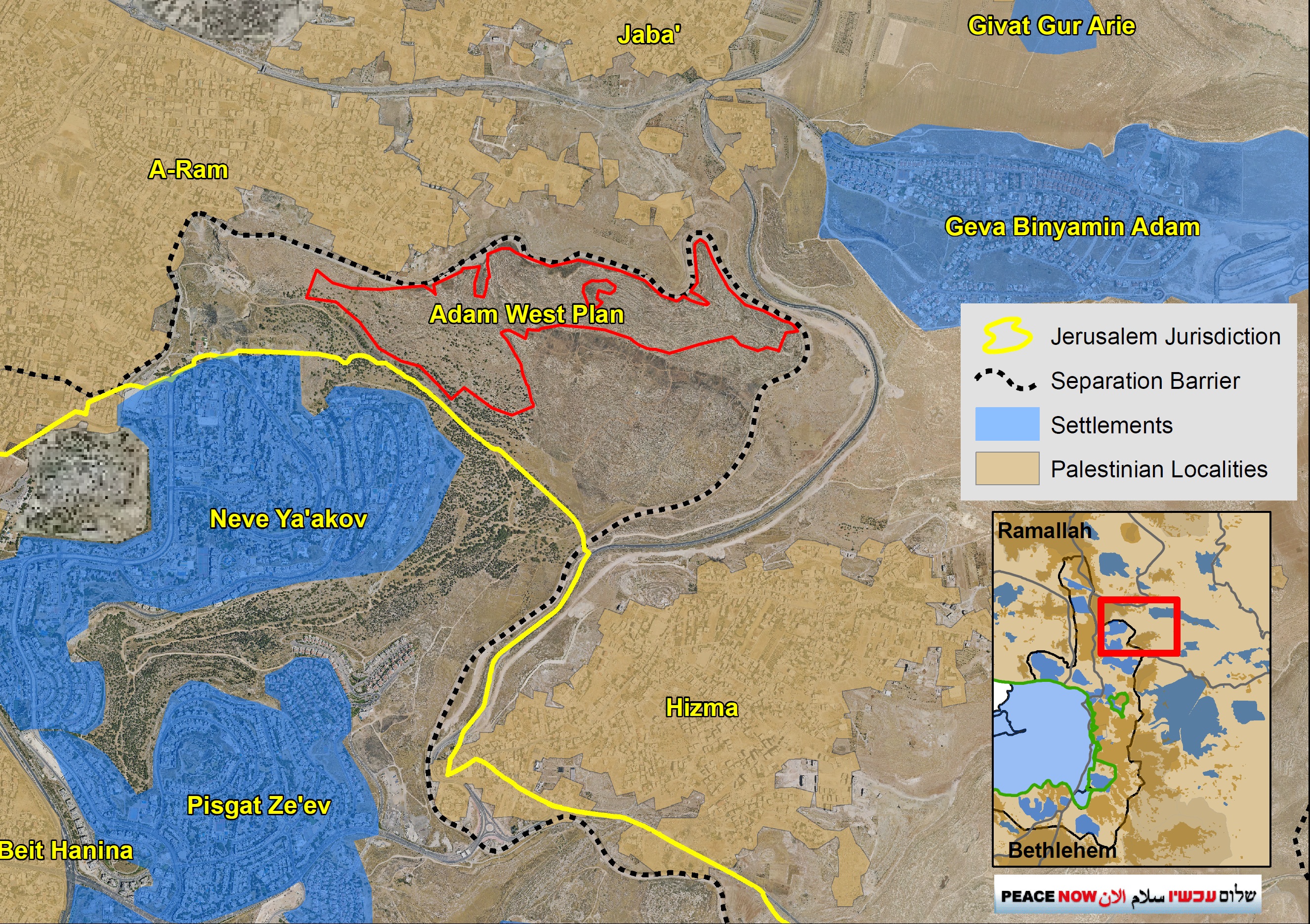 Peace Now reports that Israel is advancing a plan that will, for the first time since 1967, effectively expand the borders of Jerusalem into the West Bank by building a new “neighborhood” or the Adam settlement. The plan to build a 6,000 unit new “neighborhood” of the Adam settlement is nothing but a run-around attempt to expand the East Jerusalem settlement of Neve Ya’akov onto West Bank land. While the Adam settlement is on the West Bank side of the Israeli Separation Barrier, the new “neighborhood” is planned for land on the Israeli side of the Barrier, closer to and more functionally a part of the Neve Yaakov settlement in East Jerusalem, rather than the Adam settlement under which the plan is being put forth. Peace Now reports that, in order to accomplish the same goal with less hassle and criticism, the construction is being framed as an expansion of a Wset Bank settlement towards Jerusalem rather than the expansion of an East Jerusalem settlement into the West Bank (i.e. annexation of West Bank land).
Peace Now explained in a statement:
“This is the first time since 1967 that Jerusalem is being expanded into the West Bank. Under the guise establishing a new settlement, the government is carrying out de facto annexation through the back door. The new settlement will function in every way as a neighborhood of Jerusalem, and its designation as a “neighborhood” of the Adam settlement is merely a pretext intended to conceal a move that effectively applies Israeli sovereignty to areas of the West Bank.”
The plan has been submitted to the Higher Planning Council and can be scheduled for discussions at any time. The government clearly supports the plan, as just one week ago the Israeli Ministry of Construction and Housing signed a development agreement with the Adam settlement which committed government funding forth te construction of the new neighborhood.
More East Jerusalem News & Analysis
- “The Palestinians stuck in the no-man’s-land of Jerusalem and the Israeli settlement plan to expel them” (Mondoweiss, 2/19/2026)
- “Ahead of Ramadan: New Policy Paper on Escalating Israeli Policy at Al-Aqsa and Growing Harm to Muslim Freedom of Worship” (Ir Amim, 2/16/2026)
WEST BANK
Settlers Takeover Five Homes in Hebron
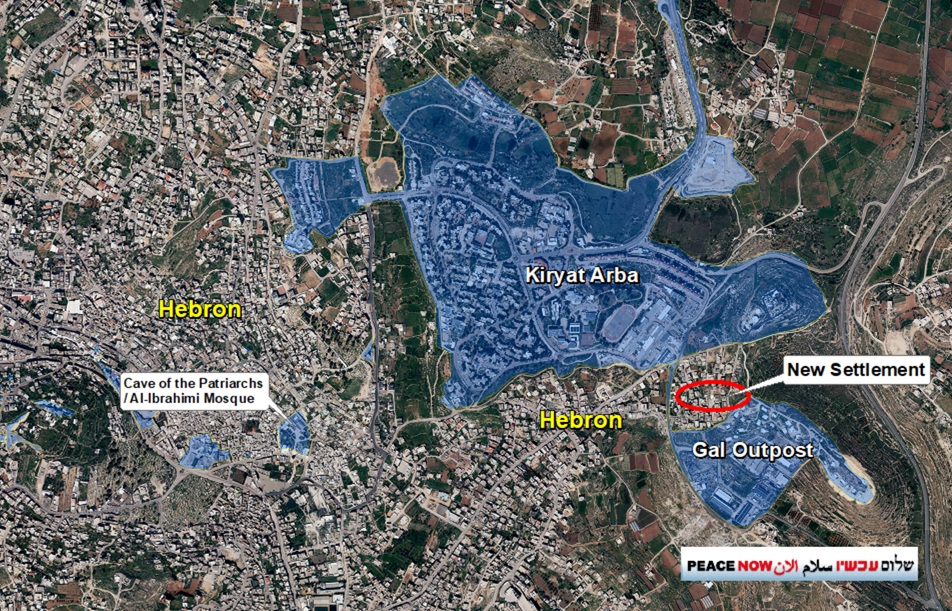 Peace Now reports that settlers have taken over five homes in Hebron, claiming to have purchased them, effectively establishing new settlement enclaves in the Jabal Jalles neighborhood of Hebron. In advance of the settlers’ entrance into the homes, the IDF carried out an arrest operation in the Jabal Jalles neighborhood.
Peace Now said in a statement:
“We are seeing here an alarming example of the consequences of the government’s new policy regarding land purchases in the West Bank. A handful of real estate–hungry settlers will in the future be able to determine many more such facts on the ground, with far-reaching political and security implications. This is what annexation looks like!”
More West Bank News & Analysis
- “Israel’s new separation wall will sever Jordan Valley from rest of West Bank” (+972 Magazine, 2/16/2026). Also see:
- “Palestinians see Israel’s new West Bank security wall cutting off their farmland” (NPR, 2/18/2026)
- “Smotrich: Next government should ‘encourage migration’ of West Bank Palestinians” (The Times of Israel, 2/18/2026)
- “Palestinians see Israel’s new West Bank security wall cutting off their farmland” (NPR, 2/18/2026)
- “Exclusive: Judea, Samaria Jewish population grew at twice Israel’s overall rate in 2025” (JNS, 2/20/2026)
- “’Apartheid now exists’: In the West Bank, new Israeli regulations stoke Palestinian fears of annexation” (NBC News, 2/18/2026)
- “Israel’s annexation drive has sped up – because the world allows it” (Middle East Eye, 2/18/2026)
- “Meet the settlers of Instagram, the photogenic West Bank women documenting pastoral life” (The Times of Israel, 2/15/2026)
- “Settler to Be Prosecuted for Fatal Shooting of Palestinian Activist in West Bank” (Haaretez, 2/15/2026)
GAZA
MK Joins Settlers in Breaching Gaza Fence
One far-right Israeli MK joined the Nahala settler movement in its latest organized breach of the Gaza fence, a repeated act that is intended to continue pressuring the government to reestablish Israeli civilian settlements in Gaza. MK Limor Son Har-Melech joined a group of a dozen or so settlers in crossing the fence to plant trees, saying: “Gaza will always be ours.” The IDF removed the settlers from Gaza, and issued a statement condemning the group for risking the safety of its members and the IDF.
SETTLER TERRORISM
Settlers, IDF Raid Mukhmas, Shoot/Kill Palestinian American Teen
A group of 30 masked settlers were accompanied by IDF troops during a violent raid on the Palestinian village of Mukhmas. The settlers stole 380 head of livestock and when Palestinians tried to prevent the theft, settlers attacked – shooting and killing one Palestinian, 19-year old Nasrallah Abu Siam who held American citizenship, and wounding many more. Despite IDF presence, there have been zero reports of arrests.
The Palestinian village of Mukhmas has come under intense settler violence over the past several weeks, with repeated and increasingly violent settler attacks.
News & Analysis on State-Backed Settler Terrorism
- “10 settler rabbis warn against ‘violence of any sort,’ amid attacks on Palestinians” (The Times of Israel, 2/17/2026)
- “Humanitarian Situation Update #358 | West Bank” (OCHA OPT, 2/19/2026)
- “If an Outpost Isn’t ‘Illegal’ in the Eyes of an Israeli, Does the Crime Even Exist?” (Haaretz, 2/20/2026)
Welcome to FMEP’s Weekly Settlement & Annexation Report. To subscribe to this report, please click here.
October 17, 2025
- Settlers Establish New Outpost to Encircle Umm Al Kheir, Court Pauses Move-In
- Eviction Date Looms for Six Families Facing Displacement from Homes in Silwan
- As The Olive Harvest Starts, Settler Terrorism Reaches New Heights
- Israeli Commitment Against West Bank Annexation is Not in Final Ceasefire Deal
- International Crisis Group Report: “Sovereignty in All but Name: Israel’s Quickening Annexation of the West Bank”
- Bonus Reads
Settlers Establish New Outpost to Encircle Umm Al Kheir, Court Pauses Move-In
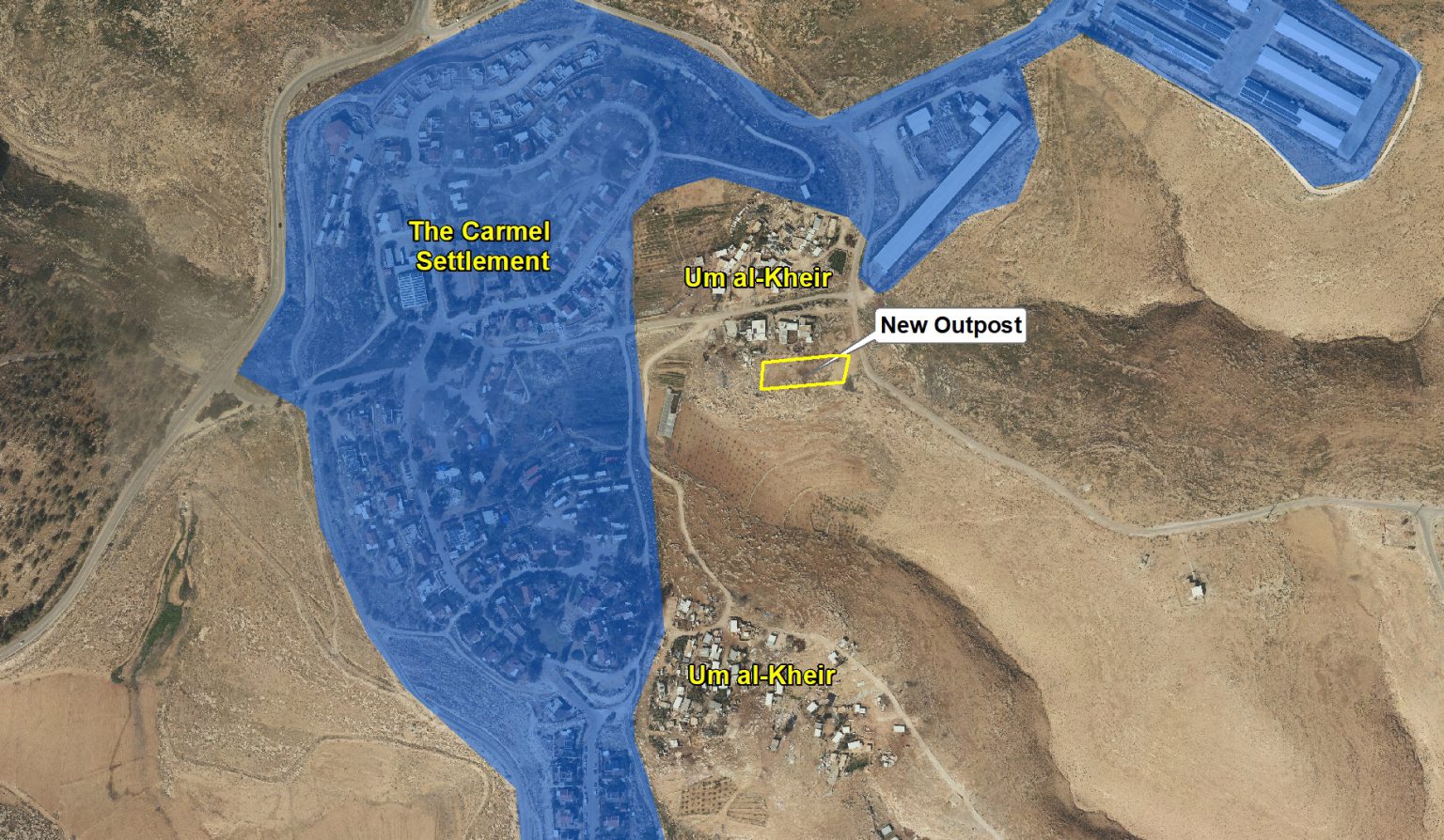 Two months ago, Israeli settlers began building yet another outpost surrounding the tiny Palestinian village of Umm al Khair in the South Hebron Hills, almost completing the encirclement of the 200 people who live in village by the Carmel settlement and its illegal outposts. The settlers cleared land and moved in caravans into the area, within spitting distance of Palestinian homes, as part of their years-long effort to expand their control of land in the area and compel/coerce the displacement of Umm al-Kheir. It was during the settlers illegal preparation of the land for this new outpost that Awdah Hathaleen, a prominent activist in the area and a protagonist in the critically acclaimed documentary No Other Land, was shot and killed by the internationally sanctioned settler Yinon Levy.
On October 12th, the Jerusalem District Court issued an order temporarily barred settlers’ from inhabiting the new outpost while the Court considers the underlying legal challenge which seeks to compel settlers to remove the caravans from the land. Settlers promptly violated the Court order, and moved more caravans into the area the very next day.
Peace Now said in a statement:
“For months, all enforcement authorities have known full well about the massive, blatantly illegal construction project taking place on the village’s land — and not only did they do nothing to stop it, they actually secured and assisted it in various ways. It is depressing and sad, though not surprising, that it takes a court order to make the army and the police do their duty. We hope the order will give the residents of Um al-Kheir, who are suffering under the settlers’ ongoing harassment, some space to breathe and live normal lives.”
Eviction Date Looms for Six Families Facing Displacement from Homes in Silwan
Six Palestinian families living in the Silwan neighborhood of East Jerusalem are facing an impending eviction date ordering them to vacate their longtime homes sometime between October 19 and November 4. If the families do not agree to their own displacement, Israeli police will remove them by force. At this point, all legal remedies have been exhausted and the Nasser, Rajabi, Shweiki, and Odeh families are set to be forcibly displaced under at the behest of Israeli settlers and the facilitation of Israeli legal courts, a system Ir Amim describes as: “proceedings [that] are underpinned by structural discrimination rooted in Jewish supremacy and a system rigged against Palestinians from the outset, which denies them equal access to justice.”
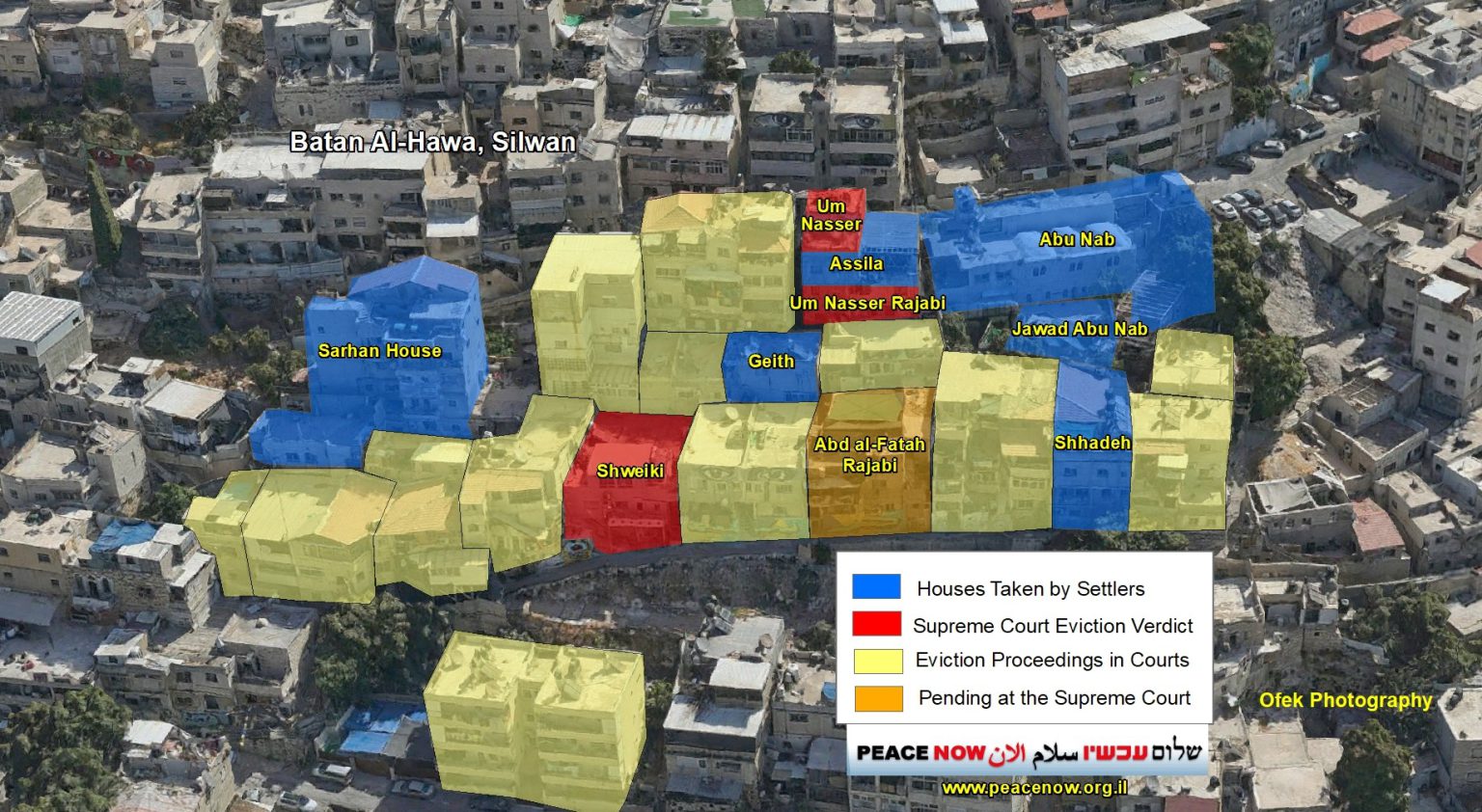 For more background on these cases, see Peace Now’s reporting.
Peace Now reports that 16 families have already been evicted from the Batan al-Hawa section of Silwan – 6 in this year alone – with settlers facilitating their displacement and taking up residence in the vacated homes. There are five additional cases affecting dozens of families that are at various stages in the Jerusalem Magistrate Court.
Peace Now said in a statement:
“This is a real emergency. If the government does not intervene, and if pressure is not brought to bear on it to act, we may witness in the coming weeks families literally thrown out into the street and settlers taking their place. This is a terrible injustice, based on discriminatory laws and on the ongoing exploitation and marginalization of East Jerusalem residents. The dispossession of Palestinians from their legally purchased homes in Silwan, under the guise of realizing a “right of return” for Jews, is an indelible stain on the State of Israel. The government can and must stop the forced expulsion of an entire community—the responsibility lies on its shoulders.”
As The Olive Harvest Starts, Settler Terrorism Reaches New Heights
The Palestinian olive harvest is now underway, and as in past years presents a massive target for violent settlers to terrorize Palestinians attempting to work their land – and in fact settler violence has rapidly increased from already high levels. Between 7 and 13 October, OCHA documented 71 Israeli settler attacks against Palestinians, 36 of which were directly connected to the olive harvest. As a result of the documented attacks, 99 Palestinians were injured and 1 killed. These attacks have included:
- On October 8th settlers were throwing stones at Palestinian cars near the village of Deir Jarir, located near Ramallah. One Palestinian was shot and killed when settlers opened fire on a group of people who had gathered to chase off the stone-throwers. This is the 12th settler attack on Deir Jarir this year, according to OCHA.
- On October 9th, settlers raided the village of Atara, near Ramallah, damaging homes and cars. Settlers established a new outpost near Atara in August 2025, and have since used the outpost as a launching point to routinely attack Atara. OCHA has counted at least 8 attacks so far.
- On October 10th, settlers attacked the Palestinians harvesting olives near Beita, resulting in an injury to an AFP photographer. Settlers further seized harvesting equipment and burned 12 vehicles.
- On October 12th, settlers staged a large-scale attack on the village of Burqa during which they cut down over 800 fruit trees (including olive trees, citrus trees, and grapevines).
- On October 13th, settlers accompanied by Israeli forces attacked Beit Fajjar, near Bethlehem. Settlers assaulted a family of six which was attempting to harvest grapes, and later assaulted the emergency responders who came to assist the victims. Settlers used sticks, molotov cocktails and dogs to injure the family, and later burned their vehicle.
- On October 13th, settlers attacked the village of Ein Yabrud, near Ramallah, and burned down a house.
- On October 16th, the two different groups of Paelstinians harvesting olives near Burin were attacked by settlers from the Yitzhar settlement. The harvesters were chased off and their farming equipment was stolen.
Israeli Commitment Against West Bank Annexation is Not in Final Ceasefire Deal
According to leaked reports, an earlier version of the Trump ceasefire deal included a commitment that Israel would not annex the West Bank. Despite Trump’s press conference weeks before where he said publicly that he will not allow Israel to annex the West Bank, ultimately the commitment was not included in the final ceasefire deal.
Nonetheless, The Times of Israel reports that the Knesset is set to reconvene from its summer break and immediately take up a few bills that would affect the annexation of the West Bank. A Knesset insider told The Times of Israel:
“there is a majority in the Knesset to annex today…The reason it’s not on the agenda is because Netanyahu has made it very clear that he’s not going to support anything of the sort. You can say it’s because of Trump. You can say it’s because of his own fear of global isolation or a regional war or whoever knows what it is that he’s thinking. But if there was a secret ballot in the Knesset today, a majority would definitely annex.”
The source further told the outlet that Netanyahu will find a way to postpone voting on the annexation bills, without outright opposing them, until the next election in October 2026.
International Crisis Group Report: “Sovereignty in All but Name: Israel’s Quickening Annexation of the West Bank”
The International Crisis Group (ICG) published a new report entitled, “Sovereignty in All but Name: Israel’s Quickening Annexation of the West Bank.” The report responds to European states offering recognition to the State of Palestine, a recognition with ICG calls a “strategy that should also have teeth,” taking seriously that “annexation is not a future threat – it is already under way.” The report urges international actors to do what they can to “halt the further consolidation of Israel’s annexation and to begin the difficult work of persuading Israel to reverse course.”
The Executive summary of the report ends:
“The impediments to a two-state solution to the Israel-Palestine conflict are longstanding and immense, and a body of informed commentary argues that they are indeed insurmountable. Perhaps they are, but there is no world in which the further progress of annexation will produce a better result for the Palestinian people – or, for that matter, for Israelis. Israel may never alter its posture in the West Bank, but if outside actors play a long game and act concertedly, they will optimise their chances of changing its behaviour. Absent that, the status quo, which denies the Palestinian people not just a state, but also basic rights, will only become further entrenched.”
Bonus Reads
- “Sweeping Israeli actions transform West Bank in shadow of Gaza war” (Washington Post, 9/28/25)
- “Ben-Gvir’s Aide Suspected of Preventing Weapon Seizure of Settler Who Shot at Palestinians” (Haaretz, 9/29/25)
- “Israel detains two Palestinian children in Hebron under claims of ‘espionage‘” (Middle East Eye, 10/1/25)
- “The Trump-Netanyahu Peace Deal Promises Indefinite Occupation” (The Intercept, 10/1/25)
- “Israeli bulldozers in West Bank carve up hopes for Palestinian state” (Reuters, 10/2/25)
- “Bureaucratic Antics for Three West Bank Villages Show How an Israeli Annexation Began Long Ago” (Haaretz, 10/12/25)
- “At This West Bank Checkpoint, ‘It’s Not Just Movement That’s Blocked. It’s Time Itself’” (Haaretz, 10/13/2025)
- “Israeli settlements close in on West Bank herding community” (Al-Monitor, 10/10/25)
- “Despite war’s end, Smotrich calls for renewed Jewish settlement in Gaza” (Ynet, 10/14/25)
Welcome to FMEP’s Weekly Settlement & Annexation Report. To subscribe to this report, please click here.
July 31, 2025
- Another Palestinian Community Displaced by Settler Terrorism
- Settlers Takeover Ein Samiya Spring, Creating Water Crisis for Dozens of Ramallah-Area Villages
- Nu’man Faces Demolition As Decades of “Silent Transfer” Reach Breaking Point
- Smotrich Calls Gaza Settlements a “Realistic Work Plan” as Activists March to Gaza
- Beloved South Hebron Hills Activist Shot Dead By Sanctioned Settler
- Bonus Reads
Another Palestinian Community Displaced by Settler Terrorism
On July 27th,over 100 residents of the Deir Alla bedouin community fled their village under the escalating, violent encroachment and coercive threats of Israeli settlers. Many families from Deir Alla had previously left the village, located in the Jordan Valley, and a violent series of settler attacks over the last week coerced the remaining few into leaving.
On Wednesday July 23rd, settlers illegally built a new outpost using an abandoned home inside of the village. Residents notified the IDF, which visited the settlers the next day but did not make the settlers leave. That night after the army left, Haaretz reports about 30 settlers attacked Deir Alla – vandalizing homes and threatening residents with arson and expulsion. On Friday night the settlers followed through on their threats and set fire to buildings in Deir Alla. Israeli authorities did respond to this attack, detaining and later releasing 12 settlers. Then, on Saturday the settlers attacked again, vandalizing more homes, destroying solar panels and the local water network, and stealing goods. Later that day, settlers returned to the village and threatened residents – telling them to abandon their homes or face violence. Under these conditions, residents of Deir Alla were expelled from the village. Once the Palestinians had left, settlers destroyed all structures in the abandoned village.
Settlers Takeover Ein Samiya Spring, Creating Water Crisis for Dozens of Ramallah-Area Villages
Following years of attempts and weeks of escalating attacks, on July 21st settlers appear to have succeeded in taking control over the Ein Samiya spring and a nearby pool, located near Ramallah. The settlers also vandalized and damaged pumping stations which transferred water from the spring to at least 30 nearby Palestinian communities. The Jerusalem Water Undertaking told Haaretz that the damage to the pumping stations has resulted in a complete shut down of the pumps and pipes, which has already resulted in prolonged water outages affecting 32 Palestinian communities. The settlers’ seizure of the spring has created a water crisis.
Haaretz reports the settlers have renamed the spring and launched a crowdfunding campaign to support and advance their theft of resources in that area. Several settlers have posted videos from the spring, celebrating their theft and announcing plans to divert water to the spring from a nearby stream. The effort raised at least $33,000 USD in its first days.
Nu’man Faces Demolition As Decades of “Silent Transfer” Reach Breaking Point
Ir Amim reports the imminent threat of demolition facing the Palestinian village of Nu’man, located in the expanded borders of Israeli-annexed East Jerusalem. After decades of fighting the Israeli bureaucracy for the ability to remain on their land and in their homes, on June 10th Israeli authorities delivered demolition notices to each and every home in Nu’man.
Ir Amim writes:
“To live in Nu’man is to face a slow, silent form of erasure—one cloaked in law, bureaucracy, and strategic neglect. The residents’ struggle to remain is part of a broader one—in Jerusalem, the West Bank, and Gaza—against a system designed to make Palestinian life in the land impossible.”
Smotrich Calls Gaza Settlements a “Realistic Work Plan” as Activists March to Gaza
What was once considered a fringe idea to build settlements in Gaza promoted by a small number of fringe settlers has now been embraced and advanced by the Israeli government – with the threat of annexation being used as part of Israel’s negotiations with Hamas over the end of Israel’s genocide.
Last week, the Knesset held a conference advocating for and planning to take up Donald Trump’s idea to transform the Gaza strip into a “Gaza Riviera.” The Knesset discussed a plan, that, according to The Guardian, provides for the construction of 850,000 settlement units, construction of hi-tech “smart cities” that trade cryptocurrency, and a metro system that runs across the territory.
Speaking at a conference commemorating the anniversary of Israel’s unilateral withdrawal from Gaza in 2005, Israeli Finance Minister Smotrich said there is a “realistic work plan” to build settlements in Gaza, saying: “We did not sacrifice these prices to transfer Gaza from one Arab to another. Gaza is an inseparable part of the Land of Israel.”
Shortly after Smotrich’s remarks, 22 members of the Knesset (including two Cabinet Ministers) signed a letter to Defense Minister Katz asking that he permit a large group of settlers to enter the northern Gaza Strip in order to begin planning for the construction of a settlement. The Nachala settler group, which was organizing the group and letter, put out a statement on X saying:
“The demand is being made as part of the call to settle the northern sector as an immediate first step toward reconquest, expulsion, and settlement of the entire Gaza Strip…The northern border was conquered and expelled — now is the time to settle.”
The next day, hundreds of settlers organized by Daniella Weiss and the Nachala settler group marched towards the Gaza border. Weiss has previously said that she has a list of 1,000 Israeli families ready to move to the Gaza strip to reestablish settlements there.
Beloved South Hebron Hills Activist Shot Dead By Sanctioned Settler
Awdah Hathaleen – a prominent Palestinian activist in the South Hebron Hills – was shot and killed by an armed Israeli settler who was reportedly attempting to destroy a main water pipeline serving Palestinian homes in Umm Al-Khair, located in the South Hebron Hills. Levy was detained by Israeli authorities, but quickly released. According to his lawyers, Levy claims he fired in self-defense. Video from the incident shows Levy firing wildly, and +972 Magazine says its analysis of video from the event shows Levy attacked the residents.
Hathaleen was a key activist and advocate bringing attention to the severe suffering and violence Palestinian villages in the South Hebron Hills are facing because of state-backed Israeli settlers trying to expel Palestinians from the land. Hathaleen participated in the globally acclaimed film “No Other Land” depicting the struggle of communities there and the routing violence of settlers.
Yinon Levy is a notoriously violent settler who built an illegal outpost called Meitarim Farm on lands near Masafer Yatta in the South Hebron Hills. Canada, France, the UK, and the European Union have current sanctions placed on Levy for his involvement in violence (including the violent expulsion of the Zanuta community) and illegal settlement activity; the U.S. previously had sanctions on Levy, but President Trump reversed those sanctions when he took office.
Bonus Reads
- “Humanitarian Situation Update #310 | West Bank” (OCHA, 7/31/25)
- “The Israeli Knesset passed a motion supporting the annexation of the West Bank. Here’s what that means.” (Mondoweiss, 7/25/25)
- “Israel’s destroyer-in-chief in Gaza lives in a settlement home marked for demolition” (+972 Magazine, 7/30/25)
- “The humanitarian crisis facing 42,000 forcibly displaced Palestinians in the West Bank” (Mondoweiss, 7/28/25)
- “The Violent Gaza-ification of the West Bank” (Time, 7/23/25)
- Thread: “Hilltop youth are fundraising for the development of an outpost in Area B of the West Bank. This is part of a greater trend. More background in the thread.” (Yehuda Shaul, 7/27/25)
Welcome to FMEP’s Weekly Settlement Report, covering everything you need to know about Israeli settlement and annexation activity this week.
To subscribe to this report, please click here.
January 17, 2025
- Settlement Advancement Continue on Weekly Basis
- Judge Rules on Five Cases, All in Favor of Settlers Claims in Batan al-Hawa
- New Bimkom-Ir Amim Report: Planning in East Jerusalem Completely Halted by New Protocol
- New Data Confirms: Settlers Face Virtually NO Accountability for Crimes Against Palestinians & Their Property
- Al-Haq and Partners File Additional Info on Booking.Com Settlement Business
- Trump Invites Settler Leaders to Attend Inauguration
- Bonus Reads
Settlement Advancement Continue on Weekly Basis
Peace Now reports the High Planning Council was scheduled to convene on January 15th to advance plans for 372 new settlement units, all planned for the Beitar Illit settlement. This is the seventh week in a row the HPC has met to approve settlement construction.
The HPC is scheduled to meet again next week, on January 22nd, for the eighth consecutive week. At that meeting, the HPC is expected to give final approval to a plan for the construction of 184 new settlement units in the Migdalim settlement.
Peace Now writes:
“Since the current Netanyahu government took office, record numbers of housing units have been advanced in the West Bank. In 2023, the HPC approved 12,349 housing units—a record high. In 2024, 9,884 housing units were approved. The transition to weekly planning approvals is the result of policy changes introduced by the Netanyahu-Smotrich government. One key decision, made in June 2023, abolished the requirement for the Defense Minister’s approval at every stage of advancing settlement plans. Previously, settlement construction plans required prior approval from the Defense Minister. In recent years, the Defense Minister limited settlement planning sessions to approximately four times a year, resulting in the approval of thousands of units in each session.
In recent weeks, however, a significant change has occurred, with the HPC convening every week to approve a few hundred housing units in each meeting. This systematic approach aims to normalize settlement planning and attract less public and international attention and criticism.”
Judge Rules on Five Cases, All in Favor of Settlers Claims in Batan al-Hawa
Peace Now reports that the Jerusalem Magistrate’s Court has ruled in favor of Israeli settlers in four cases (with a fifth ruling expected soon), resulting in the impending eviction of Palestinians from their longtime homes in the Batan al-Hawa section of the Silwan neighborhood in East Jerusalem in favor of the settlers. The five cases will result in 27 Palestinian families (131 individuals, mostly children) being forcibly displaced from their homes. The Court gave the families a six month deadline.
 The Court’s ruling accepts settlers’ claim to own the land on which the Palestinians’ homes are located, homes which the Court recognized were legally purchased by Palestinians in the 1960s. Regardless of the validity of the home ownership, the Court recognized the settler’s ownership of the land under a discriminatory Israeli law that allows Jews to “reclaim” property and land that was owned by Jews prior to 1948. This law is being used by settlers to achieve mass displacement of Palestinians across East Jerusalem.
Peace Now writes:
“This is an injustice and a crime against a vulnerable population living under occupation in East Jerusalem. The dispossession of Palestinians from their homes in Silwan, enabled by the application of the Jewish ‘right of return,’ represents an indelible stain on the State of Israel. The Israeli judicial system has failed to protect the fundamental rights of Palestinians to their homes, effectively endorsing the racist and messianic policies of the current Israeli government. A responsible government would halt the forced expulsions of this community. Tragically, our government demonstrates anything but responsibility in any regard. The International Court of Justice has explicitly addressed the discriminatory legal framework and Israel’s settlement policy in East Jerusalem in its advisory opinion, declaring these practices a violation of international law.”
Ir Amim writes:
“Since the outbreak of the war, there has been a dramatic spike in the number of court decisions authorizing evictions of Palestinian families in favor of settler groups. Over the past several months, the courts have ruled to evict a total of 17 families (households), numbering some 100 individuals–the majority of whom are from Batan al-Hawa.”
New Bimkom-Ir Amim Report: Planning in East Jerusalem Completely Halted by New Protocol
Ir Amim and Bimkom have released a new report examining the recent intensification of Israel systematical denial of the ability for Palestinians to plan for construction in East Jerusalem. In 2023 Israel replaced the traditional “Muktar Protocol” with a new process which has resulted in a near total freeze on planning for Palestinians on unregistered private property.
The report explains:
“In comparison to the “Mukhtar Protocol,” the new protocol has had a detrimental impact on private residential planning (and building) in East Jerusalem4. According to the new protocol, planning and building submissions are required to include Jordanian property tax certificates from the early 1960s or earlier (or Israeli property tax until the year 2000) along with records detailing the historical chain of ownership up to the present. These requirements, usually demanded only as part of SOLT procedures– which are problematic in themselves– are new to the planning process. Additionally, the new protocol requires that the District Planning Bureau approach state authorities, such as the Custodian of Absentee Property (CAP), the General Custodian (GC), the Israel Land Authority (ILA), the Municipality, and the SOLT registrar to check whether they have claims on the same land. In the past, the SOLT registrar was not on this list, and the Planning Bureau often did not wait for responses from the other entities to proceed.
Now, the SOLT registrar has been in effect given the right of veto within the planning process. The added requirements present East Jerusalem Palestinians with two difficulties – a bureaucratic and a fundamental one. The bureaucratic difficulty is related to the challenge of obtaining the necessary documents. The fundamental difficulty is the real danger of losing land under the Absentee Property Law, which is applied through the new protocol, as it is via SOLT.”
New Data Confirms: Settlers Face Virtually NO Accountability for Crimes Against Palestinians & Their Property
Yesh Din’s newly updated tracking shows that 94% of criminal investigations into ideological offenses committed by Israelis against Palestinians in the West Bank in the past 20 years have been closed without indictments. Further, Yesh Din has found insufficient investigations into 81% of the cases, displaying “a longstanding systemic and deliberate failure in law enforcement responses to ideologically motivated crime against Palestinians in the West Bank.”
Yesh Din further explains that the larger context of this data paints an even more dire picture. They find 66% of Palestinian victims chose not to file complaints against Israeli offenders at all – meaning the data does not tell the full story. Palestinians victims of Israeli violence routinely cite a lack of faith in the Israel Police and trust that the Israeli authorities in their decision not to file a complaint.
The picture is clear: violence is a policy. Settler violence is part of a systematic approach aimed at expanding control over West Bank territory by making Palestinian lives unbearable and pushing them off their lands.
Yesh Din writes:
“This reflects the ongoing failure of Israeli authorities to enforce the law against Israeli citizens who commit serious crimes against Palestinians and their property. For two decades, we have monitored this phenomenon and provided legal assistance to Palestinian victims. The new data underscores the lack of deterrence and the lenient policies of Israeli law enforcement toward ideological crimes. Most investigations are closed on grounds such as “unknown perpetrator” or “lack of evidence,” highlighting negligent and ineffective investigations. Only 3% of cases resulted in convictions, giving offenders a sense of immunity from accountability for their actions while Palestinians whose rights are violated remain unprotected by the law.”
Al-Haq and Partners File Additional Info on Booking.Com Settlement Business
Al-Haq and partners have filed additional evidence against Booking.com accusing the travel company of profiting from stolen land through its decision to promote rentals located in settlements in East Jerusalem and the West Bank. The new evidence, which was submitted to a court in the Netherlands where the case was filed in 2023, accuses Booking.com of adding to the number of listings it hosts in settlements – from 13 rentals to 39 rentals in East Jerusalem over the past year.
The complainants write:
“In our complaint, we argue that by promoting and listing properties in illegal settlements, Booking.com directly supports the normalisation and economic sustainability of these unlawful practices. The company provides financial backing to settlers and their enterprises, furthering the displacement of Palestinians and solidifying settlement expansion. This conduct sustains Israel’s settler-colonial regime and violations of international law, including the Fourth Geneva Convention, which prohibits population transfer into occupied territories. We have substantiated our claims thoroughly. For instance, the additional evidence builds on the July 2024 Advisory Opinion of the International Court of Justice, which reaffirmed the illegality of Israeli settlements and underscored the responsibility of states to prevent economic activities that perpetuate them.”
Trump Invites Settler Leaders to Attend Inauguration
Settlers leaders from the powerful Yesha Council are gleefully celebrating their invitation to attend the inauguration of Donald Trump, who is being sworn into office on January 20th. Yesha Council Chairman and Binyamin Regional Council Head Israel Ganz, Samaria Regional Council Head Yossi Dagan, Oranit Council Head Or Piron-Zomer, and Yesha Council CEO Omer Rahamim all plan to attend as official guests.
The Times of Israel reports the delegation plans to deliver a letter thanking Trump for “redeeming” Jerusalem and recognizing Israel’s annexation of the Golan Heights during his previous presidency.
Speaking about the delegations plans, a Yesha Council official told Israel Hayom:
“Our objective is to strengthen existing connections and forge new ones. Washington’s attention is elsewhere at present. Trump is focused on Greenland sovereignty matters, not Israel’s concerns in Judea and Samaria. Timing is crucial. We must proceed strategically and appropriately.”
In a statement to Israel Hayom, Yesha Council Chairman Israel Ganz said:
“We represent Judea and Samaria residents in standing with our allies and President-elect Trump at this historic moment. The administration’s invitation reflects our shared Biblical values with the US. We face a common moral challenge against global threats, with Judea and Samaria settlements serving as the frontline defense for Israel, America, and the free world. We envision achieving transformative progress that will ensure global stability for generations, and we support Trump’s leadership in this endeavor. Our ongoing dialogue with senior administration officials continues to advance these goals.”
Samaria Regional Council Head Yossi Dagan told Israel Hayom:
“Our delegation brings the blessing of the communities in Judea and Samaria to the new administration. Years of relationship-building with our newly elected American friends have created this pivotal opportunity for Israel, particularly its government, to achieve significant advances in strengthening our presence in the Land of Israel. Our unified approach underscores the importance of maintaining strong ties with the incoming American administration and bolstering support for the communities in Judea and Samaria, both internationally and among US Jewish communities.”
Bonus Reads
- “Defense Chief Cancels Detention Without Trial for Settlers Ahead of ‘Terrorists’ Release in Gaza Hostage Deal” (Haaretz)
- “Humanitarian Situation Update #256 | West Bank” (OCHA)
- “Israeli minister asks PM to back plan for a million Jews in Samaria” (JNS)
Welcome to FMEP’s Weekly Settlement Report, covering everything you need to know about Israeli settlement activity this week.
To subscribe to this report, please click here.
December 20, 2024
- De Facto Annexation: Israel Applies Domestic Urban Renewal Law to Settlements, Easing High-Density Construction
- High Court Orders Illegal Settler Construction Dismantled
- Knesset Caucus to Push Bill Preventing West Bank Exit
- Israeli Demolitions Continue Alarming Spike
- Israel is Expanding Settlements in the Golan Heights, As Army Moves to Expand Occupation of Syrian Land
- Bonus Reads
De Facto Annexation: Israel Applies Domestic Urban Renewal Law to Settlements, Easing High-Density Construction
In an act of de facto annexation of the settlements, Peace Now reports that the Israeli Commander of the Central Command has signed a military order applying domestic Israeli laws on urban renewal. The order establishes a new body called the “Government Authority for Urban Renewal in Judea and Samara,” to be staffed and funded with the same people and budgets as the domestic domestic authority – essentially just expanding the jurisdiction of the existing body. This authority, which is funded by Israeli taxpayer money, will be able to incentivize large-scale, high-density settlement housing projects through various tax breaks and exemptions, in so doing diverting public funds to the settlements. Public reporting suggests that up to 10,000 new settlement housing units can be advanced through this new authority in 2025.
Peace Now explains:
“This means that government budgets can now be directed to assist in the planning and implementation of eviction-rebuild projects or other urban renewal projects in settlements, and to encourage massive, high-density construction. In recent years, settlements have begun to build high-rise buildings, even towers. The new military order will make it easier for settlers to advance construction plans in built-up areas using the evacuation-reconstruction method, so that both the developers, the current homeowners, and the settlement enterprise will benefit from the change, while Israeli interests will lose out.”
High Court Orders Illegal Settler Construction Dismantled
Emek Shaveh and Yesh Din report that the Israeli High Court of Justice has accepted a petition to stop the illegal settlement construction at the historical and sacred site Nabi Abner, located northwest of Ramallah (jointly filed by Emek Shaveh, Yesh Din, and the Palestinian residents of Ras Karakar and Deir Ammar on whose land the site is located). In its decision, the High Court criticized the State for its involvement and facilitation of illegal settler construction on the land – and ordered that the buildings and infrastructure be dismantled, and that the site be restored to its previous condition within six months.
Indeed, settlers began harassing Palestinians at the Nabi Abner site more than seven years ago. The IDF opted to prevent Palestinians from accessing their historical land instead of preventing settlers from illegally entering the area, violently harassing the landowners, and harming the agriculture they tended to. Eventually, settlers had full control of the site, even building concrete pools and pergolas to transform it into an Israeli tourist site. The construction damaged antiquities at the site, which included ancient springs, aqueducts, artifacts as well as the ruins of a Palestinians village.
Yesh Din posted on X:
“The ruling upholds Palestinians’ rights to property and free access to heritage and recreational sites. This is a significant and just victory. After seven years of legal and public struggle, the Court ruled what should have been self-evident: the state is obligated to protect Palestinians’ property rights and allow them to preserve their heritage, even when settlers seek to turn the site into a recreational site for themselves.”
Emek Shaveh said in a statement:
“We welcome the court’s ruling following a lengthy legal and public struggle which affirmed the obvious: The state is obligated to protect the property rights of Palestinians and allow them to preserve their heritage even when settlers desire to turn the site into their personal recreational and leisure destination.”
Knesset Caucus to Push Bill Preventing West Bank Exit
The Israeli Knesset is set to revive a bill that is proposed at blocking any future decision by the Israeli government to cede territory in the West Bank and Israeli territorial waters in the context of a peace deal. Current Israeli Basic Law requires a public referendum or special majority vote in the Knesset for any proposal to cede territory in Israel, East Jerusalem, or the Golan Heights – – but the law does not currently include the West Bank. The proposed bill would add the West Bank and Israeli territorial waters to the covered territories.
In a statement accompanying the bill, the Knesset Land of Israel Caucus (which will reportedly be submitted soon) says that the bill is intended to “effectively prevent the establishment of a Palestinians state in any future arrangement.” The focus on Israeli territorial waters comes in light of Yair Lapid’s 2022 maritime agreement with Lebanon.
Israeli Demolitions Continue Alarming Spike
OCHA reports that on on December 16th Israeli forces carried out the demolition of two Palestinian structures, rendering 78 Palestinians displaced – which is the highest number of Palestinians displaced in a single day from demolitions due to a lack of building permits since October 2023. Those were just 2 of 76 structures that were demolitions between December 10 – 16, of which 60 were in the West Bank and 9 were in East Jerusalem.
The demolitions are part of an alarming and still unfolding surge in demolitions targeting Palestinians in East Jerusalem, particularly in sensitive areas where Israel has plans for settler-backed tourism projects that erase Palestinian history and presence in the city. Since January 2024, 17 structures have been demolished (either directly by Israel or by Palestinians who opted to self-demolish and avoid Israeli fees) in the Al-Bustan section of Silwan. 104 Palestinians have been displaced as a result.
Israel is Expanding Settlements in the Golan Heights, As Army Moves to Expand Occupation of Syrian Land
On December 15th the Israeli government approved a plan to expand settlements in the Golan Heights, an area that Israel occupied in 1967 and illegally annexed in 1981 (its annexation of that territory had been rejected by the international community until the U.S. became the first and only nation to recognize Israeli sovereignty over the Golan in 2019). Netanyahu called the settlement expansion plan necessary for Israeli security, saying he aimed to double the Israeli presence there. There are currently ~20,000 Israelis living in 30 settlements in the Golan Heights.
The move to entrench Israeli civilian settlement in the Golan Heights comes against the backdrop of Israel’s incursion deeper into Syrian land – into the so-called Buffer Zone – following the fall of the Assad regime. Syrians who live in the area that has recently come under Israeli control are already voicing fear that Israel is planning to exploit the weak and distracted new regime in order to solidify a long-term occupation of the area. Netanyahu has declared that Israel will occupy the Syrian land for the foreseeable future. A resident now under Israeli occupation told Haaretz:
“We’re used to the fact that in Israel’s view, there is no free withdrawal, so the expansion of its area of control wasn’t done solely for military and security reasons, but mainly to extort the new government in Damascus.”
On X, footage has emerged of Israeli forces opening fire at a group of Syrians gathered to protest Israel’s expanded presence in the Syrian Golan Heights.
Bonus
- “Israeli Settlers Set West Bank Mosque on Fire, Spray-paint anti-Arab Statements” (Haaretz)
- “US won’t sanction Smotrich and Ben Gvir before end of Biden’s term — officials” (The Times of Israel)
- “DF admits settler group crossed northern border into Lebanon this month” (The Times of Israel)
- “Meet the far-right settler Benjamin Netanyahu has tapped to be the next Israeli ambassador to the U.S.” (Mondoweiss)
- “Huckabee addresses settlement-focused One Israel Fund as ‘quirky right-wing’ cause goes ‘mainstream’” (eJewishPhilanthropy)
Welcome to FMEP’s Weekly Settlement Report, covering everything you need to know about Israeli settlement activity this week.
To subscribe to this report, please click here.
December 13, 2024
- More Demolitions in Silwan Imminent, Threatening Displacement and Replacement
- Israel Seizes Land Northwest of Jerusalem, Possibly to Expand Settlement
- Israel Demolishes Structures in “Agreed Upon Reserve” Near Bethlehem
- Weiss Details Work Towards Gaza Settlements
- Settlers Move on Plans to Settle South Lebanon & Syria
- U.S. Senator Intro’s Bill to Compel U.S. Adoption of Settler Terminology “Judea and Samaria”
- U.S. Democrats Introduce Bill to Codify Biden’s Sanctions on Violent Settlers
- Bonus Reads
More Demolitions in Silwan Imminent, Threatening Displacement and Replacement
Ir Amim and Peace Now continue to raise the alarm on the escalation in demolitions targeting Palestinians in Silwan, particularly in the Batan al-Hawa and al-Bustan sections of the neighborhood. In al-Bustan, it is particularly concerning that the Israeli government is rapidly pursuing its plans to displace the entire neighborhood in order to construct the “King’s Garden” tourist site.
Ir Amim explains:
“The entire neighborhood of Al Bustan, which contains approximately 115 houses and home to over 1500 Palestinians, is under threat of largescale demolition as a result of Israeli plans to establish a tourist and archaeological park in the area. Most of the homes are considered unauthorized by the Israeli authorities due to the inability to obtain building permits and therefore subject to demolition, which is a direct result of discrimination implicit within the Israeli planning system. For years, Al Bustan residents have engaged in negotiations with the Jerusalem Municipality in an attempt to secure an equitable housing solution for the community, which would legalize building and enable proper residential development. Yet, negotiations have recently broke down, and all legal channels have been exhausted, effectively removing all safeguards.”
Peace Now said in a statement:
“The Jerusalem Municipality has begun a systematic campaign to demolish an entire residential neighborhood in East Jerusalem to build a tourist park. This is an injustice that cannot go unnoticed. Instead of caring for the thousands of Jerusalem residents, the municipality is acting against them. The residents of al-Bustan invested years preparing a building plan to legalize their homes, but the municipality has refused to advance any plan. Jerusalem is not a unified city; it is a city of occupation, dispossession and discrimination.”
The demolition plans in Batan al-Hawa are no less cynical, and – like all over East Jerusalem – only one means by which settlers are displacing and replacing Palestinians. Ateret Cohanim has waged a complementary legal battle to gain ownership rights to homes in Silwan that were owned by Jews prior to 1948 – – though the homes are currently (and in some cases for generations) inhabited by Palestinians. In Batan al-Hawa, Ateret Cohanim recently won rights to the Gheith family home – and with the transfer of ownership imminent the house was burnt down allegedly by Palestinians.
Israel Seizes Land Northwest of Jerusalem, Possibly to Expand Settlement
Middle East Eye reports that Israel has seized control of Palestinian land historically belonging to the villages of Qatanna and Biddu. The land is located on the Israeli side of the separation barrier, which has been cut off from the villages for over two decades (meaning the Israeli state de-facto annexed this land already on the pretext of security). The land (5.5 hectares) was seized as “state land” and it is speculated that it will be allocated to the Har Adar settlement to enable its expansion.
Israel Demolishes Structures in “Agreed Upon Reserve” Near Bethlehem
On December 12th, Israeli forces demolished seven Palestinian structures on land near Bethlehem that was designated as Area B by the Oslo Accords, meaning the Palestinian Authority is supposed to have full control over the civil administration of the land – including building enforcement laws/regulations. These demolitions follow Israel’s decision in August 2024 to memorialize its formal control over construction enforcement in an area of land designated as an “Agreed Upon Reserve” as delineated by the Wye Agreement in 1998, at which time the Palestinian Authority was granted civilian control, much to the dismay of settlers and their government allies who have been agitating for control over an ever-increasing amount of land in the West Bank in order, at least in part, to demolish Palestinian construction in the area.
Weiss Details Work Towards Gaza Settlements
In a detailed and sourced thread on X, Yehuda Shaul (Founder of Ofek) details recent television program featuring Daniella Weiss, the leader of the Nachala Movement and the effort to establish settlements in Gaza. The program delved into Weiss’s 5-stage plan to establish GAza settlements, claiming to have already raised NIS 15 million for the effort (reportedly from Brazilian sources), some of which has been used to purchase 40 caravans, generators and furniture.
Nachala is already at work on all points of this plan, particularly what is labelled as phase 3, “establishing a temporary settlement on the Gaza border to serve as a jumping-off point for entering Gaza when the opportunity presents itself.” Shaul further highlights the role that the IDF’s current presence and entrenchment in Gaza play – Weiss plans to coop military infrastructure to sustain long term settlements.
Settlers Move on Plans to Settle South Lebanon & Syria
+972 Magazine reports on the efforts of various (and growing) settler groups to establish outposts in southern Lebanon and, now, south Syria as the Israeli military occupies these lands.
Last week, settlers succeeded in crossing into Southern Lebanon and erecting a few tents in an attempt to stay there. The IDF removed settlers rather quickly,, but that did not dash the hopes and plans of settlers to establish a long term presence there.
Amos Azaria, who founded the Uri Tsafon organization aimed at settling southern Lebanon, told +972 Magazine:
““The first time we’re evicted, we go…The second time, we stay longer. The [third] time, we stay the night. That’s how we’ll continue until there is a settlement. At first, [the army] demolishes it, and then they reach an agreement that there will be one settlement, and that’s it. In the meantime, we start working on the next settlement. It may not be realistic that the state will build a settlement [of its own accord], but that doesn’t mean the state has to demolish a community that we built. “
Earlier this year Uri Tsfon hosted a conference dedicated to planning the settlement of Lebanon, and in October it published flyers advertising homes for sale across the Israeli border, in sovereign Lebanese territory
On the Uri Tsafon Facebook page many people posted messages expressing urgency in settling territory in Syria. The Nachala Movement, headed by Daniella Weiss, even posted:
“Whoever still thinks it’s possible to leave our fate in the hands of a foreign actor — forsakes Israel’s security! Jewish settlement is the only thing that will bring about regional stability and security for the State of Israel, along with a stable economy, national resilience, and deterrence. In Gaza, in Lebanon, in the entire Golan Heights including the ‘Syrian Plateau,’ and in the entire Mount Hermon.”
U.S. Senator Intro’s Bill to Compel U.S. Adoption of Settler Terminology “Judea and Samaria”
FMEP’s Lara Friedman reports that Senator Tom Cotton (R-AR) introduced a bill to “prohibit the use of materials that use the term ‘West Bank’, and for other purposes.” If passed into law, the bill would remove all references to “West Bank” from U.S. government documents, replacing them with the biblical name used by Israeli settlers. This bill mirrors a bill introduced in the U.S. House of Representatives in March 2024. The House bill has made no progress and gained no new co-sponsors.
Friedman further explains:
“Notably, while both the Cotton bill and HR 7552 explicitly seek to compel the use of the terms “Judea and Samaria” to refer to the entire West Bank, the bills’ text specifies that it is referring to land “annexed by Israel from Jordan during the 1967 Six-Day War.” Which suggests either (a) very sloppy drafting on the part of whomever wrote the bill, (b) that Cotton and Tenney intend the word “annex” in a sense other than the legal one (since as of this writing Israel has not moved to formally annex any of the West Bank other than East Jerusalem and its West Bank environs; or (c) that the drafters of this bill are intentionally seeking to have the US formally recognize West Bank annexation by Israel in advance of – and in fact, irrespective of – a formal declaration of annexation by Israel.”
U.S. Democrats Introduce Bill to Codify Biden’s Sanctions on Violent Settlers
FMEP’s Lara Friedman reports that on December 10th a group of Democratic lawmakers in the Senate and the House of Representative introduced companion legislation that would “codify Executive Order 14115 imposing certain sanctions on persons undermining peace, security, and stability in the West Bank.” Over the past year the Biden Administration has issued a total of 33 sanctions targeting individuals and entities alleged to have participated in violence against Palestinians in the West Bank.
Since the election of Donald Trump (who takes office on January 20, 2025), settlers have prioritized lobbying for the repeal of Biden’s sanctions.
Bonus Reads
- “Intensification of Surveillance in East Jerusalem Since October 2023.” (7amleh)
- “West Bank Monthly Snapshot – Casualties, Property Damage and Displacement | November 2024” (OCHA OPT)
- “Katz orders IDF to prepare for Judea and Samaria escalation” (JNS)
Welcome to FMEP’s Weekly Settlement Report, covering everything you need to know about Israeli settlement activity this week.
To subscribe to this report, please click here.
December 5, 2024
-
- End of Year Rush: High Planning Council Set to Meet Twice to Advance Settlement Plans
- Settlers Violently Storm Palestinian Towns After Outpost Evacuation
- Israel Gives Settler Power Over Palestinian Property in East Jerusalem
- Settlement Construction Group is Working in North Gaza, As Israeli Govt Officials Meet with Gaza Settlement Activists
- Emek Shaveh Challenges Military Construction at Sebastia Site
- Recapping Knesset Debate on Annexation via Archaeology
- Settlers Set Operational Plan for Trump Administration
- Don’t Miss: New Reports from B’Tselem & Yesh Din
End of Year Rush: High Planning Council Set to Meet Twice to Advance Settlement Plans
Peace Now reports that the Civil Administration’s High Planning Council met on Nov. 4th and is scheduled to meet again on Nov. 11th to consider advancing plans for a total of 501 new settlement units. In total, Peace Now reports that Israel has advanced plans for a total of 8,720 new settlement units in the West Bank in 2024.
The following plans for a total of 274 units were listed on the agenda for November 4th, with all slated to be deposited for public review (a latter stage of the planning process):
- 83 new units in Elon Moreh settlement, located east of Nablus (for background on the significance of the Elon Moreh settlement, please see here);
- 79 new units in the Mitzpe Yishai settlement; and,
- 112 new units in the Ma’ale Amos settlement, located between Bethlehem and Hebron.
The Committee is set to meet again on November 11th with the following plans for a total of 227 new settlement units on the agenda:
- 196 units in the Telem settlement – ready for final approval. The Telem settlement is located north of Hebron;
- 21 units in the Eli settlement – ready for deposit. The Eli settlement is located southeast of the Ariel settlement in the central West Bank. Though the Eli settlement previously received Israeli government approval, a “Master Plan” – which officially zones land for distinct purposes (residential, commercial, public) – has never been issued for Eli, meaning all construction there is illegal under Israeli law; and,
- 10 units in the Givat Ze’ev settlement – ready for final approval. Givat Zeev is located south of Ramallah in an area that is on the Israeli side of the barrier.
Peace Now said in a statement:
“The Israeli government is expanding settlements in the occupied West Bank as part of its broader plan to entrench Israeli control over the territories, thereby harming any chances for a political solution. After more than a year of war, Israelis and Palestinians do not need more settlement expansion but rather hope for peace and a future free from the horrors of war and occupation.”
Settlers Violently Storm Palestinian Towns After Outpost Evacuation
In the early morning hours of December 4th, dozens of settlers marauded two Palestinian cities near Nablus, and were stopped by the IDF from raiding a third. While storming through Huawara and Beit Furik, settlers threw Molotov cocktails setting at least one home and two cars on fire, and violently attacking at least one person with stones and sticks, fracturing his skull. Israeli police said that eight people have been arrested.
The attackers reportedly came from the Yitzhar settlement, and was launched as a response to the IDF’s removal of settlers from a nearby outpost called Hill 617.
In an Editorial entitled, “Israel’s Government Instigates Settler Pogroms Against Palestinians,” the Haaretz Editorial Board writes:
“When Defense Minister Israel Katz announced when he took office that would stop the use of administrative detention orders against settlers, the lawbreakers in the occupied territories immediately understood they had been given a green light to run amok. The spirit of the new commander is that there is no commander, that the extremist settlers are above the law, that the military, the Shin Bet security service and the police must obey them, that the blood of the Palestinians can be shed and that their land and assets are there for the taking. Aware of Katz’s new policy, on Wednesday, dozens of settlers threw Molotov cocktails and set fire to homes and vehicles in the towns of Beit Furik and Hawara, near Nablus.”
Beit Furik has been a repeated target of settler attacks, including a major incursion last month.
Israel Gives Settler Power Over Palestinian Property in East Jerusalem
The Israeli government has appointed Hananel Gurfinkel as the head of a newly established position of Adminstrator General of the Custodian of Absentee Property Division in the Finance Ministry. This role holds the important and powerful task for managing absentee property owned by Palestinians in East Jerusalem.
Gurfinkel lives in the Nof Zion settlement enclave in East Jerusalem, and is the founder of an organization (Boneh Yerushalayim) dedicated to building settlements in East Jerusalem.
For the past ten years, Gurfinkel has worked in the Justice Ministry’s Custodian General’s office, where he managed Jewish-owned absentee property. In that role, Haaretz reports Gurfinkel:
“used his position to aid settler organizations seeking to control Palestinian-owned properties and promote new settlement projects in the city. He facilitated the sale of land in the Silwan area to the pro-settler group Ateret Cohanim, and hired attorneys affiliated with the group and other right-wing organizations to represent the state in eviction cases targeting Palestinian families. Gurfinkel also actively supported right-wing efforts to expand Jewish settlement and reshape the demographic landscape of East Jerusalem.
Before Gurfinkel took his post, the Custodian General’s Office rarely initiated construction plans for properties under its authority. His tenure, however, marked a significant shift, culminating in a collaboration between the Justice Ministry, Ateret Cohanim and a right-wing-managed real estate company, to advance plans for three new Jewish settlements near Palestinian neighborhoods in East Jerusalem.
Hundreds of homes for Jews are set to be built in each of these new neighborhoods, adjacent to or even inside Palestinian communities.
The construction plans include the neighborhoods of Givat Shaked near the Palestinian Arab neighborhood of Sharafat, Kdmat Zion near Ras al-Amud and another neighborhood between the Palestinian villages of Umm Lison and Jabal Mukkaber…
According to Palestinian residents of Sheikh Jarrah, Gurfinkel has been enthusiastic about evicting them.”
Settlement Construction Group is Working in North Gaza, As Israeli Govt Officials Meet with Gaza Settlement Activists
Drop Site news reports that Israel has contracted with private companies specializing in settlement construction to work in northern Gaza. It is reported to be the first confirmation that Israel has hired private contractors to conduct demolitions and construction work in northern Gaza (previously documented in Rafah) – an arrangement which brings Israeli civilians to an area outside of Israel’s internationally recognized borders.
One of the confirmed private construction companies working in northern Gaza, Libi Constriction and Infrastructure Ltd., is owned by settlers and participates widely in settlement construction, including reportedly the Adei Ad outpost, the Itamar settlement, the Revava outpost. The company’s founder (Harel Libi) has a documented criminal history of illegal construction in the West Bank and has been subjected to a removal order in 2012 after participating in violent attacks on Palestinians in the West Bank.For more details on Harel Libi and his construction company, read Drop Site’s reporting.
As Israel’s actions in Gaza continue to come under increased scrutiny (with Amnesty International recognizing it as genocide this week), Israeli government officials and actions on the ground point to a long term Israeli presence. The New York Times documents how the Israeli military has entrenched its presence in Netzarim Corridor – which has been cleared of any signs of life prior to the military’s arrival. Satellite images show at least 19 large IDF bases, 12 of which have been built or expanded since September. There are also dozens of small bases in the area. Israel’s Minister of for Food Security Avi Dichter – who also services on the Isreali Security Cabinet – said at a press conference this week:
“I think most people understand that [Israel] will be [for] years in some kind of West Bank situation where you go in and out and maybe you remain along Netzarim [corridor].”
Israeli Finance Minister Bezalel Smotrich recently advocated for the Palestinian population in Gaza to be “thinned” by half within two years.
Meanwhile, Israeli Housing Minister Yitzhak Goldknopf was photographed on the Gaza border meeting with prominent settlement activists Daniella Weiss, who was seen showing Goldknopf a map of Gaza showing where she plans to establish Israeli settlements.
Goldknopf stated;
“Jewish settlement here is the answer to the terrible massacre and the answer to the international court in The Hague which, instead of caring about the 101 hostages, chose to issue warrants against the Prime Minister and (former) Defense Minister.”
Appearing on Israeli TV last week, Weiss said:
“The moment that entry is possible, we enter,” she said. “We don’t wait for water supply infrastructure, generators or any other preparations. If 300 people enter at once, evacuating them would require 1,000 soldiers.”
Emek Shaveh Challenges Development of Sebastia
In November 2024, Emek Shaveh joined Palestinian landowners and the Sebastia municipality to file a petition against the construction of a military facility g at the summit of the Sebastia archaeological site. The petition complains that the plans violate private property rights and that the Isareli Staff Officer for Archaeology in the Civil Administration did not submit an opinion regarding the potential impact of a military facility on the ancient site.
The plans for construction were disclosed only months after the Israeli army issued a military order seizing the plot of land, and a year after the Israeli government passed a $9 million (NIS 32 million) plan designed to impose Israeli control over the site both logistically and in the narrative about the site’s history. E
Settlers have been openly agitating for Israel to assert control over the archaeological site in Sebastia for years, and the settler Samaria Regional Council organizes regular tours to the site. To secure the settlers’ visits, the IDF shuts down the town of Sebastia, closing Palestinian streets and businesses.
As in other cases across the West Bank, settlers allege that Palestinians are damaging the Sebastia site and that the Israeli government needs to intervene. In 2021 amidst intensifying settler efforts related to the site, the Palestinian Foreign Ministry called on UNESCO to “protect all Palestinian archaeological and religious sites from Israeli violations, attacks and falsifications.” The archaeological site of Sebastia is on the tentative list of World Heritage sites in Palestine.
Recapping Knesset Debate on Annexation via Archaeology
On November 27th, the Knesset’s Education, Culture, and Sports Committee discussed a proposed bill to expand the Israel Antiquities Authority’s jurisdiction into the West Bank, effectively annexing West Bank antiquity sites to Israeli control. This bill is being prepared for a first reading soon.
The discussion, as summarized by Emek Shaveh, included the strong objections to the bill from the Israeli archaeological community, which stressed the move would be tantamount to annexation and have repercussions for Israel. The Committee’s own legal advisor said that the bill is “incompatible with the region’s laws.”
Emek Shaven Director Alon Arad said:
“Advancing this legislative proposal amounts to the annexation of parts of the West Bank and is contrary to international law and agreements to which the State of Israel is a signatory. This is a bad and dangerous legislative proposal that reflects an extreme and messianic Jewish supremacist ideology. It is being promoted against the opinions of professionals and will inevitably harm the State of Israel, its foreign relations, its political horizon, and put its academic community at risk while hollowing out the field [of archaeology] and turning it into nothing more than a political tool.”
Settlers Set Operational Plan for Trump Administration
At the end of November, the settler Yesha Council convened a high-level meeting in Jerusalem to develop a “operational strategy” to implement the expansion of settlements and annexation of the West Bank during the Trump Administration.
The meeting reportedly proposed a plan that would establish 3-4 new settlements and expand the jurisdiction of regional councils over all of the West Bank land, including Palestinian areas (current jurisdictions only include settler populations). In tandem, the group proposes removing he Palestinian Authority from a position of any control and hinting at dismantling it altogether. Israel Hayom reports that MK Boaron explains:
“Instead [of the PA], the Arab population in the West Bank would be under self-governing municipal authorities. These would receive and pay for services from Israel, with residents holding status similar to Jerusalem’s Arab residents. Their national orientation would mirror the pre-1967 arrangement under Jordanian administration.””
MK Boaron also called for transforming the Jordan Valley into a “power generation huib” by building many power stations there. Plans for the two new power stations were recently announced by Israeli Energy Minister Eli Cohen.
Likud MK Avihai Boaron, who attended the meeting, said:
“We are at a critical juncture – a window of opportunity that we can utilize either wisely or squander. Taking the foolish path would merely result in 700,000 residents and additional housing units four years from now. The wise approach would establish conditions to make Judea, Samaria, and the Jordan Valley inseparable from Israel – not just by creating demographic facts on the ground, but by fundamentally transforming the region’s administrative framework.”
Don’t Miss: New Reports from B’Tselem & Yesh Din
On December 3rd, B’Tselem released a new report on the escalation of brutal policing of Palestinians in Hebron, including patterns of arbitrary arrests, severe beatings and zero accountability. The report presents over 20 testimonies collected between May and August 2024. Victims describe being randomly seized by soldiers, mostly as they were walking down the streets of the city, going about their daily affairs. They were beaten and subjected to severe abuse by soldiers, sometimes in the street, and at other times inside military outposts where they were taken.
In November, Yesh Din released a report documenting at the Abu Awwad family’s case and the severe (and insane) movement restrictions facing the family in the village of Turmusaya in the central West Bank. The family’s sole access to their residential compound, located on the outskirts of the town, was blocked by an earth mound of dirt and stones placed by soldiers and settlers in October 2023. This was only the start of a year of increasing imposition of restrictions imposed on the family by Israeli soldiers. Yesh Din has accompanied the family in filing a petition with the Israeli High Court of Justice to have the earth mound removed.