Welcome to FMEP’s Weekly Settlement Report, covering everything you need to know about Israeli settlement activity this week.
To receive this report via email, please click here.
September 27, 2017
- Netanyahu Delays Settlement Approvals at U.S. Request
- High Court Hears Arguments on the Demolition & Forced Relocation of anan al-Ahmar
- Another West Bank Community – Susiya – Faces Imminent Demolition (Again)
- Israeli Military Sets Up New Guard Post in Area A
- Defending their “Regulation Law,” Knesset Asks Court to Reject Palestinian Petitions
- Palestinian Laborer Kills Three Israelis in Settlement Attack
- Bonus Reads
Comments, questions, or suggestions? Email Kristin McCarthy at kmccarthy@fmep.org.
Netanyahu Delays Settlement Approvals at U.S. Request
Reportedly at the Trump Administration’s request, PM Netanyahu has put a two-week delay on a highly consequential meeting of the Civil Administration’s Planning Committee, which was set to consider advancing plans for the construction of as many as 2,000 new settlement units. The meeting had already been delayed at least once, out of concern for international blowback around the United Nations General Assembly confab last week. The delay comes as President Trump’s special envoy, Jason Greenblatt, arrives in the region to continue talks ostensibly aimed at restarting peace negotiations.
The decision angered Israel settlers and their allies, many of whom are already frustrated by Netanyahu’s failure to fulfill his promise to market tenders (a final step in the planning process) for 300 new units in the Beit El settlement earlier this month. Once the tenders are marketed, there will be a 60-day bidding period, after which the tenders will be awarded. Beit El is the settlement for which U.S. Ambassador David Friedman served as a longtime fundraiser, until his diplomatic appointment earlier this year. The settlement is deep in the West Bank, near Ramallah.
High Court Hears Arguments on the Demolition & Forced Relocation of Khan al-Ahmar
On September 25th, Israel’s High Court of Justice heard arguments [CORRECTED: The hearing scheduled for September 25th was delayed, and a new date for the hearing before the High Court has not yet been set. Read on for information about the State’s response to the petitions, submitted to the High Court this week.] on two competing petitions regarding the future of the residents of the Palestinian village of Khan al-Ahmar. One petition, submitted by settlers living near Khan al-Ahmar, seeks to expedite the demolition of the village school. Another petition, submitted by Khan al-Ahmar’s residents (Palestinian Bedouins), seeks to delay the demolition of the village’s structures, all of which have been issued demolition orders.
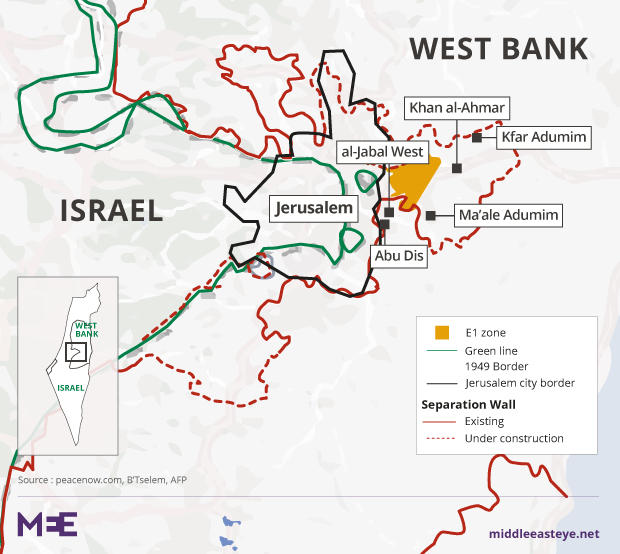
Map by Middle East Eye
We covered the background of the community – and Israel’s plan to forcibly relocate its residents [a war crime] to a site near a garbage dump, in order to expand the Maale Adumim settlement – in last week’s Settlement Report, which you can read here.
The Israeli government submitted its response to the petitions on Monday, saying it intends to carry out the demolition of the village and the relocation of its residents by mid-2018. The State asked the High Court to reject both petitions and allow the plan to advance. B’Tselem’s Executive Director Hagai El-Ad issued a blistering response to the State’s argument saying:
No sanctimonious language about a ‘planning, proprietary and realistic’ alternate, or ‘time to prepare’ can erase the disgrace or hide the facts: the destruction of Khan al-Ahmar means the forcible transfer of protected persons, and forcible transfer is a war crime. Those responsible for it will bear personal criminal liability – exactly as B’Tselem stated two weeks ago, in a letter addressed to the prime minister, defense minister, justice minister, chief of staff and the head of the Civil Administration.
Peace Now also issued a statement on the State’s response:
While the government argues that the residents of Khan al-Ahmar will received alternative housing, they will in fact be evacuated against their will for the benefit of settlers, and placed above the garbage dump in Abu Dis. This type of forceful evacuation of protected persons constitutes a severe violation of international humanitarian law.
It appears that the forceful displacement of the residents of Khan al-Ahmar is a form of “compensation” for his right wing supporters for the upcoming evacuation of the Illegal outpost of Derech Ha’Avot, following a High Court ruling.
It is shameful that settlers from Kfar Adumim, who received their lands for free from the government, are fighting for the evacuation of their Palestinian neighbors, who resided in the area long before them.
Ahead of the hearing, the Haaretz editorial board penned a plea to the Court against the forced relocation and replacement of West Bank Bedouin with Jewish settlements, stating:
This political project – the forced uprooting of Bedouin communities, replacing them with new Jewish settlements – is against international law. It has reached the doorstep of the High Court justices, who are under constant pressure to “respect the will of the people” – that is, the will of the settlers who control the government – even though this will is neither legal nor moral. It must be hoped the justices will be able to stand in the breach.
Another West Bank Community – Susiya – Faces Imminent Demolition (Again)

Map by B’Tselem
The Israeli Defense Ministry is “no longer willing to postpone” the demolition of the Palestinian community of Susiya, according to Haaretz reporting. A senior security official told Haaretz that the demolition will happen within a few months.
Like the Khan al-Ahmar community, the Palestinian residents of Susiya in the South Hebron Hills are the target of Israeli demolition orders and relocation plans. The community that makes up Susiya has a long history, as reported by Haaretz:
Susiya has long been a symbol of both Palestinian steadfastness and Israeli policies. In 1986, Israel expelled the residents from their original ancient village, whose lands were declared a national park. In 2001, they were thrown off their agricultural lands, where they had settled after the earlier expulsion. The High Court of Justice allowed them to return, but didn’t order the authorities to allow them to rebuild. As a result, all the structures in the village were built without permits and are at risk of demolition. The Civil Administration never prepared a master plan for Susiya and rejected the plan the residents had submitted, demanding instead that the residents move to an area near the city of Yatta. The residents refused, but agreed to meet with Civil Administration officials to try to come to some understanding.
The plight of Susiya’s residents continues to inspire a vibrant civil society campaign in both the U.S. and in Israel. Notably, the Obama Administration intervened in the case of Susiya as recently as last year. Back in November 2016, Senator Dianne Feinstein (D-CA) a statement praising PM Netanyahu’s decision to delay the demolition (the link includes links to Feinstein’s long engagement on this issue). In 2015, 10 members of the U.S. House of Representatives sent a letter to Secretary of State John Kerry raising the village’s plight. The New York Times, the Washington Post, and CNN are a few major U.S. outlets that have featured the Susiya’s story sympathetically.
Israeli Military Sets Up New Guard Post in Area A
Peace Now this week published a report documenting the fact that the Israeli army recently established a new guard post in the West Hebron Hills, in a part of the West Bank that is designated as “Area A.” Under the 1995 Interim Agreement, the Palestinian Authority has full civil and security control in the 18% of the West Bank designated as “Area A.” Israeli forces are not allowed to operate in – or even enter – Area A; however, for years Israel has insisted on its right to “hot pursuit” in Area A, carrying out operations at it pleases.
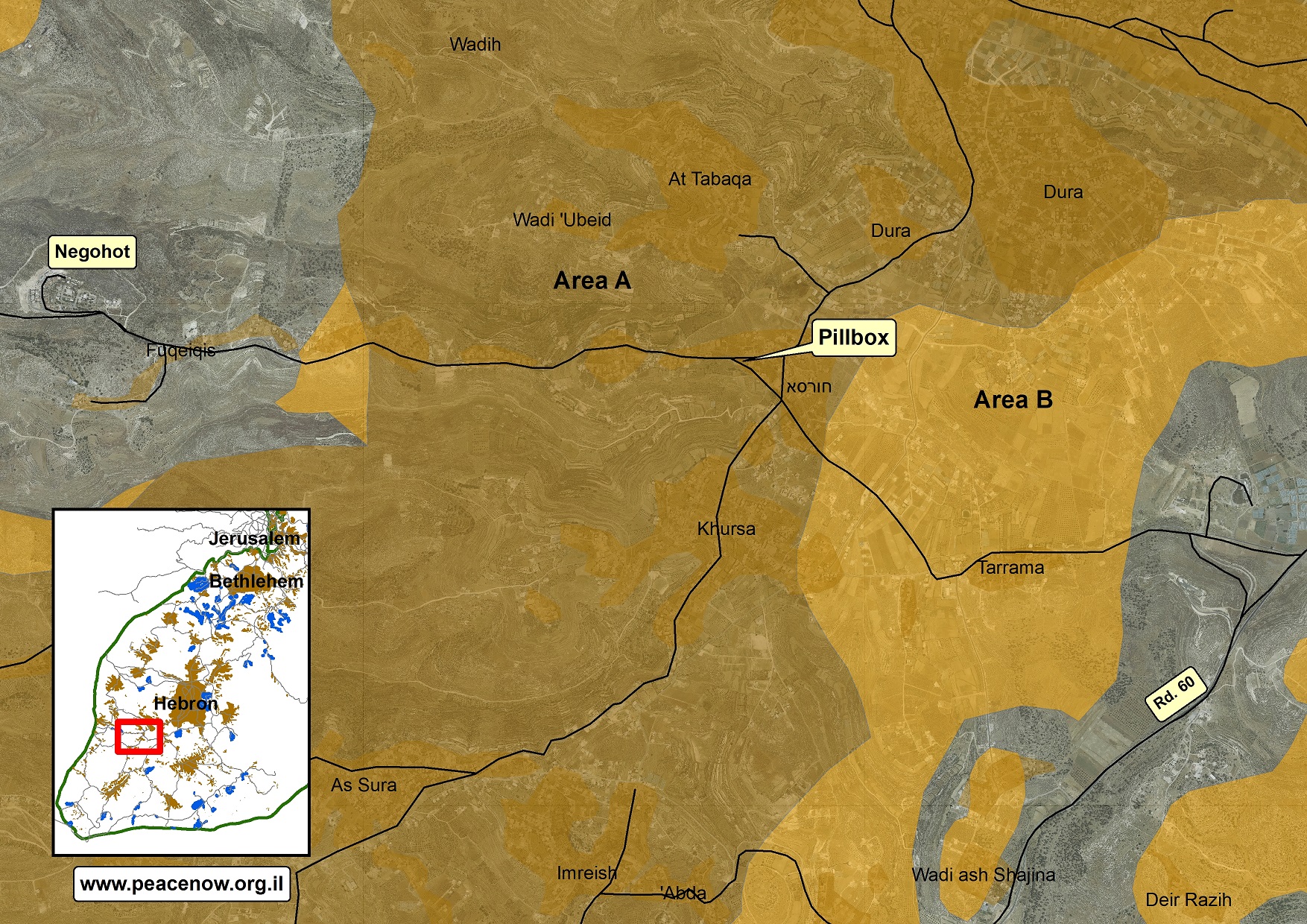
Map by Peace Now
The establishment by the IDF of a static post in Area A (dispensing with even the pretense that the operation is related to “hot pursuit”) represents a new and significant escalation in Israel’s violation of the 1995 Interim Agreement. According to Peace Now, the new “pill box” guard post was built “in the heart of the Palestinian village of Khursa in the West Hebron Hills….in order to protect vehicles of the Negohot settlers, who drive through Area A in order to shorten the way between Jerusalem and the South Hebron Hills.” The Negohot settlement was established in 1999 without official Israeli authorization. A jurisdiction was approved to retroactively legalize the settlement in 2013.
Peace Now said:
The placing of a guard post in area A is a blatant violation of the Oslo Accords and shows the length the Israeli government is willing to go in order to help a handful of settlers take a shortcut on their way home. The new IDF guard post illustrates, yet again, that the settlements do not contribute to Israel’s security, but rather pose a national security burden.
Defending their “Regulation Law,” Knesset Asks Court to Reject Palestinian Petitions
This week the Israeli Knesset submitted to the Israeli High Court of Justice its response to petitions challenging the constitutionality of the “Regulation Law,” which was passed by the Knesset in February 2017. The law provides a legal basis to retroactively legalize Israeli outposts, settlement structures, and agricultural lands that were built illegally (i.e., without permission and/or on land recognized by Israel as privately owned by Palestinians).
The Knesset’s legal advisor argued that Israel is able to selectively write laws for the West Bank. The Knesset asserts it must do so in this case because no other means exist to legalize the settlement homes and outposts [Note: no other means exist because, according to rule of law, the law applies, regardless of whether politicians like the results].The Knesset’s response asks the Court to reject petitions against the Regulation Law.
Last month, a private lawyer hired by the government submitted the State’s response to the petitions, after the Israeli Attorney General declared the law illegal and refused to defend it. The State’s response claimed that the law is legal because Israel can legislate in the West Bank and because the law provides an avenue to compensate the dispossessed Palestinian landowners.
Peace Now and Yesh Din are among the 13 civil society groups leading a legal challenge to the law on behalf of Palestinians. According to data collected by Peace Now, the law will lead to the expropriation of over 8,000 dunam (nearly 2,000 acres) of private land upon which structures have been built illegally – and tens of thousands of dunams of land on which agricultural crops have been planted. The land designated for expropriation is owned by thousands of Palestinians, among them many of the residents of the villages represented in the petition.
Palestinian Laborer Kills Three Israelis in Settlement Attack
On September 26,, a Palestinian man opened fire at the gate of the Har Adar settlement, near Jerusalem. He killed three Israelis – two civilian security guards (one of them a Palestinian citizen of Israel)and one border policeman – and injured another guard. The assailant, who was killed at the scene, was identified as 37-year-old Nimer Mahmoud Ahmad Jamal from the neighboring Palestinian village Beit Surik. He reportedly had an Israeli-issued work permit (which requires security screenings) to enter the settlement, where he was employed as a cleaner. Jamal reportedly had no security record and was married with four children (meaning he did not fit any profile for someone who might commit such an attack). He was reportedly having serious personal and family problems.
Shortly after the attack, Prime Minister Netanyahu announced a range of Israelis responses targeting not the assailant (who died in the attack) but his family, his immediate community, and potentially Palestinians beyond that: the assailant’s house will be demolished and any work permits issued to his relatives (extended family) will be revoked. The attacker’s hometown, Beit Surik, was sealed-off by the Israeli army, and his brothers was arrested. Additional Israeli troops were sent into the area around Har Adar, which sits in what Israel calls the “seam zone,” i.e., the area of the West Bank that runs along, and sometimes on the Israeli side of, the separation barrier. Netanyahu also blamed President Abbas and Palestinian official “incitement” for the attack, despite Israel media reporting widely on the personal problems of the attacker.
FMEP President Lara Friedman has written about how Israel’s response to terror, many elements of which have already unfolded around this attack, amounts to collective punishment.
Bonus Reads
- “Israeli settler sics dog on border police” (Times of Israel)
- “Israeli settler torch olive trees in revenge attack” (The New Arab)
FMEP has long been a trusted resource on settlement-related issues, reflecting both the excellent work of our grantees on the ground and our own in-house expertise. FMEP’s focus on settlements derives from our commitment to achieving lasting Israeli-Palestinian peace, and our recognition of the fact that Israeli settlements – established for the explicit purpose of dispossessing Palestinians in the West Bank and East Jerusalem of land and resources, and depriving them of the very possibility of self-determination in their own state with borders based on the 1967 lines – are antithetical to that goal.
Welcome to FMEP’s Weekly Settlement Report, covering everything you need to know about Israeli settlement activity this week.
To receive this report via email, please click here.
September 20, 2017
- Israel Moves to Forcibly Transfer West Bank Community [A War Crime]
- Normalizing Settlements in the Name of Peace – The WINEP Approach
- NEW REPORT: Yesh Din on Systematic Land Theft by Israeli Quarries in the West Bank
- NEW REPORT: Human Rights Watch on Israeli Banks’ Financing of Settlement Expansion
- Updates: Al-Walajah, Ras al-Amud, Halamish, Hebron
- Bonus Reads
Comments, questions, or suggestions? Email Kristin McCarthy at kmccarthy@fmep.org.
Israel Moves to Forcibly Transfer West Bank Community [A War Crime]
B’Tselem reports that the Civil Administration is set to soon forcibly relocate the Palestinian Bedouin community of Khan al-Ahmar in the West Bank, a war crime under international law. Haaretz confirmed the Israeli government’s intention to carry out the plan. Khan al Ahmar is located in an area that is considered key for Israel’s desired expansion of the Maale Adumim settlement and construction of the new “E-1” settlement.

Map by B’Tselem
Last week Israeli officials went to Khan al-Ahmar to tell the residents that their only option was to relocate to a site in the nearby Palestinian city of Abu Dis, next to the Abu Dis garbage dump. The village’s lawyer was not present at the time of the officials’ visit, despite Israeli authorities previously committing to not meet with the residents without their lawyer present.
Khan al-Ahmar’s residents settled in their current West Bank location in the 1950s, by Israel – after having been forced off their lands in the Negev (i.e., inside Israel proper). Israel subsequently declared the land of Khan al-Ahmar to be “state land” and over the years have repeatedly threatened the total demolition of the community. For years, international pressure – which importantly included a strong stance by the Obama Administration specifically regarding the E-1 area – has prevented Israel from going ahead with the demolitions and relocation. The Trump Administration has not commented on this specific matter to date.
Btselem Executive Director Hagai El-Ad has penned an urgent letter to Prime Minister Benjamin Netanyahu articulating why the forcible transfer of Khan al-Ahmar would constitute a war crime under international law. The accompanying press release notes:
Demolition of an entire community in the Occupied Territories is virtually unprecedented since 1967. Under the Fourth Geneva Convention, which Israel is obliged to respect in all its actions in the West Bank, this amounts to forcible transfer of protected persons, which constitutes a war crime.
B’Tselem has long documented Israel’s routine harassment of the Khan al-Ahmar community. The harassment has included: In 2015, the Israeli Civil Administration confiscated 12 solar panels donated by an international humanitarian group and that served as the sole power source for the community. In 2016, Israel demolished 12 homes, leaving 60 people homeless. In February 2017, Israel issued demolition orders for every structure in the village and that same month, Israel demolished a mobile home, leaving an elderly woman homeless. Settlers from the Maale Adumim settlement have filed petitions (starting in 2011) demanding that the Khan al-Ahmar school – a school that serves not just the Khan al-Ahmar community but others nearby – demolished.
The Israeli High Court of Justice (the equivalent of the Supreme Court) is set to hear petitions and decide on the community’s future on September 25th. Settlers have petitioned to expedite the demolitions, and Khan al-Ahmar community members have petitioned against the demolition orders.
Normalizing Settlements in the Name of Peace – The WINEP Approach
The Washington Institute for Near East Policy (WINEP) is set to launch a new portal with “up-to-date, granular information” about settlements in the West Bank. [Editor’s note: If you are looking for up-to-date, granular information about Israeli settlements, Peace Now, Terrestrial Jerusalem, Ir Amim, Yesh Din, and many other Israeli and Palestinian civil society organizations host it their websites currently. Contact FMEP for additional resources.]
The yet-to-be-revealed portal and its architect, David Makovsky, were given an early endorsement by the Washington Post’s Jackson Diehl, in a piece this week entitled “How Trump could save Palestinian statehood.” The article, quoting Makovsky extensively, promotes the notion that Trump can save the hope for peace by adopting a policy according to which, “Netanyahu stops building in areas beyond the West Bank fence, and Abbas stops paying off militants and their families.”
For people who follow the work of Makovsky and his WINEP colleague Dennis Ross, this logic should sound familiar; it is nearly identical to what Ross has been proposing, over and over, since 2013 (see also, for example: March 2015, Feb 2016, Nov 2016, Jan 2017). At the core of this logic is the notion that Israel getting U.S. backing to, in effect, unilaterally annex around 10% of the West Bank – including areas that obstruct the contiguity of a future Palestinian state and that will prevent the possibility of any viable Palestinian capital in East Jerusalem – should be seen as a generous Israeli concession to the Palestinians and a down-payment on a peace agreement.
FMEP’s Lara Friedman deconstructed these arguments back in 2013 – that analysis has not changed. As she noted back in 2013, this approach:
“…is a recipe not for strengthening the two-state solution, but for imposing a unilateral Israeli vision of a Greater Israel extending beyond the Green Line, adjacent to a balkanized Palestinian entity. Such an outcome may be appealing to Benjamin Netanyahu and his U.S. apologists. It will never be acceptable to the Palestinians and the international community, and it certainly shouldn’t be mistaken for a “solution” to the Israeli-Palestinian conflict.”
NEW REPORT: Yesh Din on Systematic Land Theft by Israeli Quarries in the West Bank
In its new report, “The Great Drain: Israeli quarries in the West Bank: High Court Sanctioned Institutionalized Theft,” the Israeli non-governmental organization Yesh Din documents how Israel’s mining and quarry activities in the West Bank constitute economic exploitation of the occupied West Bank for Israel’s exclusive profit, in violation of international law. In 2008, Yesh Din petitioned the High Court to stop all such activities; that petition was rejected.
Key findings in the new report include:
- Since the High Court of Justice ruled against Yesh Din’s 2008 petition, Israel has dramatically expanded its mining and quarrying activities in the West Bank.
- Over 20% of the State of Israel’s general consumption of gravel now comes from the quarries in the Occupied Territories.
- Official documents indicate that the Israeli authorities have a long-term plan to rely on the mining potential in the West Bank for at least the next 30 years.
Yesh Din concludes: “Decades of Israeli looting of natural resources in the West Bank are the embodiment of colonialism. In practice, the High Court ruling has rendered meaningless the acceptable interpretation of international humanitarian law, leaving in place the continued, irreversible exploitation of the occupied territory for the Israel’s economic purposes.”
NEW REPORT: Human Rights Watch on Israeli Banks’ Financing of Settlement Expansion
In its new report, “Israeli Law and Banking in the West Bank,” Human Rights Watch document how Israeli banks are failing to respect international humanitarian law by providing services to and in settlements. In doing so, the banks contribute to the expansion and entrenchment of settlements, at the expense of Palestinians.
Key findings of the report include:
- All five of Israel’s largest banks, as well as the Bank of Israel (Israel’s central bank) are operating in settlements. These five largest banks are: Bank Leumi, Hapoalim, Bank Discount, Mizrahi Tfahot, and First International Bank of Israel.
- The Israeli Association of Banks claimed to be legally obliged to offer financial services in and to settlements under Israel’s Anti-Discrimination Law (5761-2000), but the Association did not explain how refusing to provide services to settlements would constitute discrimination on the basis of nationality, race, religion, or political views. (Israel’s Anti-Discrimination Act was recently amended to require businesses, including banks, to notify customers if they decline to provide services to settlements. However, the amended version of the law does not require businesses to provide services to settlements.)
- Israel’s domestic “Banking Law” is applied to settlements via military order, which violates international humanitarian law.
- The Banking Law only prohibits banks for unreasonably refusing to provide three services: receiving deposits, opening and managing a checking account, and issuing bankers’ checks. No other services are required/obligated under the Banking Law.
The report concludes, “Human Rights Watch does not believe it is possible for businesses to operate in the settlements in compliance with their international responsibilities, due to the inherent international humanitarian law and human rights violations that characterize settlements. Human Rights Watch is calling for banks, like other businesses, to comply with their own human rights responsibilities by ceasing settlement-related activities.”
Updates: Al-Walajah, Ras al-Amud, Halamish, Hebron
- In Al-Walajah, Israelis and Palestinians marched together in protest of a wave of pending home demolitions and the imminent completion of the separation barrier which will completely encircle the village. Israel resumed construction of the wall in April and has issued dozens of demolition notices to the residents since then. In early August, al-Walaja residents formed a human barrier to prevent Israeli bulldozers from demolishing one of the threatened homes. Since then, Israel has not attempted to execute another demolition.
- Israel demolished a two-story apartment building in the Ras al-Amud, a Palestinian neighborhood of East Jerusalem. B’Tselem reports that Israel has demolished 45 Palestinian homes in East Jerusalem in 2017.
- In the area near the settlement of Halamish (where several members of an Israeli family were brutally murdered earlier this year), Kerem Navot has updated reporting on how road closures and plans for a new bypass road are leading to the settlement’s expansion and takeover of the Umm Saffa forest, a nature reserve.
- In Hebron, the Israeli settlers who broke into and illegally set up residence in the disputed “Machpela House” continue to remain in the house, under the protection of the Israeli army. They even received a visit from the Israeli Interior Minister, Aryeh Deri (Shas), this week. The High Court of Justice has not made a decision on the ownership of the house, and has granted the settlers’ wish to delay their evacuation from the house, going against an order from the Israeli Attorney General.
Bonus Reads
- “Law But Not Justice in Sheikh Jarrah” (Times of Israel)
- “WATCH: Settler attacks left-wing activist” (+972 Magazine)
- “Have Amona ‘refugees’ found recipe for post-evacuation success?” (Times of Israel)
- “Drowning in the Waste of Israeli Settlers” (Al Jazeera)
FMEP has long been a trusted resource on settlement-related issues, reflecting both the excellent work of our grantees on the ground and our own in-house expertise. FMEP’s focus on settlements derives from our commitment to achieving lasting Israeli-Palestinian peace, and our recognition of the fact that Israeli settlements – established for the explicit purpose of dispossessing Palestinians in the West Bank and East Jerusalem of land and resources, and depriving them of the very possibility of self-determination in their own state with borders based on the 1967 lines – are antithetical to that goal.
Welcome to FMEP’s Weekly Settlement Report, covering everything you need to know about Israeli settlement activity this week.
To receive this report via email, please click here.
August 16, 2017
- Israel Demolishes Buildings in Key East Jerusalem Areas
- Bedouin are Powerless in E-1 Area as Settlement Plans Loom
- Jewish National Fund Resumes Targeting Land in the Occupied West Bank
- Settlers in Israeli Government Turn Blind Eye to Settlers Breaking Israeli Law
- Former Israeli AG Says Sheikh Jarrah Property Should be Given to Palestinians
- Three New Outposts Near Nablus
- Updates: Al-Walajah, Sheikh Jarrah, Amichai Settlement
- Bonus Reads
Comments, questions, or suggestions? Email Kristin McCarthy at kmccarthy@fmep.org.
Israel Demolishes Buildings in Key East Jerusalem Areas
The Israeli government demolished eight Palestinian structures in the East Jerusalem neighborhoods of Silwan, Beit Hanina, Jabal Mukaber, and Isawiyyah. According to Ir Amim, the two apartments demolished in the al-Bustan area of Silwan are the first demolitions to be carried out there since 2008. Looking at East Jerusalem as a whole, Ir Amim writes, “[these] demolitions bring the 2017 total to 128, including 84 residential units and 44 non-residential units. These numbers are on well on target to meet or surpass the total number of 203 demolitions executed in East Jerusalem last year.”
Bedouin are Powerless in E-1 Area as Settlement Plans Loom
According to B’Tselem, last week Israeli officials confiscated solar panels that were providing electricity to a Bedouin community’s school in the controversial area adjacent to Jerusalem known as “E-1.” The confiscation happened despite a temporary court-ordered injunction against it. The Israeli government has long refused to connect the Bedouin to a power grid; the solar panels confiscated this week were donated only a month ago by a humanitarian organization.

Map by the Economist
The E-1 area has long been slated for Israeli settlement construction, but plans have been continuously delayed by the Israeli political echelon – due in large part to pressure from U.S. administrations and others in the international community. If E-1 is developed it will seal Palestinian East Jerusalem off from the West Bank to its east, and create a land bridge from Jerusalem to the Maale Adumim settlement. The settlement will render the two-state solution impossible because it would preclude the ability to draw contiguous borders for a future Palestinian state with a capital in East Jerusalem.
East Jerusalem expert Danny Seidemann has issued several warnings this year that E-1 – a “doomsday settlement” – might be slated for advancement under the current settlement policy of the Netanyahu government and with no discernable counter-pressure from the Trump Administration. Seidemann warned in January, “The main obstacle preventing a green light for E-1 has, until now, been wall-to-wall opposition from the international community, led by the United States (dating back to the era of President Clinton).”
The Bedouin community living in the E-1 area has long been threatened with forcible relocation (which would amount to population transfer). The 18 Bedouin tribes that live in the vicinity of Maale Adumim and E-1, totaling approximately 3,000 people, have already endured numerous emolitions this year alone.
Jewish National Fund Resumes Targeting Land in the Occupied West Bank
According to Peace Now, the Jewish National Fund (JNF) is set to resume its practice of purchasing land in the West Bank for use by Israeli settlers, after abandoning the effort many years ago. In the past, many of the JNF’s land purchases reportedly involved fraud, extortion, and/or forgery on the part of middlemen.
Peace Now writes, “Through purchasing lands in the occupied territories, JNF serves the settlers, hurts the possibility to arrive at a two state solution, and jeopardizes the future of Israel as a Jewish and democratic state.”
The JNF – which collects donations internationally, including in the United States – currently owns land (through its Israeli subsidiary) in numerous settlements, including Itamar, Alfei Menashe, Enav, Kedumim, Givat Ze’ev, Metzadot Yehuda, and Otniel.
Settlers in Israeli Government Turn Blind Eye to Settlers Breaking Israeli Law
There have been several recent reports about structures inside of settlements that were built (or are being built) without the legally-necessary permissions, as Israeli officials turn a blind eye.

Map of the Hayovel outpost by Times of Israel Red encircles site construction, arrow points to the house of Liberman’s settlement affairs advisor.
Notably, one report identifies dozens of unauthorized homes being built in the outpost of Hayovel (which is effectively an extension of the settlement of Eli), despite a stop-work order issued by Civil Administration (the arm of the Ministry of Defense that is sovereign in the West Bank). The construction is taking place virtually across the street from the home of Israeli Defense Minister Avigdor Liberman’s own adviser on settlement affairs, who is himself a resident of the illegal outpost (Liberman is also a settler, residing in the settlement of Nokdim). The illegal construction will double the size of the outpost.
Another report reveals that Shlomo Ne’eman, the head of the Gush Etzion Regional Council – which promotes the expansion of settlements in the Etzion bloc – lives in an illegal outpost. The Regional Council insists that the outpost is a “neighborhood” of the Karmei Tzur settlement, but aerial images show it is outside of the settlement’s municipal border. The Israeli Civil Administration has ordered the structures there to be demolished but has not carried out those orders. Settlement watchdog Kerem Naboth says, “Ne’eman has joined the list of elected officials and politicos among the settlers who are not only assisting others in stealing land, but are also doing it themselves.”
Haaretz notes that these two are part of a longer list of elected officials and senior civil servants living in illegal outposts, Also on that list far right-wing Knesset Member Bezalel Smotrich (Habayit Hayehudi), who lives in an illegally-built home in Kedumim (not coincidentally, Smotrich was one of the key backers of a law passed earlier this year to “legalize” such settlement illegalities). Likewise, a January report revealed that the head of the Finance Ministry’s department of building regulations enforcement, Avi Cohen, lives in an illegal outpost of the Eli settlement. At the time of the report in January, Rabbis for Human Rights said, “A situation in which the system responsible for enforcing building laws is headed by someone living in an outpost demonstrates contempt for the system and Israel’s values.”

Image by Kerem Naboth
Another report documents how in the Efrat settlement (in the Etzion settlement bloc) a school was recently expanded, illegally, on private Palestinian land located land outside of the settlement’s border. Funding for the project was raised by an organization, called the Ohr Torah Stone, which operates a branch in the United States and is eligible to receive tax-deductible donations from U.S. donors. According to settlement watchdog Kerem Naboth, the Efrat settlement itself was built on land that the Palestinian village of al-Khadr had long cultivated. Kerem Naboth reports, “aerial photographs from the 1980s indicate that in the past there was a vineyard on site.”
Former Israeli AG Says Sheikh Jarrah Property Should be Given to Palestinians
Speaking in Sheikh Jarrah, former Israeli Attorney General Michael Ben-Yair called on the Israeli government to intervene to stop the eviction of the Shamasneh family from their longtime family home. Ben- Yair served as the AG from 1993-1997, under prime ministers Rabin and Netanyahu.
Ben-Yair, whose family lived in Sheikh Jarrah until 1948, suggested he would be ready to reclaim his family’s property and then transfer it to the Palestinians currently living there – and called on the government to adopt a policy to do exactly that, across the board. He said, ”If the Israeli government would have acted decently toward all its residents, including you [the Arab residents], it would have appropriated the properties in the neighborhood [from their Jewish owners who lived there before the War of Independence] and given these properties to the Palestinians who live there today.”
The former AG also noted that Jews who lost property in the 1948 war were already compensated – at the expense of Palestinians. Ben-Yair said, “My family and the family of my cousin who were forced to leave the neighborhood in January 1948 got properties of Palestinians refugees on Jaffa Road and in the Katamon neighborhood in west Jerusalem. They were worth much more than the properties that we left in Sheikh Jarrah.
Since we covered the Shamasneh family’s story last week, a temporary injunction against the eviction expired on Sunday, August 13th. The family’s lawyer requested a second injunction, but the petition is still pending. As of this writing the family is still living in the home.
Three New Outposts Near Nablus
The Palestinian Authority is reporting that settlers from the radical Yitzhar settlement, south of Nablus, have moved 11 mobile homes to an area outside of the settlement, a move which would expand the settlement’s footprint. In addition, nine mobile homes were reportedly placed near the Palestinian village of Qusin, which is a few miles east of Nablus, and another nine were placed near the border of the Einav settlement, a few miles east of Qusin.
Updates: Al-Walajah, Sheikh Jarrah, Amichai Settlement
Updates from last week’s Settlement Report:
- Residents of the village of Al-Walajah were able to stop the demolition of one home last week by forming a human barrier around it, blocking a bulldozer from tearing it down. Approximately one third of the village is inside of Jerusalem’s municipal boundary. In this area specifically, Ir Amim estimates that 50% of the homes are under threat of demolition. Al-Walajah residents say the Israeli government has recently increased the rate of home demolitions significantly and has also resumed construction of the separation barrier around the village.
- UNRWA has weighed in on the pending eviction of the Shamasneh family from their home in Sheikh Jarrah. UNRWA spokesman Christopher Gunness states, “The members of the Shamasneh family are long-standing Palestine refugee residents in East Jerusalem, which is occupied territory and affected by continued settlement expansion contrary to international law. It is a matter of deep concern that Palestine refugees who have already endured multiple displacements should be subject to the humiliation of the kind inflicted by forced evictions.” The statement calls on the Israeli government to reconsider the eviction ruling.
- Construction on the first new settlement in 25 years, Amichai, remains stalled due to lack of government funding. After nearly three weeks of inactivity on the construction site, the families who the settlement is being built for are preparing to move to the area with semi-permanent structures and take up residence. On plans to move to the site while construction is stalled, one settler told Ynet News, “It is clear that when we do go there [to the site of Amichai], thousands of youths will join us. When we do, it will be to stay for good.”
Bonus Reads
- “Adalah opposes mandate of Israeli Interior Ministry borders cmte. weighing annexation of West Bank land to settlements” (August 13, 2017)
FMEP has long been a trusted resource on settlement-related issues, reflecting both the excellent work of our grantees on the ground and our own in-house expertise. FMEP’s focus on settlements derives from our commitment to achieving lasting Israeli-Palestinian peace, and our recognition of the fact that Israeli settlements – established for the explicit purpose of dispossessing Palestinians in the West Bank and East Jerusalem of land and resources, and depriving them of the very possibility of self-determination in their own state with borders based on the 1967 lines – are antithetical to that goal.