Welcome to FMEP’s Weekly Settlement & Annexation Report. To subscribe to this report, please click here.
February 27, 2026
- ANNEXATION: U.S. Offers Consular Services in Settlement, More
- WEST BANK SETTLEMENTS & OUTPOSTS: Smotrich to “Relocate” Seam Zone Village, New Bypass Road, Outpost Rebuilt Near Mukhmas, Eliyahu Raises Israeli Flag on Jordan Valley Peak, New Outpost Phenomenon Near Barrier, More
- SETTLER & STATE TERRORISM: Firey Attack on Masafer Yatta, More
ANNEXATION
In First – US To Offer Consular Services in Settlement
The United States Embassy in Jerusalem announced that it will be hosting one-day consular services inside of the Efrat settlement – marking the first time the U.S. will conduct official consular services in a settlement. The announcement further promised to schedule consular services in the Beitar Illit settlement in the coming months.The move is a significant show of support for Israel’s sovereignty over the settlements which under international law are illegal civilian settlements inside of an occupied territory. The move is tantamount to recognizing Israel’s annexation of West Bank land. A U.S. Embassy spokesperson told the New York Times that the policy of the government vis a vis settlements has not changed.
Israeli annexationists praised the announcement. MK Yuli Edelstein, former Speaker of the Knesset, called it ““a blessed step of tremendous importance” and said the move:
“adds to the international legitimacy of our right to the regions of our homeland in Judea and Samaria.”
Israeli human rights lawyer Michael Sfard said:
“This cannot be construed in any way other than as a political statement of legitimization of Israeli settlements in the West Bank.”
News & Analysis on Annexation
- “Smotrich: Jerusalem will ‘never’ cede control of Judea and Samaria” (JNS, 2/24/2026)
- “4 Questions for an Expert: Israel’s De Facto Annexation of the West Bank” (IMEU, 2/25/2026)
- “Israel’s Perfect Storm: The West Bank Has Been Sacrificed for Trump’s Gaza Plan” (Haaretz, 2/23/2026) Hagar Shezaf writes: “Anyone with eyes knows it’s foolish to think that the annexation of the West Bank will happen through a declaration. The government’s actions are making annexation a reality, and it’s happening now, out in the open.”
WEST BANK
Smotrich, Katz Advancing Plan to Relocate – AKA Ethnically Cleanse – Palestinian Village in Seam Zone
The Israeli government informed the High Court that it is advancing a long-stalled plan to “relocate” 430 residents of the Palestinian village of Arab al-Ramadin al-Junabi, a village which has lived on its land since the 1950s. The government argues the relocation plan is in the best interest of the community, which due to its location in the so-called “Seam Zone” (in the West Bank but on the Israeli side of the Separation Barrier which was built by Israel in 2002), is cut off from receiving infrastructure services from the PA and remains unserviced by Israel. Now, the village is trapped in poverty and lacking approved planning guides, though the village has worked with planning professionals at Bimkom to advance a Master Plan which Israel has rejected. Israel – which has created this situation to coerce its residents to leave – is now using it as a weapon against Arab al-Ramadin al-Junabi to carry out a court-approved ethnic cleansing.
New Settler Bypass Road Expands Apartheid Road Matrix
Peace Now reports that Israel has kicked off construction on a new settler-only bypass road – known as the Road 45 of the “Quarries Road” – that will connect settlements east and north of Ramallah more seamlessly to the Qalandiya Underpass and on to East Jerusalem, avoiding Palestinians, security checks at the Qalandiya checkpoint, and the constant traffic near the Hizma checkpoint. Beyond providing settlers a Palestinian-free path to Jerusalem, the road also creates more capacity for settlement growth in these areas.
Peace Now said in a statement:
“Peace Now: While roads inside Israel are collapsing and unable to cope with the traffic load, the government is pouring enormous budgets into a small minority of settlers in grandiose projects that Israel will ultimately be forced to evacuate. The belief that bypass roads around Palestinian villages will erase the political, diplomatic, and security problem known as the settlement enterprise is a dangerous, costly, and violent illusion. The theft of hundreds of dunams for expensive roads that serve so few, only highlights the injustice and absurdity of government policy. Israel does not need more roads that bypass Palestinians, but rather ways to reach a political solution with them.”
Settlers Rebuild Outpost Near Mukhmas
The Times of Israel reports settlers rebuilt an illegal outpost near the village of Mukhmas, which has been violently and repeatedly terrorized by settlers (under IDF supervision) recently resulting in the murder of a 19-year old Palestinian American just last week. The outpost, called “Kol Mevaser,” is located in Area B of the West Bank, underscoring the total erosion of the Oslo framework. Though the IDF has repeatedly dismantled the outpost, settlers still manage to bring in heavy construction equipment to rebuild.
Prominent Israeli activist and settlement watchdog Rabbi Arik Ascheman notes that, in the area near to Kol Mevaser outpost, the “mother outpost” Nakhalat Tzvi continues to expand illegally.
Heritage Minister Raises Israeli Flag on Mount Sartaba
Israeli Heritage Minister Eliyahu raised an Israeli flag on the peak of Mount Sartaba, located in the Jordan Valley, saying it is “a symbolic step showing Israel “reoccupying” the West Bank and vowing to use it for religious observance.” Eliyahu said the act was part of a series of similar symbolic acts planned for across the West Bank.
Mount Sartaba is also known as Alexandrium – the site of the ancient Hasmonean fortress.
New Outpost Strategy Takes Advantage of Israeli Military Zones Near Barrier
 Kerem Navot reports the emerging phenomenon of new outposts built along the Israeli security road that trods along the path of the West Bank separation barrier. There are currently 11 such outposts, accessible only via the Israeli security road not meant for civilian use.
Kerem Navot founder Dror Etkes told Haaretz,
“The establishment of a chain of illegal outposts along the barrier fence route, and the fact that large segments of the barrier route have become access roads to these outposts, indicate that since Avi Bluth became commander of the Central Command, the outposts project has transformed from one that takes place under the protection and with the cooperation of the military into an illegal project in which the military is directly involved, even financing part of it.”
Israel Systematically Denying Building Permits to Palestinians Living in Area C
Amira Haas reports for Haaretz ton the multifold mechanisms by which Israel has advanced its total control over the West Bank, expanded settlements, and displaced Palestinians. One such mechanism is systematic denial of building permits and subsequent demolitions of Palestinian homes. Haas reports that between 2009 and 2020 Israel:
- Issued building permits for 66 Palestinian buildings in Area C
- Issued building permits for 22,000 settlement units.
Haas continues:
“With construction permits effectively barred, thousands of Palestinian structures have been demolished—including 2,461 over the past two years alone—displacing about 2,500 people, data from the United Nations Office for the Coordination of Humanitarian Affairs show. Israel’s security cabinet recently approved wide-ranging steps aimed at deepening Israeli control in the occupied West Bank and enabling further growth of settlements.”
More News & Analysis from the West Bank
- “In Area C, Faster Demolitions Clear the Way for Jewish Expansion” (Haaretz, 2/23/2026)
- “2025 was record year for settlement expansion, construction and planning, NGO finds” (The Times of Israel, 2/25/2026)
- [Reported on last week] “’We Won’t Wait for Approval’ Israeli Settlers Declare New West Bank Settlement Deep Inside Palestinian Hebron” (Haaretz, 12/22/2026)
SETTLER TERRORISM
Pogrom in Masafer Yatta, South Hebron Hills
In a nighttime attack on February 24th, a group of at least 20 settlers were caught on film setting fire to several homes and vehicles in the village of Susya, located in the Masafer Yatta region of the South Hebron Hills. There were reportedly children inside one of the homes set on fire. The settlers also wielded sticks and damaged property and spray painted hateful graffiti. Four people were treated for smoke inhalation by the Palestinian Red Crescent.
On the same night, Palestinian residents of villages close to Susya reported settlers had also carried out smaller scale violent attacks and let out heads of livestock.
More Reports of Settler Attacks
In addition to the attack on Masafer Yatta, settler attacks over the past week include:
- Tell: On Feb 23rd, settlers set a mosque on fire and spray painted “Revenge” and “Price Tag.”. Tell is located near Nablus in an area surrounded by violent settlements including Itamar and the Gideon’s Farm outpost, which was recently shortlisted for legalization by the Israeli government.
- al-Mughayyir: On Feb 21st, settlers descended on a home in the village of al-Mughayyir, and proceeded to beat the Palestinian family living there. When two men came to the aid of the family, settlers and IDF soldiers in the area opened fire, wounding two. The family, the Abu Naim family, has decided to abandon their home out of fear.
- Qusra: On February 27th, settlers attacked a group of Israeli activists in near the village of Qusra, located in the area of Nablus. Two were hospitalized with head injuries.
News & Analysis of State-Backed Settler Terrorism
- “State indicts 19-year-old for alleged revenge rampage in West Bank village after outpost evacuation” (Jerusalem Post, 2/25/2026)
- “US avoids condemning settler killing of Palestinian-American in armed West Bank attack” (The Times of Israel, 2/22/2026)
- “Settlers Drive a Palestinian Family Off Its Land” (New York Times, 2/24/2026)
Welcome to FMEP’s Weekly Settlement & Annexation Report. To subscribe to this report, please click here.
January 30, 2026
- West Bank Settlements & Outposts: More Funding for Settler-Only Roads; Expanded Settler Access to Joseph’s Tomb, Soil Smuggling, and More
- Settler Terrorism: Pogrom in Masafer Yatta, Displacement in Sinjil, and More
- Bonus Reads
West Bank Settlements & Outposts
Israel Allocated More Funds for New Roads & More for Settlers
Peace Now reports that the Israeli government approved some 550 million shekels ($177.97 million) for the “reinforcement of security components,” most of which will be directed to the West Bank. The funds will be used for paving new settler security roads, upgrades to bus stations and armored buses, and new security features for settlements like fences, lighting, gates, cameras, and sensors.
The Palestine Chronicle further reports that part of the budget will be used for the construction of Route 45 (aka the “Quarry Road”), a settler-only bypass road that would connect settlements south of Ramallah to Jerusalem. Israel expropriated Palestinian land in January 2025 to allow for the construction of this road.
Peace Now said in a statement:
“Under the pretext of “security components,” the government has already invested hundreds of millions of shekels in illegal outposts and violent settler farms in the occupied territories. It is now seeking to further expand this budget, deepening Israel’s security and economic entanglement in the occupied territories. It is now clear to all — especially after Oct. 7 — that the settlements constitute a security and economic burden on Israel, yet the government continues to serve only its settler base.”
For the First Time in 25 Years, Settlers Allowed Morning Prayers Joseph’s Tomb
Israeli Defense Minister Katz agreed to allow settlers to perform morning prayers at Joseph’s Tomb in Nablus for the first time in 25 years. Joseph’s Tomb is a holy site for Jews and cultural site for Palestinians, located in the heart of Nablus. The site has long been a flashpoint for violence because the Tomb (and entrance to it) requires settlers to pass through very densely populated Palestinian neighborhoods.
On January 29th, Israeli ministers and settler leaders led a group of 1,500 people under a heavy security escort to Joseph’s Tomb. In 2000 during the Second Intifada, Israeli officials restricted Israeli access to the site to nighttime hours in hopes of minimizing conflict.
Israel is Trucking Soil from Tel Aviv to West Bank to Build New Outposts & Settlements
Kerem Navot told Haaretz that Israeli trucks are smuggling a large amount of soil from Tel Aviv construction sites to the West Bank in order to prepare the land for the expansion of at least two outposts. The soil has been transferred reportedly without the permission of the Israeli Civil Administration, and is apparently a widespread phenomenon in part because environmental regulations in the West Bank and relaxed (and bent to favor Israeli interests) and because Israel lacks regulated sites where excess construction debris can be deposited.
There has been increased construction at the two outposts, Havat Tzurim and Shacharit, preparing for what Haaretz calls “the outposts’ emerging farm operations.” Schacharit was granted retroactive legalization by the Israeli government in 2023 along with 9 others outposts, but Havat Tzurim remains illegal under Israeli law. None of the current construction is legal.
Haaretz reports:
“Settlers often frame the establishment of outposts and farms as a means of protecting nature and preserving landscapes from damage allegedly caused by the activity of Palestinians, such as overgrazing and illegal hunting. However, the dumping of excess soil increases the risk of waste contaminants seeping into groundwater reservoirs, which communities rely on for drinking and irrigation, while road construction and other land preparation activities increase the risk of erosion, flooding and other runoff issues.”
More from the West Bank
- IDF seizes thousands of dunams from a village near Hebron.
- VIDEO: “How Israel is planning to build an ‘apartheid road’” (Guardian News, 1/27/2026)
- “Israeli forces raid Hebron city and surrounding towns, turn building into military outpost” (Wafa News, 1/29/2026)
SETTLER TERRORISM
Settler & IDF Pogrom in South Hebron Hills
On January 27th a large group of settlers under IDF escort carried out a large-scale, coordinated pogrom on three villages in the Masafer Yatta region of the South Hebron Hills. The settlers moved from one village to another, setting fire to Palestinians property, stealing livestock, spraying teargas inside of homes, and horrifically terrorizing residents. Two Palestinians were severely assaulted by settlers, one severely beaten with clubs and an elderly woman had her arm broken. After the attack, two Palestinian and zero Israelis were arrested by the IDF.
In a separate incident on January 26th, settlers destroyed 500 trees in the nearby village of Susiya.
Sinjil Residents Threat of Forced Displacement, Marking New Heights of Settler Terror
Haaretz reports that 15 families have recently been forced to leave their homes located on the periphery of the town of Sinjil under settler terror. Sinjil, unlike the many bedouin and pastoral communities that have been forcibly displaced under settler terror over the past two years, is a large town with 8,000 people. Residents tell Haaretz settlers from surrounding outposts first began to trespass on their land in 2022, and it has only escalated since – causing many families to leave.
In Area B, Outpost Settlers Attack Qusra, Atara, Bir Zeit
Settlers from a newly established outpost near Nablus carried out several attacks on Palestinians in the surrounding area. The outpost is located deep in Area B (the vast majority of settlements and outposts are in Area C), and Haaretz reports that this new outpost is “the deepest so far within territories under Palestinian jurisdiction.” Settlers are expanding the outpost, and have brought in a large herd of sheep to take over grazing land. The IDF claims to have evacuated the outpost previously, but local residents report the outpost was quickly reestablished by settlers.
On January 23rd a group of at least 10 masked settlers from the new outpost attacked the village of Qusra, firing live rounds towards Palestinians and carrying clubs.
On January 25th settlers set fire to vehicles in nearby Atara village, and spray painted hateful messages.
Earlier on the same day, settlers were filmed in an olive grove in the nearby village of Beir Zeit, and settlers reportedly attacked a 60-year old woman and her son who tried to assist her.
More on settler terrorism
- Settler attacks reported in Ein Samiya and Taybeh, effecting water supply.
- “The calculated erasure of Ras Ein Al-Auja” (+972 Magazine, 1/16/26)
- Haaretz Editorial Board: “The Israeli Ethnic Cleansing Militias in the West Bank Have Succeeded Once Again” (1/27/2026)
- “A bloody season: the olive harvest in the West Bank” (Mondoweiss, 1/29/2026)
BONUS READS
- “’People will live in the streets’: Israel steps up evictions of Palestinians from east Jerusalem” (Reuters, 1/282026)
- “A Palestinian neighborhood’s last stand against Israeli settler takeover in Jerusalem” (Mondoweiss, 1/26/2026)
- “Paving military roads, Israel prepares permanent control of West Bank camps” (+972 Magazine, 1/19/26)
- “UNRWA Heads Tell Haaretz: ‘We Don’t Radicalize Palestinians – Their Lived Existence Does‘” (Haaretz, 1/20/26)
- “Israel Will Not Allow Gaza Residents to Receive Medical Treatment in West Bank, East Jerusalem Due to ‘Security Risks’” (Haaretz, 1/26/26)
- “‘I cannot help my clients’: The impossible task of representing Palestinian detainees” (+972 Magazine, 1/27/2026)
Welcome to FMEP’s Weekly Settlement Report, covering everything you need to know about Israeli settlement activity this week.
To subscribe to this report, please click here.
July 12, 2024
- A Stunning, Expansive Time for Israel’s West Bank Annexation
- Civil Admin Seizes Patchwork of Plots as “State Land” in Order to Legalize the Evyatar Outpost
- Government Establishes Jurisdiction for New Settlement on World Heritage Site Near Bethlehem
- Settlers Takeover New Building in Hebron
- Historic Year for Land Grabs: Israel Seizes Over 3,000 Acres in the Jordan Valley as “State Land”
- Civil Admin Advances Plans to Legalize Three Outposts & Build 5k New Units Across West Bank
- Israeli Cabinet Gives Civil Admin Authority Over Antiquity Sites in Area B
- Israeli Cabinet Supports Knesset Considers Bill to Transfer West Bank Antiquities Control from Civil Admin to Domestic Body
- U.S. Issues New Round of Sanctions Against Settlers & Settler Organizations
- Israeli Court Orders 11 Families Out of Homes in Batan al-Hawa, Silwan
- Israeli Court Rules to Demolish Wadi Hilweh Info Center in Silwan
- Israeli Court Tells Settlers To Leave Khalidi Library in Old City of Jerusalem
- Israel to Advance 6,000+ Settlement Units in East Jerusalem in Coming Weeks
- Amidst Wave of Violence, Settlers Lead Progrom On Massafer Yatta Region
- Ariel Settlers Close Access Road to Palestinians
- IDF Demolishes Outposts, Clashes With Settlers
- Bonus Reads
A Stunning, Expansive Time for Israel’s West Bank Annexation
Over the past two weeks, Israel has unleashed a flurry of settlement activity that makes its annexation of the West Bank complete. Even a small sampling of those acts, detailed below along with other news, are stunning when taken together. Indeed, Israeli National Missions Minister Orti Strock called this “a miraculous time,” referring to the control her and her allies have over key government bodies and how easy it is for them to fund settlement construction. Strock is a member of the Religious Zionism party, along with Bezalel Smotrich.
Renowned Israeli human rights lawyer Michael Sfard encapsulates this time powerfully in an article entitled, “Smotrich Has Completed Israel’s Annexation of the West Bank”:
“The only thing the annexationist criminals must be saying to themselves now is: why did we wait for 57 years? It’s so easy.”
Civil Admin Seizes Patchwork of Plots as “State Land” in Order to Legalize the Evyatar Outpost
On July 8th, the Israeli government declared 16 acres (66 dunams) of land south of Nablus as Israeli “state land” in order to pave the way for the legalization of the Evyatar outpost. Palestinians who have private ownership claims to the land have 45 days in which to submit an appeal. The declaration is the result of three years of “work” by Smotrich’s Settlements Administration to examine the status of the land in order to find a way for the state to take control of the land in order to legalize the outpost. The declaration comes one week after the Israeli Security of Cabinet decided in favor of legalizing the Evyatar outpost along with four other outposts.
The Evyatar outpost was illegally built by settlers on a strategic hilltop named Mount Sabih, located just south of Nablus on land historically belonging to nearby Palestinian villages Beita, Yatma, and Qablan. It was evacuated by the Israeli government in 2021 in the context of an agreement with settlers that left all construction at the site in place, maintained an IDF presence at the site, and made clear the government’s intent to legalize settlement at the site in the future – a goal which was made more than official when it was agreed to in writing as part of the coalition agreements that formed the current Israeli government.
 To underscore the absurdity which has characterized the State’s blatant intent to legalize Evyatar even though Israeli law makes that an impossibility because parts of the land are recognized by the State as privately owned by Palestinians (which is the only reason Evyatar has yet to be legalized), the State’s new declaration of “state land” is a complete patchwork. The order does not include the land on which the central square of the outpost is built, nor does it include 11 buildings, or, very importantly, the access road leading from the main road to the outpost. The implications of this patchwork is that even though the privately owned land was not seized, Palestinians will remain unable to access the land and will, in practice, lose that land as well as land abutting the settlement as it grows, expands, and establishes control over the area with the assistance of the IDF.
Peace Now reports that this is the fifth “state land” declaration so far in 2024 bringing the total land in the West Bank taken into Israeli control this year to 5,879 acres (23,572 dunams), breaking all previous annual records combined. Israel invented the concept of “state land” in order to find means by which to confiscate land in the occupied West Bank, and to do so Israel cites Ottoman law which provided that land which has not been cultivated in consecutives years becomes the property of the sovereign. Peace Now explains:
“The declaration process is essentially a legal maneuver developed by Israel to circumvent the prohibition in international law against expropriating private property of the occupied population for the benefit of the occupying power. To “convert” private land into public land (termed “state land”) without expropriating it, Israel claims that it is not changing the land’s status but merely “declaring” it officially.
According to Israel’s interpretation of Ottoman land law, which underpins the land laws in the occupied territories, if a landowner does not cultivate their land for several years, the land is no longer theirs and becomes public property. To this end, the mapping personnel of the Civil Administration, now operating under the Settlements Administration with legal counsel under Minister Smotrich, examine aerial photographs to identify uncultivated lands and mark them as “state land.”
The declaration map for the Evyatar outpost shows that there were indeed several cultivated lands, even by Israel’s stringent interpretation. For example, the declaration creates an enclave of about 3.5 dunams in the middle of the area designated for the settlement, considered private land. In principle, Israel would argue that it is not expropriating this area and that the Palestinian landowners are still recognized as the owners. However, as in hundreds of similar cases, it is clear that they will not have access to their land and no possibility of using it when it is located in the middle of an Israeli settlement.
To enable an access road connecting the outpost to the main road without crossing private land, the map’s designers managed to “find” an 11-meter-long and 1.5-meter-wide corridor of land that they claim was uncultivated and thus considered state land. This interpretation of Ottoman law brings it to absurdity.
According to this, if a person has a plot and cultivates it intensively, but there is a small uncultivated strip on the edges, say a rock that cannot be plowed, that small part of the plot is not owned by the landowner. This interpretation is far removed from the purpose of the Ottoman law, which was to encourage the empire’s subjects to cultivate the lands to increase its tax revenues.
Regarding the access road – in any case, for modern vehicles, a road 1.5 meters wide is insufficient, and it is clear that to allow access to the settlement, the state will encroach on private Palestinian lands (requiring another legal maneuver). Thus, it can be said that this entire declaration of state land is essentially an unlawful expropriation under international law.”
Government Establishes Jurisdiction for New Settlement on World Heritage Site Near Bethlehem
On July 9th, the IDF Commander signed an order establishing the jurisdiction for a new settlement on the lands just west of Bethlehem, lands that are recognized as a World Heritage Site by UNESCO. Notably, the jurisdiction for the new settlement, called “Nahal Heletz”, does not include the land on which two illegal outposts already exist on Battir’s land. The new settlement is being planned for land that is between Bethlehem and several villages to its west (Walaja, Battir, and Husan) – meaning that construction on this land will sever the territorial continuity of Palestinian land in the Bethlehem region, and, in the words of Peace Now: “turn them [the villages] into an enclave within Israeli territory.”
There are several extraordinary facts about this land and Israel’s legal acrobatics to establish a new settlement at this location:
-
- The status of the land within the new jurisdiction is unclear, and quite possibly includes privately owned Palestinian land. The Israeli Blue Line Team (a government effort to precisely map the boundaries of state land in the West Bank) has prepared updated maps to show the boundaries of state land in the area, but has yet to release it – meaning that the status of the land is unclear. The jurisdiction appears to stretch beyond the previously understood boundaries of land that Israel seized as “state land” in the 1980s, onto land that is privately owned by Palestinians. The updated boundaries might change that fact in the eyes of the Israeli government. But,once the new Blue Line in the area is made public, Palestinians will/should be able to contest it.
- There is no access road to the area, and it is surrounded by privately owned Palestinian land. Israel will have to unilaterally expropriate privately owned Palestinian land in order to pave a road to the new settlement – – an extraordinary act which Israel has done in the past (having invented a legal basis on which to do it, a concept which considers Israeli settlers as part of the “local population” of the West Bank).
- The jurisdictional area established by this new order is too small for real development – just under 30 acres (120 dunams). Peace Now explains that “small settlements severely impact open spaces, require substantial resources for infrastructure and transportation, and contradict fundamental planning principles. The sole reason for establishing such a settlement is political: the desire to prevent a Palestinian territorial continuity in the Bethlehem area and the possibility of a viable Palestinian state.”
- The jurisdiction is a stones throw away from Palestinian houses and Area B.
Settlers Takeover New Building in Hebron
Peace Now reports that in early June 2024 settlers have taken over a building (“Beit HaTkuma”) in Hebron and established a new settlement enclave there. The house, which settlers illegally entered once before but were removed under the Bennet-Lapid government, on the main road leading from the Kiryat Arba settlement to the Tomb of the Patriarchs/Al-Ibrahimi Mosque.
Settlers claim to have purchased the house, which is a three-story building, from its Palestinians owners, and report that the Civil Administration has recently issued them a permit to begin the registration process. The timing of this permit coincides with the first days of Hillel Roth’s assumption of his role in the Defense Ministry as the civilian in charge of all land matters in the West Bank. Upon receiving the permit (allegedly), the settlers decided to enter and occupy the building although the permit does not provide for that. [map]

Historic Year for Land Grabs: Israel Seizes Over 3,000 Acres in the Jordan Valley as “State Land”
 On June 25th, the head of the IDF signed an order declaring 3,138 acres (12,700 dunams) of land in the Jordan Valley as “state land” – the largest state land seizure since the Oslo Accords were signed in 1993. This is the first declaration enacted under the authority of Hillel Roth, the new civilian deputy in the Civil Administration responsible for land policy in Area C of the West Bank. Peace Now reports that the legal opinion supporting this massive declaration of state land was crafted by lawyers in the Department of Defense and not legal advisors with the IDF.
Peace Now further reports:
“A significant part of the area that was declared as state land was previously defined as a nature reserve, and also as a “fire area”, for military use, for decades. Today’s announcement completes the Israeli takeover of this area that has been done so far through the declaration of the area as a military area and as a nature reserve – something that imposed many restrictions on the Palestinians’ ability to use their lands. The declaration creates a territorial continuity between the settlements in the Jordan Valley (Yifit and Masu’a) and the settlements at the eastern end of the mountainside (Gitit and Ma’ale Efraim).”
So far in 2024, Israel has declared 5,852 acres as “state land” a figure eclipsing any other year since the Oslo Accords were signed in 1993. The highest previous total was in 2014, and it was for 1,181 acres.
Civil Admin Advances Plans to Legalize Three Outposts & Build 5k New Units Across West Bank
On July 4th, the Israeli Civil Administration approved the advancement of plans for 5,295 settlement units, including plans which would in effect legalize three outposts under the guise of being “neighborhoods” of existing settlements. This is the first time the Civil Administration’s High Planning Council has met since it came under the authority of a civilian official, Hillel Roth, who was appointed by Bezalel Smotrich. The HPC last met in March 2024. The Associated Press has called Israel’s advancement of plans a “turbo charged settlement drive [that] threatens to further stoke tensions on the West Bank.”
The three outposts that are now on their way to legalization, once given final approval, are:
- Mahane Gadi – to be legalized as a neighborhood of the Masu’a settlement in the northern Jordan Valley. This outpost was built in 2018 on an abandoned Isareli military camp. The outpost currently functions as an educational campus and pre-military academy. Plans advanced this week are for the construction of 260 settlement units. Masu’a settlement, and its outpost satellites, were recently benefitted by the Israeli government’s massive declaration of state land that borders Masu’a.
- Givat Hanan (Susya East) – to be legalized as a neighborhood of the Susya settlement located in the South Hebron Hills.
- Kedem Arava – it appears that the Kedem Arava outpost was legalized along with Beit Hogla in February 2023 (previously unclear), located south east of Jericho. Plans advanced this week are for 316 settlement units in the Kedem Arava outpost area, but filed as if they are plans for the Beit Hogla settlement.
The settlement plans that were approved for validation (a near final step in the West Bank planning process) are:
- Beitar Illit – 298 settlement units. An additional 453 units were approved for deposit (751 settlement units total).
- Givat Zeev – 452 settlement units
- Mitzpe Yericho – 365 settlement units
- Nokdim – 290 settlement units
- Immanuel – 266 settlement units
- Elon Moreh – 186 settlement units
- Kiryat Arba – 165 settlement units
- Negohot – 158 settlement units
- Tzofim – 74 settlement units
- Ganei Modiin – 46 settlement units
- Etz Efraim – 12 settlement units. An additional 24 units were approved for deposit (36 units total)
- Eli – 24 settlement units
- Mitzad (Asfar) – 6 settlement units
The settlement plans that were approved for deposit (an earlier step in the West Bank planning process) are:
- Neria – 436 settlement units
- Modin Illit – 300 settlement units
- Gva’ot – 250 settlement units. There were over 1,000 plans for the Gva’ot settlement on the High Planning Council’s agenda, but only one plan was advanced, the rest continue to be worked on.
- Yakir – 168 settlement units. Haaretz reports that these units are slated to be built on land that is discontiguous from the built up area of the Yakir settlement, on the far side of the settlement’s access road, effectively building a new settlement. The construction of these units requires the evacuation of a military base.
- Kiryat Netafim – 136 settlement units
- Hagai – 135 settlement units
- Maale Shomron (Elamatan) – 120 settlement units
- Almon (Anatot) – 91 settlement units
- Shilo – 90 settlement units
- Pduel – 37 settlement units
- Revava – 16 settlement units
- Elkana – 8 settlement units
- Shaarei Tikva – 6 settlement units
Peace Now said in a statement:
“Netanyahu and Smotrich’s agenda became evident through the decisions of the Planning Council: approval for thousands of housing units, the establishment of three new settlements, and strategic appointments of Smotrich’s allies in key roles instead of military personnel underscore the annexation occurring in the West Bank. Our government continues to change the rules of the game in the occupied West Bank, leading to irreversible harm. While the north is neglected and citizens across the country are abandoned, with 120 hostages still in Gaza, the process of annexation and land theft continues to expand, contrary to Israeli interests. This annexationist government severely undermines the security and future of both Israelis and Palestinians, and the cost of this recklessness will be paid for generations to come. We must bring down the government before it’s too late.”
Israeli Cabinet Gives Civil Admin Authority Over Antiquity Sites in Area B
In late June, the Israeli Cabinet approved several punitive measures against the Palestinian Authority, measures which included usurping the Palestinian Authority’s singular responsibility for antiquity sites in Area B. Under the decision passed last week, the Civil Administration was granted enforcement powers over antiquity sites in Area B that are alleged to be damaged.
Emek Shaveh explains why this is incredibly significant:
“Approximately 6,000 archaeological sites have been identified in the West Bank. Almost every village or settlement contains archaeological and historical remains that require archaeological supervision to prevent damage to sites, structures, or findings. Thousands of sites are located in Areas A and B…expanding the powers of the [Civil Administration] into these areas represents another Israeli departure from the Oslo Accords. The implications of the decision for Palestinian residents are far reaching. The Staff Officer for Archaeology [in the Civil Administration], which derives its authority from the antiquities law effective in the West Bank (the Jordanian Antiquities Law of 1966), will now be empowered to perform various enforcement actions in Area B including:
- Declaration of archaeological sites, determining their boundaries.
- Issuing work stoppage orders for any development within the boundaries of a declared site or a site suspected of containing archaeological remains.
- Imposing fines for damage to an antiquity site, whether the site is declared or not.
- Demolishing structures located within a declared archaeological site or one that will be declared in the future.
- Collecting information, investigating, and requesting the arrest of suspects in antiquities theft or illegal antiquities trade.
This decision taken together with other decisions for Area B aimed at promoting annexation will dramatically reduce Palestinian space. It should be noted that the SOA consistently avoids enforcing the law when it comes to heritage site destruction by settlers (this is true in Hebron, Battir, and in other places)….
The expansion of archaeological activity into the oPt, especially as reflected in this cabinet decision, indicates the government’s intention to promote annexation by any means. It also fundamentally challenges the possibility of conducting impartial archaeological-scientific activity as long as it operates as part of an oppressive mechanism under military auspices. Israeli archaeological activity in the West Bank necessarily becomes an act of land appropriation and a deepening of Israel’s hold on the West Bank. This action violates international law and ethics, disregards the existence of the Palestinian community, and serves as a weapon for oppression.
The destruction of sites cannot and should not serve as a pretext for political action, and political action should not be disguised as archaeological activity. Blurring the distinction between heritage preservation and settlement and annexation activities turns the practice of archaeology into a weapon of oppression while undermining its professional legitimacy.”
Notably, Israel Hayom credits this Cabinet action to a settler group called “Keepers of the Eternal,” (or, “Guardians of Eternity” – an offshoot of Regavim) the leader of which called the new powers granted to the Civil Administration “dramatic.” FMEP has reported on this group repeatedly as it has increased its pressure on and work with the government to take control of West Bank antiquity sites. Dating back to June 2020, the “Guardians of Eternity” began surveying areas in the West Bank that Israel has designated as archaeological sites, looking for Palestinian construction (barred by Israel in such areas) that they could then use as a pretext to demand that Israeli authorities demolish it. The group systematically began communicating its findings to the Archaeology Unit of the Israeli Civil Administration.
Then in January 2021, the Israeli government committed funding to a settler initiative to surveil archeological sites under Palestinian control. While the objective of protecting antiquities might appear uncontroversial and apolitical, the true (and transparently self-evident) objectives behind this effort are: to support yet another pretext to surveil and police Palestinians; to establish and exploit yet another means to dispossess Palestinians of their properties; to expand/deepen Israeli control across the West Bank; and to further entrench Israeli technical, bureaucratic and legal paradigms that treat the West Bank as sovereign Israeli territory. It is the result of a campaign that has taken place over the past year in which settlers have escalated their calls for the Israeli government to seize antiquities and “heritage sites” located in Palestinian communities across the West Bank, especially in Area C, which Israel today treats as functionally (and legally) indistinguishable from sovereign Israeli territory.
Israeli Cabinet Supports Knesset Considers Bill to Transfer West Bank Antiquities Control from Civil Admin to Domestic Body
Emek Shaveh reports that the Israeli cabinet gave its support to a bill in the Knesset that would transfer authority over West Bank antiquity sites from the Defense Ministry’s Civil Administration to the domestic Israeli Antiquities Authority, bringing the cultural, heritage, and archaeological sites in the West Bank under the direct control of the Israeli government in which West Bank Palestinians have no rights.
The bill, as proposed by Likud’s Amit Halevi, explains that the move is justifiable because the West Bank antiquity sites (unbelievably) “have no historical or other connection to the Palestinian Authority.” The bill passed a preliminary vote in the Knesset on July 10th.
U.S. Issues New Round of Sanctions Against Settlers & Settler Organizations
On July 11th, the United States announced another round of sanctions targeting Israeli settlers and settler organizations it asserts are perpetrating violent crimes against Palestinians and Israeli solidarity activists in the West Bank. These sanctions expand the web or already sanctioned individuals and entities.
The individuals and entities sanctioned by the U.S. this week are:
- 1 settler organization:
- Lehava – a settler group led by Benzi Gopstein, who is already under U.S. sanctions.
- 3 individuals:
- Issachar Manne – who established the Manne’s Farm outpost.
- Reut Ben Haim – the co-head of the Tzav 9 settler group, which is already under U.S. sanctions;
- Shlomo Sari – the co-head of the Tzav 9 settler group, which is already under U.S. sanctions;
- Four illegal outposts:
- Meitarim Farm (established by Yinon Levi, who is already under U.S. sanctions);
- HaMahoch Farm (established by Neria Ben Pazi, who is already under U.S. sanctions);
- Neria’s Farm (established by Neria Ben Pazi, who is already under U.S. sanctions); and,
- Manne’s Farm, established by Issachar Manne, who came under sanctions this week, and located in the South Herbon Hills.
Notably, The Times of Israel has previously reported that in 2021 a corporation owned by the Har Hebron Regional Council signed a legally binding contract with Yinon Levi (a previously sanctioned individual) to establish Meitarim Farm. This legal connection exposes the settlement municipality to US sanctions as well.
Aaron David Miler, a former state department Middle East negotiator now a senior fellow at the Carnegie Endowment for International Peace, tells The Guardian that the expanding targets of U.S. sanctions are creeping closer towards the Israeli government, saying:
“It appears that [the U.S. State Department] not just targeted extremist settlers but … introduced a linkage to territoriality by citing illegal outposts…It doesn’t take much imagination to conclude that the next target would be [Israeli] government financing for illegal outposts. And that would be a new departure to be sure.”
Sara Yager, Washington director of Human Rights Watch, said:
“In this case we’re pleased that the Biden administration is going farther than before with the alert…Now it’s time for sanctions against the Israeli authorities that are approving and inciting. We want to see the US, UK, Canada and others focus on power behind all this in the West Bank.”
Israeli Court Orders 11 Families Out of Homes in Batan al-Hawa, Silwan
This week the Jerusalem District Court ruled on two significant cases affecting 11 Palestinian families in Silwan facing forcible eviction from their homes at the hands of the Ateret Cohanim settler organization. Both cases were found in favor of the settlers, leaving 11 families at risk of imminent mass displacement from East Jerusalem. The Palestinians plan to appeal the ruling to the Israeli Supreme Court – though it was only a month ago that the Supreme Court rejected an appeal by the Shehadeh family whose case is similar to those decided this week.
On July 9th, the Israeli court rejected the final appeal of the Gheith and Abu Nab families (4 family units totalling 22 individuals) and ordered their immediate eviction. The families were also ordered to pay the legal fees incurred by Ateret Cohanim.
On July 10th, the Israeli court rejected the final appeal of the Rajabi family (7 family units, 65 individuals), ruling that the 66-member family must vacate their longtime home by January 2025.
In both cases, Ateret Cohanim claims ownership of the buildings becuase it gained control of the historic Benvenisti Trust, which oversaw the assets of Yemenite Jews who lived in Silwan in the 19th century. In 2001 the Israeli Charitable Trust Registrar granted Ateret Cohanim permission to revive the trust and become its trustees following 63 years of dormancy. In 2002, the Israeli Custodian General transferred ownership of the land in Batan al-Hawa to the Trust (i.e., to Ateret Cohanim). Since then, Ateret Cohanim has accelerated its multi-pronged campaign to remove Palestinians from their homes, claiming that the Palestinians are illegal squatters. Silwan is just one site of Ateret Cohanim’s work to establish Jewish enclaves inside densely populated Palestinian neighborhoods of East Jerusalem, for the explicit purpose of “reclaiming” Palestinian parts of Jerusalem for Jews.
Ir Amim explains:
“These families are among some 85 Palestinian families, consisting of over 700 individuals, who face largescale displacement and settler takeovers of their homes in Batan al-Hawa. This is a result of eviction claims filed by a Jewish trust established in the 19th century, which is now controlled by the Ateret Cohanim settler group who is exploiting it to take over Palestinian homes.
While carried out under a veneer of legitimacy, the proceedings are underpinned by discriminatory laws, political motivations, and a system that is rigged against Palestinians from the outset which deprives them of equal access to justice. Moreover, theses measures are a violation of international law and could amount to a form of forcible transfer.
Rather than adjudicating these cases from a broader perspective, which includes moral, geopolitical, and humanitarian considerations, as well as international law, the Israeli judiciary is instead complicit with these moves.
These cases are part and parcel of a coordinated and systematic political campaign aimed at uprooting Palestinians and expanding Jewish settlement in the heart of Palestinian neighborhoods. While the eviction claims themselves are initiated by settlers, they are aided and abetted on all levels of the state, which carry far-reaching implications on the future of Jerusalem and the conflict as a whole.”
Israeli Court Rules to Demolish Wadi Hilweh Info Center in Silwan
On July 3rd, the Jerusalem Court of Local Affairs ruled that the Wadi Hilweh Information Center will be demolished within a year, and fined the Center over $5,000 (NIS 20,000). The Wadi Hilweh Information Center is run by prominent activist Jawad Siyam, who along with the center is a fixture in Silwan and an important interlocutor with diplomats and alternative tourism who are seeking to learn about Palestinian history in the area and current struggles to remain there while enduring state + settler harassment and displacement.
The Center was opened in 2009, at which time the Jerusalem Municipality issued a warning notice demanding the demolition of part of the building that was recently “renovated” (the roof was repaired) because the Center did not obtain an Israeli-issued building permit to do the work. The Center says that the building itself predates Israel’s control of the area in 1967. It currently stands in the shadow of the massive “City of David Visitors Center” complex that the Elad settler organization has built over the years.
Peace Now said in a statement:
“Instead of taking care of all the residents of Jerusalem, Jews and Arabs, the Jerusalem Municipality works to harm the Palestinian residents and make their lives difficult. The tourist settlement in the Palestinian neighborhoods around the Old City, which is massively supported by the government, is aiming at erasing the Palestinian presence from the public space in East Jerusalem. The pressures exerted by the municipality against the Wadi Hilweh Information Center in Silwan and the intention to demolish it, are for the political purpose of not allowing the residents to organize and make their voices heard in the public domain.”
Israeli Court Tells Settlers To Leave Khalidi Library in Old City of Jerusalem
On June 30th, the Jerusalem District Court made a group of settlers vacate ta building in the Khalidi Library complex located in the Old City of Jerusalem after they broke into the building and occupied it three days prior. The library is within eyesight of the Western/Wailing Wall plaza (Kotel Plaza), on Chain Gate Road, which leads to the Haram al-Sharif. There is an IDF checkpoint right outside of the door, reflecting what an intensely sensitive area it is in.
The settlers had forged documents claiming to have purchased the building, but upon review of the Khalidi families’ own documents which show the family has owned the building for at least 160 years, the Court ordered the settlers to leave. There is another hearing set in the coming weeks which will allow the settlers, if they choose, to make their case.
Listen to Rashid Khalidi explain the history of the Khalidi Library, the current situation and its importance, and the ongoing fears of settler takeover in a conversation with FMEP Fellow Peter Beinart on a recent episode of FMEP’s “Occupied Thoughts” podcast.
In a statement, the Khalidi family said:
“Despite this temporary success, there is an ongoing fear of settler violence and the chilling effect of the occupation. Two of the settlers involved have been identified as Eli Attal ad Erez Zaka, the former linked to previous takeovers of Palestinian properties in the old city. After today’s ruling, scores of settlers remain lingering outside the house and on the rooftops filming and occasionally bagining on the doors and windows, posing a threat of breaking and entry and further illegal actions.”
Israel to Advance 6,000+ Settlement Units in East Jerusalem in Coming Weeks
Ir Amim reports that within the next two weeks Israel is planning to advance plans for 6,700 new settlement units in East Jerusalem. Plans to be advanced include:
-
- Givat Hamatos – plans for 3,500 new units, 1,300 new hotel rooms, five synagogues, and two mikvahs (ritual baths). This plan wouldl double the number of units in the settlement and expand its size by nearly 40%;
- Gilo – two plans for a total of 1,288 new settlement units, expanding hte settlement to the south east, further choking the Palestinian neighborhood of Beit Safafa and severing neighborhoods in southern Jerusalem from the Bethlehem area;
- Ramot – plans for 800 new settlement units.
Details of the plans slated for advancement are reported here by Ir Amim, and will be reported by FMEP in more detail when they are advanced.
Amidst Wave of Violence, Settlers Lead Progrom On Massafer Yatta Region
Palestinian residents in Masafer Yatta, an area of small villages in the South Hebron Hills, have been live streaming the frequent and intensifying terror that Israeli settlers have been inflicting on them for years. The terror peaked to unimaginable levels over the last weeks when, on multiple occasions, armed settlers descended on villages in the area inflicting terror, violence, and intimidation.
Eid Suleman, a prominent activist in Umm al-Khair, told the Associated Press:
“We know what this is. They’re trying to expel us out of here. The military did the dirty job last week and now the settlers are following up.”
Some of the events that have transpired include:
On June 26th, the IDF arrived in Umm al-Khair early in the morning and proceeded to demolish a third of Umm al-Khair’s structures (11 homes), leaving 38 people (30 children) homeless).
On July 1st, armed settlers descended on Umm al-Khair, some dressed as IDF officers, and fired live ammunition toward Palestinians, deployed tear gas, and attacked people with wooden sticks. Israel soldiers and police were nearby but did not intervene.
On July 2nd, settlers were accompanied by Isreali soldiers as the entered the village of Umm al-Khair and built a tent in the center square, where 40 settlers gathered in a sort of celebration. When they eventually left, the settlers cut the water pipes supplying the village and warned of their plans to return the next day.
On July 3rd, settlers descended on the nearby village of Khalled al-Daba’a and set agricultural crops and trees on fire. The settlers then proceeded to march on the homes in the village carrying cans of gasoline and guns.
On July 4th, Palestinian residents reported that 100 settlers attacked the village of Khaled al-Daba, setting fire to fruit trees and shooting live ammunition directly towards Palestinians. Settlers proceeded to beat villages with sticks. Israeli forces arrested one Palestinian.
Settlers then moved to Mufagarah, a nearby village, where they destroyed vehicles and prevented emergency medical workers from reaching Palestinians and internationals in need. Palestinians report several Palestinians and two internationals were injured by the settlers.
On July 7th, the IDF arrested members of the Hureini family – who are all prominent activists in the area – who had called the police to report that settlers had shepherded flocks of sheep onto the Hureini’s land.
The Center for Jewish Nonviolence (which maintains a protective presence in Masafer Yatta and closely allied with the local population there) reports that “the attacks on Umm al-Khair after the demolition on Wednesday are being led by a settler named Shimon Atiya (or Atia), a leader of the nearby illegal outpost, Havat Shorashim (or “Roots Farm” in English). For months, he has been one of countless settlers acting with impunity while wreaking havoc on Palestinian communities across Area C.”
The events in Massafer Yatta bring into stark relief the intensity and persistence of settler terrorism in the West Bank, especially since October 7, 2023. AIDA (Association of International Development Agencies) has recorded 1,000 incidents of settler violence since October 7th.
The outgoing head of the Israeli Army’s Central Command, Yehuda Fuchs, used his farewell speech to criticize Israel policy makers for their failure to deter settler terrorism in the West Bank.
Ariel Settlers Close Access Road to Palestinians
The Mayor of the Ariel settlement has blockaded on the main access road leading to the nearby Palestinian village ofSalfit, boasting about his actions in an Instagram post. In addition to building a blockade of boulders and a welded gate, workers also destroyed parts of the road. The Civil Administration has attempted to remove the blockades and restore use of the road, but each time the settlers have re-constructed the blockade.
The Ariel settlement Mayor, Yair Chetboun, said in the video:
“Security is foremost upon us, upon the city. We trust the IDF, love the IDF, but if the senior levels don’t understand the importance of blockading this route – which led to attacks and enables car theft. We won’t permit such a reality. We are also operating on the political front but also on the ground.”
IDF Demolishes Outposts, Clashes With Settlers
On July 3rd, settlers clashed with Israeli authorities as they attempted to demolish the illegal outpost “Oz Zion B.” Haaretz reports that five settlers were arrested for violence against Israeli Border Police, and four were quickly released without questioning or restrictions. One settler who pepper sprayed an officer was brought to court for a hearing but later released and forbidden from going near the outpost.
The demolition of the outpost was reportedly ok’d by Prime Minister Netanyahu – going over the head of Bezalel Smotrich and the Settlement Administration, which has seized control of building enforcement in the West Bank. The outpost, according to the Shin Bet, was the source of violent terror.
Bonus Reads
- “Road to Redemption: How Israel’s War Against Hamas Turned Into a Springboard for Jewish Settlement in Gaza” (Haaretz)
- “A look at how settlements have grown in the West Bank over the years” (AP)
- “West Bank Annexation and Destabilization in the Shadow of the Israel-Hamas War” (J Street)
- “The Status of De Jure West Bank Annexation” (Israel Policy Forum)
- “Mounting International Sanctions Against Powerful Israeli Settler Group Could Be Earth-shattering” (Haaretz)
- “A warm relationship is being built between Judea, Samaria and America” (JNS)
- “Why there is no uprising in the West Bank – yet” (Mondoweiss)
- “In His Retirement Speech, Israel’s Top Officer in the West Bank Revealed the Hidden Truth” (Haaretz)
- “The Companies Making it Easy to Buy in the West Bank” (The Intercept)
Welcome to FMEP’s Weekly Settlement Report, covering everything you need to know about Israeli settlement activity this week.
To subscribe to this report, please click here.
November 3, 2023
- Sheikh Jarrah Eviction Case Scheduled for November 14th
- Settler Violence & Forcible Transfer Continues to Escalate
- IDF Launches Program to Formalize Settler Militia Unit
- Events
Sheikh Jarrah Eviction Case Scheduled for November 14th
Ir Amim reports that the Enforcement and Collection Authority (ECA) has scheduled a November 14th hearing to discuss authorizing the forcible eviction of the Salem family from their home of 60+ years in the Umm Haroud section of Sheikh Jarrah. The Salem family is one of approximately 40 Palestinian families under threat of forcible displacement by settlers from the Um Haroun section of Sheikh Jarrah.
The Salem family has been fighting efforts by settlers to evict them from their home since 1988. The individuals behind the years-long effort to evict the Salem family are Yonaten Yousef, a Jerusalem city councilmember, and former deputy mayor of Jerusalem Aryeh King. Yousef and King claim to have bought the house from the Jewish family that owned it before 1948 — based on an Israeli law known as the Legal and Administrative Matters Law of 1970. This law provides Jewish Israelis the right to “reclaim” properties lost in the 1948 War. In contrast, under Israeli law the Salem family lacks any legal basis to claim both its home in Sheikh Jarrah – where the family has lived since being displaced from their home inside the Green Line during the 1948 War – or to their original home inside Israel, which they lost in the 1948 War (Israel law recognizes no such property claims by Palestinians who fled or were otherwise absent from the areas that became Israel in the course of that war)/.
In February 2022 the Jerusalem Magistrate Court froze an impending eviction of the Salem family based on the family paying the court a $7,700 “guarantee”. Around that same time the Israeli government seized a piece of the Salem property, located adjacent to the home that is now under demolition threat. Itamar Ben Gvir (who is now serving as the National Security Minister, with authority over demolitions in East Jerusalem) subsequently set up a tent on that seized property and called it his parliamentary office – a deliberate provocation.
For further background on the Salem family’s case (including on the Israeli laws that were expressly designed to enable the eviction of Palestinians in favor of settlers), see reporting by Ir Amim and Peace Now.
Settler Violence & Forcible Transfer Continues to Escalate
According to 32 Israeli human rights NGOs in a joint report, at least 13 Palestinian communities have abandoned their homes under constant, ever increasing, and unchecked violence by settlers. In a letter to the international community, the consortium of human rights groups write:
“For the past three weeks, since Hamas’s atrocities of October 7th, settlers have been exploiting the lack of public attention to the West Bank, as well as the general atmosphere of rage against Palestinians, to escalate their campaign of violent attacks in an attempt to forcibly transfer Palestinian communities. During this period, no fewer than thirteen herding communities have been displaced. Many more are in danger of being forced to flee in the coming days if immediate action is not taken.
Palestinian farmers are particularly vulnerable at this time, during the annual olive harvest season, because if they are unable to pick their olives they will lose a year’s income. Yesterday Bilal Muhammed Saleh from the village of As-Sawiya south of Nablus was murdered while tending to his olive trees. He was the seventh Palestinian to have been killed by settlers since the current war began.
Unfortunately, the Israeli government is supportive of these attacks and does nothing to stop this violence. On the contrary: government ministers and other officials are backing the violence and in many cases the military is present or even participates in the violence, including in incidents where settlers have killed Palestinians. Moreover, since the war has begun there has been a growing number of incidents in which violent settlers have been documented attacking nearby Palestinian communities while wearing military uniform and using government-issued weapons.
With grave concern and with a clear understanding of the political landscape, we recognize that the only way to stop this forcible transfer in the West Bank is a clear, strong and direct intervention by the international community.”
This past week there have been severa reports on the extent and seriousness of what is happening across the West Bank, including a report by OCHA that warns “Israeli settler violence has increased significantly, from an already high average of three incidents per day thus far in 2023 to a current average of seven per day.”
There have also been many first hand accounts of settler violence published, and world leaders have begun to express worry about what’s happening in the West Bank. These testimonies include:
- Hamdan Mohammed Al-Huraini wrote in +972 Magazine about what is happening in the village of Susiya in the South Hebron Hills, a region where many villages are under intense, imminent threat of displacement from the IDF and settlers. Al-Huraini describes how Susiya is blockaded by settlers and the IDF, so residents cannot reach nearby towns to buy food, water, medicine, or fodder for their flocks – – which threatens the income and survival of the community. He says, “If the closure of roads, the settler-soldier attacks and threats, and the lack of access to water and animal feed continue for much longer, the situation will devolve into a large-scale crime against humanity.”
- Amer Abjdullah (name changed for safety) described to Mondoweiss a raid on his community of Umm al-Khair in Massaffer Yatta. Masked men lined 17 Palestinians against a wall and threatened to shoot. Abdallah recounted one man saying, “I am not military, I am not police, I am nothing. I came here to punish you and to make you pay the price of what happened on October 7.” Further details about what is transpiring in the South Hebron Hills can be found in this spot report by FMEP and in this newsletter from Human Rights Defenders Fund.
- Hashem Saleh, who watched settlers shoot and kill his brother Bilal while they were harvesting olives in their groves in Al-Sawiya village near Nablus.
- Tariq Mustafa, who spoke to the Washington Post about his village Wadi Al-Siq, where over 40 Palestinians – including Tariq – have fled from under constant threats of violence. He said, “The war in Gaza gave the settlers the green light…Before, they would yell at us to go to Ramallah. Now they are telling us to go all the way to Jordan.”
IDF Launches Program to Formalize Settler Militia Unit
Instead of bringing law and order to the West Bank, the Israeli government and military are further empowering and arming settlers to continue their terror campaigns across the West Bank. Haaretz reports that the IDF plans to formalize the role of settlers in its military control of the West Bank by recruiting settlers – even settlers with criminal records – to join a new “regional defense militia.” With three weeks of training, these settler-soldiers will be stationed at settlements.
Events
- On November 9th, Americans for Peace Now is hosting “Meanwhile in the West Bank” featuring Hagit Ofran and Yonatan Mizrachi from Peace Now. Register here.
- Over the past week, FMEP has hosted three incredible webinars – which you can watch or listen to here:
- “Catastrophe in Gaza: What’s Next? Part 1“- featuring ft. Inès Abdel Razek (Palestine Institute for Public Diplomacy), Fadi Quran (Avaaz), & Lara Friedman (FMEP)
- “Catastrophe in Gaza: What’s Next? Part 2“- featuring Sari Bashi (Human Rights Watch), Amjad Iraqi (+972 Magazine) & Lara Friedman (FMEP)
- “Gaza, Israel and the 2023 War: Are There Any “Red Lines”?” – featuring Jamil Dakwar (Human Rights Lawyer & Adjunct Professor, New York University and Hunter College), Katherine Gallagher (Senior Staff Attorney, Center for Constitutional rights), Dr. Raz Segal (Associate Professor of Holocaust and Genocide Studies and Endowed Professor in the Study of Modern Genocide, Stockton University), in conversation with Khaled Elgindy (MEI) and Lara Friedman (FMEP)
Welcome to FMEP’s Weekly Settlement Report, covering everything you need to know about Israeli settlement activity this week.
To subscribe to this report, please click here.
October 6, 2023
- Smotrich Sidelines Military Legal Advisor In Order to Pursue Agenda
- Smotrich & Settlers Demand Bypass Road Near Huwara Following Latest Violence
- Israel Tightens Grip on Sebastia Site
- Settlers, Knesset Continue Push for IDF to Seize “Archaeological Site” at Mt. Ebal/El-Burnat
- The Acceleration of “Herding Outposts”, And Their Impact
- OCHA Reports on Ongoing Ethnic Cleansing of Masafer Yatta
- The JNF Is Funding Hilltop Youth
- Bonus Reads
Smotrich Sidelines Military Legal Advisor In Order to Pursue Agenda
Haaretz reports that Bezalel Smotrich has taken further steps to consolidate his governance over settlements and outposts in the West Bank by sidelining the Defense Ministry’s top military legal advisor in favor of his own hand-picked deputy legal advisor, Moshe Frucht. Prior to joining Smotrich, Frucht was a researcher at the far-right Kohelet Policy Forum, an organization that is widely understood to be the architect behind the anti-democratic judicial revolution and author of many legal opinions arguing for the legality of Israeli settlements under international law.
In recent meetings on the topic of settlements, Smotrich has gone from overruling the objections of the military advisor to excluding them from meetings altogether. One Israeli MK, Gilad Kariv (Labor), also accuses Smotrich of hiding the army’s official legal position from the Knesset in committee hearings and when discussing government decisions.
As a reminder, in February 2023 Smotrich was effectively made the ruling sovereign of Area C of the West Bank via his role as a minister in the Defense Ministry and as the head of the newly created Settlements Administration, which was given power over civilian affairs in Area C.
Smotrich & Settlers Demand Bypass Road Near Huwara Following Latest Violence
The Palestinian village of Huwara has been a focal point of violence over the past few days after a Palestinian gunman opened fire on a settler vehicle on October 5th, following repeated incidents of rock-throwing at Israeli vehicles near Huwara this week. Over the night of October 5th, hundreds of settlers – including MK Zvi Sukkot – descended upon Huwara in what they claim was an attempt to set up a Sukkah in celebration of the Sukkot holiday and in response to the attack. Settlers attacked Palestinian homes and businesses resulting in clashes with Palestinians. A 19-year old Palestinian boy, Labeeb Mohammed Dmaidi, was shot and killed while standing on the roof of his family home and allegedly throwing rocks towards the settlers and IDF soldiers. Palestinians believe a settler was the shooter.
The violence has resulted in the settlers demanding that the government complete the Huwara Bypass road, which has dragged on since construction began in 2021. Bezalel Smotrich publicly stated his support for the demand while in Huwara the day after the attacks, where he further called on Netanyahu to force Palestinian shops on Huwara’s main road to remain closed until the road is complete. Smotrich later criticized Netanyahu and Defense Minister Gallant for closing down Route 60 during the funeral procession for Dmaidi. Recall that earlier this year Smotrich said that Israel should “wipe out” Huwara.
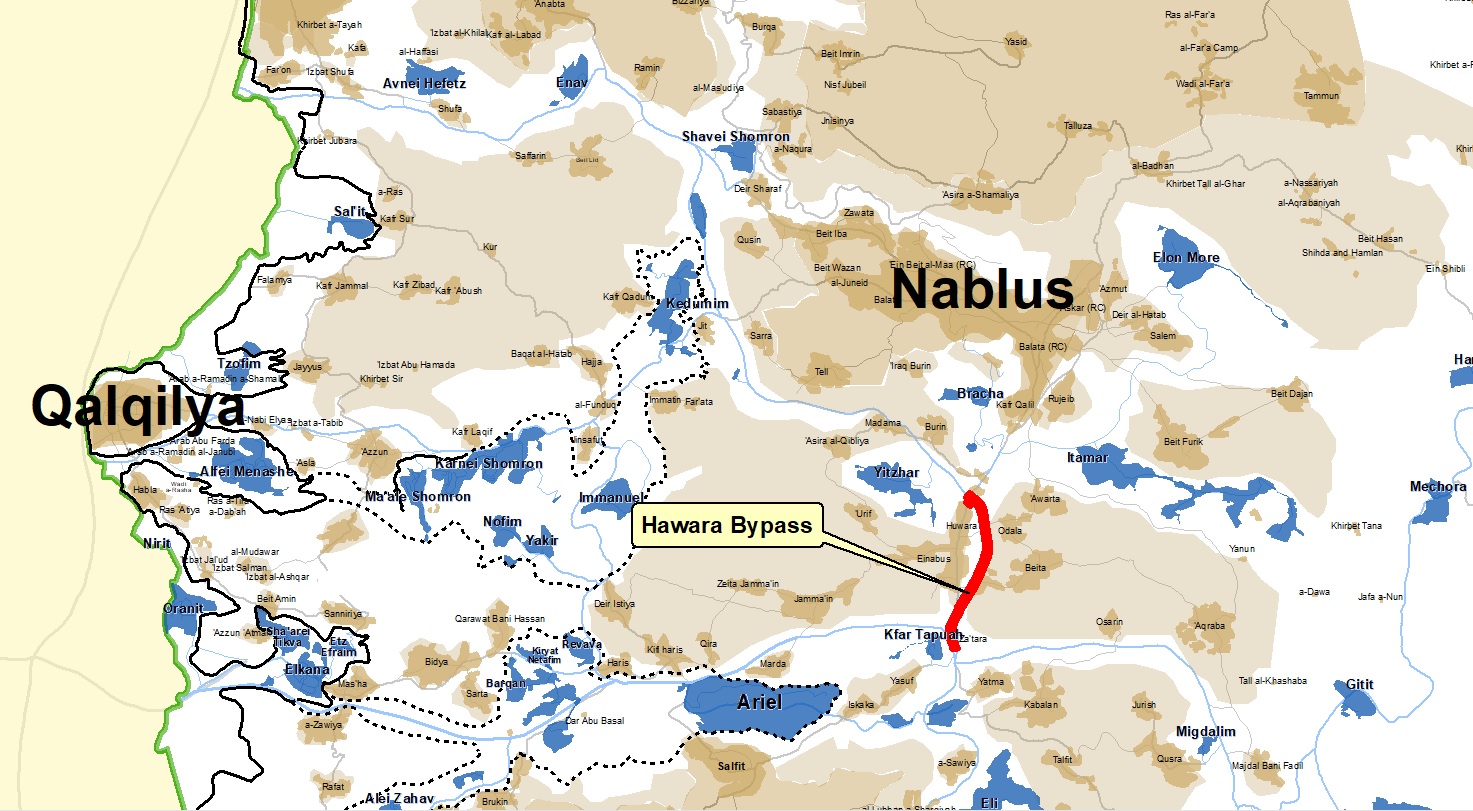 The initial shooting attack occurred on Route 60, which is used by both settlers and Palestinians as the main thoroughfare connecting central and northern West Bank. Route 60 passes through Huwwara. The bypass road is designed so that residents of Nablus-area settlements can more easily/directly access Jerusalem without driving through Huwara. Israel unilaterally expropriated private Palestinian land along the route of the road in preparation for construction.
Beyond the new demand and the possible implications it will have on the freedom of movement for Palestinians to and from Huwara, National Security Minister Ben Gvir posted on X during the settlers October 5th attack on Huwara that “”Our [Jewish Israeli] lives take priority to the Palestinians’ freedom of movement (and commerce). We’ll continue to say this truth and actively work to implement [this truth].” This is the second time that Ben Gvir has said that the rights and freedoms of Jews are more important than Palestinians.
Israel Tightens Grip on Sebastia Site
Emek Shaveh reports that on October 1st Israeli Minister for Environmental Protection, Idit Sliman, toured the archaeological site of Sebastia alongside settler leader Yossi Dagan, declaring that the land belongs to Israel. The Sebastia site is located near the Palestinian village of Sebastia, north of Nablus in the heart of the West Bank, and straddles the line designating Areas B and C, with most of the site is in Area C. The Palestinian village of Sebastia – which settlers travel through to reach the site – is in Area B entirely. During Sliman’s tour of the site the IDF sealed off all entry points to the village.
On May 7, 2023, the Israeli government approved nearly $9 million (NIS 32 million) for a project to develop and “renovate” the archaeological site of Sebastia. The project includes plans to pave a new access road for Israelis to reach the site, which they currently have to access by traveling through the Palestinian village of Sebastia.
Settlers have been openly agitating for Israel to assert control over the archaeological site in Sebastia for years, and the settler Samaria Regional Council organizes regular tours to the site. To secure the settlers’ visits, the IDF shuts down the town of Sebastia, closing Palestinian streets and businesses. As in other cases across the West Bank, settlers allege that Palestinians are damaging the Sebastia site and that the Israeli government needs to intervene. In 2021 amidst intensifying settler efforts related to the site, the Palestinian Foreign Ministry called on UNESCO to “protect all Palestinian archaeological and religious sites from Israeli violations, attacks and falsifications.” The archaeological site of Sebastia is on the tentative list of World Heritage sites in Palestine.
Emek Shaveh further explains the history and politicization of this archaeological site
“The battle over Sebastia is also played out in the narratives each side presents to the public. The informational material distributed by the PA does not include an explicit reference to the Kingdom of Israel or to the Hasmonean connection. On the other hand, in recent years the settlers have been rehabilitating the figure of Omri, a King of the Kingdom of Israel, in an effort to imbue Sebastia with greater nationalist significance. Sebastia also holds a special place in recent history for the settlers because it is the place where the leaders of Gush Emunim, the group that first fought for the establishment of settlements in the West Bank in the 1970s, celebrated the government’s agreement to establish the first settlement in the area in 1975.
In tandem with the growing campaign of recent years to apply full Israeli control over Sebastia, larger numbers of Israelis visit the site every week in buses organized by the Samaria Regional Council and accompanied by soldiers.
Sebastia, is a declared national park. National parks and nature reserves in Area C of the West Bank are managed by the Civil Administration and are referred to as “parks”. Their total area spans approximately 500,000 dunams and constitutes roughly 14.5% of Area C. Palestinians’ rights are violated in these territories through various means. In the Ein Prat Nature Reserve, for example, landowners cannot cultivate their land as their access is restricted. In Herodion National Park and Nabi Samuel, residents can neither construct nor renovate their homes.”
Settlers, Knesset Continue Push for IDF to Seize “Archaeological Site” at Mt. Ebal/El-Burnat
This week settlers have carried out daily trips to the archaeological site at Mt. Ebal, known as el-Burnat to Palestinians, located in Area B of the West Bank. On Monday, the Israeli army coordinated a trip for hundreds of Israelis to the site, but has not coordinated with settlers on their trip to the site in the subsequent days. Over the past two years, settlers have been clamoring for the army to take unilateral control over the site after the Palestinian Authority began to develop land nearby.
On October 6th, MK Son-Harmelech participated in a trip to the site and subsequently called on the government of Israel to establish a new settlement at the site (which, again, is located in Area B).
In a further show of the settlers influence and the government’s intentions with the site, Emek Shaveh reports that on September 25th a subcommittee of the Knesset’s Foreign Affairs and Defense met to discuss accusations (which have proven to be false yet are weaponized by settlers) that the Palestinian Authority has recklessly damaged and is attempting to destroy the site. Emek Shaveh explains: “The reports and the special subcommittee session are part of an orchestrated attempt by the settlers and their representatives in the Israeli parliament to use antiquity sites as a ruse for advancing annexation.”
At the hearing, the Civil Administration’s Head of Infrastructure, Lieutenant Colonel Adam Avidan, acknowledged that the site is in Area B where the IDF has limited authority. He also said the IDF constructed an observation tower to monitor Palestinian activity at the site. Avidan also explained that the IDF had summoned the Palestinian village leader to warn him not to conduct any construction work at the site, showing a map that marked the borders (reminder that the IDF does not have any authority over antiquity sites in Areas A or B).
Mt.Ebal/el-Burnat is purported to be an antiquity site where the biblical prophet Joshua built an altar, originally identified as such in the 1980s by an Israeli archaeologist though the majority of professional archaeologists do not support that conclusion. Emek Shaveh, an Israeli NGO with expertise in archaeology, called the settler campaign to seize Mt. Ebal as a “watershed in Israeli archaeology.” In July 2023, Emek Shaveh reported that a triad composed of settlers, an American Christian evangelical organization, and the Israeli army collaborated on a recent unlicensed excavation on Mount Ebal, which Emek Shaveh called antiquity theft. Further, the groups transferred some 80 cubic meters of soil from Mount Ebal to the Shavei Shomron settlement, where settlers then promoted an opportunity for members of the public to join the archaeologists in sifting through the materials (thereby promoting tourism to the settlements). Haaretz called the excavation “is mainly used as a tourist attraction to the West Bank and is of little scientific significance.”
Emek Shaveh’s explained the significance of what is happening on Mount Ebal:
“The archaeological site at Mount Ebal is becoming a watershed in Israeli archaeology. The activity on the site has turned from a pirate operation led by a group of Messianic Jews and Christians into a state sponsored operation under the auspices of the Civil Administration led by Minister Bezalel Smotrich.This is yet another violation of the Oslo Accords and suspected violation of domestic and international law that is whitewashed by Israeli authorities and intended to serve as a method for advancing the annexation of the West Bank to Israel.In addition to the alleged violation of the law, the excavation constitutes an ethical failure by the entire archaeological community in Israel whose silence continues to grant legitimacy to such projects. A comprehensive and immediate investigation is required by all the relevant parties as well as independently by the Israeli Archaeological Association.”
The Acceleration of “Herding Outposts”, And Their Impact
On October 3rd The New York Times published an article describing the impact of so-called herding outposts on the battle for control over land in the West Bank, highlighting reporting from Kerem Navot that shows how settlers have been establishing herding and farming outposts as a way to coerce the displacement of Palestinians and assert control a maximal amount of land with a minimal number of Israeli settlers.
That 20 new herding outposts have been established so far this year, showing how this tactic has accelerated since 2018 when settlers began to strategically focus on herding outposts as an effective mechanism. Three Palestinian herding communities have been displaced from their lands this year, largely in fear of nearby settlers.
The Times reports:
“The Israeli settlers’ stated intention is to chip away at wide expanses of land that the Palestinian leadership, at the advent of the Oslo peace process 30 years ago, hoped would form the territorial spine of a future Palestinian state. ‘It’s not the nicest thing to evacuate a population,’ said Ariel Danino, 26, an Israeli settler who lives on an outpost and helps lead efforts to build new ones. ‘But we’re talking about a war over the land, and this is what is done during times of war’.”
In a 2022 report on this herding phenomenon, Kerem Navot explains:
“…the development of Israeli sheep and cattle grazing in the West Bank, […] has gradually become Israel’s most significant mechanism for dispossessing Palestinian communities. At issue are tens of thousands of acres of open areas expropriated by the Israeli authorities and settlers through dozens of shepherd outposts and farms, the great majority of which have been established over the past decade. The use of grazing to seize land began in the early 1970s and continued intermittently in the 1980s and 90s. In recent years, however, the phenomenon mushroomed in terms of area size, investments, and the destructive repercussions for Palestinian communities.
The declared objective of the farm outposts is to “protect state lands”. In practice, however, they are designed to uproot Palestinian grazing and farming communities from public or private lands, and turn them into lands that only settlers can use. To promote this objective, one instrument must be used above all others: violence. Indeed, the farm outposts have recently seen some of the most violent incidents in the West Bank. It is no wonder that the uprooting of people from their lands, often also their ancestral lands, requires severe and ongoing violence. Accordingly, countless incidents involving threats, harassments, and assaults on Palestinian farmers and shepherds have occurred around these outposts in recent years, often in the presence and full support of military or police forces.
These outposts are the spearhead of a violent land-grabbing system, well planned and generously funded by various state and quasi-state bodies. These include the military, the Israeli Civil Administration (of the West Bank), regional and local councils, the World Zionist Organization’s Settlement Division, the Ministries of Agriculture and Education, and the new Ministries of Settlement and Intelligence. All are preoccupied with what has recently been referred to as the “Battle for Area C”, meaning the coercive transfer of Palestinians from the area, which represents 61% of the total area of the West Bank, and their enclosure in isolated enclaves.”
OCHA Reports on Ongoing Ethnic Cleansing of Masafer Yatta
 In a new report, OCHA OpT reports that over the past three months, 13 Palestinian families (84 individuals, 44 of which are children) have been forcibly displaced from the homes and grazing lands in the Masafer Yatta region in the South Hebron Hills.
OCHA reports:
“Over the years, and increasingly since May 2022, the Israeli authorities have imposed movement restrictions, confiscated property, demolished homes, and carried out military trainings in Masafer Yatta. Jointly, these practices have contributed to a coercive environment that has pressured residents to move out. In the past three months, movement restrictions have further intensified. Operating from a newly established military base, Israeli forces now patrol the area more frequently, further restricting people’s movement and access to markets and basic services, as well as the shipment of fodder and other inputs for livestock, on which most families rely. They have additionally confiscated vehicles used by residents. Two schools in the area report that 24 students have dropped out this year, including pupils whose families have left amid this coercive environment, and others who fear the unsafe journey to school. In one incident, in September, Israeli forces stopped teachers who were travelling to work and threatened to seize their vehicle if they used it again.”
The JNF Is Funding Hilltop Youth
Haaretz reports that the Jewish National Fund has givn $1million over the past two years to organizations which are involved in the construction of illegal outposts, specifically to support a project aimed at the “Hilltop Youth.” The funding is meant to offer professional training for young high school drop outs living in illegal WEst Bank outposts.
In response the this revelation, the Haaretz Editorial Board writes:
“The Jewish National Fund is continuing to bolster its role as a key player in the settlement enterprise and its accompanying looting and dispossession of the Palestinians in the West Bank, in preparation for a future annexation. Like all other settlement players, JNF too seems to view all means as kosher. And if they aren’t kosher, then they’ll be koshered retroactively in the future, after the settlers finish their takeover of Israel. Over the last two years, the Jewish National Fund has invested 4 million shekels in a project to rehabilitate teen dropouts living on farms and herding outposts in the West Bank. The money, which was meant to fund professional training for teens, is passed on to organizations that encourage the establishment of illegal settlement outposts….. the occupied territories aren’t the periphery, and “agricultural farms” in the West Bank lie outside Israel’s borders. And judging by its response, JNF is indifferent to their illegality. “The JNF is active in educational programs and does not deal with the legal status of these farms,” it said. In practice, it is directing at-risk youth to join the settlers’ extremist “hilltop youth.” Like all of Israel’s other national institutions, JNF completed its national mission once the state was established and should have been closed at that time. This is doubly true now that it has become the Settlement and Annexation National Fund.”
Bonus Reads
- “How to establish a new settlement without the world noticing” (+972 Magazine)
- “Settler violence is fueling the effects of climate breakdown on Palestinians” (+972 Magazine)
- “West Bank Dispatch: Settlers escalate harassment campaign, while army targets more resistance groups” (Mondoweiss)
- “Biden and Europe Beware: Your Silence on Israel’s Annexation Strengthens Putin” (Haaretz)
- “PA police extract 5 tourists mobbed after illegally entering Joseph’s Tomb in Nablus” (The Times of Israel)
- “How Israel uses settler violence to displace Palestinians” (The New Arab)
- “Why I spent Yom Kippur protecting Palestinian villagers from settler violence” (JTA News)
- ”Analysis | Israeli Far Right’s Ambitious West Bank Plan Could Be Saudi Deal’s Achilles’ Heel” (Amos Harel in Haaretz)
Welcome to FMEP’s Weekly Settlement Report, covering everything you need to know about Israeli settlement activity this week.
To subscribe to this report, please click here.
June 9, 2023
- NEXT WEEK – E-1 Back On the Agenda
- Israel Advances Plan for Massive New Industrial Zone
- Israel Quietly Expropriated Land to Facilitate the Retroactive Legalization of Havat Gilad
- Israel Allows Settlers to Operate Farms inside the Masafer Yatta Firing Zone, From Which Palestinians Are Being Forcibly Displaced
- Armenian Orthodox Church Sells Key Jerusalem Properties to an Israeli Investor
- Israel Preps New Laws to “Judaize” the Galilee, Subsidize Jewish-Only Communities in Galilee, Negev, and West Bank
- 17 Israeli Human Rights Orgs Issue Status Report on Occupation
- Yesh Din Re-Releases “Annexation Database”
- Bonus Reads
NEXT WEEK – E-1 Back On the Agenda
The High Planning Council’s Subcommittee for Objections is set to hold a third and final meeting on Monday June 12th to discuss objections that have been filed against the construction of the E-1 settlement, planned for an area just northeast of Jerusalem. Construction of this settlement would have severe geopolitical implications (cutting the West Bank in half, cutting it off from East Jerusalem); would necessitate the forcible transfer of several bedouin communities (a war crime); and affect thousands of Palestinians (shredding the fabric of life).
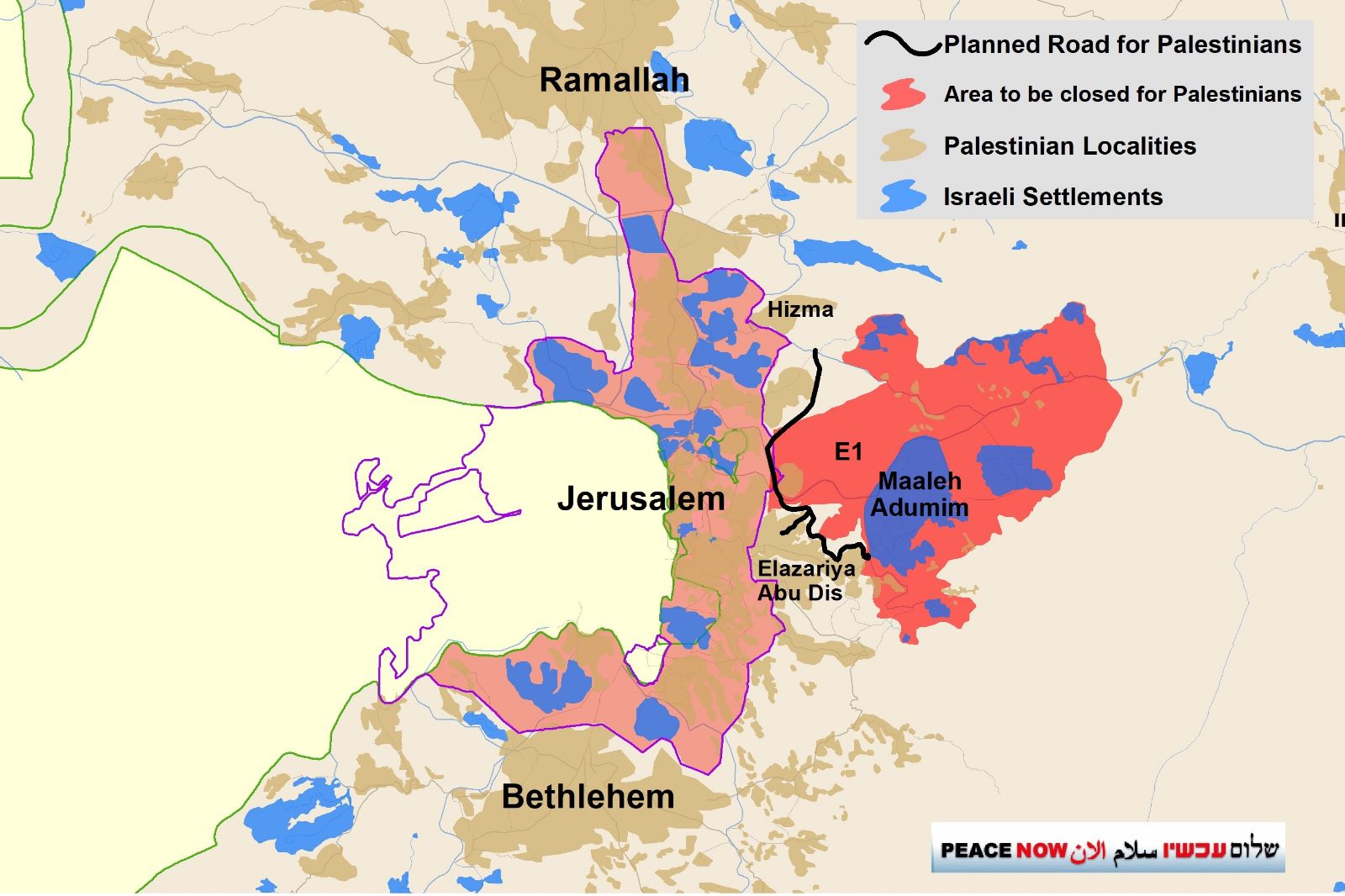 Assuming there is not another last-minute decision to take E-1 off the agenda (something that could well happen, and has happened repeatedly) this upcoming meeting promises to be a decisive one for the long-pending E-1 plan. It could very well result in the Committee – which is now under the authority of longtime settler advocate, Israeli Minister Bezalel Smotrich – granting final approval to the highly contentious plan.
As a reminder: in its current form, the E-1 plan provides for the construction of 3,412 new settlement units on a site located northeast of Jerusalem. The site is home to several Palestinian bedouin communities, comprising 3,000 people, including Khan al-Ahmar, which Israel is planning to forcibly relocate. Long called a “doomsday” settlement by supporters of a two-state solution, construction of the E-1 settlement would sever East Jerusalem from its West Bank hinterland, preventing East Jerusalem from ever functioning as a viable Palestinian capital. It would also cut the West Bank effectively in half, isolating the northern West Bank from the southern West Bank and foreclosing the possibility of the establishment of a Palestinian state with territorial contiguity.
Israel’s “answer” to that latter concern has long been to argue that Palestinians don’t need territorial contiguity, and that new roads can instead provide “transportational continuity,” via a plan called the “Sovereignty Road. If built, the “Sovereignty Road” will seal and divert Palestinian traffic around the area where Israel intends to build the E-1 settlement. In March 2023 Israel announced that construction of this so-called “Sovereignty Road” was set to begin in May 2023. There have since been reports that Israeli authorities have issued notices to Palestinian landowners whose land will be seized for construction of the road, undertaken prep work for construction, and has allocated millions of shekels to fund components of the road.
And another reminder: there have been attempts to promote the E-1 plan since the early 1990s, but due to wall-to-wall international opposition, the plan was not advanced until 2012. At that time Netaynuahu ordered it to be approved for deposit for public review (a key step in the approval process), ostensibly as payback for the Palestinians seeking recognition at the United Nations. Following an outcry from the international community, the plan again went into a sort of dormancy, only to be put back on the agenda by Netanyahu in February 2020, when he was facing his third round of elections in two years. Also, as a reminder: under the Trump Plan (which the Biden Administration has yet to comment on), the area where E-1 is located is slated to become part of Israel.
Peace Now said in a statement:
“The advancement of construction in E1 is another step in the current Israeli government’s actions, which since its establishment, has been establishing new settlements, returning settlers to the northern West Bank, and now working to create conditions for the annexation of the West Bank. Just last week, the Israeli government violated its commitment to the US government and re-established the outpost of Homesh in the northern West Bank. Next week it will violate an Israeli commitment again by promoting the construction plan in E1. This pro-settler and annexationist government seems to continue to act according to a systematic plan that leads us to a reality of apartheid, undermining the chances of a political solution between Israelis and Palestinians. The Israeli public and our friends around the world must wake up and stop Israel from falling into the abyss.”
Israel Advances Plan for Massive New Industrial Zone
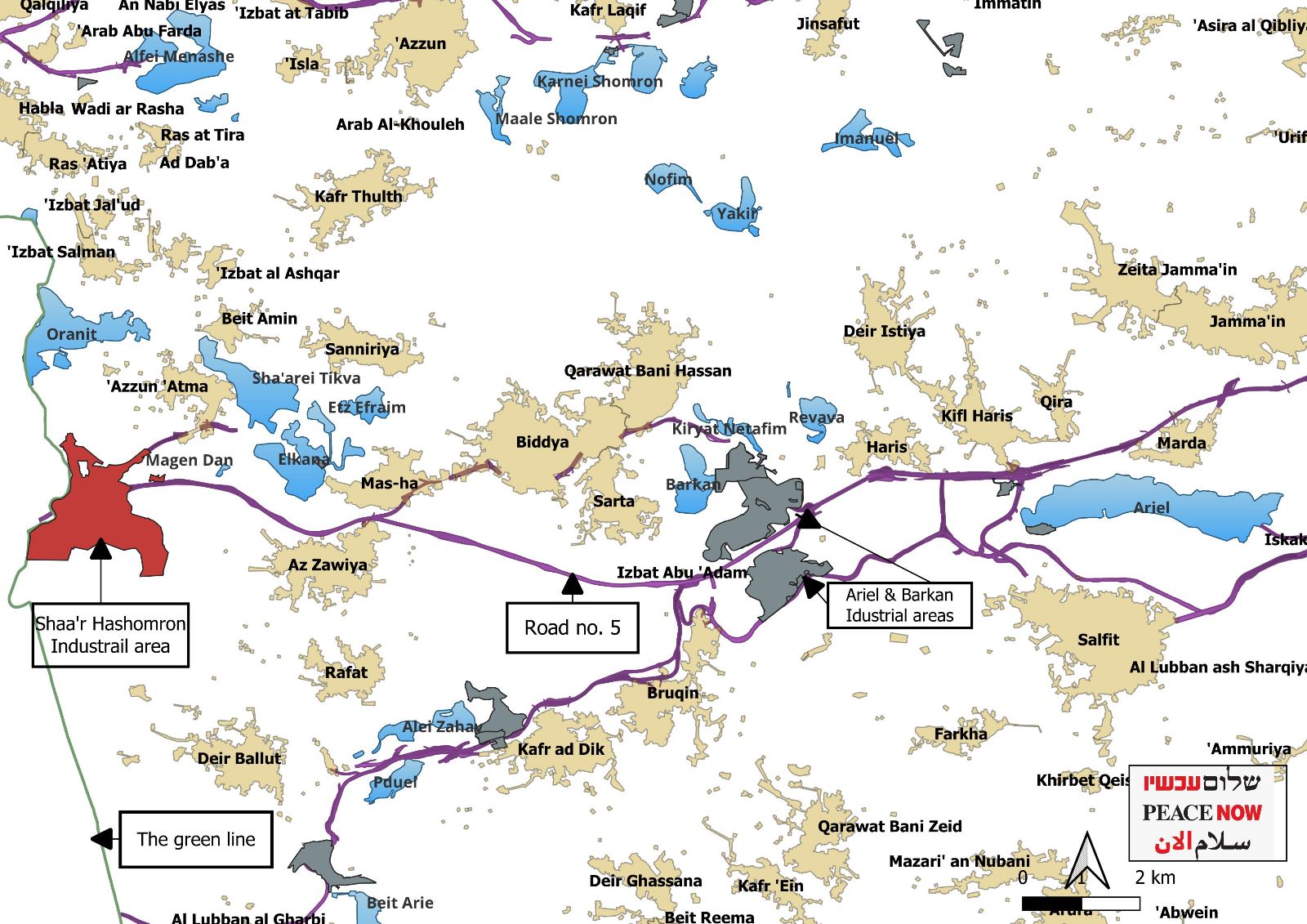 Peace Now reports that on June 2nd the Israeli High Planning Council deposited for public review a plan for the establishment of a massive new settlement industrial zone (called “Sha’ar Shomron”) to be located on lands historically belonging to the Palestinian villages of Siniria, Rafat, and Az-Zawiya in the northern West Bank. In addition to planning for industrial complexes and commercial areas, the plan also provides for the construction of educational buildings, office complexes, sports facilities, recreational areas, and tourism sites – and there is a future plan to connect the new industrial zone to the Israeli railway grid. The new settlement industrial zone is slated to be built directly adjacent to the Green Line, contributing to the erasure of the Green Line and Israel’s annexation of the West Bank.
Peace Now further reports that if the plan is approved, this will likely be the largest Israeli industrial zone in the West Bank, with 2,700 dunams of land, of which 2 million square meters will be for industrial use. Further, Peace Now notes that there is a “lack of need for an additional industrial zone”, especially in this area given that the Ariel and Barkan Industrial Zones are nearby.
Peace Now said in a statement:
“The settlement enterprise is about to receive tremendous economic support in the form of a 2 million square meter industrial zone that will greatly benefit the Shomron Regional Council, strengthen its economy, and, as in previous cases, provide very little, if anything at all, to the Palestinian villages and Palestinians themselves. The Sha’ar Shomron industrial zone is set to deeply integrate Israel’s economy into the occupation mechanism and turn thousands of Israelis into workers for the benefit of the settlement enterprise. This is a hazardous industrial settlement, not only for the Palestinians whose lands it is being built on but for the entire Israeli and Palestinian public. There is no economic prosperity here but rather another expression of the settlement enterprise and the occupation.”
For decades Israel has used industrial zones as another tool to expand and deepen control over West Bank land and natural resources. Industrial zones perpetuate Israel’s economic exploitation of occupied territory (including the local workforce, land, and other natural resources). Presented as benefiting both Israelis and Palestinians, it is in fact Orwellian to label such initiatives as “coexistence” programs, or to suggest that they offer the Palestinians benefits they should welcome. Importantly, jobs in industrial zones – often the only jobs available for Palestinians living under an Israeli occupation that prevents the development of any normal Palestinian economy – are widely viewed by Palestinians as a double-edged sword. The NGO Who Profits explained:
“Israeli Industrial Zones constitute a foundational pillar of the economy of the occupation. They contribute to the economic development of the settlements, which are in violation of international law and the Fourth Geneva Convention, while relying on the de-development of the Palestinian economy and the exploitation of Palestinian land and labor…The Industrial Zones in the oPt form part of a practice of ‘financial annexation’ which is an essential component of the broader policy of annexation taking place.”
Israel Quietly Expropriated Land to Facilitate the Retroactive Legalization of Havat Gilad
The anti-settlement watchdog Kerem Navot (aka Naboth’s Vineyard) reports that on May 2, 2023 the Israeli Custodian of Abandoned and Government Property – Yossi Segal – signed a military order declaring a small tract of land in the West Bank to be “state land.” The small tract of land happens to be where settlers have been allowed to illegally build the Havat Gilad outpost, despite the fact that aerial imagery shows that that area had been continuously cultivated by Palestinians prior to settlers taking over the land (and therefore cannot be taken over by Israel as “state land”). Nonetheless, settlers have been allowed to illegally build on this land, illegal activity which is now being rewarded and further incentivized by Segal’s move to expropriate the land – a move that paves the way for the retroactive legalization of the outpost.
As Kerem Navot chronicles, the Havat Gilad outpost has been the subject of controversy since it was first established by settlers in 2002. Since then, the outpost has become a source of radical, serious, and frequent violence against Palestinians. In 2014, two Havat Gilad settlers were sentenced to prison for setting Palestinian vehicles on fire in a price-tag attack; its residents have also been documented harassing Palestinian farmers and denying them access to their own lands. The Israeli NGO Yesh Din – which has documented violence emanating from Havat Gilad, including against Yesh Din employees – has filed several petitions against the outpost, including a 2010 case that resulted in the demolition of some of the outpost’s structures that were built on land Israel recognized as privately-owned by Palestinians. Yesh Din’s investigation shows that Havat Gilad was built on lands that the Israeli Civil Administration has now declared to be “state land” have in fact been continuously cultivated and privately owned by Palestinians; most of the outpost’s structures have standing (but unenforced) demolition orders issued against them.
In 2018, the Israeli government came under intense pressure from the settler lobby to legalize Havat Gilad in response to a Palestinian terror attack that killed a Havat Gilad settler — and came very close to doing so. At the time, the government ran into difficulties in legalizing the outpost because some of the illegal buildings were located on land Israel recognized as privately-owned by Palestinians, and the government could not – at that time – find a legal means by which to expropriate it. Meanwhile, the settler killed in the attack was subsequently buried at the outpost, and as Al-Monitor explains, the presence of a cemetery in the outpost makes its future evacuation nearly impossible. Kerem Navot’s Dror Etkes spoke to Haaretz around this same time about the phenomenon of settlers being buried in the West Bank:
“Etkes tells Haaretz he believes the choice of where the cemeteries are situated – particularly when they lie on private land some distance from the nearest homes – is not a coincidence. ‘I work on the assumption that there are always deliberate intentions afoot,’ he says. The placement of a cemetery ‘is not chosen for no reason. It is a very long-term investment – and in Judaism, whoever buries people in a certain place does so on the understanding they will not be removed. Obviously, there is deliberate intent lurking behind the location of these cemeteries,’ Etkes continues, ‘and it may be assumed that whoever buries the dead on private Palestinian land knows exactly what he’s doing.’”
Israel Allows Settlers to Operate Farms inside the Masafer Yatta Firing Zone, From Which Palestinians Are Being Forcibly Displaced
Amira Hass reports for Haaretz that Israel is allowing settlers to operate six sheep herding farms [what Americans would call “ranches”] in the Masafer Yatta area of the South Hebron Hills, which Israel has declared a “firing zone”, thereby making it illegal for civilians to enter, live, or farm on the land. This settler activity is being allowed while Israel is simultaneously pursuing the mass forcible expulsion of Palestinians from the area, based on the argument that their lives and homes in a firing zone are illegal. According to a settler from an illegal outpost, the IDF has even provided “grazing permits” to settlers authorizing their activities in the area.
The phenomenon of settlers using agricultural and farming outposts as a highly efficient means of taking control of land (a few farmers can easily take control over vast amounts of herding/grazing lands) has been thoroughly documented by Kerem Navot, which calls it “Israel’s most significant mechanism for dispossessing Palestinian communities.”
Two of the settler farms were established before the May 2022 ruling by the Israeli High Court which authorized the expulsion of Palestinians from the area, the other four were established after. Predictably, though these farms may have started as bare-bones operations, Palestinians now report:
“continuous and brisk activity around these farms, with trucks unloading, a cement truck laying down a concrete surface and all-terrain vehicles entering and leaving the farms, as well as people on horseback…Palestinians in the area say that they often see soldiers in the vicinity of Israeli shepherds, accompanying them within the firing zone.”
In stark contrast to the tolerance and assistance the IDF gives to settlers in the area who have illegally built outposts and these sheep farms, the nearby Palestinians living in Masafer Yatta are ruthlessly tormented, harassed, and attacked by Israeli settlers and the IDF. In a shocking and heartbreaking examination of what life in Masafer Yatta have become for Palestinians, Palestinian journalist and activist Hamdan Mohammed Al-Huraini quotes Issa Makhamra, a resident, who said:
“Everything is forbidden under the pretext that we live in a firing zone, even grazing sheep. Whenever we go anywhere, they set up a checkpoint. When I want to go to the city, I have to pass through this checkpoint, and I am stopped and detained for long hours. I swear to you, if the army could keep sunlight and air from us, they would do it.”
Armenian Orthodox Church Sells Key Jerusalem Properties to an Israeli Investor
The Associated Press reports that in a highly controversial move, the Armenian Orthodox Church signed a 99-year lease giving several church properties in the Old City of Jerusalem to an Australian-Israeli businessman, Danny Rothman (sometimes referred to as Danny Rubenstein). The lease reportedly includes the Hadiqat Al-Baqar (The Cows’ Garden) and its surrounding properties, including the Qishla building in Bab al-Khalil (Jaffa Gate), located in the Armenian Quarter. Rumors of this sale first surfaced in 2021, but recently a sign was placed on one of the tracts saying the land is the property of Xana Capital, the company which Danny Rothman owns. According to a bishop involved in the sale, Rothman and his business Xana Capital plans to develop the land into a luxury resort managed by a Dubai-based company.
The Armenian Archbishop, Nourhan Manougian, alleged that the Church’s real estate official and priest – Baret Yeretsian – sold the land in a “fraudulent and deceitful” deal that he was unaware of. Yeretsian, in turn, said he carried out the deal at the direction of Manougian. Both Manougian and Yeretsian have been forced into hiding due to communal outrage, with Yeretsian fleeing a mob attack with help from Israeli security forces and then relocating to California. Manougian has barricaded himself inside of a convent in the Old City, and protesters have staged weekly protests outside.
Dimitri Diliani, president of the National Christian Coalition of the Holy Land, told the AP: “From a Palestinian point of view, this is treason. From a peace activist point of view, this undermines possible solutions to the conflict.
Manuel Hassassian, the Palestinian Ambassador to Denmark, told the New Arab: “It’s a huge tract of land. By conceding it, they are erasing the Armenian presence historically, demographically, and culturally.”
In the wake of this deal coming to light, Palestinian President Mahmoud Abbas and Jordan’s King Abdullah II have both suspended recognition of Manougian’s authority, rendering him unable to sign contracts, complete transactions, or make decisions in the Palestinian territories and Jordan.
Israel Preps New Laws to “Judaize” the Galilee, Subsidize Jewish-Only Communities in Galilee, Negev, and West Bank
Two weeks ago, the Israeli security cabinet quietly organized an effort to draft and pass new laws designed to encourage Israeli Jews to move to the Galilee region of Israel, where Palestinian citizens of Israel are the majority. There are two main components of this effort so far:
- Amending the “admission committees” law to expand the number of Israel communities permitted to use such committees to screen future residents — a tool used primarily if not exclusively to prevent Palestinian citizens of Israel from moving into communities that residents want to preserve as Jewish-only towns and neighborhoods. The Israeli Ministerial Committee for Legislation granted government-backing to this proposed law weeks ago, and it recently passed its first reading in the Knesset.
- A law that will see the government subsidize land for “communities” that (in the eyes of the Israeli government) suffer from “demographic or security hardships” (which per a key backer of the law does not include Arab areas of Israel, as “Arab settlement does not suffer from similar hardships” as Jewish settlement). This law would in effect see the Israeli government subsidizing Jewish Israelis moving to areas like the Galilee and the Negev — and Prime Minister Benjamin Netanyahu is being pushed by Religious Zionism lawmakers to extend this plan to settlements in the West Bank.
Haaretz Editorial Board writes:
“The bill is part of a broader agenda that is euphemistically called ‘Zionism,’ but whose essence is Jewish supremacy in the spirit of the nation-state law. It’s a follow-up to the cabinet discussion of a resolution meant to give Jews preference in land allocations.”
17 Israeli Human Rights Orgs Issue Status Report on Occupation
On the 56th anniversary of the Occupation, a group of 17 Israel human rights organizations came together to author and publish a concise and highly relevant joint “Situation Report” on the state of the occupation. The report covers four main themes: security forces’ violence, annexation, displacement, and attacks on NGOs.
On annexation, the report covers several important issues that are being closely monitored:
- Structural changes to Israeli governance which amount to annexation of the West Bank;
- Settlement expansion;
- The completion of the Eastern Ring Road (aka the Apartheid Road);
- The “seam zone” permit regime; and,
- Gaza.
The report’s annexation section concludes with the following warnings:
» Changes advanced by Israel’s 37th government, even if not implemented in full, will lead to an irreversible transformation of the West Bank and will cement Israel’s control of the oPt’s Palestinian population and its property. The government’s policies are concurrently advanced via administrative tools, structural changes, legal reforms and huge budget allocations to settler causes. These should not be viewed piecemeal, but as a harmonized policy to accelerate the West Bank’s annexation.
» An exponential increase of the settler population is planned, paired with an unprecedented settlement-expansion drive. Building plans in over 37 settlements have already been approved and ten illegal outposts legalized – with legalization of a further 70 in the pipeline.
» Israel’s current government policies and its Jewish-supremacy ideology will further erode Palestinians’ rights and legal protections under military law, augmenting the West Bank’s dual legal system’s apartheid character. Palestinians’ diminished capacity to be served by the ICA has already been further hampered, and additional restrictions are expected.
» Large-scale construction plans are in place for the E1 area, including the Eastern Ring Road and a new settlement of 3,400 housing units. If realized, these projects will de facto annex strategic parts of Area C, east of Jerusalem, depleting much of East Jerusalem’s land reserves and further fragmenting the West Bank. Annexation of this area has been vehemently and successfully opposed by the international community in the past.
» With all eyes on the West Bank and East Jerusalem, Gaza and its population continue to be largely overlooked and its isolation from the West Bank and the outside world has been accepted as an insoluble reality. Palestinians in Gaza continue to live on the perpetual edge of a humanitarian crisis. Israel’s current government’s annexation policies and cementing of an apartheid regime will further increase Gaza’s isolation and its population’s unbearable predicament.
Yesh Din Re-Releases “Annexation Database”
The Israeli NGO Yesh Din has re-released an updated and incredibly useful database of Israeli laws – past, present, and pending; enacted and abandoned – that amount to annexation of West Bank land. The Annexation Legislation Database categorizes annexation bills into four types:
- The application of Israeli law and sovereignty;
- Direct legislation by the Knesset on the occupied territory;
- The transfer of authorities away from the military commander;
- The blurring of the Green Line.
The re-released database is complemented by a powerful article by Yesh Din’s longtime legal advisor Michael Sfard (who is a legal advisor to a host of anti-occupation, anti-apartheid, anti-settlement groups) in Foreign Policy, entitled “Israel Is Officially Annexing the West Bank.” Sfard writes:
“The high road to legal annexation is an official, public declaration, as Putin made when he annexed the Crimean Peninsula in 2014. But annexation does not necessarily involve pomp and ceremony. It can happen in dull, windowless offices and through seemingly dreary administrative and bureaucratic actions.
Exposing Israel’s annexation requires zooming out. This is what the international community fails to do, and it is why Israel’s brazen violation of international law has not drawn the ire it deserves. International discourse is hung up on the ceremonial, formal version of annexation—Putin’s annexation, which was rightly met with rebuke and sanctions. The world does not know how to deal with Netanyahu’s tactics.
Though it was not accompanied by a grand statement, the Israeli defense ministry’s portfolio transfer to Smotrich amounts to an act of de jure annexation of the West Bank—and is a dangerous step toward entrenching apartheid within the territory.”
Bonus Reads
- “Tantura massacre: Palestinian families call on Israel to mark site of mass graves” (Middle East Eye)
- “Israeli settlers encircling Jerusalem, EU envoys warn” (EU Observer)
- “Palestinian Forum Highlights Threats of Autonomous Weapons” (Human Rights Watch)
- “Settlement expansion is obstacle to peace, Blinken tells US Israel lobby” (Reuters)
Welcome to FMEP’s Weekly Settlement Report, covering everything you need to know about Israeli settlement activity this week.
To subscribe to this report, please click here.
January 13, 2023
- New Givat Hamatos Expansion Plan
- The IDF Has Prepped & Presented its Plan to Expel Palestinians from Masafer Yatta
- Israel Carries Out Demolitions in Area B
- MK Danon Unveils Jordan Valley Annexation Bill
- Settlers Demand Fast-Tracked “Regularization” of Outposts
- Biden Administration Commits to Doing Nothing More Than Issue Empty Statements in Response to Israel Expanding Settlements/Legalizing Outposts
- Peace Now Releases 2023 Settlement Map
- Adalah Publishes Detailed Analysis of New Israeli Coalition Deal
New Givat Hamatos Expansion Plan
Ir Amim reports that on March 2nd the Jerusalem Planning Committee will consider a brand new plan to expand the area of theGivat Hamatos settlement in East Jerusalem by 40% and to more than double the number of housing units slated to be built there. The new plan – called the “East Talpiyot Hill” plan – involves the construction of 3500 units and 1300 hotel rooms, to be built on a plot of land adjacent to the site where the Givat Hamatos settlement (planned for 2610 units) is slated to be built. As a reminder: tenders for the construction of those units were issued in January 2021 (just hours after PResident Biden was inaugurated), and the construction of the infrastructure for that project is already underway.
 The “East Talpiyot Hill” plan involves construction on a strategic strip of land that will expand the area of Givat Hamatos eastward, connecting it with another new settlement plan – the “Lower Aqueduct Plan.” These plans ultimately create a string of settlements — spanning from Gilo to Givat Hamatos to Har Homa — that, together with the planned “Givat HaShaked” settlement to its north, completely encircle the East Jerusalem Palestinian neighborhood of Beit Safafa with Israeli settlement construction. Ir Amim further warns that the inclusion of hotels in this new plan “will likely serve as a major source of competition with the tourism industry in Bethlehem, potentially diverting vital business from the Palestinian economy.”
This land on which the “East Talpiyot Hill”project will be built was owned by the Greek Orthodox Church until 2009 – when the church sold many of its most prized properties to settler entities. The Church has contested these sales, alleging fraud – but Israeli courts have rejected the Church’s objections and allowed the contested sales to stand. This particular tract of land was sold to an Israeli businessman and the New Talpiyot Hill company, which together initiated this new plan.
Importantly, Ir Amim notes that there are indications that Israel is carrying out land registration for plots located in the tract of land on which the “East Talpiyot Hill” project would be built. This is highly significant, as the registration appears to be happening in secret and – as revealed by Bimkom’s and Ir Amim’s ongoing monitoring and research, “settlement of land title proceedings are largely being used to dispossess Palestinians of their properties and seize more territory in East Jerusalem for Israeli settlement. “
The IDF Has Prepped & Presented its Plan to Expel Palestinians from Masafer Yatta
Haaretz reports that the Israeli Central Command has presented to the Israeli government its plan to expel some X,000 Palestinians from eight villages in Masafer Yatta in the South Hebron Hills – plans it had reportedly been working on for two months (i.e., even before the new government took power). Sources told Haaretz that the new government has not given the IDF the order to carry out the expulsions yet, but nonetheless the IDF saw fit to design a plan, using vans, to carry out the evictions. Israeli Defense Minister Yoav Galant has reportedly told the IDF that he “needs to study” the matter.
Israel Carries Out Demolitions in Area B
Haaretz has revealed that on November 24, 2022, the Israeli Civil Administration demolished two Palestinian structures in Area B of the West Bank — the area in which, under the Oslo Accords, Israel enjoys no jurisdiction over civil matters (such as building enforcement). The Civil Administration denies that the demolition violated the Oslo Accords, arguing that it was within its rights because it was acting to address alleged major damage caused to a nearby archaeological site, called Khirbet Tarfin. Israeli political figures were reportedly involved in the decision to carry out the demolitions.
In a statement to Haaretz regarding the demolitions, the Civil Administration stood proudly by its demolition, and committed to defending archaeological sites across the whole West Bank. The statement reads:
“The Civil Administration will continue to expend major efforts and resources in researching and preserving the archaeological sites in Judea and Samaria [the West Bank] in addition to pursuing enforcement activity against antiquities thieves and the building of illegal structures in the heart of archaeological sites.”
The Civil Administration’s statement – and Israel’s move to raze these two Palestinian structures – should be understood against the backdrop of the years-long campaign by settlers pushing the government to unilaterally take control over archaeological sites (defined expansively) throughout the West Bank. In this way settlers and their supporters are- with great success – weaponizing archaeology as a tool for the dispossession of Palestinians.
This effort should also be understood as an expansion of the settlers’ enormously successful tactics in getting the Israeli government to annex Area C – with Israeli policy now treating Area C as sovereign Israeli territory in virtually all ways (other than a public declaration of annexation). Now that the new governing coalition has announced a total freeze on Palestinian construction in Area C and has increased demolition of Palestinian “illegal” construction (i.e., Palestinian construction on their own private land, but lacking Israeli permits, due to the fact that Israel refuses to issue Palestinians permits to build) — and now that Netanyahu has declared Israel’s “exclusive and inalienable right to all parts of the Land of Israel” — it is not surprising, but is still alarming, to see the same land grab tactics that worked so well in Area C applied in Area B. Indeed, more Israeli actions/policies that further the erasure of any meaningful Oslo-era boundaries between West Bank areas should be anticipated.
MK Danon Unveils Jordan Valley Annexation Bill
MK Danny Danon (Likud) – who previously served as Israel’s Ambassador to the UN – has unveiled a bill that would have Israel unilaterally annex the Jordan Valley.
Jordan Valley annexation bills have been introduced into the Knesset for years, but have rarely if ever received real consideration, though support for such a measure is likely high. In September 2019, Netanyahu committed to annexing the Jordan Valley.
Settlers Demand Fast-Tracked “Regularization” of Outposts
The Forum for Young Settlements, an advocacy group by and for settlers, is pushing the new Israeli government to act swiftly to suspend the rule of law to “legalize” settlement outposts across the West Bank that were built in violation of Israeli law, and many of which are located on privately-owned Palestinian land. As part of the coalition agreements, the parties agreed to “legalize” the outposts within the first 60 days of the new government tenure- – but settlers apparently think this is too long, and are demanding that the government act immediately.
The Forum said in a statement:
“[The Forum] congratulate[s] the Prime Minister and the ministers for establishing a stable national right-wing government for the first time in years, and for introducing ‘Young Settlement Regulation’ into the coalition agreements….this is the time to approve the proposal of the decision-makers for regulation. The government’s decision is already prepared, and over 25,000 residents of the young settlements in the winter months cry out for a resolution to their humanitarian needs and immediately enable the connection of all the young settlements to electricity, water, and other infrastructures.”
Biden Administration Commits to Doing Nothing More Than Issue Empty Statements in Response to Israel Expanding Settlements/Legalizing Outposts
U.S. Ambassador to Israel Thomas Nides told the Israeli Kan news outlet that the U.S. opposes “massive settlement growth” — seeming to signal the Biden Administration’s acceptance of settlement construction on a less-than-massive scale (FMEP president Lara Friedman notes that this reminds her of an old joke: a couple celebrating their 50th wedding anniversary was asked, what made this marriage last so long? Partner 1 responded – “when we got married, we agreed that I get to make all the big decisions, and my partner gets to make all the small decisions; as it turns out, there has never been a big decision, so peace has reigned between us!”). Nides further said that the U.S. continues to oppose outpost legalization but does not have any “red lines” for the Israeli government.
Peace Now Releases 2023 Settlement Map
Peace Now has released an updated map of the West Bank, showing settlements, outposts and more. You can view and download the map here: https://peacenow.org.il/en/%d9%8dsettlements-map-2023
Adalah Publishes Detailed Analysis of New Israeli Coalition Deal
Adalah released a new report on the details contained within the new Israeli coalition deal. The paper examines the following 11 items:
- Deepened political control over law enforcement and policing;
- Accelerating the Judaization of the Naqab, Galilee, and beyond;
- Curbing the prohibition of discrimination in services and products;
- A new basic law on immigration;
- Discrimination in education;
- Impunity for the armed forces;
- Silencing criticism against Israel;
- Allowing candidates running for the Knesset to incite racism while undermining Palestinian political participation;
- Separate and unequal funding for Palestinian localities in Israel; (10) Limiting the Supreme Court’s authority; and
- De facto annexation of the West Bank.
On de facto annexation of the West Bank, Adalah writes:
“These appointments effectively give the RZP control over all settlement construction projects in the West Bank; authority over nearly all issues relating to the settlements: the building of homes, demolition of homes and other buildings, and all other aspects of daily life. This ministerial position will also no longer require the Prime Minister’s approval at various stages of West Bank settlement construction projects; instead, it will only be required once, during the initial stages. Smotrich has made clear that he intends to use this authority to de facto annex the West Bank by, in particular, dismantling the Israeli military’s Civil Administration over the Israeli Jewish settlers illegally residing there and instead putting their governance under Israeli civil domestic law, while continuing to keep Palestinians under military rule. This move will more deeply entrench the two separate systems of governance that already exist based on racial identity, an unquestionable hallmark of a system of apartheid.”
Welcome to FMEP’s Weekly Settlement Report, covering everything you need to know about Israeli settlement activity this week.
To subscribe to this report, please click here.
January 6, 2023
- Mass Expulsion (A War Crime) Underway in Masafer Yatta
- Israeli Govt & Settlers Join Together to Take Over Key Site in Silwan & Announce Start of Excavations
- High Court (& Settlers) Test New Israeli Government on Homesh Case
- United Nations General Assembly Calls for Legal Opinion on Israeli Occupation, Israel Announces Moratorium on Palestinian Construction in Area C
- Bonus Reads
Mass Expulsion (A War Crime) Underway in Masafer Yatta
In the first days of the new year, the Israeli Civil Administration began demolishing Palestinian homes and buildings in the Masafer Yatta region of the South Hebron Hills, an undertaking that won the approval of the Israeli High Court following a two-decade-long legal battle. The area of Masafer Yatta is currently home to 1,000 residents (500 of which are children) in eight villages.
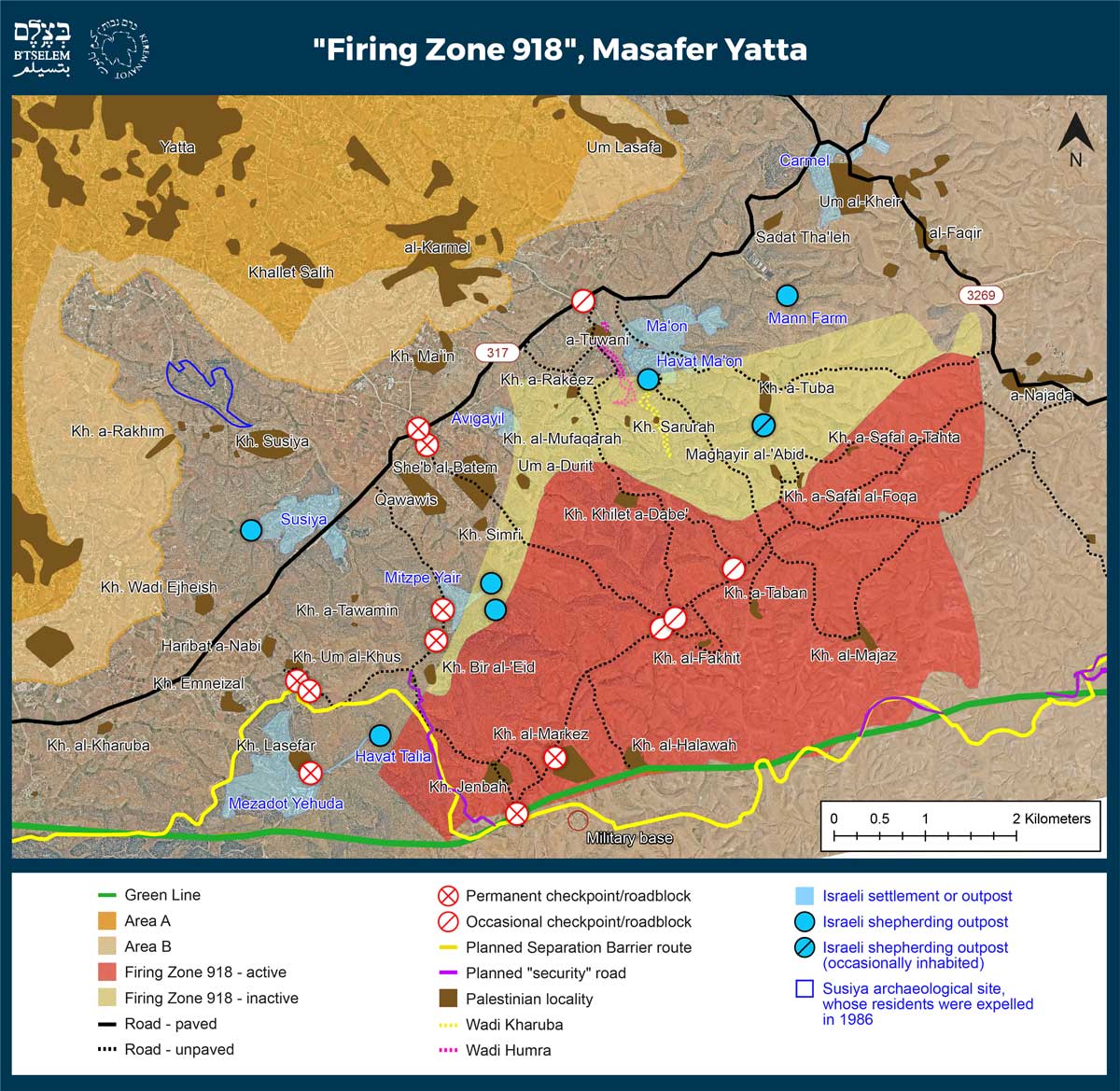 As a reminder: Israel designated the area as a firing zone in the early 1980s for the express purpose of enabling the State to clear out Palestinians who live there, in direct contradiction to a 1967 IDF legal opinion stating, among other things, “Civilians cannot be evacuated from an area in order to create training zones for the IDF, both for political and humanitarian reasons, and for reasons related to the provisions of international law.”
On January 2nd, the Israeli government announced that residents of Masafer Yatta will soon receive notices requiring them to vacate the area, further saying that the residents will be expelled to an alternative location where the State will allow them to live. In response, B’Tselem observed:
“forcible transfer of protected persons in occupied territory is a war crime, therefore, the Israeli offer of an alternative is meaningless and a violent threat that leaves the residents with no choice.”
Shortly following that announcement – on January 3-4 – Israeli forces were documented demolishing and removing Palestinian homes, structures, and olive groves in Masafer Yatta, even confiscating a tent that was used as a makeshift school.
For more information on Masafer Yatta, please check out the following resources:
- Save Masafer Yatta https://savemasaferyatta.com/en/
- +972 Magazine coverage by and about Palestinians in Masafer Yatta
- FMEP’s podcasts and webinars featuring Palestinians living there as well as activists working to stop their forcible transfer.
Israeli Govt & Settlers Join Together to Take Over Key Site in Silwan & Announce Start of Excavations
On December 27th, 2022 — days after Christmas and while most of the world was on holiday — Elad settlers, accompanied by a heavily armed detail of Israeli police, took control of a plot of land immediately adjacent to the Pool of Siloam in the Silwan neighborhood of East Jerusalem. The Pool of Siloam is an important historic site and a sacred Christian site, believed to be the site where Jesus healed the blind.
In a press release celebrating the seizure and the start of excavations – ostensibly aimed at revealing the entirety of the Pool of Siloam — the project was presented as a joint endeavor of the Elad settlers, the Israel National Parks Authority (INPA), and the Israel Antiquities Authority (IAA). Terrestrial Jerusalem characterized this joint action as “further evidence that in Silwan, the settlers and the Government of Israel are one of the same.”
According to reports, the newly-seized plot of land is owned by the Greek Orthodox Church, which leased it to Palestinian Sumarin family in 1931. The land has been used by the Sumarin family for agricultural purposes ever since. With this very public move to take control over the plot, the world learned for the first time that this land is part of the Greek Orthodox Church’s contested and controversial 2004 sale of some of its most prized assets to settler entity Ateret Cohanim (a sale that includes the Petra and New Imperial hotels in the Old City — see previous editions of this report for details on those cases). It remains unknown if there are additional properties involved in that transaction.
Terrestrial Jerusalem adds:
“The Government of Israel and the settlers have decided there is no better time to take over Church property, in a place of cardinal importance to Christianity, than the Christmas week. There is nothing new in this. The settlers and the Government customarily reserve Christmas week for their most problematic initiatives, assuming, not without reason, that the diplomats and decision-makers are all on leave and will not pay attention.”
Emek Shaveh said in response to the takeover:
“The synchronicity of the raid and statement demonstrate the seamless partnership that has evolved between the settlers, the Antiquities Authority and the Nature and Parks Authority in recent years. Now, with a new government that intentionally disavows obligations under international law and disparages democratic norms, the authorities in charge of protecting heritage sites – already thoroughly politicized – will be further challenged to maintain their professional backbone.”
Addressing the narrow and broader context, Terrestrial Jerusalem explains:
“Silwan is nestled beneath the southern ramparts of the Old City. Rich in history, Silwan is the small geographical location where the tectonic plates of Judaism Christianity, and Islam meet. Silwan is a contemporary Palestinian neighborhood in East Jerusalem. Beneath part of Silwan, Wadi Hilweh, lies the biblical City of David. Since 1991, Silwan has been the most controversial and hotly-disputed settlement in East Jerusalem. Fully backed by the Government of Israel. Extreme biblically-motivated settlers aspire to transform Silwan into a renewed manifestation of ancient Biblical Jerusalem. Evictions, displacement, archeology, national parks, demolitions, detentions, etc. have all been weapons in the arsenal of the settlers in pursuing their radical transformation of the character of Silwan. The Pool of Siloam is now the epicenter of this conflict For more background on Silwan, see our recent study.
“…The takeover of the Siloam Pool is not taking place in isolation, and its significance even goes beyond its role in the settler attempt to takeover Silwan. In recent months, we have revealed the implementation of an Israeli Government Plan which entails encircling the Old City with settlements and settler-related projects (like the Pool of Siloam excavations). This plan, not only fragments Palestinian East Jerusalem, it marginalizes the Christian and Muslim presence in the Old City and its environs. We are witnessing the incorporation of the historic, religious and cultural core of Jerusalem into a biblically interpreted Israel under the de facto authority of East Jerusalem. This is not just another bad thing” or “unhelpful unilateral step”. We are witnessing a radical transformation of the very character of Jerusalem, in ways not seen before. The evictions and demolitions in Silwan and Sheikh Jarrah, the cable car, the National Park on the Mount of Olives (see our recent report), the creation of an Israeli night spot in the Christian Quarter are intimately related: they are parts of a puzzle that disclose this unprecedented encirclement of the Old City. The takeover of the Siloam Pool is another part of that puzzle.”
Please also listen to Terrestrial Jerusalem’s latest podcast episode for a discussion of this case.
High Court (& Settlers) Test New Israeli Government on Homesh Case
On January 2, 2023 the Israeli High Court gave the new Israeli government 90 days to submit its position on the court-ordered evacuation of the illegal yeshiva located at the site of the dismantled settlement of Homesh in the northern West Bank. The Court’s order represents a first opportunity (and challenge) for Israel’s new governing coalition to move forward with its stated intention to re-establish Homesh.
To do so, the Israeli government is preparing to amend/repeal the 2005 Disengagement Law. That law not only provided for Israel’s withdrawal and removal of all settlements from Gaza, but also entailed the dismantling of the Homesh settlement, along with three others in the northern West Bank,.
Settlers, who have been pushing to reestablish Homesh for years, are planning their own test of the new government’s plans. The Times of Israel reports that settlers are preparing to spend the night of the first Passover seder (April 5th, which is the day before the Court’s deadline for the State’s response) at the site of Homesh , and are prepared to resist removal should Israeli forces try to make them leave the closed military zone. Settlers are also planning to send 1,000 people to spend that same night in the illegal Evyatar outpost – which the new government has vowed to retroactively legalize. One of the organizers of the initiative told The Times of Israel: “This will be the real test for the new government, in the field…This is no longer coalition deals and statements to the High Court. Thousands of us will return to settlements, legally, knowing we won’t be evacuated anymore.”
The U.S. State Department spoke out against the possible reestablishment of Homesh. Ned Price, the spokesman, said:
“The Homesh outpost in the West Bank is illegal. It is illegal even under Israeli law. Our call to refrain from unilateral steps certainly includes any decision to create a new settlement, to legalize outposts or allowing building of any kind deep in the West Bank, adjacent to Palestinian communities or on private Palestinian land,”
United Nations General Assembly Calls for Legal Opinion on Israeli Occupation, Israel Announces Moratorium on Palestinian Construction in Area C
On 31st December 2022, the United Nations General Assembly (UNGA) adopted a resolution calling on the International Court of Justice (ICJ) to examine the legal implications of Israel’s ongoing violation of the right of the Palestinian people to self-determination, its 55-year-long occupation, settlement, and annexation of the Palestinian territory occupied since 1967—including measures aimed at altering the demographic composition, character, and status of Jerusalem, and from its adoption of related discriminatory legislation and measures.
In response, one Israeli lawmaker – Zvika Fogel of the Otzma Yehudit party, which is part of the governing coalition – confirmed the nature of Israel’s occupation and reiterated his own hopes that Israel will annex the West Bank, saying he “cannot argue with the facts. As of right now, the occupation is permanent. And as of right now I would like to continue to apply Israeli sovereignty over all the areas that I can.”
Other parts of the Israeli government are waging a more aggressive response to the ICJ and the groups and organizations that have called for the ICJ’s involvement. The Israeli Security Cabinet meeting on January 5th to approve five actions to punish the Palestinian Authority for “waging a diplomatic war” against the state. Those actions – helpfully decoded by FMEP’s Lara Friedman – include placing a moratorium on all Palestinian construction in Area C of the West Bank (60% of West Bank land).
The Palestinian human rights group Al Haq – which has requested the advisory opinion from the ICJ – welcomed UNGA’s vote and said in a statement:
“In a historic plenary vote, the UN General Assembly voted in favour of submitting a question for an Advisory Opinion on the Question of Palestine to the International Court of Justice. Al-Haq extends its deepest appreciation to the 87 Member States who aligned with the calls of the Palestinian people and voted in favour of submitting the question for an Advisory Opinion. It is critical that the avenues of justice and rule of law are opened by Third States for the Palestinian people, who have been systematically disenfranchised and denied their inalienable right to self-determination, as well as subjected to grave breaches of jus cogens norms, which incur erga omnes obligations. The Advisory Opinion offers a critically important opportunity for the International Court of Justice to examine the legality of the occupation regime, which if found in breach of international law, may incur, for the first time, important legal obligations on Third States and the international community, to bring the occupation to an end.”
In voting for the ICJ to issue an advisory opinion, the UN General Assembly has invoked the Court’s consideration of the case without the consent of Israel (one of the involved parties). The resulting opinion is non-binding, but will provide a detailed position on the issue of Israel’s occupation.
In addition to the forthcoming work by the International Court of Justice (ICJ) – which considers cases involving states – the International Criminal Court (ICC) is investigating potential war crimes committed by Israeli individuals in the occupied Palestinian territories. The ICC’s Chief Prosecutor, Karim Khan, has indicated his desire to visit Palestine in 2023. A group of 10 Israeli human rights groups sent a joint letter to Khan’s office voicing their support for such a trip. The letter said:
“It is our position that crimes, indeed, have been and are being committed; that the Court has jurisdiction to investigate and prosecute; and, we are all committed to assisting your office in advancing the ongoing investigation of the Situation in Palestine… Israel has a record of preventing international access to the oPt: U.N. Commissions of Inquiry, Special Rapporteurs, OHCHR staff, international scholars and human rights advocates have all been, over the years, barred entry […].This context makes your visit – and the granting of access to your office – ever more important.”
Bonus Reads
- “Podcast: New Year, New Government, Old City” (Terrestrial Jerusalem ft. Danny Seidemann and Evan Gottesman)
- “Leaked EU report details plan to strengthen Palestinian claims in West Bank’s Area C” (The Times of Israel)
- “Gravestones vandalized at Christian cemetery in Jerusalem” (The Times of Israel)
- “New tourism minister Haim Katz vows to invest in West Bank, ‘Israel’s Tuscany’” (The Times of Israel)
- “Norway’s Sovereign Wealth Fund to Stop Investing in Firms Tied to West Bank Settlements” (Haaretz)
- “Haim Drukman, leader of Israeli settler movement, dies at 90” (AP)