Welcome to FMEP’s Weekly Settlement Report, covering everything you need to know about Israeli settlement activity this week.
To receive this report via email, please subscribe here.
June 16, 2017
1. Netanyahu’s Trump-Era Settlement Policy
2. Abbas & Netanyahu Harden Positions on the Future of Settlers
3. Must-Read: “How Many Settlers Really Live in the West Bank?”
4. Shin Bet Moves Against Radical Settler Activists
For questions and comments please contact FMEP’s Director of Policy & Operations, Kristin McCarthy (kmccarthy@fmep.org).
Netanyahu’s Trump-Era Settlement Policy
There is war of words about what Netanyahu’s Trump-era settlement policy actually is. According to settler leaders, Netanyahu is implementing a freeze; according to Netanyahu’s cabinet, he has given settlement construction a green light; and according to the U.S., he is expected to follow a policy of “restraint.” Notably, there has been no official statement by the Trump administration following the last week’s major settlement announcement.
Who is right? Here are the important facts and developments so far with respect to 2017 settlement growth:
- Large #s of Settlement Units Advanced: So far in 2017, plans for 4,909 new settlement housing units have been advanced through the planning process, according to Israel’s Peace Now. Of these, 3,178 were advanced at the June 6-7 meeting of the High Planning Council. And also according to Peace Now, tenders for 2,942 new settlement housing units been issued for imminent construction (meaning there are 2,942 new units actually being built, or about to be). Peace Now, which has tracked settlement growth for decades, based on the Government of Israel’s own officials numbers, notes that these 2017 numbers are “85% more than the housing units promoted during all of 2016 and in half the time.”
- A brand new settlement approved: Earlier this month, Netanyahu’s government has advanced the construction of the first entirely new settlement in 25 years, “Amichai” (a gift to “compensate” settlers who had built/taken up residence illegally in the outpost of Amona, and who were forced to move after the Netanyahu government exhausted all possible means to legalize their illegal acts).
- Illegal outpost legalized: Also earlier this month, the Netanyahu government moved to retroactively “legalize” the illegally-built outpost of “Kerem Reim,” west of Ramallah.
- Jerusalem plans looming but not moving (yet): Despite high profile reports that the government is close to issuing tenders for construction of Givat Hamatos in addition to advancing plans for Ramat Shlomo and Atarot, none of these actions have happened yet. These plans are particularly alarming for the future of Jerusalem and would preclude the contiguity of a future state of Palestine. Likewise, despite similarly high profile reports that the government is going to expedite the advancement of a visitor’s center abutting the Jewish Cemetery on the Mt. of Olives, the government has not yet advanced plans for its approval.
Abbas & Netanyahu Harden Positions on the Future of Settlers
Haaretz is reporting that Netanyahu is now demanding any peace agreement must allow all Israeli settlers to stay where they are, under Israeli rule. This represents a sharp departure from the past Netanyahu demands, as revealed by negotiation documents from the 2014 Kerry effort.
Abbas, on the other hand, is now signaling that he cannot accept a peace deal that leaves even a single settler in the future state of Palestine – also a new position since 2014.
Previously, both Netanyahu and Abbas posited that – at least in principle – some Israeli settlers could be allowed to remain in Palestine under Palestinian jurisdiction – meaning they would become citizens of Palestine (and that their settlements would not remain exclusively Jewish communities). The 2014 policy iterations were (and still are) untenable for both sides, but so too are their new positions.
3. Must-Read: “How Many Settlers Really Live in the West Bank?”

 Haaretz has an investigative report out this week delving deep into the demographics of Israelis living east of the 1967 Green Line, in violation of international law (and in some cases, in violation of Israeli law as well). Highlights from the report:
- There are 380,000 settlers in the West Bank, not including East Jerusalem settlements.
- 178,000 settlers in the West Bank live outside of the major settlement blocs (44% of total); notably, the Haaretz report does not make clear how it defined settlement “blocs” (the term has no formal or legal definition).
- These figures do not include outposts. According to Peace Now, there are 97 outposts with thousands of settlers populating them.
Shin Bet Moves Against Radical Settler Activists
The Israeli Shin Bet appears to be more actively moving to stop the pattern of violence emanating from the Yitzhar settlement, located deep inside the northern West Bank, in connection to the “Hilltop Youth” movement. This week the extremist rabbi and Yitzhar settler Yosef Elitzur was indicted on incitement charges. Elitzur is a prolific writer and teacher known for his religious justification for Jews killing non-Jews. Elitzur is the third Yitzhar settler to be prosecuted in recent weeks for incitement to violence; two others were also convicted because of violent content in articles they published online.
Additionally, nine Israeli teenagers were arrested in Jerusalem this week. There is a gag order in place over the case, but we do know the teenage settlers were arrested while at the house of Yitzhar settler and “Hilltop Youth” movement leader Elkana Pikar. Pikar himself was recently, issued a restraining order requiring him to stay away from the West Bank for four months and banning him from meeting with a list of identified activists for six months. He must also report weekly to Israeli police in the Maale Adumim settlement. Pikar is believed to have been directly involved in a string of recent violent acts perpetrated by Yitzhar extremists in the Nablus area. Notably, the Deputy Speaker of the Knesset rushed to Pikar’s defense following a previous ruling against him, saying that Elitzur is “the only one [who] has managed to get through to the Hilltop Youth and keep them in check a little.”
FMEP has long been a trusted resource on settlement-related issues, reflecting both the excellent work of our grantees on the ground and our own in-house expertise. FMEP’s focus on settlements derives from our commitment to achieving lasting Israeli-Palestinian peace, and our recognition of the fact that Israeli settlements – established for the explicit purpose of dispossessing Palestinians in the West Bank and East Jerusalem of land and resources, and depriving them of the very possibility of self-determination in their own state with borders based on the 1967 lines – are antithetical to that goal.
Welcome to FMEP’s Weekly Settlement Report, covering everything you need to know about Israeli settlement activity this week.
To receive this report via email, please subscribe here.
June 2, 2017
- High Planning Council Announces Agenda for June 7th Meeting
- Plans Advance (Again) for New Settlement for Amona Families
- This Week in Settlement-Related Violence
- Bonus Reads: Archives, Fragments, and a Biography
Contact Kristin McCarthy (kmccarthy@fmep.org) with questions and comments.
High Planning Council Announces June 7th Meeting
This morning (June 2), the Israeli High Planning Council announced the highly anticipated agenda for its June 7th meeting. According to the agenda, the committee will consider plans to advance thousands of new housing units in the West Bank (Note: Haaretz is reporting 2,100 new units, Times of Israel is reporting as many as 2,600 new units, and the settler media outlet Arutz Sheva is reporting 2,600). This does not mean imminent construction of all of these new units. The majority of the plans before the council, though significant, have more procedural steps to take before building begins. Only 400 are up for final approval according to the Times of Israel.
Reportedly, 1,500 of the 2,100 units are in settlements located inside “settlement blocs”: Maaleh Adumim (on Jerusalem’s northeast flank) and Ariel (located in the heart of the northern part of the West Bank, between Nablus to the north, Ramallah to the south, and at almost exactly the midpoint between the Green Line and the Jordan border – for background on Ariel and the Ariel “bloc” see here). Plans for new units in the South Hebron Hills and the now infamous Beit El settlement, north of Ramallah, will also be considered. Haaretz also reports that the Council will move to retroactively legalize the Kerem Reim outpost, which is currently under a stop-work order thanks to a Peace Now Israel petition before the High Court of Justice.
The announcement of this agenda – and the approvals that will likely come out of the meeting – is significant, as it is the first indication of what Netanyahu’s policy of “restrained settlement growth” will mean, post-Trump’s visit. Ahead of the announcement, Netanyahu tried to temper expectations amongst his right wing coalition members who are heavily pressuring him for rapid settlement expansion. Netanyahu reportedly told Knesset members earlier in the week that Israel does not “have a blank check” from the U.S. to build in the West Bank. Following that, Haaretz reported that the Prime Minister’s Office stepped in on Thursday night to remove “thousands” of units from the meeting agenda. Predictably, settler leaders are disappointed with the total number of units up for discussion. As things stand, it appears that Trump will make the case that approving thousands of units is, in fact, an example of “restraint,” and that, as a result, this move should earn him credit rather than criticism from the Trump Administration and the world.
Plans Advance (Again) for New Settlement for Amona Families
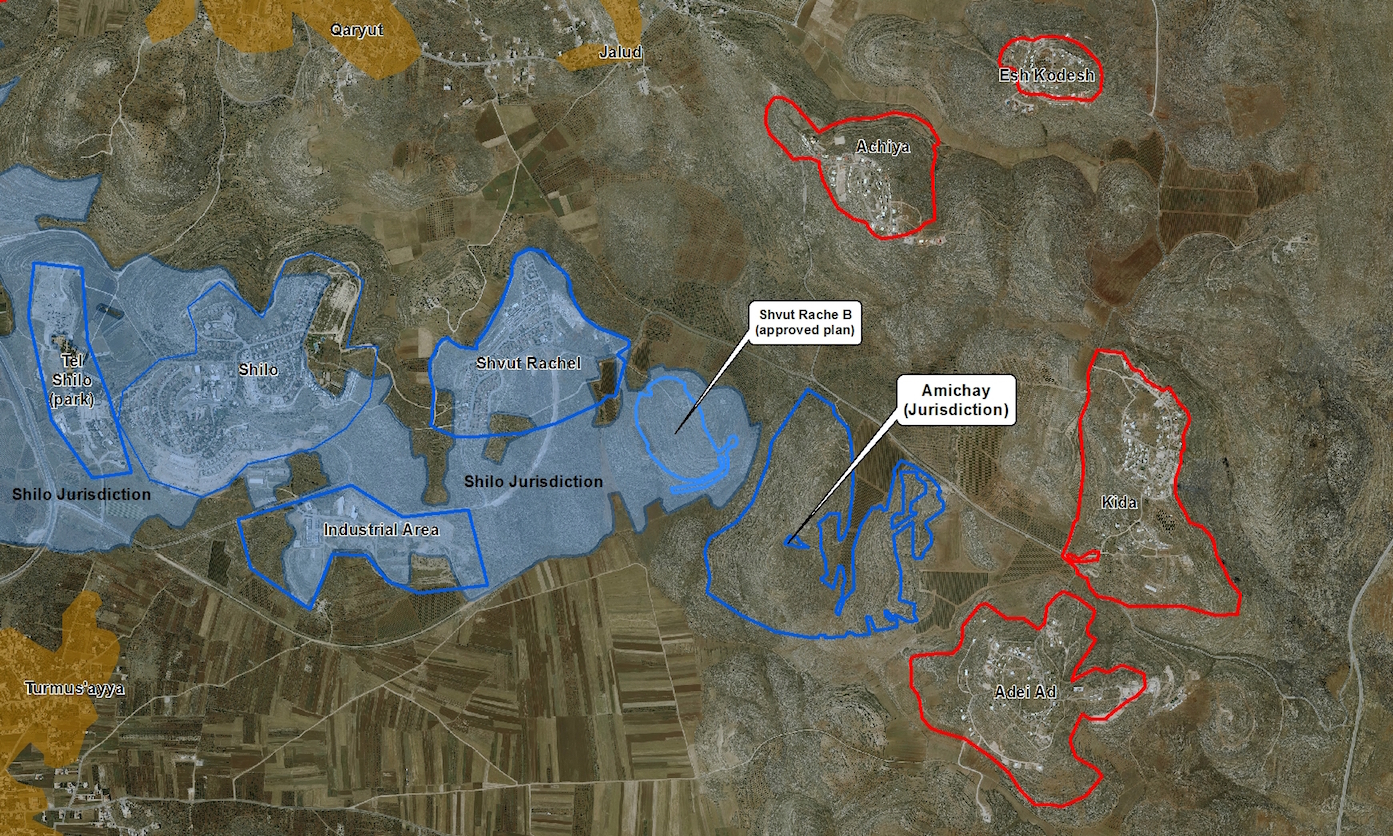
Map by Peace Now Israel
Over the weekend, Israeli authorities approved a jurisdictional outline for the first entirely new Israeli settlement established with government permission since 1992. The settlement is being called Amichai, and it is situated on a hilltop near the highly problematic Shilo settlement, located deep in the northern West Bank heartland. Peace Now Israel covers the important history of how this settlement (and a second settlement) is being built as pay-off to the families who were evacuated from the illegal Amona outpost earlier this year (i.e., it represents a concrete reward for breaking Israeli law and an incentive for further settler law-breaking).
The approval of this new jurisdiction will likely speed up the projected completion date for the Amichai settlement, which was once thought to be on a three-year timetable. Despite the rapid pace the Amichai approval is now taking, the Amona lawbreakers are demanding permission to construct temporary shelters in the jurisdiction that was just created.
This Week in Settlement-Related Violence
An IDF soldier was lightly wounded in an alleged stabbing incident at the entrance gate of the Israeli settlement Mevo Dotan. Reportedly, a 16-year old Palestinian girl approached the main gate of Mevo Dotan and stabbed a soldier who was telling her to leave the area. The girl was shot and transported to a nearby hospital where she later died of her wounds. Mevo Dotan is in the northern tip of the West Bank, fairly close to the separation barrier’s route. Previously a small settlement of ~330 people, last year Mevo Dotan nearly doubled in size.
Bonus Reads: Archives, Fragments, and a Biography
Reuters recently picked up on the impressive archival work of Akevot, an Israeli NGO unearthing and preserving Israeli government documents. The story covers more than just archived documents relating to settlements, but here’s a real money quote:
Theodor Meron, one of the world’s leading jurists who was then legal adviser to the [Israeli] foreign ministry, wrote several memos in late 1967 and early 1968 laying out his position on settlements. In a covering letter to one secret memo sent to the [Israeli] prime minister’s political secretary, Meron said: “My conclusion is that civilian settlement in the administered territories contravenes explicit provisions of the Fourth Geneva Convention.”
The United Nations Office for the Coordination of Humanitarian Affairs – Occupied Palestinian Territories (OCHA oPt) put out a new report this week titled, “Fragmented Lives: Humanitarian Overview 2016. ” In it, OCHA highlights many important ways the Israeli settlement enterprise impacted Palestinian lives in 2016. These include settler violence, settler takeovers of Palestinian property in East Jerusalem, discriminatory planning practices, the movement and access restrictions in areas near settlements, and more.
Israel’s +972 Magazine ran a feature piece on prominent Israeli activist and settlement expert Dror Etkes. The story includes his work challenging the Amona outpost as well as a great explanation of the Ottoman era law that Israeli settlers are using to massively expand settlement growth.
FMEP has long been a trusted resource on settlement-related issues, reflecting both the excellent work of our grantees on the ground and our own in-house expertise. FMEP’s focus on settlements derives from our commitment to achieving lasting Israeli-Palestinian peace, and our recognition of the fact that Israeli settlements – established for the explicit purpose of dispossessing Palestinians in the West Bank and East Jerusalem of land and resources, and depriving them of the very possibility of self-determination in their own state with borders based on the 1967 lines – are antithetical to that goal.
Welcome to FMEP’s Weekly Settlement Report, covering everything you need to know about what is happening this week related to Israeli settlement activity.
To receive this report via email, please subscribe here.
May 26, 2017
- The High Stakes of Trump’s Silence on Settlements While in Israel
- Israel Forms New Outpost Legalization Committee, Kerem Reim Plans Advance
- New Report from Peace Now Israel Shows Over 30% Increase in Settlement Activities
- IDF Makes Arrests in Huwara, Deploys More Troops to West Bank Hot Spots
Contact Kristin McCarthy (kmccarthy@fmep.org) with questions and comments.
The High Stakes of Trump’s Silence on Settlements While in Israel
President Trump’s 28-hour trip to Israel and the occupied West Bank did not include any specific policy pronouncements (click for transcripts of Pres. Trump’s public speeches: 1, 2, 3, 4). The lack of public pressure on Israel to stop settlement growth comes at a time when Netanyahu’s government is reportedly advancing plans to build new, peace-killing settlements & infrastructure in East Jerusalem and across the West Bank. Netanyahu is also under pressure by his own coalition – which apparently understands President Trump to be supportive of the Israeli settlement enterprise – to escalate the building pace even more, some have even called for outright annexation.
Following Trump’s departure from Israel, Defense Minister Avigdor Liberman said bluntly, “Israel doesn’t need a green light from Washington for settlement building.” According to Liberman, the High Planning Council – the body that approves plans for all Israeli construction in the West Bank – may meet on June 7th to consider plans for “several thousand” new settlement units. While the details of which plans the High Planning Council’s upcoming meeting will handle are not known, Liberman specifically mentioned the massive Jerusalem-area settlement Ma’ale Adumim as well as the South Hebron Hills.
Israel Forms New Outpost Legalization Committee, Kerem Reim Plans Advance
The Times of Israel reports the Israeli Security Cabinet created a new committee this week to “advance the legalization of West Bank outposts and illegal settler homes.” According to the same report, the committee will include the Prime Minister’s Office, the Defense Ministry, and the Civil Administration. With the Knesset’s passage of the Legalization Law (or “Regulation Law”) earlier this year, several cases related to the retroactive legalization of outposts have landed in the High Court of Justice.
One of those cases, stemming from a petition Peace Now filed that resulted in a stop-work order issued against the illegal outpost of Kerem Reim, is awaiting government response due to the High Court of Justice by May 30th. Americans for Peace Now reports that this week the Israeli government has acted to advance 3-year old plans for construction in Kerem Reim in the hopes of having the stop-work order lifted.
New Report from Peace Now Israel Shows Over 30% Increase in Settlement Activities
The settlement watchdog group Peace Now released an important new report on 2016 settlement growth. Several alarming facts we noted:
- There has been a 34% increase in construction starts in 2016, 70% of which was outside of the so-called “settlement blocs”
- There has been a 33% increase in planning advanced by the Israeli government, 60% of which was outside so-called “settlement blocs”
- The Efrat settlement saw the most construction in 2016. South of Bethlehem, west of the separation barrier, Efrat is inside a settlement enclave that cuts deep into the West Bank. Efrat’s location and the route of the barrier wall that grabs it, have literally severed the route of Highway 60 between Jerusalem and Bethlehem – Highway 60 is the sole major roadway providing north/south contiguity to the West Bank for Palestinians. The economic, political, and social impacts of the closure of Highway 60 at the Efrat settlement (there is literally a wall built across the highway) have been severe for the Palestinian population. The concentrated settlement growth in Efrat exacerbates all of these problems and further entrenches what settlement expert Lara Friedman called “the trend of ‘canonization’ of the West Bank.”
- On outposts, Peace Now writes, “While in recent years, most of the construction in outposts was done by individuals who initiated the construction of their own houses, in 2016 we saw more organized construction projects in outposts, with massive infrastructure works which requires funding and investment. Such investment must require the active, or at least passive, involvement of the authorities, and the settlement municipal councils in particular. The mechanism of the governmental involvement in illegal construction in the West Bank was exposed by Peace Now in our latest report, can be found here.”
IDF Makes Arrests in Huwara, Deploys More Troops to West Bank Hot Spots
Arrests were made following a violent incident in Huwara that left 1 Palestinian dead last week. Three Palestinians are reportedly in custody, including a Red Crescent ambulance driver.
Following an upsurge in settler violence in the Nablus area and elsewhere, the IDF is reportedly deploying hundreds of more troops into “known friction points, sensitive sites, and Palestinian cities.”
FMEP has long been a trusted resource on settlement-related issues, reflecting both the excellent work of our grantees on the ground and our own in-house expertise. FMEP’s focus on settlements derives from our commitment to achieving lasting Israeli-Palestinian peace, and our recognition of the fact that Israeli settlements – established for the explicit purpose of dispossessing Palestinians in the West Bank and East Jerusalem of land and resources, and depriving them of the very possibility of self-determination in their own state with borders based on the 1967 lines – are antithetical to that goal.