Welcome to FMEP’s Weekly Settlement Report, covering everything you need to know about Israeli settlement activity this week.
To subscribe to this report, please click here.
February 22, 2019
- Settlers Fly Israeli Flag Over Muslim Quarter Home Following Eviction of Palestinian Family
- Israel Approves Massive Jerusalem Housing Project – Including Settlement Units in East Jerusalem
- Facing Supreme Court Hearing, Civil Administration Decides to Partially Comply with Geo Data Request from Radical Settler Group Regavim
- U.S. Ambassador to Israel Pushes Economic Peace Scheme (Again) to “Judea & Samaria Chamber of Commerce & Industry”
- Two U.S. Congressmen Tour Settlements, Promote Annexation
- The “Sovereignty Movement” Promoting Annexation, & the Pushback
- Bonus Reads
Questions/comments? Email kmccarthy@fmep.org
Settlers Fly Israeli Flag Over Muslim Quarter Home Following Eviction of Palestinian Family
On February 17, Israeli security forces evicted the 7-member Abu Asab family was from its home of nearly 70 years in the Muslim Quarter of Jerusalem’s Old City. Within hours of the eviction, Israeli settlers moved into the home and raised an Israeli flag on its roof.
Before 1948, the property in question was owned by a Jewish family, the Maisals, which abandoned the property during Israel’s War of Independence. The Abu Asab family was settled in the property by the Jordanian government during this same period – which Palestinians know as the Nakba (the catastrophe), in the wake of their expulsion from their own home in what became Israeli West Jerusalem. Their eviction this week came at the behest of Israeli settlers who had gained control over the land trust to which the original Jewish owners had passed their property rights.
As background: Under Israel’s Legal and Administrative Matters Law, Jews who lost property in 1948 (of which there are approximately 2,000) have the right to reclaim their property. Palestinians who lost property in that same war (of which there are approximately 20,000-30,000) do not have a similar right. Settler organizations have sought to take full advantage of that law, undertaking campaigns to identify Jewish families who abandoned property now occupied by Palestinians, gain title to those properties (even if the original landowner has made no effort to reclaim the property), and then start eviction proceedings against the Palestinian residents. This is happening across East Jerusalem neighborhoods, most prominently in Sheikh Jarrah and Silwan.
Palestinian residents targeted by these evictions, like the the Abu Asab family, have no legal avenue for reclaiming their property in West Jerusalem.
Peace Now explains:
“The Maisel family dedicated the property to a trust. A few years ago, settlers managed to appoint themselves as directors of this trust, and in their name they sued the family who lived in the property in protected rent during the days of the Jordanians and paid rent regularly. With this crooked legal situation, the court granted the settlers the house and the Abu Asab family became refugees for the second time…This eviction is part of a larger strategy by proponents of the settlement enterprise to change the character of Palestinian Jerusalem neighborhoods in order to cement Israeli hegemony over the Old City and its surroundings and to prevent the chances of a two-state solution.”
Ir Amim researcher Aviv Tatarsky writes:
“When Jewish settlers move into Palestinian neighborhoods, they almost always bring with them armed guards to stand guard on their rooftops and outside their doors, a dynamic that has a detrimental influence on entire neighborhoods. Day to day life is disrupted, with residents facing pressure seemingly designed to push them out of their homes. Israeli authorities have various ways of abetting that effort, from the law allowing only Jews to reclaim property, to funding private security guards for the settlers who move in to their properties, to funding tourism initiatives that strengthen the image of those settlements vis-à-vis the Israeli and international public.”
Israel Approves Massive Jerusalem Housing Project – Including Settlement Units in East Jerusalem
According to the Middle East Eye, on February 20th the Jerusalem Planning & Building Committee approved a project for 4,416 new housing units across Jerusalem, including units in Israeli settlements and settler units located within Palestinian neighborhoods in East Jerusalem. Early reporting on the details of the plan describe:
- 76 new units in the Shuafat neighborhood of East Jerusalem
- 56 new units in the Beit Hanina neighborhood of East Jerusalem
- 464 units in the Gilo settlement
- The construction of a new commercial complex at the Atarot settlement industrial zone site, including 3 buildings with 8 floors each.
FMEP will report more details on the plan as the are clarified.
Facing Supreme Court Hearing, Civil Administration Decides to Partially Comply with Data Request from Radical Settler Group Regavim
The settler-aligned Arutz Sheva outlet reports that, days before a scheduled hearing at the Supreme Court, the Israeli Civil Administration announced that it will provide a portion of the geographical information that the radical settler group Regavim requested via a freedom of information request last year. Regavim works to dispossess Palestinians of their land and property in the West Bank by “helping” (i.e., pushing) the Israeli government to enforce planning and building laws – and possession of the Civil Administration’s most recent geographical data will undoubtedly aid Regavim in pursuing its mission. Notably, Regavim works for the application of planning and building laws only against Palestinians; key Regavim staff members actually live in illegally built settlement units (illegal even under Israeli law), which Regavim works to retroactively legalize.
Supreme Court Justice Meni Mazuz chided the Civil Administration for its failure to respond to the initial information request, and for the nine-month delay in responding to Regavim’s court petition. In light of the Civil Administration’s announcement, the Supreme Court subsequently dismissed Regavim’s petition and and ordered the Civil Administration to pay Regavim’s legal expenses related to the case.
Regavim’s Attorney Boaz Arzi crowed:
“Although it took far too long, after a year and a half we finally received the data we needed – but through legal petition, not through the Freedom of Information process. Regavim is considering submitting a new petition against the Civil Administration’s interpretation of its obligations – or more precisely, its presumptive lack of obligation – under the Freedom of Information Law, an interpretation that contradicts the Attorney General’s directive.”
The Civil Administration said:
“We will study this case and draw conclusions in order to improve our responsiveness to the public.”
U.S. Ambassador to Israel Pushes Economic Peace Scheme (Again) to “Judea & Samaria Chamber of Commerce & Industry”
On February 21st, U.S. Ambassador to Israel, David Friedman, spoke about economic co-existence initiatives at a conference hosted by the “Judea Samaria Chamber of Commerce and Industry (JSC)” (an Israeli settler body) and US-Israel Education Association (USIEA) (conference website is here). The USIEA is a U.S. evangelical group deeply involved in supporting and normalizing settlements, working in partnership with the Israeli government. It is also works with the Family Research Council to lead Congressional delegations to Israel and runs a bible camp in the Ariel settlement.
This is the second time the Ambassador has met with the JSC, the first was in October 2018 at a meeting in the Ariel settlement. Speaking to the press at this week’s conference, Ambassador Friedman said the goal of the forum is to “encourage business development in Judea and Samaria, encourage the prosperity of people who live there, most of them Palestinian residents.” Notably, until this point the U.S. State Department has not officially referred to the West Bank as “Judea & Samaria” – a biblical term for the area that is preferred by Israeli settlers and pro-annexationists.
Friedman said in his speech:
“This is not a time for words, this is a time for action, and this is the path I’m confident we’re on. One day, I believe in the near future, as we begin to see Israelis and Palestinians working together, studying together, investing together, and living together in real peace – not the ‘peace’ that comes from a piece of paper, but the real peace that’s in the heart and the soul of everyone who’s here. We will look back on days like today to understand how it all began.”
Commenting on Friedman’s remarks, FMEP President Lara Friedman tweeted:
“Folks, pay close attention to actions/statements like this one. All evidence so far suggests that US direct engagement (new policies, initiatives, funding) to normalize occupation while de-nationalizing Palestinians IS the Trump ‘peace plan’”
FMEP has repeatedly chronicled Amb. Friedman’s embrace of economic co-existence initiatives as a core U.S. priority on the ground, and has repeatedly explained the perversity of labeling Israel’s economic exploitation of occupied territory (including the local workforce, land, and other natural resources) “coexistence” or suggesting that it brings to the Palestinians benefits they should welcome. The New York Times quoted a spokesman for the Palestinian Authority explaining the Orwellian reality of settlement industrial zones:
“Somebody occupies your country, steals your land, steals your water, steals your resources, then says: ‘I’ll make a good deal for you if you come work for me. I’ll create jobs for you. We are not occupiers. We are employers.’ This is ridiculous. The colonial settlements are illegal in every sense of the word.”
Two U.S. Congressmen Tour Settlements, Promote Annexation
While on a tour of Israeli settlements in the West Bank (something that in itself would have been unusual and controversial in the past), U.S. members of Congress Andy Harris (R-MD) and Andy Barr (R-KY) expressed support for Israeli annexation of the settlements and spoke in favor of settlement industrial zones, suggesting that such zones promote peace and prosperity in the region.
While at the Barkan Industrial Zone in the northern West Bank, Barr told members of the press:
“Our job after witnessing what we have seen here today is to communicate to the administration that the best way forward for peace and prosperity for everyone, Jews and Arabs, is more industrial development here, where we can have integration and not segregation: That is the path to peace…free enterprise, where everyone has the opportunity for upward mobility and prosperity – working together – is the best way forward for peace.”
Barr’s comments echo the views of U.S. Ambassador to Israel David Friedman, who once described the Barkan Industrial Zone as a “model of Israeli-Palestinian coexistence since 1982, with thousands working and prospering together.” The reality of West Bank industrial zones, and the role they play in the lives of Palestinians, is more complicated. For decades Israel has used industrial zones as another tool to expand and deepen control over West Bank land. Jobs in industrial zones – often the only jobs available for Palestinians living under an Israeli occupation that prevents the development of any normal Palestinian economy – are widely viewed by Palestinians as a double-edged sword. FMEP has previously reported on the false notion that settlement industrial zones are in the best interests of the Palestinian people living under occupation.
Representatives Harris and Barr met with settler leader Yossi Dagan, the head of the Samaria Regional Council, and two members of the radical activist group called Women in Green, which has long advocated for Israeli annexation of the West Bank. Later on the same trip, the two also met with Prime Minister Benjamin Netanyahu.
Rep. Barr told the Women in Green:
“we will share this [sovereignty] message with our colleagues in Congress and our constituents in the United States as we echo your sentiment that a strong Israel and Israeli sovereignty is an interest not just of the Jewish people but of the United States as well.”
The “Sovereignty Movement” Promoting Annexation, & the Pushback
The Israeli “Sovereignty Movement” (an offshoot of the Women in Green organization) is working to further formalize its expanding influence over Israeli politicians and public discourse by pushing for the establishment of a Knesset committee devoted to the cause of Israeli annexation of the West Bank.
In a recent article detailing how the Israeli political echelon no longer conceals its annexationist aims, veteran Israeli journalist Shlomi Eldar explains that the “Sovereignty Movement” has been instrumental in pushing politicians and candidates to speak more openly and supportively in favor of annexation. Eldar writes:
“The Sovereignty Movement is currently focused on creating a lobby in the Knesset. Its activists are working the ruling party, distributing a journal running a website and promoting paid content on social media. The movement’s influence played a role in Likud’s Central Committee voting in December 2017 in favor of a non-binding decision imposing Israeli sovereignty on Israeli-controlled territories of the West Bank, including the Jordan Valley. This, it turns out, was just the beginning. The Sovereignty Movement posted a video on Feb. 12 calling for imposing Israeli sovereignty on the West Bank territories. ‘First of all, we get the idea of a Palestinian state off the table,’ says Science and Space Minister Ofir Akunis in the video. ‘Second, we need to make brave, difficult, challenging decisions that aren’t simple when facing the international community. First of all, we must impose sovereignty on West Bank Area C.’ According to him, on the land designated Area C, under Israeli civil and security control, there is a clear Israeli and Jewish majority.”
Commanders for Israeli Security – an organization comprised of retired and former senior officials in the Israeli defense establishment – released a statement in direct response to the growing influence of the “Sovereignty Movement,” and its newly revealed ambition of creating a Knesset committee. The statement reads:
“Today, the extreme right’s mode of operation for annexing millions of Palestinians was revealed. Undetected, a right-wing extremist group is working to ensure that the next government will implement its plan. Although most of the Israeli public understands the destructive implications of annexation, utterly opposes it, and is unaware of the measures to realize this horror scenario, the Sovereignty Movement creates facts on the ground, mobilizes extreme right-wing politicians and lays the groundwork for implementing the move. It is now clear that these are not merely delusional dreams. The declarations favoring annexation, or using the laundered term “application of sovereignty,” frequently delivered by extreme right-wing politicians, are public expressions of a well thought-out plan developed in hiding, whose implementation began during the term of the outgoing government. With backwind of the support they have mobilized so far, the annexationists no longer hide their intentions, openly proclaiming their determination to accomplish the feat during the term of the next government, leading to the destruction of Israel as a Jewish, secure and democratic state. The annexation pressure is on. The pressure exerted on politicians to express support for annexation are but the prelude to the pressure to be exerted on Prime Minister Benjamin Netanyahu, if elected, to commit to annexation as a condition for forming the next government. If the annexation move is not halted immediately, we will wake up to a different Israel during the term of the next government, without a solid Jewish majority and all the security and other implications of integrating millions of Palestinians into the State of Israel. This pressure should be stopped right now.”
Bonus Reads
- “Palestinians Live in Caves to Preserve their Land” (Al-Monitor)
- “Netanyahu Pretends the Occupation Doesn’t Exist” (Al-Monitor)
- “Honenu: The legal arm of Israel’s radical settlers” (Ynet)
- “The Escalation of Israeli Collective Punishment of Palestinians” (Al-Shabaka)
- “Verizon, Pfizer, Bank of America – US Corporations are Funding Israeli Settlements” (In These Times)
Welcome to FMEP’s Weekly Settlement Report, covering everything you need to know about Israeli settlement activity this week.
To receive this report via email, please click here.
July 28, 2017
- Bibi Embraces “Population Transfer” – Asks for US OK
- The Knesset & Bibi Move to Gerrymander Jerusalem
- Settlers Set Up Outpost, Seek to Expand Settlement as “Response” to Murders
- Settlers Seize Contested Building in Hebron
- Construction on New Settlement in Shilo Valley Stalled (Due to Lack of Funds)
- High-Ranking Government Officials Defend Outpost from Demolition
- Bonus Reads
Comments, questions, or suggestions? Email Kristin McCarthy at kmccarthy@fmep.org
Bibi Embraces “Population Transfer” – Asks for US OK
According to a report from Israel’s Channel 2 News, Prime Minister Netanyahu recently asked U.S. Ambassador David Friedman and Special Envoy Jason Greenblatt to support a populated land-swap as part of a future peace deal.
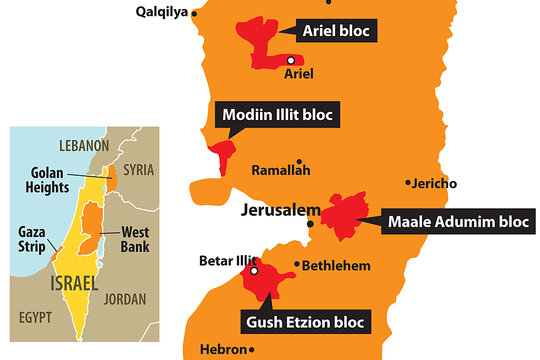
Map in CSMonitor
The swap in question would transfer 300,000 Palestinian citizens of Israel (living in the Wadi Ara region, an area known as “the triangle,” near Haifa) to the Palestinians, in exchange for Israel’s annexation of settlements in the Etzion bloc. The plan – which was previously championed by Defense Minister Avigdor Liberman, who even proposed it at the United Nations – is in effect a population transfer that would allow Israel to get rid of a large cluster of Palestinian cities, including the city where the two terrorists who attacked guards at the Haram al-Sharif/Temple Mount last week grew up.
An unnamed White House official made a statement in response to the report saying, “This may have been one of many ideas discussed several weeks ago in the context of a peace agreement and not in the context of a separate annexation.”
FMEP President Lara Friedman commented on what message Bibi’s endorsement of this idea sends: for the current Israeli government, “citizenship of Jews is inalienable right; citizenship of Arabs is revocable privilege.”
Arab Israeli MK Aida Touma-Suliman responded to the report saying, “The cat is out of the bag and Netanyahu has shown his true colors regarding the Arab population…the [Wadi] Ara residents are not only Israeli citizens, they’re also indigenous people who dwell on their land, and are not to be compared with settlers dwelling on another nation’s land. We the Arab citizens aren’t part of any such equation and aren’t willing to pay the price again for Israel’s policy of occupation and settlements.”
When Avigdor Liberman promoted the idea back in 2014, then-President Shimon Peres said, “Israel cannot take away its citizens’ citizenship simply because they’re Arab.” Then-Interior Minister Gideon Sa’ar said, “An Israeli citizen is not an object and not transferable as part of a framework political agreement.” Netanyahu has never expressed support for the plan prior to this news report, but the plan has allegedly come up in negotiations before.
The area of settlements known as the “Etzion Bloc” is home to over 22 settlements and 75,000 Israeli settlers. The loose cluster of settlements is located south of Jerusalem, extending from the 1967 Green Line deep into the West Bank; most of the settlements are on the Israeli side of the separation barrier. The major traffic junction in the area has recently seen numerous car-ramming and stabbing attacks by Palestinians targeting Israeli settlers and soldiers in the area, including an attack today that resulted in the death of the attacker and no other reported injuries.
The Knesset & Bibi Move to Gerrymander Jerusalem
In tandem with the Temple Mount/Haram al-Sharif crisis is, three important bills regarding Jerusalem’s future have advanced in the Knesset:
-

Map by Haaretz
Prime Minister Netanyahu announced his support for a bill in the Knesset that would allow 130,000 Israeli settlers living four West Bank settlements to vote in Jerusalem’s municipal elections while effectively excluding around 100,000 Palestinians from the Jerusalem municipality (most obviously the Shuafat refugee camp and Kafr Aqab, which are located outside the separation barrier). The four settlements are Maale Adumim, Givat Ze’ev, Beitar Illit, and Efrat, the last of which is six miles from Jerusalem. All are illegal under international law. Netanyahu’s support for this bill means that it is set to move forward when the Knesset’s reconvenes from its 3-month summer recess in November.
- Another bill (introduced a few days before the one described above) would allow the Israeli government to transfer Palestinian neighborhoods of Jerusalem outside the barrier to a separate, new municipality, created especially for this purpose. This bill and the one above aim to remove from the municipal area of Israel’s eternal, united capital those areas that threaten the Jewish demographic majority in Jerusalem, relegating them to a separate authority.
- These bills are complementary to a bill voted on last week that seeks to prevent the Israeli government from transferring parts of Jerusalem to a foreign power (i.e. the Palestinian government) in a future peace deal.
Settlers Set Up Outpost, Seek to Expand Settlement as “Response” to Murders
Following the horrific murder of three Israelis living in the Halamish settlement, the settlement’s leaders are seeking to consolidate and expand their illegal presence in the West Bank.
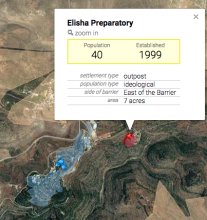
Map by Peace Now Israel
Within hours of the murder, hundreds of Halamish residents set up a campsite and a blockade of the eastern road leading to the settlement. The campsite is being called “Yad Ahi,” or “My Brother’s Hand” in memory of the three family members who were slain by a Palestinian youth last Friday. Settlers are rotating shifts inhabiting the campsite, aiming to make it an official outpost of the settlement and permanently close the road to Palestinians.
Halamish leaders are also demanding the government allow the expansion the settlement’s borders. A spokesman of the Binyamin Regional Council (which represents and provides municipal services to settlements in the Halamish region) called on the government to approve construction plans connecting the Halamish settlement to a nearby outpost called Tzofit, in order to “create a bigger security area and allow building neighborhoods that have already received zoning approvals.” Tzofit (also known as “Zufit” and/or “Elisha Preparatory”) is an illegal outpost that was established in 2007.
U.S. Ambassador David Friedman and Special Envoy Jason Greenblatt went to the illegal Halamish settlement this week to offer their condolences to the victims of the murder.
Halamish is located northwest of Ramallah, deep inside the West Bank. When the settlement was founded in the 1970s, Palestinian residents from the nearby towns of Deir Nidham and Nabi Saleh sued to stop the settlement’s construction, claiming it was being built on their villages’ land. The Israeli Supreme Court ruled in favor of the settlers, declaring the area to be state land. The Halamish settlement and its ever-growing encroachment on surrounding Palestinian villages has inspired weekly protests in Deir Nidham and Nabi Saleh, which has become infamous for weekly demonstrations – often involving clashes with the IDF – in recent years, often with international participation.
Settlers Seize Contested Building in Hebron
On the evening of July 25th — while events in Jerusalem were dominating the attention of the region and the world — 120 settlers broke into and illegally occupied a contested building near the Tomb of the Patriarchs/Ibrahimi Mosque in Hebron. The Israeli army immediately surrounded the building and on the morning of July 26th the area was declared a “closed military zone.” Prime Minister Netanyahu ordered the Defense Ministry to allow the settlers to stay as negotiations on their fate and ownership of the building continue.
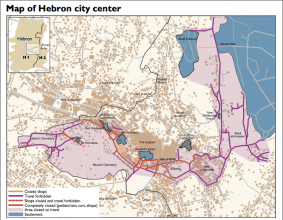
Map by B’Tselem
The Times of Israel reports that, “sources close to the prime minister said that Netanyahu was looking to avoid having to evacuate the families.” On the other hand, Yesh Atid chairman Yair Lapid called for their immediate evacuation. As of this writing, the settlers are still being allowed to illegally squat in the property.
Peace Now warned that the settler’s action can “ignite the region” and called on the government to, “follow the law and the Israeli interest and evacuate the trespassers without delay.”
J Street issued a statement calling on the U.S. government and international actors to pressure Israel to remove the settlers, saying “the Hebron settlers and their allies clearly believe that they can take advantage of the present crisis and push their long-term expansionist agenda by creating new ‘facts on the ground.’ It is vital that the prime minister and defense minister act in the best interests of Israeli security and uphold the rule of law by swiftly removing these families from the property.”
Hebron’s settlers have for some time been waging in a legal struggle to prove they legally purchased the building, known as the Machpela House. Palestinians contend they did not purchase it from the legal owners. While proceedings are ongoing, the settlers have once before broken into and occupied the building; when they did so in 2012, they were allowed to stay in the house for a week before being evacuated at the urging of the then-Attorney General of Israel who argued that it was necessary to preserve the rule of law.
Construction on New Settlement in Shilo Valley Stalled (Due to Lack of Funds)
A month after construction began on the first new settlement authorized by Israel in 25 years, the project has come to a halt – no over politics but due to insufficient government funds. The government had promised to bankroll the settlement’s construction but has not contributed to costs yet, according to the Binyamin Regional Council, which is currently footing the bill. The spokesman for the Binyamin Regional Council speculated on July 25th that the issue will be resolved quickly and expressed confidence in the government’s commitment to the project. Prime Minister Netanyahu reportedly gave orders to ensure construction is resumed quickly. As of this writing, there is no reporting to suggest construction has resumed.
High-Ranking Israeli Officials Defend Outpost from Demolition
Last week we reported on an impending demolition order against the Netiv Ha’avot outpost (near Bethlehem), along with the public relations efforts settlers were leading to elicit government intervention in their favor. The settlers got a helping hand this week when Israeli Education Minister Naftali Bennett and Yair Lapid (who heads the Yesh Atid political party) attended an event at the outpost. The Haaretz report suggests Bennett engaged in a conversation with the outpost’s leaders on how to “deal with” the demolition order and impending deadline.
Bonus Reads
- “This Synagogue Furniture Factory Is Actually a Sweatshop That Tramples Palestinians’ Rights” (July 26, 2017, Haaretz+)
- “The Settler Leader Who’s Even Charming Liberals as Israel’s Top Man in New York” (July 27, 2017, Haaretz+)
- “A Rare Glimpse: Shabak Agent Recruiting Hilltop Youth” (July 3, 2017, Jewish Press)