With all eyes on the framework agreement for a nuclear deal with Iran, and on the looming Capitol Hill battle to defend it, it is easy to forget that Israel is still in the process of forming its new government. With much of the drama playing out offstage, many observers are sitting back and waiting for the political wrangling over ministries and Knesset committee chairs to be over.
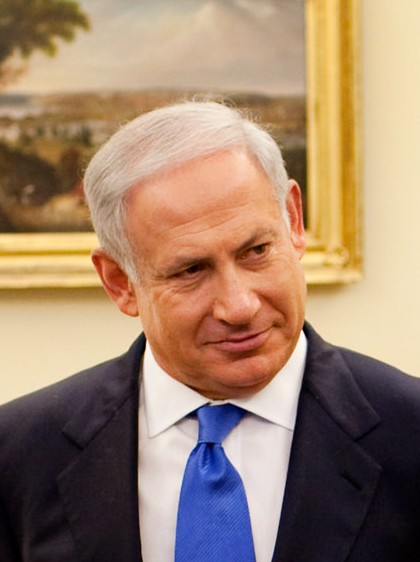 But some are making the case that there is more brewing than the doling out of prestige appointments to the leaders of the parties expected to be part of the fourth Benjamin Netanyahu government. A unity government, at one time thoroughly rejected by both Netanyahu and Zionist Union leader Isaac Herzog, has emerged again as at least a theoretical possibility.
The notion of a unity government seemed to have dissipated after both Netanyahu and Herzog initially rejected the idea, but of course, politicians say many things and decide better of it later, as circumstances change and political winds shift. Such changes are common in forming Israeli coalitions, something the selected candidate might have as much as six weeks to do after the announcement of election results.
Two factors have contributed to the revival of the possibility of a government of national unity. One is the central role the new Kulanu party will play in any new government. The party is center-right, and that makes it the most moderate of the parties that are projected by most to constitute the next coalition. Kulanu’s leader, Moshe Kahlon, is primarily interested in social welfare issues and wishes to address growing economic concerns like rising housing prices, increasing gaps between rich and poor in Israel and declining social services. This makes Kulanu, which would also prefer not to be the party farthest to the “left” in the government, naturally supportive of bringing the Labor Party into the government (Labor makes up the overwhelming bulk of the Zionist Union coalition).
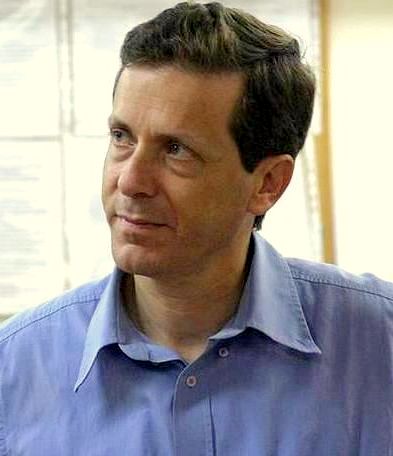 Kulanu controls ten seats in the 120-seat Knesset. Netanyahu’s 67-seat right wing majority is therefore vulnerable to Kulanu. Kahlon has clearly stated that he prefers a national unity government.
By itself, Kulanu does not explain why rumors are starting to circulate in Israel that Netanyahu is trying to woo Herzog into the government. However, combined with the new framework agreement between the P5+1 and Iran on the nuclear issue, we have a very clear motivation for Netanyahu to bring Herzog into the government.
Gary Rosenblatt of the Jewish Week lays out the reasoning well: “The prime minister is well aware that if he forms [a narrow, right-wing] coalition, the crisis in relations with the White House will only deepen. And now that the U.S. and other Western powers have signed a preliminary deal with Iran, it is all the more reason for him to be able to work with Obama in the hopes of toughening up the final agreement in the next three months — and, if all else fails, getting tacit permission from the White House to strike out at Iran if it violates the deal…In a unity government, Herzog most likely would serve as foreign minister, presenting a friendly face to the world in his international role.”
The very slight possibility that some parties from the right would not join a unity government is not a threat, as the Zionist Union brings 24 seats with it, so with them and Kulanu alone, Netanyahu would have 64 seats. It all makes sense, so why wouldn’t Netanyahu do it?
The answer is that he would, if it is a real option. True, a unity government would mean there would be significant opposition from within his own coalition to settlement policy, once again. Other policies would not be as smooth as they would under an all right wing government as well. But in the post-election cool-down, it is reasonable to think that Netanyahu has assessed the damage his scorched earth campaign for re-election caused Israel and decided he must try to repair some of it.
On the surface, the notion of a unity government is good for Israel. It should allow Israel to mend fences with the Obama Administration and the Democrats and it should forestall European pressure at the United Nations and other international fora. The reality is, however, that if Isaac Herzog does agree to the unity government, it will be a disaster for his party and have deeply negative consequences in the end for Israel, the Palestinians and American policy in the region.
A Bad Idea for Labor
The Labor Party once dominated Israeli politics, but has long since fallen off its perch. For a while, Labor was able to win support by being the party of peace, representing the Israel the world could work with and admire. But in recent years, it all too often played the role of fig leaf for center-right or right-wing leadership in power in Israel. With the failure of the Oslo Accords, which were distinctly identified with Labor, it lost its credibility as a “pragmatic peace” party.
This last election brought Labor back to some semblance of relevance, but if it once again plays the role of fig leaf for expanding settlements and continued intransigence from Netanyahu, it will lose a lot of it. The campaign itself demonstrated that Labor is still dogged by many of its old problems. A lot of the increase in support for Labor was the result of voters who were disillusioned with other center-left parties, but did not want to support Netanyahu.
Labor has much to do if it hopes to make further gains in the Israeli electorate. It will move in the opposite direction if it is again perceived as a fig leaf for Netanyahu, and especially so because the best thing Labor currently has going for it is that it is the vehicle to vote against Bibi.
A Bad Idea for Israel
National unity governments in Israel are notoriously clunky machines. The junior partner is always endeavoring to show it is moderating the policies of the senior, and the party of the Prime Minister is trying to get the most out of the other side while giving it as little as possible in terms of both policy and positioning for the next election.
On the international stage, a unity government will, at best, keep Israel from facing increased pressure to end its occupation of the Palestinians. Netanyahu will still need to appease his own party and will be very fearful of giving his rival, Naftali Bennett, the means to increase his support and position himself to challenge Likud from the right. Herzog will be under constant pressure to modify Netanyahu’s positions, but won’t have enough leverage to do much.
It’s a recipe for dysfunction, both domestically and internationally for Israel.
Dangerous for the Palestinians
The one thing a unity government might be able to do is to restart bilateral negotiations with the Palestinian Authority. Under current conditions, such talks are likely to be harmful, not helpful, for Palestinian aspirations.
Herzog will do nothing to convince Netanyahu to change his position on the Palestinian transitional government. Hamas remains political anathema in Israel. Nor is he likely to mollify the current Israeli policy view of the issue of Jerusalem. All he will be able to do is restore the status quo ante, which means talks that have no hope of success.
But the very existence of such talks will present serious problems for the Palestinians. At the very start, Palestinian President Mahmoud Abbas will likely be under pressure from the United States and Europe to re-engage. But without some assurances that things would be different in this round, he will face intense domestic pressure to stay away from that process. If he refuses, it will give Netanyahu’s allies in the United States plenty of fodder, and if he agrees to talks that produce nothing but more settlements, he will give his domestic opposition ammunition.
Herzog is a moderate, and if he were Prime Minister, it is not impossible that the right combination of pressures and incentives could get him to pursue an end to the occupation. But in a Likud-led government, he cannot be more than a fig leaf, putting a kinder face on Netanyahu’s intransigence. Without him, the Palestinians have more support, at least in Europe, for pursuing their case in international fora, and the potential for more pressure on a distinctly rejectionist, right wing Israeli government. With him, they have the worst of both worlds: less pressure on an Israel with a more reasonable image but whose policies are little different from those that have caused so much international frustration of late.
A Bad Road for US Policy
Although the two-state solution and bilateral talks to get there are still American policy, the current conditions have to change if such a goal is ever to be attained. Some way of unifying the West Bank and Gaza again, some sense of incentive for Israel to make difficult decisions, a clear vision of how to resolve difficult issues like Palestinian refugees and Jerusalem needs to be presented, etc. Simply forcing talks again will work no better today than it did in 2013, John Kerry’s last attempt which ended in disaster.
Herzog does not help change the current conditions. Instead, his presence in the government makes it easier for Netanyahu to accede to meaningless negotiations. No matter how cynically one may view American policy on this, more of the same is clearly not preferable. It is just turning up the heat on the pressure cooker.
On Iran, Herzog’s presence is even more problematic. He would be the one doing the outreach to the United States and Europe, a much less abrasive voice than Netanyahu’s. But his views on Iran are fairly close to Bibi’s. He may disagree with Netanyahu’s approach and belligerent attitude; he certainly disagrees with Bibi having played partisan politics in America on this issue. But substantively, he shares Netanyahu’s concerns about any nuclear agreement with Iran. His objections will not only be presented more effectively and diplomatically than Bibi’s, they will have the added weight of coming from “the other side” of Israeli politics, demonstrating that the country is united on this point and strengthening Republican arguments.
In the end, a unity government remains the far less likely outcome of the Israeli coalition talks. While a far-right coalition, the much more likely outcome, will increase Israel’s isolation in the short term, the possibility that Israel will end up owing more accountability to the world for its policies is good for its long term interests, however counter-intuitive that might seem. As ugly as the next few years might be, they will be similarly better for Palestinian and American interests as well than a kinder, gentler face on the same policies would be.
During the height of the Algerian revolution against French rule, Albert Camus, the celebrated writer, philosopher, humanist, and tenacious foe of fascism, was asked why he did not forcefully condemn the atrocities committed by OAS ultras and French military torturers against Algerian Muslims. Camus was a pied noir—born and raised among the European settler community in Algeria. “I love justice,” he answered, “but I love my mother more.”
Camus’s response shocked his admirers on the left, who felt their hero had failed them. Politically their disappointment is understandable, but Camus was making a profoundly important point. There is a difference in kind between attachments to principles, images, doctrines, or large, and necessarily abstract, groups—however passionate—and attachments to particular things or particular people.
If I lose my mother, the pain of that loss is not assuaged by the availability of another woman of her approximate age. My attachment was to a particular woman, not to “motherliness.” On the other hand, the pain of injustice “there and then” can be lessened by justice “here and now” because the abstract attachment to the principle of equity entails a wide set of equivalent attachments spread over time and space.
Camus loved his mother as a peasant loves and is organically attached to the place he inhabits. It is a particular and quintessentially personal attachment. Camus loved justice in the abstract way an ardent nationalist loves his “patria”—the territory of his nation—most of which he has never, and will never see or know in any personal way. Both attachments can be deep. Both can lead to enormous sacrifice, but they are different.
Understanding the Palestinian-Israeli conflict means, among other things, understanding how these two peoples come to their attachments to the same land from very different directions. Consider a peasant’s attachments to places in his world—to the ancestral burial ground, the mountain whose silhouette shadowed all below it, and the stream with familiar tendencies to flood at particular times. Such ties were deep, so deep that separation from “home” or one’s home village, could hardly be experienced as anything less than death. But these ties were not political. They did not register, for most of human history, as relevant to the political order—usually vast and imperial—within which these “places” were organized. These attachments did not inspire those who held them to “imagine” larger political communities than those who also shared, in an immediate way, the same place of habitation. Nor did they produce an honored or iconic “map image” of a territorial space attached to hundreds of thousands or millions of other human beings to whom the bearers of these feelings could feel kindredness.
Attachment to a particular place can do much to satisfy—or make miserable—those who can preserve them or lose them, but they cannot, themselves, be the basis of what Rupert Emerson called a “terminal community”; that is, a group of people too large to be known individually but which nevertheless is considered worthy of the ultimate sacrifice.
Nationalism and national states require a kind of abstract empathy that, it turns out, humans are quite capable of, but that capacity became apparent only relatively recently in human history. Nationalism requires people to shift much of their emotional investment from personal attachments to a place to abstract attachments to a space. Indeed they must learn to experience those abstract attachments as so important that for them they would be willing to sacrifice, as the saying goes, their “lives, their fortune, and their sacred honor.” The process of transforming attachments to place into attachments to space is a long and difficult one. This is what “nation-building” entails.
For masses in both Europe and the Third World, processes of industrialization, urbanization, education, and marketization, as well as immensely destructive and dislocating wars, “socially mobilized” huge populations, throwing them into new, disorienting, and difficult circumstances. But they made those populations available for this new abstract kind of attachment. From the 17th to the 20th century Jews, and in particular European Jews, experienced these processes with a vengeance. They witnessed the utter destruction of a medieval order that had both sheltered and oppressed them for centuries. But regardless of the strength of their attachment to traditional rabbinic authority, Jewish alienation and exclusion in Christian society made them more prepared for this “modern” world of abstract political loyalties than their non-Jewish contemporaries.
As both Marc Chagall and early Zionists pictured the situation, Jews were “luftmenschen,” floating in the world, unattached to gentile institutions or the fundamentally foreign places over which they hovered. The Jewish strategy of constant migration from erstwhile refuge to possible shelter was directly related to this sociological and psychological condition. All this meant Jews did not experience an attachment to specific places as intensely as ordinary folk around them. More than that, their own cultural celebration of a not-actually-known-or-remembered land—the Land of Israel—gave them centuries of practice in the cultivation of an abstract attachment, not to a “place” of irreplaceable individual meaning, but to a “space” of collective, abstract, empathic focus.
Zionism, as a nationalist movement seeking to mobilize a dispersed population and move it to a land inhabited by others, faced more challenges than most. But a typical problem that Zionism did not face was overcoming the highly parochial attachments traditional peasant and village society developed in its laboring masses. The huge task of assimilation into a Jewish “nation” that Israel faced when confronted with hundreds of thousands of Jews from very different countries and classes, and speaking different languages, was not unusual for states seeking to build nations. But Zionism did face one unique problem. It needed to make the new country, so alien for most of its Jewish inhabitants, feel familiar. This meant great emphasis on mapping the terrain of the “Land of Israel,” marking and hiking trails, and exploring as much as possible about its springs, mountains, caves, small rivers, wadis, flora and fauna. It meant changing thousands of place names to invented Hebrew designations as well. All this activity can be understood as a strong effort to establish some sense of “place” to complement the ideological attachment to the “space” of whatever parts of the country could be acquired.
The Arabs in Palestine faced a very different challenge. They sought to rouse their countrymen as members of the “Palestinian nation” to defend, not the villages and locales that were the intimate framework of their lives, but a “space” called Palestine carved out of the Levant by the outcome of battles between European and Ottoman imperialists. This was a more typical assignment for a nationalist movement; one that in Europe and elsewhere took generations if not centuries to accomplish.
When the nakba destroyed the settled life of the 950,000 or so Arabs living in what became Israel in 1948, hundreds of thousands of refugees huddled in forests, fields, and makeshift camps. Whether in Palestine, Lebanon, Syria, or Jordan, they did not yearn to return to the “space” of Palestine, but to the “place” of their village, their farm, their fields, and their homes. The keys they treasured were to the doors of their actual houses, not talismans of a space promised and celebrated but unremembered. Unlike Zionist immigrants, these refugees needed no maps of where they lived or how to get there. Indeed one reason why tens of thousands of refugees were able to surreptitiously return and remain in Israel is because they knew the back roads and trails so well. Maps are for unfamiliar spaces, not for homey places.
Although the “two state solution” may well never be achieved, its emergence as a plausible target for a negotiated settlement entailed a difficult struggle among Palestinian nationalists to transform attachment to place to attachment to space. This required considerable finesse, along with a good deal of deception and disingenuousness. On the one hand, Palestinian leaders evoked the heartbreaking stories of refugees expelled from their homes and the homes of their ancestors, and then refused permission to return. On the other hand, those committed to the “Palestinian state” option set about transforming the Palestinian pathos into a nationalist ethos focused on “Palestine” as a space, with indistinct borders encompassing parts but not all of the country. That meant using the phrase “right of return” ambiguously, to mean—perhaps, but only perhaps, and only for a very tiny number–return to places, to specific homes, fields and villages. For most it would mean return from spaces that were not in Palestine to locations in a “space” by that name– a space that would not contain “places” of actual, original, attachment.
This is a difficult political task for any nationalist movement. But it was particularly difficult for the Palestinians, because the spaces involved are so small, and therefore where the distances to specific yearned-for places, so near and yet so inaccessible, are so tantalizingly short. From the Israeli point of view, the continued evocation by Palestinians of the “places” they were forced to abandon signals either their adversary’s inability to be satisfied with a Palestinian “space” as a basis for resolving the conflict; or their dishonesty in pretending to accept partition while actually expecting that to be a stage toward eventual liberation of all the “places” in historical Palestine.
Indeed, we may use this analysis to gain a fine appreciation of one of the most difficult points in the seemingly endless and almost certainly fruitless negotiations that have been going on between Israelis and Palestinians. When Palestinians accepted the “two state solution” they did not explicitly accept it as corresponding to two peoples—Jewish and Palestinian. In their eyes that would have been equivalent to recognizing the right of the Zionist movement to have dispossessed Palestinians from their homes and their country. Instead, a Palestinian Arab state would live, side by side, with an Israeli state, containing an “Israeli people” comprised of both Jewish and Arab citizens. This position has been softened to the extent that Palestinians have offered Jewish settlers in the West Bank the opportunity to remain as law-abiding citizens of Palestine.
Meanwhile, however, Israel has escalated its demand. Originally no Israeli leader asked for or ever expected to receive Palestinian or Arab recognition of Israel’s “right to exist as a Jewish state.” But beginning with Ariel Sharon’s premiership, this became a constantly repeated demand. It is now often identified by top Israeli officials as the single most important requirement before Israel can make its own “painful compromises” for peace. Palestinian leaders and negotiators have objected to the opening that acceptance might give to Israeli policies of persecution or even expulsion of Arab citizens. They have also objected to the injustice and emotional impossibility of Palestinians, as victims, granting approval to their own historical victimization. But another obstacle to Palestinian acceptance of this demand also looms large. To name Israel as a “space” that is “Jewish,” would categorically foreclose the dream of re-establishing Palestinian refugee attachments to places in that space by confining Palestinian political ambitions, now and forever, to the “space” of the pieces of whatever mini-state of Palestine emerges from the agreement.
Because of the different trajectories that brought both national movements into collision, most Israelis can literally not imagine the pain of giving up attachments to places as part of building an attachment to a space. At the same time, most Palestinians can only understand the Israeli demand that such attachments be explicitly abandoned as reflecting the brutality and inhumanity they have come to associate with Jewish power in the space of Palestine.
This is an updated version of “Places vs. Spaces for Palestinians and Jews,” Perspectives, Spring 2014.
 Professor Ian Lustick is the Bess W. Heyman Professor of Political Science at the University of Pennsylvania. He is a past president of the Politics and History Section of the American Political Science Association and of the Association for Israel Studies, and a member of the Council on Foreign Relations.
The views expressed on the Foundation for Middle East Peace Blog are those of the authors and do not necessarily reflect the views or positions of the Foundation.
Israeli Prime Minister Benjamin Netanyahu won his fourth election last night in surprising fashion. He outdistanced the polls, including the exit polls in the waning hours of voting and won a decisive victory over the Zionist Union and Isaac Herzog. Here are some quick and initial takeaways from the results.
A huge victory for the Right
Even though the right wing/religious bloc in the Knesset didn’t grow, the right gained considerable power relative to
the last Knesset. The last government included two centrist parties, Yesh Atid, and Hatnuah. Yesh Atid actually was the biggest single party in it, with Likud having joined with Avigdor Lieberman’s party to gain a decisive lead in the 2013 elections. Hatnuah, though small, was very important to the coalition, as its head, Tzipi Livni was the fig leaf over the right wing that negotiated with the Palestinians.
This coalition is going to have a very different character. It is quite possible that Netanyahu will get the fully right-wing coalition he wants. It is very possible that the most moderate party in it will be Moshe Kahlon’s center-right Kulanu party. Kahlon is at best lukewarm on the two-state solution, although he has been critical of Netanyahu’s refusal to maintain negotiations. He probably described his view best when he said he supported Netanyahu’s 2009 Bar-Ilan speech. That’s the one Bibi just repudiated in the last days of the campaign.
Two States and Where America and American Jews Stand
No doubt, Netanyahu will try to walk back his rejection of a Palestinian state of any kind once he forms his new government. He can’t walk it back too far, given the nature of his coalition, but will seek just enough to allow people to believe that it is still possible under his watch if they so desire.
But given that very few were ever taken in by his Bar-Ilan speech, where he gave the most tepid support he could to two states, anyone who is serious about ending the conflict has to ask themselves where they stand now and what sort of policies must be pursued. The old policy is clearly a round peg for the square hole of Israel’s position.
Three sectors in particular must ask this question: mainstream Republicans who still hold on to George W. Bush’s outline; Democrats across the spectrum; and the mainstream of the International Jewish community.
Republicans have clung virtually as a unit to Bibi. Are they willing to continue to do so if that means, by definition, opposing a two-state solution? In 2012, the Republican National Committee adopted a resolution supporting Israeli rule over all the land between the Mediterranean and the Jordan Rivers. But this had little effect on elected officials, who distanced themselves from it when asked. That won’t be so easy if Bibi is perceived, correctly, as staunchly opposing two states.
Democrats have a starker dilemma. Opposition to a two-state solution, not to mention Netanyahu’s right-wing orientation on many other issues, clearly puts him outside the lines for almost all Democrats. But until Bibi started interfering in American partisan politics, they’ve been able to look past those differences as if they weren’t there. That won’t work now, but they will face considerable domestic pressure to do just that.
The same can be said for the American Jewish community. Divisions within the influential community are growing, and the tactics used by those who still wish to march in lock-step with Israel are becoming increasingly draconian and visible. That process is already underway, and this election will only accelerate it.
The choice before all these groups is not a one- or two-state solution, but whether or not Israel is going to allow Palestinians the basic rights, freedoms, and dignities that all of us expect and take for granted. From the most moderate to most radical analysis of how to resolve this conflict, that is what separates a supporter of peace from an opponent. And that is the question that these communities will have to resolve.
The Stark Choice For the International Community
At this point, there is no alternative in the realm of diplomacy to a two-state solution. The current period is one where new ideas, if they can be sold to the international community, could come to the fore, but so far, despite the attempts of some supporters of a bi-national or single secular state, they have not succeeded in penetrating the international discourse.
If Israel is going to refuse to seriously consider a two-state solution, then, the United States, United Nations, Arab League, European Union and any other international actors have a clear choice in front of them: either pack it in and give up on this issue or press Israel in unprecedented ways to concede on a two-state solution based on the generally recognized parameters (’67 borders with some swaps, shared Jerusalem, an agreed upon resolution of the Palestinian refugee issue).
The Obama Administration
The hostility between Obama and Bibi continues unabated. The White House is waiting until the last possible moment to extend its obviously reluctant congratulations. There is no doubt the relationship will continue to be strained.
On Iran, Bibi’s words to Congress could take on a little more weight in light of his victory, but on the whole very little should change as a result of the election. Obama needs to start making the case to the American public that this is a good deal, and he needs to start doing that now. But that’s no different from before.
It would be easy to be cynical, given the history of U.S.-Israel relations and Obama’s own non-confrontational style, that the United States will really press Israel. But Obama has very little to lose. Democrats will all be distancing themselves from his foreign policy in 2016, and his days as an elected official are done after that. He is certainly going to push hard on Iran. It is true that the American public recognizes Iran as a U.S. security issue. They do not view the occupation in the same way, even though it too presents serious security concerns for the United States.
The reality, however, is that without significant pressure, unprecedented pressure from the US, Israel will not move, not under Bibi. And increasing tensions, especially the possibility of lost exports to Europe, could move the Israeli electorate away from Bibi and even lead to early elections. Obama knows all this. The combination of his second term status and the rift on Israel Netanyahu opened up and later exacerbated by declaring his opposition to two states, puts Obama in an unusually advantageous position to take some bold steps to press Israel that would usually politically unfeasible.
That doesn’t mean he will take those steps. The forces opposing such actions are strong. But the opportunity is as good as it is likely to get in the foreseeable future.
The Overview
This wasn’t a referendum on Netanyahu, as many characterized it. This was a referendum on where the country should go, more centrist or more right. Netanyahu remains an unpopular and vulnerable leader, but he also remains the most popular of an unpopular bunch. In the end, Netanyahu won by waving the Arab boogeyman and saying that “droves” of Arabs were going to vote him out and gutting his right wing opponents by telling their voters that if they didn’t vote for Likud, Labor would rule again.
What the election did show was that the country is deeply divided, but that the trend of a rightward tilt continues. The solid performance of the Joint List was significant, but they drew a lot of voters away from the only fully left-wing Zionist party, Meretz, which barely survived.
Israel’s international isolation will continue to grow, and whether that growth is steady or accelerated will depend on both how much more brazen Netanyahu becomes and how much the U.S. and Europe are willing to tolerate before they take actions Israel will feel. It is not a hopeful scenario on any level.
When a federal court jury in New York reached a verdict last week on a lawsuit brought by American victims of terror attacks during the Second Intifada, holding that the Palestinian Authority could be held responsible, reactions were as quick as they were predictable.
The case involved ten families whose family members had been killed or severely injured by terrorist attacks during the Second Intifada. The Palestinian Authority was accused of indirect responsibility for these attacks. The decisive issue for the jury in the case seems to have been the fact that the PA continues to pay salaries to the families of the jailed terrorists who carried them out.
There is little doubt that the trial raises troubling issues. The first is the use of violence against civilians, which we unequivocally condemn. Another is how to address the very real suffering of the victims of terrorism and armed conflict, whether they be American, Israeli or Palestinian. But we must also consider how to do this in a practical manner that resists the use of victims’ suffering for political gains and contributes, rather than detracts from the prospects of resolving the conflict. In this regard, the verdict must be seen as a step in the wrong direction.
Benjamin Netanyahu added the verdict to his ongoing campaign to demonize Mahmoud Abbas and the Palestinian Authority. Supporters of a two-state solution fretted over the impact such a massive financial blow could have to the already feeble Palestinian economy. Palestinian solidarity activists saw one more example of how the American deck is stacked against the Palestinians.
The Palestinian Authority (PA) and the Palestine Liberation Organization (PLO) are sure to appeal this verdict, so it will likely be years before it is finally resolved. That, however, should not stop us from considering the difficult questions this case raises.
The most emotional of these questions regards the real human cost of ongoing conflict and how we, as a society both within the United States and in the larger global community address this. Those of us who believe that this verdict is unhelpful to the cause of peacemaking need to provide those families with a very good reason for why we would question these efforts at hitting back at those they deem responsible for their suffering.
Those families need to know that we are not ignoring their pain; on the contrary, we are acting in response to it, and working to ensure that it never happens to anyone else. This part of the equation must have nothing to do with which side the victims are on. Whatever differences and imbalances there may be between Israelis and Palestinians, the suffering of those who have lost loved ones, or have been traumatized or permanently injured by the violence is the same.
We are also presented here with an opportunity, however, to address one of the more vexing, if subtle, issues in this conflict, and that is the very fundamental power differences between Israelis and Palestinians. Those differences are historic and they are dictated on a daily basis by the gulf between occupier and occupied. But they play out in ways that can obscure the road to resolution.
The decisive point in this case seems to have been the fact that the plaintiffs were able to demonstrate that many of the perpetrators of the violence that killed and injured Americans in Israel were employees of the Palestinian Authority. Those perpetrators who are in Israeli jails often remained employees of the PA. Families of terrorists who died in the attacks continue to be compensated by the PA.
To the jury, and it’s probably safe to say, to most Americans, this is compelling evidence of PA complicity. Most Israelis would no doubt agree. An editorial in The Forward, which called the verdict “…a serious challenge to anyone…who still stubbornly believes that the current Palestinian leadership is capable of implementing a two-state solution,” saw this point as damning and suggested that the practice of paying families of terrorists must stop.
“What a powerful gesture it would be if Abbas stopped these payments,” read the Forward’s editorial. “It would remove one more piece of ammunition from the hands of Israeli leadership uninterested in solving the conflict. It would honor the victims of terror and acknowledge the rule of law. And — here we are probably being unduly optimistic — it would be a bold step to restore trust and prove, again, that this Palestinian leadership is willing to break from its violent past.”
Those points are all quite fair. And yet, the evidence of Abbas’ actions for over a decade overwhelmingly shows him to be a leader who eschews violence in favor of diplomacy and is willing to go farther than any Palestinian leader we know of to accommodate Israel’s security concerns and reach a two-state solution. Why, then, does he not stop those payments?
The answer lies in the day-to-day realities of Palestinian life, and in the harsh realities of occupation and the bitter conflict that has ebbed and flowed, but never ceased for so many decades.
At the time of the crimes in question, the intifada was raging and Israeli forces had responded quite harshly in the West Bank. The people, Israelis and Palestinians, across the political spectrum felt they were at war, under attack and they wanted the “bad guys” from the other side to stop endangering them and their children.
Israelis, quite correctly, feel that the brutal attacks on civilians in those years cannot be justified by Palestinians’ experiences under the occupation. Indeed, they cannot. International law does give an occupied people the right to resist their occupiers, but that right does not extend to attacking civilians in the occupying power’s territory. Such an act is nothing less than murder.
Palestinians, however, look at the years of the intifada quite differently. They see a massive Israeli incursion into the West Bank. According to the Israeli human rights group, B’Tselem, the intifada saw some 2,200 Palestinians killed who were not taking part in hostilities, as opposed to 239 such Israelis. They wonder why, when the Palestinian figure is nearly ten times bigger than the Israeli one, it is the Palestinians alone who are now being held to account.
Indeed, this is a question we should all ask.
For Palestinians, many of those engaged in violence are often the sole breadwinners of their families or at least a major source of income. For many Palestinians, however wrong we might consider it to be, these militants are seen as fighting for the independence of Palestine, for an end to the daily abuses of occupation, and ultimately, for the very lives of the people of Palestine.
If Abbas were to simply abandon those families, poverty would increase across the West Bank and so would popular opposition to the Palestinian President and his government. Even Palestinians who oppose such acts of violence, and there are a great many, would not advocate abandoning the women, elders and children who depend on the fighting-age men to the perils of increased poverty.
Cutting off these payments would be overwhelmingly unpopular among Palestinians, and that opposition is likely to undo many of the gains the Forward envisions. While it’s fair to ask what more the Palestinians can do, we should also ask what we in the United States can do, and what we might recommend to our ally, Israel, which, after all, remains the sovereign power in the territory.
The Palestinian leadership in the PA and the PLO has come a long way in their attempts to find common ground with Israel and end the occupation under which they’ve lived for almost fifty years. No one seriously believes that they were the ones leading the fight in the second intifada, nor was that the verdict reached in Federal Court this week.
Penalizing the PA because it sustains the families of convicted terrorists implies that the threat of economic ruin will dissuade terrorists from acting. Does anyone really believe that to be true? Even the plaintiffs’ case did not make the claim that the terrorists were acting under the PA’s direction, but with its tacit support, demonstrated through these payments. Militant groups are not seeking Abbas’ approval for their actions. On the contrary, Abbas has endured enormous political criticism over his security cooperation with Israel, for many years now, as they work to prevent such attacks. Both American and Israeli officials have repeatedly praised the PA’s efforts in this regard. Indeed, last year the head of Israel’s Shin Bet went so far as to publicly contradict Netanyahu’s effort to blame Abbas for rising violence in Jerusalem.
No amount of money or vengeance is going to erase a victim’s trauma, replace a lost limb, or, certainly, bring back a loved one killed by terrorism. It’s hard to see how a US civil court can play a constructive role here. Only a more forceful US, European and international policy, which presses for an end to violence on all sides and is willing to push both the parties into a reasonable agreement can do that. This is the only course that respects the blood and pain of all those who have suffered, and continue to suffer, in this conflict.
As a Jew, I would be absolutely appalled to read these sentences: “The Huckabeeans also heard from Muhammed Tamimi, national president of the Arab Organization of America, who explained to the group, according to
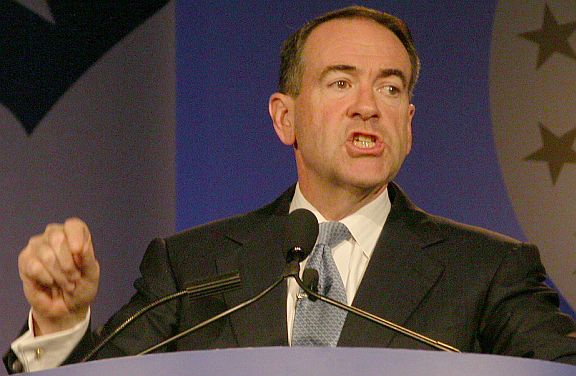
Huckabee, that there’s really no such thing as the ‘Jewish People.’ ‘The idea that they have a long history here, dating back hundreds or thousands of years, is not true,’ Huckabee said.”
In fact, what appeared in the front-page article of today’s Washington Post read, “The Huckabeeans also heard from Morton Klein, national president of the Zionist Organization of America, who explained to the group, according to Huckabee, that there’s really no such thing as the ‘Palestinians.’ ‘The idea that they have a long history, dating back hundreds or thousands of years, is not true,’ Huckabee said.”
Aside from mentioning that prospective GOP presidential candidate Mike Huckabee and his group would not be visiting Ramallah or meeting with any Palestinians, there was no mention of the Palestinians in this piece at all. Can any of us imagine an article in one of America’s most prominent newspapers where such a claim was made about Jews or Israelis without a single quote from a Jewish source in response, or at the very least a challenge to that claim by the author?
Perhaps the author of the article, William Booth, thought the assertion so absurd it needed no rebuttal. But in fact, Huckabee and Klein espoused a view of the Palestinians that a great many Americans hold, and one that even more Americans do not have the knowledge of Palestinian history to judge, and might just accept on faith.
Indeed, such statements are the very definition of “de-legitimization,” a charge Israel and her supporters throw around constantly. It is an offense to Jews when they are told they have no connection to the Land of Israel. It should be no less so for Palestinians to be told they do not exist. Yet somehow, in American discourse, the former is, rightly, treated with disdain while the latter is perfectly acceptable.
Let’s try on another picture. A Muslim cleric, a formerly powerful politician with ambitions of returning to even higher office, leads a tour of his devout followers and fellow travelers to Palestine. He takes them on a tour of the Dome of the Rock, the al-Aqsa Mosque, the Hebron Mosque, and the tombs of a list prophets revered in Islam. They meet no Israeli Jews though they do view the settlement of Har Homa from nearby Bethlehem.
Let’s say this cleric not only denied any Jewish connection to the land, but had another Muslim cleric tell a reporter that “… if you are a friend of Palestine, you are okay. If you’re an enemy, you’re in real trouble. God doesn’t change his mind about this stuff. The Qu’ran is an eternal book.” Would this not send chills down most American and Israeli spines? And wouldn’t this be called incitement to violence?
Well, substitute “Israel” for “Palestine” and the Bible for “the Qu’ran” and those were the words of Rev. Steve Sturgeon, a retired military chaplain and a pastor who was part of Huckabee’s entourage. And let’s not kid ourselves: his words reflect the views of a significant number of Americans. This is not just about Mike Huckabee, a man who is very unlikely to win the race for the White House next year. In part, though, it is about the very significant and influential segment of American society he represents.
Huckabee’s promotion for the Holy Land Tour on his website boasts that pilgrims will get to tour many biblical and historical sites, hear from Huckabee and other famous people about their views and experiences of the Holy Land and Israel’s value to the United States, and will meet with top Israeli officials. Interestingly, and unsurprisingly, there is not a mention anywhere of the Christian Palestinians who actually live in the Holy Land.
It is disturbing enough that these views have influence in the discourse around American policy toward Israel. But perhaps even more disturbing is the Washington Post allowing itself to be turned into a platform for this kind of radicalism.
The byline of the article locates the piece in “Masada, Israel.” The idealized story of Masada permeates the article, and clearly left Huckabee and his crew awestruck. Booth uncritically quotes Huckabee and zealously fills in more details himself about the Sicarii “rebels’” heroic stand at Masada, ending with a Roman siege and the decision by the Sicarii to die rather than live as Roman slaves.
These are the “Jews” these Christians admire, and about whom they beseech God in their prayers to “give us some of their backbone.” In fact, the Sicarii were a band of assassins, named after their long and curved daggers who committed atrocities, often against other Judeans. These included the massacre of 700 women and children in a raid on a Judean village, and, perhaps most tellingly, destroying the food supply in Jerusalem in order to force the people to war rather than the peace they were trying to negotiate with the Romans.
That would seem to describe al-Qaeda a lot more closely than the Huckabeean view of Israelis. But those suicidal assassins who attacked civilians are the “Jews” Huckabee and his crew admire, and why shouldn’t they? The view that was reinforced for them on this trip is one that rejects peace in favor of Israeli domination of another people and offers no sympathy for civilians harmed on a daily basis by the ongoing conflict and occupation.
But the more important question is why the Washington Post delivers their readers the Huckabeean view of Israel, and its concomitant blindness to Palestinians, with no critique and no counter-balance. Supporters of Israel would never tolerate the reverse, and rightly so. For all the activism aimed at protecting Israel’s image in the media, pro-Israel forces never have to contend with something like this on the front page of one of America’s leading dailies. And that tells us a great deal about why Americans have the one-sided view of the conflict that we do.
Based on the current polls, it is unlikely that the left and center in Israel will be capable of forming the next government after the National election in March. It appears that Labor Leader Isaac Herzog and his partner, Tzipi Livni realize this and have set their sights on something less: a “national unity government” featuring a rotation in leadership between current Prime Minister Benjamin Netanyahu and Herzog.

MK Haneen Zouabi
The cruel fact is that “the Zionist Camp” (the name taken for the joint ticket between Labor and Livni’s small HaTnuah party) and the left-wing Meretz party are just too far from the 60 Knesset seats required to form a government to seriously entertain the possibility of an actual victory. That is the case even if they would agree to include and could persuade the United Arab List (with a projected 12 seats in the Knesset) to join their coalition.
Dramatic evidence for this calculation by Herzog and Livni is their declaration of support for barring Arab Knesset Member Haneen Zoabi from running for national office. By joining the Likud in this tactic, the Zionist Camp seeks to position itself as eligible for sharing power with Netanyahu’s party. That may make short-term political sense for the leaders of the “main opposition party.”
But, it is a move that exposes the realities that politics in the “Jewish state” imposes on Jewish moderates. It appears certain, and it appears that Herzog and Livni know this, that in the kind of political arena currently constituted by the State of Israel no governing coalition in Palestine/Israel can arise which is capable of addressing the Jewish-Palestinian problem.
Demographic and cultural changes have transformed the Jewish electorate in Israel into a polity incapable of producing a left or even center-left government. The current election campaign shows that the painful implications of this state of affairs have not yet been absorbed by the remains of what used to be called “beautiful Israel.” To do so would mean recognizing that any serious strategy for bringing Jewish moderates back into power will require an alliance with non-Jews, campaigns to achieve extremely high turnout rates by non-Jews, and even extension of political rights to Arabs in East Jerusalem (perhaps to Arabs in the rest of the West Bank). Support for Zoabi’s political ostracism slams the door in the face of that strategy. At best it delays real movement toward it and at worst indicates a fundamental refusal to face the country’s deepest challenges and the realities that produce them. One of those realities is the impossibility that the country will once again ever be governed by an Ashkenazi-liberal dominated, Jewish-only, coalition.
Two instructive comparisons come to mind, one with the United States and one with France. Compared to Arabs in Israel, who comprise 15% of eligible voters, African Americans make up only 12% of the American electorate. Yet, elections in the United States have come to turn on African American participation. On average, Republican Presidential candidates receive about 57% of the white vote. Indeed, it is agreed among all observers that without a strong turnout by African Americans, Democrats simply cannot win Presidential elections in the United States. That they have done so repeatedly in recent years (including winning the popular vote in the disputed 2000 election) when African American turnout has been high, while suffering severe setbacks in off-year congressional elections (when that turnout has been low), proves the point.
Perhaps a better, though less well known, comparison is the predicament of the Socialist government of Guy Mollet in France in early 1956. The Socialists were already aware of the disastrousness of the war in Algeria. In January 1956, Mollet outlined a “Republican Coalition” that would include supporters of Pierre Mendez-France and other advocates of French withdrawal from Algeria—a coalition that would save the Fourth Republic by extricating France from the mess in Algeria forced upon the country by an alliance among right-wing and ultranationalist parties, settlers, and key elements in the military. But Mollet’s plan failed. He could not achieve a stable majority without allying with the Communists, who controlled a significant portion of the French legislature. Mollet refused to risk his “anti-communist” credentials by allowing communists in his coalition. Instead he turned to the equivalent of a “national unity government,” thereby winning power. But by joining with the right on a platform of Algerie Française, he prolonged the war, and, ultimately, destroyed the Fourth Republic. Whether the Fourth Republic could have been saved is unclear but by refusing to ally with the communists on the fateful question of staying in or leaving Algeria, Mollet sealed its doom.
There is a saying in politics—that it makes strange bedfellows. Usually that shows itself by the appearance of unexpected and even unprecedented alliances. But sometimes it shows itself by the fate of those who defy it. By refusing to face the newness of the world that must be made, the leaders of the “Zionist Camp” are deepening the crisis of the world as it is.
Professor Ian Lustick is the Bess W. Heyman Professor of Political Science at the University of Pennsylvania. He is a past president of the Politics and History Section of the American Political Science Association and of the Association for Israel Studies, and a member of the Council on Foreign Relations.
The views expressed on the Foundation for Middle East Peace Blog are those of the authors and do not necessarily reflect the views or positions of the Foundation.
Palestine has been on a marathon treaty-signing binge since the United Nations General Assembly recognized it as an Observer State in November 2012. In the past year, it has joined dozens of international agreements including the Geneva Conventions, seven human rights covenants and conventions, and most recently the International Criminal Court.
No one thinks this treaty-accession spree is motivated by the PA’s enthusiastic commitment to human rights and  international humanitarian law. The PA’s current approach to international instruments and institutions is join anything and everything a state can join. In this sense, human rights treaties are yet another political/diplomatic tool that Mahmoud Abbas is wielding against Israel. And though signing these treaties has no legal effect on Israel – which, in any case, is already a member of most of them and legally obligated to respect them – Israel responded with predictable outrage that, treaty after treaty, Palestine was being let into the “states-only” club.
For Palestinian human rights activists, this situation is a win-win. They view the fight for self-determination as central to the human rights struggle. So to the extent that joining international treaties hastens the end of Israel’s occupation, this is to be welcomed. Yet whether or not this strategy of collecting “symbols of statehood” in fact advances actual independent statehood on the ground, the treaties themselves are now legally binding on Palestine. This is an important achievement for human rights.
Activists note proudly that Palestine joined every single human rights treaty without filing a single reservation. This is extremely rare; indeed in our part of the world, I believe it is unprecedented.
Israeli violations of Palestinians human rights receive the lion’s share of the international media coverage. Yet Palestinians are also victims of severe violations of their rights by Palestinian authorities, including torture, extra-judicial killings, denial of due process and suppression of free speech and freedom of assembly (the Palestinian Independent Commission for Human Rights conducts comprehensive monitoring of these and other issues).
Of course joining international treaties is no guarantee of respect for rights. Many countries with horrendous human rights records are party to human rights conventions. But the treaties are significant as a new tool to be employed by all those working to promote respect for human rights by the PA and by Hamas authorities as well (the treaties apply to the territory of Palestine, which certainly includes both the West Bank and the Gaza Strip).
A spokesperson for the UN High Commissioner for Human Rights noted the significance last May when Palestine joined five human rights conventions: “Palestine is now bound, as of today, for five treaties and, by July 2nd, seven treaties covering many major issues. And they will therefore, like other states, now be very closely scrutinised in whether they implement those treaties. Those treaties are hard law and therefore it gives a lot of extra ammunition to civil society organizations, the media, the UN and many others to help Palestine ensure that the human rights of Palestinians in the occupied territories, in the West Bank, in Gaza, are upheld.
How can the treaties actually help to promote human rights on the ground? Each human rights treaty has a committee of experts to evaluate compliance. Each state party to the treaty submits a periodic report to this committee detailing policies and practices according to the treaty obligations. The committee of experts reviews this report, along with shadow reports from non-governmental organizations and other institutions, and then conducts a dialogue with state representatives and issues concluding recommendations. Each stage of this process is an opportunity for human rights groups to raise awareness and press government agencies to better comply with their legal obligations.
Palestine has already begun this process. This year, they are reportedly expected to submit their first periodic report to four treaty bodies: those monitoring the Covenant on Civil and Political Rights, the Convention Against Torture, the Convention for the Elimination of Racial Discrimination and the Convention on Discrimination Against Women.
Next year, Palestine is to report on three additional treaties, regarding social and economic rights, children’s rights and disability rights
I doubt they will manage to stick to this schedule. It is an enormous task to prepare comprehensive reports for seven major human rights treaties in two years. However, the conversations have already begun within the various ministries and institutions. These conversations are themselves important advocacy opportunities for improving respect for human rights.
Abbas’ strategy of treaty-accession may or may not bring Palestine closer to independence. It will be no small achievement, however if the by-product of these efforts is greater domestic respect for human rights.
 Jessica Montell served 13 years as Executive Director of B’Tselem: the Israeli Information Center for Human Rights in the Occupied Territories. She is now a visiting research fellow at the Hebrew University, Faculty of Law. Follow her on Twitter @JessicaMontell.
The views expressed on the Foundation for Middle East Peace Blog are those of the authors and do not necessarily reflect the views or positions of the Foundation.
The idea that the two-state solution to the Israeli-Palestinian conflict is dead has been repeated so many times in the
 past several years that it has taken on the droning sound of a mantra. Yet at the same time, we continue to hear pleas like the one that Palestinian Ambassador to the United Nations, Riyad Mansour made as the Security Council was about to reject the Palestinian resolution calling for an end to Israel’s occupation: “Those eager to save the two-state solution must act and cannot continue to make excuses for Israel and to permit, and thus be complicit in, its immoral and illegal behavior.”
So which is it? Must we abandon the two-state solution and think of other formulations or do we desperately need to revitalize and resuscitate the process we’ve been working on since 1993? Perhaps there is a better answer: a completely different approach to the two-state solution. (more…)
On December 31, Palestinian President Mahmoud Abbas closed out a year of stinging defeats by signing on to 18
 international accords. Included among these was the Rome Statute, the treaty that established the International Criminal Court (ICC). The reaction in Jerusalem and Washington was apoplectic.
The United States rebuked Abbas, and Israel immediately vowed harsh reprisals. Shortly thereafter, Israeli Prime Minister Benjamin Netanyahu announced that although Israel would not increase settlement growth—a routine method of punishing the Palestinians—it would withhold the tax and tariff revenues it collects for the Palestinians. The Obama administration also announced that it was reviewing the annual U.S. aid package to the Palestinian Authority. Read the rest of this article at LobeLog.

Palestinian representative to the UN, Riyad Mansour
The Palestinian Authority (PA) has now moved a step closer to making good on its threat to go to the International Criminal Court (ICC) and bring charges against Israel. There is little doubt that this was a move Palestinian President Mahmoud Abbas tried desperately to avoid. In the end, he was forced to do it by a combination of U.S.-Israeli rejectionism, Palestinian desperation to do something to try to end Israel’s occupation, and his own many missteps.
Abbas signed on to 18 international agreements after the quixotic attempt to pass a resolution at the United Nations Security Council (UNSC) predictably failed. Among them was the 1998 Rome Statute, which established the ICC and took formal effect in 2002. This is the step that the U.S. and Israel have warned Abbas against most strongly. Among all the “unilateral steps” the Palestinians could take (which, one should note, is no more “unilateral” than any number of actions taken by Israel on a routine basis), this is the one Israel worries about most. Read more at LobeLog