Given the frequently bombastic rhetoric that has come from the new President of the United States in his first two weeks in office, it is not surprising that many observers are reading the statement from the White House about Israeli settlements as being much sterner than it is. Expectations (and fears) have been raised in some quarters that President Donald Trump would be even more supportive of settlements than Israeli Prime Minister Benjamin Netanyahu, and the statement has been read by many in that context.
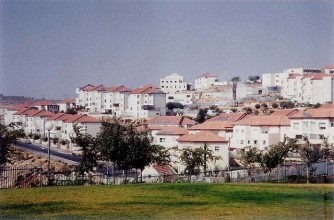
Israeli settlement of Beitar Ilit in the West Bank
The most important point made in the statement is an enormous gift to the Israeli right. The White House says that “…we don’t believe the existence of settlements is an impediment to peace.” That is a direct break with 50 years of fully bipartisan US policy on the matter. Following that with a statement that expansion of settlements “may not be helpful” in achieving peace is, contrary to what some have said, a much weaker statement than past presidents, including George W. Bush as well as Barack Obama, have issued.
As Israeli analyst Gershom Gorenberg said in a tweet early Friday, “(The) previous Israeli attitude was ‘The dogs bark and the convoy rolls on.’ Now (the) dog isn’t even barking.” Gorenberg is right, there was very little warning in this statement.
Previous Israeli attitude was “The dogs bark and the convoy rolls on.” Now dog isn’t even barking. @MJPlitnick @Lara_APN @lrozen
— Gershom Gorenberg (@GershomG) February 3, 2017
There are, however, some things that can be reasonably read into it. First, Netanyahu’s announcements this week of moving forward with still more settlement units as well as proposing the first new settlement initiated by the Israeli government in a decade were made without coordinating with the Trump administration. Given that Trump met briefly with Jordan’s King Abdullah just yesterday at the annual White House Prayer Breakfast and that Arab heads of state as well as cooler heads in both the Israeli government, and the pro-Netanyahu wing of the pro-Israel community in the US have been urging Trump to be more thoughtful of regional concerns in his approach to Israel, it is not surprising that Trump would want to make it clear to Netanyahu that he isn’t giving a blanket green light to doing such things without coordinating with Washington.
Also, the much more careful and nuanced tone here stands in sharp contrast with most of the Trump Administration’s early statements. This suggests that the White House may have sought more input on this statement than they had on others.
Indeed, it is entirely possible that such input was gathered from Israel or supporters in the US. The statement serves a crucial purpose for Netanyahu that seems to have escaped the notice of many.
Trump’s statement provides badly needed cover for Netanyahu.
The evacuation of the illegal (according to Israeli law) Amona outpost has been a huge controversy for Netanyahu for quite some time. As the evacuation was carried out this week the controversy reached a crescendo. Even though pro-settlement forces in Israel have been handsomely compensated with a bill in the Knesset to legalize outposts built on privately owned Palestinian land, announcements of new settlements, and vows from Netanyahu for much more, the settler movement was still dissatisfied. They expected more from a Prime Minister who, they believed, was completely freed from the shackles of the Obama administration.
Trump’s statement provides badly needed cover for Netanyahu to push back against those arguments. He is now able to portray himself as both a great friend of the settlements and a wise statesman who will take advantage of the opportunities Trump gives him, but will also act as a good friend to the Republican administration and not go so far as to embarrass it. It doesn’t suit Netanyahu to have a US administration that, like David Friedman (the man Trump has nominated as ambassador to Israel), supports settlements more than Netanyahu. Trump has now avoided being portrayed that way.
True, the White House’s statement last night dampened some of the more salacious fantasies of the settlement movement. But it was the absolute perfect statement for Netanyahu. That it was less “Trump-ian” than most of the President’s statements may have caught some people off-guard. But there is no less to worry about in regards to the new administration today than there was yesterday. Hopefully, after the initial shock from the tone of the statement wears off, more observers will recognize that.
Gershon Baskin is the founder of IPCRI – Israel/Palestine Center for Research and Information, and served as its co-director until January 2012. He is a long-time veteran of both Israeli peace NGOs and second track diplomacy between Israel and the Palestinians, and has many key contacts on both sides. This gives him a particularly well-informed grasp of current events.
In July 2006, after Gilad Schalit’s abduction in Gaza he began unofficially, without governmental authorization or support, to open a back channel with Hamas. Baskin was involved in the ultimately successful efforts leading up to Shalit’s release for more than five years
Baskin is a member of the steering committee of the Israeli Palestinian Peace NGO Forum, a member of the Board of Directors of ALLMEP – the Alliance for Middle East Peace, a member of the Israeli Board of One Voice Movement, and a member of the editorial committee of the Palestine Israel Journal.
Baskin holds a Ph.D. in International relations from the University of Greenwich.
All of this makes his insight into how to resolve issues particularly valuable. As this week of escalated violence in Israel and the West Bank came to a close, Baskin posted some of his thoughts to his Facebook page. We reprint them here with his permission.

From my talking and listening to many Palestinians over the past days I can conclude that no matter what we say about Israel not having plans to take over Al Aqsa, facts have nothing to do with perception and what people believe. Palestinians honestly believe that Israel has grand designs for changing the status quo on the Temple Mount/Al Aqsa. People told me quite clearly that the problem is not solely a religious one – perhaps not even mainly a religious problem – it is political, and it has to do with the continuation and the entrenchment of the occupation. The symbol of that entrenchment is Israeli control and domination over the Tempe Mount/Al Aqsa.
Here is what I think has to be done:
- Netanyahu should notify President Abbas that he is welcome to invite the leaders of the Arab world to come and pray in al Aqsa (at his invitation – not Israel’s). The list of invitees hopefully would include King Abdallah of Jordan, King Mohammed of Morocco, King Salman of Saudi Arabia, and President Sisi of Egypt.
- Israel should be holding regular, ongoing and quiet talks with the Jordanian and Palestinian Waqfs which are in control of what goes on all over the Mount. I assume that these talks are taking place but the return to status quo means that the Israeli police will refrain from entering the Mount on the condition that the officials from the Waqfs guarantee that stones, bottles and other explosive devices will not be brought into the mosques or any area on top that will be used for throwing at Jews praying at the Western Wall.
- Israel should agree that PA security personnel be allowed back onto the Mount and in the Old City and in Palestinian neighborhoods, as they used to be during the first years of the Oslo peace process. They were then in civilian dress, some of them had weapons -agreed to by Israel- others did not. They had the ability to bring suspects to Ramallah for questioning and arrest if necessary. Israel does not patrol the Palestinian neighborhoods in East Jerusalem on a regular basis – there are places that they don’t even enter. It is important to provide these people with a sense of security and for them to know that eventually understandings will be reached between Israel and Palestine on the future of Jerusalem.