The idea that “direct, bilateral negotiations are the only viable path to achieve an enduring peace,” is repeated often in the context of the Israeli-Palestinian conflict. The truth of it is obvious; any lasting agreement will require the full buy-in from both Israelis and Palestinians, and it is unlikely that an imposed settlement of the conflict would hold. The frequency with which this axiom is repeated suggests that an imposition of an agreement by outside actors such as the United Nations, the European Union or even the United States is a real possibility. In fact, virtually no one
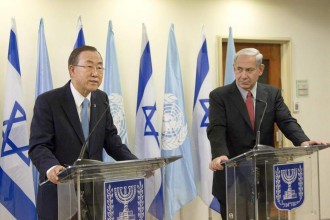
UN Secretary-General Ban Ki-Moon and Israeli Prime Minister Benjamin Netanyahu
seriously suggests that an agreement simply be imposed on Israelis and Palestinians.
The real issue is how the statement is defined. In general terms, supporters of Israeli policies take this rule to mean that no pressure should be brought upon Israel, as any such pressure is seen as undermining bilateral negotiations. Opponents of Israel’s occupation, on the other hand, tend to see outside pressure, in the form of international diplomacy or economic pressure, as crucial to incentivizing both sides into serious negotiations and toward making the difficult compromises necessary to achieve a final agreement.
As the administration of President Barack Obama enters its final months, there has been a good deal of speculation about what, if anything, the outgoing president will do about the Israeli-Palestinian conflict. Relatively free of political pressure, it seems to make sense that Obama would not want to leave this conflict as it stands, with a peace process in shambles, an increasingly isolated but aggressive Israel and a Palestinian population in deep despair and seeing violence as the only available, albeit futile, route open to them.
According to reports, the administration is considering several options: a United Nations Security Council resolution on the two-state solution, a resolution on the settlements or some combination of the two, either at the UN or in a statement of final status parameters by Obama. Any of these alternatives are staunchly opposed by Prime Minister Netanyahu and his supporters in the United States.
In order to counter such measures, the argument being made is that only bi-lateral talks can resolve the conflict, and therefore no outside pressures can be brought, in accordance with the Netanyahu government’s view that outside pressure is incompatible with direct negotiations.
In fact, outside pressure does not interfere with bilateral talks, it facilitates them. One example would be last year’s completion of the agreement to halt potential military aspects of Iran’s nuclear program in exchange for the lifting of sanctions. The United States and Iran were the key players, but the involvement of the United Kingdom, France, Russia, China, and Germany – countries that had a variety of views of and interests in the agreement – clearly helped keep negotiations on track and helped both sides to make difficult compromises.
When dealing with a conflict between two peoples that are equally passionate about their nationalism, rights, fears and historical claims, but far from equal in terms of negotiating strength, outside influence is indispensable. The compromises both Israel and the Palestinians would need to make to come to a final agreement will be difficult and will face strong domestic opposition. As with Iran, international advocacy for compromise will be indispensable for embattled leaders in both sides.
But external pressure would serve a more direct purpose in the case of Israelis and Palestinians. Israel currently has a government that, despite its Prime Minister giving lip service to a two-state solution, has worked hard to prevent one from ever coming about. Israelis who voted for Likud, the Jewish Home and other right wing parties, by and large, oppose the creation of a Palestinian state. Most Israelis see a Palestinian state as a huge risk, even if they support the creation of one. Meanwhile, Israel is an economic and political oasis in an unstable region, with the majority of its citizens enjoying a standard of living comparable to most Western countries. Without outside pressure, any Israeli leader, much less a right wing one, has no reason to take the tough, politically risky decisions that ending the occupation would entail.
On the Palestinian side, a fractured and divided leadership makes any political progress difficult. This is compounded by the loss of confidence among the Palestinian populace in both the Palestinian Authority and Hamas, and the failure of two decades of negotiations to free Palestinians from the occupation. The reality that any agreement will require compromise on both sides is complicated for Palestinians by their view that they have already sacrificed 78% of their homeland for the possibility of a sovereign homeland on the remaining 22%.
The political will required for an agreement with Israel is unlikely to be forthcoming from a Palestinian leadership that is perceived as corrupt and comfortable in positions of relative wealth and power in Ramallah. Only external pressure can push that leadership to make these decisions. The alternative is political chaos and an unknown future leadership that will almost certainly have to show more steadfastness than willingness to compromise, at least in the short run.
It is, of course, conceivable that the two sides might eventually talk again even without any outside pressure. But, as has been the case for over twenty years, talking does not lead to results by itself. The international community, especially the United States, is not merely justified in putting expectations on both sides and creating consequences for failing to meet those expectations; doing so is a requirement if there is ever to be a diplomatic resolution to this conflict.
The claim that outside pressure is the same as dictating a solution is simply false. Those making such a claim must be asked why. Opposing outside influence on both Israel and the Palestinians, and claiming that any pressure is the same as imposing a solution, is a sure way to block peace, to keep Israel and the Palestinians locked in conflict, and to prevent the realization of a two-state solution.
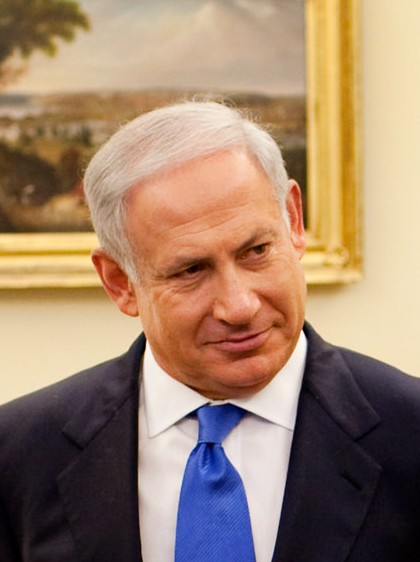
Israeli Prime Minister Benjamin Netanyahu won his fourth election last night in surprising fashion. He outdistanced the polls, including the exit polls in the waning hours of voting and won a decisive victory over the Zionist Union and Isaac Herzog. Here are some quick and initial takeaways from the results.
A huge victory for the Right
Even though the right wing/religious bloc in the Knesset didn’t grow, the right gained considerable power relative to
 the last Knesset. The last government included two centrist parties, Yesh Atid, and Hatnuah. Yesh Atid actually was the biggest single party in it, with Likud having joined with Avigdor Lieberman’s party to gain a decisive lead in the 2013 elections. Hatnuah, though small, was very important to the coalition, as its head, Tzipi Livni was the fig leaf over the right wing that negotiated with the Palestinians.
This coalition is going to have a very different character. It is quite possible that Netanyahu will get the fully right-wing coalition he wants. It is very possible that the most moderate party in it will be Moshe Kahlon’s center-right Kulanu party. Kahlon is at best lukewarm on the two-state solution, although he has been critical of Netanyahu’s refusal to maintain negotiations. He probably described his view best when he said he supported Netanyahu’s 2009 Bar-Ilan speech. That’s the one Bibi just repudiated in the last days of the campaign.
Two States and Where America and American Jews Stand
No doubt, Netanyahu will try to walk back his rejection of a Palestinian state of any kind once he forms his new government. He can’t walk it back too far, given the nature of his coalition, but will seek just enough to allow people to believe that it is still possible under his watch if they so desire.
But given that very few were ever taken in by his Bar-Ilan speech, where he gave the most tepid support he could to two states, anyone who is serious about ending the conflict has to ask themselves where they stand now and what sort of policies must be pursued. The old policy is clearly a round peg for the square hole of Israel’s position.
Three sectors in particular must ask this question: mainstream Republicans who still hold on to George W. Bush’s outline; Democrats across the spectrum; and the mainstream of the International Jewish community.
Republicans have clung virtually as a unit to Bibi. Are they willing to continue to do so if that means, by definition, opposing a two-state solution? In 2012, the Republican National Committee adopted a resolution supporting Israeli rule over all the land between the Mediterranean and the Jordan Rivers. But this had little effect on elected officials, who distanced themselves from it when asked. That won’t be so easy if Bibi is perceived, correctly, as staunchly opposing two states.
Democrats have a starker dilemma. Opposition to a two-state solution, not to mention Netanyahu’s right-wing orientation on many other issues, clearly puts him outside the lines for almost all Democrats. But until Bibi started interfering in American partisan politics, they’ve been able to look past those differences as if they weren’t there. That won’t work now, but they will face considerable domestic pressure to do just that.
The same can be said for the American Jewish community. Divisions within the influential community are growing, and the tactics used by those who still wish to march in lock-step with Israel are becoming increasingly draconian and visible. That process is already underway, and this election will only accelerate it.
The choice before all these groups is not a one- or two-state solution, but whether or not Israel is going to allow Palestinians the basic rights, freedoms, and dignities that all of us expect and take for granted. From the most moderate to most radical analysis of how to resolve this conflict, that is what separates a supporter of peace from an opponent. And that is the question that these communities will have to resolve.
The Stark Choice For the International Community
At this point, there is no alternative in the realm of diplomacy to a two-state solution. The current period is one where new ideas, if they can be sold to the international community, could come to the fore, but so far, despite the attempts of some supporters of a bi-national or single secular state, they have not succeeded in penetrating the international discourse.
If Israel is going to refuse to seriously consider a two-state solution, then, the United States, United Nations, Arab League, European Union and any other international actors have a clear choice in front of them: either pack it in and give up on this issue or press Israel in unprecedented ways to concede on a two-state solution based on the generally recognized parameters (’67 borders with some swaps, shared Jerusalem, an agreed upon resolution of the Palestinian refugee issue).
The Obama Administration
The hostility between Obama and Bibi continues unabated. The White House is waiting until the last possible moment to extend its obviously reluctant congratulations. There is no doubt the relationship will continue to be strained.
On Iran, Bibi’s words to Congress could take on a little more weight in light of his victory, but on the whole very little should change as a result of the election. Obama needs to start making the case to the American public that this is a good deal, and he needs to start doing that now. But that’s no different from before.
It would be easy to be cynical, given the history of U.S.-Israel relations and Obama’s own non-confrontational style, that the United States will really press Israel. But Obama has very little to lose. Democrats will all be distancing themselves from his foreign policy in 2016, and his days as an elected official are done after that. He is certainly going to push hard on Iran. It is true that the American public recognizes Iran as a U.S. security issue. They do not view the occupation in the same way, even though it too presents serious security concerns for the United States.
The reality, however, is that without significant pressure, unprecedented pressure from the US, Israel will not move, not under Bibi. And increasing tensions, especially the possibility of lost exports to Europe, could move the Israeli electorate away from Bibi and even lead to early elections. Obama knows all this. The combination of his second term status and the rift on Israel Netanyahu opened up and later exacerbated by declaring his opposition to two states, puts Obama in an unusually advantageous position to take some bold steps to press Israel that would usually politically unfeasible.
That doesn’t mean he will take those steps. The forces opposing such actions are strong. But the opportunity is as good as it is likely to get in the foreseeable future.
The Overview
This wasn’t a referendum on Netanyahu, as many characterized it. This was a referendum on where the country should go, more centrist or more right. Netanyahu remains an unpopular and vulnerable leader, but he also remains the most popular of an unpopular bunch. In the end, Netanyahu won by waving the Arab boogeyman and saying that “droves” of Arabs were going to vote him out and gutting his right wing opponents by telling their voters that if they didn’t vote for Likud, Labor would rule again.
What the election did show was that the country is deeply divided, but that the trend of a rightward tilt continues. The solid performance of the Joint List was significant, but they drew a lot of voters away from the only fully left-wing Zionist party, Meretz, which barely survived.
Israel’s international isolation will continue to grow, and whether that growth is steady or accelerated will depend on both how much more brazen Netanyahu becomes and how much the U.S. and Europe are willing to tolerate before they take actions Israel will feel. It is not a hopeful scenario on any level.

Palestinian representative to the UN, Riyad Mansour
The Palestinian Authority (PA) has now moved a step closer to making good on its threat to go to the International Criminal Court (ICC) and bring charges against Israel. There is little doubt that this was a move Palestinian President Mahmoud Abbas tried desperately to avoid. In the end, he was forced to do it by a combination of U.S.-Israeli rejectionism, Palestinian desperation to do something to try to end Israel’s occupation, and his own many missteps.
Abbas signed on to 18 international agreements after the quixotic attempt to pass a resolution at the United Nations Security Council (UNSC) predictably failed. Among them was the 1998 Rome Statute, which established the ICC and took formal effect in 2002. This is the step that the U.S. and Israel have warned Abbas against most strongly. Among all the “unilateral steps” the Palestinians could take (which, one should note, is no more “unilateral” than any number of actions taken by Israel on a routine basis), this is the one Israel worries about most. Read more at LobeLog