Israeli human rights group Yesh Din and the archaeologists at Emek Shaveh have released a new report on how Israel is using archaeology to entrench the occupation of the West Bank. In particular, the Civil Administration, Israel’s military authority in the West Bank, has used archaeology to confiscate Palestinian lands, as in the case of the village of Anata. From the report:
The story of the archaeological site at Tel Alamit (Khirbet Alamit) illustrates how the State of Israel expanded a settlement’s jurisdiction area in order to include an archaeological site that is significantly distant from the built-up area of the settlement, thus preventing Palestinians living nearby from maintaining their cultural, religious, and even proprietary ties to the site and its surroundings.
Tel (Khirbet) Alamit is located on registered private land[87] belonging to residents of the Palestinian village of Anata, in the same place where the village once stood. Today the village is located a few hundred meters from the site, after the historic village was destroyed in 1839 by the Egyptian ruler Muhammad Pasha during his occupation of the area.
Tel (Khirbet) Alamit was declared a historic site and an antiquity site in 1944 by the British Mandate authorities. The site contains a multi-layered two-domed archaeological tel that contains remains of buildings, mosaic floors, residential caves, water cisterns, burial caves, quarried segments, agricultural terraces, and an underground system used for industry including an olive press. The site also contained remains such as stone capitals, dressed stones, a winepress, and more. Most of the finds from the site are dated to the Byzantine period, the Middle Ages and the Ottoman period –as well as remains from the Middle Bronze Age (2000-1575 BCE), Iron II, Persian and Hellenistic / Roman periods.[88]
At the perimeter of the mound there is an ancient burial plot associated with Sheikh Abd al-Salaam, considered the founder of the village of Anata, alongside contemporary Arab tombs. To this day, the grave serves as a site of prayer and pilgrimage for the villagers.
The Israel Nature and Parks Authority website states that in Tel (Khirbet) Alamit, “structures and underground spaces and a concealment system from the period of the Bar Kochba Revolt” were discovered,[89] and that the site is identified with the Levite city of Almon.[90] But to our knowledge, there is no unequivocal historical or archaeological evidence linking this historical site to the biblical city.
In 1992, the Military Commander in the West Bank (GOC Central Command) determined the area of jurisdiction of the Anatot-Almon settlement and the Mateh Binyamin Regional Council, and included within it the area of the archaeological site of Tel (Khirbet) Alamit, in spite of its relatively distant location from the built-up area of the settlement (1,200 meters from the center of the tel to the westernmost houses of the settlement). The Sheikh’s tomb is not within the jurisdictional area, but it is located directly on its border.
Also included in the jurisdiction area are private lands of some residents of Anata. In fact, because Tel (Khirbet) Alamit is surrounded by private Palestinian land, it was impossible to include the archaeological mound in the jurisdiction of the settlement so as to enable geographical continuity between the two, without enclosing the private lands of the villagers.
For the entire Palestinian population, and even for the residents of Anata, the inclusion of Tel (Khirbet) Alamit in the Anatot-Almon settlement’s jurisdiction area effectively bars Palestinians from entering the site due to the military order prohibiting Palestinian entry into the settlements. As a result, owners of land within the jurisdiction area are unable to use or access their lands freely.
The exclusion of Palestinians from the historic site (resulting from the prohibition of entering the area of the settlement) is not only physical but also cultural, historical, and religious. The uncovering of important archaeological finds at the site does not contradict the importance of the site in the eyes of the residents of Anata and in the eyes of the Palestinian public in general. On the contrary: a site of recognized historical importance also highlights Palestinian heritage as part of the historical continuity of the cultures and peoples who have lived there. The historical-biblical context attributed to Tel (Khirbet) Alamit does not invalidate or negate the importance of other historical fragments – ancient or modern – that are also part of its history.
For more on how the Israeli government is using archaeology as a tool of occupation, read the full report.
The video is striking — no pun intended. A 16 year-old Palestinian girl in the West Bank village of Nabi Saleh grapples with Israeli soldiers in full combat gear and armed to the teeth. Despite the fact that she swats and kicks at them, the soldiers, likely hardly older than their tormentor, show admirable restraint, doing nothing to escalate the situation from a scuffle into something much worse. Days later, more video emerged, this time of the IDF raiding Nabi Saleh in the middle of the night to pull this same teenager, Ahed Tamimi, from her bed and arrest her. Since then, her mother and a female cousin have also been arrested.
In Israel, and among defenders of Israel, two questions dominate the debate: How could any Palestinian have been permitted to abuse and humiliate the IDF in this manner? And what can Israel do to ensure that it doesn’t happen again?
Israel’s Minister of Education, Naftali Bennett and Defense Minister Avigdor Leiberman, both of whom support pardoning an Israeli soldier who was caught on video killing a Palestinian who no longer posed any threat, have ideas. Bennett called for Ahed and those who joined her in the attack to be jailed for the rest of their lives. Leiberman threatened ominously: “Everyone involved, not only the girl but also her parents and those around them, will not escape from what they deserve.” Knesset member Oren Hazan, from the Likud party, suggested that the soldiers’ failure to react with force was a mistake: “Restraint is a failed and dangerous policy. Next time it must end differently.” Knesset member Bezalel Smotrich, of the Jewish Home party, called on the IDF Chief of Staff “to order that every encounter or friction between the enemy and our troops end with a painful and decisive outcome.”
All of these reactions gloss over the key question: How did Israeli soldiers come to be grappling with this Palestinian teenager in the first place? Were they minding their own business, taking care of the security of Israel or Israelis, when Ahed and her relatives suddenly turned up to “provoke” them? Or rather, since the action in the video takes place in the front yard of Ahed’s house, were the soldiers in Nabi Saleh at the Tamimi residence to arrest someone, hunt for weapons or foil a planned attack against Israel?
Alaa Tartir from Al-Shabaka has a new policy brief on how the Palestinian Authority’s security forces are subcontractors for Israel’s occupation of the West Bank:
Security collaboration between Israel and the PA has fulfilled the Oslo Accords’ objectives of institutionalizing security arrangements and launching a peace process that is tightly controlled by the security sector in order to enable Israel to fulfil its colonial ambitions while claiming to be pursuing peace. This process of “securitized peace” is manifested in a number of ways, including the PA security forces’ arrest of Palestinian suspects wanted by Israel (as in the recent case of Basil Al-‘Araj who was arrested and released by the PA only to be chased and eventually assassinated by the Israelis); the suppression of Palestinian protests against Israeli soldiers and/or settlers; intelligence sharing between the Israeli Defense Forces (IDF) and the PA security forces; a revolving door between Israeli and PA jails through which Palestinian activists cycle for the same offenses; and regular joint Israeli-Palestinian meetings, workshops, and trainings.
Not surprisingly, they aren’t very popular:
Multiple surveys over the years have shown that the majority of Palestinians in the West Bank and Gaza Strip (between 60% and 80%) oppose security coordination with Israel. And in a March 2017 Palestinian Center for Policy and Survey poll, two-thirds of respondents demanded Abbas’s resignation, with 73% expressing the belief that Abbas is not serious in his threat to suspend security coordination with Israel. In a 2010 Maan News Agency poll, 78% of respondents said they believe that the PA security forces are engaged in surveillance, monitoring activities, and intervening in people’s privacy. Finally, according to Visualizing Palestine, 67% of West Bank Palestinians said they feel that they are living in an undemocratic system that cracks down on freedoms in large part as a result of the security realm.
Read the rest of Al-Shabaka’s brief to see Alaa’s suggestions for how the Palestinian security forces could be reformed to be more responsive to the needs and concerns of ordinary Palestinians.
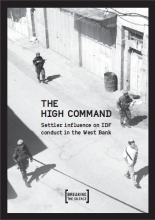 Settler involvement in operational activities
- Failure to enforce the law on settlers harming Palestinians or their property
- Settler violence against IDF soldiers
- IDF soldiers guarding settlers’ events and recreational activities
- Proximity and close personal ties between settlers and soldiers
- Integrating settlers and their political ideologies into IDF educational activities
The passing of former Israeli president Shimon Peres, the last of Israel’s founding generation of statesmen, has prompted an avalanche of eulogies from the international community. Remembering him as a “dear friend,” a “great man of the world,” and Israel’s “biggest dreamer,” world leaders and dignitaries from 70 countries gathered in Jerusalem for his funeral on Friday, among them Palestinian President Mahmoud Abbas. It was the first time Abbas had stepped foot in Israel since 2010.
The domestic backlash to Abbas’s attendance reveals that Peres is remembered quite differently among many Palestinians, and highlights Abbas’s increasing isolation at home. In Palestine, Peres is reviled for his early support of Israeli settlements, his 1996 military campaign in southern Lebanon that resulted in the Qana massacre, and his failure to deliver on promises of peace made in the Oslo Agreements.
Within hours of the announcement that Abbas would be at the funeral, pressure against his visit to Israel began to build. Members of the Joint Arab List, a political party representing Palestinian citizens of Israel, had already declined to join the funeral, and refused even to express condolences. Joint List chair Ayman Odeh explained that despite Peres’s peace efforts in the 1990s, “we have fierce opposition to his security stances of the occupation and building settlements, bringing nuclear weapons to the Middle East, and unfortunately, as president, he chose to support [Israeli Prime Minister Benjamin] Netanyahu and his policies.” That Abbas was the only Arab head of state attending was another indication of his isolation. (Representatives from Jordan, Oman, Morocco, and Bahrain, as well as Egyptian Foreign Minister Samih Shoukry, were also present.)
According to a report from Palestinian daily Ma’an News, unnamed officials attending the ongoing annual meeting of the Fatah Revolutionary Council complained about the optics of the visit, claiming that it would undermine Fatah’s base of support and hand Islamist groups a public relations victory.
Palestinian social media also mobilized against Abbas, with the hashtag “Condolences for Peres’s death are treason” beginning to trend soon after the announcement of the visit. Rumors swirled that Israeli culture minister Miri Regev had attempted to snub the Palestinian President by denying him a first row seat at the funeral, until Peres’s family intervened. Users reacted with consternation as a screenshot of Abbas on television was claimed to show him shedding tears. “This won’t help his [political] position,” one commentator said:
محمود عباس رئيس فلسطين يبكي في وفاة شمعون بيريز رئيس اسرائيل السابق .. مشهد يصعب استيعابه pic.twitter.com/Feo9tjG6lI
— مسمار (@mesmmarr) September 30, 2016
Footage also showed a smiling Abbas shaking hands with Benjamin and Sara Netanyahu, and speaking with Zionist Union MK Tzipi Livni.
High-placed Fatah officials defended Abbas’s move, saying that it would send a message to the world that the Palestinian people were serious about peace. They did not mention if Israel had committed to any reciprocal steps. Netanyahu had not acknowledged Abbas’s presence in his remarks at the funeral.
The backlash against the visit expresses the despair many ordinary Palestinians feel with the status quo. More than twenty years after the signing of the Oslo Peace Accords, Israel’s occupation of the West Bank and the settlement enterprise continue apace, while Palestinian statehood seems more distant than ever. That frustration is often directed at Abbas, who is sometimes seen as an obstacle to change. His decision to attend Peres’s funeral seems unlikely to alter that perception.
Philip Sweigart is program director at the Foundation for Middle East Peace. He holds an M.A. in International Affairs from American University’s School of International Service, and received a B.A. in Foreign Affairs and Middle East Studies from the University of Virginia, where he wrote his thesis on the role of ethno-sectarian identity and class differences in the 2011 Arab uprisings.
 Rebecca Vilkomerson has been a member of Jewish Voice for Peace since 2001 and the group’s Executive Director since 2009. She lived with her family in Israel from 2006-2009. In 2010 she was named one of the 50 most influential Jewish American leaders by the Forward, and was named one of “14 Women to Watch” in 2014.
FMEP: Jewish Voice for Peace (JVP) has, in some ways, been a lightning rod for the global movement for Boycotts, Divestment and Sanctions of Israel (BDS). Many people can’t reconcile the idea of a Jewish organization advocating a boycott of Israel. Obviously, this is especially true for those who see BDS as unfairly anti-Israel, even anti-Semitic. As the Executive Director of JVP, how do you respond to those charges? And, perhaps a parallel question, what would you say are the major differences between the public perception of the BDS movement and its reality?
Rebecca Vilkomerson: From a personal perspective, I don’t think that endorsing BDS is anti-Israel in the least. The demands of BDS are about transformation. Just as ending apartheid in South Africa did not destroy it, addressing the three demands of the BDS movement would change Israel fundamentally–ideally in ways that would bring equality and freedom for all people in the region, something I would hope would be of interest to most people.
I do want to de-couple the concepts of “anti-Israel” and “anti-Semitic.” As JVP’s statement on anti-Semitism says, in part, “Definitions of anti-Semitism that treat criticism of Israel or of Zionism as inherently anti-Semitic are inaccurate and harmful. The majority of Jews are not Israeli, and not all citizens of Israel are Jewish. Israel is a state; Zionism is a political ideology; Judaism and Jewish identity encompass a diversity of religious and secular expressions and a robust, varied set of traditions, cultures, and lived experiences.”
And that being said, I want to make a case for the legitimacy of “anti-Israel” as a category. It’s often used as an accusation, as a way to end discussion and almost always linked to or tainted by anti-Semitism. But Palestinians, whether in Israel or under Occupation or in diaspora, have experienced unbearable loss–of home, property, rights and life–at the hands of Israel. They may be deeply angry or hate the state of Israel based on their direct experiences with violence at its hands. To demand that they fight for their rights while loving or caring for Israel as a Jewish state, defined by their exclusion or subordination, is not just absurd but cruel. For those of us doing this work in part because we want to see Israel become a better place, it is incumbent upon us to understand and defend those who are struggling simply for the sake of their basic rights with no love lost for the state that oppresses them.
Palestinians, whether in Israel or under Occupation or in diaspora, have experienced unbearable loss–of home, property, rights and life–at the hands of Israel. They may be deeply angry or hate the state of Israel based on their direct experiences with violence at its hands. To demand that they fight for their rights while loving or caring for Israel as a Jewish state, defined by their exclusion or subordination, is not just absurd but cruel.
In terms of the second half of the question, I think there are numerous misconceptions about BDS. The reality is that the three core demands of BDS are actually a quite moderate call for basic internationally recognized rights: full equality for all, the end of occupation and the Palestinian right of return. While Jewish communities often react strongly in particular to this last demand, it is enshrined in the Universal Declaration of Human Rights. In fact, my own children have the right to a German passport under the same principle.
BDS does not require a one state solution; in fact, many Palestinian groups that endorsed the BDS call actually endorse two states.
The BDS movement is a Palestinian-led movement originating from a call by a broad coalition of civil society institutions. Its global network of supporters is inclusive, multi-ethnic, multi-racial, and multi-faith, including many Jews from around the world among the individual and organizational supporters. I have always found that the Boycott National Committee, the leadership body of the BDS movement, conducts itself with the highest ethical and anti-racist standards, contrary to common accusations in Jewish communities.
Finally, I think it is important to remember that BDS is a set of tactics and demands, not an end unto itself. I recommend that those who have questions go to the BDS website and look around. I am always astonished by how many people have criticisms who haven’t gone to the primary source.
FMEP: In 2010, the Jewish weekly newspaper, The Forward, listed you as one of the 50 “most influential Jewish leaders.” In 2013, the Anti-Defamation League listed JVP as one of the top 10 “anti-Israel groups” in the country. That seems like a really good illustration of the sharp divisions among American Jews that you and JVP more broadly provoke. How do you see your relationship to the Jewish community, including, but not limited to, the major Jewish institutions?
RV: Years ago, when JVP was much smaller, we made some effort to get a “place at the table” at some local Jewish Federations, Jewish Community Relations Councils, Hillels, etc., with the assumption that we belonged in any umbrella group of the Jewish community. Our hope was to challenge the bigger institutions’ positions on Israel/Palestine from the inside, especially once they knew that significant numbers of their community shared our position. However, we were never successful, and in recent years, specific guidelines have been put in place in many of these institutions to exclude JVP or others who share our views.
More recently, as we’ve continued to grow and the red lines that prevent honest debate about Israel/Palestine and Boycott, Divestment and Sanctions (BDS) have hardened in establishment Jewish institutions, we have evolved a somewhat different approach. JVP is a vibrant Jewish community to which people can connect through chapters in their hometowns, or as Rabbis, academics, students, labor activists, or health workers. Our members are showing up together to support other justice struggles like the Movement for Black Lives and the fight against the Dakota Pipeline because they see JVP as their political home. This year, for the first time we are livestreaming High Holiday services from four synagogues and chavurot (communally organized Jewish practice communities) from around the country for members who don’t have access to spiritual spaces where they can bring their full political selves to Jewish practice.
In other words, we are creating our own alternative Jewish institution that doesn’t need approval from or inclusion in the self-identified “major” Jewish institutions. We are creating a new model for Jewish communal life, one that welcomes and centers the multiplicities of Jewish experiences and histories and does not insist on a separation between justice for Palestinians and Jewish identity. It feels good that other organizations like IfNotNow, Open Hillel and the Center for Jewish Non-Violence are also emerging. We may not share the exact same approach or focus, but we have enough in common that it feels like a new universe of Jewish space is opening.
Ultimately I really believe that it is to the detriment of the mainstream Jewish communities that they are excluding a vibrant, engaged, and growing segment of the Jewish community in the U.S.
FMEP: With many thousands of members and more than 60 chapters across the country, JVP has certainly magnified its impact from its humble beginnings twenty years ago. But you face the same question all of us working on this issue face: in that time, the Israeli occupation has only tightened, US policy has become even more entrenched, and Palestinian despair has grown. Given that troubling reality, what is the path to success that you see, in both the short and long term?
Also, more than any President before him, Barack Obama came into office with the announced intention of finally ending the Israeli occupation and reaching a negotiated peace between Israel and the Palestinians. Eight years later, Obama will leave office with the situation considerably worse than when he came in, and it seems clear that the next administration, whether Clinton or Trump, is going to be much less concerned about the occupation than Obama. What do you expect going into the next administration, and how do you think it will affect JVP’s efforts?
RV: Your framing is really important and a reminder to all of us of how we have to ground our work in a feeling of urgency given the realities on the ground. But that feeling of urgency also has to be tempered with the reality of what we’re up against–the biggest U.S. aid package to Israel ever just being approved is one reminder. I’ve combined my answers to your last two questions because I think that JVP is playing a longer game than just the next administration.
We see the U.S. as the linchpin that allows Israel to continue its destructive policies, through the military, economic and diplomatic aid and cover the U.S. offers. And we (and by “we” here I mean JVP and all the other groups doing this work) know we need to build a seriously strong grassroots movement, as other movements have done at other moments in our history, in order to bring about a profound change in the U.S. approach to Israel. That is the only power that can go up against the Israel lobby, which includes Christian Zionist organizations, Jewish organizations like AIPAC, and the US arms industry which profits directly from military aid packages to Israel.
Public opinion is demonstrably changing. To offer just one example, 49% of Democrats now support economic sanctions on Israel over settlement construction, according to a Brookings Institution poll from last year. It is clear that the bipartisan consensus around Israel is crumbling, and a new coalition of women, young people, and people of color are emerging that see Palestinians and Israelis as peoples that deserve equal rights and freedom and are willing to take action in support of that belief. Palestinian rights are becoming an integral part of the progressive agenda, like racial, economic and climate justice. So while I don’t have immediate hopes (and do have a lot of fears) for the next administration, I also have a lot of optimism about where this movement is going to take us in the long term.
“You can not like the word, but what is happening is an occupation — to hold 3.5 million Palestinians under occupation. I believe that is a terrible thing for Israel and for the Palestinians.”
– Israeli Prime Minister Ariel Sharon, May 2003

Israeli flags hang from a building in occupied East Jerusalem.
On Monday, most of the presidential candidates addressed the annual conference of the American-Israel Public Affairs Committee (AIPAC). The speeches hit all the usual marks, with the candidates striving to show that they would promote Israel’s interests better than the others. Palestinians were mentioned almost exclusively in the role of the demonized villain, and the notion of a resolution of the conflict was barely given even the emptiest kind of lip service, if it was mentioned at all.
All of these speakers avoided using one particular word: occupation. None of them offered any hint that they acknowledged that Israel was occupying territory not legally its own, ruling over millions of Palestinians without basic rights. Only Bernie Sanders, delivering a speech from the campaign trail in Utah, mentioned the word.
This is a problem. In the wake of the collapse of peace efforts, anger, despair, and violence threaten to engulf Israelis and Palestinians. Statements from top Israeli security officials affirm this key point: Palestinian despair of ever ending the occupation that began in 1967 is one of the drivers of violence.
Even the more moderate forces of the Palestinian Authority have been slow to condemn acts of violence, leading to renewed accusations of incitement from the right wing government of Benjamin Netanyahu. In Gaza, millions languish in dreadful conditions under a siege imposed against the Hamas government by Israel and Egypt, even while Israel quietly acknowledges that forces much more violent than Hamas are being kept at bay by the Islamist group.
Meanwhile, Israel is sliding ever further to the right, not just in the government but in the opposition as well. There is no constituency that feels any urgency for a resolution, and no one is pushing for talks or the sort of compromises a resolution will necessitate. Instead, the Netanyahu government, bending to the influence of settlers and parties to the right of the Prime Minister, is moving to consolidate the one-state reality that exists today into a permanent one.
This is all the result of the absence of an effective diplomatic process. It is very difficult to see how this state of affairs can change if the next President of the United States is committed only to “standing with Israel” and not to pressing both sides toward a resolution. It’s even more difficult to see it if our next president can’t even acknowledge the reality of occupation.
This is hardly a radical word. It’s one whose applicability has been affirmed by the High Court of Justice in Israel, and has been used by Prime Ministers such as Ehud Barak and even Ariel Sharon. It also has the merit of describing the situation on the ground in the West Bank, and legally still applies to Gaza as well. The fact that Palestinians in the West Bank and Gaza are governed under military law, rather than civil law, is evidence that Israel itself recognizes the legal fact of occupation, despite what its right wing politicians might claim.
Our next president must find a way to strengthen Israel’s security by ending its occupation of Palestinian territory and undemocratic rule over millions of Palestinians. This isn’t just in the interests of Israelis and Palestinians; it’s also a U.S. interest, one backed by an overwhelming international consensus. Pursuing those necessarily intertwined goals, and navigating the political minefields that surround them is no easy feat.
An agreement ending the occupation is the only way there will be a secure State of Israel and a secure State of Palestine. But we can’t get there if we can’t even name the problem. Whether it is at AIPAC, along the campaign trail or after the new president is in office, it is essential that they address the problem of occupation. That starts by calling it what it is.
United Nations Secretary General Ban Ki-moon has an op-ed in today’s New York Times expanding upon remarks he made last week regarding the upsurge in violence in Israel-Palestine. It’s worth taking a moment to consider why this op-ed was necessary. In last week’s remarks, Ban unequivocally condemned terrorism, just as he did in today’s op-ed, while also noting, “security 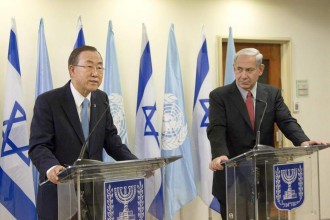 measures alone will not stop the violence. They cannot address the profound sense of alienation and despair driving some Palestinians – especially young people… As oppressed peoples have demonstrated throughout the ages, it is human nature to react to occupation, which often serves as a potent incubator of hate and extremism.”
Israeli Prime Minister Benjamin Netanyahu responded to this as he always does – ignoring the condemnation of terrorism, acting as if all the blame had been laid upon Israel, and rejecting the notion that the Israeli occupation might have something, anything, to do with Palestinian violence. He even went as far as to accuse Ban of encouraging terrorism with his remarks (Yes, it is odd to suggest that a statement from the UN Secretary General would incite violence while also rejecting as outrageous the notion that a half-century of military occupation might do so, but let’s leave that aside for now).
Israel’s own security chiefs have said the same thing – that Palestinian despair at the occupation ever ending is a major driver of violence, and that genuine steps to ameliorate that situation, rather than simply cracking down harder, must be taken.
Netanyahu’s government has made an unfortunate habit of treating every criticism, no matter how carefully or constructively worded, as an attack on Israel’s legitimacy. While we might have expected this from the Israeli right wing, it was really disappointing to see an anti-hate group like the Anti-Defamation League hastily echoing it, in a press release calling Ban’s words an “apparent justification of Palestinian terrorism.”
Ban’s analysis shouldn’t be at all controversial. Indeed, Israel’s own security chiefs have said the same thing – that Palestinian despair at the occupation ever ending is a major driver of violence, and that genuine steps to ameliorate that situation, rather than simply cracking down harder, must be taken.
In a recent report, Israel’s Shin Bet internal security service concluded that young Palestinians were motivated to act, in part, “based on feelings of national, economic and personal deprivation.” The head of Israel Defense Forces Military Intelligence, Maj. General Herzl Halevi, told a meeting of Israel’s cabinet that “feelings of rage and frustration” were major factors driving young Palestinians to these acts and that they “felt they had nothing to lose.” U.S. Ambassador to Israel Dan Shapiro laid out a similar critique in a recent speech to an Israeli security conference – receiving a similarly over-the-top Israeli government response.
No one seriously would argue that the Shin Bet and the IDF are trying to justify Palestinian terrorism. Neither was Ambassador Shapiro. And neither is the UN Secretary-General, as he made clear in his initial remarks, and again in today’s op-ed. Understanding the factors that contribute to violence is not remotely the same as “justifying” that violence. On the contrary, it’s necessary in order to develop an effective policy response. It really shouldn’t be hard to understand that the daily abuse, humiliation and dispossession that Palestinians experience under Israeli occupation is a major contributing factor in the decision of some Palestinians to resort to terrorist violence. Acknowledging this does not make terrorist violence any less reprehensible. And avoiding these facts, or suppressing discussion of them, will only result in more of that violence, not less.
On January 19, at the annual Institute for National Security Studies (INSS) conference, the leader of Israel’s opposition and head of the Zionist Union party, Isaac Herzog, unveiled an alternative approach to the issue of Israel’s nearly 49-year old occupation of the West Bank, Gaza and East Jerusalem. It has some points that clearly distinguish his policy from Israeli Prime Minister Benjamin Netanyahu’s. But it is short on detail, and includes some ideas that could make the situation even worse.
Upon examination, Herzog’s plan seems likely to garner support among the centrist, center-left and even parts of the center-right Israeli voter base. Given recent polls which show the Yesh Atid party garnering as many seats as Herzog’s Zionist Union and reflect more public confidence in Yair Lapid, the head of Yesh Atid, as a potential Prime Minister than Herzog, this plan must be read, at  least in part, as an attempt to bolster Herzog’s position as opposition leader.
The main points of Herzog’s plan, as reported in the Israeli media, are these:
- While there is no current possibility for a two-state solution, Israel will not annul the possibility either diplomatically or geographically for the future
- Hamas will face “harsh” measures for any attacks from Gaza, including targeting their leaders, and eliminating their ability to communicate over television and internet.
- Israel will complete the security barrier around the major settlement blocs. “We will be here and you, Palestinians, will be there,” Herzog said. “Live your lives, improve your economy, create employment. The blocs under Israeli sovereignty will be part of the permanent solution. They will serve as recipients of settlers from outside the major blocs.”
- The barrier through Jerusalem will cut off Palestinian villages from the city. The Defense Ministry would be charged with granting permits to Palestinians who wish to enter the city to work.
- Palestinians would have full civil authority, but not security authority in the West Bank. This would, presumably, remove the regime of building permits in many Palestinian areas, but the Israeli military will remain present throughout the entire West Bank.
- Finally, Israel would help convene a regional security conference with “moderate” Arab states (like Saudi Arabia and Egypt, for example) to deal with ISIL and other regional security issues, presumably including Iran.
Politically, this is a shrewd plan for Herzog. The “us here, them there” idea harkens back to Yitzhak Rabin, who used that as a campaign slogan in 1992. More recently, former Prime Minister Ehud Olmert proposed a similar unilateral separation in the West Bank. This part of Herzog’s plan will probably be seen as a familiar, moderate and practical solution by many in Israel who don’t consider themselves part of the far right.
One major concern in Herzog’s proposal is the fact that he would complete the separation barrier in a manner which would cut most Palestinians off from Jerusalem. He makes no mention of the holy sites, but it seems safe to assume that his plan would provide Muslim and Christian Palestinians access to the sites in some manner. Still, with a barrier cutting Jerusalem off from nearby Palestinian towns, it will inevitably be even more difficult to gain that access, and in every other way, most Palestinians would be cut off from the city they envision as the future capital of their state. Herzog does not explain how he expects such an act to lead to greater quiet and security for Israeli Jews, but no matter—such an outcome is not conceivable given the rage that will ensue if Jerusalem is inaccessible to Palestinians.
Herzog’s plan has the benefit of removing the outlying settlements, which will not only eliminate some of the most radical settlements, it will remove many of them from close proximity to Palestinians, whom they often terrorize. Without any details, we cannot be certain, but it is possible that the removal of outlying settlements could lead to much greater freedom of movement for Palestinians. This is especially so if Herzog is serious when he urged, in his INSS speech, that Palestinians build their economy and communities.
But absorbing those settlers into the large settlement blocs will cause a significant spike in construction in those blocs. As I have detailed elsewhere, the blocs are already threatening the viability and contiguity of any potential Palestinian state, and this idea will make matters much worse.
While it is certainly true that most Israelis already see the large blocs (as well as the settlements in East Jerusalem) as part of Israel, the rest of the world, including the United States, as a matter of policy, does not, although it is seen as likely that the blocs will be annexed to Israel in a future agreement. Herzog’s plan would reinforce this fact on the ground, and would make it much harder for Palestinians to get the sort of negotiated land swap they would need to agree to the annexation. This is a running theme in Herzog’s proposal: Palestinian concerns are often glossed over and Palestinian input is not only invisible, it is seen as undesirable.
Recent Israeli history shows that unilateral actions like this do not bring peace, but instead entrench the conflict even more deeply. The lesson of Gaza is not, as many say, that Israel cannot withdraw from territory lest it face increased terrorism. Rather, it is that when Israel undermines moderate Palestinians with unilateral moves, it creates a power vacuum that is filled by more militant factions.
By simply taking the land it wants, Israel would undermine the basis for negotiating over borders between it and a Palestinian state. By cutting off Jerusalem, it would undermine the basis for negotiations for the city that both Israelis and Palestinians see as their capital. Herzog is proposing a change to the framework of any possible negotiations, and if the international community lets this happen, the notion of outside moderation of talks is lost. In fact, it would leave the Palestinians to choose between the meek acquiescence to Israeli diktats or the path of violence. Even an increasingly developed Palestinian economy, if that should also result from this plan, would not be enough to alter that equation.
Herzog’s idea that under such circumstances a regional security conference that includes Israel could possibly be convened only reflects how out of touch he is with political realities in the Middle East. In fact, this plan would make it impossible for any Arab state to upgrade its relations with Israel. And his approach to Gaza sounds more like bluster than a strategy, and certainly does nothing to address the miserable conditions Israel’s blockade of the Strip has created, conditions that much of Israel’s defense establishment has repeatedly urged be improved.
This plan has some points that might be worked with, but it is not, on balance, sound policy. It has little chance of achieving the quiet Herzog envisions; on the contrary, it is likely to further enflame the conflict.
Herzog’s plan, while preferable to Netanyahu’s status quo and certainly to the vision of those even farther to the right, falls well short of a structure that gives either Israel or the international community a framework to move toward an end to Israel’s occupation. Indeed, it seems more tailored for domestic political gains than for actually resolving the vexing problems Israel faces. That might help him push back against Lapid and Netanyahu, but the price would be further complicating diplomacy and the situation on the ground. That price is too high.
-
Condemns Tel Aviv violence and Netanyahu’s portrayal of Israel’s Arabs as criminals
-
Two states is only solution, and world must be clear: settlements not part of Israel
-
Interests of Israeli Jews and Palestinian Arabs are “not conflicting, but common”
In 2015, Israel ushered in the most right-wing government in its history. But the same election produced another notable outcome: for the first time, Arab parties joined in a bloc with the sole Jewish-Arab party, Hadash, to form the Joint List. The bloc garnered 13 seats in the current Knesset, making it the third largest party and second largest in the opposition.
Ayman Odeh is the Chairperson of the Hadash party and the head of the Joint List. In these roles, MK Odeh has established himself as a respected leader, bringing a principled voice to the  opposition while balancing the diverse and sometimes contradictory politics of his own List. It is not always easy, and MK Odeh has managed to keep his coalition together while positioning himself as a leader of a progressive movement within Israel. While other opposition leaders such as Isaac Herzog (Zionist Union) and Yair Lapid (Yesh Atid) have largely backed Prime Minister Benjamin Netanyahu in many of his policies dealing with both internal security and the Israel-Palestine conflict, MK Odeh has given voice not only to the views of minority groups within Israel, but also to moderates all over the world who support peace, Palestinian rights and a two-state solution.
In December, MK Odeh embarked on a groundbreaking visit to the United States, his first as well as the first of its kind for a political leader of Israel’s Palestinian community, where he met with many politicians, community leaders and activist groups. The trip, which was supported in part by the Foundation for Middle East Peace, demonstrated that there is a significant opposition in Israel, and that Palestinian citizens of Israel, like MK Odeh, believe themselves to be a part of the country and instrumental to charting a better future for both the citizens of Israel and the Palestinians living under occupation.
FMEP conducted this interview with MK Odeh between December 23, 2015 and January 2, 2016.
How do you respond to Prime Minister Netanyahu’s statements, in the wake of the deadly attack in Tel Aviv on January 1, that he “will not permit lawlessness” in Arab areas of Israel and that he has enacted “a new plan to allocate funds and resources to dramatically increase police enforcement in Arab communities throughout Israel, namely in the Galilee, the Negev and the Triangle?”
Before addressing the words of PM Netanyahu, I wish to convey the pain I feel for the horrible shooting in the streets of Tel Aviv last Friday. Although the details of what happened are not yet clear, I condemn and denounce all violence against innocent civilians, and send my heartfelt condolences to the families of the dead and injured.
Prime Minister Netanyahu continues to renounce his responsibility for the situation and incites against an entire public, portraying the Arab population as criminals. Netanyahu’s political strength is based on his incitement against the Arab population on the day of the general elections, which has continued throughout his term in office.
The leaders of the Arab public in Israel, myself included, have repeatedly approached the government and authorities over recent years demanding to strengthen the law enforcement in the Arab towns and villages. Our main demand was the collecting of unauthorized firearms from our streets. The primary victims of these weapons are us, the Arab citizens. It is our children whose safety is in jeopardy in the streets of our towns. The Prime Minister has refused until now to allocate funds for this goal. But now, when a weapon is turned against Jews, he suddenly decides to confront the issue.
After the current media attention fades, we will continue to demand that the police consider us as equal citizens and will take responsibility for our personal safety. First and foremost, weapons must be collected from our streets.
Prime Minister Netanyahu continues to renounce his responsibility for the situation and incites against an entire public, portraying the Arab population as criminals. Netanyahu’s political strength is based on his incitement against the Arab population on the day of the general elections, which has continued throughout his term in office.
Secretary of State John Kerry recently said that Israel is reversing the Oslo Process. Most understand this to mean creating facts on the ground with settlement expansion, among other measures. Meanwhile, many members of Congress are angry at the European Union for labeling products from settlements as such. How important is it that the rest of the world differentiate between Israel and its settlements?
One of the greatest accomplishments of the Palestinian struggle in recent years is the fact that most of the world, with the latest addition being Greece, has already recognized the Palestinian state. But this also results in the realization that recognition is not enough, and the world must bring real and substantial pressure to bear on Israel. The only solution to the current situation is the end of the occupation and the establishment of a Palestinian state, according to the 67 borders, alongside Israel. If the world truly believes in this, labeling settlement products is a first and essential step in order to make it clear to Israel that the international community does not accept the settlements as part of the state of Israel. The settlements are illegal according to international law, while even under Israeli law they are not part of sovereign Israel, and therefore labeling is a minimal requirement. Furthermore, we must not forget that the settlements themselves cause systematic damage to all areas of life and the human rights of Palestinians, and this is another essential and compelling reason for the international community to object and protest their existence.
Many Americans are very concerned about the recent video circulated by Im Tirzu calling leaders of peace and human rights NGOs foreign “plants.” Along with this, we see legislation in the Knesset to label such NGOs as foreign agents. What does this say about the current state of Israeli democracy?
Netanyahu’s extreme right wing government is bad and dangerous not only for the Arab public, but for all the citizens of Israel. One of the most flagrant examples is the ferocious incitement against the human rights organizations originating from the Prime Minister’s Office, which trickles down from there to the ministers and organizations that do their bidding, such as Im Tirzu. The incitement and demonization campaigns that were initially aimed solely at the Arab public and its elected leadership, are now spreading throughout Israeli society. The purpose of this incitement is to silence any expression of opposition or criticism against the government, and consequently human rights organizations have been turned into enemies of the state. This is a concerted attempt at total de-legitimization, in order to deafen and blind the Jewish public from the reality that these organizations expose.
Labeling settlement products is a first and essential step in order to make it clear to Israel that the international community does not accept the settlements as part of the state of Israel.
I hope that now, especially now, more people will awaken and understand that when they turn a blind eye to incitement against an entire sector of the public, this incitement will, further down the road, reach them. We must stand together, Arabs and Jews, against the incitement and hatred, and offer a genuine alternative based on equality, peace and democracy.

MK Odeh and his staff at the offices of the New York Times
The community of Palestinian citizens of Israel is often seen as separate from the larger Palestinian people. How do you see the relationship of Palestinian citizens of Israel to the rest of the Palestinian people, and how do you think this might help Israel and the Palestinians reach an agreement to end their long conflict?
As a Palestinian citizen of Israel, I have no difficulty with my national identity – I am a Palestinian, yet I do not turn my back on my citizenship. I believe that it is precisely this duality that enables us – and only us – to see the entire picture. I speak Hebrew and Arabic, read newspapers and watch the news in both languages. I have in-depth familiarity with the culture and history of both the Palestinian and Israeli societies, and it is precisely because of this that we can serve as a third and crucial party in talks between the sides. Currently, while the Israeli side has no desire or intention to reach a solution, I see our role as being in the public arena, as people who can speak to the conscience of Israelis and convince them that it is in the common interests of both peoples to end the occupation and establish an independent Palestinian state.
No Israeli government has ever included Arab parties or even explicitly mixed parties like Hadash. You have said that peace is not possible without the 20% minority of Arabs in the country. Do you see any possibility in the near future that mainstream parties like Labor (or Zionist Union) or Yesh Atid would ever agree to a governing coalition that included the Joint List?
We are determined to bring down Netanyahu’s extreme right government. It is indeed true that parties with a majority of Arab voters have never been members of a government coalition, yet there is broad agreement among the Arab public that the best period, in parliamentary terms, for the Arab population was the early ’90s when the Rabin government was based on support from outside the coalition from five MKs from Hadash and the Arab Democratic Party. If and when it will be possible to form a left wing coalition committed to choosing the path of peace, equality and building a real democracy – we will consider the options.
The right is aware that alliances between marginalized communities may undermine and ultimately cause the downfall of their government, and therefore they try to pit one population against the other.
Can you talk about your idea for uniting the various marginalized communities in Israel to support democratic progress in the country?
There are many differences between the marginalized communities in Israeli society. We, the Arab citizens of Israel, are a minority nationality, and this of course distinguishes our struggle. But in social and economic matters, the difficulties and obstacles that we face are often very similar to those of other groups. The right is aware that alliances between marginalized communities may undermine and ultimately cause the downfall of their government, and therefore they try to pit one population against the other.
Even during the election campaign I reached out to the ultra-Orthodox community that also suffers from discrimination and severe poverty. True, there are still many barriers, and ultra-Orthodox parties now sit in an extreme right-wing government, but familiarity with the political processes in Israel leads me to think that this reality is in constant flux. Already, behind the scenes, the cooperation between us is expanding.
Several months ago, grassroots protests by Ethiopian Israelis erupted in protest against police violence. I chose to join them from the first night of demonstrations in the streets of Tel Aviv. I was taking a moral position as well as reacting to an issue that is close to my heart. But I was also acting on a desire to establish an alliance and partnership.
The path of change inevitably progresses through the formation of new alliances with marginalized populations, and in cultivating the deep conviction that our interests are not conflicting but rather common.