In recent weeks, an upsurge in violence in Jerusalem has brought the embattled city back into the headlines. According to Danny Seidemann, founder of Terrestrial Jerusalem and one of the leading experts on the city, this violence, boiling at a level unseen in Jerusalem since 1967, actually began over a year ago, and it is not just another spoke in the “cycle of violence.”
“Usually there’s a tendency to overstate the instability of Jerusalem,” Seidemann said at a meeting of journalists and analysts in Washington this week. “But Jerusalem is normally a far more stable city than its reputation. What we are seeing now are significant developments that go well beyond tomorrow’s headlines.”
Seidemann described a dangerous confluence of factors, with the political stalemate creating an atmosphere of despair in which the conflict, which has always been political, will finally become the religious conflict that many have believed, until now incorrectly, that it is. The current conflict centered on the Temple Mount is only the tip of the iceberg. According to Seidemann, “The entire fabric of this conflict has changed.”
“The fighting over the Temple Mount indicates the establishment of a biblical narrative which is already fanning the flames of a religious conflict,” Seidemann said. “It is planting the seeds of the transformation of a political conflict, which can be solved, into a religious conflict which cannot be solved. We are seeing the ascendancy of those faith communities that weaponize faith. We are seeing the marginalization of traditional religious bodies who understand that Jerusalem is best served by the faiths working together.
“Nothing guarantees the outbreak of violence as much as the real or perceived threat to sacred spaces,” Seidemann continued. “But the Temple Mount is the detonator, not the explosive device. Violence is sustained by the perceived loss of the two-state solution.”
As Seidemann pointed out, the two-state solution has lost a great deal of its credibility. This is true for both sides, but it is especially impactful for the Palestinians. While observers, politicians, academics and activists debate whether or not the two-state solution is still feasible, that loss of hope for ending the occupation is the key factor in creating despair among the Palestinians. Recent statements by Israeli leaders, indicating that they have no intention of ever leaving the West Bank, and by Palestinian President Mahmoud Abbas that the Palestinians no longer consider themselves bound by previous agreements may have brought doubts about the two-state solution into sharper relief, but it is the reality on the ground that convinces Palestinians of the solution’s failure.
The result is despair, and that is not at all confined to Jerusalem. Israel might have escalated the tensions in September by granting access to the Temple Mount to hundreds of the most extremist Jewish radicals, but all that did was raise the temperature on an already burning flame.
That flame, however, could burn high for some time. The increasing influence of religious forces among Palestinians has been well-documented in the Western media. Less obvious, but just as important, has been the dramatic increase in the influence radical religious forces have in Israel. Formerly, the Israeli government sought to contain such forces, and particularly to keep messianic radicals away from the Temple Mount. As Netanyahu demonstrated last month, this has changed.
The reporting in the United States has largely focused on incidents of assault or murder of Israeli civilians. In covering the leaderships of the two sides, much of the debate has been over whether or not Abbas has been “inciting” the violence, as Netanyahu accuses him of (and which the IDF refuted today). The theoretical discussion has been about whether this is the beginning of a “Third Intifada.”
All of these are missing the mark. While many, in and out of Israel, may have relegated last summer’s devastation of Gaza to historical memory, in the West Bank, Palestinians saw it as yet another confirmation of the low value the world, not only Israel, places on their lives. That despair, the despair of occupation, rather than any of Abbas’ words, is what incites violence. This is the atmosphere that leads to more protests and more violence, as Palestinians are forced to confront a reality where they have nothing to lose. It is not an “Intifada,” and it is not any sort of organized uprising. It is simply the inevitable result of an occupation that seems to have no end.
While Abbas’ faltering position as the head of the Palestinian Authority and the aggressive attitude of the Netanyahu government are major factors in creating this hopeless atmosphere, Seidemann pointed out that the problem is not limited to those bodies.
Referring to the announcement the same day of Israel having demolished homes of two terrorists who carried out deadly attacks last year, Seidemann said, “Demolishing of these houses make Palestinians wonder when the Abu Khdeir terrorists and Duma terrorists will be dealt with.”
This refers to two cases of Jewish terrorism that sparked global outrage. But the way Israel has dealt with them demonstrates why Palestinians feel so devalued. Muhammed Abu Khdeir was murdered in July of 2014. The culprits have been arrested and are still on trial at this time in Israel’s criminal court system. In contrast, Palestinians accused of terrorism are tried by Israeli military courts. And where the families of Palestinians convicted in those courts see their homes demolished in a type of collective punishment, it is the Abu Khdeir family, not those of the confessed murderers, that have been spat upon outside the court. Even the US State Department has accused the Israeli government of harassing the Abu Khdeir family.
The Duma murderers are even more immediate and galling to Palestinians. The arson in the Palestinian village of Duma in the West Bank killed an 18-month old baby and both his parents. Yet, despite the fact that Defense Minister Moshe Ya’alon has publicly stated that Israel knows who the murderers are, they have not been arrested. “This creates a feeling that Palestinian lives don’t matter, and that is not only directed at Israel, but also to the Palestinian Authority and much of Arab world,” Seidemann said.
Seidemann is one of the growing body of serious analysts who contend that the model of bilateral talks brokered by the United States that grew out of the Oslo Accords can never produce an end to Israel’s occupation. His message was that outside intervention was going to be necessary, even as he understood how difficult it would be to make that happen.
“There has been no action on Israel since collapse of Kerry initiative (in 2014),” Seidemann said. “Many in the Obama administration are making compelling arguments for simply walking away. Taking any action on this issue would require expending political capital and still may not be successful. These are strong arguments.
“But the implications of walking away are startling. It is very likely that the two-state solution, if it is not lost already, will be clearly lost before January 2017. If that happens, it will have died under this president.”
Seidemann pointed out that, in some ways, the two state solution is being lived now in Jerusalem, with Israeli Jews rarely entering Palestinian areas and Palestinians avoiding the Jewish parts unless they have work or other business there. Settlers in East Jerusalem, however, are living a one state reality, with soldiers accompanying convoys in and out of their enclaves, constant tension and very different standards of living between the two isolated communities. Seidemann described it as “Belfast at its worst.”
Seidemann said that the level of cooperation between Israel and the Palestinian Authority on security remains good. But that won’t last in the current climate. Regardless of Abbas’ commitment to non-violence, Netanyahu continues to accuse him of incitement – “Netanyahu plays on Israeli fears and anxieties like a virtuoso plays on a Stradivarius,” said Seidemann — and the security cooperation is becoming more and more of a political liability for Abbas. Eventually, those things will combine to break that cooperation. This was one of the implications of Abbas’ speech at the United Nations last week. In any case, Seidemann said, that cooperation is insufficient to deal with destabilizing forces at play.
In the ten years since it commenced, the global Boycott, Divestment and Sanctions movement (BDS) has slowly but steadily risen in visibility. Today, both the Israeli government and some in the U.S. are presenting it as an existential threat to Israel. Therefore, it is important to determine exactly what we’re talking about when we discuss BDS and it is equally important that we take a critical look at what its real impact is.
What is BDS?
The movement began in July 2005 with a joint call from a wide array of Palestinian civil society organizations, with  three main demands: An end to the occupation that began in 1967; equal rights for Palestinians citizens within Israel; and protecting and promoting the rights of Palestinian refugees to return to their homes in what is today Israel. The call was issued during the second intifada in part to present a non-violent alternative to what was perceived as the failure of armed struggle to achieve these goals.
The term “BDS” is widely understood to refer to the network of grassroots activists who are part of a global movement responding to this call to encourage boycotts of, divestment from, and ultimately international sanctions against Israel to achieve these goals. Groups and individuals involved in this network hold a variety of views on ultimate solutions to the conflict, but it is fair to say that the most visible leaders of the BDS movement generally support a vision of a single, secular and democratic state in Israel and the Occupied Territories.
This movement – its goals and its activism – is distinct from the many peace activists in Israel, Palestine, the United States and elsewhere, who confine their efforts to calls for boycotts of settlement products and divestment from businesses profiting from the 48-year old occupation of the West Bank, Gaza and East Jerusalem. Those groups take great pains to confine their efforts to Israel’s settlements and its occupation, while avoiding any such actions against Israel within its internationally recognized boundaries.
Crucially, the BDS movement is also distinct from recent actions by the European Union and the governments of many member states to distinguish between Israel within the pre-1967 lines – known as the Green Line – and the occupied territories. A July 2015 report by the European Council on Foreign Relations emphasizes that these actions and policies do not represent a policy shift by the European Union, but simply more faithful adherence to the EU’s existing laws.
Blurring the Green Line: Netanyahu, Congress and BDS working together
The key distinction is between Israel within the Green Line, and the occupied territories. Israel is understandably concerned about the potential consequences of Europe, its largest trading partner, more energetically enforcing their laws that make this distinction. For years, the EU has looked the other way on these regulations in the hope that the occupation would soon end and that the differentiation between Israel and the settlements would become moot.
More recently, as the peace process has stalled, the EU has renewed an effort to begin enforcing their existing laws more aggressively. The labeling of products imported from the settlements, rather than from Israel, is only the first step in this process. These laws are fully consistent with long-standing American policy that similarly does not recognize the legitimacy of Israeli settlements, unless and until their status is redefined in negotiations.
In Washington, the issue of BDS tends to be exaggerated, inflating the threat Israel faces apparently in order to produce legislation that would fundamentally alter the character of US foreign policy. For example, with the ostensible intention of protecting Israel from BDS, a provision was added to the recently passed Trade Promotion Authority bill (the so-called “fast track legislation) that requires the U.S. Trade Representative to discourage European Union countries from boycotting “Israel or persons doing business in Israel or Israeli-controlled territories” as part of free-trade negotiations between the U.S. and the EU.
The amendment treats Israel and the occupied territories as one unit, erasing the Green Line. Israel extends its law over its settlements, and many Israelis, including Prime Minister Benjamin Netanyahu, regard the settlements as Israeli neighborhoods. However, neither the United States nor any other country has ever accepted this, and has always differentiated between the settlements and Israel proper. Blurring this important distinction could set a dangerous precedent for treating Israeli settlements beyond the 1967 lines no differently from the internationally recognized State of Israel. At the very least, it would create confusion amongst the United States’ allies as to what US policy regarding the occupied territories and their ultimate disposition really is.
It is important to recall that U.S. law already protects Israel against boycotts initiated by foreign governments. The Export Administration Act of 1979 and the Ribicoff Amendment to the Tax Reform Act of 1976 were enacted to protect Israel from the Arab League’s boycott against the State of Israel. The amendment to the fast-track bill adds nothing in this regard. Rather, it serves only one purpose: protecting settlements from pressure. This motivated the quiet lobbying the American-Israel Public Affairs Committee (AIPAC) did to push this amendment.
Ironically, this very conflation is precisely what the most radical elements in the BDS movement strive to achieve. Those who believe that the only solution to the conflict is the end of Israel as a Jewish state and the creation of a single state in its place reject any distinction between, for example, the settlement of Ariel in the occupied territories and the city of Tel Aviv. Similarly, those who support a messianic vision of “Greater Israel,” which requires permanent Israeli control of the occupied territories, reject any distinction between Haifa and the settlements inside Hebron. For those who support a two-state solution that includes a secure, democratic and Jewish state of Israel living side by side with a secure, viable and independent Palestinian state, this conflation is extremely problematic.
What is the real impact of the global BDS movement?
There is no evidence that the European Union’s policies and actions regarding settlements are based on the actions of the BDS movement. On the contrary, it is the collapse of the peace process, the deepening of Israel’s occupation and the possible foreclosure of the two-state solution that have motivated these European moves.
In a letter to European Union Foreign Minister Federica Mogherini in April, sixteen European Foreign Ministers urged the labelling of products originating in the settlements, writing that: “European consumers must indeed have confidence in knowing the origin of goods they are purchasing. Green Line Israel and Palestinian producers will benefit from this.” Far from being motivated by the BDS movement, the ministers made it clear that it was the stalled peace process that provided the impetus for their recommendation. The goal was, in their words, “the preservation of the two-state solution.”
Likewise in the United States, the most prominent examples of concrete boycott- and divestment-related activism in the Israeli-Palestinian arena have focused unambiguously not on Israel but on the settlements and the occupation. These developments are the product of frustration with the failure of diplomacy to bring an end to the occupation, and a desire to preserve the possibility of a two-state solution.
As in Europe, the actions involved are distinct from the efforts and goals of the BDS movement. For example, the Presbyterian Church (USA) heard a great deal from the BDS movement over the years in which it debated the decision it eventually adopted in 2014 to divest from companies it believed were profiting from Israel’s occupation. Yet the Church made it clear in its decision that it was not acting in concert with the BDS movement, but from its own principles – and it focused its activism not on Israel, but explicitly on the occupied territories.
After the vote to divest, PC (USA) issued a statement saying, “[O]ur action to selectively divest was not in support of the global BDS movement. Instead it is one of many examples of our commitment to ethical investing. We are pressed and challenged to follow our faith values and commitments in all times and in all areas of our lives. The occupation must end. All peoples in Israel and Palestine should live in security, freedom, and peace. This action is but one aspect of our commitment to work to this end.”
PC (USA) went on to explicitly reiterate its support for the existence of the State of Israel and for the two-state solution, clarifying that, “This action on divestment is not to be construed or represented by any organization of the PC (USA) as divestment from the State of Israel, or an alignment with or endorsement of the global BDS (Boycott, Divest and Sanctions) movement.”
As of today, the BDS movement, in and of itself, is not a threat to Israel, either economically or in terms of security. The main impact of the BDS movement has been in generating an often-divisive debate, on American campuses, among academics faced with campaigns for academic boycotts and in getting a handful of celebrities to cancel or publicly declare their intent not to perform in Israel.
A very unfortunate response to the BDS movement has been the refusal, in many instances, to allow BDS activists to speak their piece in open debate. This attempt at ostracization, however, has backfired. It has provided the basis for the BDS movement to promote itself on free speech grounds, an argument which wins much more widespread sympathy than one that proposes economic action against Israel.
Moreover, the focus on the BDS movement too often ignores the main reason for its continued growth: the failure to end Israel’s occupation that began in 1967 and achieve Palestinian national liberation and sovereignty. The surest way to take the wind out of the BDS sails would be to work diligently to achieve those goals, and act against efforts that prevent them. An independent, sovereign and viable Palestine sharing peace, trade and security with Israel removes the impetus for both BDS and the often overly aggressive tactics being employed against it.
Statement by Matthew Duss
President, Foundation for Middle East Peace, Washington, D.C.
Presented to Subcommittee on National Security, Committee on Oversight and Government Reform
“Impact of the Boycott, Divestment, and Sanctions Movement”
Mr. Chairman, Members of the Oversight Committee, thank you for inviting me to testify today on this important and timely issue.
In the ten years since it commenced, the global Boycott, Divestment and Sanctions movement, or BDS as it is called, has slowly but steadily risen in visibility. I’d like to focus today on the role that the BDS movement has been playing recently in the U.S, particularly with regard to recent Congressional action.
In order to do that, I first want to take a moment to identify just what we’re talking about when we refer to BDS. The movement began in July 2005 with a joint call from a number of Palestinian civil society organizations, with three main demands: An end to the occupation that began in 1967; equal rights for Palestinians citizens within Israel; and protecting and promoting the rights of Palestinian refugees to return to their homes in what is today Israel. The term “BDS” is widely understood to refer to the network of grassroots activists who are part of a global movement to encourage boycotts, divestment from, and ultimately international sanctions against Israel to achieve these goals.
This movement – its goals and its activism – is distinct from the many peace activists in Israel, Palestine, the United States and elsewhere, who, in their effort to preserve the possibility of a two-state solution to the Israeli-Palestinian conflict, call for boycotts of settlement products and divestment from businesses profiting from the 48-year old occupation of the West Bank, Gaza and East Jerusalem.
Crucially, this movement is also distinct from actions and policies of the European Union and the governments of some member states that distinguish between Israel within the pre-1967 lines – known as the Green Line – and the occupied territories. A recent report by the European Council on Foreign Relations emphasizes that these actions and policies do not represent a policy shift by the European Union, but simply more faithful adherence to the EU’s existing laws.
The report states, in part, “The EU has never recognized the legality of Israeli settlements in the occupied territories (including those in East Jerusalem and the Syrian Golan Heights that have been formally annexed by Israel) and consequently does not consider agreements signed with Israel to also apply to Israeli settlement-based entities.” The report also cites a February 2010 ruling from the European Court of Justice (ECJ) stating that agreements reached with Israel must be interpreted in light of the EU’s agreements with the Palestinians, which stipulate that only Palestinian authorities can issue origin certificates for goods from the West Bank, including from Israeli settlements. As a result, the report states, “The European Commission and the EEAS have gradually been compelled to take greater care in ensuring the EU’s correct adherence to European law in its bilateral relations with Israel.”
The key distinction here is between Israel within the Green Line, and the occupied territories. Israel is understandably concerned about the potential consequences of Europe, its largest trading partner, more energetically enforcing these laws. The EU has, for years, looked the other way on these regulations in the hope that the occupation would soon end and that the differentiation between Israel and the settlements would become moot. As the ECFR report states, “[D]ue to the fact that as cooperation with Israel expanded in the 1990s, the EU treated Israel’s occupation as temporary in the belief that the imminent success of the Oslo peace process would make added clarifications a moot point. The EU therefore avoided implementing a legal regime of differentiation (between Israel and the occupied territories) during this period.”
But in recent years, as the peace process has stalled, most recently with the collapse of Secretary of State Kerry’s effort in April of last year, the EU has renewed an effort to begin more aggressively enforcing their existing laws. It is important here to point out that these laws are fully consistent with long-standing American policy that similarly does not recognize the legitimacy of Israeli settlements, unless and until their status is redefined in negotiations.
This is where we come to the recent action by Congress and the response from the State Department. With the stated intention of protecting Israel from BDS, a provision was recently added to the Trade Promotion Authority bill– a provision that implied a significant shift in the policy of the United States since 1967. The provision requires the U.S. Trade Representative to discourage European Union countries from boycotting “Israel or persons doing business in Israel or Israeli-controlled territories” (emphasis added) as part of free-trade negotiations between the U.S. and the EU. In doing so, the amendment conflates Israel and the occupied territories. By blurring this important distinction, a dangerous precedent could be set for treating Israeli settlements beyond the 1967 lines no differently from the internationally recognized State of Israel. At the very least, it would create confusion amongst our allies with regard to U.S. policy regarding the occupied territories and their ultimate disposition.
In addition, conflating Israel and the settlements for the purposes of U.S. trade negotiations represents a clear threat to the two-state solution itself, undermining the our country’s ability to effectively broker a peace agreement between the Palestinians and Israelis.
This is why it was important and appropriate for the State Department to offer a clarification as it did upon passage of the trade bill. State Department spokesman John Kirby noted that, “The United States government has … strongly opposed boycotts, divestment campaigns, and sanctions targeting the State of Israel, and will continue to do so. However, by conflating Israel and ‘Israeli-controlled territories,’ (this) provision of the Trade Promotion Authority legislation runs counter to longstanding U.S. policy towards the occupied territories, including with regard to settlement activity.” Mr. Kirby went on to state that, “The U.S. government has never defended or supported Israeli settlements and activity associated with them and, by extension, does not pursue policies or activities that would legitimize them.”
It is important to recall that U.S. law already protects Israel against boycotts initiated by foreign governments. The Export Administration Act of 1979 and the Ribicoff Amendment to the Tax Reform Act of 1976 were enacted to protect Israel from the Arab League’s boycott against the State of Israel. The amendment to the fast-track bill adds nothing in this regard. Rather, it serves only one purpose: protecting settlements from pressure.
Ironically, this very conflation is precisely what the most radical elements in the BDS movement strive to achieve. Those who believe that the only solution to the conflict is the end of Israel as a Jewish state and the creation of a single state in its place reject any distinction between, for example, the settlement of Ariel in the occupied territories and the city of Tel Aviv. Similarly, those who support a messianic vision of “Greater Israel,” which requires permanent Israeli control of the occupied territories, reject any distinction between Haifa and the settlements inside Hebron. For those who support a two-state solution that includes a secure, democratic and Jewish state of Israel living side by side with a secure and independent Palestinian state, this conflation is extremely problematic.
There is another conflation here that is also of concern. When questions arise about the possible impact of BDS, there is often no distinction made between the effects of the BDS movement and the actions taken by European or other trading partners of Israel. This ends up overstating the impact of the BDS movement, both for its supporters and detractors.
There is no evidence that the European Union’s policies and actions with regard to settlements are based on the actions of the BDS movement. On the contrary, it is the collapse of the peace process, the deepening of Israel’s occupation and the possible foreclosure of the two-state solution that have motivated these European moves. In a letter to European Union Foreign Minister Federica Mogherini in April, sixteen European Foreign Ministers urged the labelling of products originating in the settlements, writing that: “European consumers must indeed have confidence in knowing the origin of goods they are purchasing. Green Line Israel and Palestinian producers will benefit from this.” Far from being motivated by the BDS movement, the ministers made it clear that it was the stalled peace process that provided the impetus for their recommendation. The goal was, in their words, “the preservation of the two-state solution.”
Likewise in the United States, the most prominent examples of concrete boycott- and divestment-related activism in the Israeli-Palestinian arena have fact been focused unambiguously not on Israel but on the settlements and the occupation. These developments are the product of frustration with the failure of diplomacy to bring an end to the occupation, and a desire to preserve the possibility of a two-state solution. As in Europe, the actions involved are distinct from the efforts and goals of the BDS movement. For example, the Presbyterian Church (USA) heard a great deal from the BDS movement over the years in which it debated the decision it eventually adopted in 2014 to divest from companies it believed were profiting from Israel’s occupation. Yet the Church made it clear in its decision that it was not acting in concert with the BDS movement, but from its own principles – and it focused its activism not on Israel, but explicitly on the occupied territories.
In a statement made after the vote to divest, PC (USA) issued a statement saying, “[O]ur action to selectively divest was not in support of the global BDS movement. Instead it is one of many examples of our commitment to ethical investing. We are pressed and challenged to follow our faith values and commitments in all times and in all areas of our lives. The occupation must end. All peoples in Israel and Palestine should live in security, freedom, and peace. This action is but one aspect of our commitment to work to this end.”
PC (USA) went on to explicitly reiterate its support for the existence of the State of Israel and for the two-state solution, clarifying that, “This action on divestment is not to be construed or represented by any organization of the PC (USA) as divestment from the State of Israel, or an alignment with or endorsement of the global BDS (Boycott, Divest and Sanctions) movement.”
As of today, the BDS movement, in and of itself, is not a threat to Israel, either economically or in terms of security. The main impact of the BDS movement has been in generating an oftendivisive debate, on American campuses, among academics faced with campaigns for academic boycotts and in getting a handful of musicians to cancel or publicly declare their intent not to perform in Israel.
To the extent that one sees BDS actions as part of an effort to “de-legitimize” Israel, they should certainly be addressed, but not through legislation. Israel has the protection it needs and deserves under existing U.S. law. The arguments raised by the BDS movement in academic and other civil society institutions should be addressed, in the American tradition, with thoughtful, considered and ethical counter-arguments.
I would also suggest that it is a mistake to focus on the BDS movement while ignoring the main reason for its continued growth, which is the failure to end the occupation that began in 1967 and achieve Palestinian national liberation and sovereignty. If one is genuinely concerned about the impact of the BDS movement, the surest way to take the wind out of its sails would be to work diligently to achieve those goals, and act against efforts which prevent them.
Moreover, it would be hugely counterproductive to give BDS an unearned win by cooperating in any way with the conflation of Israel and the occupied Palestinian territories. We must recognize legitimate actions, whether we agree with them or not, by European governments as well as civil society actors that draw a distinction between the settlements and the State of Israel. We can and must support Israel in defending herself against actions that genuinely threaten its security and legitimacy. This has been a consistent American position since Israel’s birth.
Another position in which America has been consistent has been in opposing the creation of Israeli settlements beyond the Green Line, which have been deemed illegitimate and an obstacle to peace by every U.S. president since 1967. Efforts to blur that distinction are just as dangerous to Israel’s existence as a Jewish and democratic state as attacks on Israel’s legitimacy itself. It is entirely consistent with longstanding U.S. policy, and indeed necessary to preserve the ultimate goal of a two-state solution, to continue to preserve that distinction in U.S. policy and law.
I thank you, Committee members, for your time and attention.
Yair Lapid, Israel’s former Finance Minister, told a hawkish “pro-Israel” gathering in New York that the leaders of the Boycott, Divestment and Sanction movement (BDS) are anti-Semites and their followers are “bleeding heart, so-called intellectuals.” Lapid went on to say that European citizens and American students “…are cheering for the people and values that brought 9/11 to this country. You are supporting people that kill gays and suppress women.”
Mutual Demonization
Lapid is far from alone in elevating the movement to a threat on par with Israeli descriptions of Iran. Whether it was Israeli Prime Minister Benjamin Netanyahu placing a high-ranking Likud Member of the Knesset in charge of battling BDS or grandstanding on the issue by prominent members of Congress, the “threat” of BDS has never seemed greater.
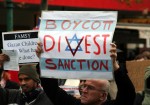
The hyperbole around the issue has never been greater either. All of it is transparently overblown to anyone who actually knows the various players in this game. The BDS movement is not made up, as Netanyahu’s Minister of Justice Ayelet Shaked stated, of radical Islamists, anti-Semites and naïve fellow travelers.
I have known many BDS leaders for many years, as I have also known many of my fellow two-state supporters. I understand their motivations. I disagree often with BDS leaders, but I have never known most of them to wish for violence of any kind, express support for al-Qaeda or ISIL, or express animosity towards Jews as Jews. Many of these folks are, indeed, anti-Zionists, and support a single democratic state in all of what they call “historic Palestine.” I disagree with them on that point, but my disagreement does not mean they hate me, or I them.
That doesn’t mean there are no anti-Semites in the BDS movement. Any pro-Palestinian movement is naturally going to attract those who wish to hide their anti-Semitic agenda under a more acceptable cloak. This small minority within their ranks does not define them.
Unintended Consequences
Israelis, and too many of its supporters, continue to bury their head in the sand about Israel’s diminishing standing in the world. The blame is on Palestinian public relations, the reach of the BDS movement, global anti-Semitism, or their own failure to adequately explain their position to the world. The one thing it never is, according to the Netanyahu government and too many “pro-Israel” groups around the world is Israeli policy.
Part of avoiding the policy debate is presenting Israel as a country constantly facing imminent destruction. While Israel faces very real threats to its citizens, it has not faced an existential threat in a very long time. Iran has never been that, as many Israeli security experts have confirmed. If a deal limiting its nuclear program is finalized, the world is unlikely to buy Israeli complaints that Iran could ever “wipe Israel off the map.” So, BDS is being primed for the role of menacing villain.
For their part, the BDS movement seems to be feeding eagerly on Israeli public relations. Despite having had no discernible impact on Israel’s economy or its determination to maintain its occupation, they are trumpeting their success.
One can understand this, of course. Bibi needs the perception of an existential threat to bolster his politics of fear, while the BDS movement, a grassroots movement with little financial backing, needs to demonstrate its own effectiveness. These tactics, however, are damaging hopes of progress toward a resolution of this vexing conflict.
By avoiding moves to end its 48-year old occupation and exaggerating the BDS threat, Israel is actually proving that only substantive pressure will convince it to end the occupation. This is a point on which the BDS movement and I agree; I have argued for decades that the biggest obstacle to ending the occupation is that Israel, in this regard a country like any other, is expected to take what it perceives as a huge risk without any pressure. The occupation’s  costs are largely covered by the European Union, United States and some Arab states, and despite the terrorist attacks Israel still occasionally endures, almost exclusively in the form of sporadic rocket fire from Gaza, the Palestinians have few means to pressure Israel. This is the logic behind the PLO’s international campaign, which must be understood as distinct from BDS.
Israel is running other risks as well. By conflating so many actors and actions with BDS tactics and movements, it risks galvanizing a much harsher opposition than it has seen in the past. Domestically, this false image of BDS is already being used to push the right wing’s assault on democracy even further, while reinforcing the Israeli sense that the “whole world is against us.”
The Effect of BDS
The fact is that any effect BDS has had on Israel’s economy is imperceptible. The economic issues Israel faces have no connection to any drop in exports or loss of investment. That does not mean it never will, but it does mean that the hysteria about BDS is way out of proportion with its impact to date. So, we are left with the most right-wing government in Israeli history governing a country whose citizens, even the majority that still supports a two-state solution, believe that ending the occupation carries major security risks. That is a country that will not change its policies absent significant pressure.
If we accept that self-evident fact, we confront the fact that many people and groups who do not wish to be associated with the BDS movement, its leadership and some of its specific goals have for years avoided any sort of organized economic action against Israel’s occupation. While one can hardly blame the BDS movement for this (in no way have they acted to prevent more moderate groups from taking actions aimed strictly at the occupation), it is an unintended consequence of their activities.
Netanyahu has taken full advantage of the political void this opens up. When the European Union wants to enforce existing laws that distinguish between products made in Israel and those from the settlements, it is considered a “sanction” against Israel; i.e. the “S” in BDS. As a result, liberal Zionist, centrist and many progressive groups avoid any hint of economic action against the occupation.
Groups like Americans for Peace Now (APN), one of the very few who are standing up to call for boycotting settlement products, are not getting the support they need. Yet the few instances of divestment or refusal to do business in the West Bank (most of which were not attributed to the BDS movement by the organizations that took such actions, some of whom even explicitly stated that they were not acting as part of that movement) have all been firmly rooted in opposition to the occupation. They have not been connected to the other conditions of the BDS movement’s call to action, regarding Palestinian citizens of Israel and the right of return of Palestinian refugees.
The Need for Economic Action
It is unfair, however, to expect the BDS movement to abandon its tactics because they are being used to scare more moderate peace groups away from action. Instead, it is the responsibility of moderates, two-state solution supporters and those who support Israel but loathe the occupation to stand up for our beliefs. Let the BDS movement do what it is doing. If you are really worried that BDS will “de-legitimize” Israel with rhetoric, then counter it with a principled, pro-Israel stand for Palestinian rights and statehood and an end to the occupation.
The distinction that Netanyahu and his cohorts in AIPAC and in Congress are trying to blur must be sharpened instead. The settlements are not Israel. They are an immoral and illegal enterprise that should not be supported — through tax dollars, investment or purchases. From such a position, classifying corporations that are profiting from the occupation, especially American ones as “socially irresponsible” can be supported on a pro-Israel basis. From that position, groups can stand up for Israel and support Israelis who are working to end the occupation, and combat the discrimination against Arabs that has become so bitter in recent years.
That is also a pro-Israel position from which Americans can demand that our government name the settlements the illegal enterprise they are, and treat them accordingly. It is a position from which one can promote a secure Israel within the Green Line that can, at long last, find some peace in that tumultuous region. It just has to stop denying millions of Palestinians their basic rights and any hope for the future. That, not Netanyahu’s demagoguery, is truly pro-Israel.