Welcome to FMEP’s Weekly Settlement & Annexation Report. To subscribe to this report, please click here.
November 7, 2025
- Tenders Issued for New Neighborhood in Geva Benaymin Settlement
- Israel Advances Plans for 1,985 New Settlement Units
- Israel Delivers Demolition Notices to Entire Village of Umm Al Kheir in South Hebron Hills
- Israel Allocates $12 Million to Deepen Control Over West Bank Archaeology Sites
- Settler Violence & The Olive Harvest
- Bonus Reads
Tenders Issued for New Neighborhood in Geva Benaymin Settlement
 Peace Now reports that on November 4th the Israeli Housing Ministry published tenders for the construction of 342 new settlement units – establishing a new neighborhood in the Geva Benyamin (aka Adam) settlement. The new construction will expand the settlement northward towards the Jaba’ bedouin community, and connect the settlement to an outpost established by settlers in February 2025. Since the outpost was established, settlers have routinely and violently attacked the Jaba’ community.
Peace Now warned:
“Since the beginning of 2025, tenders have been published for a total of 5,667 housing units in settlements – an all-time record and about 50% more than the previous peak year, 2018, when tenders were published for 3,808 units. If the tenders published this year are built, these homes would add roughly 25,000 settlers to the West Bank.”
Israel Advances Plans for 1,985 New Settlement Units
Peace Now reports that on November 5th, the High Planning Council advanced plans for the construction of 1,985 new settlement units across the West Bank.
Since the beginning of 2025, including the plans slated for approval this week, Israel has advanced a total of 28,195 settlement units — setting a record for annual numbers. See Peace Now’s records here.
The plans that received final approval this week include:
- 133 new units in the Kfar Tapuach settlement, located south of Nablus.
- 80 units in the Etz Efraim settlement, located south of Qalqilya and on the Israel-annexed side of the Separation Barrier.
- 178 units in the Ganei Modi’in settlement, located on the Israel-annexed side of the Separation Barrier in the northern West Bank.
The plans which were deposited for public review this week include:
- 720 units in the Avnei Hefetz settlement, located just east of Tulkarem;
- 568 units in the Einav settlement, located east of Tulkarem and east of the Avnei Hefetz settlement.
- 48 units in the Etz Efraim settlement (in addition to the plans which received final approval).
- 258 units in the Rosh Tzurim settlement, located south of Bethlehem in the Etzion settlement bloc.
Israel Delivers Demolition Notices to Entire Village of Umm Al Kheir in South Hebron Hills
On October 28th, the Israeli Civil Administration delivered demolition notices to 13 structures (including 11 homes) in the village of Umm al-Khair in the South Hebron Hills – a village that is almost entirely surrounded by Israeli settlements and violent outposts. The residents were given four days to appeal the demolition notices, which were issued due to lack of Israeli-issued building permits (the buildings are over a decade old).
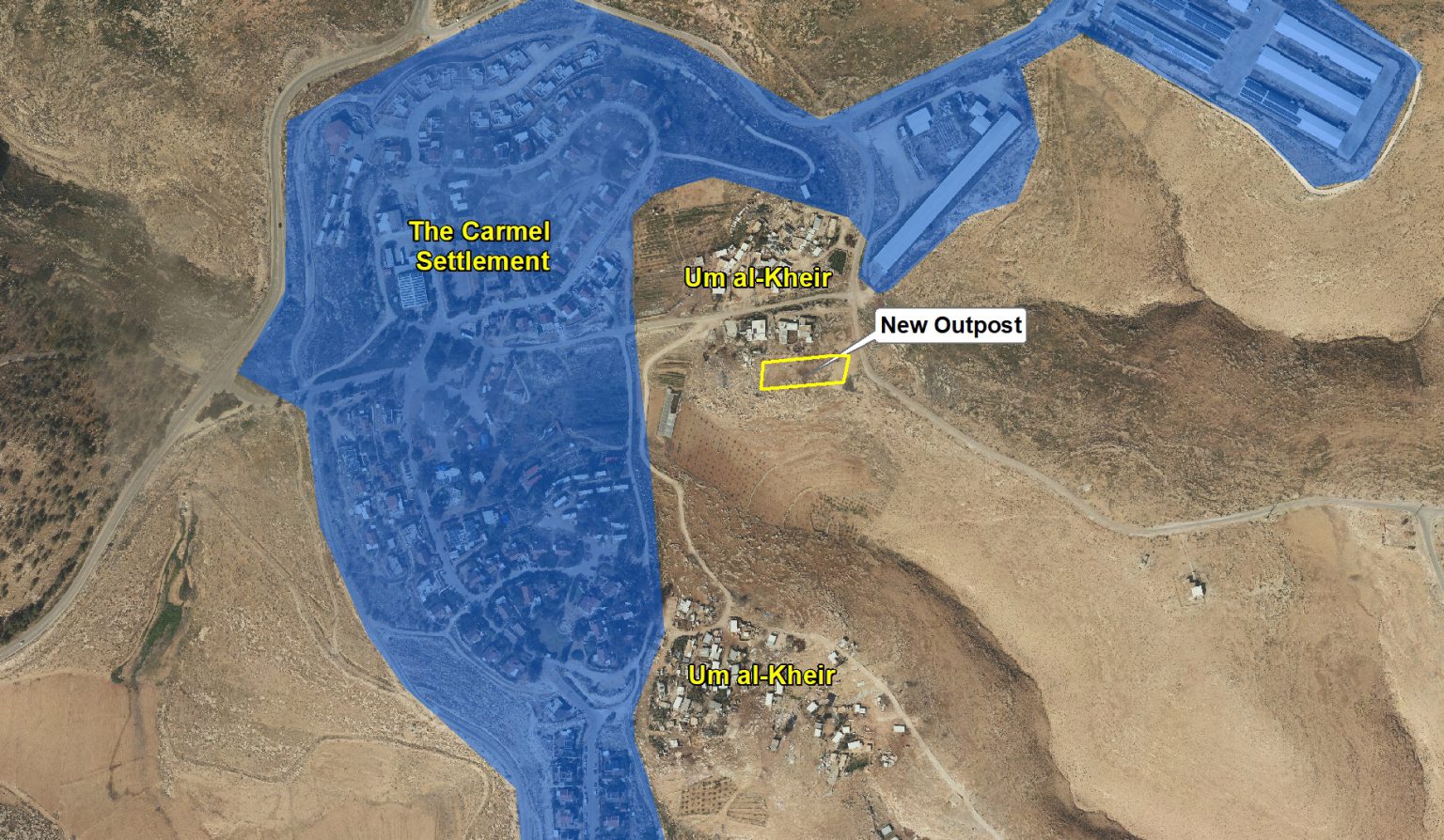 These notices come only a few weeks after the Jerusalem District Court attempted to temporarily stop settlers from establishing another new outpost literally next to homes in the Umm Al-Khair.
For an in-depth background of Umm al-Khair is its struggle to stay on its land despite settler and state violence, see Peace Now’s reporting and 972 Magazine’s repository of stories on the village – including several written by Awdah Hathaleen, a native of Umm Al-Khair who was murdered by an internationally sanctioned settler earlier this year (a settler who is facing no legal repercussions for the murder).
Israel Allocates $12 Million to Deepen Control Over West Bank Archaeology Sites
Emek Shaveh reports that on October 26th the Israeli government allocated an additional $12million (NIS 33.6 million)to renovate and strengthen Israeli control over archaeological sites in the West Bank. The government had previously allocated $33 million (NIS 120 million) in 2023 to the same project as well as a special budget of NIS 32 million for the Sebastia site alone.
Israeli Heritage Minister Amichai Eliyahu said: ““will not wait for the formal imposition of sovereignty over the West Bank.” As a reminder, in July 2024 the Israeli government gave the Civil Administrative sweeping powers over archaeological sites in Area B of the West Bank.
Emek Shaveh said in a statement:
“The government decision to redirect funds from other offices to sites in the West Bank reflects the ministers’ true priorities. At a time when health, welfare, and education systems have been severely impacted by two years of war and soaring defence spending, the government is diverting critical resources to advance the settlers’ long-standing agenda: expanding control over territory through archaeology.
By declaring more areas as archaeological sites “off limits” to Palestinians and developing them as tourist attractions to draw mainstream Israeli visitors into the settlements, the government is instrumentalising antiquities both as a bureaucratic tool for displacement and annexation, and as a means of shaping a biblical-nationalist narrative that excludes other histories and denies Palestinian connection to the land.”
Settler Violence & The Olive Harvest
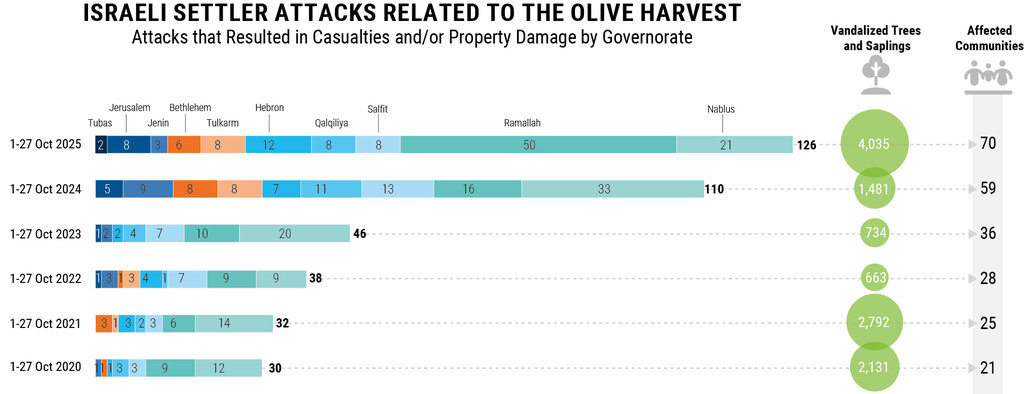 Settlers have continued to terrorize Palestinians harvesting olives during the 2025 harvest season, with virtually no recourse or accountability. Over the course of October, OCHA recorded the highest monthly number of Israeli settler attacks since OCHA began documenting such incidents in 2006, documented 260 attacks – an average of 8 per day. In addition Palestinians continue to suffer from increasingly restrictive Israeli policies that limit access to agricultural land located near settlements and/or the Separation Barrier. Adding to the heightened settler violence, the Israeli government has undertaken a deportation campaign against international solidarity activists who, for years, have accompanied Palestinians during harvest season as a protective presence.
Since October 21st, there have been at least 104 attacks, 20 of which were directly related to the olive harvest, including the following incidents of note over the past two weeks:
- Mikhmas: On October 20th, settlers from a newly established outpost attacked a group of Palestinians and solidarity activists in the bedouin villages of Mikhmas and al-Ara’ara, located north of Jerusalem. The settlers threw stones at the Palestinians and set a house and olive trees on fire. Then, on October 23rd settlers cut the water pipelines which serviced Mikhmas. On October 25th, settlers violently attacked Mikhmas, burning six structures and injuring Palestinians and solidarity activists. Many residents of Mikhmas have left the village under the coercive displacement policies of the state and the escalating violence of the settlers – which goes unpunished. OCHA has documented
- Al-Mughayyir: On October 24th dozens attacked al-Mughayyir during the night, setting cars on fire. This is the 43rd time this year that settlers have attacked Al-Mughayyir, a town that is surrounded by seven outposts.
- Samu, South Hebron Hills: Settlers were filmed ransacking a farm and torturing livestock – including baby lamb – in a small village in the South Hebron. Six lambs were killed and four were severely injured.
- Beit Ummar: Wafa News reports that on October 29th settlers cut down approximately 50 olive trees and stole construction equipment. Israeli settlers and soldiers have carried out more than 250 attacks on Palestinian olive farmers since the harvest began earlier this month, according to the Ramallah-based Colonization and Wall Resistance Commission
- Qarawat Bani Hassan: On November 4th, settlers attacked Palestinians harvesting olives alongside a large group of volunteers (including American volunteers). As filmed by the harvesters, settlers flew a drone directly into the crowd of activists injuring one, and then proceeded to shoot live ammunition into the air, threatening to shoot the volunteers while they attempted to retrieve the drone. Haaretz reports the settlers were part of the security unit of the nearby Revava settlement.
The continued violence prompted the following statement by Tom Fletcher, Under-Secretary-General for Humanitarian Affairs and Emergency Relief Coordinator:
“Reports of attacks by Israeli settlers on Palestinians and their property across the West Bank continue. Many are related to Palestinians’ attempts to harvest their olive crops. Palestinians have been killed and injured. Their homes and property damaged. Their livestock attacked. More trees have been damaged and more communities affected this year than in the previous six years. The failure to prevent or punish such attacks is inconsistent with international law. Palestinians must be protected. Impunity cannot prevail. Perpetrators must be held accountable.”
Bonus Reads
- “The Business of Apartheid: What Companies and Investors Should Know” (AFSC, 10/30/25)
- “How one road and an Israeli settlement could end dreams for this Palestinian city” (Los Angeles Times, 10/24/25)
- “Israel’s Education Commissar Wants to Force Settler Indoctrination in Schools” (Haaretz, 10/29/25)
- “Smotrich proposes weekly protest in ‘Sovereignty Square’ to push for Judea and Samaria annexation” (World Israel News, 10/26/25)