Welcome to FMEP’s Weekly Settlement & Annexation Report. To subscribe to this report, please click here.
July 3, 2026
- EAST JERUSALEM: E-1 Tenders Expected Aug 5th; Appeal to UN to Intervene in Israel’s Seizure of Church Land in Silwan; Huckabee Hosts Theatrical Ceremony for New U.S. Embassy in South Jerusalem
- WEST BANK: Smotrich Announces Three New Settlements Ready to Go in Norther WB; Settlers Push Plan to Takeover 100 Sites in Area A; Report Looks at ‘103 Nails on the Map’
- BONUS READS
EAST JERUSALEM / JERUSALEM
E-1 Tenders Set to Open Aug. 5th
According to reports the Israeli government has set dates for the publication of two tenders for the construction of the E-1 settlement:
- On August 5th, the government will open a tender for the construction of 3,401settlement units. The tender will be open for two months, during which companies can bid on the project.
- On July 21st, a tender will be opened for the construction of an employment and commercial zone in the E-1 settlement area. The tender will close September 14th.
Ir Amim writes:
“The new dates were published despite the fact that petitions against the E1 settlement project remain pending before the District Court. These include a petition filed by Attorney Michael Sfard on behalf of Ir Amim, Bimkom and Peace Now. While the June 15th court hearing on the petitions delivered an interim positive outcome, there is currently no standing injunction to halt or freeze the opening of the tenders. The court ordered the state and the Ma’ale Adumim settlement municipality to file a detailed response to the petitions’ arguments by September 1, 2026, suggesting that the petitions’ core legal questions carry sufficient weight and warrant fuller deliberations. Therefore, the court declined the state’s request to dismiss the petitions outright, allowing them to proceed to the merits phase, after which it will issue a ruling.”
Terrestrial Jerusalem’s Danny Seidemann writes:
“Earlier this year, the Government published its intent to issue tenders for the construction of E-1, which was, to all intents and purposes, a declaration of intent. The actual tender process begins on the date upon which the tender documents are published. Before that date, contractors and developers do not have the details needed to file the copious documents required to submit a bid. That date has now been fixed. That means that the clock begins ticking on August 5, and the contractors and the developers will have until October 5th to submit their bids. Once a bid is selected and the contract awarded, it will be virtually impossible to stop E-1. Until now, the Government has been able to suspend all of its plans regarding E-1 at its sole discretion. Once the contracts are signed, third-party rights come into play, and reversing course on E-1 becomes almost impossible.
The countdown that begins on August 5th will culminate shortly after the end of the bidding period on October 5th, with the signing of contracts for the construction of E1, at which time the project will have reached the point of no return…
The new dates mean that the entire bidding period will take place in the heat of the upcoming Israeli elections. Firstly, this makes the already unlikely possibility of Netanyahu freezing E-1 even less likely. He is already consolidating his rather extreme right-wing base. Secondly, E-1 may become a wedge issue in the campaign. By touting the implementation of E-1, Netanyahu will force the opposition to take a stand on the plan – and that is the last thing the opposition would like to do. Regardless, there is little likelihood of significant and vocal opposition to E-1 during the election campaign.”
Palestinians Ask UN to Intervene Against Israel’s Seizure of Church Property
The Balasan Initiative has appealed to the UN Special Procedures to intervene against Israel’s seizure of Church property in Silwan, East Jerusalem (background here). The appeal asks the United Nations to urge Israel to restore possession of the land to the Greek Patriarchate.
Balasan Initiative writes:
“Notably, based on the latest developments and increased settlement expansion and forced evacuations in Silwan, there is an increasing likelihood that this seizure will be integrated into broader plans linked to the “City of David” and “King’s Garden” settlement project administered by entities affiliated with the Elad organization.
These indicate that the developments in Silwan are part of a broader and escalating pattern of attacks that seek to undermine the indigenous Christian presence in Palestine. Expressing serious concern over the growing incidents targeting Christians and churches, in the context of what it described as unacceptable international inaction, as that in 2024 alone, incidents of violence or attacks attributed to Israeli actors were documented against Christian clergy, nuns, worshippers, and church communities, including 35 cases directed at churches, monasteries, and religious symbols.”
U.S. Advances Construction of New Embassy on Stolen Palestinian Land in Southern Jerusalem
On July 1st U.S. Ambassador Mike Huckabee and Israeli Foreign Minister Gideon Sa’ar signed an agreement to build a new U.S. embassy compound in southern Jerusalem, to be built on a stolen plot of land confiscated from Palestinians by Israel in 1950. Palestinians have produced documentation showing the land is Palestinian refugee property confiscated by the Israeli authorities, and that the site was part of an Islamic waqf. Palestinians have sustained a campaign to prove these facts since at least 1989 when Israel first signed a lease on the land to the U.S..
Huckabee paid a single dollar to lease the plot, called the Allenby Compound, in a purely symbolic act of theater. In 2017, U.S. President Donald Trump announced the U.S. would move its Embassy to Jerusalem, recognizing Jerusalem as Israel’s capital.
Huckabee said at the ceremony:
“We are going to plant our flag, our American flag, on the soil of Jerusalem for a permanent and a brand-new embassy compound that will serve as our mothership of diplomatic activities here in Israel. I would say God made that decision 3,800 years ago, and we finally got around to acknowledging what had been determined long before the United States of America came along.”
Rashid Khalidi told Haaretz:
“The Allenby compound does not belong to Israel, which has no right to offer the site to the United States for the location of its embassy in Jerusalem.. [this] collaboration of the United States government with Israel in the theft of Palestinian private and waqf property is yet another American infringement on Palestinian rights, in keeping with a long and disgraceful record of such hostile behavior towards the Palestinian people and their inalienable rights, national, religious and private.”
WEST BANK
Smotrich Says Three More New Settlements Are Imminent, Pushes for Total Annexation of Gaza
During a visit to the Israeli town Sderot near the Gaza boundary, Finance Minister Smotrich announced that Israel is ready to begin construction on a bloc of three new settlements in the northern West Bank pending a final green light from the Prime Minister. Haaretz reports Smotrich appears to be referring to the settlements Elei Sinai, Dugit and Nisanit. Smotrich also called on the IDF to complete its conquest of the whole Gaza Strip.
Settlers Push “Execution Day” Plan to Seize 100 Sites in Area A
According to Al-Andalou Agency, Israel Hayom reports Israeli settler groups have a plan to seize 100 sites located in Area A of the West Bank, the 18% of the West Bank that the Palestinian Authority is supposed to have total administrative and security control over (but in reality, does not) and where Israeli settlement activity has only recently started to target. Settlers have prepared a plan to take the sites, calling for an “execution day” where Israel takes the sites by force.
The plan was reportedly authored by the Settler Farms Association and the Havat Forum, and handed to the Israeli government ministers for consideration. The Farms Association was recently sanctioned by a group of European governments
103 Nails on the Map and in the Two-State Coffin

by Peace Now and Kerem Navot
Haaretz has published a deep dive report on the massive wave of settlements approved and constructed in the wake of October 7, 2023. The report, entitled “103 Nails on the Map: How Israel’s Government Is Burying the Two-state Solution” uses data and maps produced by Peace Now and Kerem Navot to show the overwhelming picture in totality, that Israel has undertaken sweeping efforts to fracture beyond repair any hope of a Palestinian state in the West Bank.
A supplementary article from the Haaretz Editorial Board entitled, “Israel Must Rid Itself of the Government Behind the Settler Revolution” the editors write:
“A special Haaretz project proves that the effort involves solidifying and deepening the splintering of the Palestinian territories, and confining them into increasingly smaller areas, while increasing the physical, social and economic disconnect among the enclaves. It’s a step in keeping with the principles of Religious Zionism party leader Bezalel Smotrich’s “subjugation plan.” In addition, several phenomena have become apparent, some of which involve steps from which Israel had refrained for decades, and others that are entirely new…The person who promoted this revolution, including the terrorist arm on the ground, is Smotrich. But the person who appointed him and granted him the power, authority and resources and who gave him the green light was Prime Minister Benjamin Netanyahu. If Israel is to cherish life, it needs to rid itself of the settler, Kahanist government that he heads.”
FURTHER READING
- “Escalating settler attacks raise displacement concerns in Dar Faza’a and East Tayba Bedouins” (OCHA OPT, 6/26/26)
- “Israeli settlers and troops at the archaeological site of Sebastia” (Reuters, 6/29/26)
- “‘I Am the Homeowner’ Armed Israeli Settlers Take Over Palestinian Home in PA-controlled Area B” (Haaretz, 6/28/26)
- “Ben-Gvir tours East Jerusalem Palestinian neighborhood under tight security” (Haaretz, 6/30/26)
- “Israel strips the Hebron municipality of its planning powers, threatening to further erode the city’s Palestinian identity” (Mondoweiss, 6/28/26)
- “Unshielded Childhood: Palestinian children and teenagers killed by Israel in the West Bank in 2025” (B’Tselem, June 2026)
- “In His Own Words: Naftali Bennett Is Committed to Annexing the West Bank” (Haaretz, 6/30/2026)
- “Eisenkot, What Will You Do About Settler Terror?” (Amira Hass in Haaretz, 6/30/26)
Welcome to FMEP’s Weekly Settlement & Annexation Report. To subscribe to this report, please click here.
March 27, 2026
- WEST BANK: Five New Outposts, Cabinet Approves Legalization of 30 Outposts, 972 Investigations Shows Area B Strategy Unfolding, 19 Billion for Settlements Since 2023, Weaponization Continues
- EAST JERUSALEM: 15 Families Dispossessed in Silwan
- STATE-BACKED SETTLER TERRORISM: Settlers Organze Multi-Day Terror Campaigns
- BONUS READS
WEST BANK
Overnight, Settlers Establish Five New Outposts, Killing One Palestinian Who Tried to Stop Them
Haaretz reports that on the night of March 26 settlers established five new outposts, four of which are located in Area A (some ~18% of the West Bank). Later reports suggest the IDF has already demolished all five outposts.
When approximately 40 settlers invaded land in the Palestinian village of Tayasir, settlers fired at Palestinians who came out to stop them from establishing an outpost, killing Mohammad Faraj Al-Malhi, a 27-year-old resident of East Jerusalem. Clashes at the sites of the other outposts resulted in the injury of 14 additional Palestinians. Settlers had attacked Tayasir just one day prior, firing at Palestinians
Kerem Navot founder Dror Etkes told Haaretz:
“Establishing four outposts in Area A is unprecedented by any measure, and shows the extent to which the State of Israel has lost control not only over settlers in the West Bank, but also over the army, the police and other authorities meant to enforce the law. The establishment of four outposts in a single night is an extreme event with very few precedents in the history of settlements.”
Cabinet Approves “Legalization” of 30 Outposts
The Israeli Security Cabinet reportedly approved the retroactive legalization of 30 outposts across the West Bank. The approval came during the same meeting when IDF Chief of Staff Zamir informed the Cabinet of growing settler violence. There no details on which 30 outposts were affected.
972 Investigation: Settlers Systematically Expanding Control Into Areas A & B
In an investigation with The Nation, 972 Magazine chronicles how settlers, having effectuated the de facto annexation of Area C of the West Bank, are now in the process of “methodically breach[ing] the borders of Area B…[where] settler outposts are being strategically used to seize land and drive Palestinian communities out — with the backing of the Israeli army and police. Palestinian communities on the outskirts and margins of Area B towns are being pushed inward, to the centers of these localities. Land on these margins is incrementally taken over through the construction of outposts, the carving of roads, and the declaration of military zones. The effect is a fragmented landscape in which communities are cut off from one another and from agricultural land essential to their livelihoods.”
The investigation, which focuses on the experiences of 12 Palestinians communities, reports the results of settlers’ shifting focus:
“Since October 7, settlers have worked in tandem with the Israeli army to expel at least 76 entire Palestinian communities, while settlers have simultaneously established 152 new outposts. Among these outposts, at least 22 have been established in Area B, including 12 in the “Agreed-Upon Reserve” (a plot of 167,000 dunams in the southern West Bank that is designated as Area B). One outpost has also appeared inside Area A.
According to mapping by +972 Magazine, Local Call, and The Nation, based on data collected by the Israeli organizations Kerem Navot and Peace Now, the settlers living in these outposts have taken control of around 98,000 dunams (almost 25,000 acres) in Area B and Area A. In total, settlers living in outposts now wield effective control over roughly 1 million dunams (250,000 acres) across the West Bank.”
Netanyahu Government Has Allocated 19 Million for Settlements
Peace Now reports that since returning to power in late 2022, the Netanyahu government has allocated NIS 19 Billion to the settlement enterprise. Peace Now details the expenditures in depth in their report, which you can read/download here.
Continued Escalation of Archaeology as Means of Dispossession
State and settler focus and seizure of archaeological sites continues to expand in scope and intensity. As settlers and the state now routinely make incursions into and exercise authority over Area B of the West Bank, Palestinian communities living near/amongst ancient sites are coming under increasing pressure.
Emek Shaveh documents the following incidents since Israel and the U.S. launched a war on Iran:
- Tel Aroma/Jabel Urma: Located south of Nablus and adjacent to the Palestinian town of Beita (Area B), this antiquity site has become the focus of nearby settlers who have tried to establish an outpost at the site though it was dismantled. Settlers nonetheless continue to raid the site and harass Palestinians.
- Marajam: The IDF carried out a demolition of a house in Marajam, located southwest of Duma in the central West Bank (Area C). The house was located on the periphery of an antiquity site but did not pose any threat to the site – as determined by archaeological experts.
- al-Fasayil: The IDF demolished the village of al-Fasayil on March 17th, a bedouin community in the Jordan Valley. Israel had denied building permits for their homes of 20+ years because they were built within an archaeological site. Most residents of al-Fasayil had already fled their homes and lands under the constant, violent harassment of settlers. The Israeli state has previously conducted excavations at the site.
Israeli archaeologist and Board member of Emek Shaveh writes:
“In a recent Facebook post, Israel’s Heritage Minister, Amichai Eliyahu, uploaded a reel of his visit to the Herodium palace in Jericho, putting up an Israeli flag and declaring: “This is our land. Any place built on the heritage of the Jewish people – we will destroy it.”
By defining all “Judea and Samaria” antiquities as “ours” and extracting and appropriating cultural wealth from the ground, Israel impoverishes the Occupied Palestinian Territories. It reduces the Palestinians themselves to the status of strangers in their own land.
In recent years, this has served as a preface to ethnic cleansing. Less than a week after Eliyahu made his statement about “destroying” anything built on our heritage, Israeli settlers from the illegal Palace Farm outpost demolished 13 Palestinian houses in a nearby suburb of Jericho, claiming that they endangered antiquities.
Archaeological excavations across the West Bank, in places such as Susiya, Otniel, Auja al-Foka, and Fasa’il (to name but a few), have foreshadowed the destruction of dozens of Bedouin hamlets and the expulsion of their inhabitants from the southern Hebron Hills and the Jordan Valley. An archaeological park in Jerusalem threatens 100 homes in Silwan….
Archaeology is also wielded as an administrative weapon in the West Bank and east Jerusalem. With as many as 6,000 archaeological sites in the database, legal restrictions on construction and development – as well as claims of damage and looting – are used to demolish Palestinian homes and constrain economic growth (in Israel, sites are routinely examined and, if necessary, removed to allow development)
A common Israeli claim is that Palestinians have “no interest” in antiquities. Beyond perpetuating a racist trope that justified centuries of looting by imperial powers (there are, in fact, hundreds of Palestinian archaeologists), this sentiment fails to recognize that it is Israel’s weaponization of archaeology that has become a threat to Palestinian land and identity. The more we [Israelis] insist that antiquities are ours and only ours, the more we endanger the very sites and artifacts we want to protect.
Only by realizing that the heritage of Israel and Palestine belongs to all who live between the river and the sea will we create the basic conditions for its preservation.”
EAST JERUSALEM
Ethnic Cleansing in Action: 15 Families Dispossessed in Silwan in Favor of Settlers
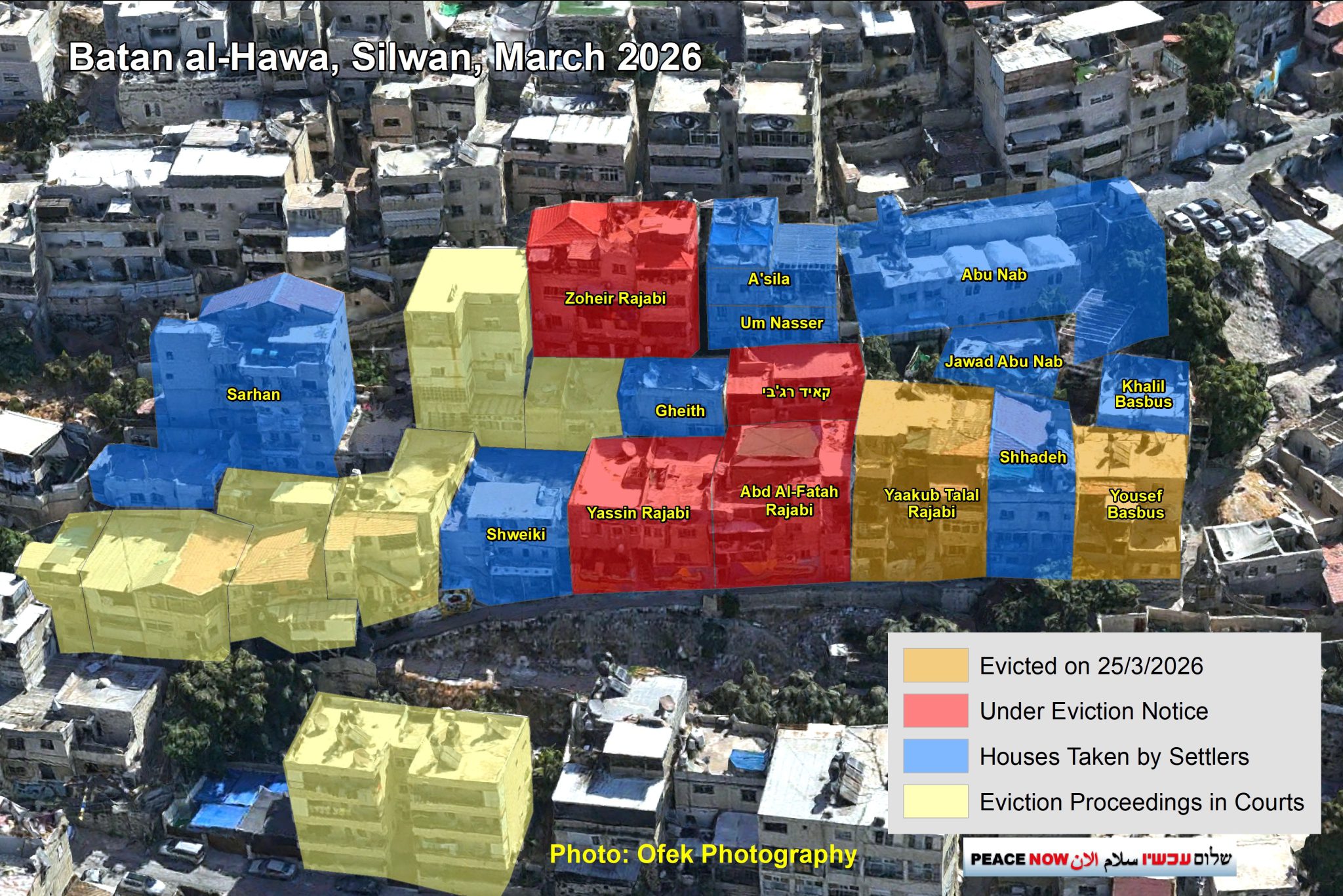 Over the past week, Israeli forces and settlers forcibly removed 15 Palestinian families from their homes in the Batan al-Hawa section of Silwan, clearing them and their belongings out so that the Ateret Cohanim settler organization can take possession of the buildings and Israeli settlers can move in. There are an additional 15 families under imminent threat of eviction on the basis of the same court decision.
Yosef Basbous, whose family was expelled this week said:
“Our family was expelled in 1948 and dispersed in refugee camps in the West Bank. I arrived in Silwan with my parents more than 60 years ago. I built this house stone by stone, brick by brick, nail by nail. Today they come to us and expel us again. They claim that the land belonged to a Yemeni waqf and that the custodian sold the land to settlers. The police say they are implementing the court’s decisions, according to the law. But what kind of law is this that can expel me, who has been here for more than 60 years.”
Another expelled resident, Jacob Rajabi told Haaretz:
“They came at 9 A.M., entered the house, took the children and women, and put us out on the street. This is the home where I was born, where I got married, raised children – my whole life is there.”
Peace Now said:
“Unfortunately, there is no other word to describe this than ethnic cleansing. Settlers, with the help of the government and a discriminatory legal system, are expelling an entire Palestinian community and replacing it with settlers. This is happening in the Jerusalem of 2026 and it is a stain that will not be erased from Israel.”
Ir Amim explains:
“These expulsions are part of an unprecedented escalation in forced displacement from Silwan that is tantamount to forcible transfer and involves multiple state institutions and entities working in collusion with settler groups and reinforced by a complicit judiciary. The amount of resources being allocated and deployed to carry out these measures during an ongoing war underscores the Israeli government’s resolve to exploit the circumstances to accelerate forcible transfer and solidify an irreversible apartheid reality. As detailed in a forthcoming Ir Amim report, a web of state and local authorities, statutory bodies, and laws converge into a single coordinated, multi-layered system of state-orchestrated dispossession and displacement of Palestinians in East Jerusalem, in flagrant violation of international law.”
B’Tselem details the history and context of Silwan, and explains:
“In Silwan, as in other Palestinian neighborhoods of Jerusalem and Palestinian villages across the West Bank, the Israeli regime uses every tool at its disposal to dispossess Palestinians of their land. The goal of removing Palestinians from their homes is pursued out in the open, the core features of Israel’s apartheid regime, via the court system, and in cooperation with settler organizations, with matching efforts to make Palestinians’ lives unbearable through systematic neglect and violence perpetrated by both official and unofficial actors. This is the reality of systematic, institutionalized violence in which Palestinian residents of Jerusalem live daily under Israel’s apartheid regime, stripped of their most basic rights. Confronting this reality requires urgent and immediate intervention by members of the international community.”
STATE-BACKED SETTLER TERRORISM
The pace of settler attacks is nearly impossible to keep track of. On March 21st (Eid weekend) settlers organized mass riots and attacks on Palestinian communities overnight, resulting in 17 pogroms across the West Bank completely undeterred by the IDF. The attacks were organized in reaction to the death of an 18-year old settler in a car accident, which settlers insisted was a terror attack despite unclear and at times contradictory facts. At the funeral for the settler, Finance Minister Bezalel Smotrich called for settlers to respond with settlement expansion, saying “We will erase the lines, the definitions, and the letters, and we will settle our land in all its expanses.” The father of the settler called him a “sacrifice“ for the settlements.
Settlers organized a second wave of terror campaigns on March 23rd, injuring at least 10. Five were reportedly arrested.
BONUS READS
- “How Israel’s strangulation of the West Bank is collapsing the Palestinian educational system” (Mondoweiss, 3/24/2026)
- “Israel’s Top Court Orders Compensation for Palestinian Family Whose Cattle Were Stolen by IDF Troops” (Haaretz, 3/25/2026)
- “32 Outposts, 10 Miles of Ground Barrier: IDF Builds New Border Line Inside Gaza. Here’s How It Looks” (Haaretz, 3/26/2025)
- “Netanyahu Coalition Pushes to Fast-track New Jewish Towns in Arab, Bedouin Areas” (Haaretz, 3/25/2026)
- “Vance’s office denies report VP raised anti-Palestinian riots with Netanyahu” (Cleveland News Journal)
- “The Iran War Is About Palestine” (Jewish Currents, 3/24/2026)
- “Israeli settlers are growing more violent in the West Bank” (The Economist, 3/26/2026)
- “Settlement of Land Title in the oPt: An International Law-Based Appraisal” (International Humanitarian Law Centre, 3/27/2026)
Welcome to FMEP’s Weekly Settlement Report, covering everything you need to know about Israeli settlement activity this week.
To subscribe to this report, please click here.
July 21, 2023
- “Dizzying” East Jerusalem Settlement Activity Continues: Israel Approves Givat Hamatos Building Permits & Schedules Discussion to Double Its Size
- Israel Expands West Bank Annexation via Archaeology, Including Construction of 4-7 New Settler Tourism Sites
- Smotrich Prepping Plans to Expand Campaign Against Palestinian Construction, With Aim to Expand Authority to Areas A & B
- Israel Opens First High Tech Campus in “Silicon Wadi” East Jerusalem Project
- Knesset Pushes Bill to Directly Fund Settlements
- Another Palestinian Bedouin Community Coerced to Leave Homes By Settler & State Terrorism
- In the Press: Bibi Denies Reports of “Settlement Freeze” Promise to Biden, Talks His Vision of Peace
- Smotrich Claims Credit for U.S.-Israeli Tensions
- Bonus Reads
“Dizzying” East Jerusalem Settlement Activity Continues: Israel Approves Givat Hamatos Building Permits & Schedules Discussion to Double Its Size
Ir Amim reports that Israel has continued its “dizzying pace” of settlement advancements in East Jerusalem, this week granting approval to four building permits for the yet-to-be-built Givat Hamatos settlement, and take an irregular step to advance a new plan – called “New Talpiot” – that would serve to massively expand the fully-approved plan for Givat Hamatos settlement.
The four building permits were issued on July 16th and will allow the foundation to be laid for several buildings in the Givat Hamatos settlement – which, if built, will be the first new settlement to be built in East Jerusalem in over two decades. The buildings (which will require separate building permits to be issued) will have a total of 900 units. The Israeli government has approved a plan to build a total of 2,610 settlement units in the Givat Hamatos settlement.
 In addition, the Jerusalem District Planning Committee is set to convene on Monday, July 24th to discuss a plan referred to as “New Talpiot Hill” that will, if approved and constructed, expand double the number of housing units in the Givat Hamatos settlement and increase its land mass by 40%, stretching Givat Hamatos eastward towards the settlement of Har Homa. The Givat Hamatos A project is directly adjacent to the area of the New Talpiot Hill project. The plan provides for 3,500 new settlement units and 1,300 hotel rooms – the latter posing a direct competition to the Palestinian tourism industry in nearby Bethlehem. The plan also calls for five synagogues and two mikvehs, clearly showing that the construction is designed to serve Israeli Jews although the neighboring Palestinian communities are suffering an acute housing crisis.
Ir Amim further notes that Israel is carrying out land registration on plots of land implicated by the New Talpiot Hill plan, a process which Israel has weaponized as a tool of settlement expansion.
Ir Amim writes:
“Together, Givat Hamatos A and New Talpiyot Hill along with concurrent settlement advancements in the area are cumulatively sealing off East Jerusalem’s southern perimeter from Bethlehem and the southern West Bank. These measures likewise further fracture the Palestinian space and deplete all remaining land reserves in the area for Palestinian development. Such conditions severely undermine the prospects of an agreed political future of Jerusalem, while depriving Palestinians of their fundamental right to housing and shelter.”
Israel Expands West Bank Annexation via Archaeology, Including Construction of 6-7 New Settler Tourism Sites
On July 17th the Israeli government approved a three-year $33 million (NIS 120 million) plan to take control over archaeological sites throughout the West Bank, including plans to establish 4-7 new settlement tourist sites. The approval of this plan is the fulfillment of a commitment made in the government’s coalition deal, which called for
The plan has several alarming components, including:
- Nearly $3million allocation of monitoring alleged antiquity destruction by PAlestinians and the Palestinian Authority, as well as for enforcement activities such as demolitioning Palestinian construction near antiquity sites.
- The construction of 4-7 new tourist installments at archaeological sites throughout the West Bank – the first being a new site at the “Hasmonean Pools” near Jericho. On this, Peace Now explains:
“The Hasmonean Palaces are located in Area C, adjacent to the Palestinian city of Jericho, which mostly falls under Areas A and B. Currently, access to the site passes through Area A. Beyond the site development, the goal of the program is also to enable access and regulate the movement of Israeli visitors from Area C into the site itself. In the past, there have been reports of plans to build a bridge over Area A to allow Israelis to reach the site.”
- The construction of a heritage center to showcase West Bank artifacts, with the possibility of building a new archaeological museum somewhere in the West Bank (location not determined).
- Surveys and excavatations.
Emek Shaveh and Peace Now both note that this new $33 million project comes in addition to the $9 million dollars in funding that the government approved in May 2023 to develop and “renovate” the archaeological site of Sebastia, located near the Palestinian village of Sebastia, north of Nablus in the heart of the West Bank. The project includes plans to pave a new access road for Israelis to reach the site, which they currently have to access by traveling through the Palestinian village of Sebastia, which will increase and entrench Israeli control not only over the site itself but the surrounding area – effectively weaponizing archaeology as a tool for dispossession.
Emek Shaveh said in a statement:
“With Bezalel Smotrich responsible for the Civil Administration and Jewish Power in charge of the Ministry of Heritage, the archaeological sites are weaponized more than ever before as a means for justifying ‘touristic settlements’, significantly entrenching and expanding the occupation and have become a central component in the present government’s steps towards advancing annexation. Along with massive settlement expansions, settler violence and legislation, the development of heritage sites in the West Bank will give control over substantial public areas and transform the multi-layered historical character of the area beyond recognition.
Although the plan is titled “an emergency plan for protection of antiquities”, only 10 million NIS of a budget of 120 million NIS are actually earmarked for defending sites against antiquity theft. Most of the budget is allocated to acts that constitute de facto annexation of the West Bank in complete violation of international law and the Oslo Accords. It is quite clear that for the current government the plan is yet another component in its efforts to thwart any possibility for a two-state solution and establish a biblical theocracy. We call on the international community to hold the State of Israel accountable to its own commitments under the Oslo accords, to the Two States Solution and to international law.”
Peace Now said in a statement:
“The Israeli government continues to settle in the West Bank in every possible way and continues to strengthen the friction with the Palestinian population. Investing over 150 million NIS in new tourist settlements implies exploiting archaeology in the West Bank to promote settlements and adversely affect Palestinians. Instead of investing in archaeological and tourism sites within Israel, the Israeli government continues to prioritize the settler minority over millions of Israelis. Investing in new settlements under the guise of heritage in the West Bank is a divisive move that harms Palestinians, distances peace and the two-state solution, and also undermines Israel’s tourism potential.”
As background, in January 2021, the Israeli government committed funding to a new settler initiative to surveil archeological sites under Palestinian control. While the objective of protecting antiquities might appear uncontroversial and apolitical, the true (and transparently self-evident) objectives behind this effort are: to support yet another pretext to surveil and police Palestinians; to establish and exploit yet another means to dispossess Palestinians of their properties; to expand/deepen Israeli control across the West Bank; and to further entrench Israeli technical, bureaucratic and legal paradigms that treat the West Bank as sovereign Israeli territory. It is the result of a campaign that has taken place over the past year in which settlers have escalated their calls for the Israeli government to seize antiquities and “heritage sites” located in Palestinian communities across the West Bank, especially in Area C, which Israel today treats as functionally (and legally) indistinguishable from sovereign Israeli territory. Funding committed by Israel for West Bank “heritage sites” should be understood in this context
Previous victories for the settlers in this same arena include the Israeli Civil Administration’s issuance in 2020 of expropriation orders – the first of their kind in 35 years – for two archaeological sites located on privately owned Palestinian property northwest of Ramallah. The settlers’ pressure is also credited as the impetus behind the government’s clandestine raid of a Palestinian village in July 2020 to seize an ancient font.
In June 2020, the “Guardians of Eternity” group began surveying areas in the West Bank that Israel has designated as archaeological sites, looking for Palestinian construction (barred by Israel in such areas) that they could then use as a pretext to demand that Israeli authorities demolish it. The group communicates its findings to the Archaeology Unit of the Israeli Civil Administration (reminder: the Civil Administration is the arm of the Israeli Defense Ministry which since 1967 has functioned as the de facto sovereign over the West Bank). The Archaeology Unit, playing its part, then delivers eviction and demolition orders against Palestinians, claiming that the structures damage antiquities in the area.
And one more reminder: in 2017, Israel designated 1,000 new archaeological sites in Area C of the West Bank. The “Guardians of Eternity” group, not coincidentally, is an offshoot of the radical Regavim organization, which among other things works to push Israeli authorities to demolish Palestinian construction (on Palestinians’ own land) that lacks Israeli permits (permits that Israel virtually never grants).
Smotrich Prepping Plans to Expand Campaign Against Palestinian Construction, With Aim to Expand Authority to Areas A & B
At a meeting of the Knesset Foreign Affairs and Defense Committee, Bezalel Smotrich revealed several plans that intensify and expand Israel’s annexation of the West Bank,, including plans to extend Israeli civilian operations – specifically the demolition of Palestinian construction – into Areas A & B.
Most drastically, Smotrich said that he is preparing a plan – expected to be approved within a month – that would allow him to direct the demolition of Palestinian buildings in Areas A & B which are determined to be a “security threat.” Smotrich told the Knesset that Israel’s ability to operate in Areas A & B are “key” to national security, and that he is working on plans to create a new unit within the Border Police which will be assigned specifically to construction law enforcement. This would be yet another advancement of Israel’s de facto annexation of the entire West Bank, which is increasingly focused not just on solidifying Israeli sovereignty over Area C but on Areas A & B as well. Haaretz notes that the Knesset Committee spent more time discussing Areas A & B than Area C. It should be noted that the Knesset Committee was convened to discuss what the Israeli government and the settlers believe to be “The Palestinian Authority’s takeover of open areas in Judea and Samaria” — a completely warped narrative of what is transpiring in the West Bank, where Israeli settlements are expanding while Palestinian are facing apartheid conditions. As admitted by an Army officer at the hearing, the Israeli military rejects 90-95% of Palestinian building requests while granting 60-70% of settler building requests
During a discussion of the Palestinian construction, Smotrich said his plan would also see Israel declare activities by Palestinian Authority to be a “foreign hostile activity,” which would prompt Israel to seize funds from the PA.
Smotrich also discussed two projects being prepared by the Jewish National Fund to plant trees on 2,500 acres of West Bank land. Smotrich talked about this tree-planting operation as a means of annexation, saying: “The [PA] actively works to seize lands. We need to do the same thing….[This means] legalization, construction, agriculture. “ This news comes the same week Israeli operated tractors were filmed uprooting Palestinian owned olive trees near the village of Tarkumiya.
As a reminder, in his role as a civilian minister in the Defense Ministry in charge of the Civil Administration, Smotrich is already empowered to order demolitions in Area C (powers which had previously been held by Israel’s military) — powers which he has wielded aggressively. As defined by the Oslo Accords, Areas A & B constitute 40% of the West Bank where the Palestinian Authority is assigned responsibility for civilian administration matters, like construction. Smotrich’s moves only underscore Israel’s erasure of any meaningful distinction between these areas, which has also been evidenced by routine military incursions into Nablus and Jenin, Israeli activity around antiquity sites under PA control, and more.
Israel Opens First High Tech Campus in “Silicon Wadi” East Jerusalem Project
The Times of Israel reports that Israel celebrated the opening of its inaugural high tech workspace that is part of the “Silicon Wadi” project, under which Israel aims to establish a major high-tech hub along the western side of East Jerusalem’s Wadi Joz neighborhood. While touted as a plan that will benefit Palestinians, its implementation has required the eviction of many Palestinian businesses in the area.
The new $2.8million (NIS 10 million) tech campus is a free workspace for Israeli and international high tech companies, and it has the capacity to host 250 workers with workstations, meeting spaces, and other available services. Four companies have already began working out of the new building.
You can read Ir Amim’s in-depth reporting on the Silicon Wadi project here.
Knesset Pushes Bill to Directly Fund Settlements
The Israeli Knesset is advancing a bill that will allow Israel to transfer tax revenue to the settlements, therefore bringing the settlements under direct Israeli law (an act of de facto annexation, illegal under international law) and further subsidizing the settlement enterprise. Even though the Israeli government has funded settlements from the outset, it has not permitted tax revenue sharing and has typically tried to hide other direct lines of funding to the settlements through non profits and other intermediaries.
The Combatants for Peace told Haaretz:
“The Netanyahu government has already ceased even trying to hide the institutionalization of apartheid. MK Asher’s reckless bill is another way to transfer budgets and to support the settlement enterprise and perpetuate the oppression and dispossession of Palestinians. What they can’t get in through the door, they’re trying to get in through the window – the main thing is to keep building.”
Another Palestinian Bedouin Community Coerced to Leave Homes By Settler & State Terrorism
B’Tselem reports that the al-Baq’ah Palestinian bedouin village was forced to abandon its village lands located west of Hebron under daily violence inflicted upon it by nearby settler outposts, and decades of harassment by the Israeli state.
The village’s decision to leave comes less than one week after the IDF demolished a water cistern used by all six families living in al-Baq’ah for personal and agricultural work. The villages told B’Tselem researchers that they are fleeing the village in fear of their lives.
B’Tselem writes:
“Al-Baq’ah joins the nearby communities of Ras a-Tin and ‘Ein Samia, which have already been driven off their lands over the past year under the same circumstances: Israel’s policy creates oppressive, unreasonable living conditions that leave residents of these communities with no choice but to abandon them. Relying on more official means (settlement building, extreme restrictions on Palestinian construction, a prohibition on infrastructure and demolitions), and on less official ones (settler violence against Palestinians), the policy has one goal: taking over more and more Palestinian lands and handing them over to Jewish hands, and it is applied against other communities still living in the area. Forcible transfer is a war crime, even if the state perpetrates it not by forcing people onto trucks but by putting so much pressure on them that their lives become unbearable and they cannot help but leave their homes and lands.”
In the Press: Bibi Denies Reports of “Settlement Freeze” Promise to Biden, Talks His Vision of Peace
Axios reports that on a July 17th call, Netanyahu informed President Biden that he does not expect to advance any more settlement planning, construction, or outpost “legalization” through the end of the 2023 year. Netanyahu issued a statement denying these reports, however Haaretz reports that Netanyahu contradicted that statement during private briefings for members of his staff and foreign journalists.
Separately, in an interview with podcaster Lex Fridman, Netanyahu provided a fresh look at what his vision of a “peace” deal is, explicitly saying that no settlements or settlers (no matter their location) would be uprooted, and that settlers would remain under Israeli sovereignty. He went on to reject Palestinian sovereignty.
Smotrich Claims Credit for U.S.-Israeli Tensions
In an interview with the settler-allied Arutz Sheva outlet (aka Israel National News), Smotrich made a few eye-opening remarks on his policies and motivations, saying:
“Our mission first and foremost is to provide security to the citizens of Israel in the settlements and all over the country. When we talk about the fight against terrorism there are two legs: the first is the development of the settlements and strengthening our grip on the territories of the Land of Israel. After all, terrorism is designed to weaken our grip – and our true answer that will eradicate it and make terrorism futile – will be further construction. When you look at Judea and Samaria, this government is building, regulating, developing, both in construction and in infrastructure on an unprecedented scale….quite a lot of the tensions that exist between the American administration and the Israeli government – and these are tensions between friends and partners and we manage these disputes with respect – stem from the policy that I am leading as a minister in the Ministry of Defense in the settlements with the full backing of the Prime Minister and the Minister of Defense.”
Bonus Reads
- “How settlers justify their pogroms” (Shabtay Bendet in +972 Magazine)
- “I was handcuffed and blindfolded for reporting on settler violence” (Basel Adra in +972 Magazine)
- “‘The escalation is frightening’: Jerusalem Christians fear for their future“ (+972 Magazine)
- “Israeli Soldiers Protect the Settlers, Then Attack Us Activists” (Illana Hammerman in Haaretz)
Welcome to FMEP’s Weekly Settlement Report, covering everything you need to know about Israeli settlement activity this week.
To subscribe to this report, please click here.
January 17, 2020
- Bennett Announces 7 New “Nature Reserves” in Area C of West Back (Partially on Private Palestinian Land) as Part of Ever-Expanding Annexation Drive
- Settlers Are Pushing Israel to Police Palestinian Construction in Areas A & B
- High Court Dismisses Settler Petition to Stop Outpost Demolition Order
- Emek Shaveh Report: Israel’s Action In Jerusalem Aimed at Obliterating the Green Line
- Bonus Reads
Comments or questions – email Kristin McCarthy (kmccarthy@fmep.org).
Bennett Announces 7 New “Nature Reserves” in Area C of West Back (Partially on Private Palestinian Land) as Part of Ever-Expanding Annexation Drive
On January 15th, Israeli Defense Minister Naftali Bennet announced that he has ordered the creation of seven new “nature reserves” in the West Bank and the expansion of 12 existing reserves. The act of designating land as a “nature reserve” is a political tool that the state of Israel has used to take control over vast tracts of land in the West Bank. This latest move, if carried out, will mark the first time since 1995 (the signing of the Oslo Accords) that the Israeli state has declared a new nature reserve in the West Bank.
In the announcement, Bennet made it clear that the new nature reserves are a part of his multi-prong drive to annex Area C and promote more Israeli settlements there:
“Today we provide a big boost for the Land of Israel and continue to develop the Jewish communities in Area C, with actions, not with words. The Judea and Samaria area has nature sites with amazing views. We will expand the existing ones and also open new ones. I invite all the citizens of Israel to tour and walk the land, to come to Judea and Samaria, sight-see, discover and continue the Zionist enterprise.”
Meir Deutsch, CEO of the radical settler group Regavim Movement, said in celebration:
“Defense Minister Naftali Bennett’s announcement of the declaration of new nature reserves in Judea and Samaria is a welcome and worthwhile step that has not been implemented for years. Bennett’s refreshing change in direction in maintaining Area C shows that there is an important and significant perceptual change here. At the same time, the petition demonstrates just how important the actual conservation of nature reserves is, and what the strategic significance of the PA is to take control of its nature reserves and its ambition to do so as far as it wants. Enforcement should look and be done, and one hour earlier.”
There are currently 76 Israeli-declared nature reserves in the West Bank, covering approximately 13% of the land. Under the Israeli Civil Administration’s regulations for the occupied territory, any activity deemed to damage the land (like construction) is prohibited, and must go through a special process for approval by Israeli authorities. This process, in theory, allows activities like construction to take place if Israel recognizes that they were ongoing prior to the declaration of the area as a nature reserve. In practice, by declaring nature reserves Israel is barring Palestinians and Bedouin communities from future building, growing crops, and/or grazing their livestock on their own land. Unsurprisingly, when Israeli settlers violate these same regulations concerning nature reserves, the Civil Administration and IDF habitually look the other way and even assist the settlers, allowing settlers to build in the parks and even manage them.
The Palestinian Authority Foreign Ministry said in response to Bennett’s annoucement:
“The Foreign Ministry condemns in the strongest terms Bennett’s colonialist and expansionist decisions and affirms that the so-called nature reserves are just another scheme for the appropriation and seizure of Palestinian land. This goes, in the end, for the benefit of shoring up settlements in the occupied West Bank.”
The Israeli NGO Emek Shaveh also condemned Bennett’s move and the underlying motivation for the declarations, writing:
“… an examination of the conduct of [Israeli authorities] demonstrates that the declaration and management of parks serve as a political tool to promote Israeli interests at the expense of the basic rights of Palestinians living in or near the sites. This political tool is apparent in several ways:
A. The way national parks prominently feature a narrative that stems from Jewish-Israeli heritage and from Israeli interests. Other legacies and narratives are almost absent, including archaeological layers from the Byzantine and Muslim periods.
B. In each of the sites discussed here, the National Parks Law was used to stop construction and development by Palestinians, to prevent access, and restrict their ability to gain a livelihood at the parks.
C. Palestinian residents do not benefit from the economic and cultural resources of the national parks, which they perceive as inaccessible and threatening.”
Moreover, according to Peace Now, 6.5% of the land Bennett has designated for the new nature reserves is, in fact, privately owned by Palestinians. The Spokesman for Peace Now, Brian Reeves, told The Independent:
“These reserves serve a larger function of keeping land off-limits to Palestinians. Nature reserves and national parks have also been used to prevent Palestinian construction….[Israel is] trying to slowly take over Area C as if this wasn’t occupied territory. No two-state solution could envision 61 per cent of the West Bank being part of Israel.”
In a 2007 report, Peace Now explained:
“Lands on the occupied territories have systematically been seized on various pretexts, in order to prevent the Palestinians in the West Bank from using them, and to undermine any Palestinian territorial contiguity. One of the means employed by Israel in order to annex lands was to declare broad tracts as nature reserves, and to include them in land blocks that the planners had intended for the settlements. This report shows that Israeli building of settlements infiltrated the bounds of many nature reserves. As such, it should be viewed as part of the wider phenomenon of the building of settlements in contravention to the construction and planning laws in effect in the West Bank. All this is in service of the goal of accelerating and deepening the process of ‘creeping annexation’ that the settlements create in the West Bank.”
Settlers Are Pushing Israel to Police Palestinian Construction in Areas A & B
According to a report published in the Yedioth Ahronoth daily newspaper on January 13th, settler leaders have been working with a right-wing Israel organization, the Kohelet Policy Forum, to convince the Israeli government’s Security Cabinet that Israel has both the right and the obligation to intervene to stop Palestinian construction in Areas A & B (areas in which, under the Oslo Accords, Israel has no authority over construction), when such construction is located anywhere near Israeli settlements and outposts. It’s worth recalling that, in July 2019, the Israeli government demolished 13 Palestinian apartment buildings in Wadi al-Hummos, a Palestinian neighborhood adjacent to East Jerusalem, in Areas A & B. The argument used to justify those demolitions? The homes posed a security risk to Israel.
Kohelet Forum’s Executive Director Meir Rubin said:
“If the Israeli government does not stop the Palestinian construction, the entire area will be filled with ghettos. The settlements will find themselves surrounded by Palestinian villages, like Gush Katif. How long can they last? How long did Gush Katif last? What normal person will want to live in a place where the army has to clear the roads before the children can go to school? Look at how they are taking over, they can see the houses of Amihai, they can see Keida, and beyond the hill is Esh Kodesh. Look at the bus now driving on the road that goes through the Shilo settlements, it is carrying children, why do they have to build specifically here?”
Kobi Eliraz, who was recently appointed by Defense Minister Naftali Bennett to lead a new government taskforce to lead Area C annexation efforts (including enforcement action against Palestinian construction) told the paper that when it comes to Israel’s reluctance to police construction outside of Area C:
“It [Israel] is sleeping stand up. I’ve been shouting and warning for years about what is taking place on the ground and nothing happens.”
The IDF Spokesperson’s Office issued a statement in response to the paper’s inquiry, saying:
“The Civil Administration, together with the IDF, are responsible for enforcing planning and construction laws pertaining to the Palestinian sector solely in Area C. Therefore, the IDF, together with the Civil Administration, is monitoring the illegal construction taking place in Area C and is taking steps to prevent it. In those places where new construction in Area B poses a new security challenge, steps are being taken to ensure the safety of the residents. Any steps taken against construction in Area B is only in the security context.”
The Office of the Coordinator of Government Activity in the Territories (COGAT) also issued a statement on the story, saying:
“The Civil Administration is responsible for implementing civilian authorities in Area C only, according to the Oslo Accords. Palestinian construction outside of these areas is not the responsibility of the Civil Administration.”
Peace Now’s Settlement Watch co-Director Shabtay Bendet told the paper:
“With the help of the backing that the settlers receive from the extremist government that has been functioning without a mandate for over a year..they are taking steps to change reality and to regress us 30 years back. Time after time we pay the price for the fact that the security establishment does the bidding of an extremist minority and accedes to its dangerous whims. The extreme right wing wants to erase all the diplomatic achievements that were made up until today with the Palestinians and to reinstate the Israeli occupation in the heart of Palestinian civilian life.”
Ironically, this effort to ramp up Israeli policing of Palestinian construction outside of Area C comes at the same time that radical settlers associated with the Yitzhar settlement (who frequently clash with and criticize the Israeli government) are telling the High Court of Justice that the Israeli government has no authority to demolish an illegal outpost located outside of Area C…because, the settlers argued, the government of Israel has no authority over construction there. See the following entry for more detail.
High Court Dismisses Settler Petition to Stop Outpost Demolition Order
On January 15th, 450 Israeli Border Patrol officers were dispatched to demolish two unauthorized outpost structures near the radical Yitzhar settlement in the central West Bank. Anticipating clashes, the police set up roadblocks, preventing settlers from Yitzhar from accessing the area – which was declared a closed military zone by the Civil Administration last year following repeated clashes with settlers.
The two structures were a part of the “Kumi Ori” outpost, and were inhabited – illegally – by two settler families. Extraordinarily, the settlers attempted to convince the court that Israel did not have authority to demolish the structures, because the outpost is not located in Area C (where Israel has complete control), but rather in a Palestinian-administered area (Area A or B) [raising the question, would the settlers recognize/respect the Palestinian Authority’s authority to evict them?]. Last week the High Court rejected this argument, ordering the demolition to go forward. .
Emek Shaveh Report: Israel’s Action In Jerusalem Aimed at Obliterating the Green Line
In a new report entitled “When Green Zones Meet the Green Line”, the archeologists at Emek Shaveh surveys ongoing projects in national parks along the Green Line in East Jerusalem, concluding that Israeli is systematically undertaking projects that eliminate any meaningful acknowledgement of the Green Line and which seek to displace Palestinians from these areas.
The report reviews, in detail, the a handful of the most significant settler-backed projects in the Ben Himmon Valley as well as the Peace Forest, just south of the Old City. In doing so, Emek Shaveh shines a spotlight on the role of the radical Elad settler group in promoting and carrying out projects and excavations – supposedly meant to protect Jerusalem antiquities – at the behest of the state of Israel, and to serve a political agenda.
Emek Shaveh concludes:
“What began a decade ago as a slow process of establishing a presence in a number of specific sites, has in recent years, developed into a substantial initiative by Elad to reshape the identity of the green areas along the seam. The changes to the sites attest to the fact that it is neither heritage nor preservation of antiquities and the public space that is the chief priority of the entities operating in the area, but rather political interests, where the ends justify the means. The development plans are intended to strengthen Israeli presence, exclude Palestinians from the area and eliminate the the Green Line, both physically and psychologically.”
Bonus Reads
- “Sealed Off and Forgotten: What You Should Know About Israel’s ‘Firing Zones’ in the West Bank” (MEMO)
- “Jordan’s King Abdullah warns of Israeli annexation, ‘untold chaos’ of possible U.S.-Iran war” (Ynet)
Welcome to FMEP’s Weekly Settlement Report, covering everything you need to know about Israeli settlement activity this week.
To subscribe to this report, please click here.
July 26, 2019
- Annexation By Demolition in East Jerusalem-adjacent area of West Bank
- High Court Rules Settlers Can Stay in Hebron Compound Owned by Palestinians
- Peace Now Report: Return of Rampant Outpost Construction is Ushering in Annexation & “A Permanent Single Undemocratic State”
- Settlement Construction Boom Preys on Vulnerable Palestinian Workers
- Settler Groups: We Want Israeli Annexation, But Not Israeli Law
- Regavim Ups Pressure on Candidates to Promise Annexation of Area C
- Settler-Palestinian “Business Council” Visits Dead Sea
- Bonus Reads
Questions or comments? Contact Kristin McCarthy at kmccarthy@fmep.org.
Annexation By Demolition in East Jerusalem-adjacent area of West Bank
On July 22nd, Israeli forces demolished 13 large apartment buildings (approximately 70 units) in the Wadi al-Hummus neighborhood, leaving the area – located in the West Bank just east of the Israel-declared municipal border of Jerusalem, but on the Israeli side of the separation barrier – looking like a war zone.
 Israel’s decision to demolish the buildings was given the official seal of approval by a Supreme Court decision (much to the comfort and pride of U.S. Ambassador David Friedman). It its arguments, the Court held that the buildings, located mostly in Area A — where the Palestinian Authority is supposed to have full control — posed an unacceptable security risk to the Israeli state because of their close proximity to Israel’s separation barrier.
In so ruling, the Supreme Court set an alarming precedent that puts thousands of additional Palestinian buildings located near the separation barrier at risk of demolition. In addition, the Court provided yet another legal tool in the service of Israel’s ongoing campaign of de facto annexation of Palestinian land.
This case demonstrates yet again, that the Israeli court system affords no meaningful measure of protection or justice for Paelstinians, a fact clearly illustrated in a recent B’Tselem report. B’Tselem said in a statement:
“The Supreme Court ruling, written by Justice Meni Mazuz, fully accepted the State’s framing of the issue as one of purely security matter… Like in many past cases, the judges did not discuss in their ruling the Israeli policy almost completely preventing Palestinian construction in East Jerusalem, with the purpose of forcing a Jewish demographic majority in the city – a policy that forces the residents to build without permits…Instead, the judges ruled that the home demolitions were necessary for security considerations, because construction near the fence ‘can provide hiding for terrorists or illegal aliens’ and enable ‘arms smuggling.’ The judgment also clarifies the extent to which the ‘transfer of powers’ to the Palestinian Authority in areas A and B as part of the interim agreements has no practical meaning – except for the need to promote Israeli propaganda. When it serves its own convenience, Israel relies on that ‘transfer of powers’ to cultivate the illusion that most of the residents of the West Bank do not really live under occupation, and that actually, the occupation is almost over. Whereas when it is not convenient for Israel, like in this case, it sets aside the appearance of ‘self-government,’ raises ‘security arguments,’ and realizes its full control of the entire territory and all of its residents.”
The Israeli NGO “Terrestrial Jerusalem” (led by Danny Seidemann) writes:
“This one case, unfolding in remote areas of the Jerusalem municipal boundary that few Israelis or Palestinians have ever heard of, illuminates the inherent absurdity of the mythical ‘undivided capital of Israel’ and the lack of correlation between the location of a village, the laws that apply to its residents and the authority that governs them. Hence, the residents of Wadi Hummus live on the Jerusalem side of the barrier, but with no rights in Israel, in an area where governance is vested in those with no formal power to govern, where the only “legitimate” use of governmental power is by an occupier whose authorities are based exclusively on military necessity.”
Daniel Sokatch, CEO of the New Israel Fund, writes:
“…we know that Israel’s policy of home demolitions is not just about security. It is an ongoing policy that has been carried out for years that is part of a deliberate planning regime designed to prevent Palestinian demographic growth in East Jerusalem. We know this because our grantees have systematically documented Israel’s policies in East Jerusalem for decades, designed to secure a Jewish majority in the city by diminishing the possibility of Palestinian life and growth…Israel’s demolition of unauthorized Palestinian structures has accelerated massively under President Donald Trump. That makes a lot of sense. Prime Minister Netanyahu and pro-annexationist government know a green light when they see one. Jason Greenblatt, President Trump’s special envoy for negotiations, recently said, that he ‘hasn’t found anything to criticize’ in Netanyahu’s policies.”
High Court Rules Settlers Can Stay in Hebron Compound Owned by Palestinians
On July 21st, a three-judge panel of the Israeli High Court of Justice ruled that Israeli settlers may continue squatting in two disputed Hebron properties while litigation regarding ownership of the property remains ongoing. The property – called the Zaatari Compound after its Palestinian owners, but called “Beit Rachel and “Beit Leah” by the settlers – is located in the heart of downtown Hebron on Shuhada Street, within sight of the Tomb of the Patriarchs/Al-Ibrahimi Mosque. Settlers claim that they purchased the property from the Zaatari family. The Zaatari family rejects that claim. The case remains under consideration in the High Court of Justice.
The new ruling is in response to the Zaatari family’s petition to have the settlers removed from the property, where the settlers have been squatting under the protection of the Israeli military since March 2018, when they broke into the homes. The settlers tried to pull off this stunt once before in 2016 to much less success; that time around, instead of validating the settlers’ theft by allowing them to stay put, a court ordered the Israeli police to evacuate the settlers.
In response to the March 2018 invasion, Peace Now said:
“The settlers’ recent break-in into the Zaatari compound constitutes just the latest in a slew of such unauthorized incidents in Hebron. Their strategy is clear. Since they have failed thus far to obtain the ownership rights legally, instead they must resort to illegal means to establish facts on the ground by squatting, knowing that the right-wing government will be reluctant to attract negative publicity from its base by evicting settlers, and will in turn attempt to delay the eviction or perhaps find a way to legalize the take-over. Fellow Israeli citizens must not give in to this emotional blackmail, and the authorities must evict these squatters without delay.”
Peace Now Report: Return of Rampant Outpost Construction is Ushering in Annexation & “A Permanent Single Undemocratic State”
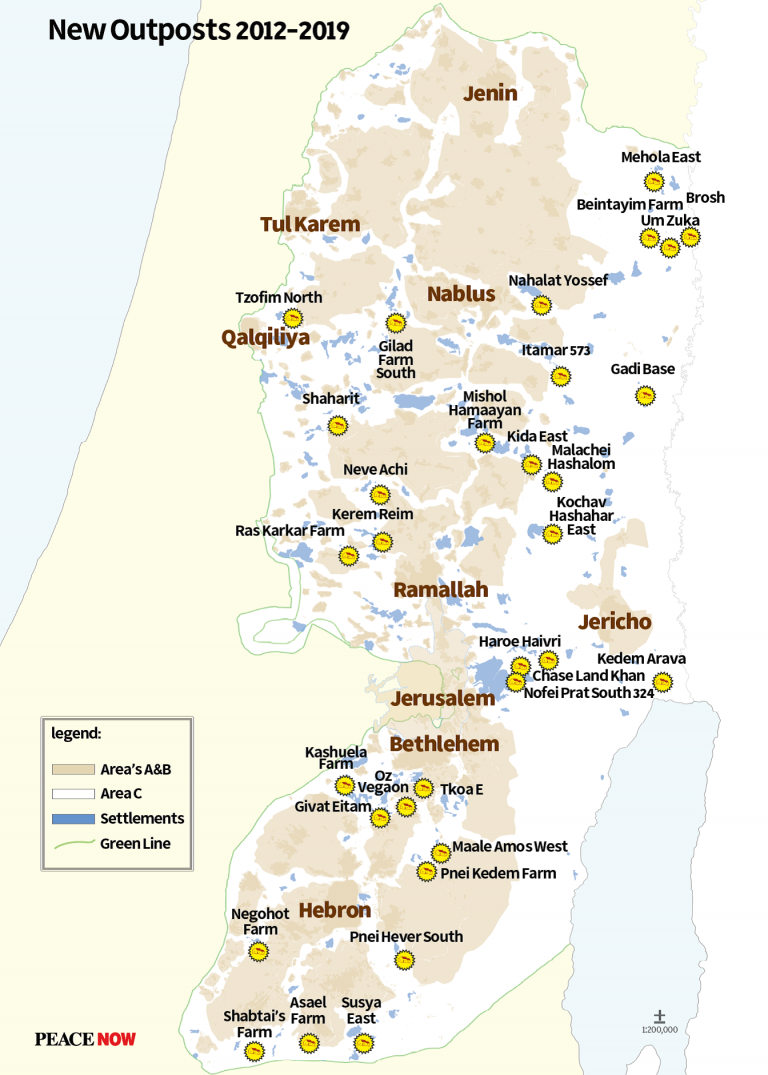 In a new report entitled, “Return of the Outpost Method,” the Israeli settlement watchdog group Peace Now documents the proliferation of new illegal outposts (i.e., new settlement sites established in contravention of Israeli law and regulations; according to international law, ALL settlement activity is illegal) in the West Bank over the past 7 years, with the direct assistance of the Israeli government. The report catalogues 32 new unauthorized outposts established deep in the West Bank since 2012; of those, 18 (56%) were established during the 2.5 years since President Trump took office.
Peace Now said in a statement accompanying the report:
“The Netanyahu government has established dozens of new settlement outposts quietly, without any public debate, in order to take over more territory and prevent the two-state solution. This comes despite talk of regulating the legal status of the more established outposts, in part to create a semblance of law enforcement in the West Bank. When the government and Knesset declare that they will do anything to legalize any unauthorized construction by settlers and even steal private land, settlers see this correctly as an incentive to build more outposts. This outpost method has consequently become a choice tactic in the process of de facto annexation of the West Bank, and it is leading us to a permanent single undemocratic state.”
For many years prior to 2012, settlers did not devote much effort towards establishing new outposts, a decision that bore in mind effective forms of international criticism of outpost construction in addition to the signals sent to the settlers by the Israel government’s decision to evacuate the unauthorized outposts. It was only after March 2011, when Netanyahu’s government declared its intention to legalize as many outposts as possible, that settlers once again set out to build outposts and claim more land in the West Bank. True to its word, the Netanyahu government has undertaken several legal projects aimed at retroactively legalizing these new outposts along with others, a campaign which FMEP has chronicled in detail (see here).
Additional key findings of the new Peace Now report include:
- Since 2012, 32 new outposts have been established, the majority after President Trump was elected. All of the new outposts (except one) are located deep inside the West Bank, in areas that Israel will likely have to evacuate within the framework of any imaginable permanent agreement.
- 21 of the outposts are agricultural farms, which take over large areas for pasturing and cultivation, while their settlers work to remove Palestinian shepherds and farmers from the vicinity.
- Around some of the new outposts there is an increase in violence and attacks against Palestinians.
- The outposts are established in an organized fashion with the involvement of the local settlement authorities, Amana and the Settlement Division of the World Zionist Organization.
- At the same time, the government is working to retroactively legalize existing outposts. To date, 15 outposts have been legalized (“regularized”) as independent settlements or “neighborhoods” in existing settlements. At least 35 additional outposts are undergoing the legalization process.
- One of the outposts established in 2012, Kerem Re’im, has already been legalized, thus becoming an official settlement with nearly 70 families living in dozens of permanent homes.
Settlement Construction Boom Preys on Vulnerable Palestinian Workers
Al-Monitor spoke with several Palestinian construction workers about the risks of participating in the surge of settlement construction that has unfolded in the Trump-Netanyahu era, which has spurred a 39% increase in Israeli spending on infrastructure in the West Bank. The surge has exacerbated an employment “catch-22” facing Palestinians: many Palestinians see no other option but to work in the settlements, but by working in the settlements, they facilitate the expansion and entrenchment of Israeli occupation that ensures there can be no normal Palestinian economic development within which they could find alternate employment.
In addition to that moral/political dilemma that settlement jobs present to an exploited and severely underemployed Palestinian workforce, Al-Monitor columnist Miriam Deprez explains:
“Settlement construction thrives off systemic labor rights abuses of the Palestinian workers by denying proper wages, insurance and basic personal protection equipment, complain the workers and a handful of organizations who try to protect them.”
One Palestinian laborer, Naser Qaswal, worked in a settlement for 25-years before he was forced to leave his job because of injuries he sustained due to the physical demands of the job, yet the settlement employer has not paid Qaswal any form of compensation. According to Qaswal, his cousin lost two fingers in an accident while working at an Israeli settlement, but he did not hold ask his employer for compensation or support in fear that Israel would withdraw his permit to work in Israel. Another laborer, Ahmed, explained how his father fell three stories off a crane while working at a settlement. The accident left him paralyzed from the neck down. The employer paid wages and caregiver fees to Ahmed’s family for the next two years, until his father passed away at the age of 52. The family was left with no income.
The absence of labor safety regulations in the settlements does not only affect Palestinians, as tragically illustrated on July 26th by the death of an Israeli two days after he fell off of a ladder while on the job at a construction site in Neriya settlement. Haaretz reports that the 2019 death toll for settlement laborers stands at 48.
Settler Groups: We Want Israeli Annexation, But Not Israeli Law
For years, settlers have been demanding that the Israel law treat the settlements exactly as part of Israel, with demands for Israeli law to apply and increasingly for outright annexation. Yet, now it seems settlers want to have their cake and eat it too, as illustrated by the Hebron Hills Regional Council – a settlement municipal association – which is fighting against a High Court petition that seeks to extend Israeli laws over settlements in its jurisdiction. Why? Because in this case, Israeli law would limit the Council’s ability to collect association fees from new homebuyers. The petition stems from a request by 26 settlers to who paid exorbitant fees to the association when they moved to the Eshkolot settlement, located in the southern tip of the West Bank but on the Israeli side of the separation barrier.
Haaretz writes:
“…the Hebron Hills Regional Council as well as the Eshkolot community association are arguing before the court that the rule on fees should not apply to [the West Bank]. The Hebron Hills Regional Council’s stand is particularly surprising because like other settler regional councils, it has been insistently calling for Israeli law to be applied in the settlements. Against this, the government is arguing that the rule applies to the settlements because it is a policy of the government’s Custodian for Government and Abandoned Property. What applies inside the Green Line, applies outside it and to Eshkolot.”
Regavim Ups Pressure on Candidates to Promise Annexation of Area
On July 19th, the radical settler group Regavim placed full-page newspaper ads warning: “A Terrorist State – Just Around the Corner.” The group accused the Israeli government of ignoring the alleged “Arab takeover” of Area C, some 60% of the West Bank that the Oslo Accords placed under (temporary) full Israeli control, as an interim stage towards negotiating permanent status of the West Bank and East Jerusalem. Specifically, Regavim accused the government of allowing the Palestinian Authority to build thousands of structures on “state-owned land in strategic locations,” construction which the settlers allege is funded by the European Union with the intention of propping up a “terrorist state” next of Israel. Regavim called on ministers and Knesset members to “take immediate action to prevent a terrorist state in our backyard.”
Settler-Palestinian “Business Council” Visits Dead Sea
On July 9th, leaders of the “Judea and Samaria Chamber of Commerce” took a field trip to the Dead Sea. Ashraf Jabari – one of the few Palestinians who attended the recent U.S.-convened “Peace to Prosperity” shindig and the only Palestinian given a speaking role on-stage at the event (also the only Palestinian to publicly praise the event) – said that the trip was a “direct continuation of the economic workshop in Bahrain,” and mentioned that the group was exploring opportunities to expand cooperation between Israeli and Palestinian business communities.
As FMEP has previously covered, Jabari has been slammed as a traitor by the Palestinian Authority, shunned and dismissed by his fellow Palestinian business people, and disowned by his family in light of his ongoing role with the Judea and Samaria Chamber of Commerce, an initiative Jabari runs alongside Israeli settlers.
Bonus Reads
- “The US Law Restricting Satellite Imagery of Palestine-Israel” (Al-Shabaka)
- “How the Goliath of the Jerusalem settler movement persuaded the world it’s really David” (Mondoweiss)
- “Amnesty International Requests TripAdvisor Employees to Delist Jewish Settlements” (Jerusalem Post)
- “In Bethlehem basement, Palestinian distiller is toasted with global acclaim” (Times of Israel)
- “I’m an Israeli settler. This is why I spoke with J Street’s first ‘alternative Birthright’ group.” (JTA)