Welcome to FMEP’s Weekly Settlement Report, covering everything you need to know about Israeli settlement activity this week.
To subscribe to this report, please click here.
August 17, 2023
- New Petition Filed Against Israel Moves to “Legalize” the Homesh Outpost
- Israel Massively Expanding Size of Outposts As Part of “Legalization” Process
- Israel to Allocate $180million to Settlements & Outposts
- Smotrich Orders Outpost Evacuation
- Emboldened Settlers Attack Village of Burqa, Murder Palestinian Teen
- Bonus Reads
New Petition Filed Against Israel Moves to “Legalize” the Homesh Outpost
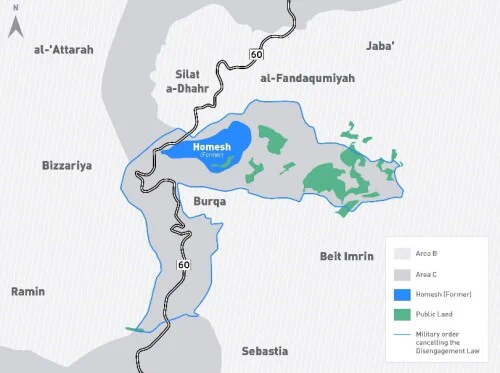
Palestinian landowners have filed a new petition with the Israeli High Court of Justice against the legalization of the Homesh outpost on a small sliver of state land surrounded by privately owned Palestinian land. The petition, which was filed in cooperation with the Israeli NGO Yesh Din, comes two weeks after another petition seeking the removal of the outpost was dismissed by the Israeli court. The State has been ordered to submit an initial response by mid-September.
Yesh Din said in a statement:
“The allocation of land to the Samaria Regional Council for the sake of establishing a new settlement deepens the continuation of systemic and blatant discrimination in the allocation of public lands in the West Bank. Less than one percent (! ) From the public lands were allocated for the benefit of the Palestinian public, while 99% were allocated to the settlements factory.
In this case, the purpose of the allocation is to promote political interest of a political level that cannot be part of the considerations of the military commander both according to international law and according to the High Court ruling. And in the specific context, the decision to allocate the land specifically to the Samaria Regional Council – in light of its many years involvement in breaking the law in the region – is unreasonable and in terms of awarding a prize specifically to the factors behind the violation. It even contradicts the authority and the main duty of the military commander to preserve and promote public order.”
As a reminder – Homesh was built on lands historically belonging to the Palestinian village of Burqa. The land was never returned to its Palestinian owners even after the settlement was dismantled in 2005. The legalization of the Homesh yeshiva – which was built illegally by settlers in the area where the Homesh settlement once stood – was explicitly agreed to in the coalition deals which formed the current Israeli government. On May 18, 2023 the IDF Commander signed a military order that finalized the Knesset’s recent repeal of key sections of the 2005 Disengagement Law, allowing Israelis to legally enter the area in the northern West Bank where the Homesh settlement stood before it was dismantled. In parallel, the Israeli Defense Minister announced that the government plans to relocate the Homesh outpost from its current location on land that Israeli courts have recognized as private Palestinian property, to a small plot of nearby “state land.” Settlers quickly rebuilt the yeshiva on the “state land” and the new outpost was soon connected to the State water grid.
Israel Massively Expanding Size of Outposts As Part of “Legalization” Process
 As part of the process of granting retroactive legalization to the outposts of Asa’el and Avigail (both located in the South Hebron Hills), the IDF recently published new maps of the proposed jurisdiction of the new settlements, showing that the government is planning to massively expand the new settlements’ boundaries. The Israel government approved the outposts for retroactive legalization, along with eight others, in February 2023. Now that the maps have been published, the public has 21 days to submit objections to the plans.

The Israeli non-profit Kerem Navot reports that the proposed new boundary of the Asa’el settlement is eighteen times larger than the outpost. The boundary of the Avigail settlement is nearly three times the size of the outpost. The Avigail outpost is located in Firing Zone 918 in the South Hebron Hills. This is the same firing zone that is home to the Palestinian communities of Masafer Yatta — whose existence pre-dates Israel’s declaration of the area as a firing zone. Those communities are today in the process of being ethnically cleansed by Israel.
Both Avigail and Asael have, illegally, built access roads on privately owned Palestinian land. Legalization of the outposts will undoubtedly also include the theft of the Palestinian-owned land these roads were illegally built on.
Israel to Allocate $180million to Settlements & Outposts
According to news reports, the Israeli government will soon vote to allocate an additional $180million (NIS 670 million) in the 2023-2024 state budget to settlements, including over $7 million (NIS 27.6 million) specifically for improving infrastructure in unauthorized outposts. The effort is being led by Finance Minister and minister in the Defense Ministry Bezalel Smotrich aligned with Settlements Minister Orit Strock. Ynet reports that the new funding calls for the conversion of five IDF bases in the West Bank to be converted into new settlements or industrial zones.
Peace Now reports further details of the budget:
- $25 million (NIS 95 million) allocated directly to the World Zionist Organization’s Settlement Division. As a reminder, the Settlement Division is a body within the WZO established in 1971 and fully funded by the Israeli government. Its mission was, and remains, to provide a channel by which the government can establish settlements – legally and illegally – in the occupied territories, while avoiding the pesky rules, regulations, and transparency requirements to which government entities are bound. The Israel government assigned management responsibilities to the WZO for over 60% of the land in the West Bank which the government declared to be “state land” (90,000 acres/400,000 dumans). The WZO has given that land to settlers to build settlements and secretly funnel government money to illegal outposts.
- $13 million (NIS 50 million) for encouraging Israeli Jewish citizens to move to settlements
- $3.6 million (NIS 13.7 million) for developing West Bank archaeological tourism sites, which comes in addition to the May 2023 invest of $9 million into these sites.
- $11.9 million (NIS 45 million) for the establishment of a new hospital.
- $15 million (NIS 57 million) for encouraging Israelis and others to move to the settlements.
The budget for these investments is being taken from the budgets of domestic programs.
Peace Now said in a statement:
“The Government of Israel is exerting all its power and the budget at its disposal to support one specific sector at the expense of the entire public. The allocation of 700 million NIS by the current government decision is evidence of the public officials’ shamelessness in prioritizing the interests of a small group living in occupied territory over the broader Israeli society. Instead of investing in Israel’s future, the Israeli government is pouring money into settlements, perpetuating the occupation, and fueling the conflict and confrontation with the Palestinians.”
Smotrich Orders Outpost Evacuation
On August 14th, on the orders of Bezalel Smotrich the IDF dismantled five buildings in an illegal outpost called “Aira Shahar“, from lands located east of Ramallah. The outpost remains on the land, with at least 15 structures allowed to remain. In explaining the demolition of the five buildings, Smotrich stressed that he attempted to negotiate the relocation of the buildings from lands recognized as privately owned Palestinian land to nearby state land. But settlers did not agree, and even attempted to stop the security forces from demolitioning the buildings by burning tires and scattering spikes on the access road.
Smotrich took heavy criticism from members of his own parties and the settlers who he serves. In his defense, Smotrich said:
“We are talking about several new buildings that were erected on regulated and private lands that belong to Arabs. We really want to settle anywhere in the Land of Israel, but there are laws and restrictions. We are doing things that have not been done for many years.”
Bonus Reads
- “Samaria farms open to public touring for the first time” (Arutz Sheva)
- “6 Things to Remember When Covering Israeli Settler Violence“ (IMEU)
- “West Bank: Entire Palestinian communities disappeared due to Israeli settler violence” (Norwegian Refugee Council)
- “Settlements Are the Engine of Israel’s ‘Forever Occupation’—and a War Crime” (Michael Lynk for DAWN)
- “The settlers wanted supreme power. They got a rebellion instead” (Meron Rapoport for +972 Magazine)
- “Palestinian Family Evicted From East Jerusalem Home Ordered to Pay for Own Eviction” (Haaretz)
- “‘Israel wanted a silent, perfect victim. We refused’” (+972 Magazine)
- “Ex-Israeli General Says Army Partner in West Bank War Crimes, Invokes Nazi Germany” (Haaretz)
- “Israeli Court Orders Release of Settler Suspected of Killing Palestinian in West Bank” (Haaretz)
- “Israel Prevents Palestinians From Defending Themselves as It Empowers the Settlers” (Amira Hass for Haaretz)
- “Radical Settlers Now Control the Israeli Government. This One Became a Left-wing Activist” (Haaretz)
Welcome to FMEP’s Weekly Settlement Report, covering everything you need to know about Israeli settlement activity this week.
To subscribe to this report, please click here.
February 17, 2023
- Israeli Government Announces Massive Settlement Expansion/De-Facto Annexation, Part 1: The Big Picture
- Israeli Government Announces Massive Settlement Expansion/De-Facto Annexation, Part 2: “Legalization” of Outposts
- Israeli Government Announces Massive Settlement Expansion/De-Facto Annexation, Part 3: Thousands of New Settlement Units
- Israeli Government Announces Massive Settlement Expansion/De-Facto Annexation, Part 4: International Responses
- Cabinet & Knesset Advance Bill to Repeal Parts of 2005 Disengagement, Reestablish Four Settlements Including Homesh
- Smotrich’s Plans to Take Over the West Bank
- Settler Olive Orchard & New Outpost Are Dismantled by Government, Causing Coalition Fight
- Settler Groups Convene Workshop on Jordan Valley Annexation
- Bonus Reads
Israeli Government Announces Massive Settlement Expansion/De-Facto Annexation, Part 1: The Big Picture
On February 12th, the Israeli Cabinet announced the single largest batch of settlement approvals in the past decade (and the first settlement announcement in more than a year). In announcing this huge wave of settlement activity, the Cabinet said it was doing so in response to a recent spate of Palestinian attacks on Israelis, most recently a car ramming attack in East Jerusalem.
As detailed below, the numbers of new settlement units and newly legalized outposts involved in this announcement are huge, but those numbers only tell a part of the entire story. With these approvals Israel is also laying the groundwork for massive infrastructure projects for the benefit of settlers and further entrenchment of Israeli security to protect these investments.
Moreover, there is no reason to believe this massive announcement is the end of the story with respect to new settlement approvals; it should be recalled that key members of the Security Cabinet – specifically Ben Gvir and Smotrich – reportedly pressed for an even bigger batch of settlement advancements, including the legalization of 77 outposts and approval of 14,000 new settlement units. The February 12th approvals will only whet the appetite of these ministers for more – and given the ongoing escalation of violence on the ground, there is every likelihood that future attacks against Israelis will be used as pretexts for meeting their demands.
Israeli Government Announces Massive Settlement Expansion/De-Facto Annexation, Part 2: “Legalization” of Outposts
In its Feb 12th decision, the Israeli Cabinet directed the relevant ministries to carry out the necessary steps to grant retroactive legalization to ten outposts located across the West Bank. In order to be fully legalized under Israeli law (but not under international law, according to which it is illegal for an occupying power to establish any civilian settlement/colony in any territory it is holding under military occupation is illegal) these outposts will need to have the status of the land clarified, then have a building plan completed, and then go through a 5-step approval process. Finance Minister Bezalel Smotrich made clear he intends to radically simplify and speed up this process when/if he is able to take control over West Bank planning bodies.
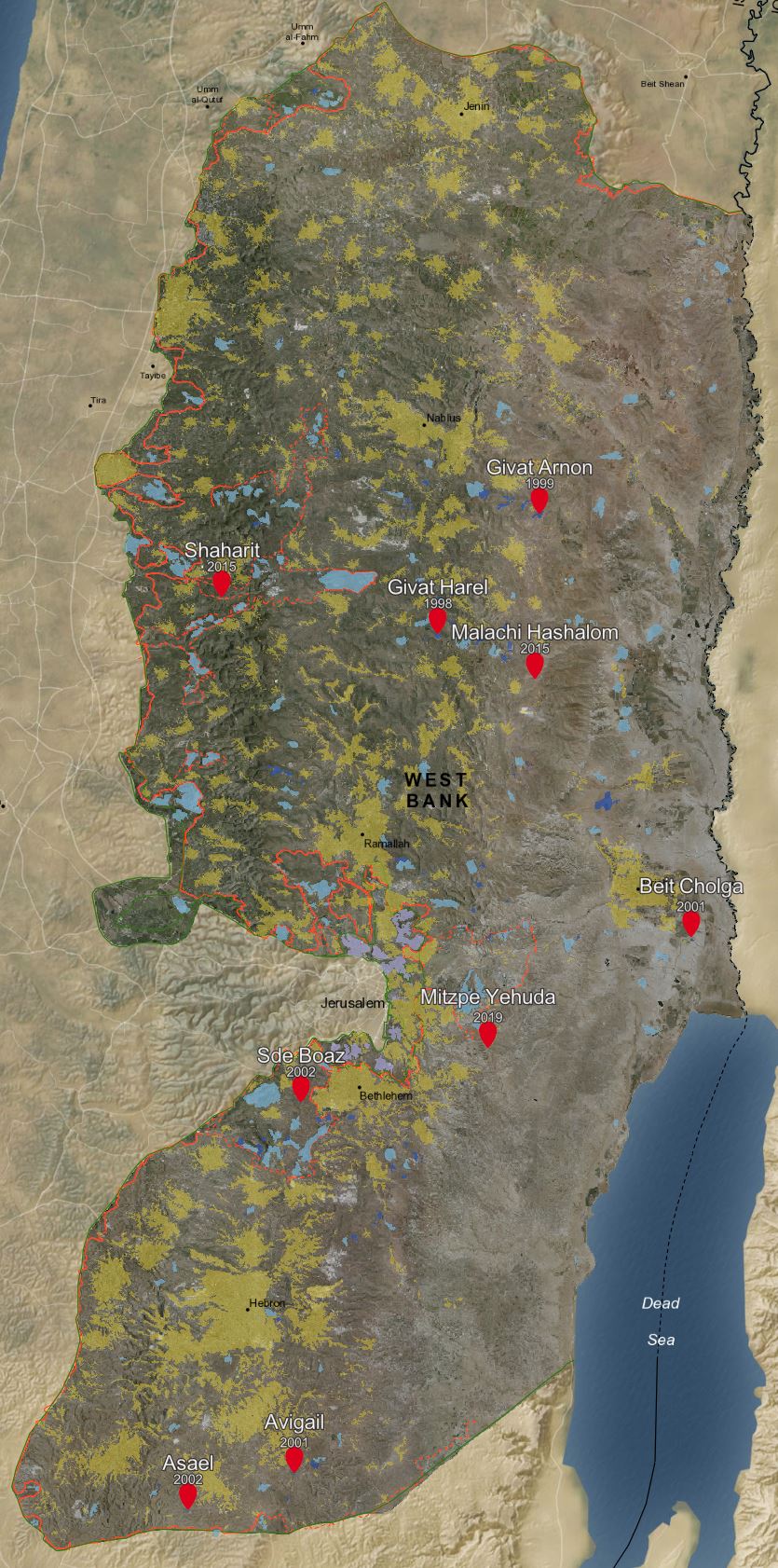
Importantly, Haaretz reports that a source said the Cabinet chose these outposts for authorization specifically because they are all located in remote or isolated locations — meaning they cannot be “legalized” via expanding the borders of a nearby settlement and declaring the outposts to be merely neighborhoods of those “legal” settlements (a legal maneuver Israel has repeatedly used to expand settlements and retroactively legalize settlements). This means, among other things, that legalization of these 10 new settlements will likely lead to additional land seizures for related infrastructure work (work that was not legally possible until now).
With respect to the remaining outposts that remain not-yet-legalized, the Cabinet approval included a clause that makes them eligible – right away, even as they remain illegal – to receive Israeli municipal services like water and electricity. Defense Minister Galant only has to sign an electricity order that was crafted under the previous government. If implemented, connecting illegal outposts to state infrastructure amounts to the de facto legalization of these outposts, even without a formal act to declare them legal.
The ten outposts slated to become official, “legal” new settlements are: Avigail, Asael, Shaharit, Givat Arnon, Givat Harel and Givat Haro’eh (which will be combined into one new settlement), Malachei Hashalom, Mitzpe Yehuda, Beit Hogla, and Sde Boaz. For further details on these outposts, please see Peace Now’s report.
Of note:
- Six of the outposts are located partially on land privately owned by Palestinians (Avigail, Givat Haroeh, Givat Harel, Givat Arnon, Mitzpe Yehuda, Malachei Hashalom).
- Three of the outposts (Avigail, Givat Arnon, and Malachei Hashalom) are located within Israel-designated firing zones, where under Israeli law any civilian presence, much less illegal civilian construction, is prohibited.
- Of particular note: the Avigail outpost is located in Firing Zone 918 in the South Hebron Hills. This is the same firing zone that is home to the Palestinian communities of Masafer Yatta — whose existence pre-dates Israel’s declaration of the area as a firing zone. Those communities are today in the process of being ethnically cleansed by Israel, based on the same law that Israel is ignoring in its legalization of the Avigail outpost.
- Two of the outposts (Avigail and Asael) have, illegally, built access roads on privately owned Palestinian land. Legalization of the outposts will undoubtedly also include the theft of the Palestinian-owned land these roads were illegally built on.
- Three of the outposts (Schacharit, Mitzpe Yehuda, and Malachei Hashalom)- are so-called “farming outposts.” That means they include very few buildings (3, 4, and 10, respectively), but a lot of land. The phenomenon of farming outposts, which have proven to be an incredibly efficient way for settlers to take over large areas of the West Bank with minimal investment in buildings and the involvement of very few people. This has been documented by the Israeli NGO Kerem Navot, which called the tactic “Israel’s most significant mechanism for dispossessing Palestinian communities.”
Minister Smotrich celebrated the announcement of the legalization of the 10 outposts and promised that there is more to come:
“That is what we as a government and as a people must do. Settlements thrive thanks to the pioneers, with much love and determination…We’ve authorized 10 outposts and we have the means to authorize more if required. My coalition partners understand this is the logical move. We’re also committed to removing all restrictions on settlement expansion in Judea and Samaria. This area must be managed in accordance with the Israeli law applicable in all parts of Israel.”
The Minister of the Negev, the Galilee and National Resilience, Yitzhak Wasserlauf, also celebrated the announcement as the start of things to come:
“Congratulations to the Security Cabinet that accepted Minister Ben-Gvir’s request and approved the communities. The dedicated settlers deserve to receive water, electricity, and public buildings. However, we will not be satisfied with just nine settlements, they are only the beginning, on the way to training more settlements, on the way to the fulfillment of the Zionist vision.”
As a reminder, Yitzhak Wasserful (a member of Ben Gvir’s Otzma Yehudit part) was granted an expanded portfolio as the Minister of the Negev and Galilee. He will now also oversee a new “young settlement department” (“young settlement” is a euphemism used by settlers for illegal outposts) that will be engaged in preparatory work for the legalization of outposts, and will also work on plans to deliver infrastructure to the outposts.
Israeli Government Announces Massive Settlement Expansion/De-Facto Annexation, Part 3: Thousands of New Settlement Units
As a result of the February 12th Israeli Security Cabinet meeting, the Civil Administration’s High Planning Council – the body that currently oversees all planning/building in the occupied West Bank – will convene in the coming days to advance plans for over 7,000 new settlement units (Minister Smotrich says 10,000 units will be advanced).
Of that total, Haaretz reports that 1,943 units are expected to immediately receive final approval for construction (including some units which have already been built but will be legalized); another 5,089 units are expected to be advanced in the planning process.
While there is no comprehensive list of all of the plans involved in these approvals and advancements, Haaretz reports that the plans expected to receive final approval will include new units in the following settlements: Rahelim, Neriya, Dolev, and Elon Moreh, Mevo’ot Yericho, and Elazar. Arutz Sheva further reports that 210 units in the Mevo Horon settlement will receive final approval, 100 of which were built illegally already.
Of particular note is a plan for 443 units in the Elazar settlement. This is, effectively, the reestablishment of the Netiv Ha’avot outpost, where five years ago the Israeli government demolished 17 structures because they were partially built on privately-owned Palestinian land (as compensation for those demolitions, the Israeli government built the evacuees an entirely new outpost near the Alon Shvut settlement, and then went about expanding the borders of the settlement to include the new buildings).
The plans not yet ready for final approvals but that are expected to be advanced in the planning process include plans for new construction in the Adam-Geva Binyamin settlement (356 units), the newly established Tel Zion settlement (627 units), the Kochav Yaakov settlement (160 units), and the Mitzpe Yericho settlement (350 units).
Israeli Government Announces Massive Settlement Expansion/De-Facto Annexation, Part 4: International Responses
Key members of the international community were quick to come out in (rhetorical) opposition to Israel’s massive settlement announcement. The U.S., U.K, France, Germany, and Italy released a joint statement “strongly opposing” the announcement saying they are “deeply troubled” by it – but none suggested they were entertaining any thoughts of imposing consequences.
The Palestinian Authority is reportedly pressing the United Nations Security Council to hold a vote in the coming days on a resolution calling on Israel to “immediately and completely” halt settlement activities. The U.S. has called the draft resolution “unhelpful” and is reported to be working against it (while also issuing public statements of dismay). Axios reports that Israeli officials believe the Palestinians are likely to secure enough support for such a resolution to pass if it is brought up for a vote, which would put the U.S. in the position of having to decide whether to vote in favor (inconceivable), abstain (improbable), or veto (likely). The U.S. is reportedly trying to convince the Palestinians to accept a statement from the Security Council in lieu of a vote.
Cabinet & Knesset Advance Bill to Repeal Parts of 2005 Disengagement, Reestablish Four Settlements Including Homesh
On February 14th, the Ministerial Committee for Legislation (a body of Ministers who decide whether to give government-backing to bills prior to their introduction to the Knesset) voted to give its approval to a bill that would repeal specific clauses of the 2005 Disengagement Law. These are the clauses that prohibit Israelis from living in the area of four settlements in the northern West Bank that were evacuated under Disengagement. If passed by the Knesset, the repeal of those clauses will allow the government to proceed with its plans to reestablish the Homesh settlement and retroactively legalize the yeshiva located there (as well as, in theory, allowing the reestablishment of the other three evacuated settlements).
Quickly following the Cabinet’s vote, the bill passed its preliminary reading in the Knesset on February 15th. It will need to pass three more readings before becoming law.
Peace Now explains the implications:
“From a human rights perspective, this will lead to a massive stealing of Palestinian land alongside increased settler violence and real danger to Palestinian lives. Homesh was primarily built on private Palestinian lands registered in the tabu (the Land Registration Office). Thus, this law will drive a final nail in the honest attempt of Palestinians to recover the massive land grab that was taken from them, and from the landowners in particular. In addition, although the Homesh settlement was evicted, a small Yeshiva located there has since been a source of violence from settlers who receive protection from the army while preventing Palestinian farmers from reaching their land. The lifting of the legal ban on the presence of Israelis in the area will provide an incentive for the arrival of more Israelis in the area. As a result, Palestinian lands will continue to be, at least de facto, expropriated.”
As a reminder, the retroactive legalization of the Homesh outpost was agreed to in coalition agreements that enabled the formation of the current Israeli government. Repealing the relevant parts of the 2005 Disengagement Law is the first step to implementing this commitment.
Also as a reminder: The government is currently facing a deadline from Israel’s High Court of Justice to submit its position on the court-ordered evacuation of the illegal yeshiva settlers built at the site of the dismantled Homesh settlement. The State has for nearly three years delayed its response to a 2019 petition filed by Yesh Din seeking both the removal of the illegal outpost and yeshiva at the site, as well as the site’s return to its Palestinian landowners. Despite Homesh being dismantled in 2005, Israel never permitted Palestinians to regain access to or control of the land, declaring it a closed military zone. That status has prevented Palestinians from entering the area, even as the IDF permitted settlers to routinely enter the area, to live (illegally, under Israeli law) at the site, and to illegally establish a yeshiva there. That yeshiva, according to the Israeli NGO Kerem Navot, has become one of the West Bank’s “hardcore centers of settler terror”. Settlers have also wreaked terror on nearby Palestinian villages, most notably Burqa and Sebastia. One Israeli politician even went so far as to say that settlers are “carrying out a pogrom” in Burqa.
Smotrich’s Plans to Take Over the West Bank
Haaretz obtained a draft government decision detailing plans to create a proposed “Settlement Administration” within the Defense Ministry. This plan would give Bezalel Smotrich – a minister in the Defense Ministry – authority, either directly or through his appointee, over the entire Civil Administration and, ipso facto, all civilian affairs in the West Bank. Smotrich proposes his new “ministry within a ministry” receive an initial budget of at least 80 million shekels.
The draft proposal was circulated to Ministers this week, but still faces opposition, including from Defense Minister Gallant – at whose expense Smotrich’s power grab would come. According to Haaretz, the proposed draft includes a carve-out for Gallant to overrule Smotrich’s authority over civil matters “in exceptional circumstances subject to the defense minister’s decision to change a specific decision or action in exceptional cases, with appropriate justification and subject to hearing the position of the other minister.”
The proposal is also opposed by IDF Chief of Staff Herzi Halevi, who reportedly told Prime Minister Netanyahu fears the plan would lead to a breakdown in the IDF chain of command.
Settler Olive Orchard & New Outpost Are Dismantled by Government, Causing Coalition Fight
A series of enforcement actions against illegal settlement activity in the West Bank has further driven a wedge between members of Netanyahu’s far-right coalition.
First, on February 12th Israeli forces dismantled a new outpost – dubbed “Gofna” by settlers – located in the northern West Bank. Six settler families arrived the previous night in an organized effort to quickly build several structures. Those buildings were demolished by the Israeli Border Police; settlers attempted to prevent the police from carrying out the evacuation. The Gofna outpost was previously established (and quickly dismantled) in July 2022 as part of a massive campaign led by the Nachala Movement to set up new outposts across the West Bank.
Then, on February 15th the Civil Administration uprooted over 800 olive trees that a settler illegally planted on land that the Israeli High Court has recognized as privately-owned Palestinian land, located near the Shilo settlement. The 2023 Court ruling concluded 15 years of litigation, but its enforcement has been repeatedly postponed. Dozens of settlers clashed violently with Israeli Border Police carrying out the tree removal; some of the settlers climbed the trees in hopes of stopping the bulldozers, and even some Knesset Members angrily tried to stop the officers from carrying out the law. Forty settlers/settler supporters were temporarily detained for their part in the violence; four Border Police officers were suspended after video footage captured them attacking one of the protestors.
Reports of the removal of the trees caused an immediate crisis in the government. Smotrich claimed that he had previously issued an order that vacated the court-ordered evacuation (in effect, Smotrich asserting the power to personally overrule the Israeli High Court). Any such order Smotrich may have issued was apparently overruled by Defense Minister Gallant – – with whom Smotrich is engaged in a power struggle (discussed above). Smotrich then wrote an urgent letter to Prime Minister Nentanyahu, who ordered the Civil Administration to halt the demolition hours after it began, though only a few trees remained in the ground at that point.
Smotrich later rehashed the turmoil, saying:
“To my astonishment, Defense Minister [Yoav Gallant] grossly violated the coalition agreement and reversed my decision…And, instead of implementing a settlement security policy, Gallant chose to continue the left-wing policy of former minister Benny Gantz and uproot the grove even though the claims against the grove were proven to be false in the legal proceedings…..violation of the [coalition] agreements will make it very difficult for the government and the coalition to conduct themselves properly.”
Later, on Twitter, Smotrich continued:
“Defense Minister Gallant’s denial of the unambiguous agreements and the prime minister’s foot dragging on the matter are unacceptable and they cannot continue…if Gallant has a problem, he’s welcome to hand in the keys. I’m sure there are lots of people in Likud who would be glad to take his place at the Defense Ministry.”
Minister Ben Gvir also vented his anger over law enforcement against illegal settler activities, saying:
“This isn’t what we signed up for when we agreed to join the Netanyahu government…We were promised a full-on right-wing government that can’t not evacuate Kahn al-Ahmar or avoid tearing down illegal buildings in East Jerusalem. A right-wing government doesn’t go only after Jews.”
Settler Groups Convene Workshop on Jordan Valley Annexation
Settler groups are continuing their push for Israel to annex the Jordan Valley. On February 12th, two settler advocacy groups held an event for lawmakers and security leaders in the Jordan Valley, starting with a tour of the region and a workshop to “discuss the challenges of sovereignty in the Valley and ways to deal with them.”
Yehudit Katsover and Nadia Matar, co-chairwomen of the Sovereignty Movement, and Nili Naouri, who heads the Israel Forever movement, who together hosted the event, said in a statement:
“sovereignty in the Jordan Valley is a necessary step for both the security, strategic and internal security aspects of the future of Israel, as expressed by prime ministers over the years, leaders of both Right and Left, which illustrates the broad national consensus behind taking the step of sovereignty in this area. Sovereignty in the Valley also does not constitute a demographic threat to the Jewish character of the State of Israel.”
MK Sharen Haskel, who attended the event and who has previously introduced annexation bills in the Knesset, said:
“The message that we’re trying to send is that this is the place where we have to apply sovereignty first. This is not just a question of sovereignty, this is also a question of security and defense of our country and of our people…We are here seeing the mountains on both sides from Jordan and the areas of Judea and Samaria, and we understand that this ground is a tactic ground that is meant to guard our security need of the state of Israel.”
Bonus Reads
- “Israel is Annexing the West Bank. Don’t be Misled by its Gaslighting” (Just Security)
- “Go West Bank: Israel Is Using the Housing Crisis to Lure Israelis Into Becoming Settlers” (Haaretz)
- “The Kohelet Tentacles: Inside the Web Surrounding the Right-wing Think Tank” (Haaretz)
- “Pompeo: Israel has Biblical claim to the land so it can’t be an occupier” (MEMO)