Welcome to FMEP’s Weekly Settlement Report, covering everything you need to know about Israeli settlement activity this week.
To subscribe to this report, please click here.
November 17, 2017
- Building Permits Issued for 240 More Settlement Units in East Jerusalem
- Israel to Displace Palestinians in the Jordan Valley & the Northern West Bank for Settlement Expansion
- Supreme Court & Attorney General Permit State to Seize Private Palestinian Land for Settlers
- New Ir Amim Policy Paper: “Bills and Government Plans for Destructive Unilateral Measures to Redraw the Borders of Jerusalem”
- New Peace Now Report: “Escalation in Israel’s Settlement Policy: The Creation of De-Facto Annexation”
- Bonus Reads
Comments, questions, or suggestions? Email Kristin McCarthy at kmccarthy@fmep.org.
Building Permits Issued for 240 More Settlement Units in East Jerusalem
On November 8th, the Jerusalem Planning and Building Committee issued building permits for 240 new settlement units in East Jerusalem – 90 units in Gilo and 150 units in Ramat Shlomo. The new building permits add to an ever-growing tidal wave of settlement activity in East Jerusalem affecting the viability of the two-state solution, while tightening the screws on the local Palestinian population.
In addition, the committee also approved permits for 44 new units for Palestinians in the East Jerusalem neighborhood of Beit Hanina. These permits are an anomaly: for the past 50 years Israel has systematically discriminated against Palestinian building rights, with only about 7% of building permits issued in Jerusalem going to Palestinians (who represent 37% of the population). Bimkom, an Israeli organization that monitors planning and building in Jerusalem, estimates that 20,000 units in East Jerusalem lack permits while an additional 10,000 more units are needed by Palestinians.
Jerusalem expert Danny Seidemann recently explained
Since 1967, the Government of Israel has directly engaged in the construction of 55,000 units for Israelis in East Jerusalem; in contrast, fewer than 600 units have been built for Palestinians in East Jerusalem, the last of which were built 40 years ago. So much for (Jerusalem Mayor Nir) Barkat’s claim ‘we build for everyone.’
In Beit Hanina, as in Palestinian neighborhoods across East Jerusalem, Israeli demolitions of buildings – based on the argument that they lack permits – only add to the misery. The most recent demolition in Beit Hanina happened last month.
Israel to Displace Palestinians in the Jordan Valley & the Northern West Bank for Settlement Expansion
For the first time, the Israeli army appears to be preparing to evict Palestinians from their land through the use of a 2003 military order meant to handle the evacuation of unauthorized Israeli outposts. Palestinians living in the northern Jordan Valley discovered the eviction order affecting around 136 acres of their land – which sits near several Israeli settlements.
A lawyer representing the Palestinians in this case submitted a petition to the Israeli Coordinator of Government Activities in the Territories (COGAT) to stop the implementation of the order. The lawyer, Tawfiq Jabareen, argues, “This is a mass expulsion order against the Palestinian population that violates international law.”
The Haaretz Editorial Board powerfully rebutted the Israeli army’s argument that the order does not, in fact, actually call for the evacuation of the Palestinians, but will only demolish structures built without Israeli permission. The Editorial Board writes,
Whatever legal proceeding ensues, the fact is that this declaration is an escalation of the pressure on the local Palestinians and part of the declared Israeli intent to evict as many Palestinians as possible from Area C, which is under total Israeli control, including from the Jordan Valley.
It’s no coincidence that near Ein al-Hilweh [one of the targeted areas] are two expanding unauthorized Jewish settlement outposts whose residents periodically threaten the shepherds and try to scare them away from grazing lands in the area. This trend can and must be stopped, because it’s illegal, unjustified and dangerous.
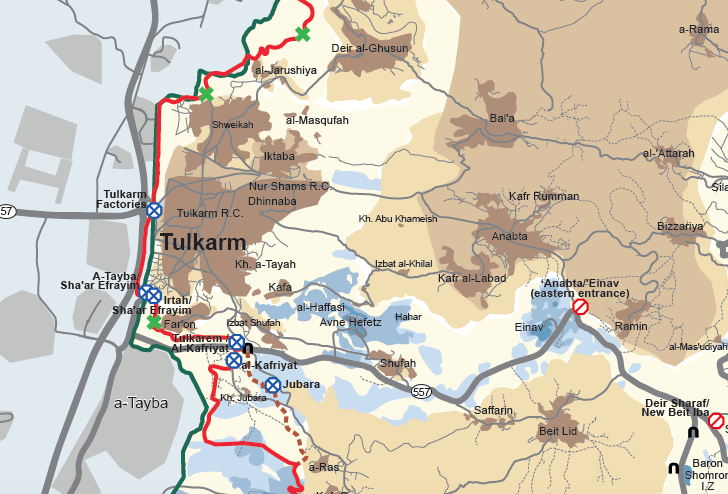
Map by B’Tselem
Israel is also moving to seize land near the city of Shufah in the West Bank, southeast of the Palestinian city of Tulkarem. Palestinian news sources report that the IDF notified residents that Israeli intends to take the land in order to build roads and recreational facilities for a nearby settlement, Avnei Hefetz. Earlier this year, Israel seized land from the Shufah village in order to build a power plant and industrial area for the settlement. In October 2017, the Israeli government advanced plans for 135 new units in the Avnei Hefetz settlement.
Supreme Court & Attorney General Permit State to Seize Private Palestinian Land for Settlers
Israeli Attorney General Avichai Mandleblit released a legal opinion this week asserting Israel’s right to confiscate privately owned Palestinian land for the exclusive benefit of Israeli settlers in the West Bank.
This new opinion concurs with a Supreme Court ruling issued last month that held Israeli settlers are a part of the “local population” of the West Bank, and can be the beneficiaries of state land seizures for “public use.” It also builds on a precedent set earlier this year in the case of the Amona outpost, when the Court ruled that Israel has a duty to care for Israeli settlers forced out of their homes (because those homes were built illegally on privately-owned Palestinian land). The Court ruled that the state has the authority confiscate “abandoned” Palestinian land to do so (Palestinians are systematically denied the right to access lands that are near settlements, Israeli roads, military bases, firing zones, etc., rendering them “abandoned”).
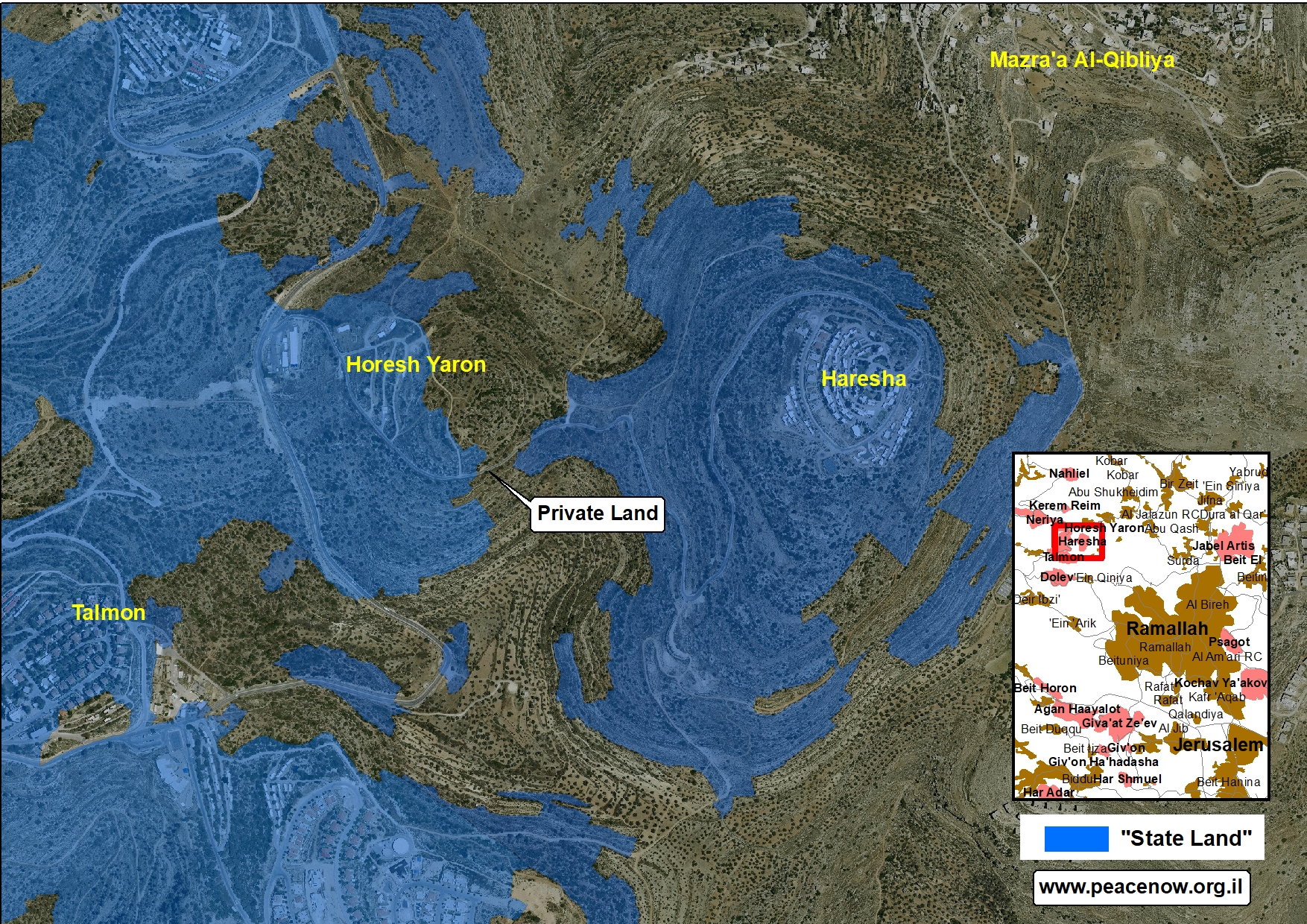
Map by Peace Now
According to the original Amona ruling, the state’s obligation was to provide temporary housing for the affected settlers; according to the subsequent ruling, the state is obligated to care for the settlers by paving roads, without regard to privately owned Palestinian land that would need to be taken. That ruling upheld the state’s confiscation of privately owned Palestinian land in order to legalize an access road to the illegal outpost of Haresha.
Located near Ramallah, the Haresha outpost was established in 1995 without government approval. In January 2010, the State responded to a petition filed by Peace Now and Yesh Din by announcing its intention to retroactively legalize Haresha; less than a year later, in August 2011, Israel seized the land the outpost was built on by declaring it as “state land.” Haresha was approved to become an official settlement in 2015 (Netanyahu legalized 24 other outposts at the same time), but the outpost still needed to submit plans in order to legalize the individual structures. That a planning process has not yet happened – in part because, as Haaretz notes, there is no legal road leading to the outpost. With the access road moving towards legalization, the outpost is set to follow suit.
Speaking to the significance of the decision on the Haresha outpost access road, Israel Justice Minister Shaked said “The attorney general has issued a legal opinion permitting the expropriation of privately owned Palestinian land to permit an access road to [Haresha] that permits the regulation [legalization] of the entire [settlement].” The anti-settlement watchdog Peace Now is expected to appeal the decision upholding the theft of privately owned land for the legalization of the access road. Peace Now issued a statement saying,
Confiscating the land would constitute a severe violation of international humanitarian law and of the Palestinians’ right to own property. The Attorney General’s legal opinion regarding the access road might lead to additional confiscations of private Palestinian lands, strengthening Israel’s stronghold over Palestinian territory. The Attorney General seeks to allow the confiscation of lands owned by Palestinians, who have no voting rights in Israel for the benefit of Israeli settlers with full rights. If the Netanyahu government will continue down this path it will lead us towards a one state reality, based on discrimination and theft.
New Ir Amim Policy Paper: “Bills and Government Plans for Destructive Unilateral Measures to Redraw the Borders of Jerusalem”
The Israeli NGO Ir Amim this week released a new policy paper analyzing the devastating ramifications of Israeli efforts to gerrymander a Jewish-majority in Jerusalem. In addition to essential background on Jerusalem’s environs and analysis of the two pieces of pending Jerusalem-related legislation, Ir Amim provides new analysis of the humanitarian, political, and urban consequences that will follow if these measures are implemented.
Looking at the impacts of the Knesset bill intended to excise two Palestinian East Jerusalem neighborhoods from the Jerusalem municipality, creating new Israeli municipalities to govern them, Ir Amim writes:
The bills and plans currently in circulation seek to displace Palestinian residents living in Jerusalem from the city, and to artificially add to Jerusalem Israeli residents from outside of it. Beyond obvious political implications, these moves can be expected to have serious humanitarian ramifications….
Should practical steps be taken to cut off the neighborhoods beyond the Barrier or a sweeping revocation of their residents’ permanent residency status implemented, we can expect another wave of migration to the East Jerusalem neighborhoods within the Barrier, already strained by a serious lack of infrastructure, services, educational institutions and affordable housing. Living conditions and infrastructure in the East Jerusalem neighborhoods inside the Barrier will decline even further. In this scenario of increasing housing shortages and infrastructure collapse, an upsurge in the number of Palestinian residents who rent or buy apartments in Israeli neighborhoods/ settlements such as Pisgat Ze’ev, Armon Hanatziv and French Hill can be expected. These phenomena, which will occur under conditions of acute uncertainty and anxiety, can be expected to significantly elevate friction and the potential for eruptions of violence in the city. Many other thousands of Palestinians – currently residents of Jerusalem – will remain beyond the Separation Barrier, now administratively displaced from their city and transferred to contrived regional authorities, only exacerbating their distress. Even should they be completely separated from Jerusalem, Israel will not be able to escape accountability for the dire political, urban and humanitarian crisis – and the fertile ground for escalating hostility – it has created.
New Peace Now Report: “Escalation in Israel’s Settlement Policy: The Creation of De-Facto Annexation”
In a new report, Peace Now details the dangerous flood of settlement activity and the de-facto annexation of Area C in the West Bank that the Netanyahu government has pursued without restraint in 2017. The report covers:
- A significant increase in the promotion of plans (6,742 units advanced) and issuance of tenders (3,154 tenders issued) for settlements across the West Bank. This includes the approval of the first new government-backed settlement in 25 years – Amichai.
- The increase in road construction in the West Bank aiming to integrate the settlements into Israel proper, attract more construction and residents in the settlements, and create settler-only highways across the West Bank – all done by expropriating more Palestinian land.
- A dangerous escalation of anti-Palestinian, pro-settlement activities in East Jerusalem including: the simultaneous settlement approvals and eviction of Palestinians from the Sheikh Jarrah neighborhood, the imminent approval of tenders for the Atarot and Givat Hamatos settlements, the expansion of settlement enclaves inside of Palestinian East Jerusalem neighborhood of Jabal al-Mukaber, and the several legislative efforts to gerrymander the borders of the Jerusalem municipality to secure a Jewish majority in the city.
In conclusion, Peace Now writes
All of the abovementioned developments attest to a quantum leap in the promotion of annexation and the blocking of the possibility of a two-state solution. With the speed of developments all across the West Bank and East Jerusalem—and as red lines are being crossed—we are approaching the final stretch before a two-state solution will be almost impossible, and the anticipated situation will be the long years of bloody conflict of Israeli rule over the Palestinians without hope for change. Thus even with the lack of a final status agreement in sight, it is our duty today to prevent silent annexation efforts and to assure the possibility of a two state solution on the ground.
Bonus Reads
- “World Zionist Organization Gave Private Palestinian Land to West Bank Settlers” (Haaretz+)
- “In first, Israel Prize to be Given for Promoting Settlements” (Times of Israel)
- “Palestinian Lawyer Attempted to Report Being Attacked by Settlers. Then He Was Detained Over Back Taxes” (Haaretz)
- “Settler leader revels in Left’s embrace as proof of movement’s power” (Times of Israel)
___
FMEP has long been a trusted resource on settlement-related issues, reflecting both the excellent work of our grantees on the ground and our own in-house expertise. FMEP’s focus on settlements derives from our commitment to achieving lasting Israeli-Palestinian peace, and our recognition of the fact that Israeli settlements – established for the explicit purpose of dispossessing Palestinians in the West Bank and East Jerusalem of land and resources, and depriving them of the very possibility of self-determination in their own state with borders based on the 1967 lines – are antithetical to that goal.
Welcome to FMEP’s Weekly Settlement Report, covering everything you need to know about Israeli settlement activity this week.
To receive this report via email, please click here.
August 16, 2017
- Israel Demolishes Buildings in Key East Jerusalem Areas
- Bedouin are Powerless in E-1 Area as Settlement Plans Loom
- Jewish National Fund Resumes Targeting Land in the Occupied West Bank
- Settlers in Israeli Government Turn Blind Eye to Settlers Breaking Israeli Law
- Former Israeli AG Says Sheikh Jarrah Property Should be Given to Palestinians
- Three New Outposts Near Nablus
- Updates: Al-Walajah, Sheikh Jarrah, Amichai Settlement
- Bonus Reads
Comments, questions, or suggestions? Email Kristin McCarthy at kmccarthy@fmep.org.
Israel Demolishes Buildings in Key East Jerusalem Areas
The Israeli government demolished eight Palestinian structures in the East Jerusalem neighborhoods of Silwan, Beit Hanina, Jabal Mukaber, and Isawiyyah. According to Ir Amim, the two apartments demolished in the al-Bustan area of Silwan are the first demolitions to be carried out there since 2008. Looking at East Jerusalem as a whole, Ir Amim writes, “[these] demolitions bring the 2017 total to 128, including 84 residential units and 44 non-residential units. These numbers are on well on target to meet or surpass the total number of 203 demolitions executed in East Jerusalem last year.”
Bedouin are Powerless in E-1 Area as Settlement Plans Loom
According to B’Tselem, last week Israeli officials confiscated solar panels that were providing electricity to a Bedouin community’s school in the controversial area adjacent to Jerusalem known as “E-1.” The confiscation happened despite a temporary court-ordered injunction against it. The Israeli government has long refused to connect the Bedouin to a power grid; the solar panels confiscated this week were donated only a month ago by a humanitarian organization.

Map by the Economist
The E-1 area has long been slated for Israeli settlement construction, but plans have been continuously delayed by the Israeli political echelon – due in large part to pressure from U.S. administrations and others in the international community. If E-1 is developed it will seal Palestinian East Jerusalem off from the West Bank to its east, and create a land bridge from Jerusalem to the Maale Adumim settlement. The settlement will render the two-state solution impossible because it would preclude the ability to draw contiguous borders for a future Palestinian state with a capital in East Jerusalem.
East Jerusalem expert Danny Seidemann has issued several warnings this year that E-1 – a “doomsday settlement” – might be slated for advancement under the current settlement policy of the Netanyahu government and with no discernable counter-pressure from the Trump Administration. Seidemann warned in January, “The main obstacle preventing a green light for E-1 has, until now, been wall-to-wall opposition from the international community, led by the United States (dating back to the era of President Clinton).”
The Bedouin community living in the E-1 area has long been threatened with forcible relocation (which would amount to population transfer). The 18 Bedouin tribes that live in the vicinity of Maale Adumim and E-1, totaling approximately 3,000 people, have already endured numerous emolitions this year alone.
Jewish National Fund Resumes Targeting Land in the Occupied West Bank
According to Peace Now, the Jewish National Fund (JNF) is set to resume its practice of purchasing land in the West Bank for use by Israeli settlers, after abandoning the effort many years ago. In the past, many of the JNF’s land purchases reportedly involved fraud, extortion, and/or forgery on the part of middlemen.
Peace Now writes, “Through purchasing lands in the occupied territories, JNF serves the settlers, hurts the possibility to arrive at a two state solution, and jeopardizes the future of Israel as a Jewish and democratic state.”
The JNF – which collects donations internationally, including in the United States – currently owns land (through its Israeli subsidiary) in numerous settlements, including Itamar, Alfei Menashe, Enav, Kedumim, Givat Ze’ev, Metzadot Yehuda, and Otniel.
Settlers in Israeli Government Turn Blind Eye to Settlers Breaking Israeli Law
There have been several recent reports about structures inside of settlements that were built (or are being built) without the legally-necessary permissions, as Israeli officials turn a blind eye.

Map of the Hayovel outpost by Times of Israel Red encircles site construction, arrow points to the house of Liberman’s settlement affairs advisor.
Notably, one report identifies dozens of unauthorized homes being built in the outpost of Hayovel (which is effectively an extension of the settlement of Eli), despite a stop-work order issued by Civil Administration (the arm of the Ministry of Defense that is sovereign in the West Bank). The construction is taking place virtually across the street from the home of Israeli Defense Minister Avigdor Liberman’s own adviser on settlement affairs, who is himself a resident of the illegal outpost (Liberman is also a settler, residing in the settlement of Nokdim). The illegal construction will double the size of the outpost.
Another report reveals that Shlomo Ne’eman, the head of the Gush Etzion Regional Council – which promotes the expansion of settlements in the Etzion bloc – lives in an illegal outpost. The Regional Council insists that the outpost is a “neighborhood” of the Karmei Tzur settlement, but aerial images show it is outside of the settlement’s municipal border. The Israeli Civil Administration has ordered the structures there to be demolished but has not carried out those orders. Settlement watchdog Kerem Naboth says, “Ne’eman has joined the list of elected officials and politicos among the settlers who are not only assisting others in stealing land, but are also doing it themselves.”
Haaretz notes that these two are part of a longer list of elected officials and senior civil servants living in illegal outposts, Also on that list far right-wing Knesset Member Bezalel Smotrich (Habayit Hayehudi), who lives in an illegally-built home in Kedumim (not coincidentally, Smotrich was one of the key backers of a law passed earlier this year to “legalize” such settlement illegalities). Likewise, a January report revealed that the head of the Finance Ministry’s department of building regulations enforcement, Avi Cohen, lives in an illegal outpost of the Eli settlement. At the time of the report in January, Rabbis for Human Rights said, “A situation in which the system responsible for enforcing building laws is headed by someone living in an outpost demonstrates contempt for the system and Israel’s values.”

Image by Kerem Naboth
Another report documents how in the Efrat settlement (in the Etzion settlement bloc) a school was recently expanded, illegally, on private Palestinian land located land outside of the settlement’s border. Funding for the project was raised by an organization, called the Ohr Torah Stone, which operates a branch in the United States and is eligible to receive tax-deductible donations from U.S. donors. According to settlement watchdog Kerem Naboth, the Efrat settlement itself was built on land that the Palestinian village of al-Khadr had long cultivated. Kerem Naboth reports, “aerial photographs from the 1980s indicate that in the past there was a vineyard on site.”
Former Israeli AG Says Sheikh Jarrah Property Should be Given to Palestinians
Speaking in Sheikh Jarrah, former Israeli Attorney General Michael Ben-Yair called on the Israeli government to intervene to stop the eviction of the Shamasneh family from their longtime family home. Ben- Yair served as the AG from 1993-1997, under prime ministers Rabin and Netanyahu.
Ben-Yair, whose family lived in Sheikh Jarrah until 1948, suggested he would be ready to reclaim his family’s property and then transfer it to the Palestinians currently living there – and called on the government to adopt a policy to do exactly that, across the board. He said, ”If the Israeli government would have acted decently toward all its residents, including you [the Arab residents], it would have appropriated the properties in the neighborhood [from their Jewish owners who lived there before the War of Independence] and given these properties to the Palestinians who live there today.”
The former AG also noted that Jews who lost property in the 1948 war were already compensated – at the expense of Palestinians. Ben-Yair said, “My family and the family of my cousin who were forced to leave the neighborhood in January 1948 got properties of Palestinians refugees on Jaffa Road and in the Katamon neighborhood in west Jerusalem. They were worth much more than the properties that we left in Sheikh Jarrah.
Since we covered the Shamasneh family’s story last week, a temporary injunction against the eviction expired on Sunday, August 13th. The family’s lawyer requested a second injunction, but the petition is still pending. As of this writing the family is still living in the home.
Three New Outposts Near Nablus
The Palestinian Authority is reporting that settlers from the radical Yitzhar settlement, south of Nablus, have moved 11 mobile homes to an area outside of the settlement, a move which would expand the settlement’s footprint. In addition, nine mobile homes were reportedly placed near the Palestinian village of Qusin, which is a few miles east of Nablus, and another nine were placed near the border of the Einav settlement, a few miles east of Qusin.
Updates: Al-Walajah, Sheikh Jarrah, Amichai Settlement
Updates from last week’s Settlement Report:
- Residents of the village of Al-Walajah were able to stop the demolition of one home last week by forming a human barrier around it, blocking a bulldozer from tearing it down. Approximately one third of the village is inside of Jerusalem’s municipal boundary. In this area specifically, Ir Amim estimates that 50% of the homes are under threat of demolition. Al-Walajah residents say the Israeli government has recently increased the rate of home demolitions significantly and has also resumed construction of the separation barrier around the village.
- UNRWA has weighed in on the pending eviction of the Shamasneh family from their home in Sheikh Jarrah. UNRWA spokesman Christopher Gunness states, “The members of the Shamasneh family are long-standing Palestine refugee residents in East Jerusalem, which is occupied territory and affected by continued settlement expansion contrary to international law. It is a matter of deep concern that Palestine refugees who have already endured multiple displacements should be subject to the humiliation of the kind inflicted by forced evictions.” The statement calls on the Israeli government to reconsider the eviction ruling.
- Construction on the first new settlement in 25 years, Amichai, remains stalled due to lack of government funding. After nearly three weeks of inactivity on the construction site, the families who the settlement is being built for are preparing to move to the area with semi-permanent structures and take up residence. On plans to move to the site while construction is stalled, one settler told Ynet News, “It is clear that when we do go there [to the site of Amichai], thousands of youths will join us. When we do, it will be to stay for good.”
Bonus Reads
- “Adalah opposes mandate of Israeli Interior Ministry borders cmte. weighing annexation of West Bank land to settlements” (August 13, 2017)
FMEP has long been a trusted resource on settlement-related issues, reflecting both the excellent work of our grantees on the ground and our own in-house expertise. FMEP’s focus on settlements derives from our commitment to achieving lasting Israeli-Palestinian peace, and our recognition of the fact that Israeli settlements – established for the explicit purpose of dispossessing Palestinians in the West Bank and East Jerusalem of land and resources, and depriving them of the very possibility of self-determination in their own state with borders based on the 1967 lines – are antithetical to that goal.