Welcome to FMEP’s Weekly Settlement Report, covering everything you need to know about Israeli settlement activity this week.
To subscribe to this report, please click here.
March 18, 2022
- Court Delays Decision on Mass Expulsion in Massafer Yatta
- Settlers Construct New Outpost on World Heritage Site in Battir
- Ma’aleh Adumim to Challenge Government of Delay of E-1 Settlement Construction
- This Week in Settler Terrorism
- U.S. Ambassador Has Harsh Words for Settlements, But Admits Some Construction Will Proceed
- Further Reading
Court Delays Decision on Mass Expulsion in Massafer Yatta
On March 15th, the Israeli High Court held what was expected to be a decisive hearing regarding the fate of eight Palestinian communities facing expulsion — at the hands of the Israeli State — from a large area in the South Hebron Hills known as Massafer Yatta. This is an area that Israel declared to be a closed “firing zone” in the 1980s (known as Firing Zone 918).
At the conclusion of this week’s hearing the Court did not issue its final ruling, but indicated it will convene another hearing in the coming months at which time it will issue its ruling. If given the green light, the forced expulsion in Massafer Yatta would constitute the largest displacement of Palestinians by Israel in decades — displacement that would be entirely illegal under international law.
This week’s court proceedings were live tweeted by the Israeli human rights group Breaking the Silence, and also covered by Palestinian journalist and activist Basel al-Adraa, who lives in Massafer Yatta. Adraa noted that it is “extremely likely” that the Israeli High Court will rule in favor of the State, and in so doing provide a green light (and legal cover, as far as the Israeli legal system is concerned) to the State’s plans to forcibly relocate some 1,300 people from the their homes and destroy their villages and their unique way of life. The State has maintained its argument that the firing zone is essential to state security, specifically for military training exercises because the terrain resembles Lebanon.
+972 Magazine, in a helpful explainer on this topic, explained why this effort to establish a pretense of legality for Israel’s actions against Palestinians in the South Hebron Hills flies in the face of international law and Israel’s obligations under treaties it has signed, writing:
“According to international law, and as detailed in treaties to which Israel is party, it is illegal to use occupied territory for a purpose that serves only the occupier and not the occupied population. In addition, international law prohibits the forcible transfer of the occupied population. The state has further claimed that one reason it needs the land in Masafer Yatta is to train soldiers for a possible war in Lebanon. But here, international law stipulates that such military use of occupied land can only be for the direct management or security needs of the occupied territory itself, making Israel’s declared purpose regarding Lebanon also illegal.”
A lawyer representing the eight communities under threat, Shlomo Lecker of the Association for Civil Rights in Israel, told Reuters:
“This case is not about a firing zone, it is about taking control of land because unlike other areas, most of this land is privately owned,” said Shlomo Lecker who, along with the Association for Civil Rights in Israel, is representing 200 of the Palestinian families under threat of displacement. In effect this is land expropriation without compensation.”
Basel al-Adraa wrote for +972 Magazine:
“Our expulsion from Masafer Yatta has never ceased over the last two decades. Lacking the ability to expel everyone at once, like in 1999, the army has tried to slowly dispossess us. To immiserate us until we leave. Every year, I have watched as Israeli soldiers seal our wells, cut water lines, and destroy the roads that connect our villages. The dangerous road conditions here are a constant reminder of a racist reality governed by an army that denies us our ability to live on our land legally. Even our vehicles are confiscated by soldiers when they feel like it. Our lives have become nearly impossible. We want to build families and homes, but know the army will destroy those as well.”
Settlers Construct New Outpost on World Heritage Site in Battir
In the early morning hours of March 14th, a group of settlers accompanied by Israeli soldiers set up a new outpost on a piece of land in the Palestinian village of Battir, located near Bethlehem, on land that is registered UNESCO world heritage site. Settlers reportedly moved in two caravans, a large tent, and sheep – suggesting an intent to establish a so-called agricultural outpost. The sheep pen was reportedly removed from the area on the same day it was brought in.
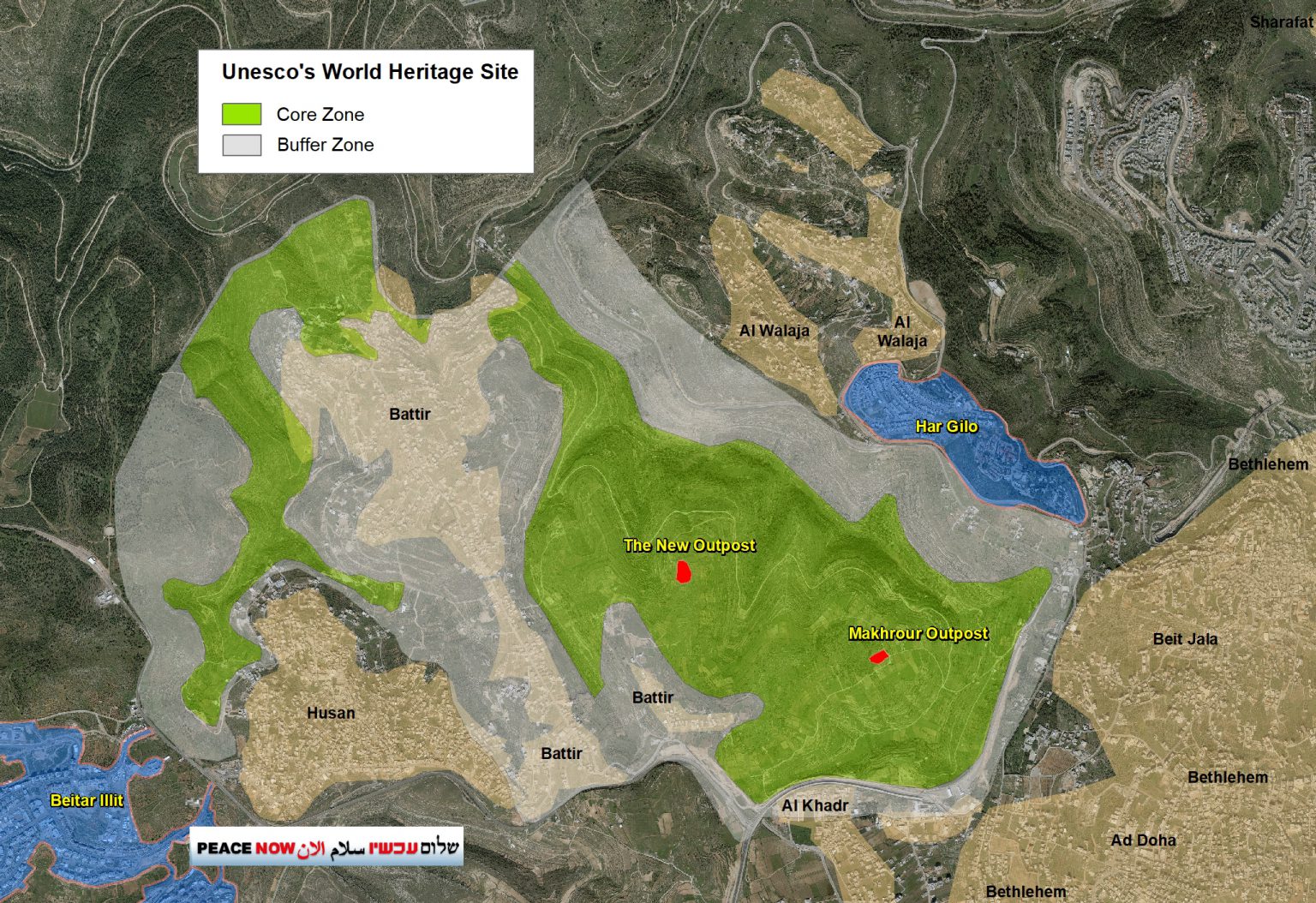 Since the outpost was set up, Middle East Eye reports that Israeli soldiers have been continuously patrolling the area to prevent any Palestinians from approaching the site – and attacking those who attempt to protest the new outpost. This is the fourth time settlers have attempted to establish an outpost in the area of Battir.
An local activist from Battir, Hassan Muamer, explained the settlers strategy:
“The settlers want to connect these two outposts [the new outpost and an outpost established in 2019 in the nearby Al-Makhrour Valley] together, and confiscate hundreds of acres of land in the process..This is all part of their plan, to shorten the distance between the two outposts, confiscate more land, and eventually connect these outposts to the settlements of Har Gilo, Gilo, and Gush Etzion, creating a massive settlement bloc that extends from Jerusalem, through Bethlehem, all the way to Hebron.”
Peace Now said in a statement:
“It is no coincidence that this illegal outpost is established while most of the public’s attention is drawn towards the war in Ukraine. The current government has already failed several times in stopping a handful of settlers in Eviatar, Homesh, and other places and has refrained from evicting illegal outposts immediately upon their establishment. The government must not fail this time, so the outpost will not be established.”
Ma’aleh Adumim to Challenge Government of Delay of E-1 Settlement Construction
The Jerusalem Post reports that the settlement council of Ma’aleh Adumim is preparing to submit an appeal against the State of Israel for delaying construction of the E-1 settlement, contending that Prime Minister Bennett and Defense Minister Gantz lack the authority to freeze the plans at this stage. The petition will be submitted to the Jerusalem Local Court, according to the report.
As a reminder, the E-1 settlement plan remains on the precipice of construction. In January 2022, the Bennett government intervened to stop a key hearing on the project. At the time, reports suggested that the political echelon had put on “indefinite hold” on the plan, largely due to U.S. pressure. U.S. Ambassador to Israel Thomas Nides seemed to confirm that U.S. pressure was exerted at that time to stop E-1 from moving forward, telling Peace Now recently:
“I went full board [sic] on E1… It is a very important area which if [built] could cut off any possibility of a capital for the Palestinians.”
Also as a reminder: in its current form, the E-1 plan provides for the construction of 3,412 new settlement units on a site located northeast of Jerusalem. The site is home to several Palestinian bedouin communities, including Khan al-Ahmar, which Israel has already undertaken to forcibly displace (many attempts). Long called a “doomsday” settlement by supporters of a two-state solution, construction of the E-1 settlement would sever East Jerusalem from its West Bank hinterland, preventing East Jerusalem from ever functioning as a viable Palestinian capital. It would also cut the West Bank effectively in half, isolating the northern West Bank from the southern West Bank and foreclosing the possibility of the establishment of a Palestinian state with territorial contiguity.
Israel’s “answer” to the latter criticism has long been to argue that Palestinians don’t need territorial contiguity, and that new roads can instead provide “transportational continuity.” To this end, Israel has already built the so-called “Sovereignty Road” – a sealed road that enables Palestinians to pass through, but not to enter, the E-1 area. That road is wholly under Israel’s control (meaning Israel can cut off Palestinian passage through it at any time). In January 2021, then-Prime Minister Netanyahu promised to increase funding for the “Sovereignty Road” as part of the drive to get E-1 built.
And another reminder: there have been attempts to promote the E-1 plan since the early 1990s, but due to wall-to-wall international opposition, the plan was not advanced until 2012, when Netaynuahu ordered it to be approved for deposit for public review (a key step in the approval process), ostensibly as payback for the Palestinians seeking recognition at the United Nations. Following an outcry from the international community, the plan again went into a sort of dormancy, only to be put back on the agenda by Netanyahu in February 2020, when he was facing his third round of elections in the two years.
Also, as a reminder: under the Trump Plan (which the Biden Administration has yet to comment on), the area where E-1 is located is slated to become part of Israel.
This Week in Settler Terrorism
On March 14th, an Israeli-licensed car drove into an IDF checkpoint, in an apparent attack, near the illegal Homesh outpost, lightly injuring two Israeli soldiers. It’s unclear what happened next, as the IDF has not said if the perpetrator – who is thought to be an Israeli settler, given the license plate on the car – was arrested. What is clear is that the IDF did not respond with lethal force, as is almost always the case when Israeli soldiers perceive themselves to be under attack by a car driven by a Palestinians.
This week’s apparent car ramming attack transpired two days after settlers from the site of the former settlement of Homesh (which is supposed to be a closed military zone) arrived at the checkpoint to stage a stone-throwing attack on Palestinian cars. The settlers ended up battling IDF soldiers who attempted to stop their terrorism. An IDF soldier subsequently filed a complaint with the Israeli police about the incident.
Elsewhere, Israel arrested two settlers on suspicion of involvement in vandalism and destruction of Palestinian property in the village of Fara’ata on March 15th. One of the detained settlers serves as the security coordinator for the Gilad outpost, and the second arrestee is a bodyguard. Following the arrest and remand of the settlers, security coordinators for various other Israeli settlements and outposts announced they will be going on strike.
It’s also worth noting that Defense Minister Benny Gantz signed an order this week to place an unnamed 21-year old settler under administration detention on suspicion of involvement with terrorism against Palestinians and Israelis. Though administrative detention is a familiar military tool used to keep Palestinians incarcerated without charge, Haaretz reports this will be the first such order signed against an Israeli since February 2020. There are currently 490 Palestinians being held as administrative detainees according to Addameer.
The detained settler is believed to be from the Givat Ronen outpost, an outpost from which settlers attacked Palestinians and Israeli activists who were planting trees on privately owned Palestinian land near the village of Burin in the northern West Bank in January 2022. Footage of the attack shows settlers wielding clubs, throwing stones, and burning a car — in the process injuring six people. Following the attack, the Israeli authorities delivered demolition notices to five structures at the Givat Ronen outpost (also known as Sneh Ya’akov), where the attackers are believed to be illegally living. The notices were posted on January 23rd.
Subsequently, the apparently undaunted settlers attacked an IDF soldier during riots near the Givat Ronen outpost. Haaretz reports that dozens of settlers participated in the attack, which included stone throwing and tear gassing Israeli troops.
Kerem Navot – an anti-settlement watchdog – provides critical history on the Givat Ronen outpost and how violence is at the center of settlers’ drive to takeover Palestinian land, tweeting:
“The outpost of ‘Givat Ronen,’ known also as ‘Sneh Yaakov,’ is named after the man who founded it in 1998–Ronen Arusi…Givat Ronen is one of two outposts located around the isolated, violent, and extremist settlement of Har Bracha, which was established overlooking the city of Nablus in 1983. Givat Ronen is located about a kilometer south of the settlement…The two outposts surrounding this settlement (like all outposts in the West Bank) are used for the same function: to take over land surrounding the settlement. In this case, the lands of the village of Burin. The approach is simple: you build an outpost on land that was looted by the state by declaring it to be “state land”; from there you continue to take over cultivated agricultural land surrounding the outpost by way of violence most of which were previously cultivated by Palestinians. In practice, as a result of the settler violence that is backed by the army, Palestinians are not able to access any of this land, or any of the land within the much larger area around the settlement covering about 5,400 dunams that this land is located in, unless they work in construction in the settlement of Har Bracha. The scumbags who carried out this pogrom below the outpost have learned this tactic well: employing murderous violence in order to increase the size of the territory that Palestinians cannot enter. They have every reason in the world to assume that in this case, as in every case, no one will bother to leverage the law against them.”
U.S. Ambassador Has Harsh Words for Settlements, But Admits Some Construction Will Proceed
Speaking to a virtual event organized by Americans Peace Now, U.S. Ambassador Thomas Nides called Israeli settlement construction “infuriating” and “stupid.” Nides, while deriding the settlement growth, conceded that the U.S cannot (or will not?) stop Israel from all settlement construction, saying:
“We can’t do stupid things that impede us for a two-state solution…We can’t have the Israelis doing settlement growth in east Jerusalem or the West Bank. I’m a bit of a nag on this, including the idea of settlement growth – which infuriates me, when they do things – just infuriates the situation, both in east Jerusalem and the West Bank… [I] would be lying [if he said that it was possible to avert] every single house that is built. I can’t stop everything, just so we are clear.”
Bonus Reads
- “Major New Developments: Plans being advanced around the Old City and the Court verdict regarding Sheikh Jarrah evictions” (Terrestrial Jerusalem)
- “Instead of Army Service, Israel Allows People to Volunteer at Illegal West Bank Outposts” (Haaretz)
- “US envoy looks to bolster West Bank economy with 4G service, tech offerings” (The Times of Israel)
- “PA complains to US over ‘settler terrorism’” (Arutz Sheva)
Welcome to FMEP’s Weekly Settlement Report, covering everything you need to know about Israeli settlement activity this week.
To subscribe to this report, please click here.
January 28, 2022
- Israel Destroyed The Salihiya’s Home in Sheikh Jarrah. Now The Salihiyas Are Appealing to the ICC
- Knesset Committee Chair Vows to Protect Homesh Outpost & Yeshiva
- A War Crime in the Making: Israel Finalizes Plan for Forcible Relocation of Khan Al-Ahmar
- Settlers Attack Palestinians & Israel Human Rights Activists
- Settlers Violently “Parade” Through West Bank Town
- Israeli Government Increases Funding for Annexation/Dispossession via Archaeology Effort
- Israel FM Denounces Effort to Connect Outposts to Israeli Services — While Israeli Communications Goes Ahead and Does Just That (for one outpost)
- Further Reading
Israel Destroyed The Salihiya’s Home in Sheikh Jarrah. Now The Salihiyas Are Appealing to the ICC
The International Centre of Justice for Palestinians (ICJP) has announced it will file an appeal with the International Criminal Court on behalf of the Salihiya family, whose members was forcibly displaced by Israeli forces from their home in Sheikh Jarrah last week. The Salihiya family home(s) and business were demolished by Israel, on the basis of Israel’s 2017 unilateral expropriation of their land ostensibly for “public use.” The ICC appeal accompanies ongoing efforts by the Salihiya family and its lawyer in Israeli courts, where the family’s lawyer recently announced they intend to file an appeal with the High Court of Justice to compel the State to rebuild the family home.
According to the ICJP press release, the Salihiya family has been a client of the London-based law firm Bindmans Solicitors since October 2021, and will be finalizing its appeal this week.
ICJP Director Crispin Blunt (a member of the British parliament) said:
“The Sheikh Jarrah case is already notorious. ICJP is proud and privileged to stand alongside this family as they represent not just their own interests, but the century of historic injustice meted out to the Palestinian people individually and collectively. For Israel’s sake, for all Palestinians, and for humanity’s sake, the Sheikh Jarrah case needs to be a turning point where justice and our common humanity starts to count for more than people’s insecurities driven by fear. Given that what has happened is wrong on any moral basis let us find the route to justice for all our sakes. ICJP stands with the victims against violence and fear. Stand with us for justice and the best of our shared interest in a just peace and the rule of a just law.”
As a reminder, on March 3, 2021, the International Criminal Court (ICC) formally opened an investigation into the “Situation in Palestine.” The investigation is expected to look at, among other things, potential war crimes committed by Israelis involved in the settlement enterprise. This could include the prosecution of Israeli officials involved in establishing settlements in the occupied territory – which are illegal under international law. For a rich discussion of the ICC case and the complexities involved in it, watch this recent FMEP webinar, ”Israel-Palestine at the International Criminal Court: What Next?”
Knesset Committee Chair Vows to Protect Homesh Outpost & Yeshiva
On January 27th, Knesset House Committee Chairman Nir Orbach, from the Yamina party (the party of Prime Minister Naftali Bennett) vowed that the government “do[es] not intend to evacuate Homesh.” The government is expected to issue a position on the illegal Homesh outpost and yeshiva (Jewish religious school) on February 6th. In the meantime, settlers who continue to visit the illegal (even under Israeli law) Homesh yeshiva also continue to regularly terrorize surrounding Palestinian villages and drivers.
The government is facing a court-mandated deadline to file its response to a 2019 case that is still pending before the Israeli High Court. That case – initiated by residents of the Palestinian village of Burqa, with the legal assistance of Yesh Din – calls for the removal of the Homesh outpost and demands that the land be returned to its Palestinian owners (and that the IDF ensures that Palestinians are indeed able to access their land). Since the Israeli government dismantled the Homesh settlement in 2005 (as part of Ariel Sharon’s “disengagement”), Palestinian have been denied access to the land, even as settlers have been permitted regular access and have been granted de facto (but not formal) permission to establish and maintain a yeshiva and outpost there.
While the government formulates its response to the case, settlers and their allies continue to raise the political stakes for the Bennett government, with the settler-run Arutz Sheva outlet even running a piece that equates the Homesh situation the Alamo (a piece which also launches a defense of the notoriously violent and frequently anarchist Hilltop Youth settler movement).
In a particularly incisive report by the Associated Press on the Homesh outpost — focusing on the settlers who illegally established and now attend yeshiva there, and the IDF’s role in enabling their continued presence — a Homesh devotee makes clear how the settlers view Palestinians:
“Ben Shachar, the teacher at the yeshiva, said farmers [referring to Palestinian landowners currently unable to access the area] should coordinate their entry with the Israeli military. He said he’s open to dialogue with ‘any Arab who accepts that the Land of Israel [which he makes clear includes all of the West Bank] belongs to the Jewish people,’ but that terrorism is ‘part of the DNA of Arab society’.”
A War Crime in the Making: Israel Finalizes Plan for Forcible Relocation of Khan Al-Ahmar
The Times of Israel reports that the Israeli Security Cabinet will soon vote on a plan to demolish the Khan Al-Ahmar bedouin community and (bizarrely) rebuild it some 300 meters from where it currently stands. The State is under the pressure of a March 6th court deadline (which has already been delayed once at the request of the State) to implement the Court-ordered demolition of Khan al-Ahmar, which the Court declared to be illegally built (i.e. lacking Israeli building permits that are virtually impossible for Palestinians to obtain).
Residents of Khan al-Ahmar – who have been living for years under a sustained threat of forcible displacement (a war crime) and are routinely harassed by Israeli forces – reportedly oppose this plan to forcibly displace them, and are planning a protest for January 30th.
At the same time, many Israeli lawmakers and right-wing groups also reject this plan – not out of concern for displacing the Bedouin, but out of concern that it doesn’t achieve the desired effect of removing them from this part of the West Bank — a strategic area in the eyes of Israeli settlers and their allies who want to build settlements encircling Jerusalem and cleanse Area C of its Palestinian residents.
Yoav Kisch of the Likud party and Religious Zionism MK Orit Strock issued a joint statement saying:
“This is a fake evacuation with highly dangerous repercussions. The damage in legalizing Khan al-Ahmar is immense. The de facto meaning is that the State of Israel approves the Palestinian plan to take over this strategic area.”
Regavim CEO Meir Deutsch said:
“The area in question, the Mishor Adumim area, is the most strategic, lying between Jerusalem and the Jordan Valley Jericho and Ramallah. That’s why the place gets so much attention from the PA and the EU…This is a small collection of huts, one of dozens in the same area, one of hundreds established in Area C. The strategic location is what draws this attention. The defense minister’s desire to whitewash the place is the realization of the Palestinian strategy to take over the area. It establishes land grabs in the heart of this strategic area…The idea the Defense Ministry came up with is about moving three hundred meters and fixing them in the heart of this strategic area, and this is not an agreed plan. The villagers have already announced that they oppose any movement, even one meter. So it makes no sense to move them. The State of Israel must do what is good for it….The state is trying, but through the displacement of 300 meters it is not avoiding confrontation, because the residents have announced that they will not move and so this solution also does not prevent conflict. It is the worst of all worlds, because it establishes a Palestinian outpost in the heart of the territory without preventing a confrontation.”
Settlers Attack Palestinians & Israel Human Rights Activists
On January 21st in broad daylight, settlers from the illegal (even under Israeli law) Givat Ronen outpost violently attacked Palestinians and Israeli activists who were planting trees on privately owned Palestinian land near the village of Burin in the northern West Bank.
Footage of the attack shows settlers wielding clubs, throwing stones, and burning a car — in the process injuring six people. Despite video footage of the incident, Israel has made no arrests (so far), though reports suggest the Israeli Shin Bet and Israeli police have opened an investigation.
The presence of, and injuries to, Israeli citizens attracted media attention and rare condemnations from the Israeli political class (and even some typically mum Jewish American organizations). Public Security Minister Bar Lev (Labor) said:
“It appears, the way I see it, that we are talking about an organized activity by a terror group that acted together to come and harm primarily Israeli citizens who had come to protest at the site. They harmed them and torched their car.”
Following the attack, the Israeli authorities delivered demolition notices to five structures at the Givat Ronen outpost (also known as Sneh Ya’akov), where the attackers are believed to be illegally living. The notices were posted on January 23rd.
Apparently undaunted, video taken on January 26th shows settlers attacking an IDF soldier during riots near the Givat Ronen outpost. Haaretz reports that dozens of settlers participated in the attack, which included stone throwing and tear gassing Israeli troops.
Kerem Navot – an anti-settlement watchdog – provides critical history on the Givat Ronen outpost and how violence is at the center of settlers’ drive to takeover Palestinian land, tweeting:
“The outpost of ‘Givat Ronen,’ known also as ‘Sneh Yaakov,’ is named after the man who founded it in 1998–Ronen Arusi…Givat Ronen is one of two outposts located around the isolated, violent, and extremist settlement of Har Bracha, which was established overlooking the city of Nablus in 1983. Givat Ronen is located about a kilometer south of the settlement…The two outposts surrounding this settlement (like all outposts in the West Bank) are used for the same function: to take over land surrounding the settlement. In this case, the lands of the village of Burin. The approach is simple: you build an outpost on land that was looted by the state by declaring it to be “state land”; from there you continue to take over cultivated agricultural land surrounding the outpost by way of violence most of which were previously cultivated by Palestinians. In practice, as a result of the settler violence that is backed by the army, Palestinians are not able to access any of this land, or any of the land within the much larger area around the settlement covering about 5,400 dunams that this land is located in, unless they work in construction in the settlement of Har Bracha. The scumbags who carried out this pogrom below the outpost have learned this tactic well: employing murderous violence in order to increase the size of the territory that Palestinians cannot enter. They have every reason in the world to assume that in this case, as in every case, no one will bother to leverage the law against them.”
Settlers Violently “Parade” Through West Bank Town
On January 24th settlers believed to be from the Yitzhar settlement staged a violent parade of cars through the West Bank village of Huwwara in celebration of a settler from the Yitzhar settlement being released from Israeli prison. The “celebration” terrorized Huwwara — with settler stone-throwing resulting in injuries to at least three people (including one child), and significant damage to at least 25 Palestinian vehicles and several businesses. Video of the attack shows Israeli forces in plain view during the rampage, but doing nothing to stop it. Israeli police have said that an investigation has been opened, but no arrests have been made.
Haaretz reports:
“Kaid Amar, the owner of a plumbing fixture store that was the target of stone-throwing, alleged in comments to Haaretz that the settlers had the protection of the soldiers at the scene. ‘They broke up my store and caused me 40,000 shekels [$12,600] in damage. My car was also wrecked. The soldiers were there around [the settlers’] cars and didn’t do anything,’ he said. Hawara Mayor Mueen Damidi said, ‘Israel says it’s a democracy, but if Palestinians were to have thrown stones, what would they have done? Shoot them. We are suffering greatly from the situation’.”
Israeli Government Increases Funding for Annexation/Dispossession via Archaeology Effort
On January 25th, the Jerusalem Affairs and Heritage Ministry announced that it will allocate $1.57 million (5 million NIS) towards “reconstruction” of the Sebastia archaeological site (located in the northern West Bank, near Nablus), pending approval from the Israeli Civil Administration. The Ministry further said that an additional $787,000 will be allocated towards the “rehabilitation” of other archaeological sites in the West Bank, as well as about $470,000 towards the Civil Administration’s ramped up efforts to “protect” West Bank archaeological sites.
Announcing the funding, Jerusalem Affairs and Heritage Minister Ze’ev Elkin said:
“The destruction of the sites, which is being carried out under the auspices of the P.A., is destroying the history of the entire region, and I will make every effort to fight it. The conservation of heritage sites in Judea and Samaria is a national mission.”
Settlers have been openly agitating – with some success – for Israel to assert control over the archaeological site in Sebastia for years. In January 2021, Emek Shaveh (an Israeli NGO expert in – and focused on – archaeology) wrote about what is happening in Sebastia, saying:
“The archaeological site of Sebastia is identified with Samaria, the capital of the Kingdom of ancient Israel in 9-8 BCE. The site also features ruins from the Hellenistic, Roman and later periods. The village of Sebastia is situated within Area B while the site itself is located mainly in area C. Over the past few years, the Samaria Regional Council has been organizing tours to the site, particularly during the school holidays. Several times this year, the Civil Administration has removed a Palestinian flag from the village and the site. In the most recent incident, a flag was raised following renovation works funded by the Belgian government. In their response the regional council blamed the Palestinians for destroying a site central to Jewish history and UNESCO for supporting the Palestinians. Sebastia is on the tentative list of World Heritage sites in Palestine….the integration of ancient sites into an organized strategy designed to weaken Palestinian hold on Area C is worrying. The formalization of this approach is likely to result in a steep rise in actions over ancient sites and structures, from water cisterns found in many villages, to major sites such as Sebastia. The justification for preserving and developing ancient sites familiar to us from East Jerusalem is now being applied wholesale to hundreds of places in the West Bank to the detriment of the Palestinians living near the sites and to the multilayered heritage inherent in the ruins which will be distorted for political ends.”
As FMEP has chronicled, settlers and their allies are intent upon using claims of Palestinian damage/neglect as a pretext for Israel taking control of archaeological sites and artifacts across the West Bank. For example, in February 2021 settlers used a construction mishap to raise claims to the Mt. Ebal site.
In January 2021, the state of Israel committed funding to a new settler initiative to surveil archeological sites under Palestinian control. While the objective of protecting antiquities might appear uncontroversial and apolitical, the true (and transparently self-evident) objective behind this effort are: to support yet another pretext to surveil and police Palestinians; to establish and exploit yet another means to dispossess Palestinians of their properties; to expand/deepen Israeli control across the West Bank; and to further entrench Israeli technical, bureaucratic and legal paradigms that treat the West Bank as sovereign Israeli territory. It is the result of a campaign that has taken place over the past year in which settlers have escalated their calls for the Israeli government to seize antiquities and “heritage sites” located in Palestinian communities across the West Bank, especially in Area C, which Israel today treats as functionally (and legally) indistinguishable from sovereign Israeli territory. The new funding committed by Israel for West Bank “heritage sites” should be understood in this context.
Previous victories for the settlers include the Israeli Civil Administration’s issuance in 2020 of expropriation orders – the first of their kind in 35 years – for two archaeological sites located on privately owned Palestinian property northwest of Ramallah. The settlers’ pressure is also credited as the impetus behind the government’s clandestine raid of a Palestinian village in July 2020 to seize an ancient font.
In June 2020, a settler group calling itself “Shomrim Al Hanetzach” (“Guardians of Eternity”) began surveying areas in the West Bank that Israel has designated as archeaological sites, looking for Palestinian construction (barred by Israel in such areas) that they could then call in Israeli authorities to demolish. The group communicates its findings to the Archaeology Unit of the Israeli Civil Administration (reminder: the Civil Administration is the arm of the Israeli Defense Ministry which since 1967 has functioned as the de facto sovereign over the West Bank). The Archaeology Unit, playing its part, then delivers eviction and demolition orders against Palestinians, claiming that the structures damage antiquities in the area.
As a reminder, in 2017, Israel designated 1,000 new archaeological sites in Area C of the West Bank. The “Guardians of Eternity” group, not coincidentally, is an offshoot of the radical Regavim organization, which among other things works to push Israeli authorities to demolish Palestinian construction (on Palestinians’ own land) that lacks Israeli permits (permits that Israel virtually never grants).
Israel FM Denounces Effort to Connect Outposts to Israeli Services — While Israeli Communications Goes Ahead and Does Just That (for one outpost)
Foreign Minister Yair Lapid made a statement to the press opposing efforts by the Knesset (including members in his own governing coalition) to connect illegal (even under Israeli law) outposts to Israeli municipal services. This is a key, longtime demand of the settlement movement and was the subject of a recent meeting between Minister Ayelet Shaked (a proponent of the outposts) and Benny Gantz (who, as Defense Minister, is ultimately responsible for implementing any such decision).
Meanwhile, Communications Minister Yoaz Hendel attended a ceremony inaugurating the installation of fiber-optic cables in the unauthorized Magen Dan outpost, located in the northern West Bank settlement of Elkana. This is the first unauthorized outpost to be connected to the Israeli fiber optic grid.
Bonus Reads
- “‘We’re here to pressure the village’: Israeli troops admit collective punishment policy” (+972 Magazine)
- “Israel Closes Case Against Police Involved in Deadly West Bank Car Chase” (Haaretz)
- “Palestinian farmers caught between Israeli rock and PA hard place” (Middle East Eye)
- “Explained: How Israel’s Absentees’ Property Law keeps Palestinians from their homes” (Middle East Eye)
- “Opinion | The Israeli Occupation’s Problem Isn’t Just a Few Violent Settlers” (Avshalom Zohar Sal / for Haaretz)
- “Palestinians call for probe into Israeli massacres in Tantura” (Al Jazeera)
- “A Progressive Jewish Response to the Discriminatory Policies of the KKL-JNF” (Breaking the Silence). From the author:
“The report begins with an executive summary, which is followed by three main sections. The first section provides an overview of the parts of KKL-JNF’s work that has displaced Palestinians and further entrenched the occupation. The second section offers a detailed explanation of the often opaque structures of the organization, including its relationship to the World Zionist Organization and the Israeli government, as well as its internal structure and budget. The final section of the report provides initial suggestions on how progressive Jews can begin to counter the work of KKL-JNF.”