Welcome to FMEP’s Weekly Settlement & Annexation Report. To subscribe to this report, please click here.
November 6, 2026
- WEST BANK: Israel Removes First Bedouin Community from E-1 Site; Settlers Move Into Jericho Homes; Settlers Attack IDF to Stop Outpost Removal; Yesh Din Publishes “Annexation Files”
- EAST JERUSALEM: Court Blocks Govt Funding to Ateret Cohanim’s Project in Silwan
- BONUS READS
WEST BANK
Israel Forcibly Transfers Bedouin Community Near E-1 Site
On November 3rd, Israeli forces carried out extensive demolitions in the Bir al-Maskub Palestinian bedouin community that is located within the boundaries of the planned E-1 settlement project. Approximately half of the community was demolished displacing 20 people; the remaining structures in the community are under demolition order.
Bimkom – Planning and Human Rights, Ir Amim and Peace Now report this is the first instance of demolitions occuring in preperation for the construction of the E-1 settlement. The organizatoins said in a joint statement:
“Israel has moved from settlement planning to displacement on the ground. The demolition of nearly half the structures in Bir al-Maskub, along with renewed demolition orders for the rest, marks the beginning of an effort to erase an entire Palestinian community. E1 is not simply about building thousands of homes for Israeli settlers. It also involves dispossessing Palestinian communities and driving them from their homes and land to make way for a new settlement. What has begun in Bir al-Maskub could spread to other communities where hundreds of Palestinians live. These actions raise grave concerns about the forcible transfer of a protected population, in violation of international law.”
Settlers Establish Enclave in Jericho Neighborhood
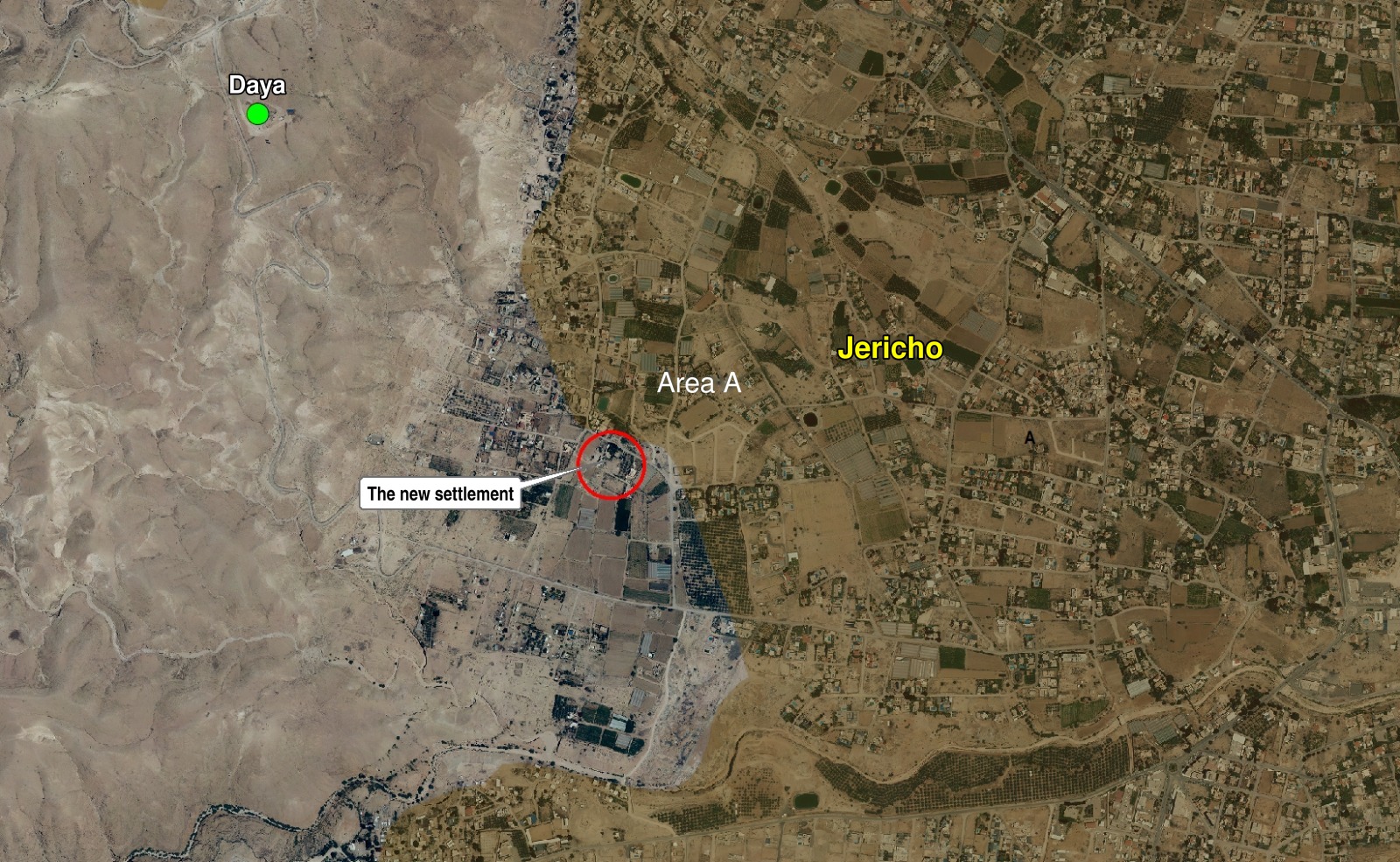 On November 4th, 30 settlers moved into eight buildings in the Ein a-Duyuk a-Tahta neighborhood on the outskirts of Jericho, the major Palestinian city in the Jordan Valley. The Benyamin settler regional council and the Nachala Movement are both involved in this new enclave, in coordinating and financing the sale on behalf of the settlers.
Settlers have been violently targeting this neighborhood for displacement and replacement for nearly two years, ever since a new outpost was established. In February 2026, settlers attacked the neighborhood and used a bulldozer to demolish over 15 Palestinian homes. And then in July, the Israeli government granted the outpost legalized status – essentially rewarding the settlers for their violent expansion.
Settlement watch-dogs warn the new settler enclave in the city of Jericho brings with it a significant new reality for Palestinians who will live side by side with settlers who have shown their violent disdain for them, and will require IDF security service.
Peace Now said in a statement:
“Establishing a settlement inside Jericho poses a security threat and constitutes a geopolitical disaster that must not be allowed to happen. This move is designed to deepen friction and violence, entrench an apartheid regime, and foreclose any possibility of a future political agreement. A settlement in Jericho will create additional flashpoints and trigger further violence, while dragging the military into unnecessary and life-threatening missions whose sole purpose is to protect a handful of messianic extremists bent on dragging Israel into the abyss. A caretaker government that has not received a mandate from the public has no authority to impose such far-reaching political and security realities on the ground. The IDF must therefore evacuate the new settlement in Jericho immediately.”
A spokesman for Combatants for Peace said:
“This is especially jarring during the harvest season, when the Israeli authorities, led by the army and the Civil Administration, do everything in their power to prevent about 100,000 Palestinian families who depend on the olive crop from reaching their lands and harvesting their olives. The establishment of the outpost in Ein Diuk Thahta is another license for the terrorism of the settlers in the area, who in July-August repeatedly attacked the residents of the area and their property and even destroyed Palestinian homes. This is another step by a government that deepens the occupation and its injustices, supports settler terrorism, fuels the fire in the region, and expands more and more settlements that are changing the face of the region in an attempt to thwart any possibility of a future peaceful political solution.”
Settlers and their government enablers celebrated the takeover of homes in Jericho:
Daniella Weiss, a co-founder of Nachala, said: “These homes in Jericho mark the end of the Oslo Accords that caused so many casualties. We are now… opening a new era.”
National Missions Minister Orit Strock said: “Settlement in Jericho is the continuation of the process of repairing the damage caused by Oslo. Jericho is the lock of the Land of Israel. This is where the cursed Oslo Accords began, and now, we have reached this root and are making it bloom again. The next step is returning to Gaza. On the eve of Shabbat Chayei Sarah, we can say that our forefather Abraham is very proud of his successors: those redeeming the land of Israel by paying its full price and settling it.”
Binyamin Regional Council head and Yesha Council chairman Israel Ganz said: “Thirty-two years after ‘Gaza and Jericho first,’ we proudly say: We have returned to Jericho! Thank you to Daniella Weiss and the Nachala Movement for their determination and partnership, which turned the dream into reality, and to Minister Orit Strock, who came to strengthen the families on the very day they moved in. We will continue to build and settle the Land of Israel.
Settlers Attack Israeli Forces To Stop Outpost Removal
Israeli settlers violently attacked Israeli security forces as they attempted, for at least the 15th time, to dismantle an illegal oupost caleld Givat Ora Yisrael located near the Palestinian village of Salfit in the northern West Bank. The IDF arrested 18 settlers who set tire on fire and placed road blocks to stop the IDF from reaching the outpost. As a consequence, Palestinians were trapped in Salfit with all major roadways blocked for several hours.
Haaretz reports the IDF is increasingly aware of and nervous about settlers who voilently attack Palestinians are more and more using that same violence to prevent the removal of illegal outposts.
Yesh Din Publishes the “Annexation Files”
Yesh Din has published a new comprehensive database of Israel’s annexation of the West Bank, and the policies, practices, finances, and bureaucracy that is uses to carry out that annexation.
Yesh Din writes:
“The Annexation Files website brings together official decisions, legislative initiatives, actions on the ground and a range of other measures through which Israel is advancing the annexation of the West Bank, occupied in 1967. Its main categories highlight different aspects of the annexation process and provide an overall picture of how it is taking shape and progressing. By presenting these measures together, the website shows that Israel’s annexation of the West Bank is not a future scenario: it has already taken place, even without an official declaration. In other words, the establishment of settlements and permanent civilian governing mechanisms, together with the exercise of sovereign powers and the administration of the territory as an integral part of the sovereign State of Israel’s system of government, have established de facto sovereign control, amounting to annexation, which is prohibited under international law.”
Essential Read: “‘There are no dreams here’: How Israel’s outgoing gov’t remade the West Bank”
Reporting for +972 Magazine, Shatha Yaish, Oren Ziv and Basel Adra trace the lives of Palestinians in nine villages across the West Bank in stories that “reveal how Israel’s occupation has become more intrusive, how the boundaries between settlers and the military have been increasingly blurred, and how the cumulative pressures of the past four years have reshaped everyday life…Taken together, their accounts offer a portrait of a territory being transformed — not only on the map but in the most intimate aspects of Palestinian life.”
Read the full article here.
EAST JERUSALEM
Court Blocks Government Funding to Settler-Run “Heritage” Center in Silwan
Ir Amim reports the Jerusalem District Court has blocked the transfer of millions in governmnet funding for the construction of a settler-operated heritage center in the Batan al-Hawa section of the Silwan neighborhood of East Jerusalem. The ruling was in response to one of the petitions filed by Ir Amim and the residents of Silwan, which challenged the project based on a conflict of interset betweent hte goals of the Ateret Cohanim setter organization (explicity to Judaize Jerusalem) and the Benvenisti Trust, a historic trust which served the needy and which the settler group revived in 2001 following 63 years of dormancy in order to take possession of extensive amounts of property in Batan al-Hawa. The heritage center is just one case where the Ateret Cohanim has taken possession of Palestinian property by claiming it belongs to the Benvinisti Trust, which it controls.
Ir Amim says:
“While the recent ruling constitutes an important legal setback to Ateret Cohanim’s efforts to further expand its settlement presence and activities in Batan al-Hawa, it does not currently halt the broader campaign of forced evictions and settler takeovers underway in the neighborhood. As noted above, 35 Palestinian families have been forcibly displaced from their homes over the past two years alone, while dozens more continue to face the threat of eviction and settler takeover by Ateret Cohanim. For more background on these measures, see here.”
Ateret Cohanim claims ownership of the buildings becuase it gained control of the historic Benvenisti Trust, which oversaw the assets of Yemenite Jews who lived in Silwan in the 19th century. In 2001 the Israeli Charitable Trust Registrar granted Ateret Cohanim permission to revive the trust and become its trustees following 63 years of dormancy. In 2002, the Israeli Custodian General transferred ownership of the land in Batan al-Hawa to the Trust (i.e., to Ateret Cohanim). Since then, Ateret Cohanim has accelerated its multi-pronged campaign to remove Palestinians from their homes, claiming that the Palestinians are illegal squatters. Silwan is just one site of Ateret Cohanim’s work to establish Jewish enclaves inside densely populated Palestinian neighborhoods of East Jerusalem, for the explicit purpose of “reclaiming” Palestinian parts of Jerusalem for Jews.
Bonus Reads
- “’King of Samaria’: How a Settlement Council Head Is Running Israel’s West Bank Policy” (Haaretz, 10/31/2026)
- “High Court Decision Fails to Address Any of the Nine Structural Remedies Requested” (Human Rights Defenders Fund)
- “The Olive Trees Remain. Their Palestinian Owners Cannot Return” (Haaretz, 11/2/2026)
Welcome to FMEP’s Weekly Settlement & Annexation Report. To subscribe to this report, please click here.
June 26, 2026
- WEST BANK: Israel Seizes Land for Outpost Legalization; Smotrich Announces Millions for Illegally Seized Ancient Pool; New Report on Israel’s Seizure of the Hasmonean Palaces; New Lightrail for Settlers?
- STATE-BACKED SETTLER TERRORISM: Key stories this week
- BONUS READS
WEST BANK
Israel Seizes Land South of Nablus to “Legalize” Givat Haroeh Outpost
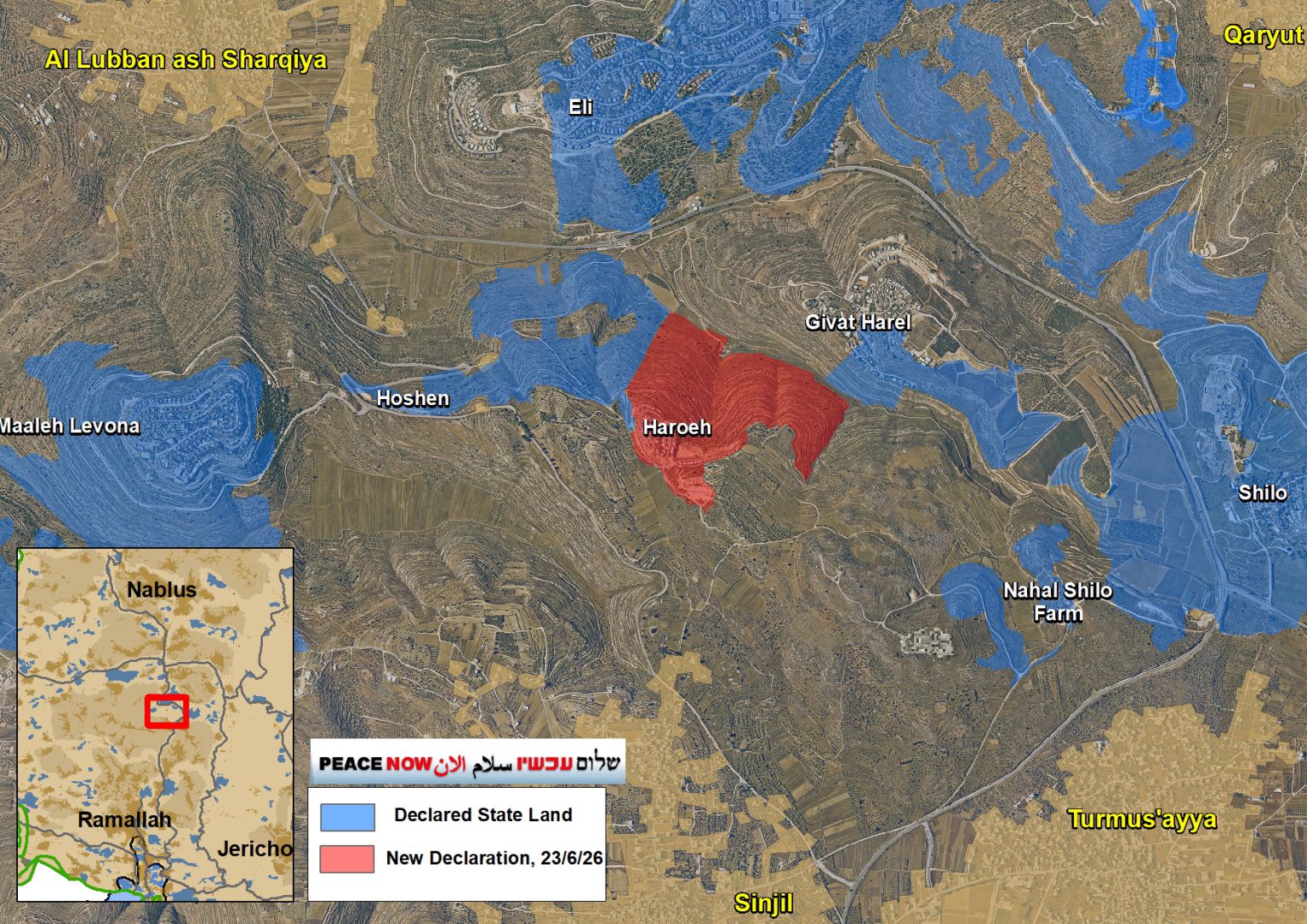 Peace Now reports the Israeli Civil Administration declared over 115 acres of land belonging to the village of Sinjil, located south of Nablus, as “state land” in order to enable the “legalization” of the Givat Haroeh outpost under Israeli law. The declaration more than quadruples the size of the outpost’s boundaries, allowing for massive growth in the future and consolidating the contiguous sting of Israeli settlements in the Shilo Valley area.
Peace Now said in a statement:
“Netanyahu and Smotrich are determined to fight against the entire world and against the interests of Israel’s residents for the benefit of a small group of settlers who receive thousands of dunams as a gift, as if there is no political conflict to resolve. They are exploiting every moment in power to create more and more facts on the ground that will make it harder for Israel to reach peace. Today it is clear to everyone that this conflict cannot be resolved without a political agreement that includes the establishment of a Palestinian state in the West Bank, yet the Israeli government is choosing instead to make this possibility more difficult and move us further away from peace and from ending the bloodshed.”
The Israeli government approved the legalization of the Givat Haroeh outpost in 2023 as part of a Cabinet decision to legalize 10 outposts, setting in motion the legal process to do so. Givat Haroeh was known to the Israeli government to have been illegally built on land that is at least partially privately owned by Palestinians; these landowners now have 45 days to file objections to the new military seizure order.
As noted at the time, a source told Haaretz that the Israeli Cabinet chose the ten outposts for authorization specifically because they are all located in remote or isolated locations — meaning they cannot be “legalized” via expanding the borders of a nearby settlement and declaring the outposts to be merely neighborhoods of those “legal” settlements (a legal maneuver Israel has repeatedly used to expand settlements and retroactively legalize settlements). This means, among other things, that legalization of these 10 new settlements would inevitably l lead to additional land seizures for related infrastructure work.
Joint Report: Israel’s Seizure of Land Near Hasmonean Palaces
In new analysis, Emek Shaveh, the Palestine Solidarity Co-op and Emek Shaveh detail Israel’s recent military seizure order taking control of land near the Hasmonean Palaces, a West Bank archaeological site located on the outskirts of Jericho in Area C of the West Bank. The seizure order will allow Israel to construct a new road to the site that bypasses Jericho.
 The construction ratchets up the violent and coercive conditions facing the Kaabneh bedouin community of Ein ad-Duyuk al Tahta, which is located on land immediately adjacent to the Hasomonean palaces. The community has been subjected to increasingly violent daily settler attacks and harassment, a trend which crescendoed on February 10, 2026 when dozens of settlers carried out a pogrom against the community. Settlers attacked violently, including women and children, looted the village, and brought in a bulldozer to level 13 homes. Israeli police and military did not respond to calls from the community for intervention. The community lives now on the ruins of these homes, while Israel is pursuing the development of the Hasmonean Palaces into a major tourist attraction.
The three groups write:
“The Hasmonean Palaces are also one of several major antiquity sites that the current Minister of Heritage, Amihai Eliyahu, had defined as “anchor sites” in the plan to develop Judeo-centric archaeological theme parks across the West Bank. In July 2023, the government had allocated 20 million NIS for the development of the site into a tourist attraction. At the time it was said that the Binyamin Regional Council would operate the site. The community of Ein ad-Duyuk al-Tahta is situated in part on what Israel considers state land and in part on land privately owned by East Jerusalemite families. The area under seizure order is privately owned, but as of June 2026, the owners have not yet been located.
In recent years, a settler-led campaign, spearheaded by the NGO Guardians of Eternity, claimed deliberate destruction of “Jewish” antiquities by the Palestinians, in an attempt to push the government to expand control over West Bank sites. The Hasmonean Palaces site was often mentioned in this context. Over the years, the SOA has carried out numerous enforcement actions at the site, including stopping works, confiscating equipment, and demolishing what it defines as illegal construction.”
Dror Etkes told The Forward:
“We will see an area completely disconnected from its surroundings. Palestinians won’t be able to enter the area. Two roads [for Israelis] will lead to this area. Settlers will be very violent, it will be very restricted for the Palestinians, construction in the area [by Palestinians] will be completely banned, the construction that already exists is without a permit and a large part of it will be demolished by Israeli authorities.
It will be another national park that will tell one story — the story the Israeli radical right wants you to hear.”
Emek Shaveh’s ED Alon Arad told The Forward:
“You change the identity so that from a village on the outskirts of Jericho it becomes a palace of a dynasty. You don’t need actual settlers there, it’s enough to build an access road, put up a fence and whatever comes with tourist development-a kiosk, a parking lot, someone to guard it…You start bringing in tourists and it’s a normalizing process for people to go inside the West Bank and return to Haifa or wherever they are from. They go in and out and it was fun for them and you create the idea that this is part of Israel.”
Smotrich Announces Millions to Renovate Illegally Seized Ancient Pool Near Jericho
Haaretz reports Israel plans to invest millions of shekels in developing an illegally-sized ancient pool and archaeological site near the Petza’el settlement in the Jordan Valley. Israeli Finance Minister Smotrich announced that he allocated 3 million shekels for the development and the site.
Settlers took control over the pool just a month ago, and began renovating the site. According to Haaretz, the IDF recognizes the area as privately owned Palestinian land. One landowner told Haaretz:
“They [the settlers] diverted the water, they are swimming in the pool, they put up Israeli flags and opened a tourist site for settlers, and they do not allow anyone to approach the area or repair anything…”We have springs on land we have owned for many years, and we use them for agricultural irrigation…we have no water.”
Dror Etkes from the Kerem Navot told Haaretz that
“trifles like Palestinian property rights do not interest the extreme and violent elements in the government. They have no problem reaching a site that settlers covet, attaching an invented history to it and looting it in the name of a historical past that has nothing behind it but a lust for plunder and nothing more.”
New Light Rail for Settlements?
On June 21st, the Gush Etzion Regional Council announced “the transportation revolution in the bloc continues” and that a new light rail line will connect the settlement block to Jerusalem. The press event announcing the project included an illustration of the light rail line, being held by the smiling Transportation Minister Miri Regev and Yaron Rosenthal, the head of the settlement regional council. Despite the public support for the announcement, the Israeli Department of Transportation denied the plan, saying it had not been approved or funded by the government.
STATE-BAKED SETTLER TERRORISM
Key Reads this week:
- “Israeli Settler Indicted Over West Bank Rampage That Left Eight Palestinians Wounded” (Haaretz, 6/26/26); “Yitzhar resident indicted after armed sheep search erupts into violence in Huwara, West Bank” (Jerusalem Post, 6/25/26); “Israel prosecutors charge settlers with terror offences after West Bank attack” (The New Arab, 6/26/26)
- “Former settlement chief charged with threatening Palestinians with assault rifle” (The Times of Israel, 6/25/26)
- “Israel’s Top Court Slams Police for Failing to Probe Settler Attack on Rabbi Solidarity Activist” (Haaretz, 6/25/26)
- “Israeli Soldiers Were Sent to Harass a Bedouin Community That’s Halfway to Expulsion” (Haaretz, 6/24/26)
- “Israeli former leaders and security chiefs threaten legal action over ‘Jewish terrorism’” (The Guardian, 6/24/26)
- “As settlers rampage, IDF soldiers accused of aiding violence, theft against Palestinians” (The Times of Israel, 6/26/26)
- “An Israeli Settler Shot a Disabled Palestinian Five Times. Police Quickly Labeled the Wounded Man a ‘Terrorist’” (Haaretz, 6/20/26)
- “Ethnic Cleansing 3.0: How Israel Became the Transfer State” (Gideon Levy in Haaretz, 6/25/26)
BONUS READS
- “How the Jewish National Fund Became the Face of Israeli Expulsion” (Haaretz, 6/24/26)
- “Chevra Kadisha Burial Society Seeks Payment From East Jerusalem Residents for Using Path to Their Homes” (Haaretz, 6/24/26)
- “Death Penalty For Palestinians Only” (Visualizing Palestine, June 2026)
- “IDF Eases Closures on West Bank Palestinian Town, but Keeps Key Highway Blocked” (Haaretz, 6/25/26)
- “The Israeli right is marching under a new flag” (+972 Magazine, 6/15/26)
- “Palestinians warn West Bank antiquities bill designed to expand Israeli control” (The Times of Israel, 6/25/26)
- “Palestinians decry Israeli push for control over ancient West Bank sites” (Reuters, 6/25/26)
- “Hundreds of Bedouin left homeless as Israel ramps up Naqab expulsions” (+972 Magazine, 6/24/26)
Welcome to FMEP’s Weekly Settlement & Annexation Report. To subscribe to this report, please click here.
February 13, 2026
- ANNEXATION: Cabinet Approves Annexation, Gov’t OKs “West Bank Heritage Authority”
- EAST JERUSALEM: Demolitions in al-Bustan
- WEST BANK SETTLEMENTS & OUTPOSTS: Settlers Bulldoze Houses, Land Seizure Near Qalqilya for New Settlement
- SETTLER & STATE TERRORISM: 54 Injured in Wave of Attacks
- BONUS READS
ANNEXATION
Cabinet Announces Sweeping Annexation Moves
On February 8th, the Israeli Security Cabinet approved seven new measures that result in the annexation of the entire West Bank, stripping powers from the Palestinian Authority and paving the way for massive settlement expansion and the continued ethnic cleansing of Palestinians from all areas of the West Bank. With the Security Cabinet decisions made and support from the Attorney General, the Israeli military is expected to quickly issue military orders duplicating the decisions in order for them to be a matter of law in the West Bank. In announcing the decisions, Israeli Ministers Katz and Smotrich issued a joint statement saying the moves are intended:
“to remove decades-old barriers, repeal discriminatory Jordanian legislation, and enable accelerated development of settlement on the ground,” the two ministers said in a joint statement.”
The seven significant acts of annexation are:
- LEGALIZING SETTLER LAND PURCHASES – The Cabinet decided to repeal a Jordanian-era law that restricted the sale of land in the West Bank to the local Palestinian population (individuals and companies), effectively legalizing the sale of West Bank land to Israelis. Now, settlers will be able to purchase land anywhere in the West Bank including in major Palestinian cities – possibly creating new enclaves that bring Israeli security installments with it, a reality that has transformed Hebron into an apartheid dystopia.
- REMOVING KEY OVERSIGHT OF LAND PURCHASES – The Security Cabinet repealed a law that requires individuals to obtain a special land purchase “transaction permit” from the Israeli Civil Administration, a law that was aimed at establishing oversight on to stem fraudulent claims of land purchases, which offered Palestinians some level of protection.
- PUBLISHING THE LAND REGISTRY – The Cabinet approved the publication of the West Bank land registry, something the settlement movement has pushed for in order to be able to identify landowners in all areas of the West Bank and approach them for purchase, which – with the repeal of the ban on the sale of land to non-Arabs – settlers can now do outright. Opening the land registry will help facilitate settler claims over disputed and/or unregistered lands, making Palestinians vulnerable to further settler harassment regarding the sale of land.
- REVIVING A “STATE LAND ACQUISITION COMMITTEE” – The Cabinet revived a “state land” acquisition committee to expand settlements. The revival of the committee is meant to facilitate the proactive government purchases of West Bank land for the purpose of settlement expansion and “to secure land reserves for settlement for generations to come.”
- EXTENDING ISRAELI CONTROL TO AREAS A & B – The Cabinet extended Israeli oversight and enforcement in Areas A & B with regard to water issues, archaeological sites, and environmental concerns. This means that the Israeli military will be able to demolish Palestinian homes and property if it determines the Palestinian presence interferes with the concerns under their purview – water, archaeology, and environment. Now, Areas A & B will be subject to the same weaponization of the planning code that is currently being used by the Civil Administration to clear Palestinians
- SEIZING HERITAGE SITE IN BETHLEHEM – The Cabinet voted to create a new municipal body to take control over the Rachel’s Tomb religious site, located within the municipal boundaries of Bethlehem. Seizing control over the site will allow the Israeli government to allocate state funds to renovating the site as well as a Jewish yeshiva next to it. Rachel’s Tomb is located just close to the heart of the city of Bethlehem, and with Israeli settlers in control over the space Mondoweiss reports that area is likely to be developed into a new settler enclave.
- SEIZING PLANNING POWERS IN HEBRON – The Security Cabinet stripped planning and building authorities from the Palestinian Municipal Authority in Hebron and transferred it to the Israeli Civil Administration. Now, the Israeli military will exercise full control over settlement construction and planning for the Cave of the Patriarchs/Il-Ibrahimi Mosque.
Finance Minister Smotrich celebrated, saying:
“We are deepening our roots in all parts of the Land of Israel and burying the idea of a Palestinian state.”
The settlement Yesha Council, which oversees all settler municipalities, said in a statement:
“The government of Israel announced today, in practice, that the Land of Israel belongs to the Nation of Israel,” the council said, adding that the decisions “rectified an injustice of many years and are entrenching Israeli sovereignty on the ground, de facto.”
Peace Now said in a statement:
“Netanyahu promised to topple Hamas in Gaza, but in practice he chose to topple the Palestinian Authority, cancel agreements that Israel signed, and impose de facto annexation on us—completely against the will of the public, Israel’s interests, and the clear position of President Trump. The cabinet’s decision shows that this is not about deepening annexation in Area C, but about dangerous and irresponsible sovereignty measures also in Areas A and B, and about breaking every possible barrier on the path to massive land theft in the West Bank. This is an extreme and irresponsible government dragging us toward disaster. All democratic forces in Israel must act now, in every possible way, to stop this!””
Palestinian analyst Nour Odeh warns:
“These Israeli decisions are not administrative or bureaucratic. They’re transformative. The only logical next steps would be dismantling Palestinian political representation & mass ethnic cleansing. The only remaining obstacle to greater Israel are the remaining Palestinians.”
Government Endorses Bill to Establish West Bank Heritage Authority
On February 8th, in addition to the seven decisions to annex the West Bank as described above the Ministerial Committee on Legislation decided to throw the governing coalition’s support behind a bill in the Knesset that create a statutory body within the Israeli government that would exercise broad authority over heritage sites in “the area” of the West Bank — an act of de facto annexation.
Emek Shaveh, Peace Now, and the Geneva Initiative highlight that, if passed, this would be the first instance of Israel applying domestic Israeli law to territory (land) rather than persons (settlers) in the West Bank. The coalition further warns that the bill does not currently provide a definition of what area the new body would have jurisdiction over, as Emek Shaveh details in its latest update:
“Previous iterations of the bill explicitly stated the intention to bring antiquities sites in Areas A, B and C under the Authority’s jurisdiction, and even included an express reference to extending its jurisdiction to Gaza. In the current version of the bill, however, following a closed-door committee session, all references to Areas A, B, C and Gaza were removed, and the question of defining the territorial scope of “the Area” was deferred to a committee discussion after the bill’s first reading in the plenum. Nevertheless, yesterday’s cabinet decision may render any future discussion concerning the definition of “the Area” in the bill redundant, as the legislation provides for the transfer of all powers and responsibilities currently vested in the Staff Officer for Archaeology within the Civil Administration (ICA) to the new statutory authority (see section 2 in annex 1 below).
Taken together, these developments constitute a fundamental turning point. Empowering an Israeli civilian authority to carry out enforcement measures, expropriations, and excavations deep inside Palestinian Authority Areas B and A effectively dismantles the framework established under the Oslo II Accords. Under that framework, responsibility for antiquities and archaeological sites in Areas A and B rests with the Palestinian Authority’s Ministry of Tourism and Antiquities, which operates pursuant to the Palestinian Authority’s Antiquities Law of 2018.”
EAST JERUSALEM
Large Scale Demolitions in al-Bustan, Silwan
Peace Now reports the Israeli government carried out extensive demolitions in the al-Bustan area of Silwan. The municipality destroyed walls between houses, a construction supply business site, and a parking structure. The demolition notices were delivered just minutes before the bulldozers arrived, depriving Palestinians of the chance to challenge the actions and/or remedy the issues cited on the notices. Residents filed an emergency injunction, and the Jerusalem District Court issued an injunction stopping the demolitions after three hours. While no homes were demolished in this instance, Israel recently issued demolition notices to 15 Palestinian homes in al-Bustan.
Peace Now explains how these demolitions are a part of a much larger scheme to replace Palestinians with Israeli settlers and tourist attractions which erase Palestinian heritage:
“Since the demolition of the Mughrabi Quarter in 1967 to make way for the Western Wall Plaza, Israel has not carried out the expulsion of an entire neighborhood. Now, the municipality, backed by the government and the police, is advancing the displacement of a whole neighborhood in order to establish a tourist-settlement park. This policy, which on the one hand virtually prevents Palestinians in Jerusalem from building homes and on the other hand demolishes their houses, is a cruel, settlement-driven policy with no limits. For years Israel has claimed that Jerusalem is a ‘united’ city, but its policy toward the Palestinian population shows that this is not ‘unity,’ but occupation.”
WEST BANK SETTLEMENTS & OUTPOSTS
Settlers Bulldoze 15 Palestinian Homes Near Jericho
Haaretz reports a group of about 30 settlers accompanied by IDF protection arrived in the village of Ein a-Duyuk a-Tahta, located near the Hasmonean Palaces antiquity site near Jericho, and proceeded to attack Palestinian residents and bulldoze 20 structures, including 15 homes. The IDF told Haaretz that the demolitions were not carried out by Israeli authorities (though eye witnesses said IDF troops were on site the whole time providing security), and said that the IDF is opening an investigation into the incident.
Israeli Heritage Minister Amichay Eliyahu said during a live video posted on X:
“We will destroy any [home] built on Jewish people’s heritage. We will return here, pave roads and make the place flourish. “We do not apologize for holding onto our land. Through hard work and the investment of millions, we are reclaiming our heritage sites and deepening our historical hold on the land of our forefathers for the sake of our children’s future…Here at the Hasmonean Palaces in Jericho, the gateway to the Land of Israel, we are raising the flag of our sovereignty.”
Israel Seizes Land Near Qalqilya
Peace Now reported that in early January 2026 the Civil Administration declared 694 dunams adjacent to the Wadi Qana nature reserve (east of Qalqilya in the central West Bank) as “state land.” The seizure, along with the purchase of land near the area by an Israeli developer, appears to indicate a new settlement, called “Dorot”, is being planned for the area.
Peace Now explains:
“In 2020, an outpost known as Nahal Qana Farm (sometimes referred to as “Dorot Farm”) was established in the area and began exerting pressure on nearby Palestinian residents and farmers. Those operating the farm grazed cattle inside Palestinian orchards and cultivated fields and forcibly prevented Palestinians from accessing hundreds of dunams in the vicinity of the outpost.
In recent years, private developers have begun marketing building plots to the public for a future city called “Dorot Illit,” intended for the ultra-Orthodox community, despite the absence of a government decision to establish a settlement in the area or an approved construction plan. As part of the land marketing, the development company presents a rendering of the planned settlement that includes all nearby Israeli settlements, while the surrounding Palestinian villages are effectively erased and are absent from the promotional materials.
It has now emerged that the government is joining the settlement planning effort: the Civil Administration has labeled the land declaration adjacent to the developers’ holdings as “Dorot.” This is not the first settlement to be established at the initiative of private developers claiming to have purchased land from Palestinians. In February 2023, the government formally approved the establishment of the settlement of Mishmar Yehuda, where state land was likewise designated adjacent to plots acquired by developers. Other settlements established in a similar manner in the past include Modi’in Illit, Revava, Avnei Hefetz and others.”
STATE-BACKED SETTLER TERRORISM
Mass Attack Leaves 54 Wounded
On Friday February 13th settlers and Israeli troops carried out a wave of attacks on Palestinians concentrated in the area south of Nablus but extending across the West Bank, leaving at least 54 wounded.
Al Jazeera reports the following attacks:
- Settlers fired live ammunition and tear gas at Palestinians near Talfit and Qusra, south of Nablus, shooting at least one man.
- Settlers stormed the Khillet as-Sadrah gathering near the town of Mikhmas, northeast of occupied Jerusalem.
- Near Ramallah in Turmus Aya, settlers cut down roughly 300 olive trees and bulldozed agricultural land, while military forces raided homes in the village and arrested multiple people.
- In the same area, the military stormed Deir Ghassaneh and Beit Rima, while forces also descended upon several towns near Jenin, including Jaba, Siris and Meithalun.
- In the Jordan Valley, settlers set fire to a building
In West Bank, Israel’s Goal is Expulsion
Israeli government policy facilitates and augments the continued settler terrorism that is resulting in the mass expulsion of Palestinians from the West Bank – a reality that is now regularly in the headlines. Now, the Israeli Shin Bet is criticizing the Israeli Police’s refusal to allocate needed police force to confront the rampant settler terrorism that is only escalating as settlers face zero consequences to their violent criminality.
Haaretz columnist Amira Hass writes in the West Bank:
“Israel has only one goal: not maintaining quiet but fomenting military and socioeconomic explosions that will encourage emigration or allow a forcible population transfer. The line separating expulsions from mass slaughter is thin to the point of invisibility, as the army has taught us in Gaza. This isn’t a prophecy but another desperate cry for the world to wake up.”
BONUS READS
- “2 settler activists cross into Lebanon to plant trees, are returned to Israel by IDF” (The Times of Israel, 2/12/2026)
- “PODCAST: Documenting the settler takeover of the West Bank” (+972 Magazine, 2/13/2026)
- “PODCAST: Entire Communities Fled: ‘The West Bank’s Area C Is Almost Completely Ethnically Cleansed‘” (Haaretz, 2/11/2026)
- “Bezalel Smotrich’s long struggle to annex the West Bank for Israel” (Al Jazeera, 2/12/2026)
- “Israel Escalates its Settlement Expansion in the Heart of a UNESCO World Heritage Site in Bethlehem: Battir” (Balasan Initiative, 2/5/2026)
- “Settlers Violence Doesn’t End With Palestinians in the West Bank” (Haaretz, 2/13/2026)
Welcome to FMEP’s Weekly Settlement Report, covering everything you need to know about Israeli settlement activity this week.
To subscribe to this report, please click here.
July 21, 2023
- “Dizzying” East Jerusalem Settlement Activity Continues: Israel Approves Givat Hamatos Building Permits & Schedules Discussion to Double Its Size
- Israel Expands West Bank Annexation via Archaeology, Including Construction of 4-7 New Settler Tourism Sites
- Smotrich Prepping Plans to Expand Campaign Against Palestinian Construction, With Aim to Expand Authority to Areas A & B
- Israel Opens First High Tech Campus in “Silicon Wadi” East Jerusalem Project
- Knesset Pushes Bill to Directly Fund Settlements
- Another Palestinian Bedouin Community Coerced to Leave Homes By Settler & State Terrorism
- In the Press: Bibi Denies Reports of “Settlement Freeze” Promise to Biden, Talks His Vision of Peace
- Smotrich Claims Credit for U.S.-Israeli Tensions
- Bonus Reads
“Dizzying” East Jerusalem Settlement Activity Continues: Israel Approves Givat Hamatos Building Permits & Schedules Discussion to Double Its Size
Ir Amim reports that Israel has continued its “dizzying pace” of settlement advancements in East Jerusalem, this week granting approval to four building permits for the yet-to-be-built Givat Hamatos settlement, and take an irregular step to advance a new plan – called “New Talpiot” – that would serve to massively expand the fully-approved plan for Givat Hamatos settlement.
The four building permits were issued on July 16th and will allow the foundation to be laid for several buildings in the Givat Hamatos settlement – which, if built, will be the first new settlement to be built in East Jerusalem in over two decades. The buildings (which will require separate building permits to be issued) will have a total of 900 units. The Israeli government has approved a plan to build a total of 2,610 settlement units in the Givat Hamatos settlement.
 In addition, the Jerusalem District Planning Committee is set to convene on Monday, July 24th to discuss a plan referred to as “New Talpiot Hill” that will, if approved and constructed, expand double the number of housing units in the Givat Hamatos settlement and increase its land mass by 40%, stretching Givat Hamatos eastward towards the settlement of Har Homa. The Givat Hamatos A project is directly adjacent to the area of the New Talpiot Hill project. The plan provides for 3,500 new settlement units and 1,300 hotel rooms – the latter posing a direct competition to the Palestinian tourism industry in nearby Bethlehem. The plan also calls for five synagogues and two mikvehs, clearly showing that the construction is designed to serve Israeli Jews although the neighboring Palestinian communities are suffering an acute housing crisis.
Ir Amim further notes that Israel is carrying out land registration on plots of land implicated by the New Talpiot Hill plan, a process which Israel has weaponized as a tool of settlement expansion.
Ir Amim writes:
“Together, Givat Hamatos A and New Talpiyot Hill along with concurrent settlement advancements in the area are cumulatively sealing off East Jerusalem’s southern perimeter from Bethlehem and the southern West Bank. These measures likewise further fracture the Palestinian space and deplete all remaining land reserves in the area for Palestinian development. Such conditions severely undermine the prospects of an agreed political future of Jerusalem, while depriving Palestinians of their fundamental right to housing and shelter.”
Israel Expands West Bank Annexation via Archaeology, Including Construction of 6-7 New Settler Tourism Sites
On July 17th the Israeli government approved a three-year $33 million (NIS 120 million) plan to take control over archaeological sites throughout the West Bank, including plans to establish 4-7 new settlement tourist sites. The approval of this plan is the fulfillment of a commitment made in the government’s coalition deal, which called for
The plan has several alarming components, including:
- Nearly $3million allocation of monitoring alleged antiquity destruction by PAlestinians and the Palestinian Authority, as well as for enforcement activities such as demolitioning Palestinian construction near antiquity sites.
- The construction of 4-7 new tourist installments at archaeological sites throughout the West Bank – the first being a new site at the “Hasmonean Pools” near Jericho. On this, Peace Now explains:
“The Hasmonean Palaces are located in Area C, adjacent to the Palestinian city of Jericho, which mostly falls under Areas A and B. Currently, access to the site passes through Area A. Beyond the site development, the goal of the program is also to enable access and regulate the movement of Israeli visitors from Area C into the site itself. In the past, there have been reports of plans to build a bridge over Area A to allow Israelis to reach the site.”
- The construction of a heritage center to showcase West Bank artifacts, with the possibility of building a new archaeological museum somewhere in the West Bank (location not determined).
- Surveys and excavatations.
Emek Shaveh and Peace Now both note that this new $33 million project comes in addition to the $9 million dollars in funding that the government approved in May 2023 to develop and “renovate” the archaeological site of Sebastia, located near the Palestinian village of Sebastia, north of Nablus in the heart of the West Bank. The project includes plans to pave a new access road for Israelis to reach the site, which they currently have to access by traveling through the Palestinian village of Sebastia, which will increase and entrench Israeli control not only over the site itself but the surrounding area – effectively weaponizing archaeology as a tool for dispossession.
Emek Shaveh said in a statement:
“With Bezalel Smotrich responsible for the Civil Administration and Jewish Power in charge of the Ministry of Heritage, the archaeological sites are weaponized more than ever before as a means for justifying ‘touristic settlements’, significantly entrenching and expanding the occupation and have become a central component in the present government’s steps towards advancing annexation. Along with massive settlement expansions, settler violence and legislation, the development of heritage sites in the West Bank will give control over substantial public areas and transform the multi-layered historical character of the area beyond recognition.
Although the plan is titled “an emergency plan for protection of antiquities”, only 10 million NIS of a budget of 120 million NIS are actually earmarked for defending sites against antiquity theft. Most of the budget is allocated to acts that constitute de facto annexation of the West Bank in complete violation of international law and the Oslo Accords. It is quite clear that for the current government the plan is yet another component in its efforts to thwart any possibility for a two-state solution and establish a biblical theocracy. We call on the international community to hold the State of Israel accountable to its own commitments under the Oslo accords, to the Two States Solution and to international law.”
Peace Now said in a statement:
“The Israeli government continues to settle in the West Bank in every possible way and continues to strengthen the friction with the Palestinian population. Investing over 150 million NIS in new tourist settlements implies exploiting archaeology in the West Bank to promote settlements and adversely affect Palestinians. Instead of investing in archaeological and tourism sites within Israel, the Israeli government continues to prioritize the settler minority over millions of Israelis. Investing in new settlements under the guise of heritage in the West Bank is a divisive move that harms Palestinians, distances peace and the two-state solution, and also undermines Israel’s tourism potential.”
As background, in January 2021, the Israeli government committed funding to a new settler initiative to surveil archeological sites under Palestinian control. While the objective of protecting antiquities might appear uncontroversial and apolitical, the true (and transparently self-evident) objectives behind this effort are: to support yet another pretext to surveil and police Palestinians; to establish and exploit yet another means to dispossess Palestinians of their properties; to expand/deepen Israeli control across the West Bank; and to further entrench Israeli technical, bureaucratic and legal paradigms that treat the West Bank as sovereign Israeli territory. It is the result of a campaign that has taken place over the past year in which settlers have escalated their calls for the Israeli government to seize antiquities and “heritage sites” located in Palestinian communities across the West Bank, especially in Area C, which Israel today treats as functionally (and legally) indistinguishable from sovereign Israeli territory. Funding committed by Israel for West Bank “heritage sites” should be understood in this context
Previous victories for the settlers in this same arena include the Israeli Civil Administration’s issuance in 2020 of expropriation orders – the first of their kind in 35 years – for two archaeological sites located on privately owned Palestinian property northwest of Ramallah. The settlers’ pressure is also credited as the impetus behind the government’s clandestine raid of a Palestinian village in July 2020 to seize an ancient font.
In June 2020, the “Guardians of Eternity” group began surveying areas in the West Bank that Israel has designated as archaeological sites, looking for Palestinian construction (barred by Israel in such areas) that they could then use as a pretext to demand that Israeli authorities demolish it. The group communicates its findings to the Archaeology Unit of the Israeli Civil Administration (reminder: the Civil Administration is the arm of the Israeli Defense Ministry which since 1967 has functioned as the de facto sovereign over the West Bank). The Archaeology Unit, playing its part, then delivers eviction and demolition orders against Palestinians, claiming that the structures damage antiquities in the area.
And one more reminder: in 2017, Israel designated 1,000 new archaeological sites in Area C of the West Bank. The “Guardians of Eternity” group, not coincidentally, is an offshoot of the radical Regavim organization, which among other things works to push Israeli authorities to demolish Palestinian construction (on Palestinians’ own land) that lacks Israeli permits (permits that Israel virtually never grants).
Smotrich Prepping Plans to Expand Campaign Against Palestinian Construction, With Aim to Expand Authority to Areas A & B
At a meeting of the Knesset Foreign Affairs and Defense Committee, Bezalel Smotrich revealed several plans that intensify and expand Israel’s annexation of the West Bank,, including plans to extend Israeli civilian operations – specifically the demolition of Palestinian construction – into Areas A & B.
Most drastically, Smotrich said that he is preparing a plan – expected to be approved within a month – that would allow him to direct the demolition of Palestinian buildings in Areas A & B which are determined to be a “security threat.” Smotrich told the Knesset that Israel’s ability to operate in Areas A & B are “key” to national security, and that he is working on plans to create a new unit within the Border Police which will be assigned specifically to construction law enforcement. This would be yet another advancement of Israel’s de facto annexation of the entire West Bank, which is increasingly focused not just on solidifying Israeli sovereignty over Area C but on Areas A & B as well. Haaretz notes that the Knesset Committee spent more time discussing Areas A & B than Area C. It should be noted that the Knesset Committee was convened to discuss what the Israeli government and the settlers believe to be “The Palestinian Authority’s takeover of open areas in Judea and Samaria” — a completely warped narrative of what is transpiring in the West Bank, where Israeli settlements are expanding while Palestinian are facing apartheid conditions. As admitted by an Army officer at the hearing, the Israeli military rejects 90-95% of Palestinian building requests while granting 60-70% of settler building requests
During a discussion of the Palestinian construction, Smotrich said his plan would also see Israel declare activities by Palestinian Authority to be a “foreign hostile activity,” which would prompt Israel to seize funds from the PA.
Smotrich also discussed two projects being prepared by the Jewish National Fund to plant trees on 2,500 acres of West Bank land. Smotrich talked about this tree-planting operation as a means of annexation, saying: “The [PA] actively works to seize lands. We need to do the same thing….[This means] legalization, construction, agriculture. “ This news comes the same week Israeli operated tractors were filmed uprooting Palestinian owned olive trees near the village of Tarkumiya.
As a reminder, in his role as a civilian minister in the Defense Ministry in charge of the Civil Administration, Smotrich is already empowered to order demolitions in Area C (powers which had previously been held by Israel’s military) — powers which he has wielded aggressively. As defined by the Oslo Accords, Areas A & B constitute 40% of the West Bank where the Palestinian Authority is assigned responsibility for civilian administration matters, like construction. Smotrich’s moves only underscore Israel’s erasure of any meaningful distinction between these areas, which has also been evidenced by routine military incursions into Nablus and Jenin, Israeli activity around antiquity sites under PA control, and more.
Israel Opens First High Tech Campus in “Silicon Wadi” East Jerusalem Project
The Times of Israel reports that Israel celebrated the opening of its inaugural high tech workspace that is part of the “Silicon Wadi” project, under which Israel aims to establish a major high-tech hub along the western side of East Jerusalem’s Wadi Joz neighborhood. While touted as a plan that will benefit Palestinians, its implementation has required the eviction of many Palestinian businesses in the area.
The new $2.8million (NIS 10 million) tech campus is a free workspace for Israeli and international high tech companies, and it has the capacity to host 250 workers with workstations, meeting spaces, and other available services. Four companies have already began working out of the new building.
You can read Ir Amim’s in-depth reporting on the Silicon Wadi project here.
Knesset Pushes Bill to Directly Fund Settlements
The Israeli Knesset is advancing a bill that will allow Israel to transfer tax revenue to the settlements, therefore bringing the settlements under direct Israeli law (an act of de facto annexation, illegal under international law) and further subsidizing the settlement enterprise. Even though the Israeli government has funded settlements from the outset, it has not permitted tax revenue sharing and has typically tried to hide other direct lines of funding to the settlements through non profits and other intermediaries.
The Combatants for Peace told Haaretz:
“The Netanyahu government has already ceased even trying to hide the institutionalization of apartheid. MK Asher’s reckless bill is another way to transfer budgets and to support the settlement enterprise and perpetuate the oppression and dispossession of Palestinians. What they can’t get in through the door, they’re trying to get in through the window – the main thing is to keep building.”
Another Palestinian Bedouin Community Coerced to Leave Homes By Settler & State Terrorism
B’Tselem reports that the al-Baq’ah Palestinian bedouin village was forced to abandon its village lands located west of Hebron under daily violence inflicted upon it by nearby settler outposts, and decades of harassment by the Israeli state.
The village’s decision to leave comes less than one week after the IDF demolished a water cistern used by all six families living in al-Baq’ah for personal and agricultural work. The villages told B’Tselem researchers that they are fleeing the village in fear of their lives.
B’Tselem writes:
“Al-Baq’ah joins the nearby communities of Ras a-Tin and ‘Ein Samia, which have already been driven off their lands over the past year under the same circumstances: Israel’s policy creates oppressive, unreasonable living conditions that leave residents of these communities with no choice but to abandon them. Relying on more official means (settlement building, extreme restrictions on Palestinian construction, a prohibition on infrastructure and demolitions), and on less official ones (settler violence against Palestinians), the policy has one goal: taking over more and more Palestinian lands and handing them over to Jewish hands, and it is applied against other communities still living in the area. Forcible transfer is a war crime, even if the state perpetrates it not by forcing people onto trucks but by putting so much pressure on them that their lives become unbearable and they cannot help but leave their homes and lands.”
In the Press: Bibi Denies Reports of “Settlement Freeze” Promise to Biden, Talks His Vision of Peace
Axios reports that on a July 17th call, Netanyahu informed President Biden that he does not expect to advance any more settlement planning, construction, or outpost “legalization” through the end of the 2023 year. Netanyahu issued a statement denying these reports, however Haaretz reports that Netanyahu contradicted that statement during private briefings for members of his staff and foreign journalists.
Separately, in an interview with podcaster Lex Fridman, Netanyahu provided a fresh look at what his vision of a “peace” deal is, explicitly saying that no settlements or settlers (no matter their location) would be uprooted, and that settlers would remain under Israeli sovereignty. He went on to reject Palestinian sovereignty.
Smotrich Claims Credit for U.S.-Israeli Tensions
In an interview with the settler-allied Arutz Sheva outlet (aka Israel National News), Smotrich made a few eye-opening remarks on his policies and motivations, saying:
“Our mission first and foremost is to provide security to the citizens of Israel in the settlements and all over the country. When we talk about the fight against terrorism there are two legs: the first is the development of the settlements and strengthening our grip on the territories of the Land of Israel. After all, terrorism is designed to weaken our grip – and our true answer that will eradicate it and make terrorism futile – will be further construction. When you look at Judea and Samaria, this government is building, regulating, developing, both in construction and in infrastructure on an unprecedented scale….quite a lot of the tensions that exist between the American administration and the Israeli government – and these are tensions between friends and partners and we manage these disputes with respect – stem from the policy that I am leading as a minister in the Ministry of Defense in the settlements with the full backing of the Prime Minister and the Minister of Defense.”
Bonus Reads
- “How settlers justify their pogroms” (Shabtay Bendet in +972 Magazine)
- “I was handcuffed and blindfolded for reporting on settler violence” (Basel Adra in +972 Magazine)
- “‘The escalation is frightening’: Jerusalem Christians fear for their future“ (+972 Magazine)
- “Israeli Soldiers Protect the Settlers, Then Attack Us Activists” (Illana Hammerman in Haaretz)
Welcome to FMEP’s Weekly Settlement Report, covering everything you need to know about Israeli settlement activity this week.
To subscribe to this report, please click here.
October 13, 2022
- Nablus Region Broiling as Settlers Rampage
- Senior Israel Officials Preside Over Cornerstone-Laying Ceremony for New Settler Tourist Project in East Jerusalem
- Israel Antiquities Chief Releases Map of New Israeli National Park Near Jericho (in Area C)
- Amidst Violent Surge, Settlers Demand Establishment of Evyatar Settlement & Yeshiva
- Bonus Reads
Nablus Region Broiling as Settlers Rampage
As violence continues to escalate across the West Bank and in East Jerusalem, this week settlers have continued, seemingly uninhibited, to instigate clashes with and terrorize Palestinians in the West Bank. Some key examples include the following (for an even more thorough listing, see the Palestine Center for Human Rights’ weekly report):
- On October 11th, Israeli settlers staged a massive march – explicitly designed to provoke Palestinians and demonstrate Israeli dominance/impunity – near the Palestinian town of Sebastia, just north of Nablus. An Israeli soldier providing security to the settlers was shot and killed by a drive-by shooter as the march got underway. Following that shooting, the Palestinian militia group calling itself “Lion’s Den” claimed credit for the drive-by shooting, leading the Israeli army to completely shut down the city of Nablus – where the Lion’s Den is based – in response.
- Late in the evening on October 12th — while the Israeli army was keeping all the entrances and exits to Nablus closed in response to the October 11th shooting of an IDF soldier guarding a settler march — the IDF again provided security for settlers, this time enabling them to enter the city of Nablus (the IDF even transported settlers in military vehicles), ostensibly to visit Joseph’s Tomb and conduct religious prayer there (ostensibly because the timing/nature of the visit appeared to be largely if not entirely about provoking Palestinians). In the course of the operation, IDF soldiers exchanged gunfire with Palestinians; no injuries were reported on either side.
- The following morning, October 13th, settlers marauded through and terrorized the Palestinian town of Huwara, located just south of the Nablus. Video footage documents IDF soldiers actively protecting (and therefore enabling) settlers who were brazenly committing crimes and assaulting Palestinians. The Palestinian Red Crescent reports 53 people were injured.
It’s worth recalling that settlers have staged several protests and marches over the past few weeks, ostensibly to pressure the Israeli government to intensify its ongoing military operation in the West Bank – which Israel has dubbed “Break the Wave” – a reference to recent attacks against Israeli civilians (and IDF soldiers, bearing in mind that when IDF personnel are injured/killed in any context by Palestinains, Israel in effect counts those IDF personnel as civilian victims of terrorism). This operation involves Israel staging near daily raids into Palestinian cities in the West Bank — tactics that have led to numerous Palestinian deaths/injuries/detentions.
Notably, the settler march held on October 11th attracted nearly 10,000 people – including lawmakers Bezalel Smotrich and well-known Kahanist (who is likely to be a powerful plate in the next Israeli government) Itamar Ben-Gvir. The settlers paraded from the Shavei Shomron settlement to the nearby Palestinian town of Sebastia, where settlers have been engaged in an effort to take control over antiquity sites under Palestinian control in the city. At the conclusion of the march, settlers staged a festival in Sebastia with live music acts, speeches, and more.
Samaria Regional Council head Yossi Dagan stated:
“We came here today to wave the Israeli flag, to state that we won’t surrender to those who wish to kick us out of our land. We will continue to settle, march, and hike through our entire country. To answer terror we build the land of Israel. We are excited to see the thousands that are marching with us.”
Senior Israel Officials Preside Over Cornerstone-Laying Ceremony for New Settler Tourist Project in East Jerusalem
 Emek Shaveh reports that a ceremony was held on October 6th to lay the cornerstone of a new pedestrian footbridge over the Ben Hinnom Valley/Wadi Rababa in Jerusalem. The bridge is a project pushed by settler groups and will serve to connect two settler-operated tourist facilities located in two Palestinian neighborhoods on opposite sides of the valley – one in Abu Tor and the other in Silwan. The ceremony was held at one of those settler-run tourist facilities – known as the “House in the Valley”, operated by the Elad Foundation – and was presided over by Israeli Minister of Jerusalem Affairs Ze’ev Elkin, Israeli Transportation Minister Yoel Razvozov, Jerusalem Mayor Moshe Leon, and Israeli Antiquities Authority director general Eli Eskosido.
Emek Shaeh comments:
“The bridge is another project in a list of new projects which are transforming the valley, such as the cable car, and the Elad Foundation’s Farm in the Valley (also called Center for Ancient Agriculture). All of these are part of the larger strategy to establish a continuum of biblically themed tourism ventures and Jewish residential settlements in the Silwan-Hinnom Valley area using a variety of legal and administrative mechanisms to displace Palestinians from their homes, shrink their public spaces and downplay their heritage.”
At the cornerstone laying ceremony on October 6th, Minister Elkin confirmed the intent behind the bridge, saying:
“the suspension bridge is an important strategic project led by the Ministry for Jerusalem Affairs and other partners. We are working to turn the Hinnom Valley into a developed tourism zone and in so doing achieve two additional goals: one is to strengthen the sense of security and sovereignty in the area, the other is to ease access to the Old City.”
On the Abu Tor side of the bridge, the Elad settler organization runs and operates a cultural center and cafe named “House in the Valley,” which opened in 2019 after Elad evicted a Palestinian family and renovated the space. A week after Elad’s new cultural center was opened, the Jerusalem Municipality issued “gardening orders” to take control, for an initial period lasting 5 years (with the likelihood of extensions after that) of 12 nearby plots of privately-owned Palestinian land. “Gardening orders” allow Israel to “temporarily” take over privately owned land for what are ostensibly public purposes (like establishing a parking lot or public garden), based on the argument that the private owners are not presently using the land. In this case, Israel has in effect made rules that guarantee that the latter condition applies: as Emek Shaveh has noted, the 12 plots in question are located in an area declared by Israel to be a national park, meaning that private landowners are legally barred from using their own land.
On the Silwan side – a neighborhood where Elad (alongside other settler organizations, including Ateret Cohanim) is waging a house-by-house campaign to displace Palestinians in favor of settlers and settler-run tourist sites – the bridge will end near the Sambuski cemetery, which until recent years was a relatively unknown, neglected site that even Israel did not recognize as a holy site. Under the Trump “Peace to Prosperity” plan, the Sambuski cemetery was suddenly transformed into a place of prime historical and religious importance to Israel. The Emek Shaveh – which has a special expertise on archaeology and the weaponization of archaeology to serve the political agenda of the settlers and the state – wrote a report on exactly how the Trump “Vision” supports settler efforts to use Jerusalem’s history and antiquities to promote Israeli-Jewish hegemony and control over the city.
Israel Antiquities Chief Releases Map of New Israeli National Park Near Jericho (in Area C)
Emek Shaveh reports that Eli Eskosido, the Director General of the Israeli Antiquities Authority, has been sharing a map showing a new “Hasmonean Palaces National Park” on land located southwest of the Palestinian city of Jericho. Notably, the land in question is located in Area C of the West Bank – where the domestic Antiquities Authority does not, legally (under Israeli law and the Oslo Accords) have any jurisdiction.
The Hasmonean Palaces archaeological site was identified in the Oslo Accords as a place of “archaeological and historic importance to the Israeli side”, granting the Israelis control over this enclave of land within a Palestinian population center. However, the area has not been developed by the Israeli government. Emek Shaveh reports that while a National Park has been planned for the area, it does not currently exist.
Bizarrely, the map promoted by Eskosido is emblazoned with the logos of domestic Israeli government bureaus, which – again – do not have any jurisdiction in the West Bank. A settler group focused on weaponizing archaeology to advance Israeli annexation in the West Bank, “Guardians of Eternity,” alleges that the site has been subject to damage by Palestinians over the years. Emek Shaveh reports that the Binyamin Regional Council – the municipal association in charge of settlements in the area – is reportedly interested in taking over direct management of the site.
Emek Shaveh notes:
“The publication of the map by Mr. Eskosido is another manifestation of steps towards de facto annexation in the realm of antiquities which we wrote about earlier this year following the Knesset’s committee’s recommendation of expanding the Israel Antiquities Authority remit into Area C.
The investment in this site is an outcome of a persistent campaign by Guardians of Eternity (Regavim) and the Shiloh Forum which exploits historical, religious and cultural affinities of the Jewish people to sites in the West Bank with the aim of galvanizing the Israeli government to expand and deepen its control. This latest involvement by the IAA in the Hasmonean Palaces should be considered within this context. Although damage by Palestinians to the site is a problem, for the most part this takes the form of light construction. It is certainly not an expression of a Palestinian Authority led plan to destroy Jewish heritage in the West Bank as the settlers repeatedly claim.”
Amidst Violent Surge, Settlers Demand Establishment of Evyatar Settlement & Yeshiva
Over the Sukkot holiday, settlers in the northern West Bank staged a renewed push for the government, specifically Defense Minister Benny Gantz, to act in order to formally establish the Evyatar settlement and yeshiva, located on Palestinian lands just south of Nablus. In February 2022, the outgoing Israeli Attorney General issued an opinion that provides a basis for granting retroactive legalization to the Evyatar outpost (which would mean authorizing Evyatar as a fully-approved new settlement, “legal” under Israeli law). Since February 2022, Defense Minister Gantz has had the authority to declare the area as “state land” as the first (and most significant) step towards authorizing Evyatar. For reasons that remain unclear, Gantz has not (yet) made a move to do so.
The saga of the Evyatar outpost became a recurring headline news story over the past two years, mostly as a result of the determined effort by Palestinians from the nearby village of Beitar to protest the Evyatar outpost and to resist the Israeli government’s efforts to retroactively legalize it. Palestinians staged regular protests near the site of Evyatar outpost, which was built illegally by settlers on a hilltop that Palestinians have long known as Mt. Sabih, land which has historically belonged to the nearby Palestinian villages of Beita, Yatma, and Qablan. No fewer than seven Palestinian protestors died as a result of the harsh and violent attempt by the IDF to quash the protests.
Bonus Reads
- “Drones terrorized Gaza for years. Now they’ll do the same in the West Bank” (+972 Magazine) → “the army is calling for the use of drones to surveil refugee camps and strike militants, for installing remote-controlled gun turrets to secure high-volume checkpoints, and for employing biometric cameras to track civilians across the West Bank.”
- “The GOP’s Plan to Build the Third Temple” (Jewish Currents)