Welcome to FMEP’s Weekly Settlement Report, covering everything you need to know about Israeli settlement activity this week.
To subscribe to this report, please click here.
September 20, 2018
- 2018 Settlement Construction Starts (& Finishes) Are Surging
- Settlement Projects Advance in Sheikh Jarrah, Jabal al-Mukaber
- Israeli Authorities Approve Plan to Seize Palestinian Land & Legalize Outpost Near Hebron
- Israel Issues “Gardening Orders” to Take Control of More Land in Silwan
- Israeli Tourism Ministers Boasts About Bankrolling Tourism Projects to Expand Settlements
- Shaked’s Judicial Interference is Subject of Special Knesset Session
- Bonus Reads
Comments, questions, or suggestions? Email Kristin McCarthy at kmccarthy@fmep.org. To subscribe to this report, please click here.
2018 Settlement Construction Starts (& Finishes) Are Surging
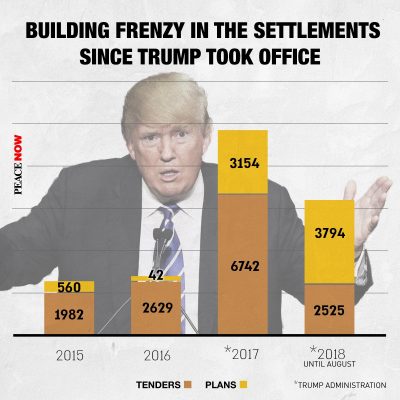
Image + Data by Peace Now
Recently released data from the Israeli Central Bureau of Statistics show that since January 2018, construction has started on a total of 1,073 new settlement units, and total of 1,075 new settlement units (started in previous years) have been completed – representing new housing for more than 10,000 settlers (assuming, conservatively, a family size of 5-6 people). Together the numbers mark a 66% increase over the same period in 2017. Though settlement plans have advanced at an alarming rate since the beginning of the Trump Administration, actual on-the-ground construction starts did not seen a significant surge until the second quarter of 2018, which saw a 187% increase over the first quarter.
Peace Now released a statement saying:
“The Netanyahu government continues to destroy the chances for peace. Further construction in the settlements undermines Israel’s interest in reaching a two-state solution, as such a solution will not be stable without a viable Palestinian state, which settlements increasingly threaten. Unfortunately, since Trump’s election, we have seen a sharp increase in the approval of the plans and tenders, and now we are beginning to see the consequences of these approvals on the ground.”
Settler leaders were characteristically dissatisfied with the pace of construction. The Director of the Yesha Council (and umbrella group representing all Israeli settlements), Yigal Dilmoni, told the Jerusalem Post:
“We are talking about a few hundreds units, which is very little, relative to thousands built throughout the country. Judea and Samaria still have the low building numbers, we expect and hope that we will be given more building permits.”
Settlement Projects Advance in Sheikh Jarrah, Jabal al-Mukaber
Ir Amim reports that two plans for new settlement buildings in the Palestinian East Jerusalem neighborhood of Sheikh Jarrah have been deposited for public review. If implemented, the two plans would build two new 6-story buildings in the Um Harun section of Sheikh Jarrah, one with 3 settlement units and the second with 10 settlement units. If implemented the plans will also involve the demolition of two buildings and the eviction of five Palestinian families living there.
The plans were originally approved for deposit in July 2017. As Ir Amim reported in detail at the time, both plans (numbers 14151 & 14029) are linked directly to Jerusalem settlement impresario Aryeh King. King can now count several significant victories for his settlement projects in sensitive Jerusalem neighborhoods over the past two weeks, totalling 309 new settlement units: Two plans were advanced in Sheikh Jarrah, totalling 14 units; one plan was advanced in Beit Hanina, totalling 75 units; also this week, King reportedly announced (though details are scant – stay tuned) that the government has approved a plan for 220 new units in the Nof Zion settlement enclave, located inside the Jabal al-Mukaber neighborhood. It is worth noting that, back in September 2017, the government was poised to issue permits for 176 units in Nof Zion – it is not clear if the 220 include those units, or are in addition to them, or if the numbers are inaccurate or deliberately misleading.
Settlement advancements in Sheikh Jarrah are becoming alarmingly routine. In addition to the developments this week, the inflammatory plan to build a Jewish religious school (known as the Glassman yeshiva project) was recommended for final approval. If implemented, an eight story building will be erected at the entrance to the Sheikh Jarrah neighborhood. The massive building will also include dormitories for young religious men and eight units to house “lecturers visiting from abroad.”
Israeli Authorities Approve Plan to Seize Palestinian Land & Legalize Outpost Near Hebron

by Land Research Center
The Land Research Center, a Palestinian organization, reports that the Israeli Civil Administration – the arm of the Israeli Defense Ministry that runs all affairs in the West Bank – has published a detailed plan to expand the borders of the Tene-Omarim settlement to include an outpost that was built without Israeli government authorization, located on lands claimed by the Palestinian village of Dahriyeh.
In order to carry out the plan, the Israeli Civil Administration will add 260,000 square meters of land (roughly 64 acres) to the settlement. The plan calls for 150 new units in Tene-Omarim in addition to new roads and open areas to connect the settlement to an outpost northeast of its borders.
In May 2018, the Israeli Civil Administration advanced plans for 143 new settlement units in Tene-Omarim.
Israel Issues “Gardening Orders” to Take Control of More Land in Silwan
On August 24th, the Israeli NGO Emek Shaveh reported that the Jerusalem Municipality had issued “gardening orders” as a means of taking over new areas of privately owned land in the Silwan and Abu-Tor neighborhoods of East Jerusalem (in the area known in Hebrew as the Ben Hinnom Valley). Under Israeli law, the Jerusalem municipality can issue orders to use private land for public purposes if it deems the land “unutilized” by its owners. News of the orders broke the day before U.S. National Security Advisor John Bolton attended a dinner party in Silwan hosted by the radical settler group Elad.
The orders seize 27 plots of land owned by Palestinians, based on the argument that the plots are not being used by their owners. The orders disingenuously note that Palestinian owners can seek to reclaim their land in the event that they obtain Israeli-issued building permits (without which they are unable to utilize the land for their own purposes). This explanation, as Emek Shaveh notes, ignores the fact that “the land owners cannot receive construction permits because their land is situated within a national park which, according to law, precludes construction.”
Emek Shaveh goes on to report:
“The gardening orders are the latest in a series of development activities in the Ben Hinnom Valley/Silwan area and will no doubt complement the Elad Foundation’s initiatives in the valley and efforts to link it with tourism ventures in the City of David/Wadi Hilweh. The Elad Foundation together with government ministries are currently promoting several projects within the area covered by the gardening order including a café in Abu Tor, the planned cable car intended to link West Jerusalem to the Kedem Center, and the archaeological excavations which the Elad Foundation has been funding in recent years adjacent to the Catholic cemetery.”
Israeli Tourism Ministers Boasts About Bankrolling Tourism Projects to Expand Settlements
At a meeting with the Yesha Council (the powerful umbrella group representing all Israeli settlements), Minister of Tourism Yariv Levin (Likud) told settler leaders:
“Tourism in Judea and Samaria (West Bank) is at a point of tremendous momentum. We now have a window of opportunity to make big moves in the tourism industry and this is a time of desire that should definitely be exploited. We will continue to establish and bankroll activities in Judea and Samaria in addition to establishing facts on the ground.”
Minister Levin boasted of having directed USD 11.15 million (NIS 40 million) to West Bank tourism projects over the past three years of his tenure.
In addition to his work directing taxpayer funds to the settlements, Minister Levin has also been pushing legislation and procedural rules that advance the direct application of Israeli laws over the settlements (an act of de facto annexation).
Shaked’s Judicial Interference is Subject of Special Knesset Session
On September 17th, the Knesset held a special session (during the Knesset recess) titled, “Justice Minister Ayelet Shaked’s attack on the High Court of Justice and the danger to democracy.” As FMEP has extensively documented, Justice Minister Shaked has been hard at work transforming the Israeli judicial branch in favor of pro-settlement and pro-annexation policies.
Meretz Chairwoman MK Tamar Zandberg opened the the special session defending her own party against accusations of political interference with the Court (Shaked denies a quote attributed to her saying that the High Court is an “arm of the Meretz party”). Zandberg said:
“the High Court of Justice was never a branch of Meretz. We often far from agree with the rulings of the High Court of Justice, which legitimized settlements, but we live in a democratic country governed by the rule of law, and the independence of the judicial system is one of its basic principles. The High Court of Justice is the focus of an extreme, unbridled attack aimed at clipping its wings and distorting the foundations on which it was established.”
One of many speakers, MK Michal Rozin (Meretz) said:
“Ayelet Shaked’s commander’s spirit is felt in the justice system – from the deepening of her control in the Judicial Appointments Committee, which has become a committee for the appointment of conservatives, to rulings which adopt her anti-constitutional lines, such as allowing the theft of Palestinian lands by the Jerusalem District Court. This spirit is aimed at applying sovereignty in the conquered territories, reducing the freedom of the citizens and expanding the Orthodox control on our daily lives.”
Appearing at the hearing under summons on behalf of the government, Justice Minister Shaked told her critics in the Knesset:
“I understand your anger about the fact that Jews are not being evacuated from their homes, but you must pull yourself together. We have a country to protect. The rule of law must be preserved. We cannot accept a situation in which your criticism of the court is sinking to such depths to which you have recently deteriorated. As the Minister of Justice, I call upon those who sit in this House – on the Left and the Right – to maintain dignified discourse. We don’t have another legal system. Of course it is legitimate to express criticism against a ruling. It is acceptable to argue over ideas, it is permissible to argue over areas of authority. I do so from time to time, but we must maintain respectability and dignified discourse.”
Bonus Reads
- “APN Peace Cast w/ Hagit Ofran” (Americans for Peace Now)
- “How Peace Keeps Receding in the Middle East” (Washington Post)
Welcome to FMEP’s Weekly Settlement Report, covering everything you need to know about Israeli settlement activity this week.
To receive this report via email, please click here.
March 15, 2018
- Settler Put in Charge of Office Dedicated to Seizing Palestinian Property in East Jerusalem
- 7 Months After Illegally Breaking In/Occupying Hebron Property, High Court Orders IDF to Evacuate Settlers
- Israel Moves to Confiscate More Palestinian Land Near Nablus
- B’Tselem Report: “Life Under the Shadow of the Beit El Settlement”
- “Settlements Are A War Crime”: UN High Commissioner Weighs in on 2017 Settlement Activities
- Bonus Reads
Comments, questions, or suggestions? Email Kristin McCarthy at kmccarthy@fmep.org.
Settler Put in Charge of Office Dedicated to Seizing Palestinian Property in East Jerusalem
A recent Haaretz report revealed that, more than a year ago, the Israeli Justice Ministry transferred authority over East Jerusalem absentee property cases to a division within the Justice Ministry headed by radical Israeli settler leader Hananel Gurfinkel. According to the report, over the course of the time Gurfinkel has been responsible for the East Jerusalem portfolio, the Justice Ministry has significantly increased its cooperation with nonprofit settler organizations to evict Palestinians and transfer the property to Israeli Jews – particularly in the Silwan and Sheikh Jarrah neighborhoods. The responsibility was transferred from the “Unit for the Location and Restitution of Unclaimed Property” in the Administrator General’s Office, to the economic unit, which Gurfinkel has lead for many years.
Gurfinkel lives in the Nof Zion settlement enclave, located in the Jabal al-Mukaber neighborhood of East Jerusalem (Nof Zion is set to triple in size, btw), and has a history of leading efforts to evict Palestinians from East Jerusalem and to replace them with Israeli Jews. Back in 2016, while serving in the Administrator General’s office he reportedly founded ”Building Jerusalem,” a nonprofit organization dedicated to combating the “Arab conquest” of Jerusalem. In that time he has also been elected to the central committee of the right-wing Habayit Hayehudi political party.
With Gurfinkel in charge of the Administrator General’s East Jerusalem property cases, the office has drawn much criticism, particularly around its decision to hire attorney Moshe Segal to represent the government in property disputes against Palestinians. Segal was reportedly hired without going through a competitive bidding process, as required for government contracts. Even more alarming, Segal provides legal representation to two of the most aggressive settler groups active in East Jerusalem – Elad and Ateret Cohanim – which regularly petition the Administrator General to evict Palestinians and award property rights to Israeli Jews. Segal representation of these clients appears to pose a blatant conflict of interest.
After initially – and bizarrely – denying that Segal works for the government, the Justice Ministry defended Segal’s hiring and dismissed the idea that there might be a conflict of interest, saying “the administrator general and attorney Segal do not represent opposing positions” (suggesting with remarkable honestly, that it is the official view of the Ministry that the positions of the settler organizations and the government are indistinguishable). The Justice Ministry further defended its operations, saying in part:
“The handling of assets managed by the administrator general division were transferred to the economic unit … as part of a structural change and based on the giving of additional tasks to the Unit for the Location and Restitution of Unclaimed Property…The administrator general division manages the property of private owners all over the country and is obligated to act for their benefit, including handling suits against trespassers. The division has no separate policy concerning management of property located in one region or another.”
The Haaretz Editorial Board issued a blistering response to their paper’s breaking news, saying that assigning such authorities to Gurfinkel is “crooked, improper, and possibly illegal.”
7 Months After Illegally Breaking In/Occupying Hebron Property, High Court Orders IDF to Evacuate Settlers
On March 12, the Israeli High Court of Justice finally issued a ruling to evict nearly 100 Israeli settlers who have been squatting in a disputed property in Hebron, after having broken into the building nearly seven months ago. Since first ordering them to leave the site in October 2017, the High Court has repeatedly agreed to delay the evacuation, pending various appeals. Since then, the settlers have repeatedly petitioned the Court for delays and comprises, all of which the High Court has rejected.
Peace Now told The Times of Israel that the government should “show zero tolerance for any further attempts to postpone the evacuation” and that hopefully “this time the invaders will honor the court and evacuate without violence and without unnecessary dramas.”
The property, which the settlers have named “Beit Machpelah” (Palestinians call it the “Abu Rajab House”) sits across the street from the historic religious site known as the Tomb of the Patriarch to Jews and the Ibrahimi Mosque to Muslims. Palestinians claim it is owned by the Abu Rajab family, while settlers claim the property was legally purchased. When the settlers broke into the property, the Israeli army protected their presence there (allowing them to freely enter and exit the property) and declared the area a closed military zone to keep Palestinians away from the settlers. The army also failed to protect Palestinians from the settlers, some of whom are violent, squatting there. In a recently published report, the United Nations High Commissioner for Human Rights addresses the case of the disputed property (page 4 and 6), documenting several incidents of settler-violence resulting in hospitalization and slamming the IDF for not intervening, and in once case arresting Palestinians who were the victims of the settlers’ stone-throwing.
Israel Moves to Confiscate More Palestinian Land Near Nablus
According to a report by Al Jazeera, the Israeli army entered the Palestinian town of Burin in an effort to inform its leaders that Israel intends to confiscate a parcel of land in the city that is currently the site of a local secondary school. IDF soldiers reportedly said that the land is being confiscated for “security reasons.” According to Yahia Kadous, who is the head of Burin, Israel has already seized much of the land around the school, and the latest decision is a continuation of Israel’s incremental annexation of land on the village’s periphery.

Map by WINEP
Burin is a Palestinian town just south of Nablus, near the notoriously violent Israeli settlement of Yitzhar. Settlers, mainly from Yitzhar, have launched a string of attacks on the Burin and other surrounding villages over the past year. The Israeli NGO Yesh Din has documented 20 incidents of settlers throwing stones at Burin residents and houses over the past six months alone. As is often the case across the West Bank, the IDF stands idly by as settlers attack, and in some cases the IDF enters Burin to disperse counter-protests – deploying tear gas canisters and stun grenades. In early March, a Yesh Din video showed Israeli soldiers invading Burin and firing a tear gas canister at a Palestinian couple and their infant who were fleeing their home as the soldiers approached.
In response to the constant violence and the IDF’s abdication of responsibility, Yesh Din has launched a campaign seeking to compel the IDF to do more to stop the attacks on Burin. Yesh Din unveiled the campaign, writing:
“The residents of Burin and surrounding villages are thus repeatedly impacted not only by the violence of settlers, but also by the violence of the Israeli security forces, whose task it is to provide protection for the Palestinians. This reality must and can be prevented. Yesh Din has launched a public campaign calling for an immediate end to settler harassment in the Yitzhar area including settler trespass into the village and fields of Burin. The campaign calls upon the Head of the Central Command in the Israeli army to fulfil his duty to protect Palestinians and prevent offences from being committed against them by Israeli civilians. We demand that the Israeli authorities investigate and bring the Israeli perpetrators to justice.”
B’Tselem Report: “Life Under the Shadow of the Beit El Settlement”
In a new publication, B’Tselem documents the detrimental impact that the Beit El settlement has had on 14,000 Palestinians living in the nearby al-Jalazun refugee camp. As a reminder, U.S. Ambassador David Friedman served as President of American Friends of Beit El, and on his watch the organization raised major funding to support the settlement.
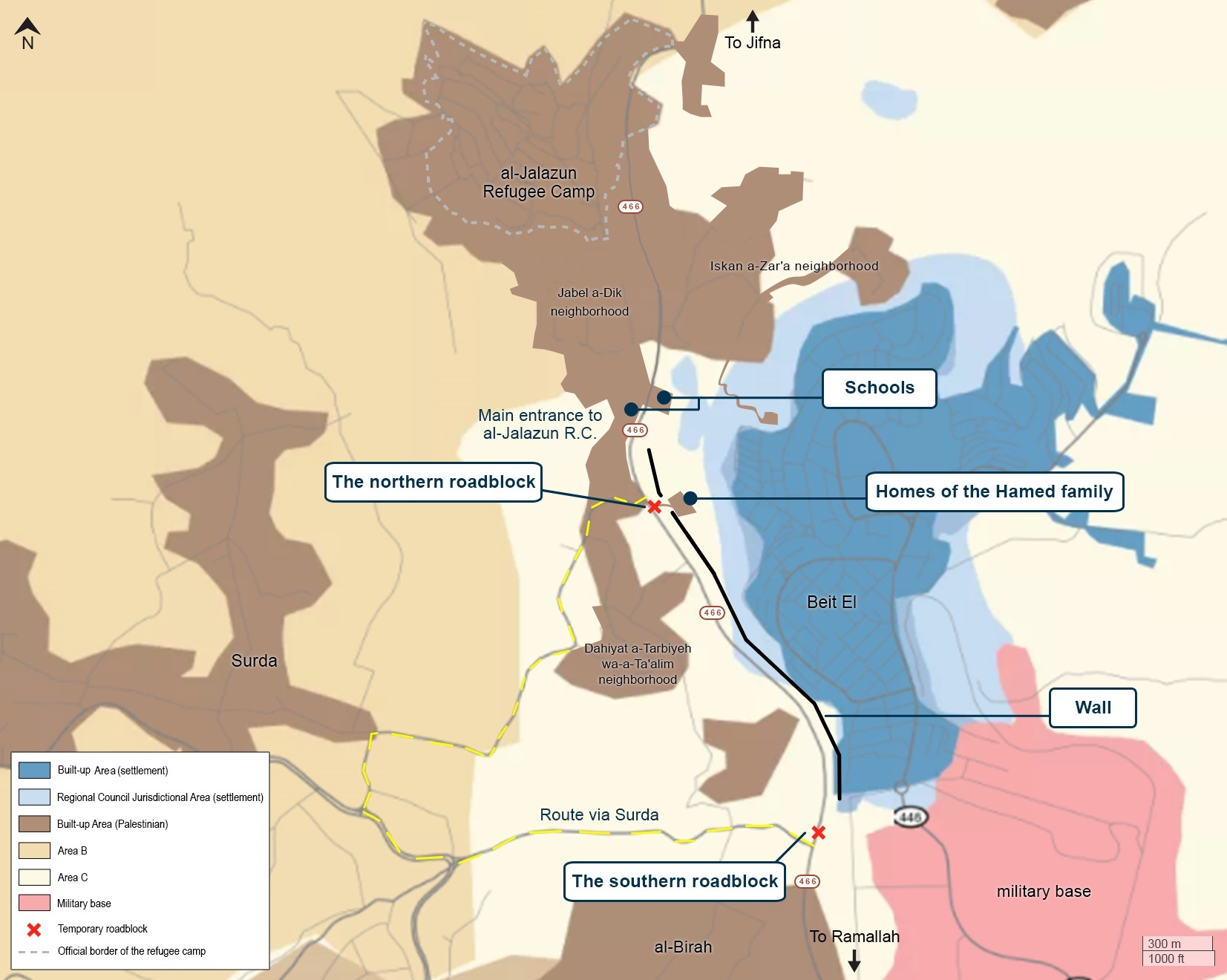
Map by B’Tselem
The Israeli army frequently denies al-Jalazun residents the right to use roads near Beit El, which severely restricts their ability to commute to jobs or seek medical treatment, or to simply go about their lives unmolested. Additionally, the Beit El settlement successfully lobbied the Israeli government to build a massive separation wall between the settlement and the refugee camp, a wall which has cut-off one Palestinian family from the camp.
B’Tselem compiled numerous testimonies from residents of al-Jalazun refugee camp that shed light on how such severe infringements on freedom of movement have impacted their daily lives. On resident, Muhammad Safi, said:
“Life here has become unbearable. If it happened once a year, or even once a month, I might have been able to live with it, but for months it happened here every day and it was unbearable. The humiliation, the anxiety, the fear I and other taxi drivers working this route feel all the time can make a person sick. I’m thinking about looking for other work, but there aren’t too many alternatives. I pray to God to make it better for us.”
“Settlements Are A War Crime”: UN High Commissioner Weighs in on 2017 Settlement Activities
The United Nations High Commissioner for Human Rights recently submitted the annual report tracking the expansion of Israel settlements, documenting activities from November 2016 through October 2017. The report covers a lot of ground — documenting and condemning Israeli activities in Area C of the West Bank, legislative initiatives concerning Jerusalem, discriminatory planning and zoning practices, home demolitions and evictions, the role of Israeli security forces, an increase in settler violence, and instances of collective punishment. It also reiterates that all Israeli settlements in occupied territories are a war crime under the Fourth Geneva Convention.
In a key section describing how many of these policies create what the report calls a “coercive environment” that amounts to a population transfer, the report says:
“Forcible transfer does not necessarily require the use of physical force by authorities; it may be triggered by specific factors that give individuals or communities no choice but to leave, amounting to what is known as a ‘coercive environment’. Any transfer without the genuine and fully informed consent of those affected is considered forcible. Genuine consent to a transfer cannot, however, be presumed in an environment marked by the use or threat of physical force, coercion, fear of violence, or duress (A/HRC/34/38, para. 28; A/HRC/34/39 para. 41). Human rights, such as the rights to freedom of movement, privacy and family life, in addition to economic, social and cultural rights (A/HRC/16/71, para. 24), are usually violated within the context of forcible transfer.”
Bonus Reads
- “Do Israeli Settlers Have Any Power in America?” (The Forward)
- “Israeli Settlers Hold Country Hostage to their Ideology”(Al-Monitor)
- “West Bank demolitions and displacement continue at similar pace to 2017” (OCHA)
Welcome to FMEP’s Weekly Settlement Report, covering everything you need to know about Israeli settlement activity this week.
To receive this report via email, please click here.
September 7, 2017
- In Sheikh Jarrah, Palestinians Evicted, Settlers Move In
- Major Expansion in Settlement Enclave – Approval of Permits Imminent
- High Court Lets Settlers Stay in Hebron House [That They Took Over Illegally]
- Amichai Update: Work on New Settlement to Resume with Infusion of Government Funds
- U.S. Ambassador Questions if the Occupation Exists, Minimizes Impact of Settlement Enterprise
- Bonus Reads
Comments, questions, or suggestions? Email Kristin McCarthy at kmccarthy@fmep.org.
In Sheikh Jarrah, Palestinians Evicted, Settlers Move In
On September 5th, the Israeli army evicted members of the Shamasneh family from their home in Sheikh Jarrah, a Palestinian neighborhood in East Jerusalem; they had lived in that home since 1964. Within hours of the eviction, extremist Israeli settlers moved into the home. This is the first eviction to be carried out in Sheikh Jarrah since 2009, when evictions there inspired a sustained domestic and international protest.
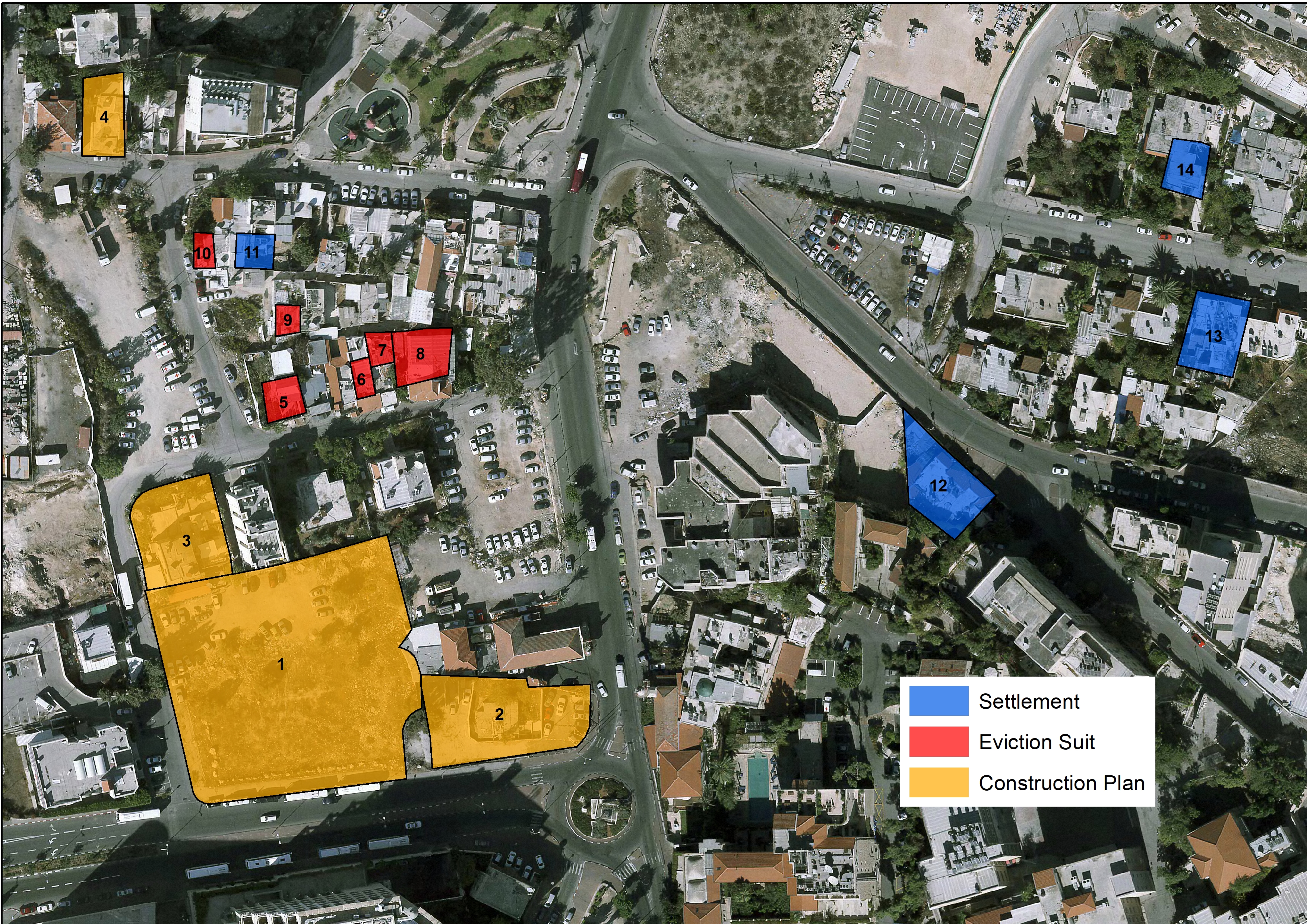
Map by Peace Now
The Shamasneh family was sent an eviction notice back in 2013, after a court ruled in favor of Israelis who sought to “redeem” the home. Their case was based on an Israeli law that allows Jews to reclaim property and land they were forced to abandon in 1948, when Jordan captured East Jerusalem (a right Palestinians are not afforded with respect to properties they were forced to abandon in what became Israel in 1948). The eviction of the Shamasneh family was repeatedly delayed out of “humanitarian concerns” over the health of the elderly Shamasneh patriarch. Earlier this year, it became clear the eviction was going to be carried out when a wave of provocative East Jerusalem settlement plans were advanced, including multiple plans to build more settlement units in the Sheikh Jarrah neighborhood.
Regarding the Shamasneh’s case, Ir Amim wrote:
Today’s eviction of the Shamasneh family symbolizes the boldness with which these settlement activities in the most sensitive part of East Jerusalem are now being executed – with the full backing of the state – and the pressing need to halt this escalation of events in order to preserve the waning viability of the two state solution.
Regarding that same eviction, East Jerusalem settler impresario (and city councilman) Aryeh King exulted:
I expect more evictions this year of residents who refuse to recognize the Jewish owners of the properties where they are living. With the opening of the new National Insurance Institute nearby, the Nahalat Shimon [Shimon Hatzaddik] neighborhood is going to see a significant expansion of Jewish settlement, which residents of Jerusalem have waited for years to see.
On the evening prior to the eviction, Israeli forces raided several Palestinian homes in Sheikh Jarrah and issued six additional eviction notices.
Major Expansion in Settlement Enclave – Approval of Permits Imminent
The Jerusalem municipality is set to grant building permits for 176 new housing units in the Nof Zion settlement, an Israeli enclave located inside the Palestinian neighborhood of Jabel Mukaber in East Jerusalem. If approved, construction of the units will make Nof Zion the largest Israeli settlement enclave in East Jerusalem.
Peace Now, which was first to report the story, wrote:
It appears that the [Israeli] government has opened all the floodgates when it comes to settlement developments within Palestinian neighborhoods. Building a large settlement in the heart of a Palestinian neighborhood would constitute a severe blow to Jerusalem and to the chance to arrive at a two state solution. This is not a matter of real estate but a matter of politics and sovereignty, as the Israelis moving to homes inside Palestinian neighborhoods are motivated solely by ideology, and are trying to prevent a future compromise in Jerusalem.
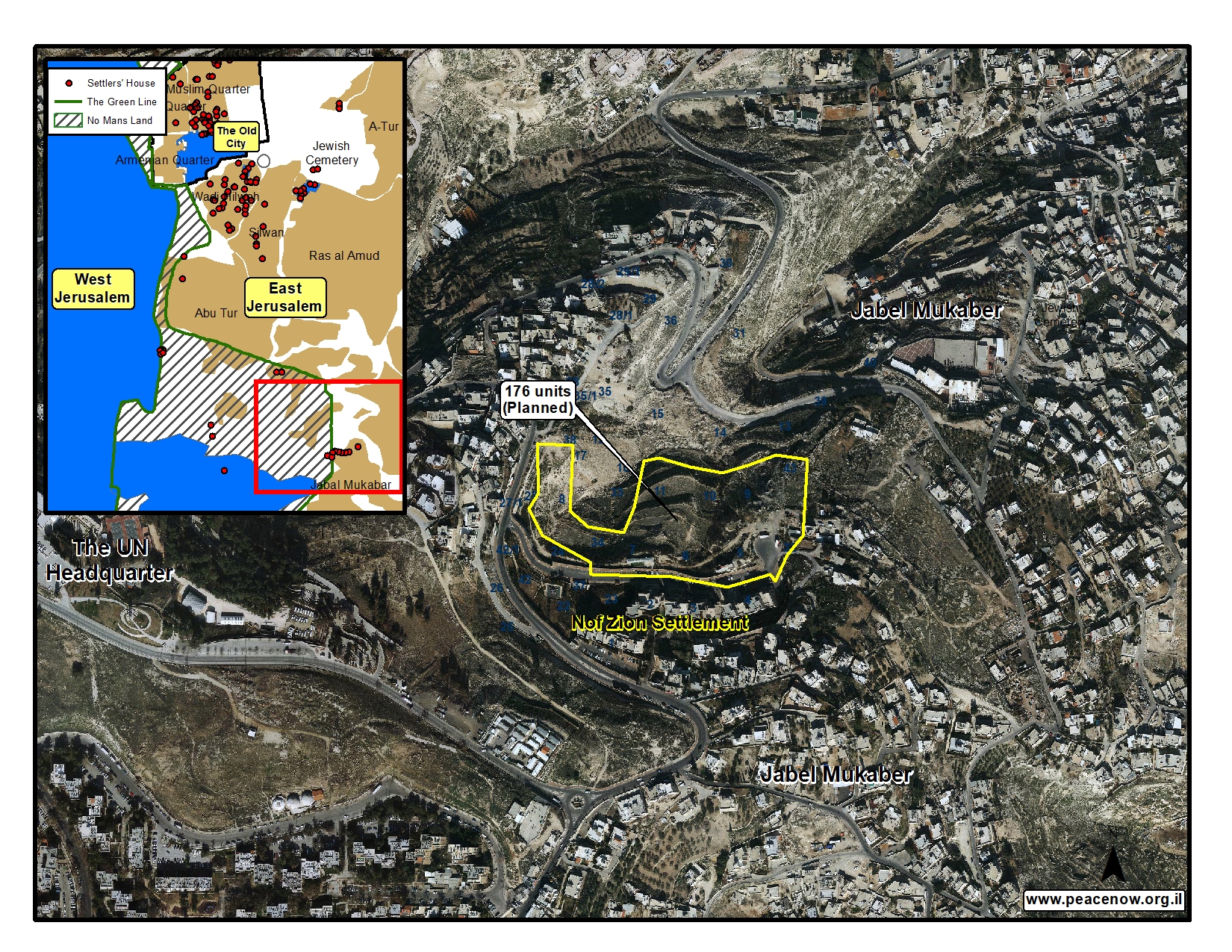
Map by Peace Now
Plans for 395 new units for the Nof Zion enclave were originally approved in 1994, but the first phase of construction bankrupted the developer. A drama ensued over the fate of the project, after a Palestinian-American made a bid to buy the development rights. His winning bid was ultimately blocked by right-wing Israelis [with a key role played by Jerusalem settler impresario Aryeh King] who objected to the sale of the property – in an Palestinian neighborhood – to an Arab.
As it stands, only the Prime Minister’s personal intervention might stop the construction, which does not seem likely given Netanyahu’s repeated declaration that his is the most settlement-friendly government in the country’s history.
The units are not the only construction happening in Nof Zion. Earlier this year, the government approved a plan to build a new synagogue and mikveh on private Palestinian land that was expropriated from the Jabel Mukaber neighborhood in 2016.
Ir Amim writes:
The primary objective of the settlers’ infiltration into the Palestinian neighborhoods in and around the Old City is to undermine the possibility of dividing Jerusalem, thereby foiling the possibility of a political resolution on the city and an end to the Israeli-Palestinian conflict. The building permits will issue a clear statement that the Israeli government sanctions and supports the establishment of new facts on the ground designed for this purpose.
High Court Lets Settlers Stay in Hebron House [That They Took Over Illegally]
On September 3rd, the Israeli High Court of Justice issued an injunction allowing for a one-week delay of the evacuation of 100 Israeli settlers from the “Machpela House” in Hebron. The settlers have been illegally inhabiting the house, under the protection of the Israeli army, since they broke into the property on July 25th.
The delay is the result of a last minute petition filed by the squatters claiming rightful ownership of the house; the petition gives Palestinian claimants and the state of Israel one week to respond, during which time the settlers are allowed to remain in the house. The injunction reverses an order by the Israeli Attorney General last week to evacuate the settlers by September 3rd.
Peace Now said in a statement about the settlers’ latest petition:
The settlers’ petition is absolutely outrageous and its baseless arguments have been rejected again and again in previous legal proceedings. After having been granted an independent administration a few days ago, it is no wonder the Hebron settlers feel empowered to do as they wish, while ignoring the law and on the expense of Palestinians. [Editor’s note: the reference to an “independent administration” relates to a decision last week, explained in the same Peace Now explainer linked above, to promote the status of an administrative body that can represent Hebron’s settlers to the Israeli government].
Amichai Update: Work on New Settlement to Resume with Infusion of Government Funds
On September 3rd, the Israeli Cabinet approved the allocation of 55 million shekels ($15.3 USD) to the Interior Ministry for the construction of the Amichai settlement in the Shilo Valley, the first official new Israeli settlement to be built in 25 years. The construction of Amichai, which was approved as a pay-off for families evicted from the illegally built the Amona outpost, has been stalled for nearly two months for lack of funds.
The Cabinet’s resolution notes that any additional government contribution to the project “depends among other things on court verdicts,” because “legal proceedings are now before the court against the construction of the new settlement, including the infrastructure work.” Last week we reported on a petition to the High Court filed by Bimkom on behalf of Palestinian landowners in the vicinity of Amichai.
The government’s funding will go towards providing public infrastructure to the new settlement: paving access roads, building sewage systems, and connecting it to the Israeli power grid. The 55 million shekels allocated this week fall within the original 60 million shekel budget approved by the Cabinet last year.
U.S. Ambassador Questions if the Occupation Exists, Minimizes Impact of the Settlement Enterprise
In an interview in the Jerusalem Post, U.S. Ambassador to Israel David Friedman articulated major points of the Trump Administration’s approach to Israel, the Palestinians, and peace negotiations.
Alarmingly, the Ambassador called into question whether or not Israel is, in fact, occupying the West Bank. Amb. Friedman – who before he was nominated to be Ambassador had a long history of criticizing the American Jewish Left, including calling its members “kapos” – reportedly told the Post, “The [American Jewish] Left…is portrayed as believing that only if the ‘alleged occupation’ ended would Israel become a better society.” Following the publication of Ambassador Friedman’s interview, a senior White House official told the Guardian that his comments do not represent a shift in U.S. policy.
Israel’s occupation of the West Bank, East Jerusalem, and the Gaza Strip is an objective fact, acknowledged by the entire international community including, until now, the United States. As noted by Americans for Peace Now:
The West Bank and Gaza are viewed by virtually all international legal experts as “occupied territory.” Since 1967, legal experts, including in Israel, have been virtually unanimous in recognizing this…Even the Israeli Supreme Court has repeatedly used the term “belligerent occupation” to describe Israel’s rule over the West Bank and Gaza… Even Ariel Sharon, one of the principal architects of Israel’s policy of building settlements in the West Bank and Gaza, recognized this reality. On May 26, 2003, when he was Prime Minister of Israel, he bluntly told fellow Likud members, “You may not like the word, but what’s happening is occupation [using the Hebrew word “kibush,” which is only used to mean “occupation”]. Holding 3.5 million Palestinians under occupation is a bad thing for Israel, for the Palestinians and for the Israeli economy.”
Also of concern with respect to settlements, Ambassador Friedman said,
If you listened to the Obama administration, you would think that the [Israeli] settlements had overtaken the West Bank. It’s still under 2% of the territory. I am personally convinced that there’s nothing in the current status quo with regards to settlements that precludes the resolution of the Palestinian [issue].
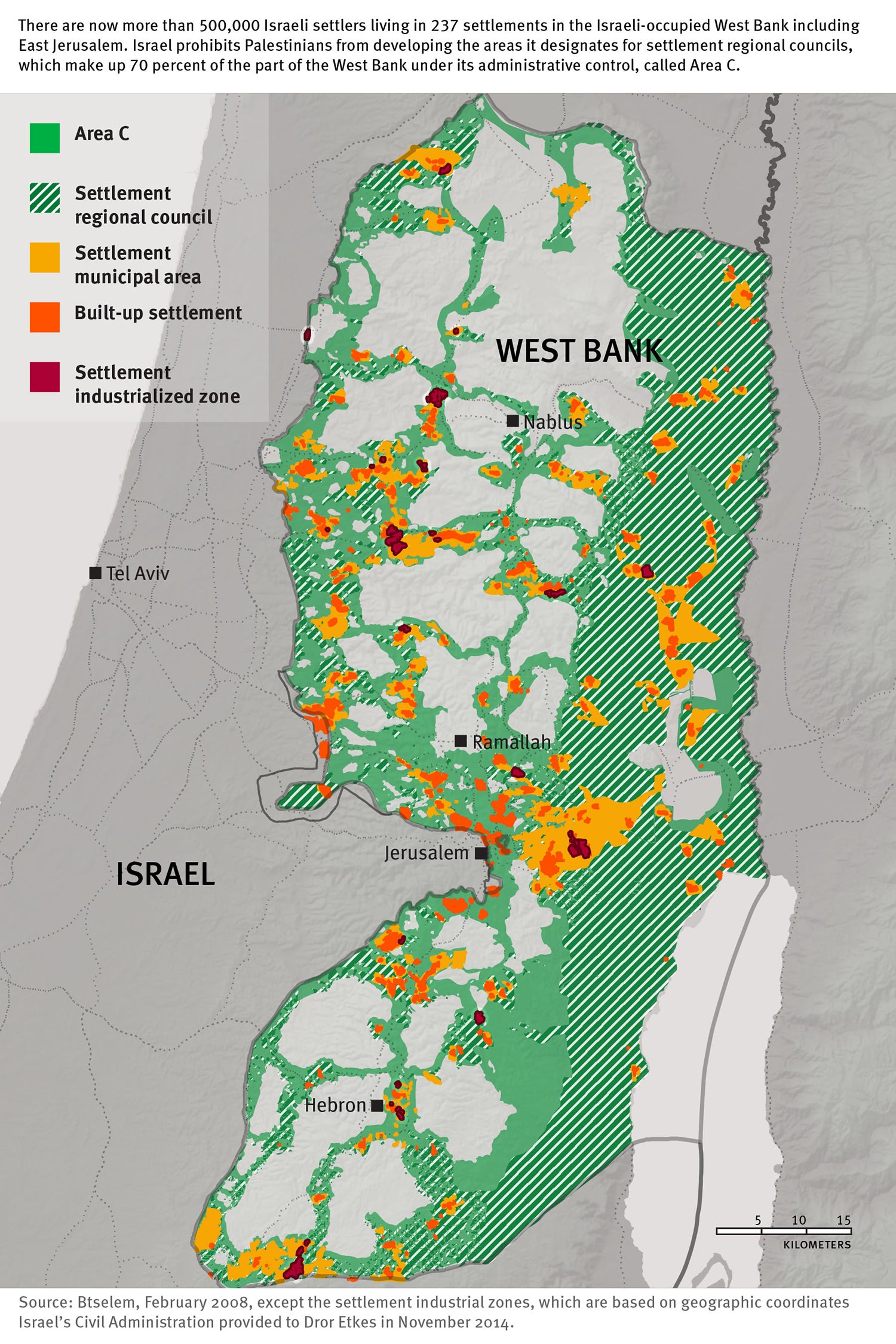
Map by Human Rights Watch
Ambassador Friedman’s 2% figure is misleading. It refers restrictively to the amount of land settlers have actually built on [2% of the West Bank], but does not count the many ways settlements have created a massive, paralytic footprint in the West Bank. This argument was comprehensively dismantled last November by FMEP’s Lara Friedman, in her testimony before the UN Security Council.
In a report last year, Yesh Din explained further:
The jurisdiction areas of many settlements are much larger than the area they actually use. In 2013, the total area under the jurisdiction of settlements, including regional councils, stood at 1.2 million dunams (roughly 120,000 hectares), or 63% of Area C. In practice, the area covered by the settlement enterprise is larger, as it also includes the unauthorized outposts, many of which are outside local council jurisdiction areas, as well as their farmland. Palestinians are barred from entering all of these areas, by virtue of a “closed military zone” order which prohibits entry without a permit.
The settlements command an area that is larger than their residential, built-up portion. Each community has a system of access roads, and each is assigned vast areas intended to ensure the residents’ safety. Many settlements include farmland, industry and commerce zones, green areas and parks, and in many of them the distance between the houses is so large, that the space they take up has no direct correlation to the number of people living in them.
Yesh Din’s full report, “Land Takeover Practices Employed by Israel in the West Bank” is available online here.
Bonus Reads
- “Illegal outpost residents ask court to save parts of homes set to be razed” (Times of Israel)
- “Bedouin Shepherds Between a Rock, a Hard Army, and West Bank Settlers” (Haartez)
FMEP has long been a trusted resource on settlement-related issues, reflecting both the excellent work of our grantees on the ground and our own in-house expertise. FMEP’s focus on settlements derives from our commitment to achieving lasting Israeli-Palestinian peace, and our recognition of the fact that Israeli settlements – established for the explicit purpose of dispossessing Palestinians in the West Bank and East Jerusalem of land and resources, and depriving them of the very possibility of self-determination in their own state with borders based on the 1967 lines – are antithetical to that goal.