Welcome to FMEP’s Weekly Settlement & Annexation Report. To subscribe to this report, please click here.
March 27, 2026
- WEST BANK: Five New Outposts, Cabinet Approves Legalization of 30 Outposts, 972 Investigations Shows Area B Strategy Unfolding, 19 Billion for Settlements Since 2023, Weaponization Continues
- EAST JERUSALEM: 15 Families Dispossessed in Silwan
- STATE-BACKED SETTLER TERRORISM: Settlers Organze Multi-Day Terror Campaigns
- BONUS READS
WEST BANK
Overnight, Settlers Establish Five New Outposts, Killing One Palestinian Who Tried to Stop Them
Haaretz reports that on the night of March 26 settlers established five new outposts, four of which are located in Area A (some ~18% of the West Bank). Later reports suggest the IDF has already demolished all five outposts.
When approximately 40 settlers invaded land in the Palestinian village of Tayasir, settlers fired at Palestinians who came out to stop them from establishing an outpost, killing Mohammad Faraj Al-Malhi, a 27-year-old resident of East Jerusalem. Clashes at the sites of the other outposts resulted in the injury of 14 additional Palestinians. Settlers had attacked Tayasir just one day prior, firing at Palestinians
Kerem Navot founder Dror Etkes told Haaretz:
“Establishing four outposts in Area A is unprecedented by any measure, and shows the extent to which the State of Israel has lost control not only over settlers in the West Bank, but also over the army, the police and other authorities meant to enforce the law. The establishment of four outposts in a single night is an extreme event with very few precedents in the history of settlements.”
Cabinet Approves “Legalization” of 30 Outposts
The Israeli Security Cabinet reportedly approved the retroactive legalization of 30 outposts across the West Bank. The approval came during the same meeting when IDF Chief of Staff Zamir informed the Cabinet of growing settler violence. There no details on which 30 outposts were affected.
972 Investigation: Settlers Systematically Expanding Control Into Areas A & B
In an investigation with The Nation, 972 Magazine chronicles how settlers, having effectuated the de facto annexation of Area C of the West Bank, are now in the process of “methodically breach[ing] the borders of Area B…[where] settler outposts are being strategically used to seize land and drive Palestinian communities out — with the backing of the Israeli army and police. Palestinian communities on the outskirts and margins of Area B towns are being pushed inward, to the centers of these localities. Land on these margins is incrementally taken over through the construction of outposts, the carving of roads, and the declaration of military zones. The effect is a fragmented landscape in which communities are cut off from one another and from agricultural land essential to their livelihoods.”
The investigation, which focuses on the experiences of 12 Palestinians communities, reports the results of settlers’ shifting focus:
“Since October 7, settlers have worked in tandem with the Israeli army to expel at least 76 entire Palestinian communities, while settlers have simultaneously established 152 new outposts. Among these outposts, at least 22 have been established in Area B, including 12 in the “Agreed-Upon Reserve” (a plot of 167,000 dunams in the southern West Bank that is designated as Area B). One outpost has also appeared inside Area A.
According to mapping by +972 Magazine, Local Call, and The Nation, based on data collected by the Israeli organizations Kerem Navot and Peace Now, the settlers living in these outposts have taken control of around 98,000 dunams (almost 25,000 acres) in Area B and Area A. In total, settlers living in outposts now wield effective control over roughly 1 million dunams (250,000 acres) across the West Bank.”
Netanyahu Government Has Allocated 19 Million for Settlements
Peace Now reports that since returning to power in late 2022, the Netanyahu government has allocated NIS 19 Billion to the settlement enterprise. Peace Now details the expenditures in depth in their report, which you can read/download here.
Continued Escalation of Archaeology as Means of Dispossession
State and settler focus and seizure of archaeological sites continues to expand in scope and intensity. As settlers and the state now routinely make incursions into and exercise authority over Area B of the West Bank, Palestinian communities living near/amongst ancient sites are coming under increasing pressure.
Emek Shaveh documents the following incidents since Israel and the U.S. launched a war on Iran:
- Tel Aroma/Jabel Urma: Located south of Nablus and adjacent to the Palestinian town of Beita (Area B), this antiquity site has become the focus of nearby settlers who have tried to establish an outpost at the site though it was dismantled. Settlers nonetheless continue to raid the site and harass Palestinians.
- Marajam: The IDF carried out a demolition of a house in Marajam, located southwest of Duma in the central West Bank (Area C). The house was located on the periphery of an antiquity site but did not pose any threat to the site – as determined by archaeological experts.
- al-Fasayil: The IDF demolished the village of al-Fasayil on March 17th, a bedouin community in the Jordan Valley. Israel had denied building permits for their homes of 20+ years because they were built within an archaeological site. Most residents of al-Fasayil had already fled their homes and lands under the constant, violent harassment of settlers. The Israeli state has previously conducted excavations at the site.
Israeli archaeologist and Board member of Emek Shaveh writes:
“In a recent Facebook post, Israel’s Heritage Minister, Amichai Eliyahu, uploaded a reel of his visit to the Herodium palace in Jericho, putting up an Israeli flag and declaring: “This is our land. Any place built on the heritage of the Jewish people – we will destroy it.”
By defining all “Judea and Samaria” antiquities as “ours” and extracting and appropriating cultural wealth from the ground, Israel impoverishes the Occupied Palestinian Territories. It reduces the Palestinians themselves to the status of strangers in their own land.
In recent years, this has served as a preface to ethnic cleansing. Less than a week after Eliyahu made his statement about “destroying” anything built on our heritage, Israeli settlers from the illegal Palace Farm outpost demolished 13 Palestinian houses in a nearby suburb of Jericho, claiming that they endangered antiquities.
Archaeological excavations across the West Bank, in places such as Susiya, Otniel, Auja al-Foka, and Fasa’il (to name but a few), have foreshadowed the destruction of dozens of Bedouin hamlets and the expulsion of their inhabitants from the southern Hebron Hills and the Jordan Valley. An archaeological park in Jerusalem threatens 100 homes in Silwan….
Archaeology is also wielded as an administrative weapon in the West Bank and east Jerusalem. With as many as 6,000 archaeological sites in the database, legal restrictions on construction and development – as well as claims of damage and looting – are used to demolish Palestinian homes and constrain economic growth (in Israel, sites are routinely examined and, if necessary, removed to allow development)
A common Israeli claim is that Palestinians have “no interest” in antiquities. Beyond perpetuating a racist trope that justified centuries of looting by imperial powers (there are, in fact, hundreds of Palestinian archaeologists), this sentiment fails to recognize that it is Israel’s weaponization of archaeology that has become a threat to Palestinian land and identity. The more we [Israelis] insist that antiquities are ours and only ours, the more we endanger the very sites and artifacts we want to protect.
Only by realizing that the heritage of Israel and Palestine belongs to all who live between the river and the sea will we create the basic conditions for its preservation.”
EAST JERUSALEM
Ethnic Cleansing in Action: 15 Families Dispossessed in Silwan in Favor of Settlers
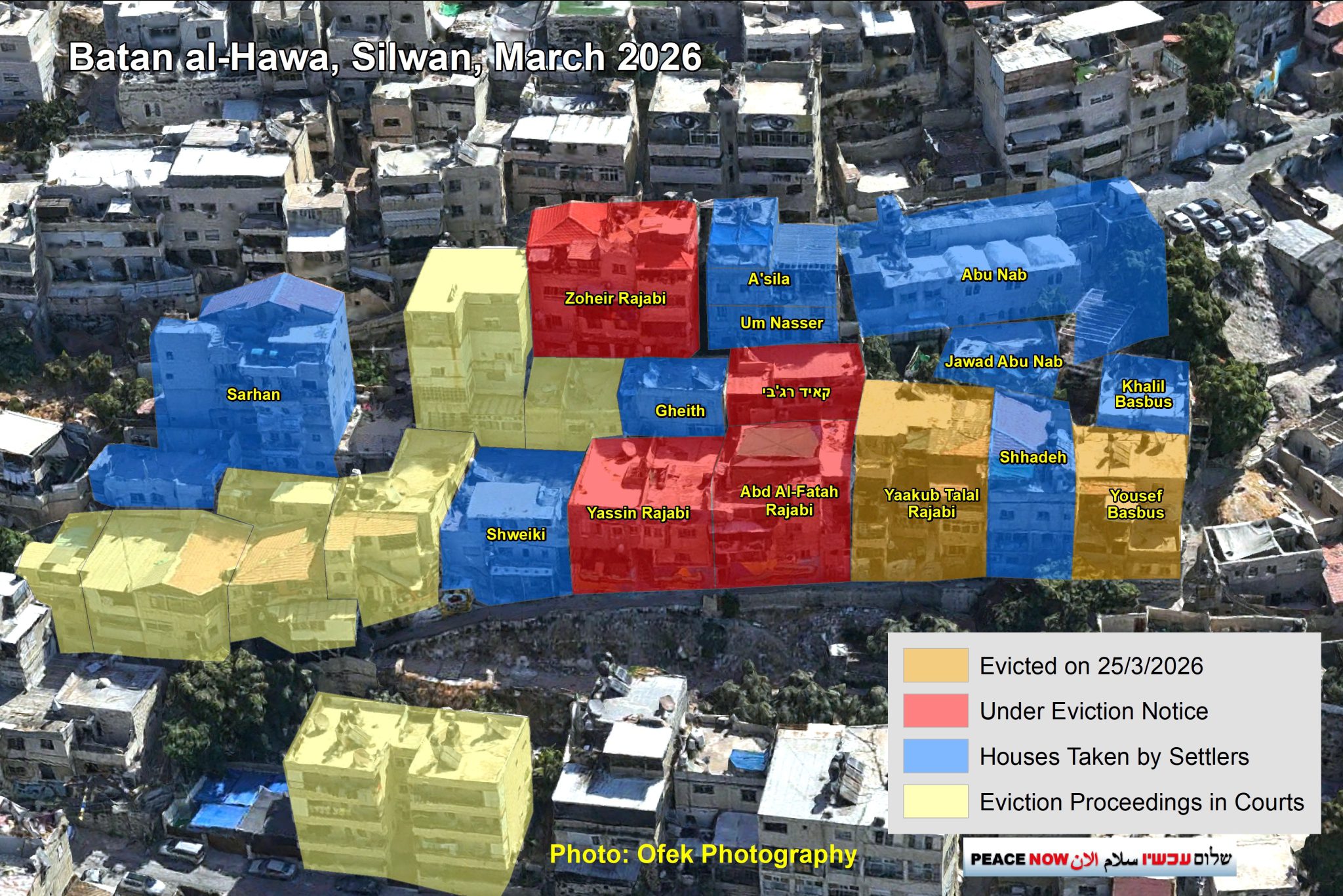 Over the past week, Israeli forces and settlers forcibly removed 15 Palestinian families from their homes in the Batan al-Hawa section of Silwan, clearing them and their belongings out so that the Ateret Cohanim settler organization can take possession of the buildings and Israeli settlers can move in. There are an additional 15 families under imminent threat of eviction on the basis of the same court decision.
Yosef Basbous, whose family was expelled this week said:
“Our family was expelled in 1948 and dispersed in refugee camps in the West Bank. I arrived in Silwan with my parents more than 60 years ago. I built this house stone by stone, brick by brick, nail by nail. Today they come to us and expel us again. They claim that the land belonged to a Yemeni waqf and that the custodian sold the land to settlers. The police say they are implementing the court’s decisions, according to the law. But what kind of law is this that can expel me, who has been here for more than 60 years.”
Another expelled resident, Jacob Rajabi told Haaretz:
“They came at 9 A.M., entered the house, took the children and women, and put us out on the street. This is the home where I was born, where I got married, raised children – my whole life is there.”
Peace Now said:
“Unfortunately, there is no other word to describe this than ethnic cleansing. Settlers, with the help of the government and a discriminatory legal system, are expelling an entire Palestinian community and replacing it with settlers. This is happening in the Jerusalem of 2026 and it is a stain that will not be erased from Israel.”
Ir Amim explains:
“These expulsions are part of an unprecedented escalation in forced displacement from Silwan that is tantamount to forcible transfer and involves multiple state institutions and entities working in collusion with settler groups and reinforced by a complicit judiciary. The amount of resources being allocated and deployed to carry out these measures during an ongoing war underscores the Israeli government’s resolve to exploit the circumstances to accelerate forcible transfer and solidify an irreversible apartheid reality. As detailed in a forthcoming Ir Amim report, a web of state and local authorities, statutory bodies, and laws converge into a single coordinated, multi-layered system of state-orchestrated dispossession and displacement of Palestinians in East Jerusalem, in flagrant violation of international law.”
B’Tselem details the history and context of Silwan, and explains:
“In Silwan, as in other Palestinian neighborhoods of Jerusalem and Palestinian villages across the West Bank, the Israeli regime uses every tool at its disposal to dispossess Palestinians of their land. The goal of removing Palestinians from their homes is pursued out in the open, the core features of Israel’s apartheid regime, via the court system, and in cooperation with settler organizations, with matching efforts to make Palestinians’ lives unbearable through systematic neglect and violence perpetrated by both official and unofficial actors. This is the reality of systematic, institutionalized violence in which Palestinian residents of Jerusalem live daily under Israel’s apartheid regime, stripped of their most basic rights. Confronting this reality requires urgent and immediate intervention by members of the international community.”
STATE-BACKED SETTLER TERRORISM
The pace of settler attacks is nearly impossible to keep track of. On March 21st (Eid weekend) settlers organized mass riots and attacks on Palestinian communities overnight, resulting in 17 pogroms across the West Bank completely undeterred by the IDF. The attacks were organized in reaction to the death of an 18-year old settler in a car accident, which settlers insisted was a terror attack despite unclear and at times contradictory facts. At the funeral for the settler, Finance Minister Bezalel Smotrich called for settlers to respond with settlement expansion, saying “We will erase the lines, the definitions, and the letters, and we will settle our land in all its expanses.” The father of the settler called him a “sacrifice“ for the settlements.
Settlers organized a second wave of terror campaigns on March 23rd, injuring at least 10. Five were reportedly arrested.
BONUS READS
- “How Israel’s strangulation of the West Bank is collapsing the Palestinian educational system” (Mondoweiss, 3/24/2026)
- “Israel’s Top Court Orders Compensation for Palestinian Family Whose Cattle Were Stolen by IDF Troops” (Haaretz, 3/25/2026)
- “32 Outposts, 10 Miles of Ground Barrier: IDF Builds New Border Line Inside Gaza. Here’s How It Looks” (Haaretz, 3/26/2025)
- “Netanyahu Coalition Pushes to Fast-track New Jewish Towns in Arab, Bedouin Areas” (Haaretz, 3/25/2026)
- “Vance’s office denies report VP raised anti-Palestinian riots with Netanyahu” (Cleveland News Journal)
- “The Iran War Is About Palestine” (Jewish Currents, 3/24/2026)
- “Israeli settlers are growing more violent in the West Bank” (The Economist, 3/26/2026)
- “Settlement of Land Title in the oPt: An International Law-Based Appraisal” (International Humanitarian Law Centre, 3/27/2026)
Welcome to FMEP’s Weekly Settlement & Annexation Report. To subscribe to this report, please click here.
November 21, 2025
- Israel Announces Seizure of Sebastia Archaeological Site
- Settlers Establish New Outpost Near Bethlehem
- IDF Raids Bedouin Village in Advance of Settlement Expansion
- Settlers Terrorize Palestinians After IDF Dismantles Illegal Outpost
- State-Backed Settler Terrorism This Week
- Human Rights Watch: Not Just Gaza – Israel Committing War Crimes in the West Bank
- Bonus Reads
Israel Announces Seizure of Sebastia Archaeological Site
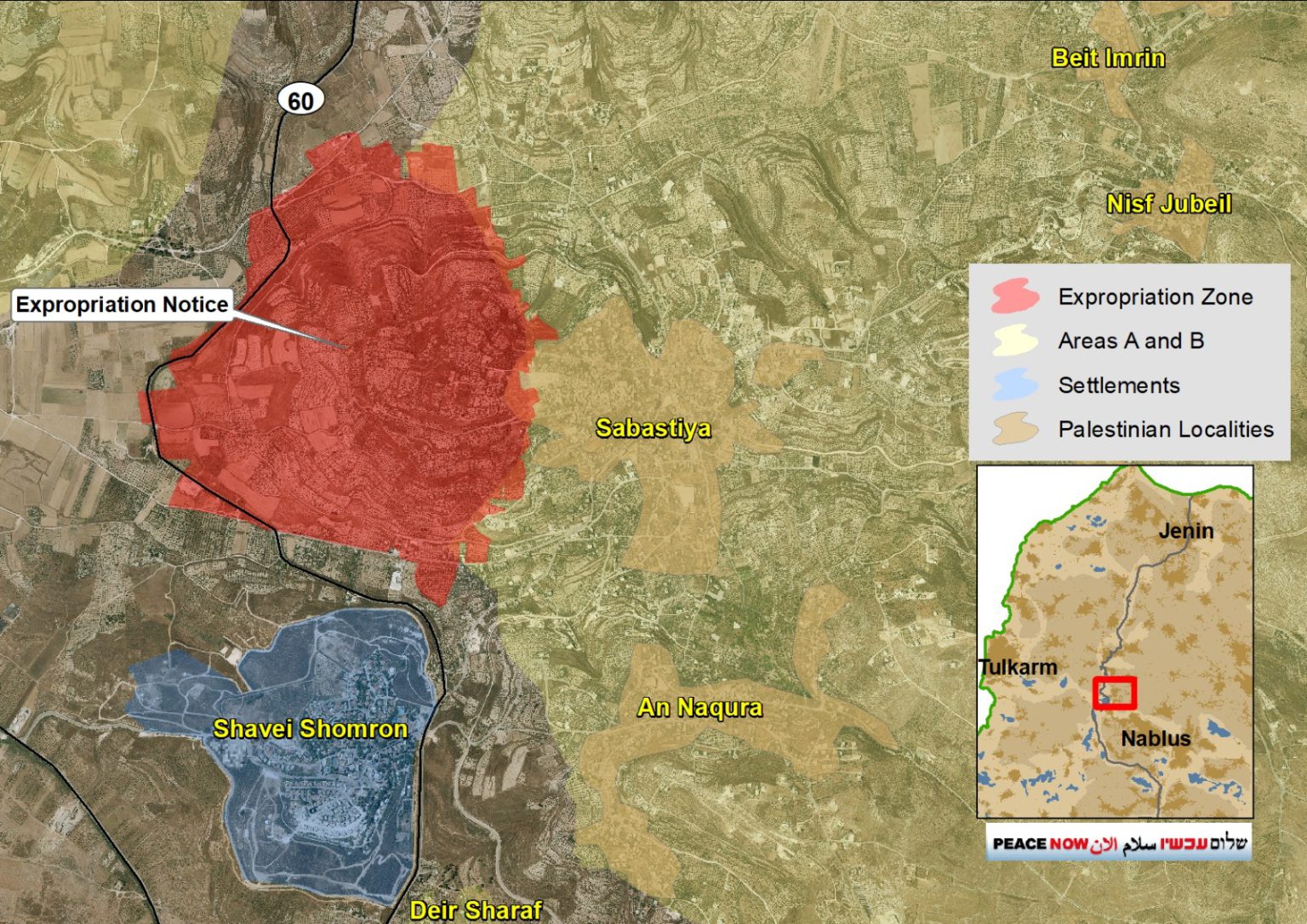 On November 19th the Israeli government announced it will expropriate a large amount of privately owned Palestinian land (445 acres, 1,800 dunams) surrounding and including the Sebastia archaeological site, located in the northern West Bank, in order to bring it under Israeli control and to develop the site into a major tourist attraction. The Israeli government has already allocated 30 million shekels ($9.24 million) to the development of the Sebastia site.
Emek Shaveh said in a statement:
“Under the guise of concern for heritage, the government is investing tens of millions of shekels in turning heritage sites into weapons of dispossession and annexation. The intention to expropriate private land is anything but preservation; its purpose is to establish a tourism settlement that will detach Sebastia’s heritage from the town and Judaize the area through the tourists who visit the site.”
The government’s plan will unilaterally seize land from the villages of Burqa and Sebastia, land in Area C which the Israeli government recognizes as lawfully owned by Palestinians, some of which is cultivated olive groves. The government is nonetheless carrying out the expropriation on the basis of an administrative order for antiquities. Emek Shaveh says Sebastia will be the fifth and most significant archaeological site expropriated by Israel since 1967, and Peace Now provides the receipts.
Along with dispossessing Palestinian landowners, Israel’s plans for the area will devastate the Palestinian tourism industry built around the site, which under Israeli control will be developed not for the benefit of Palestinians but for the Israeli tourism industry and settlers. Tellingly, the Israeli government has already begun renovating a nearby railway station – the Masoudia station – into a tourist site (a settlement) and planning a new access road to the site that bypasses the Palestinian village of Sebastia.
Emek Shaveh explains:
“The intention is clear – to sever the ancient site of Sebastia from the Palestinian historic town of Sebastia, connect the site to Road 60 and turn the site into a settler-led tourist attraction (similar to the City of David in Silwan, East Jerusalem). This development follows government decision 491 (May 2023), which allocates 32 million NIS to develop what Israeli authorities call the “Shomron (Samaria) National Park” in a plan that entails massive development of the site, including a visitors’ centre, a parking lot, and a fence which will separate the acropolis from the rest of the town.”
Peace Now explains:
“The Sebastia case is especially unusual because the expropriation targets an archaeological site that has long served as an economic, cultural, and tourism anchor for residents of Sebastia and the surrounding area, and that has been open to the public. Around the site are souvenir shops and restaurants, and in Sebastia itself, many residents earn their living from guiding visitors and renting rooms to tourists. The Sebastia site lies inside the village, among residents’ homes. The expropriation concerns the western part of the site, an area with fewer homes and surrounded by olive groves.” And on the railway station settlement site, Peace Now says: “Turning the Masoudia train station into a tourist site is, in fact, the establishment of a new settlement. This is not a heritage site—it’s part of a deliberate government plan to plant settlements deep inside a densely populated Palestinian area between Nablus and Jenin. These projects will increase the security burden, deepen the occupation, and advance annexation. The only ‘heritage’ being promoted here is the legacy of lawlessness and brute force championed by the Gush Emunim settler movement, which, then as now, acted illegally, clashed with security forces, and imposed facts on the ground for which the State of Israel continues to pay a heavy price to this day.”
Peace Now said in a statement:
“The Israeli government’s drive for dispossession and annexation knows no limits, and it is prepared to violate international law openly to pursue it. This is part of a broader effort to take control and expand settlements in areas northwest of Nablus that Israel evacuated during the disengagement. Sebastia is a heritage site located inside a Palestinian village, part of its history and part of a future Palestinian state. Under the Oslo Accords, signed by Israel, it should have been transferred to Palestinian administration long ago. Israeli greed harms not only the landowners, but also the prospect of a peaceful solution that upholds the rights and heritage of both peoples.”
Settlers Establish New Outpost Near Bethlehem
 The chairman of the local Etzion settler council, Yaron Rosenthal, proudly and publicly announced the establishment of a new outpost, called “Shdema”, on a hilltop near the Palestinian town of Beit Sahour east of Bethlehem. This new outpost is not a wild and haphazard effort by fringe radical settlers to build an outpost, but the organized and intentional work of settler leadership to establish a permanent new settlement. Tractors appeared overnight to clear and level the land, and several caravans were precipitously moved onto the site with three settler families reported to have moved in.
In his announcement, Rosenthal made it clear that the outposts came in response to the IDF’s evacuation of another outpost in Gush Etzion. The outpost was also built days after a Palestinian attack targeting Israelis at the nearby Gush Etzion junction, where one person was killed and three were injured by masked, knife-wielding assailants.
Peace Now has filed a complaint demanding an investigation into the Gush Etzion Regional Council’s involvement in the illegal construction of the outpost, and said in a statement:
“The new outpost is intended to choke the Palestinian town of Beit Sahour and block its development. There is no limit to the settlers’ audacity in establishing outposts and creating facts on the ground, while using public funds and denying Israel the chance for a future of peace and two states.”
Settlers have spent almost two decades trying to build a settlement at this exact site, an area called Ush Ghurab. The site was an Israeli military base but was vacated in the early 2000s. The U.S. then initiated a plan to fund and build a children’s hospital (with services aimed at Palestinians), but the plan was ultimately scuttled under settler pressure and the Israeli government build a new military post at the site.
IDF Raids Bedouin Village in Advance of Settlement Expansion
Ir Amim reports the Israeli police and soldiers raided the bedouin village of Kasarat living near the site of the future E-1 settlement. A group of 150 soldiers reportedly invaded the village in the early morning hours, forcing residents out of their homes while they proceeded to ransack each residence and beat several men. Residents reported extensive damage and stolen cash after the soldiers left.
Israeli Police have said the raid was aimed at finding weapons, though there were no arrests or seizures. Attorney Roni Pelli, who works for Yesh Din, told The Times of Israel that holding an entire village hostage is a form of collective punishment, and illegal under international law.
Ir Amim warns:
“The scale and violent nature of this unprovoked military action against an entire village is unprecedented in this area and could further indicate Israel’s intent to uproot the Palestinian communities living on lands marked within the E1 corridor….
Ir Amim has long stressed the danger of expulsion for vulnerable Palestinian communities in and around E1, whose land is directly threatened by the plan’s reemergence and approval. We have likewise warned that expulsions could be the first step taken by Israeli authorities following the plan’s approval. In addition to the severe geopolitical ramifications of the E1 settlement plans for the prospects of a viable Palestinian state, the most immediate repercussions are already unfolding on the ground for Palestinian communities.
This military action comes as the District Court reviews several petitions filed against the approval of the E1 settlement plans, including a petition initiated by Ir Amim together with partner organizations, Bimkom and Peace Now. It also follows the court’s recent rejection of a request for an injunction. The raid on the Kasarat community suggests that the authorities intend to continue pushing forward with the E1 plans at full speed, despite the petitions still under review.”
Settlers Terrorize Palestinians After IDF Dismantles Illegal Outpost
On November 17th, Israeli security forces dismantled the violent illegal outpost of Zur Misgavi (aka Givat Hatilim), located near Hebron. Attempting to thwart the evacuation, Israeli settlers barricaded themselves in the outpost and proceeded to throw rocks and metal rods, and burn vehicles and tires as the military and police attempted to remove them. Six settlers were arrested. Smotrich explained his support for the outpost demolition by saying he plans to build thousands of new settlement units on the same plot of land and the outpost was in his way.
The demolition of the outpost was apparently carried out at the request of the Gush Etzion Regional Council which raised concern about anarchy in the area and complained about the unauthorized construction.
The outpost evacuation enraged parts of the settler movement and in retaliation, settlers proceeded to terrorize nearby Palestinians communities, conducting violent raids on two towns.
First, settlers attack Umm al-Butm (located at the foot of the Zur Misgavi outpost), setting buildings and vehicles on fire and assaulting at least one women.
Second, settlers attacked Jab’a, setting fire to three homes, three vehicles, and a caravan. Video from the scene is terrifying. Settlers graffitied several buildings, writing “A Jew doesn’t evict a Jew.”
Following the fiery attack on Jab’a, the IDF announced a manhunt to find the attacks, and several high ranking Israeli officials made public statements condemning settler violence.
State-Backed Settler Terrorism This Week
Over the course of the last two weeks more and more criticism has fallen at the feet of the Israeli government, which has long sought to characterize settler violence as a small problem of a few bad apples, absolving the state of its systematic involvement, financing, and encouragement of settler violence. Following the settler attacks on Jab’a and Umm al-Batun and under mounting international pressure to address the problem, Prime Minister Netanyahu made public comments promising “forceful action” against settler violence, but continuing to assert the problem is one of the minority.
Bibi later convened his cabinet and top security officials to discuss how to address settler violence, reportedly to include getting violent settlers to attend educational programs (i.e. no real legal consequences or accountability). Later, Israeli security officials reportedly drafted a new plan to reportedly entails several recommendations including to: to create a special investigative team to handle severe cases; increase military and police deployment in the West Bank; establish 14 security hubs in violent hotspots; expand surveillance networks with new cameras; and increase punishment of offenders to include property seizures, fines and gun license revocations.
In an editorial, the Jerusalem Post Editorial Board wrote that the Israeli government is complicit in the violence, writing: ”The public silence of Netanyahu and Katz and the encouragement of Ben-Gvir point to the only plausible conclusion that the government is part of the problem, not the solution.”
While the Israeli government formulates a response, settler terrorism in the West Bank continues on a daily basis – and no arrests have been reported. Key attacks this week include:
- Attacks on Jab’a and Umm al-Bum, as detailed above.
- Huwara – On November 20th, settlers conducted a pogrom on the village of Huwara. First throwing stones and molotov cocktails, settlers further escalated to setting vehicles, homes and a scrapyard on fire, resulting in a massive blaze. IDF are reported to have arrested at least one Palestinian journalist who was documenting the attack, but no arrests of Israeli settlers have been reported.
- Al-Mirkez – On November 21st settlers used clubs to violently assault Palestinians in the village of al-Mirkez, located in the Masafer Yatta area of the South Hebron Hills.
- Luban a-Sharqiya – Settlers torched several buildings.
- Abu Falah – Settlers burned an agricultural building and set a home on fire while residents were still inside.
- Deir Sharif – Settlers vandalized a plant nursery, destroyed a bathroom fixture showroom, and burned over a dozen cars.
- Beit Furik – Settlers raided Beit Furik.
- Susya – Settlers attacked an elderly Palestinian man, knocking him off his donkey and requiring hospitalization.
Human Rights Watch: Not Just Gaza – Israel Committing War Crimes in the West Bank
Human Rights Watched published a new report entitled, “‘All My Dreams Have Been Erased’: Israel’s Forced Displacement of Palestinians in the West Bank.” An excerpt reads:
“This report examines the Israeli government’s conduct of Operation Iron Wall from its start in January 2025 through July 2025, and the resulting mass displacement of Palestinians from three refugee camps in the northern West Bank. Human Rights Watch found that Israeli forces committed forcible displacement in violation of the law of occupation under international humanitarian law that amount to war crimes. Human Rights Watch also found that Israeli forces committed the forcible transfer of population and other inhumane acts as part of a widespread or systematic attack directed against a civilian population, which are crimes against humanity under the Rome Statute of the International Criminal Court. Israel’s actions also violated international human rights law, which remains in effect in the West Bank…
When forced displacement is committed as part of a widespread or systematic attack on a civilian population, thus reflecting state or organizational policy, it can constitute a crime against humanity. These actions may also be considered “ethnic cleansing,” a non-legal term used to describe a policy to remove an ethnic or religious group from particular areas “by violent and terror-inspiring means.”…
This forced displacement reflects the broader pattern of ongoing rights violations by Israeli authorities against the Palestinian population, including the crimes against humanity of apartheid and persecution.”
Read the full report here.
Bonus Reads
- “IDF Blocks Activists From Aiding Palestinian Olive Harvest, Declares West Bank Village Closed Military Zone” (Haaretz, 11/14/25)
- “Averting West Bank collapse: How to revive Palestinian politics” (ECFR, November 2025)
- “Editorial | In the West Bank, the IDF Only Arrests Those Who Come to Protect Palestinians” (Haaretz, 11/16/25)
- “‘Palestinian Farmers Are Fighting to Survive’ Drought and Settler Violence Make 2025 West Bank Olive Harvest Worst in Living Memory” (Haaretz, 11/14/25)
Welcome to FMEP’s Weekly Settlement & Annexation Report. To subscribe to this report, please click here.
August 29, 2025
- Settlers Continue to Terrorize & Take Over South Hebron Hills Communities
- Senior Israeli Officials Appear to be Making Rounds to Illegal Outposts
- The IDF’s Collective Punishment of Al-Mughayyir Spurs Fears of West Bank Genocide
- Bonus Reads
Settlers Continue to Terrorize & Take Over South Hebron Hills Communities
 Over the past week there have been several reported settler attacks on Palestinian communities in the South Hebron Hills, including one brutal attack on Palestinians and Israeli activists in the village of Qawawis that left seven people wounded. Masked settlers were filmed assaulting people and damaging property with huge clubs.
In addition to perpetrating unabated violence, settlers have also established several new outposts in the South Hebron Hills area, furthering their de facto annexation and the violent, coerced displacement of Palestinians.
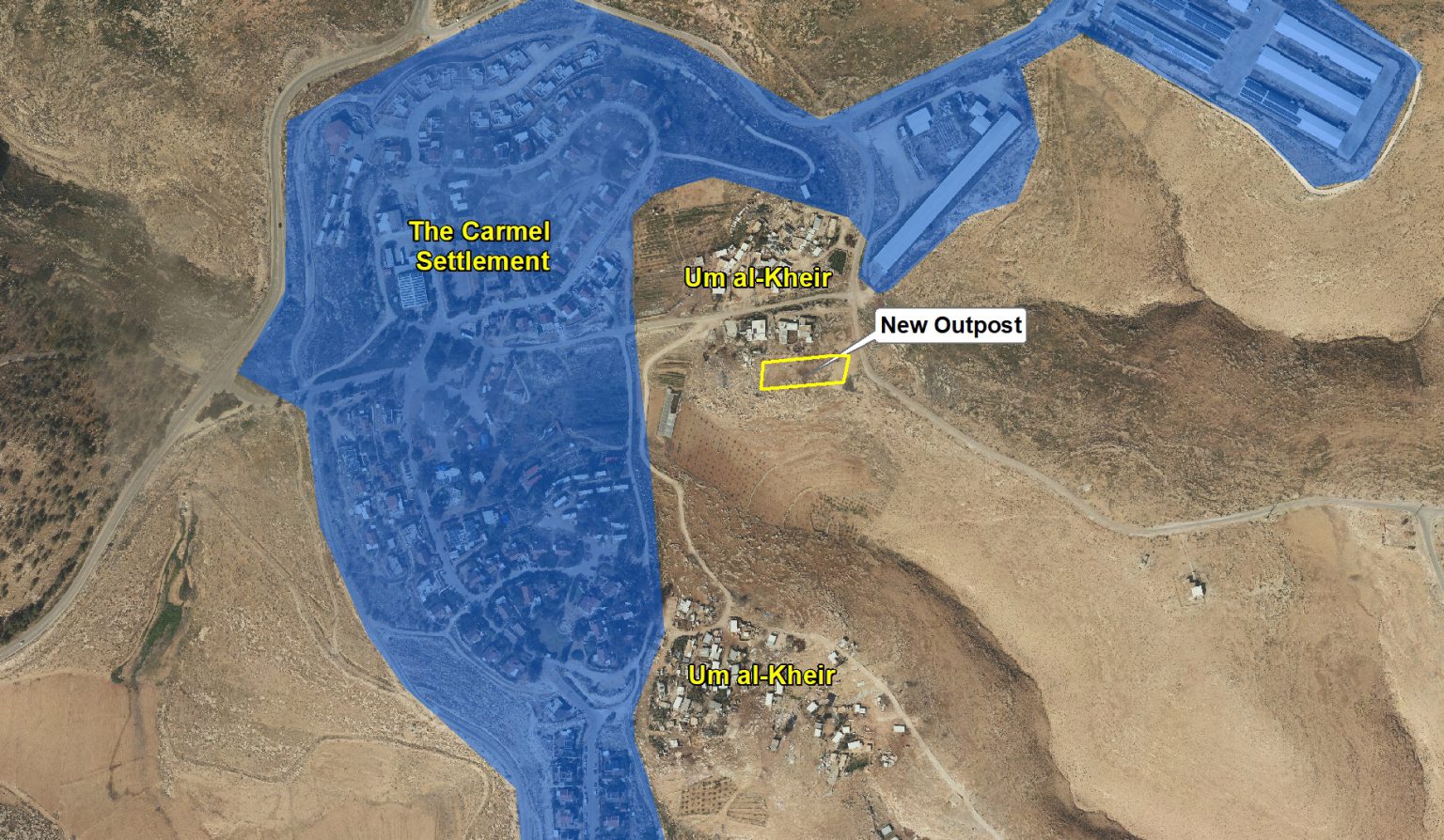
One of the new outposts was established just meters from Palestinian homes in the village of Umm Al-Khair, the site of the recent murder of Awdah Hathaleen by the internationally sanctioned settler Yinon Levy. The new outpost has been established on the area of land Yinon Levy was illegally clearing before he shot and killed Hathaleen. Peace Now reports settlers have brought in four pre-fab mobile homes on the land and it appears settlers intend to bring in at least two more caravans there.
The new outpost threatens to bisect the lands and neighborhoods of Um Al-Khair, pinching off the northern part of the village from the southern part. Tariq Hathaleen, a resident of Um Al-Khair and the brother of Awdah, told Haaretz:
“I think these trailers have been placed there mainly to pressure the community…It’s not as if they lack land. There are millions of dunams around, but they’re coming to this spot to pressure the community and the people to leave. That’s the aim of these trailers.”
Peace Now said in a statement:
“This is the peak of the Israeli government’s mistreatment of the residents of Um al-Kheir. After decades of home demolitions, the denial of permits and infrastructure, and escalating violence from settlers and the army, comes the harsh blow of establishing a permanent outpost in the middle of the village. The settlers who erected the illegal outpost overnight did so on behalf of the authorities, with direct support from the Har Hevron Regional Council, the army, the police and the government. Since the formation of the Smotrich-Ben Gvir government, about 90 Palestinian communities have been displaced by violent settlers who established nearby outposts. The aim of the new outpost in Um al-Kheir is clear: to drive the residents from their land.”
In addition – Palestinian news sources report three new outposts were established on lands belonging to the village of Birin in the South Hebron Hills. Settlers have spent the better part of two months preparing the land for establishing an outpost, by clearing roads, destroying crops and intimidating Palestinians out of the area.
Senior Israeli Officials Appear to be Making Rounds to Illegal Outposts
Senior Israeli security officials are helping advance the mission of Smotrich’s Settlement Administration to advance the de facto annexation of the West Bank by solidifying the presence of outposts across the West Bank.i
On August 13th the commander of Israel’s West Bank police district Moshe Pinchi and National Security Minister Itamar Ben Gvir, visited an illegal outpost called “Ma’aleh Tidhar” known to be associated with the violent Hilltop Youth movement. The men were photographed next to violent settler Elisha Yered – who was arrested under suspicion of murder in 2023 but released. Yered later tweeted:
“To reach Ma’aleh Tidhar, a strategic outpost established about a month and a half ago to link the eastern and central parts of the Gush Etzion settlement bloc, you have to climb a rough dirt track that barely a 4×4 can manage…But the national security minister, Itamar, did it today along with MK Limor Son Har-Melech, and even brought with him the West Bank district’s officers to show his firm stand with us.”
On August 24th, two high ranking Israeli IDF officers (Chief of Staff Lt. Gen. Eyal Zamir & Central Command Commander Avi Bluth) visited the illegal outpost called Maoz Shaul, located near the Avnei Hefetz settlement in the northern West Bank. It appears the visit was not meant to catch press attention, but nonetheless indicates the IDF’s knowledge of the new and illegal outpost, and its support for its continued presence in the area.
Finance Minister Bezalel Smotrich, who also is a Minister in the Defense Ministry, celebrated the occasion saying in a tweet that the visit shows the IDF’s ““excellent cooperation” with his work to legalize outpost, and that “The farms lead the way in pioneering settlement in Judea and Samaria, acting as a vital shield for many communities there, as well as for the Sharon region [on the coastal plain] and other parts of the country.”
The IDF’s Collective Punishment of Al-Mughayyir Spurs Fears of West Bank Genocide
The Israeli army uprooted over 10,000 olive trees during a three day siege on the Palestinian village of Al-Mughayyir northeast of Ramllah, in what is a forthright declaration of collective punishment of the entire village following an alleged terror attack near the Adei Ad settlement. During the IDF’s siege on the village, +972 Magazine reports residents lived under curfew while every home in the village was raided, businesses were closed and the village was sealed shut. The IDF caused significant destruction to the village streets, infrastructure, homes, and businesses.
IDF Central Command head Maj. Gen. Avi Bluth made it clear that Israel’s policy is that of collective punishment, saying at a press briefing:
“Every village and every enemy must know that if they carry out an attack against the residents [settlers], they will pay a heavy price…They will experience a curfew, they will experience a siege, and they will experience shaping operations…We are now getting a grip on this village…The first mission is to hunt [the assailant] … The second is to carry out shaping operations here, and to ensure that everyone is deterred — not only this village, but every village that tries to raise a hand against the residents [settlers].”
Following Bluth’s remarks, +972 Magazine reports Yesh Din and ACRI (two Israeli human rights groups) have filed a criminal complaint with the Military Advocate General, calling for an investigation into war crimes.
Kareem Jubran, director of the field research department of the Israeli human rights organization B’Tselem, told Haaretz:
“Our greatest fear – and we emphasized this when we [B’Tselem] presented our genocide report – is that every small incident will now immediately cause an insane Israeli response. We saw that last week in al-Mughayyir. Every trigger can produce genocide in the West Bank, too. What happened here is the proof of that.”.
Deputy Council Head of the village, Abu Na’im, told Haaretz:
“That is their goal, for us to leave. It is perhaps a different tactic from Gaza, but the goal is the same.”
Bonus Reads
- “West Bank Monthly Snapshot – Casualties, Property Damage and Displacement | July 2025” (OCHA, 8/22/25)
- “Chairman Lawler Introduces Bill to Repeal Inactive Restrictions on Building U.S. Facilities in Israel” (Press Release, 815/25)
- “Fears Israeli forces turning Sebastia into garrison to ‘Judaize’ site” (The New Arab, 8/27/25)
- “’Neglect and Apathy’ | Israel’s UNRWA Closures Leave Hundreds of Palestinian Students in East Jerusalem Without Schools as Summer Ends” (Haaretz, 8/28/25)
- “As World Leaders Push for a Palestinian State, in the West Bank, ‘Annexation Is Reality’” (Haaretz, 8/27/25)
- “Will Israel’s West Bank Settlement Plan Ignite the Third Intifada?” (Haaretz, 8/25/2025)
- “Tiny Patch of West Bank Land Fuels Dreams of Greater Israel” (New York Times, 8/25/2025)
- “How Israel Is Funding Settler Violence To Overrun Palestinian Villages in the West Bank” (New Lines Magazine, 8/27/2025)
Welcome to FMEP’s Weekly Settlement Report, covering everything you need to know about Israeli settlement and annexation activity this week.
To subscribe to this report, please click here.
January 10, 2025
- Six Consecutive Weeks of Settlement Advancements
- Israel Expands Jurisdiction of Adam Settlement to “Legalize” Nearby Outpost, Formalize Violent Dispossession of Palestinians
- Israel Renews Plan for Yeshiva in Sheikh Jarrah, East Jerusalem
- Smotrich Increases Subsidy Program for Illegal Farming Outposts
- Court Tells IDF To Publish More Land Allocations in Advance
- Rapid Outpost Growth Caps 2024
- Bonus Reads
Six Consecutive Weeks of Settlement Advancements
Israel has shifted to weekly planning approvals to end the 2024 year and start 2025.
Starting in early December 2024, the High Planning Council (which is the body in the Israeli Defense Ministry which oversees construction in the West Bank) has met weekly to approve settlement construction, a significant escalation in its activity. In the first eight days of 2025, the HPC has already met twice to advance construction plans for 1,213 new settlement units – a rate which could result in the soaring pace of final approval and construction commencement.
Peace Now said in a statement:
“The Higher Planning Council’s weekly meetings indicate an attempt to normalize settlement planning, aiming to maximize housing unit approvals while minimizing public and international criticism. These weekly sessions exemplify the Netanyahu-Smotrich government’s annexation policy, which is leading to either a political deadlock or, worse, a political and security crisis.”
The approvals/advancements are as follows:
On December 4, 2024 the HPC convened to advance the construction of 274 settlement units, including:
- Elon Moreh – 83 units advanced
- Mitzpe Yishai – 79 units advanced
- Ma’ale Amos – 112 units advanced
On December 11, 2024 the HPC convened to advance the construction of 227 settlement units, including:
- Telem – 196 units approved
- Eli – 21 units advanced
- Givat Ze’ev – 10 units approved
On December 18, 2024 the HPS convened to advance 286 settlement units, including:
- Eli – 118 units advanced
- Nofim – 168 units advanced
On December 25, 2024 the HPC convened to advance 198 settlement units, including:
- Givat Ze’ev – 5 units advanced
- Etz Efraim – 192 units advanced
- Alei Zahav – 1 unit advanced
On January 1, 2025 the HPC convened to advanced 765 settlement units, including:
- Beitar Illit – 765 units approved for construction
On January 8, 2025 the HPC convened to advance 448 settlement units, including:
- Kochav Yaakov – 1 unit advanced
- Geva Binyamin – 356 units approved
- Karnei Shomron – 68 units approved
- Beitar Illit – 23 units advanced
Israel Expands Jurisdiction of Adam Settlement to “Legalize” Nearby Outpost, Formalize Violent Dispossession of Palestinians
 Peace Now reports the Israeli Civil Administration has published a notice of intent to expand the jurisdiction of the Adam settlement (aka Geva Binyamin) to include a nearby illegal outpost, Bnei Adam, as well as the land from which the Palestinian community of Briyat Hizma was violently expelled in October 2023 (one of the X communities coerced into abandoning the land and homes under the incessant, escalating, and uninhibited terrorism of settlers). This move will allow Israel to grant legal status to the outpost, claiming it as a neighborhood of the Adam settlement).
Peace Now said in a statement:
“This is an extreme example of the Israeli government’s method of dispossession and takeover: settlers establish an illegal outpost, then violently expel Palestinian neighbors, and finally the government steps in to permanently take over the land, include it within the settlement area, and allow for the legalization of the illegal outpost. Settler violence is not a bug; it’s a feature, and part of an illegal and immoral policy of dispossession and expulsion operated by Netanyahu’s government.”
Israel Renews Plan for Yeshiva in Sheikh Jarrah, East Jerusalem
Ir Amim reports that Israel is planning to revive a highly controversial and potentially destabilizing plan to build a massive yeshiva at the entrance to the Palestinian East Jerusalem neighborhood of Sheikh Jarrah. The Jerusalem District Planning Committee was scheduled to hold a private discussion on the plan January 7th; the plan – referred to as the Glassman Yeshiva – calls for the construction of an 11-story building (3 stories below ground) which will include a religious school and dormitories for students and faculty. There are several settler enclaves in Sheikh Jarrah currently, while Palestinians are facing concerted eviction efforts by settlers and the government. The situation in Sheikh Jarrah has long been volatile and violent, and the focus of international solidarity protests.
 The yeshiva is slated to be built on a patch of land that was expropriated from Palestinian owners for “public needs”; in 2007 the land was transferred by the Israeli government to the Ohr Somayach Institutions, an international organization which is promoting the yeshiva plan. Ir Amim reports that in 2023, the Ohr Somayach Institutions received over 6 million NIS from its U.S. branch and its donors.
Ir Amim has filed a formal letter to the District Planning Committee arguing that erroneous and incomplete information was provided to planning authorities regarding the plan, and that there is a severe shortage of available land for Palestinian use – including public buildings and schools. These same issues were formally raised by Ir Amim in 2021, and there has been no public reports that the issues with the planning of the yeshiva have been resolved or justified.
Smotrich Increases Subsidy Program for Illegal Farming Outposts
In late December 2024, Finance Minister Bezalel Smotrich announced a increased funding for a grant program that provides subsidies to settlement agricultural farms, including illegal farming outposts. These types of illegal outposts are increasingly popular tools for settlers to assert control over a large amount of territory with only a few settlers and a herd of livestock. Smotrich celebrated the has increased the budget for supporting West Bank agricultural farms and expedited the grant process for those seeking government subsidies.
While visiting the Mishkenot Harel farming outpost, Smotrich told press:
“Our policy is aimed at preserving national land reserves, creating secure and strategic territorial contiguity, and curbing Palestinian efforts to expand their illegal control over lands in the region,” declares Smotrich, who also serves as a minister in the Defense Ministry with control over the recently established Settlements Administration.”
Court Tells IDF To Publish More Land Allocations in Advance
Peace Now reports that a new ruling by the Israeli High Court of Justice has limited the exceptions under which the state can ignore its obligation to publish in advance notice of its intention to allocate lands in the West Bank that are outside of the boundaries of settlements. Since a previous Court ruling in 2015, the State has published only a small percentage of land allocations, not always including allocation renewals or allocations related to absentee properties. The ruling is the direct result of Peace Now’s petition challenging the secretive land allocation process which denied Palestinians any opportunity to prove land ownership claims.
Peace Now said in a statement:
“The court issued a red card to the government today and ruled that the time has come to stop the lawlessness and the distribution of land in the dark. For 57 years, the State of Israel has done whatever it wants with land in the Occupied Territories, with no transparency and outside the rules of proper administration. As a result, 99.76% of the land allocated by Israeli authorities in the Territories has been allocated only to Israelis, while almost nothing has been allocated to Palestinians. This statistic is one of the reasons Israel is accused of maintaining an apartheid regime in the territories. If there had been minimal transparency in the government’s actions in the Territories, it is possible they would not have dared to act in such a discriminatory and blatant manner.”
Rapid Outpost Growth Caps 2024
Peace Now reports that settlers have established at least seven new outposts in the last two months of 2024, all of which are located on land classified as Area B under the Oslo Accords. Five of the new outposts are located in the so-called “Agreed Upon Reserve” – a large area of land to the south and east of Bethlehem that has come under the intense targeting by Bezalel Smotrich and his settler allies who have moved to formalize unilateral Israeli sovereignty there. The other two new outposts are in the Ramallah area.
 Peace Now documented over a dozen Palestinian homes that have been abandoned as a result of these new outposts, likely in fear of the violence settlers routinely inflict on Palestinians in their vicinity. Palestinians have already reported several violent encounters with one of the new outposts (called “Mikne Avraham” by settlers) located in the Agreed Upon Reserve. Haaretz reports that several young adults and teenagers are living at the Mikne Avraham outpost and they are terrorizing Palestinian herding communities who live nearby. In one case, the settlers have beaten a young Palestinian twice, conducted a home invasion posing as IDF, and set first to the same families’ granary. That Palestinian family has fled under the threat of escalating violence and non-responses from the Israeli military police.
Peace Now notes that, over the past decades, the Israeli government has not enabled or permitted settlement building in Area B, while allowing rampant illegal settlement construction across Area C. That seems to have changed now, with settlers seeing a green light to illegally establish Israeli presence in Area B. Of the five new settlements established in Area B in recent months, only one (which was built on lands north of Turmus Ayya) has been removed by the IDF, though settlers have already re-established the outposts.
In total, settlers established 52 new outposts in 2024, of which 13.5% are located in Area B. Commenting on the maximalist ambitions of Israeli settlers, Peace Now said in a statement:
“After seizing control of Area C and systematically displacing Palestinians through house demolitions and settler violence, settlers have now set their sights on Area B,” Peace Now said upon publishing its new report. The Israeli government’s annexation plans are not limited to Area C. By enabling settlers to establish outposts deep in Area B, the government blatantly violates another critical element of the Oslo Accords. If we do not act today, we will find ourselves returning to full military rule across the entire West Bank.”
The Haaretz Editorial Board writes:
“Supporters of annexation are no longer making do with Area C of the West Bank – that is, the part assigned to full Israeli control by the Oslo Accords. The success of the theft enterprise in Area C has increased their appetite, and they are constantly seeking to expand to other areas.For some time now, the movement to steal Palestinian lands has also been setting its sights on Area B, the part of the West Bank under Palestinian civilian control but Israeli security control….The demolition of Palestinian buildings in an area that Israel has until now refrained from interfering with, coupled with the establishment of new outposts, shows that annexation has begun creeping into Area B as well. This is a dangerous development. It threatens the Palestinians living there and accelerates Israel’s descent into a thuggish apartheid state that has removed itself from the family of nations.”
Bonus Reads
- “Humanitarian Situation Update #254 | West Bank” (OCHA OPT)
- “Overkill: A Critical Appraisal of the Use of Force by Israel in the West Bank” (Diakonia)
- “Israeli settlements, and the expanding divide of settlers and Palestinians” (CBS News)
- “Candidate for Israel’s Top Court Lives in House Illegally Built on Private Palestinian Land” (Haaretz)
- “Israel mulls calling int’l conference to divide Syria into cantons – report” (i24 News)
- “After decades fighting demolitions, Palestinian sees own home wrecked” (Washington Post)
- “ Israel’s Policy of Judaization Is Swallowing Arab Towns and Building Synagogues in Their Place” (Haaretz Editorial)
Welcome to FMEP’s Weekly Settlement Report, covering everything you need to know about Israeli settlement activity this week.
To subscribe to this report, please click here.
November 8, 2024
- Givat Hamatos Expansion Plan to Advance
- MK Sukkot Introduces Bill to Legalize All Outposts
- Settlers Lead Pogrom in al-Bireh
- Mapping the Settler-Led Expulsions of 50+ Palestinian Communities Since 2022
- Settlers Rejoice Over U.S. Election Results
- Netanyahu Appoints Kahanist Settler as New Ambassador to the U.S.
- Bonus Reads
Givat Hamatos Expansion Plan to Advance
Ir Amim reports the Jerusalem District Court was scheduled to meet on November 5th (coinciding with the U.S. presidential election) to advance a highly controversial plan to expand the Givat Hamatos settlement in East Jerusalem (called the “Hebron Road”). The outcome of hte meeting has not been reported at the time of publication, though Ir Amim expected the Committee to discuss and dismiss objections to the plan, advancing it to the final approval stage.
The plan to expand Givat Hamatos calls for 3,500 new settlement housing units in addition to 1,300 hotel rooms to be built on the eastern slopes of the settlement. This plan will double the number of housing units in the Givat Hamatos settlement and increase its land mass by 40%. Further, the new settlement will be built on a strategic strip of land that will expand the area of Givat Hamatos eastward, connecting it with another new settlement plan – the “Lower Aqueduct Plan.” These plans ultimately create a string of settlements — spanning from Gilo to Givat Hamatos to Har Homa — that, together with the planned “Givat HaShaked” settlement to its north, completely encircle the East Jerusalem Palestinian neighborhood of Beit Safafa with Israeli settlement construction.
Ir Amim comments:
“Currently under construction, Givat Hamatos is the first new settlement to be built in East Jerusalem in over 20 years. These two plans along with concurrent settlement advancements in the area are cumulatively sealing-off East Jerusalem’s southern border from Bethlehem and the southern West Bank, while creating more contiguity with the Gush Etzion settlements. Rather than utilizing these plans to address the acute housing needs of the local Palestinian population, they are instead intended for Jewish Israelis despite the land’s proximity to Palestinian neighborhoods, including Beit Safafa, which is being encircled and choked-off by Israel settlements.”
MK Sukkot Introduces Bill to Legalize All Outposts
MK Zvi Sukkot has tabled a draft bill that would grant legal status (under Israeli law) to ~140 outposts across the West Bank. The bill would transform illegal outposts – regardless of the status of land on which settlers built on – into government-recognized settlements within two years, connecting the outposts to all Israeli infrastructure and services – entrenching the presence of radical (and often violent) Israeli settlers on Palestinian land near Palestinian population centers.
Settlers and their allies in the Knesset have been pushing for years for the government to grant formal recognition to outposts. The coalition agreements which brought the current Israeli government into power included a commitment to the full recognition and integration of outposts. The government has done a lot to fulfill this pledge, as seen in the actions taken to legalize the Homesh outpost, the Evyatar outpost, and the Israeli Cabinet’s February 2023 decision to legalize ten of the most isolated, legally complicated outposts. That decision also included approval of a clause that makes the remaining outposts eligible – right away, even as they remain illegal – to receive Israeli municipal services like water and electricity.
Settlers Lead Pogrom in al-Bireh
At 3am on November 4th, a group of masked settlers violently attacked the Palestinian town of El-Bireh (near downtown Hebron) – leaving at least 17 cars on fire and buildings defaced with the slogan, “For Judea and Samaria – War.” The armed settlers shot at Palestinians attempting to stop the pogrom and put out the fires and they shot at an ambulance arriving at the scene. Reuters described the settler’s attach as “one of their boldest raids yet in the area that serves as the Palestinians’ seat of government in the occupied West Bank.”
The Palestinian Centre for Human Rights said in a statement:
“The Palestinian Centre for Human Rights (PCHR) strongly condemns Israeli armed settlers’ attack on two towns in Ramallah, central West Bank, and burning 19 vehicles. This incident follows a month during which settlers carried out more than 180 attacks, primarily against olive harvesters, in an alarming escalation of state-backed violence across the West Bank.
These crimes are part of a broader systematic violence by settlers under the protection of IOF. This violence persists amid an atmosphere of impunity and protection settlers receive within Israel, perpetuating a broader policy of demographic change and entrenching Israel’s sovereignty and grip on the West Bank, as well as furthering the ethnic cleansing of Palestinians…
PCHR condemns settler violence, pointing out that most of it occurs under the protection of IOF, which intervene to secure settlers during their attacks and their subsequent withdrawal while suppressing Palestinians attempting self-defense. Often, no serious complaints or investigations are pursued.”
Mapping the Settler-Led Expulsions of 50+ Palestinian Communities Since 2022
The Israeli settlement watchdog group Kerem Navot has published a new map with aerial photography documenting the expulsion of 50+ Palestinian communities which have been targeted by settler terrorism. The map contains two aerial photos (one before and one after the expulsion) for each community.
The need for such a map came into focus after the Palestinian residents of Ras al-Tin left their land under constant threat of violence by the nearby agricultural outpost called Micha’s Farm. Kerem Navot explains:
“After the expulsion of the residents of Ras Al Tin, we [Kerem Navot] described the event here as unprecedented at that time. What we didn’t know was that this would become a pattern, one that would repeat itself in dozens of other Palestinian communities and settlement clusters in the coming years, reshaping the map of the West Bank.
The “success” of the settlers in Ras Al Tin inspired settlers in other areas of the West Bank to adopt similar methods. During the 15 months between the expulsion of the residents of Ras al-Tin and the massacre on October 7, 2023, five more Palestinian shepherd communities were forcibly removed.
…Even though this violence is primarily carried out by settler gangs, it proceeds without fear or concern for law enforcement authorities. This impunity reflects a clear and consistent policy advanced by successive Israeli governments. Especially the current one, which is more corrupt and racist than its predecessors, aiming to effectively annex increasing parts of the West Bank, devoid of its Palestinian population.”
Settlers Rejoice Over U.S. Election Results
Settlers have been celebrating the election of Donald Trump as the next U.S. President, and Netanyahu was amongst the first foreign leaders to congratulate Trump on his victory. Ben Gvir said in the Knesset that “this is the time for sovereignty, the time for total victory, ” and Israel Ganz (head of the Yesha Council) called for the government to annex the West Bank, posting on X:
“Time for sovereignty! One strong Trump, One Jewish state.”
Mayor of the Beit El settlement, said that Trump’s election heralded “a golden age for settlement” continuing:
“This is an unparalleled opportunity to act with great resolve in the Judea and Samaria region, to put an end to the murderous terrorism here, and to continue Israeli construction widely and extensively in all our territory…This is the time to apply sovereignty to Judea and Samaria and to recognize the region is part of the complete Israel…there will not be two states here between the sea and Jordan.”
Settlers widely hope (and expect) Trump to repeal the Biden Administration’s sanctions against Israeli settlers and settler identities. So far, Biden has sanctioned 14 settlers and 13 settler entities.
Al-Monitor reports that settler leader Yossi Dagan (head of the Samaria Regional Council) has close ties to the Trump inner circle after making several visits to the U.S. over the past few months – rallying Jewish communities in swing states to vote for Trump. Dagan also campaigned in Israel to get U.S. citizens living there to vote. Dagan told Haaretz:
“A great burden has been lifted, a great weight. The American pressure affected everything regarding security and the settlements. I believe that this pressure will stop or weaken. It’s still too early to know what will change, but it’s clear that the Israeli government won’t be able to come and say that there is American pressure.”
Netanyahu Appoints Kahanist Settler as New Ambassador to the U.S.
Prime Minister Netanyahu has appointed Yechiel Lieter as Israel’s new Ambassador to the United States. Born in the U.S., Lieter is has extreme far-right roots in Israel. He has been active in the settlement movement and lives in the Eli settlement. The Times of Israel reports Lieter was one of the first residents of the Admot Yishai settlement enclave in the city Hebron, and two years later he founded an organization to support more settlement growth there. In his youth, he was active in the Jewish Defense League – a designated terrorist group founded by extremist rabbi Meir Kahane.
More recently, Lieter served as a senior fellow at the Kohelet Policy Forum (which has played a hugely significant role in shaping Israel’s far-right legislative agenda) and has published articles calling for Israel to annex the West Bank and dismantle the Palestinian Authority. He campaigned against hte Oslo Accords in the 90s.
Haaretz reports that Lieter is close to David Friedman, who served as the U.S. Ambassador to Israel during Trump’s first term.
In a statement on Leiter’s appointment, Hadar Susskind (CEO of Americans for Peace Now) said:
“Netanyahu has never been subtle, and this appointment is no different. Sending a Kahanist settler to Washington is a clear sign that Netanyahu and his government are moving toward their goal of annexation and doing so openly.”
Bonus Reads
- “DAWN: Sanction Amana Settlement Organization and Its Leadership for Promoting Settler Violence, Seizing Private Palestinian Land” (DAWN)
- “In Masafer Yatta, our very right to education is under fire” (+972 Magazine)
Welcome to FMEP’s Weekly Settlement Report, covering everything you need to know about Israeli settlement activity this week.
To subscribe to this report, please click here.
September 27, 2024
- High Court Denies Request to Allow Zanuta to be Even Minimally Rehabilitate Village After Settler Destruction
- Bimkom Report on Outpost Retroactive Authorization
- Israeli Groups Release Report on Annexation
- U.S. Congress Votes to Advance Bill that Labels Settlements As Israel, Greenlighting Annexation
- Bonus Reads
High Court Denies Request to Allow Zanuta to be Even Minimally Rehabilitate Village After Settler Destruction
On September 18th, the human rights group Haqel filed an urgent appeal to the Israel High Court of Justice on behalf of the residents of Zanuta seeking permission to undertake minor construction in order to make the village inhabitable again. Settlers damaged, destroyed, and ransacked every building in the village after residents fled the village on October 28, 2023 under rampant and unmitigated settler terrorism.
In response, the Court said the residents are not allowed to undertake any building in their village because the entire area is an Israeli-designated archaeological site. When Haqel submitted its appeal it had included an expert legal opinion, including an archaeological expert who informed the Court that there is no archaeological obstacle to allowing the residents to rebuild structures to status quo ante. The opinion – which is signed by five renowned Israeli international law experts – goes on to conclude “we are of the opinion that the actions taken by the authorities towards the residents of the village of Zenuta constitute a forcible transfer of the residents from their village.”
In past hearings, the Court has suggested to the residents of Zanuta that in light of their plight and the prohibition on building in their village, they have the option to move to a new area of land approximately 2.5km north, a patch of land that abuts the borders of Areas A and B – – a convenient location for the State of Israel and its settlers who have moved to annex Area C and clear it of Palestinians.
Breaking the Silence said in a statement:
“The case of Khirbet Zanuta holds enormous symbolic importance in that the success or failure of the residents’ return will set an important precedent for many of the other villages that have been forcibly expelled. We urge stakeholders and people in positions of influence in the international community to act decisively, to apply pressure to the Israeli authorities with regards to allowing for reconstruction of the village (with the pre-October status quo as the relevant reference point for ‘new’ construction) without fear of the authorities demolishing homes or confiscating equipment, as well as law enforcement against the violent settlers who are intent on making it impossible for residents to live there.”
Bimkom Report on Outpost Retroactive Authorization
Bimkom: Planners for Human Rights released a report this past February entitled, “Connection to infrastructure and establishment of public buildings in outposts included in legalization processes.” The report dismantles any notion of legality behind the Israeli governments stated plan to retroactively authorize 70 outposts, as announced in February 2024. Bimkom also surveys its legal, planning, and economic consequences. Bimkom writes:
“It [the report] shows that the planning procedure is nothing more than a cover for de facto regularization of the outposts, since in the vast majority of cases the most basic conditions for advancing regularization are not met.”
Israeli Groups Release Report on Annexation
The Association for Civil Rights in Israel, Breaking the Silence, Ofek, and Yesh Din’ just published an English translation of its July 2024 report, “A Silent Takeover: Changing the Nature of Israeli Control of the West Bank.” It’s summary reads:
“The Government of Israel is methodically implementing a strategy designed to achieve the political vision of applying full Israeli sovereignty to the West Bank, while establishing a reality of Jewish supremacy and forcing the Palestinians living in the Area into to the smallest possible geographical space.
Many of the government’s steps alter the face of the West Bank and the structure of Israeli control there, including:
> Appointing MK Smotrich as the Additional Minister in the Ministry of Defense and transferring broad powers from the Military Commander to MK Smotrich
> Approving immense budgets for expanding the Israeli settlements in the West Bank and improving infrastructure and quality of life there
> Retroactively authorizing Israeli outposts
> Declaring state land and nature preserves
> Denying settler violence and not enforcing the law
> Abusing Palestinian communities, leading to their forced expulsion from their homes.
This current government is stripping off the mask that Israeli governments have insofar worn. For years, it presented Israel as a regime in the Occupied Palestinian Territories that upholds the legal obligations incumbent upon it in the West Bank, and whose administration’s decisions are subject to judicial review by the Israeli Supreme Court. The government’s policy now openly seeks to apply Israeli sovereignty and reinforce Jewish supremacy in the West Bank.”
U.S. Congress Votes to Advance Bill that Labels Settlements As Israel, Greenlighting Annexation
FMEP’s Lara Friedman reports that the U.S. House of Representatives has voted to pass a bill that calls for the U.S. to label any/all products from coming from Israeli settlement as “Made in Israel.” Called the “Anti-BDS Labeling Act” (HR 5179) the bill gives a greenlight to Israel’s de facto annexation of the settlements. It passed by a vote of 231-189, with all Republicans plus 16 Democrats voting in favor.
HR 5179 was introduced by Rep. Claudia Tenney (R-NY), who was visited by a delegation of Israeli advocates headed by Yossi Dagan, the head of a settler regional council and longtime pro-settlement advocate. In press coverage of the meeting, Israel Hayom reports that Tenney and Dagan agreed to collaborate on advancing another bill, which Tenney introduced in March 2024, that would mandate the U.S. government to adopt “Judea and Samaria” as official terminology instead of “West Bank.” That bill, according to Friedman, has seen no action since it was introduced.
Opposing HR5179, Rep. Nadler (D-NY) – posted a video on X saying:
“This bill isn’t about combatting BDS—it’s about attempting to green light Israeli annexation of Area C of the West Bank and undermining the Biden-Harris’ Administration’s delicate negotiations to end the Israel-Hamas war.”
Friedman explains:
“As has always been the case in this battle over how to label the place-of-origin of settlement products, the argument behind HR 5179 boils down to: (1) if people know that a product was produced in a settlement, some will likely choose NOT to buy the product, in a decision that reflects their personal opposition to Israeli occupation/settlements; (2) such an action by an individual consumer, as an expression of their own deeply-held values, is a form of BDS and as such is antisemitic, anti-Israel; (3) the U.S. government, as part of its support for its ally Israel, must implement policies that in effect establish special place-of-origin rules for Israel [i.e., hold Israel to a different standard than the rest of the world] that protect Israel/settlements; (4) These Israel-specific rules-of-origin must ensure that U.S. consumers who might want to make an informed decision with respect to purchasing or not purchasing settlement products are prevented from doing so — in this case, by depriving them of accurate place-of-origin data; and (5) Failure to implement/enact policies that in effect prevent US consumers making informed decisions with respect to whether or not they wish to purchase settlements products is antisemitic, anti-Israel, and a form of BDS.”
Bonus Reads
- “The U.S. Must Sanction Israel’s Messianic Ministers – and American Jews Should Welcome It” (Haaretz)
- “Movement and Access in the West Bank | September 2024” (OCHA)
Welcome to FMEP’s Weekly Settlement Report, covering everything you need to know about Israeli settlement activity this week.
To subscribe to this report, please click here.
August 23, 2024
- Smotrich Tours Land Near Bethlehem He Now Controls, Threatens Systematic Demolition of Palestinian Buildings
- Following Pogrom in Jit, Borrel Threatens EU Sanctions Against Israeli Ministers
- New Outpost Reported Near Jericho
- IDF Invades Ramallah Neighborhoods to Demolish Two Homes
- The Israeli Government Has Transferred 150,000+ Guns to Settlers
- Peace Now Releases New Settlements Map
- Bonus Reads
Smotrich Tours Land Near Bethlehem He Now Controls, Threatens Systematic Demolition of Palestinian Buildings
On August 18th, Bezalel Smotrich staged a tour of a large swath of land in Area B near Bethlehem which was recently transferred into his hands by the Israeli military. While there, Smotrich told announced that he is advancing immediate plans to scale up systematic demolitions of Palestinian buildings in the area – a saying, “we will roll up our sleeves, the State of Israel returns to being the owner of the house.”
In July, Peace Now reported that the Israeli Commander of the Central Command signed two orders granting the Israeli government vast planning authorities an additional 3% or 41,300 acres (167,000 dunams) of the West Bank, in the areas to the east of and between Bethlehem and Hebron. These lands constitute what is referred to as the “Agreed-Upon Reserve” as delineated by the Wye Agreement in 1998, at which time the Palestinian Authority was granted civilian control (areas A & B according to the Oslo Accords), much to the dismay of settlers and their government allies who have been agitating for control over an ever-increasing amount of land in the West Bank in order, at least in part, to demolish Palestinian construction in the area.The first order granted Israeli authority to operate in the entire “Agreed-Upon Reserve”, and the second order made construction in the areas illegal – establishing guidelines for Israeli authorities to demolish any/all Palestinian buildings if they were built after 1998 (the Wye Agreement).
Peace now reports:
“One of the arguments made by settlers against Palestinian construction in these Areas is that it harms important natural values. However, this claim is full of hypocrisy. First, as mentioned, the Agreed-Upon Reserve is called “Green Area” by virtue of the agreement. The territory determined by professionals who found that it indeed holds worthy natural values deserving protection, and its precise boundaries were not set. Moreover, at the same cabinet meeting a month ago, where it was decided to start demolishing Palestinian homes in the Agreed-Upon Reserve, it was also decided to establish a new settlement on the lands of Battir village (Nahal Heletz settlement). This settlement is intended to be established in the heart of a site declared by UNESCO as a world heritage site in danger. Thus, it is difficult to argue that nature preservation is at the forefront of the cabinet ministers’ priorities. Lastly, there are many cases in which settlements harm real nature reserves, but authorities are not eager to address them.”
Following Pogrom in Jit, Borrel Threatens EU Sanctions Against Israeli Ministers
In the week since settlers from the Havat Gilad outpost led a pogrom against the Palestinian village of Jit – resulting in the murder of 1 Palestinian, injuries to many others, and widespread fire damage of homes,vehicles, and property – sustained international criticism of the Israeli government’s non-response has finally resulted in the arrest of four suspects.
The U.S. vocally criticized the Israeli government for failing to curb settler violence, and European Union Foreign Policy chief Josep Borrell Fonteles announced that he is advancing sanctions against violent settlers and complicit Israeli government ministers. One possible target for sanctions is the Amana settler group, which was recently sanctioned by the Canadian government. Peace Now has produced a new succinct report revealing the depths to which Amana finances and leads illegal settlement activity – making it an obvious and impactful target for serious international sanctions regimes.
New Outpost Reported Near Jericho
Palestinian sources report that settlers have established a new outpost north of Jericho, near the Auja spring.
IDF Invades Ramallah Neighborhoods to Demolish Two Homes
On August 12th a large Israeli force arrived in neighborhoods on the outskirts of Ramallah to demolish two Palestinian homes that were alleged to be the homes of Palestinians accused of participating in a violent attack targeting Israelis. During the IDF’s incursion – which included hundreds of Israeli soldiers and tens of military vehicles – two Palestinians were shot and killed by Israeli forces, and at least nine others sustained injuries. OCHA reports that, in addition to the two homes which were detonated, “16 other residences were damaged, and 12 households comprising 49 people, including four children, were forced to temporarily evacuate their homes at midnight.”
The Israeli Government Has Transferred 150,000+ Guns to Settlers
Visualizing Palestine has released a new visual showing the huge number of military grade guns that have been transferred to settlers by the Israeli government since October 7, 2023 – – and how the increase in number of guns has fueled the establishment of over 800 new settler militias and police forces. This has coincided, predictably, with the increase in frequency and severity of settler attacks on Palestinians — and the total impunity within which settlers are allowed to continue their terrorism.
Check out the graphics and underlying data here.
Peace Now Releases New Settlements Map
Peace Now has published a new highly detailed map of West Bank and East Jerusalem settlements.
Along with the map, Peace Now provided a new graphic capturing the current state of the settlement enterprise in the West Bank, where there are:
- 478,000 settlers;
- 147 settlements;
- 201 outposts (90 of which are argricultural/farming outposts).
Bonus Reads
- “Injuries during Israeli military incursion into Qalqilya area-town” (Wafa News)
Welcome to FMEP’s Weekly Settlement Report, covering everything you need to know about Israeli settlement activity this week.
To subscribe to this report, please click here.
July 12, 2024
- A Stunning, Expansive Time for Israel’s West Bank Annexation
- Civil Admin Seizes Patchwork of Plots as “State Land” in Order to Legalize the Evyatar Outpost
- Government Establishes Jurisdiction for New Settlement on World Heritage Site Near Bethlehem
- Settlers Takeover New Building in Hebron
- Historic Year for Land Grabs: Israel Seizes Over 3,000 Acres in the Jordan Valley as “State Land”
- Civil Admin Advances Plans to Legalize Three Outposts & Build 5k New Units Across West Bank
- Israeli Cabinet Gives Civil Admin Authority Over Antiquity Sites in Area B
- Israeli Cabinet Supports Knesset Considers Bill to Transfer West Bank Antiquities Control from Civil Admin to Domestic Body
- U.S. Issues New Round of Sanctions Against Settlers & Settler Organizations
- Israeli Court Orders 11 Families Out of Homes in Batan al-Hawa, Silwan
- Israeli Court Rules to Demolish Wadi Hilweh Info Center in Silwan
- Israeli Court Tells Settlers To Leave Khalidi Library in Old City of Jerusalem
- Israel to Advance 6,000+ Settlement Units in East Jerusalem in Coming Weeks
- Amidst Wave of Violence, Settlers Lead Progrom On Massafer Yatta Region
- Ariel Settlers Close Access Road to Palestinians
- IDF Demolishes Outposts, Clashes With Settlers
- Bonus Reads
A Stunning, Expansive Time for Israel’s West Bank Annexation
Over the past two weeks, Israel has unleashed a flurry of settlement activity that makes its annexation of the West Bank complete. Even a small sampling of those acts, detailed below along with other news, are stunning when taken together. Indeed, Israeli National Missions Minister Orti Strock called this “a miraculous time,” referring to the control her and her allies have over key government bodies and how easy it is for them to fund settlement construction. Strock is a member of the Religious Zionism party, along with Bezalel Smotrich.
Renowned Israeli human rights lawyer Michael Sfard encapsulates this time powerfully in an article entitled, “Smotrich Has Completed Israel’s Annexation of the West Bank”:
“The only thing the annexationist criminals must be saying to themselves now is: why did we wait for 57 years? It’s so easy.”
Civil Admin Seizes Patchwork of Plots as “State Land” in Order to Legalize the Evyatar Outpost
On July 8th, the Israeli government declared 16 acres (66 dunams) of land south of Nablus as Israeli “state land” in order to pave the way for the legalization of the Evyatar outpost. Palestinians who have private ownership claims to the land have 45 days in which to submit an appeal. The declaration is the result of three years of “work” by Smotrich’s Settlements Administration to examine the status of the land in order to find a way for the state to take control of the land in order to legalize the outpost. The declaration comes one week after the Israeli Security of Cabinet decided in favor of legalizing the Evyatar outpost along with four other outposts.
The Evyatar outpost was illegally built by settlers on a strategic hilltop named Mount Sabih, located just south of Nablus on land historically belonging to nearby Palestinian villages Beita, Yatma, and Qablan. It was evacuated by the Israeli government in 2021 in the context of an agreement with settlers that left all construction at the site in place, maintained an IDF presence at the site, and made clear the government’s intent to legalize settlement at the site in the future – a goal which was made more than official when it was agreed to in writing as part of the coalition agreements that formed the current Israeli government.
 To underscore the absurdity which has characterized the State’s blatant intent to legalize Evyatar even though Israeli law makes that an impossibility because parts of the land are recognized by the State as privately owned by Palestinians (which is the only reason Evyatar has yet to be legalized), the State’s new declaration of “state land” is a complete patchwork. The order does not include the land on which the central square of the outpost is built, nor does it include 11 buildings, or, very importantly, the access road leading from the main road to the outpost. The implications of this patchwork is that even though the privately owned land was not seized, Palestinians will remain unable to access the land and will, in practice, lose that land as well as land abutting the settlement as it grows, expands, and establishes control over the area with the assistance of the IDF.
Peace Now reports that this is the fifth “state land” declaration so far in 2024 bringing the total land in the West Bank taken into Israeli control this year to 5,879 acres (23,572 dunams), breaking all previous annual records combined. Israel invented the concept of “state land” in order to find means by which to confiscate land in the occupied West Bank, and to do so Israel cites Ottoman law which provided that land which has not been cultivated in consecutives years becomes the property of the sovereign. Peace Now explains:
“The declaration process is essentially a legal maneuver developed by Israel to circumvent the prohibition in international law against expropriating private property of the occupied population for the benefit of the occupying power. To “convert” private land into public land (termed “state land”) without expropriating it, Israel claims that it is not changing the land’s status but merely “declaring” it officially.
According to Israel’s interpretation of Ottoman land law, which underpins the land laws in the occupied territories, if a landowner does not cultivate their land for several years, the land is no longer theirs and becomes public property. To this end, the mapping personnel of the Civil Administration, now operating under the Settlements Administration with legal counsel under Minister Smotrich, examine aerial photographs to identify uncultivated lands and mark them as “state land.”
The declaration map for the Evyatar outpost shows that there were indeed several cultivated lands, even by Israel’s stringent interpretation. For example, the declaration creates an enclave of about 3.5 dunams in the middle of the area designated for the settlement, considered private land. In principle, Israel would argue that it is not expropriating this area and that the Palestinian landowners are still recognized as the owners. However, as in hundreds of similar cases, it is clear that they will not have access to their land and no possibility of using it when it is located in the middle of an Israeli settlement.
To enable an access road connecting the outpost to the main road without crossing private land, the map’s designers managed to “find” an 11-meter-long and 1.5-meter-wide corridor of land that they claim was uncultivated and thus considered state land. This interpretation of Ottoman law brings it to absurdity.
According to this, if a person has a plot and cultivates it intensively, but there is a small uncultivated strip on the edges, say a rock that cannot be plowed, that small part of the plot is not owned by the landowner. This interpretation is far removed from the purpose of the Ottoman law, which was to encourage the empire’s subjects to cultivate the lands to increase its tax revenues.
Regarding the access road – in any case, for modern vehicles, a road 1.5 meters wide is insufficient, and it is clear that to allow access to the settlement, the state will encroach on private Palestinian lands (requiring another legal maneuver). Thus, it can be said that this entire declaration of state land is essentially an unlawful expropriation under international law.”
Government Establishes Jurisdiction for New Settlement on World Heritage Site Near Bethlehem
On July 9th, the IDF Commander signed an order establishing the jurisdiction for a new settlement on the lands just west of Bethlehem, lands that are recognized as a World Heritage Site by UNESCO. Notably, the jurisdiction for the new settlement, called “Nahal Heletz”, does not include the land on which two illegal outposts already exist on Battir’s land. The new settlement is being planned for land that is between Bethlehem and several villages to its west (Walaja, Battir, and Husan) – meaning that construction on this land will sever the territorial continuity of Palestinian land in the Bethlehem region, and, in the words of Peace Now: “turn them [the villages] into an enclave within Israeli territory.”
There are several extraordinary facts about this land and Israel’s legal acrobatics to establish a new settlement at this location:
-
- The status of the land within the new jurisdiction is unclear, and quite possibly includes privately owned Palestinian land. The Israeli Blue Line Team (a government effort to precisely map the boundaries of state land in the West Bank) has prepared updated maps to show the boundaries of state land in the area, but has yet to release it – meaning that the status of the land is unclear. The jurisdiction appears to stretch beyond the previously understood boundaries of land that Israel seized as “state land” in the 1980s, onto land that is privately owned by Palestinians. The updated boundaries might change that fact in the eyes of the Israeli government. But,once the new Blue Line in the area is made public, Palestinians will/should be able to contest it.
- There is no access road to the area, and it is surrounded by privately owned Palestinian land. Israel will have to unilaterally expropriate privately owned Palestinian land in order to pave a road to the new settlement – – an extraordinary act which Israel has done in the past (having invented a legal basis on which to do it, a concept which considers Israeli settlers as part of the “local population” of the West Bank).
- The jurisdictional area established by this new order is too small for real development – just under 30 acres (120 dunams). Peace Now explains that “small settlements severely impact open spaces, require substantial resources for infrastructure and transportation, and contradict fundamental planning principles. The sole reason for establishing such a settlement is political: the desire to prevent a Palestinian territorial continuity in the Bethlehem area and the possibility of a viable Palestinian state.”
- The jurisdiction is a stones throw away from Palestinian houses and Area B.
Settlers Takeover New Building in Hebron
Peace Now reports that in early June 2024 settlers have taken over a building (“Beit HaTkuma”) in Hebron and established a new settlement enclave there. The house, which settlers illegally entered once before but were removed under the Bennet-Lapid government, on the main road leading from the Kiryat Arba settlement to the Tomb of the Patriarchs/Al-Ibrahimi Mosque.
Settlers claim to have purchased the house, which is a three-story building, from its Palestinians owners, and report that the Civil Administration has recently issued them a permit to begin the registration process. The timing of this permit coincides with the first days of Hillel Roth’s assumption of his role in the Defense Ministry as the civilian in charge of all land matters in the West Bank. Upon receiving the permit (allegedly), the settlers decided to enter and occupy the building although the permit does not provide for that. [map]

Historic Year for Land Grabs: Israel Seizes Over 3,000 Acres in the Jordan Valley as “State Land”
 On June 25th, the head of the IDF signed an order declaring 3,138 acres (12,700 dunams) of land in the Jordan Valley as “state land” – the largest state land seizure since the Oslo Accords were signed in 1993. This is the first declaration enacted under the authority of Hillel Roth, the new civilian deputy in the Civil Administration responsible for land policy in Area C of the West Bank. Peace Now reports that the legal opinion supporting this massive declaration of state land was crafted by lawyers in the Department of Defense and not legal advisors with the IDF.
Peace Now further reports:
“A significant part of the area that was declared as state land was previously defined as a nature reserve, and also as a “fire area”, for military use, for decades. Today’s announcement completes the Israeli takeover of this area that has been done so far through the declaration of the area as a military area and as a nature reserve – something that imposed many restrictions on the Palestinians’ ability to use their lands. The declaration creates a territorial continuity between the settlements in the Jordan Valley (Yifit and Masu’a) and the settlements at the eastern end of the mountainside (Gitit and Ma’ale Efraim).”
So far in 2024, Israel has declared 5,852 acres as “state land” a figure eclipsing any other year since the Oslo Accords were signed in 1993. The highest previous total was in 2014, and it was for 1,181 acres.
Civil Admin Advances Plans to Legalize Three Outposts & Build 5k New Units Across West Bank
On July 4th, the Israeli Civil Administration approved the advancement of plans for 5,295 settlement units, including plans which would in effect legalize three outposts under the guise of being “neighborhoods” of existing settlements. This is the first time the Civil Administration’s High Planning Council has met since it came under the authority of a civilian official, Hillel Roth, who was appointed by Bezalel Smotrich. The HPC last met in March 2024. The Associated Press has called Israel’s advancement of plans a “turbo charged settlement drive [that] threatens to further stoke tensions on the West Bank.”
The three outposts that are now on their way to legalization, once given final approval, are:
- Mahane Gadi – to be legalized as a neighborhood of the Masu’a settlement in the northern Jordan Valley. This outpost was built in 2018 on an abandoned Isareli military camp. The outpost currently functions as an educational campus and pre-military academy. Plans advanced this week are for the construction of 260 settlement units. Masu’a settlement, and its outpost satellites, were recently benefitted by the Israeli government’s massive declaration of state land that borders Masu’a.
- Givat Hanan (Susya East) – to be legalized as a neighborhood of the Susya settlement located in the South Hebron Hills.
- Kedem Arava – it appears that the Kedem Arava outpost was legalized along with Beit Hogla in February 2023 (previously unclear), located south east of Jericho. Plans advanced this week are for 316 settlement units in the Kedem Arava outpost area, but filed as if they are plans for the Beit Hogla settlement.
The settlement plans that were approved for validation (a near final step in the West Bank planning process) are:
- Beitar Illit – 298 settlement units. An additional 453 units were approved for deposit (751 settlement units total).
- Givat Zeev – 452 settlement units
- Mitzpe Yericho – 365 settlement units
- Nokdim – 290 settlement units
- Immanuel – 266 settlement units
- Elon Moreh – 186 settlement units
- Kiryat Arba – 165 settlement units
- Negohot – 158 settlement units
- Tzofim – 74 settlement units
- Ganei Modiin – 46 settlement units
- Etz Efraim – 12 settlement units. An additional 24 units were approved for deposit (36 units total)
- Eli – 24 settlement units
- Mitzad (Asfar) – 6 settlement units
The settlement plans that were approved for deposit (an earlier step in the West Bank planning process) are:
- Neria – 436 settlement units
- Modin Illit – 300 settlement units
- Gva’ot – 250 settlement units. There were over 1,000 plans for the Gva’ot settlement on the High Planning Council’s agenda, but only one plan was advanced, the rest continue to be worked on.
- Yakir – 168 settlement units. Haaretz reports that these units are slated to be built on land that is discontiguous from the built up area of the Yakir settlement, on the far side of the settlement’s access road, effectively building a new settlement. The construction of these units requires the evacuation of a military base.
- Kiryat Netafim – 136 settlement units
- Hagai – 135 settlement units
- Maale Shomron (Elamatan) – 120 settlement units
- Almon (Anatot) – 91 settlement units
- Shilo – 90 settlement units
- Pduel – 37 settlement units
- Revava – 16 settlement units
- Elkana – 8 settlement units
- Shaarei Tikva – 6 settlement units
Peace Now said in a statement:
“Netanyahu and Smotrich’s agenda became evident through the decisions of the Planning Council: approval for thousands of housing units, the establishment of three new settlements, and strategic appointments of Smotrich’s allies in key roles instead of military personnel underscore the annexation occurring in the West Bank. Our government continues to change the rules of the game in the occupied West Bank, leading to irreversible harm. While the north is neglected and citizens across the country are abandoned, with 120 hostages still in Gaza, the process of annexation and land theft continues to expand, contrary to Israeli interests. This annexationist government severely undermines the security and future of both Israelis and Palestinians, and the cost of this recklessness will be paid for generations to come. We must bring down the government before it’s too late.”
Israeli Cabinet Gives Civil Admin Authority Over Antiquity Sites in Area B
In late June, the Israeli Cabinet approved several punitive measures against the Palestinian Authority, measures which included usurping the Palestinian Authority’s singular responsibility for antiquity sites in Area B. Under the decision passed last week, the Civil Administration was granted enforcement powers over antiquity sites in Area B that are alleged to be damaged.
Emek Shaveh explains why this is incredibly significant:
“Approximately 6,000 archaeological sites have been identified in the West Bank. Almost every village or settlement contains archaeological and historical remains that require archaeological supervision to prevent damage to sites, structures, or findings. Thousands of sites are located in Areas A and B…expanding the powers of the [Civil Administration] into these areas represents another Israeli departure from the Oslo Accords. The implications of the decision for Palestinian residents are far reaching. The Staff Officer for Archaeology [in the Civil Administration], which derives its authority from the antiquities law effective in the West Bank (the Jordanian Antiquities Law of 1966), will now be empowered to perform various enforcement actions in Area B including:
- Declaration of archaeological sites, determining their boundaries.
- Issuing work stoppage orders for any development within the boundaries of a declared site or a site suspected of containing archaeological remains.
- Imposing fines for damage to an antiquity site, whether the site is declared or not.
- Demolishing structures located within a declared archaeological site or one that will be declared in the future.
- Collecting information, investigating, and requesting the arrest of suspects in antiquities theft or illegal antiquities trade.
This decision taken together with other decisions for Area B aimed at promoting annexation will dramatically reduce Palestinian space. It should be noted that the SOA consistently avoids enforcing the law when it comes to heritage site destruction by settlers (this is true in Hebron, Battir, and in other places)….
The expansion of archaeological activity into the oPt, especially as reflected in this cabinet decision, indicates the government’s intention to promote annexation by any means. It also fundamentally challenges the possibility of conducting impartial archaeological-scientific activity as long as it operates as part of an oppressive mechanism under military auspices. Israeli archaeological activity in the West Bank necessarily becomes an act of land appropriation and a deepening of Israel’s hold on the West Bank. This action violates international law and ethics, disregards the existence of the Palestinian community, and serves as a weapon for oppression.
The destruction of sites cannot and should not serve as a pretext for political action, and political action should not be disguised as archaeological activity. Blurring the distinction between heritage preservation and settlement and annexation activities turns the practice of archaeology into a weapon of oppression while undermining its professional legitimacy.”
Notably, Israel Hayom credits this Cabinet action to a settler group called “Keepers of the Eternal,” (or, “Guardians of Eternity” – an offshoot of Regavim) the leader of which called the new powers granted to the Civil Administration “dramatic.” FMEP has reported on this group repeatedly as it has increased its pressure on and work with the government to take control of West Bank antiquity sites. Dating back to June 2020, the “Guardians of Eternity” began surveying areas in the West Bank that Israel has designated as archaeological sites, looking for Palestinian construction (barred by Israel in such areas) that they could then use as a pretext to demand that Israeli authorities demolish it. The group systematically began communicating its findings to the Archaeology Unit of the Israeli Civil Administration.
Then in January 2021, the Israeli government committed funding to a settler initiative to surveil archeological sites under Palestinian control. While the objective of protecting antiquities might appear uncontroversial and apolitical, the true (and transparently self-evident) objectives behind this effort are: to support yet another pretext to surveil and police Palestinians; to establish and exploit yet another means to dispossess Palestinians of their properties; to expand/deepen Israeli control across the West Bank; and to further entrench Israeli technical, bureaucratic and legal paradigms that treat the West Bank as sovereign Israeli territory. It is the result of a campaign that has taken place over the past year in which settlers have escalated their calls for the Israeli government to seize antiquities and “heritage sites” located in Palestinian communities across the West Bank, especially in Area C, which Israel today treats as functionally (and legally) indistinguishable from sovereign Israeli territory.
Israeli Cabinet Supports Knesset Considers Bill to Transfer West Bank Antiquities Control from Civil Admin to Domestic Body
Emek Shaveh reports that the Israeli cabinet gave its support to a bill in the Knesset that would transfer authority over West Bank antiquity sites from the Defense Ministry’s Civil Administration to the domestic Israeli Antiquities Authority, bringing the cultural, heritage, and archaeological sites in the West Bank under the direct control of the Israeli government in which West Bank Palestinians have no rights.
The bill, as proposed by Likud’s Amit Halevi, explains that the move is justifiable because the West Bank antiquity sites (unbelievably) “have no historical or other connection to the Palestinian Authority.” The bill passed a preliminary vote in the Knesset on July 10th.
U.S. Issues New Round of Sanctions Against Settlers & Settler Organizations
On July 11th, the United States announced another round of sanctions targeting Israeli settlers and settler organizations it asserts are perpetrating violent crimes against Palestinians and Israeli solidarity activists in the West Bank. These sanctions expand the web or already sanctioned individuals and entities.
The individuals and entities sanctioned by the U.S. this week are:
- 1 settler organization:
- Lehava – a settler group led by Benzi Gopstein, who is already under U.S. sanctions.
- 3 individuals:
- Issachar Manne – who established the Manne’s Farm outpost.
- Reut Ben Haim – the co-head of the Tzav 9 settler group, which is already under U.S. sanctions;
- Shlomo Sari – the co-head of the Tzav 9 settler group, which is already under U.S. sanctions;
- Four illegal outposts:
- Meitarim Farm (established by Yinon Levi, who is already under U.S. sanctions);
- HaMahoch Farm (established by Neria Ben Pazi, who is already under U.S. sanctions);
- Neria’s Farm (established by Neria Ben Pazi, who is already under U.S. sanctions); and,
- Manne’s Farm, established by Issachar Manne, who came under sanctions this week, and located in the South Herbon Hills.
Notably, The Times of Israel has previously reported that in 2021 a corporation owned by the Har Hebron Regional Council signed a legally binding contract with Yinon Levi (a previously sanctioned individual) to establish Meitarim Farm. This legal connection exposes the settlement municipality to US sanctions as well.
Aaron David Miler, a former state department Middle East negotiator now a senior fellow at the Carnegie Endowment for International Peace, tells The Guardian that the expanding targets of U.S. sanctions are creeping closer towards the Israeli government, saying:
“It appears that [the U.S. State Department] not just targeted extremist settlers but … introduced a linkage to territoriality by citing illegal outposts…It doesn’t take much imagination to conclude that the next target would be [Israeli] government financing for illegal outposts. And that would be a new departure to be sure.”
Sara Yager, Washington director of Human Rights Watch, said:
“In this case we’re pleased that the Biden administration is going farther than before with the alert…Now it’s time for sanctions against the Israeli authorities that are approving and inciting. We want to see the US, UK, Canada and others focus on power behind all this in the West Bank.”
Israeli Court Orders 11 Families Out of Homes in Batan al-Hawa, Silwan
This week the Jerusalem District Court ruled on two significant cases affecting 11 Palestinian families in Silwan facing forcible eviction from their homes at the hands of the Ateret Cohanim settler organization. Both cases were found in favor of the settlers, leaving 11 families at risk of imminent mass displacement from East Jerusalem. The Palestinians plan to appeal the ruling to the Israeli Supreme Court – though it was only a month ago that the Supreme Court rejected an appeal by the Shehadeh family whose case is similar to those decided this week.
On July 9th, the Israeli court rejected the final appeal of the Gheith and Abu Nab families (4 family units totalling 22 individuals) and ordered their immediate eviction. The families were also ordered to pay the legal fees incurred by Ateret Cohanim.
On July 10th, the Israeli court rejected the final appeal of the Rajabi family (7 family units, 65 individuals), ruling that the 66-member family must vacate their longtime home by January 2025.
In both cases, Ateret Cohanim claims ownership of the buildings becuase it gained control of the historic Benvenisti Trust, which oversaw the assets of Yemenite Jews who lived in Silwan in the 19th century. In 2001 the Israeli Charitable Trust Registrar granted Ateret Cohanim permission to revive the trust and become its trustees following 63 years of dormancy. In 2002, the Israeli Custodian General transferred ownership of the land in Batan al-Hawa to the Trust (i.e., to Ateret Cohanim). Since then, Ateret Cohanim has accelerated its multi-pronged campaign to remove Palestinians from their homes, claiming that the Palestinians are illegal squatters. Silwan is just one site of Ateret Cohanim’s work to establish Jewish enclaves inside densely populated Palestinian neighborhoods of East Jerusalem, for the explicit purpose of “reclaiming” Palestinian parts of Jerusalem for Jews.
Ir Amim explains:
“These families are among some 85 Palestinian families, consisting of over 700 individuals, who face largescale displacement and settler takeovers of their homes in Batan al-Hawa. This is a result of eviction claims filed by a Jewish trust established in the 19th century, which is now controlled by the Ateret Cohanim settler group who is exploiting it to take over Palestinian homes.
While carried out under a veneer of legitimacy, the proceedings are underpinned by discriminatory laws, political motivations, and a system that is rigged against Palestinians from the outset which deprives them of equal access to justice. Moreover, theses measures are a violation of international law and could amount to a form of forcible transfer.
Rather than adjudicating these cases from a broader perspective, which includes moral, geopolitical, and humanitarian considerations, as well as international law, the Israeli judiciary is instead complicit with these moves.
These cases are part and parcel of a coordinated and systematic political campaign aimed at uprooting Palestinians and expanding Jewish settlement in the heart of Palestinian neighborhoods. While the eviction claims themselves are initiated by settlers, they are aided and abetted on all levels of the state, which carry far-reaching implications on the future of Jerusalem and the conflict as a whole.”
Israeli Court Rules to Demolish Wadi Hilweh Info Center in Silwan
On July 3rd, the Jerusalem Court of Local Affairs ruled that the Wadi Hilweh Information Center will be demolished within a year, and fined the Center over $5,000 (NIS 20,000). The Wadi Hilweh Information Center is run by prominent activist Jawad Siyam, who along with the center is a fixture in Silwan and an important interlocutor with diplomats and alternative tourism who are seeking to learn about Palestinian history in the area and current struggles to remain there while enduring state + settler harassment and displacement.
The Center was opened in 2009, at which time the Jerusalem Municipality issued a warning notice demanding the demolition of part of the building that was recently “renovated” (the roof was repaired) because the Center did not obtain an Israeli-issued building permit to do the work. The Center says that the building itself predates Israel’s control of the area in 1967. It currently stands in the shadow of the massive “City of David Visitors Center” complex that the Elad settler organization has built over the years.
Peace Now said in a statement:
“Instead of taking care of all the residents of Jerusalem, Jews and Arabs, the Jerusalem Municipality works to harm the Palestinian residents and make their lives difficult. The tourist settlement in the Palestinian neighborhoods around the Old City, which is massively supported by the government, is aiming at erasing the Palestinian presence from the public space in East Jerusalem. The pressures exerted by the municipality against the Wadi Hilweh Information Center in Silwan and the intention to demolish it, are for the political purpose of not allowing the residents to organize and make their voices heard in the public domain.”
Israeli Court Tells Settlers To Leave Khalidi Library in Old City of Jerusalem
On June 30th, the Jerusalem District Court made a group of settlers vacate ta building in the Khalidi Library complex located in the Old City of Jerusalem after they broke into the building and occupied it three days prior. The library is within eyesight of the Western/Wailing Wall plaza (Kotel Plaza), on Chain Gate Road, which leads to the Haram al-Sharif. There is an IDF checkpoint right outside of the door, reflecting what an intensely sensitive area it is in.
The settlers had forged documents claiming to have purchased the building, but upon review of the Khalidi families’ own documents which show the family has owned the building for at least 160 years, the Court ordered the settlers to leave. There is another hearing set in the coming weeks which will allow the settlers, if they choose, to make their case.
Listen to Rashid Khalidi explain the history of the Khalidi Library, the current situation and its importance, and the ongoing fears of settler takeover in a conversation with FMEP Fellow Peter Beinart on a recent episode of FMEP’s “Occupied Thoughts” podcast.
In a statement, the Khalidi family said:
“Despite this temporary success, there is an ongoing fear of settler violence and the chilling effect of the occupation. Two of the settlers involved have been identified as Eli Attal ad Erez Zaka, the former linked to previous takeovers of Palestinian properties in the old city. After today’s ruling, scores of settlers remain lingering outside the house and on the rooftops filming and occasionally bagining on the doors and windows, posing a threat of breaking and entry and further illegal actions.”
Israel to Advance 6,000+ Settlement Units in East Jerusalem in Coming Weeks
Ir Amim reports that within the next two weeks Israel is planning to advance plans for 6,700 new settlement units in East Jerusalem. Plans to be advanced include:
-
- Givat Hamatos – plans for 3,500 new units, 1,300 new hotel rooms, five synagogues, and two mikvahs (ritual baths). This plan wouldl double the number of units in the settlement and expand its size by nearly 40%;
- Gilo – two plans for a total of 1,288 new settlement units, expanding hte settlement to the south east, further choking the Palestinian neighborhood of Beit Safafa and severing neighborhoods in southern Jerusalem from the Bethlehem area;
- Ramot – plans for 800 new settlement units.
Details of the plans slated for advancement are reported here by Ir Amim, and will be reported by FMEP in more detail when they are advanced.
Amidst Wave of Violence, Settlers Lead Progrom On Massafer Yatta Region
Palestinian residents in Masafer Yatta, an area of small villages in the South Hebron Hills, have been live streaming the frequent and intensifying terror that Israeli settlers have been inflicting on them for years. The terror peaked to unimaginable levels over the last weeks when, on multiple occasions, armed settlers descended on villages in the area inflicting terror, violence, and intimidation.
Eid Suleman, a prominent activist in Umm al-Khair, told the Associated Press:
“We know what this is. They’re trying to expel us out of here. The military did the dirty job last week and now the settlers are following up.”
Some of the events that have transpired include:
On June 26th, the IDF arrived in Umm al-Khair early in the morning and proceeded to demolish a third of Umm al-Khair’s structures (11 homes), leaving 38 people (30 children) homeless).
On July 1st, armed settlers descended on Umm al-Khair, some dressed as IDF officers, and fired live ammunition toward Palestinians, deployed tear gas, and attacked people with wooden sticks. Israel soldiers and police were nearby but did not intervene.
On July 2nd, settlers were accompanied by Isreali soldiers as the entered the village of Umm al-Khair and built a tent in the center square, where 40 settlers gathered in a sort of celebration. When they eventually left, the settlers cut the water pipes supplying the village and warned of their plans to return the next day.
On July 3rd, settlers descended on the nearby village of Khalled al-Daba’a and set agricultural crops and trees on fire. The settlers then proceeded to march on the homes in the village carrying cans of gasoline and guns.
On July 4th, Palestinian residents reported that 100 settlers attacked the village of Khaled al-Daba, setting fire to fruit trees and shooting live ammunition directly towards Palestinians. Settlers proceeded to beat villages with sticks. Israeli forces arrested one Palestinian.
Settlers then moved to Mufagarah, a nearby village, where they destroyed vehicles and prevented emergency medical workers from reaching Palestinians and internationals in need. Palestinians report several Palestinians and two internationals were injured by the settlers.
On July 7th, the IDF arrested members of the Hureini family – who are all prominent activists in the area – who had called the police to report that settlers had shepherded flocks of sheep onto the Hureini’s land.
The Center for Jewish Nonviolence (which maintains a protective presence in Masafer Yatta and closely allied with the local population there) reports that “the attacks on Umm al-Khair after the demolition on Wednesday are being led by a settler named Shimon Atiya (or Atia), a leader of the nearby illegal outpost, Havat Shorashim (or “Roots Farm” in English). For months, he has been one of countless settlers acting with impunity while wreaking havoc on Palestinian communities across Area C.”
The events in Massafer Yatta bring into stark relief the intensity and persistence of settler terrorism in the West Bank, especially since October 7, 2023. AIDA (Association of International Development Agencies) has recorded 1,000 incidents of settler violence since October 7th.
The outgoing head of the Israeli Army’s Central Command, Yehuda Fuchs, used his farewell speech to criticize Israel policy makers for their failure to deter settler terrorism in the West Bank.
Ariel Settlers Close Access Road to Palestinians
The Mayor of the Ariel settlement has blockaded on the main access road leading to the nearby Palestinian village ofSalfit, boasting about his actions in an Instagram post. In addition to building a blockade of boulders and a welded gate, workers also destroyed parts of the road. The Civil Administration has attempted to remove the blockades and restore use of the road, but each time the settlers have re-constructed the blockade.
The Ariel settlement Mayor, Yair Chetboun, said in the video:
“Security is foremost upon us, upon the city. We trust the IDF, love the IDF, but if the senior levels don’t understand the importance of blockading this route – which led to attacks and enables car theft. We won’t permit such a reality. We are also operating on the political front but also on the ground.”
IDF Demolishes Outposts, Clashes With Settlers
On July 3rd, settlers clashed with Israeli authorities as they attempted to demolish the illegal outpost “Oz Zion B.” Haaretz reports that five settlers were arrested for violence against Israeli Border Police, and four were quickly released without questioning or restrictions. One settler who pepper sprayed an officer was brought to court for a hearing but later released and forbidden from going near the outpost.
The demolition of the outpost was reportedly ok’d by Prime Minister Netanyahu – going over the head of Bezalel Smotrich and the Settlement Administration, which has seized control of building enforcement in the West Bank. The outpost, according to the Shin Bet, was the source of violent terror.
Bonus Reads
- “Road to Redemption: How Israel’s War Against Hamas Turned Into a Springboard for Jewish Settlement in Gaza” (Haaretz)
- “A look at how settlements have grown in the West Bank over the years” (AP)
- “West Bank Annexation and Destabilization in the Shadow of the Israel-Hamas War” (J Street)
- “The Status of De Jure West Bank Annexation” (Israel Policy Forum)
- “Mounting International Sanctions Against Powerful Israeli Settler Group Could Be Earth-shattering” (Haaretz)
- “A warm relationship is being built between Judea, Samaria and America” (JNS)
- “Why there is no uprising in the West Bank – yet” (Mondoweiss)
- “In His Retirement Speech, Israel’s Top Officer in the West Bank Revealed the Hidden Truth” (Haaretz)
- “The Companies Making it Easy to Buy in the West Bank” (The Intercept)
Welcome to FMEP’s Weekly Settlement Report, covering everything you need to know about Israeli settlement activity this week.
To subscribe to this report, please click here.
June 14, 2024
- Israel Ministry of Agriculture Has Made Long Term Investments into Illegal Farming Outposts Over Past Six Years
- U.S. Sanctions Settler Entity Behind Attacks on Gaza-Bound Aid Convoys
- Israeli Settler Group To Hold Conference on Settling Southern Lebanon
- Bonus Reads
Israel Ministry of Agriculture Has Made Long Term Investments into Illegal Farming Outposts Over Past Six Years
Peace Now published a new report detailing evidence that the Israeli Ministry of Agriculture has given $448,000 (1.66 million NIS) to the leaders of illegal farming outposts over the past six years. Agricultural outposts (also called farm outposts) have proliferated over the past several years, and have become a preferred means by which settlers can take control over vast areas of land with only a few individuals grazing herds of livestock.
Peace Now reports that the list of settlers who have received support via the Agricultural Ministries program titled “Preserving Open Areas Through Animal Grazing,” includes three individuals – Nerya Ben Pazi, Moshe Sharvit and Zvi Bar Yossef – who have been sanctioned by the United States (the government funding of these illegal outposts appears to pre-date the U.S. sanctions) due to their involvement in violence against Palestinians and activists.
Peace Now said in its report:
“All the farm outposts established in recent years in the occupied territories present themselves as ‘guardians of state lands’ and are part of a system designed to dispossess Palestinians and prevent them from accessing extensive areas in Area C. The vast majority, if not all, of the farms are involved in expelling Palestinian farmers and shepherds from the vicinity, some of them through threats or by calling on IDF forces to remove or expel Palestinians, and some even resort to physical violence. In the past year, especially after October 7th, over 1,000 Palestinians were forced to flee their homes out of fear of attacks by settlers. In almost all cases they were in places where a farm outpost was established in the area.”
U.S. Sanctions Settler Entity Behind Attacks on Aid Convoys
On June 14th the U.S. Department of State announced that it had imposed sanctions on the Tzav 9 organization, which it called “a violent extremist Israeli group.” Tzav 9 and its members have led organized efforts to stop aid trucks from reaching Gaza. Four of its members have been arrested by Israeli police in association with attacks on aid convoys, though no indictments have been filed. Notably, the U.S. did not sanction any individuals associated with the attacks, though the identity of at least four is known. The State Department detailed:
“For months, individuals from Tzav 9 have repeatedly sought to thwart the delivery of humanitarian aid to Gaza, including by blockading roads, sometimes violently, along their route from Jordan to Gaza, including in the West Bank. They also have damaged aid trucks and dumped life-saving humanitarian aid onto the road. On May 13, 2024, Tzav 9 members looted and then set fire to two trucks near Hebron in the West Bank carrying humanitarian aid destined for men, women, and children in Gaza….We will continue to use all tools at our disposal to promote accountability for those who attempt or undertake such heinous acts, and we expect and urge that Israeli authorities do the same.”
The U.S. based advocacy group DAWN had previously called for the U.S. to impose sanctions on Tzav 9 as well as entities that fundraise for it, specifically highlighting two Israeli charities, one U.S. charity (JGIVE-Friends of Asor Fund USA Inc.) and the payment processor Stripe. Michael Schaeffer Omer-Man, director of research for Israel-Palestine at DAWN, said:
“Tzav 9’s violent attacks to block humanitarian aid for Gaza could not take place without the well-oiled network of companies and organizations funding and supporting them. If the U.S. is serious about punishing all of those responsible for this kind of criminal activity, it should sanction companies like TickChak, which has repeatedly financed violent settlers, including their attacks on humanitarian aid convoys.”
Tzav 9 means “Order 9” in Hebrew, which is a direct reference to call-up orders for Israeli military reservists.
Israeli Settler Group To Hold Conference on Settling Southern Lebanon
According to a flier shared on X, a group calling themselves the “South Lebanon Settlement Movement” is planning to convene a conference on June178th to explore the “biblical, historic, legal, and practical consideration of Israeli colonization of Lebanon.”
Bonus Reads
- “Settlers Expelled This Palestinian Family From Its Village. Then the Terror Began All Over Again” (Haaretz)
- “Israel army accused of ‘active’ support for settlers in West Bank violence” (Al-Monitor)
- VIDEO – “Palestinians in the West Bank Are Living in the Shadow of the War in Gaza” (New York Times)
- “Apple Matches Worker Donations to IDF and Illegal Settlements, Employees Allege” (The Intercept)
- “Water Supply Reduced in Palestinian Neighborhood in East Jerusalem Amid Heat Wave” (Haaretz)
Welcome to FMEP’s Weekly Settlement Report, covering everything you need to know about Israeli settlement activity this week.
To subscribe to this report, please click here.
May 31, 2024
- Gallant Further Rolls Back 2005 Disengagement Law to Allow Reestablish of Three More Settlements in Northern West Bank
- Israel Court Finalizes the Dispossession of Shehadeh Family in Silwan
- Activists Petition for Demolition of Violent Jordan Valley Outpost Under Int’l Sanctions
- Two New Outposts Reported
- Extensive Updates on the Continued Politicization of Archaeology in Service of Settlements
- 21 New Roadblocks & 8 Newly Closed Gates Propel Settler Takeover in Bethlehem Area
- Bonus Reads
Gallant Further Rolls Back 2005 Disengagement Law to Allow Reestablish of Three More Settlements in Northern West Bank
On May 22nd, Israeli Defence Minister Yoav Gallant announced that he had ordered the IDF to lift the military order barring Israeli citizens from entering the areas where the Sa-Nur, Ganim, and Kadim settlements once stood in the northern West Bank. Gallant said:
“The Jewish hold on Judea and Samaria guarantees security, the application of the law to cancel disengagement will lead to the development of settlement and provide security to residents of the area,”
 The Times of Israel reports that the head of the IDF Central Command, Maj. Gen. Yehuda Fox, signed lifted the military order as Gallant had ordered, but Fox also signed a new order making the three settlement sites closed military zones. Intimating the eventuality of the settlers’ return to the areas, a source in the Israeli military was quoted by Army Radio explaining that the IDF will need to plan and move additional forces to the area in order to provide security for the settlers. Peace Now further reports that over the past year, settlers have visited and held events in the evacuated settlement areas with coordination and security from the IDF.
As a reminder, the Israeli Knesset passed legislation repealing the 2005 Disengagement Law in order to clear the way for settlers to reestablish four settlements in the northern West Bank – Homesh, Sa-Nur, Kadim, and Ganim. The IDF then issued a military closure order against three of the settlements, allowing settlers to enter the Homesh area (where settlers had illegally built and continue to run a yeshiva).
Peace Now said in a statement:
“Instead of safeguarding Israel’s security and political interests, Gallant is catering to the extreme settler factions. The last thing Israel needs is more isolated and unnecessary settlements that will be a security burden and move us further away from a necessary and urgent political solution. Our political leadership must change direction, work to end the war and pursue a comprehensive regional agreement based on two states. Only this way will we bring security, return the hostages, and prevent international isolation. This is the real victory.”
Israel Court Finalizes the Dispossession of Shehadeh Family in Silwan
On May 26th, the Israeli Supreme Court rejected a last ditch appeal by the Shehadeh family against their eviction from their home in Silwan at the behest of the Ateret Cohanim settler organization. In dismissing the procedural appeal (which alleged that the presiding judge mishandled the case, seeking a retrial), the Court once again affirmed its April 2024 ruling that ordered the 15-member family to leave their home by June 1, 2024 – or face eviction by Israeli authorities.
The Shehadeh family has spent years fighting against their eviction from their home of 60 years in the Batan Al-Hawa section of Silwan at the behest of the Ateret Cohanim settler organization. The settler group’s claim to the home is based on having gained control of the historic Benvenisti Trust, which oversaw the assets of Yemenite Jews who lived in Silwan in the 19th century. In 2001 the Israeli Charitable Trust Registrar granted Ateret Cohanim permission to revive the trust and become its trustees, (following 63 years of dormancy). In 2002, the Israeli Custodian General transferred ownership of the land in Batan al-Hawa to the Trust (i.e., to Ateret Cohanim). Since then, Ateret Cohanim has accelerated its multi-pronged campaign to remove Palestinians from their homes, claiming that the Palestinians are illegal squatters. To date, 14 Palestinian families have been evicted under legal campaigns waged by Ateret Cohanim, with many more under threat.
Underscoring how the Israeli legal system is fundamentally unequal, Ir Amim writes:
“The Shehadeh family is among some 85 Palestinian families, numbering over 700 individuals, who face largescale displacement from Batan al-Hawa as a result of eviction demands filed by the Ateret Cohanim settler group, via the Benvenisti Trust…The eviction lawsuits are filed on the basis of the 1970 Legal and Administrative Matters law. Article 5 of this law exclusively affords Jews with land restitution rights for assets they allegedly owned in East Jerusalem before 1948 despite many of these properties now inhabited by Palestinians. This provision was established despite the fact that some Jews who lost properties in East Jerusalem in 1948 reportedly received compensation at the time by the state in the form of alterative property in West Jerusalem (formerly belonging to Palestinian refugees). No parallel legal mechanism exists for Palestinians to recover pre-1948 assets on the Israeli side of the Green Line, many of which are now inhabited by Jews. To the contrary, the 1950 Absentee Property Law enshrines that Palestinians who were forced to abandon their homes and lands in what became Israel after the war of 1948 can never retrieve them.”
The Supreme Court ruling ignores ongoing litigation initiated in 2020 by Ir Amim that challenges the legitimacy and legality of Ateret Cohanim’s control of the Benvenisti Trust. In response to the filing, the Israeli Registrar of Trusts (department within the Justice Ministry) announced that it will open an investigation into the allegations. Ir Amim is still awaiting news on the investigation.
Activists Petition for Demolition of Violent Jordan Valley Outpost Under Int’l Sanctions
Peace Now and activists in the Jordan Valley filed a petition with the Israeli High Court of Justice seeking the enforcement of existing demolition orders against the illegal outpost called “Moshe’s Farm.” The outpost is is illegal under Israeli law and has recently been subjected to international sanctions by states targeting settlers and associated organizations that perpetrate violence in the West Bank. The founder of the outpost, Moshe Sharvit, was also sanctioned.
The Israeli Civil Administration issued demolition orders against Moshe’s Farm in 2021 because it has been build without Israeli building permits. The demolition orders have never been enforced, allowing the outpost to take over more land, terrorize surrounding Palestinian communities, and expand the number of buildings and amenities – including a water and electricity supply for air conditioning, a pool, and enough infrastructure to support up to 100 people. The outpost also herds livestock in the area – which has proven to be and effective means for settlers to coerce the displacement of Palestinians and assert control a maximal amount of land with a minimal number of Israeli settlers.
Highlighting the impact the outpost has had on the area, Peace Now writes:
“Since the farm was established, the lives of the surrounding Palestinian shepherd communities have become unbearable, to the point that some have been forced to flee their homes. Moshe Sharvit and other young people from the farm go out daily to drive away Palestinian herds and prevent them from reaching grazing areas. The Jordan Valley Activists group, a group of Israeli volunteers who invest their time and energy in trying to assist and protect the Palestinian shepherd communities in the Jordan Valley, began accompanying the shepherd communities near Sharvit’s farm immediately after the farm was established. They go to the grazing areas with the Palestinian shepherds, document the harassment and attacks, try to prevent harm to the Palestinians and reach out to the police. The Jordan Valley activists have accumulated testimonies and videos of dozens, if not hundreds, of incidents of harassment and violence by the farm residents, for which dozens of complaints have been filed with the police.”
Two New Outposts Reported
Peace Now reports that settlers have illegally constructed a new outpost in the South Hebron Hills, near the Otniel settlement. From pictures, it looks like settlers have driven in at least six mobile homes onto a cleared plot of land. This outpost is the 200th illegal outpost that Peace Now has documented.
In addition, Wafa News also reported a new outpost north of Jericho in the Jordan Valley. According a local activist Ayman Gharib, “Around 15 illegal settlers brought building equipment and set up a new settlement outpost about 300 meters from Al-Auja water canal.” Gharib further reports that this is the second new outpost in the area in the same number of weeks and that the canal is a significant source of water for communities north of Jericho.
Extensive Updates on the Continued Politicization of Archaeology in Service of Settlements
Emek Shaveh provides extensive updates showing how antiquity continues to be weaponized by Isareli settlers in full cooperation with the government, including the following news:
- New Chief Executive Officer in the Ministry of Heritage. On Sunday May 5th the Israeli government approved the appointment of a new CEO for the Ministry of Heritage, Itay Granik, who is a right-wing political activist.
- Head of IAA is strengthening relationships with ultra nationalists. The Director General of the Israel Antiquities Authority (IAA) Eli Escusido gave a lecture at Ben Gvir’s Jewish Power party faction meeting in the Knesset. Emek Shaveh writes: “The fact that the IAA is deepening its partnership with political actors and ideological-messianic organizations represents a further shift away from the authority’s obligation to professionalism and public service. The choice to harness archaeology to the agenda of the extreme Right in Israel and their evangelical counterparts is a highly worrying departure from its professional and ethical foundations. Pursuing this path will no doubt result in the growing isolation of the entire Israeli archaeological community.”
- Tender for Jerusalem Cable Car possibly coming up. Emek Shaveh says, “The progress made by the JDA in recruiting multiple consultants lead us to believe that a tender for construction of the cable car will likely be published in the near future.”
- Hapoalim Bank Subsidizes Visits to Settler Sites in the West Bank: Bank Hapoalim and the Jewish National Fund (JNF) sponsored, advertised and subsidized tours/events for Israelis in settlement sites in the Greater Jerusalem area, including at a site operated by the Elad settler organization in the Hinnom Valley, in Nabi Samuel, and in collaboration with a settler organization called “Eshkolot“, which runs tourist centers for Israelis in the West Bank.
21 New Roadblocks & 8 Newly Closed Gates Propel Settler Takeover in Bethlehem Area
In a new report entitled, “An Israeli roadblock: How Israel Took Control Over the West Bethlehem area,” Kerem Navot takes a detailed look at how – in the wake of October 7, 2023 – Israeli settlers and the IDF have significantly entrenched and expanded their control over the areas to the south and east of Bethlehem through the restriction of freedom of movement and denial of access to agricultural land. Kerem Navot emphasizes that “the reality described [in this report] is the outcome of decades of planning and efforts aimed at taking control of lands and displacing their owners. These efforts have been greatly intensified since October 7.”
The report’s main findings are that, since October 7th:
- 21 roadblocks and barriers have been added on agricultural roads. Today, there are a total of 60 roadblocks and barriers. This means that over a third of the roadblocks and barriers in the area were installed in the seven months following the onset of the war. The new roadblocks and barriers in this area serve two interconnected purposes: 1) Preventing Palestinians from exiting their villages onto the bypass roads. 2) Blocking agricultural roads leading to agricultural lands, primarily situated west of Route 60.
- A roadblock on the Nahalin-Bethlehem road was relocated from its original location to a new location, in order to facilitate the settlers of Neve Daniel in taking control of an area west of the settlement.
- One metal gate was relocated and completely closed to the east of the illegal outpost of Sde Boaz, enabling the settlers to extend their control over additional areas surrounding the outpost.
- Three gates (two on the access roads to Husan village and one south of Nahalin village) that were open prior to the 7th of October have been completely closed ever since.
- Four gates that Palestinian farmers previously used to access their lands adjacent to the settlement of Efrat, have been completely sealed off to Palestinians. As a result, these lands remained uncultivated ever since.
The report was covered by Haaretz, in which Amira Hass wrote:
“The de facto expulsion of Palestinian farmers and shepherds is one of the means through which the army and the settlers have been preventing Palestinians across the West Bank from cultivating fields and vineyards, or from tending their flocks, more intensively so since October 7. Here, west of Bethlehem, in an area dotted with settlements and outposts in what is known as “Gush Etzion,” the expulsion of Palestinians from their lands is also achieved through an extensive network of locked iron gates, as well as 24 rock and earth barriers across agricultural roads. This is in addition to barriers across exits to main roads, meant to reduce the traffic of Palestinian vehicles….Theoretically, every roadblock requires some kind of land expropriation order. Etkes is unaware of any such order, and in truth, there are no supporting orders for the old roadblocks either. For a long time, it’s been hard to distinguish between local initiatives by settlers (military or civilian) to block access to Palestinians and temporary orders of the army. The boundaries are completely blurred”
Bonus Reads
- “PRESS RELEASE Booking.com sued for laundering profits from Israeli war crimes in Palestine” (Al-Haq, SOMO, ELSC, TRF)
- “Al-Aqsa ‘belongs only to Israel’, says Ben Gvir during ‘incendiary’ visit” (Middle East Eye)
- “Israel’s FM Cuts Ties Between Spanish Embassy and West Bank Palestinians After Recognition of Palestinian State” (Haaretz)
- “Opinion | The Polite Israeli Settlers, Courteously Dispossessing Palestinians” (Amira Hass, Haaretz)
- “Backing settlement, Ben Gvir says he’d be ‘very happy to live in Gaza’ after the war” (The Times of Israel)