Welcome to FMEP’s Weekly Settlement Report, covering everything you need to know about Israeli settlement activity this week.
To subscribe to this report, please click here.
July 12, 2024
- A Stunning, Expansive Time for Israel’s West Bank Annexation
- Civil Admin Seizes Patchwork of Plots as “State Land” in Order to Legalize the Evyatar Outpost
- Government Establishes Jurisdiction for New Settlement on World Heritage Site Near Bethlehem
- Settlers Takeover New Building in Hebron
- Historic Year for Land Grabs: Israel Seizes Over 3,000 Acres in the Jordan Valley as “State Land”
- Civil Admin Advances Plans to Legalize Three Outposts & Build 5k New Units Across West Bank
- Israeli Cabinet Gives Civil Admin Authority Over Antiquity Sites in Area B
- Israeli Cabinet Supports Knesset Considers Bill to Transfer West Bank Antiquities Control from Civil Admin to Domestic Body
- U.S. Issues New Round of Sanctions Against Settlers & Settler Organizations
- Israeli Court Orders 11 Families Out of Homes in Batan al-Hawa, Silwan
- Israeli Court Rules to Demolish Wadi Hilweh Info Center in Silwan
- Israeli Court Tells Settlers To Leave Khalidi Library in Old City of Jerusalem
- Israel to Advance 6,000+ Settlement Units in East Jerusalem in Coming Weeks
- Amidst Wave of Violence, Settlers Lead Progrom On Massafer Yatta Region
- Ariel Settlers Close Access Road to Palestinians
- IDF Demolishes Outposts, Clashes With Settlers
- Bonus Reads
A Stunning, Expansive Time for Israel’s West Bank Annexation
Over the past two weeks, Israel has unleashed a flurry of settlement activity that makes its annexation of the West Bank complete. Even a small sampling of those acts, detailed below along with other news, are stunning when taken together. Indeed, Israeli National Missions Minister Orti Strock called this “a miraculous time,” referring to the control her and her allies have over key government bodies and how easy it is for them to fund settlement construction. Strock is a member of the Religious Zionism party, along with Bezalel Smotrich.
Renowned Israeli human rights lawyer Michael Sfard encapsulates this time powerfully in an article entitled, “Smotrich Has Completed Israel’s Annexation of the West Bank”:
“The only thing the annexationist criminals must be saying to themselves now is: why did we wait for 57 years? It’s so easy.”
Civil Admin Seizes Patchwork of Plots as “State Land” in Order to Legalize the Evyatar Outpost
On July 8th, the Israeli government declared 16 acres (66 dunams) of land south of Nablus as Israeli “state land” in order to pave the way for the legalization of the Evyatar outpost. Palestinians who have private ownership claims to the land have 45 days in which to submit an appeal. The declaration is the result of three years of “work” by Smotrich’s Settlements Administration to examine the status of the land in order to find a way for the state to take control of the land in order to legalize the outpost. The declaration comes one week after the Israeli Security of Cabinet decided in favor of legalizing the Evyatar outpost along with four other outposts.
The Evyatar outpost was illegally built by settlers on a strategic hilltop named Mount Sabih, located just south of Nablus on land historically belonging to nearby Palestinian villages Beita, Yatma, and Qablan. It was evacuated by the Israeli government in 2021 in the context of an agreement with settlers that left all construction at the site in place, maintained an IDF presence at the site, and made clear the government’s intent to legalize settlement at the site in the future – a goal which was made more than official when it was agreed to in writing as part of the coalition agreements that formed the current Israeli government.
 To underscore the absurdity which has characterized the State’s blatant intent to legalize Evyatar even though Israeli law makes that an impossibility because parts of the land are recognized by the State as privately owned by Palestinians (which is the only reason Evyatar has yet to be legalized), the State’s new declaration of “state land” is a complete patchwork. The order does not include the land on which the central square of the outpost is built, nor does it include 11 buildings, or, very importantly, the access road leading from the main road to the outpost. The implications of this patchwork is that even though the privately owned land was not seized, Palestinians will remain unable to access the land and will, in practice, lose that land as well as land abutting the settlement as it grows, expands, and establishes control over the area with the assistance of the IDF.
Peace Now reports that this is the fifth “state land” declaration so far in 2024 bringing the total land in the West Bank taken into Israeli control this year to 5,879 acres (23,572 dunams), breaking all previous annual records combined. Israel invented the concept of “state land” in order to find means by which to confiscate land in the occupied West Bank, and to do so Israel cites Ottoman law which provided that land which has not been cultivated in consecutives years becomes the property of the sovereign. Peace Now explains:
“The declaration process is essentially a legal maneuver developed by Israel to circumvent the prohibition in international law against expropriating private property of the occupied population for the benefit of the occupying power. To “convert” private land into public land (termed “state land”) without expropriating it, Israel claims that it is not changing the land’s status but merely “declaring” it officially.
According to Israel’s interpretation of Ottoman land law, which underpins the land laws in the occupied territories, if a landowner does not cultivate their land for several years, the land is no longer theirs and becomes public property. To this end, the mapping personnel of the Civil Administration, now operating under the Settlements Administration with legal counsel under Minister Smotrich, examine aerial photographs to identify uncultivated lands and mark them as “state land.”
The declaration map for the Evyatar outpost shows that there were indeed several cultivated lands, even by Israel’s stringent interpretation. For example, the declaration creates an enclave of about 3.5 dunams in the middle of the area designated for the settlement, considered private land. In principle, Israel would argue that it is not expropriating this area and that the Palestinian landowners are still recognized as the owners. However, as in hundreds of similar cases, it is clear that they will not have access to their land and no possibility of using it when it is located in the middle of an Israeli settlement.
To enable an access road connecting the outpost to the main road without crossing private land, the map’s designers managed to “find” an 11-meter-long and 1.5-meter-wide corridor of land that they claim was uncultivated and thus considered state land. This interpretation of Ottoman law brings it to absurdity.
According to this, if a person has a plot and cultivates it intensively, but there is a small uncultivated strip on the edges, say a rock that cannot be plowed, that small part of the plot is not owned by the landowner. This interpretation is far removed from the purpose of the Ottoman law, which was to encourage the empire’s subjects to cultivate the lands to increase its tax revenues.
Regarding the access road – in any case, for modern vehicles, a road 1.5 meters wide is insufficient, and it is clear that to allow access to the settlement, the state will encroach on private Palestinian lands (requiring another legal maneuver). Thus, it can be said that this entire declaration of state land is essentially an unlawful expropriation under international law.”
Government Establishes Jurisdiction for New Settlement on World Heritage Site Near Bethlehem
On July 9th, the IDF Commander signed an order establishing the jurisdiction for a new settlement on the lands just west of Bethlehem, lands that are recognized as a World Heritage Site by UNESCO. Notably, the jurisdiction for the new settlement, called “Nahal Heletz”, does not include the land on which two illegal outposts already exist on Battir’s land. The new settlement is being planned for land that is between Bethlehem and several villages to its west (Walaja, Battir, and Husan) – meaning that construction on this land will sever the territorial continuity of Palestinian land in the Bethlehem region, and, in the words of Peace Now: “turn them [the villages] into an enclave within Israeli territory.”
There are several extraordinary facts about this land and Israel’s legal acrobatics to establish a new settlement at this location:
-
- The status of the land within the new jurisdiction is unclear, and quite possibly includes privately owned Palestinian land. The Israeli Blue Line Team (a government effort to precisely map the boundaries of state land in the West Bank) has prepared updated maps to show the boundaries of state land in the area, but has yet to release it – meaning that the status of the land is unclear. The jurisdiction appears to stretch beyond the previously understood boundaries of land that Israel seized as “state land” in the 1980s, onto land that is privately owned by Palestinians. The updated boundaries might change that fact in the eyes of the Israeli government. But,once the new Blue Line in the area is made public, Palestinians will/should be able to contest it.
- There is no access road to the area, and it is surrounded by privately owned Palestinian land. Israel will have to unilaterally expropriate privately owned Palestinian land in order to pave a road to the new settlement – – an extraordinary act which Israel has done in the past (having invented a legal basis on which to do it, a concept which considers Israeli settlers as part of the “local population” of the West Bank).
- The jurisdictional area established by this new order is too small for real development – just under 30 acres (120 dunams). Peace Now explains that “small settlements severely impact open spaces, require substantial resources for infrastructure and transportation, and contradict fundamental planning principles. The sole reason for establishing such a settlement is political: the desire to prevent a Palestinian territorial continuity in the Bethlehem area and the possibility of a viable Palestinian state.”
- The jurisdiction is a stones throw away from Palestinian houses and Area B.
Settlers Takeover New Building in Hebron
Peace Now reports that in early June 2024 settlers have taken over a building (“Beit HaTkuma”) in Hebron and established a new settlement enclave there. The house, which settlers illegally entered once before but were removed under the Bennet-Lapid government, on the main road leading from the Kiryat Arba settlement to the Tomb of the Patriarchs/Al-Ibrahimi Mosque.
Settlers claim to have purchased the house, which is a three-story building, from its Palestinians owners, and report that the Civil Administration has recently issued them a permit to begin the registration process. The timing of this permit coincides with the first days of Hillel Roth’s assumption of his role in the Defense Ministry as the civilian in charge of all land matters in the West Bank. Upon receiving the permit (allegedly), the settlers decided to enter and occupy the building although the permit does not provide for that. [map]

Historic Year for Land Grabs: Israel Seizes Over 3,000 Acres in the Jordan Valley as “State Land”
 On June 25th, the head of the IDF signed an order declaring 3,138 acres (12,700 dunams) of land in the Jordan Valley as “state land” – the largest state land seizure since the Oslo Accords were signed in 1993. This is the first declaration enacted under the authority of Hillel Roth, the new civilian deputy in the Civil Administration responsible for land policy in Area C of the West Bank. Peace Now reports that the legal opinion supporting this massive declaration of state land was crafted by lawyers in the Department of Defense and not legal advisors with the IDF.
Peace Now further reports:
“A significant part of the area that was declared as state land was previously defined as a nature reserve, and also as a “fire area”, for military use, for decades. Today’s announcement completes the Israeli takeover of this area that has been done so far through the declaration of the area as a military area and as a nature reserve – something that imposed many restrictions on the Palestinians’ ability to use their lands. The declaration creates a territorial continuity between the settlements in the Jordan Valley (Yifit and Masu’a) and the settlements at the eastern end of the mountainside (Gitit and Ma’ale Efraim).”
So far in 2024, Israel has declared 5,852 acres as “state land” a figure eclipsing any other year since the Oslo Accords were signed in 1993. The highest previous total was in 2014, and it was for 1,181 acres.
Civil Admin Advances Plans to Legalize Three Outposts & Build 5k New Units Across West Bank
On July 4th, the Israeli Civil Administration approved the advancement of plans for 5,295 settlement units, including plans which would in effect legalize three outposts under the guise of being “neighborhoods” of existing settlements. This is the first time the Civil Administration’s High Planning Council has met since it came under the authority of a civilian official, Hillel Roth, who was appointed by Bezalel Smotrich. The HPC last met in March 2024. The Associated Press has called Israel’s advancement of plans a “turbo charged settlement drive [that] threatens to further stoke tensions on the West Bank.”
The three outposts that are now on their way to legalization, once given final approval, are:
- Mahane Gadi – to be legalized as a neighborhood of the Masu’a settlement in the northern Jordan Valley. This outpost was built in 2018 on an abandoned Isareli military camp. The outpost currently functions as an educational campus and pre-military academy. Plans advanced this week are for the construction of 260 settlement units. Masu’a settlement, and its outpost satellites, were recently benefitted by the Israeli government’s massive declaration of state land that borders Masu’a.
- Givat Hanan (Susya East) – to be legalized as a neighborhood of the Susya settlement located in the South Hebron Hills.
- Kedem Arava – it appears that the Kedem Arava outpost was legalized along with Beit Hogla in February 2023 (previously unclear), located south east of Jericho. Plans advanced this week are for 316 settlement units in the Kedem Arava outpost area, but filed as if they are plans for the Beit Hogla settlement.
The settlement plans that were approved for validation (a near final step in the West Bank planning process) are:
- Beitar Illit – 298 settlement units. An additional 453 units were approved for deposit (751 settlement units total).
- Givat Zeev – 452 settlement units
- Mitzpe Yericho – 365 settlement units
- Nokdim – 290 settlement units
- Immanuel – 266 settlement units
- Elon Moreh – 186 settlement units
- Kiryat Arba – 165 settlement units
- Negohot – 158 settlement units
- Tzofim – 74 settlement units
- Ganei Modiin – 46 settlement units
- Etz Efraim – 12 settlement units. An additional 24 units were approved for deposit (36 units total)
- Eli – 24 settlement units
- Mitzad (Asfar) – 6 settlement units
The settlement plans that were approved for deposit (an earlier step in the West Bank planning process) are:
- Neria – 436 settlement units
- Modin Illit – 300 settlement units
- Gva’ot – 250 settlement units. There were over 1,000 plans for the Gva’ot settlement on the High Planning Council’s agenda, but only one plan was advanced, the rest continue to be worked on.
- Yakir – 168 settlement units. Haaretz reports that these units are slated to be built on land that is discontiguous from the built up area of the Yakir settlement, on the far side of the settlement’s access road, effectively building a new settlement. The construction of these units requires the evacuation of a military base.
- Kiryat Netafim – 136 settlement units
- Hagai – 135 settlement units
- Maale Shomron (Elamatan) – 120 settlement units
- Almon (Anatot) – 91 settlement units
- Shilo – 90 settlement units
- Pduel – 37 settlement units
- Revava – 16 settlement units
- Elkana – 8 settlement units
- Shaarei Tikva – 6 settlement units
Peace Now said in a statement:
“Netanyahu and Smotrich’s agenda became evident through the decisions of the Planning Council: approval for thousands of housing units, the establishment of three new settlements, and strategic appointments of Smotrich’s allies in key roles instead of military personnel underscore the annexation occurring in the West Bank. Our government continues to change the rules of the game in the occupied West Bank, leading to irreversible harm. While the north is neglected and citizens across the country are abandoned, with 120 hostages still in Gaza, the process of annexation and land theft continues to expand, contrary to Israeli interests. This annexationist government severely undermines the security and future of both Israelis and Palestinians, and the cost of this recklessness will be paid for generations to come. We must bring down the government before it’s too late.”
Israeli Cabinet Gives Civil Admin Authority Over Antiquity Sites in Area B
In late June, the Israeli Cabinet approved several punitive measures against the Palestinian Authority, measures which included usurping the Palestinian Authority’s singular responsibility for antiquity sites in Area B. Under the decision passed last week, the Civil Administration was granted enforcement powers over antiquity sites in Area B that are alleged to be damaged.
Emek Shaveh explains why this is incredibly significant:
“Approximately 6,000 archaeological sites have been identified in the West Bank. Almost every village or settlement contains archaeological and historical remains that require archaeological supervision to prevent damage to sites, structures, or findings. Thousands of sites are located in Areas A and B…expanding the powers of the [Civil Administration] into these areas represents another Israeli departure from the Oslo Accords. The implications of the decision for Palestinian residents are far reaching. The Staff Officer for Archaeology [in the Civil Administration], which derives its authority from the antiquities law effective in the West Bank (the Jordanian Antiquities Law of 1966), will now be empowered to perform various enforcement actions in Area B including:
- Declaration of archaeological sites, determining their boundaries.
- Issuing work stoppage orders for any development within the boundaries of a declared site or a site suspected of containing archaeological remains.
- Imposing fines for damage to an antiquity site, whether the site is declared or not.
- Demolishing structures located within a declared archaeological site or one that will be declared in the future.
- Collecting information, investigating, and requesting the arrest of suspects in antiquities theft or illegal antiquities trade.
This decision taken together with other decisions for Area B aimed at promoting annexation will dramatically reduce Palestinian space. It should be noted that the SOA consistently avoids enforcing the law when it comes to heritage site destruction by settlers (this is true in Hebron, Battir, and in other places)….
The expansion of archaeological activity into the oPt, especially as reflected in this cabinet decision, indicates the government’s intention to promote annexation by any means. It also fundamentally challenges the possibility of conducting impartial archaeological-scientific activity as long as it operates as part of an oppressive mechanism under military auspices. Israeli archaeological activity in the West Bank necessarily becomes an act of land appropriation and a deepening of Israel’s hold on the West Bank. This action violates international law and ethics, disregards the existence of the Palestinian community, and serves as a weapon for oppression.
The destruction of sites cannot and should not serve as a pretext for political action, and political action should not be disguised as archaeological activity. Blurring the distinction between heritage preservation and settlement and annexation activities turns the practice of archaeology into a weapon of oppression while undermining its professional legitimacy.”
Notably, Israel Hayom credits this Cabinet action to a settler group called “Keepers of the Eternal,” (or, “Guardians of Eternity” – an offshoot of Regavim) the leader of which called the new powers granted to the Civil Administration “dramatic.” FMEP has reported on this group repeatedly as it has increased its pressure on and work with the government to take control of West Bank antiquity sites. Dating back to June 2020, the “Guardians of Eternity” began surveying areas in the West Bank that Israel has designated as archaeological sites, looking for Palestinian construction (barred by Israel in such areas) that they could then use as a pretext to demand that Israeli authorities demolish it. The group systematically began communicating its findings to the Archaeology Unit of the Israeli Civil Administration.
Then in January 2021, the Israeli government committed funding to a settler initiative to surveil archeological sites under Palestinian control. While the objective of protecting antiquities might appear uncontroversial and apolitical, the true (and transparently self-evident) objectives behind this effort are: to support yet another pretext to surveil and police Palestinians; to establish and exploit yet another means to dispossess Palestinians of their properties; to expand/deepen Israeli control across the West Bank; and to further entrench Israeli technical, bureaucratic and legal paradigms that treat the West Bank as sovereign Israeli territory. It is the result of a campaign that has taken place over the past year in which settlers have escalated their calls for the Israeli government to seize antiquities and “heritage sites” located in Palestinian communities across the West Bank, especially in Area C, which Israel today treats as functionally (and legally) indistinguishable from sovereign Israeli territory.
Israeli Cabinet Supports Knesset Considers Bill to Transfer West Bank Antiquities Control from Civil Admin to Domestic Body
Emek Shaveh reports that the Israeli cabinet gave its support to a bill in the Knesset that would transfer authority over West Bank antiquity sites from the Defense Ministry’s Civil Administration to the domestic Israeli Antiquities Authority, bringing the cultural, heritage, and archaeological sites in the West Bank under the direct control of the Israeli government in which West Bank Palestinians have no rights.
The bill, as proposed by Likud’s Amit Halevi, explains that the move is justifiable because the West Bank antiquity sites (unbelievably) “have no historical or other connection to the Palestinian Authority.” The bill passed a preliminary vote in the Knesset on July 10th.
U.S. Issues New Round of Sanctions Against Settlers & Settler Organizations
On July 11th, the United States announced another round of sanctions targeting Israeli settlers and settler organizations it asserts are perpetrating violent crimes against Palestinians and Israeli solidarity activists in the West Bank. These sanctions expand the web or already sanctioned individuals and entities.
The individuals and entities sanctioned by the U.S. this week are:
- 1 settler organization:
- Lehava – a settler group led by Benzi Gopstein, who is already under U.S. sanctions.
- 3 individuals:
- Issachar Manne – who established the Manne’s Farm outpost.
- Reut Ben Haim – the co-head of the Tzav 9 settler group, which is already under U.S. sanctions;
- Shlomo Sari – the co-head of the Tzav 9 settler group, which is already under U.S. sanctions;
- Four illegal outposts:
- Meitarim Farm (established by Yinon Levi, who is already under U.S. sanctions);
- HaMahoch Farm (established by Neria Ben Pazi, who is already under U.S. sanctions);
- Neria’s Farm (established by Neria Ben Pazi, who is already under U.S. sanctions); and,
- Manne’s Farm, established by Issachar Manne, who came under sanctions this week, and located in the South Herbon Hills.
Notably, The Times of Israel has previously reported that in 2021 a corporation owned by the Har Hebron Regional Council signed a legally binding contract with Yinon Levi (a previously sanctioned individual) to establish Meitarim Farm. This legal connection exposes the settlement municipality to US sanctions as well.
Aaron David Miler, a former state department Middle East negotiator now a senior fellow at the Carnegie Endowment for International Peace, tells The Guardian that the expanding targets of U.S. sanctions are creeping closer towards the Israeli government, saying:
“It appears that [the U.S. State Department] not just targeted extremist settlers but … introduced a linkage to territoriality by citing illegal outposts…It doesn’t take much imagination to conclude that the next target would be [Israeli] government financing for illegal outposts. And that would be a new departure to be sure.”
Sara Yager, Washington director of Human Rights Watch, said:
“In this case we’re pleased that the Biden administration is going farther than before with the alert…Now it’s time for sanctions against the Israeli authorities that are approving and inciting. We want to see the US, UK, Canada and others focus on power behind all this in the West Bank.”
Israeli Court Orders 11 Families Out of Homes in Batan al-Hawa, Silwan
This week the Jerusalem District Court ruled on two significant cases affecting 11 Palestinian families in Silwan facing forcible eviction from their homes at the hands of the Ateret Cohanim settler organization. Both cases were found in favor of the settlers, leaving 11 families at risk of imminent mass displacement from East Jerusalem. The Palestinians plan to appeal the ruling to the Israeli Supreme Court – though it was only a month ago that the Supreme Court rejected an appeal by the Shehadeh family whose case is similar to those decided this week.
On July 9th, the Israeli court rejected the final appeal of the Gheith and Abu Nab families (4 family units totalling 22 individuals) and ordered their immediate eviction. The families were also ordered to pay the legal fees incurred by Ateret Cohanim.
On July 10th, the Israeli court rejected the final appeal of the Rajabi family (7 family units, 65 individuals), ruling that the 66-member family must vacate their longtime home by January 2025.
In both cases, Ateret Cohanim claims ownership of the buildings becuase it gained control of the historic Benvenisti Trust, which oversaw the assets of Yemenite Jews who lived in Silwan in the 19th century. In 2001 the Israeli Charitable Trust Registrar granted Ateret Cohanim permission to revive the trust and become its trustees following 63 years of dormancy. In 2002, the Israeli Custodian General transferred ownership of the land in Batan al-Hawa to the Trust (i.e., to Ateret Cohanim). Since then, Ateret Cohanim has accelerated its multi-pronged campaign to remove Palestinians from their homes, claiming that the Palestinians are illegal squatters. Silwan is just one site of Ateret Cohanim’s work to establish Jewish enclaves inside densely populated Palestinian neighborhoods of East Jerusalem, for the explicit purpose of “reclaiming” Palestinian parts of Jerusalem for Jews.
Ir Amim explains:
“These families are among some 85 Palestinian families, consisting of over 700 individuals, who face largescale displacement and settler takeovers of their homes in Batan al-Hawa. This is a result of eviction claims filed by a Jewish trust established in the 19th century, which is now controlled by the Ateret Cohanim settler group who is exploiting it to take over Palestinian homes.
While carried out under a veneer of legitimacy, the proceedings are underpinned by discriminatory laws, political motivations, and a system that is rigged against Palestinians from the outset which deprives them of equal access to justice. Moreover, theses measures are a violation of international law and could amount to a form of forcible transfer.
Rather than adjudicating these cases from a broader perspective, which includes moral, geopolitical, and humanitarian considerations, as well as international law, the Israeli judiciary is instead complicit with these moves.
These cases are part and parcel of a coordinated and systematic political campaign aimed at uprooting Palestinians and expanding Jewish settlement in the heart of Palestinian neighborhoods. While the eviction claims themselves are initiated by settlers, they are aided and abetted on all levels of the state, which carry far-reaching implications on the future of Jerusalem and the conflict as a whole.”
Israeli Court Rules to Demolish Wadi Hilweh Info Center in Silwan
On July 3rd, the Jerusalem Court of Local Affairs ruled that the Wadi Hilweh Information Center will be demolished within a year, and fined the Center over $5,000 (NIS 20,000). The Wadi Hilweh Information Center is run by prominent activist Jawad Siyam, who along with the center is a fixture in Silwan and an important interlocutor with diplomats and alternative tourism who are seeking to learn about Palestinian history in the area and current struggles to remain there while enduring state + settler harassment and displacement.
The Center was opened in 2009, at which time the Jerusalem Municipality issued a warning notice demanding the demolition of part of the building that was recently “renovated” (the roof was repaired) because the Center did not obtain an Israeli-issued building permit to do the work. The Center says that the building itself predates Israel’s control of the area in 1967. It currently stands in the shadow of the massive “City of David Visitors Center” complex that the Elad settler organization has built over the years.
Peace Now said in a statement:
“Instead of taking care of all the residents of Jerusalem, Jews and Arabs, the Jerusalem Municipality works to harm the Palestinian residents and make their lives difficult. The tourist settlement in the Palestinian neighborhoods around the Old City, which is massively supported by the government, is aiming at erasing the Palestinian presence from the public space in East Jerusalem. The pressures exerted by the municipality against the Wadi Hilweh Information Center in Silwan and the intention to demolish it, are for the political purpose of not allowing the residents to organize and make their voices heard in the public domain.”
Israeli Court Tells Settlers To Leave Khalidi Library in Old City of Jerusalem
On June 30th, the Jerusalem District Court made a group of settlers vacate ta building in the Khalidi Library complex located in the Old City of Jerusalem after they broke into the building and occupied it three days prior. The library is within eyesight of the Western/Wailing Wall plaza (Kotel Plaza), on Chain Gate Road, which leads to the Haram al-Sharif. There is an IDF checkpoint right outside of the door, reflecting what an intensely sensitive area it is in.
The settlers had forged documents claiming to have purchased the building, but upon review of the Khalidi families’ own documents which show the family has owned the building for at least 160 years, the Court ordered the settlers to leave. There is another hearing set in the coming weeks which will allow the settlers, if they choose, to make their case.
Listen to Rashid Khalidi explain the history of the Khalidi Library, the current situation and its importance, and the ongoing fears of settler takeover in a conversation with FMEP Fellow Peter Beinart on a recent episode of FMEP’s “Occupied Thoughts” podcast.
In a statement, the Khalidi family said:
“Despite this temporary success, there is an ongoing fear of settler violence and the chilling effect of the occupation. Two of the settlers involved have been identified as Eli Attal ad Erez Zaka, the former linked to previous takeovers of Palestinian properties in the old city. After today’s ruling, scores of settlers remain lingering outside the house and on the rooftops filming and occasionally bagining on the doors and windows, posing a threat of breaking and entry and further illegal actions.”
Israel to Advance 6,000+ Settlement Units in East Jerusalem in Coming Weeks
Ir Amim reports that within the next two weeks Israel is planning to advance plans for 6,700 new settlement units in East Jerusalem. Plans to be advanced include:
-
- Givat Hamatos – plans for 3,500 new units, 1,300 new hotel rooms, five synagogues, and two mikvahs (ritual baths). This plan wouldl double the number of units in the settlement and expand its size by nearly 40%;
- Gilo – two plans for a total of 1,288 new settlement units, expanding hte settlement to the south east, further choking the Palestinian neighborhood of Beit Safafa and severing neighborhoods in southern Jerusalem from the Bethlehem area;
- Ramot – plans for 800 new settlement units.
Details of the plans slated for advancement are reported here by Ir Amim, and will be reported by FMEP in more detail when they are advanced.
Amidst Wave of Violence, Settlers Lead Progrom On Massafer Yatta Region
Palestinian residents in Masafer Yatta, an area of small villages in the South Hebron Hills, have been live streaming the frequent and intensifying terror that Israeli settlers have been inflicting on them for years. The terror peaked to unimaginable levels over the last weeks when, on multiple occasions, armed settlers descended on villages in the area inflicting terror, violence, and intimidation.
Eid Suleman, a prominent activist in Umm al-Khair, told the Associated Press:
“We know what this is. They’re trying to expel us out of here. The military did the dirty job last week and now the settlers are following up.”
Some of the events that have transpired include:
On June 26th, the IDF arrived in Umm al-Khair early in the morning and proceeded to demolish a third of Umm al-Khair’s structures (11 homes), leaving 38 people (30 children) homeless).
On July 1st, armed settlers descended on Umm al-Khair, some dressed as IDF officers, and fired live ammunition toward Palestinians, deployed tear gas, and attacked people with wooden sticks. Israel soldiers and police were nearby but did not intervene.
On July 2nd, settlers were accompanied by Isreali soldiers as the entered the village of Umm al-Khair and built a tent in the center square, where 40 settlers gathered in a sort of celebration. When they eventually left, the settlers cut the water pipes supplying the village and warned of their plans to return the next day.
On July 3rd, settlers descended on the nearby village of Khalled al-Daba’a and set agricultural crops and trees on fire. The settlers then proceeded to march on the homes in the village carrying cans of gasoline and guns.
On July 4th, Palestinian residents reported that 100 settlers attacked the village of Khaled al-Daba, setting fire to fruit trees and shooting live ammunition directly towards Palestinians. Settlers proceeded to beat villages with sticks. Israeli forces arrested one Palestinian.
Settlers then moved to Mufagarah, a nearby village, where they destroyed vehicles and prevented emergency medical workers from reaching Palestinians and internationals in need. Palestinians report several Palestinians and two internationals were injured by the settlers.
On July 7th, the IDF arrested members of the Hureini family – who are all prominent activists in the area – who had called the police to report that settlers had shepherded flocks of sheep onto the Hureini’s land.
The Center for Jewish Nonviolence (which maintains a protective presence in Masafer Yatta and closely allied with the local population there) reports that “the attacks on Umm al-Khair after the demolition on Wednesday are being led by a settler named Shimon Atiya (or Atia), a leader of the nearby illegal outpost, Havat Shorashim (or “Roots Farm” in English). For months, he has been one of countless settlers acting with impunity while wreaking havoc on Palestinian communities across Area C.”
The events in Massafer Yatta bring into stark relief the intensity and persistence of settler terrorism in the West Bank, especially since October 7, 2023. AIDA (Association of International Development Agencies) has recorded 1,000 incidents of settler violence since October 7th.
The outgoing head of the Israeli Army’s Central Command, Yehuda Fuchs, used his farewell speech to criticize Israel policy makers for their failure to deter settler terrorism in the West Bank.
Ariel Settlers Close Access Road to Palestinians
The Mayor of the Ariel settlement has blockaded on the main access road leading to the nearby Palestinian village ofSalfit, boasting about his actions in an Instagram post. In addition to building a blockade of boulders and a welded gate, workers also destroyed parts of the road. The Civil Administration has attempted to remove the blockades and restore use of the road, but each time the settlers have re-constructed the blockade.
The Ariel settlement Mayor, Yair Chetboun, said in the video:
“Security is foremost upon us, upon the city. We trust the IDF, love the IDF, but if the senior levels don’t understand the importance of blockading this route – which led to attacks and enables car theft. We won’t permit such a reality. We are also operating on the political front but also on the ground.”
IDF Demolishes Outposts, Clashes With Settlers
On July 3rd, settlers clashed with Israeli authorities as they attempted to demolish the illegal outpost “Oz Zion B.” Haaretz reports that five settlers were arrested for violence against Israeli Border Police, and four were quickly released without questioning or restrictions. One settler who pepper sprayed an officer was brought to court for a hearing but later released and forbidden from going near the outpost.
The demolition of the outpost was reportedly ok’d by Prime Minister Netanyahu – going over the head of Bezalel Smotrich and the Settlement Administration, which has seized control of building enforcement in the West Bank. The outpost, according to the Shin Bet, was the source of violent terror.
Bonus Reads
- “Road to Redemption: How Israel’s War Against Hamas Turned Into a Springboard for Jewish Settlement in Gaza” (Haaretz)
- “A look at how settlements have grown in the West Bank over the years” (AP)
- “West Bank Annexation and Destabilization in the Shadow of the Israel-Hamas War” (J Street)
- “The Status of De Jure West Bank Annexation” (Israel Policy Forum)
- “Mounting International Sanctions Against Powerful Israeli Settler Group Could Be Earth-shattering” (Haaretz)
- “A warm relationship is being built between Judea, Samaria and America” (JNS)
- “Why there is no uprising in the West Bank – yet” (Mondoweiss)
- “In His Retirement Speech, Israel’s Top Officer in the West Bank Revealed the Hidden Truth” (Haaretz)
- “The Companies Making it Easy to Buy in the West Bank” (The Intercept)
Welcome to FMEP’s Weekly Settlement Report, covering everything you need to know about Israeli settlement activity this week.
To receive this report via email, please click here.
November 30, 2017
- Israeli Attorney General Argues Against “Regulation Law,” But Endorses its Goal
- One Structure Demolished in the Netiv Ha’avot Outpost, But Will Others Follow?
- Interior Ministry Pushes Plan for a New Settlement City in West Bank “Seam-Line” Region
- Ir Amim & Bimkom Report – “Deliberately Planned: A Policy to Thwart Planning in the Palestinian Neighborhoods of Jerusalem”
- UPDATES: Bedouin Communities Fight Eviction; Jerusalem “Supermajority” Bill Advances
- Bonus Reads
Comments, questions, or suggestions? Email Kristin McCarthy at kmccarthy@fmep.org.
Israeli Attorney General Argues Against “Regulation Law,” But Endorses its Goal
On November 22nd, Israeli Attorney General Avichai Mandleblit issued his much-anticipated response to a petition before the Supreme Court challenging the constitutionality of the “Regulation Law,” a law passed by the Knesset in February 2017 paving the way for the retroactive legalization of 55 Israeli outposts, 4,000 illegally constructed settlement units, and seizure of thousands of dunams of Palestinian agricultural land. Two petitions were filed against the law, one by a group of Israeli NGOs (ACRI, Peace Now, and Yesh Din),the second by a group of Palestinian NGOs including Al-Mezan and Adalah.
In a 72-page opinion, AG Mandleblit said the law is “a sweeping and injurious arrangement that does not meet the test of proportionality,” adding it “will also cause severe discrimination against the Palestinian population in the region.” At the same time, Mandelblit’s underlying argument – consistent with his actions and words in recent weeks – effectively endorsed the goal of retroactively legalizing the illegal construction and land seizures through other legal means.
The Palestinian NGOs sharply criticized the AG’s opinion, saying:
Although Israeli Attorney General Avichai Mandelblit maintains that the law should be repealed, his position is still problematic from the standpoint of international law. In parallel to his opposition to the law, the AG noted that “validating” the settlements is a worthy act and that the State of Israel now has a number of other tools at its disposal that allow it to “validate” Israeli construction on private Palestinian land that was transferred to a settlement “in good faith.”
In the AG’s response, he authorizes use of these tools including, amongst other measures, expropriation of Palestinian land for “public needs,” such “regulating” the construction of an access road to an illegal Israeli settlement outpost.
Adalah, JLAC, and Al Mezan emphasize that the AG’s position clashes directly with international law explicitly forbidding the construction of settlements and the transfer of the occupying power’s civilian population into occupied territory – this is considered a war crime. International law specifically bans harm to Palestinian property in the West Bank for the purposes of development and expansion of settlements.
Peace Now, ACRI, and Yesh Din also issued a joint statement criticizing the Attorney General for his support for retroactive legalization by means other than the Regulation Law, saying:
…despite opposing the “Regularization Law”, Mandelblit has recently approved other legal steps to allow for the takeover of privately owned Palestinian land. During the past two weeks, the AG issued two legal opinions, one concerning land near the Haresha outpost and another in Ofra, in which he approved expropriation of private Palestinian land for the sole benefit of settlements.
In his legal opinions Mandelblit fails to recognize that any takeover of private Palestinian land for the purpose of settlements stands in violation of IHL, specifically the laws of occupation that apply to the West Bank.
The undersigned organizations [ACRI, Peace Now, and Yesh Din] will continue to work against any government initiative, whether through legislation or by form of legal opinions, which violates human rights of Palestinians in the West Bank.
One Structure Demolished in the Netiv Ha’avot Outpost, But Will Others Follow?
On November 29th, the Israeli army razed an illegally-built structure in the unauthorized outpost of Netiv Ha’avot, near the Elazar settlement south of Jerusalem. Dozens of settlers protested the demolition by barricading themselves inside, forcing the Israeli army to remove them one-by-one against their protests before demolishing the building.
As FMEP reported in October, the Supreme Court upheld a 2016 decision ordering the demolition of 17 structures in Netiv Ha’avot that were built on privately owned Palestinian land. The structure razed on November 29th was the second to be demolished in accordance with this ruling, following the razing of a memorial statue earlier this year. The remaining 15 structures are residential homes and must be demolished by March 2018, according to the court order.

Map by Haaretz
However, Haaretz reports that Israeli Attorney General Avichai Mandleblit will soon decide whether to save six of the remaining structures from complete demolition by issuing building permits for the sections of the homes that were built (without permits) on Israeli state land. The six structures – unlike the remaining nine – were built mostly on land that has not been proven to be privately owned by Palestinians (allowing Israel to seize it as “state land”). As FMEP reported last month, the Supreme Court has already dismissed a similar petition submitted by the settlers arguing for partial demolitions; the AG’s issuance of building permits would circumvent the court’s decision.
The Netiv Ha’avot settlers are also fighting to retroactively legalize the entire unauthorized Netiv Ha’avot outpost (not only the 17 structures that have been ordered to be demolished), which was built without permission from the Israeli government. In October, the High Planning Council advanced plans to build homes for Netiv Ha’avot residents in an alternate, ostensibly permitted, location; however, the plans specified a parcel of land that is also problematic under Israeli law because it is outside of the borders of any “legal” settlement. Indicative of how the settlement planning process often rewards illegal settlement activity with more settlement activity, the Council sought to address this challenge by ordering the borders of the nearby Alon Shvut settlement to be expanded to incorporate the land where the structures are planned to be built.
Interior Ministry Pushes Plan for a New Settlement City in West Bank “Seam-Line” Region
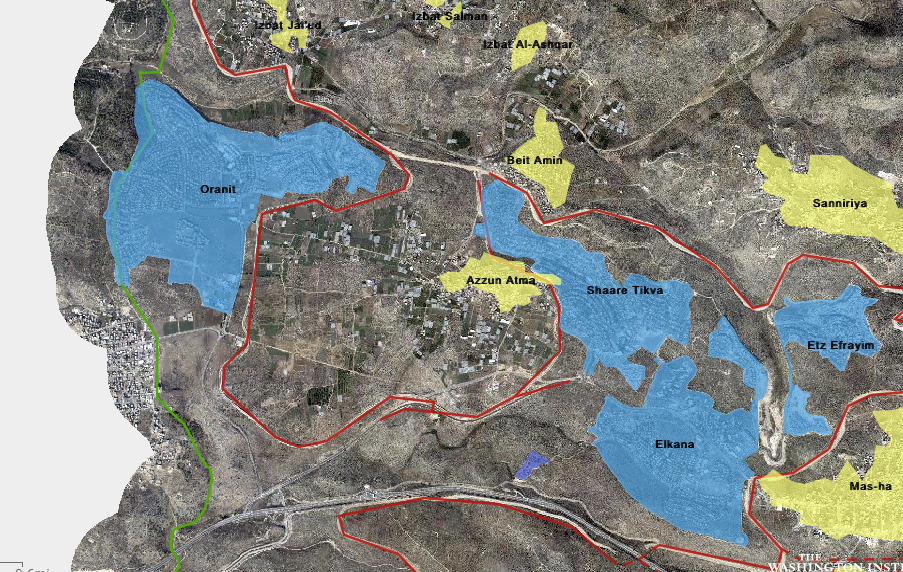
Map by WINEP
The Israeli Interior Ministry has reportedly recommended creating a new Israeli [settlement] city in the West Bank that unites four West Bank settlements – Etz Efraim, Sha’arei Tikva, Oranit and Elkana – allowing for increased construction on the land between them. The four settlements are all located in the “seam-line” zone, the area created by the weaving route of the Israeli separation barrier that was built to keep many settlements on the Israeli side of the barrier despite being east of the 1967 Green Line.
FMEP will report more details on this story as it develops.
Ir Amim & Bimkom Report – “Deliberately Planned: A Policy to Thwart Planning in the Palestinian Neighborhoods of Jerusalem”
A new report by Ir Amim and Bimkom shines a harsh spotlight on the discriminatory urban planning process in East Jerusalem, as well as the increasing rate of home demolitions that, coupled with settlement expansion, are undermining the future of the Palestinian community there. In three case studies, the report’s authors look at how Israel deliberately blocks applications for planning and building in Palestinian neighborhoods in East Jerusalem, making it impossible for Palestinians to build legally.
Ir Amim & Bimkom write
This discrimination in planning is the product of a policy driven by demographic considerations – in particular, the objective of increasing the Israeli population while reducing the Palestinian population, with the underlying goal of ensuring Jewish demographic superiority….
The outcome of this policy has a devastating impact at both the individual and community levels. Barriers to legal building push many Palestinians to build without permits. Each year, the Jerusalem Municipality (herein, Municipality) and the District Planning Bureau (formerly under the auspices of the Interior Ministry and now the Finance Ministry), demolish dozens of housing units constructed without permits in the Palestinian neighborhoods of East Jerusalem; in 2016 alone, the authorities demolished 123 housing units. The psychological and economic ramifications of this reality are profound. Moreover, inadequate planning prevents the construction of schools and the development of public spaces and employment and commercial zones, thereby weakening the community as a whole.
This treatment is clearly discriminatory, particularly when contrasted with the fact that the Israeli government continues to approve and fast-track approvals both for settlement planning in construction in major settlement neighborhoods of East Jerusalem and in settlement enclaves located in the heart of Palestinian neighborhoods. For details see this recent report from Peace Now.
UPDATES: Bedouin Communities Fight Eviction; Jerusalem “Supermajority” Bill Advances
- Over 100 Palestinians joined residents of Jabal al-Baba to protest the Bedouin community’s imminent eviction from the E-1 settlement area just east of Jerusalem. The Jabal al-Baba community, which has lived in the area since it was expelled from the Negev in 1948, was given an eviction notice earlier this month demanding that it leave the area and stating that all structures there will be demolished. Jabal al-Baba is one of the many Bedouin communities located near Israeli settlements in Area C that are facing the imminent threat of eviction; the Khan al-Ahmar community (also located in the Maale Adumim/E-1 area) and two Jordan Valley bedouin villages have also been ordered to leave their land. The European Union has called on Israel to halt the planned demolitions. The EU statement also highlighted the impending demolition of Susiya, a Palestinian city in the South Hebron Hills. Both Susiya and Khan al-Ahmar were the subject of concern of a recent letter to Prime Minister Netanyahu, signed by 10 U.S. Senators, demanding the demolitions be canceled and articulating serious concerns about the settlement enterprise, saying, “these communities are currently facing the imminent threat of evacuations and demolitions, and have been targeted by settlement movement activists seeking to entrench the Israeli occupation and prevent the ultimate creation of an independent Palestinian state.”
- The Knesset’s Constitution, Law & Justice Committee voted to advance a bill that, if passed into law, will require a supermajority of votes in the Knesset to approve any deal that transfers sovereignty of any part of Jerusalem to a foreign power. This law would in effect give a minority in the Knesset veto power over any future peace deal with the Palestinians. The bill is now set for two final votes in the Knesset before becoming law. Ir Amim provides valuable analysis of the bill, and points out that the language is careful to differentiate between territorial concessions and municipal changes, a distinction that is apparently intended to support other pending legislation that would bureaucratically excise some Palestinian neighborhoods from Jerusalem – a move that the Knesset is also considering in order to manufacture and preserve a Jewish majority in the city.
Bonus Reads
- “UN Settlement Business Data Can Stem Abuse” (Human Rights Watch)
- “Border Homes, in Jerusalem but Not, Face an Existential Deadline” (New York Times)
- “Why Won’t Israel Let Me Mourn My Father?” (New York Times)
- “US Ambassador David Friedman Drops Out of West Bank Memorial Ceremony for Murdered US Citizen” (Jerusalem Post)
__
FMEP has long been a trusted resource on settlement-related issues, reflecting both the excellent work of our grantees on the ground and our own in-house expertise. FMEP’s focus on settlements derives from our commitment to achieving lasting Israeli-Palestinian peace, and our recognition of the fact that Israeli settlements – established for the explicit purpose of dispossessing Palestinians in the West Bank and East Jerusalem of land and resources, and depriving them of the very possibility of self-determination in their own state with borders based on the 1967 lines – are antithetical to that goal.
Welcome to FMEP’s Weekly Settlement Report, covering everything you need to know about Israeli settlement activity this week.
To receive this report via email, please click here.
September 27, 2017
- Netanyahu Delays Settlement Approvals at U.S. Request
- High Court Hears Arguments on the Demolition & Forced Relocation of anan al-Ahmar
- Another West Bank Community – Susiya – Faces Imminent Demolition (Again)
- Israeli Military Sets Up New Guard Post in Area A
- Defending their “Regulation Law,” Knesset Asks Court to Reject Palestinian Petitions
- Palestinian Laborer Kills Three Israelis in Settlement Attack
- Bonus Reads
Comments, questions, or suggestions? Email Kristin McCarthy at kmccarthy@fmep.org.
Netanyahu Delays Settlement Approvals at U.S. Request
Reportedly at the Trump Administration’s request, PM Netanyahu has put a two-week delay on a highly consequential meeting of the Civil Administration’s Planning Committee, which was set to consider advancing plans for the construction of as many as 2,000 new settlement units. The meeting had already been delayed at least once, out of concern for international blowback around the United Nations General Assembly confab last week. The delay comes as President Trump’s special envoy, Jason Greenblatt, arrives in the region to continue talks ostensibly aimed at restarting peace negotiations.
The decision angered Israel settlers and their allies, many of whom are already frustrated by Netanyahu’s failure to fulfill his promise to market tenders (a final step in the planning process) for 300 new units in the Beit El settlement earlier this month. Once the tenders are marketed, there will be a 60-day bidding period, after which the tenders will be awarded. Beit El is the settlement for which U.S. Ambassador David Friedman served as a longtime fundraiser, until his diplomatic appointment earlier this year. The settlement is deep in the West Bank, near Ramallah.
High Court Hears Arguments on the Demolition & Forced Relocation of Khan al-Ahmar
On September 25th, Israel’s High Court of Justice heard arguments [CORRECTED: The hearing scheduled for September 25th was delayed, and a new date for the hearing before the High Court has not yet been set. Read on for information about the State’s response to the petitions, submitted to the High Court this week.] on two competing petitions regarding the future of the residents of the Palestinian village of Khan al-Ahmar. One petition, submitted by settlers living near Khan al-Ahmar, seeks to expedite the demolition of the village school. Another petition, submitted by Khan al-Ahmar’s residents (Palestinian Bedouins), seeks to delay the demolition of the village’s structures, all of which have been issued demolition orders.
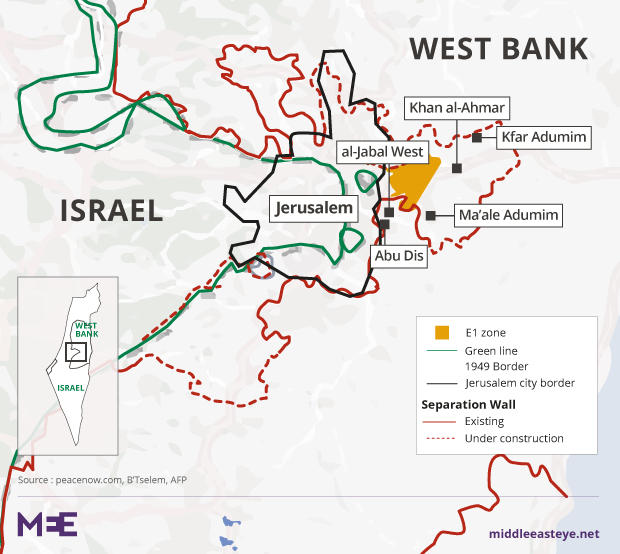
Map by Middle East Eye
We covered the background of the community – and Israel’s plan to forcibly relocate its residents [a war crime] to a site near a garbage dump, in order to expand the Maale Adumim settlement – in last week’s Settlement Report, which you can read here.
The Israeli government submitted its response to the petitions on Monday, saying it intends to carry out the demolition of the village and the relocation of its residents by mid-2018. The State asked the High Court to reject both petitions and allow the plan to advance. B’Tselem’s Executive Director Hagai El-Ad issued a blistering response to the State’s argument saying:
No sanctimonious language about a ‘planning, proprietary and realistic’ alternate, or ‘time to prepare’ can erase the disgrace or hide the facts: the destruction of Khan al-Ahmar means the forcible transfer of protected persons, and forcible transfer is a war crime. Those responsible for it will bear personal criminal liability – exactly as B’Tselem stated two weeks ago, in a letter addressed to the prime minister, defense minister, justice minister, chief of staff and the head of the Civil Administration.
Peace Now also issued a statement on the State’s response:
While the government argues that the residents of Khan al-Ahmar will received alternative housing, they will in fact be evacuated against their will for the benefit of settlers, and placed above the garbage dump in Abu Dis. This type of forceful evacuation of protected persons constitutes a severe violation of international humanitarian law.
It appears that the forceful displacement of the residents of Khan al-Ahmar is a form of “compensation” for his right wing supporters for the upcoming evacuation of the Illegal outpost of Derech Ha’Avot, following a High Court ruling.
It is shameful that settlers from Kfar Adumim, who received their lands for free from the government, are fighting for the evacuation of their Palestinian neighbors, who resided in the area long before them.
Ahead of the hearing, the Haaretz editorial board penned a plea to the Court against the forced relocation and replacement of West Bank Bedouin with Jewish settlements, stating:
This political project – the forced uprooting of Bedouin communities, replacing them with new Jewish settlements – is against international law. It has reached the doorstep of the High Court justices, who are under constant pressure to “respect the will of the people” – that is, the will of the settlers who control the government – even though this will is neither legal nor moral. It must be hoped the justices will be able to stand in the breach.
Another West Bank Community – Susiya – Faces Imminent Demolition (Again)

Map by B’Tselem
The Israeli Defense Ministry is “no longer willing to postpone” the demolition of the Palestinian community of Susiya, according to Haaretz reporting. A senior security official told Haaretz that the demolition will happen within a few months.
Like the Khan al-Ahmar community, the Palestinian residents of Susiya in the South Hebron Hills are the target of Israeli demolition orders and relocation plans. The community that makes up Susiya has a long history, as reported by Haaretz:
Susiya has long been a symbol of both Palestinian steadfastness and Israeli policies. In 1986, Israel expelled the residents from their original ancient village, whose lands were declared a national park. In 2001, they were thrown off their agricultural lands, where they had settled after the earlier expulsion. The High Court of Justice allowed them to return, but didn’t order the authorities to allow them to rebuild. As a result, all the structures in the village were built without permits and are at risk of demolition. The Civil Administration never prepared a master plan for Susiya and rejected the plan the residents had submitted, demanding instead that the residents move to an area near the city of Yatta. The residents refused, but agreed to meet with Civil Administration officials to try to come to some understanding.
The plight of Susiya’s residents continues to inspire a vibrant civil society campaign in both the U.S. and in Israel. Notably, the Obama Administration intervened in the case of Susiya as recently as last year. Back in November 2016, Senator Dianne Feinstein (D-CA) a statement praising PM Netanyahu’s decision to delay the demolition (the link includes links to Feinstein’s long engagement on this issue). In 2015, 10 members of the U.S. House of Representatives sent a letter to Secretary of State John Kerry raising the village’s plight. The New York Times, the Washington Post, and CNN are a few major U.S. outlets that have featured the Susiya’s story sympathetically.
Israeli Military Sets Up New Guard Post in Area A
Peace Now this week published a report documenting the fact that the Israeli army recently established a new guard post in the West Hebron Hills, in a part of the West Bank that is designated as “Area A.” Under the 1995 Interim Agreement, the Palestinian Authority has full civil and security control in the 18% of the West Bank designated as “Area A.” Israeli forces are not allowed to operate in – or even enter – Area A; however, for years Israel has insisted on its right to “hot pursuit” in Area A, carrying out operations at it pleases.
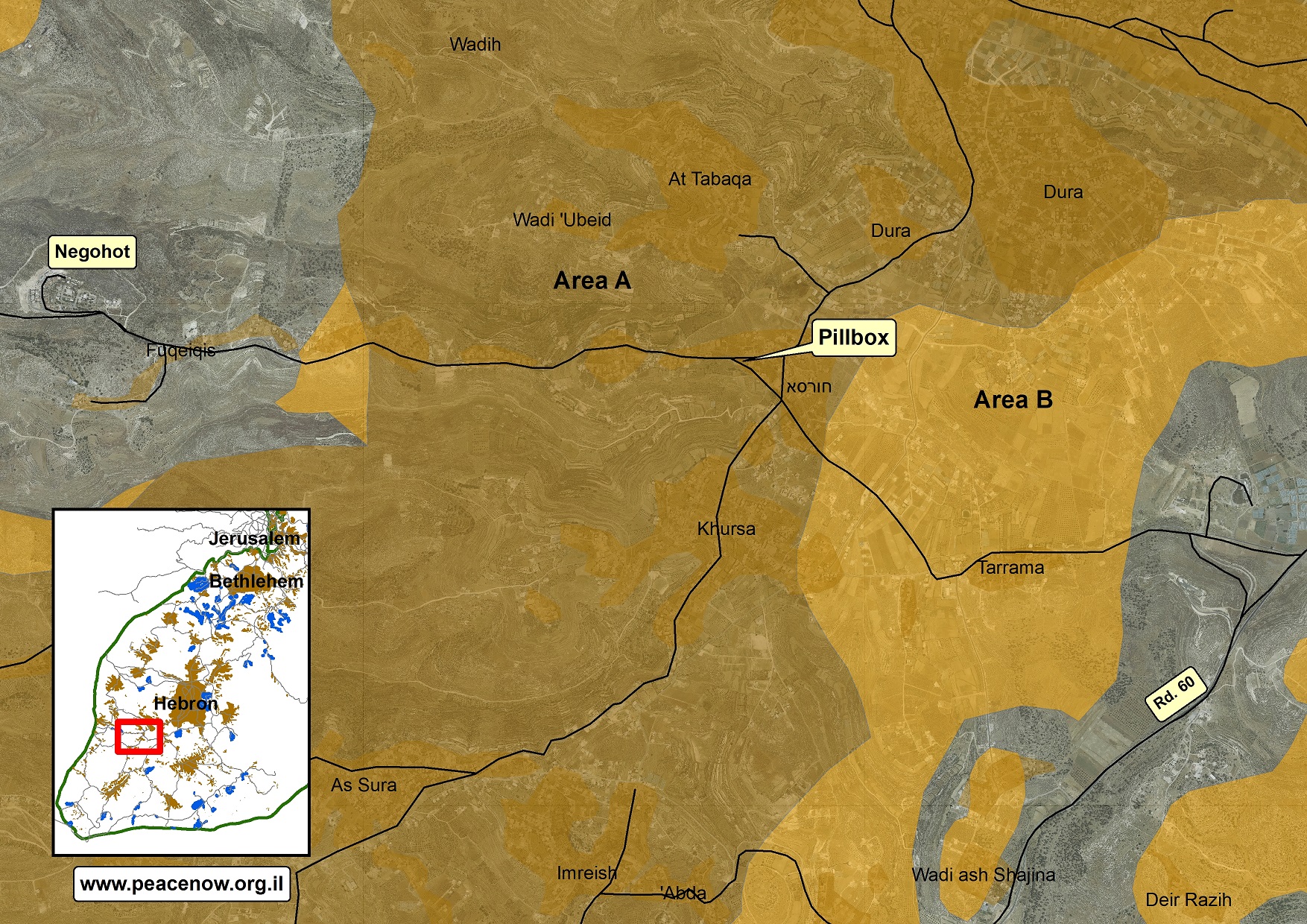
Map by Peace Now
The establishment by the IDF of a static post in Area A (dispensing with even the pretense that the operation is related to “hot pursuit”) represents a new and significant escalation in Israel’s violation of the 1995 Interim Agreement. According to Peace Now, the new “pill box” guard post was built “in the heart of the Palestinian village of Khursa in the West Hebron Hills….in order to protect vehicles of the Negohot settlers, who drive through Area A in order to shorten the way between Jerusalem and the South Hebron Hills.” The Negohot settlement was established in 1999 without official Israeli authorization. A jurisdiction was approved to retroactively legalize the settlement in 2013.
Peace Now said:
The placing of a guard post in area A is a blatant violation of the Oslo Accords and shows the length the Israeli government is willing to go in order to help a handful of settlers take a shortcut on their way home. The new IDF guard post illustrates, yet again, that the settlements do not contribute to Israel’s security, but rather pose a national security burden.
Defending their “Regulation Law,” Knesset Asks Court to Reject Palestinian Petitions
This week the Israeli Knesset submitted to the Israeli High Court of Justice its response to petitions challenging the constitutionality of the “Regulation Law,” which was passed by the Knesset in February 2017. The law provides a legal basis to retroactively legalize Israeli outposts, settlement structures, and agricultural lands that were built illegally (i.e., without permission and/or on land recognized by Israel as privately owned by Palestinians).
The Knesset’s legal advisor argued that Israel is able to selectively write laws for the West Bank. The Knesset asserts it must do so in this case because no other means exist to legalize the settlement homes and outposts [Note: no other means exist because, according to rule of law, the law applies, regardless of whether politicians like the results].The Knesset’s response asks the Court to reject petitions against the Regulation Law.
Last month, a private lawyer hired by the government submitted the State’s response to the petitions, after the Israeli Attorney General declared the law illegal and refused to defend it. The State’s response claimed that the law is legal because Israel can legislate in the West Bank and because the law provides an avenue to compensate the dispossessed Palestinian landowners.
Peace Now and Yesh Din are among the 13 civil society groups leading a legal challenge to the law on behalf of Palestinians. According to data collected by Peace Now, the law will lead to the expropriation of over 8,000 dunam (nearly 2,000 acres) of private land upon which structures have been built illegally – and tens of thousands of dunams of land on which agricultural crops have been planted. The land designated for expropriation is owned by thousands of Palestinians, among them many of the residents of the villages represented in the petition.
Palestinian Laborer Kills Three Israelis in Settlement Attack
On September 26,, a Palestinian man opened fire at the gate of the Har Adar settlement, near Jerusalem. He killed three Israelis – two civilian security guards (one of them a Palestinian citizen of Israel)and one border policeman – and injured another guard. The assailant, who was killed at the scene, was identified as 37-year-old Nimer Mahmoud Ahmad Jamal from the neighboring Palestinian village Beit Surik. He reportedly had an Israeli-issued work permit (which requires security screenings) to enter the settlement, where he was employed as a cleaner. Jamal reportedly had no security record and was married with four children (meaning he did not fit any profile for someone who might commit such an attack). He was reportedly having serious personal and family problems.
Shortly after the attack, Prime Minister Netanyahu announced a range of Israelis responses targeting not the assailant (who died in the attack) but his family, his immediate community, and potentially Palestinians beyond that: the assailant’s house will be demolished and any work permits issued to his relatives (extended family) will be revoked. The attacker’s hometown, Beit Surik, was sealed-off by the Israeli army, and his brothers was arrested. Additional Israeli troops were sent into the area around Har Adar, which sits in what Israel calls the “seam zone,” i.e., the area of the West Bank that runs along, and sometimes on the Israeli side of, the separation barrier. Netanyahu also blamed President Abbas and Palestinian official “incitement” for the attack, despite Israel media reporting widely on the personal problems of the attacker.
FMEP President Lara Friedman has written about how Israel’s response to terror, many elements of which have already unfolded around this attack, amounts to collective punishment.
Bonus Reads
- “Israeli settler sics dog on border police” (Times of Israel)
- “Israeli settler torch olive trees in revenge attack” (The New Arab)
FMEP has long been a trusted resource on settlement-related issues, reflecting both the excellent work of our grantees on the ground and our own in-house expertise. FMEP’s focus on settlements derives from our commitment to achieving lasting Israeli-Palestinian peace, and our recognition of the fact that Israeli settlements – established for the explicit purpose of dispossessing Palestinians in the West Bank and East Jerusalem of land and resources, and depriving them of the very possibility of self-determination in their own state with borders based on the 1967 lines – are antithetical to that goal.