Welcome to FMEP’s Weekly Settlement Report, covering everything you need to know about Israeli settlement activity this week.
To subscribe to this report, please click here.
September 20, 2024
- Israeli Supreme Court Orders Immediate Eviction in East Jerusalem, Fears of Mass Expulsion Grow
- Residents of Zanuta Return to Land to Find Destruction, Israel “Offers” Permanent Displacement as Solution
- UN Adopts on Resolution Calling for Israel to End Illegal Occupation of Palestinian Territory
- Blinken Calls on Israel to Changes Rules of Engagement in the West Bank
- Bonus Reads
Israeli Supreme Court Orders Immediate Eviction in East Jerusalem, Fears of Mass Expulsion Grow
On September 10th, the Israeli Supreme Court unanimously rejected a final appeal submitted by the Ghaith family (15 people), affirming the District Court’s ruling to evict the family from their longtime home in favor of the Ateret Cohanim settler organization. The Ghaith family was ordered by the Court to immediately leave their home located in the Batan al-Hawa section of the Silwan neighborhood of East Jerusalem, where 85 families face dispossession (details). Underscoring the struggle Palestinians face in Silwan to remain in their homes and on their land, in addition to the eviction cases threatening mass displacement, Israel is also carrying out an accelerated demolition campaign targeting Palestinians in Silwan over the past year.
Ir Amim reports that since October 7th there has been a dramatic spike in court decisions to evict Palestinians at the behest of settlers, with 14 families having been dispossessed in the past six months – including the Shehadeh family who were dispossessed of their home just one month ago. More – this is the second major case in the past two months that has seen a Palestinian family thrown out of their homes in Silwan – – setting an increasingly entrenched precedent for the cases that are still pending. All of these cases hinge on the settlers’ use of the discriminatory law (the 1970 Legal and Administrative Matters law) and the Court’s continued acceptance of that law as a weapon by which to replace Palestinians with Jews. The law provides a right for Jews to reclaim property that was owned prior to 1948, but abandoned during war. Palestinians are provided no such right and further, as Ir Amim explains, “to the contrary, the 1950 Absentee Property Law enshrines that Palestinians who were forced to abandon their homes and lands in what became Israel after the war of 1948 can never retrieve them.”
Ir Amim writes:
“Although the Israeli government often characterize these cases as private real estate disputes, they are rather part and parcel of a systematic campaign aimed to cement Israeli control over the Old City Basin, the most religiously and politically sensitive part of Jerusalem. These measures are reinforced by a constellation of settler-operated tourist sites, which together, serve to alter the character of the space and forge a ring of Israeli control around the Old City. This creates an irreversible reality on the ground that deliberately erodes conditions for an agreed political resolution on Jerusalem and the rest of the territory. Such actions severely violate the individual and collective rights of Palestinians in the city, while carrying an acute humanitarian impact on the affected families.”
Noting that both the Ghaith family case and the Shehadeh family case (which one month ago concluded wit the dispossession of the family in favor of settlers) have been ruled on by conservative Israeli Justice Sohlberg, Peace Now says in a statement:
“If this eviction is carried out, God forbid, it will be an injustice and a crime against a vulnerable population under occupation in East Jerusalem, leaving an indelible stain on the State of Israel. The government can and must stop the forced displacement of an entire community and the responsibility lies on its shoulders. The International Court of Justice (ICJ) specifically referred in its opinion to the system of discriminatory laws and the Israeli settlement policy in East Jerusalem and determined that it is a violation of international law. Although the matter is political and the legal process is only the tool for its realization, it is important to emphasize that Judge Solberg’s decision stands in contrast to the decisions of other judges in the Supreme Court who have granted permission to appeal in similar cases. It seems that Judge Solberg is using his powers to prevent the discussion from reaching judges whose position is different from his own, precisely two days before the state’s position on the issue is supposed to be given to the court.”
Residents of Zanuta Return to Land to Find Destruction, Israel “Offers” Permanent Displacement as Solution
It has been nearly a year since the residents of Zanuta – a remote herding community in the South Hebron Hills – has been forcibly displaced from the lands under the shadow of continuous settler violence and lack of any action by the IDF to stop the terrorism, which only escalated in the wake of October 7th. In July 2024 the Israeli High Court of Justice ruled that the State of Israel must facilitate their safe return to the land. Villagers started returning to the area in August to discover that in the intervening months, settlers have been allowed to enter the area and destroy nearly all of the houses, the small school, and the village’s health clinic. The village appeared ransacked. Only days after their initial return, the village was attacked by Yinon Levy (a settler under international sanctions for his involvement in violence) while the Israeli police and army watched.
With the legal assistance of Haqel, the villagers submitted a request with COGAT to restore and protect the village’s buildings. Instead of offering that small measure of justice, the Civil Administration responded by “offering” the villagers a chance to relocate their lives to land 2.5km away – land that Israel has declared to be “state land” but land that is adjacent to Areas A and B (not situated solidly in Area C, as the current village is). The letter also stated that the Civil Administration will not permit any new construction in the current village and intends to carry out enforcement against buildings that lack Israeli permits in 30 days.
Haqel issued the following statement in response to the absurd proposal:
“the state is threatening the residents with destruction of the remainder of the demolished building in the village if the residents accept the offer to evacuate the village and move to the area adjacent to areas A and B. There is no doubt that the state’s proposal at the present time, precisely with the return of the residents to their village by order of the High Court after the previous violent expulsion, is intended to formalize and complete the deportation of the residents of the village of Zanuta where the settlers began their efforts to ethnically cleanse Area C of its Palestinian residents. The state ignores any historical and proprietary connection of the residents to the village who have in their possession documents proving their rights to hundreds of dunams of private land in the village and forcing them to be displaced to an area in which they have no property rights and where there are other Palestinian landowners present.”
UN Adopts on Resolution Calling for Israel to End Illegal Occupation of Palestinian Territory
On September 18th, the United Nations General Assembly voted to adopt a resolution demanding that Israel end “its unlawful presence in the Occupied Palestinian Territory” within 12 months. The resolution further calls for member states to cease transferring arms to Israel that may be used in the occupied lands. Only 14 countries voted against the measure, including Israel and the United States. Kenneth Roth, founder and former director of Human Rights Watch, suggests that:
“The US government’s response suggests a refusal to recognize the new legal reality in which Israel now finds itself….The US government’s response to the general assembly resolution reflected (at least feigned) ignorance of the legal paradigm shift that has occurred. The Biden administration accused the general assembly of “ignoring Israel’s very real security concerns”, but that misses the point of the ICJ ruling. Those security concerns must be met from within Israel, not through occupation.”
While the resolution is non-binding, it provides decisive clarity that the majority of the world (124 out of 198) holds Israel’s occupation is illegal and should end. The resolution’s language is largely informed by the advisory opinion issued by the International Court of Justice some two months ago.
Blinken Calls on Israel to Changes Rules of Engagement in the West Bank
U.S. Secretary of State Antony Blinken called upon Israel to change its rules of engagement in the West Bank after an American citizen, Aysenur Ezgi Eygi, was shot in the head and killed by an IDF soldier while participating in a protest against the Evyatar outpost in the Palestinian village of Beita.
Eygi’s family said in a statement:
“Aysenur, an activist and volunteer, was peacefully standing for justice as an international observer and witness to Palestinian suffering. She was taking shelter in an olive grove when she was shot in the head and killed by a bullet from an Israeli soldier. This cannot be misconstrued as anything except a deliberate, targeted and precise attack by the military against an unarmed civilian.”
The family’s statement helps put the spotlight on the ongoing struggle of Palestinians from the area of Beita to stop the retroactive legalization of a violent outpost, which was established illegally by settlers on a strategic hilltop named Mount Sabih, located just south of Nablus on land historically belonging to nearby Palestinian villages Beita, Yatma, and Qablan. Palestinians have held weekly protests against the government’s plans and the continued presence of settlers in the area ever since – protests which have resulted in no fewer than seven Palestinian protesters dying as a result of the harsh and violent actions by the IDF to quash the protests. Then, on July 8, 2024, the Israeli government declared 16 acres (66 dunams) of land as Israeli “state land” in order to pave the way for the legalization of the Evyatar outpost. The declaration is the result of three years of “work” by Smotrich’s Settlements Administration to examine the status of the land in order to find a way for the state to take control of the land in order to legalize the outpost. The declaration was made one week after the Israeli Security of Cabinet decided in favor of legalizing the Evyatar outpost along with four other outposts.
Blinken said:
“We’ve long seen reports of the security forces looking the other way when extremist settlers use violence against Palestinians. We’ve seen reports of excessive force by Israeli security forces against Palestinians. It’s not acceptable. It has to change. And we’ll be making that clear to the senior-most members of the Israeli government.”
Bonus Reads
- “IDF expands Judea and Samaria security guards authority” (JNS)
- “A plan to liquidate northern Gaza is gaining steam” (+972 Magazine)
- “Annexation, Expulsion and Israeli Settlements: Netanyahu Gears Up for Next Phase of Gaza War” (Haaretz)
- “What Settler Violence Is Doing to Israel’ (The Atlantic)
- “How extremist settlers in the West Bank became the law” (Financial Times)
- “How the Israeli settlers movement shaped modern Israel” (The Conversation)
- “Israel’s Existential Threat from Within” (NYT The Daily Podcast)
Welcome to FMEP’s Weekly Settlement Report, covering everything you need to know about Israeli settlement activity this week.
To subscribe to this report, please click here.
September 6, 2024
- Settler Terrorism & Sanctions
- Operation “Summer Camps” and the Expansion of Israel’s War Against Palestinians
- Bonus Reads
Settler Terrorism & Sanctions
Settlers have continued to terrorize Palestinians across the West Bank. Over the past few days settlers have been documented:
- Raiding the village of Qaryut (near Nablus) and setting fields on fire (Sept. 6). The settlers, accompanied by soldiers, clashed with locals during which time a 13-year old girl was shot and killed in her bedroom, reportedly by Israeli military forces;
- On the same day (Sep. 6th) an American-Turkish citizen, Aysenur Ezgi Eygi, was shot in the head when Israeli forces and settlers opened fire on a protest in Beitar;
- Torching cars in the villages of Deir Dibwan and Khirbet Abu Falah, leaving graffiti indicating it was a “price tag” attack;
Settlers continue perpetrating unabated and escalating violence despite the expanding number of sanctions on settlers by foreign governments and bodies. In its new report on settler violence, the International Crisis Group calls on foreign governments not only to continue expanding sanctions on violent settlers and entitities, but to accompany those sanctions with curbing arms sales to Israel.
One country continuing to expand sanctions is the U.S., which is also under continued civil society pressure to continue doing so. On August 28th the U.S. government announced two new sanction targets: the Israeli settler group Hashomer Yosh, and Yitzhak Levi Filant – an Israeli who serves as the civilian security coordinator for the Yitzhar settlement. Both are accused by the U.S. government of being responsible for violence against Palestinians in the West Bank.
The sanctions on the Hashomer Yosh (“The Guardian of Judea and Samaria”) organization is particularly notable because it is funded by the Israeli government, and its executives are affiliated with Israeli officials Itamar Ben Gvir and Bezalel Smotrich. In response to the U.S. sanctions, the group even defended its actions by asserting that it coordinates its activities with the government. +972 Magazine further revealed that the organization has received funding from the U.S.-based Central Fund of Israel between 2015-2019. The group is identified by Palestinian activists in the South Hebron Hills as the “number one” group behind settler terrorism, which led to the coerced displacement of the Khirbet Zanuta community earlier this year. For more on this organization, see Peace Now’s reporting.
Yitzhak Levi Filant serves as the civilian security coordinator for the Yitzhar settlement According to DAWN, Filant has participated in or directed “violent assaults, shootings, threats at gunpoint, arson, and property destruction targeting Palestinian civilians between October 2019 and February 2024…Most recently, on February 17, 2024, Filant and other settlers set up a makeshift roadblock outside the village of Asira al-Qibliya and forcibly removed three Palestinian civilians from a car, assaulted them, and threatened to burn the vehicle if they returned.”
In addition to the new U.S. sanctions, Haaretz reports that the European Union Foreign Minister Josep Borell will ask members to impose sanctions on Israeli ministers Bezalel Smotrich and Itamar Ben Gvir. The EU would have to vote unanimously to impose sanctions, though individual member states can proceed with sanctions independent of EU consensus. The settler-run Arutz Sheva outlet reports that EU members have already promised Israeli diplomats that they will veto the sanctions.
Operation “Summer Camps” and the Expansion of Israel’s War Against Palestinians
The Israeli military’s operation “Summer Camps” has lasted 10 days so far, during which at least 30 Palestinians have been killed and terrorized the West Bank cities of Jenin, Tulkarem, Tubas, and surrounding areas. Palestinians there have endured repeated airstrikes, constant buzzing of drones, large-scale and repetitive raids, and the destruction of infrastructure including roads, water systems and electricity grids. Israel’s operations have effectively paralyzed life across the West Bank. The Israeli government and military say their campaign – which is the largest since the Second Intifada – is to root out resistance cells and have been spurred by the recent uptick in the use of explosives, including recent booby trapped cars and a suicide bomber.
Though there have been reports that Israeli forces withdrew from Jenin and Tulkarem on September 6th, Israel Hayom has previously reported that the Israeli government is planning for a long-term, large-scale military operation across the whole West Bank – with Hebron being the next target. Other reports suggest the Israeli government is moving to designate the entire West Bank as an active combat zone, no longer a secondary front of its war on Gaza. Israeli Defense Minister Gallant urged extensive military campaigns in the West Bank, saying “we [Israel] are mowing the lawn, [but] the moment will also come when we will pull out the roots, that must be done.
In Jenin and Tulkarem in the northern West Bank, Palestinians were trapped in their homes unable to leave for days. Israel has also shot at Palestinian ambulances and obstructed their ability to reach injured people or even respond to emergency calls not related to Israel’s incursion. The Palestinian Red Crescent told Haaretz that it took 8 hours for an ambulance to reach and transport a patient for her dialysis treatment – which the hospital later suspended because they did not have enough consistent electricity to run the machines. A resident of Jenin told the New York Times:
“…this is the first time we see this kind of brutality…There is no humanity. They uprooted the trees, broke the buildings. The sewer mains meters under the ground, they ripped them up. The electricity, the water — they didn’t leave anything untouched.”
Another Jenin resident told +972 Magazine reporter Mariam Barghouti:
“What do you think they’re doing? They’re pushing for escalation so that they can fully depopulate us..They’re making life for us unbearable…What this does is naturally push us toward confrontation, and when we do, the Israeli military further intensifies its abusive practices.”
The Haaretz Editorial Board ominously warns:
“Ten days ago, the army intensified the combat and launched Operation Summer Camps, which is currently underway. The reins have been loosened and the army is now operating like it does in Gaza. At least 38 Palestinians have been killed in the West Bank, including at least nine minors. The destruction sown by the army in the refugee camps resembles the destruction in Gaza. These have always been futile operations whose only result, in the absence of a political plan, is pushing West Bank residents further into despair and toward armed struggle. The minister of the West Bank, Bezalel Smotrich, and the national security minister, Itamar Ben-Gvir, under Netanyahu’s leadership and with the army’s participation, are doing everything they can to open another front in addition to the ones that are already aflame. They will soon get their wish.”
Bonus Reads
- “‘This is a war’: FM urges Gaza-style temporary evacuation of Palestinians in West Bank” (The Times of Israel)
- “Inside the Movement to Settle Southern Lebanon” (Jewish Currents)
- “Shin Bet Chief Warns PM and Ministers: Jewish Terror Is Jeopardizing Israel’s Existence“ (Haaretz)
- “Israeli settlers are seizing Palestinian land under cover of war – they hope permanently” (BBC)
- “Aiding and Abetting Jewish Settler Terror: Will There Now Be Real Consequences?” (Haaretz Editorial Board)
- “Trump’s Israel adviser suggests diverting $1 billion from Palestinian aid to fund West Bank annexation” (Forward)
Welcome to FMEP’s Weekly Settlement Report, covering everything you need to know about Israeli settlement activity this week.
To subscribe to this report, please click here.
July 19, 2024
- Historic ICJ Advisory Opinion Says Israel’s Occupation is Illegal, Calls for Settlements to be Dismantled
- Israel Grants Itself Civilian Control of An Additional 3% of West Bank Land
- Settlers Enter Abu Nab House in Batan al-Hawa, Silwan As Shehadeh Family Faces 20-Day Eviction Notice
- Palestinians Blast IDF Closure of Courtyard in Ibrahimi Mosque Complex
- New Outpost Established East of Ramallah
- European Union Issues New Sanctions on Israeli Settlers, Orgs, and Outposts
- U.S. Sanctions Two More Individuals, Including First Military Target
- Further Reading on Silwan, Masafer Yatta & More
- Bonus Reads
Historic ICJ Advisory Opinion Says Israel’s Occupation is Illegal, Calls for Settlements to be Dismantled
In an advisory opinion issued on July 19th, the International Court of Justice ruled that Israel’s occupation of East Jerusalem and the West Bank is illegal, and its policies constitute apartheid. The Court said that Israel should immediately end its occupation, make restitution to those damaged by it, including dismantling settlements, evacuating all settlers, and dismantling parts of the Separation Barrier that fall east of the 1967 Green Line. It also calls for the return of all Palestinians who were displaced from their homes as a result of Israel’s occupation.
In delivering the Court’s findings, ICJ President Nawaf Salam said:
“The sustained abuse of Israel of its position as an occupying power through annexation and an assertion of permanent control over the occupied Palestinian territory and continued frustration of the right of the Palestinian people to self-determination violates fundamental principles of international law and renders Israel’s presence in the occupied Palestinian territory unlawful.”
Further, the Court – which is the principal judicial organ of the United Nations – calls on all States “not to recognize as legal the situation arising from the unlawful presence of the State of Israel in the Occupied Palestinian Territory and not to render aid or assistance in maintaining the situation created by the continued presence of the State of Israel in the Occupied Palestinian Territory.” This includes banning trade and investments that touch Israel’s settlements. Though the advisory opinion is non-binding, the Court’s rulings hold legal and moral authority.
The Palestinian human rights group Al-Haq issued a detailed explainer in advance of the opinion’s release, which is a good resource for understanding the legal questions the Court was considering. Following the publication of the opinion, Al-Haq posted on X:
“This is a first step towards rectifying the generational harm of Israel’s illegal occupation, ongoing Nakba, settler-colonialism and apartheid to the Palestinian people, which must be ended, and all Israeli discriminatory measures and legislation repealed. Set against a backdrop of aggressive settlement expansion, increased settler attacks & the GazaGenocide the Advisory Opinion is a stark reminder to States and corporations alike of the need to take concrete action against Israel’s crimes and end Israeli presence in Palestine.”
Even in advance of the release of the ICJ’s advisory opinion, Israeli government officials were bracing for its findings. Smotrich even called on Netanyahu to annex the West Bank in retaliation, a demand he reiterated after the opinion was published.
Israel Grants Itself Civilian Control of An Additional 3% of West Bank Land
Peace Now reports that the Israeli Commander of the Central Command has signed two new orders granting the Israeli government vast planning authorities an additional 3% or 41,300 acres (167,000 dunams) of the West Bank, in the areas to the east of and between Bethlehem and Hebron. Previously, these lands were under the (theoretical) civilian control of the Palestinian Authority (areas A & B according to the Oslo Accords), much to the dismay of settlers and their government allies who have been agitating for control over an ever-increasing amount of land in the West Bank in order, at least in part, to demolish Palestinian construction in the area.
The first order granted Israeli authority to operate in these areas, and the second order made construction in the areas illegal – establishing guidelines for Israeli authorities to demolish any/all Palestinian buildings if they were built after 1998 (the Wye Agreement). Importantly, Bezalel Smotrich and his allies hold authority within the Civil Administration to pursue and enforce demolitions.
Peace Now said in a statement:
“There is no end to the desire for control and annexation by the settler government. The Israeli government is taking upon itself authorities that Netanyahu himself transferred to the Palestinians under the Wye Agreement in 1998. There is no Israeli interest in demolishing Palestinian homes in Area B, which will only harm Israel’s security and international standing, but it solely serves the interests of messianic settlers. It should be noted that the “Agreed-Upon Reserve” is not a genuine nature reserve. It is an Israeli invention born out of the Wye Agreement, where Netanyahu sought to prevent the implementation of agreements signed with the Palestinians and to avoid transferring authority to them in these territories. Therefore, they were defined as “reserves” so that the territories would be transferred to Palestinians but with a prohibition on Palestinian construction. However, they do not constitute an actual reserve.”
Settlers Enter Abu Nab House in Batan al-Hawa, Silwan As Shehadeh Family Faces 20-Day Eviction Notice
Peace Now reports that on July 16th settlers entered the home owned by the Palestinian Abu-Nab family in Silwan and immediately began construction work inside. Last week the Jerusalem District Court ruled in favor of the settlers claim to home and ordered the immediate dispossession of the Abu Nab family. Settlers acted fast to take possession of the home while the family was not home, even as the Abu Nab family lawyer prepared an appeal against the ruling.
On the same day that settlers entered the Abu Nab family home, the Shehadeh family (who lives next door to the Abu-Nabs) received an eviction notice giving them 20 days to leave their home or face forcible eviction. The Shehadeh family has already been denied an appeal by the Israeli Supreme Court.
Peace Now said in a statement:
“This is a real alarm. If the government does not intervene and if pressure is not applied on it to intervene, we may see Israeli police forcibly evicting Palestinian families from their homes in Silwan in the coming weeks, and settlers moving in instead. This is a terrible injustice based on discriminatory laws and the exploitation of the vulnerability of East Jerusalem residents, who are not equal citizens living under occupation in Jerusalem. This is part of a larger scheme to expel an entire Palestinian community to make way for settlements in East Jerusalem, and this crime must be stopped. Now.”
Palestinians Blast IDF Closure of Courtyard in Ibrahimi Mosque Complex
The Palestinian-run Hebron Municipality condemned the closure of a courtyard outside of the Ibrahimi Mosque in Hebron. The director of the Hebron Endowments, Ghassan Al-Rajabi, on July 11th Israeli troops used sheet metal to close off the courtyard area. Rajabi called it, “a blatant assault against the sanctity and status of the Mosque.”
The Hebron Municipality issued a statement saying:
“This assault comes as part of the statistical projects that seek to consecrate the honorable Abrahamic Shrine and its surroundings, and impose complete control over it by erecting tracks and an electric elevator earlier to facilitate the settlers’ access to the shrine, which will cause its historical and religious landmarks to be distorted and changed and violated the religious and cultural rights of the original owners of the land And the ability to exercise and access their religious rights freely and safely. Know that the occupation authorities had this plan for years and it has been objected and objected by the Ministry of Endowments and Religious Affairs, the owner of the legal, legal and administrative state on the shrine.”
New Outpost Established East of Ramallah
Palestinian sources report that settlers established a new outpost east of Ramallah on July 15th.
Hassan Mleihat, the general supervisor of the Al-Baidar Organization said at a press conference:
“A group of extremist settlers set up tents and placed barbed wire over land belonging to the village of Burqa, east of Ramallah…This area has seen rising conflicts between illegal settlers and Palestinians over land, and the new outpost is part of the occupation government’s plans to seize more land for settlement expansion.”
European Union Issues New Sanctions on Israeli Settlers, Orgs, and Outposts
On July 15th the European Union on Monday sanctioned five Israeli settlers, two outposts and one settler organization group that it deemed are “responsible for serious and systematic human rights abuses against Palestinians in the West Bank.” the European Council, the E.U. body that represents the heads of the member governments, said in a statement.
These sanctions duplicated some of the sanctions the U.S. has imposed already.
Israeli press reports that several additional countries – including the U.K. under new leadership – have warned Israeli officials that more sanctions should be expected should Smotrich continue his settlement and annexation activities. Haaretz reports that Israeli officials are concerned sanctions will be placed on the major settler groups Amana and Regavim.
U.S. Sanctions Two More Individuals, Including First Military Target
The United States made two announcements of new sanctions this week. First on July 17th the U.S. said it had designated Shlomo Yehezkel Hai Sarid, who is the head of the previously-sanctioned Tsav 9 settler organization. Then on July 18th the U.S. announced that it had sanctioned Elor Azaria, who is a former IDF sergeant who was filmed executing a wounded Palestinian in 2016. Azaria was convicted by an Israeli court and served only 18 months in prison.
So far, the U.S. has placed sanctions on 11 settlers and 11 settler entities who have perpetrated violence and disorder in the West Bank. Azaria is unique among the designated individuals in that he was sanctioned for his actions while serving in the Israeli IDF some eight years ago, not for his active participation in settler terrorism.
Further Reading on Silwan, Masafer Yatta & More
Following FMEP’s publication of the Settlement Report last eek, several new must-read resources have been published regarding stories that FMEP closely follows.
On the pending mass displacement of Palestinians from Silwan:
- Peace Now published a very detailed explainer on the four legal cases at the forefront of the fight currently underway.
On the ongoing settler terrorism that is making live untenable for Palestinians in the South Hebron Hills:
- AP published, “Mounting home demolitions and settler attacks plunge a Palestinian village into crisis” (AP)
On the every escalating campaign by settlers to weaponize archaeology in pursuit of displacing PAlestinians and seizing control over the West Bank:
- The Jerusalem Post published an op-ed claiming that the Palestinian Authority is directing the “wanton annihilation of Jewish heritage” in the West Bank and calling for the Israeli government to seize control over all sites in Area B.
Bonus Reads
- “The US held off sanctioning this Israeli army unit despite evidence of abuses. Now its forces are shaping the fight in Gaza” (CNN)
- “Some 100,000 Palestinian Residents of Jerusalem Receive Only 4-12 Hours of Running Water per Week” (Ir Amim)
- “Israel’s legalization of settlements in the northern West Bank, explained” (Mondoweiss)
- “Far-right groups that block aid to Gaza receive tax-deductible donations from US and Israel” (AP)
- “What life is like for Palestinians living under Israeli occupation” (Al Jazeera Video)
Welcome to FMEP’s Weekly Settlement Report, covering everything you need to know about Israeli settlement activity this week.
To subscribe to this report, please click here.
July 12, 2024
- A Stunning, Expansive Time for Israel’s West Bank Annexation
- Civil Admin Seizes Patchwork of Plots as “State Land” in Order to Legalize the Evyatar Outpost
- Government Establishes Jurisdiction for New Settlement on World Heritage Site Near Bethlehem
- Settlers Takeover New Building in Hebron
- Historic Year for Land Grabs: Israel Seizes Over 3,000 Acres in the Jordan Valley as “State Land”
- Civil Admin Advances Plans to Legalize Three Outposts & Build 5k New Units Across West Bank
- Israeli Cabinet Gives Civil Admin Authority Over Antiquity Sites in Area B
- Israeli Cabinet Supports Knesset Considers Bill to Transfer West Bank Antiquities Control from Civil Admin to Domestic Body
- U.S. Issues New Round of Sanctions Against Settlers & Settler Organizations
- Israeli Court Orders 11 Families Out of Homes in Batan al-Hawa, Silwan
- Israeli Court Rules to Demolish Wadi Hilweh Info Center in Silwan
- Israeli Court Tells Settlers To Leave Khalidi Library in Old City of Jerusalem
- Israel to Advance 6,000+ Settlement Units in East Jerusalem in Coming Weeks
- Amidst Wave of Violence, Settlers Lead Progrom On Massafer Yatta Region
- Ariel Settlers Close Access Road to Palestinians
- IDF Demolishes Outposts, Clashes With Settlers
- Bonus Reads
A Stunning, Expansive Time for Israel’s West Bank Annexation
Over the past two weeks, Israel has unleashed a flurry of settlement activity that makes its annexation of the West Bank complete. Even a small sampling of those acts, detailed below along with other news, are stunning when taken together. Indeed, Israeli National Missions Minister Orti Strock called this “a miraculous time,” referring to the control her and her allies have over key government bodies and how easy it is for them to fund settlement construction. Strock is a member of the Religious Zionism party, along with Bezalel Smotrich.
Renowned Israeli human rights lawyer Michael Sfard encapsulates this time powerfully in an article entitled, “Smotrich Has Completed Israel’s Annexation of the West Bank”:
“The only thing the annexationist criminals must be saying to themselves now is: why did we wait for 57 years? It’s so easy.”
Civil Admin Seizes Patchwork of Plots as “State Land” in Order to Legalize the Evyatar Outpost
On July 8th, the Israeli government declared 16 acres (66 dunams) of land south of Nablus as Israeli “state land” in order to pave the way for the legalization of the Evyatar outpost. Palestinians who have private ownership claims to the land have 45 days in which to submit an appeal. The declaration is the result of three years of “work” by Smotrich’s Settlements Administration to examine the status of the land in order to find a way for the state to take control of the land in order to legalize the outpost. The declaration comes one week after the Israeli Security of Cabinet decided in favor of legalizing the Evyatar outpost along with four other outposts.
The Evyatar outpost was illegally built by settlers on a strategic hilltop named Mount Sabih, located just south of Nablus on land historically belonging to nearby Palestinian villages Beita, Yatma, and Qablan. It was evacuated by the Israeli government in 2021 in the context of an agreement with settlers that left all construction at the site in place, maintained an IDF presence at the site, and made clear the government’s intent to legalize settlement at the site in the future – a goal which was made more than official when it was agreed to in writing as part of the coalition agreements that formed the current Israeli government.
 To underscore the absurdity which has characterized the State’s blatant intent to legalize Evyatar even though Israeli law makes that an impossibility because parts of the land are recognized by the State as privately owned by Palestinians (which is the only reason Evyatar has yet to be legalized), the State’s new declaration of “state land” is a complete patchwork. The order does not include the land on which the central square of the outpost is built, nor does it include 11 buildings, or, very importantly, the access road leading from the main road to the outpost. The implications of this patchwork is that even though the privately owned land was not seized, Palestinians will remain unable to access the land and will, in practice, lose that land as well as land abutting the settlement as it grows, expands, and establishes control over the area with the assistance of the IDF.
Peace Now reports that this is the fifth “state land” declaration so far in 2024 bringing the total land in the West Bank taken into Israeli control this year to 5,879 acres (23,572 dunams), breaking all previous annual records combined. Israel invented the concept of “state land” in order to find means by which to confiscate land in the occupied West Bank, and to do so Israel cites Ottoman law which provided that land which has not been cultivated in consecutives years becomes the property of the sovereign. Peace Now explains:
“The declaration process is essentially a legal maneuver developed by Israel to circumvent the prohibition in international law against expropriating private property of the occupied population for the benefit of the occupying power. To “convert” private land into public land (termed “state land”) without expropriating it, Israel claims that it is not changing the land’s status but merely “declaring” it officially.
According to Israel’s interpretation of Ottoman land law, which underpins the land laws in the occupied territories, if a landowner does not cultivate their land for several years, the land is no longer theirs and becomes public property. To this end, the mapping personnel of the Civil Administration, now operating under the Settlements Administration with legal counsel under Minister Smotrich, examine aerial photographs to identify uncultivated lands and mark them as “state land.”
The declaration map for the Evyatar outpost shows that there were indeed several cultivated lands, even by Israel’s stringent interpretation. For example, the declaration creates an enclave of about 3.5 dunams in the middle of the area designated for the settlement, considered private land. In principle, Israel would argue that it is not expropriating this area and that the Palestinian landowners are still recognized as the owners. However, as in hundreds of similar cases, it is clear that they will not have access to their land and no possibility of using it when it is located in the middle of an Israeli settlement.
To enable an access road connecting the outpost to the main road without crossing private land, the map’s designers managed to “find” an 11-meter-long and 1.5-meter-wide corridor of land that they claim was uncultivated and thus considered state land. This interpretation of Ottoman law brings it to absurdity.
According to this, if a person has a plot and cultivates it intensively, but there is a small uncultivated strip on the edges, say a rock that cannot be plowed, that small part of the plot is not owned by the landowner. This interpretation is far removed from the purpose of the Ottoman law, which was to encourage the empire’s subjects to cultivate the lands to increase its tax revenues.
Regarding the access road – in any case, for modern vehicles, a road 1.5 meters wide is insufficient, and it is clear that to allow access to the settlement, the state will encroach on private Palestinian lands (requiring another legal maneuver). Thus, it can be said that this entire declaration of state land is essentially an unlawful expropriation under international law.”
Government Establishes Jurisdiction for New Settlement on World Heritage Site Near Bethlehem
On July 9th, the IDF Commander signed an order establishing the jurisdiction for a new settlement on the lands just west of Bethlehem, lands that are recognized as a World Heritage Site by UNESCO. Notably, the jurisdiction for the new settlement, called “Nahal Heletz”, does not include the land on which two illegal outposts already exist on Battir’s land. The new settlement is being planned for land that is between Bethlehem and several villages to its west (Walaja, Battir, and Husan) – meaning that construction on this land will sever the territorial continuity of Palestinian land in the Bethlehem region, and, in the words of Peace Now: “turn them [the villages] into an enclave within Israeli territory.”
There are several extraordinary facts about this land and Israel’s legal acrobatics to establish a new settlement at this location:
-
- The status of the land within the new jurisdiction is unclear, and quite possibly includes privately owned Palestinian land. The Israeli Blue Line Team (a government effort to precisely map the boundaries of state land in the West Bank) has prepared updated maps to show the boundaries of state land in the area, but has yet to release it – meaning that the status of the land is unclear. The jurisdiction appears to stretch beyond the previously understood boundaries of land that Israel seized as “state land” in the 1980s, onto land that is privately owned by Palestinians. The updated boundaries might change that fact in the eyes of the Israeli government. But,once the new Blue Line in the area is made public, Palestinians will/should be able to contest it.
- There is no access road to the area, and it is surrounded by privately owned Palestinian land. Israel will have to unilaterally expropriate privately owned Palestinian land in order to pave a road to the new settlement – – an extraordinary act which Israel has done in the past (having invented a legal basis on which to do it, a concept which considers Israeli settlers as part of the “local population” of the West Bank).
- The jurisdictional area established by this new order is too small for real development – just under 30 acres (120 dunams). Peace Now explains that “small settlements severely impact open spaces, require substantial resources for infrastructure and transportation, and contradict fundamental planning principles. The sole reason for establishing such a settlement is political: the desire to prevent a Palestinian territorial continuity in the Bethlehem area and the possibility of a viable Palestinian state.”
- The jurisdiction is a stones throw away from Palestinian houses and Area B.
Settlers Takeover New Building in Hebron
Peace Now reports that in early June 2024 settlers have taken over a building (“Beit HaTkuma”) in Hebron and established a new settlement enclave there. The house, which settlers illegally entered once before but were removed under the Bennet-Lapid government, on the main road leading from the Kiryat Arba settlement to the Tomb of the Patriarchs/Al-Ibrahimi Mosque.
Settlers claim to have purchased the house, which is a three-story building, from its Palestinians owners, and report that the Civil Administration has recently issued them a permit to begin the registration process. The timing of this permit coincides with the first days of Hillel Roth’s assumption of his role in the Defense Ministry as the civilian in charge of all land matters in the West Bank. Upon receiving the permit (allegedly), the settlers decided to enter and occupy the building although the permit does not provide for that. [map]

Historic Year for Land Grabs: Israel Seizes Over 3,000 Acres in the Jordan Valley as “State Land”
 On June 25th, the head of the IDF signed an order declaring 3,138 acres (12,700 dunams) of land in the Jordan Valley as “state land” – the largest state land seizure since the Oslo Accords were signed in 1993. This is the first declaration enacted under the authority of Hillel Roth, the new civilian deputy in the Civil Administration responsible for land policy in Area C of the West Bank. Peace Now reports that the legal opinion supporting this massive declaration of state land was crafted by lawyers in the Department of Defense and not legal advisors with the IDF.
Peace Now further reports:
“A significant part of the area that was declared as state land was previously defined as a nature reserve, and also as a “fire area”, for military use, for decades. Today’s announcement completes the Israeli takeover of this area that has been done so far through the declaration of the area as a military area and as a nature reserve – something that imposed many restrictions on the Palestinians’ ability to use their lands. The declaration creates a territorial continuity between the settlements in the Jordan Valley (Yifit and Masu’a) and the settlements at the eastern end of the mountainside (Gitit and Ma’ale Efraim).”
So far in 2024, Israel has declared 5,852 acres as “state land” a figure eclipsing any other year since the Oslo Accords were signed in 1993. The highest previous total was in 2014, and it was for 1,181 acres.
Civil Admin Advances Plans to Legalize Three Outposts & Build 5k New Units Across West Bank
On July 4th, the Israeli Civil Administration approved the advancement of plans for 5,295 settlement units, including plans which would in effect legalize three outposts under the guise of being “neighborhoods” of existing settlements. This is the first time the Civil Administration’s High Planning Council has met since it came under the authority of a civilian official, Hillel Roth, who was appointed by Bezalel Smotrich. The HPC last met in March 2024. The Associated Press has called Israel’s advancement of plans a “turbo charged settlement drive [that] threatens to further stoke tensions on the West Bank.”
The three outposts that are now on their way to legalization, once given final approval, are:
- Mahane Gadi – to be legalized as a neighborhood of the Masu’a settlement in the northern Jordan Valley. This outpost was built in 2018 on an abandoned Isareli military camp. The outpost currently functions as an educational campus and pre-military academy. Plans advanced this week are for the construction of 260 settlement units. Masu’a settlement, and its outpost satellites, were recently benefitted by the Israeli government’s massive declaration of state land that borders Masu’a.
- Givat Hanan (Susya East) – to be legalized as a neighborhood of the Susya settlement located in the South Hebron Hills.
- Kedem Arava – it appears that the Kedem Arava outpost was legalized along with Beit Hogla in February 2023 (previously unclear), located south east of Jericho. Plans advanced this week are for 316 settlement units in the Kedem Arava outpost area, but filed as if they are plans for the Beit Hogla settlement.
The settlement plans that were approved for validation (a near final step in the West Bank planning process) are:
- Beitar Illit – 298 settlement units. An additional 453 units were approved for deposit (751 settlement units total).
- Givat Zeev – 452 settlement units
- Mitzpe Yericho – 365 settlement units
- Nokdim – 290 settlement units
- Immanuel – 266 settlement units
- Elon Moreh – 186 settlement units
- Kiryat Arba – 165 settlement units
- Negohot – 158 settlement units
- Tzofim – 74 settlement units
- Ganei Modiin – 46 settlement units
- Etz Efraim – 12 settlement units. An additional 24 units were approved for deposit (36 units total)
- Eli – 24 settlement units
- Mitzad (Asfar) – 6 settlement units
The settlement plans that were approved for deposit (an earlier step in the West Bank planning process) are:
- Neria – 436 settlement units
- Modin Illit – 300 settlement units
- Gva’ot – 250 settlement units. There were over 1,000 plans for the Gva’ot settlement on the High Planning Council’s agenda, but only one plan was advanced, the rest continue to be worked on.
- Yakir – 168 settlement units. Haaretz reports that these units are slated to be built on land that is discontiguous from the built up area of the Yakir settlement, on the far side of the settlement’s access road, effectively building a new settlement. The construction of these units requires the evacuation of a military base.
- Kiryat Netafim – 136 settlement units
- Hagai – 135 settlement units
- Maale Shomron (Elamatan) – 120 settlement units
- Almon (Anatot) – 91 settlement units
- Shilo – 90 settlement units
- Pduel – 37 settlement units
- Revava – 16 settlement units
- Elkana – 8 settlement units
- Shaarei Tikva – 6 settlement units
Peace Now said in a statement:
“Netanyahu and Smotrich’s agenda became evident through the decisions of the Planning Council: approval for thousands of housing units, the establishment of three new settlements, and strategic appointments of Smotrich’s allies in key roles instead of military personnel underscore the annexation occurring in the West Bank. Our government continues to change the rules of the game in the occupied West Bank, leading to irreversible harm. While the north is neglected and citizens across the country are abandoned, with 120 hostages still in Gaza, the process of annexation and land theft continues to expand, contrary to Israeli interests. This annexationist government severely undermines the security and future of both Israelis and Palestinians, and the cost of this recklessness will be paid for generations to come. We must bring down the government before it’s too late.”
Israeli Cabinet Gives Civil Admin Authority Over Antiquity Sites in Area B
In late June, the Israeli Cabinet approved several punitive measures against the Palestinian Authority, measures which included usurping the Palestinian Authority’s singular responsibility for antiquity sites in Area B. Under the decision passed last week, the Civil Administration was granted enforcement powers over antiquity sites in Area B that are alleged to be damaged.
Emek Shaveh explains why this is incredibly significant:
“Approximately 6,000 archaeological sites have been identified in the West Bank. Almost every village or settlement contains archaeological and historical remains that require archaeological supervision to prevent damage to sites, structures, or findings. Thousands of sites are located in Areas A and B…expanding the powers of the [Civil Administration] into these areas represents another Israeli departure from the Oslo Accords. The implications of the decision for Palestinian residents are far reaching. The Staff Officer for Archaeology [in the Civil Administration], which derives its authority from the antiquities law effective in the West Bank (the Jordanian Antiquities Law of 1966), will now be empowered to perform various enforcement actions in Area B including:
- Declaration of archaeological sites, determining their boundaries.
- Issuing work stoppage orders for any development within the boundaries of a declared site or a site suspected of containing archaeological remains.
- Imposing fines for damage to an antiquity site, whether the site is declared or not.
- Demolishing structures located within a declared archaeological site or one that will be declared in the future.
- Collecting information, investigating, and requesting the arrest of suspects in antiquities theft or illegal antiquities trade.
This decision taken together with other decisions for Area B aimed at promoting annexation will dramatically reduce Palestinian space. It should be noted that the SOA consistently avoids enforcing the law when it comes to heritage site destruction by settlers (this is true in Hebron, Battir, and in other places)….
The expansion of archaeological activity into the oPt, especially as reflected in this cabinet decision, indicates the government’s intention to promote annexation by any means. It also fundamentally challenges the possibility of conducting impartial archaeological-scientific activity as long as it operates as part of an oppressive mechanism under military auspices. Israeli archaeological activity in the West Bank necessarily becomes an act of land appropriation and a deepening of Israel’s hold on the West Bank. This action violates international law and ethics, disregards the existence of the Palestinian community, and serves as a weapon for oppression.
The destruction of sites cannot and should not serve as a pretext for political action, and political action should not be disguised as archaeological activity. Blurring the distinction between heritage preservation and settlement and annexation activities turns the practice of archaeology into a weapon of oppression while undermining its professional legitimacy.”
Notably, Israel Hayom credits this Cabinet action to a settler group called “Keepers of the Eternal,” (or, “Guardians of Eternity” – an offshoot of Regavim) the leader of which called the new powers granted to the Civil Administration “dramatic.” FMEP has reported on this group repeatedly as it has increased its pressure on and work with the government to take control of West Bank antiquity sites. Dating back to June 2020, the “Guardians of Eternity” began surveying areas in the West Bank that Israel has designated as archaeological sites, looking for Palestinian construction (barred by Israel in such areas) that they could then use as a pretext to demand that Israeli authorities demolish it. The group systematically began communicating its findings to the Archaeology Unit of the Israeli Civil Administration.
Then in January 2021, the Israeli government committed funding to a settler initiative to surveil archeological sites under Palestinian control. While the objective of protecting antiquities might appear uncontroversial and apolitical, the true (and transparently self-evident) objectives behind this effort are: to support yet another pretext to surveil and police Palestinians; to establish and exploit yet another means to dispossess Palestinians of their properties; to expand/deepen Israeli control across the West Bank; and to further entrench Israeli technical, bureaucratic and legal paradigms that treat the West Bank as sovereign Israeli territory. It is the result of a campaign that has taken place over the past year in which settlers have escalated their calls for the Israeli government to seize antiquities and “heritage sites” located in Palestinian communities across the West Bank, especially in Area C, which Israel today treats as functionally (and legally) indistinguishable from sovereign Israeli territory.
Israeli Cabinet Supports Knesset Considers Bill to Transfer West Bank Antiquities Control from Civil Admin to Domestic Body
Emek Shaveh reports that the Israeli cabinet gave its support to a bill in the Knesset that would transfer authority over West Bank antiquity sites from the Defense Ministry’s Civil Administration to the domestic Israeli Antiquities Authority, bringing the cultural, heritage, and archaeological sites in the West Bank under the direct control of the Israeli government in which West Bank Palestinians have no rights.
The bill, as proposed by Likud’s Amit Halevi, explains that the move is justifiable because the West Bank antiquity sites (unbelievably) “have no historical or other connection to the Palestinian Authority.” The bill passed a preliminary vote in the Knesset on July 10th.
U.S. Issues New Round of Sanctions Against Settlers & Settler Organizations
On July 11th, the United States announced another round of sanctions targeting Israeli settlers and settler organizations it asserts are perpetrating violent crimes against Palestinians and Israeli solidarity activists in the West Bank. These sanctions expand the web or already sanctioned individuals and entities.
The individuals and entities sanctioned by the U.S. this week are:
- 1 settler organization:
- Lehava – a settler group led by Benzi Gopstein, who is already under U.S. sanctions.
- 3 individuals:
- Issachar Manne – who established the Manne’s Farm outpost.
- Reut Ben Haim – the co-head of the Tzav 9 settler group, which is already under U.S. sanctions;
- Shlomo Sari – the co-head of the Tzav 9 settler group, which is already under U.S. sanctions;
- Four illegal outposts:
- Meitarim Farm (established by Yinon Levi, who is already under U.S. sanctions);
- HaMahoch Farm (established by Neria Ben Pazi, who is already under U.S. sanctions);
- Neria’s Farm (established by Neria Ben Pazi, who is already under U.S. sanctions); and,
- Manne’s Farm, established by Issachar Manne, who came under sanctions this week, and located in the South Herbon Hills.
Notably, The Times of Israel has previously reported that in 2021 a corporation owned by the Har Hebron Regional Council signed a legally binding contract with Yinon Levi (a previously sanctioned individual) to establish Meitarim Farm. This legal connection exposes the settlement municipality to US sanctions as well.
Aaron David Miler, a former state department Middle East negotiator now a senior fellow at the Carnegie Endowment for International Peace, tells The Guardian that the expanding targets of U.S. sanctions are creeping closer towards the Israeli government, saying:
“It appears that [the U.S. State Department] not just targeted extremist settlers but … introduced a linkage to territoriality by citing illegal outposts…It doesn’t take much imagination to conclude that the next target would be [Israeli] government financing for illegal outposts. And that would be a new departure to be sure.”
Sara Yager, Washington director of Human Rights Watch, said:
“In this case we’re pleased that the Biden administration is going farther than before with the alert…Now it’s time for sanctions against the Israeli authorities that are approving and inciting. We want to see the US, UK, Canada and others focus on power behind all this in the West Bank.”
Israeli Court Orders 11 Families Out of Homes in Batan al-Hawa, Silwan
This week the Jerusalem District Court ruled on two significant cases affecting 11 Palestinian families in Silwan facing forcible eviction from their homes at the hands of the Ateret Cohanim settler organization. Both cases were found in favor of the settlers, leaving 11 families at risk of imminent mass displacement from East Jerusalem. The Palestinians plan to appeal the ruling to the Israeli Supreme Court – though it was only a month ago that the Supreme Court rejected an appeal by the Shehadeh family whose case is similar to those decided this week.
On July 9th, the Israeli court rejected the final appeal of the Gheith and Abu Nab families (4 family units totalling 22 individuals) and ordered their immediate eviction. The families were also ordered to pay the legal fees incurred by Ateret Cohanim.
On July 10th, the Israeli court rejected the final appeal of the Rajabi family (7 family units, 65 individuals), ruling that the 66-member family must vacate their longtime home by January 2025.
In both cases, Ateret Cohanim claims ownership of the buildings becuase it gained control of the historic Benvenisti Trust, which oversaw the assets of Yemenite Jews who lived in Silwan in the 19th century. In 2001 the Israeli Charitable Trust Registrar granted Ateret Cohanim permission to revive the trust and become its trustees following 63 years of dormancy. In 2002, the Israeli Custodian General transferred ownership of the land in Batan al-Hawa to the Trust (i.e., to Ateret Cohanim). Since then, Ateret Cohanim has accelerated its multi-pronged campaign to remove Palestinians from their homes, claiming that the Palestinians are illegal squatters. Silwan is just one site of Ateret Cohanim’s work to establish Jewish enclaves inside densely populated Palestinian neighborhoods of East Jerusalem, for the explicit purpose of “reclaiming” Palestinian parts of Jerusalem for Jews.
Ir Amim explains:
“These families are among some 85 Palestinian families, consisting of over 700 individuals, who face largescale displacement and settler takeovers of their homes in Batan al-Hawa. This is a result of eviction claims filed by a Jewish trust established in the 19th century, which is now controlled by the Ateret Cohanim settler group who is exploiting it to take over Palestinian homes.
While carried out under a veneer of legitimacy, the proceedings are underpinned by discriminatory laws, political motivations, and a system that is rigged against Palestinians from the outset which deprives them of equal access to justice. Moreover, theses measures are a violation of international law and could amount to a form of forcible transfer.
Rather than adjudicating these cases from a broader perspective, which includes moral, geopolitical, and humanitarian considerations, as well as international law, the Israeli judiciary is instead complicit with these moves.
These cases are part and parcel of a coordinated and systematic political campaign aimed at uprooting Palestinians and expanding Jewish settlement in the heart of Palestinian neighborhoods. While the eviction claims themselves are initiated by settlers, they are aided and abetted on all levels of the state, which carry far-reaching implications on the future of Jerusalem and the conflict as a whole.”
Israeli Court Rules to Demolish Wadi Hilweh Info Center in Silwan
On July 3rd, the Jerusalem Court of Local Affairs ruled that the Wadi Hilweh Information Center will be demolished within a year, and fined the Center over $5,000 (NIS 20,000). The Wadi Hilweh Information Center is run by prominent activist Jawad Siyam, who along with the center is a fixture in Silwan and an important interlocutor with diplomats and alternative tourism who are seeking to learn about Palestinian history in the area and current struggles to remain there while enduring state + settler harassment and displacement.
The Center was opened in 2009, at which time the Jerusalem Municipality issued a warning notice demanding the demolition of part of the building that was recently “renovated” (the roof was repaired) because the Center did not obtain an Israeli-issued building permit to do the work. The Center says that the building itself predates Israel’s control of the area in 1967. It currently stands in the shadow of the massive “City of David Visitors Center” complex that the Elad settler organization has built over the years.
Peace Now said in a statement:
“Instead of taking care of all the residents of Jerusalem, Jews and Arabs, the Jerusalem Municipality works to harm the Palestinian residents and make their lives difficult. The tourist settlement in the Palestinian neighborhoods around the Old City, which is massively supported by the government, is aiming at erasing the Palestinian presence from the public space in East Jerusalem. The pressures exerted by the municipality against the Wadi Hilweh Information Center in Silwan and the intention to demolish it, are for the political purpose of not allowing the residents to organize and make their voices heard in the public domain.”
Israeli Court Tells Settlers To Leave Khalidi Library in Old City of Jerusalem
On June 30th, the Jerusalem District Court made a group of settlers vacate ta building in the Khalidi Library complex located in the Old City of Jerusalem after they broke into the building and occupied it three days prior. The library is within eyesight of the Western/Wailing Wall plaza (Kotel Plaza), on Chain Gate Road, which leads to the Haram al-Sharif. There is an IDF checkpoint right outside of the door, reflecting what an intensely sensitive area it is in.
The settlers had forged documents claiming to have purchased the building, but upon review of the Khalidi families’ own documents which show the family has owned the building for at least 160 years, the Court ordered the settlers to leave. There is another hearing set in the coming weeks which will allow the settlers, if they choose, to make their case.
Listen to Rashid Khalidi explain the history of the Khalidi Library, the current situation and its importance, and the ongoing fears of settler takeover in a conversation with FMEP Fellow Peter Beinart on a recent episode of FMEP’s “Occupied Thoughts” podcast.
In a statement, the Khalidi family said:
“Despite this temporary success, there is an ongoing fear of settler violence and the chilling effect of the occupation. Two of the settlers involved have been identified as Eli Attal ad Erez Zaka, the former linked to previous takeovers of Palestinian properties in the old city. After today’s ruling, scores of settlers remain lingering outside the house and on the rooftops filming and occasionally bagining on the doors and windows, posing a threat of breaking and entry and further illegal actions.”
Israel to Advance 6,000+ Settlement Units in East Jerusalem in Coming Weeks
Ir Amim reports that within the next two weeks Israel is planning to advance plans for 6,700 new settlement units in East Jerusalem. Plans to be advanced include:
-
- Givat Hamatos – plans for 3,500 new units, 1,300 new hotel rooms, five synagogues, and two mikvahs (ritual baths). This plan wouldl double the number of units in the settlement and expand its size by nearly 40%;
- Gilo – two plans for a total of 1,288 new settlement units, expanding hte settlement to the south east, further choking the Palestinian neighborhood of Beit Safafa and severing neighborhoods in southern Jerusalem from the Bethlehem area;
- Ramot – plans for 800 new settlement units.
Details of the plans slated for advancement are reported here by Ir Amim, and will be reported by FMEP in more detail when they are advanced.
Amidst Wave of Violence, Settlers Lead Progrom On Massafer Yatta Region
Palestinian residents in Masafer Yatta, an area of small villages in the South Hebron Hills, have been live streaming the frequent and intensifying terror that Israeli settlers have been inflicting on them for years. The terror peaked to unimaginable levels over the last weeks when, on multiple occasions, armed settlers descended on villages in the area inflicting terror, violence, and intimidation.
Eid Suleman, a prominent activist in Umm al-Khair, told the Associated Press:
“We know what this is. They’re trying to expel us out of here. The military did the dirty job last week and now the settlers are following up.”
Some of the events that have transpired include:
On June 26th, the IDF arrived in Umm al-Khair early in the morning and proceeded to demolish a third of Umm al-Khair’s structures (11 homes), leaving 38 people (30 children) homeless).
On July 1st, armed settlers descended on Umm al-Khair, some dressed as IDF officers, and fired live ammunition toward Palestinians, deployed tear gas, and attacked people with wooden sticks. Israel soldiers and police were nearby but did not intervene.
On July 2nd, settlers were accompanied by Isreali soldiers as the entered the village of Umm al-Khair and built a tent in the center square, where 40 settlers gathered in a sort of celebration. When they eventually left, the settlers cut the water pipes supplying the village and warned of their plans to return the next day.
On July 3rd, settlers descended on the nearby village of Khalled al-Daba’a and set agricultural crops and trees on fire. The settlers then proceeded to march on the homes in the village carrying cans of gasoline and guns.
On July 4th, Palestinian residents reported that 100 settlers attacked the village of Khaled al-Daba, setting fire to fruit trees and shooting live ammunition directly towards Palestinians. Settlers proceeded to beat villages with sticks. Israeli forces arrested one Palestinian.
Settlers then moved to Mufagarah, a nearby village, where they destroyed vehicles and prevented emergency medical workers from reaching Palestinians and internationals in need. Palestinians report several Palestinians and two internationals were injured by the settlers.
On July 7th, the IDF arrested members of the Hureini family – who are all prominent activists in the area – who had called the police to report that settlers had shepherded flocks of sheep onto the Hureini’s land.
The Center for Jewish Nonviolence (which maintains a protective presence in Masafer Yatta and closely allied with the local population there) reports that “the attacks on Umm al-Khair after the demolition on Wednesday are being led by a settler named Shimon Atiya (or Atia), a leader of the nearby illegal outpost, Havat Shorashim (or “Roots Farm” in English). For months, he has been one of countless settlers acting with impunity while wreaking havoc on Palestinian communities across Area C.”
The events in Massafer Yatta bring into stark relief the intensity and persistence of settler terrorism in the West Bank, especially since October 7, 2023. AIDA (Association of International Development Agencies) has recorded 1,000 incidents of settler violence since October 7th.
The outgoing head of the Israeli Army’s Central Command, Yehuda Fuchs, used his farewell speech to criticize Israel policy makers for their failure to deter settler terrorism in the West Bank.
Ariel Settlers Close Access Road to Palestinians
The Mayor of the Ariel settlement has blockaded on the main access road leading to the nearby Palestinian village ofSalfit, boasting about his actions in an Instagram post. In addition to building a blockade of boulders and a welded gate, workers also destroyed parts of the road. The Civil Administration has attempted to remove the blockades and restore use of the road, but each time the settlers have re-constructed the blockade.
The Ariel settlement Mayor, Yair Chetboun, said in the video:
“Security is foremost upon us, upon the city. We trust the IDF, love the IDF, but if the senior levels don’t understand the importance of blockading this route – which led to attacks and enables car theft. We won’t permit such a reality. We are also operating on the political front but also on the ground.”
IDF Demolishes Outposts, Clashes With Settlers
On July 3rd, settlers clashed with Israeli authorities as they attempted to demolish the illegal outpost “Oz Zion B.” Haaretz reports that five settlers were arrested for violence against Israeli Border Police, and four were quickly released without questioning or restrictions. One settler who pepper sprayed an officer was brought to court for a hearing but later released and forbidden from going near the outpost.
The demolition of the outpost was reportedly ok’d by Prime Minister Netanyahu – going over the head of Bezalel Smotrich and the Settlement Administration, which has seized control of building enforcement in the West Bank. The outpost, according to the Shin Bet, was the source of violent terror.
Bonus Reads
- “Road to Redemption: How Israel’s War Against Hamas Turned Into a Springboard for Jewish Settlement in Gaza” (Haaretz)
- “A look at how settlements have grown in the West Bank over the years” (AP)
- “West Bank Annexation and Destabilization in the Shadow of the Israel-Hamas War” (J Street)
- “The Status of De Jure West Bank Annexation” (Israel Policy Forum)
- “Mounting International Sanctions Against Powerful Israeli Settler Group Could Be Earth-shattering” (Haaretz)
- “A warm relationship is being built between Judea, Samaria and America” (JNS)
- “Why there is no uprising in the West Bank – yet” (Mondoweiss)
- “In His Retirement Speech, Israel’s Top Officer in the West Bank Revealed the Hidden Truth” (Haaretz)
- “The Companies Making it Easy to Buy in the West Bank” (The Intercept)
Welcome to FMEP’s Weekly Settlement Report, covering everything you need to know about Israeli settlement activity this week.
To subscribe to this report, please click here.
June 14, 2024
- Israel Ministry of Agriculture Has Made Long Term Investments into Illegal Farming Outposts Over Past Six Years
- U.S. Sanctions Settler Entity Behind Attacks on Gaza-Bound Aid Convoys
- Israeli Settler Group To Hold Conference on Settling Southern Lebanon
- Bonus Reads
Israel Ministry of Agriculture Has Made Long Term Investments into Illegal Farming Outposts Over Past Six Years
Peace Now published a new report detailing evidence that the Israeli Ministry of Agriculture has given $448,000 (1.66 million NIS) to the leaders of illegal farming outposts over the past six years. Agricultural outposts (also called farm outposts) have proliferated over the past several years, and have become a preferred means by which settlers can take control over vast areas of land with only a few individuals grazing herds of livestock.
Peace Now reports that the list of settlers who have received support via the Agricultural Ministries program titled “Preserving Open Areas Through Animal Grazing,” includes three individuals – Nerya Ben Pazi, Moshe Sharvit and Zvi Bar Yossef – who have been sanctioned by the United States (the government funding of these illegal outposts appears to pre-date the U.S. sanctions) due to their involvement in violence against Palestinians and activists.
Peace Now said in its report:
“All the farm outposts established in recent years in the occupied territories present themselves as ‘guardians of state lands’ and are part of a system designed to dispossess Palestinians and prevent them from accessing extensive areas in Area C. The vast majority, if not all, of the farms are involved in expelling Palestinian farmers and shepherds from the vicinity, some of them through threats or by calling on IDF forces to remove or expel Palestinians, and some even resort to physical violence. In the past year, especially after October 7th, over 1,000 Palestinians were forced to flee their homes out of fear of attacks by settlers. In almost all cases they were in places where a farm outpost was established in the area.”
U.S. Sanctions Settler Entity Behind Attacks on Aid Convoys
On June 14th the U.S. Department of State announced that it had imposed sanctions on the Tzav 9 organization, which it called “a violent extremist Israeli group.” Tzav 9 and its members have led organized efforts to stop aid trucks from reaching Gaza. Four of its members have been arrested by Israeli police in association with attacks on aid convoys, though no indictments have been filed. Notably, the U.S. did not sanction any individuals associated with the attacks, though the identity of at least four is known. The State Department detailed:
“For months, individuals from Tzav 9 have repeatedly sought to thwart the delivery of humanitarian aid to Gaza, including by blockading roads, sometimes violently, along their route from Jordan to Gaza, including in the West Bank. They also have damaged aid trucks and dumped life-saving humanitarian aid onto the road. On May 13, 2024, Tzav 9 members looted and then set fire to two trucks near Hebron in the West Bank carrying humanitarian aid destined for men, women, and children in Gaza….We will continue to use all tools at our disposal to promote accountability for those who attempt or undertake such heinous acts, and we expect and urge that Israeli authorities do the same.”
The U.S. based advocacy group DAWN had previously called for the U.S. to impose sanctions on Tzav 9 as well as entities that fundraise for it, specifically highlighting two Israeli charities, one U.S. charity (JGIVE-Friends of Asor Fund USA Inc.) and the payment processor Stripe. Michael Schaeffer Omer-Man, director of research for Israel-Palestine at DAWN, said:
“Tzav 9’s violent attacks to block humanitarian aid for Gaza could not take place without the well-oiled network of companies and organizations funding and supporting them. If the U.S. is serious about punishing all of those responsible for this kind of criminal activity, it should sanction companies like TickChak, which has repeatedly financed violent settlers, including their attacks on humanitarian aid convoys.”
Tzav 9 means “Order 9” in Hebrew, which is a direct reference to call-up orders for Israeli military reservists.
Israeli Settler Group To Hold Conference on Settling Southern Lebanon
According to a flier shared on X, a group calling themselves the “South Lebanon Settlement Movement” is planning to convene a conference on June178th to explore the “biblical, historic, legal, and practical consideration of Israeli colonization of Lebanon.”
Bonus Reads
- “Settlers Expelled This Palestinian Family From Its Village. Then the Terror Began All Over Again” (Haaretz)
- “Israel army accused of ‘active’ support for settlers in West Bank violence” (Al-Monitor)
- VIDEO – “Palestinians in the West Bank Are Living in the Shadow of the War in Gaza” (New York Times)
- “Apple Matches Worker Donations to IDF and Illegal Settlements, Employees Allege” (The Intercept)
- “Water Supply Reduced in Palestinian Neighborhood in East Jerusalem Amid Heat Wave” (Haaretz)
Welcome to FMEP’s Weekly Settlement Report, covering everything you need to know about Israeli settlement activity this week.
To subscribe to this report, please click here.
June 7, 2024
- Jerusalem Flag Parade Terrorizes Jerusalem, Ben Gvir Tests Temple Mount Status Quo
- IDF Demolishes Outpost, Ben Gvir Calls (Again) for Gallant to Be Dismissed
- Settlers & Knesset Call for Israel to Create “Special Regime” With Open Fire Directives to Fortify Settlement Safety
- Israeli Govt is Working with “Friends in the U.S.” To Cancel/Reduce Sanctions on Settlers
- Bonus Reads
Jerusalem Flag Parade Terrorizes Jerusalem, Ben Gvir Tests Temple Mount Status Quo
On June 5th, tens of thousands of Israelis – including ministers and Knesset members – took part in the annual Jerusalem Flag parade [of terror] through the Old City of Jerusalem, going from the Damascus Gate, through the Muslim Quarter, and culminating with a rally at the Western Wall Plaza. Demonstrating how inflammatory the march and many of its participants are each year, and how particularly frenzied and emboldened the participants were expected to be this year, 3,000 police officers were deployed along the parade route and throughout the city. In addition to the chants common for years (including “May your village burn,” “Death to Arabs” “Muhammad is dead,” and “May their name be erased”) marchers physically assaulted Palestinians, activists, and Israeli and Palestinian journalists – flaunting their incendiary, criminal behavior while police and military officers largely stood by (thirteen people were arrested, and five detained, including a Palestinian journalist who was attacked).
In addition, Haaretz reports that hundreds of Israelis were permitted entry to the Temple Mount on June 5th as part of the parade day, which posed a serious test of Netanyahu’s control over his National Security Minister Ben Gvir as well as Netanyahu’s commitment to upholding the delicate and ever-eroding Status Quo on the Temple Mount, which has been succinctly articulated by Bibi Netanyahu himself as: “Muslims pray on the Temple Mount, non-Muslims visit the Temple Mount”.
Ben Gvir, in his role as the Israeli National Security Minister, is ostensibly in charge of ensuring the security of Jerusalem and on the Temple Mount. True to his ideology and political commitments, Ben Gvir caused a serious panic as the parade began by saying that he had revoked the status quo and that Jews can freely pray on the Temple Mount (an incendiary demand by the Temple Mount Movement to which Ben Gvir subscribes). Netanyahu’s office countered by quickly issuing a statement that the Status Quo has not and will not change.
While the political drama swirled, Haaretz reported that some of the Jewish Israeli parade-goers who were permitted to go to the Temple Mount started to sing and pray, and then were stopped and removed by Israeli police. An activists who went to the Temple Mount told Arutz Sheva that dozens were removed.
After being overruled by Netanyahu, Ben Gvir did not back down, telling Army Radio after the march that “My policy is very clear on this matter: Jews can be anywhere in Jerusalem, pray anywhere.”
The Temple Mount issue is not the only headline Ben Gvir made that day. While arriving at the Damascus Gate to join the festivities (along with Smotrich), Ben Gvir he told reporters:
“I came here for one thing, to send a message to Hamas and every house in Gaza and also in the north. Jerusalem is ours. The Damascus Gate, Temple Mount is ours. Today, according to my policy, Jews entered the Old City freely. And also the Temple Mount where they prayed freely. We say in the simplest way, it’s ours. This is the message to Hamas. I pray for the wounded, pray for the release of the hostages. But I say Hamas and Hezbollah must be defeated in war, only in war! And this is ours, our Temple Mount, our Damascus Gate. Let the whole world know it.”
One of the journalists who was assaulted that day, Nir Hasson of Haaretz, later wrote:
“The Flag March on Jerusalem Day is an accurate thermometer of the condition of Israeli society. It measures the levels of hatred, racism and violence in the religious Zionist society and the tolerance of the police and the rest of society to these traits. This year’s diagnosis is terminal. Wednesday’s march was one of the most violent and ugliest I have seen – and I have witnessed every single one over the past 16 years.”
Ir Amim said in a statement calling for the parade to be re-routed away from the Muslim Quarter:
“Against the backdrop of the ongoing devastating war in Gaza and growing international criticism over Israel’s conduct, the Israeli authorities are preparing to mark Jerusalem Day on June 5, which commemorates the “liberation” of East Jerusalem and “re-unification” of the city. This year, the date on which Jerusalem Day is celebrated according to the Hebrew calendar falls on the exact date of the start of the 1967 War and marks 57 years of Israeli occupation and illegal annexation of East Jerusalem. Over the past nearly six decades, consecutive Israeli governments have continued to create irreversible facts on the ground to entrench Israeli control over Jerusalem in its entirety and foil any prospect of an agreed political resolution with two capitals in the city. As a result, it continues to cement a one-state reality of permanent occupation and systematic oppression of Palestinians.”
IDF Demolishes Outpost, Ben Gvir Calls (Again) for Gallant to Be Dismissed
On June 4th the IDF demolished an illegal outpost in the northern West Bank, which was built by settlers without permission on privately owned Palestinian land southwest of Nablus near the settlement called Yair’s Farm. The Israeli Civil Administration reports that a total of six structures were demolished.
The Civil Administration’s action against the outpost elicited the latest repudiation of Gallant by his fellow Minister Itamar Ben Gvir, who called on Netanyahu to fire Gallant over the outpost demolition. As a reminder, as a result of a power struggle between Gallant and Smotrich in forming the current government (circa February 2023), Defense Minister Gallant ceded most all authority over civilian matters in the West Bank to Smotrich – – except for the authority over building enforcement laws. However, the compromise was the Gallant had to notify Smotrich of any plans to demolish settlement/outpost construction. In March 2024, news leaked that Smotrich is actively trying to wrest demolition powers from Gallant, though the demolition this week makes clear that Gallant remains in control (because Smotrich is opposed to enforcing Israeli law if it means holding settlers accountable).
Settlers and their leaders are also furious over the demolition of the outpost, which they say was built in memory of Moti Shamir, who was killed during the Hamas attack on Israeli towns on October 7, 2023. Settlers also say that the land is not privately owned by Palestinians, instead they feel justified in building there because they expect the government to declare the land as “state land” soon.
Settlers & Knesset Call for Israel to Create “Special Regime” With Open Fire Directives to Fortify Settlement Safety
This week saw several media hits and a Knesset hearing pushing a call along similar lines for the Israeli government to drastically step up its military operations in the West Bank to protect settlements and outposts.
At a Knesset subcommittee hearing on June 2nd, settlers called for the military to undertake more proactive military operations against Palestinian population centers.
In an op-ed published in Israel Hayom on June 2nd, former national security advisor Meir Ben Shabbat urged the government to establish a “special regime” with “unique open-fire instructions for the Seam Zone”
Yigal Dilmoni had an op-ed published in The Jewish Press on May 28th, in which he warned that the IDF needs to increase its operations in the West Bank and for settlements to expand in order to prevent another October 7th.
Israeli Govt is Working with “Friends in the U.S.” To Cancel/Reduce Sanctions on Settlers
The Associated Press reports that Bezalel Smotrich said the Israeli government is working with “our friends in the U.S.” to cancel or reduce the Bedien Administrations sanctions on settlers and settler entities believed to be perpetrating violent attacks on Palestinians and activists in the West Bank. The AP’s reporting also demonstrates just how ineffectual those sanctions are, with one of the sanctioned individuals saying that it has only further emboldened him to continue his activities in the West Bank, and that he only experienced financial punishment for two months before the Israeli government and banking sector reopened his accounts, and crowd-funding campaigns raised tens of thousands on his behalf.
Bonus Reads
- “Worshipers who arrived at Mount Ebal detained by the IDF” (Arutz Sheva)
- “UN rights office criticises Israel over deaths of 500 Palestinians in West Bank” (Reuters)
- “In the West Bank, Guns and a Locked Gate Signal a Town’s New Residents” (The New York Times)
- “Rising violence strikes fear into West Bank school” (Al-Monitor)
- “Trump Is Desperate for Miriam Adelson’s Cash. Her Condition: West Bank Annexation” (Haaretz)
- “US sanctions Palestinian group under decree used to target Israeli settlers” (Al Jazeera)
Welcome to FMEP’s Weekly Settlement Report, covering everything you need to know about Israeli settlement activity this week.
To subscribe to this report, please click here.
April 26, 2024
- Smotrich Directs Government to Prepare to Fund & Service 68 Illegal Outposts
- U.S. Balks on Designating Israeli Military Unit Named in Annual Human Rights Report
- U.S. Publishes 2023 Human Rights Report
- Bonus Reads
Smotrich Directs Government to Prepare to Fund & Service 68 Illegal Outposts
On April 20th Israel’s Channel 12 News reported that Bezalel Smotrich – in his capacity as a minister in the Defence Ministry – has ordered several ministries to begin the practical preparations to service 68 outposts, even though the legal process to grant the outposts retroactive legalization has not concluded (or even begun). The move essentially directs the government to treat the outposts as if they are settlements even though they are still illegal under Israeli law – which should be understand as an act of de facto annexation. Smotrich’s orders include a call for the preparation of budgets and service plans to extend utilities – including water, roads, state-funded medical clinics, schools, and more – to the outposts.
Peace Now explains further:
“For Peace Now’s understanding, this is in fact a ‘legalization bypass’ route, according to which the various authorities will treat these illegal outposts as if they were legal for the purposes of budgets and services and refrain from enforcing the demolition orders in them, even if the legalization procedures for those outposts have not yet begun or been completed…So far, the list of the 68 outposts destined to move to the status of “Sites under Legalization” has not been published and it is difficult to know which outposts are involved. A cautious assessment of Peace Now is that these are mostly relatively old outposts (as appears in the coalition agreement between Likud and Smotritch’s party (section 119), which referred to the legalization of outposts established before February 2011). At the same time, it’s plausible that the list also comprises outposts established later, like the Malachei Hashalom outpost, which was established in 2015 but the government has already decided on the intention to legalize it.”
The coalition agreements which brought the current Israeli government into power included a commitment to the full recognition and integration of outposts. The government has done a lot to fulfill this pledge, as seen in the actions taken to legalize the Homesh outpost, the Evyatar outpost, and the Israeli Cabinet’s February 2023 decision to legalize ten of the most isolated, legally complicated outposts. That decision also included approval of a clause that makes the remaining outposts eligible – right away, even as they remain illegal – to receive Israeli municipal services like water and electricity.
The United States criticized the Israeli government over these reports, with U.S. State Department Deputy Spokesperson Vedant Patel saying at a press briefing on April 24th:
“…these reports about directives to support illegal outposts in the West Bank, we believe that to be dangerous and reckless. Our policy, U.S. policy, remains that settlements are counterproductive to the cause of peace and the Government of Israel’s program is inconsistent with international law. And we’ll continue to urge Israeli officials to refrain from taking actions to fund outposts that have long been illegal under Israeli law. Actions or announcements seeking to expand outposts will only move the goal of peace and stability in the region further away.”
U.S. Balks on Designating Israeli Military Unit Named in Annual Human Rights Report
Despite reports earlier in the week, the U.S. has decided to not enforce the Leahy Law against the Netzah Yehuda battalion, which is a special IDF unit for ultra-orthodox soldiers stationed in the West Bank. The unit, which attracts members of the radical and violent Hilltop Youth settler movement, is alleged to have participated in gross human rights violations, including the causing the death of U.S. citizen Omar Assaf. and Secretary Blinken himself even hinted that actions against the battalion were imminently forthcoming.
By the end of the week, ABC News reported that the U.S. had reversed its plans to sanction IDF units, and that the U.S. will not announce sanctions while it reviews new information Israel has provided regarding its steps to remediate U.S. concerns. The Associated Press reports that Secretary Blinkin sent a letter to the Speaker of the U.S. House of Representatives explaining that while the government has determined the battalion engaged in gross misconduct, the U.S. will withhold sanctions. Blinken also assured the stridently pro-Israel Speaker of the House that, should any sanctions be announced in the future, it would not impede or delay the transfer of the $17 billion in military aid to Israel that the U.S. Congress just passed.
The U.S. Department of State has reportedly been investigating the Netzah Yehuda battalion as well as other units for over a year. The unit was named in the just released “2023 Country Reports on Human Rights Practices” in association with the death of Omar Assad in January 2022. The report also notes that Israel investigated Assad’s death and did not bring a single charge against the unit or its members.
This would be the first time the U.S. has ever (anywhere) enforced the Leahy Law against a foreign military. The designation would disqualify the sanctioned units from receiving U.S. military assistance or training, but it would not stop the units from using weapons purchased by Israel from the U.S. (a symbolic if not actually meaningful designation).
Noting the symbolic importance of the use of the Leahy Law to sanction Israeli military units, Haaretz columnist Alon Pinkas notes:
“While the impact of the sanctions the law stipulates may be very limited, the United States is essentially acknowledging a very inconvenient truth: A combat unit in the Israeli army is acting like a militia….Second, the United States is drawing a clear contrast between Israel and the West Bank. This shouldn’t be taken lightly or dismissed as an ad hoc technicality.”
U.S. Publishes 2023 Human Rights Report
On April 22nd, Secretary Blinken released the 2023 Country Reports on Human Rights Practices. As a reminder, the report is designed to provide an ostensibly objective synopsis of how governments across the world perpetrate and handle human rights abuses. However, the report’s treatment of Israel and its role in the West Bank, Gaza Strip, and East Jerusalem is consistently a matter of controversy. During Blinkin’s press briefing to mark the release of the new report, he had to defend the State Department against accusations of holding Israel to a lower standard than any other country.
The 101-page section on “Israel, West Bank, and Gaza” opens with a lengthy preface on the events of October 7, 2023 and following events, noting the record high level of settler violence against Palestinians in the West Bank that has followed. Beyond a few mentions of settler violence, the report does not discuss the Israeli settlement enterprise, which is the underlying context perpetuating the systematic violation of Palestinian human rights.
The report once again maintains the format imposed on the report by the Trump Administration, with a section entitled “Israel, West Bank, and Gaza.” Under this format, which the Biden Administration also used in its 2020 and 2021 reports, there is a section on Israel (looking at the practices of the Israeli government in sovereign Israeli territory, including East Jerusalem) and a separate section on the West Bank & Gaza (looking primarily at the practices of the Palestinian Authority, Hamas, and the “Israeli authorities in the West Bank”). Prior to the Trump era, the report and its sections were entitled “Israel and the Occupied Territories.” The Trump administration adopted the new section titles in its 2017 report and completed its elimination of the word “occupation” in its 2018 report. The Biden Administration’s decision to continue this new format was widely reported when the administration’s first report was released in early 2021. The Biden Administration re-introduced the word “occupation” in its first report.
Notably, the report does not cite any of the seven Palestinian NGOs that the Israeli government declared to be terrorist organizations in October 2021, including Al-Haq which is largely held to be the preeminent Palestinian human rights group.
Amnesty International published its own report recapping 2023 human rights concerns across the globe, in it taking shots at the U.S. and other countries’ failures to uphold and enforce international human rights law. The report’s overview explains that the report exposes the
“betrayal of human rights principles by today’s leaders and institutions. In the face of multiplying conflicts, the actions of many powerful states have further damaged the credibility of multilateralism and undermined the global rules-based order first established in 1945.
In a conflict that defined 2023 and shows no sign of abating, evidence of war crimes continues to mount as the Israeli government makes a mockery of international law in Gaza. Following the horrific attacks by Hamas and other armed groups on 7 October, Israeli authorities responded with unrelenting air strikes on populated civilian areas often wiping out entire families, forcibly displacing nearly 1.9 million Palestinians and restricting the access of desperately needed humanitarian aid despite growing famine in Gaza.
The report points to the USA’s brazen use of its veto to paralyse the UN Security Council for months on a much-needed resolution for a ceasefire, as it continues to arm Israel with munitions that have been used to commit what likely amounts to war crimes. It also highlights the grotesque double standards of European countries such as the UK and Germany, given their well-founded protestations about war crimes by Russia and Hamas, while they simultaneously bolster the actions of Israeli and US authorities in this conflict.
‘The confounding failure of the international community to protect thousands of civilians – a horrifically high percentage of them children – from being killed in the occupied Gaza Strip makes patently clear that the very institutions set up to protect civilians and uphold human rights are no longer fit for purpose. What we saw in 2023 confirms that many powerful states are abandoning the founding values of humanity and universality enshrined in the Universal Declaration of Human Rights,’ said Agnès Callamard.”
Bonus Reads
- “Less Than Quarter of Israeli Jews in Favor of Renewed Settlement in Gaza, Poll Finds” (Haaretz)
- “Israeli, U.S. Officials Say New Sanctions Due to Conduct of Ben-Gvir, Smotrich” (Haaretz)
- “Far-right Advisor to Ben-Gvir Sanctioned by U.S. Tries to Get Gas, Finds Credit Card Blocked” (Haaretz)
Welcome to FMEP’s Weekly Settlement Report, covering everything you need to know about Israeli settlement activity this week.
To subscribe to this report, please click here.
April 19, 2024
- Israeli Courts Order Two Significant Evictions in East Jerusalem, Presaging Mass Forced Displacement in Sheikh Jarrah, Silwan
- Supreme Court Green Lights Eviction of Shehadeh Family from Batan Al-Hawa Home
- Israeli Court Orders Eviction of the Diab Family from Sheikh Jarrah Home
- Lower Aqueduct Settlement Plan Published Tender
- Ir Amim & Bimkom: Israel Has Accelerated East Jerusalem Settlement Building Since Oct 7th
- Ben Gvir Seizes Authority Over East Jerusalem Housing Demolitions
- New Plan to Massively/Strategically Expand the Ariel Settlement Industrial Zone
- Smotrich Designates Symbols for Four Outposts Previously Approved for Retroactive Legalization
- The U.S. & E.U Unveil New Sanctions Targeting Settlers & Settler Entities
- Bonus Reads
Israeli Courts Order Two Significant Evictions in East Jerusalem, Presaging Mass Forced Displacement in Sheikh Jarrah, Silwan
Over the past week – on the eve of Passover and in days after the end of Ramadan, while genocide continues in Gaza and violence escalates in the West Bank – two separate Israeli courts have ordered the eviction of Palestinian families from their longtime homes in East Jerusalem in favor of Israeli settlers; both cases set a terrifying precedent for dozens more Palestinian families fighting against settler groups on the same basis of argumentation. The mass dispossession and displacement of Palestinians from East Jerusalem is advancing. These cases put on full display the tight cooperation between settler entities and the Israeli state in advancing the displacement of Palestinians from East Jerusalem, and their replacement with Israeli Jews.
Ir Amim explains:
“Although the Israeli government often characterizes these cases as private real estate disputes, they are rather part and parcel of a systematic campaign to further entrench Israeli control of the most politically sensitive areas in East Jerusalem. The eviction claims are filed on the basis of a discriminatory Israeli law (see more below) by settler groups working in collaboration with the state to expand Jewish settlement in the heart of Palestinian neighborhoods. This thereby serves to foil any possibility of East Jerusalem serving as a future Palestinian capital.
…A common thread between these cases is that the eviction lawsuits were filed by settler groups based on the 1970 Legal and Administrative Matters law. Article 5 of this law exclusively affords Jews with land restitution rights for assets allegedly owned by Jews in East Jerusalem before 1948 despite many of these properties now inhabited by Palestinians. No parallel legal mechanism exists for Palestinians to recover pre-1948 assets on the Israeli side of the Green Line, many of which are now inhabited by Jews. To the contrary, the 1950 Absentee Property Law enshrines that Palestinians who were forced to abandon their homes and lands in what became Israel after the war of 1948 can never retrieve them…Settler organizations aided by state bodies act to secure ownership rights of these assets despite having no relation to the previous Jewish owners or occupants. Acquisition of these rights provides settler groups with the legal platform to “retrieve” the property from the General Custodian and initiate eviction lawsuits against Palestinian families through application of the 1970 law. A department within the Ministry of Justice, the General Custodian is the Israeli body responsible for managing abandoned property, including alleged pre-1948 Jewish assets in East Jerusalem until “reclaimed.” Between 1948-1967, these properties were administered by the Jordanian Custodian of Enemy Property and then transferred into the management of the Israeli General Custodian in 1967 following Israel’s occupation and annexation of East Jerusalem.”
Supreme Court Green Lights Eviction of Shehadeh Family from Batan Al-Hawa Home
On April 11th, the Israeli Supreme Court Justice Noam Sohleberg dismissed a final petition in the case of the Palestinian Shehadeh family, who has spent years fighting against their eviction from their home of 60 years in the Batan Al-Hawa section of Silwan at the behest of the Ateret Cohanim settler organization. Justice Sohlberg ordered the Shehadeh family to leave by June 1st or face forced eviction by Israeli authorities, and also ordered the family to pay legal fees for the settler group. The case has been ongoing since 2021, and the Supreme Court’s ruling last week marks the end of any potential avenues of further appeal. Ir Amim writes that only state intervention can halt the eviction.
The Shahadeh family is one of 85 families (700 people) in Batan al-Hawa facing displacement at the behest of Ateret Cohanim, a settler organization which has waged a years-long eviction campaign against Palestinians living in Silwan, on property the settler NGO claims to own. The group’s claim is based on having gained control of the historic Benvenisti Trust, which oversaw the assets of Yemenite Jews who lived in Silwan in the 19th century. In 2001 the Israeli Charitable Trust Registrar granted Ateret Cohanim permission to revive the trust and become its trustees, (following 63 years of dormancy). In 2002, the Israeli Custodian General transferred ownership of the land in Batan al-Hawa to the Trust (i.e., to Ateret Cohanim). Since then, Ateret Cohanim has accelerated its multi-pronged campaign to remove Palestinians from their homes, claiming that the Palestinians are illegal squatters.
The Supreme Court ruling ignores ongoing litigation initiated in 2020 by Ir Amim that challenges the legitimacy and legality of Ateret Cohanim’s control of the Benvenisti Trust. In response to the filing, the Israeli Registrar of Trusts (department within the Justice Ministry) announced that it will open an investigation into the allegations. Ir Amim is still awaiting news on the investigation.
Israeli Court Orders Eviction of the Diab Family from Sheikh Jarrah Home
On April 15th, the Jerusalem Magistrate’s Court ruled that the Palestinian Diab family (30 people) can be evicted from their home of 70 years in the Kerem al-Jaouni area of Sheikh Jarrah at the behest of the Nahalat Shimon settler group. The Court ruled that Nahalat Shimon owns the land based on the claim that it was owned by Jews before 1948, which Israeli law allows Jews to “reclaim.” The Diab family was ordered to leave by July 15th, or face forcible displacement by Israeli authorities. The family, who was also ordered to pay the legal fees of the settler group, can appeal this ruling to the Jerusalem District Court.
The Diab family is one of 30 Palestinian families in the Kerem al-Jaouni area of Sheikh Jarrah fighting against the settler group Nahalat Shimon, which is seeking their dispossession. Peace Now explains the

current context of evictions across all of Sheikh Jarrah:
“In 1948, the land, which was then without structures, came under Jordanian rule. The Jordanians designated the land for the rehabilitation of dozens of Palestinian refugee families, who exchanged their refugee status for homes in the newly built neighborhood in Sheikh Jarrah. After 1967, the Jewish associations recovered the ownership rights of the land based on the Legal and Administrative Matters Law (see below), and began to demand that the refugee families vacate their homes. To that extent, the associations were exercising the “right of return” of Jews to properties taken in 1948 (a right not afforded to Palestinians).
The [Israeli] settlement in Karem Ja’uni in Sheikh Jarrah began in 2008 when the al-Kurd family was evicted from their home, and in 2009 the Rawi, Hanoun and part of (another) al-Kurd families were evicted. Since then, settlers have filed at least 14 eviction cases against dozens of families of hundreds of people in Karem Ja’uni in Sheikh Jarrah. On the western side of the Sheikh Jarrah neighborhood, in Um Haroun, there are another few dozens of families facing eviction lawsuits by settlers, and in Batan Al-Hawa in Silwan there are almost 100 families at risk of eviction.
About two years ago, the Supreme Court ruled with regard to four of the Karem Ja’uni families, that they will be able to stay in their homes at least until the land registration procedure in the area is completed. Following this ruling, the Magistrate’s Court applied the same arrangement to two of the eviction cases. The cases of seven additional families is still pending in the Supreme Court, while the cases of the rest of the families are still ongoing in the Jerusalem Magistrate’s Court.”
Peace Now said in a statement:
“This is a heinous injustice based on a discriminatory system of laws. The story here is not legal but political. The court is only the tool by which settlers use with the close assistance of state authorities to commit the crime of displacing an entire community and replacing it with settlement. The Israeli government and settlers have no problem to displace thousands of Palestinians in the name of “the Right of Return” to properties before 1948, while they strongly claim that the millions of Israelis living in Palestinian properties before 1948 cannot be evicted. This injustice can and should be stopped by the government”.
Lower Aqueduct Settlement Plan Published Tender
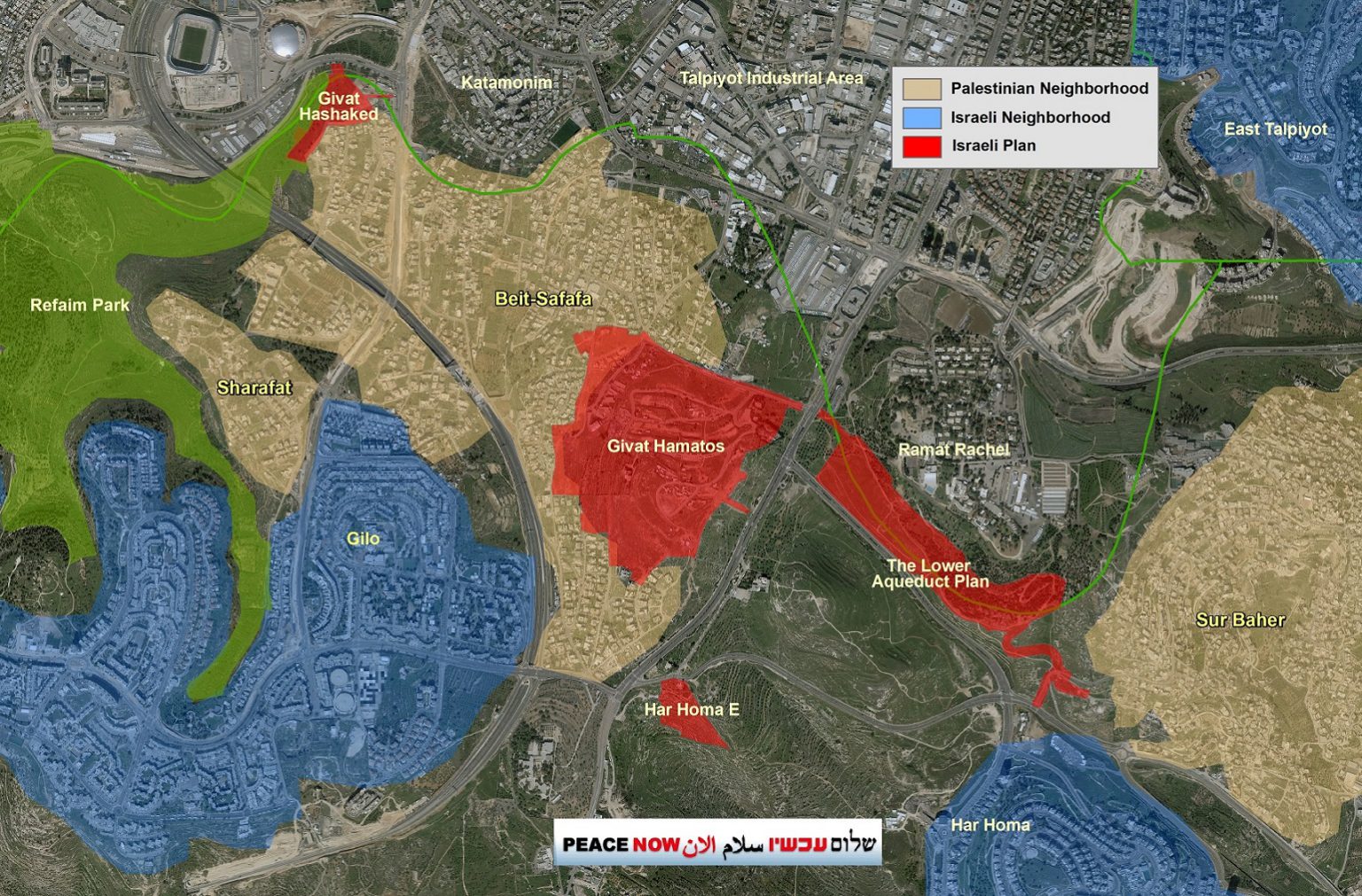 Peace Now reports that the Israeli Housing Ministry has published a tender for the construction of 1,047 settlement units constituting a new settlement in East Jerusalem called the Lower Aqueduct” plan. The settlement will be located on a sliver of land located between the controversial settlements of Givat Hamatos and Har Homa in East Jerusalem, adjacent to the Palestinian neighborhood of Umm Tuba and fall on both sides of the 1967 Green Line. The settlement is designed to connect the two settlements and seal East Jerusalem off from Bethlehem, and in so doing establish a huge, uninterrupted continuum of Israeli settlements on the southern rim of Jerusalem. According to Ir Amim, this is the first major new East Jerusalem settlement established by Israel since 2012.
Peace Now writes:
“The plan was promoted at an unprecedented speed from its inception to the tender issue: it was placed on the table of the District Planning Committee in July 2021, discussed in January 2022 by the District Committee which ordered revisions to the plan, and was approved for deposit in July 2022. That is, the tender was issued less than three years after the plans were submitted.
Politically, this is a strategic plan that will severely impact the possibility of a continuous urban Palestinian connection in East Jerusalem. In practice, the plan blocks the last corridor remaining for connecting Beit Safafa and Sur Baher with other parts of East Jerusalem. It should be noted that although about half of the plan’s area is beyond the Green Line, and half within it, its strategic location between Givat HaMatos and Har Homa makes it particularly problematic politically.”
Ir Amim has previously written:
“This plan carries serious ramifications on the political future of Jerusalem. If constructed, it will extend the Israeli settlement wedge along East Jerusalem’s southern border, further creating a sealing-off effect of East Jerusalem from the southern West Bank, while fracturing the Palestinian space and depleting more vacant land for Palestinian development….Beyond its geopolitical ramifications, the advancement of this plan underscores the systematic discrimination implicit in Israeli planning and building policy in Jerusalem. Since the beginning of 2023, over 18,500 housing units have been advanced for new or existing Israeli settlements in East Jerusalem, while residential development for Palestinians has been all but neglected. This is despite the fact that Palestinians constitute nearly 40% of Jerusalem’s population. 2023 is slated to join 2022 as being the two years with the highest number of settlement units advanced in the last decade in East Jerusalem. Such inequitable urban planning policy has long served as a driver of Palestinian displacement in service of solidifying a Jewish demographic majority in Jerusalem and further cementing Israeli territorial control to foil prospects for a just political resolution.”
Ir Amim & Bimkom: Israel Has Accelerated East Jerusalem Settlement Building Since Oct 7th
The Israeli anti-settlement NGOs Bimkom and Ir Amim have released a joint report reviewing the Israeli government’s wartime policies and how they have led to the acceleration of both settlement activity and home demolitions, posing an ever increasing threat to the rights and futures of Palestinian residents.
The report reads:
“Since the outbreak of the war six months ago, there has been a major surge in the promotion and fast-tracking of new settlement plans in East Jerusalem and a dramatic spike in the rate of demolitions of Palestinian homes. The Israeli government is clearly exploiting the war to create more facts on the ground to predetermine the final status of Jerusalem and thwart all prospects for a negotiated political agreement, while forcibly displacing Palestinians from their homes and the city.
Measures are being taken to establish eight brand-new settlements in East Jerusalem within or adjacent to Palestinian neighborhoods with a total of over 12,000 housing units. For details and analysis of these plans, click here or above for the full policy brief.
In juxtaposition to this major uptick in the advancement of new settlements, demolitions of Palestinian homes have reached unparalleled levels since the start of the war. This serves as a form of collective punishment and part of a series of repressive measures currently being employed by Israel against Palestinians under its control. Between October 7, 2023—March 10, 2024, 98 homes were demolished, which marks a nearly two-fold monthly increase compared to the period preceding the war. (Demolitions were halted during the month of Ramadan as in the past).”
Ben Gvir Seizes Authority Over East Jerusalem Housing Demolitions
On April 8th, the Israeli Cabinet decided to hand extremist minister Ben Gvir power over demolitions and housing enforcement in East Jerusalem. The CAbinet’s decision moved the Real Estate Enforcement Division from the Finance Ministry to the Ministry of National Security, which is controlled by Ben Gvir. The Real Estate Enforcement Division has the power to enforce against illegal construction in East Jerusalem and conducts demolitions and imposes fines alongside the Jerusalem municipality’s Building Supervision Department. It is important to note that the rate of demolitions in East Jerusalem during the Gaza war and in 2023 overall was higher than in other months or years, and it seems that transferring authority to Ben Gvir will only exacerbate this trend.
Daniel Seidemann, founder of Terrestrial Jerusalem, explained on X:
“In the eyes of the Palestinians in East Jerusalem, home demolitions are the most brutal & egregious manifestations of Israeli occupation. W/the exception of real or perceived threat to Al Aqsa, no issue in Jerusalem is more volatile & more incendiary than home demolitions. As per yesterday’s Cabinet Resolution, very broad powers will now be vested in Ben Gvir and an Authority or which he is responsible. these include administrative demolition orders, cease work orders, execution of judicial demolition orders, and much more. Ben Gvir has repeatedly declared his intent to carry out large scale home demolitions, particularly in E. Jerusalem. He then was opposed by the Police Chief, who now does his bidding. Ben Gvir has already expedited demolitions. However Ben Gvir had a problem: he had absolutely no statutory power in relation to demolitions. The role of the Police was to secure the demolitions ordered by the Jerusalem Municipality or Government of Israel (incl. judicial bodies). Bravado aside, he was a spectator.All that changed yesterday by means of the Cabinet Resolution. Having declared his intent “to show the Arabs of East Jerusalem who’s boss” by carrying out large scale demolitions. He will now have all the statutory powers and resources necessary to make good on his promise.”
Peace Now said in a statement:
“It has been unequivocally proven that law enforcement authorities under the responsibility of Itamar Ben Gvir exacerbate tension, violence, and hatred between the state and its citizens. The Real Estate Enforcement Division should operate with integrity and profound sensitivity to our political and social reality. However, it is highly doubtful that this will occur under the authority of Itamar Ben Gvir, the Minister of National Insecurity, who has previously been convicted of inciting racism and supporting a terrorist organization.”
New Plan to Massively/Strategically Expand the Ariel Settlement Industrial Zone
Peace Now reports that the Israeli Civil Administration’s High Planning Council convened on April 10th to consider 26 settlement plans, the most consequential of which is a plan to significantly expand the Ariel settlement industrial zone. This plan proposes to significantly expand the industrial zone eastward toward the new Ariel West settlement, which just began construction, connecting the two for all practical purposes.
Peace Now further explains the consequences of this plan:
“Expanding the industrial area eastward, on the one hand, and the establishment of the planned settlement of Ariel West, which infrastructure works for its establishment have recently begun, on the other hand, are intended to create a territorial continuum of settlements that will effectively block any possibility of development for Palestinian communities in the vicinity, including Salfit, Harres, and Kifl Harres. The plan essentially disconnects Salfit – the district town from the surrounding villages it serves.”
It’s worth revisiting the role settlement industrial zones play in perpetuating ISraeli occupation, annexation, and apartheid. For decades Israel has used industrial zones as another tool to expand and deepen control over West Bank land and natural resources. Industrial zones are part of Israel’s economic exploitation of occupied territory (including the local workforce, land, and other natural resources). Presented as benefiting both Israelis and Palestinians, it is in fact Orwellian to label such initiatives as “coexistence” programs, or to suggest that they offer the Palestinians benefits they should welcome. Importantly, jobs in industrial zones – often the only jobs available for Palestinians living under an Israeli occupation that prevents the development of any normal Palestinian economy – are widely viewed by Palestinians as a double-edged sword. The NGO Who Profits explained:
“Israeli Industrial Zones constitute a foundational pillar of the economy of the occupation. They contribute to the economic development of the settlements, which are in violation of international law and the Fourth Geneva Convention, while relying on the de-development of the Palestinian economy and the exploitation of Palestinian land and labor…The Industrial Zones in the oPt form part of a practice of ‘financial annexation’ which is an essential component of the broader policy of annexation taking place.”
Peace Now said in a statement:
“The government of Israel continues to build at an unprecedented pace in the Occupied Territories. Expanding an industrial area in the heart of the West Bank is not an Israeli interest, and certainly not a Palestinian interest. The industrial area west of Ariel does not promote economic growth, but rather harms both the Israeli and Palestinian economies alike.”
Smotrich Designates Symbols for Four Outposts Previously Approved for Retroactive Legalization
On April 6th, Finance Minister Smotrich (who also heads the Settlement Administration and a minister in the Defense Ministry) issued a statement announcing that he has designated “locality symbols” to four outposts that the government has previously approved to be retroactively legalized as new settlements: Mitzpe Yehuda, Beit Hogla, Shacharit, and Asa’el.
Peace Now explains:
“A ‘locality symbol’ is a serial number assigned by the Ministry of Interior to each official Israeli locality. For the government to allocate funds and resources for settlement development or to prepare construction plans, a settlement must have a “locality symbol.” Smotrich’s announcement aims to bolster his standing among his supporters as someone who does a lot for the settlements. Therefore, he exploits a bureaucratic maneuver and tries to present it as a new achievement.
The significance of assigning locality symbols to these four new settlements is that the government bureaucracy has already begun working to promote these settlements. It should be noted that since the government’s decision in February to establish nine new settlements, the commander of the military’s Central Command, Maj. Gen. Yehuda Fuchs has issued orders in recent months defining the jurisdictional areas of six of them: Mishmar Yehuda, Givat Haroeh. Apparently, defining the jurisdictional area of the remaining three settlements is delayed due to land ownership issues.”
The U.S. & E.U Unveil New Sanctions Targeting Settlers & Settler Entities
On April 19th the United States Department of State announced a third round of sanctions targeting one Israeli settler and two settler entities. The European Union announced sanctions on the same day, against four settlers and two settler entities. This round of sanctions is particularly notable because it expands the sanctions’ targets to include entities which fund settlers involved in violence, and because it targets a prominent political ally and confidant of Itamar Ben Gvir.
The U.S. sanctions target:
- Ben Zion (Bentzi) Gopstein – founder of the radical, violent Lehava settler organization, and “one of the closest confidants” of Kahanist Minister Itamar Ben Gvir. The U.S. State Department says that Lehava and its members “have been involved in acts or threats of violence against Palestinians, often targeting sensitive or volatile areas.” Gopstein was convicted in early 2024 for incitement to racism
- The Mount Hebron Fund – an organization leading a fundraising campaign for Yinon Levi, an Israeli settler previously sanctioned by the U.S. The U.S. group DAWN writes that the crowdfunding campaign had the declared intention of bypassing US sanctions. The AP reports the fundraising effort raised $140,000.
- Shlom Asiraich – an organization leading a fundraising campaign for David Chai Chasdai, an Israeli settler previously sanctioned by the U.S.. The AP reports the fundraising effort raised $31,000.
The European Union sanctions target:
- Lehava – the organization run by Ben Zion Gopstein (who the U.S. sanctioned as an individual, but did not sanction Lehava).
- The Hilltop Youth settler organization – a notoriously violent group based out of the Yitzhar settlement and involved in establishing illegal outposts throughout the West Bank. The Hilltop Youth have been called “the Jewish ISIS,” and regularly engage in violence against Palestinians, Israeli authorities, and activists.
- Neriya Ben Pazi – who was previously sanctioned by the U.S..
- Yinon Levi – who was previously sanctioned by the U.S..
- Meir Ettinger – who is the grandson of the late, extremist rabbi Meir Kahane, and a well-known leader of the Hilltop Youth leader.
- Elisha Yered – who previously served as a spokesperson for MK Limor Son Har-Melech, an ally of Ben Gvir.
Itamar Ben Gvir responded to the new sanction, saying:
“The harassment of the Lehava organization and dearest settlers, who never engaged in terrorism or harmed anyone, are the result of a blood libel by Israel-hating, antisemitic elements who for years have openly supported Hamas, Fatah, and other anarchist organizations that harm IDF soldiers.”
Bonus Reads
- On Settler Terrorism:
- “West Bank sees biggest settler rampage since war in Gaza began as Israeli teen’s body is found” (AP)
- “Al-Haq, Al Mezan and PCHR Urge the International Community to Intervene as Israeli Forces and Settler Violence Intensifies Across the West Bank” (read)
- “Homes burned, animals killed: Palestinians describe Israeli settler rampage” (Washington Post)
- “Israel Responsible for Rising Settler Violence” (Human Rights Watch)
- “Opinion | Dear President Biden, Are You Okay With Israeli Settlers Using American Weapons?” (Amira Hass in Haaretz)
- “Blinken Is Sitting on Staff Recommendations to Sanction Israeli Military Units Linked to Killings or Rapes” (Pro Publica)
- “Blinken says he’s made ‘determinations’ linked to human rights accusations against Israel” (The Times of Israel)
- “Ben Gvir forms police team targeting left-wing activists in the West Bank” (The Times of Israel)
- “Editorial | Goodbye, Green Line: The Israeli Government Goes All Out to Boost West Bank Settlements” (Haaretz Editorial Board)
- “Housing, Showers, Electricity: These Are the Outposts the Israeli Army Is Building in the Heart of Gaza” (Haaretz)
Welcome to FMEP’s Weekly Settlement Report, covering everything you need to know about Israeli settlement activity this week.
To subscribe to this report, please click here.
March 29, 2024
- Israel to Legalize Ahiya Outpost, Framing it as a Neighborhood of the Shilo Settlement
- Israel Expedites New West Bank Road for Settlers, Foreshadowing Mass Expansion of Settlement Growth West of Ramallah
- U.S. Undercuts Its Own Sanctions on Settlers, Says Israel Banks Can Continue Hosting Accounts
- Haaretz Reveals Mortgage Fraud Behind Some Outposts Construction
- Palestinian NGOs Issue Alert on Israeli Crimes in the West Bank, East Jerusalem
- The Health & Psychological Impacts of Settler Terrorism
- Settlement Wastewater is Damaging Palestinian Land, Livelihood & Contributing to Forcible Displacement
- Bonus Reads
Israel to Legalize Ahiya Outpost, Framing it as a Neighborhood of the Shilo Settlement
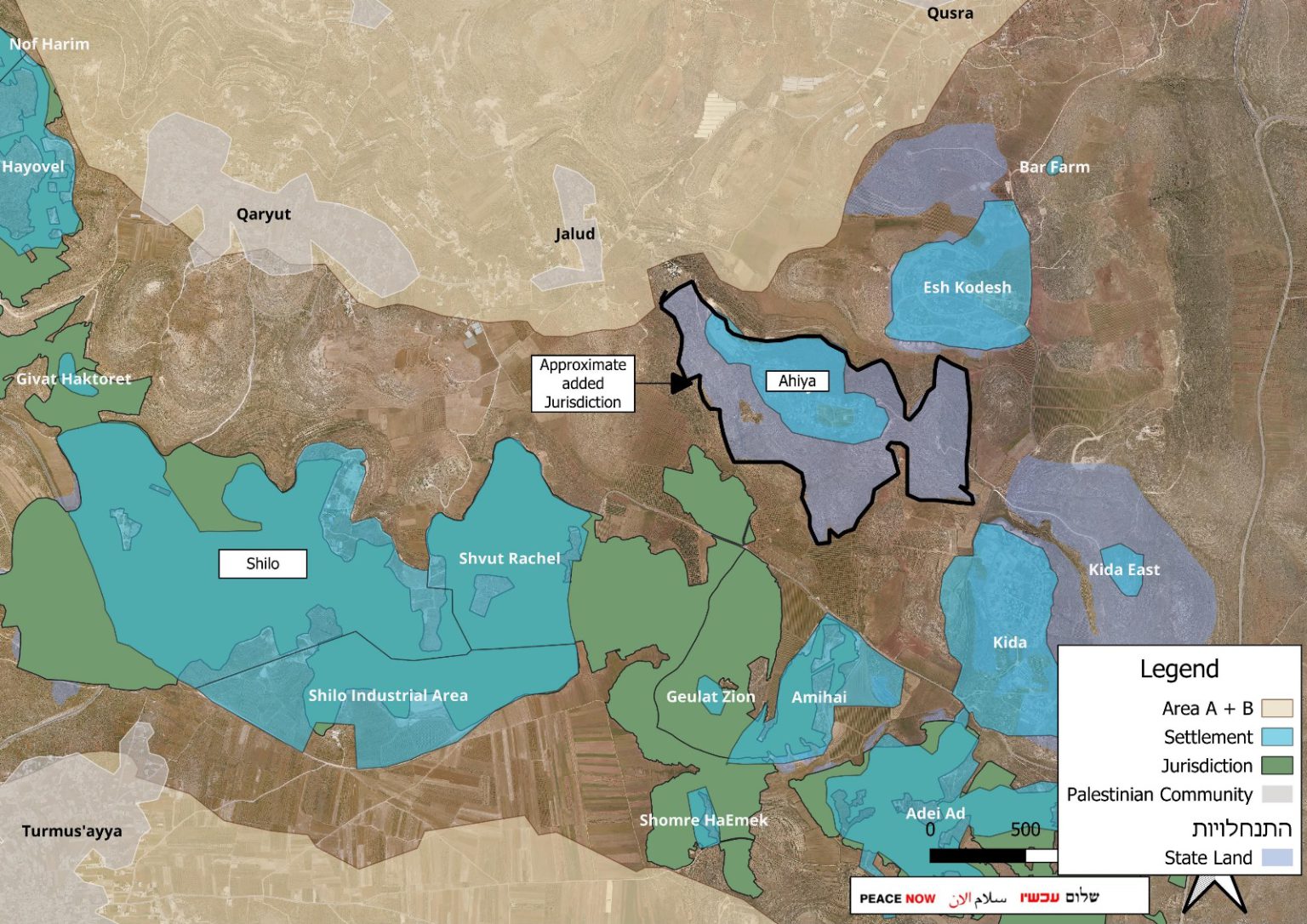 Peace Now reports that the Israeli Civil Administration announced that it will grant retroactive authorization to the Ahiya outpost by massively expanding the jurisdiction of the Shilo settlement to include the land on which the outpost was illegally constructed. The outpost is not contiguous with the built up area of the Shile outpost, and is more properly understood to be a new outpost, not simply an expansion of an existing one.
Peace Now explains:
“According to Peace Now’s estimation, the decision to approve the outpost of Ahiya as a neighborhood of Shilo rather than a new settlement is intended to prevent international criticism and the need to pass the decision in the security cabinet. On the other hand, the decision serves Minister Smotrich, who in the past month has exerted increased authority over settlements and declared a record number of dunams as state lands, promoted thousands of housing units, and more. In 2023, Israel approved five outposts as new settlement neighborhoods, reaching a record number of 15 outposts approved as settlements in 2023. In 2018, Minister Smotrich proposed legislation to regulate approximately 70 outposts as settlements. Since assuming office, he has announced several initiatives to achieve this objective.”
The Shilo settlement is located in the heart of the northern West Bank, in the Shiloh Valley, in an area of settlements that are designed to form an uninterrupted corridor of Israeli control connecting sovereign Israel to the Ariel settlement, through the isolated Shiloh Valley settlements, all the way to the Jordan Valley. In so doing, It will completely bisect the northern part of the West Bank.
The Shiloh settlement has spun off several illegal outposts (Amichai, Adei Ad, Shvut Rachel) which have systematically been added to the Shilo settlement by expanding the settlements borders, a move which rewards illegal construction and land theft and further encourages it. This pattern is exemplified by the Amihai outpost.
The Amichai settlement was approved for construction in 2017, making it (at that time) the first new settlement formally approved by the Israeli government in 25 years. Aerial imagery from 2021 show the massive growth Amichai has enjoyed in the years that followed its establishment, a previously empty hilltop with cultivated fields nearby have been transformed into a sizable suburban neighborhood. In addition to new construction, Amichai was also massively expanded, subsequent to its initial construction, when the Israeli Civil Administration announced that its plan to retroactively legalize the Adei Ad outpost by significantly expanding the borders of the Amichai settlement to turn Adei Ad into a (non-contiguous) neighborhood. In effect, this was a slight-of-hand by Israel to turn the Adei Ad outpost into an entirely new official, legal settlement. In 2013, Israel allocated additional land near the Amichai settlement to the World Zionist Organization, in order to expand the settlement. This has all come at the continued cost to Palestinians from the nearby village of Turmus Ayya on whose land Amichai was established and whom settlers from the Amichai outpost and others nearby routinely harass and terrorize.
In a statement, Peace Now says:
“Establishing another settlement is the last thing Israel needs. Deepening Israeli presence in the West Bank serves only a small and extremist group in Israel and harms the entire Israeli public. The Israeli government, under Minister Smotrich’s leadership, continues to evade a political solution and imposes facts on the ground that will escalate violence and deepen the dispossession and oppression of Palestinians in the West Bank.”
Israel Expedites New West Bank Road for Settlers, Foreshadowing Mass Expansion of Settlement Growth West of Ramallah
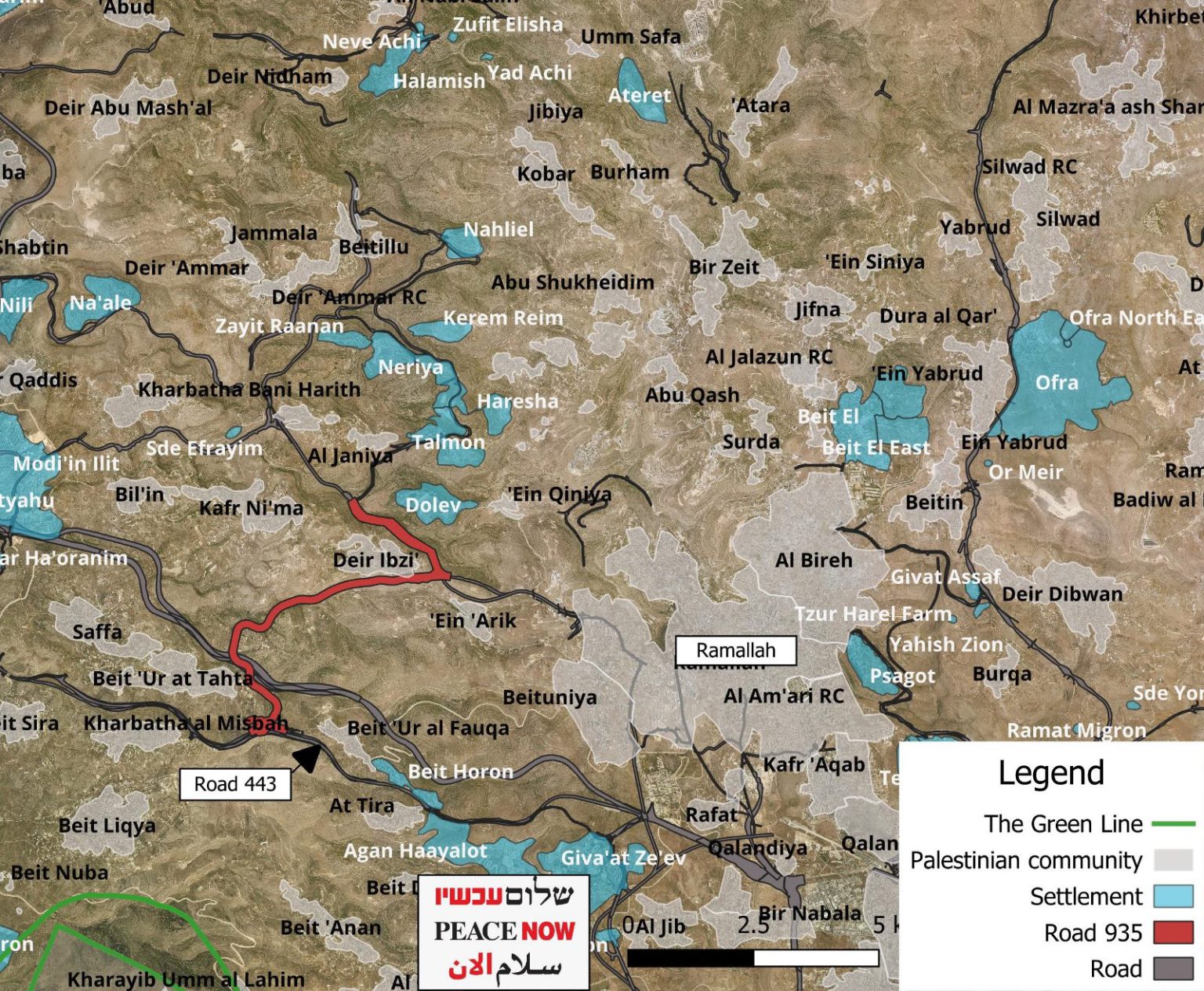 Peace Now reports that Israeli Finance Minister Bezalel Smotrich and Transportation Minister Miri Regev announced plan to fast-track the planning and construction of a new road for settlers in the West Bank, designed to connect the Gush Talmonim settlement area west of Ramallah to Route 443. This road will give the settlements in this area (including Dolev, Almon, Haresha, and others) a more direct route to Jerusalem through Palestinian land, which Israel will expropriate. – and, according to Peace Now, will facilitate the massive expansion of the Gush Talmonim settlement by the tens of thousands.
Peace Now writes:
“The Gush Talmonim Road – Route 443 is an extremely dangerous project for the area west to Ramallah. Its construction will create a wide and densely populated settlement bloc, exacerbating friction between settlers and Palestinians and further complicating a political solution. The road will not reduce violence in the area but rather escalate it to new heights. The political solution lies not in such illogical roads but in a political horizon and hope for both peoples.”
U.S. Undercuts Its Own Sanctions on Settlers, Says Israel Banks Can Continue Hosting Accounts
According to reporting by the Times of Israel, this week the U.S. government sent a letter to the Israeli Finance Ministry saying that, in effect, Israeli banks can maintain accounts for the seven individuals sanctioned by the U.S. government without facing repercussions. The letter is reported to have stated that the sanctions were not intended to cut off sanctioned individuals from all of their assets, only from international/foreign transactions, and that the individuals should be permitted access to their bank accounts for basic purchases.
The letter was prompted by a series of events stemming from recently announced sanctions on Israeli settlers who have participated in violence against Palestinians. Following the U.S.’s announcement, several European countries (and possibly the EU) followed suit, and Israeli banks moved to close accounts for those individuals in fear of being locked out of international banking systems for violating sanctions. Israeli Finance Minister Bezalel Smotrich, seeking retaliation against the banks for the decision to close the accounts, threatened to take steps to cut Palestinian banking off from Israeli banks (the Palestinian economy operates in shekels and is largely dependent on the Israeli banking sector).
Muhammad Shehada, Chief of Communications at the Euro-Med Human Rights Monitor, posted on X:
“Biden quietly reverses the (feckless) sanctions he put on 7 individual settlers, removing the freeze on their accounts & effectively emptying the sanctions of any practical content according to Israel Hayom! It was purely a PR stunt all along to whitewash his complicity in Gaza.”
Tariq Habash, a former political apointee in the U.S. Department of Education who recently resigned in protest of the Biden Administration’s Israel policy, posted:
“The Biden Admin has now eroded the primary policy to deter illegal settlement expansions in the West Bank, undermining the entire purpose of issuing sanctions and compromising U.S. policy yet again.”
Hugh Lovatt, Senior Policy Fellow at the European Council on Foreign Relations, posted on X:
“Once again, the U.S. is scared of its own bark and inherently unable to put any meaningful pressure on Israel. It has promised to undermine the potency of its (secondary) sanctions regime. What could potentially have turned into a game changer is now barely an inconvenience.”
Former J Street lobbyist Dylan Williams posted:
“Between this bizarre move to ease the impact of sanctions on violent settlers and accepting Israel’s patently false assurance that it’s following US and international law per NSM-20, the Biden administration is regressing when it comes to standing up for US interests with Israel.”
Haaretz Reveals Mortgage Fraud Behind Some Outposts Construction
Haaretz and Kerem Navot recently revealed a pattern or mortgage fraud behind the construction of some outposts. The investigation shows that Israeli banks issue mortgages to settlers for the construction of homes in a settlement (with specific land parcel numbers recorded), but the actual construction happens elsewhere – thereby enabling the costly construction of outposts. The complicity/knowledge of the banks in issuing these mortgages is unclear and different for each case – but it is clear that the World Zionist Organization is deeply involved in these dealings.
Most flagrantly, Israeli Finance Minister Bezalel Smotrich – who is also a minister in the Defense Ministry overseeing settlement affairs – himself engaged in this fraud. He took a mortgage for a lot in the Kedumim settlement, but built the house on totally unrelated land located outside the settlement’s zoning plan.
In addition, Yehuda Eliyahu – who Smotrich appointed as head of the Settlement Administration that Smotrich created – also participated in this scheme. He received a 2004 mortgage on a land parcel in the Neria settlement, but built in what is now called the Haresha outpost.
Dror Etkes, founder of the Kerem Navot settlement watchdog group, told Haaretz:
“The two main protagonists of this story, Finance Minister Smotrich and his longtime friend-partner Yehuda Eliyahu, together with their friends in the settlement department, were part of a group of settlers who obtained mortgages while misleading the banks. This may be the reason why 11 years later, as an MK, it was so important for Smotrich to exempt the activity of the settlement department from the Freedom of Information Act.“
Palestinian NGOs Issue Alert on Israeli Crimes in the West Bank, East Jerusalem
Amidst ongoing genocide in Gaza, the three preeminent Palestinian human rights groups – Al-Haq, Al-Mezan, and the Palsetinian Center for Human Rights, have issued a new report on spike in Israeli violations and crimes in the West Bank in the first months of 2024. These crimes include extrajudicial killings, attacks on medical personnel, raids and arrests, demolitions and land razings, land confiscation, settlement expansion, settler violence, and more.
In conclusion, the groups write:
“Our organizations believe that the main target of the Israeli crimes and violations in the West Bank is the existence of the Palestinian people in Mandatory Palestine, for the purpose of entrenching the Zionist settler-colonial project. This is particularily evident in Gaza as well, where the Israeli military aggression has led to the forced displacement of approximately 1.9 million Palestinians within the Gaza Strip amid systematic targeting and destruction, rendering the Strip unlivable and thereby forcing its people to flee. The absence of accountability and concrete enforcement of international law, the international community’s inaction and third states’ complicity are fueling the continuation of Israel’s settler-colonial project and ongoing genocide in Gaza.
Our organizations emphasize that these crimes and violations would not have continued without Israel’s long-enjoyed impunity and third states failure to hold perpetrators accountable and put an end to these crimes, according to Common Article 1 of the Four Geneva Conventions and Articles 146 and 147 of the Fourth Geneva Convention.
Our organizations also call upon the Prosecutor of the International Criminal Court to expedite the investigation into the situation in Palestine initiated more than two years ago and issue arrest warrants to hold the perpetrators accountable for these crimes, particularly the ongoing genocide in the Gaza Strip.
As Israel attempts to eliminate the Palestinian people and their right to self-determination, our organizations reiterate that addressing the situation in Palestine requires tackling the root causes of the Palestinian struggle, emphasizing that the international community and the United Nations member states hold the primary responsibility for the violence in Palestine through their inaction and complicity in Israel’s systematic and widespread violations. We urge the international community to assume its responsibilities to stop the ongoing genocide against the Palestinian people.”
The Health & Psychological Impacts of Settler Terrorism
Physicians for Human Rights has released a new report detailing the multifaceted trauma inflicted on Palestinians in the West Bank by settler terrorism. PHRI writes in the intro:
“For over five years, we’ve been flooded with reports chronicling settler violence. However, this worn-out term obscures a grim reality: life beside settler outposts and farms entail daily exposure to oppressive and coercive mechanisms, systemic discrimination, and a continuous sense of insecurity and fear. Our latest position paper explores how constant exposure to such routine violence is detrimental to the health of Palestinians, highlighting the social and psychological repercussions.”
The paper can be downloaded here.
Settlement Wastewater is Damaging Palestinian Land, Livelihood & Contributing to Forcible Displacement
The Norwegian Refugee Committee has issued a new report on the damage that settlement wastewater is inflicting on Palestinian land and livelihoods. The organization investigated two sites in the West Bank and found human sewage and animal waste flowing from settlements into Palestinian land, destroying crops and land. This, in turn, severely impacts the productivity of Palestinian agriculture, and contributes to the many pressures from Israeli settlers and the government which force Palestinians off their land. The Israeli Water Authority is responsible for water and sewage management for settlements in the West Bank.
One Palestinian farmer who has land close to Immanuel settlement industrial zone, told NRC:
“Wastewater has extensively flooded my land. A salt layer now covers the soil, significantly impacting the quality of the produced oil from my olive groves. Olive trees each used to yield no less than 25 kilograms of olives, but today production has dropped by half.”
Samah Hadid, NRC’s Middle East and North Africa Head of Advocacy said:
“Israel’s settlements routinely contaminate critical water systems and agricultural lands with wastewater, exacerbating environmental risks, further destabilising the already fragile Palestinian economy, and heightening the likelihood of various diseases like diarrhoea and kidney failure.”
In 2017, B’Tselem published a comprehensive report criticizing the illegal Israeli practice of exporting its waste to the occupied territories. The report provides more context for the extent to which hazardous wastewater poses significant damage to Palestinian land and futures. The report says:
“Israel regards the facilities built in the West Bank as part of its local waste management system, yet it applies less rigorous regulatory standards there than it does inside its own territory. Whereas polluting plants located within Israel are subject to progressive air pollution control legislation, polluting plants in the industrial zones of settlements are subject to virtually no restrictions. Moreover, the facilities in settlements are not required to report on the amount of waste they process, the hazards their operation pose, or the measures they adopt to prevent – or at least reduce – these risks. B’Tselem sent requests for information on these matters to the Ministry of Environmental Protection and the Civil Administration. The requests have gone unanswered.
…For many years, Israel has been taking advantage of its power as occupier to transfer the treatment of waste (including hazardous waste) and sewage from its sovereign territory to the West Bank. To that end, it has created a situation in which environmental legislation in the West Bank is much laxer than inside Israel, conveniently overlooking the long-term impact of environmental hazards on the Palestinian population and on natural resources, and neglecting to prepare future rehabilitation plans. This has created a financial incentive to transfer the treatment of environmental hazards from Israel to the West Bank. The Palestinians who live in the occupied territory are the ones to pay the price for this environmental damage, even though they were never asked their opinion on the matter and although, as a population under occupation, they have no political power and no real ability to resist.”
Bonus Reads
- “Israeli settlers step up attacks on Palestinian farms, expanding West Bank outposts” (NPR)
- “In a West Bank settlement, Israelis tend red cows and plan the Third Temple” (Middle East Eye)
Welcome to FMEP’s Weekly Settlement Report, covering everything you need to know about Israeli settlement activity this week.
To subscribe to this report, please click here.
March 22, 2024
- Jordan Valley, Part 1: Israel Declares Massive Swathe of Land in Jordan Valley as “State Land”
- Jordan Valley, Part 2: Israel Expands Three West Bank Nature Reserves – Including an Outpost in the Jordan Valley
- Jordan Valley, Part 3: B’Tselem Documents Post-Oct 7th Acceleration of Settler-Terrorism in the Jordan Valley
- HR Group Petitions for the Demolition of Outpost Affiliated with U.S.-Sanctioned Settler
- Smotrich Moving to Appoint Settler as Top Dog on Outposts Demolitions, Over the Authority of High-Ranking Military Authorities
- Bonus Reads: Sanctions
- Bonus Reads
Jordan Valley, Part 1: Israel Declares Massive Swathe of Land in Jordan Valley as “State Land”
Peace Now reports that the Israeli Ministry of Defence is prepared to announce the declaration of 2,000 acres (8,000 dunams) in the northern Jordan Valley near the Yafit settlement as “state land”. According to Peace Now, this is the largest declaration of “state land” since the Oslo Accords were signed.
Peace Now explains:
“The declaration of state land is one of the main methods by which the State of Israel seeks to assert control over land in the occupied territories. Land declared as state land is no longer considered privately owned by Palestinians in the eyes of Israel, and they are prevented from using it. Additionally, the state leases state land exclusively to Israelis.”
This declaration comes just a few weeks after Israel issued another “state land” declaration, for 652 acres of land east of Jerusalem between the Ma’ale Adumim and Keidar settlements.
Jordan Valley, Part 2: Israel Expands Three West Bank Nature Reserves – Including an Outpost in the Jordan Valley
Haaretz reports that the Israeli Civil Administration has signed orders expanding the boundaries of three nature reserves in the West Bank, a move which not only closes off more West Bank land from Palestinians, but is also designed to include an illegal outpost. Under Israeli law, no construction is allowed to occur in areas designated as a nature reserve.
Two of the nature reserves – Umm Zuka and Petza’el, are located in the Jordan Valley. The third, Kana and Samar, is located near the northern shore of the Dead Sea.
The illegal outpost Havat Ori/Ori’s Farm is now included within the expanded boundaries of the Umm Zuka nature reserve in the northern Jordan Valley. Over the past few years, the outpost – which grazes herds of cattle – has already successfully forced Palestinians off of large amounts of land in its vicinity while facing no enforcement against its illegal construction. In the past, when the IDF has been called to assist Palestinian herders in their struggle to graze cattle in the area, Israeli soldiers have removed Paelstinians from their land and confiscated their cattle (a practice which Yesh Din has recently filed a petition with the High Court of Justice to stop). The settlers, even when entering a nearby firing zone, have been protected and allowed to continue taking over more land and entrenching their illegally constructed outpost.
The story is repeated throughout the Jordan Valley and the West Bank, as so-called “herding outposts” have proven to be extremely successful and efficient way for a small number of settlers (and their cattle) to take over a large amount of land.
In 2019, a group of Israeli human rights activists petitioned the Israeli High Court to revoke the special status of the Umm Zuka nature reserve and firing zone in the West Bank, saying the Israel’s designation of the land as a protected area has only served as a pretext to remove Palestinians and allow settlers to take over. Part of the petition cited the impacts of an unauthorized outpost near Umm Zaka, which had essentially turned the wilderness area into a private settler park where Palestinians are not allowed to enter. The Civil Administration spokesperson told Haaretz that it is undertaken unspecified “enforcement proceedings” against the unauthorized outpost.
After the petition was filed, Israeli lawyer Eitay Mack who made the filing, told Haaretz:
“the reserve and the firing zone have effectively become a private settler farm that receives personal security service from Israel Defense Forces soldiers and bars entry to the farm’s enormous territory on the basis of ethnicity, nationality, religion and political opinions.”
Jordan Valley, Part 3: B’Tselem Documents Post-Oct 7th Acceleration of Settler-Terrorism in the Jordan Valley
In a new paper and accompanying video, B’Tselem documents how settlers and the Israeli government have “ramped up efforts to drive Palestinian shepherding communities out of the northern Jordan Valley.” The paper documents testimonies from Palestinian communities at risk of forced displacement, and unpacks several methods employed by settlers and the Israeli government pushing their removal. Those methods are: land takeover, settler violence, travel restrictions, soldier violence, and harassment by the settler regional council.
B’Tselem writes:
“Since the Hamas attack on Israel on 7 October 2023, Israel has stepped up its efforts to drive dozens of Palestinian shepherding communities in the northern Jordan Valley out of their homes and lands. Through cooperation and collaboration among the military, police, settlers and the Jordan Valley Regional Council, Israel has reduced grazing areas available to Palestinians, blocked regular water supply and took measures to isolate the Jordan Valley from the rest of the West Bank. This policy is nothing new. Israel has been undermining these communities’ subsistence for decades, in part, by denying Palestinians’ access to nearly 80% of the Jordan Valley declared as firing zones, nature reserves or the municipal area of settlements. Israel uses these zoning declarations to justify its refusal to approve building plans that would allow residents of these pastoral communities to build homes legally and connect to water and electricity infrastructure. On top of this, with full backing and protection from the military and the police, settlers subject residents of these communities to severe violence on a daily basis. This policy imposes impossible living conditions on Palestinian residents of the Jordan Valley.”
HR Group Petitions for the Demolition of Outpost Affiliated with U.S.-Sanctioned Settler
While the reach and impact of U.S.-led sanctions against Israeli seven settlers and two illegal outposts continues to grow, the Israeli anti-settlement group Torat Tzedek and five Palestinian landowners have filed a petition with the High Court of Justice seeking the demolition of the HaMahoch Farm outpost, which is affiliated with an Israeli settler (Neriya Ben Pazi) who was recently sanctioned by the U.S. government. The outpost, located east of Ramallah, was not one of the two outposts also sanctioned.
Neriya Ben Pazi and his associates are alleged to have organized and participated in a particularly gruesome attack and subsequent torturing of Palestinians who were in the process of abandoning the Wadi al-Seeq village (having chosen to abandon their longtime homes in light of routine and severe harassment by settlers).
TIn addition to calling for the HaMahoch Farm outpost to be demolished, the petition asks the Court to order the IDF and Civil Administration to adopt a protocol that prioritizes enforcement actions (evacuation and demolition) of any/all outposts which are a staging ground for violent settlers should be a high priority for demolition. Though the IDF apparently has criteria for prioritizing along these lines, it has not translated to practice. The Times of Israel reports that in May 2023 Bezalel Smotrich intervened to stop the Israeli Civil Administration from demolishing the HaMahoch Farm outpost in May 2023.
Torat Tzedek, led by Rabbi Arik Ascherman, alleged in its petition:
“These settlers have constantly and daily attacked and harassed Palestinian residents who use private Palestinian lands in the area, harming them, their animals and their property, destroying trees and vegetation, and causing them to abandon the area after decades in which these territories were cultivated and used by Palestinians. Even after the departure, the settlers continue to harass and loot the property of the Palestinians, to invade the private lands and prevent the return of the Palestinians to the area.”
Rabbi Ascherman further explains:
“Because of him and the series of outposts he has set up since 2019, there are thousands of dunams of land where Bedouin who’ve lived there for 40 years are no longer there. What is new about this petition is that it challenges the standard defense by the state that it carries out the demolition of illegal structures according to a [pre-determined] timetable.”
Smotrich Moving to Appoint Settler as Top Dog on Outposts Demolitions, Over the Authority of High-Ranking Military Authorities
Haaretz reports that Bezalel Smotrich – who serves as a minister in the Defense Ministry who oversees the Settlement Administration, enjoying near unchecked authority over Area C -plans to install one of his allies as a Deputy head of the Civil Administration. The move is seen as a reaction to the Civil Administration’s enforcement of building law against unauthorized outposts, which Smotrich wants to protect and authorize as settlements. In recent weeks, the Civil Administration has dismantled two outposts (1, 2 and 3).
Haaretz explains that in tandem with the installation of his ally, Smotrich wants to force Israeli district brigade commanders to explain any/all decisions to demolish structures in settlements and outposts. This would subordinate high ranking IDF personnel to a civilian, political appointee.
That appointee is reportedly set to be Hillel Roth, who lives in the Yitzhar settlement – which is notoriously violent and defiant of Israeli enforcement actions against its illegal activities.
Bonus Reads: Sanctions
There was a tremendous amount of analysis and news regarding international sanctions on settlers and outposts. Including a few:
- “From Drones to Construction: U.S. Sanctions Liable to Hurt Donations to Illegal West Bank Outposts” (Haaretz)
- “The Settler-run Government Is Mortgaging Israel’s Future” (Haaretz Editorial Board) Excerpt: “These measures are highly significant. However, because the criminal settler infrastructure is deep, and it has many accomplices, these sanctions are only the start of dismantling the occupation and settlement enterprise.”
- “How will new US sanctions impact the illegal West Bank farming outposts they target?” (The Times of Israel)
- “Israeli minister calls for expanding West Bank settlement activity due to EU sanctions” (Al Andalou)
Bonus Reads
- “How Israeli settlers are expanding illegal outposts amid Gaza war” (Al Jazeera)
- “Israeli study says settlement policy in occupied West Bank’s ‘Area C’ has failed” (The New Arab)
- [INSANE headline alert] “The grandmother who wants to lead Israelis back to a Gaza without Palestinians” (CNN)
- “’Israeli Settlers Can Now Do Whatever They Please. They Want to Drive Off Those Who Live There’” (Haaretz)
- “Delayed Ambulances and Traffic Holdups: Israeli Army Blocks Entry to West Bank Villages Since Start of Gaza War” (Haaretz)
- “The Israeli public is dispirited. So why is the right euphoric?” (+972 Magazine)