Yair Lapid, Israel’s former Finance Minister, told a hawkish “pro-Israel” gathering in New York that the leaders of the Boycott, Divestment and Sanction movement (BDS) are anti-Semites and their followers are “bleeding heart, so-called intellectuals.” Lapid went on to say that European citizens and American students “…are cheering for the people and values that brought 9/11 to this country. You are supporting people that kill gays and suppress women.”
Mutual Demonization
Lapid is far from alone in elevating the movement to a threat on par with Israeli descriptions of Iran. Whether it was Israeli Prime Minister Benjamin Netanyahu placing a high-ranking Likud Member of the Knesset in charge of battling BDS or grandstanding on the issue by prominent members of Congress, the “threat” of BDS has never seemed greater.
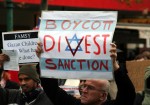
The hyperbole around the issue has never been greater either. All of it is transparently overblown to anyone who actually knows the various players in this game. The BDS movement is not made up, as Netanyahu’s Minister of Justice Ayelet Shaked stated, of radical Islamists, anti-Semites and naïve fellow travelers.
I have known many BDS leaders for many years, as I have also known many of my fellow two-state supporters. I understand their motivations. I disagree often with BDS leaders, but I have never known most of them to wish for violence of any kind, express support for al-Qaeda or ISIL, or express animosity towards Jews as Jews. Many of these folks are, indeed, anti-Zionists, and support a single democratic state in all of what they call “historic Palestine.” I disagree with them on that point, but my disagreement does not mean they hate me, or I them.
That doesn’t mean there are no anti-Semites in the BDS movement. Any pro-Palestinian movement is naturally going to attract those who wish to hide their anti-Semitic agenda under a more acceptable cloak. This small minority within their ranks does not define them.
Unintended Consequences
Israelis, and too many of its supporters, continue to bury their head in the sand about Israel’s diminishing standing in the world. The blame is on Palestinian public relations, the reach of the BDS movement, global anti-Semitism, or their own failure to adequately explain their position to the world. The one thing it never is, according to the Netanyahu government and too many “pro-Israel” groups around the world is Israeli policy.
Part of avoiding the policy debate is presenting Israel as a country constantly facing imminent destruction. While Israel faces very real threats to its citizens, it has not faced an existential threat in a very long time. Iran has never been that, as many Israeli security experts have confirmed. If a deal limiting its nuclear program is finalized, the world is unlikely to buy Israeli complaints that Iran could ever “wipe Israel off the map.” So, BDS is being primed for the role of menacing villain.
For their part, the BDS movement seems to be feeding eagerly on Israeli public relations. Despite having had no discernible impact on Israel’s economy or its determination to maintain its occupation, they are trumpeting their success.
One can understand this, of course. Bibi needs the perception of an existential threat to bolster his politics of fear, while the BDS movement, a grassroots movement with little financial backing, needs to demonstrate its own effectiveness. These tactics, however, are damaging hopes of progress toward a resolution of this vexing conflict.
By avoiding moves to end its 48-year old occupation and exaggerating the BDS threat, Israel is actually proving that only substantive pressure will convince it to end the occupation. This is a point on which the BDS movement and I agree; I have argued for decades that the biggest obstacle to ending the occupation is that Israel, in this regard a country like any other, is expected to take what it perceives as a huge risk without any pressure. The occupation’s  costs are largely covered by the European Union, United States and some Arab states, and despite the terrorist attacks Israel still occasionally endures, almost exclusively in the form of sporadic rocket fire from Gaza, the Palestinians have few means to pressure Israel. This is the logic behind the PLO’s international campaign, which must be understood as distinct from BDS.
Israel is running other risks as well. By conflating so many actors and actions with BDS tactics and movements, it risks galvanizing a much harsher opposition than it has seen in the past. Domestically, this false image of BDS is already being used to push the right wing’s assault on democracy even further, while reinforcing the Israeli sense that the “whole world is against us.”
The Effect of BDS
The fact is that any effect BDS has had on Israel’s economy is imperceptible. The economic issues Israel faces have no connection to any drop in exports or loss of investment. That does not mean it never will, but it does mean that the hysteria about BDS is way out of proportion with its impact to date. So, we are left with the most right-wing government in Israeli history governing a country whose citizens, even the majority that still supports a two-state solution, believe that ending the occupation carries major security risks. That is a country that will not change its policies absent significant pressure.
If we accept that self-evident fact, we confront the fact that many people and groups who do not wish to be associated with the BDS movement, its leadership and some of its specific goals have for years avoided any sort of organized economic action against Israel’s occupation. While one can hardly blame the BDS movement for this (in no way have they acted to prevent more moderate groups from taking actions aimed strictly at the occupation), it is an unintended consequence of their activities.
Netanyahu has taken full advantage of the political void this opens up. When the European Union wants to enforce existing laws that distinguish between products made in Israel and those from the settlements, it is considered a “sanction” against Israel; i.e. the “S” in BDS. As a result, liberal Zionist, centrist and many progressive groups avoid any hint of economic action against the occupation.
Groups like Americans for Peace Now (APN), one of the very few who are standing up to call for boycotting settlement products, are not getting the support they need. Yet the few instances of divestment or refusal to do business in the West Bank (most of which were not attributed to the BDS movement by the organizations that took such actions, some of whom even explicitly stated that they were not acting as part of that movement) have all been firmly rooted in opposition to the occupation. They have not been connected to the other conditions of the BDS movement’s call to action, regarding Palestinian citizens of Israel and the right of return of Palestinian refugees.
The Need for Economic Action
It is unfair, however, to expect the BDS movement to abandon its tactics because they are being used to scare more moderate peace groups away from action. Instead, it is the responsibility of moderates, two-state solution supporters and those who support Israel but loathe the occupation to stand up for our beliefs. Let the BDS movement do what it is doing. If you are really worried that BDS will “de-legitimize” Israel with rhetoric, then counter it with a principled, pro-Israel stand for Palestinian rights and statehood and an end to the occupation.
The distinction that Netanyahu and his cohorts in AIPAC and in Congress are trying to blur must be sharpened instead. The settlements are not Israel. They are an immoral and illegal enterprise that should not be supported — through tax dollars, investment or purchases. From such a position, classifying corporations that are profiting from the occupation, especially American ones as “socially irresponsible” can be supported on a pro-Israel basis. From that position, groups can stand up for Israel and support Israelis who are working to end the occupation, and combat the discrimination against Arabs that has become so bitter in recent years.
That is also a pro-Israel position from which Americans can demand that our government name the settlements the illegal enterprise they are, and treat them accordingly. It is a position from which one can promote a secure Israel within the Green Line that can, at long last, find some peace in that tumultuous region. It just has to stop denying millions of Palestinians their basic rights and any hope for the future. That, not Netanyahu’s demagoguery, is truly pro-Israel.
Benjamin Netanyahu, Prime Minister:
“I think anyone who is going to establish a Palestinian state and to evacuate territory is giving radical Islam a staging ground against the State of Israel.” (Politico, 3/16/15)
“I think the Israeli people understand now what I always say: that there cannot be a situation, under any agreement, in which we relinquish security control of the territory west of the River Jordan.” (Times of Israel, 7/13/14)
Naftali Bennett, Minister of Education:
“I will do everything in my power to make sure they [Palestinians] never get a state.” (New Yorker, 1/21/13)
“We are not going to give up more land. This approach has failed. Now, if it means that the world will penalize us, that is unfair but so be it.” (Times of Israel, 2/17/15)
“Israel cannot withdraw from more territory and cannot allow for the establishment of a Palestinian state in the West Bank.” (New York Times, 11/6/14)
In a 2010 television debate with Palestinian Israeli Ahmed Tibi: “When [Palestinians] were still climbing trees, we had a Jewish state here… We were here long before you.” (972 Mag, 1/1/13)
Yuval Steinitz, Minister of National Infrastructure, Energy, and Water:
“Israel should stop transferring the taxes it collects for the Palestinian Authority and consider dismantling it if it continues to act against Israel in the international arena. Establishing a Palestinian state in the current conditions will bring war, terrorism and a Hamas and Islamic State takeover of Judea and Samaria.” (Jerusalem Post, 12/18/14)
“The demand for Israel to withdraw to the 1967 lines, without holding on to the Jordan Valley, without defensible borders, without security control, and without the demilitarization of Gaza… is a recipe for collective suicide.” (Jerusalem Post, 9/8/14)
Ayelet Shaked, Minister of Justice:
“We should manage the conflict and not give up on any centimeter of land. Yes, it’s not perfect, but it’s better than any other alternative.” (Jewish Telegraphic Agency, 2/3/15)
“Around us in the Middle East there is total chaos. I’m not willing to give up on my land for this chaos.” (The Forward, 5/7/15)
Moshe Ya’alon, Minister of Defense:
“It is time to free ourselves of the concept that everything leads to a framework that is called a state. From my standpoint, they can call it the Palestinian empire. I don’t care. It would basically be autonomy.” (Jerusalem Post, 10/17/14)
“I think we made a mistake with land for peace.” (The Forward, 6/10/14)
Tzipi Hotovely, Deputy Minister of Foreign Affairs:
“This land is ours. All of it is ours. We expect as a matter of principle of the international community to recognize Israel’s right to build homes for Jews in their homeland, everywhere.” (The Guardian, UK, 5/22/15)
“We need to demand sovereignty over all of Judea and Samaria, and nothing less than that.” (Times of Israel, 7/16/12)
Miri Regev, Minister of Culture and Sport:
“The expression Palestinian state should not be used.” (al-Arabiya, 6/11/09)
“The towns in the Jordan Valley are a strategic and security asset of the state of Israel that must stay in our hands.” (The Guardian, UK, 12/31/13)
Silvan Shalom, Vice Prime Minister, Minister of the Interior:
“We are all against a Palestinian state, there is no question about it.” (Ha’aretz, 5/18/15)
“Judea and Samaria are the bulletproof vest of Israel.” (Ha’aretz. 5/18/15)
Danny Danon, Minister of Science, Technology and Space:
“Enough with the two-state-solution. Land-for-peace is over. We don’t want a Palestinian State. We need to apply  Israeli sovereignty over all Jewish communities in Judea and Samaria. It’s been about 20 years since the Oslo Accords. That’s finished and now we’re ready for new ideas…We are a nationalist government and not a government that will establish a Palestinian government on 1967 lines.” (Arutz 7, 10/2/12)
“I understand the importance of political power, so I will use my strength and influence to convince as many people as I can within the (Likud) party and outside the party that a Palestinian state is bad news for Israel.” (The Forward, 7/8/13)
Zeev Elkin, Minister of Jerusalem:
“There is no place for a Palestinian state, not in temporary borders and not in any other configuration.” (Arutz Sheva, 3/25/11)
“Whoever objects to the ‘two state’ solution does not need to present an alternative solution because the basic  situation is that this territory belongs to us.” (Arutz Sheva, 10/24/13)
“For 20 years, we talked about what to give and why. Now the time has come for an entirely different discourse…This is our land, and it’s our right to apply sovereignty over it. Regardless of the world’s opposition, it’s time to do in Judea and Samaria what we did in [East] Jerusalem and the Golan.” (Times of Israel, 7/16/12)
“I certainly think a Palestinian state is no solution. And if I think a Palestinian state is no solution, that means I do want a Jewish presence here. Which raises the question: What do you do with the Palestinian population? And I don’t think the answer to that question can be found right now.” (Times of Israel, 7/29/13)
Uri Ariel, Minister of Agriculture:
“There will be just one state between the Jordan River and the sea, and that is the State of Israel.” (Middle East Monitor, 5/30/14)
“Anyone here today understands that the vision of two states is unrealistic and will never happen.” (Times of Israel, 8/25/13)
Yisrael Katz, Minister of Intelligence and Atomic Energy:
“I will not agree to a Palestinian state. The only practical solution is an autonomous entity in the A and B areas with an affiliation with Jordan and Israeli security control.” (YNet News, 7/10/13)
“Israel needs to take unilateral steps to apply Israeli sovereignty to all of the settlements in Judea and Samaria.” (Jerusalem Post, 5/6/11)
After Benjamin Netanyahu’s surprising victory in Israel’s national elections in March, he took until the last possible minute to complete the process of forming the government for his fourth term as Israel’s prime minister. For all the time he invested, despite making it just under the wire, Netanyahu ended up with a fragile, ultra-right-wing coalition and more work ahead of him to bring in at least one more party.
The government Netanyahu presented to Israeli President Reuven Rivlin was a bare majority of 61 seats out of the 120-seat Knesset. There are no fig leafs in this coalition, no Tzipi Livni or Ehud Barak for Netanyahu to send to talk fruitlessly with the Palestinians. One might think this would make the coalition more stable, since it consists entirely of the right wing. In this, one would be wrong. Read more at LobeLog.