Earlier today, Likud Knesset Member, David Bitan, who chairs the governing faction in the Knesset, stated on an Israeli talk show that he would try to find a way to strip the citizenship of Hagai El-Ad , executive director of B’Tselem. Bitan described El-Ad’s testimony to a special session of the United Nations Security Council on Israeli settlements as “explicit breach of trust by an Israeli citizen against the state, and as such he should find himself another citizenship.”
Zehava Gal-On, the Chairwoman of the Meretz party, described Bitan’s comments as “dangerously close to incitement to murder.” That characterization is important considering right wing efforts over the past two years to incite violence against peace and human rights activists in Israel.
To be clear, Bitan’s threat to revoke El-Ad’s citizenship is mere posturing. Despite the gathering strength of anti-democratic forces in Israel, the country’s laws prevent the revocation of citizenship simply for presenting a case against settlements at the United Nations (which, incidentally, cannot and has not been challenged on its merits). But as another log on the already frighteningly large fire of incitement against progressive activists in Israel, it is quite significant.
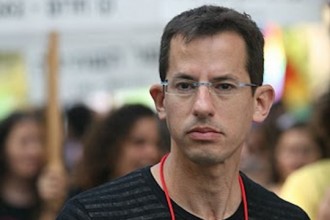
Hagai El-Ad, executive director of B’Tselem
Bitan’s actions are just one more reflection of the disdain the Israeli right has for democratic principles. This disdain is fundamental to the case they make against El-Ad. Prime Minister Benjamin Netanyahu, in his own attack on El-Ad and B’Tselem, said that “What these organizations cannot achieve through democratic elections in Israel, they try to achieve by international coercion.” For Netanyahu and his supporters, the future of the occupation is a matter for Israeli citizens alone to decide, while millions of Palestinians who suffer under it get no say in the matter. That’s not democracy. It is, in fact, as anti-democratic as anything can be.
The same can be said about conditional citizenship. Once, it was Avigdor Lieberman threatening the citizenship of Palestinian citizens of Israel based on their ethnicity. Now the Likud chair threatens the citizenship of a Jewish human rights advocate based on his politics. As MK Gal-On said, “In a democracy, citizenship is a basic right. It’s not a gift given to those who appeal to the chairman of the coalition.”
The United States Department of State has already indicated that they understand the grave threat to democracy that the Netanyahu government’s attitudes represent. In a statement to the Israeli daily, Yediot Ahoronot, State Department spokesman Edgar Vasquez said, “In general, we believe that a free civil society free of inhibitions is a central component of democracy… As we have said many times in the past, we believe that it is important that governments defend the freedom of expression and create an atmosphere in which all voices can be heard. We are concerned by any incident in the world when these principles are under threat.”
A stronger message, from governments and supporters of peace, needs to be sent. These incidents represent a steadily mounting effort to erode Israeli democracy, which is already reeling under the weight of fifty years of occupation. Arresting that erosion is crucial for Israelis, Palestinians and the cause of peace and justice for both.
Recently, the right wing Israeli group Im Tirtzu created a highly inflammatory video singling out leaders of four leading Israeli human rights groups as “plants” by foreign powers seeking to undermine the State of Israel and supporting terror attacks. The video has been widely condemned as incitement to violence against these individuals and their organizations. The Foundation for Middle East Peace quickly moved to support our Israeli colleagues, as did many other organizations.
The groups – B’Tselem, Breaking the Silence, Hamoked, and the Public Committee Against Torture In Israel – are among the many peace and human rights NGOs that are increasingly targeted by hateful rhetoric and even by anti-democratic legislation in the Knesset, much of which has been spurred by Im Tirtzu and their allies in the Likud and Jewish Home parties, the two largest parties in Israel’s governing coalition.
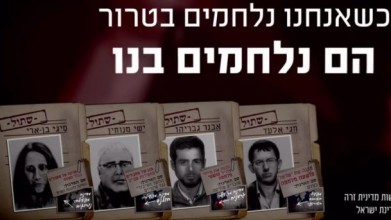
Still from Im Tirtzu’s video showing mock “files” on Israeli human rights leaders
Defenses of these human rights workers and condemnations of Im Tirtzu have come not only from the Israeli left and its supporters, but also from key officials in the Israeli government, military and intelligence communities.
Opposition Leader Isaac Herzog, to Netanyahu: “Take responsibility, tell Im Tirtzu that its video is beyond the ‘separation wall’ of what is acceptable in our democratic society… Stop those who stain your (Netanyahu’s) whole camp with hate.”
Former Foreign Minister Tzipi Livni: “I will oppose any attempt to paint people or entire communities as collaborators with the enemy.”
MK Zehava Gal-On, Chair of the Meretz Party: “This is an explicit call to action for these people’s blood. The public atmosphere of violence assisted in spreading this material like wildfire, and is further encouraged by politicians’ blazing hatred and populist appeals. I am afraid for their safety.”
Yuval Diskin, Former Director General of the Shin Bet: “[Israeli human rights groups] provide another, important mirror to our actions. Even if they can make us angry, even if they are sometimes inaccurate or not doing their jobs correctly – their contribution is very important.”
Amiram Levin, former IDF General and former Deputy Director of the Mossad: “’Breaking the Silence’ strengthens the IDF and its moral code…‘Breaking the Silence’ guards IDF soldiers in the impossible place in which politicians have abandoned them.”
Ami Ayalon, former head of the Shin Bet: “As a former soldier and commander of the army and who is today a private citizen who believes that the IDF is a moral army only when its fighters are reporting what they saw with their own eyes, I break the silence.”
J Street: “It is time for American Jewry to make its voice heard loudly and clearly. Whether we personally agree with the work of Breaking the Silence or the other NGOs targeted or not, we hope there can be near unanimous consensus across the political spectrum that [Im Tirtzu’s] behavior is outside the bounds of our community’s values and standards.”
The Anti-Defamation League: “Im Tirtzu’s highly disturbing video employs fear tactics to accuse Israeli human rights activists and organizations of being culpable in the ongoing wave of Palestinian terrorism. This is a form of incitement which clearly crosses over into hate speech.”
Religious Action Center of Reform Judaism, letter to Prime Minister Benjamin Netanyahu: “A particular concern is that the violent rhetoric doesn’t come only from the extremes, but is echoed by public figures, members of your government, and the media. That is why it is essential that you exercise your leadership to set the tone of civil discourse – preventing incitement and violence – regardless of any disagreements you may have with the views of the human rights NGOs. We have seen the horrors that occur when words of incitement turn to acts of violence; such incitement cannot go unchecked.”
Joint Statement of the Worldwide Conservative/Masorti Movement: “We must hold leaders and neighbors alike accountable for a society in which issues are debated based on facts, people are treated with respect regardless of their beliefs, and tolerance and acceptance drown out the noise of hate.”
New Israel Fund: “The new campaign by the extremist Im Tirtzu group, naming and inciting against four human rights leaders, is designed to further delegitimize the proper work of human rights organizations while endangering the personal safety of these leaders who are our friends and allies. Not for nothing did an Israeli judge deem Im Tirtzu to have “fascist attributes.”
Americans for Peace Now: “American Jewish leaders have, with good reason, long pointed to Israel’s vibrant civil society and freedom of speech as evidence of the robustness of Israeli democracy in an un-democratic region. Today, these same leaders must recognize that burgeoning attacks on Israeli progressive civil society are a threat to Israel’s democracy and feed the kind of extremism that has already led to attacks and the murder of an Israeli prime minister.”
T’Ruah: The Rabbinic Call for Human Rights: “This hateful rhetoric is all too reminiscent of the time when the walls of Jerusalem displayed posters of Prime Minister Yitzchak Rabin z”l in a Nazi uniform, and when crowds chanted “Death to Rabin” at rallies.”
B’Tselem USA: “This crude attempt to gin up support for silencing human rights activists by publicly attacking them for political gain is nothing short of sickening. This attack may come in Im Tirtzu’s voice but the hands are those of the current Israeli government.”
Ameinu and ARZA: “Im Tirtzu’s actions are a direct threat to Israel and a desecration of the Zionist Dream of Israel’s founders…this video adds to a growing culture of incitement within Israel and the Palestinian territories — one that is strengthened by divisive and irresponsible statements by government ministers and Members of the Knesset — which has already lead to violence…Im Tirtzu, the racist Lehava movement, the Tag Mechir (Price Tag) vigilantes and other foes of Israeli democracy must be denounced without reservation.”
Peace Now ad: “Whoever finances Im Tirtzu also supports Jewish terrorism”
Partners for Progressive Israel: “These are the tactics that resulted in the assassination of YItzhak Rabin twenty years ago; and these are the same tactics used by totalitarian parties of the right in Europe in the inter-war period in their successful campaigns to destroy democracy in Italy and Germany.”
Jewish Voice for Peace: “This video is just the latest, and perhaps most egregious, example of the climate of hate and violence directed at anyone who stands up for the rights of Palestinians.”
Foundation for Middle East Peace: “FMEP’s support for these groups is based on shared values of democracy, equality, and tolerance. Hateful attacks like the one launched by Im Tirzu undermine those values. The activists named in the video represent the best of an open, democratic civil society, something of which all Israelis should be proud, just as we at FMEP are proud to share in the common work of advancing human rights in our societies.”
Hagai El-Ad, Executive Director of B’Tselem: The Israeli Information Center for Human Rights in the Occupied Territories: “I’m not afraid of Im Tirtzu. I’m afraid of the occupation, of indifference to injustice, sanctimoniousness and passing shock.”
HaMoked: The Center for the Defense of the Individual: “There can be no doubt that this campaign which targets private individuals falls outside the protection of freedom of speech. It constitutes unbridled incitement and dangerous provocation that put at risk the personal wellbeing and safety of the organizations’ employees who “star” in it.”
Yesterday, the right-wing Israeli group Im Tirzu released an inflammatory and offensive video attacking four leading Israeli human rights activists as dangerous “foreign agents.” Among the activists targeted were Hagai El Ad, director of B’tselem, and Avner Gvaryahu of Breaking the Silence.
In response to this attack, the Foundation for Middle East Peace strongly affirms its support for Hagai and Avner, for our grantee organizations Breaking the Silence and B’tselem, and for all of those who work toward the cause of human rights and peace in Israel and Palestine. FMEP’s support for these groups is based on shared values of democracy, equality, and tolerance. Hateful attacks like the one launched by Im Tirzu undermine those values. The activists named in the video represent the best of an open, democratic civil society, something of which all Israelis should be proud, just as we at FMEP are proud to share in the common work of advancing human rights in our societies.
We call on other pro-Israel, pro-Palestinian, and pro-peace organizations in the U.S. to join us in standing in solidarity with our Israeli colleagues against the increasing atmosphere of incitement against Israeli human rights organizations.
In the aftermath of the horrific terrorist attacks in Paris last week, Israeli Defense Minister Moshe Ya’alon remarked on the tension between security and liberty. “In the United States until the events of September 11, the balance between security and human rights favored human rights on the issue, for example of eavesdropping on potential terrorists,” he said. “In France and other countries in Europe, [a shift toward security] hasn’t yet happened. Countries fighting terrorism have no alternative in this other than shifting in the direction of security. I assume that we will see a large number of steps [to carry out] inspections: passport inspections, inspections at the entrance to public places.”
As in the U.S. this dichotomy between security and human rights is at the very heart of the debate in Israel. ”We believe not only are these not contradictory, but that human rights provides  security,” said Hagai El-Ad, the Executive Director of B’Tselem, Israel’s leading human rights groups monitoring its occupation of the West Bank and Gaza Strip, on a recent press call. “Indeed, we think that human rights are the reasons for which we have security, they are why people have a society that must be protected. So one has to wonder what kind of society do we end up with (in Ya’alon’s framework) and would that society be worth defending if you take Ya’alon’s idea to extremes. I hope that idea will work differently in France. Time will tell.”
The last several months have seen an increase in attacks on civilians in Israel and the West Bank, and it is natural that such attacks test the resolve of any society to maintain its commitment to human rights. Terrorist groups count on the idea that their attacks will erode that resolve, as it did in the United States after September 11, and as it has in Israel over many years, and especially in the past six years under a right wing government.
The diminished regard for human rights is particularly evident in the Israeli practice of punitive house demolitions, in which the homes of accused terrorists’ families are destroyed, often leaving dozens of people homeless for a crime in which they played no part. El-Ad points out that, “In 2004, a military commission reviewed the procedure, found the practice is not effective, and recommended abandoning it.”
In 2005, Israel’s Defense Ministry did indeed order a halt to the procedure, based on evidence that, rather than deterring attacks, punitive house demolitions inflamed Palestinian anger.
“We should not call them punitive, but vindictive,” El-Ad said. “They are carried out against families who are not charged with anything. This is [a violation of] the Geneva Conventions, which forbids collective punishment, and against basic morality.”
El-Ad says that reviving the practice had been discussed for some time, and that last year, after the kidnapping and murder of three Israeli youths that sparked a summer of horrific violence and the war in Gaza, the practice was revived.
While Israeli leaders like Ya’alon argue that these demolitions deter terrorism, Israel’s own research has shown they do no such thing. This is a clear example where disregard for human rights has a distinctly negative impact on security.
But house demolitions are not the only example. In recent weeks, the upsurge in violence between Israelis and Palestinians has been centered in two areas: Jerusalem and Hebron. The tensions in Jerusalem have been well-documented, but the situation in Hebron garners less international attention. Yet those tensions have repeatedly resulted in attacks on both Israeli settlers and soldiers as well as against Palestinian civilians.
The situation in Hebron is extremely difficult. As Musa Abu Hashhash, B’Tselem’s Hebron District field researcher, points out, “Hebron has had half of the casualties in the last few weeks. It is the only Palestinian town where settlers live inside the town itself.
“The 1997 Hebron Agreement divides Hebron into H1 and H2. [H1 is the Palestinian portion of Hebron. H2, approximately 20% of the city, is controlled by Israel.] H2 has seventeen checkpoints and restricted movement, which leads to deserted streets. B’Tselem did a survey in 2007 and found that 1007 homes are empty and 1400 shops have been closed. These are the long term effects of the settlers’ presence.”
It remains to be seen how France and other European countries will respond in the long term to the horrors we all witnessed in Paris. One can only hope that they reject Moshe Ya’alon’s notion that security must mean de-emphasizing human rights. Instead, they can opt for the more nuanced view that El-Ad expressed, in which security is enhanced by preserving human rights, while the denial of those rights puts innocent civilians at greater risk.
“We at B’Tselem have an uncompromising position against violence against innocent civilians,” he said. “But the government in Israel imagines that the recent violence came out of nowhere, and if there is any context, it is only Palestinian incitement and anti-Semitism. We also reject that notion. The context of what we are witnessing is the occupation.”
Ali Saad Dawabsheh was only 18 months old when Israeli settlers who entered his village of Douma to carry out a so-called “price tag” attack took his life away by setting fire to his home. The crime brought shock and horror to many, regardless of their views of the overall Israel-Palestinian conflict.
But the reality is that this death is very much a part of that conflict. It cannot be understood apart from it. It is not anomalous. Ali was far from the first baby killed in this conflict, on either side.

Graffiti meaning “revenge”
It is no surprise that such a horrifying act leads people to say “something more must be done.” But, of course, the conflict will not end over this incident. In a matter of weeks, Ali’s death will be just one more tragedy in a long list of tragedies in Israel-Palestine.
Is it possible for this tragedy to move us closer to resolving the conflict? Is it possible that, even without ultimately resolving the major political issues we can make it more difficult for an atrocity like this to occur? Perhaps it is, if we ask one important question and make sure we get all the answers to it.
Why is Ali Dawabsheh dead?
Ali and his family were in their home at night when arsonists set it on fire. Ali’s parents and four year-old brother suffered severe burns and Ali died. The attackers spray-painted the word “nekama” in Hebrew on the resident. The word means “revenge.”
Why is Ali Dawabsheh dead?
Until the murderers are caught, we cannot be certain, but it is likely that this “price tag” attack was carried out in response to Israel’s demolition of two structures in the settlement of Beit El on the West Bank. After the High Court in Israel ordered their demolition, the Netanyahu government immediately granted permits for hundreds of new living units in Beit El and the East Jerusalem area. This, however, was apparently not enough compensation for those who carried out this heinous act.
Why is Ali Dawabsheh dead?
Given the shocking nature of the crime, the Israeli government will likely put considerable resources toward identifying and arresting the perpetrators. However, on a day-to-day basis, Palestinians in the West Bank have no protection from settlers. Israeli Defense Forces and Border Police often do not prevent settler attacks on Palestinians. It’s not uncommon to see them protecting settlers as they attack Palestinians.
Moreover, the forces of the Palestinian Authority have no jurisdiction over settlers and cannot protect their own citizens from them. Settlers in general feel they may act with impunity. As the Israeli human rights group, B’Tselem states, “In recent years, Israeli civilians set fire to dozens of Palestinian homes, mosques, businesses, agricultural land and vehicles in the West Bank. The vast majority of these cases were never solved, and in many of them the Israeli Police did not even bother to take elementary investigative actions.”
Why is Ali Dawabsheh dead?
In the wake of Ali’s death, the rush to express outrage was staggering. Israeli politicians across the spectrum vowed that the murderers would be brought to justice. No doubt, they are sincere in their personal outrage and in the desire to show Israelis and the rest of the world that this is something they will not tolerate as leaders.
But their comments are universally directed at the crime itself, implying that this act was an anomalous blot on the Israeli page with no cause other than hate and extremism. The words not only of Benjamin Netanyahu, Naftali Bennett and other leaders of the current government, but also those of opposition leaders Isaac Herzog and Yair Lapid make no connection between Ali’s murder and the occupation, the settlement project or the increasingly anti-Arab tone of many of Israel’s leaders.
There was scant mention of the tolerance shown to the extreme right of the settler movement over the years. As Amos Harel put it in Ha’aretz, “The forgiveness the state has shown over many long years toward the violence of the extreme right – which was also evident this week at Beit El (none of those attacking the police are now in detention) – is also what makes possible the murderous hate crimes like Friday’s in the village of Douma. There is a price for the gentle hand.”
The decision to build hundreds of units in Beit El and East Jerusalem sent a message that the government would find ways to make the rulings of the High Court against illegal building moot in all practical ways. The bigger message that was sent in the wake of protests in Beit El where Israeli soldiers were attacked was this: violence pays, at least for the settlers.
The occupation and settlement program are themselves a form of daily violence that dispossess Palestinians, place them under military rule and deprive them of their basic rights. It may not be easy to end the occupation, but the casual way many in Israel have turned to “managing the conflict” and given up on ending the occupation sends the message that such institutionalized violence by Israel against Palestinians is at least tolerable. Why would anyone be surprised that the more radical elements among settlers would take that a few steps further?
Why is Ali Dawabsheh dead?
In the wake of Ali’s death, Palestinian President Mahmoud Abbas called for the International Criminal Court (ICC) to investigate this act as a war crime. But this was an act of civilian murder, even if the civilian(s) who committed it was living in a settlement deemed illegal under international law. Moreover, the ICC would not act if Israel were legitimately pursuing the perpetrators, which it certainly seems like it is doing. Politicizing Ali’s death in this manner is typical of the conflict, and thoroughly counter-productive.
Indeed, mixed in with his words of outrage, Netanyahu also could not resist politicizing it in his own way by saying that Israel pursues such criminals while Palestinians name streets after them (In reality, Israel celebrates its own terrorists too). This was an opportunity for the two leaders to unite in condemning a crime and calling for justice. Instead, both took it as an opportunity to aggravate the differences between them.
Why is Ali Dawabsheh dead?
While this goes on, members of the United States Congress works to legitimize the settlement enterprise by equating it under the law with Israel itself. The White House is focused on the Iran nuclear deal and it is not yet clear what, if any action the current administration might take to improve the situation in Israel-Palestine before they leave office. In Europe, merely labeling products emanating from settlements is so controversial that the process of setting up an enforcement mechanism for a regulation that already exists in European Union law is dragging along at a snail’s pace.
Without ending the occupation of the West Bank, it is only a matter of time before the next horrifying incident, whether it happens to a Palestinian or an Israeli child. As Noam Sheizaf of +972 Magazine wrote, “…violence is inseparable from the colonial reality in the occupied territories — without putting an end to that reality, there is no chance to properly deal with violence. Even if things cool down temporarily, the situation will only grow worse in the long run. The only solutions are the evacuation of settlements or equal rights for all.”
And ultimately, Sheizaf’s words are the answer to the all important question:
What can we do to prevent more deaths like Ali Dawabsheh’s?
Ultimately, there is no way to stop these incidents without ending the occupation and the daily reality of privileged and protected Israeli settlers living in a Palestinian territory mostly populated by people who live under military occupation.
However, this crime was entirely predictable. Crimes like it can be prevented, at least some of the time, and it does not require an end to the conflict to do so.
Until the conflict is resolved, Israel must meet its responsibilities to protect Palestinian civilians from settlers. Both Israelis and Palestinians can treat incidents like this one as the crimes they are and refrain from politicizing them, allowing both sides to condemn them unreservedly and in unison. Finally, the United States and Europe can stop equivocating and insist that the settlement project stop immediately, and be prepared to put real pressure on Israel to make it happen.
Ali’s death can be a wake up call, or it can be just another horrible story among decades of horrible stories. Which it will be will depend as much on people’s willingness to pressure their own governments in a productive direction as it will on those governments, in Jerusalem, Ramallah, Brussels and Washington, finding the courage to finally act. Some Israeli settlers would condemn Ali’s murder. But until the occupation and the settlement project end, tragedies like this on are inevitable. If there is to be any hope of preventing them, it has to start with people standing up to finally say “NO” to the settlements and to force their governments to do likewise.
The shell game is a tried-and-true method of persuading people to give their money to the person running the game. In political terms, it’s also a reliable method of persuading people to buy into the political stance of the man running the game.
Elliott Abrams is a master of the shell game. He provides what seems like a serious and sober analysis, with just enough cherry-picking of facts and omission of detail to convince you of his point of view. That is a big reason why this man, who is responsible for some of the greatest foreign policy fiascos in American history, continues to be considered a legitimate source for foreign policy analysis.
Perhaps it’s not surprising. Despite the enormous catastrophes brought on by the neoconservative school of thought of which Abrams is a part, the philosophy, such as it is, continues to be an influential voice in the foreign policy debate in the United States. This is, however, even more reason to look at an apparent change of course from Abrams with a skeptical eye. Read more at LobeLog