United Nations Secretary General Ban Ki-moon has an op-ed in today’s New York Times expanding upon remarks he made last week regarding the upsurge in violence in Israel-Palestine. It’s worth taking a moment to consider why this op-ed was necessary. In last week’s remarks, Ban unequivocally condemned terrorism, just as he did in today’s op-ed, while also noting, “security 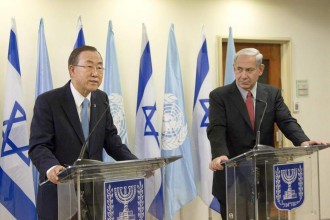 measures alone will not stop the violence. They cannot address the profound sense of alienation and despair driving some Palestinians – especially young people… As oppressed peoples have demonstrated throughout the ages, it is human nature to react to occupation, which often serves as a potent incubator of hate and extremism.”
Israeli Prime Minister Benjamin Netanyahu responded to this as he always does – ignoring the condemnation of terrorism, acting as if all the blame had been laid upon Israel, and rejecting the notion that the Israeli occupation might have something, anything, to do with Palestinian violence. He even went as far as to accuse Ban of encouraging terrorism with his remarks (Yes, it is odd to suggest that a statement from the UN Secretary General would incite violence while also rejecting as outrageous the notion that a half-century of military occupation might do so, but let’s leave that aside for now).
Israel’s own security chiefs have said the same thing – that Palestinian despair at the occupation ever ending is a major driver of violence, and that genuine steps to ameliorate that situation, rather than simply cracking down harder, must be taken.
Netanyahu’s government has made an unfortunate habit of treating every criticism, no matter how carefully or constructively worded, as an attack on Israel’s legitimacy. While we might have expected this from the Israeli right wing, it was really disappointing to see an anti-hate group like the Anti-Defamation League hastily echoing it, in a press release calling Ban’s words an “apparent justification of Palestinian terrorism.”
Ban’s analysis shouldn’t be at all controversial. Indeed, Israel’s own security chiefs have said the same thing – that Palestinian despair at the occupation ever ending is a major driver of violence, and that genuine steps to ameliorate that situation, rather than simply cracking down harder, must be taken.
In a recent report, Israel’s Shin Bet internal security service concluded that young Palestinians were motivated to act, in part, “based on feelings of national, economic and personal deprivation.” The head of Israel Defense Forces Military Intelligence, Maj. General Herzl Halevi, told a meeting of Israel’s cabinet that “feelings of rage and frustration” were major factors driving young Palestinians to these acts and that they “felt they had nothing to lose.” U.S. Ambassador to Israel Dan Shapiro laid out a similar critique in a recent speech to an Israeli security conference – receiving a similarly over-the-top Israeli government response.
No one seriously would argue that the Shin Bet and the IDF are trying to justify Palestinian terrorism. Neither was Ambassador Shapiro. And neither is the UN Secretary-General, as he made clear in his initial remarks, and again in today’s op-ed. Understanding the factors that contribute to violence is not remotely the same as “justifying” that violence. On the contrary, it’s necessary in order to develop an effective policy response. It really shouldn’t be hard to understand that the daily abuse, humiliation and dispossession that Palestinians experience under Israeli occupation is a major contributing factor in the decision of some Palestinians to resort to terrorist violence. Acknowledging this does not make terrorist violence any less reprehensible. And avoiding these facts, or suppressing discussion of them, will only result in more of that violence, not less.
Last week, U.S. Ambassador to Israel Dan Shapiro caused a stir by ever-so-gently telling the truth about the occupation. Speaking to a conference at Tel Aviv’s respected Institute for National Security Studies, he addressed “the latest increase in tensions and violence between Israelis and Palestinians,” and observed, “Too many attacks on Palestinians lack a vigorous investigation or response by Israeli authorities; too much vigilantism goes unchecked; and at times there seem to be two standards of adherence to the rule of law: one for Israelis and another for Palestinians.”
The outraged reaction from Israeli officials—which included a demeaning slur against the American ambassador by a former Netanyahu aide, as well as Netanyahu himself trying to shame Shapiro by noting the recent murder of an Israeli woman whom Shapiro had actually memorialized in his speech—was as overwrought as it was predictable. The fact that Shapiro’s words of concern were far outnumbered by words of solidarity and support mattered little. It has been the policy of the Netanyahu government that even the most carefully worded public criticisms by its closest friends shall be treated as an attack on the very foundations of the state.
It is simply a matter of fact that Israelis and Palestinians in the West Bank live under two different systems of law—the former under Israeli civilian law, the latter under military law imposed after the territories were occupied in 1967. If an Israeli and Palestinian were to be arrested at the same spot in the West Bank at the same moment for the same crime, they would be subjected to two entirely different legal procedures, the former Israeli civil law and the latter military law. In this regard, it’s only Shapiro’s use of “seems” that seems a bit odd. Read more at Tablet Magazine