Earlier today, Likud Knesset Member, David Bitan, who chairs the governing faction in the Knesset, stated on an Israeli talk show that he would try to find a way to strip the citizenship of Hagai El-Ad , executive director of B’Tselem. Bitan described El-Ad’s testimony to a special session of the United Nations Security Council on Israeli settlements as “explicit breach of trust by an Israeli citizen against the state, and as such he should find himself another citizenship.”
Zehava Gal-On, the Chairwoman of the Meretz party, described Bitan’s comments as “dangerously close to incitement to murder.” That characterization is important considering right wing efforts over the past two years to incite violence against peace and human rights activists in Israel.
To be clear, Bitan’s threat to revoke El-Ad’s citizenship is mere posturing. Despite the gathering strength of anti-democratic forces in Israel, the country’s laws prevent the revocation of citizenship simply for presenting a case against settlements at the United Nations (which, incidentally, cannot and has not been challenged on its merits). But as another log on the already frighteningly large fire of incitement against progressive activists in Israel, it is quite significant.
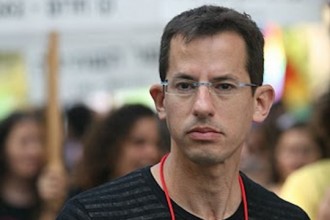
Hagai El-Ad, executive director of B’Tselem
Bitan’s actions are just one more reflection of the disdain the Israeli right has for democratic principles. This disdain is fundamental to the case they make against El-Ad. Prime Minister Benjamin Netanyahu, in his own attack on El-Ad and B’Tselem, said that “What these organizations cannot achieve through democratic elections in Israel, they try to achieve by international coercion.” For Netanyahu and his supporters, the future of the occupation is a matter for Israeli citizens alone to decide, while millions of Palestinians who suffer under it get no say in the matter. That’s not democracy. It is, in fact, as anti-democratic as anything can be.
The same can be said about conditional citizenship. Once, it was Avigdor Lieberman threatening the citizenship of Palestinian citizens of Israel based on their ethnicity. Now the Likud chair threatens the citizenship of a Jewish human rights advocate based on his politics. As MK Gal-On said, “In a democracy, citizenship is a basic right. It’s not a gift given to those who appeal to the chairman of the coalition.”
The United States Department of State has already indicated that they understand the grave threat to democracy that the Netanyahu government’s attitudes represent. In a statement to the Israeli daily, Yediot Ahoronot, State Department spokesman Edgar Vasquez said, “In general, we believe that a free civil society free of inhibitions is a central component of democracy… As we have said many times in the past, we believe that it is important that governments defend the freedom of expression and create an atmosphere in which all voices can be heard. We are concerned by any incident in the world when these principles are under threat.”
A stronger message, from governments and supporters of peace, needs to be sent. These incidents represent a steadily mounting effort to erode Israeli democracy, which is already reeling under the weight of fifty years of occupation. Arresting that erosion is crucial for Israelis, Palestinians and the cause of peace and justice for both.
Yesterday, the right-wing Israeli group Im Tirzu released an inflammatory and offensive video attacking four leading Israeli human rights activists as dangerous “foreign agents.” Among the activists targeted were Hagai El Ad, director of B’tselem, and Avner Gvaryahu of Breaking the Silence.
In response to this attack, the Foundation for Middle East Peace strongly affirms its support for Hagai and Avner, for our grantee organizations Breaking the Silence and B’tselem, and for all of those who work toward the cause of human rights and peace in Israel and Palestine. FMEP’s support for these groups is based on shared values of democracy, equality, and tolerance. Hateful attacks like the one launched by Im Tirzu undermine those values. The activists named in the video represent the best of an open, democratic civil society, something of which all Israelis should be proud, just as we at FMEP are proud to share in the common work of advancing human rights in our societies.
We call on other pro-Israel, pro-Palestinian, and pro-peace organizations in the U.S. to join us in standing in solidarity with our Israeli colleagues against the increasing atmosphere of incitement against Israeli human rights organizations.
In the aftermath of the horrific terrorist attacks in Paris last week, Israeli Defense Minister Moshe Ya’alon remarked on the tension between security and liberty. “In the United States until the events of September 11, the balance between security and human rights favored human rights on the issue, for example of eavesdropping on potential terrorists,” he said. “In France and other countries in Europe, [a shift toward security] hasn’t yet happened. Countries fighting terrorism have no alternative in this other than shifting in the direction of security. I assume that we will see a large number of steps [to carry out] inspections: passport inspections, inspections at the entrance to public places.”
As in the U.S. this dichotomy between security and human rights is at the very heart of the debate in Israel. ”We believe not only are these not contradictory, but that human rights provides  security,” said Hagai El-Ad, the Executive Director of B’Tselem, Israel’s leading human rights groups monitoring its occupation of the West Bank and Gaza Strip, on a recent press call. “Indeed, we think that human rights are the reasons for which we have security, they are why people have a society that must be protected. So one has to wonder what kind of society do we end up with (in Ya’alon’s framework) and would that society be worth defending if you take Ya’alon’s idea to extremes. I hope that idea will work differently in France. Time will tell.”
The last several months have seen an increase in attacks on civilians in Israel and the West Bank, and it is natural that such attacks test the resolve of any society to maintain its commitment to human rights. Terrorist groups count on the idea that their attacks will erode that resolve, as it did in the United States after September 11, and as it has in Israel over many years, and especially in the past six years under a right wing government.
The diminished regard for human rights is particularly evident in the Israeli practice of punitive house demolitions, in which the homes of accused terrorists’ families are destroyed, often leaving dozens of people homeless for a crime in which they played no part. El-Ad points out that, “In 2004, a military commission reviewed the procedure, found the practice is not effective, and recommended abandoning it.”
In 2005, Israel’s Defense Ministry did indeed order a halt to the procedure, based on evidence that, rather than deterring attacks, punitive house demolitions inflamed Palestinian anger.
“We should not call them punitive, but vindictive,” El-Ad said. “They are carried out against families who are not charged with anything. This is [a violation of] the Geneva Conventions, which forbids collective punishment, and against basic morality.”
El-Ad says that reviving the practice had been discussed for some time, and that last year, after the kidnapping and murder of three Israeli youths that sparked a summer of horrific violence and the war in Gaza, the practice was revived.
While Israeli leaders like Ya’alon argue that these demolitions deter terrorism, Israel’s own research has shown they do no such thing. This is a clear example where disregard for human rights has a distinctly negative impact on security.
But house demolitions are not the only example. In recent weeks, the upsurge in violence between Israelis and Palestinians has been centered in two areas: Jerusalem and Hebron. The tensions in Jerusalem have been well-documented, but the situation in Hebron garners less international attention. Yet those tensions have repeatedly resulted in attacks on both Israeli settlers and soldiers as well as against Palestinian civilians.
The situation in Hebron is extremely difficult. As Musa Abu Hashhash, B’Tselem’s Hebron District field researcher, points out, “Hebron has had half of the casualties in the last few weeks. It is the only Palestinian town where settlers live inside the town itself.
“The 1997 Hebron Agreement divides Hebron into H1 and H2. [H1 is the Palestinian portion of Hebron. H2, approximately 20% of the city, is controlled by Israel.] H2 has seventeen checkpoints and restricted movement, which leads to deserted streets. B’Tselem did a survey in 2007 and found that 1007 homes are empty and 1400 shops have been closed. These are the long term effects of the settlers’ presence.”
It remains to be seen how France and other European countries will respond in the long term to the horrors we all witnessed in Paris. One can only hope that they reject Moshe Ya’alon’s notion that security must mean de-emphasizing human rights. Instead, they can opt for the more nuanced view that El-Ad expressed, in which security is enhanced by preserving human rights, while the denial of those rights puts innocent civilians at greater risk.
“We at B’Tselem have an uncompromising position against violence against innocent civilians,” he said. “But the government in Israel imagines that the recent violence came out of nowhere, and if there is any context, it is only Palestinian incitement and anti-Semitism. We also reject that notion. The context of what we are witnessing is the occupation.”