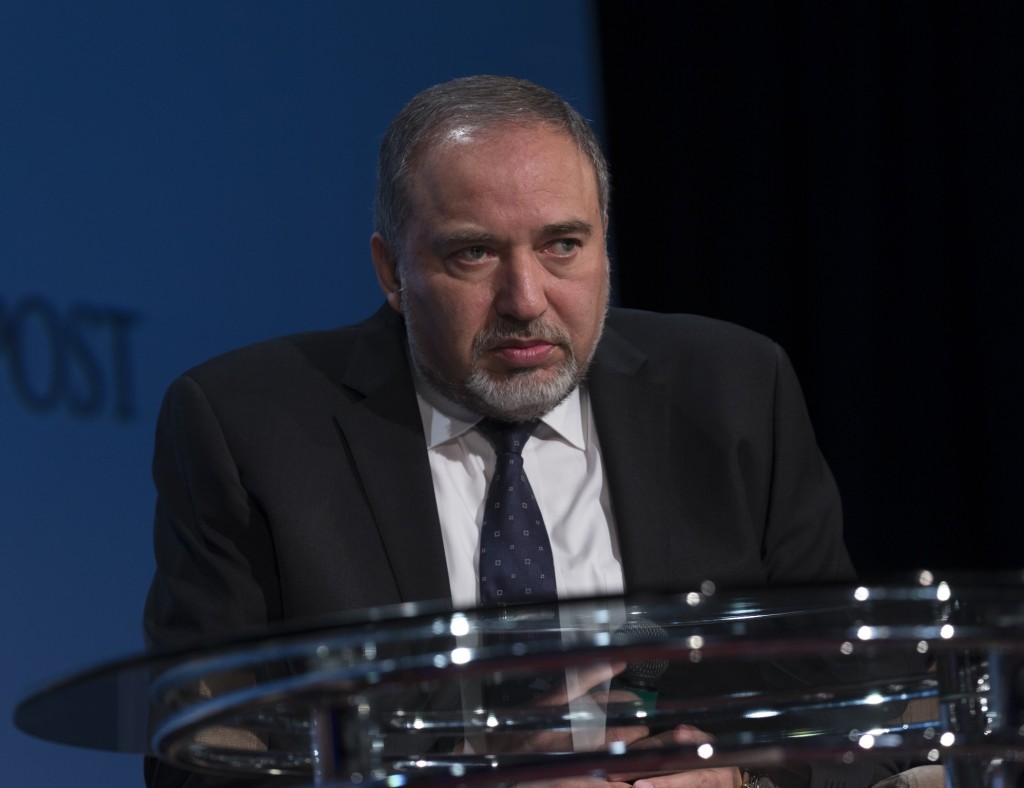
Avigdor Liberman – Israel’s new defense minister? (Shutterstock)
Earlier today, it was reported that Avigdor Lieberman, the head of Israel’s right wing Yisrael Beiteinu party, has agreed to join the government of Benjamin Netanyahu in the post of Defense Minister. This is a concerning development for a number of reasons.
The agreement between Lieberman and Netanyahu comes in the wake of Netanyahu’s negotiations to bring the Zionist Union into the government, during which Netanyahu made a point of refusing to offer the Defense portfolio to ZU Chairman Isaac Herzog. While it might seem that Netanyahu turned to Lieberman only because he was unable to come to satisfactory terms with Herzog, Labor Party MK Stav Shaffir is likely correct in observing that “It is now clear that Bibi used (Herzog) in order to bring Lieberman into the government.” That is, Herzog was used as bait.
But the real context for the decision to move Lieberman into the Defense Ministry is the need to replace Likud Minister Moshe Ya’alon. Ya’alon and Netanyahu have been at loggerheads in recent weeks. The disagreements have centered on two specific events.
The first was the widely publicized video of an Israeli soldier shooting and killing a Palestinian who was already laying on the ground, subdued and semi-conscious. Ya’alon had made it clear that this was a serious violation of Israel Defense Forces rules of engagement. At first, Netanyahu agreed, but after being slammed by right-wing critics, and public support for the soldier swelled, he changed his position.
More recently, Netanyahu strongly criticized the Deputy Chief of Staff, Yair Golan, for a speech he made on Holocaust Memorial Day expressing concern about the growing “intolerance and violence” within Israeli society. Ya’alon explicitly pushed back on Netanyahu’s criticism of Golan, insisting that such statements, even if unpopular, are within the purview of IDF leaders.
Netanyahu has long had an uneasy relationship with the Israeli military and intelligence. He views the military as a tool of the government, and its duty is to enact and support the policies the government decides upon. The military, on the other hand, sees itself as having a key role in deciding Israel’s security needs, and has, throughout Israeli’s history, held an esteemed position in Israeli society not only as protectors but, whether one thinks it justified or not, as a symbol of Israeli ethics and morality.
As Aluf Benn, editor of Ha’aretz put it, “The IDF is still the most popular body in Israel, and over the past few weeks its leaders have made clear that they do not intend to be the military arm of the Beitar soccer club’s extremist fans, La Familia, or of the right wing singer the Shadow.”
But that is exactly what Avigdor Lieberman is going to want to turn them into. Indeed, Labor MK Erel Margalit stated it clearly: “Netanyahu decapitated the defense minister on live TV, and the gangs have triumphed over democracy. This is a day of celebration for extremists, La Familia and the hilltop youth, and at this rate Elor Azaria (the soldier who shot the subdued Palestinian terrorist referenced above) will be appointed deputy defense minister by Bibi.”
It is precisely this difference that led Netanyahu to replace Ya’alon with Lieberman. Where Ya’alon fought for what he saw as the independence and integrity of the military, Lieberman’s views line up perfectly with the Israeli political right’s.
During recent conflicts with Hamas, Lieberman was at the forefront of stirring up internal tensions. He called for boycotts of businesses owned by Palestinian citizens of Israel, and has accused Israeli human rights groups of supporting Hezbollah and other militant groups. As a 2014 editorial in Ha’aretz put it, “This incitement, which rolls from the top echelons of the Israeli government down into society, eventually evolves into the physical violence that has become commonplace at demonstrations, when right-wing activists attack those protesting government policy while shouting ‘Death to Arabs,’ and ‘Death to leftists.’”
Moshe Ya’alon is a committed member of the Likud and the Israeli right. One should not forget that only recently, he stirred controversy and engaged in incitement himself when he called the human rights/IDF veterans’ group Breaking the Silence “traitors” for publishing testimonies of IDF soldiers about their experiences in combat and in the occupation (a charge he later withdrew).
But Lieberman is a different breed. This is a man who advocates a loyalty oath for non-Jewish citizens of Israel, wishes to excise towns populated by Palestinian citizens of Israel, and whose statements have often been seen as encouraging attacks on Arabs and leftists in Israel. He is someone who has a warm relationship with Russia’s Vladimir Putin and a difficult one with much of the United States government.
If anyone envisioned Isaac Herzog joining the government and making it easier for the European Union and the United States to work with Israel, Lieberman’s appointment brings the opposite result. Israel is now led by a trio of right-wingers in Netanyahu, Lieberman and Naftali Bennett, each more radical than the last. The opposition, such as it is, is now weakened even further by Herzog’s failed attempt to join the government, a move opposed by most of his own party.
Many observers have voiced concern about the decline of Israel’s democracy under Netanyahu. We have now seen another significant setback with Lieberman’s appointment as Defense Minister. Perhaps the one hope, if any is to be found, is that the opposition may now find new leadership which might start to regain the ground liberal Israelis have lost.
In the aftermath of the horrific terrorist attacks in Paris last week, Israeli Defense Minister Moshe Ya’alon remarked on the tension between security and liberty. “In the United States until the events of September 11, the balance between security and human rights favored human rights on the issue, for example of eavesdropping on potential terrorists,” he said. “In France and other countries in Europe, [a shift toward security] hasn’t yet happened. Countries fighting terrorism have no alternative in this other than shifting in the direction of security. I assume that we will see a large number of steps [to carry out] inspections: passport inspections, inspections at the entrance to public places.”
As in the U.S. this dichotomy between security and human rights is at the very heart of the debate in Israel. ”We believe not only are these not contradictory, but that human rights provides  security,” said Hagai El-Ad, the Executive Director of B’Tselem, Israel’s leading human rights groups monitoring its occupation of the West Bank and Gaza Strip, on a recent press call. “Indeed, we think that human rights are the reasons for which we have security, they are why people have a society that must be protected. So one has to wonder what kind of society do we end up with (in Ya’alon’s framework) and would that society be worth defending if you take Ya’alon’s idea to extremes. I hope that idea will work differently in France. Time will tell.”
The last several months have seen an increase in attacks on civilians in Israel and the West Bank, and it is natural that such attacks test the resolve of any society to maintain its commitment to human rights. Terrorist groups count on the idea that their attacks will erode that resolve, as it did in the United States after September 11, and as it has in Israel over many years, and especially in the past six years under a right wing government.
The diminished regard for human rights is particularly evident in the Israeli practice of punitive house demolitions, in which the homes of accused terrorists’ families are destroyed, often leaving dozens of people homeless for a crime in which they played no part. El-Ad points out that, “In 2004, a military commission reviewed the procedure, found the practice is not effective, and recommended abandoning it.”
In 2005, Israel’s Defense Ministry did indeed order a halt to the procedure, based on evidence that, rather than deterring attacks, punitive house demolitions inflamed Palestinian anger.
“We should not call them punitive, but vindictive,” El-Ad said. “They are carried out against families who are not charged with anything. This is [a violation of] the Geneva Conventions, which forbids collective punishment, and against basic morality.”
El-Ad says that reviving the practice had been discussed for some time, and that last year, after the kidnapping and murder of three Israeli youths that sparked a summer of horrific violence and the war in Gaza, the practice was revived.
While Israeli leaders like Ya’alon argue that these demolitions deter terrorism, Israel’s own research has shown they do no such thing. This is a clear example where disregard for human rights has a distinctly negative impact on security.
But house demolitions are not the only example. In recent weeks, the upsurge in violence between Israelis and Palestinians has been centered in two areas: Jerusalem and Hebron. The tensions in Jerusalem have been well-documented, but the situation in Hebron garners less international attention. Yet those tensions have repeatedly resulted in attacks on both Israeli settlers and soldiers as well as against Palestinian civilians.
The situation in Hebron is extremely difficult. As Musa Abu Hashhash, B’Tselem’s Hebron District field researcher, points out, “Hebron has had half of the casualties in the last few weeks. It is the only Palestinian town where settlers live inside the town itself.
“The 1997 Hebron Agreement divides Hebron into H1 and H2. [H1 is the Palestinian portion of Hebron. H2, approximately 20% of the city, is controlled by Israel.] H2 has seventeen checkpoints and restricted movement, which leads to deserted streets. B’Tselem did a survey in 2007 and found that 1007 homes are empty and 1400 shops have been closed. These are the long term effects of the settlers’ presence.”
It remains to be seen how France and other European countries will respond in the long term to the horrors we all witnessed in Paris. One can only hope that they reject Moshe Ya’alon’s notion that security must mean de-emphasizing human rights. Instead, they can opt for the more nuanced view that El-Ad expressed, in which security is enhanced by preserving human rights, while the denial of those rights puts innocent civilians at greater risk.
“We at B’Tselem have an uncompromising position against violence against innocent civilians,” he said. “But the government in Israel imagines that the recent violence came out of nowhere, and if there is any context, it is only Palestinian incitement and anti-Semitism. We also reject that notion. The context of what we are witnessing is the occupation.”
Palestine has been on a marathon treaty-signing binge since the United Nations General Assembly recognized it as an Observer State in November 2012. In the past year, it has joined dozens of international agreements including the Geneva Conventions, seven human rights covenants and conventions, and most recently the International Criminal Court.
No one thinks this treaty-accession spree is motivated by the PA’s enthusiastic commitment to human rights and  international humanitarian law. The PA’s current approach to international instruments and institutions is join anything and everything a state can join. In this sense, human rights treaties are yet another political/diplomatic tool that Mahmoud Abbas is wielding against Israel. And though signing these treaties has no legal effect on Israel – which, in any case, is already a member of most of them and legally obligated to respect them – Israel responded with predictable outrage that, treaty after treaty, Palestine was being let into the “states-only” club.
For Palestinian human rights activists, this situation is a win-win. They view the fight for self-determination as central to the human rights struggle. So to the extent that joining international treaties hastens the end of Israel’s occupation, this is to be welcomed. Yet whether or not this strategy of collecting “symbols of statehood” in fact advances actual independent statehood on the ground, the treaties themselves are now legally binding on Palestine. This is an important achievement for human rights.
Activists note proudly that Palestine joined every single human rights treaty without filing a single reservation. This is extremely rare; indeed in our part of the world, I believe it is unprecedented.
Israeli violations of Palestinians human rights receive the lion’s share of the international media coverage. Yet Palestinians are also victims of severe violations of their rights by Palestinian authorities, including torture, extra-judicial killings, denial of due process and suppression of free speech and freedom of assembly (the Palestinian Independent Commission for Human Rights conducts comprehensive monitoring of these and other issues).
Of course joining international treaties is no guarantee of respect for rights. Many countries with horrendous human rights records are party to human rights conventions. But the treaties are significant as a new tool to be employed by all those working to promote respect for human rights by the PA and by Hamas authorities as well (the treaties apply to the territory of Palestine, which certainly includes both the West Bank and the Gaza Strip).
A spokesperson for the UN High Commissioner for Human Rights noted the significance last May when Palestine joined five human rights conventions: “Palestine is now bound, as of today, for five treaties and, by July 2nd, seven treaties covering many major issues. And they will therefore, like other states, now be very closely scrutinised in whether they implement those treaties. Those treaties are hard law and therefore it gives a lot of extra ammunition to civil society organizations, the media, the UN and many others to help Palestine ensure that the human rights of Palestinians in the occupied territories, in the West Bank, in Gaza, are upheld.
How can the treaties actually help to promote human rights on the ground? Each human rights treaty has a committee of experts to evaluate compliance. Each state party to the treaty submits a periodic report to this committee detailing policies and practices according to the treaty obligations. The committee of experts reviews this report, along with shadow reports from non-governmental organizations and other institutions, and then conducts a dialogue with state representatives and issues concluding recommendations. Each stage of this process is an opportunity for human rights groups to raise awareness and press government agencies to better comply with their legal obligations.
Palestine has already begun this process. This year, they are reportedly expected to submit their first periodic report to four treaty bodies: those monitoring the Covenant on Civil and Political Rights, the Convention Against Torture, the Convention for the Elimination of Racial Discrimination and the Convention on Discrimination Against Women.
Next year, Palestine is to report on three additional treaties, regarding social and economic rights, children’s rights and disability rights
I doubt they will manage to stick to this schedule. It is an enormous task to prepare comprehensive reports for seven major human rights treaties in two years. However, the conversations have already begun within the various ministries and institutions. These conversations are themselves important advocacy opportunities for improving respect for human rights.
Abbas’ strategy of treaty-accession may or may not bring Palestine closer to independence. It will be no small achievement, however if the by-product of these efforts is greater domestic respect for human rights.
 Jessica Montell served 13 years as Executive Director of B’Tselem: the Israeli Information Center for Human Rights in the Occupied Territories. She is now a visiting research fellow at the Hebrew University, Faculty of Law. Follow her on Twitter @JessicaMontell.
The views expressed on the Foundation for Middle East Peace Blog are those of the authors and do not necessarily reflect the views or positions of the Foundation.
The idea that the two-state solution to the Israeli-Palestinian conflict is dead has been repeated so many times in the
 past several years that it has taken on the droning sound of a mantra. Yet at the same time, we continue to hear pleas like the one that Palestinian Ambassador to the United Nations, Riyad Mansour made as the Security Council was about to reject the Palestinian resolution calling for an end to Israel’s occupation: “Those eager to save the two-state solution must act and cannot continue to make excuses for Israel and to permit, and thus be complicit in, its immoral and illegal behavior.”
So which is it? Must we abandon the two-state solution and think of other formulations or do we desperately need to revitalize and resuscitate the process we’ve been working on since 1993? Perhaps there is a better answer: a completely different approach to the two-state solution. (more…)