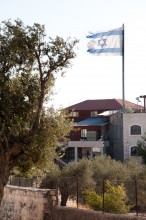
An Israeli outpost in occupied East Jerusalem (Shutterstock)
On Monday the Knesset passed a bill that would legalize settlement outposts in the occupied West Bank that were built on privately owned Palestinian land. The law can now be used to raise the status of outposts all over the West Bank to those of settlements that are legal under Israeli law (all settlements beyond the Green Line are illegal according to international law). That would be a tremendous setback to the already dimming prospects of an Israeli withdrawal from the West Bank, and to the two-state solution.
The law has already been challenged in court by Israeli human rights groups. Countries including the United Kingdom, France, Germany, Jordan and Turkey have all condemned the law, as has the United Nations. American Jewish groups, including centrist groups like the Anti-Defamation League and American Jewish Committee, have also expressed their objections to this law.
In light of the law’s passage, FMEP is updating our policy brief about the “Formalization” or “Regularization” Law.
What is the “formalization law”?
The law allows the Israeli government to retroactively legalize outposts built in the West Bank if the outpost was set up on privately owned Palestinian land with government involvement, but was not an officially sanctioned settlement. Palestinian owners would not be able to retrieve their land, but would be entitled to annual financial compensation payments at 125% of the value of the land as determined by the Israeli government.
What are the specific problems with the bill?
Israeli Attorney General, Avichai Mendelblit, stated that the bill is inconsistent with Israeli law, violates international law, and seeks to undermine the status of the High Court of Israel. It is an attempt to legalize a procedure that also violates Israeli jurisprudence and precedent since the beginning of the occupation that has agreed that the State cannot simply confiscate privately owned Palestinian land for settlements. Forcing landowners to accept a payment in exchange does not mitigate this, as the Court has repeatedly confirmed. Mandelblit has since repeated that he would not defend this law against legal challenge.
What is the status of the bill now?
The bill is now the law of the land. The legal challenges it faces are considerable, and most observers believe the law will not withstand those challenges. Still, until Israel’s High Court of Justice makes a ruling on the case, the law is in place and we cannot be absolutely certain that the law will be struck down by the Court. In the meantime, the law will have an effect on the ground. There are currently 16 outposts and settlements that have demolition orders against them due to claims of private Palestinian ownership of their lands. The law will freeze those orders for one year. Given the difficulty of getting such orders implemented (the Amona outpost was taken down just last week, after first being deemed illegal by israel’s High Court in 2006), setting the clock back on them adds a new layer of complication to an already difficult process. Similarly, the very passage of this law encourages settlers to set up outposts with even greater impunity. By the time the Court rules, even if it does strike the law down, there could be many more outposts on privately owned Palestinian land.
For more background on the law, see our original policy brief here.
Gershon Baskin is the founder of IPCRI – Israel/Palestine Center for Research and Information, and served as its co-director until January 2012. He is a long-time veteran of both Israeli peace NGOs and second track diplomacy between Israel and the Palestinians, and has many key contacts on both sides. This gives him a particularly well-informed grasp of current events.
In July 2006, after Gilad Schalit’s abduction in Gaza he began unofficially, without governmental authorization or support, to open a back channel with Hamas. Baskin was involved in the ultimately successful efforts leading up to Shalit’s release for more than five years
Baskin is a member of the steering committee of the Israeli Palestinian Peace NGO Forum, a member of the Board of Directors of ALLMEP – the Alliance for Middle East Peace, a member of the Israeli Board of One Voice Movement, and a member of the editorial committee of the Palestine Israel Journal.
Baskin holds a Ph.D. in International relations from the University of Greenwich.
All of this makes his insight into how to resolve issues particularly valuable. As this week of escalated violence in Israel and the West Bank came to a close, Baskin posted some of his thoughts to his Facebook page. We reprint them here with his permission.

From my talking and listening to many Palestinians over the past days I can conclude that no matter what we say about Israel not having plans to take over Al Aqsa, facts have nothing to do with perception and what people believe. Palestinians honestly believe that Israel has grand designs for changing the status quo on the Temple Mount/Al Aqsa. People told me quite clearly that the problem is not solely a religious one – perhaps not even mainly a religious problem – it is political, and it has to do with the continuation and the entrenchment of the occupation. The symbol of that entrenchment is Israeli control and domination over the Tempe Mount/Al Aqsa.
Here is what I think has to be done:
- Netanyahu should notify President Abbas that he is welcome to invite the leaders of the Arab world to come and pray in al Aqsa (at his invitation – not Israel’s). The list of invitees hopefully would include King Abdallah of Jordan, King Mohammed of Morocco, King Salman of Saudi Arabia, and President Sisi of Egypt.
- Israel should be holding regular, ongoing and quiet talks with the Jordanian and Palestinian Waqfs which are in control of what goes on all over the Mount. I assume that these talks are taking place but the return to status quo means that the Israeli police will refrain from entering the Mount on the condition that the officials from the Waqfs guarantee that stones, bottles and other explosive devices will not be brought into the mosques or any area on top that will be used for throwing at Jews praying at the Western Wall.
- Israel should agree that PA security personnel be allowed back onto the Mount and in the Old City and in Palestinian neighborhoods, as they used to be during the first years of the Oslo peace process. They were then in civilian dress, some of them had weapons -agreed to by Israel- others did not. They had the ability to bring suspects to Ramallah for questioning and arrest if necessary. Israel does not patrol the Palestinian neighborhoods in East Jerusalem on a regular basis – there are places that they don’t even enter. It is important to provide these people with a sense of security and for them to know that eventually understandings will be reached between Israel and Palestine on the future of Jerusalem.
Professor Brent Sasley is an Associate Professor and Graduate Advisor in the Department of Political Science at the University of Texas at Arlington. He studies and teaches the politics of the Middle East and of Israel; the nature of identity formation; and decision-making processes. He is the author of The Cold War in the Middle East, 1950-1991. FMEP asked for his views on some of the current issues concerning Israeli and American policy.
Israel finally has its new governing coalition. The idea that the Zionist Union might join in a national unity government appears to be simmering, and while Benjamin Netanyahu might try to coax them in, for now Israel is going to have a right wing/religious coalition, with the center-right Kulanu representing the only moderate party. Given Netanyahu’s statements in the election regarding the two-state solution and the apparent absence of the Palestinian issue in both the election and the coalition talks, do you see any alternative for Mahmoud Abbas other than continuing to try to internationalize the issue, at the UN, the ICC and perhaps in Europe?
The narrow coalition does indeed appear to be comprised almost entirely of rightist and religious parties, with  Kulanu representing the soft right. Moshe Kahlon’s interests in economic issues means his party is unlikely to pay much attention to settlement building or policy toward the West Bank and peace process. He might serve as a brake on some of Bayit Yehudi’s and Likud’s excesses, but otherwise his silence will serve to facilitate the continuation of the last two governments’ policies.
While Abbas’s own intransigence and fear of finally ending the conflict certainly plays a role in the failure of previous talks, the notion that the PA or Abbas have to do more to show interest in progress, and that if only they had, then Israel would have moved forward with the necessary concessions and agreements, is nonsense. An international legal effort (what some have called “lawfare”) to achieve statehood is not without precedent, including by the Zionist movement.
So if I’m Mahmoud Abbas, I don’t see much hope not only for serious talks, but for serious confidence-building measures such as curbing settlement activity outside the main blocs, ending the harsh rhetoric coming from Israel’s leaders, and distinguishing between Fatah/the PA and Hamas. It makes sense, then, for Abbas to continue working on the effort to change the international legal-diplomatic balance.
Let’s assume for the moment that the P5+1 and Iran do indeed conclude a deal similar to the one the White House described in the framework agreement. While lifting sanctions will give Iran the opportunity to expand its regional influence, a deal and an end of sanctions will also give the Americans, the Saudis and the other Arab states near the Gulf the opportunity to engage Iran and possibly open dialogue to help the whole Middle East start to climb back from the turmoil that has engulfed it in recent years. How do you view a post-nuclear-standoff future in the region and how do you think Israel might respond if there is increased dialogue with Iran?
It is difficult to say what the regional effects and what Israel’s reaction will be, because the success and aftermath of the agreement are both contingent on several other factors. I do not share the optimism that an agreement over Iran’s nuclear program will generate greater cooperation between Iran and the United States or will reduce Iranian ambitions in the Middle East. The Iranian regime’s survival is partly dependent on maintaining its commitment to the revolution. Yet legitimacy based on revolutionary impulses requires that one always strive to enhance or expand that revolution. Normalization of Iran in the region would undermine those impulses, and thus serves as a threat to the regime.
For its part, Israel very much fears Iranian normalization, but I think the fear is overstated, as I mentioned. It’s likely there will be efforts to maintain and expand dialogue between Washington and Tehran, and perhaps other regional states as well. This would be a direct threat to Israel’s position in the region, which in recent years has benefitted from the Sunni Arab states’ competition with and hostility toward Iran. Jerusalem would benefit greatly from getting ahead of the possibility of growing Iranian integration, however unlikely. It can do so by making serious efforts to reduce its presence in the West Bank, and respond constructively to the Arab Peace Initiative, which remains on the table.
Finally, given your responses to the first two questions, and given not only the current tense atmosphere between Obama and Netanyahu but also the new partisan divide over Israel (which AIPAC is desperately trying to reverse while groups like the RJC are working hard to expand it), how do you see the future of US-Israel relations going? We know security cooperation will be unaffected, but what about the “special relationship,” the cover the US gives Israel in the international arena, and other such aspects? In particular, I’d like to know how you see this going in the event of a new Clinton White House.
I’ve long argued that the relationship is far stronger than it seems on the basis of personal tensions between Obama and Netanyahu. These personal problems make the big policy discussions harder, but the relationship is rooted in a variety of other factors—strategic cooperation, shared cultural identity, similar political systems, public sympathy—that have and will overcome the individual-level problems because they are so routinized.
That said, it’s clear that the U.S. and Israel have increasingly divergent perceptions about international politics and put emphasis on different priorities. The settlement enterprise has expanded over time, across all Israeli governments. Netanyahu might have increased building in more isolated areas, but he’s still only the latest representation of a decades-long process. Yet settlements are increasingly problematic for Western publics and countries, including the United States. Similarly, Israel continues to hold a regional perspective on the Iranian nuclear program, the Arab uprisings, conventional threats to the Jewish state, and so on, while the United States has been trying to shift its attention to other issues by adopting a more global perspective.
In both cases, while the Obama Administration has certainly pushed harder for such changes, it seems that American foreign policy has been slowly moving in this direction anyway, partly pushed by external systemic forces. This is not to say that Washington will turn away from the Middle East—even Barack Obama couldn’t, as much as he tried. But if the White House’s attention is further diffused across the globe, Israel’s regional concerns will matter less.
It’s hard to know what a Hillary Clinton White House would do. I suspect the problem of settlements would remain a thorn in the personal relationship with Netanyahu. More broadly, it’s very possible the days of a Democratic president maintaining a Bill Clinton-style closeness with an Israeli leader could well be over. Much also depends on who becomes the next prime minister of Israel, if the current government has only a brief time in office. It’s also possible that this Netanyahu government limps along for a few years, kept in power but also constrained by its domestic political struggles, and therefore doesn’t engage in major policy changes but rather continues along the current path. This will make it harder for Clinton to challenge Netanyahu on the big policy questions.