The New York-based group T’Ruah: The Rabbinic Call For Human Rights recently filed a complaint with the State Attorney General against the American arm of an Israeli organization called Honenu. The complaint is based on the fact that Honenu offers financial assistance to the families of both accused and convicted Jewish terrorists in Israel.
It is no secret that American charities send tax-deductible donations to Israeli settlements. And, while supporting settlements may be contrary to the stated policy of the United States, sending such donations is neither illegal nor a violation of IRS regulations governing tax-deductible charitable donations.
What makes Honenu different is that they act in support of people who have committed acts of terrorism. It is on this basis that T’Ruah filed its complaint.
Honenu’s activities were exposed in a report by Israel’s Channel 10. According to that report, Honenu sent funds to the family of an Israeli convicted of killing seven Palestinians in May 1990; the families of two Israelis convicted of attempted murder for trying to plant a bomb at a school in East Jerusalem in 2002; and an Israeli who kidnapped and abused a Palestinian boy in 2010. Further, according to Israeli reporter Uri Blau, Honenu has also sent money to the family of Yigal Amir, who assassinated Yitzhak Rabin in 1995.
As T’Ruah’s complaint states, ““Honenu is doing exactly what Hamas and the PLO have been criticized for — providing personal support, if not incentives, for those who commit terrorist acts.”
Will the AG uphold T’Ruah’s complaint? This is questionable. The basis for criminalizing such donations has usually been that the money is supporting groups appearing on the State Department’s list of terrorist organizations. The case T’Ruah is building is that these groups should be included on that list or that the spirit of the law – that American charitable donations must be barred from supporting acts of terrorism – be carried out. In the past, the Hebron Fund has been the target of similar complaints, though no action has been taken yet.
But the issue does not stop there. As so-called “price tag” attacks (where settlers attack Palestinians in response to Israeli decisions to take down illegal outposts or other measures that Israel takes from time to time to limit settlement activity) have escalated, even the current government in Israel — one of the most right-wing, pro-settlement ever elected — has taken to using the “terrorist” label against the groups that commit these acts. That opens the door for stigmatization even if the American tax authorities will not revoke tax-exempt status from organizations that support the radical settlers in the West Bank.
Stigmatizing such organizations can have a significant impact. While Honenu is a relatively small organization, the funds it raises are channeled through the Central Fund of Israel, a much larger NGO which raised over $70 million from 2009-13 for a variety of causes in Israel, and which was also named in T’Ruah’s complaint. The overwhelming majority of these causes are perfectly legitimate charities. If there is a political cost for supporting a group like Honenu, one which could put other donations at risk, perhaps the Central Fund and other large funding sources would end its relationship with such groups
To many, it might seem absurd that Americans can get tax deductions for supporting settlements in any way when United States policy has always opposed them. But we must keep in mind that the US has deliberately loose regulations about charitable donations and, in many ways, this helps organizations across the political spectrum. While no non-profit can violate the law, many can and do oppose a wide variety of US policies.
Legality is the dividing line. Europe recognizes the illegality of settlements under international law. As the European Council on Foreign Relations points out, this opens the door for the EU and its member states to remove the tax-exempt status of organizations supporting the settlements, whether the settlers in question are engaged in acts of direct violence or not.
In the United States, however, the legality of the settlements is a politicized question that has become very murky. In 1978, the State Department Legal Advisor deemed settlements “inconsistent with international law,” a stance that has never been officially rescinded. However, every President since Ronald Reagan has avoided calling settlements illegal and Congress has never made any such determination. This makes it much more difficult to slow funding from American charities that is flowing to the West Bank.
Whether T’Ruah’s complaint will result in Honenu being stripped of its non-profit status or not, it is imperative that groups that support settlements be held up to the light, so that people who donate can make an educated choice about what they support. More importantly, if it serves as a vehicle to push the United States to shift its position on the legality of the settlements to one that is in line with almost the entire world (the overwhelming majority of international legal opinion), it will have accomplished a lot more than cutting off a few dollars from one group that supports the most radical settler elements.
Video courtesy of Americans for Peace Now
Ali Saad Dawabsheh was only 18 months old when Israeli settlers who entered his village of Douma to carry out a so-called “price tag” attack took his life away by setting fire to his home. The crime brought shock and horror to many, regardless of their views of the overall Israel-Palestinian conflict.
But the reality is that this death is very much a part of that conflict. It cannot be understood apart from it. It is not anomalous. Ali was far from the first baby killed in this conflict, on either side.
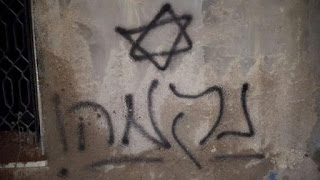
Graffiti meaning “revenge”
It is no surprise that such a horrifying act leads people to say “something more must be done.” But, of course, the conflict will not end over this incident. In a matter of weeks, Ali’s death will be just one more tragedy in a long list of tragedies in Israel-Palestine.
Is it possible for this tragedy to move us closer to resolving the conflict? Is it possible that, even without ultimately resolving the major political issues we can make it more difficult for an atrocity like this to occur? Perhaps it is, if we ask one important question and make sure we get all the answers to it.
Why is Ali Dawabsheh dead?
Ali and his family were in their home at night when arsonists set it on fire. Ali’s parents and four year-old brother suffered severe burns and Ali died. The attackers spray-painted the word “nekama” in Hebrew on the resident. The word means “revenge.”
Why is Ali Dawabsheh dead?
Until the murderers are caught, we cannot be certain, but it is likely that this “price tag” attack was carried out in response to Israel’s demolition of two structures in the settlement of Beit El on the West Bank. After the High Court in Israel ordered their demolition, the Netanyahu government immediately granted permits for hundreds of new living units in Beit El and the East Jerusalem area. This, however, was apparently not enough compensation for those who carried out this heinous act.
Why is Ali Dawabsheh dead?
Given the shocking nature of the crime, the Israeli government will likely put considerable resources toward identifying and arresting the perpetrators. However, on a day-to-day basis, Palestinians in the West Bank have no protection from settlers. Israeli Defense Forces and Border Police often do not prevent settler attacks on Palestinians. It’s not uncommon to see them protecting settlers as they attack Palestinians.
Moreover, the forces of the Palestinian Authority have no jurisdiction over settlers and cannot protect their own citizens from them. Settlers in general feel they may act with impunity. As the Israeli human rights group, B’Tselem states, “In recent years, Israeli civilians set fire to dozens of Palestinian homes, mosques, businesses, agricultural land and vehicles in the West Bank. The vast majority of these cases were never solved, and in many of them the Israeli Police did not even bother to take elementary investigative actions.”
Why is Ali Dawabsheh dead?
In the wake of Ali’s death, the rush to express outrage was staggering. Israeli politicians across the spectrum vowed that the murderers would be brought to justice. No doubt, they are sincere in their personal outrage and in the desire to show Israelis and the rest of the world that this is something they will not tolerate as leaders.
But their comments are universally directed at the crime itself, implying that this act was an anomalous blot on the Israeli page with no cause other than hate and extremism. The words not only of Benjamin Netanyahu, Naftali Bennett and other leaders of the current government, but also those of opposition leaders Isaac Herzog and Yair Lapid make no connection between Ali’s murder and the occupation, the settlement project or the increasingly anti-Arab tone of many of Israel’s leaders.
There was scant mention of the tolerance shown to the extreme right of the settler movement over the years. As Amos Harel put it in Ha’aretz, “The forgiveness the state has shown over many long years toward the violence of the extreme right – which was also evident this week at Beit El (none of those attacking the police are now in detention) – is also what makes possible the murderous hate crimes like Friday’s in the village of Douma. There is a price for the gentle hand.”
The decision to build hundreds of units in Beit El and East Jerusalem sent a message that the government would find ways to make the rulings of the High Court against illegal building moot in all practical ways. The bigger message that was sent in the wake of protests in Beit El where Israeli soldiers were attacked was this: violence pays, at least for the settlers.
The occupation and settlement program are themselves a form of daily violence that dispossess Palestinians, place them under military rule and deprive them of their basic rights. It may not be easy to end the occupation, but the casual way many in Israel have turned to “managing the conflict” and given up on ending the occupation sends the message that such institutionalized violence by Israel against Palestinians is at least tolerable. Why would anyone be surprised that the more radical elements among settlers would take that a few steps further?
Why is Ali Dawabsheh dead?
In the wake of Ali’s death, Palestinian President Mahmoud Abbas called for the International Criminal Court (ICC) to investigate this act as a war crime. But this was an act of civilian murder, even if the civilian(s) who committed it was living in a settlement deemed illegal under international law. Moreover, the ICC would not act if Israel were legitimately pursuing the perpetrators, which it certainly seems like it is doing. Politicizing Ali’s death in this manner is typical of the conflict, and thoroughly counter-productive.
Indeed, mixed in with his words of outrage, Netanyahu also could not resist politicizing it in his own way by saying that Israel pursues such criminals while Palestinians name streets after them (In reality, Israel celebrates its own terrorists too). This was an opportunity for the two leaders to unite in condemning a crime and calling for justice. Instead, both took it as an opportunity to aggravate the differences between them.
Why is Ali Dawabsheh dead?
While this goes on, members of the United States Congress works to legitimize the settlement enterprise by equating it under the law with Israel itself. The White House is focused on the Iran nuclear deal and it is not yet clear what, if any action the current administration might take to improve the situation in Israel-Palestine before they leave office. In Europe, merely labeling products emanating from settlements is so controversial that the process of setting up an enforcement mechanism for a regulation that already exists in European Union law is dragging along at a snail’s pace.
Without ending the occupation of the West Bank, it is only a matter of time before the next horrifying incident, whether it happens to a Palestinian or an Israeli child. As Noam Sheizaf of +972 Magazine wrote, “…violence is inseparable from the colonial reality in the occupied territories — without putting an end to that reality, there is no chance to properly deal with violence. Even if things cool down temporarily, the situation will only grow worse in the long run. The only solutions are the evacuation of settlements or equal rights for all.”
And ultimately, Sheizaf’s words are the answer to the all important question:
What can we do to prevent more deaths like Ali Dawabsheh’s?
Ultimately, there is no way to stop these incidents without ending the occupation and the daily reality of privileged and protected Israeli settlers living in a Palestinian territory mostly populated by people who live under military occupation.
However, this crime was entirely predictable. Crimes like it can be prevented, at least some of the time, and it does not require an end to the conflict to do so.
Until the conflict is resolved, Israel must meet its responsibilities to protect Palestinian civilians from settlers. Both Israelis and Palestinians can treat incidents like this one as the crimes they are and refrain from politicizing them, allowing both sides to condemn them unreservedly and in unison. Finally, the United States and Europe can stop equivocating and insist that the settlement project stop immediately, and be prepared to put real pressure on Israel to make it happen.
Ali’s death can be a wake up call, or it can be just another horrible story among decades of horrible stories. Which it will be will depend as much on people’s willingness to pressure their own governments in a productive direction as it will on those governments, in Jerusalem, Ramallah, Brussels and Washington, finding the courage to finally act. Some Israeli settlers would condemn Ali’s murder. But until the occupation and the settlement project end, tragedies like this on are inevitable. If there is to be any hope of preventing them, it has to start with people standing up to finally say “NO” to the settlements and to force their governments to do likewise.