Ali Saad Dawabsheh was only 18 months old when Israeli settlers who entered his village of Douma to carry out a so-called “price tag” attack took his life away by setting fire to his home. The crime brought shock and horror to many, regardless of their views of the overall Israel-Palestinian conflict.
But the reality is that this death is very much a part of that conflict. It cannot be understood apart from it. It is not anomalous. Ali was far from the first baby killed in this conflict, on either side.

Graffiti meaning “revenge”
It is no surprise that such a horrifying act leads people to say “something more must be done.” But, of course, the conflict will not end over this incident. In a matter of weeks, Ali’s death will be just one more tragedy in a long list of tragedies in Israel-Palestine.
Is it possible for this tragedy to move us closer to resolving the conflict? Is it possible that, even without ultimately resolving the major political issues we can make it more difficult for an atrocity like this to occur? Perhaps it is, if we ask one important question and make sure we get all the answers to it.
Why is Ali Dawabsheh dead?
Ali and his family were in their home at night when arsonists set it on fire. Ali’s parents and four year-old brother suffered severe burns and Ali died. The attackers spray-painted the word “nekama” in Hebrew on the resident. The word means “revenge.”
Why is Ali Dawabsheh dead?
Until the murderers are caught, we cannot be certain, but it is likely that this “price tag” attack was carried out in response to Israel’s demolition of two structures in the settlement of Beit El on the West Bank. After the High Court in Israel ordered their demolition, the Netanyahu government immediately granted permits for hundreds of new living units in Beit El and the East Jerusalem area. This, however, was apparently not enough compensation for those who carried out this heinous act.
Why is Ali Dawabsheh dead?
Given the shocking nature of the crime, the Israeli government will likely put considerable resources toward identifying and arresting the perpetrators. However, on a day-to-day basis, Palestinians in the West Bank have no protection from settlers. Israeli Defense Forces and Border Police often do not prevent settler attacks on Palestinians. It’s not uncommon to see them protecting settlers as they attack Palestinians.
Moreover, the forces of the Palestinian Authority have no jurisdiction over settlers and cannot protect their own citizens from them. Settlers in general feel they may act with impunity. As the Israeli human rights group, B’Tselem states, “In recent years, Israeli civilians set fire to dozens of Palestinian homes, mosques, businesses, agricultural land and vehicles in the West Bank. The vast majority of these cases were never solved, and in many of them the Israeli Police did not even bother to take elementary investigative actions.”
Why is Ali Dawabsheh dead?
In the wake of Ali’s death, the rush to express outrage was staggering. Israeli politicians across the spectrum vowed that the murderers would be brought to justice. No doubt, they are sincere in their personal outrage and in the desire to show Israelis and the rest of the world that this is something they will not tolerate as leaders.
But their comments are universally directed at the crime itself, implying that this act was an anomalous blot on the Israeli page with no cause other than hate and extremism. The words not only of Benjamin Netanyahu, Naftali Bennett and other leaders of the current government, but also those of opposition leaders Isaac Herzog and Yair Lapid make no connection between Ali’s murder and the occupation, the settlement project or the increasingly anti-Arab tone of many of Israel’s leaders.
There was scant mention of the tolerance shown to the extreme right of the settler movement over the years. As Amos Harel put it in Ha’aretz, “The forgiveness the state has shown over many long years toward the violence of the extreme right – which was also evident this week at Beit El (none of those attacking the police are now in detention) – is also what makes possible the murderous hate crimes like Friday’s in the village of Douma. There is a price for the gentle hand.”
The decision to build hundreds of units in Beit El and East Jerusalem sent a message that the government would find ways to make the rulings of the High Court against illegal building moot in all practical ways. The bigger message that was sent in the wake of protests in Beit El where Israeli soldiers were attacked was this: violence pays, at least for the settlers.
The occupation and settlement program are themselves a form of daily violence that dispossess Palestinians, place them under military rule and deprive them of their basic rights. It may not be easy to end the occupation, but the casual way many in Israel have turned to “managing the conflict” and given up on ending the occupation sends the message that such institutionalized violence by Israel against Palestinians is at least tolerable. Why would anyone be surprised that the more radical elements among settlers would take that a few steps further?
Why is Ali Dawabsheh dead?
In the wake of Ali’s death, Palestinian President Mahmoud Abbas called for the International Criminal Court (ICC) to investigate this act as a war crime. But this was an act of civilian murder, even if the civilian(s) who committed it was living in a settlement deemed illegal under international law. Moreover, the ICC would not act if Israel were legitimately pursuing the perpetrators, which it certainly seems like it is doing. Politicizing Ali’s death in this manner is typical of the conflict, and thoroughly counter-productive.
Indeed, mixed in with his words of outrage, Netanyahu also could not resist politicizing it in his own way by saying that Israel pursues such criminals while Palestinians name streets after them (In reality, Israel celebrates its own terrorists too). This was an opportunity for the two leaders to unite in condemning a crime and calling for justice. Instead, both took it as an opportunity to aggravate the differences between them.
Why is Ali Dawabsheh dead?
While this goes on, members of the United States Congress works to legitimize the settlement enterprise by equating it under the law with Israel itself. The White House is focused on the Iran nuclear deal and it is not yet clear what, if any action the current administration might take to improve the situation in Israel-Palestine before they leave office. In Europe, merely labeling products emanating from settlements is so controversial that the process of setting up an enforcement mechanism for a regulation that already exists in European Union law is dragging along at a snail’s pace.
Without ending the occupation of the West Bank, it is only a matter of time before the next horrifying incident, whether it happens to a Palestinian or an Israeli child. As Noam Sheizaf of +972 Magazine wrote, “…violence is inseparable from the colonial reality in the occupied territories — without putting an end to that reality, there is no chance to properly deal with violence. Even if things cool down temporarily, the situation will only grow worse in the long run. The only solutions are the evacuation of settlements or equal rights for all.”
And ultimately, Sheizaf’s words are the answer to the all important question:
What can we do to prevent more deaths like Ali Dawabsheh’s?
Ultimately, there is no way to stop these incidents without ending the occupation and the daily reality of privileged and protected Israeli settlers living in a Palestinian territory mostly populated by people who live under military occupation.
However, this crime was entirely predictable. Crimes like it can be prevented, at least some of the time, and it does not require an end to the conflict to do so.
Until the conflict is resolved, Israel must meet its responsibilities to protect Palestinian civilians from settlers. Both Israelis and Palestinians can treat incidents like this one as the crimes they are and refrain from politicizing them, allowing both sides to condemn them unreservedly and in unison. Finally, the United States and Europe can stop equivocating and insist that the settlement project stop immediately, and be prepared to put real pressure on Israel to make it happen.
Ali’s death can be a wake up call, or it can be just another horrible story among decades of horrible stories. Which it will be will depend as much on people’s willingness to pressure their own governments in a productive direction as it will on those governments, in Jerusalem, Ramallah, Brussels and Washington, finding the courage to finally act. Some Israeli settlers would condemn Ali’s murder. But until the occupation and the settlement project end, tragedies like this on are inevitable. If there is to be any hope of preventing them, it has to start with people standing up to finally say “NO” to the settlements and to force their governments to do likewise.
Statement by Matthew Duss
President, Foundation for Middle East Peace, Washington, D.C.
Presented to Subcommittee on National Security, Committee on Oversight and Government Reform
“Impact of the Boycott, Divestment, and Sanctions Movement”
Mr. Chairman, Members of the Oversight Committee, thank you for inviting me to testify today on this important and timely issue.
In the ten years since it commenced, the global Boycott, Divestment and Sanctions movement, or BDS as it is called, has slowly but steadily risen in visibility. I’d like to focus today on the role that the BDS movement has been playing recently in the U.S, particularly with regard to recent Congressional action.
In order to do that, I first want to take a moment to identify just what we’re talking about when we refer to BDS. The movement began in July 2005 with a joint call from a number of Palestinian civil society organizations, with three main demands: An end to the occupation that began in 1967; equal rights for Palestinians citizens within Israel; and protecting and promoting the rights of Palestinian refugees to return to their homes in what is today Israel. The term “BDS” is widely understood to refer to the network of grassroots activists who are part of a global movement to encourage boycotts, divestment from, and ultimately international sanctions against Israel to achieve these goals.
This movement – its goals and its activism – is distinct from the many peace activists in Israel, Palestine, the United States and elsewhere, who, in their effort to preserve the possibility of a two-state solution to the Israeli-Palestinian conflict, call for boycotts of settlement products and divestment from businesses profiting from the 48-year old occupation of the West Bank, Gaza and East Jerusalem.
Crucially, this movement is also distinct from actions and policies of the European Union and the governments of some member states that distinguish between Israel within the pre-1967 lines – known as the Green Line – and the occupied territories. A recent report by the European Council on Foreign Relations emphasizes that these actions and policies do not represent a policy shift by the European Union, but simply more faithful adherence to the EU’s existing laws.
The report states, in part, “The EU has never recognized the legality of Israeli settlements in the occupied territories (including those in East Jerusalem and the Syrian Golan Heights that have been formally annexed by Israel) and consequently does not consider agreements signed with Israel to also apply to Israeli settlement-based entities.” The report also cites a February 2010 ruling from the European Court of Justice (ECJ) stating that agreements reached with Israel must be interpreted in light of the EU’s agreements with the Palestinians, which stipulate that only Palestinian authorities can issue origin certificates for goods from the West Bank, including from Israeli settlements. As a result, the report states, “The European Commission and the EEAS have gradually been compelled to take greater care in ensuring the EU’s correct adherence to European law in its bilateral relations with Israel.”
The key distinction here is between Israel within the Green Line, and the occupied territories. Israel is understandably concerned about the potential consequences of Europe, its largest trading partner, more energetically enforcing these laws. The EU has, for years, looked the other way on these regulations in the hope that the occupation would soon end and that the differentiation between Israel and the settlements would become moot. As the ECFR report states, “[D]ue to the fact that as cooperation with Israel expanded in the 1990s, the EU treated Israel’s occupation as temporary in the belief that the imminent success of the Oslo peace process would make added clarifications a moot point. The EU therefore avoided implementing a legal regime of differentiation (between Israel and the occupied territories) during this period.”
But in recent years, as the peace process has stalled, most recently with the collapse of Secretary of State Kerry’s effort in April of last year, the EU has renewed an effort to begin more aggressively enforcing their existing laws. It is important here to point out that these laws are fully consistent with long-standing American policy that similarly does not recognize the legitimacy of Israeli settlements, unless and until their status is redefined in negotiations.
This is where we come to the recent action by Congress and the response from the State Department. With the stated intention of protecting Israel from BDS, a provision was recently added to the Trade Promotion Authority bill– a provision that implied a significant shift in the policy of the United States since 1967. The provision requires the U.S. Trade Representative to discourage European Union countries from boycotting “Israel or persons doing business in Israel or Israeli-controlled territories” (emphasis added) as part of free-trade negotiations between the U.S. and the EU. In doing so, the amendment conflates Israel and the occupied territories. By blurring this important distinction, a dangerous precedent could be set for treating Israeli settlements beyond the 1967 lines no differently from the internationally recognized State of Israel. At the very least, it would create confusion amongst our allies with regard to U.S. policy regarding the occupied territories and their ultimate disposition.
In addition, conflating Israel and the settlements for the purposes of U.S. trade negotiations represents a clear threat to the two-state solution itself, undermining the our country’s ability to effectively broker a peace agreement between the Palestinians and Israelis.
This is why it was important and appropriate for the State Department to offer a clarification as it did upon passage of the trade bill. State Department spokesman John Kirby noted that, “The United States government has … strongly opposed boycotts, divestment campaigns, and sanctions targeting the State of Israel, and will continue to do so. However, by conflating Israel and ‘Israeli-controlled territories,’ (this) provision of the Trade Promotion Authority legislation runs counter to longstanding U.S. policy towards the occupied territories, including with regard to settlement activity.” Mr. Kirby went on to state that, “The U.S. government has never defended or supported Israeli settlements and activity associated with them and, by extension, does not pursue policies or activities that would legitimize them.”
It is important to recall that U.S. law already protects Israel against boycotts initiated by foreign governments. The Export Administration Act of 1979 and the Ribicoff Amendment to the Tax Reform Act of 1976 were enacted to protect Israel from the Arab League’s boycott against the State of Israel. The amendment to the fast-track bill adds nothing in this regard. Rather, it serves only one purpose: protecting settlements from pressure.
Ironically, this very conflation is precisely what the most radical elements in the BDS movement strive to achieve. Those who believe that the only solution to the conflict is the end of Israel as a Jewish state and the creation of a single state in its place reject any distinction between, for example, the settlement of Ariel in the occupied territories and the city of Tel Aviv. Similarly, those who support a messianic vision of “Greater Israel,” which requires permanent Israeli control of the occupied territories, reject any distinction between Haifa and the settlements inside Hebron. For those who support a two-state solution that includes a secure, democratic and Jewish state of Israel living side by side with a secure and independent Palestinian state, this conflation is extremely problematic.
There is another conflation here that is also of concern. When questions arise about the possible impact of BDS, there is often no distinction made between the effects of the BDS movement and the actions taken by European or other trading partners of Israel. This ends up overstating the impact of the BDS movement, both for its supporters and detractors.
There is no evidence that the European Union’s policies and actions with regard to settlements are based on the actions of the BDS movement. On the contrary, it is the collapse of the peace process, the deepening of Israel’s occupation and the possible foreclosure of the two-state solution that have motivated these European moves. In a letter to European Union Foreign Minister Federica Mogherini in April, sixteen European Foreign Ministers urged the labelling of products originating in the settlements, writing that: “European consumers must indeed have confidence in knowing the origin of goods they are purchasing. Green Line Israel and Palestinian producers will benefit from this.” Far from being motivated by the BDS movement, the ministers made it clear that it was the stalled peace process that provided the impetus for their recommendation. The goal was, in their words, “the preservation of the two-state solution.”
Likewise in the United States, the most prominent examples of concrete boycott- and divestment-related activism in the Israeli-Palestinian arena have fact been focused unambiguously not on Israel but on the settlements and the occupation. These developments are the product of frustration with the failure of diplomacy to bring an end to the occupation, and a desire to preserve the possibility of a two-state solution. As in Europe, the actions involved are distinct from the efforts and goals of the BDS movement. For example, the Presbyterian Church (USA) heard a great deal from the BDS movement over the years in which it debated the decision it eventually adopted in 2014 to divest from companies it believed were profiting from Israel’s occupation. Yet the Church made it clear in its decision that it was not acting in concert with the BDS movement, but from its own principles – and it focused its activism not on Israel, but explicitly on the occupied territories.
In a statement made after the vote to divest, PC (USA) issued a statement saying, “[O]ur action to selectively divest was not in support of the global BDS movement. Instead it is one of many examples of our commitment to ethical investing. We are pressed and challenged to follow our faith values and commitments in all times and in all areas of our lives. The occupation must end. All peoples in Israel and Palestine should live in security, freedom, and peace. This action is but one aspect of our commitment to work to this end.”
PC (USA) went on to explicitly reiterate its support for the existence of the State of Israel and for the two-state solution, clarifying that, “This action on divestment is not to be construed or represented by any organization of the PC (USA) as divestment from the State of Israel, or an alignment with or endorsement of the global BDS (Boycott, Divest and Sanctions) movement.”
As of today, the BDS movement, in and of itself, is not a threat to Israel, either economically or in terms of security. The main impact of the BDS movement has been in generating an oftendivisive debate, on American campuses, among academics faced with campaigns for academic boycotts and in getting a handful of musicians to cancel or publicly declare their intent not to perform in Israel.
To the extent that one sees BDS actions as part of an effort to “de-legitimize” Israel, they should certainly be addressed, but not through legislation. Israel has the protection it needs and deserves under existing U.S. law. The arguments raised by the BDS movement in academic and other civil society institutions should be addressed, in the American tradition, with thoughtful, considered and ethical counter-arguments.
I would also suggest that it is a mistake to focus on the BDS movement while ignoring the main reason for its continued growth, which is the failure to end the occupation that began in 1967 and achieve Palestinian national liberation and sovereignty. If one is genuinely concerned about the impact of the BDS movement, the surest way to take the wind out of its sails would be to work diligently to achieve those goals, and act against efforts which prevent them.
Moreover, it would be hugely counterproductive to give BDS an unearned win by cooperating in any way with the conflation of Israel and the occupied Palestinian territories. We must recognize legitimate actions, whether we agree with them or not, by European governments as well as civil society actors that draw a distinction between the settlements and the State of Israel. We can and must support Israel in defending herself against actions that genuinely threaten its security and legitimacy. This has been a consistent American position since Israel’s birth.
Another position in which America has been consistent has been in opposing the creation of Israeli settlements beyond the Green Line, which have been deemed illegitimate and an obstacle to peace by every U.S. president since 1967. Efforts to blur that distinction are just as dangerous to Israel’s existence as a Jewish and democratic state as attacks on Israel’s legitimacy itself. It is entirely consistent with longstanding U.S. policy, and indeed necessary to preserve the ultimate goal of a two-state solution, to continue to preserve that distinction in U.S. policy and law.
I thank you, Committee members, for your time and attention.
When President Barack Obama signed the Trade Promotion Authority (TPA) bill last week, a precedent was set. The bill included a provision that “…requires the U.S. Trade Representative to discourage European Union countries from boycotting ‘Israel or persons doing business in Israel or Israeli-controlled territories’ during free-trade negotiations between the U.S. and the EU.”

Israeli settlement of Beitar Ilit in the West Bank
In effect, this amendment treated Israeli settlements, for the first time in American history, as being part of Israel and therefore deserving the same protection. It was a small step; there is no enforcement mechanism in the bill.
However, it cracked the dam and opened the potential for a flood. This small amendment was a first step in reversing long-standing American opposition to the settlements, and its support for the two-state solution. Read more at Talking Points Memo
Yair Lapid, Israel’s former Finance Minister, told a hawkish “pro-Israel” gathering in New York that the leaders of the Boycott, Divestment and Sanction movement (BDS) are anti-Semites and their followers are “bleeding heart, so-called intellectuals.” Lapid went on to say that European citizens and American students “…are cheering for the people and values that brought 9/11 to this country. You are supporting people that kill gays and suppress women.”
Mutual Demonization
Lapid is far from alone in elevating the movement to a threat on par with Israeli descriptions of Iran. Whether it was Israeli Prime Minister Benjamin Netanyahu placing a high-ranking Likud Member of the Knesset in charge of battling BDS or grandstanding on the issue by prominent members of Congress, the “threat” of BDS has never seemed greater.
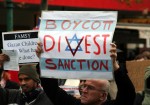
The hyperbole around the issue has never been greater either. All of it is transparently overblown to anyone who actually knows the various players in this game. The BDS movement is not made up, as Netanyahu’s Minister of Justice Ayelet Shaked stated, of radical Islamists, anti-Semites and naïve fellow travelers.
I have known many BDS leaders for many years, as I have also known many of my fellow two-state supporters. I understand their motivations. I disagree often with BDS leaders, but I have never known most of them to wish for violence of any kind, express support for al-Qaeda or ISIL, or express animosity towards Jews as Jews. Many of these folks are, indeed, anti-Zionists, and support a single democratic state in all of what they call “historic Palestine.” I disagree with them on that point, but my disagreement does not mean they hate me, or I them.
That doesn’t mean there are no anti-Semites in the BDS movement. Any pro-Palestinian movement is naturally going to attract those who wish to hide their anti-Semitic agenda under a more acceptable cloak. This small minority within their ranks does not define them.
Unintended Consequences
Israelis, and too many of its supporters, continue to bury their head in the sand about Israel’s diminishing standing in the world. The blame is on Palestinian public relations, the reach of the BDS movement, global anti-Semitism, or their own failure to adequately explain their position to the world. The one thing it never is, according to the Netanyahu government and too many “pro-Israel” groups around the world is Israeli policy.
Part of avoiding the policy debate is presenting Israel as a country constantly facing imminent destruction. While Israel faces very real threats to its citizens, it has not faced an existential threat in a very long time. Iran has never been that, as many Israeli security experts have confirmed. If a deal limiting its nuclear program is finalized, the world is unlikely to buy Israeli complaints that Iran could ever “wipe Israel off the map.” So, BDS is being primed for the role of menacing villain.
For their part, the BDS movement seems to be feeding eagerly on Israeli public relations. Despite having had no discernible impact on Israel’s economy or its determination to maintain its occupation, they are trumpeting their success.
One can understand this, of course. Bibi needs the perception of an existential threat to bolster his politics of fear, while the BDS movement, a grassroots movement with little financial backing, needs to demonstrate its own effectiveness. These tactics, however, are damaging hopes of progress toward a resolution of this vexing conflict.
By avoiding moves to end its 48-year old occupation and exaggerating the BDS threat, Israel is actually proving that only substantive pressure will convince it to end the occupation. This is a point on which the BDS movement and I agree; I have argued for decades that the biggest obstacle to ending the occupation is that Israel, in this regard a country like any other, is expected to take what it perceives as a huge risk without any pressure. The occupation’s  costs are largely covered by the European Union, United States and some Arab states, and despite the terrorist attacks Israel still occasionally endures, almost exclusively in the form of sporadic rocket fire from Gaza, the Palestinians have few means to pressure Israel. This is the logic behind the PLO’s international campaign, which must be understood as distinct from BDS.
Israel is running other risks as well. By conflating so many actors and actions with BDS tactics and movements, it risks galvanizing a much harsher opposition than it has seen in the past. Domestically, this false image of BDS is already being used to push the right wing’s assault on democracy even further, while reinforcing the Israeli sense that the “whole world is against us.”
The Effect of BDS
The fact is that any effect BDS has had on Israel’s economy is imperceptible. The economic issues Israel faces have no connection to any drop in exports or loss of investment. That does not mean it never will, but it does mean that the hysteria about BDS is way out of proportion with its impact to date. So, we are left with the most right-wing government in Israeli history governing a country whose citizens, even the majority that still supports a two-state solution, believe that ending the occupation carries major security risks. That is a country that will not change its policies absent significant pressure.
If we accept that self-evident fact, we confront the fact that many people and groups who do not wish to be associated with the BDS movement, its leadership and some of its specific goals have for years avoided any sort of organized economic action against Israel’s occupation. While one can hardly blame the BDS movement for this (in no way have they acted to prevent more moderate groups from taking actions aimed strictly at the occupation), it is an unintended consequence of their activities.
Netanyahu has taken full advantage of the political void this opens up. When the European Union wants to enforce existing laws that distinguish between products made in Israel and those from the settlements, it is considered a “sanction” against Israel; i.e. the “S” in BDS. As a result, liberal Zionist, centrist and many progressive groups avoid any hint of economic action against the occupation.
Groups like Americans for Peace Now (APN), one of the very few who are standing up to call for boycotting settlement products, are not getting the support they need. Yet the few instances of divestment or refusal to do business in the West Bank (most of which were not attributed to the BDS movement by the organizations that took such actions, some of whom even explicitly stated that they were not acting as part of that movement) have all been firmly rooted in opposition to the occupation. They have not been connected to the other conditions of the BDS movement’s call to action, regarding Palestinian citizens of Israel and the right of return of Palestinian refugees.
The Need for Economic Action
It is unfair, however, to expect the BDS movement to abandon its tactics because they are being used to scare more moderate peace groups away from action. Instead, it is the responsibility of moderates, two-state solution supporters and those who support Israel but loathe the occupation to stand up for our beliefs. Let the BDS movement do what it is doing. If you are really worried that BDS will “de-legitimize” Israel with rhetoric, then counter it with a principled, pro-Israel stand for Palestinian rights and statehood and an end to the occupation.
The distinction that Netanyahu and his cohorts in AIPAC and in Congress are trying to blur must be sharpened instead. The settlements are not Israel. They are an immoral and illegal enterprise that should not be supported — through tax dollars, investment or purchases. From such a position, classifying corporations that are profiting from the occupation, especially American ones as “socially irresponsible” can be supported on a pro-Israel basis. From that position, groups can stand up for Israel and support Israelis who are working to end the occupation, and combat the discrimination against Arabs that has become so bitter in recent years.
That is also a pro-Israel position from which Americans can demand that our government name the settlements the illegal enterprise they are, and treat them accordingly. It is a position from which one can promote a secure Israel within the Green Line that can, at long last, find some peace in that tumultuous region. It just has to stop denying millions of Palestinians their basic rights and any hope for the future. That, not Netanyahu’s demagoguery, is truly pro-Israel.
In the wake of the collapse of the last round of Israeli-Palestinian talks last April, it’s become widely accepted that the continuing growth of Israeli settlements is a key obstacle to an agreement. This has created difficulties for those inclined to support the Israeli government’s ability to do whatever it wants. One way to make it easier to defend the settlements and the occupation that sustains them is to obscure the difference between them and Israel proper. As I wrote last month, a method that lobbyists like the American-Israel Public Affairs Committee (AIPAC) have been employing lately to accomplish that is to target the Boycott, Divestment, and Sanctions movement (BDS).
Several recent pieces of legislation demonstrate how this is accomplished. In Illinois, a bill prohibiting Illinois from contracting with businesses that are boycotting Israel passed unanimously in both the State Legislature and Senate. The language of the bill specifically includes “territories controlled by the State of Israel” – that is, territories occupied by Israel after the 1967 war, which no country in the world, including the U.S., recognizes as part of Israel.
In Congress, amendments to the bills that would give the President the power to negotiate the Trans-Pacific Partnership trade deal without public scrutiny (called “fast track”) require the President to make combatting any boycotts of Israel a principle trade objective and would require the President to report to Congress on any businesses that are participating in such boycotts. These amendments also specifically include “territories controlled by Israel.”
In both cases, the legislation does little if anything to protect Israel’s legitimacy. Rather, they extend existing American protection to Israel’s settlements, treating them as if they were a part of Israel for the first time in American history.
It is important to recall that US law already protects Israel against boycotts started by foreign governments. The Export Administration Act of 1979 and the Ribicoff Amendment to the Tax Reform Act of 1976 were enacted to protect Israel from the Arab League boycott against it. The Illinois law extends this protection in a small way, to encompass any boycotts against Israel, whether initiated by governments or civil society. The amendments in Congress, by contrast, change nothing with regard to boycotts of the internationally recognized State of Israel.
The real effect of those amendments and the major effect of the Illinois law as well, actually has nothing to do with any boycotts of Israel, whether by Arab states or activists. The upshot of all of these measures is that, for the first time, the United States is treating the settlements as if they were part of Israel. At no time has the United States ever implied any recognition of Israeli sovereignty over any territory it occupied in 1967. Even Israel’s annexations of the Golan Heights and East Jerusalem have never been recognized by the United States.
Promulgating bills purported to be opposing BDS is a clever way to disguise what is, in reality, an effort to affect a major shift in American policy toward the settlements. Admittedly, it is a slower way to change that policy, and one must point out that the Illinois law clearly does have some, albeit small, influence on potential BDS activities. There can be no doubt, however, that when the dust settles and politicians look back on what they did here, the one and perhaps only effect that will stand out will be setting a precedent for treating the settlements as a part of Israel.
Here, it is instructive to examine a post by Eugene Kontorovich at the Volokh Conspiracy celebrating these new laws. Kontorovich, who is one of a microscopic number of international law experts who defend the legality of Israel’s settlement program, wastes no time in capitalizing on the dual nature of the bills. He immediately blurs the very crucial distinction between European economic actions directed entirely at Israel’s settlements, and some civil society BDS actions that take aim at Israel more generally.
Kontorovich derides European concerns about the economic and legal risks of doing business with the settlements, calling them legally groundless. He does not expand on this point; perhaps a sign that he knows it is easily assailable. In fact, there are serious issues for firms that are considering doing business with or in the settlements.
The overwhelming opinion of both international law scholars is that Israel’s settlements are illegal and violate the Fourth Geneva Convention, which forbids an occupying power from transferring its own citizens into occupied territory. As a result, the European Union and a number of European countries have passed laws that exclude settlement products from favorable import laws that Israel is entitled to as an associate of the EU or has worked out in trade agreements.
Europe has never really enforced those laws, but this could be changing, and that is what has Kontorovich and his ilk concerned. A recent trade deal between the EU and Israel became controversial due to provisions that barred any dealings with the settlements. The EU is also considering enforcing its laws about labelling products that come from the settlements, and thus distinguishing between them and Israeli products.
Crucially, Kontorovich describes these measures, and European warnings to businesses about them, as actions and warnings against “Israeli companies,” and this is again part of the agenda of blurring the distinction between Israel and the settlements. Kontorovich then moves into a general attack on the global BDS movement.
By melding his arguments against European measures and those of the BDS movement, Kontorovich lumps all economic action together, without distinguishing between actions directed at Israel and those directed at the occupation. This can hardly be seen as accidental; virtually every major move by businesses, governments, churches or any other entity that could have even the slightest economic effect on Israel has been scrupulously directed solely at Israel’s settlements and its ongoing occupation. That holds whether those actions have included any involvement of the global BDS movement or not.
Indeed, Kontorovich hardly stands alone in this. Boycotts or divestment proposals directed solely at the settlements and the occupation are routinely called “anti-Israel” and described, wholly inaccurately, as being directed against Israel.
Kontorovich also employs the disingenuous comparison of the BDS movement’s actions to the Arab League boycott of Israel. A group of governments, however, took that action, and as such, it is appropriate for another government to act to counter it. Economic movements from civil society, by contrast, are one of the few non-violent paths that groups of citizens have to affect policy. It is well established as protected speech under the United States Constitution and cannot be compared to the actions of foreign governments. Kontorovich surely knows this, but chooses, unsurprisingly, not to address it.
That protection of civil society boycott must hold, whether or not the boycott is popular. The global BDS movement is certainly a flashpoint, and clearly, parts of it are distinctly anti-Zionist, often to an extreme, and reject the very concept of a two-state solution. While such attitudes are not universal in that movement, it is certainly fair to say that for many in the pro-Israel community, those views characterize the movement as a whole.
That, however, should not mean that our government should act against a boycott movement. Kontorovich is essentially correct in one of his statements: “the message of the BDS movement…is fundamentally rejected by the vast majority of Americans.” If that is the case, however, that argues AGAINST such legislation, not for it. To legislate against a well-established aspect of free speech should require an extraordinary threat. Yet Israel’s popularity in the United States certainly guarantees, at least for the immediate future, that Israeli products and services will continue to sell in the American market.
It is worth asking, however, how much impact it would have if, someday, the United States also chose to differentiate between settlement products and actual Israeli ones. Aside from the friendly trade deals that settlement products would not qualify for, might people be less inclined to buy products from settlements, which are much less popular than Israel, if they could tell the difference between them and Israeli ones?
Perhaps that is what really concerns Kontorovich, as well as AIPAC, which has been pushing this legislation. The BDS movement has had very little impact, to date, on Israel’s economy. Just to cite one example, one of the biggest victories they were involved in, the decision by the Presbyterian Church, USA (PCUSA) to divest from several companies they viewed as helping to support the occupation, exclusively targeted settlements. Moreover, PCUSA specifically stated that this was done based on its own initiative, and not as a part of the BDS movement.
Kontorovich’s arguments, and AIPAC’s legislation, raise a very fundamental question about restricting free speech. Is the United States willing to restrict free speech, albeit speech that is not very popular, when that speech is directed at another, allied country when the speech has clearly posed no material threat to that country? Is our standard for dangerous speech that low?
It also raises a key question related to American policy in the Israel-Palestine conflict. That question is whether the United States regards the settlements as part of Israel. Do we, in fact, agree with the most radical anti-Zionists and the most radical settlers, both of whom make no distinction between the settlements and the actual state of Israel?
More to the point, are we willing to stigmatize, penalize and perhaps someday even outlaw initiatives by many civil society groups, including many that are profoundly pro-Israel, that seek to end Israel’s occupation, reverse the settlement program and finally reach a two-state agreement?
Ultimately, Kontorovich and AIPAC are working with their arguments and legislation against those things. By hiding protection of settlements in language that seems to be defending Israel, they are moving that agenda forward. It’s important that this disingenuousness is exposed and people understand what they are really being asked to support.
The shell game is a tried-and-true method of persuading people to give their money to the person running the game. In political terms, it’s also a reliable method of persuading people to buy into the political stance of the man running the game.
Elliott Abrams is a master of the shell game. He provides what seems like a serious and sober analysis, with just enough cherry-picking of facts and omission of detail to convince you of his point of view. That is a big reason why this man, who is responsible for some of the greatest foreign policy fiascos in American history, continues to be considered a legitimate source for foreign policy analysis.
Perhaps it’s not surprising. Despite the enormous catastrophes brought on by the neoconservative school of thought of which Abrams is a part, the philosophy, such as it is, continues to be an influential voice in the foreign policy debate in the United States. This is, however, even more reason to look at an apparent change of course from Abrams with a skeptical eye. Read more at LobeLog