On July 21, Omar el-Abed, a 19-year-old Palestinian from the West Bank village of Khobar, brutally murdered three Israeli civilians inside the settlement of Halamish. Three days later, Israel’s ambassador to the United Nations, Danny Danon, spoke about the attack in an address to the Security Council. In his remarks, Danon insinuated that money was a prime factor motivating el-Abed to attack: “The terrorist who murdered this family did so knowing that the PA [Palestinian Authority] will pay him thousands of dollars a month.”
Danon’s comment was another salvo in the ongoing—and exceptionally successful—campaign to stoke outrage against PA President Mahmoud Abbas and the Palestinian program providing financial support to families of those imprisoned or killed by Israel. The program has existed for decades and some of the funding in question may actually end up in the Israeli prison system, since it enables Palestinian prisoners to purchase goods in prison commissaries. Yet it only recently became a point of contention, with critics like Danon now arguing that these payments incentivize terror, nicknaming the program, “pay-to-slay.” Today, a chorus of voices on Capitol Hill, in the US media, and from Israel demands that the United States cut off assistance to the Palestinians, unless and until the program ends.
That is one side of the argument. The other side holds that even as terrorism is wholly unacceptable, the root cause of Palestinian violence is Israel’s now 50-year-long military occupation of the West Bank, East Jerusalem, and Gaza Strip, implemented through policies that are intrinsically violent, and that stoke popular misery, despair, and outrage. Such sentiments echo in the Facebook post el-Abed published immediately before committing his heinous crime: “I am young, I have not yet reached the age of 20, I have many dreams and aspirations. But what life is this, in which they murder our wives and our youth without any justification. They desecrate the Al-Aqsa mosque and we are asleep, it’s a disgrace that we sit idly by.”
It is a fact that Israeli military forces detain an extraordinary number of Palestinians, often for long periods without any due process. Many are convicted in military courts that have nearly a 100 percent conviction rate. According to Palestinian sources, Israel has arrested 40 percent of the male Palestinian population since 1967. This is in addition to Palestinians killed while attacking, or accused of attacking, Israeli targets.
Most Israelis sees these men as terrorists; most Palestinians view them as martyrs and political prisoners. This is the brutal, zero-sum ethos of national struggle—something that will change only after the conflict ends. In the meantime, given this rate of arrests, funding for families of those killed or imprisoned by Israel represents a critical social safety net. Removing it would amount to collective punishment, illegal under international law and viewed by most of the world as immoral.
Read the rest of the article at The Nation.
Earlier today the United Nations Educational, Scientific and Cultural Organization, known as UNESCO, passed a resolution criticizing Israeli government policies with regard to religious historical sites in occupied East Jerusalem, particularly the Al Aqsa/Haram al-Sharif complex in Jerusalem’s Old City. The Israeli government and many others criticized the resolution for failing to mention the Jewish connection to the Temple Mount, the site upon which the Haram al-Sharif now sits.
Some headlines notwithstanding, the resolution itself does not actually “deny” or “nullify” the Jewish connection to the Temple Mount, it simply does not acknowledge it. But this is problematic enough. The Temple Mount, which held the two Jewish temples, is the holiest site in the Jewish faith, and a hugely important site in the history of the Jewish people. While the resolution does “[affirm] the importance of the Old City of Jerusalem and its Walls for the three monotheistic religions,” failing to affirm this specifically with regard to the Temple Mount would seem to be a clear betrayal of UNESCO’s stated mission of “[b]uilding intercultural understanding… through protection of heritage and support for cultural diversity.”

In addition to being an irresponsible move, it’s also a confounding one. Elsewhere in the text, the UNESCO resolution refers to the “Bilal Ibn Rabaḥ Mosque/Rachel’s Tomb” in Bethlehem and the “Al-Haram al-Ibrahimi/Tomb of the Patriarchs” in Al-Khalil/Hebron, referring to these sites by names by which they are known by Muslims, Christians, and Jews. The fact that UNESCO chose not do the same for the Haram al-Sharif/Temple Mount is troubling, and reveals its political purpose. This resolution seems to be the latest in a series of pointless stunts by a Palestinian leadership desperate to create the illusion of progress, but bereft of actual ideas. It does nothing to advance the Palestinian cause, while doing a lot to provoke Israeli fears and provide another useful tool for the Israeli right to use to distract attention from the occupation.
Problems with the UNESCO resolution aside, however, it’s important to put this in context of other events in East Jerusalem. While the denial or downplaying of the Jewish historical connection to the Temple Mount area is ahistorical and offensive, it really can’t be compared to the countless ways in which Israeli policy functions — not just in words in some resolution, but in actual deeds on the ground — to undermine the Palestinian connection to Jerusalem. Indeed, Jewish historical claims are among the instruments often used by the Israeli government to justify the constriction of Palestinian life and seizing of Palestinian property as it seeks to reshape East Jerusalem, in violation of its commitments under international conventions. The UNESCO resolution deserves criticism, but let’s understand what the genuine threats to peace, dignity, and equality really are.
Gershon Baskin is the founder of IPCRI – Israel/Palestine Center for Research and Information, and served as its co-director until January 2012. He is a long-time veteran of both Israeli peace NGOs and second track diplomacy between Israel and the Palestinians, and has many key contacts on both sides. This gives him a particularly well-informed grasp of current events.
In July 2006, after Gilad Schalit’s abduction in Gaza he began unofficially, without governmental authorization or support, to open a back channel with Hamas. Baskin was involved in the ultimately successful efforts leading up to Shalit’s release for more than five years
Baskin is a member of the steering committee of the Israeli Palestinian Peace NGO Forum, a member of the Board of Directors of ALLMEP – the Alliance for Middle East Peace, a member of the Israeli Board of One Voice Movement, and a member of the editorial committee of the Palestine Israel Journal.
Baskin holds a Ph.D. in International relations from the University of Greenwich.
All of this makes his insight into how to resolve issues particularly valuable. As this week of escalated violence in Israel and the West Bank came to a close, Baskin posted some of his thoughts to his Facebook page. We reprint them here with his permission.

From my talking and listening to many Palestinians over the past days I can conclude that no matter what we say about Israel not having plans to take over Al Aqsa, facts have nothing to do with perception and what people believe. Palestinians honestly believe that Israel has grand designs for changing the status quo on the Temple Mount/Al Aqsa. People told me quite clearly that the problem is not solely a religious one – perhaps not even mainly a religious problem – it is political, and it has to do with the continuation and the entrenchment of the occupation. The symbol of that entrenchment is Israeli control and domination over the Tempe Mount/Al Aqsa.
Here is what I think has to be done:
- Netanyahu should notify President Abbas that he is welcome to invite the leaders of the Arab world to come and pray in al Aqsa (at his invitation – not Israel’s). The list of invitees hopefully would include King Abdallah of Jordan, King Mohammed of Morocco, King Salman of Saudi Arabia, and President Sisi of Egypt.
- Israel should be holding regular, ongoing and quiet talks with the Jordanian and Palestinian Waqfs which are in control of what goes on all over the Mount. I assume that these talks are taking place but the return to status quo means that the Israeli police will refrain from entering the Mount on the condition that the officials from the Waqfs guarantee that stones, bottles and other explosive devices will not be brought into the mosques or any area on top that will be used for throwing at Jews praying at the Western Wall.
- Israel should agree that PA security personnel be allowed back onto the Mount and in the Old City and in Palestinian neighborhoods, as they used to be during the first years of the Oslo peace process. They were then in civilian dress, some of them had weapons -agreed to by Israel- others did not. They had the ability to bring suspects to Ramallah for questioning and arrest if necessary. Israel does not patrol the Palestinian neighborhoods in East Jerusalem on a regular basis – there are places that they don’t even enter. It is important to provide these people with a sense of security and for them to know that eventually understandings will be reached between Israel and Palestine on the future of Jerusalem.
In recent weeks, an upsurge in violence in Jerusalem has brought the embattled city back into the headlines. According to Danny Seidemann, founder of Terrestrial Jerusalem and one of the leading experts on the city, this violence, boiling at a level unseen in Jerusalem since 1967, actually began over a year ago, and it is not just another spoke in the “cycle of violence.”
“Usually there’s a tendency to overstate the instability of Jerusalem,” Seidemann said at a meeting of journalists and analysts in Washington this week. “But Jerusalem is normally a far more stable city than its reputation. What we are seeing now are significant developments that go well beyond tomorrow’s headlines.”
Seidemann described a dangerous confluence of factors, with the political stalemate creating an atmosphere of despair in which the conflict, which has always been political, will finally become the religious conflict that many have believed, until now incorrectly, that it is. The current conflict centered on the Temple Mount is only the tip of the iceberg. According to Seidemann, “The entire fabric of this conflict has changed.”
“The fighting over the Temple Mount indicates the establishment of a biblical narrative which is already fanning the flames of a religious conflict,” Seidemann said. “It is planting the seeds of the transformation of a political conflict, which can be solved, into a religious conflict which cannot be solved. We are seeing the ascendancy of those faith communities that weaponize faith. We are seeing the marginalization of traditional religious bodies who understand that Jerusalem is best served by the faiths working together.
“Nothing guarantees the outbreak of violence as much as the real or perceived threat to sacred spaces,” Seidemann continued. “But the Temple Mount is the detonator, not the explosive device. Violence is sustained by the perceived loss of the two-state solution.”
As Seidemann pointed out, the two-state solution has lost a great deal of its credibility. This is true for both sides, but it is especially impactful for the Palestinians. While observers, politicians, academics and activists debate whether or not the two-state solution is still feasible, that loss of hope for ending the occupation is the key factor in creating despair among the Palestinians. Recent statements by Israeli leaders, indicating that they have no intention of ever leaving the West Bank, and by Palestinian President Mahmoud Abbas that the Palestinians no longer consider themselves bound by previous agreements may have brought doubts about the two-state solution into sharper relief, but it is the reality on the ground that convinces Palestinians of the solution’s failure.
The result is despair, and that is not at all confined to Jerusalem. Israel might have escalated the tensions in September by granting access to the Temple Mount to hundreds of the most extremist Jewish radicals, but all that did was raise the temperature on an already burning flame.
That flame, however, could burn high for some time. The increasing influence of religious forces among Palestinians has been well-documented in the Western media. Less obvious, but just as important, has been the dramatic increase in the influence radical religious forces have in Israel. Formerly, the Israeli government sought to contain such forces, and particularly to keep messianic radicals away from the Temple Mount. As Netanyahu demonstrated last month, this has changed.
The reporting in the United States has largely focused on incidents of assault or murder of Israeli civilians. In covering the leaderships of the two sides, much of the debate has been over whether or not Abbas has been “inciting” the violence, as Netanyahu accuses him of (and which the IDF refuted today). The theoretical discussion has been about whether this is the beginning of a “Third Intifada.”
All of these are missing the mark. While many, in and out of Israel, may have relegated last summer’s devastation of Gaza to historical memory, in the West Bank, Palestinians saw it as yet another confirmation of the low value the world, not only Israel, places on their lives. That despair, the despair of occupation, rather than any of Abbas’ words, is what incites violence. This is the atmosphere that leads to more protests and more violence, as Palestinians are forced to confront a reality where they have nothing to lose. It is not an “Intifada,” and it is not any sort of organized uprising. It is simply the inevitable result of an occupation that seems to have no end.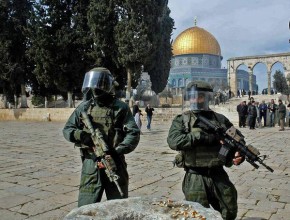
While Abbas’ faltering position as the head of the Palestinian Authority and the aggressive attitude of the Netanyahu government are major factors in creating this hopeless atmosphere, Seidemann pointed out that the problem is not limited to those bodies.
Referring to the announcement the same day of Israel having demolished homes of two terrorists who carried out deadly attacks last year, Seidemann said, “Demolishing of these houses make Palestinians wonder when the Abu Khdeir terrorists and Duma terrorists will be dealt with.”
This refers to two cases of Jewish terrorism that sparked global outrage. But the way Israel has dealt with them demonstrates why Palestinians feel so devalued. Muhammed Abu Khdeir was murdered in July of 2014. The culprits have been arrested and are still on trial at this time in Israel’s criminal court system. In contrast, Palestinians accused of terrorism are tried by Israeli military courts. And where the families of Palestinians convicted in those courts see their homes demolished in a type of collective punishment, it is the Abu Khdeir family, not those of the confessed murderers, that have been spat upon outside the court. Even the US State Department has accused the Israeli government of harassing the Abu Khdeir family.
The Duma murderers are even more immediate and galling to Palestinians. The arson in the Palestinian village of Duma in the West Bank killed an 18-month old baby and both his parents. Yet, despite the fact that Defense Minister Moshe Ya’alon has publicly stated that Israel knows who the murderers are, they have not been arrested. “This creates a feeling that Palestinian lives don’t matter, and that is not only directed at Israel, but also to the Palestinian Authority and much of Arab world,” Seidemann said.
Seidemann is one of the growing body of serious analysts who contend that the model of bilateral talks brokered by the United States that grew out of the Oslo Accords can never produce an end to Israel’s occupation. His message was that outside intervention was going to be necessary, even as he understood how difficult it would be to make that happen.
“There has been no action on Israel since collapse of Kerry initiative (in 2014),” Seidemann said. “Many in the Obama administration are making compelling arguments for simply walking away. Taking any action on this issue would require expending political capital and still may not be successful. These are strong arguments.
“But the implications of walking away are startling. It is very likely that the two-state solution, if it is not lost already, will be clearly lost before January 2017. If that happens, it will have died under this president.”
Seidemann pointed out that, in some ways, the two state solution is being lived now in Jerusalem, with Israeli Jews rarely entering Palestinian areas and Palestinians avoiding the Jewish parts unless they have work or other business there. Settlers in East Jerusalem, however, are living a one state reality, with soldiers accompanying convoys in and out of their enclaves, constant tension and very different standards of living between the two isolated communities. Seidemann described it as “Belfast at its worst.”
Seidemann said that the level of cooperation between Israel and the Palestinian Authority on security remains good. But that won’t last in the current climate. Regardless of Abbas’ commitment to non-violence, Netanyahu continues to accuse him of incitement – “Netanyahu plays on Israeli fears and anxieties like a virtuoso plays on a Stradivarius,” said Seidemann — and the security cooperation is becoming more and more of a political liability for Abbas. Eventually, those things will combine to break that cooperation. This was one of the implications of Abbas’ speech at the United Nations last week. In any case, Seidemann said, that cooperation is insufficient to deal with destabilizing forces at play.
In what has almost become an annual ritual, an upsurge in violence has again put Jerusalem on edge. Originally centered on the Haram al-Sharif/Temple Mount area in Jerusalem’s Old City, the clashes have now spread beyond, into the West Bank.
Israeli journalist Amos Harel wrote yesterday that Israeli-Palestinian security coordination, which both Israeli and American officials have repeatedly credited with reducing violence in the past years, could now be breaking down. “It’s possible… that the current model is nearing its end,” wrote Harel. “One of the reasons is the Palestinian sense of despair with respect to the diplomatic process, which has been expressed in Abbas’ recent speeches.”
Speaking at a symposium at the Washington Institute for Near East Policy, Lt. Gen. Keith Dayton — who as United States Security Coordinator oversaw the training of Palestinian security forces — warned that, in the absence of meaningful progress toward ending the occupation and creating a Palestinian state, Israeli-Palestinian security cooperation was in danger. “There is perhaps a two-year shelf life on being told that you’re creating a state, when you’re not,” he said. This was in 2009. Since then, the Palestinians have received little in return except for a more entrenched occupation, and the relentless growth of settlements.
In the absence of a genuine political process that can conceivably deliver any change, both sides are engaging in provocative behaviors designed to appeal to their respective political bases. Whether it is Palestinian President Mahmoud Abbas declaring that the Palestinians are no longer bound by signed agreements; the head of Israel’s Foreign Ministry, Tzipi Hotovely, bluntly stating that Israel will not leave the West Bank no matter what the Palestinians do; or the inflammatory rhetoric on both sides about Jerusalem’s holy sites, there is a real danger of the violence escalating even further out of control. The international community must demand an end not only to violence, but also to the occupation that drives it, and back that demand up with action.
While both Israeli and Palestinian leaders continue to engage in unhelpful rhetoric, it’s important to recognize that the occupation itself is the most effective form of incitement there is. This reality is often overlooked in the day-to-day news coverage of the conflict, in which violence often tends to be reported as a problem only when it impacts Israelis.
The spread of violence, with the loss of civilian lives on both sides, is unavoidable as long as Palestinians live under a system in which they are denied basic rights, and no political process to give them a hope for a better future. The Israeli and Palestinian leadership, as well as the United States and its international partners, have all failed to provide that hope. All of these parties share responsibility to stem the tide of violence, and all of them have to work together to resolve this conflict, end the occupation and bring peace and security to Israelis and Palestinians.
To this end, it is particularly important for the United States, as Israel’s key ally and patron, to begin articulating consequences for Israel’s continued occupation and settlement construction, which violate both international law and specific commitments Israel has made to the U.S. In the absence of such consequences, we should only expect more of the same: a deepening occupation, more settlements, and periodic upsurges in violence year after year after year.