United Nations Secretary General Ban Ki-moon has an op-ed in today’s New York Times expanding upon remarks he made last week regarding the upsurge in violence in Israel-Palestine. It’s worth taking a moment to consider why this op-ed was necessary. In last week’s remarks, Ban unequivocally condemned terrorism, just as he did in today’s op-ed, while also noting, “security 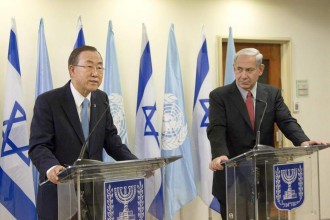 measures alone will not stop the violence. They cannot address the profound sense of alienation and despair driving some Palestinians – especially young people… As oppressed peoples have demonstrated throughout the ages, it is human nature to react to occupation, which often serves as a potent incubator of hate and extremism.”
Israeli Prime Minister Benjamin Netanyahu responded to this as he always does – ignoring the condemnation of terrorism, acting as if all the blame had been laid upon Israel, and rejecting the notion that the Israeli occupation might have something, anything, to do with Palestinian violence. He even went as far as to accuse Ban of encouraging terrorism with his remarks (Yes, it is odd to suggest that a statement from the UN Secretary General would incite violence while also rejecting as outrageous the notion that a half-century of military occupation might do so, but let’s leave that aside for now).
Israel’s own security chiefs have said the same thing – that Palestinian despair at the occupation ever ending is a major driver of violence, and that genuine steps to ameliorate that situation, rather than simply cracking down harder, must be taken.
Netanyahu’s government has made an unfortunate habit of treating every criticism, no matter how carefully or constructively worded, as an attack on Israel’s legitimacy. While we might have expected this from the Israeli right wing, it was really disappointing to see an anti-hate group like the Anti-Defamation League hastily echoing it, in a press release calling Ban’s words an “apparent justification of Palestinian terrorism.”
Ban’s analysis shouldn’t be at all controversial. Indeed, Israel’s own security chiefs have said the same thing – that Palestinian despair at the occupation ever ending is a major driver of violence, and that genuine steps to ameliorate that situation, rather than simply cracking down harder, must be taken.
In a recent report, Israel’s Shin Bet internal security service concluded that young Palestinians were motivated to act, in part, “based on feelings of national, economic and personal deprivation.” The head of Israel Defense Forces Military Intelligence, Maj. General Herzl Halevi, told a meeting of Israel’s cabinet that “feelings of rage and frustration” were major factors driving young Palestinians to these acts and that they “felt they had nothing to lose.” U.S. Ambassador to Israel Dan Shapiro laid out a similar critique in a recent speech to an Israeli security conference – receiving a similarly over-the-top Israeli government response.
No one seriously would argue that the Shin Bet and the IDF are trying to justify Palestinian terrorism. Neither was Ambassador Shapiro. And neither is the UN Secretary-General, as he made clear in his initial remarks, and again in today’s op-ed. Understanding the factors that contribute to violence is not remotely the same as “justifying” that violence. On the contrary, it’s necessary in order to develop an effective policy response. It really shouldn’t be hard to understand that the daily abuse, humiliation and dispossession that Palestinians experience under Israeli occupation is a major contributing factor in the decision of some Palestinians to resort to terrorist violence. Acknowledging this does not make terrorist violence any less reprehensible. And avoiding these facts, or suppressing discussion of them, will only result in more of that violence, not less.
In the aftermath of the horrific terrorist attacks in Paris last week, Israeli Defense Minister Moshe Ya’alon remarked on the tension between security and liberty. “In the United States until the events of September 11, the balance between security and human rights favored human rights on the issue, for example of eavesdropping on potential terrorists,” he said. “In France and other countries in Europe, [a shift toward security] hasn’t yet happened. Countries fighting terrorism have no alternative in this other than shifting in the direction of security. I assume that we will see a large number of steps [to carry out] inspections: passport inspections, inspections at the entrance to public places.”
As in the U.S. this dichotomy between security and human rights is at the very heart of the debate in Israel. ”We believe not only are these not contradictory, but that human rights provides  security,” said Hagai El-Ad, the Executive Director of B’Tselem, Israel’s leading human rights groups monitoring its occupation of the West Bank and Gaza Strip, on a recent press call. “Indeed, we think that human rights are the reasons for which we have security, they are why people have a society that must be protected. So one has to wonder what kind of society do we end up with (in Ya’alon’s framework) and would that society be worth defending if you take Ya’alon’s idea to extremes. I hope that idea will work differently in France. Time will tell.”
The last several months have seen an increase in attacks on civilians in Israel and the West Bank, and it is natural that such attacks test the resolve of any society to maintain its commitment to human rights. Terrorist groups count on the idea that their attacks will erode that resolve, as it did in the United States after September 11, and as it has in Israel over many years, and especially in the past six years under a right wing government.
The diminished regard for human rights is particularly evident in the Israeli practice of punitive house demolitions, in which the homes of accused terrorists’ families are destroyed, often leaving dozens of people homeless for a crime in which they played no part. El-Ad points out that, “In 2004, a military commission reviewed the procedure, found the practice is not effective, and recommended abandoning it.”
In 2005, Israel’s Defense Ministry did indeed order a halt to the procedure, based on evidence that, rather than deterring attacks, punitive house demolitions inflamed Palestinian anger.
“We should not call them punitive, but vindictive,” El-Ad said. “They are carried out against families who are not charged with anything. This is [a violation of] the Geneva Conventions, which forbids collective punishment, and against basic morality.”
El-Ad says that reviving the practice had been discussed for some time, and that last year, after the kidnapping and murder of three Israeli youths that sparked a summer of horrific violence and the war in Gaza, the practice was revived.
While Israeli leaders like Ya’alon argue that these demolitions deter terrorism, Israel’s own research has shown they do no such thing. This is a clear example where disregard for human rights has a distinctly negative impact on security.
But house demolitions are not the only example. In recent weeks, the upsurge in violence between Israelis and Palestinians has been centered in two areas: Jerusalem and Hebron. The tensions in Jerusalem have been well-documented, but the situation in Hebron garners less international attention. Yet those tensions have repeatedly resulted in attacks on both Israeli settlers and soldiers as well as against Palestinian civilians.
The situation in Hebron is extremely difficult. As Musa Abu Hashhash, B’Tselem’s Hebron District field researcher, points out, “Hebron has had half of the casualties in the last few weeks. It is the only Palestinian town where settlers live inside the town itself.
“The 1997 Hebron Agreement divides Hebron into H1 and H2. [H1 is the Palestinian portion of Hebron. H2, approximately 20% of the city, is controlled by Israel.] H2 has seventeen checkpoints and restricted movement, which leads to deserted streets. B’Tselem did a survey in 2007 and found that 1007 homes are empty and 1400 shops have been closed. These are the long term effects of the settlers’ presence.”
It remains to be seen how France and other European countries will respond in the long term to the horrors we all witnessed in Paris. One can only hope that they reject Moshe Ya’alon’s notion that security must mean de-emphasizing human rights. Instead, they can opt for the more nuanced view that El-Ad expressed, in which security is enhanced by preserving human rights, while the denial of those rights puts innocent civilians at greater risk.
“We at B’Tselem have an uncompromising position against violence against innocent civilians,” he said. “But the government in Israel imagines that the recent violence came out of nowhere, and if there is any context, it is only Palestinian incitement and anti-Semitism. We also reject that notion. The context of what we are witnessing is the occupation.”
When a federal court jury in New York reached a verdict last week on a lawsuit brought by American victims of terror attacks during the Second Intifada, holding that the Palestinian Authority could be held responsible, reactions were as quick as they were predictable.
The case involved ten families whose family members had been killed or severely injured by terrorist attacks during the Second Intifada. The Palestinian Authority was accused of indirect responsibility for these attacks. The decisive issue for the jury in the case seems to have been the fact that the PA continues to pay salaries to the families of the jailed terrorists who carried them out.
There is little doubt that the trial raises troubling issues. The first is the use of violence against civilians, which we unequivocally condemn. Another is how to address the very real suffering of the victims of terrorism and armed conflict, whether they be American, Israeli or Palestinian. But we must also consider how to do this in a practical manner that resists the use of victims’ suffering for political gains and contributes, rather than detracts from the prospects of resolving the conflict. In this regard, the verdict must be seen as a step in the wrong direction.
Benjamin Netanyahu added the verdict to his ongoing campaign to demonize Mahmoud Abbas and the Palestinian Authority. Supporters of a two-state solution fretted over the impact such a massive financial blow could have to the already feeble Palestinian economy. Palestinian solidarity activists saw one more example of how the American deck is stacked against the Palestinians.
The Palestinian Authority (PA) and the Palestine Liberation Organization (PLO) are sure to appeal this verdict, so it will likely be years before it is finally resolved. That, however, should not stop us from considering the difficult questions this case raises.
The most emotional of these questions regards the real human cost of ongoing conflict and how we, as a society both within the United States and in the larger global community address this. Those of us who believe that this verdict is unhelpful to the cause of peacemaking need to provide those families with a very good reason for why we would question these efforts at hitting back at those they deem responsible for their suffering.
Those families need to know that we are not ignoring their pain; on the contrary, we are acting in response to it, and working to ensure that it never happens to anyone else. This part of the equation must have nothing to do with which side the victims are on. Whatever differences and imbalances there may be between Israelis and Palestinians, the suffering of those who have lost loved ones, or have been traumatized or permanently injured by the violence is the same.
We are also presented here with an opportunity, however, to address one of the more vexing, if subtle, issues in this conflict, and that is the very fundamental power differences between Israelis and Palestinians. Those differences are historic and they are dictated on a daily basis by the gulf between occupier and occupied. But they play out in ways that can obscure the road to resolution.
The decisive point in this case seems to have been the fact that the plaintiffs were able to demonstrate that many of the perpetrators of the violence that killed and injured Americans in Israel were employees of the Palestinian Authority. Those perpetrators who are in Israeli jails often remained employees of the PA. Families of terrorists who died in the attacks continue to be compensated by the PA.
To the jury, and it’s probably safe to say, to most Americans, this is compelling evidence of PA complicity. Most Israelis would no doubt agree. An editorial in The Forward, which called the verdict “…a serious challenge to anyone…who still stubbornly believes that the current Palestinian leadership is capable of implementing a two-state solution,” saw this point as damning and suggested that the practice of paying families of terrorists must stop.
“What a powerful gesture it would be if Abbas stopped these payments,” read the Forward’s editorial. “It would remove one more piece of ammunition from the hands of Israeli leadership uninterested in solving the conflict. It would honor the victims of terror and acknowledge the rule of law. And — here we are probably being unduly optimistic — it would be a bold step to restore trust and prove, again, that this Palestinian leadership is willing to break from its violent past.”
Those points are all quite fair. And yet, the evidence of Abbas’ actions for over a decade overwhelmingly shows him to be a leader who eschews violence in favor of diplomacy and is willing to go farther than any Palestinian leader we know of to accommodate Israel’s security concerns and reach a two-state solution. Why, then, does he not stop those payments?
The answer lies in the day-to-day realities of Palestinian life, and in the harsh realities of occupation and the bitter conflict that has ebbed and flowed, but never ceased for so many decades.
At the time of the crimes in question, the intifada was raging and Israeli forces had responded quite harshly in the West Bank. The people, Israelis and Palestinians, across the political spectrum felt they were at war, under attack and they wanted the “bad guys” from the other side to stop endangering them and their children.
Israelis, quite correctly, feel that the brutal attacks on civilians in those years cannot be justified by Palestinians’ experiences under the occupation. Indeed, they cannot. International law does give an occupied people the right to resist their occupiers, but that right does not extend to attacking civilians in the occupying power’s territory. Such an act is nothing less than murder.
Palestinians, however, look at the years of the intifada quite differently. They see a massive Israeli incursion into the West Bank. According to the Israeli human rights group, B’Tselem, the intifada saw some 2,200 Palestinians killed who were not taking part in hostilities, as opposed to 239 such Israelis. They wonder why, when the Palestinian figure is nearly ten times bigger than the Israeli one, it is the Palestinians alone who are now being held to account.
Indeed, this is a question we should all ask.
For Palestinians, many of those engaged in violence are often the sole breadwinners of their families or at least a major source of income. For many Palestinians, however wrong we might consider it to be, these militants are seen as fighting for the independence of Palestine, for an end to the daily abuses of occupation, and ultimately, for the very lives of the people of Palestine.
If Abbas were to simply abandon those families, poverty would increase across the West Bank and so would popular opposition to the Palestinian President and his government. Even Palestinians who oppose such acts of violence, and there are a great many, would not advocate abandoning the women, elders and children who depend on the fighting-age men to the perils of increased poverty.
Cutting off these payments would be overwhelmingly unpopular among Palestinians, and that opposition is likely to undo many of the gains the Forward envisions. While it’s fair to ask what more the Palestinians can do, we should also ask what we in the United States can do, and what we might recommend to our ally, Israel, which, after all, remains the sovereign power in the territory.
The Palestinian leadership in the PA and the PLO has come a long way in their attempts to find common ground with Israel and end the occupation under which they’ve lived for almost fifty years. No one seriously believes that they were the ones leading the fight in the second intifada, nor was that the verdict reached in Federal Court this week.
Penalizing the PA because it sustains the families of convicted terrorists implies that the threat of economic ruin will dissuade terrorists from acting. Does anyone really believe that to be true? Even the plaintiffs’ case did not make the claim that the terrorists were acting under the PA’s direction, but with its tacit support, demonstrated through these payments. Militant groups are not seeking Abbas’ approval for their actions. On the contrary, Abbas has endured enormous political criticism over his security cooperation with Israel, for many years now, as they work to prevent such attacks. Both American and Israeli officials have repeatedly praised the PA’s efforts in this regard. Indeed, last year the head of Israel’s Shin Bet went so far as to publicly contradict Netanyahu’s effort to blame Abbas for rising violence in Jerusalem.
No amount of money or vengeance is going to erase a victim’s trauma, replace a lost limb, or, certainly, bring back a loved one killed by terrorism. It’s hard to see how a US civil court can play a constructive role here. Only a more forceful US, European and international policy, which presses for an end to violence on all sides and is willing to push both the parties into a reasonable agreement can do that. This is the only course that respects the blood and pain of all those who have suffered, and continue to suffer, in this conflict.