Earlier today, Likud Knesset Member, David Bitan, who chairs the governing faction in the Knesset, stated on an Israeli talk show that he would try to find a way to strip the citizenship of Hagai El-Ad , executive director of B’Tselem. Bitan described El-Ad’s testimony to a special session of the United Nations Security Council on Israeli settlements as “explicit breach of trust by an Israeli citizen against the state, and as such he should find himself another citizenship.”
Zehava Gal-On, the Chairwoman of the Meretz party, described Bitan’s comments as “dangerously close to incitement to murder.” That characterization is important considering right wing efforts over the past two years to incite violence against peace and human rights activists in Israel.
To be clear, Bitan’s threat to revoke El-Ad’s citizenship is mere posturing. Despite the gathering strength of anti-democratic forces in Israel, the country’s laws prevent the revocation of citizenship simply for presenting a case against settlements at the United Nations (which, incidentally, cannot and has not been challenged on its merits). But as another log on the already frighteningly large fire of incitement against progressive activists in Israel, it is quite significant.
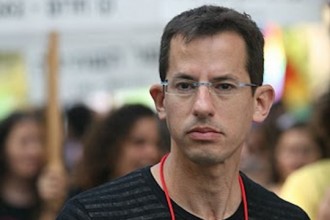
Hagai El-Ad, executive director of B’Tselem
Bitan’s actions are just one more reflection of the disdain the Israeli right has for democratic principles. This disdain is fundamental to the case they make against El-Ad. Prime Minister Benjamin Netanyahu, in his own attack on El-Ad and B’Tselem, said that “What these organizations cannot achieve through democratic elections in Israel, they try to achieve by international coercion.” For Netanyahu and his supporters, the future of the occupation is a matter for Israeli citizens alone to decide, while millions of Palestinians who suffer under it get no say in the matter. That’s not democracy. It is, in fact, as anti-democratic as anything can be.
The same can be said about conditional citizenship. Once, it was Avigdor Lieberman threatening the citizenship of Palestinian citizens of Israel based on their ethnicity. Now the Likud chair threatens the citizenship of a Jewish human rights advocate based on his politics. As MK Gal-On said, “In a democracy, citizenship is a basic right. It’s not a gift given to those who appeal to the chairman of the coalition.”
The United States Department of State has already indicated that they understand the grave threat to democracy that the Netanyahu government’s attitudes represent. In a statement to the Israeli daily, Yediot Ahoronot, State Department spokesman Edgar Vasquez said, “In general, we believe that a free civil society free of inhibitions is a central component of democracy… As we have said many times in the past, we believe that it is important that governments defend the freedom of expression and create an atmosphere in which all voices can be heard. We are concerned by any incident in the world when these principles are under threat.”
A stronger message, from governments and supporters of peace, needs to be sent. These incidents represent a steadily mounting effort to erode Israeli democracy, which is already reeling under the weight of fifty years of occupation. Arresting that erosion is crucial for Israelis, Palestinians and the cause of peace and justice for both.

Palestinian representative to the UN, Riyad Mansour
The Palestinian Authority (PA) has now moved a step closer to making good on its threat to go to the International Criminal Court (ICC) and bring charges against Israel. There is little doubt that this was a move Palestinian President Mahmoud Abbas tried desperately to avoid. In the end, he was forced to do it by a combination of U.S.-Israeli rejectionism, Palestinian desperation to do something to try to end Israel’s occupation, and his own many missteps.
Abbas signed on to 18 international agreements after the quixotic attempt to pass a resolution at the United Nations Security Council (UNSC) predictably failed. Among them was the 1998 Rome Statute, which established the ICC and took formal effect in 2002. This is the step that the U.S. and Israel have warned Abbas against most strongly. Among all the “unilateral steps” the Palestinians could take (which, one should note, is no more “unilateral” than any number of actions taken by Israel on a routine basis), this is the one Israel worries about most. Read more at LobeLog