Israeli human rights group Yesh Din and the archaeologists at Emek Shaveh have released a new report on how Israel is using archaeology to entrench the occupation of the West Bank. In particular, the Civil Administration, Israel’s military authority in the West Bank, has used archaeology to confiscate Palestinian lands, as in the case of the village of Anata. From the report:
The story of the archaeological site at Tel Alamit (Khirbet Alamit) illustrates how the State of Israel expanded a settlement’s jurisdiction area in order to include an archaeological site that is significantly distant from the built-up area of the settlement, thus preventing Palestinians living nearby from maintaining their cultural, religious, and even proprietary ties to the site and its surroundings.
Tel (Khirbet) Alamit is located on registered private land[87] belonging to residents of the Palestinian village of Anata, in the same place where the village once stood. Today the village is located a few hundred meters from the site, after the historic village was destroyed in 1839 by the Egyptian ruler Muhammad Pasha during his occupation of the area.
Tel (Khirbet) Alamit was declared a historic site and an antiquity site in 1944 by the British Mandate authorities. The site contains a multi-layered two-domed archaeological tel that contains remains of buildings, mosaic floors, residential caves, water cisterns, burial caves, quarried segments, agricultural terraces, and an underground system used for industry including an olive press. The site also contained remains such as stone capitals, dressed stones, a winepress, and more. Most of the finds from the site are dated to the Byzantine period, the Middle Ages and the Ottoman period –as well as remains from the Middle Bronze Age (2000-1575 BCE), Iron II, Persian and Hellenistic / Roman periods.[88]
At the perimeter of the mound there is an ancient burial plot associated with Sheikh Abd al-Salaam, considered the founder of the village of Anata, alongside contemporary Arab tombs. To this day, the grave serves as a site of prayer and pilgrimage for the villagers.
The Israel Nature and Parks Authority website states that in Tel (Khirbet) Alamit, “structures and underground spaces and a concealment system from the period of the Bar Kochba Revolt” were discovered,[89] and that the site is identified with the Levite city of Almon.[90] But to our knowledge, there is no unequivocal historical or archaeological evidence linking this historical site to the biblical city.
In 1992, the Military Commander in the West Bank (GOC Central Command) determined the area of jurisdiction of the Anatot-Almon settlement and the Mateh Binyamin Regional Council, and included within it the area of the archaeological site of Tel (Khirbet) Alamit, in spite of its relatively distant location from the built-up area of the settlement (1,200 meters from the center of the tel to the westernmost houses of the settlement). The Sheikh’s tomb is not within the jurisdictional area, but it is located directly on its border.
Also included in the jurisdiction area are private lands of some residents of Anata. In fact, because Tel (Khirbet) Alamit is surrounded by private Palestinian land, it was impossible to include the archaeological mound in the jurisdiction of the settlement so as to enable geographical continuity between the two, without enclosing the private lands of the villagers.
For the entire Palestinian population, and even for the residents of Anata, the inclusion of Tel (Khirbet) Alamit in the Anatot-Almon settlement’s jurisdiction area effectively bars Palestinians from entering the site due to the military order prohibiting Palestinian entry into the settlements. As a result, owners of land within the jurisdiction area are unable to use or access their lands freely.
The exclusion of Palestinians from the historic site (resulting from the prohibition of entering the area of the settlement) is not only physical but also cultural, historical, and religious. The uncovering of important archaeological finds at the site does not contradict the importance of the site in the eyes of the residents of Anata and in the eyes of the Palestinian public in general. On the contrary: a site of recognized historical importance also highlights Palestinian heritage as part of the historical continuity of the cultures and peoples who have lived there. The historical-biblical context attributed to Tel (Khirbet) Alamit does not invalidate or negate the importance of other historical fragments – ancient or modern – that are also part of its history.
For more on how the Israeli government is using archaeology as a tool of occupation, read the full report.
The video is striking — no pun intended. A 16 year-old Palestinian girl in the West Bank village of Nabi Saleh grapples with Israeli soldiers in full combat gear and armed to the teeth. Despite the fact that she swats and kicks at them, the soldiers, likely hardly older than their tormentor, show admirable restraint, doing nothing to escalate the situation from a scuffle into something much worse. Days later, more video emerged, this time of the IDF raiding Nabi Saleh in the middle of the night to pull this same teenager, Ahed Tamimi, from her bed and arrest her. Since then, her mother and a female cousin have also been arrested.
In Israel, and among defenders of Israel, two questions dominate the debate: How could any Palestinian have been permitted to abuse and humiliate the IDF in this manner? And what can Israel do to ensure that it doesn’t happen again?
Israel’s Minister of Education, Naftali Bennett and Defense Minister Avigdor Leiberman, both of whom support pardoning an Israeli soldier who was caught on video killing a Palestinian who no longer posed any threat, have ideas. Bennett called for Ahed and those who joined her in the attack to be jailed for the rest of their lives. Leiberman threatened ominously: “Everyone involved, not only the girl but also her parents and those around them, will not escape from what they deserve.” Knesset member Oren Hazan, from the Likud party, suggested that the soldiers’ failure to react with force was a mistake: “Restraint is a failed and dangerous policy. Next time it must end differently.” Knesset member Bezalel Smotrich, of the Jewish Home party, called on the IDF Chief of Staff “to order that every encounter or friction between the enemy and our troops end with a painful and decisive outcome.”
All of these reactions gloss over the key question: How did Israeli soldiers come to be grappling with this Palestinian teenager in the first place? Were they minding their own business, taking care of the security of Israel or Israelis, when Ahed and her relatives suddenly turned up to “provoke” them? Or rather, since the action in the video takes place in the front yard of Ahed’s house, were the soldiers in Nabi Saleh at the Tamimi residence to arrest someone, hunt for weapons or foil a planned attack against Israel?
Alaa Tartir from Al-Shabaka has a new policy brief on how the Palestinian Authority’s security forces are subcontractors for Israel’s occupation of the West Bank:
Security collaboration between Israel and the PA has fulfilled the Oslo Accords’ objectives of institutionalizing security arrangements and launching a peace process that is tightly controlled by the security sector in order to enable Israel to fulfil its colonial ambitions while claiming to be pursuing peace. This process of “securitized peace” is manifested in a number of ways, including the PA security forces’ arrest of Palestinian suspects wanted by Israel (as in the recent case of Basil Al-‘Araj who was arrested and released by the PA only to be chased and eventually assassinated by the Israelis); the suppression of Palestinian protests against Israeli soldiers and/or settlers; intelligence sharing between the Israeli Defense Forces (IDF) and the PA security forces; a revolving door between Israeli and PA jails through which Palestinian activists cycle for the same offenses; and regular joint Israeli-Palestinian meetings, workshops, and trainings.
Not surprisingly, they aren’t very popular:
Multiple surveys over the years have shown that the majority of Palestinians in the West Bank and Gaza Strip (between 60% and 80%) oppose security coordination with Israel. And in a March 2017 Palestinian Center for Policy and Survey poll, two-thirds of respondents demanded Abbas’s resignation, with 73% expressing the belief that Abbas is not serious in his threat to suspend security coordination with Israel. In a 2010 Maan News Agency poll, 78% of respondents said they believe that the PA security forces are engaged in surveillance, monitoring activities, and intervening in people’s privacy. Finally, according to Visualizing Palestine, 67% of West Bank Palestinians said they feel that they are living in an undemocratic system that cracks down on freedoms in large part as a result of the security realm.
Read the rest of Al-Shabaka’s brief to see Alaa’s suggestions for how the Palestinian security forces could be reformed to be more responsive to the needs and concerns of ordinary Palestinians.
Given the frequently bombastic rhetoric that has come from the new President of the United States in his first two weeks in office, it is not surprising that many observers are reading the statement from the White House about Israeli settlements as being much sterner than it is. Expectations (and fears) have been raised in some quarters that President Donald Trump would be even more supportive of settlements than Israeli Prime Minister Benjamin Netanyahu, and the statement has been read by many in that context.
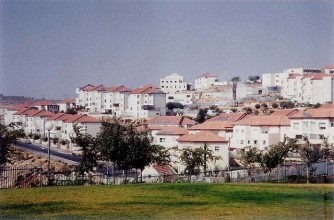
Israeli settlement of Beitar Ilit in the West Bank
The most important point made in the statement is an enormous gift to the Israeli right. The White House says that “…we don’t believe the existence of settlements is an impediment to peace.” That is a direct break with 50 years of fully bipartisan US policy on the matter. Following that with a statement that expansion of settlements “may not be helpful” in achieving peace is, contrary to what some have said, a much weaker statement than past presidents, including George W. Bush as well as Barack Obama, have issued.
As Israeli analyst Gershom Gorenberg said in a tweet early Friday, “(The) previous Israeli attitude was ‘The dogs bark and the convoy rolls on.’ Now (the) dog isn’t even barking.” Gorenberg is right, there was very little warning in this statement.
Previous Israeli attitude was “The dogs bark and the convoy rolls on.” Now dog isn’t even barking. @MJPlitnick @Lara_APN @lrozen
— Gershom Gorenberg (@GershomG) February 3, 2017
There are, however, some things that can be reasonably read into it. First, Netanyahu’s announcements this week of moving forward with still more settlement units as well as proposing the first new settlement initiated by the Israeli government in a decade were made without coordinating with the Trump administration. Given that Trump met briefly with Jordan’s King Abdullah just yesterday at the annual White House Prayer Breakfast and that Arab heads of state as well as cooler heads in both the Israeli government, and the pro-Netanyahu wing of the pro-Israel community in the US have been urging Trump to be more thoughtful of regional concerns in his approach to Israel, it is not surprising that Trump would want to make it clear to Netanyahu that he isn’t giving a blanket green light to doing such things without coordinating with Washington.
Also, the much more careful and nuanced tone here stands in sharp contrast with most of the Trump Administration’s early statements. This suggests that the White House may have sought more input on this statement than they had on others.
Indeed, it is entirely possible that such input was gathered from Israel or supporters in the US. The statement serves a crucial purpose for Netanyahu that seems to have escaped the notice of many.
Trump’s statement provides badly needed cover for Netanyahu.
The evacuation of the illegal (according to Israeli law) Amona outpost has been a huge controversy for Netanyahu for quite some time. As the evacuation was carried out this week the controversy reached a crescendo. Even though pro-settlement forces in Israel have been handsomely compensated with a bill in the Knesset to legalize outposts built on privately owned Palestinian land, announcements of new settlements, and vows from Netanyahu for much more, the settler movement was still dissatisfied. They expected more from a Prime Minister who, they believed, was completely freed from the shackles of the Obama administration.
Trump’s statement provides badly needed cover for Netanyahu to push back against those arguments. He is now able to portray himself as both a great friend of the settlements and a wise statesman who will take advantage of the opportunities Trump gives him, but will also act as a good friend to the Republican administration and not go so far as to embarrass it. It doesn’t suit Netanyahu to have a US administration that, like David Friedman (the man Trump has nominated as ambassador to Israel), supports settlements more than Netanyahu. Trump has now avoided being portrayed that way.
True, the White House’s statement last night dampened some of the more salacious fantasies of the settlement movement. But it was the absolute perfect statement for Netanyahu. That it was less “Trump-ian” than most of the President’s statements may have caught some people off-guard. But there is no less to worry about in regards to the new administration today than there was yesterday. Hopefully, after the initial shock from the tone of the statement wears off, more observers will recognize that.
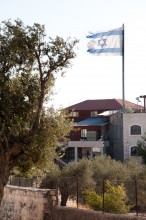
An Israeli outpost in occupied East Jerusalem (Shutterstock)
On Sunday the Israeli cabinet unanimously passed a bill that would legalize settlement outposts in the occupied West Bank that were built on privately owned Palestinian land. If passed by the Knesset, the law could potentially be used to raise the status of many outposts all over the West Bank to those of settlements that are legal under Israeli law (all settlements beyond the Green Line are illegal according to international law). That would be a tremendous setback to the already dimming prospects of an Israeli withdrawal from the West Bank, and to the two-state solution.
The Obama Administration made clear its opposition to the bill. “This would represent an unprecedented and troubling step that’s inconsistent with prior Israeli legal opinion and also break long-standing policy of not building on private Palestinian land,” State Department Spokeswoman Elizabeth Trudeau said. “We hope it doesn’t become law.”
What is the “formalization law”?
The bill in question is referred to colloquially as the “formalization law.” It would allow the Israeli government to retroactively legalize outposts built in the West Bank if the outpost was set up on privately owned Palestinian land with government involvement, but was not an officially sanctioned settlement. Palestinian owners would not be able to retrieve their land, but would be entitled to financial compensation at a value determined by the Israeli government.
How does this change the status quo?
Israel has retroactively legalized specific outposts many times in the past. This law, however, would allow the Israeli government to retroactively legalize an outpost quickly, preventing the Israeli judicial system from compelling the state to dismantle the outpost. While this law is not solely a response to the current dispute over the Amona outpost, that dispute has accelerated the motion on this bill.
What are the specific problems with the bill?
Israeli Attorney General, Avichai Mendelblit, stated that the bill is inconsistent with Israel’s rule of law, violates international law, and seeks to undermine the status of the High Court of Israel. It is an attempt to legalize a procedure that also violates Israeli jurisprudence and precedent since the beginning of the occupation that has agreed that the State cannot simply confiscate privately owned Palestinian land for settlements. Forcing landowners to accept a payment in exchange does not mitigate this, as the Court has repeatedly confirmed.
What is the status of the bill now?
The approval of the bill by the ministerial committee means that it will come to the Knesset floor for readings, debates and, eventually, votes. It must pass three readings in the Knesset to become law.
Is the bill controversial, or will it pass easily?
The bill is being pushed hard by the religious nationalist Jewish Home Party and its leading ministers, Naftali Bennett and Ayelet Shaked (ironically, Shaked, the Minister of Justice, is opposed in this effort by the people in her own ministry, who agree with the Attorney General). Prime Minister Benjamin Netanyahu seems to recognize that the bill is going to damage Israel in the international community and could provoke action from the outgoing Obama administration. Still, he has yielded to pressure from the settler movement and approved the bill along with the rest of the ministers who voted to bring the bill to the Knesset. Netanyahu objected mostly to the timing, hoping he could delay both this bill and the High Court’s decision on the Amona outpost until after President Obama left office, but he failed on both counts.
There is no doubt that the opposition, led by the Yesh Atid and Zionist Union parties will oppose this bill. Much will depend on whether lawmakers from Likud and other center-right parties join them. The fact that the Attorney General opposes the bill is very important, and may very swell sway enough Knesset members to oppose it. But with both Bennett and Netanyahu, as well as, quite likely, Defense Minister Avigdor Liberman supporting the bill, political pressure on coalition MKs will be intense. One faction, the Kulanu party which is part of Netanyahu’s governing coalition, had been opposed to the bill, but relented under pressure from Netanyahu, who did not wish to see his coalition fracture over this issue.
The bill has now passed its first reading in the Knesset. Two more readings are required for the bill to become law. The bill is not being submitted for a second reading yet. There is time for friends of Israel to try to convince the Prime Minister and the rest of his cabinet not to move forward with this bill. But the Jewish Home faction is sure to press for the bill to move forward, so the time to act is now.
Last November, when the European Union announced the implementation of long-standing regulations regarding the labeling of products from Israeli settlements, the government of Prime Minister Benjamin Netanyahu played one of its biggest cards, suspending contact with the EU regarding the Israeli-Palestinian conflict. After nearly three months, which saw accusations of European anti-Semitism and Congressional condemnation of the European decision, Netanyahu backed down. The EU held to its position and refused to grant Israel any compensation for it. The episode reveals the enormous amount of untapped potential for altering the status quo with regard to Israel’s occupation of the West Bank and its siege on the Gaza Strip.
The EU decision to label certain products as coming from Israeli settlements was both the long-delayed implementation of existing policy and a show of impatience with the Netanyahu government’s intransigence on the peace process. It was also a counter to the attempts by Netanyahu and his supporters, particularly in the United States, to blur the line between Israel within its internationally recognized borders and the settlements in areas captured in 1967.
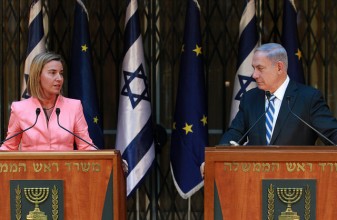
EU Foreign Affairs chief Frederica Mogherini and Israeli PM Benjamin Netanyahu, May 20, 2015. (Source: flickr/eeas)
That’s why Netanyahu reacted so harshly to a seemingly minor decision, one which would have only a negligible impact on the settlements’ economy, let alone all of Israel’s. Netanyahu went after the EU labeling regulations with every tool he could realistically employ. Israel could, of course, take measures to restrict trade with Europe or even break off all diplomatic relations. But since the EU is Israel’s top trading partner, has a great many friendly trade deals with Israel, and accounts for some 27% of Israel’s export business, that would be unwise to say the least.
Netanyahu did not just climb down from his position, he unconditionally surrendered. In a last-ditch effort, he tried to get EU Foreign Affairs chief Federica Mogherini to state that there would be no further EU measures in this vein, which Mogherini flatly refused to do. Netanyahu was left with the choice of a serious erosion in EU-Israel ties or accepting the labeling measure and moving on. He chose the latter.
The labeling controversy is a reminder that Israel needs not only the EU, but the United States, a lot more than either entity needs Israel. It lights a path out of the morass in which the Israeli-Palestinian conflict is now stuck, setting the stage for more productive negotiations in the future.
Speaking to the Jerusalem Post on February 21, the United Nations Special Envoy to the Middle East, Nikolay Mlednov said, “If I were to say to you today, let’s get the (Palestinian) president (Mahmoud Abbas) and prime minister (Netanyahu) in the same room tomorrow, that would be daydreaming. Our role is to actually figure out how we can create the conditions under which such a process can resume in a meaningful manner.”
Like many other diplomats and observers, Mlednov is saying that conditions are not ripe for talks. But he also rightly notes that there is a task before the world’s diplomats beyond simply waiting for the respective leaderships of Israel and the Palestinian Authority to declare themselves ready.
Calling regional conferences, as some have suggested, is a fine idea, but only if there will be more than empty statements emerging from them. What must emerge from such conferences is a determination by the Middle East Quartet and each of its members (the United States, United Nations, Russian Federation and European Union) as well as the Arab states involved to create the conditions that Mlednov speaks of.
In order to create those conditions, they must be conceived with certain basic understandings. One is that, while it is true that ultimately the Israelis and Palestinians will have to negotiate any agreements themselves, this cannot occur in a vacuum. Israel is a regional superpower, the most stable state in the Middle East and the military giant in the region. The Palestinians are a stateless people who have lived under occupation for nearly half a century with little leverage in negotiations. This imbalance is a key reason why talks have not been productive in the past two decades.
Another issue is that negotiations have dragged on so long and yielded so little that both publics, but especially the Palestinians, have lost faith in the process. Only pressure from the outside, particularly from other Arab states, can give Palestinian President Mahmoud Abbas, or any other Palestinian leader, the cover he needs to reenter talks.
The conditions that need to be created are ones which establish incentives for progress toward a resolution and consequences for intransigence or failure to meet obligations. It also needs to be clear that the “carrots” are granted after the parties have achieved progress, not before.
There also needs to be an immediate change in the status quo in order for both Israelis and Palestinians to buy in to renewed talks. At this point, two decades of frustration and recrimination have soured too many people on both sides on further discussion. This can be addressed with two simultaneous steps.
First, an international declaration stating that the West Bank and Gaza Strip are, according to international law, held in belligerent occupation, meaning Israel is responsible for the security of West Bank Palestinians; it is also responsible for ensuring that the border crossings of the Gaza Strip allow for legitimate import and export of goods and materials sufficient to sustain the needs of the people there; and that the settlements are, as a result of that declaration, clearly illegal.
Second, an international committee charged with monitoring and reporting violations by any official spokesperson or media outlet, Israeli or Palestinian, would be created. Any incitement (which would need to be defined by the committee in very specific language) would be reported publicly, and repeated violations would trigger specific consequences.
Consequences for the Palestinians are clear enough: the loss of some amount of international aid. If this were done today, it would threaten to topple the Palestinian Authority. But if Israel is charged with fulfilling its obligations as an occupying power under international law, it would impact the PA, but would not cause the West Bank to descend into chaos.
For Israel, consequences are more politically complicated. Netanyahu may have overreached with the EU, but Israel is still a valued partner to Europe and the United States for many reasons, and even with its lurch to the right in recent years, Israel still has a great deal of popular support. Still, there are also so many facets to the relationships between Israel and both the EU and US that there are options for action.
The United States, for example, has, on several occasions, withheld loan guarantees from Israel. While those guarantees only enable Israel to borrow money at a considerably lower interest rate, it was enough to force Israel to do as the United States insisted for both George H.W. Bush in 1990 and his son over a decade later. Other options include temporary suspension of arms shipments, altering of trade deals, and action or inaction in international fora, such as the United Nations Security Council or even the International Criminal Court.
Incentives are also easy to imagine. For the Palestinians, these include eventual statehood, independence, increased overseas trade and participation in international bodies. For Israel, opening up the Arab markets and the ability to work with Arab states to address regional concerns, the de-fanging of the international opprobrium against it that is growing today, and involvement in regional security measures.
The specifics are less important than the sheer political will to enact consequences. Reluctance to apply significant pressure to the Palestinians has been rare, but Israeli actions which displease its international benefactors have generally been met with polite statements of disapproval.
No matter how well-crafted a peace process may be, it depends on the international community being willing to stand firm on both the carrots and the sticks, and to apply the standards evenly to both sides. Only by doing so can the mistrust, anger, and frustration of both sides, as well as the imbalance of power between Israel and the Palestinians, be countered.
The experience of the EU labeling fight shows that, when the determination is there, it can be done.
Last week, U.S. Ambassador to Israel Dan Shapiro caused a stir by ever-so-gently telling the truth about the occupation. Speaking to a conference at Tel Aviv’s respected Institute for National Security Studies, he addressed “the latest increase in tensions and violence between Israelis and Palestinians,” and observed, “Too many attacks on Palestinians lack a vigorous investigation or response by Israeli authorities; too much vigilantism goes unchecked; and at times there seem to be two standards of adherence to the rule of law: one for Israelis and another for Palestinians.”
The outraged reaction from Israeli officials—which included a demeaning slur against the American ambassador by a former Netanyahu aide, as well as Netanyahu himself trying to shame Shapiro by noting the recent murder of an Israeli woman whom Shapiro had actually memorialized in his speech—was as overwrought as it was predictable. The fact that Shapiro’s words of concern were far outnumbered by words of solidarity and support mattered little. It has been the policy of the Netanyahu government that even the most carefully worded public criticisms by its closest friends shall be treated as an attack on the very foundations of the state.
It is simply a matter of fact that Israelis and Palestinians in the West Bank live under two different systems of law—the former under Israeli civilian law, the latter under military law imposed after the territories were occupied in 1967. If an Israeli and Palestinian were to be arrested at the same spot in the West Bank at the same moment for the same crime, they would be subjected to two entirely different legal procedures, the former Israeli civil law and the latter military law. In this regard, it’s only Shapiro’s use of “seems” that seems a bit odd. Read more at Tablet Magazine
On January 19, at the annual Institute for National Security Studies (INSS) conference, the leader of Israel’s opposition and head of the Zionist Union party, Isaac Herzog, unveiled an alternative approach to the issue of Israel’s nearly 49-year old occupation of the West Bank, Gaza and East Jerusalem. It has some points that clearly distinguish his policy from Israeli Prime Minister Benjamin Netanyahu’s. But it is short on detail, and includes some ideas that could make the situation even worse.
Upon examination, Herzog’s plan seems likely to garner support among the centrist, center-left and even parts of the center-right Israeli voter base. Given recent polls which show the Yesh Atid party garnering as many seats as Herzog’s Zionist Union and reflect more public confidence in Yair Lapid, the head of Yesh Atid, as a potential Prime Minister than Herzog, this plan must be read, at 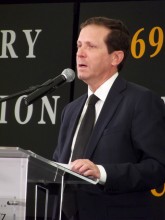 least in part, as an attempt to bolster Herzog’s position as opposition leader.
The main points of Herzog’s plan, as reported in the Israeli media, are these:
- While there is no current possibility for a two-state solution, Israel will not annul the possibility either diplomatically or geographically for the future
- Hamas will face “harsh” measures for any attacks from Gaza, including targeting their leaders, and eliminating their ability to communicate over television and internet.
- Israel will complete the security barrier around the major settlement blocs. “We will be here and you, Palestinians, will be there,” Herzog said. “Live your lives, improve your economy, create employment. The blocs under Israeli sovereignty will be part of the permanent solution. They will serve as recipients of settlers from outside the major blocs.”
- The barrier through Jerusalem will cut off Palestinian villages from the city. The Defense Ministry would be charged with granting permits to Palestinians who wish to enter the city to work.
- Palestinians would have full civil authority, but not security authority in the West Bank. This would, presumably, remove the regime of building permits in many Palestinian areas, but the Israeli military will remain present throughout the entire West Bank.
- Finally, Israel would help convene a regional security conference with “moderate” Arab states (like Saudi Arabia and Egypt, for example) to deal with ISIL and other regional security issues, presumably including Iran.
Politically, this is a shrewd plan for Herzog. The “us here, them there” idea harkens back to Yitzhak Rabin, who used that as a campaign slogan in 1992. More recently, former Prime Minister Ehud Olmert proposed a similar unilateral separation in the West Bank. This part of Herzog’s plan will probably be seen as a familiar, moderate and practical solution by many in Israel who don’t consider themselves part of the far right.
One major concern in Herzog’s proposal is the fact that he would complete the separation barrier in a manner which would cut most Palestinians off from Jerusalem. He makes no mention of the holy sites, but it seems safe to assume that his plan would provide Muslim and Christian Palestinians access to the sites in some manner. Still, with a barrier cutting Jerusalem off from nearby Palestinian towns, it will inevitably be even more difficult to gain that access, and in every other way, most Palestinians would be cut off from the city they envision as the future capital of their state. Herzog does not explain how he expects such an act to lead to greater quiet and security for Israeli Jews, but no matter—such an outcome is not conceivable given the rage that will ensue if Jerusalem is inaccessible to Palestinians.
Herzog’s plan has the benefit of removing the outlying settlements, which will not only eliminate some of the most radical settlements, it will remove many of them from close proximity to Palestinians, whom they often terrorize. Without any details, we cannot be certain, but it is possible that the removal of outlying settlements could lead to much greater freedom of movement for Palestinians. This is especially so if Herzog is serious when he urged, in his INSS speech, that Palestinians build their economy and communities.
But absorbing those settlers into the large settlement blocs will cause a significant spike in construction in those blocs. As I have detailed elsewhere, the blocs are already threatening the viability and contiguity of any potential Palestinian state, and this idea will make matters much worse.
While it is certainly true that most Israelis already see the large blocs (as well as the settlements in East Jerusalem) as part of Israel, the rest of the world, including the United States, as a matter of policy, does not, although it is seen as likely that the blocs will be annexed to Israel in a future agreement. Herzog’s plan would reinforce this fact on the ground, and would make it much harder for Palestinians to get the sort of negotiated land swap they would need to agree to the annexation. This is a running theme in Herzog’s proposal: Palestinian concerns are often glossed over and Palestinian input is not only invisible, it is seen as undesirable.
Recent Israeli history shows that unilateral actions like this do not bring peace, but instead entrench the conflict even more deeply. The lesson of Gaza is not, as many say, that Israel cannot withdraw from territory lest it face increased terrorism. Rather, it is that when Israel undermines moderate Palestinians with unilateral moves, it creates a power vacuum that is filled by more militant factions.
By simply taking the land it wants, Israel would undermine the basis for negotiating over borders between it and a Palestinian state. By cutting off Jerusalem, it would undermine the basis for negotiations for the city that both Israelis and Palestinians see as their capital. Herzog is proposing a change to the framework of any possible negotiations, and if the international community lets this happen, the notion of outside moderation of talks is lost. In fact, it would leave the Palestinians to choose between the meek acquiescence to Israeli diktats or the path of violence. Even an increasingly developed Palestinian economy, if that should also result from this plan, would not be enough to alter that equation.
Herzog’s idea that under such circumstances a regional security conference that includes Israel could possibly be convened only reflects how out of touch he is with political realities in the Middle East. In fact, this plan would make it impossible for any Arab state to upgrade its relations with Israel. And his approach to Gaza sounds more like bluster than a strategy, and certainly does nothing to address the miserable conditions Israel’s blockade of the Strip has created, conditions that much of Israel’s defense establishment has repeatedly urged be improved.
This plan has some points that might be worked with, but it is not, on balance, sound policy. It has little chance of achieving the quiet Herzog envisions; on the contrary, it is likely to further enflame the conflict.
Herzog’s plan, while preferable to Netanyahu’s status quo and certainly to the vision of those even farther to the right, falls well short of a structure that gives either Israel or the international community a framework to move toward an end to Israel’s occupation. Indeed, it seems more tailored for domestic political gains than for actually resolving the vexing problems Israel faces. That might help him push back against Lapid and Netanyahu, but the price would be further complicating diplomacy and the situation on the ground. That price is too high.
The recent decision by the European Union to label products from Israeli settlements in the occupied West Bank has elicited loud cries of protest from Israel and from the Netanyahu government’s supporters in Washington. Critics have claimed that Israel is being treated unfairly, that the EU is trying to pressure Israel into concessions outside of the framework of bilateral negotiations, and that these measures are a part of the Boycott, Divestment and Sanctions movement whose real aim, critics claim, is to de-legitimize Israel.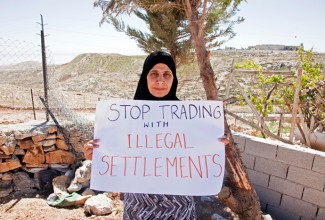
In fact, the EU measures simply represent an effort to more faithfully implement a longstanding policy, backed by a strong international consensus, of differentiating between the State of Israel within the pre-1967 line, often referred to as the Green Line, and Israeli settlements built in the territories occupied in the 1967 war.
The effort to oppose this differentiation is often based on partial or misleading information, which we address below. It is important to recognize, however, that the unimpeded growth of settlements will eventually foreclose the option of a two-state solution, if it hasn’t already done so, as it will eliminate any possibility of contiguous and economically viable Palestinian state. It is therefore imperative that anyone hoping for a peaceful future for Israelis and Palestinians understand the facts about the settlements, EU labeling and the goal of differentiation.
- Is labeling an attempt to pressure Israel into concessions?
No, it is an attempt to clarify the view of the EU, one shared by the United States, that the settlements are not part of Israel. The labeling decision applies to limited categories of products, mostly agricultural, from the settlements. Israel’s finance ministry said that the labeling decision would impact some $50M per year, which is less than 1% of Israel’s trade with the EU in 2014, a total of $14 billion. It is meant to signal European concern about the lack of a diplomatic process, to be sure. It is a signal that the EU wants to see movement toward a resolution of this conflict resume, but in the absence of that movement, unilateral Israeli steps like settlement building will not be legitimated.
- Is labeling part of an effort by the EU to diminish its trade ties with Israel?
No. The EU extends extremely favorable trade arrangements with Israel, and it has publicly reaffirmed both its support for those arrangements and its opposition to any sort of boycott of Israeli products. Indeed, they have stressed that even when it comes to settlement products, no boycott is being considered by the EU.
- Why is the EU doing this, even though all parties agree there will be territorial changes from the 1967 line in any final agreement?
Along with the overwhelming majority of the international community, the EU views Israeli settlements beyond the Green Line as illegal under international law. Along with the U.S., the EU recognizes that there will likely be an exchange of territories when a two-state solution is agreed upon. Until such agreements are finalized, however, all land captured in 1967 is legally considered occupied territory.
- Is this just a technical decision by the EU to comply with long-standing policy?
Partly. It has long been EU policy that products from Israeli settlements are to be excluded from the very favorable trade deals Israel enjoys with the EU. Until now, however, the EU has not enforced the labeling laws, on the assumption that they would soon become moot in the wake of a peace deal between Israel and the Palestinians. The decision to enforce these measures demonstrates the recognition by the EU that Israel will not soon end its occupation, and is an effort to keep the two-state solution viable.
- Isn’t the EU singling out Israel here? Aren’t there nearly 200 other territorial disputes in the world? Why does the EU treat this one differently from, say, Western Sahara?
The idea of “200 other territorial disputes” has become a popular talking point, but it has little connection to the question at hand. With only a few exceptions, those territorial disputes do not involve the issues of settlements or even occupation. In the case, for example, of Crimea, the EU has banned trade and imports from that territory due to Russia’s intervention there. Multiple U.S. administrations have made clear that resolving the Israel-Palestinian conflict is a core national security interest; the EU measures are fully consistent with that view. Such foreign policy concerns are also explicitly spelled out in the EU’s trade agreement with Israel. The case of Western Sahara is the only truly comparable one to the West Bank, but the EU does not have the same policy in both places, thus labeling requirements are different. While the EU supports a peace process in Western Sahara, it does not recognize the territory as occupied. However, a European court recently ruled that the EU’s 2012 trade deal with Morocco was invalid due to the issue of Western Sahara. As the court’s decision implies, the discrepancy between these policies does not indicate that the policy regarding the West Bank is wrong or discriminatory, but rather that the policy regarding Western Sahara is inconsistent with broader EU policies. The argument this strengthens is not that labeling products from Israeli settlements is wrong, but that the same rule should apply in Western Sahara.
- Why shouldn’t the United States fight the EU on labeling?
As the Obama administration said in response to the EU decision, labeling products from settlements as what they are does not constitute a boycott on Israel. Further, as Secretary of State John Kerry recently pointed out, the process of transitioning Israeli rule over Palestinians to the Palestinians themselves is currently being reversed by Israeli settlement policy. Anyone who supports the two-state solution should welcome efforts to differentiate between Israel and the occupied territories. Efforts to blur that distinction threaten to enmesh Israelis and Palestinians in a perpetual conflict.
- What is the US stance on settlement products?
The United States’ trade agreements with Israel were expanded in 1996 to include the West Bank and Gaza Strip. This was a part of a larger process of creating a “Qualifying Industrial Zone” to encourage economic cooperation between Israel, the Palestinians, Egypt and Jordan. Nonetheless, products made in the West Bank are required to be labeled as such, though they are not required to be specifically labeled as being from Israeli settlements. Despite this, when Congress passed legislation which applied in a uniform fashion to both Israel and “territories controlled by Israel,” the Obama Administration was quick to declare that, “…by conflating Israel and ‘Israeli-controlled territories,’ a provision of the Trade Promotion Authority legislation runs counter to longstanding U.S. policy towards the occupied territories, including with regard to settlement activity.”
- Won’t this labeling decision amount to a de facto boycott of Israel, and encourage more such boycotts?
No, these measures are not connected the Boycott, Divestment, and Sanctions (BDS) movement. The EU has stated clearly that they are opposed to all boycotts against Israel. One EU official told the Huffington Post, “It is essential to remind that the EU is strictly against any kind of boycott of Israeli products. Accordingly, we consider that a transparent labeling scheme is the best way to avoid that. In the absence of such a scheme, some European consumers and operators intending not to buy products from the settlements might be tempted not to buy Israeli products at all.”
-
Condemns Tel Aviv violence and Netanyahu’s portrayal of Israel’s Arabs as criminals
-
Two states is only solution, and world must be clear: settlements not part of Israel
-
Interests of Israeli Jews and Palestinian Arabs are “not conflicting, but common”
In 2015, Israel ushered in the most right-wing government in its history. But the same election produced another notable outcome: for the first time, Arab parties joined in a bloc with the sole Jewish-Arab party, Hadash, to form the Joint List. The bloc garnered 13 seats in the current Knesset, making it the third largest party and second largest in the opposition.
Ayman Odeh is the Chairperson of the Hadash party and the head of the Joint List. In these roles, MK Odeh has established himself as a respected leader, bringing a principled voice to the 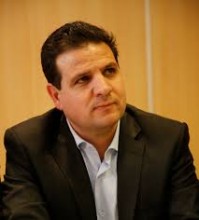 opposition while balancing the diverse and sometimes contradictory politics of his own List. It is not always easy, and MK Odeh has managed to keep his coalition together while positioning himself as a leader of a progressive movement within Israel. While other opposition leaders such as Isaac Herzog (Zionist Union) and Yair Lapid (Yesh Atid) have largely backed Prime Minister Benjamin Netanyahu in many of his policies dealing with both internal security and the Israel-Palestine conflict, MK Odeh has given voice not only to the views of minority groups within Israel, but also to moderates all over the world who support peace, Palestinian rights and a two-state solution.
In December, MK Odeh embarked on a groundbreaking visit to the United States, his first as well as the first of its kind for a political leader of Israel’s Palestinian community, where he met with many politicians, community leaders and activist groups. The trip, which was supported in part by the Foundation for Middle East Peace, demonstrated that there is a significant opposition in Israel, and that Palestinian citizens of Israel, like MK Odeh, believe themselves to be a part of the country and instrumental to charting a better future for both the citizens of Israel and the Palestinians living under occupation.
FMEP conducted this interview with MK Odeh between December 23, 2015 and January 2, 2016.
How do you respond to Prime Minister Netanyahu’s statements, in the wake of the deadly attack in Tel Aviv on January 1, that he “will not permit lawlessness” in Arab areas of Israel and that he has enacted “a new plan to allocate funds and resources to dramatically increase police enforcement in Arab communities throughout Israel, namely in the Galilee, the Negev and the Triangle?”
Before addressing the words of PM Netanyahu, I wish to convey the pain I feel for the horrible shooting in the streets of Tel Aviv last Friday. Although the details of what happened are not yet clear, I condemn and denounce all violence against innocent civilians, and send my heartfelt condolences to the families of the dead and injured.
Prime Minister Netanyahu continues to renounce his responsibility for the situation and incites against an entire public, portraying the Arab population as criminals. Netanyahu’s political strength is based on his incitement against the Arab population on the day of the general elections, which has continued throughout his term in office.
The leaders of the Arab public in Israel, myself included, have repeatedly approached the government and authorities over recent years demanding to strengthen the law enforcement in the Arab towns and villages. Our main demand was the collecting of unauthorized firearms from our streets. The primary victims of these weapons are us, the Arab citizens. It is our children whose safety is in jeopardy in the streets of our towns. The Prime Minister has refused until now to allocate funds for this goal. But now, when a weapon is turned against Jews, he suddenly decides to confront the issue.
After the current media attention fades, we will continue to demand that the police consider us as equal citizens and will take responsibility for our personal safety. First and foremost, weapons must be collected from our streets.
Prime Minister Netanyahu continues to renounce his responsibility for the situation and incites against an entire public, portraying the Arab population as criminals. Netanyahu’s political strength is based on his incitement against the Arab population on the day of the general elections, which has continued throughout his term in office.
Secretary of State John Kerry recently said that Israel is reversing the Oslo Process. Most understand this to mean creating facts on the ground with settlement expansion, among other measures. Meanwhile, many members of Congress are angry at the European Union for labeling products from settlements as such. How important is it that the rest of the world differentiate between Israel and its settlements?
One of the greatest accomplishments of the Palestinian struggle in recent years is the fact that most of the world, with the latest addition being Greece, has already recognized the Palestinian state. But this also results in the realization that recognition is not enough, and the world must bring real and substantial pressure to bear on Israel. The only solution to the current situation is the end of the occupation and the establishment of a Palestinian state, according to the 67 borders, alongside Israel. If the world truly believes in this, labeling settlement products is a first and essential step in order to make it clear to Israel that the international community does not accept the settlements as part of the state of Israel. The settlements are illegal according to international law, while even under Israeli law they are not part of sovereign Israel, and therefore labeling is a minimal requirement. Furthermore, we must not forget that the settlements themselves cause systematic damage to all areas of life and the human rights of Palestinians, and this is another essential and compelling reason for the international community to object and protest their existence.
Many Americans are very concerned about the recent video circulated by Im Tirzu calling leaders of peace and human rights NGOs foreign “plants.” Along with this, we see legislation in the Knesset to label such NGOs as foreign agents. What does this say about the current state of Israeli democracy?
Netanyahu’s extreme right wing government is bad and dangerous not only for the Arab public, but for all the citizens of Israel. One of the most flagrant examples is the ferocious incitement against the human rights organizations originating from the Prime Minister’s Office, which trickles down from there to the ministers and organizations that do their bidding, such as Im Tirzu. The incitement and demonization campaigns that were initially aimed solely at the Arab public and its elected leadership, are now spreading throughout Israeli society. The purpose of this incitement is to silence any expression of opposition or criticism against the government, and consequently human rights organizations have been turned into enemies of the state. This is a concerted attempt at total de-legitimization, in order to deafen and blind the Jewish public from the reality that these organizations expose.
Labeling settlement products is a first and essential step in order to make it clear to Israel that the international community does not accept the settlements as part of the state of Israel.
I hope that now, especially now, more people will awaken and understand that when they turn a blind eye to incitement against an entire sector of the public, this incitement will, further down the road, reach them. We must stand together, Arabs and Jews, against the incitement and hatred, and offer a genuine alternative based on equality, peace and democracy.

MK Odeh and his staff at the offices of the New York Times
The community of Palestinian citizens of Israel is often seen as separate from the larger Palestinian people. How do you see the relationship of Palestinian citizens of Israel to the rest of the Palestinian people, and how do you think this might help Israel and the Palestinians reach an agreement to end their long conflict?
As a Palestinian citizen of Israel, I have no difficulty with my national identity – I am a Palestinian, yet I do not turn my back on my citizenship. I believe that it is precisely this duality that enables us – and only us – to see the entire picture. I speak Hebrew and Arabic, read newspapers and watch the news in both languages. I have in-depth familiarity with the culture and history of both the Palestinian and Israeli societies, and it is precisely because of this that we can serve as a third and crucial party in talks between the sides. Currently, while the Israeli side has no desire or intention to reach a solution, I see our role as being in the public arena, as people who can speak to the conscience of Israelis and convince them that it is in the common interests of both peoples to end the occupation and establish an independent Palestinian state.
No Israeli government has ever included Arab parties or even explicitly mixed parties like Hadash. You have said that peace is not possible without the 20% minority of Arabs in the country. Do you see any possibility in the near future that mainstream parties like Labor (or Zionist Union) or Yesh Atid would ever agree to a governing coalition that included the Joint List?
We are determined to bring down Netanyahu’s extreme right government. It is indeed true that parties with a majority of Arab voters have never been members of a government coalition, yet there is broad agreement among the Arab public that the best period, in parliamentary terms, for the Arab population was the early ’90s when the Rabin government was based on support from outside the coalition from five MKs from Hadash and the Arab Democratic Party. If and when it will be possible to form a left wing coalition committed to choosing the path of peace, equality and building a real democracy – we will consider the options.
The right is aware that alliances between marginalized communities may undermine and ultimately cause the downfall of their government, and therefore they try to pit one population against the other.
Can you talk about your idea for uniting the various marginalized communities in Israel to support democratic progress in the country?
There are many differences between the marginalized communities in Israeli society. We, the Arab citizens of Israel, are a minority nationality, and this of course distinguishes our struggle. But in social and economic matters, the difficulties and obstacles that we face are often very similar to those of other groups. The right is aware that alliances between marginalized communities may undermine and ultimately cause the downfall of their government, and therefore they try to pit one population against the other.
Even during the election campaign I reached out to the ultra-Orthodox community that also suffers from discrimination and severe poverty. True, there are still many barriers, and ultra-Orthodox parties now sit in an extreme right-wing government, but familiarity with the political processes in Israel leads me to think that this reality is in constant flux. Already, behind the scenes, the cooperation between us is expanding.
Several months ago, grassroots protests by Ethiopian Israelis erupted in protest against police violence. I chose to join them from the first night of demonstrations in the streets of Tel Aviv. I was taking a moral position as well as reacting to an issue that is close to my heart. But I was also acting on a desire to establish an alliance and partnership.
The path of change inevitably progresses through the formation of new alliances with marginalized populations, and in cultivating the deep conviction that our interests are not conflicting but rather common.