On January 19, at the annual Institute for National Security Studies (INSS) conference, the leader of Israel’s opposition and head of the Zionist Union party, Isaac Herzog, unveiled an alternative approach to the issue of Israel’s nearly 49-year old occupation of the West Bank, Gaza and East Jerusalem. It has some points that clearly distinguish his policy from Israeli Prime Minister Benjamin Netanyahu’s. But it is short on detail, and includes some ideas that could make the situation even worse.
Upon examination, Herzog’s plan seems likely to garner support among the centrist, center-left and even parts of the center-right Israeli voter base. Given recent polls which show the Yesh Atid party garnering as many seats as Herzog’s Zionist Union and reflect more public confidence in Yair Lapid, the head of Yesh Atid, as a potential Prime Minister than Herzog, this plan must be read, at 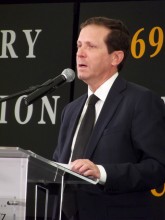 least in part, as an attempt to bolster Herzog’s position as opposition leader.
The main points of Herzog’s plan, as reported in the Israeli media, are these:
- While there is no current possibility for a two-state solution, Israel will not annul the possibility either diplomatically or geographically for the future
- Hamas will face “harsh” measures for any attacks from Gaza, including targeting their leaders, and eliminating their ability to communicate over television and internet.
- Israel will complete the security barrier around the major settlement blocs. “We will be here and you, Palestinians, will be there,” Herzog said. “Live your lives, improve your economy, create employment. The blocs under Israeli sovereignty will be part of the permanent solution. They will serve as recipients of settlers from outside the major blocs.”
- The barrier through Jerusalem will cut off Palestinian villages from the city. The Defense Ministry would be charged with granting permits to Palestinians who wish to enter the city to work.
- Palestinians would have full civil authority, but not security authority in the West Bank. This would, presumably, remove the regime of building permits in many Palestinian areas, but the Israeli military will remain present throughout the entire West Bank.
- Finally, Israel would help convene a regional security conference with “moderate” Arab states (like Saudi Arabia and Egypt, for example) to deal with ISIL and other regional security issues, presumably including Iran.
Politically, this is a shrewd plan for Herzog. The “us here, them there” idea harkens back to Yitzhak Rabin, who used that as a campaign slogan in 1992. More recently, former Prime Minister Ehud Olmert proposed a similar unilateral separation in the West Bank. This part of Herzog’s plan will probably be seen as a familiar, moderate and practical solution by many in Israel who don’t consider themselves part of the far right.
One major concern in Herzog’s proposal is the fact that he would complete the separation barrier in a manner which would cut most Palestinians off from Jerusalem. He makes no mention of the holy sites, but it seems safe to assume that his plan would provide Muslim and Christian Palestinians access to the sites in some manner. Still, with a barrier cutting Jerusalem off from nearby Palestinian towns, it will inevitably be even more difficult to gain that access, and in every other way, most Palestinians would be cut off from the city they envision as the future capital of their state. Herzog does not explain how he expects such an act to lead to greater quiet and security for Israeli Jews, but no matter—such an outcome is not conceivable given the rage that will ensue if Jerusalem is inaccessible to Palestinians.
Herzog’s plan has the benefit of removing the outlying settlements, which will not only eliminate some of the most radical settlements, it will remove many of them from close proximity to Palestinians, whom they often terrorize. Without any details, we cannot be certain, but it is possible that the removal of outlying settlements could lead to much greater freedom of movement for Palestinians. This is especially so if Herzog is serious when he urged, in his INSS speech, that Palestinians build their economy and communities.
But absorbing those settlers into the large settlement blocs will cause a significant spike in construction in those blocs. As I have detailed elsewhere, the blocs are already threatening the viability and contiguity of any potential Palestinian state, and this idea will make matters much worse.
While it is certainly true that most Israelis already see the large blocs (as well as the settlements in East Jerusalem) as part of Israel, the rest of the world, including the United States, as a matter of policy, does not, although it is seen as likely that the blocs will be annexed to Israel in a future agreement. Herzog’s plan would reinforce this fact on the ground, and would make it much harder for Palestinians to get the sort of negotiated land swap they would need to agree to the annexation. This is a running theme in Herzog’s proposal: Palestinian concerns are often glossed over and Palestinian input is not only invisible, it is seen as undesirable.
Recent Israeli history shows that unilateral actions like this do not bring peace, but instead entrench the conflict even more deeply. The lesson of Gaza is not, as many say, that Israel cannot withdraw from territory lest it face increased terrorism. Rather, it is that when Israel undermines moderate Palestinians with unilateral moves, it creates a power vacuum that is filled by more militant factions.
By simply taking the land it wants, Israel would undermine the basis for negotiating over borders between it and a Palestinian state. By cutting off Jerusalem, it would undermine the basis for negotiations for the city that both Israelis and Palestinians see as their capital. Herzog is proposing a change to the framework of any possible negotiations, and if the international community lets this happen, the notion of outside moderation of talks is lost. In fact, it would leave the Palestinians to choose between the meek acquiescence to Israeli diktats or the path of violence. Even an increasingly developed Palestinian economy, if that should also result from this plan, would not be enough to alter that equation.
Herzog’s idea that under such circumstances a regional security conference that includes Israel could possibly be convened only reflects how out of touch he is with political realities in the Middle East. In fact, this plan would make it impossible for any Arab state to upgrade its relations with Israel. And his approach to Gaza sounds more like bluster than a strategy, and certainly does nothing to address the miserable conditions Israel’s blockade of the Strip has created, conditions that much of Israel’s defense establishment has repeatedly urged be improved.
This plan has some points that might be worked with, but it is not, on balance, sound policy. It has little chance of achieving the quiet Herzog envisions; on the contrary, it is likely to further enflame the conflict.
Herzog’s plan, while preferable to Netanyahu’s status quo and certainly to the vision of those even farther to the right, falls well short of a structure that gives either Israel or the international community a framework to move toward an end to Israel’s occupation. Indeed, it seems more tailored for domestic political gains than for actually resolving the vexing problems Israel faces. That might help him push back against Lapid and Netanyahu, but the price would be further complicating diplomacy and the situation on the ground. That price is too high.
The New York-based group T’Ruah: The Rabbinic Call For Human Rights recently filed a complaint with the State Attorney General against the American arm of an Israeli organization called Honenu. The complaint is based on the fact that Honenu offers financial assistance to the families of both accused and convicted Jewish terrorists in Israel.
It is no secret that American charities send tax-deductible donations to Israeli settlements. And, while supporting settlements may be contrary to the stated policy of the United States, sending such donations is neither illegal nor a violation of IRS regulations governing tax-deductible charitable donations.
What makes Honenu different is that they act in support of people who have committed acts of terrorism. It is on this basis that T’Ruah filed its complaint.
Honenu’s activities were exposed in a report by Israel’s Channel 10. According to that report, Honenu sent funds to the family of an Israeli convicted of killing seven Palestinians in May 1990; the families of two Israelis convicted of attempted murder for trying to plant a bomb at a school in East Jerusalem in 2002; and an Israeli who kidnapped and abused a Palestinian boy in 2010. Further, according to Israeli reporter Uri Blau, Honenu has also sent money to the family of Yigal Amir, who assassinated Yitzhak Rabin in 1995.
As T’Ruah’s complaint states, ““Honenu is doing exactly what Hamas and the PLO have been criticized for — providing personal support, if not incentives, for those who commit terrorist acts.”
Will the AG uphold T’Ruah’s complaint? This is questionable. The basis for criminalizing such donations has usually been that the money is supporting groups appearing on the State Department’s list of terrorist organizations. The case T’Ruah is building is that these groups should be included on that list or that the spirit of the law – that American charitable donations must be barred from supporting acts of terrorism – be carried out. In the past, the Hebron Fund has been the target of similar complaints, though no action has been taken yet.
But the issue does not stop there. As so-called “price tag” attacks (where settlers attack Palestinians in response to Israeli decisions to take down illegal outposts or other measures that Israel takes from time to time to limit settlement activity) have escalated, even the current government in Israel — one of the most right-wing, pro-settlement ever elected — has taken to using the “terrorist” label against the groups that commit these acts. That opens the door for stigmatization even if the American tax authorities will not revoke tax-exempt status from organizations that support the radical settlers in the West Bank.
Stigmatizing such organizations can have a significant impact. While Honenu is a relatively small organization, the funds it raises are channeled through the Central Fund of Israel, a much larger NGO which raised over $70 million from 2009-13 for a variety of causes in Israel, and which was also named in T’Ruah’s complaint. The overwhelming majority of these causes are perfectly legitimate charities. If there is a political cost for supporting a group like Honenu, one which could put other donations at risk, perhaps the Central Fund and other large funding sources would end its relationship with such groups
To many, it might seem absurd that Americans can get tax deductions for supporting settlements in any way when United States policy has always opposed them. But we must keep in mind that the US has deliberately loose regulations about charitable donations and, in many ways, this helps organizations across the political spectrum. While no non-profit can violate the law, many can and do oppose a wide variety of US policies.
Legality is the dividing line. Europe recognizes the illegality of settlements under international law. As the European Council on Foreign Relations points out, this opens the door for the EU and its member states to remove the tax-exempt status of organizations supporting the settlements, whether the settlers in question are engaged in acts of direct violence or not.
In the United States, however, the legality of the settlements is a politicized question that has become very murky. In 1978, the State Department Legal Advisor deemed settlements “inconsistent with international law,” a stance that has never been officially rescinded. However, every President since Ronald Reagan has avoided calling settlements illegal and Congress has never made any such determination. This makes it much more difficult to slow funding from American charities that is flowing to the West Bank.
Whether T’Ruah’s complaint will result in Honenu being stripped of its non-profit status or not, it is imperative that groups that support settlements be held up to the light, so that people who donate can make an educated choice about what they support. More importantly, if it serves as a vehicle to push the United States to shift its position on the legality of the settlements to one that is in line with almost the entire world (the overwhelming majority of international legal opinion), it will have accomplished a lot more than cutting off a few dollars from one group that supports the most radical settler elements.
Video courtesy of Americans for Peace Now