Welcome to FMEP’s Weekly Settlement & Annexation Report. To subscribe to this report, please click here.
December 19, 2025
- Rajabi Family Evicted from Home in Silwan, Settlers Move In; More Evictions Expected
- Israel Advances Plans for the Atarot Settlement
- Preliminary Details on 19 New Settlements
- Settlers Cross Into Gaza, Again, With No Repercussions
- Governing Coalition to Push Annexation Ahead of 2026 Elections
- Israel Continues Holding Jordan Valley Activist With No Charges
- State-Backed Settler Terror this Week
- The History and Power of Settler Militias
- Bonus Reads
Rajabi Family Evicted from Home in Silwan, Settlers Move In; More Evictions Expected
On December 14th, three households of the Rajabi family were forced by settlers and the Israeli court system to leave their home of 50 years in the Batan al-Hawa section of Silwan, East Jerusalem. In distressing scenes captured on video, 14 members of the Rajabi family left the home that they owned and built. Two family members are disabled, one of which is in a coma and was displaced from his home on a stretcher. Once the Rajabi family had left, settlers promptly moved in.
Dozens of Palestinian families – hundreds of people – in Batan al-Hawa are awaiting the same fate as the Rajabi family. This week the Basbous family was handed an eviction notice, ordering them to leave their home by January 5, 2026.
Ateret Cohanim is behind nearly a dozen lawsuits seeking the eviction of approximately 700 Palestinians from the Batan al-Hawa section of Silwan. The settler group has pursued the mass displacement of Palestinians in Silwan since gaining control of a pre-1948 land trust – called the Benvenisti Trust – which owned land in Silwan in the 19th century. In 2002, the Israeli Custodian General agreed to transfer land in Batan al-Hawa to the Trust/Ateret Cohanim. Since then, Ateret Cohanim has accelerated its multifaceted campaign to remove Palestinians from their homes, claiming that the Palestinians are illegally squatting on sacred land owned by the Trust. Notably, under Israeli law, Palestinians enjoy no similar right to reclaim land that belonged to them before 1948 (to the contrary – Israeli law is engineered to erase Palestinian properties rights based, largely based on the absentee property law).
Ir Amim writes:
“With this eviction, the number of Palestinian families who have lost their homes to settlers in Batan al-Hawa in less than 15 months rises to 12 families, as part of a systematic campaign aimed at displacing Palestinian residents. Hundreds of more residents from Batan Al-Hawa face the same fate as the Rajabi Family as Ateret Cohanim and the state intensify their efforts against Palestinian families in the area.”
For more resources on Ateret Cohanim and the mass displacement of Palestinians it is effectuating in Silwan, see resources from Ir Amim and Peace Now.
Israel Advances Plans for the Atarot Settlement
The Israeli government is advancing plans for the construction of the massive Atarot settlement, planned for the site of the former Qalandiya airport between Ramallah and East Jerusalem. The plans were submitted to the Jerusalem District Planning Committee for a hearing on December 17th, and were expected to approve an outline plan for the settlement.
The plan for the Atarot settlement, which has existed since 2007, calls for a huge new settlement on the site of the defunct Qalandiya Airport, located on a sliver of land between Ramallah and Jerusalem. In its current form, the plan provides for up to 9,000 residential units for ultra-Orthodox Jews (assuming, conservatively, an average family size of 6, this means housing for 54,000 people), as well as synagogues, ritual baths (mikvehs), commercial properties, offices and work spaces, a hotel, and a water reservoir. If built, the Atarot settlement will effectively be an Israeli city surrounded by Palestinian East Jerusalem neighborhoods on three sides and Ramallah to its north. Geopolitically, it will have a similar impact to E-1 in terms of dismembering the West Bank and cutting it off from Jerusalem.
The Atarot settlement plan was last considered in 2021 when Naftali Bennet was Prime Minister, but was delayed from consideration by the planning committee – reportedly at the urging of U.S. Secretary of State Blinken. The Committee delayed advancement of the plan by ordering an environmental study which was expected to take about one year. Notably, in ordering the study, the Court made it clear that the environmental study is “standard practice” and expressed support for the underlying plan, saying it believes the plan represents a proper use of unutilized land reserves.
Just recently, he Israeli Knesset recently approved a large budget for the Environmental Protection Ministry to restore and rehabilitate contaminated land a the Atarot site for eventual settlement construction.
Peace Now said in a statement:
“This is a destructive plan that, if implemented, would prevent any possibility of connecting East Jerusalem with the surrounding Palestinian area and would, in practice, prevent the establishment of a Palestinian state alongside Israel. The Netanyahu government is seizing every moment to bury our chances for a future of peace and compromise. Especially now, when it is clear to everyone that the ideas of ‘managing the conflict’ and ‘decisive victory’ have led to a security disaster for Israel, we must act to resolve the conflict.”
Jerusalem expert Daniel Seidemann notes that it is worth recalling that, under the Trump “Peace to Prosperity” plan unveiled in 2019, the area where the Atarot settlement is planned for was designated as a “special tourist zone” under Palestinian control. Following news that the plan is being revived, Seidemann posted:
“This is also a big middle finger to Trump. The Trump “Deal of the Century” awards virtually all of Jerusalem, East & West, to Israel. The one exception that is reserved for the Palestinians is the area of Atarot/Qualandia. The Netanyahu regime is now taking that.”
Preliminary Details on 19 New Settlements
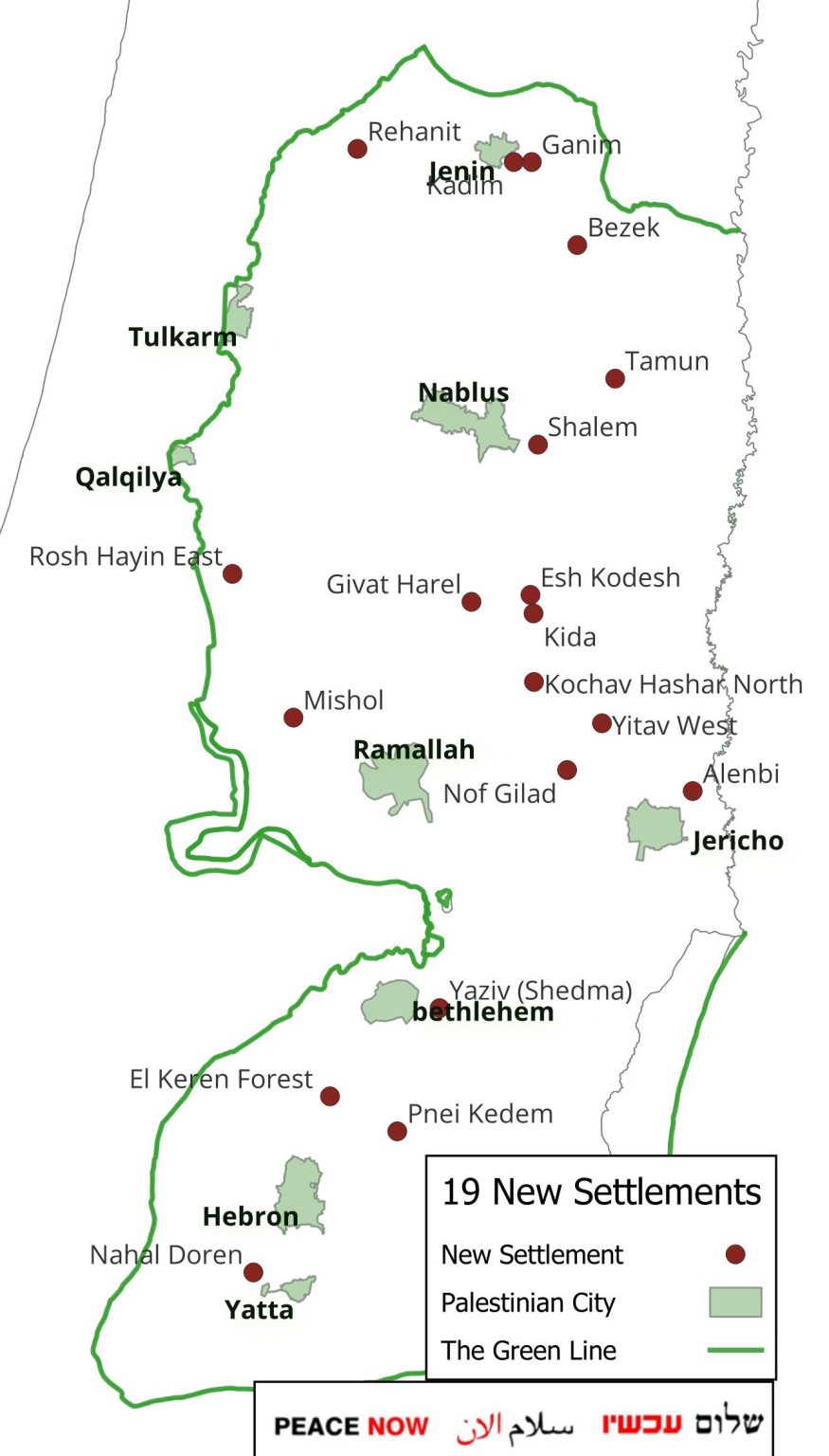 As reported last week as news broke, the Israeli security cabinet has reportedly voted to approve the establishment of 19 new settlements. If the approvals are confirmed, Peace Now reports this will mean the Israeli government has approved the establishment of 68 new settlements since 2023. Prior to 2023, there were 141 settlements, the new total would be 209.
Mu’ayyan Sa’ban, head of the Palestinian Authority’s Colonization and Wall Resistance Commission, told The Times of Israel:
“The decision by the so-called ‘Israeli occupation cabinet’ to establish and settle 19 new colonies across the West Bank constitutes the latest step in a race to annihilate Palestinian geography for the sake of settler colonialism.”
While precise information about all of the new settlements plans are not known (the security cabinet deliberates in private and does not publish its decisions), Peace Now reports what is believed to be details of the 19 new settlements:
-
- 2 settlements – Ganim and Kadim – that were dismantled by the Israeli government as part of the 2005 Gaza Disengagement Plan. Haaretz adds that “in practice, it completes the repeal of the Disengagement Plan in the northern West Bank and paves the way for rebuilding the settlements that were evacuated from that area in 2005. It would increase army presence in the area, most of which was placed under Palestinian control by the Oslo Accords. It’s an explosive, unilateral move that deepens Israel’s control over a sensitive, densely populated Palestinian area, and it will quite likely lead to escalation”
- 10 might be currently-existing illegal outposts that the government is granting full authorization to (rewarding settler lawlessness):
- Bezek – currently a farming outpost located on the highest peak between the Jordan Valley and the Jenin area.
- Esh Kodesh – located near the Palestinians village of Jalud and Qusra
- Kida – located near the Palestinian town of Duma
- Kokhav Hashahar North – likely to be constructed at the site of the Nahalah Ephraim farming outpost, located east of Ein Samia. This outpost and future settlement are built on the lands from which the Palestinian village of Ein Samia was expelled.
- Mishuol – reportedly to be constructed west of Ramallahe near the Naaleh settlement, potentially at the site of the Shalom Farm outpost. This outpost and future settlement are built on the lands from which the Palestinian village of Arab al-Jahalin was expelled.
- Nof Gilad – while not totally clear, this might be establishing a settlement at the site of a farming outpost of the same name located in the Jordan Valley (inside the Umm Zuqa nature reserve), or it might be a new settlement at the site of the Nezach Harel farming outpost located between Taybeh and Jericho. This outpost and future settlement are built on the lands from which the Palestinian village of Mu’arrajat was expelled.
- Rosh HaAyin East – reportedly to be constructed at the site of the Shirat David farming outpost near the Palestinian villages of Zawiya and Deir Ballut, south of Qalqilya in the central West Bank.
- Shalem – currently a farming outpost located just east of Nablus.
- Yitav West – this might be constructed at the site of the Aujua farming outpost, near the bedouin village of Ras al-’Ain, a community which is facing the threat of displacement under constant settler violence.
- Yatziv (Shadma) – this outpost was established only one month ago on an abandoned Israeli military base adjacent to the Palestinian town of Beit Sahour, near Bethlehem.
-
- 5 appear to be new settlements on land where there is currently no Israeli presence:
- Allenby – reportedly to be constructed near the Allenby checkpoint, located in the Jordan Valley by Jericho.
- Tamum – likely near the Palestinian village of Tamum, located between the Jordan Valley and the Nablus area.
- Nahal Doran – expected to be built between the settlements of Shima and Adoraim, located just north of the Palestinian village of Yatta in the southern West Bank.
- Ya’ar al-Keren – reportedly to be constructed south of Bethlehem, between the Palestinian towns of Beit Ummar and the Al-’Arrub refugee camp.
- 5 appear to be new settlements on land where there is currently no Israeli presence:
-
- 2 are reportedly neighborhoods of existing settlements, but are being upgraded to new status which will allow for greater growth:
- Givat Harel – located between the Palestinian towns of Sinjil and Lubban al-Sharqiya. The Times of Israel reminds that Givat Harel was granted status as an authorized, independent settlement in February 2023. It is unclear why it is being approved again.
- Pnei Kedem – currently considered a neighborhood of the Mezad (Asfar) settlement, located east of the Palestinian village of Sa’ir.
- Reihanit – reportedly to be constructed near the Palestinian village of Ya’bad in the far northern West Bank.
- 2 are reportedly neighborhoods of existing settlements, but are being upgraded to new status which will allow for greater growth:
Peace Now said in a statement:
“The government is doing everything it can to entrench Israel’s presence in the territories and to foreclose the possibility of a future of peace and two states for two peoples. Establishing settlements in areas where Israel has not previously had a presence is intended to sever Palestinian territorial continuity and to destroy what little economic development remains possible for Palestinians. The government’s policy is not only immoral, but also a security and economic folly that will further worsen Israel’s situation.”
Settlers Cross Into Gaza, Again, With No Repercussions
Over the past week the settler group Nahala has organized at least two groups of settlers to enter Gaza (an active war zone) and perform symbolic acts pushing for the establishment of Israeli settlements in Gaza. The illegal crossings were part of a Hanukkah celebration on December 18th, attended by several MKs from the ruling party, called “Raising the Flag in Gaza.” Reportedly, the settlers asked to hold the event in Gaza, but did not receive permission.
The event organized at least two groups to enter. One group drove a vehicle into Gaza and were able to raise an Israeli flag before being removed by the IDF. In a separate location, another large group broke down a barrier and attempted to cross a fence border, but were stopped by Israeli forces.
No settlers were arrested.
Daniella Weiss, leader of the Nahala organization, said:
“It is precisely in these days that we need to say in a clear voice what is obvious: Gaza belongs to the people of Israel. And we must start settling in Gaza now. This is a just and correct demand that has significant support from a large majority of the public in the State of Israel.”
Governing Coalition to Push Annexation Ahead of 2026 Elections
Haaretz reports that over the course of the Knesset’s winter session, and ahead of Israeli elections anticipated for the fall of 2026, the Israeli governing coalition is pushing bills that Knesset bills that impose Israeli sovereignty over the West Bank, i.e. annexation.
Israel Continues Holding Jordan Valley Activist With No Charges
Israel issued a six-month extension on the administrative detention of Ayman Ghrayeb, a prominent Palestinian human rights defender who was detained at the direction of settlers on November 17th (and then disappeared for two days only to reappear and report severe torture requiring hospitalization). Israel’s administrative detention protocol allow for infinite renewals of the order, and does not require Israel to, at any point, bring charges or provide evidence of a crime. ACRI reports Israel is currently holding 3,350 Palestinians in administrative detention, a figure that is three times higher than it was prior to October 7, 2023.
State-Backed Settler Terror this Week
Settlers continued to terrorize Palestinians across the West Bank this week, and the violence has now spilled into Israel proper.
On December 12th, three settlers attacked a Palestinian family – including a woman who is 9 months pregnant and her two children – while driving in Jaffa. They admitted to pepper spraying the family and reportedly called the woman, Hanan Abu Shehadeh, a “stinking Arab.” The attackers are members of the Hilltop Youth settler group, and have at times banned from entering the West Bank because of their violence against Palestinians. The trio was arrested a few days after the attack, and appeared in court on the 16th where the Israeli police rep told the court the attack was planned and racially motivated. The Court ordered their detention for at least five days pending charges.
On December 16th in Tuqu’, settlers shot and killed a Palestinian teen who, along with four friends, was running away from a highway road and an unidentified black vehicle. The IDF alleges the teens had been throwing rocks at the vehicle. The murder of Muheeb occurred in the hours following a funeral for 16-year old Ammar Sabah, who was shot and killed by the IDF during a raid of Tuqu’ just the day before.
Writing in The Hill, a publication targeted at and widely read by staff members in the U.S. Congress, a Palestinian-American explains the violence and fear Palestinians are experiencing in Turmusaya, where there are many U.S. citizens living. The author, Yaser Alkam, calls on the U.S. to do more to protect its citizens and all Palestinians, writing:
“With only the rarest of exceptions, our attackers go unpunished. I have repeatedly reported settler attacks to the U.S. Embassy and asked for protection, only to receive vague and non-committal responses with little to no follow-up. Every U.S. administration for decades has fueled a sense of impunity among Israelis that they can do whatever they want — including killing U.S. citizens — and the U.S. will not demand accountability or place conditions on the billions of dollars in military funding given to Israel annually.
With the Gaza ceasefire deal, President Trump has shown that he is willing to rein Israel in. He can and must do the same when it comes to settler violence — not just for the sake of Palestinian-Americans, but for all Palestinians who are suffering daily from Israel’s military occupation and forced displacement.”
The History and Power of Settler Militias
Drop Site News reports takes a deep dive into the official deputization of settler militia groups, since 1964, to police Palestinians across the West Bank, creating a system of extreme violence and no accountability. The report says that 450 settler rapid response squads existed prior to October 7, 2023, after which 700 new squads were constituted by Ben Gvir, who also provided 10,000 assault rifles to the effort in addition to loosening gun ownership eligibility.
Drop Site writes:
“Rights groups report that complaints about organized violence by armed settlers routinely bounce between various jurisdictions of Israeli authorities. Police classify suspects as “military auxiliaries” and pass the files to the army; the army returns them as “civilian” cases; civilian authorities cite military jurisdiction, and the investigations close for “lack of evidence.”…’They don’t distinguish even between the hagmar and the rapid-response squads, everyone’s in uniform now,’ a resident from the South Hebron Hills told Drop Site on condition of anonymity. ‘I know many of them by name. Some even have criminal records. Now they’ve been given uniforms’.”
Bonus Reads
- “Israel is seizing an ancient historical site to turn it into a tourist site” (NPR, 12/18/25)
- “‘A Cause for Serious Concern’ Germany Condemns Israeli Plan to Build Over 750 Housing Units Across West Bank” (Haaretz, 12/13/2025)
- “Katz and Smotrich: Palestinian waste burning in West Bank is threat to national security” (Ynet, 12/18/2025)