Welcome to FMEP’s Weekly Settlement & Annexation Report. To subscribe to this report, please click here.
November 21, 2025
- Israel Announces Seizure of Sebastia Archaeological Site
- Settlers Establish New Outpost Near Bethlehem
- IDF Raids Bedouin Village in Advance of Settlement Expansion
- Settlers Terrorize Palestinians After IDF Dismantles Illegal Outpost
- State-Backed Settler Terrorism This Week
- Human Rights Watch: Not Just Gaza – Israel Committing War Crimes in the West Bank
- Bonus Reads
Israel Announces Seizure of Sebastia Archaeological Site
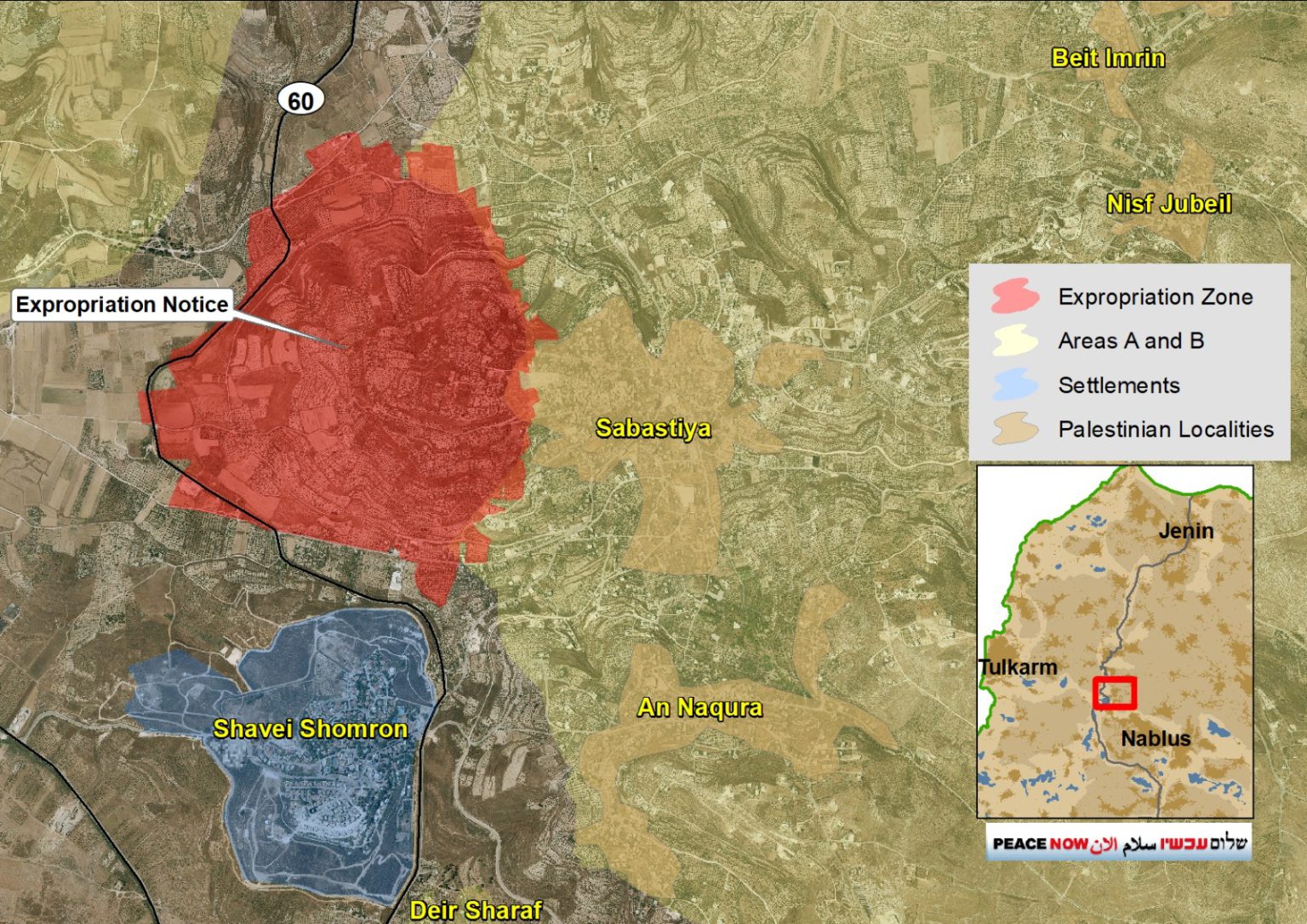 On November 19th the Israeli government announced it will expropriate a large amount of privately owned Palestinian land (445 acres, 1,800 dunams) surrounding and including the Sebastia archaeological site, located in the northern West Bank, in order to bring it under Israeli control and to develop the site into a major tourist attraction. The Israeli government has already allocated 30 million shekels ($9.24 million) to the development of the Sebastia site.
Emek Shaveh said in a statement:
“Under the guise of concern for heritage, the government is investing tens of millions of shekels in turning heritage sites into weapons of dispossession and annexation. The intention to expropriate private land is anything but preservation; its purpose is to establish a tourism settlement that will detach Sebastia’s heritage from the town and Judaize the area through the tourists who visit the site.”
The government’s plan will unilaterally seize land from the villages of Burqa and Sebastia, land in Area C which the Israeli government recognizes as lawfully owned by Palestinians, some of which is cultivated olive groves. The government is nonetheless carrying out the expropriation on the basis of an administrative order for antiquities. Emek Shaveh says Sebastia will be the fifth and most significant archaeological site expropriated by Israel since 1967, and Peace Now provides the receipts.
Along with dispossessing Palestinian landowners, Israel’s plans for the area will devastate the Palestinian tourism industry built around the site, which under Israeli control will be developed not for the benefit of Palestinians but for the Israeli tourism industry and settlers. Tellingly, the Israeli government has already begun renovating a nearby railway station – the Masoudia station – into a tourist site (a settlement) and planning a new access road to the site that bypasses the Palestinian village of Sebastia.
Emek Shaveh explains:
“The intention is clear – to sever the ancient site of Sebastia from the Palestinian historic town of Sebastia, connect the site to Road 60 and turn the site into a settler-led tourist attraction (similar to the City of David in Silwan, East Jerusalem). This development follows government decision 491 (May 2023), which allocates 32 million NIS to develop what Israeli authorities call the “Shomron (Samaria) National Park” in a plan that entails massive development of the site, including a visitors’ centre, a parking lot, and a fence which will separate the acropolis from the rest of the town.”
Peace Now explains:
“The Sebastia case is especially unusual because the expropriation targets an archaeological site that has long served as an economic, cultural, and tourism anchor for residents of Sebastia and the surrounding area, and that has been open to the public. Around the site are souvenir shops and restaurants, and in Sebastia itself, many residents earn their living from guiding visitors and renting rooms to tourists. The Sebastia site lies inside the village, among residents’ homes. The expropriation concerns the western part of the site, an area with fewer homes and surrounded by olive groves.” And on the railway station settlement site, Peace Now says: “Turning the Masoudia train station into a tourist site is, in fact, the establishment of a new settlement. This is not a heritage site—it’s part of a deliberate government plan to plant settlements deep inside a densely populated Palestinian area between Nablus and Jenin. These projects will increase the security burden, deepen the occupation, and advance annexation. The only ‘heritage’ being promoted here is the legacy of lawlessness and brute force championed by the Gush Emunim settler movement, which, then as now, acted illegally, clashed with security forces, and imposed facts on the ground for which the State of Israel continues to pay a heavy price to this day.”
Peace Now said in a statement:
“The Israeli government’s drive for dispossession and annexation knows no limits, and it is prepared to violate international law openly to pursue it. This is part of a broader effort to take control and expand settlements in areas northwest of Nablus that Israel evacuated during the disengagement. Sebastia is a heritage site located inside a Palestinian village, part of its history and part of a future Palestinian state. Under the Oslo Accords, signed by Israel, it should have been transferred to Palestinian administration long ago. Israeli greed harms not only the landowners, but also the prospect of a peaceful solution that upholds the rights and heritage of both peoples.”
Settlers Establish New Outpost Near Bethlehem
 The chairman of the local Etzion settler council, Yaron Rosenthal, proudly and publicly announced the establishment of a new outpost, called “Shdema”, on a hilltop near the Palestinian town of Beit Sahour east of Bethlehem. This new outpost is not a wild and haphazard effort by fringe radical settlers to build an outpost, but the organized and intentional work of settler leadership to establish a permanent new settlement. Tractors appeared overnight to clear and level the land, and several caravans were precipitously moved onto the site with three settler families reported to have moved in.
In his announcement, Rosenthal made it clear that the outposts came in response to the IDF’s evacuation of another outpost in Gush Etzion. The outpost was also built days after a Palestinian attack targeting Israelis at the nearby Gush Etzion junction, where one person was killed and three were injured by masked, knife-wielding assailants.
Peace Now has filed a complaint demanding an investigation into the Gush Etzion Regional Council’s involvement in the illegal construction of the outpost, and said in a statement:
“The new outpost is intended to choke the Palestinian town of Beit Sahour and block its development. There is no limit to the settlers’ audacity in establishing outposts and creating facts on the ground, while using public funds and denying Israel the chance for a future of peace and two states.”
Settlers have spent almost two decades trying to build a settlement at this exact site, an area called Ush Ghurab. The site was an Israeli military base but was vacated in the early 2000s. The U.S. then initiated a plan to fund and build a children’s hospital (with services aimed at Palestinians), but the plan was ultimately scuttled under settler pressure and the Israeli government build a new military post at the site.
IDF Raids Bedouin Village in Advance of Settlement Expansion
Ir Amim reports the Israeli police and soldiers raided the bedouin village of Kasarat living near the site of the future E-1 settlement. A group of 150 soldiers reportedly invaded the village in the early morning hours, forcing residents out of their homes while they proceeded to ransack each residence and beat several men. Residents reported extensive damage and stolen cash after the soldiers left.
Israeli Police have said the raid was aimed at finding weapons, though there were no arrests or seizures. Attorney Roni Pelli, who works for Yesh Din, told The Times of Israel that holding an entire village hostage is a form of collective punishment, and illegal under international law.
Ir Amim warns:
“The scale and violent nature of this unprovoked military action against an entire village is unprecedented in this area and could further indicate Israel’s intent to uproot the Palestinian communities living on lands marked within the E1 corridor….
Ir Amim has long stressed the danger of expulsion for vulnerable Palestinian communities in and around E1, whose land is directly threatened by the plan’s reemergence and approval. We have likewise warned that expulsions could be the first step taken by Israeli authorities following the plan’s approval. In addition to the severe geopolitical ramifications of the E1 settlement plans for the prospects of a viable Palestinian state, the most immediate repercussions are already unfolding on the ground for Palestinian communities.
This military action comes as the District Court reviews several petitions filed against the approval of the E1 settlement plans, including a petition initiated by Ir Amim together with partner organizations, Bimkom and Peace Now. It also follows the court’s recent rejection of a request for an injunction. The raid on the Kasarat community suggests that the authorities intend to continue pushing forward with the E1 plans at full speed, despite the petitions still under review.”
Settlers Terrorize Palestinians After IDF Dismantles Illegal Outpost
On November 17th, Israeli security forces dismantled the violent illegal outpost of Zur Misgavi (aka Givat Hatilim), located near Hebron. Attempting to thwart the evacuation, Israeli settlers barricaded themselves in the outpost and proceeded to throw rocks and metal rods, and burn vehicles and tires as the military and police attempted to remove them. Six settlers were arrested. Smotrich explained his support for the outpost demolition by saying he plans to build thousands of new settlement units on the same plot of land and the outpost was in his way.
The demolition of the outpost was apparently carried out at the request of the Gush Etzion Regional Council which raised concern about anarchy in the area and complained about the unauthorized construction.
The outpost evacuation enraged parts of the settler movement and in retaliation, settlers proceeded to terrorize nearby Palestinians communities, conducting violent raids on two towns.
First, settlers attack Umm al-Butm (located at the foot of the Zur Misgavi outpost), setting buildings and vehicles on fire and assaulting at least one women.
Second, settlers attacked Jab’a, setting fire to three homes, three vehicles, and a caravan. Video from the scene is terrifying. Settlers graffitied several buildings, writing “A Jew doesn’t evict a Jew.”
Following the fiery attack on Jab’a, the IDF announced a manhunt to find the attacks, and several high ranking Israeli officials made public statements condemning settler violence.
State-Backed Settler Terrorism This Week
Over the course of the last two weeks more and more criticism has fallen at the feet of the Israeli government, which has long sought to characterize settler violence as a small problem of a few bad apples, absolving the state of its systematic involvement, financing, and encouragement of settler violence. Following the settler attacks on Jab’a and Umm al-Batun and under mounting international pressure to address the problem, Prime Minister Netanyahu made public comments promising “forceful action” against settler violence, but continuing to assert the problem is one of the minority.
Bibi later convened his cabinet and top security officials to discuss how to address settler violence, reportedly to include getting violent settlers to attend educational programs (i.e. no real legal consequences or accountability). Later, Israeli security officials reportedly drafted a new plan to reportedly entails several recommendations including to: to create a special investigative team to handle severe cases; increase military and police deployment in the West Bank; establish 14 security hubs in violent hotspots; expand surveillance networks with new cameras; and increase punishment of offenders to include property seizures, fines and gun license revocations.
In an editorial, the Jerusalem Post Editorial Board wrote that the Israeli government is complicit in the violence, writing: ”The public silence of Netanyahu and Katz and the encouragement of Ben-Gvir point to the only plausible conclusion that the government is part of the problem, not the solution.”
While the Israeli government formulates a response, settler terrorism in the West Bank continues on a daily basis – and no arrests have been reported. Key attacks this week include:
- Attacks on Jab’a and Umm al-Bum, as detailed above.
- Huwara – On November 20th, settlers conducted a pogrom on the village of Huwara. First throwing stones and molotov cocktails, settlers further escalated to setting vehicles, homes and a scrapyard on fire, resulting in a massive blaze. IDF are reported to have arrested at least one Palestinian journalist who was documenting the attack, but no arrests of Israeli settlers have been reported.
- Al-Mirkez – On November 21st settlers used clubs to violently assault Palestinians in the village of al-Mirkez, located in the Masafer Yatta area of the South Hebron Hills.
- Luban a-Sharqiya – Settlers torched several buildings.
- Abu Falah – Settlers burned an agricultural building and set a home on fire while residents were still inside.
- Deir Sharif – Settlers vandalized a plant nursery, destroyed a bathroom fixture showroom, and burned over a dozen cars.
- Beit Furik – Settlers raided Beit Furik.
- Susya – Settlers attacked an elderly Palestinian man, knocking him off his donkey and requiring hospitalization.
Human Rights Watch: Not Just Gaza – Israel Committing War Crimes in the West Bank
Human Rights Watched published a new report entitled, “‘All My Dreams Have Been Erased’: Israel’s Forced Displacement of Palestinians in the West Bank.” An excerpt reads:
“This report examines the Israeli government’s conduct of Operation Iron Wall from its start in January 2025 through July 2025, and the resulting mass displacement of Palestinians from three refugee camps in the northern West Bank. Human Rights Watch found that Israeli forces committed forcible displacement in violation of the law of occupation under international humanitarian law that amount to war crimes. Human Rights Watch also found that Israeli forces committed the forcible transfer of population and other inhumane acts as part of a widespread or systematic attack directed against a civilian population, which are crimes against humanity under the Rome Statute of the International Criminal Court. Israel’s actions also violated international human rights law, which remains in effect in the West Bank…
When forced displacement is committed as part of a widespread or systematic attack on a civilian population, thus reflecting state or organizational policy, it can constitute a crime against humanity. These actions may also be considered “ethnic cleansing,” a non-legal term used to describe a policy to remove an ethnic or religious group from particular areas “by violent and terror-inspiring means.”…
This forced displacement reflects the broader pattern of ongoing rights violations by Israeli authorities against the Palestinian population, including the crimes against humanity of apartheid and persecution.”
Read the full report here.
Bonus Reads
- “IDF Blocks Activists From Aiding Palestinian Olive Harvest, Declares West Bank Village Closed Military Zone” (Haaretz, 11/14/25)
- “Averting West Bank collapse: How to revive Palestinian politics” (ECFR, November 2025)
- “Editorial | In the West Bank, the IDF Only Arrests Those Who Come to Protect Palestinians” (Haaretz, 11/16/25)
- “‘Palestinian Farmers Are Fighting to Survive’ Drought and Settler Violence Make 2025 West Bank Olive Harvest Worst in Living Memory” (Haaretz, 11/14/25)