Welcome to FMEP’s Weekly Settlement Report, covering everything you need to know about Israeli settlement activity this week.
To subscribe to this report, please click here.
August 11, 2022
- Israel Completes Secret Registration of New Land in East Jerusalem
- Israel Asks Court to Stay Out of Homesh Outpost Case on Promise to Evacuate Settlers (Eventually)
- IDF Removes Settlers from Ramat Migron Outpost
- This Week in Area C: Continued Annexation & Harassment
- Not Just Area C: Settlers Eye Archaeological Site in Area B
- Update: Israeli University Defends Excavation Near Nabi Saleh
- New Analysis of “Silicon Wadi” Project
- Bonus Reads
Israel Completes Secret Registration of New Land in East Jerusalem
Israel Hayom reports that Israel has succeeded in secretly registering State ownership of 16 dunams (four acres) of land in East Jerusalem, opening the possibility for constructing a new settlement enclave there.
The Israeli Justice Ministry secretly completed the acquisition of the land after the Israeli Custodian General hired researchers tasked with finding evidence that the land was purchased by Jews in the 1920s as part of a larger land purchase, though this part of the land was not registered. A court recently accepted new evidence found by the researchers, resulting in the land being placed under the control of the Israeli Custodian of Absentee Property on a temporary basis, while the State searches for the Jewish owners (or their heirs).
The newly-registered land is surrounded by Palestinian neighborhoods, close to the West Bank barrier (which in this location is an actual wall) to the East – with Abu Dis on the far side – and the Palestinian neighborhood of Jabal al-Mukhaber to the west. According to Haaretz, the location is considered one of the most sensitive in East Jerusalem, due to its proximity to the building designated as the future home of the Palestinian parliament and its distance from other Jewish neighborhoods.
This land is south of the area where that has been planned for the settlement called Kidmat Tzion, though this plan has been frozen. In 2017 (during the Trump-Netanyahu era), Ir Amim reported that Kidmat Zion was one of nine Jerusalem area settlements that Israel planned to move forward.
Israel Asks Court to Stay Out of Homesh Outpost Case on Promise to Evacuate Settlers (Eventually)
On August 10th, lawyers representing the Israeli government told the High Court of Justice that it plans to remove settlers from the illegal Homesh outpost site as soon as the Defense Minister sets a date for the evacuation, asking the Court to allow it to delay the evacuation until it finds “the right time from a security standpoint.” This is the second time the State has assured the Court that it will dismantle the outpost without committing to a deadline to enforce Israeli law against the settlers illegally living and studying there.
The Israeli NGO Yesh Din said in response:
“The state continues its foot-dragging and refuses to carry out its legal and moral obligation, which is to evacuate the outpost built illegally on private land belonging to the village of Burqa. The expulsion of Palestinians and the stealing of their land must end. Every day that passes increases the injustice and rewards lawbreakers. The defense minister and the prime minister, like their predecessors, prove that the rule of law will always take second place in the face of political interests and appeasing the settlers. The Supreme Court must bring them back into line by a clear judicial ruling that expresses its displeasure at this conduct, which is a complete infraction of the law and infringement of Palestinian rights.”
The State has, for over a year, delayed its response to a 2019 petition filed by Yesh Din seeking the removal of settlers and settler structures from the site of the former Homesh settlement, located in the northern West Bank, and a guarantee of the site’s return to Palestinian landowners. The Homesh settlement was dismantled by the Israeli government as part of the 2005 Disengagement Plan (along with two other small settlements in the area). Despite Homesh being dismantled, Israel never permitted Palestinians to regain access to or control of the land, declaring it a closed military zone. That status has prevented Palestinians from entering the area, while allowing settlers to routinely enter and (illegally, under Israeli law) inhabit the land, even (illegally) establishing a yeshiva there. That yeshiva, according to the Israeli NGO Kerem Navot, has become one of the West Bank’s “hardcore centers of settler terror”. Settlers have also wreaked terror on nearby Palestinian villages, most notably Burqa and Sebastia. One Israeli politician even went so far as to say that settlers are “carrying out a pogrom” in Burqa.
Settlers and and their powerful allies in the government ramped up their lobbying campaign pressing the Israeli government to officially reestablish the Homesh settlement in the wake of the death of settler Yehuda Dimentan in December 2021. Dimentan studied at the illegal yeshiva at the Homesh site. In January 2022, settlers staged a massive march to Homesh as part of its pressure campaign to legalize the yeshiva in his memory.
IDF Removes Settlers from Ramat Migron Outpost
In the early morning hours of August 11th, Israeli forces cleared the illegal outpost dubbed by settlers “Ramat Migron”, removing three mobile homes and razing a structure used by settlers as a synagogue. The Times of Israel reports that three families and several young settlers were living in the outpost, which is located north of Ramallah on a hilltop where the illegal outpost of Migron, evacuated by the government of Israel a decade ago, formerly stood. Settlers remain defiant, saying:
“We have something to tell you, ministers of the government: we do not intend even for a moment to give up, and we intend to continue to hold on to the hill until it becomes an established and flourishing permanent settlement.”
As a reminder, the illegal outpost known as Migron was dismantled by the Israeli government in 2012 when the Israeli High Court ruled the land is privately owned by Palestinians. Since then settlers have continually sought to reestablish a settlement there. Israeli forces have razed outposts at the site at least 10 times in the past 10 years — all the while denying Palestinians the ability to reclaim control over land that an Israeli court affirmed they own.
As a reminder: In addition to the IDF retaining control over the Migron outpost site, Israel rewarded the settlers it forcibly removed from the outpost by promising to establish two new official settlements: “New Migron” as well as 184 housing units to be built east of the settlement of Adam (aka, Geva Binyamin). Construction of the “New Migron” settlement was completed in July 2020. All said, the two new settlements and temporary housing for the evicted settlers cost Israeli taxpayers millions of dollars – sending a clear message that settler law-breaking pays off.
This Week in Area C: Continued Annexation & Harassment
The Israeli state and its settlers have not taken a summer break from the ongoing campaign to effect the de facto and de jure annexation of Area C.
- On a tour of the northern West Bank, Justice Minister Gideon Sa’ar called for a new National Plan to “protect” Area C.
- Also in the northern West Bank, work began this week on a large, new Torah center in the Immanuel settlement – a settlement currently enjoying a construction boom as reported by Arutz Sheva.
- And finally, settlers continue to closely monitor and report on Palestinian construction in Area C – this time on a new water park that opened this summer and a few new Though settlers allege the water park was built illegally, the Israeli Civil Administration assured Israel Hayom that illegal construction has already been dismantled.
Not Just Area C: Settlers Eye Archaeological Site in Area B
As FMEP has chronicled, settlers and the Israeli state have undertaken an organized campaign that weaponizes archaeology to serve their own political agenda. Just last week, FMEP covered how the Sambuski cemetery in East Jerusalem is a part of the effort.
An August 3rd report by Israel Hayom details Palestinian plans to develop a national park at a historical site that settlers refer to as “Tel Orma,” which is the site of an ancient fort and reportedly rich with remnants of Jewish heritage in the area. The report suggests that the Palestinian Authority has damaged the site and is also determined to destroy evidence of Jewish civilization and antiquities that are potentially located there. This site is in Area B of the West Bank, where Israel does not exercise civil control of matters like culture and archaeology, but that has not stopped settlers from flying a drone over the site to see what the Palsetinians have been developing there, or from visiting the site to see the work in person.
Head of the Samaria Regional Council Yossi Dagan – whose ambitions to take over more land for the settlements are not confined to Area A – told Israel Hayom:
“We call on the Israeli government, the defense minister, and the public security minister to take action right away and protect these important places. Just like no other country in the world would allow its people’s history to be attacked, we must not allow rioters from the Palestinian Authority to harm our history. Tel Orma is [part of] the Jewish people’s legacy and an important part of Jewish history, and we cannot stand by as the place is systematically destroyed.”
Update: Israeli University Defends Excavation Near Nabi Saleh
Following media attention to an excavation being conducted by Bar Illan University in the West Bank, the university has now publicly defended the dig, saying that it is located on “State land.” The Israeli Civil Administration also stated that the dig is being conducted legally and that a permit had been issued in accordance with Israeli military law which governs the occupied territories.
The area is located between the Palestinian villages of Nabi Saleh and Deir Nidham, just north of Ramallah. Palestinians claim that the land is privately owned.
New Analysis of “Silicon Wadi” Project
This week Ir Amim issued a new report on the “Silicon Wadi” project being implemented by the Jerusalem Municipality, which calls for the establishment of a major high-tech hub along the western side of East Jerusalem’s Wadi Joz neighborhood, requiring the eviction of many Palestinian businesses located there. The report is a useful summary of where the project stands, what its implications are, and how the “Silicon Wadi” initiative connects to larger plans by the State and settlers to increase Israeli hegemony over Jerusalem.
Most importantly and urgently, Ir Amim stresses regarding the Silicon Wadi project:
- Palestinian businesses are in a “tenuous position” because most are able to operate based on “special use” permits allowing them to conduct business on land that is not zoned/designated for such use. Theoretically, Israel can revoke those permits if it chooses.
- The land in question has not been registered, and Israel has been re-initiating the land registration in other parts of Jerusalem. If the process were to be restarted for this land, the land could be placed under the control of the Israeli Custodian General. Ir Amim also reports that the attorney hired by Israel to conduct an unofficial mapping of the area is known to have ties to settler groups.
- The project fails to address the primary need of East Jerusalem: housing. The ongoing housing crisis in East Jerusalem is at an all-time high.
- And finally, Ir Amim writes: “The land slated for the Wadi Joz Business Park is located between the Kerem al-Jaouni section of Sheikh Jarrah, where settler groups have been working to evict approximately 30 Palestinian families, 5 and the northeastern part of the Old City. …there is speculation that the plan aims to extend the ring of settlements within Palestinian neighborhoods around the Old City and establish an Israeli stronghold on the northeastern side under the guise of economic development.”
Bonus Reads
- “More U.S. Jews Moved to West Bank Settlements in 2021 Than Any Other Year in Past Decade” (Haaretz)
- “Israel expands West Bank security fence as violence escalates in Jenin” (Al-Monitor)
- “Israel Demolished a Palestinian’s Home in Violation of Court Orders. He Now Lives in a Tent With His Children” (Haaretz)
- “Top British Funder of Israel Trips to Probe Surprise Overnight Stays in Settlement” (Haaretz)
- “Jewish groups fume at construction of illegal Palestinian water park“ (Israel Hayom)
- “Opinion Shame on me for believing courts could stop the Israeli settlement machine” (Gershom Gorenberg / Washington Post)
- “Basketball Team From West Bank Settlement Should Be Kicked Out of Israel League, Says Ex-pro Player” (Haaretz)
Welcome to FMEP’s Weekly Settlement Report, covering everything you need to know about Israeli settlement activity this week.
To subscribe to this report, please click here.
August 4, 2022
- Encircling Jerusalem: Israel Advances Settlement Plans Across the City, While Settler Projects Tighten the Noose
- Dumping Any Pretense of Respect for Rule of Law, Israeli High Court Reverses Course, Allows Mitzpe Kramim Outpost to be “Legalized”
- Settlers Acquire Another Home in Downtown Hebron
- Elad Closes Palestinian Access Road Near Sambuski Cemetary in Silwan
- This Week in Area C, Part 1: JNF Approves Purchase of Palestinian Land In Jordan Valley While High Court Weighs Petition
- This Week in Area C, Part 2: Regavim Files Petition Pushing for Immediate Demolition of Palestinian Construction in Area C
- This Week in Area C, Part 3: Settlers Continue to Occupy Six Sites After Recent Attempt to Establish New Outposts En Masse
- Groups Petition to Cancel New Israeli-Led Archeological Dig in the West Bank Citing Legal Questions
- Bonus Reads
Encircling Jerusalem: Israel Advances Settlement Plans Across the City, While Settler Projects Tighten the Noose
It must be stressed that events over the past several months (while the Settlement Report has taken an abbreviated form) have rapidly accelerated the encirclement of Jerusalem by settlements and settler-backed projects — developments which come at the direct expense of Palestinians — their presence in Jerusalem, their rights as land owners, and their quality of life. This encirclement continues to progress, unabated and almost entirely unchallenged, each day. 
Last week, on July 25th, the Jerusalem District Planning Committee advanced plans for two brand new settlements in East Jerusalem – “Givat HaShaked” and the “Lower Aqueduct” plan. These two settlements that would nearly complete the encirclement of Jerusalem to the south. Details of those plans are:
- The Lower Aqueduct plan (1,465 new units) was approved for deposit for public comment. This plan would see a new settlement – called the Lower Aqueduct Plan – built on a small sliver of land between the controversial settlements of Givat Hamatos and Har Homa – and is intended to connect them. In so doing, it will establish an uninterrupted continuum of Israeli settlements on the southern rim of Jerusalem, and destroy the contiguity of Palestinian land in the West Bank and East Jerusalem.
- The Givat HaShaked settlement was also discussed, and the Committee opted to increase the total number of units that the plan outlines for construction, from ~400 to 700 housing units, plus schools and synagogues. Ir Amim and Terrestrial Jerusalem both report that, after a few technical requirements are met, the plan to build Givat HaShaked is expected to receive final approval when the Committee reconvenes in the coming weeks. The plan for Givat HaShaked is unprecedented, according to Terrestrial Jerusalem, in that it is the first settlement of this size that that Israeli government will establish inside of a Palestinian neighborhood – Beit Safafa, which will be completely encircled by Israeli construction if Givat HaShaked is built.
For more background on the Lower Aqueduct plan, see resources by: Terrestrial Jerusalem and Ir Amim.
These plans are significant developments in the effort to establish settler hegemony over East Jerusalem, but are only part of the story of how the encirclement of East Jerusalem has rapidly advanced over the past months. In addition to the construction of new settlements and growth of existing ones, settlers are succeeding in advancing new projects under the guise of tourism (like: the Cable Car, a new visitors center in Batan Al Hawa, and more) and the State is undertaking systematic efforts to take over more and more land. Those methods include the revival of a politicized land registration process in East Jerusalem and the expansion of “national park” lands onto the Mount of Olives. Palestinians in Sheikh Jarrah and Silwan also continue to face the looming threat of dispossession through Court proceedings. In a rare piece of good news — on July 21st the Israeli Supreme Court partially accepted a petition filed by the Duweik family, which has led to the (temporary) freezing of their eviction.
Another facet is the looming threat is the seemingly growing inevitability of the construction of the E-1 settlement to Jerusalem’s east. Prior to the arrival of U.S. President Joe Biden in Jerusalem on July 13th, the Israeli government intervened to postpone a critical hearing on the E-1 settlement, rescheduling it for September 12th. The rescheduled hearing, if it is not postponed yet again, could result in granting final approval to the highly contentious plan (and barring intensive outside pressure such additional postponement seems highly improbable, given the Israeli domestic politics and the upcoming national election). See Terrestrial Jerusalem for a recap of President Biden’s visit.
Dumping Any Pretense of Respect for Rule of Law, Israeli High Court Reverses Course, Allows Mitzpe Kramim Outpost to be “Legalized”
Nearly two years after ruling there is no possible legal basis by which the Mitzpe Kramim outpost can be retroactively “legalized” under Israeli law, the Israeli Supreme Court has now reversed course and will allow the State to formally legalize the settlement using the so-called Market Regulation principle.
In its original ruling, issued in September 2020, the High Court held that construction of the Mitzpe Kramim outpost was not undertaken in “good faith” because there were “multiple warning signs” that the land was privately owned by Palestinians. The outpost was ordered to be dismantled at that time. Now, with apparently no new evidence, the Court decided to accept the settlers’ claim of “good faith.”
The “good faith” condition for retroactive legalization of illegal settler construction on privately-owned Palestinian land is a central element of the “market regulation” legal principle which was devised by former Attorney General Avichai Mandelblit in December 2018 as an alternative to the (now overturned) Settlement Regulation Law. The principle offers a path to grant retroactive legalization to the settlers for what this principle treats as “unintentional” land theft – throwing the principles of both rule of law and private property rights out the window. Peace Now has a comprehensive breakdown of the legal opinion, including the specific criteria outlining which outposts can qualify under the new scheme. It is estimated that 2,000 illegal settlement structures qualify for retroactive legalization using this principle.
Yesh Din writes on the significance of this ruling:
“This ruling overtly indicates Israel’s intentions to continue to pursue retroactive legalization of illegal Israeli construction in blatant disregard of the rights of the local Palestinian population of the West Bank. The State of Israel continues to ignore the duties bestowed upon it by IHL, as the occupying power, to protect the occupied population. Additionally, as the occupying power, Israel is prohibited from transferring the occupier’s population into occupied territory. The interpretation of the Supreme Court’s majority opinion will, in practice, undoubtedly serve to fulfill the intentions of the repealed Regularization Bill from 2017. It will enable settlers, backed by the Civil Administration and other State authorities, to take over thousands of dunams of Palestinian land, leading to human rights violations on a massive scale all over the West Bank and serving as the basis for future negligent and illegal policies, which are now more likely to be given the go-ahead by the Supreme Court. This ruling symbolizes a turning point of Israel’s Supreme Court, which, for the first time, has endorsed the forced confiscation of privately owned land, which is not required for military needs, for the sole purpose of use by Israeli civilians for the establishment of a new settlement.”
In +972 Magazine, Orly Noy writes:
“The court’s ruling could potentially pave the way for the retroactive legalization of thousands more homes in outposts built on privately-owned Palestinian land…The legalization of Mitzpe Kramim is only a footnote in Israel’s policies of dispossession and land theft on both sides of the Green Line, carried out through what the Israeli regime deems completely “legal” expropriations…And one more word regarding the concept of “good faith,” which was sufficient reasoning for the High Court to retroactively legalize the theft of private Palestinian land. This same line of argumentation did not protect the residents of Umm al-Hiran, a Bedouin village in the Negev/Naqab, from being threatened with destruction and expulsion, even though they were physically placed where the village exists today in the 1950s by the military government after it expelled them from their original land, on which Kibbutz Shoval now sits. Although the state itself was the one to move them to their new location, the residents of Umm al-Hiran have lived for decades without basic infrastructure such as water and electricity — that is, until the state decided to destroy the village in order to build Hiran, a town for Jews alone, on its ruins. Unlike the settlers of Mitzpe Kramim, the residents of Umm al-Hiran did not take over land that did not belong to them, nor did they settle on private land that belonged to others. And yet, the state did not hesitate to brutally deport them — even killing a local resident, Yacoub Abu al-Qi’an, in the process. The same court that will allow the residents of Mitzpe Kramim to remain on land it itself admits does not belong to them did not hesitate to legalize the cleansing of Umm al-Hiran. Because, after all, in the apartheid regime, even the concept of “good faith” applies solely to Jewish citizens.”
Settlers Acquire Another Home in Downtown Hebron
On July 28th, a settler group called Harchvi announced it has purchased a three-story house in central Hebron, very close to the Tomb of the Patriarchs/Al-Ibrahimi Mosque and on the Palestinian side of a key IDF checkpoint (the “Pharmacy” checkpoint), which Israeli Jews are supposed to be prohibited from crossing. The group was granted a purchase agreement by the Israeli Defense Ministry this week, which seemingly legitimizes the settlers claim to have purchased the property – but it is not a final determination of the legality of the transaction. This is the second such house in Hebron that settlers have claimed to have purchased from Palestinians owners this year.
Providing more detail on the status of the house, Peace Now writes:
“Peace Now has no information regarding the alleged deal in this case. We know from many other cases in Hebron and in the West Bank that these are dubious purchases, which are sometimes based on forgery or the purchase of only small parts of the property. It almost always turns out that the settlers may have managed to acquire the rights from one person, but the rest of the rights holders did not agree and the issue gets to courts for lengthy hearings. When settlers entered the Za’atari house in March 2018, the case got to the courts and the legal argument is still pending, but the settlers are still in the house. Every purchase of land in the territories requires the approval of the Minister of Defense – according to the law in the Occupied Territories, in order to make a transaction and register it in the land registry, a transaction permit from the Civil Administration is required. Any such transaction-permit requires the prior approval of the Minister of Defense. In this case, it is hard to believe that the settlers have a transaction permit from the Minister of Defense. In all previous cases the settlers hurry to establish a fact on the ground, enter the house and only then submit applications for registration of purchase, and only then does it come to the Defense Minister’s approval. The defense minister can refuse and prevent the execution of the deal.”
In addition to the settlement activity in Hebron that the state of Israel has formally (and publicly) sanctioned, +972 Magazine reports this week that over the past month settlers have been bulldozing Palestinian stores that have been inaccessible to their owners for more than 20 years under Israel closure orders. Though the Israeli Civil Administration has denied authorizing the settlers’ destruction of the stores over the past month, one of the Palestinian shop owners, Tareq Al-Kiyal, raises the point that “Nothing moves in the Old City — and certainly no bulldozers come in and destroy buildings — without a green light from the army.” Palestinians have filed a police report regarding the damage to the stores, which they believe were demolished by settlers in order to expand the nearby settlement enclave, Avraham Avinu.
The shops are in an area referred to as the Kiyal Market, which was “temporarily” shuttered by the Israeli army in 2001 during the Second Intifada. Since then, Palestinians have been forbidden from reopening the shops and cannot even enter their shops to remove valuable equipment. Meanwhile, Israeli settlers have systematically looted the stores, and have been using the buildings for warehouses, recreational spaces, and even as housing.
Elad Closes Palestinian Access Road Near Sambuski Cemetary in Silwan
Emek Shaveh reports that the Elad settler group has blocked an access road near the Sambuski cemetery in the Silwan neighborhood of East Jerusalem, a move which blocks car traffic to the Wadi Rababa area of Silwan where some 150 Palestinian families live. Palestinian residents, in partnership with Emek Shaveh, have appealed to several Israeli authoritative bodies (including the Israeli Nature and Parks Authority, the Jerusalem Municipality, and the Israeli police) to remove the boulders blocking the road, but Elad has failed to cooperate with efforts to negotiate a solution and has instead continued their work at the site. Emek Shaveh reports that the ongoing blockage of the road has led to daily friction between Palestinians and Elad employees.
The Sambuski cemetery is deeply integrated into Elad’s overarching, comprehensive plan to control the Silwan neighborhood. However, the cemetery was a relatively unknown, neglected site until recent years. In 2020, the Trump “Peace to Prosperity” plan identified the Sambuski cemetery as a place of prime historical and religious importance to Israel, elevating the status of the cemetery. The Israeli NGO Emek Shaveh – which has a special expertise on archaeology and the way archeology has been weaponized to serve the political agenda of the settlers and the state – wrote a report on exactly how the Trump “Vision” supports settler efforts to use Jerusalem’s history and antiquities to promote Israeli-Jewish hegemony and control over the city.
Emek Shaveh explains how the cemetery is connected to other settler endeavors in Silwan:
“For the Elad Foundation the cemetery is a strategic site as it links together two important focal points of its enterprise – the neighborhood of Silwan, home to the City of David archaeological park and specifically to the Pool of Siloam at the southern tip of the site, and the Hinnom Valley an area which Elad has been developing for the past two years (more below).”
This Week in Area C, Part 1: JNF Approves Purchase of Palestinian Land In Jordan Valley While High Court Weighs Petition
At the urging of the Israeli government, the Board of the Jewish National Fund (JNF) approved the allocation of $18 million for the purchase of 250 acres (1,000 dunams) of Palestinian-owned land in the Jordan Valley, land that is the subject of a petition with the High Court of Justice.
Israel has controlled the land in question since issuing a military closure order in 1969. In the 1980s, the World Zionist Organization then allocated the land (which is privately owned by Palestinians) to settlers without any documentation of either having received control of the land from the government, or documentation allocating the land to the settlers. Since then, settlers have developed the land into profitable date farms. In 2018, several Palestinian landowners have filed a petition with the High Court of Justice to have the settlers removed from the area and the land returned to their control. In a contentious court hearing in June 2022, in which the State conceded that it does not know how or why the settlers were allocated the land in the first place, High Court Justice Esther Hayut told the State lawyer: “Given that you cannot explain how the land was given to those to whom it was given, does that give them the right to remain there forever?”
The JNF – via its subsidiary group Himnuta, which handles West Bank transactions – allegedly secured a deal with a Palestinian landowner to purchase the land in phases, starting with a smaller plot in 2018. Further phases of the the transaction were canceled due to criticism of the JNF’s involvement in land purchases in the occupied West Bank at the time. The deal is now back in process at the request of the Isareli Defense Ministry in order to finalize the transaction before the High Court.
This Week in Area C, Part 2: Regavim Files Petition Pushing for Immediate Demolition of Palestinian Construction in Area C
The settler group Regavim filed a petition with the Israeli High Court of Justice seeking to change operational procedures within the Civil Administration so that Palestinian construction in Area C can be immediately demolished – eliminating any chance for Palestinian landowners to challenge the demolition of their property – if it is believed to be illegal. Regavim calls it “absurd” that the Civil Administration would allow Palestinians a chance to assert their legal rights to build on land in Area C before demolition is carried out.
While settlers push for faster demolition of illegal (under Israeli law) Palestinian construction in Area C, a new piece by +972 Magazine reveals that an Israeli official who is in charge of handing out demolition orders against Palestinian buildings in the Massaffer Yatta region, himself lives in an illegally built home in an illegally built outpost. This only furthers the clear message that settler groups are not interested in ensuring the faithful enforcement of Israeli law, but are rather interested in wielding Israeli law as a weapon to displace and replace Palestinians.
This Week in Area C, Part 3: Settlers Continue to Occupy Six Sites After Recent Attempt to Establish New Outposts En Masse
According to an op-ed by Arlene Kushner, settlers continue to ”maintain a presence” at six sites located in Area C where they are planning to establish new outposts. These are the same sites that were part of a large-scale effort two weeks ago, led by the Nahala settler movement, to establish six new outposts all at once. That effort was thwarted by Defense Minister Benny Gantz, who ordered Israeli security forces to prevent and remove settlers from the sites.
The determination of settlers to violate the law is unsurprising, in the ensuing hours after the failed operation a leader of the Nahala Movement, Daniela Weiss, told Haaretz:
“We’ll be back, of course. We’ll try to come back in a day or two. If it’s this Shabbat, I can’t say. We’re taking it one step at a time.”
Groups Petition to Cancel New Israeli-Led Archeological Dig in the West Bank Citing Legal Questions
The Israeli NGOs Haqel and Emek Shaveh report that on July 25th, an Israeli archaeologist launched a new excavation of the “Tel Tibnah” site in the Ramallah district, with sponsorship from the Israeli Bar-Ilan University. The NGOs jointly raised concerns about the political motivation behind the excavation, given “several fundamental legal and ethical issues” with the dig. The groups have called for the immediate cancellation of the excavation.
Haqel and Emek Shaveh further explain:
To the best of our knowledge, the site is situated on private and public lands of three Palestinian villages: Deir-Nisham, Beit Rima and Nebi Salah, and lies in proximity to the village of Abud. These lands are used by the local Palestinian population for agriculture and herding. In addition, within the site there is a spring that serves for drinking and irrigation. Initiating archaeological projects on privately owned land, even if these are declared as archaeological sites, demands that notification be given to the owners of these lands and their approval is required in advance. Entering private property without the permission of the owner is defined as a criminal act of incursion, even more so when conducting actions that might damage property and prevent access to the property, as is a frequent occurrence throughout the West Bank. The local residents unambiguously submitted their objection to the proposed excavations which will have a dramatic effect on their lives, impact their freedom of movement and violate their property rights. So far, this objection has not been taken into consideration.
The main question at stake is the State of Israel’s range of legitimate courses of action and that of Israeli academia. Initiation of an academic archaeological excavation serves, by nature, a scientific-academic motivation. This project does not serve an immediate necessity or mitigate against a pending danger, and does not meet the criteria as a “salvage excavation”, nor does it serve the local population living around the site. Any attempt to “govern” archaeological sites that are not within the sovereign borders of Israel is a political act and not a scientific one.
In addition, the claims of “antiquity robbery” should not justify state actions, and the political act should not be concealed as an archaeological one. The erosion of the distinction between heritage protection on the one hand and settlement and annexation on the other, threatens the future of archaeology.”
As FMEP has chronicled, settlers and their allies are intent on taking control of archaeological sites in the West Bank, and and seizing artifacts that are currently under Palestinian control. Settlers claim the sites are neglected and/or damaged. To that end, the settler groups known as “the Shilo Forum” and the “Shomrim al HaNetzach” (“Preservers of the Eternal”) — see background on these groups here — issued a report surveying 365 sites in the West Bank and arguing that the Palestinian Authority is moving to “erase all traces of Israel’s ancient Jewish heritage.” The accusations were in addition to allegations of neglect, mismanagement, and intentional damage. The report is part of the organizations’ campaign to push the Israeli government to assert control over these sites.
Bonus Reads
- “Saving Masafer Yatta: The Fight Against Expulsion” (Mondoweiss)
- “Military Rule: Testimonies of soldiers from the Civil Administration, Gaza DCL and COGAT (2011-2021)” (Breaking the Silence)
- “Palestinian family encircled by Israeli settlement” (Al-Monitor)
Welcome to FMEP’s Weekly Settlement Report, covering everything you need to know about Israeli settlement activity this week.
To subscribe to this report, please click here.
February 4, 2022
- Israeli Attorney General Approves Retroactive Legalization of the Evyatar Outpost (Final Decision to be Made by Government)
- Another Palestinian Family to Be Forcibly Dispossessed of its home in Jerusalem
- New Tender Issued for Settler Foot Bridge Over Ben Hinnom Valley
- Knesset Committee Recommends Expanding Israel Antiquities Authority Oversight into the West Bank
- Further Reading
Israeli Attorney General Approves Retroactive Legalization of the Evyatar Outpost (Final Decision to be Made by Government)
Haaretz reports that in the final hours of his tenure outgoing Israeli Attorney General Avichai Mandleblit issued a legal opinion that provides a basis for granting retroactive legalization to the Evyatar outpost (which would mean authorizing Evyator as a fully-approved new settlement, “legal” under Israeli law).
As a reminder: the Evyatar outpost was illegally built by settlers on land located just south of Nablus, in the very heart of the northern West Bank. The site of the outpost is known to Palestinians as Mount Sabih, and has historically belonged to the nearby Palestinian villages of Beita, Yatma, and Qablan. With this new opinion, the Israeli Attorney General has decided that enough of the land on which the illegal outpost was built can be declared as “state land,” which means the Israeli government can give the area to the settlers.
As another reminder, this time from Peace Now:
“the declaration of state lands is a procedure that was used by Israel since the 1980’s in order to take over nearly one million dunams in the occupied territories. The declaration is based on a draconian Israeli interpretation of the Ottoman Land Law according to which if land is not cultivated for a certain period it becomes public land and is managed by the state (and in the case of Israeli occupation of the territories, it is managed by the Civil Administration).”
With the legal opinion of the Attorney General, the Bennett government is now in a position to authorize Evyatar as a new settlement. If granted government approval, Defense Minister Benny Gantz can issue a formal declaration of “state land” (more on that process here). In January 2022, reports indicated that Gantz had agreed to the plan to legalize Evyatar.
That said, the Bennett government could, theoretically, still elect to not authorize the outposts, but that outcome is extremely unlikely, to say the least – notwithstanding the fact that Foreign Minister (and alternate Prime Minister) Yair Lapid has reportedly warned Prime Minister Bennett that authorizing Evyatar will damage Israel-U.S. relations. Also, the Israeli Labor and Meretz parties (both part of the governing coalition) oppose the legalization of Evyatar.
Palestinian Authority settlement officer Ghassan Daghlas told Haaretz:
“Israel is trying to establish facts on the ground and the timing of the announcement is not coincidental, a day after the publication of the Amnesty report.”
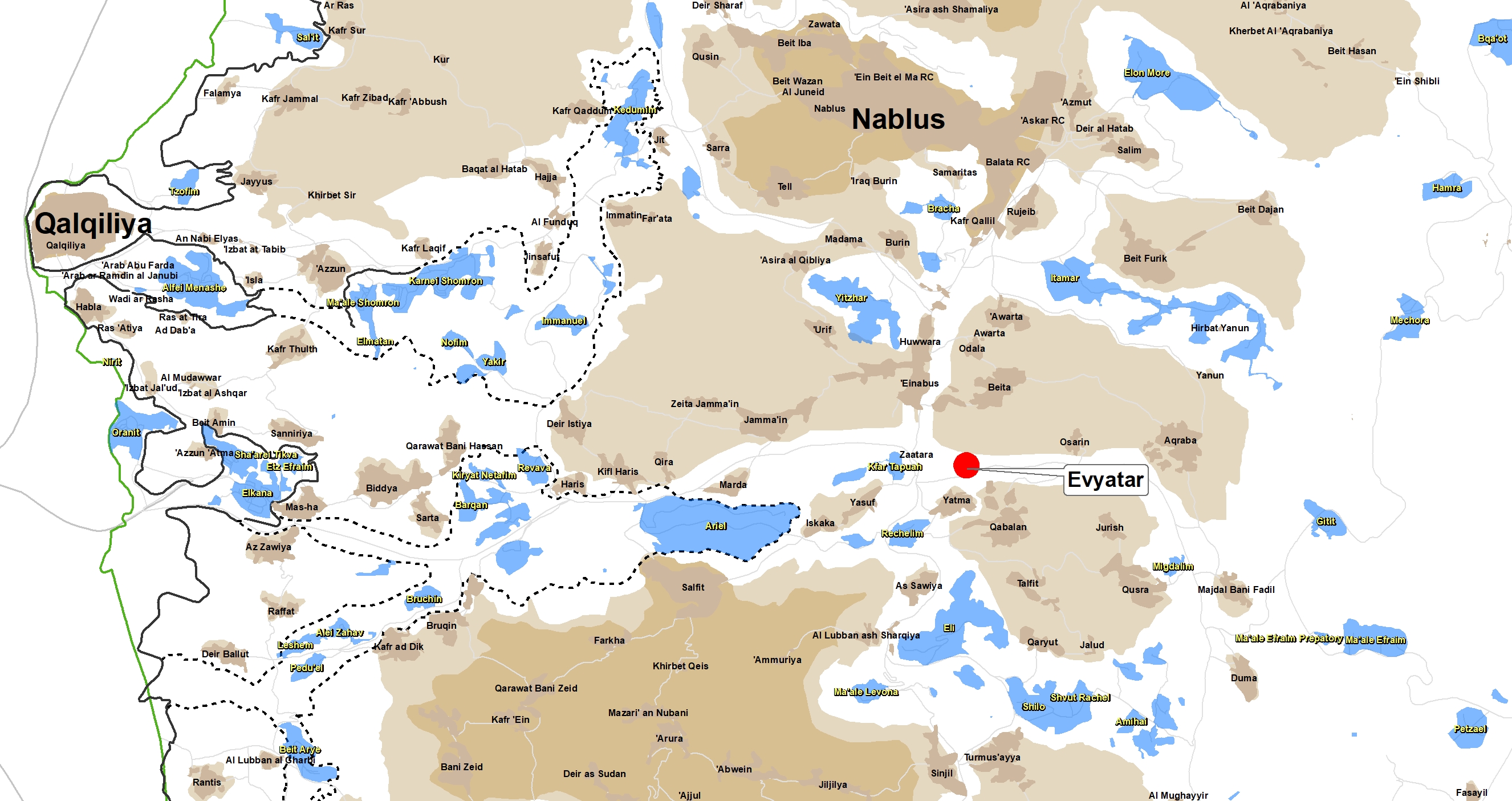
Map by Peace Now
In the very early days of the Bennett-Lapid coalition government, it was decided that the government would undertake an “investigation” into the status of the land on which the outpost was illegally established. That investigation was part of a package deal meant to both appease the settlers who were illegally squatting at the site and their allies. The package was also intended to quell Palestinian protests against the outpost and the international attention they were increasingly gaining – attention linked in larger part to the violent reaction against Palestinians by settlers and IDF soldiers, including most notably in Beita, which saw the death of several protestors, including children.
In addition to the “investigation,” the package also sought to balance bitter divisions within the Bennett government over whether to evacuate the outpost or grant it retroactive legalization. In the end, the government reached a “deal” which saw the settlers (temporarily) voluntarily vacate the outpost on July 2, 2021. In return, the government agreed to leave the settlers’ illegal construction at the site in place (i.e., did not demolish it) — including buildings and roads — while it carried out its investigation into the status of the land. In this way, the “compromise” left the outpost intact and allowed Israel to maintain complete control over the site during the “survey” process, clearly signalling that the government’s objective was never to enforce Israeli law, but, rather, was always about finding a legal and political “solution” to enable them to launder the settlers’ actions and accommodate their demands. Indeed, the terms of the Evyatar “compromise” made clear that the Bennet government was confident that it would find a pretext on which to assert that the land on which the outpost stands is “state land,” which can be used by the state as it sees fit (which nearly 100% of the time means, will be used to benefit the settlers)).
Peace Now said in a statement:
“Instead of stopping the ideological delinquency of a handful of settlers who allow themselves to establish facts on the ground against the law, and contrary to the Israeli interest, the government seeks to encourage them and give them a reward. The establishment of a new settlement in the depths of the West Bank is a security burden, and a threat to the chances for peace. Coalition members who oppose the occupation and support two states must demand that the Defense Minister stop the madness and not approve the settlement in Eviatar.”
Another Palestinian Family to Be Forcibly Dispossessed of its home in Jerusalem
Ir Amim reports that Israeli authorities have officially cleared the way for the Palestinian Salem family to be evicted from its longtime home in Sheikh Jarrah. The eviction can take place at any time between March 1st and April 1st. Once evicted, the Salem family home will be handed over to two settlers, one of whom is Jerusalem Deputy Mayor Aryeh King – suggesting that, at least in this case, the Israel government’s agenda and the settlers’ agenda are one and the same.
The Israeli registrar, in publishing its approval of the eviction window, also ordered the Salem family to pay 5,000 shekels (~$1,500 USD) for legal expenses.
The Salem family told WAFA news that they intend to appeal their eviction to the Israeli High Court, though a member of the family made it clear that the Israeli courts are part of a system designed to dispossess them:
“The Israeli court is biased. It only aims at emptying Jerusalem from Palestinians to give our place to settlers…even if we appeal, we don’t trust the Israeli court system. We depend only on solidarity in Palestine and beyond…We are three brothers living with our families, including seven children and our 74-year-old mother, Fatima Salem, the head of the family…We were all born here and have nowhere else to go. If they do expel us, we will continue to live in the street, right here”.
On the possibility of delaying the Salem family’s forcible displacement, Ir Amim notes:
“Although the Selam family’s legal representation may appeal the Enforcement and Collection Authority’s decision authorizing the family’s eviction and request an injunction to freeze it, there is no guarantee the court will approve such a request. The family’s attorney has hence made it clear that the remaining legal remedies are extremely limited. Therefore the only real effective means of preventing the family’s impending displacement is through state intervention.”
Israeli settlers and police had specifically requested a window in which to carry out the eviction to enable them to carry out the eviction by surprise — thereby (theoretically) making it harder for the family and protesters to prepare and for large crowds to gather. It must be understood that this flexible date is just the latest twist on the cruelty and hardship endured by the Salem family for years. It’s also worth recalling that earlier this month, in the context of a similar approval for the eviction of a Palestinian family living in the same neighborhood (the Salihiya family), Israel chose to implement the eviction in the dead of night, on one of the coldest nights of the year.
For further background on the Salem family’s case (including on the Israeli laws that were expressly designed to enable the eviction of Palestinians in favor of settlers), see reporting by Ir Amim and Peace Now.
New Tender Issued for Settler Foot Bridge Over Ben Hinnom Valley
Ir Amim reports that the Moriah Jerusalem Development Corporation issued a tender for a settler-initiated project to build a new pedestrian footbridge over the Ben Hinnom/Wadi Rababa Valley in Jerusalem. Bidding on the tender is set to close on February 28, 2022. An appeal against the plan, filed in 2018 by Israeli NGOs Peace Now and Emek Shaveh, was rejected by the Courts.
The bridge will serve to connect two settler-operated tourist facilities located on opposite sides of the valley – one in the in the Palestinian Abu Tor neighborhood and the other in the Silwan neighborhood.
On the Abu Tor side of the bridge, the Elad settler organization runs and operates a cultural center and cafe named “House in the Valley,” which opened in 2019 after Elad evicted a Palestinian family and renovated the space. A week after Elad’s new cultural center was opened, the Jerusalem Municipality issued “gardening orders” to take control, for a period lasting 5 years (with the likelihood of extensions after that), of 12 nearby plots of privately owned Palestinian land. “Gardening orders” allow Israel to “temporarily” take over privately owned land for what are ostensibly public purposes (like establishing a parking lot or public garden), based on the argument that the private owners are not presently using the land. In this case, Israel has in effect made rules that guarantee that the latter condition applies: as Emek Shaveh has noted, the 12 plots in question are located in an area declared by Israel to be a national park, meaning that private landowners are legally barred from using their own land.
On the Silwan side – a neighborhood where Elad (alongside other settler organizations, including Ateret Cohanim) is waging a house-by-house campaign to displace Palestinians in favor of settlers and settler-run tourist sites – the bridge will end near the Sambuski cemetery, which until recent years was a relatively unknown, neglected site that even Israel did not recognize as a holy site. Under the Trump “Peace to Prosperity” plan, the Sambuski cemetery suddenly became a place of prime historical and religious importance to Israel. The Israeli NGO Emek Shaveh – which has a special expertise on archaeology and the weaponization of archaeology to serve the political agenda of the settlers and the state – wrote a report on exactly how the Trump “Vision” supports settler efforts to use Jerusalem’s history and antiquities to promote Israeli-Jewish hegemony and control over the city.
Ir Amim writes:
“As part of the intensifying band of settlement around the Old City, the Wadi Rababa/Hinnom valley area is of particular significance as it stretches along the seam between Silwan and West Jerusalem and serves as the main entrance into the neighborhood from this direction. In recent years, there has been an increase of tourism projects in and around this location promoted by the government and the Elad settler organization, which together create a more seamless link between West Jerusalem and Elad’s constellation of settlement sites in Silwan.”
Knesset Committee Recommends Expanding Israel Antiquities Authority Oversight into the West Bank
On January 24th, the Knesset’s Education Committee held a hearing to discuss the alleged destruction of Jewish antiquity sites in the West Bank by Paelstinians and the Palestinian Authority, and what Israel should do to stop it. The Committee made several recommendations, including the suggestion for the government to expand the jurisdiction of the Israeli Antiquities Authority to include Area C, which would amount to yet another act of de facto annexation of some 60% of the West Bank. The Committee also recommended offering formal authorization for settler regional councils to “protect” and manage antiquity sites in Area C, which settlers are already doing on their own accord (with State funding and the help of the IDF in some cases). These archaeologically-focused annexation efforts run in parallel to other ongoing efforts by settlers and their political allies to unilaterally (and openly) annex Area C.
The hearing was based on a report on this very subject authored by a group calling itself the “Guardians of Eternity.” That group is an offshoot of the settler group Regavim. Emek Shaveh – an Israeli NGO focused on archaeology – called the report “highly questionable,” noting that the scientific editor of the report is anonymous, the report did not use acceptable archaeological methodology when surveying different sites, and the data on which the report based its conclusions and recommendations has not been made public.
Emek Shaveh’s Executive Director, Alon Arad, briefly addressed the Knesset Committee, urging the Members to understand the political agenda at play. Arad said:
“The destruction of antiquities should not constitute a pretext for political action and I think we should also refrain from camouflaging the political nature of this discussion as an archaeological act. Blurring the lines between archaeology and heritage on the one hand, and settlement and annexation, on the other endangers the future of archaeology.”
Emek Shaveh later said in a statement:
“There are approximately 6000 antiquity sites in the West Bank. The significance is that practically in every village or town there are archaeological remains of varying scale from a watering hole to a multilayered mound. It follows that there is always a tension between the need for modern development and the safeguarding of heritage sites. It is also clear that the problem of antiquity destruction is used by settlers and right-wing MKs as a justification for displacement…in just two years from 2017-2019, there was a 162% rise in demolition orders citing archaeology…Emek Shaveh believes that the destruction of antiquities should not be used as a justification for settlement expansion nor for promoting actions which advance de facto annexation. The appropriate approach to safeguarding antiquities in Area C must include the following: Israel must respect International Humanitarian Law and conventions which outline its duties vis-à-vis cultural heritage sites as the occupier in occupied territory, including maintaining separation between the IAA and the Staff Officer for Archaeology. Israel should promote cooperation with the Palestinian Authority on all levels: information sharing, oversight, and enforcement – something that was mutually agreed in the Oslo Accords. Israel must outlaw the trade in antiquities which gives impetus to antiquity theft.”
The Knesset Committee’s discussion of this subject comes on the heels of a decision by Israeli Minister of Heritage and Jerusalem Affairs, Ze’ev Elkin, to allocate $1.57 million (5 million NIS) towards “reconstruction” of the Sebastia archaeological site (located in the northern West Bank, near Nablus), pending approval from the Israeli Civil Administration. The Ministry further said that an additional $787,000 will be allocated towards the “rehabilitation” of other archaeological sites in the West Bank, as well as about $470,000 towards the Civil Administration’s ramped up efforts to “protect” West Bank archaeological sites.
As FMEP has chronicled, settlers and their allies are intent upon using claims of Palestinian damage/neglect as a pretext for Israel taking control of archaeological sites and artifacts across the West Bank. For example, in February 2021 settlers used a construction mishap to raise claims to the Mt. Ebal site.
Bonus Reads
- “Israeli soldiers force closure of Palestinian stores in Hebron’s Old City” (Basel al-Adra – +972 Magazine)
- “The purpose of settler terrorism” (Edo Konrad – +972 Magazine)
- THREAD: “During a discussion in the government about settler violence the Chief of Staff stated Israeli soldiers don’t have the authority to detain Israeli settlers who attacked Palestinians…” (Oren Ziv – Twitter)
Welcome to FMEP’s Weekly Settlement Report, covering everything you need to know about Israeli settlement activity this week.
To subscribe to this report, please click here.
January 21, 2022
- Under Cover of Darkness & Cold, Israel Evicts Palestinian Family & Demolishes Their Homes in Sheikh Jarrah
- Israel Advances Plan for New Settlement in East Jerusalem
- Settlers Continue To Press For “Legalization” of Homesh Outpost & Yeshiva
- New U.S. Ambassador Will “Absolutely Not” Visit Settlements
- Further Reading
Under Cover of Darkness & Cold, Israel Dispossessed Palestinian Family & Demolished Their Homes in Sheikh Jarrah
At approximately 3:00am on Wednesday, January 19th Israeli forces undertook a major operation in order to forcibly remove the Salhiya family from their longtime home in Sheikh Jarrah — rendering 7 adults and 5 children homeless in the middle of the night in the freezing rain. Israeli forced then moved to promptly demolish the home. The action followed Israel’s aborted two days earlier, on January 17th, to remove the family, during which it razed part of the Salhiya family plot, including a plant nursery.
As a reminder, Israel pursued this dispossession after unilaterally expropriating the plot of land owned by the Salhiya family in 2017 for “public use.” Israeli authorities say that they intend to use the land to build schools to serve Palestinians, who have long suffered from a shortage of school facilities. As has been noted, this argument is hard to take seriously, given that land exists elsewhere in Sheikh Jarrah on which schools could be built without evicting and rendering an entire Palestinian family. Ir Amim explains:
“Although Israeli law allows for the expropriation of private property for public purposes, it is typically only carried out in the absence of alternative options. The authorities have had various options at their disposal, including use of other plots of open land in the neighborhood, which would not have necessitated the Salahiya family’s eviction. Rather than using such plots, the municipality saw it reasonable to dispossess a Palestinian family to meet such needs.”
In order to carry out this forcible dispossession, Israel forces first cut power to the entire (Palestinian) area in which the Salhiya house and businesses were located. Accounts from those present at the eviction/demolition reported that Israeli forces violently assaulted several members of the Salhiya family including children. Israeli forces also arrested eighteen human rights defenders – including members of the Salhiya family — for resisting the eviction (for a detailed update on these cases, please see this report by Human Rights Defenders Fund). An additional six human rights defenders were arrested later on January 19th during a protest against the demolition, held in front of the Jerusalem Mayor’s home. Human Rights Defenders Fund, which is funding the legal representation of those arrested, said:
“HRDF opposes the unjust evictions of family homes in Sheikh Jarrah and will continue to stand with Palestinian HRDs defending their basic human rights for property and shelter. We will continue to closely monitor Sheikh Jarrah neighborhood and oppose any illegitimate attempt to change its demographics.”
The overnight evictions have been roundly criticized by human rights groups and several international governments. The European Union slammed the eviction/demolition, along with separate statements issued by individual European nations. The United States Ambassador to the United Nations, Linda Thomas-Greenfield also spoke out (weakly, in a statement framed in classic bothsides-isms).
Israel Advances Plan for New Settlement in East Jerusalem
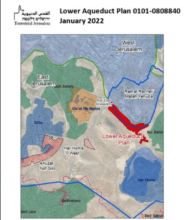 On January 17th, the Jerusalem District Planning Committee approved for deposit for public review a new settlement plan in East Jerusalem – called the “Lower Aqueduct” plan. The new settlement is intended to connect the controversial settlements of Givat Hamatos and Har Homa, establishing an uninterrupted continuum of Israeli settlements on the southern rim of Jerusalem, and destroying the contiguity of Palestinian land in the West Bank and East Jerusalem.
As laid out in new reporting from Terrestrial Jerusalem, the plan is being promoted by the Jerusalem Municipality together with the Israel Lands Authority, but – as the reporting predicts –
“when the smoke clears, it will become evident that the same protagonists that are facilitating settlements in Sheikh Jarrah, Silwan, Givat Shaked, Musrara – i.e. the Custodian General and the Absentee Property Custodian – are deeply implicated in the Plan.”
Terrestrial Jerusalem further notes that the plan is being advanced at an expedited pace, giving the appearance that “someone senior and in a position of authority is expediting the Plan at [a] highly irregular pace.”
In total, the plan provides for the construction of 1,465 new units – around half of which will be constructed over the 1967 Green Line the demarcates (in the eyes of the international community) the line between Israeli-annexed West Jerusalem and Israeli-occupied East Jerusalem. The plan also provides for open public spaces and buildings including schools and a gymnasium.
Importantly, the new settlement will impinge on the two neighboring East Jerusalem Palestinian villages of Sur Baher and Umm Tuba, and will involve the expropriation by Israel of privately owned Palestinian land. Most notably, in order to pave a new access road for the new settlement, the State will likely expropriate land privately owned by Palestinian residents of Umm Tuba.
Ir Amim’s Aviv Tartarsky told The Times of Israel:
“This is another way in which Israel is erasing the Green Line in Jerusalem, ending Palestinian contiguity, and expropriating the lands of Palestinians. When Palestinians tried to plan construction there, it was rejected — and now the territory will be confiscated.”
Following the committee’s decision to this week to advance the plan, the European Union, France, Germany, Spain and Italy all issued statements calling for Israel to reverse the move. France also published a joint statement with Ireland and Estonia.
Settlers Continue To Press For “Legalization” of Homesh Outpost & Yeshiva
In a display of brazen lawlessness, more than 1,200 Israeli Jews managed to enter the closed military zone that is the site of the former Homesh settlement – where settlers have illegally established and operated a yeshiva for years – in order to celebrate the Jewish holiday of Tu B’Shvat, as part of their ongoing campaign to pressure the government to reestablish the settlement.
To reach the site, settlers (identified as yeshiva students by The Jewish Press) marched en masse for two hours with armed guards through the outskirts of the Palestinian village of Sebastia. On their way, settlers passed easily through at least two IDF checkpoints — meant to stop traffic towards the Homesh area, though Israeli soldiers in practice prevented only the freedom of Palestinian traffic in that direction. Sebastia is a routinely besieged city, suffering closures in the wake of the murder of settler Yehuda Dimentan and as a consequence of Israeli settler’s focus on archaeological sites in the city [as has been covered in the Settlement Report regularly: settlers, in collaboration with Israeli authorities, are openly seeking to exploit archeology as a tool to dispossess Palestinians in the West Bank].
In Jerusalem, settler leaders and their allies continued their mass protest in front of the Prime Minister’s residence in a bid to pressure Bennett to authorize Homesh, amongst other demands.
New U.S. Ambassador Will “Absolutely Not” Visit Settlements
In an interview with the Yedioth Ahronoth news outlet, U.S. Ambassador Thomas Nides said that he will not visit Israeli settlements in the West Bank, unlike his immediate predecessor David Friedman.
When questioned about his travel policy as compared to Friedman’s, Nides said:
“Because just like I ask both the Palestinians and Israelis not to take steps that inflame the situation, I don’t want to do things intentionally that would create disrespect or anger among people. Now, listen, I’ll make mistakes. I’ll say things that will aggravate people. I’m sure that in this interview, I’ll say something that will aggravate someone. But I don’t want to intentionally anger people.”
It’s worth recalling that the Biden Administration has not reversed or publicly rejected the Trump Administration’s “Pompeo Doctrine,” which made it U.S. policy to view Israeli settlements as not “per se inconsistent with international law.” The overwhelming majority of the international community holds that all Israeli settlements and outposts in the West Bank are illegal pursuant to Article 49 of the Fourth Geneva Convention, which states:
“The Occupying Power shall not deport or transfer parts of its own civilian population into the territory it occupies.” It also prohibits the “individual or mass forcible transfers, as well as deportations of protected persons from occupied territory”.
Bonus Reads
- “PODCAST: Excavating Israel’s underground settlements” (+972 Magazine)
- “Palestinian Activist Dies Two Weeks After Being Run Over by Israeli Police Truck” (Haaretz)
- “There’s a Mass Palestinian Grave at a Popular Israeli Beach, Veterans Confess” (Haaretz)
- “JNF Board Members Demand End to Controversial Tree-planting in Negev Until Questions Answered” (Haaretz)
Welcome to FMEP’s Weekly Settlement Report, covering everything you need to know about Israeli settlement activity this week.
To subscribe to this report, please click here.
**The settlement report will be taking a two-week break, and is planned to return the week of October 18th**
September 24, 2021
- New Givat Hamatos Settlement Plan – to Replace Existing, Approved, & Tendered Plan – Advances in Jerusalem
- Settlers, IDF Continue to Impose Control Over Sebastia Archaeological Site As Settlers Amp Up Campaign to Takeover Sites in Palestinian Areas
- Bonus Reads
New Givat Hamatos Settlement Plan – to Replace Existing, Approved, & Tendered Plan – Advances in Jerusalem
Ir Amim reports that, on September 12th, the Jerusalem Local Planning Committee approved for public deposit a new outline plan for the Givat Hamatos settlement in East Jerusalem. This new plan would replace the existing outline plan for Givat Hamatos, under which tenders for the construction of 1,257 settlement units were awarded in January 2021.
Ir Amim explains:
“According to the information currently available, the new plan neither expands the territorial area of the future settlement nor does it explicitly call for an increase in the number of housing units. However, it does cite a 30% increase in the total scope of construction, which appears contradictory. Additional information is still needed to definitively confirm the details of this apparent 30% increase; however, it could be allocated, for example, towards the enlargement of individual housing units. The Jerusalem Municipality has long sought to expand the number of housing units in Givat Hamatos as demonstrated by a master plan it attempted to advance last year, which included an additional 3,900 units. The plan, however, did not move forward.
It should be noted that the approval process for the new outline plan (TPS 979336) will be fast-tracked since it is under the jurisdiction of the Local Planning Committee and will therefore not need to go before the District Planning Committee. While submission of new outline plans after completion of a tender process does occasionally occur, it is typically initiated by contractors in order to maximize future profits. In this instance, it is the municipality who has submitted the new outline plan.
The new plan’s potential impact on the tendered units is still unclear; however, it will certainly not terminate the contracts with the tenders’ winning bidders. Moreover, the ongoing construction of infrastructure works on Givat Hamatos indicates that the process is advancing at full speed. These measures underscore that the current government is continuing to accelerate further settlement and steps towards de facto annexation regardless of promoting the notion of change and reform to Israel’s policies and actions.”
The existing outline plan for Givat Hamatos, under which the tenders were issued, continues to face a legal challenge initiated by Palestinian residents of East Jerusalem (with the assistance of Ir Amim). That petition – which alleges that the planned construction of government-subsidized housing has discriminatory eligibility guidelines – is still pending. A hearing was scheduled on May 27th, but was delayed at the request of the State. The hearing has been rescheduled for October 20th, and Ir Amim secured the Court’s condition that applications for Givat Hamatos housing will not be accepted in the intervening period.
Givat Hamatos has long been regarded as a doomsday settlement by parties interested in preserving the possibility of a two-state solution, in that it will prevent the division of Jerusalem into an Israeli capital and a Palestinian capital (if the Givat Hamatos settlement is built, the Palestinian neighborhood of Beit Safafa in East Jerusalem will be completely surrounded by Israeli construction, severing its connection to the West Bank). Indeed, regardless of the implications of Givat Hamatos on a two-state solution, the impact of the new settlement on the Beit Safafa neighborhood are severe.
Settlers, IDF Continue to Impose Control Over Sebastia Archaeological Site As Settlers Amp Up Campaign to Takeover Sites in Palestinian Areas
In what has become routine, on September 22nd the Israeli army sealed off the archaeological site in the Palestinian city of Sebastia, in order to allow a settler tourist group to visit the site. In addition to securing the site itself, the Palestinian Mayor of Sebastia, Mohammad Azem, told Palestinian media that Israeli troops were also stationed at the town’s entrances as well as all the roads leading to the site, and prevented Palestinains from opening their stores and businesses.
As FMEP has chronicled, settlers and their allies are intent upon taking control of archaeological sites in the West Bank, including Sebastia, and and seizing artifacts that are currently under Palestinian control. Settlers claim the sites are neglected and/or damaged. To that end, the settler groups known as “the Shilo Forum” and the “Shomrim al HaNetzach” (“Preservers of the Eternal”) — see background on these groups here — recently issued a report surveying 365 sites in the West Bank and arguing that the Palestinian Authority is moving to “erase all traces of Israel’s ancient Jewish heritage.” The accusations were in addition to allegations of neglect, mismanagement, and intentional damage. The report is part of the organizations’ campaign to push the Israeli government to assert control over these sites.
An advocate for this strategy – – Michael Freund, who served as a deputy communications director in the Netanyahu government – – wrote in the Jerusalem Post:
“Ever since the signing of the 1993 Oslo Accords, and the establishment of the Palestinian Authority, the Palestinians have been serially abusing our heritage, from digging up the Temple Mount in Jerusalem to attacking and burning Joseph’s Tomb in Shechem (Nablus). It should be clear to all that the Palestinians cannot be entrusted with safeguarding or administering Jewish historical sites under any circumstances whatsoever. The State of Israel needs to assume and assert responsibility for the national and historical heritage of the Jewish people in Judea and Samaria.”
Bonus Reads
- “Palestinians aim to prove right of return with ancestral land titles” (Middle East Eye)
- “The Illegal Settler Outpost Has Running Water. Its Palestinian Neighbors Don’t. This Is Apartheid at Its Starkest” (Haaretz)
- “Why the climate movement must support the Palestinian cause” (Middle East Eye)
- “Opinion | Israel Is Crushing My Right to Protest Its Occupation” (Haaretz // Galia Golan)
Welcome to FMEP’s Weekly Settlement & Annexation Report. To subscribe to this report, please click here.
July 30, 2021
- Sheikh Jarrah Updates: Court Issues Delays for Three Cases; Bennett Reportedly Considering Delaying Four Others
- In First Since Settlement Regulation Law Was Overturned, Israel Announces Intent to Demolish Settlement Buildings on Privately Owned Palestinian Land
- Elad Settler Group Loses Control Over East Jerusalem Holy Site/Archaeological Park
- Knesset Votes Down West Bank Annexation Bill, Condemns Ben & Jerry’s
- State Allows (& Funds) “Farming Outposts” to Graze Huge Tracts of West Bank Land
- Outpost Activity Continues in the South Hebron Hills
- Israeli Army Let Settlers Stay at Abandoned Base Despite Knowing Plans for Illegal Outpost
- Bonus Reads
Comments or questions? Email Kristin McCarthy – kmccarthy@fmep.org.
Sheikh Jarrah Updates: Court Issues Delays for Three Cases; Bennett Reportedly Considering Delaying Four Others
On July 29th, the Israeli Supreme Court issued notices delaying the forcible displacement of three families (Dajani, Hammad, and Dahoudi) from their longtime homes in the Sheikh Jarrah neighborhood of East Jerusalem. The eviction orders were set to become enforceable on Sunday August 1st, but the Court has halted the evictions while an appeal filed by the Palestinian families is dealt with.
Also sheduled for August 2nd, the Supreme Court is currently set to hold a final hearing to decide on the fate of four other Palestinian families (Jaouni, Iskafi, al-Kurd, and al-Qadi) facing forcible eviction in Sheikh Jarrah. According to press reports, Prime Minister Naftali Bennett is considering delaying the final hearing (thus stopping the evictions for the time being). Notably, reports suggest Bennett is looking not to cancel the evictions but only to postpone a final decision on them – a postponement that could be reversed at any time at the whim of the Prime Minister (for example, when the world’s attention is elsewhere).
In an op-ed in The Guardian, Mohammad El-Kurd – whose family is facing eviction – powerfully wrote:
“On 2 August, the Israeli supreme court, whose jurisdiction over the eastern part of Jerusalem defies international law, is set to decide whether it will allow the appeal of my family and three others – a last legal obstacle before we can be expelled. There have been postponements before. Palestinians are accustomed to this kind of stalling; it tests our stamina. But we are as stubborn as anyone else faced with the prospect of losing their home – their life, their memories – to those using force, intimidation and biased laws. In the face of this cruelty, and despite teargas and skunk water, we are resisting. We cannot allow them to steal our homes once more, and we refuse to continue living in refugee camps while colonisers live in our houses. We cannot let them throw more of us on to the streets. We are tired of being turned into a refugee population, neighbourhood after neighbourhood, one home at a time. I have no faith in the Israeli judicial system; it is a part of the settler-colonial state, built by settlers for settlers. Nor do I expect any of the international governments who have been deeply complicit in Israel’s colonial enterprise to intervene on our behalf. But I do have faith in those people around the world who protest and pressure their governments to end what is essentially unconditional support for Israeli policies. Impunity and war crimes will not be stopped by statements of condemnation and raised eyebrows. We Palestinians have repeatedly articulated what kind of transformative political measures must be taken – such as civil society boycotts and state-level sanctions. The problem is not ignorance, it is inaction.”
In First Since Settlement Regulation Law Was Overturned, Israel Announces Intent to Demolish Settlement Buildings on Privately Owned Palestinian Land
On July 28th, the Israeli Attorney General’s office informed the High Court of Justice that within three years (!!) it plans to carry out the demolition of two buildings built by settlers on privately owned Palestinian land located inside of the Eli settlement, in the context of a petition filed in 2011 by Palestinian land owners with the assistance of Yesh Din and Bimkom. Notably, the underlying legal petition sought the demolition of a total of 20 buildings constructed illegally on private Palestinian land, 18 of which Israel granted retroactive legalization in February 2020.
According to the Jerusalem Post, this is the first instance of the Court resuming looking at a case of this kind since the Settlement Regulation Law was overturned by the Court in June 2020. Previously, all cases involving illegal construction inside of settlements had been frozen while the Court considered the constitutionality of the law, which sought to create a legal basis by which Israel would be able to grant retroactive legalization to outposts and settlement structures built on land that even Israel acknowledges is privately owned by Palestinians.
In resuming its consideration of the case, the Court first asked to be updated on the State’s reexamination of the status of the land in hopes of finding a means by which to retroactively legalize the illegal construction, despite the fact that a previous government effort confirmed that the two buildings fall outside of the boundaries of state-owned land. With no other avenue available to “legalize” the construction, the State informed the Court this week that it intends to demolish the structures after the three years, which it claimed was the amount of time required to provide new housing for the four affected settler families [demonstrating, as always, that settler law-breakers are never punished and always rewarded]. This long delay also suggests that the State will continue to look for new ways to avoid demolishing the homes.
Leaders of the Land of Israel Lobby in the Knesset, MKs Yoav Kisch and Orit Strock, told Israel Hayom:
“This week, the government informed the High Court of Justice that it agrees to demolish the homes of four families in Eli. This is a horrifying, shocking announcement. Rather than preventing the destruction of Jewish homes in Judea and Samaria, the government is busy regulating the illegal construction crimes in the Bedouin sector. This is a badge of shame for the government, which is freezing construction, as well as going back on all its promises to regulate [settlements] and also demolishing Jews’ homes.”
Yisrael Gantz – who heads the Benyamim settler regional council – said:
“We are surprised that the government is falling in line with the Arab petitioners and announcing that it will, heaven forbid, demolish two homes where families have been living for years, which are part of a living, vibrant neighborhood. Razing a home whose status was legal and which a new review by the Civil Administration left outside the settlement’s borders is a new low in crimes against settlement in Judea and Samaria. These two homes are just a preview. We have hundreds of homes with similar status in the Binyamin settlements and thousands throughout the settlements as a whole that suddenly found themselves outside the new ‘blue lines’ drawn in the Civil Administration’s work. No normal country would demolish homes in a situation like this.”
Elad Settler Group Loses Control Over East Jerusalem Holy Site/Archaeological Park
On July 1st, the State of Israel re-asserted control over a significant and highly sensitive archaeological and holy site – the Davidson Archaeological Park – located just outside of the walls of the Temple Mount/Haram Al-Sharif. The park, which includes most notably tunnels that run directly from the Western Wall plaza to the settler-run Davidson Center in Silawn – had been run by the Elad settler organization since 2018, when the State willingly transferred its authority to Elad to operate the park.
In 2015 the Israeli NGO Emek Shaveh, which is made up of archeological experts, filed a petition against Elad’s role at the park, arguing that “it is highly problematic to place the running or management of a holy site that is situated alongside the Western Wall foundations in the hands of a private and politicized organization.” Emek Shaveh’s argument mirrored an opinion issued by Israel’s Attorney General which held that holy sites should be managed by the State.
Notably, the end of the state’s contract with Elad regarding the Davidson Park reduces but does not eliminate Elad’s role in managing key sites in Jerusalem. Elad continues to operate the nearby City of David archaeological park (just outside the Old City’s walls), where it has been advancing numerous settlement projects meant to strengthen its control over the area and displace Palestinians.
Emek Shaveh said in a statement:
“We are pleased that the authorities have put an end to a highly problematic arrangement whereby a private right-wing organization is operating an important site situated in perhaps the most sensitive place in the region. We hope that in the future the State will take full responsibility for additional sites which it handed over to the settlers’ foundation. The City of David is, no doubt, the next site that ought to be returned to full management by the State. Emek Shaveh’s case regarding the tunnel linking the Davidson Center to Givati is still ongoing.”
Knesset Votes Down West Bank Annexation Bill, Condemns Ben & Jerry’s
In a July 28th preliminary vote the Knesset rejected, by a relatively slim margin (64 to 50), a bill to annex the entire West Bank. Members of Prime Minister Naftali Bennett’s ruling party, Yamina, voted against the bill. The bill had been submitted by members of the Likud party, which is now in the opposition after 15 years of being the most powerful party in the country and having had the ability to pass such a bill if desired. One of the bill’s cosponsors, Miki Zohar, said after the vote:
“You promised again and again that you will take action to bring about sovereignty over Judea and Samaria and you once again broke your word,” Zohar said. “You once again proved that you have no ideology and that no values are holy for you except for keeping your cabinet seats.”
Justice Minister Gideon Sa’ar (New Hope) responded, saying:
“I heard MK Mikki Zohar relating to the fact that in the last administration, Netanyahu wanted to apply sovereignty but Blue and White prevented him from doing so. And I was just thinking to myself, ‘How far from the truth can you get?’…So you, MK Zohar, party whip for the Likud in the last Knesset, could have brought this bill up in the last Netanyahu government, during the Trump administration, during the amazing window of opportunity – you could have submitted the sovereignty bill and had a majority in the Knesset.”
Around the same time this bill was voted on, 90 members of the Knesset, including Yamina members, signed a letter calling on Ben & Jerry’s to reverse its decision to end sales in the occupied West Bank. The letter refers to settlements as “towns and cities in Israel” – a statement tantamount to a declaration of de facto – if not official – annexation. Notably, 6 MKs – from Labor and Meretz – subsequently removed their names for the letter, claiming that they signed on without seeing the final wording, and that the final wording does not reflect their views.
State Allows (& Funds) “Farming Outposts” to Graze Huge Tracts of West Bank Land
In response to a Peace Now inquiry, the Israeli Agricultural Ministry revealed that it has granted permits to unauthorized (i.e., illegal under even Israel law) agricultural outposts to use over 2,000 acres (8,500 dunams) of land in the West Bank for grazing, in a program which entrenches and expands the outposts’ illegal presence across the West Bank.

Map by Peace Now
And if that wasn’t enough of a scandal, the Ministry confirmed that it provided sizable grants – totalling over $800,000 (2.6 million NIS) over the past few years – to at least three settlement organizations for the purpose of bringing volunteers to these outposts – which, again, are illegal even under Israeli law – to work the land. Notably, these settler organizations publicly boast about their farming activities with respect to a total of 50 farming outposts, suggesting that settlers are making use of far more than the 2,000 acres permitted by the Ministry (the Ministry clarified that it funds activities only related to the areas where settlers are authorized to work — so apparently they see no problem].
Peace Now said:
“The Ministry of Agriculture takes millions of Shekels of public monies and give them to associations which are intrinsically linked to illegal activity. If the government wants to stop more outposts such as “Evyatar” from existing, and to stop the small group of ideological settlers who allow themselves to set facts on the ground that determines the foreign and security policies for Israel, it must change its ways immediately and stop supporting outposts and illegal activities”.
Two of the outposts to which the Agricultural Ministry awarded grazing permits are located in the south Hebron hills, on land that is privately owned by Palestinians. One of those outposts, established by a settler named Shavti Kohslaviski, has active demolition orders issued against it. A third outpost that received grazing permits is located near the Elon Moreh settlement, on a site that is partially privately owned Palestinian land that Israel has made inaccessible to its Palestinian owners but on which settlers regularly trespass .
Israeli Army Let Settlers Stay at Abandoned Base Despite Knowing Plans for Illegal Outpost
Kerem Navot reports that on July 23rd, dozens of settlers were allowed to stay at an abandoned military base in the Jordan Valley with permission of the Israeli army. The Israeli Commander in charge of the area reportedly said that he granted permission for the settlers to hike in the area and spend one night at the army base – – despite the fact that the settlers openly declared their intent to establish a permanent presence there. The settlers left after two nights at the site, though a government source told Haaretz that the problem will continue to linger, saying “the minute the brigade commander allowed this one time, they will go up there regularly, when they feel like it, with or without permission, and the defense establishment will have to start dealing with it.”
Kerem Navot reports:
“The organization that is behind this current takeover attempt is called “Nahala.” Nahala is the same group behind the takeover of Mount Sbeih south of the village of Beita, upon which the outpost of Eviatar was founded two months ago, and operates behind a fictional NGO (which we wrote about not long ago- https://bit.ly/3763yJW). Yes, you understood that correctly: The same people who broke the law when they established the outpost Eviatar, are advancing a new aggressive takeover of lands that do not belong to them, instead of standing trial. Welcome to the West Bank.”
Outpost Activity Continues in the South Hebron Hills
On July 25th, Palestinian media reported that settlers have begun reestablishing an outpost in the south Herbron hills, near the town of Yatta. Settlers had abandoned the outpost a few months ago under regular protests by Palestinians.
On July 27th, the Israeli government dismantled another outpost – called “Beit Dror” by settlers – in the south Hebron hills. There were seven families of settlers living at the outpost in pre-fabricated homes which were removed from the area by cranes. Following the evacuation, the settlers held a cornerstone-laying ceremony at the site, vowing to return and permanently build on the land.
Bonus Reads
- “Over 140 Palestinians hurt after Israeli troops attack anti-settlement protesters” (The New Arab)
- “A water spring in the occupied Jordan Valley targeted for takeover by Israeli settlers” (WAFA)
- “Palestinian teenager killed by Israeli troops in West Bank” (The New Arab)
- “Ben & Jerry’s Is Shunning Israeli Settlements. The U.S. Should Too” (DAWN)