Welcome to FMEP’s Weekly Settlement & Annexation Report. To subscribe to this report, please click here.
June 5, 2026
- WEST BANK: E-1 Update; High Council Advances Plans for 2,162 New Units; Archaeology Annexation Bill is Stopped for Now; Tax Break for Settlers; WZO Eases Land Purchase Rules
- Further Reading
WEST BANK
E-1 Update
As previously reported, tenders for the construction of the E-1 settlement were scheduled to be published/opened on June 1st – – but as of reporting the tenders have not been published. Terrestrial Jerusalem founder and Jerusalem expert Danny Seidemann cautions that delays are normal and alarm should remain high:
“In the past, this [delay] would be very much in line with Netanyahu’s modus operandi: bluster, but at the last moment make E-1 go away without leaving fingerprints. However, with Smotrich breathing down his neck and elections approaching, Netanyahu will be called out if he silently freezes E-1. He is not likely to do that.”
On June 3rd, 85 members of the U.S. Congress penned a letter to Secretary of State Rubio urging action to stop the construction of E-1. On the same day, a group of EU representatives visited Khan al-Ahmar, the bedouin community that stands to be forcibly transferred from their land by Israel in order to enable the construction of the E-1 settlement. At the United Nations, the Arab Group (an official regional and political coalition composed of 22 member states representing the Arab nations), issued a statement touching on many Israeli annexationist moves including E-1, urging strong opposition and increased pressure on the Israeli government to back off.
2,162 New Settlement Units Advanced
On June 3rd, the Israeli High Planning Council advanced the construction of 2,162 new settlement units, including plans for two new settlements. The plans advanced this week were:
- Hamivesher (a new settlement): The Council approved for deposit a plan for the construction of 234 new settlement units in the outpost of Hamivesher, which would authorize its as a legal (under Israeli law only) settlement. Until now, the Hamivesher outpost has been laundered through the planning process as a “neighborhood” of the Kiryat Arba settlement but is more properly understood as its own settlement. The Hamivesher settlement is detached from Kiryat Arba, located some ~800 meters north.
- Gvaot: The Council gave final approval for the construction of 1,006 new units in the Gvaot settlement, located west of Bethlehem. There are only a few dozen families currently living in the Gvaot settlement, so this plan represents a massive expansion and its transformation into a more established and urban settlement. Gvaot was built illegally by settlers and initially laundered as a “neighborhood” of the Alon Shvut settlement despite being detached from it. The government authorized Gvaot as an independent settlement in March 2025.
- Har Bracha: The Council approved a plan for 922 new units in the Har Bracha settlement, located south of Nablus. If given final approval, this plan will triple the size of Har Bracha, which is known to be particularly violent towards surrounding Palestinian communities.
Celebrating the approvals, Bezalel Smotrich said:
“This is not just a planning step, but a national development that solidifies our hold on the territory, strengthens Israel’s security, and establishes clear facts that prevent the establishment of an Arab terrorist state in the heart of the country.”
Bibi Stops (for now) Annexation-Via-Archaeology Bill
It’s widely reported that Prime Minister Netanyahu has intervened to stop the advancement of a bill that would annex heritage and archaeological sites across the West Bank and Gaza. Emek Shaveh warns the bill is not dead yet:
“it is important to emphasize that the bill has yet to be withdrawn (a procedure that we will demand). And as long as it remains within the legislative process, it can be revived relatively quickly. Since it has already passed its first reading, a future government or coalition could apply legislative continuity and resume the process from the point at which it was halted. In practical terms, the bill remains very close to being ready for second and third readings.”
Israel Seizes Herodium Archaeological Site & Surrounding Land
The Israeli Civil Administration issued an expropriation order for the Herodium archaeological site – which Israel had already seized and declared an Israeli national park – and surrounding areas, totalling 320 dunams (80 acres). The Herodium site is located on a hilltop south east of Bethlehem, in Area C, surrounded by settlements. This is at least the third archaeological annexation of the year, following the expropriation at the Nabi Samwil site last week and at the Sebastia site in February 2026.
Peace Now said in a statement:
”The government is trying to exploit every moment before the elections to create additional facts on the ground that will advance the full annexation of the West Bank. Tourist and archaeological sites constitute another form of settlement. Their purpose is not only to seize extensive areas of land but also to shape public consciousness, marginalize the Palestinian connection to the land, and transform this country into a land exclusively for Jews, both physically and in terms of heritage. This policy condemns us to many more years of a painful and bloody conflict that can only be resolved through a compromise over this land, which is precious to both Israelis and Palestinians.”
Tax Break for Settlers aka Looting Public Funds for Settlers
This week by a vote of 32-23 the Knesset passed a bill that grants a 7% tax break (capped at NIS 10,000 per year) to residents of 58 specified settlements – most of which are settlements which support, based on voting data, Bezalel Smotrich’s political party (an earlier version of the bill sought to benefit all settlements, but was shrunk to 58 settlements when the cost was estimated at 450million NIS annually). Ostensibly, the 58 settlements were selected based on distance from Israel’s Separation Barrier and the use for armored school buses for children.
Peace Now – which said the move is “a brazen move of looting public funds” – said in a statement:
“The proposal to grant tax benefits to settlements is brazen greed on the part of settlement leaders. No sector in the country receives more benefits and public investment than the settlers, and there is no justification whatsoever for adding tax breaks that would simply plunder the public treasury for the benefit of a small minority within the government’s political base.”
WZO Eases Rules on Land Purchases
The World Zionist Organization recently announced that it will begin allowing settlers to buy a second residential plot of land. Until now, the WZO closely controlled land management and most settlers do not own the land on which their houses are situated, instead they have long term leases on the land via the WZO.
Bonus Reads
- “Israeli Settlers Wound Three Palestinians in Attack Near West Bank’s Hebron, Medics Say” (Haaretz, 6/5/26)
- “Seven Palestinians Wounded in West Bank Settler Raid, Some by IDF Fire” (Haaretz, 5/30/26)
- “Digitally annexing the West Bank: Israel moves its theft of Palestinian land online” (Mondoweiss, 6/3/26)
- “Who Will Stop Smotrich, if Not The Hague?” (Haaretz, 6/3/26)
Welcome to FMEP’s Weekly Settlement & Annexation Report. To subscribe to this report, please click here.
May 22, 2026
- WEST BANK: Smotrich Orders Khan Al-Ahmar Demolition; Knesset Fast-Tracks Annexation-via-Archaeology; Smotrich Leads Settlers to Joseph’s Tomb
- EAST JERUSALEM: Flag March and Related Government Action
- STATE-BACKED SETTLER TERRORISM: EU Sanctions
- BONUS READS
WEST BANK
Smotrich Orders Khan al-Ahmar Cleared, as E-1 Plan Advances
On May 19th, Israeli Finance Minister Bezalel Smotrich announced that he had ordered preparations for the forcible displacement and demolition of the Khan al-Ahmar, the bedouin village located just east of Jerusalem in an area that needs to be cleared in order for the construction of the E-1 settlement. The destruction of the community is expected to move forward in the coming days, as the publication of tenders for the construction of the E-1 settlements is scheduled for June 1st and bids will close on June 6th.
Amnesty International says that, if implemented, the forcible transfer of Khan al-Ahmar is a war crime. Smotrich said he issued the order after the International Criminal Court notified him that it was prepared to issue an arrest warrant against him, along with National Security Minister Ben Gvir, Settlement Minister Orit Strock, and two IDF officials.
The E-1 settlement will see the construction of 3,401 new settlement units on a site located northeast of Jerusalem that is home to several Palestinian bedouin communities, comprising 3,000 people, including about 300 residents of Khan al-Ahmar. The residents of Khan al-Ahmar have lived and worked on this land since the 1950s – when the community was forced to leave their land in the Negev during the 1948 war. There has been a decades long drama over the Israeli government’s plans to construct the E-1 settlement, which has long been held as a red-line for Israel that the international community had been willing to step up to maintain.
Terrestrial Jerusalem’s Danny Seidemann explains:
“Why Khan al-Ahmar? Israel has delineated the area under its exclusive control in the occupied West Bank between Jerusalem and the Jordan River Valley. It has consolidated its hold by large and medium-sized settlements, and “illegal” outposts. It has neutralized the Palestinian presence, and has seamlessly integrated the area into pre-1967. Multi-lane highways, tunnels, and bridges have erased the Green Line.
There is little doubt that this reality is tantamount to de facto annexation.If that be so, why is Israel so obsessed with the displacement of the few hundred
Bedouin of Khan al-Ahmar that it is willing to bear universal opprobrium in order to evacuate the hamlet?
The answer is simple: because Khan al-Ahmar and similar Bedouin encampments are the final obstacle standing in the way of de jure annexation.
In 1967, Israel annexed East Jerusalem. It did so without extending Israeli citizenship to the Palestinians residing in the annexed areas. The Palestinians of East Jerusalem enjoy certain personal entitlements, but no political rights.”
Balasan Initiative explains:
“The evacuation of Khan Al-Ahmar violates the International Criminal Law (ICL) and International Humanitarian Law (IHL), which prohibit the forcible transfer of protected persons from territory under occupation…particularly in light of the retaliatory intentions of Smotrich following the ICC arrest warrant proceedings, the planned evacuation of Khan Al-Ahmar remains unlawful, unjustified, and incompatible with international humanitarian law.
Hence, alongside the humanitarian consequences that would result from the demolition of the village and the forcible displacement of its residents, the destruction of Khan Al-Ahmar must also be understood within the broader framework of territorial fragmentation and settlement expansion in the occupied Palestinian territory. The village’s strategic location within the E-1 corridor renders its removal politically and geographically significant, as it would facilitate the territorial linkage between Ma’ale Adumim and Jerusalem while further isolating East Jerusalem from the remainder of the West Bank. Such measures undermine the contiguity and viability of a future Palestinian state and reinforce irreversible demographic and geographic changes on the ground.”
Peace Now said in a statement:
“Minister Smotrich seeks to take revenge on The Hague and the international community at the expense of one of the most vulnerable communities, which for years has struggled simply for the right to live on the small piece of land in its possession. The expulsion of Khan al-Ahmar is part of a broader government plan to take control of the entire central West Bank area, build in E1, and remove all Palestinian communities from the region. This is a cynical and destructive plan that could devastate the prospects for future peace and a resolution of the conflict, as part of Smotrich and his allies’ annexation agenda.”
Knesset Fast-Tracks Annexation-via-Archaeology
On May 20th, the Israeli Knesset passed a bill allocating $86 million (NIS 250 million) for developing archaeological and heritage sites across the West Bank. In addition to this huge budget investment, on May 11th the Knesset began fast-tracking a separate bill that would outright annex heritage, antiquities, and archaeological sites to Israel by bringing them under direct Israeli civilian control. That bill is being finalized by the relevant Knesset Committee and expected to be ready for its second and third readings and vote on Sunday, May 24th. For further information on the bill, see this detailed paper opposing the bill by Emek Shaveh.
If approved, the annexation bill will create a new Israeli civilian authority under the Heritage Ministry given exclusive authority to develop and manage West Bank heritage sites, taking those authorities away from the Israeli Defense Ministry. The new body in the Heritage Ministry would have the power to acquire or expropriate land for the purpose of protecting, conserving, researching, and developing heritage sites. In an added absurdity, Heritage Minister Amihai Eliyahu recently announced he has selected Esther Schreiber as the next head of the Israel Antiquities Authority (IAA), that is in despite of the fact Schreiber has no background in archaeology and lacks experience in managing large public institutions.
Emek Shaveh said:
“The political appointment at the Israel Antiquities Authority and the proposed Heritage Authority Law for the West Bank are two sides of the same coin: transforming archaeology from a tool of research into an instrument of propaganda in the service of annexation, dispossession, and a messianic ideology.”
The Haaretz Editorial Board writes:
“The proposed new agency will be another tool by which the government will be able to abuse its Palestinian subjects in the West Bank (it will have the authority to expropriate land) and to harness archaeology to the needs of the settlers. The bill also amounts to annexation, in violation of international law. The bill, like Schreiber’s appointment, was advanced despite overwhelming opposition from Israel’s archaeological community, which already faces boycotts abroad that hinder its operation. It can only be hoped that the government is replaced before Eliyahu & Co. also manage to destroy Israeli archaeology.”
Smotrich Leads Settler Raid on Joseph’s Tomb
On May 14th Finance Minister Smotrich led a group of over 100 settlers on a trip to Joseph’s Tomb for morning prayers, the heritage site in Nablus as Israel expands the scope and scale of Israeli presence there. Smotrich promised to control the site and said during his visit:
“Our presence here at Joseph’s Tomb, in broad daylight, is a clear statement: the people of Israel are returning home to all parts of their land…Joseph’s Tomb is living testimony to the inseparable connection between the people of Israel and their land.”
As a reminder, Joseph’s Tomb is a holy site for Jews and cultural site for Palestinians, located in the heart of Nablus. The tomb is located within Area A of the West Bank (where Israel does not, under the Oslo Accords, have direct control). However, Joseph’s Tomb is one of two sites in Area A which the Oslo Accords stipulate are under the control of the Israeli military. As such, it has been a perennial flashpoint, largely due to deliberately provocative actions by settlers.
In January 2026, Israeli Defense Minister Katz agreed to allow settlers to perform morning prayers at Joseph’s Tomb in Nablus for the first time in 25 years, and on January 29th, Israeli ministers and settler leaders led a group of 1,500 people under a heavy security escort to Joseph’s Tomb. In 2000 during the Second Intifada, Israeli officials restricted Israeli access to the site to nighttime hours in hopes of minimizing conflict.
EAST JERUSALEM
Israel to Expropriate Land/Homes/Business on Chain Gate Road
Ir Amim reports that on May 17th – Jerusalem Day – the Israeli government approved the establishment of an inter-ministerial committee tasked with advancing land expropriation of dozens of properties along the Chain Gate road in the Old City. The move would displace generations-old Palestinian family homes and businesses in the Muslim Quarter. Ir Amim explains:
“The decision refers to a 1968 land expropriation order for an area within Jerusalem’s Old City, which served as the basis for the expropriation of properties in the Jewish Quarter and the displacement of its Palestinian residents at the time. According to the new government decision, the expropriation order issued 58 years ago was never fully implemented. This specifically concerns properties along the southern side of Chain Gate Street (Bab al-Silsila Street), a strategic and central corridor along the seamline between the Muslim and Jewish Quarters that connects Jaffa Gate directly to Al-Aqsa/Temple Mount. See exaction location on map below.
The government now appears poised to advance the expropriation of these properties under a decades-old order, with the new committee tasked with devising the mechanism for its implementation. The committee has been instructed to complete an action plan within 12 months.”
The Flag March
As in years past, thousands of radical Israeli settlers staged a violent rampage – the “Flag March” – through the Old City on Jerusalem Day, bringing destruction and chaos with them as they attempted to show dominance and control over the city. As usual, the crowds shouted “Death to Arabs” and “May your village burn,” and gangs of young settlers were filmed attacking shopkeepers and one Israeli journalist.
Israel Ministers Smotrich and Ben Gvir joined the parade this year, with Ben Gvir leading a large group into the Al-Aqsa Mosque Compound – waiving the Israeli flag in front of the Dome of the Rock. Ir Amim explained the significance of this event:
“The erosion of the status quo at Al-Aqsa cannot be separated from the Flag March itself. In the lead-up to the march, we warned about the growing influence of Temple movements and the support they receive from organizers and participants alike. Throughout the march, countless shirts and flags called for the construction of a Third Temple — in even greater numbers than in previous years — alongside signs reading: “This is not Al Aqsa, this is the Temple Mount!” and “You wanted a massacre? You’ll get a Nakba!” Meanwhile, in the markets of the Old City, Palestinian shop owners were forced by police to close their businesses to clear the area for marchers. Year after year, the daily lives and livelihoods of Palestinian residents are disrupted and undermined to facilitate the march’s passage through the Damascus Gate plaza and Muslim Quarter.
Throughout the march, racist and violent chants filled the streets, including: “May your village burn,” “May your name be erased,” and “Slaughter Nablus.” Palestinian residents and solidarity activists were assaulted, while shops and property were vandalized — all under heavy police presence and with little meaningful intervention. Many Palestinian residents were forced to remain inside their homes or leave the Old City altogether out of fear of violence from the crowds.
Contrary to the way these events are often portrayed in mainstream coverage, such displays of racism and hatred are not isolated incidents on the margins of the march — they are central to it. They unfold within a crowd that includes not only youth, but also educators and adults, many of whom respond with indifference or outright encouragement. The march is officially recognized by Israel’s Ministry of Education and supported by the Jerusalem Municipality. The deeper issue is not merely the racist slogans or acts of violence, but the march itself: a public display of domination in the heart of the Muslim Quarter, built on the takeover and paralysis of Palestinian public space and reflective of a much broader political reality.”
Bonus Reads on East Jerusalem
- “Palestinians forced to demolish own homes to make way for Israeli theme park” (The Guardian, 5/22/26)
- “Only 7% Approved: Palestinian Building Permits in East Jerusalem Plunge, Freezing Construction” (Haaretz, 5/17/26)
- “Israel to Build Defense Compound on Site of Demolished UNRWA Headquarters in East Jerusalem” (Haaretz, 5/17/26)
- LISTEN: “And I too, Love Jerusalem “: Voices from Al Nakba” (This is Palestine podcast, 5/14/2026)
- “Israel’s trying to expel a whole Palestinian district in East Jerusalem, activists say” (NPR, 5/19/26)
STATE BACKED SETTLER TERRORISM
EU Sanctions Violent Settler Entities & Individuals
On May 11th the European Union announced that it plans to place sanctions on several Israeli settlement organizations, including Amana, Nachala and its leader Daniella Weiss, Hashomer Yosh and its former CEO Avichai Suissa, and Regavim and its Director Meir Deutsch. For background on these organizations, see Peace Now’s reporting.
An EU MP told The Guardian that the decision to sanction these entities and individuals is only a “baby step” after years of deadlock on the action. Ireland, a member of the EU, is going even further and is expected to introduce a bill seeking to limit the trade of goods with Israeli settlements.
In response, Israeli Minister Smotrich called for Israel to annex parts of the West Bank. Ben Gvir called the sanctions antisemitic.
Peace Now said in a statement:
“This is a grave warning sign presented to us by the European Union. The rampant violence of settlers in the West Bank, encouraged and supported by the government, is leading Israel into a moral abyss and casting an indelible stain on the State of Israel. The European Union’s decision is also a call to the Israeli public to open its eyes and see the reality we have created through decades of control and settlement in the occupied territories. It is time to stop the deterioration and begin the long journey toward a political agreement and peace. The first step is stop settlement activity.”
Bonus Reads on Settler Terrorism
- “The State Is Supplanting Settlers as the Driving Force of West Bank Takeover” (Haaretz, 5/18/26)
- “’He Attacked a Tied-up Dog’: Israeli Settler Filmed Abusing Palestinian-owned Dog in West Bank” (Haaretz, 5/16/26)
- “Israeli settlers force Palestinian family to exhume and rebury their father” (Al Jazeera, 5/9/26) and,
- “In the Palestinian Village Where a Man Was Buried Twice in a Day, Residents Are Still Stunned” (Haaertz, 5/16/26)
- “Timeline: How One Palestinian West Bank Community Was Erased” (Haaretz, 5/13/26)
- “They Fled to Safety in Palestinian Territory, Then Settlers Attacked Again” (New York Times, 5/16/26)
BONUS READS
- “Israel’s Gradual Annexation of Southern Syria under the Pretext of Mine Removal” (Syrian Network for Human Rights, 5/17/26)
- “Israeli Right’s Praise of Free Market Capitalism Stops at West Bank Settlements” (Haaretz, 5/18/2026)
- ”Israel’s Real Police Commander Lives in the West Bank Settlement of Kiryat Arba” (Haaretz, 5/12/26)
- “Strangle, Expel, Collapse: The Smotrich Doctrine for Bringing Down the Palestinian Authority” (Haaretz, 5/18/26)
- “The Numbers Behind the ‘Sacred Work’ of Cleansing West Bank Palestinians for Future Jewish Villas” (Haaretz, 5/20/26)
- “Erased: Israeli Settlers’ Brutal War on Palestinian Communities in the West Bank” (Haaretz)
Welcome to FMEP’s Weekly Settlement & Annexation Report. To subscribe to this report, please click here.
November 21, 2025
- Israel Announces Seizure of Sebastia Archaeological Site
- Settlers Establish New Outpost Near Bethlehem
- IDF Raids Bedouin Village in Advance of Settlement Expansion
- Settlers Terrorize Palestinians After IDF Dismantles Illegal Outpost
- State-Backed Settler Terrorism This Week
- Human Rights Watch: Not Just Gaza – Israel Committing War Crimes in the West Bank
- Bonus Reads
Israel Announces Seizure of Sebastia Archaeological Site
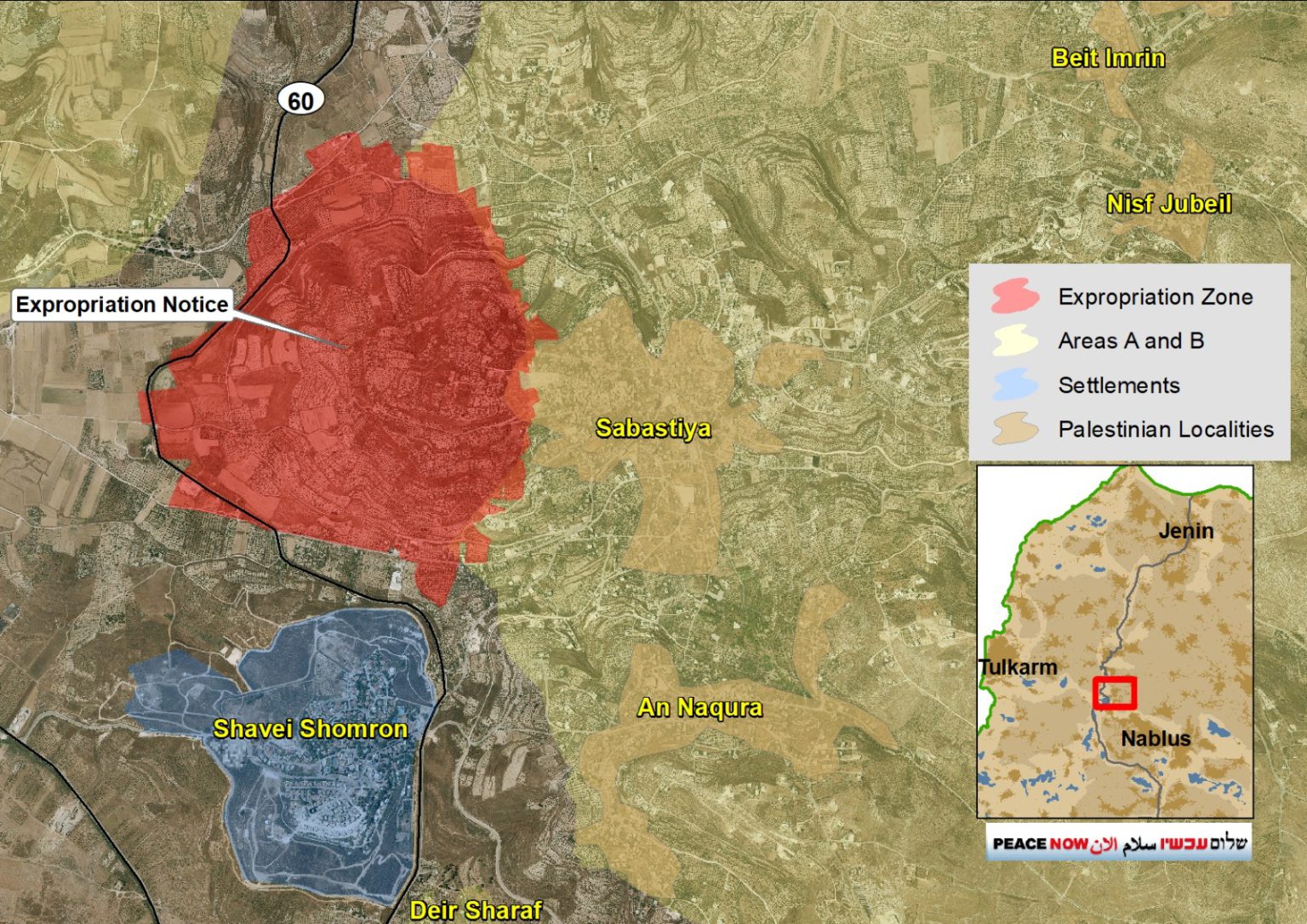 On November 19th the Israeli government announced it will expropriate a large amount of privately owned Palestinian land (445 acres, 1,800 dunams) surrounding and including the Sebastia archaeological site, located in the northern West Bank, in order to bring it under Israeli control and to develop the site into a major tourist attraction. The Israeli government has already allocated 30 million shekels ($9.24 million) to the development of the Sebastia site.
Emek Shaveh said in a statement:
“Under the guise of concern for heritage, the government is investing tens of millions of shekels in turning heritage sites into weapons of dispossession and annexation. The intention to expropriate private land is anything but preservation; its purpose is to establish a tourism settlement that will detach Sebastia’s heritage from the town and Judaize the area through the tourists who visit the site.”
The government’s plan will unilaterally seize land from the villages of Burqa and Sebastia, land in Area C which the Israeli government recognizes as lawfully owned by Palestinians, some of which is cultivated olive groves. The government is nonetheless carrying out the expropriation on the basis of an administrative order for antiquities. Emek Shaveh says Sebastia will be the fifth and most significant archaeological site expropriated by Israel since 1967, and Peace Now provides the receipts.
Along with dispossessing Palestinian landowners, Israel’s plans for the area will devastate the Palestinian tourism industry built around the site, which under Israeli control will be developed not for the benefit of Palestinians but for the Israeli tourism industry and settlers. Tellingly, the Israeli government has already begun renovating a nearby railway station – the Masoudia station – into a tourist site (a settlement) and planning a new access road to the site that bypasses the Palestinian village of Sebastia.
Emek Shaveh explains:
“The intention is clear – to sever the ancient site of Sebastia from the Palestinian historic town of Sebastia, connect the site to Road 60 and turn the site into a settler-led tourist attraction (similar to the City of David in Silwan, East Jerusalem). This development follows government decision 491 (May 2023), which allocates 32 million NIS to develop what Israeli authorities call the “Shomron (Samaria) National Park” in a plan that entails massive development of the site, including a visitors’ centre, a parking lot, and a fence which will separate the acropolis from the rest of the town.”
Peace Now explains:
“The Sebastia case is especially unusual because the expropriation targets an archaeological site that has long served as an economic, cultural, and tourism anchor for residents of Sebastia and the surrounding area, and that has been open to the public. Around the site are souvenir shops and restaurants, and in Sebastia itself, many residents earn their living from guiding visitors and renting rooms to tourists. The Sebastia site lies inside the village, among residents’ homes. The expropriation concerns the western part of the site, an area with fewer homes and surrounded by olive groves.” And on the railway station settlement site, Peace Now says: “Turning the Masoudia train station into a tourist site is, in fact, the establishment of a new settlement. This is not a heritage site—it’s part of a deliberate government plan to plant settlements deep inside a densely populated Palestinian area between Nablus and Jenin. These projects will increase the security burden, deepen the occupation, and advance annexation. The only ‘heritage’ being promoted here is the legacy of lawlessness and brute force championed by the Gush Emunim settler movement, which, then as now, acted illegally, clashed with security forces, and imposed facts on the ground for which the State of Israel continues to pay a heavy price to this day.”
Peace Now said in a statement:
“The Israeli government’s drive for dispossession and annexation knows no limits, and it is prepared to violate international law openly to pursue it. This is part of a broader effort to take control and expand settlements in areas northwest of Nablus that Israel evacuated during the disengagement. Sebastia is a heritage site located inside a Palestinian village, part of its history and part of a future Palestinian state. Under the Oslo Accords, signed by Israel, it should have been transferred to Palestinian administration long ago. Israeli greed harms not only the landowners, but also the prospect of a peaceful solution that upholds the rights and heritage of both peoples.”
Settlers Establish New Outpost Near Bethlehem
 The chairman of the local Etzion settler council, Yaron Rosenthal, proudly and publicly announced the establishment of a new outpost, called “Shdema”, on a hilltop near the Palestinian town of Beit Sahour east of Bethlehem. This new outpost is not a wild and haphazard effort by fringe radical settlers to build an outpost, but the organized and intentional work of settler leadership to establish a permanent new settlement. Tractors appeared overnight to clear and level the land, and several caravans were precipitously moved onto the site with three settler families reported to have moved in.
In his announcement, Rosenthal made it clear that the outposts came in response to the IDF’s evacuation of another outpost in Gush Etzion. The outpost was also built days after a Palestinian attack targeting Israelis at the nearby Gush Etzion junction, where one person was killed and three were injured by masked, knife-wielding assailants.
Peace Now has filed a complaint demanding an investigation into the Gush Etzion Regional Council’s involvement in the illegal construction of the outpost, and said in a statement:
“The new outpost is intended to choke the Palestinian town of Beit Sahour and block its development. There is no limit to the settlers’ audacity in establishing outposts and creating facts on the ground, while using public funds and denying Israel the chance for a future of peace and two states.”
Settlers have spent almost two decades trying to build a settlement at this exact site, an area called Ush Ghurab. The site was an Israeli military base but was vacated in the early 2000s. The U.S. then initiated a plan to fund and build a children’s hospital (with services aimed at Palestinians), but the plan was ultimately scuttled under settler pressure and the Israeli government build a new military post at the site.
IDF Raids Bedouin Village in Advance of Settlement Expansion
Ir Amim reports the Israeli police and soldiers raided the bedouin village of Kasarat living near the site of the future E-1 settlement. A group of 150 soldiers reportedly invaded the village in the early morning hours, forcing residents out of their homes while they proceeded to ransack each residence and beat several men. Residents reported extensive damage and stolen cash after the soldiers left.
Israeli Police have said the raid was aimed at finding weapons, though there were no arrests or seizures. Attorney Roni Pelli, who works for Yesh Din, told The Times of Israel that holding an entire village hostage is a form of collective punishment, and illegal under international law.
Ir Amim warns:
“The scale and violent nature of this unprovoked military action against an entire village is unprecedented in this area and could further indicate Israel’s intent to uproot the Palestinian communities living on lands marked within the E1 corridor….
Ir Amim has long stressed the danger of expulsion for vulnerable Palestinian communities in and around E1, whose land is directly threatened by the plan’s reemergence and approval. We have likewise warned that expulsions could be the first step taken by Israeli authorities following the plan’s approval. In addition to the severe geopolitical ramifications of the E1 settlement plans for the prospects of a viable Palestinian state, the most immediate repercussions are already unfolding on the ground for Palestinian communities.
This military action comes as the District Court reviews several petitions filed against the approval of the E1 settlement plans, including a petition initiated by Ir Amim together with partner organizations, Bimkom and Peace Now. It also follows the court’s recent rejection of a request for an injunction. The raid on the Kasarat community suggests that the authorities intend to continue pushing forward with the E1 plans at full speed, despite the petitions still under review.”
Settlers Terrorize Palestinians After IDF Dismantles Illegal Outpost
On November 17th, Israeli security forces dismantled the violent illegal outpost of Zur Misgavi (aka Givat Hatilim), located near Hebron. Attempting to thwart the evacuation, Israeli settlers barricaded themselves in the outpost and proceeded to throw rocks and metal rods, and burn vehicles and tires as the military and police attempted to remove them. Six settlers were arrested. Smotrich explained his support for the outpost demolition by saying he plans to build thousands of new settlement units on the same plot of land and the outpost was in his way.
The demolition of the outpost was apparently carried out at the request of the Gush Etzion Regional Council which raised concern about anarchy in the area and complained about the unauthorized construction.
The outpost evacuation enraged parts of the settler movement and in retaliation, settlers proceeded to terrorize nearby Palestinians communities, conducting violent raids on two towns.
First, settlers attack Umm al-Butm (located at the foot of the Zur Misgavi outpost), setting buildings and vehicles on fire and assaulting at least one women.
Second, settlers attacked Jab’a, setting fire to three homes, three vehicles, and a caravan. Video from the scene is terrifying. Settlers graffitied several buildings, writing “A Jew doesn’t evict a Jew.”
Following the fiery attack on Jab’a, the IDF announced a manhunt to find the attacks, and several high ranking Israeli officials made public statements condemning settler violence.
State-Backed Settler Terrorism This Week
Over the course of the last two weeks more and more criticism has fallen at the feet of the Israeli government, which has long sought to characterize settler violence as a small problem of a few bad apples, absolving the state of its systematic involvement, financing, and encouragement of settler violence. Following the settler attacks on Jab’a and Umm al-Batun and under mounting international pressure to address the problem, Prime Minister Netanyahu made public comments promising “forceful action” against settler violence, but continuing to assert the problem is one of the minority.
Bibi later convened his cabinet and top security officials to discuss how to address settler violence, reportedly to include getting violent settlers to attend educational programs (i.e. no real legal consequences or accountability). Later, Israeli security officials reportedly drafted a new plan to reportedly entails several recommendations including to: to create a special investigative team to handle severe cases; increase military and police deployment in the West Bank; establish 14 security hubs in violent hotspots; expand surveillance networks with new cameras; and increase punishment of offenders to include property seizures, fines and gun license revocations.
In an editorial, the Jerusalem Post Editorial Board wrote that the Israeli government is complicit in the violence, writing: ”The public silence of Netanyahu and Katz and the encouragement of Ben-Gvir point to the only plausible conclusion that the government is part of the problem, not the solution.”
While the Israeli government formulates a response, settler terrorism in the West Bank continues on a daily basis – and no arrests have been reported. Key attacks this week include:
- Attacks on Jab’a and Umm al-Bum, as detailed above.
- Huwara – On November 20th, settlers conducted a pogrom on the village of Huwara. First throwing stones and molotov cocktails, settlers further escalated to setting vehicles, homes and a scrapyard on fire, resulting in a massive blaze. IDF are reported to have arrested at least one Palestinian journalist who was documenting the attack, but no arrests of Israeli settlers have been reported.
- Al-Mirkez – On November 21st settlers used clubs to violently assault Palestinians in the village of al-Mirkez, located in the Masafer Yatta area of the South Hebron Hills.
- Luban a-Sharqiya – Settlers torched several buildings.
- Abu Falah – Settlers burned an agricultural building and set a home on fire while residents were still inside.
- Deir Sharif – Settlers vandalized a plant nursery, destroyed a bathroom fixture showroom, and burned over a dozen cars.
- Beit Furik – Settlers raided Beit Furik.
- Susya – Settlers attacked an elderly Palestinian man, knocking him off his donkey and requiring hospitalization.
Human Rights Watch: Not Just Gaza – Israel Committing War Crimes in the West Bank
Human Rights Watched published a new report entitled, “‘All My Dreams Have Been Erased’: Israel’s Forced Displacement of Palestinians in the West Bank.” An excerpt reads:
“This report examines the Israeli government’s conduct of Operation Iron Wall from its start in January 2025 through July 2025, and the resulting mass displacement of Palestinians from three refugee camps in the northern West Bank. Human Rights Watch found that Israeli forces committed forcible displacement in violation of the law of occupation under international humanitarian law that amount to war crimes. Human Rights Watch also found that Israeli forces committed the forcible transfer of population and other inhumane acts as part of a widespread or systematic attack directed against a civilian population, which are crimes against humanity under the Rome Statute of the International Criminal Court. Israel’s actions also violated international human rights law, which remains in effect in the West Bank…
When forced displacement is committed as part of a widespread or systematic attack on a civilian population, thus reflecting state or organizational policy, it can constitute a crime against humanity. These actions may also be considered “ethnic cleansing,” a non-legal term used to describe a policy to remove an ethnic or religious group from particular areas “by violent and terror-inspiring means.”…
This forced displacement reflects the broader pattern of ongoing rights violations by Israeli authorities against the Palestinian population, including the crimes against humanity of apartheid and persecution.”
Read the full report here.
Bonus Reads
- “IDF Blocks Activists From Aiding Palestinian Olive Harvest, Declares West Bank Village Closed Military Zone” (Haaretz, 11/14/25)
- “Averting West Bank collapse: How to revive Palestinian politics” (ECFR, November 2025)
- “Editorial | In the West Bank, the IDF Only Arrests Those Who Come to Protect Palestinians” (Haaretz, 11/16/25)
- “‘Palestinian Farmers Are Fighting to Survive’ Drought and Settler Violence Make 2025 West Bank Olive Harvest Worst in Living Memory” (Haaretz, 11/14/25)
Welcome to FMEP’s Weekly Settlement & Annexation Report. To subscribe to this report, please click here.
September 12, 2025
- Netanyahu Signs Final Approval of E-1, Celebrates End of Palestinian State
- Netanyahu Delays Discussion of Plan to Annex the Jordan Valley
- ‘Formalizing Apartheid’: Smotrich Presents Plan to Annex 82% of the West Bank
- State Land Declaration to Legalize Havat Gilad Outpost
- Settlers Establish New Enclave on Key Hebron Street (Currently) Open to Palestinians
- West Bank News & Analysis
- East Jerusalem News & Analysis
- Bonus Reads
Netanyahu Signs Final Approval of E-1, Celebrates End of Palestinian State
On September 11th, Israeli Prime Minister Netanyahu held a ceremony in the Ma’ale Adumim settlement to celebrate the signing of the E-1 settlement framework plan, the final approval for the construction of a settlement designed to foreclose any possibility of a Palestinian state. Netanyahu is happy to state the intention behind the settlement, saying at the ceremony that “We are going to fulfill our promise that there will be no Palestinian state, this place belongs to us.”
Bezalel Smotrich also attended the ceremony, where he told Bibi in front of the crowd:
“Mr. Prime Minister, all of us, soon, will thank you and congratulate and celebrate together the application of sovereignty throughout Judea and Samaria.”
 The signing of the E-1 framework was done as part of a massive umbrella agreement worth billions of shekels to develop the wider Ma’ale Adumim and E-1 area. Peace Now reports that the framework includes a government commitment to invest 3 billion shekels in infrastructure for the construction of 7,600 housing units, of which about 3,400 are in E1. The plan seeks to double the population of the Ma’ale Adumim settlement and build new roads, public institutions, and other infrastructure – – furthering Israel’s de facto annexation of a huge area east of Jerusalem.
Ir Amim said in a statement:
“Today, the Israeli Government is expected to sign a government umbrella agreement with the West Bank settlement of Ma’ale Adumim, which will allocate 3 billion NIS to finance and accelerate the development of the E1 and Ma’ale Adumim area. The signing ceremony will be attended by the Israeli Prime Minister, underscoring the high-level political backing for this move.
In other words, annexation par excellence.
For perspective: an umbrella agreement was signed with the Jerusalem Municipality seven years ago for the city’s development that totaled just 1 billion NIS. Despite the fact that Jerusalem has 25 times more residents than Maaleh Adumim, the settlement will receive triple what was allocated to the Jerusalem municipality.
This comes on the heels of last month’s approval of the E1 settlement plans and publication of tenders for 3300 new housing units between Maaleh Adumim and the Mishor Adumim industrial zone. Following the recent intervention by Finance Minister Bezalel Smotrich, a percentage of these housing units will likely be sold at discounted rates as part of a government subsidized housing lottery.
Annexation and entrenchment of Israeli apartheid on full throttle.”
Netanyahu Delays Discussion of Plan to Annex the Jordan Valley
Last week, Israeli Prime Minister Benjamin Netanyahu postponed the Security Cabinet’s discussion of his plan to formally annex the Jordan Valley (some 30% of the West Bank). Israel Hayom reports that in preparing the plan for discussion in the Security Cabinet, Ron Dermer (Netanyahu’s Strategic Affairs Minister) worked with U.S. officials to OK the Jordan Valley plan and believes that, contrary to annexation of the full West Bank, the annexation of the Jordan Valley would receive bipartisan support in the United States. Netanyahu and Dermer reportedly framed the annexation push as a response to increasing diplomatic pressure on Israel vis a vis Gaza, particularly European promises to recognize a State of Palestine
Rumors of Netanyahu’s intent to advance the annexation of the Jordan Valley were followed quickly by two significant, headline-grabbing responses. First, Israeli Minister Bezalel Smotrich publicly debuted his own plan for annexation – a plan that would see Israel annex 82% of the West Bank (for more, see below), a plan that far overshadows the Netanyahu-Dermer plan. Second and in response to Smotrich’s plan, the UAE released a statement saying that annexation is a “red line” and “means there can be no lasting peace” and would “end the pursuit of regional integration” (hinting at ending the Abraham Accords, which the UAE signed in 2020). Only after the UAE statement was it reported that Netanyahu pulled Jordan Valley annexation off of the agenda for the Cabinet meeting scheduled for September 4th.
Netanyahu’s plan for a more limited annexation of the Jordan Valley is nothing new (and is of course being actively carried out in a de facto manner). Netanyahu has pushed for the de jure annexation of the Jordan Valley since at least 2019.
The Jordan Valley is home to around 65,000 Palestinians, though ~10,000 settlers have managed to exert their control over nearly 85% of the Valley. On a weekly basis, FMEP shares reporting from the ground of settler attacks on PAlestinians communities in the Jordan Valley, new outposts, more declarations of state land or closed military zones – – all of which have violently coerced many Palestinians into leaving while Israel silently annexes the Jordan Valley.
‘Formalizing Apartheid’: Smotrich Presents Plan to Annex 82% of the West Bank
On September 2nd, Israeli Finance Minister Smotrich held a press conference to unveil his proposal to annex 82% of the West Bank, a plan accompanied by a map (emblazoned with a government logo) leaving only six major Palestinian population centers as un-annexed land, entirely surrounded by the Israeli state. Smotrich publicly promoted his plan days after reporting that suggested Netanyahu was prepared to advance a plan to annex the Jordan Valley, which constitutes 30% of the West Bank – much less than Smotrich and his settlers allies are aiming for, and indeed working to achieve.
While showing off his proposed map, Smotrich said:
“We have no desire to apply our sovereignty over a population that seeks our destruction. Enemies must be fought, not allowed a comfortable life. Therefore, the overriding principle for applying sovereignty is: maximum land with minimum population.”
Smotrich estimated 80,000 Palestinians live on land that he proposes annexing to Israel, and those Palestinians will be offered the status currently held only by Palestinian East Jerusalemites — a status short of full citizenship and which denies Palestinians the right to vote for the government that rules their lives. However, as Haaretz notes, Smotrich’s assertion that 80,000 live in areas his map shows as future Israeli territory does not comport with known demographics. For example, Smotrich’s map shows all of Bethlehem and its surrounding lands as annexed to Israel, and it’s estimated that the population of this area is around 200,000 Palestinians.
Smotrich proposes the un-annexed Palestinian population centers will be islands of land administered by “regional civilian management alternatives,” calling for the Palestinian Authority to be dismantled. Knesset Member Aido Touma-Sliman said:
“Smotrich’s annexation map is the clearest expression yet of this government’s fascism. It seeks to erase an entire people by redrawing borders with brutality and arrogance, turning the West Bank into fragmented prisons with no geographic continuity under Israeli sovereignty. It exposes a regime no longer hiding behind false claims of democracy, but openly pursuing fascist control over millions of Palestinians. The international community must not look away. Every endorsement, every silence, every normalization in the face of this map is complicity in the crime of apartheid and in the erasure of the Palestinian people’s right to exist.”
Smotrich’s public pitch for annexing the majority of the West Bank (and formalizing apartheid) received harsh criticism from many corners of the international community – most notably from Israel’s Abraham Accords core partner the UAE. The Trump Administration, on the other hand, not only refrained from criticism of Smotrich but repeatedly clarified for Israeli news outlets that the U.S. has never expressed opposition to Israeli annexation plans.
To be clear, Smotrich’s plan proposes a large scale of annexation of the West Bank that he is already implementing in a de facto nature (he has admitted as much repeatedly). Since taking control over the Settlements Administration, a new division created within the Israeli Defense Ministry, Smotrich has acted as the reigning sovereign of the West Bank. With authority over all civilian matters in the West Bank and significant input on security matters, Smotrich has undertaken a mass-scale effort to annex land, increase the number of settlers, demolish/displace Palestinian communities, and hollow out the Palestinian Authority. Smotrich has fundamentally transformed Israel’s governance of the West Bank, bringing the West Bank under Israeli civilian authority and virtually eliminating the thin facade of separation between how Israel governs the occupied territories and how it governs its own sovereign territory
State Land Declaration to Legalize Havat Gilad Outpost
Peace Now reports the Israel Civil Administration has declared a huge area of land (112 acres) near Nablus to be “state land.” The land historically belonged to the Palestinian villages of Tell, Jit, and Far’ata, but in 2002 settlers illegally built the Havat Gilad outpost on privately owned land in the area and have since lobbied the Israeli government to legalize the outpost.
However – the land that has been seized does not include the land on which structures in the Havat Gilad outpost are currently built, and the seized land is, according to The Times of Israel, a “tortuously drawn and include islands of land within the state land zone that may be privately owned by Palestinians.”
Peace Now says this is an Israeli effort to establish a new settlement, not to legalize the Havat Gilad outpost. Peace Now explained:
“…the state has declared land about one kilometer south of the outpost as “state land” for the purpose of “legalizing” it. However, the declared lands show that the vast majority of the outpost’s houses are built on private land and therefore cannot be legalized. To make the outpost “legal” according to Israel’s own rules (all settlements are illegal under international law), the existing houses would have to be demolished and the outpost rebuilt elsewhere, about a kilometer away from its current location.
It is already clear, however, that in practice no buildings will be demolished; instead, new construction will simply be added on the declared land. For decades the government has allowed the outpost to continue to seize private land and has refrained from removing the settlers. It is hard to believe that now, as it promotes formal ‘regularization,’ it will suddenly demolish homes.”
As Kerem Navot has chronicled, the Havat Gilad outpost has been the subject of controversy since it was first established by settlers in 2002. Since then, the outpost has become a source of radical, serious, and frequent violence against Palestinians. In 2014, two Havat Gilad settlers were sentenced to prison for setting Palestinian vehicles on fire in a price-tag attack; its residents have also been documented harassing Palestinian farmers and denying them access to their own lands. The Israeli NGO Yesh Din – which has documented violence emanating from Havat Gilad, including against Yesh Din employees – has filed several petitions against the outpost, including a 2010 case that resulted in the demolition of some of the outpost’s structures that were built on land Israel recognized as privately-owned by Palestinians. Yesh Din’s investigation shows that Havat Gilad was built on lands that the Israeli Civil Administration has now declared to be “state land” have in fact been continuously cultivated and privately owned by Palestinians; most of the outpost’s structures have standing (but unenforced) demolition orders issued against them.
In 2018, the Israeli government came under intense pressure from the settler lobby to legalize Havat Gilad in response to a Palestinian terror attack that killed a Havat Gilad settler — and came very close to doing so. At the time, the government ran into difficulties in legalizing the outpost because some of the illegal buildings were located on land Israel recognized as privately-owned by Palestinians, and the government could not – at that time – find a legal means by which to expropriate it. Meanwhile, the settler killed in the attack was subsequently buried at the outpost, and as Al-Monitor explains, the presence of a cemetery in the outpost makes its future evacuation nearly impossible. Kerem Navot’s Dror Etkes spoke to Haaretz around this same time about the phenomenon of settlers being buried in the West Bank:
“Etkes tells Haaretz he believes the choice of where the cemeteries are situated – particularly when they lie on private land some distance from the nearest homes – is not a coincidence. ‘I work on the assumption that there are always deliberate intentions afoot,’ he says. The placement of a cemetery ‘is not chosen for no reason. It is a very long-term investment – and in Judaism, whoever buries people in a certain place does so on the understanding they will not be removed. Obviously, there is deliberate intent lurking behind the location of these cemeteries,’ Etkes continues, ‘and it may be assumed that whoever buries the dead on private Palestinian land knows exactly what he’s doing.’”
Settlers Establish New Enclave on Key Hebron Street (Currently) Open to Palestinians
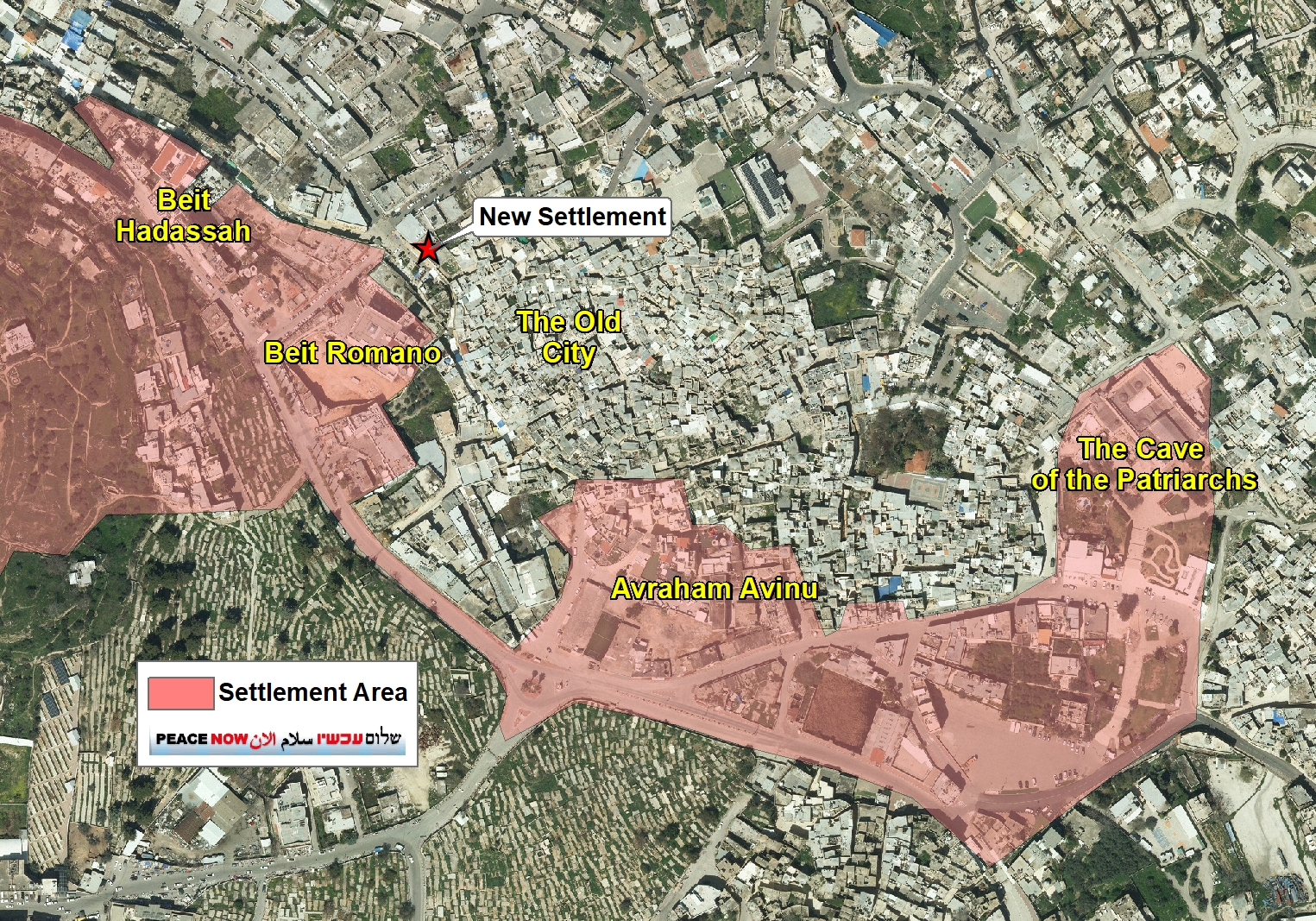 Settlers have taken over a building on Shallala Street in Hebron, one of the main access streets available for Palestinians to reach the Old City of Hebron and the Ibrahimi Mosque. Shallala Street runs parallel to Shuhada Street, which is closed to Palestinians. Peace Now warns the new enclave raises concern that the Israeli government or army may move to close the street to Palestinians in order to provide security to the settlers.
Peace Now said in a statement:
“This settlement is a direct initiative of the government. The Custodian of Government Property allocated the building to the settlers, and the army opened a special passage for them to enter. The goal of establishing a settlement in the heart of Hebron’s casbah is to seize new areas of the city and displace Palestinians from them, similar to what was done in the city center around the existing settlements. The settlement in Hebron is the ugliest face of Israeli control in the territories. Nowhere else in the West Bank is apartheid so blatant. Establishing a new settlement in Hebron is a provocation that harms Israel’s political and security interests.”
On the same day as Smotrich’s presentation, Israeli forces arrested the mayor of Hebron, Tayseer Abu Sneineh. Hebron is the largest Palestinian city in the West Bank and is home to 800,000 Palestinians. Some 500 messianic Israeli settlers have been imposing their presence in the city’s old town since the 1980s, and Abu Sneineh is known for his role in a Fatah cell that planned and carried out the shooting of six Israeli and Jewish settlers in the city’s old town in 1980, locally known as the “Dabuya Operation.” After his initial arrest, Abu Sneineh was later released in a prisoner swap in 1983 alongside other members of the cell.
Abu Sneineh’s arrest came days after Israeli media outlets reported that Israel’s Prime Minister, Benjamin Netanyahu, was considering the establishment of a tribal “emirate” in Hebron, separate from the Palestinian Authority, which first surfaced in the pages of the Wall Street Journal last July.
Local Palestinian media speculated as to whether Abu Sneineh’s arrest was possibly a prelude to removing potential sources of local opposition to annexation, especially given Abu Sneineh’s
West Bank News & Analysis
- “The government is establishing a new enforcement unit that will operate in the West Bank against Palestinian construction” (Peace Now, 9/10/25)
- “Israeli Foreign Ministry Sparks Backlash With Rosh Hashanah Outing in West Bank” (Haaretz, 9/9/25)
- “Settlers sprayed graffiti, set vehicles on fire in Palestinian village overnight” (The Times of Israel, 9/11/2025)
- “A New Settler Hut Popped Up in Hebron. What Followed Confirmed the Palestinian Neighbors’ Worst Fears” (Haaretz, 9/6/2025)
- “The U.S. visa cancellations for Palestinians marks another step towards West Bank annexation” (Mondoweiss, 9/5/25)
- “The Settlers’ Next Prize” (Al Jazeera, 9/8/2025)
East Jerusalem News & Analysis
- “US Secretary of State Marco Rubio to attend inauguration of settler tourist site near Haram al-Sharif/Temple Mount” (Peace Now, 9/8/25)
- “A Stranglehold on Sheikh Jarrah–New Tools for Israeli Takeover and Palestinian Displacement” (Ir Amim, 9/7/25)
- Ir Amim’s Annual Report on the State of Education in East Jerusalem, 2024-2025 School Year” (Ir Amim, August 2025)
Bonus Reads
- “A Rogue Force Operates in Gaza Under IDF Cover, Endangering Soldiers and Unarmed Palestinians” (Haaretz, 8/4/25)
- “Most Americans, including MAGA supporters, oppose Israeli annexation of West Bank — poll” (The Times of Israel, 9/11/25)
- “20 years after Gaza settlement disengagement, some dream of going back” (NPR, 9/10/25)
- “Israel Has Seen Extremists in High Office. But Nothing Like Netanyahu’s Shin Bet Pick” (Haaretz, 8/8/25)
- “Zionism: 77 Years of Expulsion” (Hagai El Ad in Haaretz, 9/10/2025)
Welcome to FMEP’s Weekly Settlement & Annexation Report. To subscribe to this report, please click here.
August 21, 2025
- E-1 Settlement is Fully Approved
- Settlers Take Over Land, Establish New Enclave n Hebron’s H-1
- Settler Terrorism & Ongoing Mass Displacement in the West Bank
- Bonus Reads
E-1 Settlement is Fully Approved
 On August 20th, the Israeli government granted final approval for the construction of the E-1 settlement, clearing the way for infrastructure work to commence in the coming months and construction of 3,500 new settlement units to potentially begin in early 2026. The settlement is planned for an area that bisects the West Bank by connecting the Maale Adumim settlement to Israeli settlements in East Jerusalem. The design divides Ramallah and the northern West Bank from Bethlehem and the southern West Bank, which will severely affect the connectivity and fabric of life of Palestinians, and forcibly displace thousands of bedouin living in 18 communities on the land now.
The UN Office for Human Rights (OHCHR) released a statement condemning the approval saying:
“[the plan] represents another grave and unlawful step to consolidate annexation of the occupied West Bank, in violation of international law…By dramatically restricting Palestinian’s ability to move within the occupied West Bank, it will have catastrophic effects on their enjoyment of fundamental rights to access health, education, employment, and maintain family and society connections.”
Following the approval of the E-1 plan, Israel Finance Minister Bezalel Smotrich celebrated by saying this settlement approval is:
“historic …[and] a significant step that practically erases the two-state delusion and consolidates the Jewish people’s hold on the heart of the Land of Israel…The Palestinian state is being erased from the table not by slogans but by deeds. Every settlement, every neighborhood, every housing unit is another nail in the coffin of this dangerous idea.”
The plan for E-1 is decried by proponents of a two-state solution, because it is designed to preclude the ability to draw a contiguous border for a Palestinian state that includes East Jerusalem communities. Unlike vociferous opposition from many European countries, the Trump Administration has not criticized the E-1 settlement approval. U.S. Ambassador to Israel Mike Huckabee told the AP that talk of a two-state solution was not a “high priority” for the Trump administration. A spokesperson for the U.S. State Department elaborated on the U.S. position:
“A stable West Bank keeps Israel secure and is in line with this administration’s goal to achieve peace in the region.”
Settlers Take Over Land, Establish New Enclave n Hebron’s H-1
Peace Now reports that settlers have taken control over and established a presence on a small plot of land in the Tel Rumeida neighborhood of central Hebron, on land located between a mosque and a Palestinian girls’ high school. There are no other settlement enclaves close to this new set up (which currently features two caravans placed on land that was cleared by the settlers in advance of moving the structures in), leading Peace Now to warn the new settler installment has “far-reaching implications for the security deployment required to protect it”.
This new settler enclave is in the H1 area of Hebron, which is supposed to be under the full authority of the Palestinian Authority; and Israeli military order prevents Israelis from entering the H-1 area.
Peace Now explains the situation in Tel Rumeida:
“The Palestinian residents of Tel Rumeida live under a regime of severe restrictions. For more than 20 years, the Israeli military has prohibited Palestinian vehicles from driving on the neighborhood’s roads. Residents must walk home on foot and carry all goods themselves. Over the past two years, the army has closed off all pedestrian access points into the neighborhood with checkpoints. Only residents registered as living in Tel Rumeida are allowed to enter – and only after inspection. The checkpoints remain open until 9:00 p.m. with one checkpoint supposedly open also after 9:00pm, however residents report that it is not consistently accessible…The new settlement is isolated and distant from the existing settler homes in Tel Rumeida and has far-reaching implications for the security deployment required to protect it. This impacts not only settlers but also the daily lives of Palestinian residents, worshippers at the mosque, and students attending the nearby school.”
Peace Now said in a statement:
“The settlement in Hebron represents the ugliest face of Israel’s control over the occupied territories. Nowhere in the West Bank is apartheid more apparent. The Netanyahu-Smotrich government has no restraints. The establishment of a new settlement within a dense Palestinian area in Hebron, particularly in an area under Palestinian control, is a provocation that undermines Israeli political and security interests. Its establishment constitutes a violation of both a signed international agreement and Israeli military law.”
Settler Terrorism & Ongoing Mass Displacement in the West Bank
Settlers continue to terrorize and forcibly displace Palestinian communities across the West Bank, including the Ein Ayoub neighborhood just last week. Increasingly brazen and emboldened by the systematic lack of enforcement against settlers for their violent crimes, settlers were filmed by a BBC film crew attacking Turmus Ayya in the central West Bank. A short distance north of Turmus Ayya, a mob of 70 settlers recently lynched two Palestinians, including 20 year old Palestinian American Saif Musallet.
OCHA presents critical reporting on the intensification of settler violence targeting Palestinians in the West Bank. It reports:
“Since the beginning of 2025, OCHA has documented more than 1,000 attacks by Israeli settlers in 230 communities across the West Bank that resulted in casualties, property damage or both, more than 60 per cent of which were in Ramallah, Nablus and Hebron governorates. In total, 11 Palestinians were killed in these attacks, including five by Israeli settlers, five by Israeli forces and one where it remains unknown if he was killed by Israeli settlers or forces. In addition, 696 Palestinians were injured in these attacks, including 473 by Israeli settlers, 217 by Israeli forces and six where it remains unknown if they were injured by Israeli settlers or forces. In comparison, 11 Palestinians were killed in attacks by settlers in 2024, including three by Israeli settlers, two by Israeli forces and six where it remains unknown whether they were killed by Israeli settlers or forces. In addition, last year, there were 486 Palestinians injured in settler attacks, including 362 by Israeli settlers, 115 by Israeli forces, and nine where it remains unknown if they were injured by Israeli settlers or forces.”
Bonus Reads
- “Israeli activists briefly cross Syria border in bid to establish settlement” (The Times of Israel, 8/19/25)
- “The Spread of Settlement Outposts and the Killing of Palestinians in the West Bank Are the Same Thing” (Haaretz, 8/14/25)
- “EXCLUSIVE: Centrist Ruben Gallego Circulating Letter Pushing Trump to Investigate Israeli Settler Violence” (Zeteo, 8/15/25)
Welcome to FMEP’s Weekly Settlement & Annexation Report. To subscribe to this report, please click here.
August 14, 2025
- Israel to Approve E-1 Settlement Next Week
- Israel Published Tenders for Huge Expansion of Ma’ale Adumim Settlement
- Israel Publishes Tenders for Construction of a New Settlement, Ariel West
- Plan for Yeshiva in Sheikh Jarrah Advances Again As Israel Seeks New Ways to Expel Palestinian Residents
- Plan for Yeshiva in Sheikh Jarrah Advances Again As Israel Seeks New Ways to Expel Palestinian Residents
- Another West Bank Communities Have Been Expelled By Settler Terrorism
- Bonus Reads
Israel to Approve E-1 Settlement Next Week
 On August 13th, the High Planning Council published its decision to reject all objections to the plan for the E-1 settlement, clearing the way for the Israeli government to grant final approval to the highly controversial plan at a meeting scheduled in less than one week, on August 20th. Peace Now warns that if the planning process continues to move as quickly as it has over the past weeks, construction on E-1 could conceivably begin within a few months.
Bezalel Smotrich, in what has been described as a “victory lap,” held a press conference at the site of the future E-1 settlement where he claimed that U.S. President Trump has approved the plan, though the White House declined to confirm. At the event, which was held prior to formal confirmation of approval, Smotrich said:
“The approval of construction in the E1 area undermines the idea of a Palestinian state and is part of the broader steps we are taking as part of our de facto sovereignty plan, which began with the formation of this government. After decades of international pressure and freezing of projects, we are defying conventions and cementing the connection between Ma’aleh Adumim and Jerusalem.”
The governments of Jordan and Qatar issued a statement condemning Smotrich’s announcement and the plan for the E-1 settlement. The statements come in addition to previous day condemnations of Netanyahu’s public profession that he has a deep “connection” to the vision of Greater Israel as described in the Bible.
Peace Now said in a statement:
“The E1 plan is deadly for the future of Israel and for any chance of achieving a peaceful two-state solution. We are standing at the edge of an abyss, and the government is driving us forward at full speed. There is a solution to the Israeli-Palestinian conflict and to the terrible war in Gaza — the establishment of a Palestinian state alongside Israel — and it will ultimately come. The government’s annexation moves are taking us further away from this solution and guaranteeing many more years of bloodshed.”
Israel Published Tenders for Huge Expansion of Ma’ale Adumim Settlement
On August 12th, the Israeli Land Authority published tenders for the construction of 3,300 new settlement units that would connect the Ma’ale Aduminm settlement to the Mishor Adumim industrial zone to its east. Increasing the size of the settlement by 33%. The construction will be on land immediately south of the future E-1 settlement, compounding Israel’s total control of the highly sensitive area. Peace Now further notes that Ma’ale Adumim does not appear to need new construction, as the population growth has been stagnant for a decade.
Israel Publishes Tenders for Construction of a New Settlement, Ariel West
On August 12th, the Israeli Ministry of Housing published tenders for 730 units to build a new “neighborhood” of the Ariel settlement (called the “Amririm Neighborhood”). In reality, the new units will be built on a hilltop located 1.2 miles away from Ariel in an area that is non-contiguous with the built up area of the current Ariel settlement – meaning that a new settlement has been approved for construction. The new tenders join a previously issued batch of tenders issued in 2021 for 731 units, though the tenders have not yet been opened for bidding. Regardless, infrastructure work on the hilltop was reported to have begun in March 2024.
 The hilltop is located on land declared by Israel to be “state land” inside of the jurisdictional boundaries of the Ariel settlement, as authorized by the Israeli government. The jurisdictional boundaries of Ariel include several non-contiguous land areas — due to the fact that the area is dotted with land that even Israel recognizes to be legally owned by Palestinians (leaving Palestinian land in some places nearly completely surrounded by land given to the settlement).
The new settlement will further exacerbate the limitations that the settlements inflict on Palestinian agricultural workers in addition to the future development of the nearby Palestinian town of Salfit, as illustrated in this video by Peace Now. Even before the “expansion” plan, Ariel’s jurisdictional area was identified as a direct hindrance on the future development of Salfit.
Plan for Yeshiva in Sheikh Jarrah Advances Again As Israel Seeks New Ways to Expel Palestinian Residents
Ir Amim reports the Jerusalem District Planning Committee has accepted modifications to plans for the construction of the Glassman Yeshiva at the entrance to the Sheikh Jarrah neighborhood of East Jerusalem. The Committee also republished the updated plan, starting a 30-day clock for the public to submit objections to the plan.
The plan calls for the construction of an 11-story building (3 stories below ground) which will include a religious school and dormitories for students and faculty. There are several settler enclaves in Sheikh Jarrah currently, while Palestinians are facing concerted eviction efforts by settlers and the government.
The yeshiva is slated to be built on a patch of land that was expropriated from Palestinian owners for “public needs”; in 2007 the land was transferred by the Israeli government to the Ohr Somayach Institutions, an international organization which is promoting the yeshiva plan. Ir Amim reports that in 2023, the Ohr Somayach Institutions received over 6 million NIS from its U.S. branch and its donors.
At the same time, Ir Amim reports that a settler owned company has applied for a building permit in the Um Haroun section of Sheikh Jarrah, which if granted will result in the expulsion of five members of the Saou family even though they are considered “protected tenants” even under Israeli law. Ir Amim explains why this is novel, and hugely consequential:
“This is the first attempt to evict Palestinians with protected tenancy status under the guise of urban renewal (pinoi binui). In the past, protected tenancy status successfully protected certain families in Sheikh Jarrah from attempted evictions. If settlers successfully evict the Saou family as part of an “urban renewal” project, this can set a dangerous precedent for many other Um Haroun residents. Settler activists are already preparing to request a building permit which will allow them to tear down an additional building in Um Haroun and evict its Palestinian residents. Almost all the other homes in Um Haroun are threatened by an urban renewal plan which is in the preliminary stages of its approval process.”
Israel Advances Plan for New Settlement “Nofey Rachel” in East Jerusalem
 Ir Amim reports that the Jerusalem District Committee has submitted for public review a plan for the construction of a new settlement – Nofey Rachel – in East Jerusalem. Once the plan is published, there is a 60 day period for the public to submit objections to the plan.
The new settlement plan calls for 650 settlement units to be built on land on the southern slopes of the Sur Baher neighborhood in East Jerusalem, directly bordering the boundaries of the “Lower Aqueduct” settlement plan. Together, Ir Amim explains:
“these two settlements will isolate Sur Baher-Umm Tuba, fracturing it from the Palestinian space around it, inducing Beit Safafa to its northwest and Beit Sahour and Bethlehem in the West Bank to its south. As such, the new plan will extend the Israeli territorial continuum between Har Homa, the Lower Aqueduct, and Givat Hamatos, which further seals off the southern edge of East Jerusalem from Bethlehem and the southern West Bank.”
For more information regarding the plan see Ir Amim’s previous alert.
Another West Bank Communities Have Been Expelled By Settler Terrorism
The Ein Ayoub bedouin community (19 households, 102 people) has been expelled from their land near Ramallah as a result of unabated settler terrorism which has included arson, violent attacks, poisoned livestock, and drones surveilling their homes. Settlers built a new outpost near the community in the weeks preceding the expulsion.
On August 8th settlers and IDF soldiers entered the communities and threatened residents, telling them to leave within 24hours. The next morning, armed settlers returned to the village, standing guard in an act of intimidation and threat. The IDF arrived in the village on Sunday night and ordered the community to leave the village because of a new military order declaring the area a “closed military zone”. After facing international attention, the IDF later said that the soldiers evicted the community in error due to a “misunderstanding” and that the order was not meant to be applied to the bedouin. The community residents decided to leave the community, citing the fear of lawlessness and violence they face daily. One resident told Haaretz that he asked IDF soldiers if they would protect the community if they decided to say, to which the soldier replied: “I don’t protect Bedouin.”
Ein Ayoub is the third community expelled from the land in the past two monts by the coercive violence of settlers.
Bonus Reads
- “West Bank faces rising wave of settler violence against IDF and police” (Ynet, 8/11/25)
- “With Arson and Land Grabs, Israeli Settler Attacks in West Bank Hit Record High” (New York Times, 8/14/25)
- “Israel builds new settlement road northeast of occupied East Jerusalem” (MEMO, 8/10/25)
- “IDF to remain in Samaria camps through 2025” (JNS, 8/10/25)
- “Bowen: Israeli settlers intensify campaign to drive out West Bank Palestinians” (BBC, 8/10/25)
- ”U.S. to Reportedly Soften Criticism of Israel, Judicial Coup in Annual Human Rights Report ” (Haaretz, 8/10/25)
Welcome to FMEP’s Weekly Settlement & Annexation Report. To subscribe to this report, please click here.
August 8, 2025
- Israeli Planning Committee Convened on E-1 Settlement Plan, Decision Pending
- Israel Advances Plans to Expand Four Settlements in East Jerusalem: Gilo, Har Homa, East Talpiot, and Ramot
- New Outpost Near Bethlehem Tightens Settler Grip on Kisan
- In Highly Symbolic Trip, U.S. Speaker Johnson Visits the Ariel Settlement
- Bonus Reads
Israeli Planning Committee Convened on E-1 Settlement Plan, Decision Pending
On August 6th the High Planning Council convened for a final hearing on public objections submitted against the E-1 settlement plan. In an unusual delay, the Committee meeting ended without issuing its decision and as of publication the decision is still pending. The decision to reject the objections to the E-1 plan and advance it towards final approval could be issued by the Committee any day.
The hearing itself seemed to indicate the Committee’s strong support for the plan and intention to advance it to the final stage of approval. The hearing was scheduled on very short notice, so much so that none of the objectors were able to attend. Peace Now relayed that the committee meeting began with an argument between the committee members and a lawyer representing the Palestinian community of Al-Ezaria which stands to be displaced by E-1 construction. The lawyer asked the committee to be allowed to make preliminary arguments, which the Chair of the Committee rejected and proceeded to have a discussion on the plan.
The E-1 settlement has, for decades, been viewed as a “dooms-day” settlement and treated as a red-line for countries pushing diplomatic efforts towards a two state solution. E-1 is also vehemently opposed by Palestinians and human rights activists because of the impact it will have on thousands of bedouin, including Khan Al-Ahmar, who live in the area slated for the settlements’ construction, just east of Jerusalem. Construction of this settlement would have severe geopolitical implications (cutting the West Bank in half, cutting it off from East Jerusalem); would necessitate the forcible transfer of several bedouin communities (a war crime); and affect thousands of Palestinians (shredding the fabric of life).
There have been attempts to promote the E-1 plan since the early 1990s, but due to wall-to-wall international opposition, the plan was not advanced until 2012. At that time Netaynuahu ordered it to be approved for deposit for public review (a key step in the approval process), ostensibly as payback for the Palestinians seeking recognition at the United Nations. Following an outcry from the international community, the plan again went into a sort of dormancy, only to be put back on the agenda by Netanyahu in February 2020. Though plans for construction have been repeatedly delayed, in the interim Israel has taken decisive steps to prepare for the construction of E-1, including building the “Sovereignty Road” in 2023, and then In March 2024, Israel seized the land – by declaring it “state land” – designated for the construction of E-1.
Israel Advances Plans to Expand Four Settlements in East Jerusalem: Gilo, Har Homa, East Talpiot, and Ramot
Ir Amim reports that the Jerusalem District Planning Committee was scheduled to meet on August 4th to advance plans to expand three settlements in East Jerusalem, which if all approved would see 3,976 new settlement units built.
The plans considered for advancement are:
-
- Gilo South – 1,900 new units that will expand the Gilo settlement south towards Beit Jala/Bethlehem, to be built on land that includes ancient olive groves owned and tended to by residents of Beit Jala.
- Har Homa East – 660 new settlement units that will expand the settlement to the south and east, further encroaching on two Palestinian communities – Beit Sahour/Nu’man and Um Tuba – where residents are facing the threat of mass displacement at the hands of the Israeli government and settlers.
- East Talpiyot – 700 new units that will expand the settlement south further threatening to permanently divide the Palestinian neighborhoods of Sur Baher and Jabal Mukabber.
- Ramot – 900 new units that will expand the settlement north right up to the Separation Wall.
While Israeli authorities look to advance these plans for the benefit of settlers, authorities are also advancing plans for the mass displacement of Palestinians from East Jerusalem. Including most receipts plans to demolish a 5-story building in the A-Sawana neighborhood which will displace 17 families. In an all too common occurrence, the building was constructed without Israeli permits (which are systematically denied to Palestinians), and so Israel issued a demolition order against the building soon after it was built. The order has not been enforced for 22 years, but is now being pursued by and Israeli agency under the full control of National Security Minister Itamar Ben Gvir.
New Outpost Near Bethlehem Tightens Settler Grip on Kisan
Middle East Eye reports settlers have established a new outpost east of Bethlehem near the Palestinian village of Kisan. Kisan has struggled against settler encroachment for decades, and OCHA reports that 65% of the village’s land has already been seized by Israel for the construction of settlements including Ma’ale Amos and Mizpe Shalem.
The village is almost completely surrounded by Israeli settlements and at least eight outposts, and has been the target of routine, sustained, and violent harassment by settlers. Over the past month, 23 families (128 people) from the areas surrounding Kisan were forcibly displaced by repeated violence attacks by settlers.
In Highly Symbolic Trip, U.S. Speaker Johnson Visits the Ariel Settlement
Speaker of the House Mike Johnson (R, LA-4) arrived in Israel this week and included a stop in the Ariel settlement on his itinerary, making him the highest ranking elected official to visit a settlement (though U.S. Ambassador David Friedman and former U.S. Secretary of State Mike Pompeo have previously done so).
Speaker Johnson was escorted on his trip to Ariel by Marc Zell, chairman of the Republicans Overseas Israel chapter, who gleefully celebrated Johnson’s visit and the support Johnson offered to Israel’s annexation of the West Bank. According to Zell, Johnson said that “the mountains of Judea and Samaria are the rightful property of the Jewish People.”
Israel Hayom reports that the settler Yesha Council was key to arranging Johnson’s visit to Ariel, and sees it as “a step towards legitimizing Israeli settlement.” Axios reports that the evangelical group “U.S. Israel Education Association” (USIEA) was the main organizer of Johnson’s stay in Israel. USIEA is run by American evangelical mega-church pastors Heather Johnston, and the organization is a pro-Israel, pro-settlement, non-profit group which works with the Family Research Council to lead Congressional delegations to Israel. USEIA has previously signed contracts with the Israeli government to bring thousands Israeli high schoolers to the Ariel settlement to help Jewish Israeli students who are “disconnected from the roots of their faith” to establish “a deeper connection to God by embracing their biblical and cultural heritage.” The website also says that Ariel is “at the forefront of biblical prophecy unfolding in modern Israel.”
Drop Site News reports that Speaker Johnson’s trip to the Ariel settlement connects to a long-running evangelical Christian apocalyptic movement calling for the construction of the Third Temple in order to usher in the end of times (as believed by dispensationalist Christians).
Johnson was joined on his trip to Israel by Arkansas Gov. Sarah Huckabee-Sanders (who is the daughter of the current U.S. Ambassador to Israel Mike Huckabee), Reps. Moran, McCaul, Tenney, and Cloud. Rep. Claudia Tenney serves as the chair of the Friends of Judea and Samaria Caucus in the U.S. Congress, and champions legislation to acknowledge Israel sovereignty over the West Bank. The trip is being labelled a private trip, and not an official one.
At the CUFI conference In March 2024 Johnson stated: “The United States must show unwavering strength and support for Israel.” He continued, “God is going to bless the nation that blesses Israel. We understand that that’s our role. It’s also our biblical admonition. This is something that’s an article of faith for us.”
Bonus Reads
- “Israeli Settlers Torch Palestinian Farmhouse, Tag Walls With ‘Revenge’ and ‘Price Tag‘” (Haaretz, 8/4/25)
- “Court Clears Settler of Assaulting Bedouin Women and a Toddler in the West Bank” (Haaretz, 8/5/25)
- “Thousands of Israelis Marched to Gaza – Not to Free It, but Rather to Call for Renewed Jewish Settlement” (Haaretz, 8/4/25)
Welcome to FMEP’s Weekly Settlement & Annexation Report. To subscribe to this report, please click here.
July 25, 2025
- Violence, Anarchy in Northern West Bank as Outpost Settlers Reign Terror on Palestinians & Israeli Force
- Red Alert: Planning Committee to Convene on E-1 Settlement Plan
- Ramallah Area Settler Violence Reaches Extreme, Settlers Murder U.S. Citizen
- Another Bedouin Community Displaced in Jordan Valley By Unabated Settler Terrorism
- Israel Sidesteps Palestinian Authority to Renovate Ibrahimi Mosque/Cave of the Patriarchs
- Bonus Reads
Knesset Votes for West Bank Annexation
On July 23rd, the Israeli Knesset voted 71-13 in favor of a non-binding declaration to unilaterally annex the West Bank. The resolution called on the government to “apply Israeli sovereignty, law, judgement and administration to all the areas of Jewish settlement of all kinds in Judea, Samaria, and the Jordan Valley.”
Following the vote, the newly-elected Speaker of the Knesset Amir Ohana said:
“This is our land. This is our home. The Land of Israel belongs to the people of Israel. In 1967, the occupation did not begin; it ended, and our homeland was returned to its rightful owners. We are the original first natives of this piece of land. Jews cannot be the ‘occupier’ of a land that for 3,000 years has been called Judea.”
Yisrael Ganz, head of a settler regional council and Chairman of the settler Yesha Council, stated:
“I thank the ministers and Members of Knesset from both the coalition and the opposition who voted for this important proposal to advance Israeli sovereignty in Judea and Samaria. The approval of the proposal, by a large majority of Zionist MKs, once again proves the broad support of the people of Israel for Israeli sovereignty in Judea and Samaria. It is clear and undeniable evidence of the national will to realize our values and our right to our land. This vote is a significant milestone on the path toward advancing the strategic step that will fortify the security of the entire State of Israel. I now call on the Government of Israel: Turn this decision into reality on the ground. We are at a critical and historic juncture. We must not miss this opportunity. The Yesha Council will continue to work tirelessly until Israeli sovereignty is applied in Judea and Samaria.”
Red Alert: Planning Committee to Convene on E-1 Settlement Plan
The High Planning Council is expected to convene on August 6th to advance plans for the construction of the controversial E-1 settlement project. Assuming there is not another last-minute decision to take E-1 off the agenda (something that could well happen, and has happened repeatedly) this upcoming meeting promises to be a decisive one for the long-pending E-1 plan. A subcommittee is scheduled to hear the remaining public objections to the plan, after which it is highly likely the subcommittee will recommend that the full Council approves the plan for validation. Terrestrial Jerusalem notes that, with the dismissal of objections on August 6th, the E-1 settlement plan will be “just one pen-stroke away from final statutory approval.”
Settlement experts are united in raising the alarm over the August 6th meeting, and the signal it sends regarding the government’s determination to destroy any last chance of a future Palestinian state. The E-1 settlement has, for decades, been viewed as a “dooms-day” settlement and treated as a red-line for countries pushing diplomatic efforts towards a two state solution. E-1 is also vehemently opposed by Palestinians and human rights activists because of the impact it will have on thousands of bedouin who live in the area slated for the settlements’ construction, just east of Jerusalem. Construction of this settlement would have severe geopolitical implications (cutting the West Bank in half, cutting it off from East Jerusalem); would necessitate the forcible transfer of several bedouin communities (a war crime); and affect thousands of Palestinians (shredding the fabric of life).
Peace Now said in a statement:
“The Netanyahu-Smotrich government is exploiting the war in Gaza and the current internal and international power dynamics to establish facts on the ground that would eliminate any prospect for peace and a two-state reality. The government is condemning us to continued conflict and bloodshed and is leading Israel to the edge of the abyss. Advancing the E1 plan could be a generational disaster that would make peace even harder to achieve in the future.”
In its current form, the E-1 plan provides for the construction of 3,412 new settlement units on a site located northeast of Jerusalem. The site is home to several Palestinian bedouin communities, comprising 3,000 people, including Khan al-Ahmar, which Israel is planning to forcibly relocate. There have been attempts to promote the E-1 plan since the early 1990s, but due to wall-to-wall international opposition, the plan was not advanced until 2012. At that time Netaynuahu ordered it to be approved for deposit for public review (a key step in the approval process), ostensibly as payback for the Palestinians seeking recognition at the United Nations. Following an outcry from the international community, the plan again went into a sort of dormancy, only to be put back on the agenda by Netanyahu in February 2020, when he was facing his third round of elections in two years. Also, as a reminder: under the Trump Plan (which the Biden Administration has yet to comment on), the area where E-1 is located is slated to become part of Israel.
Ramallah Area Settler Violence Reaches Extreme, Settlers Murder U.S. Citizen
On July 11th Israeli settlers attacked the West Bank village of Sinjil and killed two Palestinians – one of which was a U.S. citizen, Saif Musalat. The attack and Sinjil and murder of Musalat was just one part of a weeks long escalating settler terror campaign waged against Palestinian villages in the Ramallah area. The campaign of terror in the area includes the settlers’ attacks on Turmus Aya, Kufir Malk and the Christian village of Taybeh. Five Palestinians have been killed during these attacks.
The attacks on Taybeh and the murder of a U.S. citizen has received more attention from Israeli and international press than many of the other attacks, given the equities at stake. U.S. Ambassador Mike Huckabee – a Christian Zionist – even called for Israel to investigate the murder. Having tracked accountability efforts for years, data compiled by Yesh Din demonstrates there is a 3% probability that a settler is held accountable for an alleged crime.
Another Bedouin Community Displaced in Jordan Valley By Unabated Settler Terrorism
On July 4th, hundreds of residents of the Mu’arjat bedouin village north of Jericho were coerced into leaving their village under the constant and escalating terrorism of nearby settlers seeking to displace and replace the Palestinians, annexing the land and banishing the people. In the days immediately preceding the decision by residents to leave, settlers launched two days of attacks on the village during which they vandalized homes and stole livestock. This is the 30th community to be displaced since October 2023. Haaretz reports that there is only one remaining bedouin village in the vicinity of where Mua’arjat once stood — an area near the Kohhav Hashahar settlement and its violent outposts in the Jordan Valley.
Yosef Malihaat, a 35-year old former resident of Mu’arjat, told Haaretz:
“Our lives here are over. The settlers came right up to our house and threatened us. It’s incredibly painful to leave this land – we were born here. There’s no law in Israel today, and that’s why they send these people here – they’re criminals. It’s all intentional. I’ve never seen anything like it in my life. It’s dangerous to keep our children here. They’ve destroyed our livelihood, and when we called the police, they did nothing,”
OCHA said in a statement:
“The forced displacement of the Al Mu’arrajat East community highlights the deepening protection crisis facing Palestinian herding communities in Area C, where a coercive environment, characterized by settler violence, land confiscation, restricted freedom of movement and lack of law enforcement, continue to deprive families of safety, accountability, and any real prospect of return. The impact is severe and multifaceted; families are experiencing heightened insecurity, psychological distress, and loss of livelihoods, with women, children and older persons facing the greatest vulnerabilities due to forced displacement.”
B’Tselem said in an email:
“Last week, the expulsion of another community in the West Bank was completed. The residents of Mu’arrajat in the Jordan Valley, near Jericho, endured years of daily violence by settlers who invaded their community, stole and poisoned livestock, torched the mosque and violently attacked the school. This past weekend, the last remaining families decided to dismantle their homes, pack up and leave, after settlers recently established an outpost within the community itself, took over homes and stole dozens of sheep.
Mu’arrajat was a longstanding, sizable community, home to about 70 families and some 600 residents. Years of violence and harassment by settlers, the military and the Civil Administration gradually drove residents to leave, until the last families left this past weekend. It is the 30th community expelled from the West Bank since the start of the war on Gaza, as part of Israel’s campaign to ethnically cleanse Area C through a combination of military force and settler violence.”
Israel Sidesteps Palestinian Authority to Renovate Ibrahimi Mosque/Cave of the Patriarchs
Israeli press reports that the Defense Ministry has decided to take unilateral administrative control over the Cave of the Patriarch/Ibrahimi Mosque in Hebon, further stripping the Palestinian Authority/Hebron Municipality of its role in administering the site. The Defense Ministry is reportedly doing this with an eye towards renovating the site, and doing so without consultation or approval from Palestinians.
Peace Now said in a statement:
“The annexationist government is playing with fire and with the security of us all. The Cave of the Patriarchs is considered the fourth holiest site in Islam after Al-Aqsa Mosque, and any unilateral change is perceived by millions of Muslims as a humiliation and an attack on a sacred place. Documents recently exposed by intelligence services revealed the central role that messianic provocations on the Temple Mount — backed by the government — played in Hamas’s preparations for October 7. The government is dragging us into a religious war in the name of a messianic fringe. Anyone who truly cares about the Cave of the Patriarchs should seek an agreement with the Palestinians that would allow for consensual changes to holy sites, with the consent of all parties involved.”
Bonus Reads
- “‘No life without water’: Settler attacks threaten West Bank communities” (Al-Arabiya, 7/20/25)
- “8 U.S. states to advance law requiring use of ‘Judea and Samaria’ in official documents” (Ynet, 7/20/25)
- “Huckabee visits Christian Samaria village said to have been targeted by Israeli extremists” (JNS, 7//20/25)
- “In sign of shift, far-right US network airs segment on unchecked settler violence” (The Times of Israel, 7/18/25)
Welcome to FMEP’s Weekly Settlement Report, covering everything you need to know about Israeli settlement activity this week.
To subscribe to this report, please click here.
March 1, 2024
- Israel Declares 652 Acres of “State Land” Near Ma’ale Adumim Settlement & E-1 Site
- Israel Approves Municipal Boundaries for Outpost to be Authorized as a New Settlement
- Defense Ministry Demolishes Two Outposts
- Settlers Enter Gaza During Rally at Erez Crossing
- Settler Head Calls for Genocide Against West Bank Palestinians – Akin to Gaza – In Response to Palestinian Attack Near Eli Settlement
- Blinken: New Israeli Settlements are Inconsistent with International Law
- Bonus Reads
Israel Declares 652 Acres of “State Land” Near Ma’ale Adumim Settlement & E-1 Site
 On February 29th, the Israeli Civil Administration announced that it had declared 652 acres of West Bank land south of the Ma’ale Adumim settlement to be “state land,” bringing it under the management of the Israeli state and preparing it for the possibility of settlement construction. The land had previously been designated as part of the E-1 settlement plan, even though Israeli law does not allow Israel to plan construction on land that is not under its management. Additionally, this land is located between the Ma’ale Adumim and the Kedar settlement to its south, if construction indeed takes place – the two settlements (which both received planning advancements last week) could be connected.
Palestinian landowners have 45 days to submit an objection to the Israeli military to challenge the declaration. The land previously belonged to the Palestinian towns of Abu Dis and Al-Azaria, but it had not been formally registered in the Land Registry at the time Israel suspended registration proceedings in 1968. The land was registered in the property tax books of the villages, but these records are not accepted by the state of Israel as proof of ownership unless the land has been continuously cultivated (which, in a lot of cases, is impossible given Israeli restrictions and settlements).
Three Palestinian bedouin communities currently live in the area – the Abu Nuwar, Wadi Abu Al-Suwan, and the Abu Hindi communities – totalling 1,000 people. Since arriving on these lands in the 1970s after being forced to flee their land in Israel, these communities have been regularly targeted by Israeli policies designed to force them to once again pack up and leave.
Peace Now said in a statement:
“Instead of planning for a future of peace and security, the Israeli government continues to further the occupation and dispossession by perpetuating the conflict and bloodshed. Expropriating thousands of dunams of land from Palestinian communities demonstrates how settlements are already negatively impacting Palestinian lives and are not just a future problem or obstacle to a political solution. Construction in settlements must be halted immediately, regardless of negotiations and political arrangements.”
Israel Approves Municipal Boundaries for Outpost to be Authorized as a New Settlement
 On February 27th Bezalel Smotrich announced the approval of municipal boundaries for the retroactive legalization of the illegal farming outpost known as Mitzpe Yehuda. The outpost-turned-settlement has been named Mishmar Yehuda, and is located east of Bethlehem and south of the Ma’ale Adumim settlement. Peace Now reports that the Israeli Ministry of Housing has already contracted architects and planners to continue advancing the settlement plans, which holds potential for over 13,000 new settlement units housing approximately 65,000 settlers. The next step in the planning process is for Smotrich’s “Settlement Administration” to prepare a Master Plan for the construction.
Celebrating the announcement, Smotrich said:
“We came to this land to build and to be built up in it. We will continue the settlement momentum throughout the land. Congratulations to Gush Etzion, congratulations to the settlements, and congratulations to the State of Israel.”
In February 2023, the Israeli Security Cabinet issued a decision to retroactively legalize ten illegal outposts including Mitzpe Yehuda. The approval of a jurisdiction is the carrying out of this order. At the time, Haaretz reported that a source said the Cabinet chose these outposts for authorization specifically because they are all located in remote or isolated locations — meaning they could not be “legalized” via expanding the borders of a nearby settlement and declaring the outposts to be merely neighborhoods of those “legal” settlements (a legal maneuver Israel has repeatedly used to expand settlements and retroactively legalize settlements). This means, among other things, that legalization of these 10 new settlements will likely lead to additional land seizures for related infrastructure work (work that was not legally possible until now).
Defense Ministry Demolishes Two Outposts
The Times of Israel reports that the IDF demolished two farming outposts this week: Sde Yonatan and Or Mier. Both are built on privately owned Palestinian land, and both have been repeatedly dismantled by the IDF.
Settlers Enter Gaza During Rally at Erez Crossing
On February 29th while dozens of Israeli settlers gathered at the Erez Crossing point into Gaza to rally for the reestablishment of Gaza settlements, several individuals “violently” broke through the IDF checkpoint and entered Gaza. Some of the settlers made it 500 meters past the IDF checkpoint before being caught by the IDF. Nine were arrested by Israeli police for violating a closed military order, though none have been charged.
Other settlers participating in the protest built two rudimentary structures, which they said are meant to be for “New Nisanit”, which settlers want to establish in northern Gaza in the area where the Nisanit settlement stood prior to 2005, when the Israeli government dismantled it along with 21 other settlements. The campaign to reestablish settlements in Gaza is being led by the Nachala organization, which called on its followers to bring “appropriate gear” and “sleeping bags” to the protest this week. As became clear in January 2024, the Nachala has thousands of supporters, including at least 12 Israeli government ministers and 15 members of Knesset – all of whom attended Nachala’s recent conference entitled “Conference for the Victory of Israel – Settlement Brings Security: Returning to the Gaza Strip and Northern Samaria.”
Israel has kept the Erez Crossing point closed, even to humanitarian aid, since October 7th – despite increasing international pressure to allow the entry of needed supplies.
Settler Head Calls for Genocide Against West Bank Palestinians – Akin to Gaza – In Response to Palestinian Attack Near Eli Settlement
On February 29th, two Israelis were killed by a Palestinian shooting in an attack near the Eli settlement. In addition to the typical responses from the Israeli government (calling for more settlements, more checkpoints, road closures, and retribution against the attackers family), the head of the Binyamin Regional Council, Israel Gantz, called for the Israeli government to launch a West Bank operation like the one it is waging in Gaza – which the International Court of Justice said is plausibly genocide.
Haaretz reports that Israel Gantz said:
“the terrorism here and in Gaza is the same terrorism, with the same terrorists and the same ambitions. It is necessary to mount a crushing attack on the West Bank, enter the city centers, destroy infrastructure and get rid of terrorists just like in Gaza.”
Blinken: New Israeli Settlements are Inconsistent with International Law
Responding to questions at a news conference in Buenos Aires on February 23rd, U.S. Secretary of State said that the Biden Administration believes new Israeli settlements are “inconsistent with international law” – a statement which is being widely interpreted as a reversal of the so-called “Pompeo Doctrine.” Blinken’s statement of illegality was in relation to new settlements, but he later went on to say that the Biden Administration “maintains firm opposition to settlement expansion,” explaining that it weakens Israeli security.
White House National Security Adviser John Kirby later said:
“We [the Biden Administration] are simply reaffirming the fundamental conclusion that these settlements are inconsistent with international law… this is a position that has been consistent over a range of Republican and Democratic administrations.”
Blinken was sharply criticized by former Secretary of State Mike Pompeo and former Ambassador to Israel under Trump, David Friedman. Friedman recently published a proposal outlining Israeli annexation of the West Bank “in accordance with biblical prophecy and values.” The plan calls for granting Palestinians permanent residency but no voting rights. Friedman cites the U.S. rule of Puerto Rico as an example.
Bonus Reads
- “Settler Colonial Spillover of the Gaza Genocide” (Al-Shabaka)
- LISTEN – “Settler Colonial Spillover in the West Bank with Fathi Nimer” (Rethinking Palestine by Al-Shabaka)
- “‘They took our home, our land, everything’: Palestinians displaced by illegal settlers tell their stories” (The Guardian)
- “The Israeli Settlers Attacking Their Palestinian Neighbors” (The New Yorker)
- “Sparking the Next War? Any Restrictions to Al Aqsa Imposed During Ramadan Will Violate Muslim Freedom of Worship & Liable to Foment Unrest” (Ir Amim)
- “In Israeli-occupied Hebron, Palestinians describe living in ‘a prison’” (Washington Post)
Welcome to FMEP’s Weekly Settlement Report, covering everything you need to know about Israeli settlement activity this week.
To subscribe to this report, please click here.
June 16, 2023
- E-1 Hearing Canceled, Israel Announces Plan for 4,570 of New Settlement Units
- Ir Amim Warns Plans for 7,000+ East Jerusalem Settlement Are on the Agenda
- Homesh Outpost Connected to State Water Grid
- Settlers Press for Jordan Valley Annexation
- Israel Begins Work on New Industrial Zone Near Ramallah
- Ghaith Sub Laban Family Under Eviction Order
- New Report Shows Nearly Half of West Bank Land Taken By Israel “For Public Purposes” Has Gone for Exclusive Use of Settlers
- Adalah Spells Out What Annexation Looks Like, Calls for Urgent Intervention
- Bonus Reads
E-1 Hearing Canceled, Israel Announces Plan for 4,500 of New Settlement Units
Haaretz reports that Prime Minister Netanyahu intervened to postpone a decisive hearing on plans to build the E-1 settlement that was set to take place on June 12th, with no new date set. The delay followed the typical international opposition to the E-1 settlement, which for decades has been viewed as a “dooms-day” settlement and treated a red line for countries pushing diplomatic efforts towards a two state solution. E-1 is also vehemently opposed by Palestinians and human rights activists because of the impact it will have on thousands of bedouin who live in the area slated for the settlements’ construction, just east of Jerusalem.
Daniel Seidemann – founder of Terrestrial Jerusalem and an expert on all things Jerusalem – commented on the cancellation of the E-1 hearing:
“This not at all trivial. But there is an iron-clad rule. Any time that Netanyahu does anything that can be seen as conciliatory, he compensates by doing other outrages, especially in Jerusalem, sometimes the West Bank.”
True to the format, some three days later, on June 12th, news broke that the Israeli government plans to advance 4,570 new settlement units at an upcoming meeting of the Civil Administration’s High Planning Council, set to convene near the end of June.
Preliminary reports on what will be on the agenda indicates that 1,000 units will be up for final approval, including:
- 500 units in Givat Ze’ev
- 300+ units in Elkana
- 300+ units in Revava
Settlements plan which might be advanced through earlier stages of the planning process include:
- Givat Ze’ev (in addition to the 500 units up for final approval)
- Ma’ale Adumim
- Kiryat Arba
- Beitar Illit
- And a dozen more.
This will be the second time the High Planning Council meets this year, and will come some four months after Israel signed the Aqaba Agreement – in which Israel agreed to a four month freeze. Of course, there has been no such freeze in settlement planning, construction, and other annexation activities across the West Bank (as this weekly report has chronicled – all accomplished without convening the High Planning Council. As a reminder, in its first meeting in February 2023, the High Planning Council advanced the largest slate of settlement plans – 7,287 units – in the past decade, including granting retroactive legalization to ten outposts.
Ir Amim Warns Plans for 7,000+ East Jerusalem Settlement Are on the Agenda
Ir Amim warns that – in addition to the actions that the High Planning Council might take in the West Bank – various other domestic Israeli authorities are poised to advance plans for over 7,000 new settlement units across East Jerusalem.
East Jerusalem settlement plans that are on the agenda of planning authorities include:
- Givat Hamatos A (“Tzmerot” Plan) – scheduled for June 12th, but no updates are available at the time of publication. This plan aims to massively expand the current construction outline for the Givat Hamatos settlement in East Jerusalem by adding an additional 1,200 units to the existing plan, bringing the total number of settlement units to be built in Givat Hamatos to 3,810 (assuming, conservatively, an average family size of 5, this means housing for an additional nearly 20,000 Israelis).
- Givat Hamatos / New Talpiyot Hill – scheduled to be discussed by the Jerusalem Local Planning Committee on June 28th. This plan will expand the area of the Givat Hamatos settlement in East Jerusalem by 40%, more than doubling the number of housing units slated to be built there. It involves the construction of 3500 units and 1300 hotel rooms, to be built on a strategic strip of land that will expand the area of Givat Hamatos eastward, connecting it with another new settlement plan – the “Lower Aqueduct Plan.”
- Kidmat Zion – scheduled to be discussed by the Jerusalem Local Planning Council on July 12th. Kidmat Zion will be located between the Ras al-Amud neighborhood and the Israeli separation barrier, with the Abu Dis neighborhood on the other side of the wall. The settlement enclave will be accessible only by driving through densely populated areas of Ras Al-Amud; and,
- Ramot A and B -scheduled for discussion and approval for deposit for objections on June 26. These two plans, outlining a total of 1,918 units, for deposit for public review. Both plans will expand the existing settlement of Ramot northeastward towards the Palestinian town of Bir Nabala. See more details from Ir Amim here.
There are several additional plans for East Jerusalem settlements that, though unscheduled at the moment, are also important to watch: Givat HaShaked, Lower Aqueduct Plan, Nof Zahav, and the Wadi Joz (“Silicon Wadi”) project.
Ir Amim writes:
“Although the E1 plans were again halted due reportedly to international pressure, a spate of other detrimental settlement plans are moving forward at full force in East Jerusalem which require immediate attention.
Against the backdrop of the 56th year anniversary of the Israeli occupation and illegal annexation of East Jerusalem, it is clear that such developments only continue to cement a one-state reality of permanent occupation and systematic oppression whereby one group is afforded full human and civil rights and the other is deprived of those rights.
In Jerusalem, one of the most severe expressions of this reality is the Israeli urban planning policy which aims to engineer Jewish demographic dominance, while pushing significant parts of the Palestinian population out of the city. In contrast to the thousands of housing units advanced annually for Israeli settlements in East Jerusalem, residential development in Palestinian areas is systematically suppressed and neglected, which undermines Palestinian rights to housing and serves as a lever of displacement.
In the absence of equitable urban planning and housing solutions, Palestinians are either forced out of Jerusalem or compelled to construct homes without building permits, which subjects them to the threat of demolition. Between January 1-June 15, 2023, there have been 68 home demolitions across East Jerusalem under the pretext of lacking building permits. This marks a significant rise from 2022 for the same period.”
Homesh Outpost Connected to State Water Grid As Settlers Move In
Weeks after being moved some one hundred yards from its original location – – to a small island of land Israel believes to be “state land” amidst privately owned Palestinian land – – Homesh settlers have swiftly worked to build a more “permanent” yeshiva, which is already hosting 40-50 religious students. The illegal Homesh yeshiva is now connected to the Israel water system – becoming what Haaretz called an “irreversible reality.” Settlers are now agitating for the state to pave access roads, which will necessarily require the expropriation of private Palestinian land.
 Settlers have carried out their work to build a new Homesh yeshiva with the unofficial permission of the Israeli government (and an obedient IDF) even though their construction is illegal. Over the past few months, the Israeli government has taken several radical steps towards establishing a new settlement in the area of the former Homesh settlement – including the repeal of relevant clauses in the Disengagement Law and the issuance of a military order to allow an Israeli civilian presence in the area. Haaretz further revealed that a state-funded organization – B’nai Horin-Neriya – has acted as a conduit to obscure the investment of state funds into the Homesh outpost. The organization has paid salaries of two Homesh yeshiva teachers since at least 2020.
Homesh was built on lands historically belonging to the Palestinian village of Burqa. The land was never returned to its Palestinian owners even after the settlement was dismantled in 2005.
In a new website promoting a campaign to stop the establishment of Homesh, Yesh Din – an Israeli NGO which has assisted Palestinians’ legal efforts to regain access to their land – writes:
“For 45 years Israel has denied residents of the Palestinian village Burqa in the West Bank access to their privately-owned land where the Israeli settlement Homesh once stood. The private Palestinian lands were expropriated in 1978 through a military seizure order for ‘security’ needs and two years later the settlement of Homesh was erected there. For 25 years, several dozen Israeli families lived in the settlement until Israel evacuated Homesh in 2005 as part of the disengagement plan. Almost continuously since the evacuation, an illegal Israeli outpost has been present in this area. For over a decade, Yesh Din has been assisting the residents of Burqa in their persistent legal battle aimed at evacuating the outpost that was established on their lands and allowing them free and safe access to them.”
Settlers are celebrating their triumph at Homesh, and have continued to openly discuss their goals of reestablishing the three other settlements dismantled by the Israeli government as a result of the 2005 Disengagement Law.
Shmuel Wende, executive director of the Homesh Yeshivah for the past three-and-a-half year, told JNS:
“We moved into our new permanent structure but had to do so in the middle of the night so as not to make a fuss. We are calling on the government to make this area 100% official, to pave roads, and go back to the way it was before the expulsion [disengagement].”
On the B’nai Horin-Neriya website – the state-funded organization which pays Homesh salaries and raises money to support constructions there – boasts:
“It’s not often in history that we get to see history taking shape in front of our eyes… this is one of the greatest events of the settlement enterprise to have taken place! The State of Israel is returning to northern Samaria!”
Settlers Press for the Annexation of the Jordan Valley
With a mounting number of victories, parts of the settler lobby are once again centering a longtime demand to annex the Jordan Valley. Justice Minister Levin and several other ministers offered supportive speeches and videos at a recent youth conference hosted by the “Sovereignty Movement”.
The Sovereignty Movement’s co-chair, Yehudit Katsover, said at the conference:
“We are beginning with the Jordan Valley. This is the eastern wall of the State of Israel and it must be strong. There is a broad consensus regarding the Jordan Valley. It is not an issue of Right and Left, It is clear to everyone that we must be here. Gantz also spoke about it at the time, the Prime Minister spoke about it, and opposition Knesset members proposed legislation on this issue. The Jordan Valley will be, with God’s help, under Israeli sovereignty, it’s only a matter of time. Of course, we are not relinquishing Judea and Samaria, but we are taking one step forward because the chance is greater in the Jordan Valley.”
Justice Minister Yariv Levin (Likud) said in a video sent to the conference:
“The Land of Israel, did, does, and will always belong to the people of Israel, as its name indicates. I am convinced that the joint effort that we have been exerting over the years to promote and strengthen our hold in the country and responsibly facilitate the application of Israeli law throughout the Land of Israel will ultimately produce results.”
Settlement and National Missions Minister, Orit Struk (Religious Zionism) said:
“The Jordan Valley is the most important place for the application of Sovereignty because it is, in fact, the place that secures our current eastern border. Therefore, your gathering here today and your continued activity are crucial. It is important that you know that our government established the issue of sovereignty as part of its agenda. It is found in the guidelines of the government and it is found in its political program as an objective when it will become politically possible. There is an excellent chance that we are on the way to achieving that objective.”
Annexation of the Jordan Valley has, in the past, garnered serious effort from the Israeli government. During his 2019 campaign, Netanyahu announced that he would immediately annex the Jordan Valley if reelected, and presented an error-ridden map explaining how he would annex the area without annexing a single Palestinian. His plan called for the annexation of an area which constitutes nearly a quarter of the area of the West Bank (22.3%) where (at the time) 30 settlements and 18 outposts had been established. Peace Now estimated 20% of the targeted land (62,000 acres) is privately owned by Palestinians – a fact that Netanyahu did not even mention, much less explain how he would address. After being elected, Netanyahu faced international opposition to the plan, and in order to quiet the criticism while saving face with his base – Netanyahu formed an inter-ministerial task force dubbed the “Sovereignty Committee” to design a plan for the annexation of the Jordan Valley.
Israel Begins Work on New Industrial Zone Near Ramallah
Kerem Navot shares photographs of bulldozers appearing to begin clearing land just west of Ramallah, a site where Israel intends to build a new industrial zone. The new industrial zone was fully approved in 2016, and will be constructed along the “Apartheid Road” route. In addition to a commercial area, the development will include public buildings, stores, roads, a parking lot and open space.
Ghaith Sub Laban Family Under Eviction Order
On Sunday June 11th an eviction order came into effect allowing for the removal, at any moment, of the Ghaith Sub Laban family from their longtime home in the Old City of Jerusalem. The forcible removal of the couple was not carried out as of publication, and it is reported that the settlers behind the eviction have requested a flexible timeline for carrying out the eviction – normally two weeks. Meaning the Ghait h Sub Laban family is living under constant insecurity.
Since then, their streets outside of their home have been a near constant scene of protest and solidarity, with activists organizing to stop any attempts to forcibly remove the couple from their home.
The Ghaith-Sub Laban family has spent the past 40-years in a legal battle against settlers (and the State) over their home in the Muslim Quarter of the Old City of Jerusalem. This family’s story is not unique, and the broader, systemic processes behind the forcible dispossession of Palestinians in Jerusalem is also discussed. In March 2023, FMEP hosted Rafat Sub Laban and Ir Amim’s Amy Cohen on a podcast – “‘We Are Determined to Stay”: One Palestinian Family’s Story of Dispossession in Jerusalem” – to discuss the Sub Laban case and how it relates to broader State-back settler efforts to dispossess Palestinians across Jerusalem.
Ir Amim explains:
“The family of veteran Ir Amim staff member, Ahmad Sub Laban, has been embroiled in a 45-year legal battle against persistent attempts by the state and settler groups to displace them and takeover their home for Jewish settlement. The family rented the house in 1953 from the Hashemite Kingdom of Jordan and as such was afforded protected tenancy rights. After 45 years of recurring lawsuits and harassment by the Israeli authorities and settler organizations, the Supreme Court recently ruled to terminate the family’s protected tenancy status and evict them from their home.”
For a comprehensive overview of the Sub Laban family’s legal battle, as well as other East Jerusalem eviction cases, please see Ir Amim’s report.
New Report Shows Nearly Half of West Bank Land Taken By Israel “For Public Purposes” Has Gone for Exclusive Use of Settlers
In a first of its kind report published by the Israeli NGOs Kerem Navot and Haqel – entitled, “For the Common Good” – military orders from 1967-2022 are examined to show how the Israeli government has mis-used expropriation orders that are issued “for the public good” to give land to settlements and outposts.
After a thorough legal examination of Israel’s ability to expropriate West Bank land, the report closely examines all 313 expropriation orders, finding that out of a total of 74,000 dunams seized (over 18,000 acres):
- 50% of the land (37,000 dunams / 9,142 acres) now serves both Palestinians and Israelis. These orders were issued mainly to pave shared roads throughout the West Bank;
- 48% of the land (36,000 dunams / 8,895 acres) now serves Israeli settlers exclusively. Much of the land was eventually handed over for the construction of settlements and/or access roads to settlements;
- 2% (1,532 dunams / 378 acres) are now used by Palestinians only.
The authors write:
“The conclusion of this study is evident: under the guise of its legal obligation to ensure the wellbeing of the Palestinian population in the West Bank, Israel has nevertheless expropriated extensive areas of land to promote the settlement project beginning in 1967. In some cases, it has done so while completely and blatantly ignoring its duty to ensure that the expropriated area is for the use of the Palestinian population, and in other, more sophisticated cases, it has done so by creating a dependency between the mutual interests of both Palestinian and settler populations.”
The issue of Israel’s use of expropriate orders to further the settlement movement is highly relevant to the events unfolding in the West Bank today, particularly in light of the government’s undisguised efforts to grant retroactive legalization to outposts that were built on land determined to be privately owned Palestinian land. On this score, the report offers this important history (p.22):
“Recently, the issue of expropriation for settlement purposes has been raised again when Attorney General Avichai Mandelblit approved the expropriation of private land in order to pave a road leading to the illegal outpost of Harasha. His legal opinion relied, among other things, on the verdict of Justice Salim Jubran in the HCJ Ziada case, which referred to settlers as part of the area’s ‘local population,’ rendering their welfare as the concern of the military commander. This position, as stated by the Attorney General, diverged from ‘the traditional legal position accepted for many years, according to which the expropriation of private land for public purposes that serve Israeli settlement may be allowed only when it also serves the Palestinian population”. In the summary of his opinion he stated that in light of the final verdict, there is no longer any legal principle that impedes the promotion of a regulated access road to the Harasha outpost by way of expropriation for public purposes, subject to criteria based on proportionality and reasonability. Note that afterwards, as part of a request for an additional hearing in the HCJ Ziada case given its precedents, including the allowance to take possession of private Palestinian land for the exclusive benefit of settlers, Supreme Court President Esther Hayut stated that “indeed, as noted by the plaintiffs, it appears that the verdict contradicts previous law in this context, and presents both renewal and difficulty”.
After the hearing in the HCJ Ziada case, the court addressed this issue directly as part of the petitions against the Regulation Law. Supreme Court President Hayut ruled with the majority opinion:
‘Indeed, as this court ruled, the military commander is entitled by the power of his authority according to Article 43 of the Hague Regulations to consider the benefit of the local population in its entirety as well, including the Israeli population in the area (the Abu Safia issue, in paragraph 20). However, as far as we are concerned with the question of “public purpose” according to the expropriation laws applicable in the area, I do not find that these allow the expropriation of private land owned by Palestinians or claimed to have proprietary relations, for the purpose of building and expanding Israeli settlements, and for that purpose alone.’
Thus, the court reverted to the traditional legal position whereby Palestinians’ private land must not be expropriated to serve the needs of the Israeli settler population exclusively.”
Adalah Spells Out What Annexation Looks Like, Calls for Urgent Intervention
The Palestinian NGO Adalah issued a blistering paper showing the ongoing ways in which the Israeli government is annexing Palestinians lands in the West Bank. The short and to the point document calls on the international community to intervene to stop Israel’s actions.
Joining a chorus of other analysts asserting that annexation is happening via bureaucratic changes within the Israeli government, Adalah’s analysis offers a detailed accounting of how the current Israeli government has brought the West Bank under the control of its civilian government.
The report concludes:
“The Israeli government is working systematically to implement the policy goals declared in its coalition agreements. Its actions express an intention to continue to entrench a regime of Jewish supremacy that grants the Jewish people an exclusive right to self-determination, as enshrined in the 2018 Basic Law: Israel- the Nation-State of the Jewish People, and to extend it beyond the Green Line into occupied Palestinian territory. All of the government’s declarations and actions demonstrate that its stated intention is not merely de facto annexation camouflaged in the framework of a temporary occupation but annexation de jure, in flagrant violation of international law.
The measures adopted by the government and the legislation approved by the Knesset thus far clearly reveal the trend of transferring parts of the military regime’s sphere of operation associated with the settlements to various Israeli government offices. The concept regarding the unification of laws between the localities in Israel and the settlements is expressed in a most alarming way in the aforementioned decisions.
These measures and laws deepen and expand the subjugation and oppression of the Palestinian people and express the total denial of their right to self-determination in their homeland, while implementing laws and institutional measures which, in practice, bypass the applicability of IHL and replace it with domestic Israeli law.
These decisions constitute annexation of parts of the West Bank, wherein a variety of government ministries will administer the settlements and, in practice, manage occupied territories as if they were an integral part of Israeli territory. Hence, these decisions will lead to the deepening of the de facto annexation of occupied territories and could be considered part of a de jure annexation process, in absolute violation of the laws of occupation.”