Welcome to FMEP’s Weekly Settlement & Annexation Report. To subscribe to this report, please click here.
July 31, 2025
- Another Palestinian Community Displaced by Settler Terrorism
- Settlers Takeover Ein Samiya Spring, Creating Water Crisis for Dozens of Ramallah-Area Villages
- Nu’man Faces Demolition As Decades of “Silent Transfer” Reach Breaking Point
- Smotrich Calls Gaza Settlements a “Realistic Work Plan” as Activists March to Gaza
- Beloved South Hebron Hills Activist Shot Dead By Sanctioned Settler
- Bonus Reads
Another Palestinian Community Displaced by Settler Terrorism
On July 27th,over 100 residents of the Deir Alla bedouin community fled their village under the escalating, violent encroachment and coercive threats of Israeli settlers. Many families from Deir Alla had previously left the village, located in the Jordan Valley, and a violent series of settler attacks over the last week coerced the remaining few into leaving.
On Wednesday July 23rd, settlers illegally built a new outpost using an abandoned home inside of the village. Residents notified the IDF, which visited the settlers the next day but did not make the settlers leave. That night after the army left, Haaretz reports about 30 settlers attacked Deir Alla – vandalizing homes and threatening residents with arson and expulsion. On Friday night the settlers followed through on their threats and set fire to buildings in Deir Alla. Israeli authorities did respond to this attack, detaining and later releasing 12 settlers. Then, on Saturday the settlers attacked again, vandalizing more homes, destroying solar panels and the local water network, and stealing goods. Later that day, settlers returned to the village and threatened residents – telling them to abandon their homes or face violence. Under these conditions, residents of Deir Alla were expelled from the village. Once the Palestinians had left, settlers destroyed all structures in the abandoned village.
Settlers Takeover Ein Samiya Spring, Creating Water Crisis for Dozens of Ramallah-Area Villages
Following years of attempts and weeks of escalating attacks, on July 21st settlers appear to have succeeded in taking control over the Ein Samiya spring and a nearby pool, located near Ramallah. The settlers also vandalized and damaged pumping stations which transferred water from the spring to at least 30 nearby Palestinian communities. The Jerusalem Water Undertaking told Haaretz that the damage to the pumping stations has resulted in a complete shut down of the pumps and pipes, which has already resulted in prolonged water outages affecting 32 Palestinian communities. The settlers’ seizure of the spring has created a water crisis.
Haaretz reports the settlers have renamed the spring and launched a crowdfunding campaign to support and advance their theft of resources in that area. Several settlers have posted videos from the spring, celebrating their theft and announcing plans to divert water to the spring from a nearby stream. The effort raised at least $33,000 USD in its first days.
Nu’man Faces Demolition As Decades of “Silent Transfer” Reach Breaking Point
Ir Amim reports the imminent threat of demolition facing the Palestinian village of Nu’man, located in the expanded borders of Israeli-annexed East Jerusalem. After decades of fighting the Israeli bureaucracy for the ability to remain on their land and in their homes, on June 10th Israeli authorities delivered demolition notices to each and every home in Nu’man.
Ir Amim writes:
“To live in Nu’man is to face a slow, silent form of erasure—one cloaked in law, bureaucracy, and strategic neglect. The residents’ struggle to remain is part of a broader one—in Jerusalem, the West Bank, and Gaza—against a system designed to make Palestinian life in the land impossible.”
Smotrich Calls Gaza Settlements a “Realistic Work Plan” as Activists March to Gaza
What was once considered a fringe idea to build settlements in Gaza promoted by a small number of fringe settlers has now been embraced and advanced by the Israeli government – with the threat of annexation being used as part of Israel’s negotiations with Hamas over the end of Israel’s genocide.
Last week, the Knesset held a conference advocating for and planning to take up Donald Trump’s idea to transform the Gaza strip into a “Gaza Riviera.” The Knesset discussed a plan, that, according to The Guardian, provides for the construction of 850,000 settlement units, construction of hi-tech “smart cities” that trade cryptocurrency, and a metro system that runs across the territory.
Speaking at a conference commemorating the anniversary of Israel’s unilateral withdrawal from Gaza in 2005, Israeli Finance Minister Smotrich said there is a “realistic work plan” to build settlements in Gaza, saying: “We did not sacrifice these prices to transfer Gaza from one Arab to another. Gaza is an inseparable part of the Land of Israel.”
Shortly after Smotrich’s remarks, 22 members of the Knesset (including two Cabinet Ministers) signed a letter to Defense Minister Katz asking that he permit a large group of settlers to enter the northern Gaza Strip in order to begin planning for the construction of a settlement. The Nachala settler group, which was organizing the group and letter, put out a statement on X saying:
“The demand is being made as part of the call to settle the northern sector as an immediate first step toward reconquest, expulsion, and settlement of the entire Gaza Strip…The northern border was conquered and expelled — now is the time to settle.”
The next day, hundreds of settlers organized by Daniella Weiss and the Nachala settler group marched towards the Gaza border. Weiss has previously said that she has a list of 1,000 Israeli families ready to move to the Gaza strip to reestablish settlements there.
Beloved South Hebron Hills Activist Shot Dead By Sanctioned Settler
Awdah Hathaleen – a prominent Palestinian activist in the South Hebron Hills – was shot and killed by an armed Israeli settler who was reportedly attempting to destroy a main water pipeline serving Palestinian homes in Umm Al-Khair, located in the South Hebron Hills. Levy was detained by Israeli authorities, but quickly released. According to his lawyers, Levy claims he fired in self-defense. Video from the incident shows Levy firing wildly, and +972 Magazine says its analysis of video from the event shows Levy attacked the residents.
Hathaleen was a key activist and advocate bringing attention to the severe suffering and violence Palestinian villages in the South Hebron Hills are facing because of state-backed Israeli settlers trying to expel Palestinians from the land. Hathaleen participated in the globally acclaimed film “No Other Land” depicting the struggle of communities there and the routing violence of settlers.
Yinon Levy is a notoriously violent settler who built an illegal outpost called Meitarim Farm on lands near Masafer Yatta in the South Hebron Hills. Canada, France, the UK, and the European Union have current sanctions placed on Levy for his involvement in violence (including the violent expulsion of the Zanuta community) and illegal settlement activity; the U.S. previously had sanctions on Levy, but President Trump reversed those sanctions when he took office.
Bonus Reads
- “Humanitarian Situation Update #310 | West Bank” (OCHA, 7/31/25)
- “The Israeli Knesset passed a motion supporting the annexation of the West Bank. Here’s what that means.” (Mondoweiss, 7/25/25)
- “Israel’s destroyer-in-chief in Gaza lives in a settlement home marked for demolition” (+972 Magazine, 7/30/25)
- “The humanitarian crisis facing 42,000 forcibly displaced Palestinians in the West Bank” (Mondoweiss, 7/28/25)
- “The Violent Gaza-ification of the West Bank” (Time, 7/23/25)
- Thread: “Hilltop youth are fundraising for the development of an outpost in Area B of the West Bank. This is part of a greater trend. More background in the thread.” (Yehuda Shaul, 7/27/25)
Welcome to FMEP’s Weekly Settlement Report, covering everything you need to know about Israeli settlement activity this week.
To subscribe to this report, please click here.
December 13, 2024
- More Demolitions in Silwan Imminent, Threatening Displacement and Replacement
- Israel Seizes Land Northwest of Jerusalem, Possibly to Expand Settlement
- Israel Demolishes Structures in “Agreed Upon Reserve” Near Bethlehem
- Weiss Details Work Towards Gaza Settlements
- Settlers Move on Plans to Settle South Lebanon & Syria
- U.S. Senator Intro’s Bill to Compel U.S. Adoption of Settler Terminology “Judea and Samaria”
- U.S. Democrats Introduce Bill to Codify Biden’s Sanctions on Violent Settlers
- Bonus Reads
More Demolitions in Silwan Imminent, Threatening Displacement and Replacement
Ir Amim and Peace Now continue to raise the alarm on the escalation in demolitions targeting Palestinians in Silwan, particularly in the Batan al-Hawa and al-Bustan sections of the neighborhood. In al-Bustan, it is particularly concerning that the Israeli government is rapidly pursuing its plans to displace the entire neighborhood in order to construct the “King’s Garden” tourist site.
Ir Amim explains:
“The entire neighborhood of Al Bustan, which contains approximately 115 houses and home to over 1500 Palestinians, is under threat of largescale demolition as a result of Israeli plans to establish a tourist and archaeological park in the area. Most of the homes are considered unauthorized by the Israeli authorities due to the inability to obtain building permits and therefore subject to demolition, which is a direct result of discrimination implicit within the Israeli planning system. For years, Al Bustan residents have engaged in negotiations with the Jerusalem Municipality in an attempt to secure an equitable housing solution for the community, which would legalize building and enable proper residential development. Yet, negotiations have recently broke down, and all legal channels have been exhausted, effectively removing all safeguards.”
Peace Now said in a statement:
“The Jerusalem Municipality has begun a systematic campaign to demolish an entire residential neighborhood in East Jerusalem to build a tourist park. This is an injustice that cannot go unnoticed. Instead of caring for the thousands of Jerusalem residents, the municipality is acting against them. The residents of al-Bustan invested years preparing a building plan to legalize their homes, but the municipality has refused to advance any plan. Jerusalem is not a unified city; it is a city of occupation, dispossession and discrimination.”
The demolition plans in Batan al-Hawa are no less cynical, and – like all over East Jerusalem – only one means by which settlers are displacing and replacing Palestinians. Ateret Cohanim has waged a complementary legal battle to gain ownership rights to homes in Silwan that were owned by Jews prior to 1948 – – though the homes are currently (and in some cases for generations) inhabited by Palestinians. In Batan al-Hawa, Ateret Cohanim recently won rights to the Gheith family home – and with the transfer of ownership imminent the house was burnt down allegedly by Palestinians.
Israel Seizes Land Northwest of Jerusalem, Possibly to Expand Settlement
Middle East Eye reports that Israel has seized control of Palestinian land historically belonging to the villages of Qatanna and Biddu. The land is located on the Israeli side of the separation barrier, which has been cut off from the villages for over two decades (meaning the Israeli state de-facto annexed this land already on the pretext of security). The land (5.5 hectares) was seized as “state land” and it is speculated that it will be allocated to the Har Adar settlement to enable its expansion.
Israel Demolishes Structures in “Agreed Upon Reserve” Near Bethlehem
On December 12th, Israeli forces demolished seven Palestinian structures on land near Bethlehem that was designated as Area B by the Oslo Accords, meaning the Palestinian Authority is supposed to have full control over the civil administration of the land – including building enforcement laws/regulations. These demolitions follow Israel’s decision in August 2024 to memorialize its formal control over construction enforcement in an area of land designated as an “Agreed Upon Reserve” as delineated by the Wye Agreement in 1998, at which time the Palestinian Authority was granted civilian control, much to the dismay of settlers and their government allies who have been agitating for control over an ever-increasing amount of land in the West Bank in order, at least in part, to demolish Palestinian construction in the area.
Weiss Details Work Towards Gaza Settlements
In a detailed and sourced thread on X, Yehuda Shaul (Founder of Ofek) details recent television program featuring Daniella Weiss, the leader of the Nachala Movement and the effort to establish settlements in Gaza. The program delved into Weiss’s 5-stage plan to establish GAza settlements, claiming to have already raised NIS 15 million for the effort (reportedly from Brazilian sources), some of which has been used to purchase 40 caravans, generators and furniture.
Nachala is already at work on all points of this plan, particularly what is labelled as phase 3, “establishing a temporary settlement on the Gaza border to serve as a jumping-off point for entering Gaza when the opportunity presents itself.” Shaul further highlights the role that the IDF’s current presence and entrenchment in Gaza play – Weiss plans to coop military infrastructure to sustain long term settlements.
Settlers Move on Plans to Settle South Lebanon & Syria
+972 Magazine reports on the efforts of various (and growing) settler groups to establish outposts in southern Lebanon and, now, south Syria as the Israeli military occupies these lands.
Last week, settlers succeeded in crossing into Southern Lebanon and erecting a few tents in an attempt to stay there. The IDF removed settlers rather quickly,, but that did not dash the hopes and plans of settlers to establish a long term presence there.
Amos Azaria, who founded the Uri Tsafon organization aimed at settling southern Lebanon, told +972 Magazine:
““The first time we’re evicted, we go…The second time, we stay longer. The [third] time, we stay the night. That’s how we’ll continue until there is a settlement. At first, [the army] demolishes it, and then they reach an agreement that there will be one settlement, and that’s it. In the meantime, we start working on the next settlement. It may not be realistic that the state will build a settlement [of its own accord], but that doesn’t mean the state has to demolish a community that we built. “
Earlier this year Uri Tsfon hosted a conference dedicated to planning the settlement of Lebanon, and in October it published flyers advertising homes for sale across the Israeli border, in sovereign Lebanese territory
On the Uri Tsafon Facebook page many people posted messages expressing urgency in settling territory in Syria. The Nachala Movement, headed by Daniella Weiss, even posted:
“Whoever still thinks it’s possible to leave our fate in the hands of a foreign actor — forsakes Israel’s security! Jewish settlement is the only thing that will bring about regional stability and security for the State of Israel, along with a stable economy, national resilience, and deterrence. In Gaza, in Lebanon, in the entire Golan Heights including the ‘Syrian Plateau,’ and in the entire Mount Hermon.”
U.S. Senator Intro’s Bill to Compel U.S. Adoption of Settler Terminology “Judea and Samaria”
FMEP’s Lara Friedman reports that Senator Tom Cotton (R-AR) introduced a bill to “prohibit the use of materials that use the term ‘West Bank’, and for other purposes.” If passed into law, the bill would remove all references to “West Bank” from U.S. government documents, replacing them with the biblical name used by Israeli settlers. This bill mirrors a bill introduced in the U.S. House of Representatives in March 2024. The House bill has made no progress and gained no new co-sponsors.
Friedman further explains:
“Notably, while both the Cotton bill and HR 7552 explicitly seek to compel the use of the terms “Judea and Samaria” to refer to the entire West Bank, the bills’ text specifies that it is referring to land “annexed by Israel from Jordan during the 1967 Six-Day War.” Which suggests either (a) very sloppy drafting on the part of whomever wrote the bill, (b) that Cotton and Tenney intend the word “annex” in a sense other than the legal one (since as of this writing Israel has not moved to formally annex any of the West Bank other than East Jerusalem and its West Bank environs; or (c) that the drafters of this bill are intentionally seeking to have the US formally recognize West Bank annexation by Israel in advance of – and in fact, irrespective of – a formal declaration of annexation by Israel.”
U.S. Democrats Introduce Bill to Codify Biden’s Sanctions on Violent Settlers
FMEP’s Lara Friedman reports that on December 10th a group of Democratic lawmakers in the Senate and the House of Representative introduced companion legislation that would “codify Executive Order 14115 imposing certain sanctions on persons undermining peace, security, and stability in the West Bank.” Over the past year the Biden Administration has issued a total of 33 sanctions targeting individuals and entities alleged to have participated in violence against Palestinians in the West Bank.
Since the election of Donald Trump (who takes office on January 20, 2025), settlers have prioritized lobbying for the repeal of Biden’s sanctions.
Bonus Reads
- “Intensification of Surveillance in East Jerusalem Since October 2023.” (7amleh)
- “West Bank Monthly Snapshot – Casualties, Property Damage and Displacement | November 2024” (OCHA OPT)
- “Katz orders IDF to prepare for Judea and Samaria escalation” (JNS)
Welcome to FMEP’s Weekly Settlement Report, covering everything you need to know about Israeli settlement activity this week.
To subscribe to this report, please click here.
October 17, 2024
- ILA Approves Tenders for Significant Expansion of Ramat Shlomo Settlement in E Jerusalem
- As Palestinian Olive Harvest Starts, Rampant Settler Violence Already Documented as International Activists Are Deported
- U.K. Sanctions Seven Settler Entities, Including Amana
- Israeli AG Asks for More Paperwork Before Govt Provides Bomb Shelters to Illegal Outposts
- Likud Party Shares Invite “Preparing to Settle” Gaza
- Peace Now Reports On Post-October 7th West Bank Expansion
- Bonus Reads
ILA Approves Tenders for Significant Expansion of Ramat Shlomo Settlement in E Jerusalem
Ir Amim reports that on October 14th the Israel Lands Authority (ILA) published a tender for the expansion of the Ramat Shlomo settlement located on the northern border of East Jerusalem. The tender covers the construction of 286 new settlement units in an open patch of land north of the currently built-up settlement area, expanding the settlement north towards the edge of the Palestinian neighborhood of Beit Hanina. This tender is part of a larger plan for a total of 650 new settlement units units. After approving the tender, the ILA decided to delay its publication date (on which the tender will open for bids) to some time after November 20th.
Ir Amim writes:
“If built, these units would further fragment Palestinian space, achieving two goals of Israeli policy in East Jerusalem: (1) Further complicating the possibility of drawing the future border of a Palestinian capital in Jerusalem and, (2) blocking the ability of Palestinian neighborhoods (Beit Hanina, in this case) to expand and develop in order to meet the needs of their population.”
As Palestinian Olive Harvest Starts, Rampant Settler Violence Already Documented as International Activists Are Deported
The Palestinian olive harvest kicked off October 10th and farmers are already facing harassment and violence by settlers, who are unrestrained by IDF (absence of) enforcement. In addition to the violence, settlers have also been filmed harvesting olives from privately owned orchards. National Security Minister Ben Gvir called on Netanyahu to cancel the olive harvest entirely.
A statement by 12 UN experts called on the Israeli government to protect Palestinians, saying:
“Restricting olive harvests, destroying orchards and banning access to water sources is an attempt by Israel to expand its illegal settlements.”
In addition, the Israeli government has deported at least two American citizens volunteering through an organization called Fazaa to accompany Palestinian farmers during the olive harvest. According to Fazaa, the two volunteers were arrested and interrogated by Israeli soldiers who accused them of violating a closed military zone order. The Israeli government accused the two volunteers of being anarchists and supporting Hamas
According to Haaretz, 17 foreign activists have deported in recent months – – tracking the creation of a team with the IDF dedicated tracking activists in the West Bank.
U.K. Sanctions Seven Settler Entities, Including Amana
On October 15th, the United Kingdom imposed sanctions on three Israeli outposts and four settler groups – including the very powerful Amana organization. Prime Minister Keir Starmer also told the BBC that his government is also considering imposing sanctions on Israeli Ministers Smotrich and Ben Gvir.
U.K. Foreign Secretary David Lammy said in a statement:
“When I went to the West Bank earlier this year, on one of my first trips as Foreign Secretary, I met with Palestinians whose communities have suffered horrific violence at the hands of Israeli settlers. The inaction of the Israeli government has allowed an environment of impunity to flourish where settler violence has been allowed to increase unchecked. Settlers have shockingly even targeted schools and families with young children. Today’s measures will help bring accountability to those who have supported and perpetrated such heinous abuses of human rights. The Israeli government must crack down on settler violence and stop settler expansion on Palestinian land. As long as violent extremists remain unaccountable, the UK and the international community will continue to act.”
The Amana organization is deeply intertwined with the entire settlement enterprise in both legal and illegal (under Israeli law) ways. It plays a central and influential role in the realm of settler political leadership, is very well financed, and owns and develops a large portfolio of land in the West Bank for settlements and outposts. The Times of Israel describes Amana as “ the settlement movement’s development arm and the most prominent Israeli development organization in the West Bank.” The U.K. follows Canada as the second country to impose sanctions on Amana, a growing movement that a group of U.S. Senators urged the Biden Administration to join.
The U.K-sanctioned outposts are:
- Tirzah Valley Farm outpost (the U.K. previously sanctioned Moshe Sharvit, who founded the Meitarim outpost);
- Meitarim outpost (the U.K. previously sanctioned Yinon Levy, who founded the Meitarim outpost); and,
- Shuvi Eretz outpost.
The U.K. also sanctioned the following organizations in addition to Amana:
- Od Yosef Chai Yeshiva – a notoriously violent religious school located in the Yitzhar settlement;
- Torat Lechima – an Israeli charitable organization; and,
- “Hashomer Yosh” – and Israeli organization which brings volunteers to illegal outposts.
Israeli AG Asks for More Paperwork Before Govt Provides Bomb Shelters to Illegal Outposts
Israel’s Attorney General has slowed a plan approved by the Israeli Cabinet to place mobile bomb shelters in illegal outposts. Chastising the Cabinet in a letter to Prime Minister Netanyahu, AG Baharv-Miara insists that such a decision must be reviewed by professionals, a budget impact must be prepared, and a legal position paper must be issued.
In response, Finance Minister Bezalel Smotrich – who also serves as a minister in the Defense Ministry where he acts as the de facto governor of the West Bank – said:
“We will continue to fix, regulate, and create de facto sovereignty, and the attorney general will continue to interfere… [thanks to] the cabinet ministers for voting unanimously in favor of the decision…we are continuing together and with all our strength for the sake of settlement and security.”
Likud Party Shares Invite “Preparing to Settle” Gaza
Haaretz reports that the Likud Party has issued an invitation to an event promoting Israel’s resettlement of Gaza. Hosted by Daniel Weiss’s Nachala settlement group, the event is scheduled to be held next week near the Gaza buffer zone, and at least eight Member of Knesset are expected to attend including Ben-Gvir, Smotrich, Eliyahu, and Wasserlauf.
In a statement, the Nachala group said:
“the event is not just a theoretical conference, but a practical exercise and preparation for renewed settlement in Gaza…the return to settlement in Gaza is no longer just an idea but a process that is already in advanced stages, with government and public support.”
Peace Now Reports On Post-October 7th West Bank Expansion
In a new report, Peace Now detailing Israel’s rapid annexation of land in Area C – including 5 new settlements, 43 new outposts, new roads, and plans for 8,681 new settlement units – since October 2023.
Peace Now writes:
“After a year of war in Gaza and nearly two years under an extreme right-wing, pro-settler government, the Israeli government’s policy in the occupied West Bank has become fully apparent: annexing the West Bank and shrinking Palestinian space in Area C.
This policy is being carried out through the establishment of a record number of illegal outposts, a sharp increase in the quantity and intensity of settler violence—described by the head of the General Security Service (Shin Bet) as Jewish terrorism—closures of roads and highways, and unprecedented measures to legalize and fund illegal outposts. At the same time, the government is completing an administrative infrastructure for the annexation of the West Bank, by transferring powers from the Civil Administration, a military body, to the newly created Settlement Administration, a civil and political administration under the direct authority and control of Minister Smotrich.”
Bonus Reads
- “Shin Bet Accuses Israel Police of Ignoring Dangers of Jewish Terror as Rift Between Authorities Deepens” (Haaretz)
- “Israel’s new tactic to seizing West Bank lands: Settlement ‘buffer zones’” (Middle East Eye)
- “Israel Land Authority tells UNRWA to evacuate Jerusalem premises for breaching lease” (The Times of Israel)
- “UNRWA headquarters in Jerusalem to be seized” (Israel Hayom)
- “Beita’s resurgent civil resistance after a year of settler attacks” (Mondoweiss)
Welcome to FMEP’s Weekly Settlement Report, covering everything you need to know about Israeli settlement activity this week.
To subscribe to this report, please click here.
August 16, 2024
- New Blue Line Map Paves Way for New Settlement, Nahal Heletz
- New Blue Line Map Grants Migdal Oz Settlement More Land
- Tender Issued for Alon Shvut Construction
- Givat Hamatos Expansion Plan Deposited
- Settlers Open Long Awaited “Zip Line” Project in Jerusalem
- Settlers Lead Violent Pogrom in Jit
- Threat of Multiple Demolitions in al-Bustan, Along with Settler Takeovers, Amplifies Threat of Mass Displacement
- IDF Partially Dismantled Giv’at Oz Zion Outpost
- Settlers Stage Another Protest On Gaza Boundary
- Regavim Files Lawsuit Against U.S. Government Over Settler Sanctions
- Canada Revoked JNF Tax Exemption
- Bonus Reads
New Blue Line Map Paves Way for New Settlement, Nahal Heletz
 On August 14th the Israeli Civil Administration’s Blue Line Team released an updated map delineating more state land in the area of the Palestinian village of Battir, land on which the government is advancing plans to build a new settlement, called Nahal Heletz. This move is tantamount to issuing a new declaration of “state land,” though the Israeli government views it as a correction and/or update to previous maps. If built, Nahal Heletz would be the first new settlement the Israeli government has planned since 2017, when the Amichai settlement was established.
Speaking after the declaration, Smotrich said:
“No anti-Israelism or anti-Zionism will stop the continued development of the settlements. We will continue to fight the dangerous idea of a Palestinian state, and establish facts on the ground. This is my life’s mission and God willing I will continue with it as much as I can.”
The updated map of the Blue Line changes the status of an irregularly shaped area of 602.7 dunams to “state land”, allowing the settlement to be planned there – a slice of land much larger than what had previously been planned for the new settlement. Palestinians – whose access to their own privately owned land near the area of the settlement will be restricted – have 45 days to submit an appeal against the designation. Peace Now notes that the shape of the new line:
“rais[es] questions about how it is possible to construct a settlement in such a fragmented and irregularly shaped area. Based on the settlers’ past experience, it is highly likely that parts of the land outside the blue line will be incorporated into the settlement, and Palestinians will be denied access to their land. As seen in the map, extraordinary efforts have been made to create a blue line for the intended settlement…The pace of declarations of blue line boundaries and state land is unprecedented. Just last week (7.8.24), 116 dunams were declared as state land in the Migdal Oz settlement. The numerous declarations of state land and blue line boundaries for settlements are a result of the government’s policy to prevent the establishment of a Palestinian state and to legitimize the settlement enterprise.”
Recall that a month ago the Israeli government established a jurisdiction for the new settlement before the status of the land was clear. The Israeli Blue Line Team (a government effort to precisely map the boundaries of state land in the West Bank) said at the time that it had updated its maps of state land boundaries in the area, but those maps were note released until August 14th, and – to no one’s surprise – discovered the boundaries of state land in the area to include more area than previously declared, allowing for the settlement to be established.
Battir is a Palestinian village known for its ancient terraced hills, which are recorded as a UNESCO World Heritage site. Notably, the new settlement does not include the land on which two illegal outposts already exist on Battir’s land. The new settlement is being planned for land that is between Bethlehem and several villages to its west (Walaja, Battir, and Husan) – meaning that construction on this land will sever the territorial continuity of Palestinian land in the Bethlehem region, and, in the words of Peace Now: “turn them [the villages] into an enclave within Israeli territory.”
Palestinian journalist and commentator Nour Odeh told Al Jazeera:
“[Smotrich] is flexing his muscles, telling the world that he cares very, very little about international law…[the settlement] devours what’s left of [Palestinian] land in the Bethlehem area, which has shrunk to nearly 10 percent of its original size…[it is located] not just in any UNESCO World Heritage Site, but also in … the only place left for agriculture, for picnics, planning and building”.
New Blue Line Map Grants Migdal Oz Settlement More Land
On August 7th, the Israeli Civil Administration published a new map which expands the amount of land in the area of the Migdal Oz settlement by 116.2 dunmans. According to Israeli press, the government is preparing plans for the construction of 500 new settlement units on this land.
Migdal Oz is located between Bethlehem and Hebron in the southern West Bank, in an area where the Israel separation barrier cuts deeply into the West Bank so much so that the Migdal Oz, and Efrat settlements are on the Israeli side of the barrier (de facto annexed into Israeli proper.
Peace Now said in a statement:
“The Israeli government continues to legitimize the injustice and original sin of the settlement enterprise. Instead of evacuating settlements established through military seizure orders, which have taken hundreds of dunams from the Palestinian residents of Beit Ummar, the government perpetuates this injustice with regulations and laws that deepen the hostility between Israelis and Palestinians. This is a messianic government focused solely on annexation and the perpetuation of the war & occupation, with no regard for the security of either Israelis or Palestinians.”
Tender Issued for Alon Shvut Construction
Peace Now reports that the Israeli Ministry of Housing issued a tender for the construction of 110 new settlement units in the Alon Shvut settlement. The Alon Shvut settlement, located just north of the Kfar Etzion settlement and between Bethlehem and Hebron. The Alon Shvut settlement was last expanded in 2019, when the Israeli government created a new outpost near the settlement in order to “temporarily” house settlers who had been forcibly evacuated from the Netiv Ha’avot outpost. The government then added the area on which the settlers were relocated to the jurisdiction of Alon Shvut.
Peace Now notes that this is the second tender published for West Bank construction in 2024.
Peace Now said in a statement:
“This new tender adds to the additional construction that the Israeli government has been advancing across the West Bank since the beginning of the year. So far, the government has promoted over 8,700 units in the planning council, and with this new tender, the total number of housing units put up for tender stands at 630. Instead of focusing on areas like the north or the south that are in need of development and investment, the Israeli government chooses to promote housing units in occupied territories that do not belong to it.”
Givat Hamatos Expansion Plan Deposited
Ir Amim reports that on August 4th the Jerusalem District PLanning Committed formally deposited for public review a plan to massively expand the Givat Hamatos settlement along the Hebron Road. The plan calls for 3,5000 new settlement units and 1,300 hotel rooms to be built on the eastern slopes of the Givat Hamatos settlement – construction which would double the number of housing units in the Givat Hamatos settlement and increase its land mass by 40%. Further, the new settlement will be built on a strategic strip of land that will expand the area of Givat Hamatos eastward, connecting it with another new settlement plan – the “Lower Aqueduct Plan.” These plans ultimately create a string of settlements — spanning from Gilo to Givat Hamatos to Har Homa — that, together with the planned “Givat HaShaked” settlement to its north, completely encircle the East Jerusalem Palestinian neighborhood of Beit Safafa with Israeli settlement construction.
Previous iterations of this plan included the Greek Patriarchate as a co-developer, but the newly deposited plans do not include mention of the Church anywhere. The Church has said in the past that part of the development is intended for use by the city’s Christian community, though previous reports indicate that the plan calls for five synagogues and two mikvehs, clearly showing that the construction is designed to serve Israeli Jews.
Settlers Open Long Awaited “Zip Line” Project in Jerusalem
On August 14th, the settler organization Elad celebrated the opening of one of its many touristic settlements in Jerusalem, this one a zipline in the Jerusalem’s Peace Forest. The zipline travels over the heads of Palestinian houses in the Jabal al Mukhaber neighborhood (see pictures). The zipline connects the “Peace Forest” in the Abu Tor neighborhood to another popular tourism site, the Armon Hanatziv promenade.
 As part of this project, Elad also established a new tourism center in the Peace Forest, a project that was paid for by the Israeli Ministry of Housing, to the tune of 43 million NIS ($12.38 million USD). The House – which the settlers have named “Beit Shatz” – was purchased by Elad as part of Elad’s broader efforts to use tourist projects as a means for taking control over the area, which is situated in a national park.
The behavior of Elad and the Israeli government in the Peace Forest underscores the the systematic discrimination in planning policies and enforcement facing Palestinians in Jerusalem. The several Palestinian families living in the “Peace Forest” and are prohibited from building or expanding/renovating their homes because of the strict building prohibitions for national parks. Elad managed to circumvent those same restrictions by pushing the Jerusalem Municipality to request that the area they are targeting be designated as an “open public space,” which would allow the project to advance. In December 2019, Jerusalem planning authorities granted the settler-backed request. That same month, Israel pursued demolition orders against Palestinian homes in the Peace Forest that lacked building permits, despite the fact that in some cases Palestinians have repeatedly applied for and been denied permits.
Peace Now said in a statement:
“The zip line project is one of many initiatives by the Elad organization in Jerusalem, where, in every case, the municipality and/or government bodies were involved in transferring responsibility for the sites to the foundation. For example, the archaeological site of the City of David has been operated by the Elad organization for decades, the Israeli government is constructing a cable car to the Elad organization’s tourism complex in the City of David, a camping site at the edge of the Peace Forest was developed with three million shekels of state funds, and the Hinnom Valley was handed over for agro-tourism development under Elad’s responsibility
These projects, along with the latest zip line initiative, represent a tourism activity intertwined with political interests, aimed at allowing the foundation to become a powerhouse in Jerusalem’s tourism sector. Elad seeks to control and manage numerous sites, both in terms of the content delivered to the public and the shaping of the space. Elad’s tourism activities can be seen as a form of “touristic settlement,” designed to make the area as “Jewish-Israeli” as possible and to complicate any future compromise agreement in Jerusalem, where two capitals for two states are envisioned.”
Jerusalem expert Daniel Seidemann commented on X:
“Gleeful teenagers will screech as the race above the iconic views of the Mt. of Olives, the Old City and al Aqsa included in the ticket. This is the crass Disneyfication of historic Jerusalem, and it’s not the first. A cable car is under construction leading from West Jerusalem to the settler headquarters in Silwan, a mere 179 meters away from Al Aqsa mosque.”
Settlers Lead Violent Pogrom in Jit
On August 15th, ~100 Israeli settlers from the X settlement launched a violent attack on the Palestinian village of Jit, located near Nablus in the northern West Bank. One Palestinian was killed by settler gunfire and many more were injured. Video of the pogrom show widespread damage to property as a result of settlers setting vehicles and homes on fire. The IDF arrived about an hour into the ordeal, and removed settlers from the town, but made only one arrest. The IDF later said it has opened an investigation into the incident.
Threat of Multiple Demolitions in al-Bustan, Along with Settler Takeovers, Amplifies Threat of Mass Displacement
Ir Amim continues to raise alarm regarding the imminent mass displacement of Palestinians from their longtime homes in the al-Bustan section of Silwan, in East Jerusalem.
The threat turned into reality for the Shehadeh family, whose home was taken over by settlers on August 15th with the assistance of Israeli police. Ir Amim says the Shehadeh family, “lost their home to an organization intent on displacing their entire community, all with the help of a legal system that imparts anything but justice” This is the 15th Palestinian family dispossessed by the Ateret Cohanim settler organization, with another 80+ families facing the same threat. Ateret Cohanim, in coordination with the state, has capitalized on Israel’s discriminatory laws which allow Jews to “reclaim” houses that they owned prior to 1948 (Palestinians have no such parallel right).
On August 5th, Israeli authorities demolished another home in Al-Bustan, where eight more homes face the same demolition threat.
Ir Amim writes:
“All legal remedies have been exhausted. As a result, over 20 more Palestinians stand to be displaced. Several additional homes could likewise be under impending threat. The increased risk of mass demolition in Al Bustan follows the demolition of the home of community leader and well-known activist, Fakhri Abu Diab, in February, which profoundly impacted the community and triggered extreme alarm among its residents. It is assumed that Abu Diab was deliberately targeted due to his work to secure a housing solution for the community and a cruel way for the authorities to instill fear in the rest of the neighborhood.
Demolitions of Palestinian homes have reached unparalleled levels since the outbreak of the war. Such practices constitute a form of collective punishment, retaliatory state violence, and part of a series of repressive measures currently being employed by Israel against Palestinians under its control. Since October 7, 160 homes have been destroyed in East Jerusalem alone, marking a two-fold monthly increase in demolitions compared to the period preceding the war. Between January 1-August 8, 2024, 113 homes have been demolished, representing a 75% increase compared to the same period last year.
The numbers are only liable to accelerate in light of the planned changes in the government ministry which presides over the National Enforcement Unit–one of the units responsible for carrying out demolitions in East Jerusalem. On July 24, the Knesset approved the transfer of the National Enforcement Unit from the Ministry of Finance to the Ministry of National Security, placing it under the direct authority of ultranationalist and far-right Minister Itamar Ben Gvir. The transfer of the unit was included in coalition agreements during the formation of the government last year. Over the past year and half, Ben Gvir has made numerous statements calling for the intensification of demolitions of Palestinian homes. Such a move is cause for extreme alarm and will directly impact areas of East Jerusalem.”
To read more about the multitudes of threats facing Palestinians in al-Bustan, see Ir Amim’s reporting.
IDF Partially Dismantled Giv’at Oz Zion Outpost
On August 6t the IDF dismantled 15 temporary buildings that compromised a new and expanded section of the illegal Giv’at Oz Zion outpost, which settlers built on privately owned Palestinian land north of Ramallah. The outpost, according to the Shin Bet, has been the source of violent terror. Prime Minister Netanyahu and Finance Minister Bezalel Smotrich (who oversees building enforcement in the West Bank) both approved this demolition at the request of the IDF Commander.
Just over a month ago the IDF clashed with settlers at the Oz Zion outpost when forces arrived to demolish the new section. The July demolition was reportedly ok’d by Prime Minister Netanyahu – going over the head of Bezalel Smotrich and the Settlement Administration, which has seized control of building enforcement in the West Bank.
Settlers Stage Another Protest On Gaza Boundary
On August 12th, ~300 Israeli settlers held a protest near the Gaza barrier, continuing to promote their call to resettle the Gaza strip. Specifically, the event was to be held near the entrance to the so-called Netzarim Corridor, a road and control zone that IDF cut into Gaza to severing the north and the south – destroying everything in its path and near it. In anticipation of the rally, the IDF expanded the closed zone around the Gaza barrier. The IDF told The Times of ISrael that it feared the event would be attacked by Palestinians, though Haaretz reports that the IDF anticipated the protestors trying to enter Gaza as they have done at previous protests. During the event itself the IDF escorted 100 protestors to the ANZAC memorial site close to the Netzarim junction.
One of the protestors told Haaretz:
“We requested entry to Netzarim Junction because it is a symbolic location with available land for settlement, a fitting Zionist response to our enemies,” she said. “We have over 600 families ready to move here. We can’t wait for the war to end, and it will also significantly support the war effort.”
The protest, organized in part by the Nahala settler group, was held on the Jewish holiday Tisha B’Av (which commemorating the dates on which two ancient temples in Jerusalem were destroyed) and featured prayer and a traditional reading of scripture.
Regavim Files Lawsuit Against U.S. Government Over Settler Sanctions
The Israeli settler group Regavim “assembled a team of lawyers” (according to its newsletter) and filed a petition challenging sanctions imposed by the Biden Administration on Israeli settlers. The Christian Zionist group “Texas for Israel” filed the petition with the District Court of Northern Texas, arguing that the sanctions violate the rights of Americans because it prohibits citizens from providing financial support to designated individuals and entities, which the complainants say constitutes a violation of the rights to free speech and religion.
There is a growing international sanction regime targeting individual settlers and increasingly connected entities that are alleged to have participated in acts of violence in the West Bank. In July, reports began circulating that the European Union was/is considering sanctions against Regavim specifically. Fearing sanctions, settlers and their allies in the government have mobilized a concerted effort to push back against the continued escalation of those sanctions – which to date have not touched Israeli government officials or major settler organizations other than Amana (which was sanctioned by the Canadian government only).
Canada Revoked JNF Tax Exemption
In addition to being the first state to issue sanctions on the Amana settler organization, Canada has also become the first state to revoke the tax exempt status of organizations – in this case the very prominent Canadian arm of the Jewish National Fund and the Ne’eman Foundation – because of its illegal activities in the West Bank. Haaretz reports that the revokation was prompted by complaints submitted to the government by Palestinian rights groups, alleging that the organizations finance illegal settlement construction.
Bonus Reads
- “New Settlement, expanding outposts, represent wholesale attack on World Heritage Site of Land of Olives and Vines – Cultural Landscape of Southern Jerusalem, Battir” (Joint alert by Peace Now, Combatants for Peace, Emek Shaveh)
- “While We Were at War: The Government’s Annexation Revolution in the West Bank Since October 7th” (Peace Now)
- “Israel is redrawing the West Bank, cutting into a prospective Palestinian state” (Washington Post)
- “Israel’s Top Court: IDF Must Protect Palestinians From West Bank Settlers, Even During War” (Haaretz)
- “US leads international condemnations of Ben Gvir’s ‘provocations’ at Temple Mount” (The Times of Israel)
- “What if the U.S. Doesn’t Veto Sanctions Against Israel? ‘It’s the End of the World,’ Says Legal Expert” (Haaretz)
- “Which countries have sanctioned Israeli settlers – and does it mean much?” (Al-Jazeera)
- “US to continue aid to Israeli military unit involved in Palestinian American’s death” (Middle East Eye)
- “IDF says US activist shot by troops accidentally at West Bank anti-settlement rally” (The Times of Israel)
- “Is the wall around the West Bank for protection or separation?” (Israel Hayom)
Welcome to FMEP’s Weekly Settlement Report, covering everything you need to know about Israeli settlement activity this week.
To subscribe to this report, please click here.
June 28, 2024
- West Bank Annexation: Israeli Military Cedes Control of West Bank Civilian Affairs to Settler
- In Secretly Recorded Tapes, Smotrich Confirms Israel is Annexing the West Bank via Bureaucracy
- Israel Authorizes Five Outposts, Hints at Thousands of Units & More Annexation to Come
- Knesset Forms Caucus to Push for Resettlement of Gaza
- Canada Sanctions Prominent Settler Groups & Leaders
- Israeli High Court Hears Petition Challenging De Facto Annexation in the Jordan Valley
- Bonus Reads
West Bank Annexation: Israeli Military Cedes Control of West Bank Civilian Affairs to Settler
In an act of de jure annexation of the West Bank, on May 29th the head of the Israeli Civil Administration signed an order ceding a significant part of the military’s authority over affairs in the West Bank to a newly created, civilian administrator who reports to Bezalel Smotrich. Filling that role is Hillel Roth, a close ally of Smotrich and resident of the radical, violent Yitzhar settlement. Roth was appointed as Deputy head of the Civil Administration and now has authority over the enforcement of building regulations in settlements and outposts; West Bank real estate transactions; government property; land and water arrangements; protection of holy places (except the Cave of the Patriarchs, Rachel’s Tomb and Samuel’s Tomb); forestry laws; tourism; public bathing; planning of cities, villages and construction; some land registration processes; management and administration of regional councils; and many more.
Smotrich stressed that these changes are meant to be long lasting, and that if the current government changes, the architecture of annexation will remain.
This is a significant continuation of the transfer of control over the West Bank from the Israeli military – which has acted as the occupying power of the West Bank since 1967 – to Israeli civilian government elected by Israelis (and not Palestinians living in the West Bank) to advance Israeli state interests. It’s reasonable to expect that Roth, working in tandem with Smotrich, will continue to advance annexation, accelerate settlement construction, outpost legalization, and enforcement against Palestinian construction. To learn more about why this transfer of power matters, listen to a new FMEP podcast featuring FMEP Fellow Peter Beinart speaks with Professor Yael Berda.
Longtime anti-settlement activist Yehuda Shaul described the step as “de jure annexation,” claiming that “Israeli civilian governance has been extended into the West Bank under Smotrich’s guidance.”
Mairav Zonszein, a senior analyst for Israel-Palestine at Crisis Group, told The Guardian:
“The big story is that this is no longer ‘creeping annexation’ or ‘de facto annexation’, it is actual annexation…This is the legalisation [and] normalisation of a long-term policy. Smotrich is basically re-establishing the way in which the occupation works by taking a large part out of the hands of the military…Half the people he has brought in to the defence ministry are from [the pro-settler Israeli NGO] Regavim. The same people who worked at Regavim to disposess Palestinians in Area C are now in government positions.”
In Foreign Policy, David Rosenberg writes:
“Control over public bathing may seem like a minor business on par with dog catching. But it is not: A big part of the contest for the future of the West Bank is about demographics—increasing the settler population—and control of land. The Settlements Administration is meant to give the settlers the tools to do that more effectively. The natural springs that dot the West Bank serve Palestinian farmers as well as Israeli bathers and constitute one of many battlegrounds for control of the land and its resources.”
In Secretly Recorded Tapes, Smotrich Confirms Israel is Annexing the West Bank via Bureaucracy
At a settler event on June 9th, members of the Peace Now team secretly recorded a speech Bezalel Smotrich made in which he detailed how the Israeli government is bringing the West Bank under Isreal’s civilian/domestic government through a series of administrative moves that were designed to obscure Israel’s annexation from the world, making it appear that the military is still in charge. Smotrich described the efforts as “mega dramatic” saying that the government is cementing its control over the Area C of the West Bank by transferring powers from the military to civilians, but doing it in a way that:
“would be easier to swallow in the political and legal context, so that people wouldn’t say that we are now doing an annexation, and sovereignty, etc., so we did not change the legal status of the land. The military commander is still the sovereign.”
Smotrich went on to detail what the government has accomplished over the past several years, including the establishment of the Settlement Administration and the transfer of powersf from the military to that civilian body, establishing a legalization bypass route to grant outposts authorization, and the upcoming transfer of legal authority from the military to an official under Smotrich’s control. To read more about these moves, see Peace Now’s reporting.
Smotrich’s ultimate goal is, of course, to have no distinction between Israel’s governance regime over 48 Israel and the whole West Bank, not just Area C. A Palestinian settlement expert, Khalil Tafakji, told Mondoweiss that the next logical step is for Smortich to set his sights on Area B, where the Palestinian Authority is empowered to oversee civilian affairs.
Peace Now said in a statement:
“Smotrich said out loud what Netanyahu is trying to hide. While all eyes are on what the Israeli government is doing in Gaza, they are also actively pursuing annexation of the West Bank. Since the war began over two dozen new outposts have been established, and a similar number of Palestinian communities have been forcibly displaced. And in a blatant violation of international law, the government has transferred power in the Occupied West Bank from the army to a civilian body. This illegal act of annexation makes clear that two legal systems are now officially at play for the Palestinians and one for Israeli settlers.”
Michael Sfard, an Israeli human rights lawyer, told The Guardian:
“The bottom line is that [for] anyone who thought the question of annexation was foggy, this order should end any doubts. What this order does is transfers vast areas of administrative power from the military commander to Israeli civilians working for the government.”
The Haaretz Editorial Board writes:
“Netanyahu, Smotrich and their colleagues are annexing the West Bank right now. They are instituting apartheid and destroying the two-state solution. And if they succeed, Israel will cease to exist as a democratic country.”
Israel Authorizes Five Outposts, Hints at Thousands of Units & More Annexation to Come
On June 27th, the Israeli Security Cabinet approved the retro legalization of five outposts along with a series of punitive sanctions on the Palestinian Authority. In announcing the decision, Smotrich said the Cabinet also approved the advancement of plans for thousands of new settlement units across the West Bank as well as forcible transfer of authority over a specific West Bank nature reserve in Area B from the Palestinian Authority to Israel (an act of de jure annexation). According to the Times of Israel the nature preserve, which is not named, has been an obsession of Regavim and other settler groups which allege the Palestinian Authority has been building there (entrenching a Palestinian presence on land the settlers want) and damaging heritage sites – which is a common and often baseless accusation settlers level against Palestinians.
The Prime Minister’s office has not independently confirmed the details of the Cabinet’s decisions, but the Cabinet Secretary Yehuda Fuchs did confirm the decision to legalize the five outposts. The outposts set to be legalized as full-fledge settlements – which will be afforded the ability to expand its territory, receive Israeli services, etc etc – are:
- Evyatar, which was built on a strategic hilltop named Mount Sabih, located just south of Nablus on land historically belonging to nearby Palestinian villages Beita, Yatma, and Qablan. The history of the Evyatar outpost and the Israeli government’s efforts to legalize were headline news in 2021, with Palestinians staging regular protests against the outpost and settlers along with the IDF violently attacking those protests. Since 2021, the Israeli government has been “examining” the land in order to find a basis by which to declare the area as “state land” and allow settlers to once again live there. For further background, see here.
- Sde Efraim;
- Givat Asaf, located east of Ramallah;
- Heletz, in the southern West Bank;
- Adorayim, in the southern West Bank.
The proposal for authorizing these outposts was first promoted as a response to European states – Norway, Ireland, Spain, and Slovenia – announcing recognition of a Palestinian state.
As a reminder, the Israeli government has spent decades finding means by which to grant authorization to outposts that settlers have illegally built (oftentimes with the open encouragement and funding of the government) throughout the West Bank. The outposts that, to date, are still illegal under Israeli law for the most part are either newly constructed outposts, or they are located on land that even the Israeli government has in the past recognized as privately owned Palestinian land. For the past five years at least, the Israeli government has been inventing new legal bases by which to expropriate privately owned Palestinian land in order to authorize those remaining and new illegal outposts – even tasking government teams to design legal pathways for each outpost to receive authorization. Newly invented legal tools have included most notably the Regulation Law (which was later overturned by the Israeli High Court), and the Market Regulation Principle, and the findings/recommendations of the 2018 Zandberg Report. It remains unclear what basis will be used for these five new outposts set for legalization, or if the Israeli government intends
Knesset Forms Caucus to Push for Resettlement of Gaza
Two members of the Knesset recently launched the “Knesset Caucus for the Renewal of Settlement in the Gaza Strip.” The Caucus is dedicated to push legislation and policy in favor of establishing Jewish settlements in Gaza, an increasingly popular idea even beyond settlers and their allies. A recent survey by the Pew Research Center found that 50% of Jewish Israelis support occupying the Gaza Strip after the war against Hamas ends — although it did not explicitly ask about settlement.
Canada Sanctions Prominent Settler Groups & Leaders
On June 27th, the government of Canada announced sanctions against 5 settler entities and 7 individuals, including prominent settler groups like Amana, Lehava, and the Hilltop Youth, as well as prominent settler leaders, including Daniella Weiss. Canada is the first foreign government to issue sanctions against Weiss or Amana, which is one of the most powerful and well resourced settler organizations behind the illegal construction of outposts in the West Bank. Amna has also received Israeli government funding despite its very public involvement in illegal activities.
In a statement the Canadian Foreign Minister Melanie Joly said:
“We remain deeply concerned by extremist settler violence in the West Bank and condemn such acts, not only for the significant impact they have on Palestinian lives, but also for the corrosive impact they have on prospects for lasting peace. We call on authorities to ensure the protection of civilians and hold perpetrators of such violence accountable.”
Israeli High Court Hears Petition Challenging De Facto Annexation in the Jordan Valley
On June 22nd, the Israeli High Court held a hearing on a case submitted by Palestinian herders in the Jordan Valley who have had their livestock seized by the Jordan Valley Regional Council. The Palestinians, whose petition is supported by Yesh Din, argue that the settler regional council does not have authority to enforce its bylaws on Palestinians.
The three-judge panel appeared to at least partially sympathize with the legal argument of the Palestinians, which assert that the settlers do not have jurisdiction to regulate Palestinians or the land. Instead, one of the judges asked the settlers why they do not just call the Israeli Civil Administration to handle the issue.
Since October 7th, Yesh Din has documented several instances of settlers conspiring with the Jordan Valley Regional Council to confiscate herds of livestock belonging to Palestinians based on the claim that they are illegally grazing in the Regional Council’s jurisdiction, and then demanding exorbitant fees for their return. Yesh Din identifies this not only as an illegal practice, but as a policy “designed to annex and take over Areas C while pushing Palestinians out…to force Palestinian communities from their homes.
The IDF’s own legal council has issued a legal opinion confirming that settler municipalities do not have jurisdiction or authority to enforce any laws or regulations against Palestinians. But the settler regional council rejected this opinion, saying that its jurisdiction applies to an area of land (and anyone/thing who enters that land) – not just a certain type of people (i.e. Israeli settlers).
Yesh Din explained why this is a significant legal claim:
“The danger posed by the pretension of the regional council, which seeks to hold the power to regulate the grazing of Palestinian herders, has enormous ramifications. This is a new and predatory form of economic violence by settlers and an authority that has distinct annexationist aspects, as it expresses the degradation of the military commander’s responsibility in the occupied territory and the assignment of its authorities to civilian governmental bodies.”
Bonus Reads
- “A settler shot my husband. Then Israel bulldozed my childhood home“ (+972)
- “Is the US poised to sanction an Israeli minister for the first time?” (The Times of Israel)
- “Settler Real Estate Company Allegedly Sold Land It Doesn’t Own. Israel Threatens Legal Action” (Haaretz)
- “Israeli legal team seeks clarification on US sanctions against protest group” (JNS)
Welcome to FMEP’s Weekly Settlement Report, covering everything you need to know about Israeli settlement activity this week.
To subscribe to this report, please click here.
May 17, 2024
- Haqel Details High Court Order for the Return of Bedouin in South Hebron Hills
- Calls to Build Settlements in Gaza Grow Louder Within Israeli Government
- In First, Human Rights Groups Sue Irish Investment Fund Over Settlement Profiteering
- New York Times Profiles Israel’s Historic & Current Failure to Check Settler Extremism
- Further Reporting on Settler Activities This Week
- Bonus Reads
Haqel Details High Court Order for the Return of Bedouin in South Hebron Hills
As covered in last week’s report, the Israeli High Court of Justice ruled in favor of returning 360 Palestinians to their homes in Khirbet Zanouta, a herding community which was forcibly expelled from their lands in the South Hebron Hills by extreme settler violence. The case of Khirbet Zanouta was recently profiled in a longform New York Times investigation, which highlights the human rights group Haqel and details how the Israeli legal system is designed to protect settlers and operated to deny Palestinians access to justice.
In a new brief about the ruling, Haqel explains that the order demands three things of the State:
- An outline of all measures planned to ensure the safe return of residents to the villages of Zanuta and Um Darith, focusing on their security and the protection of their property and livestock. This also applies to the petitioners in an additional petition heard jointly with Haqel’s petition.
- The State justify the absence of a dedicated emergency contact center for the petitioners or their representatives.
- An explanation of the absence of police response to incidents following complaints by petitioners and the lack of evidence collection.
Explaining the significance of the ruling, Haqel says:
“The illegal construction in outposts and settlements is an organized crime on a huge scale. It’s time for the law enforcement authorities to do their “This decision sets an important precedent for cases involving the protection of communities at risk of forced displacement and for those communities who were expelled from their homes and villages. Haqel will closely evaluate the actions of the State on the ground and the means in which they plan to ensure the return of the villagers to their homes.”
Calls to Build Settlements in Gaza Grow Louder Within Israeli Government
Haaretz reports that many Israeli elected officials, including Communications Minister Shlomo Karhi and National Security Minister Itamar Ben-Gvir, joined a march to Gaza on May 14th (Israeli Independence Day) to demand the removal of PAlestinians from Gaza and Israeli settlement of the strip.
Ben-Gvir called the removal of Palestinians and Jewish settlement the “true solution” to Israel’s current war on Gaza. At a speech at the march, he said:
“First, we must return to Gaza now! We are coming home to the Holy Land! And second, we must encourage emigration. Encourage the voluntary emigration of the residents of Gaza. It is moral!”
Settler leader Daniella Weiss, whose organization – Nahala – organized the march and appeared on-stage with Ben Gvir, told the protestors:
“Instead of this smoke [rising over Gaza] we want to see Jewish settlements in the Gaza Strip.”
In First, Human Rights Groups Sue Irish Investment Fund Over Settlement Profiteering
On 15th May, Global Legal Action Network (GLAN), Al-Haq and Sadaka – the Ireland Palestine Alliance submitted a complaint against the Ireland Strategic Investment Fund (ISIF), alleging that the fund’s investments in 11 companies that are linked to Israeli war crimes and are therefore liable for seizure by Ireland’s Criminal Assets Bureau (CAB). The complaint outlines how revenue generated by activity of these 11 companies supports both Israel’s illegal settlements and its ongoing Gaza offensive.
The groups say this is the first petition of its kind anywhere in the world,
Shawan Jabarin, the General Director of Al-Haq, said:
“The illegal settlements are one key part of Israel’s broader apartheid regime imposed on the Palestinian people. ISIF must face legal accountability for investing in companies complicit in the crime of apartheid. It is imperative that the Irish government carries out an immediate action plan to cut all of Ireland’s economic ties profiting from this heinous crime”.
New York Times Profiles Israel’s Historic & Current Failure to Check Settler Extremism
The New York Times published a three-part article investigating the rise of ultranationalist politics in Israel, and how the failure to enforce the rule of law in the West Bank is at the heart of that story. The article starts with the rise and current role of Bezalel Smotrich, opening with the revelation that the head of Israel’s Central Command, Maj. Gen. Yehuda Fuchs (Fox), has been critical of Smotrich for the ways in which he undermines law enforcement efforts in the West Bank, particularly help illegal settlement construction circumvent punishment – saying that enforced against illegal settlement construction has dwindled “to the point where it has disappeared.” This current situation – whereby an Israeli extremist who has previously organized to subvert Israeli law is now in charge of enforcing that law – is traced back to the founding of Israel.
In response to the article, Smotrcih posted on X that the New York Times engages in blood libel against Israel.
Further Reporting on Settler Activities This Week
OCHA reports:
- “On 9 May, a number of families from Mantiqat Shib al Butum in the firing zone of Masafer Yatta were granted access by Israeli forces to their agricultural land located near the settlement of Mitzpe Yair for the first time since February 2024 but found that 600 olive trees planted on 60 dunums of land had been vandalized due to sheep grazing by Israeli settlers. A fence was also destroyed and a shed erected, also presumably by Israeli settlers. On 7 May, Israeli settlers cut a wire feeding electricity to 50 houses in ِAl Mazra’a al Qibliya village, in Ramallah governorate, causing a blackout for ten hours.”
- “On 13 May, the last two remaining families Ein Samiya herding community (Ramallah), comprising 19 people including 11 children, were forced to leave their community amid attacks by Israeli settlers and moved to Kafr Malik village. Settlers stole the empty tents, a vehicle and fodder and have remained in the area, prohibiting the families from returning. As of today, all 29 households in the community (156 people) have become displaced. Across the West Bank, since 7 October, some 233 Palestinian households comprising 1,385 people, mostly herding families, including 654 children, have been displaced amid settler violence and access restrictions.”
The PLO National Bureau for Defending the Land and Resisting Settlements reports the following illegal settler activities over the past week:
- Settlers welded the doors of the old Hebron Municipality’s building located in the Ain Al-Askar area as a prelude to seizing it. The case is reportedly being considered by the Courts.
- Setters erected a new settlement outpost and placed sheep and fodder in it, 700 meters from the Ras Ain Al-Auja Bedouin community in the Jordan Valley.
- Settlers illegally built a new road on lands in the village of Husan in the “Wadi Qadis” area, extending from the Ain Qadis spring all the way to the Ain al-Taqa spring near Bethlehem.
Bonus Reads
- “The Dubious Land Deal Threatening East Jerusalem’s Armenian Quarter’ (The Nation)
Welcome to FMEP’s Weekly Settlement Report, covering everything you need to know about Israeli settlement activity this week.
To subscribe to this report, please click here.
February 2, 2024
- Israel’s High Planning Council Convenes for First Time in 2024, Promotes Plan for Expanding Givat Ze’ev
- Conference Planning for Gaza Resettlement Draws Israeli Ministers
- Biden Issues Executive Order on Settler Violence
- Bonus Reads
Israel’s High Planning Council Convenes for First Time in 2024, Promotes Plan for Expanding Givat Zeev
Peace now reports that the High Planning Council – the body within the Israeli Defense Ministry which oversees planning and construction in the West Bank, and is under the authority by minister Bezalel Smotrich – met for two days this week, January 31st and February 1st, marking its first meeting in 2024.
On February 1st, the Council reportedly considered a plan to build 68 new settlement units in the Givat Ze’ev settlement, located south of Ramallah in an area that is on the Israeli side of the barrier.
In 2023, the High Planning Council promoted plans for 12,349 new settlement units (not including East Jerusalem) which was a record high since Peace Now began systematically recording such figures in 2012. Bezalel Smotrich gained nearly unilateral authority over the High Planning Council in 2023, while also receiving approval from the Israeli Cabinet to significantly shorten the planning process for settlement construction. Importantly, the shortened planning process removed any significant role for Israeli politicians to intervene – a lever which designed and used successive Israeli governments to throttle settlement planning in response to internal and/or international pressure.
Peace Now said in a statement:
“The Netanyahu-Smotrich-Ben Gvir government continues its destructive construction in the West Bank, adding to the illegal construction widespread throughout the West Bank in the past year and an unrestrained development across all areas of the Occupied Territories. The government of Israel begins 2024 with a clear signal that it is heading towards eliminating the two-state solution, despite the clear understanding that only this solution can halt the cycle of violence.”
Conference Planning for Gaza Resettlement Draws Israeli Ministers
On January 28th over 3,000 people – including no less than 12 Israeli government ministers and 15 members of Knesset – attended the “Conference for the Victory of Israel – Settlement Brings Security: Returning to the Gaza Strip and Northern Samaria,” held in Jerusalem. The conference was organized by the Nahala settler organization, which was founded and continues to be ran by Daniella Weiss. At the conference, Weiss suggested Palestinians will eventually choose to leave Gaza after Israel withholds food long enough, saying Palestinians have “lost the right” to live there.
As the title suggests, the conference featured speakers calling for – and actually planning in detail – the reestablishment of Israeli settlements in the Gaza strip, and for the permanent removal (ethnic cleansing) of Palestinians from the area. The conference included maps showing where settlers aim to reestablish communities, including in Gaza City, and vendors offered chances for attendees to sign up for relocating to specific settlements.
This was by no means a fringe event. The speakers included not only the far-right ministers like Smotrich and Ben-Gvir, but Likud ministers like Haim Katz who said Israel has “opportunity to rebuild and expand the land of Israel” in Gaza. In fact, one third of Netanyahu’s cabinet members attended.
Analyst and pollster Dahlia Scheindlin said:
“We can no longer look at this as some kind of fringe phenomena Even if the idea [of settling Gaza] sounds far-fetched right now, we have to realize that over time, Israel has developed a tradition of beginning with what seem like extreme policies on the margins and [them] then creeping into the mainstream. I would expect that this government over the next number of years will make efforts to increasingly legitimize the idea of Israel occupying the Gaza Strip and rebuilding settlements, and then little by little, try to lay the groundwork to do it.”
Haaretz columnist Alon Pinkas wrote:
“This was not a fringe opposition group: it was the government of Israel in all its political splendor, unabashedly showing its true colors. This was the governing coalition in an orgy of anti-state and antidemocratic euphoria…What you saw was messianic ecstasy and religious fervor in a position of power. What you saw was not merely a theocratic-fascist strain in Israeli society and politics but almost half of Mr. Netanyahu’s coalition (27 lawmakers), including five ministers in his government.”
Prime Minister Netanyahu did not attend nor publicly criticize the conference. Indeed, Netanyahu has called for Israel to retain security control over Gaza following the its current war – which the International Court of Justice recently ruled constitutes plausible genocide.
The conference was, however, condemned by left wing members of the Israeli opposition, including Benny Gantz, who said the conference ““harmed Israeli society during wartime, harmed our legitimacy in the world, harmed efforts to create a framework for the return of our hostages.” Opposition Leader Yair Lapid said the conference “poses an international damage, undermines potential negotiations, endangers IDF soldiers, and reflects a grave lack of responsibility.”
The conference – which received widespread international media coverage – was roundly criticized by key Israeli allies, including the United States, France, and Germany.
Biden Issues Executive Order on Settler Violence
On February 1st, the Biden Administration issued an executive order aimed at punishing Israeli settlers involved in violence in the West Bank, including East Jerusalem. The order allows the U.S. to sanction any Israeli found to be “directing, enacting, implementing and enforcing or failing to enforce policies that threaten the peace, security and stability in the West Bank.” The Administration simultaneously announced sanctions against four Israeli settlers, all of whose participation in violence against Palestinians and Jewish activists in the West Bank has been recently documented. Haaretz calls the EO the “most punitive measure ever taken from the U.S. government against Israeli citizens.”
This is an escalation of the U.S. decision to issue visa bans to several dozen violent settlers December 2023. In addition to being banned from traveling to the U.S., the four settlers sanctioned this week will have their assets and bank accounts in the U.S. (if they have any) frozen, and they will be locked out of the U.S. financial system and unable to engage in any commerce with people in the United States.
Axios reports that the U.S. had considered sanctioning Israeli government ministers Bezalel Smotrich and Itamar Ben-Gvir, but ultimately did not. U.S. officials have denied this. Smotrich called the new order an “antisemitic lie.”
Reaction to the Executive Order has been mixed.
Voicin skepticism, political analyst Yousef Munayyer posted on X:
“First, this is significant because it represents, as far as I can recall, the US effort to sanction Israelis over their violations of Palestinian rights.That said, the extent to which it is effective depends a lot on the political will to designate violent Israeli settlers. If done honestly, it could have a significant impact not just on the violent settlers themselves but an entire transnational financing network. That is the test that will tell us whether this is a serious effort at addressing a real problem on the ground or an unserious effort at trying to save face for Biden in an election year with voters appalled at his handling of Palestine.Settler violence has long been a major problem and politically it is among the easiest for the admin to address given the US’s history of opposing settlements in its public statements. But it has taken years for even this action which we still should doubt will be enforced.More of a problem however is that this fits into a liberal Zionist understand of the settlers, not the state, being the problem. It is an off ramp that puts the onus on the settlers while ignoring the elephant in the room; The settlement enterprise is a state enterprise. It won’t take long to find out whether this is a fig leaf or a genuine effort and the designations and the designation process will tell us a lot. However, if the Biden admin thinks that taking lukewarm measures on an issue they should have seriously addressed years ago is going to make voters forget about the genocide they are backing in Gaza they are sorely mistaken.”
Articulating the potential power of the EO, Joel Braunold, Managing Director of the S. Danny Abraham Center, posted on X:
“This is a weapon of mass destruction in the sanctions world and the targeting is extremely broad in who the Sec of State and Treasury have authorities to hit – and by large I mean gigantic. Reports says they will start with a scalpel. Authority gives them ability to target heads of government entities who threaten the peace security and stability of the West Bank or who plan order or direct acts of violence targeting civilians, place civilians in reasonable fear of violence including property destruction or seizure by private actors – this includes leaders of government agencies. The sanction power applies also to U.S. citizens so having a passport doesn’t get you out of it. It’s a full spectrum material support ban meaning any FX, credits payments by or through banks securities etc that touch US jurisdiction. The level of banking risk for anyone in the West Bank who is Israeli just jumped up into a different stratosphere. All Israeli banks are tied into the SWIFT system and have U.S. branches so can’t run afoul. For foundations who have been supporting settlements calls your lawyers. Starting from the moment the State department lists you need significant material support statue vetting and the risk of others being added will have a freezing effect in major ways. More then differentiation this EO opens up possibilities of full sanctioning of major parts of settlement movement up to and including ministers and gov departments should admin go that route.”
Matt Duss, Executive Vice President of Center for International Policy, told Time Magazine:
“Steps like this are a good way to show that they are serious this time. Consequences for Israeli violence against Palestinians—whether in the form of just physical violence, settlement growth, expulsion of families, demolition of homes—that has always been a missing piece in the U.S.-led peace process. There have always and only been consequences imposed on one side, the weaker side, the Palestinian side. So what I think the administration is importantly signaling here is that’s going to change.”
Bonus Reads
- “Israeli Settler Rampage: Hundreds of Olives Almond, Vine Trees Destroyed in West Bank” (Palestine Chronicle)
- “ The War in Gaza Brings Severe Poverty and Despair to the West Bank” (Haaretz)
- “In the West Bank, Palestinians Struggle to Adjust to a New Reality” (The New York Times)
- “‘We Are Not Very Far From an Explosion’” (The New York Times)
Welcome to FMEP’s Weekly Settlement Report, covering everything you need to know about Israeli settlement activity this week.
To subscribe to this report, please click here.
January 26, 2024
- Israel To Advance Plan for New Settlement in East Jerusalem
- IDF Considers Arming Settlers Militia Groups with Anti-Tank Missiles
- More on Settlements In Gaza
- Antiquities Theft in Gaza
- Bonus Reads
Israel To Advance Plan for New Settlement in East Jerusalem
Ir Amim reports that the Jerusalem District Planning Committee will convene on January 29th for a hearing on a plan to build a new settlement enclave in the small Palestinian East Jerusalem neighborhood of Umm Lysoon. At the hearing, the Committee could move to deposit the plan for public review. The plan calls for 450 settlement units to be built on a piece of land in the northern section of Umm Lysoon, abutting the Jabal Al Mukkaber neighborhood. Unsurprisingly, some of the same settlers who are pushing the Umm Lysoon plan not only live in Jabal Al-Mukaver, but have already succeeded in massively expanding the Nof Zion/Nof Zahaf settler enclave in that neighborhood.
Ir Amim explains:
“If constructed, the plan would constitute a major settlement within the heart of Umm Lysoon, which until now has remained untouched from the threat of setter presence or encroachment. As with other East Jerusalem neighborhoods, Umm Lysoon continues to suffer from a severe shortage in housing, public buildings, and basic infrastructure. Instead of promoting residential development to meet the needs of local residents, the plan is rather being advanced to establish a new Jewish settler enclave inside a Palestinian neighborhood on land marked in policy documents for the community’s development…It should be underscored that these settlement plans are being promoted on the remaining land reserves of each community, while ignoring the extreme housing crisis within these neighborhoods. In contrast to its robust residential development for Israelis across the city, the Israeli government continues to abdicate responsibility for providing housing opportunities for Palestinians despite them constituting nearly 40% of Jerusalem’s population.”
 In July 2023, Ir Amim and Bimkom first reported on Israel’s plans to build the new settlement enclave in the Umm Lysoon neighborhood in East Jerusalem, highlighting that the State was simultaneously carrying out land registration for the land where the enclave was designed for. Indeed, the plan for the new Umm Lysoon enclave hinges on the settlers’ work with the State to transfer ownership of the land into the hands of settlers using the land registration process – – which Ir Amim and Bimkom have shown to be a politically-driven tool used by the State to fuel the expansion of settlements across the city.
The land where the new enclave is being planned for has been managed by the Israeli Custodian General, the State body which acts as a caretaker for property abandoned by Israeli Jews as a result of the 1948 war, with the idea that the property will be returned to its original owners. Settlers have worked with the state to secure ownership rights to East Jerusalem land despite having no relation to the previous Jewish owners. Such is the case with the Umm Lysoon land, where the Israeli Custodian General is submitting the plans (even though it does not own the land, just manages it) for the new enclave alongside Topodia LTD, a settler-linked construction company. Topodia managed to acquire ownership of a very small percentage of the land within the enclaves planned borders, but the planning requires the willing participation of the Israeli Custodian General.
IDF Considers Arming Settlers Militia Groups with Anti-Tank Missiles
Haaretz reports that the Israeli military is close to approving a plan that will deliver anti-tank missiles to some of the 700 newly-created settler militia groups across the West Bank, specifically to groups located in isolated settlements close to Palestinian population centers.
The settler militia groups (also referred to as “security units” and “standby squads”) were established in the wake of Hamas’ attack on October 7th, and continue to operate under the authority and supervision of the IDF’s Central Command. So far, these militia units have received a large supply of weapons and munitions, including thousands of pistols, M-16 semiautomatic rifles and machine guns.
More on Settlements In Gaza
The campaign to reestablish settlements in Gaza continues to gain traction in the Israeli political arena. This week, Likud ministers Haim Katz (Tourism Minister) and Miki Zohar (Sports and Culture Minister ) have been vocally encouraging their fellow lawmakers and ministers to attend an upcoming conference entitled, “Only Settlement Will Bring Security”.
In addition to the two Likud ministers, confirmed participants include National Security Minister Itamar Ben Gvir; Minister for the Development of the Periphery, the Negev and the Galilee Yitzhak Wasserlauf; and Heritage Minister Amichai Eliyahu, all from the Otzma Yehudit party. Fellow party members MKs Limor Son Har Melch, Yitzhak Kroizer, Almog Cohen and Zvika Fogel will also attend, the report said. Religious Zionism MKs Moshe Salomon, Zvi Sukkot and Michal Woldiger are also planning to participate. Bezalel Smotrich is not reportedly confirmed as a participant, but has vocally supported the resettlement of Gaza in the recent past.
Pushing back on the increasingly mainstream endorsement of the resettlemetn of Gaza, the Haaretz Editorial Board writes:
“The racist/settler wing of the cabinet, the Knesset, and the public is endangering Israel’s existence. In the name of a zealous, messianic vision, it is knowingly intensifying hatred between the two peoples, distancing any possibility of reconciliation and turning Israel into a pariah in the enlightened world. This is additional proof of the urgent need to hold a general election as soon as possible and oust this disastrous government.”
Antiquities Theft in Gaza
Over the past week there have been reports and documentation from Gaza of IDF antiquity theft. While this is not squarely under the scope of this settlement report, FMEP has long tracked the weaponization of archaeology for the purpose of displacing Palestinians and replacing them with Israeli Jews. See the following reports on the IDF’s recent
- Emek Shaveh: “IDF Invites Israel Antiquities Authority to Gaza following “discovery” of Antiquities Storage Facility.”
- On Facebook, the Israel Antiquity Authority celebrates the “discovery” of an ancient lamp and mortar bowl by IDF soldiers in Gaza, confirming that the treasures have been transferred to Israel.
- “Israeli Forces Display Stolen Gaza Artifacts in Knesset – Reports” (Palestine Chronicle)
Bonus Reads
- “The West Bank economy has been hammered by war“ (NPR)
Welcome to FMEP’s Weekly Settlement Report, covering everything you need to know about Israeli settlement activity this week.
To subscribe to this report, please click here.
January 12, 2024
Peace Now Petitions Israeli High Court Over Illegal Outpost
Peace Now reports that the Israeli Supreme Court will convene on January 29th to hear a petition concerning an illegal outpost that settler built initially on July 23, 2023 on land belonging to the Beit ‘Awwa municipality, west of Hebron. The petition was filed by the municipality, Peace Now, and a group of Palestinian residents who have been severely affected by the outpost and accompanying construction.
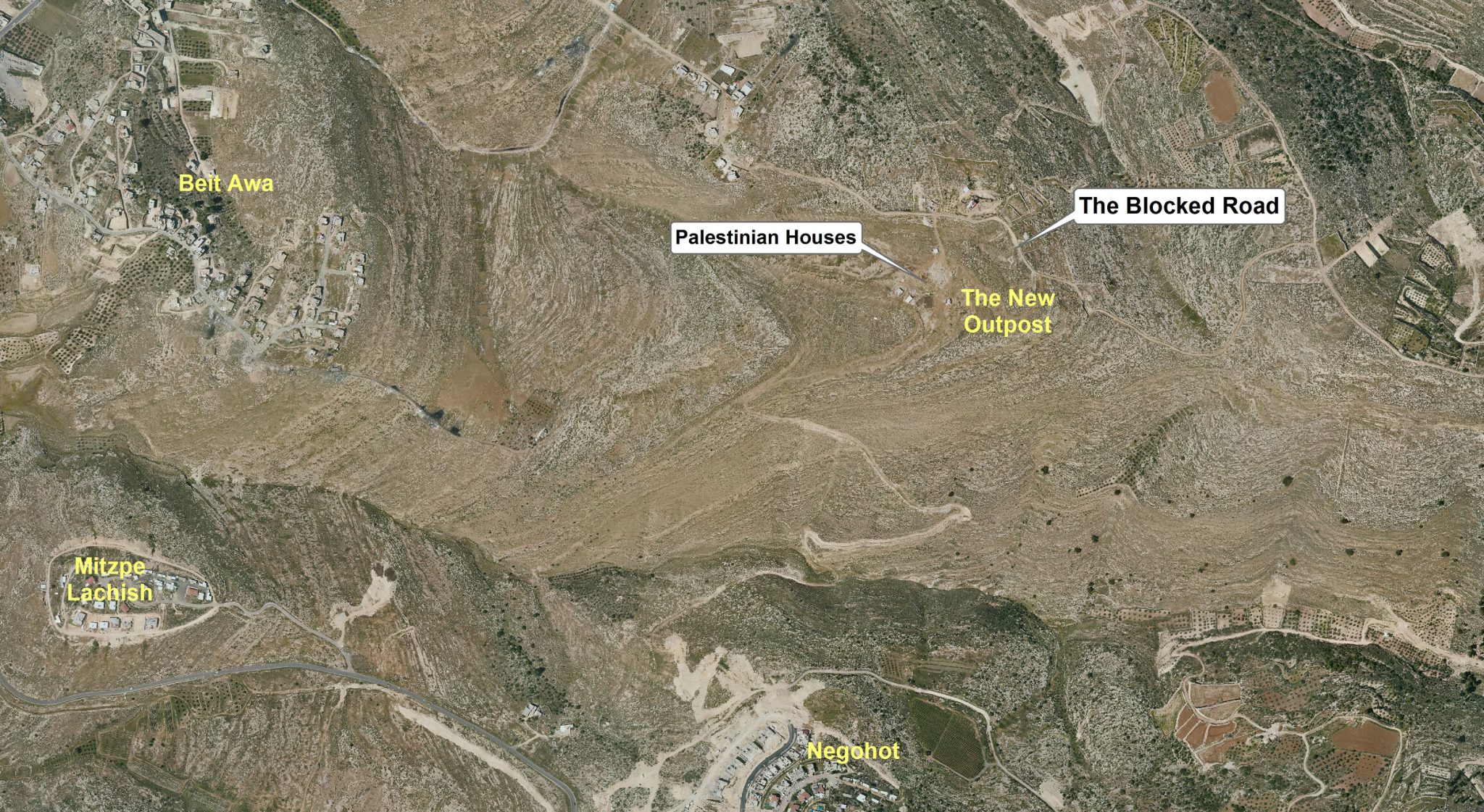 The petition seeks the re-opening of a road that leads to six homes and agricultural land, a road that has been blocked by the UDF since August 2023. Since then, Palestinians who live in those six homes have been forced to walk several hundred meters uphill with their water, supplies, and food (amongst other challenges posed by the inability to access one’s home and agricultural land by vehicle). Meanwhile, since October 7, 2023 settlers have illegally paved at least two new roads between the outpost and the Negohot settlement.
Peace Now said in a statement:
“The establishment of the new outpost has had severe consequences on the lives of Palestinians in the area. The military’s involvement with the settlers, through securing illegal activities and blocking Palestinian roads, is unbearable. Instead of halting the settlers and preventing the establishment of illegal outposts and roads in an area that affects the future of the State of Israel and regional security stability, the IDF is assisting lawbreakers. It is time to put an end to lawlessness in the territories and dismantle the illegal outposts.”
The outpost was established in July 2023 by setters from the nearby Negohot outpost. Settlers initially took over dozens of dunams of land, bulldozing and clearing th area with heavy machinery and assistance from the IDF. Since then, the outpost has evolved and grown to have many structures and a permanent settler presence. These settlers have engaged on violent intimidation and harassment of Palestinians who live and work near the outpost.
With Eyes on Gaza, Four Major Developments Regarding West Bank Antiquity Sites Targeted for Annexation by Israel
Emek Shaveh has raised concerns over recent developments at four different antiquity sites in the West Bank, explaining that these events taken together show how “processes tantamount to the weaponization of heritage in the service of settlement expansion in the Occupied Territories continue unhindered.” Details of the developments are below.
New Outpost in Battir
As FMEP has previously reported, on December 24, 2023 settlers established an illegal outpost on land near the Palestinian village of Battir (a UNESCO World Heritage Site). Emek Shaveh adds, “The new outpost established […] is situated half a kilometer from the village Battir in the core zone of the World Heritage Site. The announcement of plans to expand the Har Gilo settlement in 2022 also remains a threat to the integrity of the World Heritage site.”
Allocation of Funds for Secret “Khirbet Eqed” Site
Emek Shaveh reports that on December 31, 2023 the Knesset’s Finance Committee approved a $3.25 million (NIS 12.25 million) budget for the preservation and development of a site called “Khirbet Eqed,” located in a JNF-established Park (the Ayalon-Canada Park) in the “seam zone” area between the Israeli separation barrier and the 1967 Green Line.
Emek Shaveh explains:
“Khirbet Eqed and its environs has been excavated multiple times by Israeli archaeologists since 1976, mainly by the Civil Administration’s Staff Office for Archaeology (SOA) and Tel Aviv University. Since the construction of the separation wall east of Mavo Horon in the early 2000s, this area had been de-facto annexed both physically and, with the help of the park, also conceptually…The Ayalon-Canada Park and the investment in Khirbet Eqed is an example of a site where the process of annexation has been completed. What began with the expulsion of Palestinian communities in 1967 and was followed by the establishment of a settlement segued into the creation of a park which has been cut off from the West Bank. The latest plan takes this process to its logical conclusion with the development of the archaeological site and tourist attractions, all in service of erasing the greenline. Investment in Khirbet Eqed has the same purpose of entrenching Israeli control and normalizing tourism on Palestinian land like at multiple other sites throughout the West Bank.”
Military Activity in Bani Naim
Over the past week, Emek Shaveh has fielded many reports about increased military activity in the village of Bani Naim, where there are three antiquity sites. Bani Naim is located in Area A of the West Bank as defined by the Oslo Accords, where the IDF does not have authority to operate. Settlers have targeted at least two of these sites, located a bit south of the village, in their lobbying efforts to push the Israeli government to unilaterally seize and “safeguard.”
Government Budget Allocation Funds Settlers’ Antiquity Agenda
Emek Shaveh reports key details on the government’s December 2023 approval and allocation of $19 million (NIS 72 million) for a “Jerusalem and Heritage” program.
The approved budget and later additions include:
- $4.25millino (NIS 16 million) to promote tourism to antiquity sites in the West Bank.
- $8.8million (NIS 33 million) for a project entitled “Strengthening and Branding of Jerusalem’s Historical Basin”.
- $4.25 million (NIS 16 million) for the Shalem Plan C which is focused on the excavation, preservation and development of archaeology in the Historic Basin mainly in the archaeological park of the City of David, located in the Silwan neighborhood of East Jerusalem.
- $670,000 (2.5 million NIS) for the Sebastia plan () aimed at turning the site into a tourist stronghold with a total budget of 32 million NIS.
Knesset Caucus, Settler Leader Promises Gaza Resettlement
In early January 2024, the Knesset “Caucus to Strengthen the Awareness of Israeli Victory” held a meeting to encourage the re-establishment of settlements in Gaza. Led by MK Tzvi Succot, the caucus discussed what “victory” in the context of the current war on Gaza could look like, with applause for nearly every time a speaker mentioned resettlement.
MK Zuccot led the charge, encouraging that:
“At least in the northern Gaza Strip we first have to conquer, annex, destroy all the houses, build neighborhoods – large and expansive neighborhoods, large settlements in that place that will be named after our heroes, after the nation’s heroes who fought there. We will distribute free plots there to the soldiers who fought, to the wounded who fought. This image, and this is the most important thing, of the destroyed Gaza, of Palestine Square that will become Israeli Heroism Square, this image will echo in every home around the world so that everyone will see what happens to those who mess with the people of Israel.”
One of the figures leading the calls for the resettlement of Gaza, is settler leader Daniella Weiss who attended the caucus meeting. Weiss later claimed on X that she is planning a convoy to the northern areas of Gaza on January 11th. Weiss has said that over 1,000 Israelis are ready to move to Gaza, and called for the Israeli government to clear all Palestinians out of Gaza so that the settlers can see the sea. It is unclear at the time of publication if the convoy proceeded.
Bonus Reads
- “Editorial | Arming and Mobilizing Settlers Must Stop to End Violence Against West Bank Palestinians” (Haaretz)
- “Settlers killed a Palestinian teen. Israeli forces didn’t stop it.” (Washington Post)
Welcome to FMEP’s Weekly Settlement Report, covering everything you need to know about Israeli settlement activity this week.
To subscribe to this report, please click here.
November 10, 2023
- Smotrich Calls for West Bank Land Grab To Create “Sterile” Areas Near Settlements
- After 30 Years, Israeli High Court Orders Settlers Off Palestinian Land
- With Settlers Acting as a West Bank Militia, U.S. Transfers 24,000 Rifles to Israel
- On Reestablishing Gaza Settlements
- Bonus Reads
Smotrich Calls for West Bank Land Grab To Create “Sterile” Areas Near Settlements
Bezalel Smotrich, the Israeli Finance Minister and deputy minister in the Defense Ministry who operates as the de facto governor of Area C in the West Bank – wrote a letter to PM Netanyahu and Defense Minister Gallant calling for the establishment of extensive “sterile security zones” (i.e. closed to Palestinians) to form a wide perimeter around settlements and key roads throughout the West Bank. The recommendation is tantamount to a call for unilateral annexation of more West Bank land to the settlements and a proposal for removing Palestinians from their land under the guise of security. This would include seizing actively cultivated agricultural land that is privately owned by Palestinians (ownership which is recognized by Israel).
Smotrich made a point to say that the “sterile security zones” would be used to stop Palestinians from harvesting their olives during peak season (now). Palestinian farmers in the West Bank are already struggling to harvest olives this season due to the near total military shutdown of the West Bank. Smotrich, in his proposal for creating these “sterile” zones around settlements and roads, also argued that the creation of these zones would accomplish “the removal of left-wing [Israeli] anarchist activists who set the area on fire.” Israeli and international activists have long accompanied Palestinians during the olive harvest season in part to offer protection to the farmers posed by settlers and the IDF.
Commenting on Smotrich’s proposal Jan Egeland, head of the Norwegian Refugee Committee, said on X:
“Israel’s Additional Minister of Defence Bezalel Smotrich has called to establish extensive closed military zones around illegal Israeli settlements + along major routes in occupied West Bank, which would prevent Palestinians freely moving & increase risk of forced displacement. In Gaza, we have witnessed the transfer, en masse, of Palestinians without any guarantees of their safety, survival, and eventual return to their homes. Public statements by Israeli officials are also calling for the deportation of millions to Egypt. Israel must not further perpetrate forcible transfer, and should allow the safe return and compensate for damages caused to displaced Palestinians in the West Bank and Gaza according to international law.”
After 30 Years, Israeli High Court Orders Settlers Off Palestinian Land
Haaretz reports that on November 8th, the Israeli High Court ordered settlers to vacate a land in the Jordan Valley that they had been given illegally and improperly by the State over 30 years ago. The judge sharply criticized how the State, which originally seized the privately owned land via a temporary military seizure, proceeded to allocate the privately owned land to the World Zionist Organization. The State was ordered to pay the legal fees of the petitioners and also intimated that the State could be liable to pay for its illegal profit off the land for the past 30 years.
This case dates back to a 1969 military seizure order for a vast tract of land in the Jordan Valley, including a parcel of land privately owned by Palestinians. Instead of canceling the seizure order and returning the land to its owners, the state instead gave control over that land to the World Zionist Organization. Then, on the 1980s, the World Zionist Organization allocated the land to settlers without any documentation of either having received control of the land from the government, or documentation allocating the land to the settlers. Since then, settlers have developed the land into profitable date farms. In 2018, several Palestinian landowners have filed a petition with the High Court of Justice to have the settlers removed from the area and the land returned to their control. In a contentious court hearing in June 2022, in which the State conceded that it does not know how or why the settlers were allocated the land in the first place, High Court Justice Esther Hayut told the State lawyer: “Given that you cannot explain how the land was given to those to whom it was given, does that give them the right to remain there forever?”
With Settlers Acting as a West Bank Militia, U.S. Transfers 24,000 Rifles to Israel
On November 7th, a coalition of 26 Palestinian human rights groups appealed to the third state parties to press for an immediate intervention to protect Palestinians in the West Bank and Jerusalem from state-backed settler violence. On the day the letter was sent, OCHA reported that Israeli settlers killed at least nine Palestinians, including at least one child, and injured 62. In addition, at least 905 Palestinians, including 356 children, have been forcibly displaced because of Israeli settler violence and access and movement restrictions. These numbers continue to grow. Since the Oct. 7th Hamas attack, there has been an average of seven settler attacks a day and the scale of displacement has escalated sharply, with nearly four times as many West Bank communities depopulated in the past month as in the preceding year and eight months combined.
In a rare public criticism, President Biden and the U.S. Secretary of State Blinken have both raised concern about the scale of settler violence in the West Bank in the wake of the October 7th massacre by Hamas and Israel’s war on Gaza. On Oct. 25 President Biden warned that settler violence was “pouring gasoline on fire,” and Secretary Blinken raised concerns while in Israel on November 3rd.
Nonetheless, the Biden Administration finalized the sale of 24,000 assault rifles to Israel despite the settler violence and loosened gun regulations in Israel. Before the sale was complete, the U.S. reportedly received assurances from the Netanyahu government that these particular guns will not end up in the hands of settlers policing Palestinians in the West Bank. The government said these guns would arm Israeli civilian response teams that operate within sovereign Israeli territory, under control of the Israeli police (which, it should be recalled, are under the control of Security Minister Itamar Ben Gvir).
In the wake of rare public concerns from the U.S. administration, on November 8th, PM Netanyahu convened a meeting with settler leaders during which he was reported to have told them that he would not tolerate a “handful of extremists[settlers]…[who] cause great damage to the State of Israel.”
In a new report on settler violence since Oct 7th, Peace Now writes:
“The war in Gaza has created a new reality where the security system in the West Bank increasingly relies on settlers within the framework of operational activities, becoming more dependent on them. Ideological and violent settlers leverage the war to coerce the military for their own goals of expulsion and harm to Palestinians, even interfering with IDF activities. This blurring of boundaries between the army and civilians, which has always been a significant problem in the Israeli occupation system in the territories, might cause a dire deterioration, potentially leading to the creation of a third front in the West Bank. Meanwhile, amid the war, a group of settlers managed to strengthen their hold over Area C, advocating for the coercive displacement of Palestinians and exacerbating the discriminatory practices and oppression against them in the West Bank. A decisive political decision to evacuate violent outposts not to disrupt security during wartime could prevent numerous attacks. Initiating law enforcement against violent settlers could restrain and deter others. Preventing the conscription of violent settlers into the reserves and the immediate dismissal of reservist soldiers involved in or enabling violence are essential steps, not mandating political decisions”
On Reestablishing Gaza Settlements
Several senior Israeli officials have been publicly proclaiming their hope to reestablish settlements in the Gaza Strip, which were removed by the Israeli government as part of the 2005 Disengagement Plan. In fact, members of Netanyahu’s Likud party have introduced a piece of legislation in the Knesset that would cancel the part of the Disengagement Law that bars Israelis from entering the Gaza Strip.
Amira Hass warns that these statements should be taken seriously, writing in Haaretz:
“As the last 50 years have shown, any single settler’s hallucination should be taken seriously, and treated as a plan of action by the next government, if not the current one. And when the hallucination is built on overt plans for total destruction and mass expulsion, wars are the most suitable ground for its realization.”
Bonus Reads
- ““‘Leave or Die’ An account from a Palestinian in the West Bank” (Slate)
- “Trending: Israeli Soldiers Document and Proudly Post Their Own Abuse of Palestinians” (Haaretz)
- “How a Campaign of Extremist Violence Is Pushing the West Bank to the Brink” (New York Times)
- “Local Construction Firm for Secret US Base in Israel Also Built an Illegal Settlement” (The Intercept)
- “The Gaza-fication of the West Bank” (The New Yorker, interview with Hagai El-Ad)
- “Kathy Hochul’s Israel Trip Bankrolled by Group Funding Illegal Settlements” (The Intercept)