Welcome to FMEP’s Weekly Settlement & Annexation Report. To subscribe to this report, please click here.
April 8, 2021
- Israel Advances Plan to Build New Har Homa E Settlement, In 1st East Jerusalem Settlement Advancements Under Biden
- IDF Helps Settlers Stage Midnight Move-In to Three Buildings in Silwan
- Data Proves Discriminatory Nature of Israel’s West Bank Demolition Policy (Not that it Was In Doubt)
- JNF Expected to Give Final Approval for West Bank Land Purchases
- Bonus Reads
Comments or questions? Email Kristin McCarthy – kmccarthy@fmep.org.
Israel Advances Plan to Build New Har Homa E Settlement, In 1st East Jerusalem Settlement Advancements Under Biden
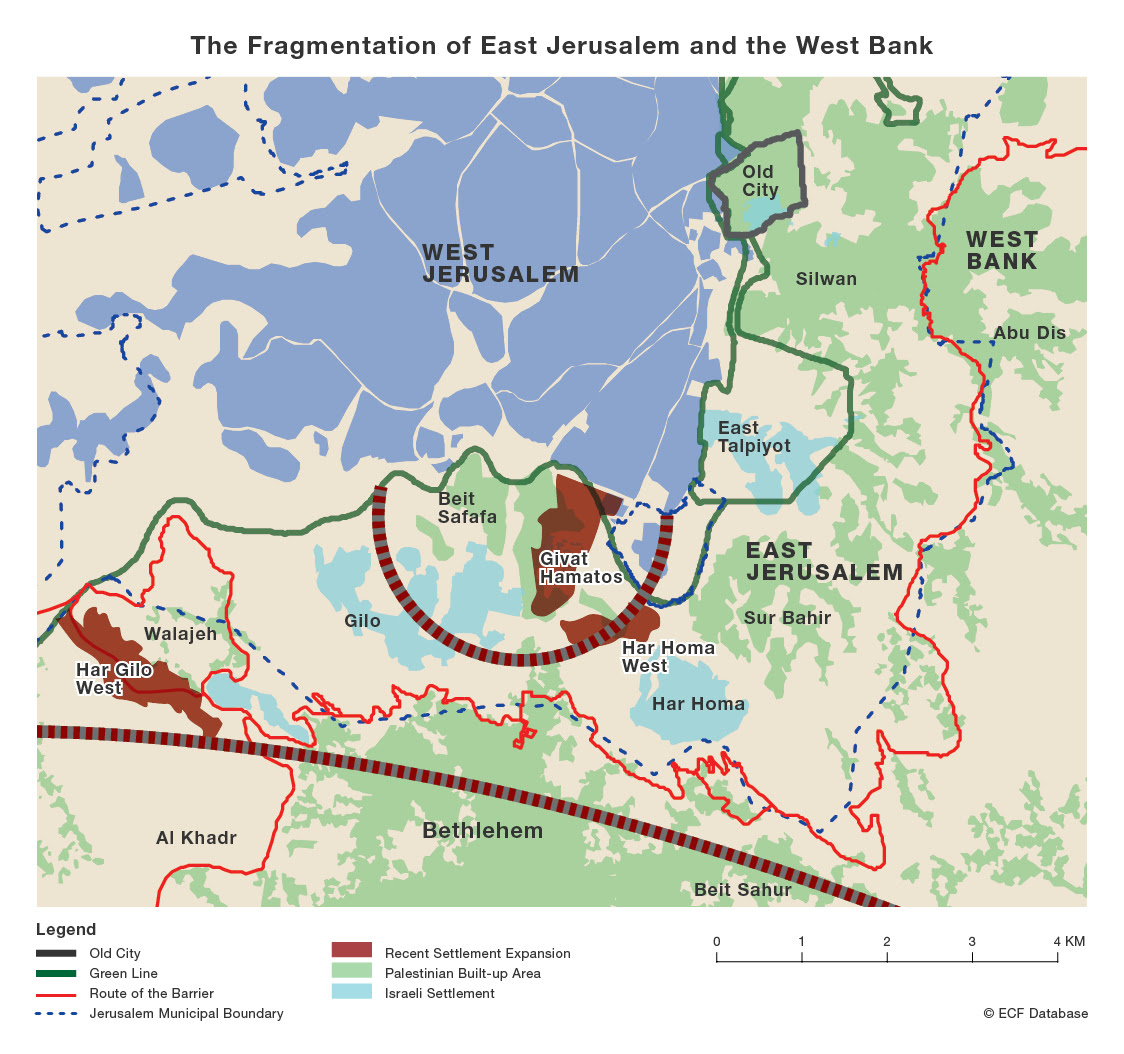 On April 7th the Jerusalem Local Planning Committee advanced a plan to build 540 new units in what is framed as an expansion of the Har Homa settlement in East Jerusalem. However, the new units will be built in an open area – non-contiguous with the current built-up area of Har Homa – between the Har Homa settlement and the site of the planned Givat Hamatos settlement, tenders for which were issued in January 2021. Meaning that the new construction is more properly understood as a new settlement – called Har Homa E (and sometimes called Har Homa West) – and is a significant step towards completing a ring of Israeli settlements on Jerusalem’s southern edge, and encircling the Palestinian neighborhood of Beit Safafa.
Ir Amim explains:
“Along with Givat Hamatos, construction of Har Homa E will serve as another step in linking the existing Har Homa and Gilo neighborhoods/settlements to create an Israeli sealing-off effect along the southern perimeter of East Jerusalem. This will fracture Bethlehem and the southern West Bank from East Jerusalem, while isolating the Palestinian neighborhood of Beit Safafa and depleting the remaining land reserves for further development of the neighborhood. If carried out, these measures will constitute a major obstacle towards the future establishment of a contiguous independent Palestinian state with a capital in East Jerusalem.”
Ir Amim researcher Aviv Tatarsky said in a statement:
“The plan’s advancement is a worrying sign for those who believed that the change in power in the United States would force Israel to restrain settlement construction.”
As of publication of this FMEP update, the Biden Administration has not issued a comment on the advancement of the Har Homa E plan.
Now that the Jerusalem Local Planning Committee has approved the plan, the plan awaits final approval by the Jerusalem District Planning Committee. That committee is scheduled to meet on April 21st. Ir Amim notes that:
“because the land in question is not state land but rather belongs to private Israeli landowners who claim to have purchased it, the plan’s final approval does not require a tendering stage in order for construction to begin.”
The Har Homa E plan provides the constriction of several highrise buildings – two 30-floor towers and three 12-floor buildings – in addition to a large public green space, a new road, spaces designated for future public buildings, and another open space for the preservation of an ancient aqueduct.
IDF Helps Settlers Stage Midnight Move-In to Three Buildings in Silwan
In the pre-dawn hours of April 8th, Israel security forces escorted 15 settler families affiliated with the Ateret Cohanim organization as they moved into three buildings in Silwan, a Palestinian neighborhood in East Jerusalem in the shadow of the Haram Al-Sharif/Temple Mount. The buildings are specifically in the Yeminite quarter of Silwan, where Ateret Cohanim is waging a campaign to take over more and more land and property largely (but not entirely) based on the revival of an old Yemenite land trust.
According to Haaretz, a member of the Palestinian Abu Dihab family, which owned the three buildings, sold them to the settlers; having gained control of the properties, Ateret Cohanim renovated the buildings to accomdate at least 16 total units. The family has issued a statement condemning that member for selling the properties to settlers.
Data Proves Discriminatory Nature of Israel’s West Bank Demolition Policy (Not that it Was In Doubt)
In response to a freedom of information petition filed by two human rights groups – Bimkom and Haqel – the Israeli Civil Administration issued new data that shows exactly how discriminatory Israel’s demolition enforcement is against Palestinians in the West Bank. Out of 187 demolition orders issued by the Civil Administration from 2019-2020, 159 orders (85%) were issued against Palestinian buildings, while just 28 (15%) were issued against settler structures. The discrimination is even greater when taking into account the data on the implementation of these orders. Of the 28 orders issued against Israeli structures, only two-thirds have been carried out (so far); of the 159 orders issued against Palestinians, three-quarters have been carried out (so far).
The data also shows that Israel sharply increased the issuance of expedited demolition orders under Military Order 1797, using this military order for 19 demolitions in 2019, and for 134 demolitions in 2020. This data underscores the discriminatory nature of Israel’s policy of expedited demolitions of new structures under Military Order 1797, and the discriminatory manner in which Israel is exercising this extraordinary new power (that it granted to itself in 2018). As a reminder: Military Order 1797 empowers Israel to summarily demolish buildings within 96 hours of the issuance of a demolition order, and all but eliminates any legal recourse for Palestinians.
Alon Cohen Lipshitz, who coordinates Bimkom’s activity in Area C, said:
“[Israel] is failing in its job to provide protection to protected communities and residents, and undermines basic human rights, like the right to a roof over one’s head. Tens of thousands of demolition orders and thousands of demolitions aren’t enough for the regime; it chooses to circumvent the law by creating new orders that allow homes to be demolished within a few days, without allowing for the defense of rights. This selective enforcement does deep and broad harm almost exclusively to the most sensitive Palestinian population – the shepherding community.”
JNF Expected to Give Final Approval for West Bank Land Purchases
In a vote scheduled for April 11th, the Board of the Jewish National Fund (known as the JNF-KKL in Israel) is expected to approve the adoption of a policy to officially make the purchase of land in the West Bank a part of the group’s mission. Ahead of the formal vote, a coalition of liberal Zionist groups threatened to boycott the JNF if it formalizes its policy on set. The letter was signed by 24 organizations and 7,000 individuals.
As FMEP has previously reported, if this new policy is indeed adopted, the JNF will officially make financing the Israeli settlement enterprise a loud-and-proud part of its mission. This would be a shift not so much in policy as in public relations, given that the JNF has long worked in support of settlements, but until this point has left settlement-related activities deliberately obscured. The shift in approach that will culminate in Sunday’s vote is in line with the JNF’s new right-wing, settler leadership (which effectively took control of the organization in October 2020).
According to a February 2021 report, the proposed JNF policy – which could see hundreds of millions of dollars invested in the settlement enterprise – includes directives for the organization to purchase land subject to the following conditions:
- The land is privately owned by Palestinians.
- The land will be used to expand existing settlements, not build new ones (this presumptively includes purchasing land to build outposts).
- The land is in Area C (some 60% of the West Bank), not land in Areas A and B.
- The land is located inside of a settlement’s jurisdiction or adjacent to it.
- Focus will be on purchasing land in areas identified as a priority, including the Jordan Valley, the Etzion settlement bloc, areas around Jerusalem, the Binyamin region north of Jerusalem, the South Hebron Hills, and areas adjacent to the pre-1967 border. The draft specifically says that no land shall be purchased in the Nablus or Jenin areas.
- Foreign donations will only be used to purchase land in the West Bank if the laws of the donor’s country permit it.
Bonus Reads
- “PA urges action against Israel settlements“ (MEMO)
- “Liberal Jewish groups threaten boycott of JNF-KKL if it buys West Bank land” (The Forward)
- “Palestinian village becomes prison for residents” (Al-Monitor)
Welcome to FMEP’s Weekly Settlement Report, covering everything you need to know about Israeli settlement activity this week.
To subscribe to this report, please click here.
May 29, 2020
- In a Legal First, Peace Now Submits Petition Against Allocation of Land for Purpose of Building the Givat Eitam/E-2 Settlement
- Master Plan for Har Homa-E Settlement Gets Final Approved
- Israel Advancing Plans for a New Settlement Industrial Zone
- Some Settlers Lobby To Change Trump Plan as Annexation Map Becomes Clearer
- Netanyahu Says He Will Not Delay Annexation & Fights Off Criticism of Settlers
- Settler Leader Blames Yesha Council Head for Delaying Annexation
- USMEP Briefing Paper on Annexation
- Bonus Reads
Comments/Questions? Email Kristin McCarthy(kmccarthy@fmep.org).
In a Legal First, Peace Now Submits Petition Against Allocation of Land for Purpose of Building the Givat Eitam/E-2 Settlement
On May 21st, Peace Now formally submitted a petition to challenge Israel’s plan to build the Givat Eitam/E-2 settlement on a hilltop known to Palestinians as A-Nahle, located just south of Bethlehem. Peace Now has mounted several legal challenges to Israel’s drive to build Givat Eitam/E-2, but this petition is groundbreaking in that it seeks to challenge Israel’s allocation of land for settlement purposes, arguing that Israel is obligated to allocate the land to the Palestinians instead. This is the first time the issue of land allocation is being brought to trial.
There are three main arguments in the petition, Peace Now summarizes:
- The allocation of land to build a settlement contravenes Israel’s duties to protect the land for the local Palestinian population according to international law;
- Allocating land to Israelis over Palestinians is tainted by discrimination since 99.8% of West Bank land allocated since 1967 has been gone primarily to Israeli purposes, and
- The Palestinians’ need for the land in question is far greater than that of the Efrat settlement, as a Peace Now spatial planning analysis confirms. For more on the legal arguments of the appeal, read here.
This petition comes after Peace Now lost a previous effort to overturn Israel’s declaration of the land as “state land” (a move which then made it possible for Israeli to allocate the land for settlement). Attempts to legally stop Israel from building new settlements have typically not continued past this point. One reason for this is that in order to challenge how “state land” is allocated, the petitioner must, in effect, concede that the land in question is legitimately “state land” in the first place — something Palestinians do not concede with respect to land seized by Israel. That makes this petition, which is led by Peace Now along with over a dozen Palestinian landowners, novel.
Commenting on the decision to file the new petition, Peace Now said in a statement:
“The decision to allocate a-Nahla land for a new settlement is illegal, immoral and un-Jewish. Implementing this plan will severely damage not only the Palestinian landowners and the development capacity of the Bethlehem area, but also the ability to reach a future peace agreement and territorial compromise for a future Palestinian state alongside a secure Israel. The land should be allocated for Palestinian development in the region.”
Master Plan for Har Homa-E Settlement Gets Final Approved
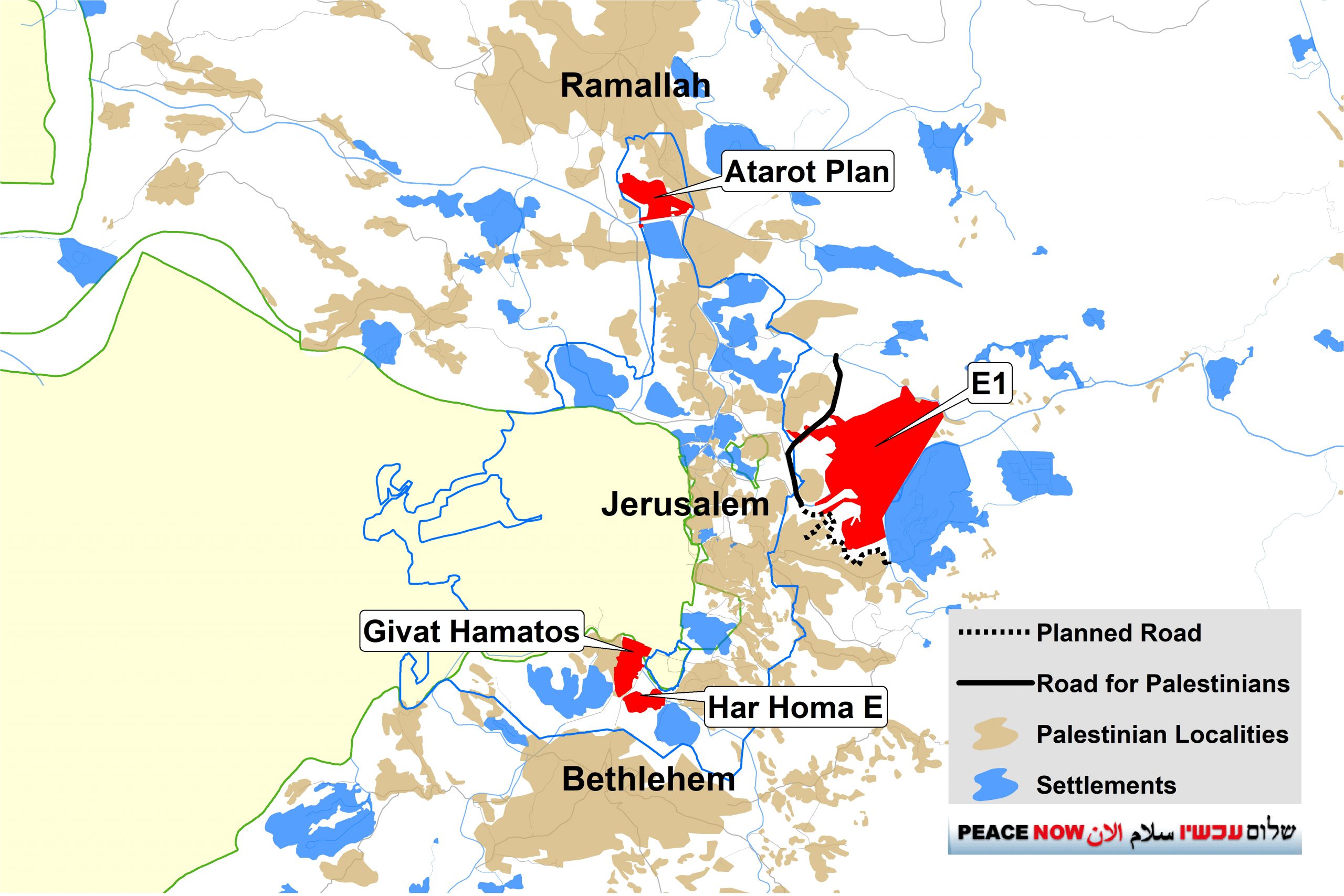
Map by Peace Now
Ir Amim reports that on May 25th the Jerusalem District Committee granted final approval of a master plan that provides for the construction of 2,000 units in the “Har Homa E” settlement (aka Har Homa West). Planners must now submit a detailed outline plan(s) for approval before building can commence; one such plan, for 500 units, is already being advanced through the planning process.
Ir Amim writes:
“Construction in Har Homa E will serve as another step in connecting the existing Gilo and Har Homa neighborhoods/settlements and create a contiguous Israeli built-up area along the southern perimeter of East Jerusalem. This will likewise detach Bethlehem and the southern West Bank from East Jerusalem while isolating the Palestinian neighborhood of Beit Safafa. In line with the new reality created by the Trump Plan and its unilateral recognition of Israeli sovereignty of East Jerusalem, these developments will constitute a major obstacle towards the future establishment of a Palestinian capital in the city and the prospect of a viable two-state framework.”
For further details on the two Har Homa E plans – one of which is a master plan – see Ir Amim’s excellent analysis.
Israel Advancing Plans for a New Settlement Industrial Zone
Haaretz reports that the Israeli Civil Administration is advancing plans to build a new settlement industrial zone – called “Samaritans Gate” by settlers – on land that straddles the Green Line in the northern West Bank. The zone is slated to take over 3,000 dunams (740 acres) of West Bank land to the east of the Israeli city of Kafr Qasem.
In addition to the Palestinians who the new industrial zone will impact, the plan is drawing significant opposition from Israeli environmental groups who are concerned about the impact of the project on the terrain. The zone is slated to be built on a riverbed in what is considered a rare ecological corridor in Israel.
Mor Gilboa, an activist with “Climate for Peace,” said:
“the military government in the territories has for decades created a list of climate blights on the environment. The plan ignores nature the same as it ignores Palestinian rights to these territories which don’t belong to Israel under international law.”
For more information on why settlement industrial zones exploit and harm Palestinians, their land, and their resources, see this brief by Who Profits.
Some Settlers Lobby Against (or for changes to) Trump Plan as Annexation Map Becomes Clearer
Settler leaders as well as their political allies are increasingly vocal in their opposition to the Trump Plan, as details regarding the closely guarded joint mapping process have surfaced in the press. In addition to their resolute opposition to Israel’s acceptance of the even a notion that a Palestinian state can be established under certain conditions in the future, the settlers have focused in on the amount of land that the Trump Plan permits (and doesn’t permit) Israel to annex.
In an interview from early May 2020, U.S. Ambassador David Friedman said that the Plan calls for Israel to annex no more than 30% of the West Bank (50% of Area C), which would leave 15 settlements/outpost as enclaves (i.e., Israeli sovereign territory that is outside the Israeli state’s borders, connected only by roads). Settlers have strongly rejected this concept, but have reportedly been frozen out of the joint mapping committee and are failing to find outside avenues of influence.
David Elhayani – the head of the settler Yesha Council and also head of the Jordan Valley Regional Council – told The Times of Israel that the members of the joint U.S.-Israeli mapping committee have refused to meet with the settlers or received their proposed maps, and said that the committee “refuses to be flexible with regard to the map.” Ayelet Shaked (Yamina Party) also expressed frustration with being locked out of the mapping process, telling Army Radio that the mapping team is not letting anyone make any changes to the map originally proposed by the Trump Administration.
Undaunted, the settlers reportedly have drawn up maps outlining three different versions of annexation they say they could accept, since these maps do not leave any Israeli enclaves (as of publication, the settlers’ maps have not been revealed publicly). According to media reports, one version of the map would add 2.5% more land to Israel (amounting to Israeli annexation of a total of 32.5% of the West Bank), a second would add 5% more land to Israel (total of 35%), and a third would add 8.5% more land to Israel (total 38.5%). David Elhayani – the head of the settler Yesha Council and also head of the Jordan Valley Regional Council – said
“In our optimal map, 38.5 percent of the West Bank would be annexed to Israel. This is most of Area C. In our map there is Israeli territorial contiguity and it’s the Palestinians who remain in enclaves.”
Settler leaders and Yamina Party members are making the rounds in the Knesset, using a map to try to convince MKs to oppose the Trump Plan for the reasons discussed above.
Unsurprisingly, the Trump Administration officials are reportedly irritated by the oppositional role that the settler leadership are playing. U.S. officials have reportedly sent messages relaying their frustration over the settlers’ rejection of and ingratitude for the Trump Plan. Those messages also note, reportedly, that the map settlers are using to lobby MKs against the plan is not the final map. Suggesting that the settlers should take what their being offered and after that can ask for more, a U.S. official told Israel Hayom:
“If the settlers don’t want what the administration currently has to offer, they shouldn’t come to us in the future. The expectation was that they see the bigger picture, remember where they were standing in December 2016 (when the United Nations Security Council passed Resolution 2334 that harmed Israel and was spearheaded by the Obama administration), and that they consider where they could be standing four years from now if the Palestinians continue to reject negotiations with Israel.”
The relationship between settlers and the Trump Administration was further inflamed when settler leader Yossi Dagan told the press that U.S. officials were requiring Israel to abandon its claim to the remaining 70% of the West Bank as part of the Trump Plan. Quashing that report (and thereby making clear that the U.S. is not requiring Israel to give up its quest for even more territory in the future), a U.S. official said:
“This is a complete lie and whoever is spreading it is doing great damage to Israel, the US and the Jewish people.”
All that being said, settlers (and their leaders and allies) remain split on the Trump Plan. While the majority (24) of settlement council leaders voted for a Yesha Council resolution critical of the Trump Plan, Efrat settlement head Oded Revivi continues to support the Trump Plan, though he has made it clear that he is advocating for settlers to pocket the gifts Trump is offering, without forfeiting the rest. Revivi is aligned with Ariel settlement leader Eli Shavrio. Dismissing the position of Revivi and Shavrio, one suggested that they have the luxury of living near the Green Line, meaning:
“They don’t have a problem with Palestinians gaining control of transportation routes or enclaves.”
Netanyahu Says He Will Not Delay Annexation & Fights Off Criticism of Settlers
Following the first day of his trial, Israeli Prime Minister Netanyahu told leaders in his Likud faction that he will definitely promote annexation on July 1st, saying “It is a big opportunity and we will not let it pass by…[July is] a goal date in July, and we won’t change it.”
Two days after Bibi’s comments made headlines, Prime Minister-in-waiting Benny Gantz gave an address to his own faction (Blue & White) in which he offered veiled criticism of some of Netanyahu’s other policies, but offered only support for the pursuit of annexation. Gantz said:
“We are currently presented with meaningful windows of opportunity that could improve and even transform the reality in the region across all fronts, including, of course, the American government’s peace plan… [I will work] to ensure the best outcome that will fortify Israel’s security and protect our state and international interests.”
In an interview on May 28th, Netanyahu continued to fight off criticism from settlers and Yamina Party leaders, explaining his position on key points and taking on criticism at length:
“For the first time since the establishment of the state, I’ve managed to secure American recognition [of our sovereignty rights], first on the Golan Heights and in Jerusalem, and then through an agreement that will facilitate American recognition in the areas of our homeland inside Judea and Samaria. These are [US President Donald] Trump’s decisions, and the person who broached these matters with him was me. No one else…Within this package [the Trump Plan] is a historic opportunity for changing the tide of history, which was pointing one way. The whole time. All the diplomatic plans proposed to us in the past asked us to concede swathes of the Land of Israel, return to the 1967 borders and divide Jerusalem. To take in [Palestinian] refugees. This is a reversal. We aren’t the ones being forced to make concessions, rather the Palestinians are.”
Notably, with respect to the criticisms that the Trump Plan permits the possibility of a future Palestinian state, Netanyahu clarified that this should not be mis-understood to mean the Palestinians would ever have an actual state, according to any standard meaning of the term, starting with the fact that such a state would be predicated on Palestinians accepting Israeli security control over the entire West Bank:
“Regardless of negotiations. If they [the Palestinians] see fit to meet and accept about 10 stringent conditions – including Israeli sovereignty west of the Jordan River, preserving a united Jerusalem, refusing to accept refugees, not uprooting Jewish communities, and Israeli sovereignty in large swathes of Judea and Samaria, etc. – the [diplomatic] process will move ahead. They need to acknowledge that we control security in all areas. If they consent to all this, then they will have an entity of their own that President Trump defines as a state. There are those who claim and – an American statesman told me: ‘But Bibi, it won’t be a state.’ I told him, call it what you want. At the heart of the Trump plan are foundations we have only dreamed about. All the things we are being criticized about from the right – and what am I? These are things for which we fought for many long years and we’ve finally achieved them. Then they come with the criticism.”
When asked to address concerns that if/when Israel annexes the Jordan Valley, thousands of Palestinians living there will be granted Israeli citizenship, Netanyahu dispelled the notion altogether, saying:
“They will remain a Palestinian enclave. You’re not annexing Jericho. There’s a cluster or two. You don’t need to apply sovereignty over them, they will remain Palestinian subjects if you will. But security control also applies to these places.”
Israeli human rights lawyer Michael Sfard corrected Netanyahu’s comments, Tweeting:
“The gap between the number of Palestinian communities in the Jordan Valley that the Prime Minister has named (2) and the number of communities that actually exist (47) – represents the number of villages and villagers that with annexation would be displaced from this area forcibly. This is a very small purge.”]
On May 29th, Netanyahu gave yet another interview, in which he was asked if the annexation plan he intends to bring up for a vote as early as July 1 will include the topic of Palestinian statehood, as provided for under the Trump Plan (though, as we’ve repeatedly documented, the Trump Plan does not provite for a real Palestinian state under any standard definition of the term, but rather for semi-autonomous Palestinian islands within an Israel sovereign sea ). Netanyahu responded:
“That subject is separate. A government decision on the matter is not expected.”
Settler Leader Blames Yesha Council Head for Delaying Annexation
In Efrat Mayor Oded Revivi’s telling of what went down in the days leading up to the moment when Netanyahu and Trump stood side by side to unveil the Trump Plan, a late night statement issued by David Elhayani (Yesha Council head) changed history. According to Revivi, the White House had planned to announce that annexation could take place immediately. Instead, as a result of Elhayani’s opposition to the Trump Plan and the controversy his statement triggered, the timeline for annexation was delayed, and the “joint mapping committee” was invented.
The other settler leaders who travelled to Washington with Elhayani and Revivi disagree with the latter’s telling of what happened. Nonetheless, Revivi offers one dramatic, insider’s perspective about the involvement of settler leaders leading up to the unveiling of the Trump Plan.
USMEP Briefing Paper on Annexation
Daniel Levy of the U.S.-Middle East Project has produced a detailed analysis of all the goings-on surrounding annexation, including his own predictions on how a number of key questions will be answered. After assessing the internal politics and options confronting Israeli, American, Palestinian, European, and Arab decision makers, Levy concludes with an important point:
“Israeli impunity is the key driver of the current journey away from peace and equality. Israel’s cost/benefit calculation will need to change to prevent that journey continuing down the same path and to usher us onto the path less travelled. A better way forward would have to challenge that impunity. It would necessitate desisting from the delegitimization and criminalization of sanctioning Israel for its policies or of conditioning various preferential arrangements that Israel enjoys, while guaranteeing the space for legitimate Palestinian political expression and alternative visions for the future (especially as two states becomes ever-less attainable). Open debate and policy options certainly cannot be foreclosed in the service of cheapened and scurrilous accusations of antisemitism.”
Bonus Reads
- “Annexation Is the Israeli Settlers’ Real Estate Dream Come True” (Haaretz)
- “This Will Be the Heavy Price of Annexation for the Israelis” (Haaretz)
- Ex-chief West Bank land inspector planted groves on Palestinian ground” (The Times of Israel)
- “Mixed messages on West Bank sovereignty leaves diplomats flailing” (Jerusalem Post)
- “Can Annexation be Reversed?” (Jerusalem Post)
- “IDF not yet tasked with annexation” (Jerusalem Post)
- “PLO fears Israel could use violence to annex parts of West Bank” (MEMO)
- “Israel Must be Smart about Annexation” (Ynet)