Welcome to FMEP’s Weekly Settlement & Annexation Report. To subscribe to this report, please click here.
May 22, 2026
- WEST BANK: Smotrich Orders Khan Al-Ahmar Demolition; Knesset Fast-Tracks Annexation-via-Archaeology; Smotrich Leads Settlers to Joseph’s Tomb
- EAST JERUSALEM: Flag March and Related Government Action
- STATE-BACKED SETTLER TERRORISM: EU Sanctions
- BONUS READS
WEST BANK
Smotrich Orders Khan al-Ahmar Cleared, as E-1 Plan Advances
On May 19th, Israeli Finance Minister Bezalel Smotrich announced that he had ordered preparations for the forcible displacement and demolition of the Khan al-Ahmar, the bedouin village located just east of Jerusalem in an area that needs to be cleared in order for the construction of the E-1 settlement. The destruction of the community is expected to move forward in the coming days, as the publication of tenders for the construction of the E-1 settlements is scheduled for June 1st and bids will close on June 6th.
Amnesty International says that, if implemented, the forcible transfer of Khan al-Ahmar is a war crime. Smotrich said he issued the order after the International Criminal Court notified him that it was prepared to issue an arrest warrant against him, along with National Security Minister Ben Gvir, Settlement Minister Orit Strock, and two IDF officials.
The E-1 settlement will see the construction of 3,401 new settlement units on a site located northeast of Jerusalem that is home to several Palestinian bedouin communities, comprising 3,000 people, including about 300 residents of Khan al-Ahmar. The residents of Khan al-Ahmar have lived and worked on this land since the 1950s – when the community was forced to leave their land in the Negev during the 1948 war. There has been a decades long drama over the Israeli government’s plans to construct the E-1 settlement, which has long been held as a red-line for Israel that the international community had been willing to step up to maintain.
Terrestrial Jerusalem’s Danny Seidemann explains:
“Why Khan al-Ahmar? Israel has delineated the area under its exclusive control in the occupied West Bank between Jerusalem and the Jordan River Valley. It has consolidated its hold by large and medium-sized settlements, and “illegal” outposts. It has neutralized the Palestinian presence, and has seamlessly integrated the area into pre-1967. Multi-lane highways, tunnels, and bridges have erased the Green Line.
There is little doubt that this reality is tantamount to de facto annexation.If that be so, why is Israel so obsessed with the displacement of the few hundred
Bedouin of Khan al-Ahmar that it is willing to bear universal opprobrium in order to evacuate the hamlet?
The answer is simple: because Khan al-Ahmar and similar Bedouin encampments are the final obstacle standing in the way of de jure annexation.
In 1967, Israel annexed East Jerusalem. It did so without extending Israeli citizenship to the Palestinians residing in the annexed areas. The Palestinians of East Jerusalem enjoy certain personal entitlements, but no political rights.”
Balasan Initiative explains:
“The evacuation of Khan Al-Ahmar violates the International Criminal Law (ICL) and International Humanitarian Law (IHL), which prohibit the forcible transfer of protected persons from territory under occupation…particularly in light of the retaliatory intentions of Smotrich following the ICC arrest warrant proceedings, the planned evacuation of Khan Al-Ahmar remains unlawful, unjustified, and incompatible with international humanitarian law.
Hence, alongside the humanitarian consequences that would result from the demolition of the village and the forcible displacement of its residents, the destruction of Khan Al-Ahmar must also be understood within the broader framework of territorial fragmentation and settlement expansion in the occupied Palestinian territory. The village’s strategic location within the E-1 corridor renders its removal politically and geographically significant, as it would facilitate the territorial linkage between Ma’ale Adumim and Jerusalem while further isolating East Jerusalem from the remainder of the West Bank. Such measures undermine the contiguity and viability of a future Palestinian state and reinforce irreversible demographic and geographic changes on the ground.”
Peace Now said in a statement:
“Minister Smotrich seeks to take revenge on The Hague and the international community at the expense of one of the most vulnerable communities, which for years has struggled simply for the right to live on the small piece of land in its possession. The expulsion of Khan al-Ahmar is part of a broader government plan to take control of the entire central West Bank area, build in E1, and remove all Palestinian communities from the region. This is a cynical and destructive plan that could devastate the prospects for future peace and a resolution of the conflict, as part of Smotrich and his allies’ annexation agenda.”
Knesset Fast-Tracks Annexation-via-Archaeology
On May 20th, the Israeli Knesset passed a bill allocating $86 million (NIS 250 million) for developing archaeological and heritage sites across the West Bank. In addition to this huge budget investment, on May 11th the Knesset began fast-tracking a separate bill that would outright annex heritage, antiquities, and archaeological sites to Israel by bringing them under direct Israeli civilian control. That bill is being finalized by the relevant Knesset Committee and expected to be ready for its second and third readings and vote on Sunday, May 24th. For further information on the bill, see this detailed paper opposing the bill by Emek Shaveh.
If approved, the annexation bill will create a new Israeli civilian authority under the Heritage Ministry given exclusive authority to develop and manage West Bank heritage sites, taking those authorities away from the Israeli Defense Ministry. The new body in the Heritage Ministry would have the power to acquire or expropriate land for the purpose of protecting, conserving, researching, and developing heritage sites. In an added absurdity, Heritage Minister Amihai Eliyahu recently announced he has selected Esther Schreiber as the next head of the Israel Antiquities Authority (IAA), that is in despite of the fact Schreiber has no background in archaeology and lacks experience in managing large public institutions.
Emek Shaveh said:
“The political appointment at the Israel Antiquities Authority and the proposed Heritage Authority Law for the West Bank are two sides of the same coin: transforming archaeology from a tool of research into an instrument of propaganda in the service of annexation, dispossession, and a messianic ideology.”
The Haaretz Editorial Board writes:
“The proposed new agency will be another tool by which the government will be able to abuse its Palestinian subjects in the West Bank (it will have the authority to expropriate land) and to harness archaeology to the needs of the settlers. The bill also amounts to annexation, in violation of international law. The bill, like Schreiber’s appointment, was advanced despite overwhelming opposition from Israel’s archaeological community, which already faces boycotts abroad that hinder its operation. It can only be hoped that the government is replaced before Eliyahu & Co. also manage to destroy Israeli archaeology.”
Smotrich Leads Settler Raid on Joseph’s Tomb
On May 14th Finance Minister Smotrich led a group of over 100 settlers on a trip to Joseph’s Tomb for morning prayers, the heritage site in Nablus as Israel expands the scope and scale of Israeli presence there. Smotrich promised to control the site and said during his visit:
“Our presence here at Joseph’s Tomb, in broad daylight, is a clear statement: the people of Israel are returning home to all parts of their land…Joseph’s Tomb is living testimony to the inseparable connection between the people of Israel and their land.”
As a reminder, Joseph’s Tomb is a holy site for Jews and cultural site for Palestinians, located in the heart of Nablus. The tomb is located within Area A of the West Bank (where Israel does not, under the Oslo Accords, have direct control). However, Joseph’s Tomb is one of two sites in Area A which the Oslo Accords stipulate are under the control of the Israeli military. As such, it has been a perennial flashpoint, largely due to deliberately provocative actions by settlers.
In January 2026, Israeli Defense Minister Katz agreed to allow settlers to perform morning prayers at Joseph’s Tomb in Nablus for the first time in 25 years, and on January 29th, Israeli ministers and settler leaders led a group of 1,500 people under a heavy security escort to Joseph’s Tomb. In 2000 during the Second Intifada, Israeli officials restricted Israeli access to the site to nighttime hours in hopes of minimizing conflict.
EAST JERUSALEM
Israel to Expropriate Land/Homes/Business on Chain Gate Road
Ir Amim reports that on May 17th – Jerusalem Day – the Israeli government approved the establishment of an inter-ministerial committee tasked with advancing land expropriation of dozens of properties along the Chain Gate road in the Old City. The move would displace generations-old Palestinian family homes and businesses in the Muslim Quarter. Ir Amim explains:
“The decision refers to a 1968 land expropriation order for an area within Jerusalem’s Old City, which served as the basis for the expropriation of properties in the Jewish Quarter and the displacement of its Palestinian residents at the time. According to the new government decision, the expropriation order issued 58 years ago was never fully implemented. This specifically concerns properties along the southern side of Chain Gate Street (Bab al-Silsila Street), a strategic and central corridor along the seamline between the Muslim and Jewish Quarters that connects Jaffa Gate directly to Al-Aqsa/Temple Mount. See exaction location on map below.
The government now appears poised to advance the expropriation of these properties under a decades-old order, with the new committee tasked with devising the mechanism for its implementation. The committee has been instructed to complete an action plan within 12 months.”
The Flag March
As in years past, thousands of radical Israeli settlers staged a violent rampage – the “Flag March” – through the Old City on Jerusalem Day, bringing destruction and chaos with them as they attempted to show dominance and control over the city. As usual, the crowds shouted “Death to Arabs” and “May your village burn,” and gangs of young settlers were filmed attacking shopkeepers and one Israeli journalist.
Israel Ministers Smotrich and Ben Gvir joined the parade this year, with Ben Gvir leading a large group into the Al-Aqsa Mosque Compound – waiving the Israeli flag in front of the Dome of the Rock. Ir Amim explained the significance of this event:
“The erosion of the status quo at Al-Aqsa cannot be separated from the Flag March itself. In the lead-up to the march, we warned about the growing influence of Temple movements and the support they receive from organizers and participants alike. Throughout the march, countless shirts and flags called for the construction of a Third Temple — in even greater numbers than in previous years — alongside signs reading: “This is not Al Aqsa, this is the Temple Mount!” and “You wanted a massacre? You’ll get a Nakba!” Meanwhile, in the markets of the Old City, Palestinian shop owners were forced by police to close their businesses to clear the area for marchers. Year after year, the daily lives and livelihoods of Palestinian residents are disrupted and undermined to facilitate the march’s passage through the Damascus Gate plaza and Muslim Quarter.
Throughout the march, racist and violent chants filled the streets, including: “May your village burn,” “May your name be erased,” and “Slaughter Nablus.” Palestinian residents and solidarity activists were assaulted, while shops and property were vandalized — all under heavy police presence and with little meaningful intervention. Many Palestinian residents were forced to remain inside their homes or leave the Old City altogether out of fear of violence from the crowds.
Contrary to the way these events are often portrayed in mainstream coverage, such displays of racism and hatred are not isolated incidents on the margins of the march — they are central to it. They unfold within a crowd that includes not only youth, but also educators and adults, many of whom respond with indifference or outright encouragement. The march is officially recognized by Israel’s Ministry of Education and supported by the Jerusalem Municipality. The deeper issue is not merely the racist slogans or acts of violence, but the march itself: a public display of domination in the heart of the Muslim Quarter, built on the takeover and paralysis of Palestinian public space and reflective of a much broader political reality.”
Bonus Reads on East Jerusalem
- “Palestinians forced to demolish own homes to make way for Israeli theme park” (The Guardian, 5/22/26)
- “Only 7% Approved: Palestinian Building Permits in East Jerusalem Plunge, Freezing Construction” (Haaretz, 5/17/26)
- “Israel to Build Defense Compound on Site of Demolished UNRWA Headquarters in East Jerusalem” (Haaretz, 5/17/26)
- LISTEN: “And I too, Love Jerusalem “: Voices from Al Nakba” (This is Palestine podcast, 5/14/2026)
- “Israel’s trying to expel a whole Palestinian district in East Jerusalem, activists say” (NPR, 5/19/26)
STATE BACKED SETTLER TERRORISM
EU Sanctions Violent Settler Entities & Individuals
On May 11th the European Union announced that it plans to place sanctions on several Israeli settlement organizations, including Amana, Nachala and its leader Daniella Weiss, Hashomer Yosh and its former CEO Avichai Suissa, and Regavim and its Director Meir Deutsch. For background on these organizations, see Peace Now’s reporting.
An EU MP told The Guardian that the decision to sanction these entities and individuals is only a “baby step” after years of deadlock on the action. Ireland, a member of the EU, is going even further and is expected to introduce a bill seeking to limit the trade of goods with Israeli settlements.
In response, Israeli Minister Smotrich called for Israel to annex parts of the West Bank. Ben Gvir called the sanctions antisemitic.
Peace Now said in a statement:
“This is a grave warning sign presented to us by the European Union. The rampant violence of settlers in the West Bank, encouraged and supported by the government, is leading Israel into a moral abyss and casting an indelible stain on the State of Israel. The European Union’s decision is also a call to the Israeli public to open its eyes and see the reality we have created through decades of control and settlement in the occupied territories. It is time to stop the deterioration and begin the long journey toward a political agreement and peace. The first step is stop settlement activity.”
Bonus Reads on Settler Terrorism
- “The State Is Supplanting Settlers as the Driving Force of West Bank Takeover” (Haaretz, 5/18/26)
- “’He Attacked a Tied-up Dog’: Israeli Settler Filmed Abusing Palestinian-owned Dog in West Bank” (Haaretz, 5/16/26)
- “Israeli settlers force Palestinian family to exhume and rebury their father” (Al Jazeera, 5/9/26) and,
- “In the Palestinian Village Where a Man Was Buried Twice in a Day, Residents Are Still Stunned” (Haaertz, 5/16/26)
- “Timeline: How One Palestinian West Bank Community Was Erased” (Haaretz, 5/13/26)
- “They Fled to Safety in Palestinian Territory, Then Settlers Attacked Again” (New York Times, 5/16/26)
BONUS READS
- “Israel’s Gradual Annexation of Southern Syria under the Pretext of Mine Removal” (Syrian Network for Human Rights, 5/17/26)
- “Israeli Right’s Praise of Free Market Capitalism Stops at West Bank Settlements” (Haaretz, 5/18/2026)
- ”Israel’s Real Police Commander Lives in the West Bank Settlement of Kiryat Arba” (Haaretz, 5/12/26)
- “Strangle, Expel, Collapse: The Smotrich Doctrine for Bringing Down the Palestinian Authority” (Haaretz, 5/18/26)
- “The Numbers Behind the ‘Sacred Work’ of Cleansing West Bank Palestinians for Future Jewish Villas” (Haaretz, 5/20/26)
- “Erased: Israeli Settlers’ Brutal War on Palestinian Communities in the West Bank” (Haaretz)
Welcome to FMEP’s Weekly Settlement & Annexation Report. To subscribe to this report, please click here.
April 17, 2026
- WEST BANK: 34 New Settlements
- EAST JERUSALEM: Demolitions and Evictions in Silwan, Eviction in Old City, First Jerusalem Outpost
- STATE-BACKED SETTLER TERRORISM
- BONUS READS
WEST BANK
Unprecedented: Israel Approves 34 New Settlements

This is the largest number of settlements ever approved at one time. Since Netanyahu came back to power in 2022, his government has approved the establishment of 103 settlements. Before 2022, there were 127 official settlements, meaning that over the past 4 years the Netanyahu government has increased the number of settlements by 80%.
According to media reports (the Cabinet has not published official information), the new settlements are located across the entire West Bank. Notably:
- Six new settlements will be established in isolated areas of the northern West Bank encircling the Palestinian city of Jenin. There is not currently any Israeli presence in at least five of these areas, meaning these settlements will bring with them significant new infrastructure and military presence to serve and protect the settlements. When the Israeli Cabinet met to consider and approve the 34 new settlements, its reported that IDF Chief of Staff Lt. Gen. Eyal Zamir warned the lawmakers that the IDF does not have enough manpower to meet the needs posed by 34 new settlements, and that the IDF could potentially collapse.
- Seven new settlements are slated for the Jordan Valley
- Six new settlements in the South Hebron Hills area, 3 of which are slated for firing zones.
- 8 of the new settlements will be built on land that Israel recognizes as privately owned by Palestinians.
- Only 15 of the settlements are slated to be built on land that Israel has declared “state land,” meaning that eleven settlements will be built on land without clear legal status.
- All of the new settlements are located in Area C.
Peace Now said in a statement:
“The government has gone into a frenzy ahead of the elections, seeking to create as many facts on the ground as possible and leave Israel with scorched earth. Today it is already clear to everyone—and the IDF emphasizes this again and again—that the establishment of settlements harms security, places an abnormal burden on the IDF, and undermines the possibility of resolving the conflict and achieving any future security and peace.”
Israeli settlement expert Shaul Arieli posted on X:
“…32 of the 34 settlements are planned outside the route of the existing security barrier. This exposes the gap between the security rationale long presented to the public and the reality on the ground. If the barrier was built to ensure security, why insist on expanding settlement activity beyond it? The answer is clear: ideology, not security, lies at the heart of this policy. It should also be emphasized that these locations remain approximate, as no official map has been published and no final coordinates have been determined. This ambiguity is hardly incidental; it enables the advancement of far-reaching policies away from public scrutiny, avoiding real-time criticism.”
EAST JERUSALEM
Ethnic Cleansing of Silwan Continues with Demolitions and Evictions
On March 30th, Israel demolished four Palestinian buildings in the Al-Bustan section of Silwan – displacing 16 people and damaging other houses in the area. During the demolitions, Israeli inspectors said 10 more demolitions will happen in the coming weeks, and another 30 demolitions are planned for later this year. That would conclude the demolition of the entire neighborhood; Israel plans to build a settler-run archaeological park called “King’s Garden” on the ruins of Palestinian homes.
Ir Amim writes:
“These expulsions are part of an unprecedented escalation in forced displacement from Silwan that is tantamount to forcible transfer and involves multiple state institutions and entities working in collusion with settler groups and reinforced by a complicit judiciary. The amount of resources being allocated and deployed to carry out these measures during an ongoing war underscores the Israeli government’s resolve to exploit the circumstances to accelerate forcible transfer and solidify an irreversible apartheid reality. As detailed in a forthcoming Ir Amim report, a web of state and local authorities, statutory bodies, and laws converge into a single coordinated, multi-layered system of state-orchestrated dispossession and displacement of Palestinians in East Jerusalem, in flagrant violation of international law.”
In a report on Silwan, B’Tselem writes:
“Silwan lies within what is also known as the Holy Basin, which includes the Muslim and Christian quarters of the Old City, Sheikh Jarrah, aTur (Mount of Olives), Wadi alJoz, Ras al‘Amud and Jabal alMukabber. Due to its geographic location, Silwan is rich in archaeological and historical sites, which Israel uses to justify planning and zoning policies that restrict Palestinian development and promote Israeli control in the area. Declaring land as a national park, archaeological site or nature reserve serves, in practice, as a tool for dispossessing Palestinian residents of their land. Moreover, the development of these areas as heritage sites is carried out in close cooperation with far-right civil society organizations, particularly Ateret Cohanim and Elad. This joint effort serves a clear political objective: creating a Jewish strip of territory that severs the contiguity of Palestinian neighborhoods in East Jerusalem and cuts them off from the rest of the West Bank.”
First Jerusalem-Area Outpost
Settlers have erected the first ever outpost within Israel’s expanded municipal borders of Jerusalem, on lands between the bedouin village of Nu’uman and Umm Tuba.
Haaretz reports the settlers behind the new outpost are a group of teenagers, and while the outpost is currently one large tent the settlers have begun clearing roads. These settlers have already established a pattern of violence, and have launched at least one attac on nearby Palestinian villages – after which the IDF arrested four Palestinians and zero settlers. The settlers also attack Palestinians who have approached their outpost hilltop. Their violent presence has already limited the ability of Palestinians to graze their livestock in the area.
Eviction of Elderly Family in the Old City
The Jerusalem Magistrate Court has ruled that 12 elderly members of the Palestinian Basha family must vacate their home in the Old City, where their family has lived since the 1930s, by April 26th. The State of Israel initiated the eviction case in 2018, arguing that the property belongs to a Jewish religious endowment. The state filed the lawsuit in cooperation with the Ateret Cohanim settler organization.
Mufid Basha told Haaretz: “We have nowhere to go. This is where I was born, and so were all my siblings.”
Peace Now said in a statement:
“This is an injustice that cries out to heaven. While hundreds of thousands of Israelis live securely in properties that belonged to Palestinians before 1948, the law in East Jerusalem allows Palestinians to be dispossessed of homes that belonged to Jews before 1948. The government has established a mechanism for the dispossession and expulsion of Palestinians in East Jerusalem, and the General Custodian, a governmental body, has become a central executive arm of this policy. In addition to dozens of eviction lawsuits filed in recent years against Palestinians, the Custodian has also initiated and advanced plans for new settlements within Palestinian neighborhoods in Jerusalem.”
STATE-BACKED SETTLER TERRORISM
State-backed settler terrorism has continued at an alarming rate of 10 incidents per day since the start of the Israeli-U.S. war on Iran. Key incidents over the past three weeks include:
- Tayasir: On April 9th settlers attacked the Palestinian village of Tayasir,resulting in the murder of one Palestinian, Alaa Khaled Sbaih. This deadly attack is the latest in a string of settler attacks on Tayasir, with settlers injuring Palestinians and setting homes, vehicles, and buildings on fire. Settlers attacked a CNN crew who was documenting their attacks on Tayasir. On April 1st, before the murder of Sbaih, eight families from Tayasir decided to leave their homes and village under the coercive threat of settler violence.
- Deir Jarir: Settles attacked the Palestinian village of Deir Jarir on April 11th, opening fire on Palestinians who attempted to deter them. One Palestinian, Ali Majed Hamadneh (23), was killed by settler fire as he ran away from the settlers.
Further reading on settler terrorism:
- “Israeli Settler Violence: A Strategy to Displace Palestinians from their Land” (Arab Center DC, 4/10/2026)
- “After uprooting Palestinian hamlets, extremist settlers set sights on purge of entire West Bank” (The Times of Israel, 3/31/2026)
- “A strategy ‘to make life intolerable’: Israeli settlers are driving Christians out of West Bank” (The Guardian, 4/5/2026)
- “Political Pressure on IDF High Command Hampers Enforcement Against Settler Violence, Source Says” (Haaretz, 3/31/2026)
- “It’s Time for Trump to Understand: Israel’s Government Won’t Stop Jewish Terror in the West Bank” (Haaretz Editorial, 3/29/2026)
- “Amir Survived a Settler’s Bullet Once. This Time, They Shot Him Through the Heart – in Front of His Father” (Haaretz, 3/27/2026)
- “Israeli Settler Violence Is So Out of Control Even Western Activists Can’t Stop Them” (Jerusalem Post, 4/16/2026)
BONUS READS
- “After Expelling 120 Families, Israeli Settlers Turn Stream Into Holiday Attraction” (Haaretz, 4/12/2026)
- “On the Brink: The Forced Displacement Crisis Facing Bedouin Communities in the Naqab” (Adalah, March 2026)
- “Israeli policies pose an existential threat to Palestinians in the West Bank. Why isn’t there more resistance?” (Mondoweiss, 3/31/2026)
- “US Sanctions: Criminalizing Palestinian and Global Justice Work” (Al-Shabaka, 3/31/2026)
- “‘It’s Treason’: He’s a Founder of Israel’s Settlements. He’s Horrified by the Rise of Jewish Terror” (Haaretz, 4/9/2026)
- “No permit, no work, no future: inside the lives of West Bank workers crushed by Israel’s labor ban” (Mondoweiss, 4/16/2026)
Welcome to FMEP’s Weekly Settlement & Annexation Report. To subscribe to this report, please click here.
January 23, 2026
- Greater Jerusalem: Impending Eviction in Muslim Quarter; Israel Demolishes UNRWA Headquarters
- Settlement & Outpost Construction: “State Land” Declaration; Settlers Celebrate Yatziv Settlement
- Settler Terrorism
- Israeli Government Policy
- Bonus Reads
Greater Jerusalem
Impending Eviction in Muslim Quarter
Ir Amim reports the impending eviction of the Basha family (13 people in six households) from their homes in the Muslim Quarter of the Old City of Jerusalem. Ir Amim explains:
“According to lawsuit filings, the building was purchased approximately 100 years ago by Jews and later registered under a Jewish trust known as Torat Chaim. The Basha family does not dispute prior Jewish ownership but maintains that the property was purchased by their family from the original Jewish owners. In support of their claims, they submitted evidence and noted that although the trust retrieved a nearby building in the Muslim Quarter, it never asserted ownership rights over their property. Despite this, the Israeli courts have systematically ruled against them and ordered their eviction.”
Israel Demolishes UNRWA Headquarters in East Jerusalem
Israel demolished UNRWA buildings near Sheikh Jarrah in annexed East Jerusalem, and is expected to initiate planning for a new 1,400-unit settlement neighborhood there. See reporting:
- “Israel Razed UNRWA’s East Jerusalem HQ, Now It’s Planning to Build 1,400 Housing Units on the Site” (Haaretz, 1/20/26)
- “Israel demolishes UNRWA’s East Jerusalem headquarters; UN agency: ‘Unprecedented attack’” (The Times of Israel, 1/20/26)
- “Israel demolishes buildings in UN Palestinian agency’s East Jerusalem compound” (Reuters, 1/20/26)
Israel is further threatening to seize UNRWA assets in the West Bank, see:
- “UNRWA school in West Bank city set to be closed by Israel within days, agency says” (The Times of Israel, 1/23/26)
- “West Bank Education Centre Could Close in Days Due to Israeli Seizure Threat, Says UNRWA” (Haaretz, 1/23/26)
Settlement & Outpost Construction
“State Land” Declaration Near Qalqilya Advances New “Dorot” Settlement Plan
Peace Now reports the Israeli Civil Administration issued a “state land” east of Qalqilya, paving the way, possibly, for the construction of a massive new settlement in the area. Peace Now reports:
“The declaration complements an initiative by private Israeli developers who claim to have succeeded in purchasing about 200 dunams from Palestinians in the area and to be in the process of acquiring an additional 400 dunams. Together with the privately purchased plots, the newly declared “state land” could be used by the government to establish a new settlement in an area that constitutes the only remaining contiguous Palestinian territorial stretch east of Qalqilya.”
Near Bethlehem, Settlers Celebrate Speedy Outpost Legalization
The Times of Israel reports that settlers held a celebration of the sudden legalization of an outpost – called “Yatziv” meaning “stable” – adjacent to Beit Sahour, near Bethlehem. Israeli Minister Bezalel Smotrich attended the ceremony and said:
“We are standing stable here in Israel…We’re going to be here forever. We will never establish a Palestinian state here.”
Settler Terrorism
- Settlers raided a quarry Urif, near Nablus, setting vehicles and buildings on fire. The attack was caught on film.
- Settlers led a deadly attack on the bedouin village near Mukhmas, near Ramallah, setting fire to multiple tents and buildings. Settlers also beat residents and international volunteers. Four people were injured, eight homes and two vehicles were set on fire. Footage from the village during the attack is harrowing.
- More:
Israeli Government Policy
- “Israel Allocates $160M for Public Transport Security, Most Will Go to West Bank” (Haaretz, 1/23/26)
- “In the Knesset, Lawmakers Salute the Lawless Settlers Who Shape Israel’s Fate” (Haaretz, 1/19/26)
- “Israeli minister approves gun licences for 18 illegal West Bank settlements” (Al Jazeera, 1/22/26)
Bonus Reads
- “West Bank Monthly Snapshot – Casualties, Property Damage and Displacement | December 2025” (UN OCHA, 1/21/26)
- “Living Hell: The Israeli Prison System as a Network of Torture Camps” (B’Tselem, February 2026)
Welcome to FMEP’s Weekly Settlement Report, covering everything you need to know about Israeli settlement activity this week.
To subscribe to this report, please click here.
July 26, 2024
- Israeli Army Seizes Key Area of Sebastia Archaeological Site
- Family in Old City Faces Dispossession
- First Demolition in Al-Walajah Area C Could be Sign of More to Come
- Peace Now: In 2023, Israeli Government Funded 101 Illegal Outposts
- Israeli Human Rights Groups Publish Joint “State of the Occupation” Report
- Bonus Reads
Israeli Army Seizes Key Area of Sebastia Archaeological Site
Seizure Of Sebastia Summit 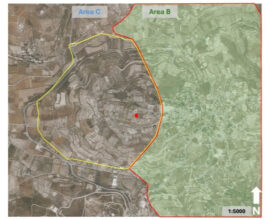 Emek Shaveh reports that on July 10th the Israeli army issued an order seizing land at the summit of the Sebastia archeological site in the northern West Bank. The dot of land (1.3 dunams / .3 acres) is surrounded by the Palestinian village of Sebastia in Area C of the West Bank. Emek Shaveh reports that the IDF is likely to set up a military post on the small area, and erect an Israeli flag at the highest point.
This seizure comes over one year after the Israeli government passed a $9 million (NIS 32 million) plan designed to impose Israeli control over the site both logistically and in the narrative about the site’s history. Emek Shaveh explains:
“the government wants to turn the site into an ‘anchor site’ for tourists which would emphasise Jewish history and Jewish rights to the site. The plan, designed to complete the separation of the acropolis from the village and divert tourism away from the village itself, also threatens the Outstanding Universal Values attributed to the site by the State of Palestine and international experts in the field of heritage. “
Settlers have been openly agitating for Israel to assert control over the archaeological site in Sebastia for years, and the settler Samaria Regional Council organizes regular tours to the site. To secure the settlers’ visits, the IDF shuts down the town of Sebastia, closing Palestinian streets and businesses.
As in other cases across the West Bank, settlers allege that Palestinians are damaging the Sebastia site and that the Israeli government needs to intervene. In 2021 amidst intensifying settler efforts related to the site, the Palestinian Foreign Ministry called on UNESCO to “protect all Palestinian archaeological and religious sites from Israeli violations, attacks and falsifications.” The archaeological site of Sebastia is on the tentative list of World Heritage sites in Palestine.
Family in Old City Faces Dispossession
Ir Amim reports that the Palestinian Quastiro family who has been running a coffee shop (al-Musrara Cafe) located near the Old City of Jerusalem is facing imminent dispossession of their business at the behest of of the Israeli Custodian General, the government body which can “reclaim” buildings that were owned by Jews prior to 1948.
The coffee shop is located on the popular al-Musrara Street, which leads from the Damascus Gate to the Old City towards West Jerusalem Jerusalem. Ir Amim explains “the strategic location has made properties there a target of settler takeover, and a few settler families are already living in some of the residential units in the area….The pretext under which the General Custodian is attempting to evict the family could suggest intent on renting or handing over the property to an Israeli settler organization.”
First Demolition in Al-Walajah Area C Could be Sign of More to Come
Ir Amim reports that on July 22nd Israeli forces demolished the home of the Palestinian Rabah family (12 individuals) in the village of Al-Walaja, located on the southern border of Jerusalem (partially within Israeli’s expanded municipality borders).
Ir Amim explains the significance of this demolition:
“this is the first time a home demolition in Area C of al-Walaja has taken place in years and could indicate a policy change which would place many more homes in the village at risk of demolition. In 2016, the Israeli authorities dramatically toughened their demolition policy in the part of al-Walaja annexed to East Jerusalem. This has resulted in the destruction of dozens of homes in the past eight years by the National Enforcement Unit, an organ of the Ministry of Finance operating in East Jerusalem along with areas inside the Green Line…While the reason behind the Civil Administration’s decision to carry out the demolition is unknown, it could indicate a major change in policy which would place dozens of homes in Area C of al-Walaja under threat of demolition. Finance Minister Bezalel Smotrich who received authority over civil issues in Area C has prioritized increased demolitions of Palestinian homes (along with Israeli takeovers of large areas and authorization of unauthorized outposts). “
The home was built by the Rabah brothers in 2012 adjacent to their parents home on the family’s land. Despite owning the land, the brothers were denied Israeli building permits because the Separation Barrier was being constructed some 35 meters away – – meaning that the land was now located in an area where the ISraeli military prohibits new construction for “security” reasons.
Since 1967, Al-Walajah has suffered due to its location and its complicated status under Israeli law. Much of the village’s lands, including areas with homes, were annexed by Israel in 1967, but Israel never gave the villagers Jerusalem legal residency by Israel – meaning that under Israeli law, their mere presence in their homes is illegal). Today it is acutely suffering from a multi-prong effort by the Israeli government and settlers to grab more land for settlement expansion in pursuit of the “Greater Jerusalem” agenda. This land grab campaign includes home demolitions (four homes in Al-Walajah were demolished by Israel on November 2, 2022, for example), the construction of the separation barrier and bypass roads in a way that seals off the village on three sides, and the systematic denial of planning permits.
Peace Now: In 2023, Israeli Government Funded 101 Illegal Outposts
Peace Now released a new report showing that in 2023 the Israeli government financed 68 settler farming outposts and 33 other (non-farming outposts) to the tune of $7.6 million (NIS 28 million). Peace Now reports that over $20.5 million (NIS 75 million) has been earmarked for outposts in 2024, and that settler regional councils will soon be asked to submit applications for outpost funding in 2024.
The government seeks to obscure its funding of illegal outposts by transferring the money to the World Zionist Organization’s Settlement Division, which then makes the transfers to the outposts. While it is not entirely certain, Peace Now is confident in surmising that government funds were provided by the WZO to five illegal farming outposts that have been targeted by international sanctions.
Peace Now’s findings include:
- In 2023, the Israeli government financed 68 settler farms in the West Bank with an amount of NIS 15 million. Additional NIS 39 million is allocated for farms in 2024.
- In addition the government funded 33 illegal outposts (that are not farms) with NIS 13 million in 2023. Additional NIS million is allocation for outposts in 2024.
- The funds were used for financing vehicles, drones, cameras, electric generators, electric gates, lamp posts, fences, solar panels and more.
- The IDF and the Central Command were involved in planning and approving the funds, including deciding which farms and outposts would receive funding and which components would be financed in each farm and outpost.
The farming outposts have been a particular focus for many settlement watchdog groups because they have significantly proliferated over the past few years, and they are exceptionally effective in gaining control over vast areas in the West Bank with only a few settlers, a few tents, herds of livestock, and – usually – violence.
Peace Now said in a statement:
“Not only does the Israeli government allow settlers to take over lands, establish outposts and farms in violation of the law, and attack and displace Palestinians without any response, it also funds and assists them. Settler violence is not a bug; it is a feature. It is part of an ongoing effort by the Israeli government to systematically expel Palestinians from their homes and lands in Area C in the West Bank.”
Israeli Human Rights Groups Publish Joint “State of the Occupation” Report
In its second annual report, The Platform: Israeli NGOs for Human Rights, published a new report and commentary on Israel’s rule over the West Bank. Twenty-one Israeli human rights groups contributed to the report coordinated by the New Israel Fund. The report affirms that “Israel’s actions in the West Bank today meet the criteria of apartheid.”
The report details four “trends” that defined the work of the contributing organizations in 2023:
- The humanitarian disaster in the Gaza Strip and the suspected war crimes committed by Israel;
- The deepening of the annexation and the acceleration of dispossession in the West Bank;
- The increased Israelisation efforts and displacement of the Palestinian population in East Jerusalem; and,
- The accelerated erosion of democratic space in Israel.
You can read the report and its details here.
Bonus Reads
- “‘Fighting the same battle’: After Oct. 7, settlers court Republican evangelicals” (The Times of Israel)
- “The ICJ Is Right: The Israeli Settlements Are an Illegal Affront” (The New Republic)
Welcome to FMEP’s Weekly Settlement Report, covering everything you need to know about Israeli settlement activity this week.
To subscribe to this report, please click here.
July 12, 2024
- A Stunning, Expansive Time for Israel’s West Bank Annexation
- Civil Admin Seizes Patchwork of Plots as “State Land” in Order to Legalize the Evyatar Outpost
- Government Establishes Jurisdiction for New Settlement on World Heritage Site Near Bethlehem
- Settlers Takeover New Building in Hebron
- Historic Year for Land Grabs: Israel Seizes Over 3,000 Acres in the Jordan Valley as “State Land”
- Civil Admin Advances Plans to Legalize Three Outposts & Build 5k New Units Across West Bank
- Israeli Cabinet Gives Civil Admin Authority Over Antiquity Sites in Area B
- Israeli Cabinet Supports Knesset Considers Bill to Transfer West Bank Antiquities Control from Civil Admin to Domestic Body
- U.S. Issues New Round of Sanctions Against Settlers & Settler Organizations
- Israeli Court Orders 11 Families Out of Homes in Batan al-Hawa, Silwan
- Israeli Court Rules to Demolish Wadi Hilweh Info Center in Silwan
- Israeli Court Tells Settlers To Leave Khalidi Library in Old City of Jerusalem
- Israel to Advance 6,000+ Settlement Units in East Jerusalem in Coming Weeks
- Amidst Wave of Violence, Settlers Lead Progrom On Massafer Yatta Region
- Ariel Settlers Close Access Road to Palestinians
- IDF Demolishes Outposts, Clashes With Settlers
- Bonus Reads
A Stunning, Expansive Time for Israel’s West Bank Annexation
Over the past two weeks, Israel has unleashed a flurry of settlement activity that makes its annexation of the West Bank complete. Even a small sampling of those acts, detailed below along with other news, are stunning when taken together. Indeed, Israeli National Missions Minister Orti Strock called this “a miraculous time,” referring to the control her and her allies have over key government bodies and how easy it is for them to fund settlement construction. Strock is a member of the Religious Zionism party, along with Bezalel Smotrich.
Renowned Israeli human rights lawyer Michael Sfard encapsulates this time powerfully in an article entitled, “Smotrich Has Completed Israel’s Annexation of the West Bank”:
“The only thing the annexationist criminals must be saying to themselves now is: why did we wait for 57 years? It’s so easy.”
Civil Admin Seizes Patchwork of Plots as “State Land” in Order to Legalize the Evyatar Outpost
On July 8th, the Israeli government declared 16 acres (66 dunams) of land south of Nablus as Israeli “state land” in order to pave the way for the legalization of the Evyatar outpost. Palestinians who have private ownership claims to the land have 45 days in which to submit an appeal. The declaration is the result of three years of “work” by Smotrich’s Settlements Administration to examine the status of the land in order to find a way for the state to take control of the land in order to legalize the outpost. The declaration comes one week after the Israeli Security of Cabinet decided in favor of legalizing the Evyatar outpost along with four other outposts.
The Evyatar outpost was illegally built by settlers on a strategic hilltop named Mount Sabih, located just south of Nablus on land historically belonging to nearby Palestinian villages Beita, Yatma, and Qablan. It was evacuated by the Israeli government in 2021 in the context of an agreement with settlers that left all construction at the site in place, maintained an IDF presence at the site, and made clear the government’s intent to legalize settlement at the site in the future – a goal which was made more than official when it was agreed to in writing as part of the coalition agreements that formed the current Israeli government.
 To underscore the absurdity which has characterized the State’s blatant intent to legalize Evyatar even though Israeli law makes that an impossibility because parts of the land are recognized by the State as privately owned by Palestinians (which is the only reason Evyatar has yet to be legalized), the State’s new declaration of “state land” is a complete patchwork. The order does not include the land on which the central square of the outpost is built, nor does it include 11 buildings, or, very importantly, the access road leading from the main road to the outpost. The implications of this patchwork is that even though the privately owned land was not seized, Palestinians will remain unable to access the land and will, in practice, lose that land as well as land abutting the settlement as it grows, expands, and establishes control over the area with the assistance of the IDF.
Peace Now reports that this is the fifth “state land” declaration so far in 2024 bringing the total land in the West Bank taken into Israeli control this year to 5,879 acres (23,572 dunams), breaking all previous annual records combined. Israel invented the concept of “state land” in order to find means by which to confiscate land in the occupied West Bank, and to do so Israel cites Ottoman law which provided that land which has not been cultivated in consecutives years becomes the property of the sovereign. Peace Now explains:
“The declaration process is essentially a legal maneuver developed by Israel to circumvent the prohibition in international law against expropriating private property of the occupied population for the benefit of the occupying power. To “convert” private land into public land (termed “state land”) without expropriating it, Israel claims that it is not changing the land’s status but merely “declaring” it officially.
According to Israel’s interpretation of Ottoman land law, which underpins the land laws in the occupied territories, if a landowner does not cultivate their land for several years, the land is no longer theirs and becomes public property. To this end, the mapping personnel of the Civil Administration, now operating under the Settlements Administration with legal counsel under Minister Smotrich, examine aerial photographs to identify uncultivated lands and mark them as “state land.”
The declaration map for the Evyatar outpost shows that there were indeed several cultivated lands, even by Israel’s stringent interpretation. For example, the declaration creates an enclave of about 3.5 dunams in the middle of the area designated for the settlement, considered private land. In principle, Israel would argue that it is not expropriating this area and that the Palestinian landowners are still recognized as the owners. However, as in hundreds of similar cases, it is clear that they will not have access to their land and no possibility of using it when it is located in the middle of an Israeli settlement.
To enable an access road connecting the outpost to the main road without crossing private land, the map’s designers managed to “find” an 11-meter-long and 1.5-meter-wide corridor of land that they claim was uncultivated and thus considered state land. This interpretation of Ottoman law brings it to absurdity.
According to this, if a person has a plot and cultivates it intensively, but there is a small uncultivated strip on the edges, say a rock that cannot be plowed, that small part of the plot is not owned by the landowner. This interpretation is far removed from the purpose of the Ottoman law, which was to encourage the empire’s subjects to cultivate the lands to increase its tax revenues.
Regarding the access road – in any case, for modern vehicles, a road 1.5 meters wide is insufficient, and it is clear that to allow access to the settlement, the state will encroach on private Palestinian lands (requiring another legal maneuver). Thus, it can be said that this entire declaration of state land is essentially an unlawful expropriation under international law.”
Government Establishes Jurisdiction for New Settlement on World Heritage Site Near Bethlehem
On July 9th, the IDF Commander signed an order establishing the jurisdiction for a new settlement on the lands just west of Bethlehem, lands that are recognized as a World Heritage Site by UNESCO. Notably, the jurisdiction for the new settlement, called “Nahal Heletz”, does not include the land on which two illegal outposts already exist on Battir’s land. The new settlement is being planned for land that is between Bethlehem and several villages to its west (Walaja, Battir, and Husan) – meaning that construction on this land will sever the territorial continuity of Palestinian land in the Bethlehem region, and, in the words of Peace Now: “turn them [the villages] into an enclave within Israeli territory.”
There are several extraordinary facts about this land and Israel’s legal acrobatics to establish a new settlement at this location:
-
- The status of the land within the new jurisdiction is unclear, and quite possibly includes privately owned Palestinian land. The Israeli Blue Line Team (a government effort to precisely map the boundaries of state land in the West Bank) has prepared updated maps to show the boundaries of state land in the area, but has yet to release it – meaning that the status of the land is unclear. The jurisdiction appears to stretch beyond the previously understood boundaries of land that Israel seized as “state land” in the 1980s, onto land that is privately owned by Palestinians. The updated boundaries might change that fact in the eyes of the Israeli government. But,once the new Blue Line in the area is made public, Palestinians will/should be able to contest it.
- There is no access road to the area, and it is surrounded by privately owned Palestinian land. Israel will have to unilaterally expropriate privately owned Palestinian land in order to pave a road to the new settlement – – an extraordinary act which Israel has done in the past (having invented a legal basis on which to do it, a concept which considers Israeli settlers as part of the “local population” of the West Bank).
- The jurisdictional area established by this new order is too small for real development – just under 30 acres (120 dunams). Peace Now explains that “small settlements severely impact open spaces, require substantial resources for infrastructure and transportation, and contradict fundamental planning principles. The sole reason for establishing such a settlement is political: the desire to prevent a Palestinian territorial continuity in the Bethlehem area and the possibility of a viable Palestinian state.”
- The jurisdiction is a stones throw away from Palestinian houses and Area B.
Settlers Takeover New Building in Hebron
Peace Now reports that in early June 2024 settlers have taken over a building (“Beit HaTkuma”) in Hebron and established a new settlement enclave there. The house, which settlers illegally entered once before but were removed under the Bennet-Lapid government, on the main road leading from the Kiryat Arba settlement to the Tomb of the Patriarchs/Al-Ibrahimi Mosque.
Settlers claim to have purchased the house, which is a three-story building, from its Palestinians owners, and report that the Civil Administration has recently issued them a permit to begin the registration process. The timing of this permit coincides with the first days of Hillel Roth’s assumption of his role in the Defense Ministry as the civilian in charge of all land matters in the West Bank. Upon receiving the permit (allegedly), the settlers decided to enter and occupy the building although the permit does not provide for that. [map]

Historic Year for Land Grabs: Israel Seizes Over 3,000 Acres in the Jordan Valley as “State Land”
 On June 25th, the head of the IDF signed an order declaring 3,138 acres (12,700 dunams) of land in the Jordan Valley as “state land” – the largest state land seizure since the Oslo Accords were signed in 1993. This is the first declaration enacted under the authority of Hillel Roth, the new civilian deputy in the Civil Administration responsible for land policy in Area C of the West Bank. Peace Now reports that the legal opinion supporting this massive declaration of state land was crafted by lawyers in the Department of Defense and not legal advisors with the IDF.
Peace Now further reports:
“A significant part of the area that was declared as state land was previously defined as a nature reserve, and also as a “fire area”, for military use, for decades. Today’s announcement completes the Israeli takeover of this area that has been done so far through the declaration of the area as a military area and as a nature reserve – something that imposed many restrictions on the Palestinians’ ability to use their lands. The declaration creates a territorial continuity between the settlements in the Jordan Valley (Yifit and Masu’a) and the settlements at the eastern end of the mountainside (Gitit and Ma’ale Efraim).”
So far in 2024, Israel has declared 5,852 acres as “state land” a figure eclipsing any other year since the Oslo Accords were signed in 1993. The highest previous total was in 2014, and it was for 1,181 acres.
Civil Admin Advances Plans to Legalize Three Outposts & Build 5k New Units Across West Bank
On July 4th, the Israeli Civil Administration approved the advancement of plans for 5,295 settlement units, including plans which would in effect legalize three outposts under the guise of being “neighborhoods” of existing settlements. This is the first time the Civil Administration’s High Planning Council has met since it came under the authority of a civilian official, Hillel Roth, who was appointed by Bezalel Smotrich. The HPC last met in March 2024. The Associated Press has called Israel’s advancement of plans a “turbo charged settlement drive [that] threatens to further stoke tensions on the West Bank.”
The three outposts that are now on their way to legalization, once given final approval, are:
- Mahane Gadi – to be legalized as a neighborhood of the Masu’a settlement in the northern Jordan Valley. This outpost was built in 2018 on an abandoned Isareli military camp. The outpost currently functions as an educational campus and pre-military academy. Plans advanced this week are for the construction of 260 settlement units. Masu’a settlement, and its outpost satellites, were recently benefitted by the Israeli government’s massive declaration of state land that borders Masu’a.
- Givat Hanan (Susya East) – to be legalized as a neighborhood of the Susya settlement located in the South Hebron Hills.
- Kedem Arava – it appears that the Kedem Arava outpost was legalized along with Beit Hogla in February 2023 (previously unclear), located south east of Jericho. Plans advanced this week are for 316 settlement units in the Kedem Arava outpost area, but filed as if they are plans for the Beit Hogla settlement.
The settlement plans that were approved for validation (a near final step in the West Bank planning process) are:
- Beitar Illit – 298 settlement units. An additional 453 units were approved for deposit (751 settlement units total).
- Givat Zeev – 452 settlement units
- Mitzpe Yericho – 365 settlement units
- Nokdim – 290 settlement units
- Immanuel – 266 settlement units
- Elon Moreh – 186 settlement units
- Kiryat Arba – 165 settlement units
- Negohot – 158 settlement units
- Tzofim – 74 settlement units
- Ganei Modiin – 46 settlement units
- Etz Efraim – 12 settlement units. An additional 24 units were approved for deposit (36 units total)
- Eli – 24 settlement units
- Mitzad (Asfar) – 6 settlement units
The settlement plans that were approved for deposit (an earlier step in the West Bank planning process) are:
- Neria – 436 settlement units
- Modin Illit – 300 settlement units
- Gva’ot – 250 settlement units. There were over 1,000 plans for the Gva’ot settlement on the High Planning Council’s agenda, but only one plan was advanced, the rest continue to be worked on.
- Yakir – 168 settlement units. Haaretz reports that these units are slated to be built on land that is discontiguous from the built up area of the Yakir settlement, on the far side of the settlement’s access road, effectively building a new settlement. The construction of these units requires the evacuation of a military base.
- Kiryat Netafim – 136 settlement units
- Hagai – 135 settlement units
- Maale Shomron (Elamatan) – 120 settlement units
- Almon (Anatot) – 91 settlement units
- Shilo – 90 settlement units
- Pduel – 37 settlement units
- Revava – 16 settlement units
- Elkana – 8 settlement units
- Shaarei Tikva – 6 settlement units
Peace Now said in a statement:
“Netanyahu and Smotrich’s agenda became evident through the decisions of the Planning Council: approval for thousands of housing units, the establishment of three new settlements, and strategic appointments of Smotrich’s allies in key roles instead of military personnel underscore the annexation occurring in the West Bank. Our government continues to change the rules of the game in the occupied West Bank, leading to irreversible harm. While the north is neglected and citizens across the country are abandoned, with 120 hostages still in Gaza, the process of annexation and land theft continues to expand, contrary to Israeli interests. This annexationist government severely undermines the security and future of both Israelis and Palestinians, and the cost of this recklessness will be paid for generations to come. We must bring down the government before it’s too late.”
Israeli Cabinet Gives Civil Admin Authority Over Antiquity Sites in Area B
In late June, the Israeli Cabinet approved several punitive measures against the Palestinian Authority, measures which included usurping the Palestinian Authority’s singular responsibility for antiquity sites in Area B. Under the decision passed last week, the Civil Administration was granted enforcement powers over antiquity sites in Area B that are alleged to be damaged.
Emek Shaveh explains why this is incredibly significant:
“Approximately 6,000 archaeological sites have been identified in the West Bank. Almost every village or settlement contains archaeological and historical remains that require archaeological supervision to prevent damage to sites, structures, or findings. Thousands of sites are located in Areas A and B…expanding the powers of the [Civil Administration] into these areas represents another Israeli departure from the Oslo Accords. The implications of the decision for Palestinian residents are far reaching. The Staff Officer for Archaeology [in the Civil Administration], which derives its authority from the antiquities law effective in the West Bank (the Jordanian Antiquities Law of 1966), will now be empowered to perform various enforcement actions in Area B including:
- Declaration of archaeological sites, determining their boundaries.
- Issuing work stoppage orders for any development within the boundaries of a declared site or a site suspected of containing archaeological remains.
- Imposing fines for damage to an antiquity site, whether the site is declared or not.
- Demolishing structures located within a declared archaeological site or one that will be declared in the future.
- Collecting information, investigating, and requesting the arrest of suspects in antiquities theft or illegal antiquities trade.
This decision taken together with other decisions for Area B aimed at promoting annexation will dramatically reduce Palestinian space. It should be noted that the SOA consistently avoids enforcing the law when it comes to heritage site destruction by settlers (this is true in Hebron, Battir, and in other places)….
The expansion of archaeological activity into the oPt, especially as reflected in this cabinet decision, indicates the government’s intention to promote annexation by any means. It also fundamentally challenges the possibility of conducting impartial archaeological-scientific activity as long as it operates as part of an oppressive mechanism under military auspices. Israeli archaeological activity in the West Bank necessarily becomes an act of land appropriation and a deepening of Israel’s hold on the West Bank. This action violates international law and ethics, disregards the existence of the Palestinian community, and serves as a weapon for oppression.
The destruction of sites cannot and should not serve as a pretext for political action, and political action should not be disguised as archaeological activity. Blurring the distinction between heritage preservation and settlement and annexation activities turns the practice of archaeology into a weapon of oppression while undermining its professional legitimacy.”
Notably, Israel Hayom credits this Cabinet action to a settler group called “Keepers of the Eternal,” (or, “Guardians of Eternity” – an offshoot of Regavim) the leader of which called the new powers granted to the Civil Administration “dramatic.” FMEP has reported on this group repeatedly as it has increased its pressure on and work with the government to take control of West Bank antiquity sites. Dating back to June 2020, the “Guardians of Eternity” began surveying areas in the West Bank that Israel has designated as archaeological sites, looking for Palestinian construction (barred by Israel in such areas) that they could then use as a pretext to demand that Israeli authorities demolish it. The group systematically began communicating its findings to the Archaeology Unit of the Israeli Civil Administration.
Then in January 2021, the Israeli government committed funding to a settler initiative to surveil archeological sites under Palestinian control. While the objective of protecting antiquities might appear uncontroversial and apolitical, the true (and transparently self-evident) objectives behind this effort are: to support yet another pretext to surveil and police Palestinians; to establish and exploit yet another means to dispossess Palestinians of their properties; to expand/deepen Israeli control across the West Bank; and to further entrench Israeli technical, bureaucratic and legal paradigms that treat the West Bank as sovereign Israeli territory. It is the result of a campaign that has taken place over the past year in which settlers have escalated their calls for the Israeli government to seize antiquities and “heritage sites” located in Palestinian communities across the West Bank, especially in Area C, which Israel today treats as functionally (and legally) indistinguishable from sovereign Israeli territory.
Israeli Cabinet Supports Knesset Considers Bill to Transfer West Bank Antiquities Control from Civil Admin to Domestic Body
Emek Shaveh reports that the Israeli cabinet gave its support to a bill in the Knesset that would transfer authority over West Bank antiquity sites from the Defense Ministry’s Civil Administration to the domestic Israeli Antiquities Authority, bringing the cultural, heritage, and archaeological sites in the West Bank under the direct control of the Israeli government in which West Bank Palestinians have no rights.
The bill, as proposed by Likud’s Amit Halevi, explains that the move is justifiable because the West Bank antiquity sites (unbelievably) “have no historical or other connection to the Palestinian Authority.” The bill passed a preliminary vote in the Knesset on July 10th.
U.S. Issues New Round of Sanctions Against Settlers & Settler Organizations
On July 11th, the United States announced another round of sanctions targeting Israeli settlers and settler organizations it asserts are perpetrating violent crimes against Palestinians and Israeli solidarity activists in the West Bank. These sanctions expand the web or already sanctioned individuals and entities.
The individuals and entities sanctioned by the U.S. this week are:
- 1 settler organization:
- Lehava – a settler group led by Benzi Gopstein, who is already under U.S. sanctions.
- 3 individuals:
- Issachar Manne – who established the Manne’s Farm outpost.
- Reut Ben Haim – the co-head of the Tzav 9 settler group, which is already under U.S. sanctions;
- Shlomo Sari – the co-head of the Tzav 9 settler group, which is already under U.S. sanctions;
- Four illegal outposts:
- Meitarim Farm (established by Yinon Levi, who is already under U.S. sanctions);
- HaMahoch Farm (established by Neria Ben Pazi, who is already under U.S. sanctions);
- Neria’s Farm (established by Neria Ben Pazi, who is already under U.S. sanctions); and,
- Manne’s Farm, established by Issachar Manne, who came under sanctions this week, and located in the South Herbon Hills.
Notably, The Times of Israel has previously reported that in 2021 a corporation owned by the Har Hebron Regional Council signed a legally binding contract with Yinon Levi (a previously sanctioned individual) to establish Meitarim Farm. This legal connection exposes the settlement municipality to US sanctions as well.
Aaron David Miler, a former state department Middle East negotiator now a senior fellow at the Carnegie Endowment for International Peace, tells The Guardian that the expanding targets of U.S. sanctions are creeping closer towards the Israeli government, saying:
“It appears that [the U.S. State Department] not just targeted extremist settlers but … introduced a linkage to territoriality by citing illegal outposts…It doesn’t take much imagination to conclude that the next target would be [Israeli] government financing for illegal outposts. And that would be a new departure to be sure.”
Sara Yager, Washington director of Human Rights Watch, said:
“In this case we’re pleased that the Biden administration is going farther than before with the alert…Now it’s time for sanctions against the Israeli authorities that are approving and inciting. We want to see the US, UK, Canada and others focus on power behind all this in the West Bank.”
Israeli Court Orders 11 Families Out of Homes in Batan al-Hawa, Silwan
This week the Jerusalem District Court ruled on two significant cases affecting 11 Palestinian families in Silwan facing forcible eviction from their homes at the hands of the Ateret Cohanim settler organization. Both cases were found in favor of the settlers, leaving 11 families at risk of imminent mass displacement from East Jerusalem. The Palestinians plan to appeal the ruling to the Israeli Supreme Court – though it was only a month ago that the Supreme Court rejected an appeal by the Shehadeh family whose case is similar to those decided this week.
On July 9th, the Israeli court rejected the final appeal of the Gheith and Abu Nab families (4 family units totalling 22 individuals) and ordered their immediate eviction. The families were also ordered to pay the legal fees incurred by Ateret Cohanim.
On July 10th, the Israeli court rejected the final appeal of the Rajabi family (7 family units, 65 individuals), ruling that the 66-member family must vacate their longtime home by January 2025.
In both cases, Ateret Cohanim claims ownership of the buildings becuase it gained control of the historic Benvenisti Trust, which oversaw the assets of Yemenite Jews who lived in Silwan in the 19th century. In 2001 the Israeli Charitable Trust Registrar granted Ateret Cohanim permission to revive the trust and become its trustees following 63 years of dormancy. In 2002, the Israeli Custodian General transferred ownership of the land in Batan al-Hawa to the Trust (i.e., to Ateret Cohanim). Since then, Ateret Cohanim has accelerated its multi-pronged campaign to remove Palestinians from their homes, claiming that the Palestinians are illegal squatters. Silwan is just one site of Ateret Cohanim’s work to establish Jewish enclaves inside densely populated Palestinian neighborhoods of East Jerusalem, for the explicit purpose of “reclaiming” Palestinian parts of Jerusalem for Jews.
Ir Amim explains:
“These families are among some 85 Palestinian families, consisting of over 700 individuals, who face largescale displacement and settler takeovers of their homes in Batan al-Hawa. This is a result of eviction claims filed by a Jewish trust established in the 19th century, which is now controlled by the Ateret Cohanim settler group who is exploiting it to take over Palestinian homes.
While carried out under a veneer of legitimacy, the proceedings are underpinned by discriminatory laws, political motivations, and a system that is rigged against Palestinians from the outset which deprives them of equal access to justice. Moreover, theses measures are a violation of international law and could amount to a form of forcible transfer.
Rather than adjudicating these cases from a broader perspective, which includes moral, geopolitical, and humanitarian considerations, as well as international law, the Israeli judiciary is instead complicit with these moves.
These cases are part and parcel of a coordinated and systematic political campaign aimed at uprooting Palestinians and expanding Jewish settlement in the heart of Palestinian neighborhoods. While the eviction claims themselves are initiated by settlers, they are aided and abetted on all levels of the state, which carry far-reaching implications on the future of Jerusalem and the conflict as a whole.”
Israeli Court Rules to Demolish Wadi Hilweh Info Center in Silwan
On July 3rd, the Jerusalem Court of Local Affairs ruled that the Wadi Hilweh Information Center will be demolished within a year, and fined the Center over $5,000 (NIS 20,000). The Wadi Hilweh Information Center is run by prominent activist Jawad Siyam, who along with the center is a fixture in Silwan and an important interlocutor with diplomats and alternative tourism who are seeking to learn about Palestinian history in the area and current struggles to remain there while enduring state + settler harassment and displacement.
The Center was opened in 2009, at which time the Jerusalem Municipality issued a warning notice demanding the demolition of part of the building that was recently “renovated” (the roof was repaired) because the Center did not obtain an Israeli-issued building permit to do the work. The Center says that the building itself predates Israel’s control of the area in 1967. It currently stands in the shadow of the massive “City of David Visitors Center” complex that the Elad settler organization has built over the years.
Peace Now said in a statement:
“Instead of taking care of all the residents of Jerusalem, Jews and Arabs, the Jerusalem Municipality works to harm the Palestinian residents and make their lives difficult. The tourist settlement in the Palestinian neighborhoods around the Old City, which is massively supported by the government, is aiming at erasing the Palestinian presence from the public space in East Jerusalem. The pressures exerted by the municipality against the Wadi Hilweh Information Center in Silwan and the intention to demolish it, are for the political purpose of not allowing the residents to organize and make their voices heard in the public domain.”
Israeli Court Tells Settlers To Leave Khalidi Library in Old City of Jerusalem
On June 30th, the Jerusalem District Court made a group of settlers vacate ta building in the Khalidi Library complex located in the Old City of Jerusalem after they broke into the building and occupied it three days prior. The library is within eyesight of the Western/Wailing Wall plaza (Kotel Plaza), on Chain Gate Road, which leads to the Haram al-Sharif. There is an IDF checkpoint right outside of the door, reflecting what an intensely sensitive area it is in.
The settlers had forged documents claiming to have purchased the building, but upon review of the Khalidi families’ own documents which show the family has owned the building for at least 160 years, the Court ordered the settlers to leave. There is another hearing set in the coming weeks which will allow the settlers, if they choose, to make their case.
Listen to Rashid Khalidi explain the history of the Khalidi Library, the current situation and its importance, and the ongoing fears of settler takeover in a conversation with FMEP Fellow Peter Beinart on a recent episode of FMEP’s “Occupied Thoughts” podcast.
In a statement, the Khalidi family said:
“Despite this temporary success, there is an ongoing fear of settler violence and the chilling effect of the occupation. Two of the settlers involved have been identified as Eli Attal ad Erez Zaka, the former linked to previous takeovers of Palestinian properties in the old city. After today’s ruling, scores of settlers remain lingering outside the house and on the rooftops filming and occasionally bagining on the doors and windows, posing a threat of breaking and entry and further illegal actions.”
Israel to Advance 6,000+ Settlement Units in East Jerusalem in Coming Weeks
Ir Amim reports that within the next two weeks Israel is planning to advance plans for 6,700 new settlement units in East Jerusalem. Plans to be advanced include:
-
- Givat Hamatos – plans for 3,500 new units, 1,300 new hotel rooms, five synagogues, and two mikvahs (ritual baths). This plan wouldl double the number of units in the settlement and expand its size by nearly 40%;
- Gilo – two plans for a total of 1,288 new settlement units, expanding hte settlement to the south east, further choking the Palestinian neighborhood of Beit Safafa and severing neighborhoods in southern Jerusalem from the Bethlehem area;
- Ramot – plans for 800 new settlement units.
Details of the plans slated for advancement are reported here by Ir Amim, and will be reported by FMEP in more detail when they are advanced.
Amidst Wave of Violence, Settlers Lead Progrom On Massafer Yatta Region
Palestinian residents in Masafer Yatta, an area of small villages in the South Hebron Hills, have been live streaming the frequent and intensifying terror that Israeli settlers have been inflicting on them for years. The terror peaked to unimaginable levels over the last weeks when, on multiple occasions, armed settlers descended on villages in the area inflicting terror, violence, and intimidation.
Eid Suleman, a prominent activist in Umm al-Khair, told the Associated Press:
“We know what this is. They’re trying to expel us out of here. The military did the dirty job last week and now the settlers are following up.”
Some of the events that have transpired include:
On June 26th, the IDF arrived in Umm al-Khair early in the morning and proceeded to demolish a third of Umm al-Khair’s structures (11 homes), leaving 38 people (30 children) homeless).
On July 1st, armed settlers descended on Umm al-Khair, some dressed as IDF officers, and fired live ammunition toward Palestinians, deployed tear gas, and attacked people with wooden sticks. Israel soldiers and police were nearby but did not intervene.
On July 2nd, settlers were accompanied by Isreali soldiers as the entered the village of Umm al-Khair and built a tent in the center square, where 40 settlers gathered in a sort of celebration. When they eventually left, the settlers cut the water pipes supplying the village and warned of their plans to return the next day.
On July 3rd, settlers descended on the nearby village of Khalled al-Daba’a and set agricultural crops and trees on fire. The settlers then proceeded to march on the homes in the village carrying cans of gasoline and guns.
On July 4th, Palestinian residents reported that 100 settlers attacked the village of Khaled al-Daba, setting fire to fruit trees and shooting live ammunition directly towards Palestinians. Settlers proceeded to beat villages with sticks. Israeli forces arrested one Palestinian.
Settlers then moved to Mufagarah, a nearby village, where they destroyed vehicles and prevented emergency medical workers from reaching Palestinians and internationals in need. Palestinians report several Palestinians and two internationals were injured by the settlers.
On July 7th, the IDF arrested members of the Hureini family – who are all prominent activists in the area – who had called the police to report that settlers had shepherded flocks of sheep onto the Hureini’s land.
The Center for Jewish Nonviolence (which maintains a protective presence in Masafer Yatta and closely allied with the local population there) reports that “the attacks on Umm al-Khair after the demolition on Wednesday are being led by a settler named Shimon Atiya (or Atia), a leader of the nearby illegal outpost, Havat Shorashim (or “Roots Farm” in English). For months, he has been one of countless settlers acting with impunity while wreaking havoc on Palestinian communities across Area C.”
The events in Massafer Yatta bring into stark relief the intensity and persistence of settler terrorism in the West Bank, especially since October 7, 2023. AIDA (Association of International Development Agencies) has recorded 1,000 incidents of settler violence since October 7th.
The outgoing head of the Israeli Army’s Central Command, Yehuda Fuchs, used his farewell speech to criticize Israel policy makers for their failure to deter settler terrorism in the West Bank.
Ariel Settlers Close Access Road to Palestinians
The Mayor of the Ariel settlement has blockaded on the main access road leading to the nearby Palestinian village ofSalfit, boasting about his actions in an Instagram post. In addition to building a blockade of boulders and a welded gate, workers also destroyed parts of the road. The Civil Administration has attempted to remove the blockades and restore use of the road, but each time the settlers have re-constructed the blockade.
The Ariel settlement Mayor, Yair Chetboun, said in the video:
“Security is foremost upon us, upon the city. We trust the IDF, love the IDF, but if the senior levels don’t understand the importance of blockading this route – which led to attacks and enables car theft. We won’t permit such a reality. We are also operating on the political front but also on the ground.”
IDF Demolishes Outposts, Clashes With Settlers
On July 3rd, settlers clashed with Israeli authorities as they attempted to demolish the illegal outpost “Oz Zion B.” Haaretz reports that five settlers were arrested for violence against Israeli Border Police, and four were quickly released without questioning or restrictions. One settler who pepper sprayed an officer was brought to court for a hearing but later released and forbidden from going near the outpost.
The demolition of the outpost was reportedly ok’d by Prime Minister Netanyahu – going over the head of Bezalel Smotrich and the Settlement Administration, which has seized control of building enforcement in the West Bank. The outpost, according to the Shin Bet, was the source of violent terror.
Bonus Reads
- “Road to Redemption: How Israel’s War Against Hamas Turned Into a Springboard for Jewish Settlement in Gaza” (Haaretz)
- “A look at how settlements have grown in the West Bank over the years” (AP)
- “West Bank Annexation and Destabilization in the Shadow of the Israel-Hamas War” (J Street)
- “The Status of De Jure West Bank Annexation” (Israel Policy Forum)
- “Mounting International Sanctions Against Powerful Israeli Settler Group Could Be Earth-shattering” (Haaretz)
- “A warm relationship is being built between Judea, Samaria and America” (JNS)
- “Why there is no uprising in the West Bank – yet” (Mondoweiss)
- “In His Retirement Speech, Israel’s Top Officer in the West Bank Revealed the Hidden Truth” (Haaretz)
- “The Companies Making it Easy to Buy in the West Bank” (The Intercept)
Welcome to FMEP’s Weekly Settlement Report, covering everything you need to know about Israeli settlement activity this week.
To subscribe to this report, please click here.
June 7, 2024
- Jerusalem Flag Parade Terrorizes Jerusalem, Ben Gvir Tests Temple Mount Status Quo
- IDF Demolishes Outpost, Ben Gvir Calls (Again) for Gallant to Be Dismissed
- Settlers & Knesset Call for Israel to Create “Special Regime” With Open Fire Directives to Fortify Settlement Safety
- Israeli Govt is Working with “Friends in the U.S.” To Cancel/Reduce Sanctions on Settlers
- Bonus Reads
Jerusalem Flag Parade Terrorizes Jerusalem, Ben Gvir Tests Temple Mount Status Quo
On June 5th, tens of thousands of Israelis – including ministers and Knesset members – took part in the annual Jerusalem Flag parade [of terror] through the Old City of Jerusalem, going from the Damascus Gate, through the Muslim Quarter, and culminating with a rally at the Western Wall Plaza. Demonstrating how inflammatory the march and many of its participants are each year, and how particularly frenzied and emboldened the participants were expected to be this year, 3,000 police officers were deployed along the parade route and throughout the city. In addition to the chants common for years (including “May your village burn,” “Death to Arabs” “Muhammad is dead,” and “May their name be erased”) marchers physically assaulted Palestinians, activists, and Israeli and Palestinian journalists – flaunting their incendiary, criminal behavior while police and military officers largely stood by (thirteen people were arrested, and five detained, including a Palestinian journalist who was attacked).
In addition, Haaretz reports that hundreds of Israelis were permitted entry to the Temple Mount on June 5th as part of the parade day, which posed a serious test of Netanyahu’s control over his National Security Minister Ben Gvir as well as Netanyahu’s commitment to upholding the delicate and ever-eroding Status Quo on the Temple Mount, which has been succinctly articulated by Bibi Netanyahu himself as: “Muslims pray on the Temple Mount, non-Muslims visit the Temple Mount”.
Ben Gvir, in his role as the Israeli National Security Minister, is ostensibly in charge of ensuring the security of Jerusalem and on the Temple Mount. True to his ideology and political commitments, Ben Gvir caused a serious panic as the parade began by saying that he had revoked the status quo and that Jews can freely pray on the Temple Mount (an incendiary demand by the Temple Mount Movement to which Ben Gvir subscribes). Netanyahu’s office countered by quickly issuing a statement that the Status Quo has not and will not change.
While the political drama swirled, Haaretz reported that some of the Jewish Israeli parade-goers who were permitted to go to the Temple Mount started to sing and pray, and then were stopped and removed by Israeli police. An activists who went to the Temple Mount told Arutz Sheva that dozens were removed.
After being overruled by Netanyahu, Ben Gvir did not back down, telling Army Radio after the march that “My policy is very clear on this matter: Jews can be anywhere in Jerusalem, pray anywhere.”
The Temple Mount issue is not the only headline Ben Gvir made that day. While arriving at the Damascus Gate to join the festivities (along with Smotrich), Ben Gvir he told reporters:
“I came here for one thing, to send a message to Hamas and every house in Gaza and also in the north. Jerusalem is ours. The Damascus Gate, Temple Mount is ours. Today, according to my policy, Jews entered the Old City freely. And also the Temple Mount where they prayed freely. We say in the simplest way, it’s ours. This is the message to Hamas. I pray for the wounded, pray for the release of the hostages. But I say Hamas and Hezbollah must be defeated in war, only in war! And this is ours, our Temple Mount, our Damascus Gate. Let the whole world know it.”
One of the journalists who was assaulted that day, Nir Hasson of Haaretz, later wrote:
“The Flag March on Jerusalem Day is an accurate thermometer of the condition of Israeli society. It measures the levels of hatred, racism and violence in the religious Zionist society and the tolerance of the police and the rest of society to these traits. This year’s diagnosis is terminal. Wednesday’s march was one of the most violent and ugliest I have seen – and I have witnessed every single one over the past 16 years.”
Ir Amim said in a statement calling for the parade to be re-routed away from the Muslim Quarter:
“Against the backdrop of the ongoing devastating war in Gaza and growing international criticism over Israel’s conduct, the Israeli authorities are preparing to mark Jerusalem Day on June 5, which commemorates the “liberation” of East Jerusalem and “re-unification” of the city. This year, the date on which Jerusalem Day is celebrated according to the Hebrew calendar falls on the exact date of the start of the 1967 War and marks 57 years of Israeli occupation and illegal annexation of East Jerusalem. Over the past nearly six decades, consecutive Israeli governments have continued to create irreversible facts on the ground to entrench Israeli control over Jerusalem in its entirety and foil any prospect of an agreed political resolution with two capitals in the city. As a result, it continues to cement a one-state reality of permanent occupation and systematic oppression of Palestinians.”
IDF Demolishes Outpost, Ben Gvir Calls (Again) for Gallant to Be Dismissed
On June 4th the IDF demolished an illegal outpost in the northern West Bank, which was built by settlers without permission on privately owned Palestinian land southwest of Nablus near the settlement called Yair’s Farm. The Israeli Civil Administration reports that a total of six structures were demolished.
The Civil Administration’s action against the outpost elicited the latest repudiation of Gallant by his fellow Minister Itamar Ben Gvir, who called on Netanyahu to fire Gallant over the outpost demolition. As a reminder, as a result of a power struggle between Gallant and Smotrich in forming the current government (circa February 2023), Defense Minister Gallant ceded most all authority over civilian matters in the West Bank to Smotrich – – except for the authority over building enforcement laws. However, the compromise was the Gallant had to notify Smotrich of any plans to demolish settlement/outpost construction. In March 2024, news leaked that Smotrich is actively trying to wrest demolition powers from Gallant, though the demolition this week makes clear that Gallant remains in control (because Smotrich is opposed to enforcing Israeli law if it means holding settlers accountable).
Settlers and their leaders are also furious over the demolition of the outpost, which they say was built in memory of Moti Shamir, who was killed during the Hamas attack on Israeli towns on October 7, 2023. Settlers also say that the land is not privately owned by Palestinians, instead they feel justified in building there because they expect the government to declare the land as “state land” soon.
Settlers & Knesset Call for Israel to Create “Special Regime” With Open Fire Directives to Fortify Settlement Safety
This week saw several media hits and a Knesset hearing pushing a call along similar lines for the Israeli government to drastically step up its military operations in the West Bank to protect settlements and outposts.
At a Knesset subcommittee hearing on June 2nd, settlers called for the military to undertake more proactive military operations against Palestinian population centers.
In an op-ed published in Israel Hayom on June 2nd, former national security advisor Meir Ben Shabbat urged the government to establish a “special regime” with “unique open-fire instructions for the Seam Zone”
Yigal Dilmoni had an op-ed published in The Jewish Press on May 28th, in which he warned that the IDF needs to increase its operations in the West Bank and for settlements to expand in order to prevent another October 7th.
Israeli Govt is Working with “Friends in the U.S.” To Cancel/Reduce Sanctions on Settlers
The Associated Press reports that Bezalel Smotrich said the Israeli government is working with “our friends in the U.S.” to cancel or reduce the Bedien Administrations sanctions on settlers and settler entities believed to be perpetrating violent attacks on Palestinians and activists in the West Bank. The AP’s reporting also demonstrates just how ineffectual those sanctions are, with one of the sanctioned individuals saying that it has only further emboldened him to continue his activities in the West Bank, and that he only experienced financial punishment for two months before the Israeli government and banking sector reopened his accounts, and crowd-funding campaigns raised tens of thousands on his behalf.
Bonus Reads
- “Worshipers who arrived at Mount Ebal detained by the IDF” (Arutz Sheva)
- “UN rights office criticises Israel over deaths of 500 Palestinians in West Bank” (Reuters)
- “In the West Bank, Guns and a Locked Gate Signal a Town’s New Residents” (The New York Times)
- “Rising violence strikes fear into West Bank school” (Al-Monitor)
- “Trump Is Desperate for Miriam Adelson’s Cash. Her Condition: West Bank Annexation” (Haaretz)
- “US sanctions Palestinian group under decree used to target Israeli settlers” (Al Jazeera)
Welcome to FMEP’s Weekly Settlement Report, covering everything you need to know about Israeli settlement activity this week.
To subscribe to this report, please click here.
February 9, 2024
- State Begins Land Registration in the Armenian Quarter, Where Settlers Look to Win
- Tender Issued for Efrat Settlement
- Terrestrial Jerusalem Updates Settlement Tracking Tool
- Peace Now: Final Report on 2023 Settlement Activity
- U.S. Now Requires Countries to Certify Compliance with International Law as Condition for Military Aid
- Israeli Banks Respond to U.S. Sanctions on Four Settlers
- Bonus Reads
State Begins Land Registration in the Armenian Quarter, Where Settlers Look to Win
Ir Amim reports that the government of Israel has recently initiated land registration in the Armenian Quarter of the Old City of Jerusalem, where the state appears to be backing efforts by settlers to take control over a significant portion of land. Elsewhere in Jerusalem, it has become painfully obvious that the State has weaponized the land registration (also called settlement of land title) process to transfer ownership of strategic land wanted for settlement construction into the hands of settlers, thereby fueling the dispossession of Palestinians who have not had access to land registration
The specific tract of land undergoing land title registration proceedings is located in the heart of the Armenian Quarter, and is involved in a disputed land transaction between the Armenian Patriarchate and an Israeli real estate developer believed to be aligned with the Ateret Cohanim settler organization. For a detailed history of events, see Ir Amim’s reporting here.
Terrestrial Jerusalem has previously warned that these events are not a mere land dispute, and:
“are of such consequences as to jeopardize the viability of the Armenian community and the very character of Jerusalem…This purported sale of rights [by the Armenian Patriarchate to the Israeli real estate company] was done without legal authorization, and with the community intentionally uninformed as to what was happening.”
Ir Amim warns:
“Such a move threatens to solidify the company’s attempted seizure of the land and challenge the community’s right of standing to contest the deal. This should be seen within the larger context of state and settler efforts to Israelize the Old City and erode its historically multicultural and multireligious character, including the Christian presence in Jerusalem. Recent threats against the Christian population have been marked by attempted settler takeovers of properties, plans to expand a National Park onto church lands on the Mt. of Olives, and acts of desecration of Christian sites and cemeteries among other incidents of harassment.”
In a June 2023 report, entitled “The Grand Theft,” Ir Amim and Bimkom explain the history of land registration in East Jerusalem, unpacking how the entire legal land ownership situation Palestinian residents of East Jerusalem find themselves in today is an Israeli-imposed “Catch-22”, resulting directly from Israel’s annexation of East Jerusalem in 1967. The report explains:
“Although the lack of settlement of land title procedures has had detrimental consequences for Palestinian communities in East Jerusalem, its renewal carries far worse repercussions. After five years of monitoring the implementation of SOLT [settlement of land title] in East Jerusalem, its alarming nature has become clear. SOLT is being exploited as a new and potent tool of land theft, under the guise of a legitimate legal process to establish Palestinian property rights. It appears to have become the State of Israel’s main method to appropriate more land in East Jerusalem and advance the displacement and dispossession of Palestinians from areas of strategic interest to the State. SOLT is almost exclusively being initiated to finalize ownership rights in existing or planned Israeli settlements, settler enclaves in the heart of Palestinian neighborhoods, areas with state-deemed ‘Absentee Property,’ or property allegedly owned by Jews pre-1948.”
In September 2022, FMEP hosted a podcast with Ir Amim’s Amy Cohen on land registration, which you can listen to (or watch) here.
Tender Issued for Efrat Settlement
Peace Now reports that on February 4th, the Israeli Ministry of Houseing published a tender for the construction of 62 settlement units in the Efrat settlement. The Efrat settlement is located south of Bethlehem, inside a settlement block that cuts deep into the West Bank. Efrat’s location and the route of the barrier wall around it, have literally severed the route of Highway 60 south of Bethlehem, cutting off Bethlehem and Jerusalem from the southern West Bank. The economic, political, and social impacts of the closure of Highway 60 at the Efrat settlement (there is literally a wall built across the highway) have been severe for the Palestinian population.
Peace Now said in a statement:
“Advancing construction deep in Palestinian territory, adjacent to Palestinian population, undermines the chances for the establishment of a Palestinian state alongside the state of Israel and deepens the conflict. The current tender is a clear statement by the Israeli government that settlement construction continues unabated, and any political resolution is far from the goals of this government.”
Terrestrial Jerusalem Updates Settlement Tracking Tool
On February 6th, Terrestrial Jerusalem published an updated version of its detailed table tracking settlement plans in East Jerusalem. In the introduction to the table, Terrestrial Jerusalem writes:
“In recent months, the pace with which settlement schemes have been advancing through the statutory processes that advance them towards final approval and implementation has been frenetic. That pace has been so intense that even those who follow these developments have found it difficult to keep abreast of them. On occasion, significant development goes unnoticed. This in turn makes it more difficult to detect the underlying trends, to prioritize the plans that are most consequential and to identify means of engaging on them.
This report – a table of all of the significant settlement schemes in East Jerusalem that are being currently expedited – aspires to address these challenges. For those who monitor settlement activity with high granularity, it will draw attention to the relevant developments as they occur, accessing the relevant documentation and maps through links in the document. For those who track the settlement issues in East Jerusalem from a wider perspective, the table will serve as a reference, when needed, and allow for an overview of the more general trends that have emerged.
This is not a comprehensive list. We have selected only those town plans that we deem to be consequential in the context of the conflict that grips East Jerusalem. For example, numerous plans for adding stories to buildings in existing settlement neighborhoods are no less illegal than new settlements, but citing these in the current context would merely be a distraction. On the other hand, we do include statutory plans that are settlement-related, but not plans for new settlement units: plans for expanding roads, plans entailing large-scale demolitions of Palestinian homes and national parks are also included, provided that they directly serve the settlement enterprise .”
Peace Now: Final Report on 2023 Settlement Activity
Peace Now has issued a report reviewing the major settlement advancements of 2023, calling it the best year for the settlement enterprise since the Oslo Accords. The report’s key finding are:
- Establishment of new outposts and displacement of Palestinian communities – A record number of 26 new outposts were established during 2023, while 21 Palestinian communities were forcibly displaced from their homes.
- Advancement of construction plans – A record number of 12,349 housing units were promoted in settlements in the West Bank (East Jerusalem excluded).
- The legalization of 15 illegal outposts was advanced.
- Structural and administrative changes towards annexation of the Occupied Territories.
- Development and promotion of roads – Allocation of approximately 3 billion Shekels for roads in settlements, constituting around 20% of the total Israeli road investment.
U.S. Now Requires Countries to Certify Compliance with International Law as Condition for Military Aid
On February 8th, U.S. President Biden issued a new national security memorandum that requires all recipients (with no exception) of U.S. military assistance to submit a written certifications that they are complying with humanitarian and international law, and will cooperate with U.S. humanitarian aid efforts. Specifically for countries which are presently engaged in hostilities, the memo gives a 45-day deadline for those countries to provide these assurances to the U.S., or face the possibility of a suspension in aid. Israel is the largest recipient of U.S. military assistance.
The memo further requires that the White House provide periodic briefings and reports to Congress including “an assessment of any credible reports or allegations that such defense articles and, as appropriate, defense services, have been used in a manner not consistent with international law.” It also requires Congress to receive a formal notification when the measure is waived.
Israeli Banks Respond to U.S. Sanctions on Four Settlers
One week after the U.S. announced sanctions against four Israeli settlers accused of participating in violence in the West Bank, two Israeli banks have followed suit by closing the accounts for each of the designated individuals (reminder, these individuals are sanctioned by the U.S. but are not in Israeli jail or under criminal proceedings in Israel, the U.S. sanctions were announced in large part because the U.S. did not believe Israel was doing enough to prosecute criminal settlers and discourage violence in the West Bank).
In response to outcry against the Israeli banks which close the accounts, the Bank of Israel defended the banks, explaining:
“Banking corporations by virtue of their international activity must establish policies and procedures for the use of international sanctions lists and foreign countries’ national sanctions lists, and for engaging or carrying out actions with entities declared on such lists. Overriding such sanctions regimes can expose banking corporations to significant risks, including compliance risks, money laundering risks and terrorism financing, legal risks and reputation risks. Maintaining the proper management and regular activity of Israel’s banking corporations is necessary for maintaining the regular activity of the economy as a whole, maintaining a proper relationship with the global economy, and finally for the proper functioning of the Israeli economy.”
The U.S. investigative research and advocacy group DAWN issued a call for the U.S. Treasury Department to investigate and possibly sanction several other monetary bodies, including Israeli Bank Leumi, which DAWN discovered to be continuing to service U.S. sanctioned individuals. Notably, the Israeli bank Hapoalim continues to process payments for a crowd-funding campaign explicitly in support of a sanctioned individual and his family. Michael Schaeffer Omer-Man, director of research for Israel-Palestine at DAWN said in a statement:
“If the administration is serious about sanctioning violent Israeli settlers, it should ensure that it creates consequences for the Israeli banks and charities openly defying the sanctions rules. Sanctions against individuals without enforcement against the institutions helping them evade those sanctions only formalizes Israeli impunity.”
Finally, +972 Magazine published an in-depth look at each of the four sanctioned individuals – — David Chai Chasdai, Shalom Zicherman, Einan Tanjil, and Yinon Levi — revealing the failure of Israeli law enforcement against settlers and the far-reaching ramifications of the violence in which these individuals participate.
Bonus Reads
- “Silwan faces escalating home demolitions in fight against messianic settlers” (Mondoweiss)
- “Biden Executive Order on West Bank violence more likely to be used against Palestinians than Israeli settlers” (Mondoweiss)
- “First Settlers, Now Cyber: U.S. Threatens to Cancel Entry Visas for Spyware Makers” (Haaretz)
- “Biden’s Wake-up Call: Reminding Israelis That the West Bank Stands Apart From Israel” (Carolina Landsmann for Haaretz)
Welcome to FMEP’s Weekly Settlement Report, covering everything you need to know about Israeli settlement activity this week.
To subscribe to this report, please click here.
December 8, 2023
- Israel Approves First New East Jerusalem Settlement Since 2012 – the “Lower Aqueduct plan”
- “Kahanist” March Calls for Israeli Control Over Western Wall, Clash With Israeli Police
- In Armenian Quarter, Settler Group Believed to Be Behind Disputed Land Deal
- U.S. & Belgium Imposes Visa Ban on Dozens of Settlers, Criticizes Israel’s Lack of Action
- Miftah Reports on “State Sponsored Settler Terrorism”
- A Roundup of Settler Violence
- Bonus Reads
Israel Approves First New East Jerusalem Settlement Since 2012 – the “Lower Aqueduct plan”
On December 4, 2023 the Jerusalem District Planning Committee approved a plan to build a new settlement – called the “Lower Aqueduct” plan – on a sliver of land located between the controversial settlements of Givat Hamatos and Har Homa in East Jerusalem. The settlement will be adjacent to the Palestinian neighborhood of Umm Tuba and fall on both sides of the 1967 Green Line. Its location is intended to connect the two and in so doing, it will establish a huge, uninterrupted continuum of Israeli settlements on the southern rim of Jerusalem, and will destroy Palestinian contiguity between the West Bank and East Jerusalem. [map]
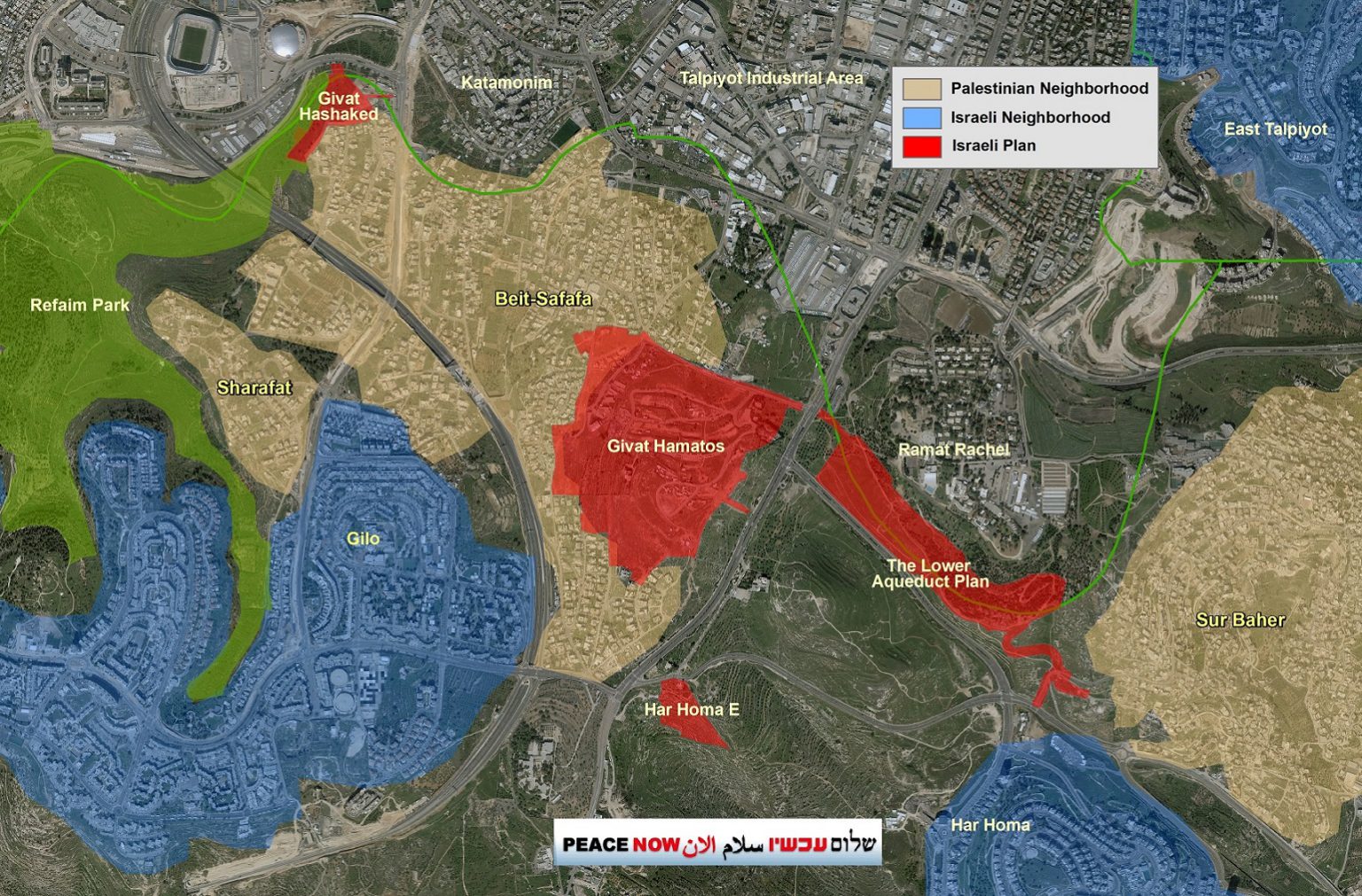
The final approved plan provides for the construction of 1,792 settlement units. According to Ir Amim, this is the first major new East Jerusalem settlement established by Israel since 2012.
Ir Amim says:
“This plan carries serious ramifications on the political future of Jerusalem. If constructed, it will extend the Israeli settlement wedge along East Jerusalem’s southern border, further creating a sealing-off effect of East Jerusalem from the southern West Bank, while fracturing the Palestinian space and depleting more vacant land for Palestinian development….Beyond its geopolitical ramifications, the advancement of this plan underscores the systematic discrimination implicit in Israeli planning and building policy in Jerusalem. Since the beginning of 2023, over 18,500 housing units have been advanced for new or existing Israeli settlements in East Jerusalem, while residential development for Palestinians has been all but neglected. This is despite the fact that Palestinians constitute nearly 40% of Jerusalem’s population. 2023 is slated to join 2022 as being the two years with the highest number of settlement units advanced in the last decade in East Jerusalem. Such inequitable urban planning policy has long served as a driver of Palestinian displacement in service of solidifying a Jewish demographic majority in Jerusalem and further cementing Israeli territorial control to foil prospects for a just political resolution.”
Peace Now said in a statement:
“The Israeli government continues to undermine any viable two-state solution. While the IDF is engaged in the Gaza Strip, and hundreds of Israelis living in border areas in the north and south are uncertain about when they can return to their homes, the government is advancing construction beyond the Green Line, further jeopardizing the security of all Israeli residents seeking a hopeful future with secure borders.”
“Kahanist” March Calls for Israeli Control Over Western Wall, Clash With Israeli Police
On the first night of Hanukkah, approximately 150 far right wing Israelis gathered for a planned march through the Old City of Jerusalem calling for Israeli control over the Temple Mount. Israeli police – which had previously approved the march (likely with the knowledge and approval of Netanyahu) and its route – ultimately stopped the march from leaving its convening point, resulting in clashes and at least one arrest.
The point of the march was to call on Israel to “restore full Jewish control over the Temple Mount and Jerusalem,” an inflammatory message that threatens to further undermine the very delicate status quo. Indeed, the march’s organizers dubbed the march the “Maccabi March,” referencing an important Jewish revolt that ended in the rededication of the Temple. An the night of the march, attendees were shouting racist slogans and raising racist signs.
Israeli Opposition Leader Yair Lapid said in a tweet that the march is:
“A blatant Kahanist attempt to set other [war] fronts on fire and to bring about more destruction and death.”
Daniel Seidemann, founder of Terrestrial Jerusalem, said:
“If there is any provocation more dangerous, more incendiary and more likely to trigger an eruption of violence in East Jerusalem and/or the West Bank and/or the Lebanese border, I can’t think of one.”
In Armenian Quarter, Settler Group Believed to Be Behind Disputed Land Deal
Ir Amim reports that senior executives of the Ateret Cohanim settler groups have recently been seen meeting with representatives of the real estate company behind the controversial purchase of a significant amount of land in the Armenian Quarter of the Old City of Jerusalem. The reports appear to confirm suspicion that Xana Gardens is actively collaborating with settlers in, according to Ir Amim, “attempts to Israelize the Old City and erode its historically multicultural and multireligious character.”
For a background on this case, please see reporting by Ir Amim and Terrestrial Jerusalem.
U.S. & Belgium Imposes Visa Ban on Dozens of Settlers, Criticizes Israel’s Lack of Action
On December 5th, the U.S. Department of State announced that it has placed visa restrictions on dozens of settlers believed to be complicit in violent attacks on Palestinians in the West Bank. The U.S. also imposed visa bans on several dozen Palestinians believed to have perpetrated violence against Israelis.
U.S. Secretary of State Antony Blinken said in announcing the new policy:
“Last week in Israel, I made clear that the United States is ready to take action using our own authorities. Today, the State Department is implementing a new visa restriction policy targeting individuals believed to have been involved in undermining peace, security, or stability in the West Bank, including through committing acts of violence or taking other actions that unduly restrict civilians’ access to essential services and basic necessities. Immediate family members of such persons also may be subject to these restrictions.”
The list of individuals affected by this effort is not expected to be made public, but individuals will be notified if their visas are being revoked. Settlers who are U.S. citizens will not be affected. Axios reports that the last time the U.S. imposed such restrictions was under the Clinton administration.
It is unclear what process the U.S. government is undertaking to identify acts of violence and the individuals involved in them. On December 6th, OCHA reported that since October 7th settlers have launched 318 attacks against Palestinians, resulting in:
- 8 Palestinians have been killed by Israeli settlers;
- 84 Palestinians have been injured by settlers;
- 241 incidents resulting in damage to Palestinian-owned property;
- 1,014 people, including 388 children, have been displaced amid settler violence and access restrictions. The displaced households are from 15 herding/Bedouin communities.
Israel, for its part, is currently holding four settlers and two Israeli (non-settlers) in administrative detention who are believed to have perpetrated violence against Palestinians since October 7th. In announcing the visa bans, U.S. Secretary of State Antony Blinken said that the U.S. continues to push the Israeli government to “do more to hold accountable extremist settlers who have committed violent attacks against Palestinians in the West Bank.”
Soon after the U.S.’s announcement, Belgium announced a similar policy banning settlers suspected of engaging in violence from entering the country. Belgium Prime Minister said in a tweet that he will work with the U.S. in implementing this policy.
Last week, the spokesperson for the French Foreign Ministry publicly stated that the European Union should also consider sanctions on violent settlers. The comments were in support of U.S. President Biden’s op-ed in which he had threatened to impose visa bans, a week before the policy was implemented.
Miftah Reports on “State Sponsored Settler Terrorism”
The Palestinian NGO Miftah has published a short new report on settler violence, saying “settler violence and terror is a systematic state policy pursued by every Israeli government past and present, and the whole government apparatus is complicit and responsible for such terrorism.”
The report calls on the international community to “muster the courage and political will to hold Israel accountable with effective measures.” Specifically, it calls on the International Criminal Court to investigate war crimes in Palestine, label settlement products, impose a complete ban on trade with settlements, blacklist settler groups on terrorists lists, freeze assets of individuals and companies involved in the settlement enterprise, and more.
You can read the full report here.
A Roundup of Settler Violence
The following are a few examples of settler violence that have been picked up by major media outlets over the past two weeks:
- “Left-wing Israeli Activists Attacked While Protecting Settler-targeted West Bank Village” (Haaretz – Dec. 4th)
- “Homes and EU-funded school in West Bank village wrecked after threats by settlers” (The Times of Israel – Dec. 4th)
- “Israeli Soldiers Documented Shooting Disabled Palestinian in West Bank” (Haaretz – Dec. 7th)
- “Two Palestinians Killed in Separate Incidents in West Bank” (Haaretz – Dec. 3rd)
Bonus Reads
- “Return to Gush Katif: A determined movement emerges to resettle Israelis in Gaza” (The Times of Israel)
- “With All Eyes on Gaza, West Bank Palestinians Are Facing Unprecedented Violence” (Haaretz)
- Israeli Army Mulls Shutting Down Unit of Settler ‘Hilltop Youth’ Amid Violent Incidents Against Palestinians““ (Haaretz)
- “A Bitter Season in the West Bank” (The New York Review)
- “Northern Israeli Kibbutz Residents Prevent Palestinians From Harvesting Their Olives” (Haaretz)
- “West Bank settlers unwavering in support for Israeli government” (Al-Monitor)
- “Amid a Settler Onslaught, Protective Presence Activism Falters” (Jewish Currents)
Welcome to FMEP’s Weekly Settlement Report, covering everything you need to know about Israeli settlement activity this week.
To subscribe to this report, please click here.
November 17, 2023
-
- West Bank Stats via OCHA (as of November 16th)
- Settlers Take Over Large Amount of Property in the Armenian Quarter
- Plan for New National Park in East Jerusalem Resurfaces (Mount Scopus Slopes National Park)
- “Lower Aqueduct” Settlement Plan on the Agenda Again
- Israel Opens Huwwara Road for Settlers, While Keeping Palestinians Under Lock Down
- Sheikh Jarrah Eviction Case Postponed
- Accountability as Settlers Terrorize South Hebron Hills
- B’Tselem: H-2 Area of Hebron Suffering Under Collective Punishment
- Bonus Reads
West Bank Stats via OCHA (as of November 16th)
OCHA reports that in the West Bank since October 7th:
- 248 settler attacks against Palestinians have been recorded, resulting in Palestinian casualties (30 incidents), damage to Palestinian-owned property (182 incidents), or both casualties and damage to property (36 incidents). This reflects a daily average of six incidents, compared with three since the beginning of the year. Over one-third of these incidents included threats with firearms, including shootings. In nearly half of all incidents, Israeli forces were either accompanying or actively supporting the attackers.
- At least 143 Palestinian households comprising 1,014 people, including 388 children, have been displaced amid settler violence and access restrictions. The displaced households are from 15 herding/Bedouin communities.
- 186 Palestinians, including 51 children, have been killed by Israeli forces; and an additional eight, including one child, have been killed by Israeli settlers in the West Bank, including East Jerusalem. Four Israelis have been killed in attacks by Palestinians.
- Israeli forces have injured 2,661 Palestinians, including at least 282 children, over half of them in the context of demonstrations. An additional 74 Palestinians have been injured by settlers. Some 33 per cent of those injuries have been caused by live ammunition.
- A total of 48 Palestinians, including 24 children, have been displaced since 7 October following punitive demolitions.
- An additional 135 Palestinians, including 66 children, have been following demolitions in Area C and East Jerusalem, due to lack of permits.
Settlers Take Over Large Amount of Property in the Armenian Quarter
Terrestrial Jerusalem reports that on November 16th a group of settlers guarded by Israeli police entered and took control over several tracts of strategically located land in the Armenian Quarter of the Old City of Jerusalem owned by the Armenian Patriarchate. The settlers assert that the lands were leased to them by the Armenian Patriarchate, a lease the Patriarchate contests the legality of and then formally canceled on October 26, 2023.
The Armenian Patriarchate of Jerusalem issued the following statement on Nov. 16th:
“The Armenian Patriarchate of Jerusalem is under possibly the greatest existential threat of its 16-century history. This existential-territorial threat fully extends to all the Christian communities of Jerusalem.
The Armenian Patriarchate has recently canceled a contract tainted with false representation, undue influence, and unlawful benefits.
Instead of providing a lawful response to the cancellation, the developers attempting to build on the Cow’s Garden have completely disregarded the legal posture of the PAtriarchate toward this issue, and instead have elected for provocation, aggression, and other harassing , incendiary tactics including destruction of property, the hiring of heavily armed provocateurs, and other instigation.
In recent days, the cast destruction and removal of asphalt on the grounds of the Armenian Quarter have been done without the presentation of permits from the municipality by neither the developer nor the police. Despite this fact, the police have chosen in the last few days to demand that all the members of the Armenian Community vacate the premises.
We plead with the entirety of the Christian communities of Jerusalem to stand with the Armenian Patriarchate in these unprecedented times as this is another clear step taken toward the endangerment of the Christian presence in Jerusalem and the Holy Land”
Rumors of this sale first surfaced in 2021, but it wasn’t until June 2023 the details of the sale were publicly reported. At the time, the Associated Press reported that the Armenian Orthodox Church signed a 99-year lease giving several church properties in the Old City of Jerusalem to an Australian-Israeli businessman, Danny Rothman (sometimes referred to as Danny Rubenstein). The lease reportedly includes the Hadiqat Al-Baqar (The Cows’ Garden) and its surrounding properties, including the Qishla building in Bab al-Khalil (Jaffa Gate), located in the Armenian Quarter. In total,
In June 2023, settlers placed a sign on one of the tracts saying the land is the property of Xana Capital, the company which Danny Rothman owns. According to a bishop involved in the sale, Rothman and his business Xana Capital plans to develop the land into a luxury resort managed by a Dubai-based company.
The Armenian Archbishop, Nourhan Manougian, alleged that the Church’s real estate official and priest – Baret Yeretsian – sold the land in a “fraudulent and deceitful” deal that he was unaware of. Yeretsian, in turn, said he carried out the deal at the direction of Manougian. Both Manougian and Yeretsian have been forced into hiding due to communal outrage.”
Terrestrial Jeruslame’s Danny Seidemann stresses the active role of the Israeli government in collaborating with settlers to take control of these properties, as in the case of other settler takeovers across the Old City. He writes.:
“We have seen this pattern all too often. In the past, both distant and recent, settlers succeeded to take over strategically located Church sites of great historical, religious and cultural value. These include enormously important Greek Orthodox properties only meters away: the Imperial and Petra Hotel at Jaffa Gate, the St. John’s Hospice in Muristan, adjacent too the Church of the Holy Sepulcher, etc…
The most important aspect is the least visible: the location suggests that this property has been singled out, and is likely an integral part of an ambitious and highly consequential Government plan. For many years, and under the radar, the Government of Israel has been implementing projects to encircle the Old City w/ Biblically motivated settlements and settlement-related projects: a planned Israeli National Park over the Christian holy sites on the Mount if Olives, a cable car from West Jerusalem to the settler headquarters n Silwan, the opening of an Israeli Night spot at the entrance to the Christian Quarter at New Gate, etc. are just a few, of the prominent examples. There are dozens more. More than a billion sheqels have been invested in this Government project. Its goals are to encircle the religious, historical and cultural core of Jerusalem with settlement enclaves, and projects that will etch the Biblically motivated settler narrative into the landscape and urban fabric.
This is no mere “bad thing”. The Government plan will radically undermine the character of Jerusalem, fragmenting Palestinian Jerusalem and marginalizing the already challenged Christian presence in the city. This is so impactful, that one prominent Christian cleric cautioned that the tome is not far off when Jerusalem will no longer be hospitable to Christians.”
Plan for New National Park in East Jerusalem Resurfaces (Mount Scopus Slopes National Park)
Ir Amim and Bimkom jointly report that the Israeli government appears to have renewed its efforts to designate the open area between the Palestinian neighborhoods of al-Isawiyyah and a-Tur in East Jeruasalem as a new national park, called the Mount Scopus Slopes National Park.
Ir Amim and Bimkom explain:
“The plan aims to turn the large vacant space between the aforementioned neighborhoods into a national park, which would extend eastward from Hebrew University towards the edge of the city and the E1 corridor. This will severely limit proper development of both neighborhoods, including the ability to adequately expand, which is essential. In addition, a large national park in this location would contribute to Israeli territorial contiguity between Jerusalem and the E1/Maaleh Adumim area. It will likewise serve as a form of touristic settlement, which increases Israeli control over more land and fractures the Palestinian space in the city.
The designation of areas as national parks and/or green spaces is a common practice in East Jerusalem used to alter the character of the space, fragment the Palestinian environs, and suppress urban planning, while enabling the seizure of their lands for Israeli interests.”
“Lower Aqueduct” Settlement Plan on the Agenda Again
Ir Amim reports that the JErusalem District Planning Committee is scheduled to meet on November 21st to discuss objections submitted against the “Lower Aqueduct” settlement plan, located in East Jerusalem. This plan would see a new settlement of 1,465 units built on a sliver of land located between the controversial settlements of Givat Hamatos and Har Homa – and is intended to connect the two. In so doing, it will establish a huge, uninterrupted continuum of Israeli settlements on the southern rim of Jerusalem, and will destroy Palestinian contiguity between the West Bank and East Jerusalem. For more background on the Lower Aqueduct plan, see resources by: Terrestrial Jerusalem and Ir Amim.
Adding insult to injury, two years ago the Jerusalem Municipality and the Ministry of Jerusalem Affairs initiated a plan to build a new Palestinian business center in the precise area targeted by the “lower aqueduct” plan, as part of an Israeli government initiative to reduce poverty in East Jerusalem. The Jerusalem Municipality subsequently abandoned the plan for the Palestinian business center under pressure from settlers, specifically from the Har Homa settlement which borders the area. Ir Amim comments:
“Not only is this yet another example of severe planning discrimination, but construction of this new neighborhood will serve to further create Israeli territorial contiguity along East Jerusalem’s southern perimeter while depleting more land reserves for Palestinian development.”
Peace Now notes that the majority of the land on which the new settlement will be built (half of which is in East Jerusalem and half in West Jerusalem) is privately owned, or managed by the Israeli Custodian General. Although recent reporting suggests the Custodian General is moving to advance settlement construction on lands it manages across East Jerusalem, its legal ability to do so is questionable (and doing so has historically not been its practice).
Israel Opens Huwwara Road for Settlers, While Keeping Palestinians Under Lock Down
Peace Now reports that the first section of the Huwara Bypass Road – near Nablus – opened for vehicular traffic on Sunday, November 12, 2023. Settlers – along with Bezalel Smotrich, who is effectively the governor of the West Bank – have pressed for this road to open for settlers since before the October 7th attacks. With the opening of the Huwara Bypass road, settlers now have exclusive use of two highways in the area, while Palestinans do not have access to either one.
The Huwwara Bypass Road is designed for residents of Nablus-area settlements to bypass the Palestinian village of Huwwara (which is an area with heavy traffic congestion from daily commuters), in order to more easily/directly access Jerusalem. This bypass road has long been a top priority for the settlers, who have complained about the long commute to Jerusalem and the limits this puts on the potential for growth of Nablus-area settlements. Building the road also gained urgency for the settlers after the release of the Trump Plan’s conceptual map, which left the area where the road is slated to be built within the borders a future Palestinian “state.” On October 6th (the day before Hamas’ heinous massacre of civilians in the south of Israel), Smotrich and settlers pressed for the road to be completed and opened after a spate of Palestinian attacks on Israeli persons and cars in the area.
Peace Now reports:
“Despite the ongoing war, the government is investing considerable efforts to open the road quickly, and construction continued even during the Gaza war, despite interruptions in other building and infrastructure projects during this period. The road’s trajectory required the confiscation of private Palestinian lands from the villages of Burin, Huwara, Beita, Awarta, Yasuf, Yatma, and A-Sawiya. The old Huwara Road, which until recently served both settlers and Palestinians, has been a central artery for Palestinian traffic from the Nablus area to Ramallah and southern West Bank. The road has been closed to Palestinian traffic since the beginning of the war. The Central Command Chief decided to reopen the road to Palestinians in parallel with the opening of the bypass road. However, settlers opposed its reopening, arguing that the old Huwara Road should also serve as a secure passage only for settlers. Eventually, the old Huwara Road was reopened to limited Palestinian traffic only on the evening of Sunday, November 12, 2023.”
Sheikh Jarrah Eviction Case Postponed
FMEP has been informed that the Israeli Enforcement and Collection Authority (ECA) has postponed its discussion of the eviction of the Salem family from their home of 60+ years in the Umm Haroud section of Sheikh Jarrah, which was scheduled for November 14th. The Salem family is one of approximately 40 Palestinian families under threat of forcible displacement by settlers from the Um Haroun section of Sheikh Jarrah.
The Salem family has been fighting efforts by settlers to evict them from their home since 1988. The individuals behind the years-long effort to evict the Salem family are Yonaten Yousef, a Jerusalem city councilmember, and former deputy mayor of Jerusalem Aryeh King. Yousef and King claim to have bought the house from the Jewish family that owned it before 1948 — based on an Israeli law known as the Legal and Administrative Matters Law of 1970. This law provides Jewish Israelis the right to “reclaim” properties lost in the 1948 War. In contrast, under Israeli law the Salem family lacks any legal basis to claim both its home in Sheikh Jarrah – where the family has lived since being displaced from their home inside the Green Line during the 1948 War – or to their original home inside Israel, which they lost in the 1948 War (Israel law recognizes no such property claims by Palestinians who fled or were otherwise absent from the areas that became Israel in the course of that war)/.
In February 2022 the Jerusalem Magistrate Court froze an impending eviction of the Salem family based on the family paying the court a $7,700 “guarantee”. Around that same time the Israeli government seized a piece of the Salem property, located adjacent to the home that is now under demolition threat. Itamar Ben Gvir (who is now serving as the National Security Minister, with authority over demolitions in East Jerusalem) subsequently set up a tent on that seized property and called it his parliamentary office – a deliberate provocation.
For further background on the Salem family’s case (including on the Israeli laws that were expressly designed to enable the eviction of Palestinians in favor of settlers), see reporting by Ir Amim and Peace Now.
Accountability as Settlers Terrorize South Hebron Hills
The intensification of settler terrorism and displacement efforts in the South Hebron Hills has continued to escalate. The Association for Civil Rights in Israel wrote an urgent appeal to the head of the IDF, calling for the IDF to intervene on behalf of Palestinians. Citing many specific incidents, ACRI writes:
“settlers living in outposts in the South Hebron Hills, have presented themselves in Palestinian communities dressed in military uniforms, sometimes masked, and intimidated residents, violently attacked them, damaged property and even ordered them to leave their homes.”
B’Tselem: H-2 Area of Hebron Suffering Under Collective Punishment
B’Tselem has called the IDF-imposed curfew on Palestinians living in the H-2 area of Hebron “collective punishment.” It also collected testimonies of families living in H-2 under highly restrictive and frightening conditions. B’Tselem writes:
“Since the war broke out on 7 October 2023, the military has been imposing a curfew on 11 neighborhoods in Area H2 in Hebron. Stores and businesses have been shut down and thousands of people, amounting to about 750 families, are imprisoned at home. Only after two weeks of full curfew, on 21 October 2023, did the military permit residents to leave home on Sundays, Tuesdays and Thursdays, for an hour in the morning and an hour in the evening.
Venturing out of the house requires crossing checkpoints and engaging with soldiers. This invariably involves humiliating treatment and meticulous body searches, and takes up most of the brief window of time allotted to the residents. As a result, many cannot get back in time to the checkpoint and have to stay out an entire day or night until it reopens. This prevents residents from getting what they need, and some are running low on food, water, medication and cooking gas.
The curfew has completely disrupted life in H2. Residents cannot get to work and school or visit family, and all the businesses are closed. They are living in complete uncertainty, without knowing when they will return to normal. Meanwhile, settlers in Hebron are enjoying full freedom of movement, which they use to harrass residents and damage their property.
There is no justification for keeping hundreds of people under a blanket movement ban, locked up at home for weeks on end. Israel is taking advantage of the fact that local and international attention is currently diverted from the West Bank to impose far-reaching measures that constitute collective punishment, which is prohibited under international law. This conduct is integral to Israel’s apartheid regime, which is at its most flagrant in Hebron.”
Bonus Reads
- “West Bank olive harvest ‘more dangerous than ever’ under shadow of war” (+972 Magazine)
- ”Coalition of 11 right-wing organizations unveils Gaza strip resettlement initiative” (Jerusalem Post)
- “From Montana to Samaria – The cowboys who came to help” (Arutz Sheva)
- “‘They Don’t Want People to Know We Exist’ Palestinians across the West Bank describe what life has been like since October 7.” (New York Magazine)
- “While It Bombs Gaza, Israel Is Now Shooting to Kill Palestinians in the West Bank” (Haaretz)
Welcome to FMEP’s Weekly Settlement Report, covering everything you need to know about Israeli settlement activity this week.
To subscribe to this report, please click here.
September 15, 2023
-
- New from FMEP
- Israel Advances Plan for New, Heavily Fortified Settlement Enclave in East Jerusalem – “Kidmat Tzion”
- Israel Advances Plan to Massively Expand of Givat Hamatos Settlement (New Talpiyot Hill/Hebron Strip Plan)
- Settlers Forcibly Seize East Jerusalem Home, Later Removed
- Oslo & The Settlements
- Bonus Reads
New from FMEP
- This week FMEP launched a new microsite dedicated to tracking Palestine-related lawfare. Lawfare refers to efforts that seek to exploit U.S. laws and courts in order to quash criticism and activism challenging Israeli policies, to delegitimize Palestinian organizations and the Palestinian cause, and to undermine and even criminalize support for and/or solidarity with the Palestinian people. This includes legislation and policies targeting Americans’ rights to boycott Israel and/or settlements. Notably: these efforts almost universally mandate, explicitly or implicitly, that Israeli settlements in the OPT be treated as part of Israel. You can visit the new site here: lawfare.fmep.org
- This week FMEP hosted a webinar entitled, “Forcible Transfer is a War Crime: West Bank Pogroms are Working” featuring B’Tselem’s Sarit Michaeli and Kareem Jubran in conversation with FMEP’s Sarah Anne Minkin. The discussion highlights the role settler terrorism is playing in forcibly displacing entire Palestinian communities from Area C. You can watch or listen to the discussion here.
Israel Approves New, Heavily Fortified Settlement Enclave in East Jerusalem – “Kidmat Tzion”
On September 11th, the Jerusalem Local Planning & Building Committee met, and subsequently approved for deposit, plans to build a massive new settlement enclave inside of the Ras al-Amud neighborhood of East Jerusalem. The new enclave – called “Kidmat Tzion” – was approved for the construction of 384 settlement units, to be located on a tiny strip of land between the Ras al-Amud neighborhood and the Israeli separation barrier, with the Abu Dis neighborhood on the other side of the wall.
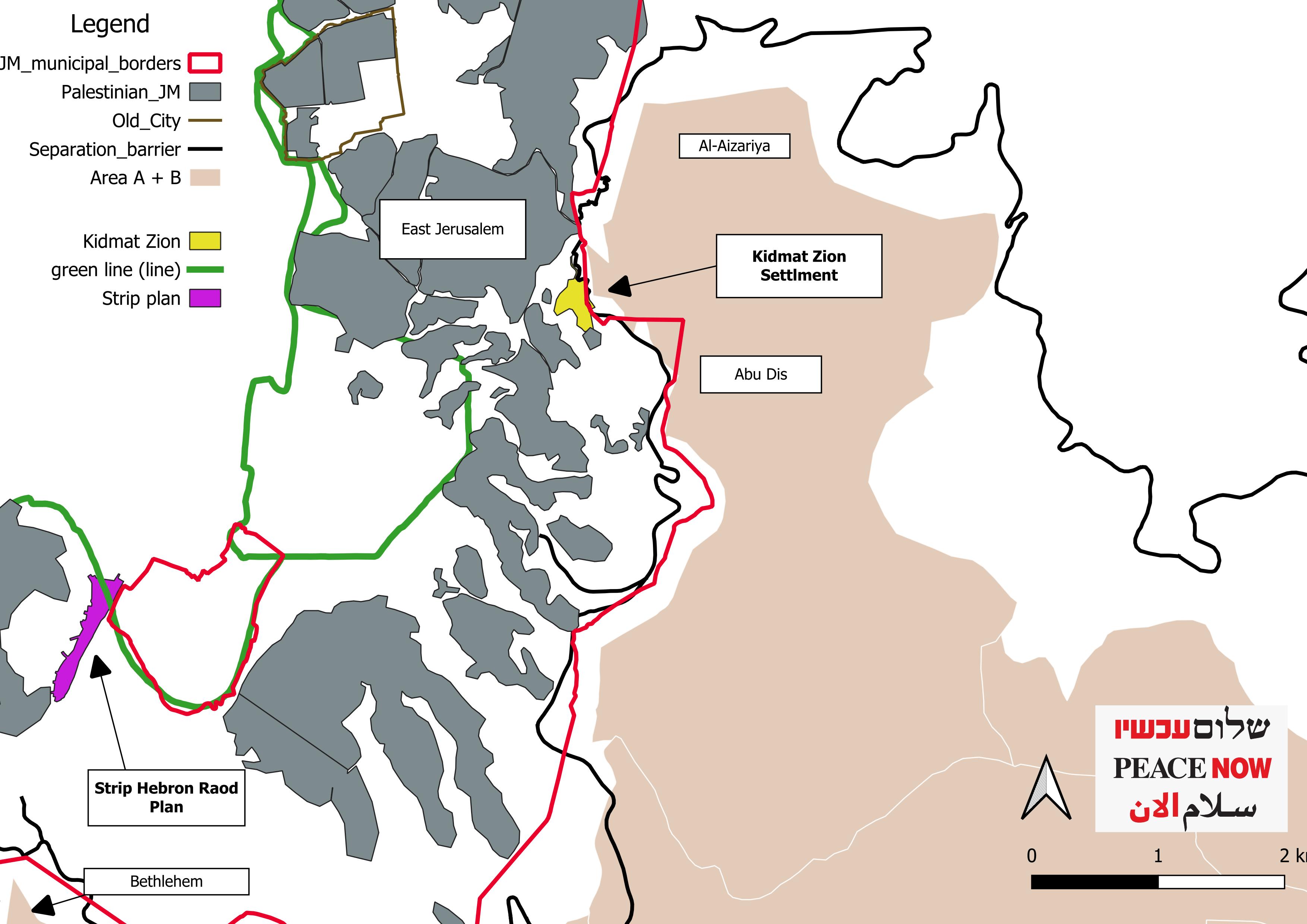 The settlement enclave will be accessible only by driving through densely populated areas of Ras Al-Amud. To deal with the reality of its location, the architects of the plan have designed the enclave to be a heavily guarded and gated community. It will be surrounded by an electric fence, a patrol road, a concrete guard station at its entrance, and the roofs of the houses will have cameras and spotlights installed. The security plan for the enclave had to be prepared and filed by the IDF’s Central Command, which specified that four armed security guards will patrol the neighborhood at all times, as well as a security chief and an armored vehicle.
Haaretz notes that – despite its sensitivity – the plan has been flying through the planning process at a much faster speed than is typical, and was brazenly approved this week while U.S. Assistant Secretary of State Barbara Leaf – a senior U.S. official – was in Israel. Sari Kronish of the Israeli NGO Bimkom told Haaretz:
“The lightning speed with which the District Committee is promoting a plan to build a Jews-only, gated village in the heart of a Palestinian neighborhood in [East] Jerusalem raises the suspicion that this is a political ploy.”
Amy Cohen, Ir Amim’s Director of International Advocacy told Haaretz:
“Israel promotes tens of thousands of housing units for Jews in East Jerusalem every year, while systematically denying Palestinians the same housing rights, all with the aim of pushing them out of East Jerusalem and influencing the city’s demographic balance in a crude and artificial way,” said “This proposal severs the single access road leading to Palestinian homes and is being advanced with a speed we have never seen before. The move is doubly problematic since the City Engineer himself notes that necessary basic tests were not conducted.”
Originally introduced in April 2023, the plan is the product of the Ateret Cohanim settler group – rather, its affiliate the Bahorim Company – which filed documents with the planning committee that show it (Bahorim) only owns 10% of the land where Kidmat Tzion is planned for. The land is unregistered, but Bahorim submitted a table of ownership purporting to show that dozens of plots were owned by Jews prior to 1948, still other plots are owned by settler affiliated groups including one run by U.S. millionaire and settlement financier Irving Moskowitz, and 1 or 2 plots are owned by Palestinians. Part of the land is owned by the Israeli Custodian General.
Construction of this settlement could well achieve the considerable geopolitical consequences the settlers hope for — most notably by complicating if not outright blocking any future division of Jerusalem (or sharing agreement) under any possible Israeli-Palestinian peace agreement. It is worth recalling that Abu Dis has been repeatedly suggested by Israel and its allies (including in the Trump Plan) as the capital of a future Palestinian state (as a substitute for Jerusalem), and an unfinished building in Abu Dis was designed to be the future home of a Palestinian parliament. This settlement plan would scuttle all such ideas. Indeed, in the planning documents Ateret Cohanim explained:
“Palestinian institutions in Abu Dis were built with the vision of turning the town into the capital city of Palestine and building a corridor and passage to the center of Jerusalem, and thus promoting the takeover of the entire city…The significance of establishing and developing the neighborhood is to create a shield for Jerusalem against Palestinian ambitions. The neighborhood will disturb the contiguity [of the area] and protect us from dividing the city.”
The new settlement enclave will also further solidify the infrastructure connecting settlements south of Jerusalem to the city. Kidmat Zion will be located adjacent to the so-called “American Road,” which will tunnel underneath parts of Abu Dis. The “American Road” is a section of north-south highway that is meant to seamlessly connect settlements located in the north and south of Jerusalem to one another, and to serve as a bypass for settler traffic to cut through East Jerusalem’s Palestinian neighborhoods. While the road will be accessible to Palestinians (a fact touted by Israel as proof of Israeli good intentions), the obvious primary purpose is to entrench Israel settlements, expand Israeli control over all of East Jerusalem, and close off Palestinian East Jerusalem neighborhoods from the rest of the West Bank, thereby (further) torpedoing Palestinian hopes of one day establishing a capital in East Jerusalem.
Israel Approves Expansion of Givat Hamatos Settlement (New Talpiyot Hill/Hebron Strip Plan)
On September 11th, the Jerusalem District Planning Committee also approved for deposit a plan that will expand the Givat Hamatos settlement. The plan – referred to as “New Talpiot Hill” and/or Hebron Strip – stands to double the number of housing units in the Givat Hamatos settlement and increase its land mass by 40%, introducing not only 3,500 new settlement units but 1,300 hotel rooms in highrise buildings, posing a direct competition to the Palestinian tourism industry in nearby Bethlehem.
Further, the new settlement will be built on a strategic strip of land that will expand the area of Givat Hamatos eastward, connecting it with another new settlement plan – the “Lower Aqueduct Plan.” These plans ultimately create a string of settlements — spanning from Gilo to Givat Hamatos to Har Homa — that, together with the planned “Givat HaShaked” settlement to its north, completely encircle the East Jerusalem Palestinian neighborhood of Beit Safafa with Israeli settlement construction.
Peace Now reports that the project is a joint initiative of the Greek Orthodox Church and a private company. The Church has said that part of the development is intended for use by the city’s Christian community, though previous reports indicate that the plan calls for five synagogues and two mikvehs, clearly showing that the construction is designed to serve Israeli Jews.
Ir Amim writes:
“Together, Givat Hamatos A and New Talpiyot Hill along with concurrent settlement advancements in the area are cumulatively sealing off East Jerusalem’s southern perimeter from Bethlehem and the southern West Bank. These measures likewise further fracture the Palestinian space and deplete all remaining land reserves in the area for Palestinian development. Such conditions severely undermine the prospects of an agreed political future of Jerusalem, while depriving Palestinians of their fundamental right to housing and shelter.”
Settlers Forcibly Seize East Jerusalem Home, Later Removed
On September 12th, a group of settlers forcibly seized a Palestinian home belonging to the Idris family in the Old City of Jerusalem. At the time, the matriarch of the family was in the hospital. The family arrived back home to find their house taken over by settlers. They were told to file a complaint in order to prove their ownership of the house.
The settlers were guarded by the Israeli security forces while they removed the families furniture, changed the doors and locks on the home and installed metal bars on the windows and roof. PCHR also reports the settlers built a “steel staircase and a mobile room to be later attached to the house.”
The settlers were later removed from the house by the Israeli police.
Oslo & The Settlements
Peace Now has published a host of information looking at how the settlement enterprise has thrived since the signing of the Oslo Accords thirty years ago. Key facts are:
| 1993 | 2023 |
| 110,000 settlers living in the West Bank | 465,000 settlers living in the West Bank |
| 128 settlements in the West Bank | 300 settlements and outposts in the West Bank |
| 140,000 settlers living in East Jerusalem settlements | 230,000 settlers living in East Jerusalem settlements |
| 800 settlers living in enclaves inside of Palestinians East Jerusalem neighborhoods | 3,000 settlers living in enclaves inside of Palestinians East Jerusalem neighborhoods |
Peace Now concludes:
“The thirty years following the Oslo Accords were characterized by a significant expansion of the settler population in the West Bank and East Jerusalem, growing from approximately 250,000 in 1993 to nearly 700,000 by 2023. This population growth is a result of Israel’s ongoing expansion of settlements, the establishment of new settlements in the form of outposts, and the construction of hundreds of kilometers of bypass roads, making it easier for settlements to connect to Israel. Additionally, a significant reinforcement of the settler population comes from the Haredim (ultra-Orthodox), who have no ideological connection to the settlements and had not settled in the West Bank before the Oslo Accords, except for a few neighborhoods in East Jerusalem (Neve Yaakov, Ramat Shlomo, and Ramot).
The conclusions drawn from the data are clear. The settlement enterprise did not suffer from the Oslo Accords but rather thrived. Israel continued to expand, develop, and authorize settlements in the West Bank unabated. Even in years when few new settlements were established (1993–1997), infrastructure work continued. When factoring in agricultural land and pastures seized by settlers, it can be concluded that the settlement enterprise has never been in a better position, while the situation for Palestinians in the West Bank remains difficult and fraught with challenges.”
Bonus Reads
- “The Palestinian Boy Whose Village Was Destroyed Turned Into a True Freedom Fighter” (Haaretz)
- “Settlers Assault Palestinian and Left-wing Israeli Activists in Separate West Bank Attacks” (Haaretz)
- “Israel to close West Bank, Gaza Strip crossings over Rosh Hashanah” (i24 News)
- “Israel’s finance minister now governs the West Bank. Critics see steps toward permanent control” (AP)