Welcome to FMEP’s Weekly Settlement & Annexation Report. To subscribe to this report, please click here.
November 13, 2025
- Mass Displacement & Forcible Transfer in Silwan: Three Families Dispossessed, New Eviction Order Delivered
- Boundaries set for 13 West Bank settlements, Including Sa-Nur in Northern West Bank
- Israel Delivers Eviction Notices in Qalandiya in Order to Build New Waste Treatment Plant
- Israel Grants Tax Benefit to Settlements in “Threatened Areas”
- Settler Terrorism This Week
- Bonus Reads
Mass Displacement & Forcible Transfer in Silwan: Three Families Forcibly Dispossessed, New Eviction Order Delivered
 In the early morning of November 9th, a large contingent of Israeli police forcibly displaced three Palestinian households (14 people from the Odeh and Shweiki families) from their longtime apartment building in the Batan Al-Hawa section of Silwan, paving the way for settlers to immediately enter and take over the properties under police escort. In addition, Israel police also raided the Rajabi family home and delivered a court order rejecting the families’ latest petition and ordered their eviction in 21 days. Peace Now reports the dispossession of the Odeh and Shweiki families is an important, precedent setting event because many other eviction cases were awaiting the outcome and will likely clear the way for many more evictions.
In the past 15 months, at the behest of settlers and the cooperation of the courts, Israel has evicted 9 Palestinian households in Silwan under a systematically unequal legal framework that affords Jews, but not Palestinians, the ability to “reclaim” properties that were abandoned before 1948. A total of 19 Palestinian families have been evicted at the behest of the Ateret Cohanim settler organization, which has waged a widespread campaign to dispossess and replace Palestinians in Batan al-Hawa. Ir Amim writes:
“Although couched in the language of legality, these measures are in fact anchored in a discriminatory legal regime that deprives Palestinians of equal rights and any genuine path to justice. Such actions amount to a form of forcible transfer and a grave violation of international law. With today’s evictions, the threat facing the community of Batan al-Hawa has grown ever more acute. Without urgent intervention, many more stand to lose their homes in the coming weeks and months ahead.”
Further – Ir Amim reports the eviction of the Shweiki and Odeh families happened days before the eviction order was set to take effect, which according to the watchdog “rais[es] serious questions concerning its legal pretext and procedural legitimacy. While the legal basis for carrying out the eviction early remains unclear, it appears to have been intended to mislead and catch residents off guard.”
Peace Now said in a statement:
“This is an injustice and a crime against a vulnerable population living under occupation in East Jerusalem. The dispossession of Palestinians from their homes in Silwan, enabled by the application of the Jewish ‘right of return,’ represents an indelible stain on the State of Israel. The Israeli judicial system has failed to protect the fundamental rights of Palestinians to their homes, effectively endorsing the racist and messianic policies of the current Israeli government. A responsible government would halt the forced expulsions of this community. Tragically, our government demonstrates anything but responsibility in any regard.”
An article covering the totality of struggle over Batan al-Hawa published in +972 Magazine writes:
“Each layer of Israel’s bureaucracy approved the evictions before they were sanctioned by the Supreme Court — often seen as a final check against Israel’s full-blown descent into authoritarianism. ‘The settlers have a presence in every ministry: education, interior, the municipality, they’re all working together from inside the system,’ explained Zuheir Rajabi, who heads the Batan Al-Hawa neighborhood committee and faces eviction orders himself. ‘These institutions serve the settlers because, in part, the settlers run them.’”
Boundaries set for 13 West Bank settlements, Including Sa-Nur in Northern West Bank
Israeli occupation authorities have formally approved boundaries for 13 new settlements across the West Bank Area C, including the re-establishment of the Sa-Nur settlement in the northern West Bank which the Israeli government dismantled in 2005. This announcement paves the way for outposts to be legally transformed into fully authorized settlements and expanded.
The new settlements are:
- Sa-Nur: The establishment of a boundary for the Sa-Nur settlement is the culmination of years of agitation by settlers and eager support from Israeli officials to re-establish settlements which the government dismantled in 2005.
- Ahiya: The Ahiya outpost received initial government approval in March 2024, when it was included in the expanded borders of the nearby Shilo settlement in the central West Bank. Ahiya is located in an string of settlements that are designed to form an uninterrupted corridor of Israeli control connecting sovereign Israel to the Ariel settlement, through the isolated Shiloh Valley settlements, all the way to the Jordan Valley. In so doing, it will completely bisect the northern part of the West Bank.
- Haresha: Located east of Ramallah and surrounded by privately owned Palestinian land, the Israeli government has successfully used the Haresha outpost as a test case for new legal tools to justify the expropriation of privately owned Palestinian land in order to retroactively legalize outposts.
- Adei Ad: Located in the Shiloh Valley, the Israeli government announced its plan to retroactively legalize the Adei Ad outpost in August 2018 by expanding the borders of the nearby Amichai settlement (a settlement which was established as a reward to settler law-breakers who evacuated from the unauthorized Amona outpost). The Adei Ad outpost has been a source of violent settlers launching attacks on nearby Palestinian communities, including Turmus Ayya.
- Shvut Rachel: Located in the Shiloh Valley, the Israeli government expanded the boarders of the nearby Shilo settlement in order to legalize the Shvut Rachel outpost.
- Yair’s Farm: located southwest of Nablus.
- Tel Menashe: located located on the tip of the northern West Bank, inside the “seam zone” between the 1967 Green Line and the Israel separation barrier.
- Maoz Tzvi: located in the northern West Bank.
- Migron: located south east of Ramallah.
- Nofei Prat: located east of Jerusalem.
- Givonit
- Ir Hatamarim: located near Jericho.
- Gadi: located in the Jordan Valley.
Celebrating the news, Smotrich said:
“The decision on the new boundaries provides stability, enables planning and development, and establishes the settlement blocs in the heart of the country. This is Zionism at its best, this is national responsibility, and this is the historical justice of the generation of children who are returning to build their country.”
Israel Delivers Eviction Notices in Qalandiya in Order to Build New Waste Treatment Plant
Peace Now reports the Israel Land Authority has ordered the eviction of dozens of Palestinians and demolition of two apartment buildings surrounded by cultivated agricultural land belonging to residents in the village of Qalandiya. The dispossession of these families is required by Israel in order to build a waste incineration facility in the area, a facility which would serve . Qalandiya is located just north of Jerusalem, technically within Israel’s expanded borders of Jerusalem but partially on the West Bank side of the Separation Barrier. When the Barrier was constructed it divided the town of Qalandiya and a gate was installed to allow Palestinians to access agricultural land that was on the Israeli side, a gate that was opened by Israeli officials only twice per year.
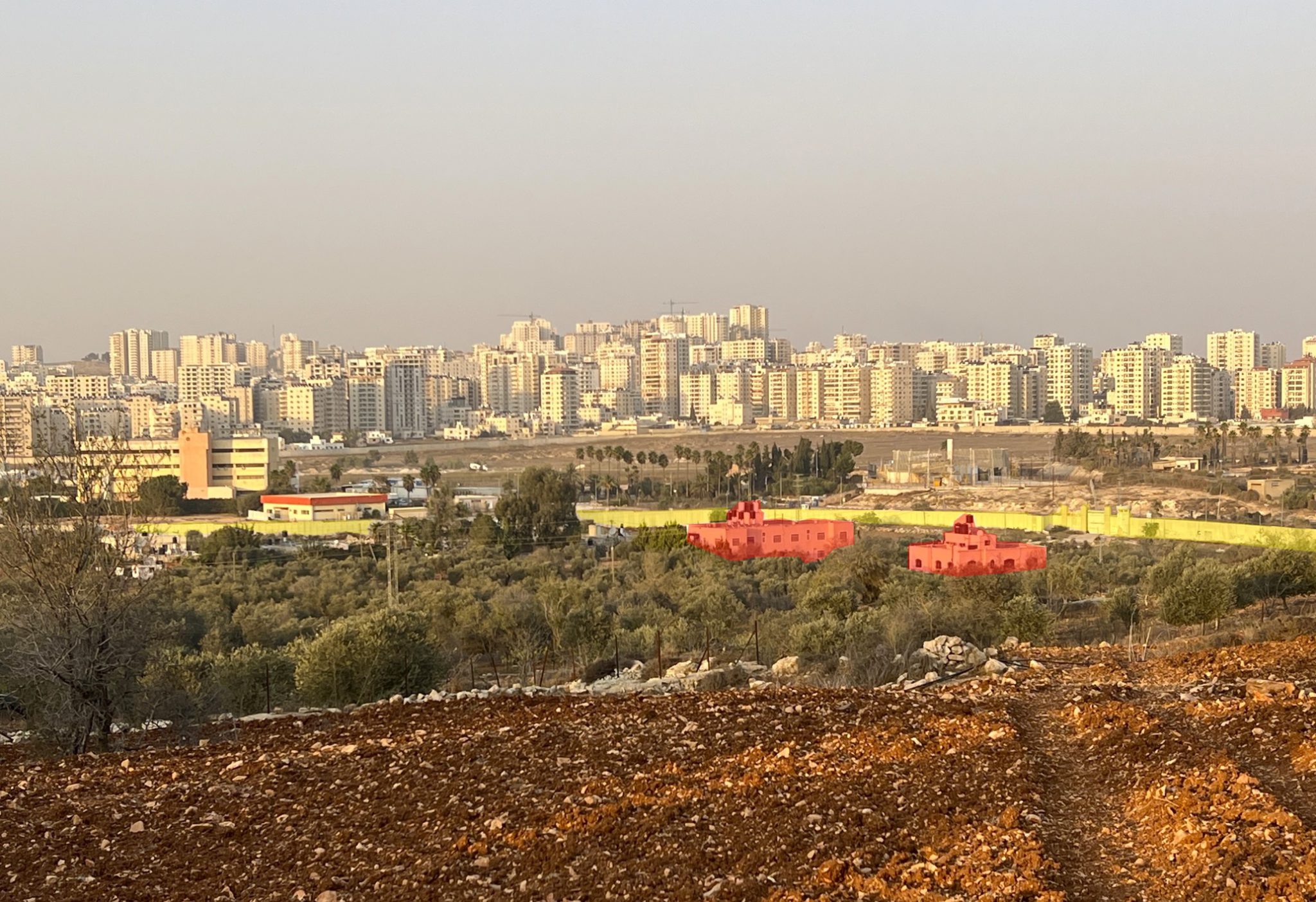 Earlier this year, Bezalel Smotrich signed a notice re-establishing two expired expropriation orders from 1970 and 1982 that covered the area. The government then approved a plan initiated by an Israeli company to build the waste treatment facility on the land and re-route the Separation Barrier, confiscating even more land, so that the new facility would be on the Israeli side.
Peace Now said in a statement:
“The government’s appetite for annexation and dispossession knows no bounds. As if there were no other place in the Jerusalem area to build a waste facility besides the few remaining dunams left to Qalandiya’s residents after decades of expropriations and fences. This would constitute a blatant violation of international law and basic moral principles to expel residents living under occupation for the sake of a plant serving the occupying power.”
The Israeli human rights group B’Tselem published a 2017 report on Israel’s exploitation of West Bank land to serve as Israel’s garbage dump, surveying several of the 15 Israeli waste treatment facilities (at the time) in the occupied West Bank. The report says:
“The findings presented in this report reveal another facet of the Israeli policy of using Palestinian space and Palestinian residents for the state’s own benefit. As an integral part of its waste management apparatus, Israel – abusing its status as an occupying power – transfers to the West Bank large amounts of waste (including hazardous waste) generated inside its territory. This report presented but a few examples of this practice…Israel has created sacrifice zones beyond its sovereign borders, in the West Bank. At least fifteen waste treatment facilities have been built there to process waste (including hazardous waste) most of which was generated in Israel. Relying on the immense power disparity between the occupying power and the occupied population, Israel has set up a bureaucratic mechanism that allows it to transfer a broad range of industrial, medical and urban by-products from its own territory to the West Bank.”
Israel Grants Tax Benefit to Settlements in “Threatened Areas”
The Israeli Knesset has advanced a bill through its preliminary hearing that, if passed into law, would grant certain settlements a 25% increase in how tax benefits are scored, allowing settlers living in areas classified as “under security threat” a massive tax break.
Settler Terrorism This Week
Settler terrorism continues to reach alarming new heights, as the rate and severity of settler attacks over the past week shows. Not only are settlers targeting the olive harvest and particularly vulnerable communities, like Umm al-Khair, but settlers this week organized a large-scale attack targeted at a significant Palestinian industrial zone. With videos of each attack published to social media on a near daily basis, parts of international media has begun to pay attention to the crisis and lawlessness unfolding in the West Bank. Israeli officials have subsequently made several statements promising to crack down on settler violence, most trying to insist that settler violence is a result of a small number of fringe settlers.
Summing up reality, Israeli news reporter Barak Ravid said plainly:
“In one word: conspiracy. As long as the IDF continues to treat it as a phenomenon of ‘troubled boys,’ Jewish terror attacks in the West Bank will only intensify. This is a terrorist organization. It has political and religious leadership, it has funding (part of it from the state), it has infrastructure and bases, and it has commanders and activists.”
Haaretz Editorial Board writes:
“Such incidents are made possible because the Israel Defense Forces stand by and do nothing to crack down on the violence and protect those under attack. Among the rioters are soldiers in uniform, members of the settlements’ emergency security squads, who exploit the uniforms and weapons given to them for self-defense to attack Palestinians, who only want to harvest their crops.”
With a pointed amount of heat focused on the IDF’s response (and Israeli government data showing the increase in settler attacks in 2025) the IDF has accused the Israeli Police and Shin Bet of failing to act due to pressure from government ministers and lawmakers. The IDF Chief then said he would work towards cracking down on settler violence. Notably, on November 9th the IDF arrested Ariel Dahari for beating an elderly woman (horrifyingly caught on video) during a settler attack on Turmus Ayya two weeks ago. Dahari has a history of violence in the West Bank, was arrested in 2019.
A few of the highest profile settler terror attacks over the last week include:
-
- Beit Lid Industrial Zone and Dayr Sharaf: On November 11th a large gang of masked settlers launched a coordinated attack on a Palestinian industrial zone in Beit Lid, seeming to signal an alarming new phase of settler terrorism targeting the infrastructure of Palestinian society in the West Bank. Settlers set fire to and destroyed a factory owned by the Al Juneidi plant, a dairy factory that a major employer and supplier across the West Bank. The attack also destroyed a plastics factory, a large warehouse, the homes of five families, and 10 vehicles (including a large shipping truck). Settlers beat and threw stones at Palestinians on the scene, injuring four.The IDF was called to the scene and, while attempting to disperse the settlers, were also attacked. Out of the approximately 100 attackers, only four settlers were arrested – three of which were quickly released. Later that day, horrifying video shows chaos in the bedouin community of Dary Sharaf, located close to the Beit Lid industrial zone, after settlers set several tent homes on fire.The pogrom on Beit Lid sparked many international condemnations and even the denunciations of a few Israeli officials.
- Beita: Dozens of settlers launched an incredibly violent attack on Palestinians and journalists on October 8th. The attack seriously injured 11 people including Oded Yedaya, the principal of a nearby art school, who had his jaw and cheekbone broken by settlers wielding clubs and throwing stones. Two employees for Reuters were also injured. Haaretz reports that prior to the attack settlers had pitched a tent in the olive groves belonging to Beita residents.
- Umm Al-Khair: On November 11th, settlers attempted to enter olive groves belonging to the residents of Umm Al-Khair, a village in the South Hebron Hills that is facing mass displacement efforts by the Israeli state and by settlers. Palestinians attempted to stop the settlers from entering the groves, and when a Palestinian resident called the Israeli police to report the illegal incursion, Israeli police arrived only to arrest the Palestinian man who called in to report the issue, and guard the settlers as they entered the grove and grazed their sheep. Later, several activists were also arrested.
- Deir Istiya: On November 12th, settlers attacked and set fire to a mosque in the town of Deir Istiya.
Bonus Reads
- “Palestinian Teenager Dies in West Bank After Month-long Coma From IDF Tear Gas Inhalation” (Haaretz, 11/12/25)
- “Dozens of Dems Urge Netanyahu Not to Raze West Bank Homes, Community Center” (Haaretz, 11/7/25)
- “There Is No Cease-Fire in the West Bank” (New York Times, 11/11/25)
- “Hundreds of Palestinians in Three Villages Haven’t Received a Permit to Stay in Their Homes” (Haaretz, 11/10/2025)
- “This Palestinian Photojournalist Has Long Documented Israeli Violence. This Time, It Nearly Killed Him” (Haaretz, 11/8/25)
- “IDF holds wide-scale drill in West Bank” (The Times of Israel, 11/10/2025)